
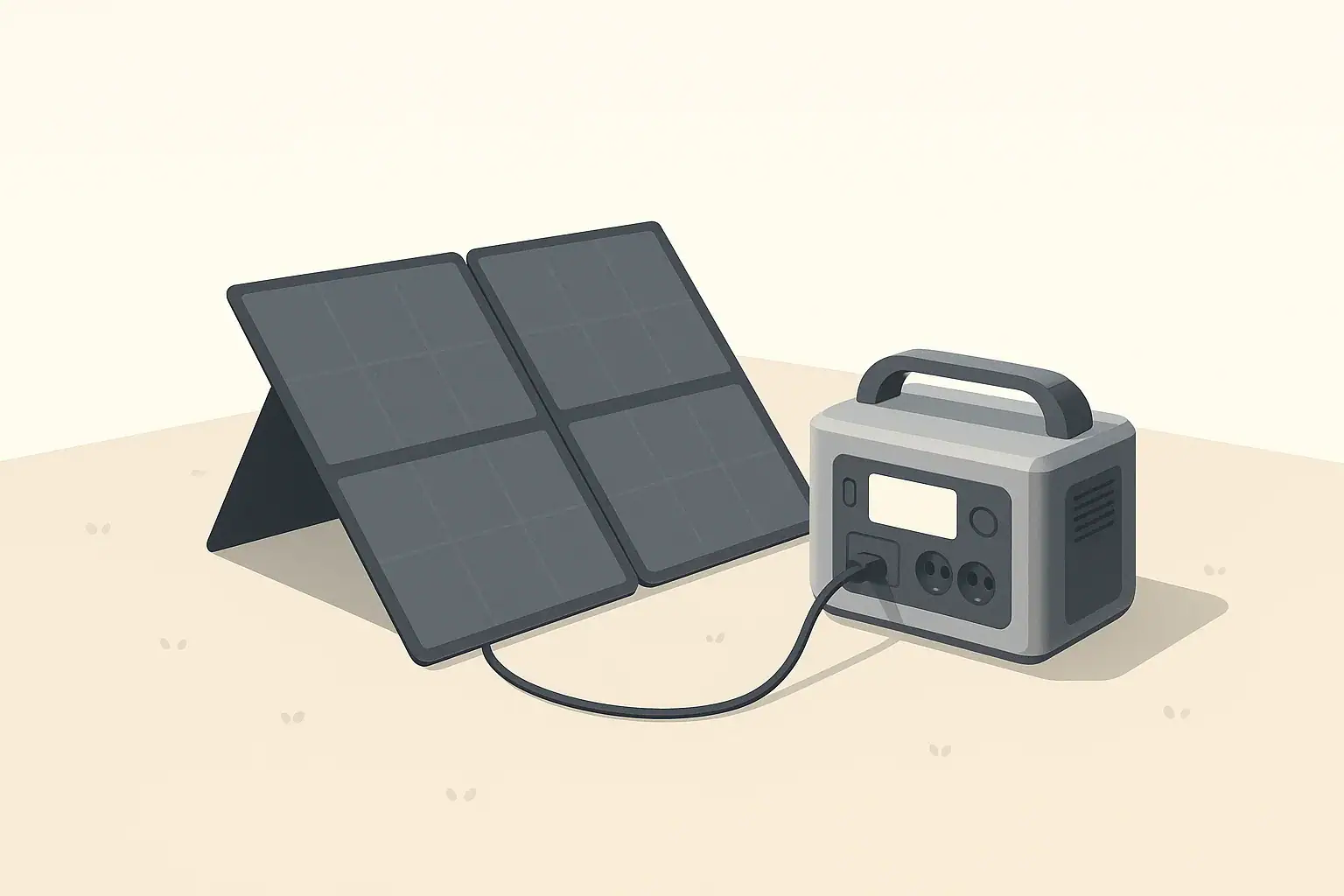
What Is Overpaneling on a Portable Power Station?
Overpaneling means connecting solar panels with a total rated wattage higher than the published solar input watt limit of a portable power station or solar generator. For example, using 500 watts of panels on an input that is listed as 300 watts.
This idea often comes from rooftop solar, where arrays are sometimes slightly oversized to capture more energy during weaker sun hours. However, portable power stations have different limits and built-in electronics that must be respected.
To understand whether you can overpanel safely, you need to know:
- How the solar input is specified (voltage, current, and watt limits)
- What the internal charge controller actually does
- What happens if you exceed one or more of those limits
- How your use case (camping, RV, backup power) affects the decision
How Solar Input Limits Really Work
Solar inputs on portable power stations are usually limited in three ways: maximum voltage, maximum current, and maximum charging power in watts. These are separate but related limits.
Voltage limits (V)
The voltage limit is often the most critical. It is usually written as something like “12–30 V” or “10–50 V max.” Exceeding this maximum voltage can damage the input electronics. Unlike wattage, voltage is not something the power station can safely ignore if it is too high.
Key points about voltage:
- Solar panels in series add their voltages.
- Solar panels in parallel keep the same voltage but add current.
- Cold weather can increase panel voltage above the nameplate rating.
You should design your panel configuration so that the coldest expected open-circuit voltage stays below the portable power station’s maximum input voltage. When in doubt, use fewer panels in series or switch to parallel wiring (staying within current limits).
Current limits (A)
The current limit is often stated as a maximum amps value or implied by the connector rating. If the array can supply more current than the input can handle, a properly designed charge controller will usually limit the current to its safe level. However, repeatedly pushing connectors or cables beyond their ratings can lead to overheating, damage, or even fire risk.
Current-related concerns include:
- Overheating connectors or extension cables
- Undersized wire gauge causing voltage drop and heat
- Fuses or breakers tripping in external setups
Panels in parallel add current, so very large parallel arrays can approach or exceed safe current levels even if the voltage is acceptable.
Power limits (W)
The watt limit (power) is usually what people focus on: “max 300 W solar input” for example. Wattage is the product of volts times amps (W = V × A). Many modern charge controllers can simply clip or limit power to their maximum rating if the panels could produce more than they can use.
This means that if voltage and current are within safe limits, connecting slightly more wattage than the input rating often just results in the power station charging at its maximum rate while ignoring the extra potential power.
Example values for illustration.
| What to check | Why it matters | Typical notes |
|---|---|---|
| Maximum input voltage (V) | Exceeding this can damage electronics | Design series strings to stay safely below this even in cold weather |
| Recommended voltage range | Ensures MPPT or PWM controller can operate efficiently | Stay within both minimum and maximum values for best charging |
| Maximum input current (A) | Protects connectors and internal wiring from overheating | Avoid very large parallel arrays that could exceed this limit |
| Maximum solar input power (W) | Defines the fastest possible solar charging rate | Overpaneling beyond this gives diminishing returns |
| Connector type and rating | Connectors have their own voltage and current limits | Use adapters and cables that meet or exceed these ratings |
| User manual guidance on solar | Often clarifies whether oversizing is allowed | Follow manufacturer recommendations for safe operation |
When Is Overpaneling Usually Safe vs Risky?
Whether overpaneling makes sense depends on which limit you are exceeding and by how much. It also depends on your climate and how you actually use the portable power station.
Relatively safe scenarios (when done carefully)
In many cases, a modest amount of overpaneling is acceptable if you stay within voltage and current limits. Examples include:
- Small oversize on wattage only: For instance, using 400 W of panels on a 300 W input, with voltage and current within spec. The charge controller simply clips output.
- Cloudy or shaded locations: A larger array can help you reach the same daily energy in weak sun, especially in winter or forested campsites.
- Short cables, good connectors: Using quality, appropriately sized cables and connectors reduces heating and voltage drop even when the array can deliver close to the controller’s limit.
In these situations, the main downside is cost and portability, not safety—assuming specifications are respected.
High-risk scenarios
Overpaneling becomes risky when you push beyond what the hardware can tolerate. Avoid the following:
- Exceeding maximum voltage: Wiring too many panels in series so that open-circuit voltage is higher than the input rating is one of the fastest ways to damage a charge controller.
- Pushing connectors beyond their ratings: Large arrays in parallel may stay within controller current limits but overload the physical connector or cable.
- Using unknown or mismatched panels: Mixing dissimilar panels (for example, very different wattages or voltages) can create unpredictable behavior and poor performance.
- Ignoring heat buildup: Overloaded connectors, cable bundles in the sun, or coiled extension cords can overheat.
If you are unsure about voltage or current calculations, keep panel wattage at or below the published limit, or consult a qualified solar professional.
MPPT vs PWM and overpaneling behavior
Many larger portable power stations use MPPT (Maximum Power Point Tracking) charge controllers, which are better suited to modest overpaneling. MPPT controllers can often accept higher panel wattage and simply limit output power to their maximum rating, as long as voltage and current limits are respected.
Smaller units may use PWM (Pulse Width Modulation) controllers, which generally prefer panels that more closely match the battery voltage. Overpaneling in PWM systems often gives little benefit and can waste potential power.
Check the manual or product specs to see which type of controller your device uses and follow any manufacturer guidelines about maximum panel wattage.
How to Read Panel Specs for Overpaneling Decisions
To make informed decisions about overpaneling, you need to understand a few key solar panel specifications. These are typically listed on the back of the panel or in a spec sheet.
Key panel ratings
- Rated power (Pmax): The panel’s wattage under standardized test conditions (e.g., 100 W, 200 W). Real-world output is often lower.
- Open-circuit voltage (Voc): The voltage when the panel is not connected to a load. This is critical for staying below your input’s voltage limit, especially in series wiring.
- Voltage at max power (Vmp): The operating voltage when the panel is producing its rated power.
- Current at max power (Imp): The current the panel produces at its rated power.
- Short-circuit current (Isc): The current when the panel’s positive and negative terminals are directly connected. This is used for fuse sizing and safety.
Series vs parallel wiring and overpaneling
How you combine panels greatly affects whether overpaneling is safe:
- Series wiring: Adds panel voltages; current stays the same. Helpful for meeting minimum MPPT voltage requirements, but can quickly exceed maximum voltage in cold climates.
- Parallel wiring: Adds panel currents; voltage stays roughly the same. Good for staying under voltage limits, but total current can become high, stressing connectors and cables.
When considering overpaneling, many users keep the number of panels in series modest to respect voltage limits, and then add additional parallel strings only if current limits and connector ratings allow.
Example: evaluating a hypothetical setup
Imagine a portable power station with a solar input rated for:
- 10–40 V DC input
- Maximum 10 A
- Maximum 300 W
And you have three 120 W panels rated approximately at:
- Voc: 22 V
- Vmp: 18 V
- Imp: 6.7 A
Some general observations:
- Two in series: Voc about 44 V, already above the 40 V limit, so unsafe in series on cold mornings.
- Two in parallel: Voc stays 22 V, Imp about 13.4 A, potentially above the 10 A limit and connector rating.
- One panel: Safely below all limits, but only 120 W.
In this hypothetical case, it may be safer to use fewer or smaller panels, or a different configuration, rather than heavily overpaneling.
Benefits of Modest Overpaneling for Real Use Cases
In practical scenarios like camping, RV travel, or backup power, a modest level of overpaneling can be helpful when done safely.
Short power outages at home
For brief outages, you may rely on solar to top up your portable power station between loads. Overpaneling within safe voltage and current limits can help by:
- Recovering energy more quickly after running essential devices
- Reducing the number of sunny hours needed to recharge
- Improving resilience on partly cloudy days
However, panels sized much larger than the input may not provide additional practical benefit if the outage is short and roof or yard space is limited.
Remote work, camping, and vanlife
In mobile scenarios, solar conditions vary widely. Shade from trees, nearby vehicles, and parking orientation can significantly reduce effective panel output.
Modest overpaneling can help by:
- Maintaining laptop and router power through partial shade
- Letting you recharge the battery even during shorter winter days
- Offsetting losses from less-than-ideal panel tilt or orientation
Portability and storage space often become the practical limits. There is little point in carrying far more panel capacity than the input can ever use, especially if it is heavy or difficult to deploy.
RV and basic off-grid use
In an RV, you may have more roof space but also more energy demands (fans, lights, small appliances). Overpaneling slightly can make sense to keep your portable power station topped up while you are driving or parked.
Considerations for RV users include:
- Ensuring the array never exceeds voltage limits, even in cold mountain climates
- Using appropriate cable gauges and connectors rated for the expected current
- Mounting panels securely and allowing ventilation to prevent overheating
If you intend to integrate a portable power station with existing RV wiring or solar systems, it is wise to consult a qualified RV or solar technician rather than improvising connections.
Safety Considerations When Overpaneling
Any time you consider connecting panels larger than the published input watt limit, place safety before potential gains in charging speed.
Thermal and fire safety
High currents through undersized parts can cause dangerous heating. To reduce risk:
- Use cables with adequate gauge for the expected current and length.
- Avoid coiling excess cable while under load; coils trap heat.
- Keep connectors off the ground where water or debris may collect.
- Periodically feel connectors and cables during use; discontinue use if they are uncomfortably hot.
Electrical protection and disconnects
For larger arrays, additional protection can improve safety and usability:
- Inline fuses or appropriate breakers sized to the array’s current ratings.
- A clearly accessible way to disconnect the panels before moving equipment or during storms.
- Weather-resistant connectors and junctions rated for outdoor use.
A qualified electrician or solar technician can help with selecting and installing suitable protective components in more complex setups.
Battery health and longevity
Within safe input specs, the portable power station’s internal battery management system controls charge rates to protect the battery. Overpaneling does not usually force the battery to charge faster than it is designed to; the controller simply limits input power.
However, overall battery health still benefits from:
- Avoiding sustained operation at very high temperatures
- Not leaving the device stored fully discharged
- Occasionally cycling the battery as recommended by the manufacturer
These practices matter more for longevity than modest, well-managed overpaneling.
Planning Solar and Overpaneling for Daily Energy Needs
Instead of starting from the input watt limit, it is often better to start from your daily energy needs and typical sun conditions, then decide whether overpaneling helps.
Estimate your daily energy use
Add up the watt-hours (Wh) you expect to use in a day from devices such as:
- Laptops and monitors for remote work
- Wi-Fi routers and phones
- Small fridges or coolers
- LED lighting and fans
You can estimate daily usage with simple assumptions, like a 60 W laptop used for 5 hours (about 300 Wh) or a 40 W fridge compressor averaging 30% duty cycle over 24 hours (about 288 Wh). These are examples only; real usage varies.
Match panel capacity to sun hours
Solar harvest depends on both panel size and usable sun hours per day. If your location provides about 4–5 good sun hours on average, a 300 W array might produce roughly 1.2–1.5 kWh of energy on a clear day before system losses. Overpaneling slightly can help maintain similar daily energy in less ideal conditions.
Example values for illustration.
| Panel watts range | Sun hours example | Approx. energy per day | Notes |
|---|---|---|---|
| 100–150 W | 4 hours | 0.4–0.6 kWh | Light loads only; good for phones, small electronics |
| 200–300 W | 4 hours | 0.8–1.2 kWh | Can support laptop work and modest lighting |
| 300–400 W | 4 hours | 1.2–1.6 kWh | Supports small fridge plus electronics in good sun |
| 400–600 W | 3–4 hours | 1.2–2.4 kWh | More margin for clouds and winter days |
| 600–800 W | 3–4 hours | 1.8–3.2 kWh | Useful for higher-demand RV or extended outages |
| 800–1000 W | 3 hours | 2.4–3.0 kWh | Often beyond what a single portable input can accept |
Practical Guidelines for Deciding on Overpaneling
To decide whether overpaneling makes sense for your portable power station, keep these practical guidelines in mind:
- Never exceed the maximum input voltage. Treat this as an absolute limit, allowing a safety margin for cold-weather voltage increase.
- Respect connector and cable current ratings. Design for continuous operation without overheating.
- Consider a modest oversize only. Often 20–50% over the watt limit is enough to compensate for less-than-ideal conditions, if allowed by the manufacturer.
- Prioritize reliability over maximum numbers. A slightly smaller, well-matched array is often more dependable and easier to deploy.
- Follow the user manual. If the manufacturer discourages connecting higher-wattage arrays, do not override those recommendations.
- Seek expert help for complex setups. If integrating multiple arrays, roof mounts, or other power systems, consult a qualified electrician or solar professional.
Approached thoughtfully, overpaneling can improve daily solar harvest for a portable power station, but it must always be done within the electrical and safety limits of the equipment you are using.
Frequently asked questions
Can I connect more solar panel watts than my portable power station’s solar input rating?
Often you can connect a modestly larger wattage array if the panels’ open-circuit voltage and total current remain within the station’s specified voltage and amp limits; the charge controller will typically cap charging at the station’s maximum power. However, follow the user manual and ensure cables and connectors are rated for the higher potential current to avoid overheating or damage.
What happens if the panels’ open-circuit voltage exceeds the device’s maximum input voltage?
If the array’s Voc exceeds the maximum input voltage, you risk damaging the input electronics or voiding warranties; input protection may not prevent all failures. Always calculate cold-weather Voc for series strings and keep a safety margin below the maximum rated input voltage.
Is wiring panels in parallel a safe way to increase usable wattage without raising voltage?
Parallel wiring keeps voltage roughly the same while increasing current, which can be safe if the total current stays below the controller, cable, and connector ratings. Excessive parallel strings can overload connectors or cause overheating, so use appropriate wire gauge, fusing, and rated connectors.
How much overpaneling is usually acceptable without causing problems?
A modest oversize—commonly in the 20–50% range over the watt rating—is often acceptable for MPPT-equipped portable stations if voltage and current limits are respected. The exact acceptable amount depends on the device’s specs and any manufacturer guidance, so check the manual before sizing an oversized array.
Will modest overpaneling damage my battery or shorten its life?
When kept within the input and controller limits, modest overpaneling generally won’t force the battery to accept higher-than-design charging currents because the charge controller and battery management system limit charging. Still, avoid sustained high temperatures and follow recommended charging/storage practices to protect long-term battery health.
Recommended next:
- Are Portable Power Stations the Future of Backup Power?
- Portable Power Stations and Renewable Energy
- Solar Panel Series vs Parallel: Which Is Better for Charging a Power Station?
- How Many Solar Watts Do You Need to Fully Recharge in One Day?
- Shading and Angle: How Placement Changes Solar Charging Speed
- MC4, Anderson, DC Barrel: Solar Connectors and Adapters Explained
- More in Solar →
Related guides
Browse this topic →
- Beginner-friendly sizing, runtime & specs
- Solar & charging (MPPT, fast charging, cables)
- Batteries (LiFePO4, cycles, care & storage)
- Safety, cold-weather performance, real-world tips
More in Solar
See all →- Solar Charging in Shade: Why Power Collapses and What You Can Do
- Can You Mix Different Solar Panels on One Power Station? A Safe Matching Checklist
- How to Read Solar Panel Specs for Power Stations: Voc, Vmp, Imp, and Why It Matters
- Solar Safety Basics: Cables, Heat, and Preventing Connector Melt
- Balcony Solar + Power Station: A Practical Setup for Apartments
Keep reading
About this site
Portable Energy Lab publishes practical, independent guides about portable power—clear sizing, safe use, and real-world expectations.
Affiliate disclosure
Some links on this site may be affiliate links. If you buy through these links, we may earn a small commission at no extra cost to you. This helps support our content. Learn more.