
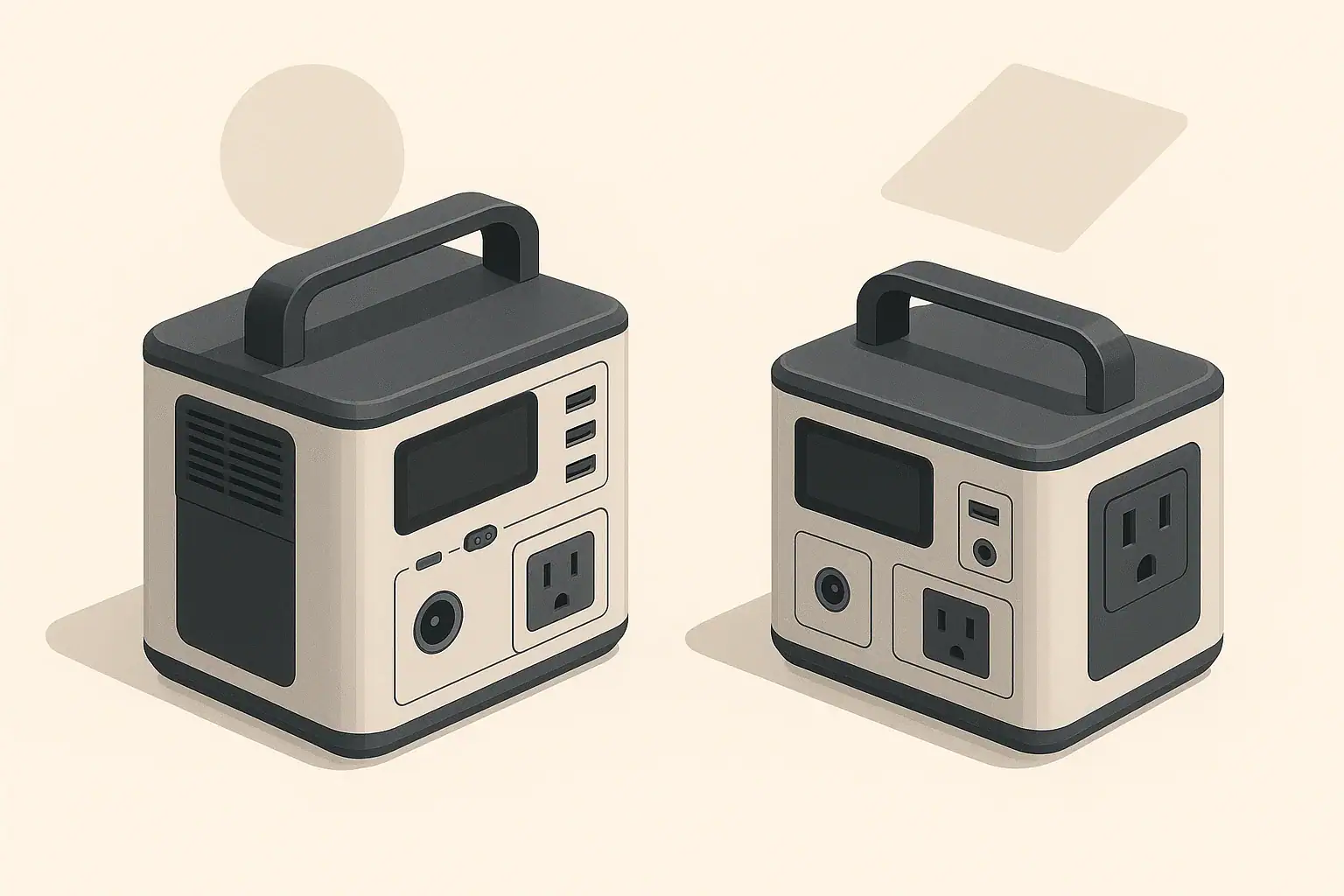
Overview: Two Different Ways to Get Portable Power
When you need electricity away from standard wall outlets, two common options are a self-contained portable power station or a setup using a separate inverter connected to a 12 V car battery. Both can run small devices, help during short outages, and support camping or vehicle-based travel, but they differ in safety, complexity, and convenience.
This guide explains how each approach works, compares pros and cons, and highlights important safety considerations. The goal is to help you choose a solution that fits your power needs, budget, and comfort level with electrical equipment.
How Each System Works
What Is a Portable Power Station?
A portable power station is an all-in-one battery power system. Inside a single enclosure it usually includes:
- A rechargeable battery (often lithium-based, sometimes sealed lead-acid)
- A built-in inverter to provide AC outlets
- DC outputs such as 12 V car-style ports
- USB ports for phones, tablets, and small electronics
- A charge controller and input ports for wall charging, car charging, and often solar
- Internal protections such as over-current, short-circuit, and temperature monitoring
Most portable power stations display remaining battery percentage and sometimes estimated runtime or input/output watts. Many support pass-through operation, meaning they can charge while also powering devices, within their limits.
What Is an Inverter + Car Battery Setup?
An inverter plus car battery setup uses separate components to achieve a similar result:
- A 12 V battery, often a starting battery from a vehicle or a dedicated deep-cycle battery
- A stand-alone power inverter that converts 12 V DC to 120 V AC
- Cables or clamps to connect the inverter to the battery
The inverter provides AC outlets, and sometimes USB ports, but the system does not usually include an integrated charge controller or multiple charging options. Charging is typically done via the vehicle’s alternator, a separate battery charger, or a solar charge controller wired to the battery.
Because the components are separate, the user is responsible for selecting compatible parts, making proper connections, and managing safety details like fuses, cable sizing, and ventilation.
Example values for illustration.
| Factor | Portable Power Station | Inverter + Car Battery |
|---|---|---|
| Ease of setup | Ready to use; plug-and-play | Requires selecting parts and making safe connections |
| Safety features | Integrated protections and monitoring | Depends on inverter, wiring, and user installation |
| Port variety | Typically AC, 12 V DC, and multiple USB | Often AC only; USB depends on inverter model |
| Expandability | Usually fixed capacity; some allow add-ons | Battery bank and inverter can often be upsized |
| Monitoring | Built-in display for charge and power | May have simple indicators; detailed monitoring requires extras |
| Portability | Single carry unit | Multiple heavy components to move |
| Upfront complexity | Low | Moderate to high |
Pros and Cons of Portable Power Stations
Advantages
Portable power stations are designed for simplicity and everyday users. Key advantages include:
- Ease of use: Most are plug-and-play. You connect devices as you would to a wall outlet or USB charger.
- Integrated design: Battery, inverter, charge controller, and protections are matched by the manufacturer, reducing compatibility guesswork.
- Multiple outputs: Several AC outlets, USB-A and USB-C ports, and 12 V ports are common, so you can power laptops, phones, lights, and small appliances at the same time.
- Clean, quiet operation: No combustion; suitable for indoor use within guidelines, as there are no exhaust fumes.
- Charging flexibility: Many support charging from the wall, a vehicle outlet, and solar panels via a dedicated input.
- Built-in monitoring: Displays usually show battery level and sometimes wattage, helping you manage capacity and runtime.
Limitations
Portable power stations also have trade-offs:
- Fixed capacity: The internal battery size is set. While a few models allow expansion, many do not.
- Cost per watt-hour: You pay for integration, protections, and convenience, so the cost per unit of stored energy can be higher than a basic battery and inverter.
- Repair and upgrades: Internal components are typically not user-serviceable. You generally cannot swap the battery type or significantly increase inverter size.
- Weight vs capacity: Larger-capacity units can be heavy to move, even though they are still relatively compact.
Pros and Cons of Inverter + Car Battery Systems
Advantages
A separate inverter with a car or deep-cycle battery can be attractive for certain users:
- Potentially lower cost per watt-hour: Especially if you already own a suitable battery or inverter.
- Flexibility and scalability: You can choose battery type and capacity, upgrade the inverter size, or build a larger battery bank over time.
- Serviceability: Individual components can often be replaced or upgraded separately as they wear out or your needs grow.
- Integration with vehicle systems: When done safely, a dedicated battery can be charged from the vehicle alternator or solar, which is appealing for RV or van setups.
Limitations
This approach also introduces complexity and risk, especially for users new to DC and AC systems:
- More complex setup: You must match inverter size to battery capacity and cable ratings, and plan for fusing and connections.
- Fewer built-in protections: Some inverters have basic protections, but the overall system safety depends heavily on how it is assembled.
- Limited outputs: Many inverters offer only AC outlets and perhaps basic USB ports. Extra DC distribution usually requires additional components.
- Portability challenges: A lead-acid car or deep-cycle battery is heavy, and carrying the inverter, battery, and cabling as separate pieces is less convenient.
- Vehicle battery strain: Using the starting battery for extended loads can leave a vehicle unable to start if not managed carefully.
Capacity, Sizing, and Realistic Runtime
Understanding Capacity (Wh) and Power (W)
Whether you use a portable power station or an inverter with a car battery, two core concepts are the same:
- Capacity (watt-hours, Wh): How much energy is stored. This helps estimate runtime.
- Power (watts, W): How quickly energy is used. Devices draw a certain number of watts while running.
The inverter or power station also has two power ratings:
- Running watts: The continuous power it can provide.
- Surge watts: Short bursts needed for motors or compressors when they start.
Simple Runtime Estimation
A rough estimate of runtime (in hours) is:
Runtime ≈ Battery capacity (Wh) ÷ Device load (W)
For example, if you have about 500 Wh of usable capacity and a 50 W load (such as a small fan and a light), you might get around 10 hours in ideal conditions. Real-world runtimes are usually lower due to inverter losses, battery chemistry, and discharge limits.
In a car battery setup, usable capacity is often less than the theoretical rating stamped on the battery, especially for starting batteries, which are not intended for deep discharge. Deep discharging lead-acid batteries can shorten their life.
Outputs, Inverters, and Pass-Through Power
AC vs DC vs USB Outputs
Portable power stations commonly provide:
- AC outlets: For household-style plugs, limited by inverter watt rating.
- 12 V DC ports: For automotive-style devices such as coolers or air pumps.
- USB ports: For phones, tablets, cameras, and other electronics.
An inverter plus car battery setup usually focuses on AC outlets, with USB ports only if the inverter includes them. Dedicated DC outputs often require additional components such as fuse blocks or distribution panels.
Pure Sine Wave vs Modified Sine Wave
Many portable power stations use pure sine wave inverters, which closely mimic household AC power and are friendlier to sensitive electronics, motors, and some chargers. Some stand-alone inverters are also pure sine, while others are modified sine wave, which can cause extra noise, heat, or compatibility issues for certain devices.
When choosing an inverter for a car battery system, consider whether your devices require or strongly benefit from pure sine wave AC, especially if you plan to power electronics, medical support equipment prescribed by a professional, or motor-driven devices.
Pass-Through Operation
Many portable power stations support pass-through operation, allowing them to be charged from the wall, car, or solar while also powering loads. The total power delivered is still limited by the internal electronics, but this feature can help during short outages or when using solar throughout the day.
In contrast, pass-through use in a car battery system relies on your charging method (alternator, standalone charger, or solar controller). You must ensure that your battery is not discharged faster than it is charged, and that cabling, fusing, and chargers are suitably rated.
Charging Options and Planning Charge Time
Wall Charging
Portable power stations usually include a dedicated wall charger or internal AC charger. Charge time depends on the charger’s wattage and the battery size. As a rough idea, a 500 Wh station with a 100 W charger might take several hours to recharge fully, under ideal conditions.
For inverter plus battery systems, you can use an appropriate 12 V battery charger. Larger external chargers can recharge faster but must be matched to the battery type and size, and used according to manufacturer instructions.
Vehicle Charging
Portable power stations often plug into a vehicle’s 12 V outlet, drawing limited power (commonly under 150 W) while you drive. This is slower than wall charging but useful to top up over time.
With an inverter and car battery, the vehicle alternator can recharge the battery while driving, but sustained high loads from the inverter may exceed what the system is designed to support. Long stationary use with the engine off can deplete the starting battery and prevent the vehicle from starting.
Solar Charging
Many portable power stations accept solar panel input through dedicated ports, often with a built-in or matched charge controller. This can support off-grid use if you size the panels appropriately and account for sun hours.
In a car battery system, you generally need a separate solar charge controller wired to the battery. You must size the controller, panels, and wiring for expected current, and position panels safely and securely.
Use Cases: Which Option Fits Your Scenario?
Short Power Outages at Home
For most households wanting backup for essentials such as phone charging, a modem/router, a laptop, and a few LED lights, a portable power station is often simpler and safer. You can keep it charged and bring it out when needed.
Connecting either system directly into home wiring or panels involves additional safety and legal considerations. Any connection to a home electrical system should be planned and installed by a qualified electrician using appropriate equipment. Avoid improvised backfeeding through outlets, which is hazardous and may be illegal.
Remote Work and Electronics
For powering laptops, monitors, and networking gear, the cleaner AC output and built-in USB ports of many portable power stations are convenient. A car battery and inverter can work, but requires more attention to preventing deep discharge and maintaining adequate ventilation around the battery, especially if it is not sealed.
Camping, Vanlife, and RV Basics
For tent camping or short trips, a portable power station is easy to move, charge from the car, and pair with a folding solar panel. It offers silent operation and simple device connection.
For vanlife and RVs with larger, more permanent electrical systems, an inverter and battery bank can be more scalable. Many users in that category plan multi-battery banks, larger inverters, and solar arrays. Designing such systems involves careful attention to wire sizing, fusing, ventilation, and compliance with relevant codes; it is often helpful to consult professional resources or an experienced installer.
Running Appliances
Smaller appliances such as compact fans, LED lights, and low-power electronics are generally manageable for both options. High-draw appliances like space heaters, hair dryers, or large air conditioners can quickly exceed the capabilities of modest portable power stations and small inverters.
For refrigeration, a high-efficiency fridge or 12 V compressor cooler paired with sufficient battery capacity and solar can work, but requires careful power budgeting. Motors have startup surges that must be within the inverter’s surge rating.
Example values for illustration.
| Device type | Typical watts range (example) | Planning note |
|---|---|---|
| Smartphone charging | 5–20 W | Low draw; many charges from a modest battery |
| Laptop | 40–90 W | Consider several hours per day for remote work |
| LED light | 5–15 W | Good for long runtimes even on small systems |
| Portable fan | 20–50 W | Plan for overnight use during outages or camping |
| Mini fridge or 12 V cooler | 40–100 W (running) | Allow for startup surge and duty cycle |
| Small microwave | 600–1000 W | Short use only on higher-capacity inverters |
| Space heater | 1000–1500 W | Drains batteries very quickly; often impractical |
Safety Considerations for Both Options
Battery Safety and Placement
For portable power stations:
- Use them on a stable, dry, level surface.
- Keep vents unobstructed to allow cooling airflow.
- Avoid placing them directly next to heat sources or in direct, intense sunlight for extended periods.
- Follow any temperature ranges listed in the manual, especially for charging in cold or hot conditions.
For inverter plus car battery systems:
- Ensure the battery is secured so it cannot tip or slide.
- Provide ventilation, particularly for lead-acid batteries, which can release gas during charging.
- Prevent short circuits by protecting battery terminals from accidental contact with metal tools or objects.
- Use appropriately rated cables and fuses between the battery and inverter, as recommended by qualified resources or professionals.
Cords, Loads, and Overheating
Regardless of system type:
- Do not overload the inverter or power station beyond its rated continuous wattage.
- Use extension cords only when necessary, and choose cords rated for the load and length.
- Avoid running cords where they can be pinched by doors, crushed under furniture, or become tripping hazards.
- If cords, plugs, or outlets feel hot to the touch, reduce the load and inspect for damage.
Indoor vs Outdoor Use
Portable power stations are commonly used indoors, but should still be kept away from flammable materials and protected from moisture. Follow the manufacturer’s guidelines on indoor use and environmental conditions.
For inverter plus car battery setups, outdoor or semi-outdoor placement is often safer for venting and heat, provided the equipment is protected from rain and standing water. Avoid placing inverters directly next to fuel containers or other flammable materials.
Cold Weather and Storage
Most batteries have reduced performance in cold temperatures, with shorter runtimes and slower charging. Charging many lithium-based batteries below freezing can be harmful; check the operating and charging temperature guidelines for your system.
For storage:
- Store in a cool, dry place away from direct sunlight.
- Avoid extreme temperatures, both hot and cold.
- Charge to a recommended level before long-term storage and top up periodically to reduce self-discharge effects.
Working With Home Electrical Systems
Connecting any portable power source to a home’s wiring requires proper equipment and methods to prevent backfeeding utility lines, overloading circuits, or violating electrical codes. High-level considerations include:
- Using appropriate transfer equipment designed for standby or backup power.
- Ensuring that any connection prevents simultaneous backfeed into the grid.
- Making sure breaker ratings, wiring, and loads are compatible with the power source.
Planning and installing these connections should be done by a qualified electrician familiar with local code requirements. Avoid homemade interlocks or improvised cords between power stations, inverters, and household outlets.
When to Choose Which Option
In general:
- A portable power station suits users who want a self-contained, relatively low-maintenance solution for small devices, short outages, and mobile use.
- An inverter plus car battery setup can fit users who are comfortable with electrical components, want greater flexibility or capacity scaling, and are prepared to handle system design and ongoing maintenance responsibilities.
In either case, understanding capacity, load, and safe operating practices will help you get reliable, practical power when you need it.
Frequently asked questions
How long will a portable power station or an inverter with a car battery run my devices?
Runtime depends mainly on usable battery capacity (Wh) divided by the device load (W) — roughly Runtime ≈ Wh ÷ W. Expect lower real-world runtimes due to inverter losses, battery chemistry, and depth-of-discharge limits; starting batteries in cars usually offer less usable capacity than deep-cycle batteries.
Is it safe to operate an inverter and car battery indoors compared to a portable power station?
Portable power stations are generally safer for indoor use because they are sealed, include built-in protections, and typically do not emit gases. Inverter plus car battery systems—especially those using lead-acid batteries—can emit hydrogen during charging and therefore require good ventilation, secure mounting, correct fusing, and careful wiring.
Can I charge both systems with solar panels, and what do I need to know?
Yes. Many portable power stations have a built-in or matched solar charge controller and a dedicated input for straightforward solar charging, while an inverter plus battery requires a separate solar charge controller sized for the panels and battery; using an MPPT controller improves charging efficiency.
Which option is more cost-effective per watt-hour: a portable power station or an inverter plus battery?
A separate inverter with a chosen battery bank often provides a lower cost per watt-hour because you can select battery chemistry and capacity independently. However, portable power stations trade a higher unit cost for integration, convenience, and built-in protections, and lifecycle and maintenance costs also affect overall value.
Can I run a refrigerator or a space heater with a portable power station vs inverter + car battery?
Small refrigerators or 12 V compressor coolers can be run by either option if the inverter can handle the fridge’s startup surge and you have enough battery capacity and duty-cycle planning. Space heaters draw 1000–1500 W continuously and will deplete most portable systems quickly, making them impractical for extended use on battery-based setups.
Recommended next:
- Portable Power Station vs Power Bank
- Portable Power Station vs UPS: What Changes for Computers and Networking?
- Portable Power Station vs Power Bank: Where the Line Really Is
- Portable Power Station vs DIY Solar Battery Box: When DIY Makes Sense
- Portable Power Station vs Home Backup Battery: Which Fits Apartments Best?
- More in Comparison →
Related guides
Browse this topic →
- Beginner-friendly sizing, runtime & specs
- Solar & charging (MPPT, fast charging, cables)
- Batteries (LiFePO4, cycles, care & storage)
- Safety, cold-weather performance, real-world tips
More in Comparison
See all →- Portable Power Station vs Power Bank vs UPS: Which Backup Fits Your Gear?
- Portable Power Station vs Power Bank vs UPS: Which One You Actually Need for Home/Travel
- LiFePO4 vs NMC Batteries: Weight, Cold Performance, Safety, and Real Cycle Life Differences
- Portable Power Station vs Home Backup Battery: Which Fits Apartments Best?
- Portable Power Station vs DIY Solar Battery Box: When DIY Makes Sense
Keep reading
About this site
Portable Energy Lab publishes practical, independent guides about portable power—clear sizing, safe use, and real-world expectations.
Affiliate disclosure
Some links on this site may be affiliate links. If you buy through these links, we may earn a small commission at no extra cost to you. This helps support our content. Learn more.