
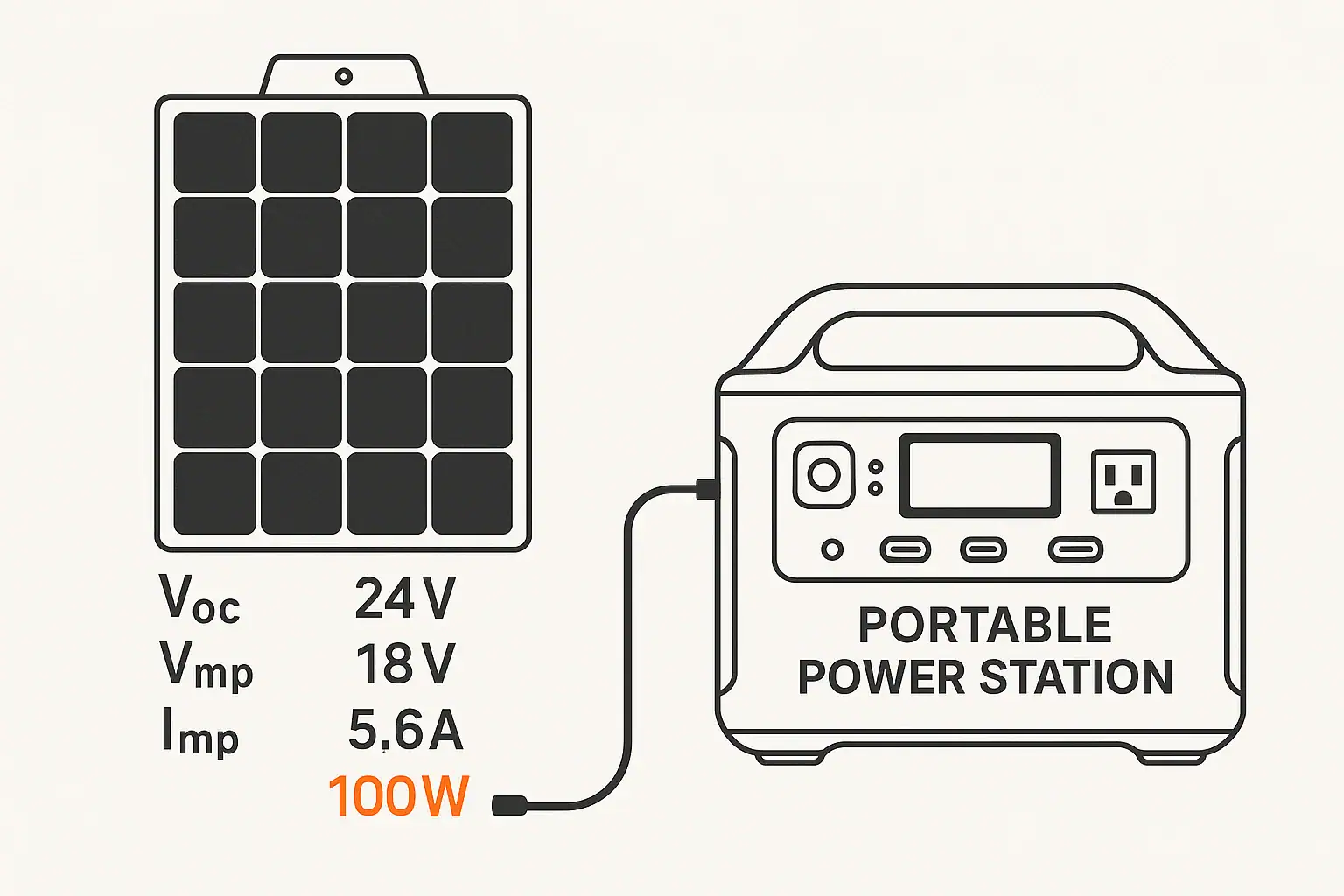
Most charging problems between solar panels and portable power stations come down to mismatched specs like Voc, Vmp, Imp, and maximum input limits. If you understand these numbers, you can size your solar array correctly, avoid errors, and get the fastest realistic charge times.
When you look at a solar panel label, you’ll see terms like open-circuit voltage, operating voltage, current at maximum power, and rated watts. These directly affect how many panels you can connect, what cables or adapters you can use, and whether your power station’s MPPT input can handle the array safely. Learning how to read these specs helps you avoid undercharging, overvoltage faults, and wasted runtime.
This guide breaks down each spec in plain language, shows real-world examples, and ends with a practical checklist of what to look for when pairing solar panels with a portable power station.
Understanding Solar Panel Specs for Portable Power Stations
Solar panel spec labels can look like alphabet soup, but each value has a clear meaning and a direct impact on how well a portable power station charges. The most important specs for matching panels to a power station are Voc, Vmp, Imp, Isc, and rated power in watts.
Voc (open-circuit voltage) is the maximum voltage the panel can produce with no load connected. It matters because your power station’s solar input has a maximum voltage rating; if your array’s Voc is higher than that limit, you risk input faults or damage.
Vmp (voltage at maximum power) is the voltage when the panel is operating at its most efficient point under standard test conditions. Your power station’s MPPT controller will try to run the panel near Vmp to get the best charging power.
Imp (current at maximum power) is the current delivered at that optimum point. Together, Vmp and Imp define the panel’s usable wattage: Pmax = Vmp × Imp. Isc (short-circuit current) is the maximum current when the panel’s output is shorted; it’s important for cable and connector current ratings.
All of these specs must fit within your power station’s solar input window, which typically lists a voltage range (for example, 12–60 V DC) and a maximum input wattage or current. Reading and comparing these values is the foundation of safe, efficient solar charging.
How Voc, Vmp, and Imp Work Together with Your Power Station
To understand how solar panel specs interact with a portable power station, it helps to look at how a panel behaves electrically. A solar panel does not produce a fixed voltage and current; instead, its output changes with sunlight, temperature, and the load applied by the MPPT controller inside the power station.
Voc and input voltage limits: Voc is measured with no load, in bright sun, at standard test conditions. It represents the highest voltage the panel can reach. When panels are wired in series, their Voc values add together. Your power station’s solar input will specify a maximum voltage (for example, 50 V or 100 V). The sum of all panel Voc values in series must stay below this limit, with some margin for cold-weather increases, because panels produce higher voltage at lower temperatures.
Vmp and charging efficiency: Vmp is the voltage where the panel delivers its rated power. An MPPT controller constantly adjusts the load to keep the panel operating near Vmp. If the combined Vmp of your array is too low, the power station may not start charging or may charge inefficiently. If it’s within the input range and reasonably above the station’s battery voltage, the controller can harvest power effectively.
Imp and current limits: Imp tells you the current at maximum power. When panels are wired in parallel, their currents add. Your power station may have a maximum input current (for example, 10 A or 15 A). The combined Imp of parallel strings should stay at or below this limit, or the controller will simply clip the extra power, wasting potential charging capacity.
Rated watts vs. real watts: The panel’s watt rating (Pmax) is calculated as Vmp × Imp under ideal lab conditions. In real use, you will usually see 60–80% of that rating due to temperature, angle, and atmospheric conditions. Your power station’s maximum solar input wattage should be compared to the realistic output of your array, not just the nameplate ratings.
When you align Voc with the voltage limit, Vmp with the MPPT operating range, and Imp with the current limit, you get a safe, compatible setup that can approach the power station’s maximum solar charging rate.
| Spec | What It Means | Typical Use in Matching to a Power Station |
|---|---|---|
| Voc | Panel voltage with no load | Ensure series Voc stays below max input voltage |
| Vmp | Voltage at maximum power | Check that array Vmp is within MPPT operating range |
| Imp | Current at maximum power | Keep parallel Imp within max input current |
| Isc | Short-circuit current | Size cables and connectors for safe current capacity |
| Pmax | Rated panel power in watts | Compare to power station’s max solar input watts |
Practical Examples of Matching Solar Panels to Power Stations
Seeing actual numbers makes it easier to understand how Voc, Vmp, and Imp affect a portable power station setup. The following scenarios are simplified but realistic, assuming full sun and standard test conditions.
Example 1: Single folding panel to a compact power station
Imagine a 100 W folding panel labeled: Voc 22 V, Vmp 18 V, Imp 5.6 A, Isc 6.0 A. Your compact power station lists a solar input range of 12–28 V and a maximum of 100 W. In this case, the panel’s Voc (22 V) is below the 28 V limit, and Vmp (18 V) is comfortably inside the 12–28 V range. Imp (5.6 A) is well within typical input current limits. This is a straightforward, compatible match. In good conditions, you might see 60–80 W going into the station.
Example 2: Two panels in series to reach a higher voltage input
Now consider two 100 W panels with Voc 22 V, Vmp 18 V, Imp 5.6 A. A mid-size power station lists a solar input of 18–60 V and 200 W max. If you wire the panels in series, Voc becomes 44 V (22 + 22) and Vmp becomes 36 V (18 + 18), while Imp stays 5.6 A. Voc is below the 60 V limit, and Vmp is well within the operating window, so the setup is safe and efficient. The array’s rated power is 200 W, matching the station’s maximum input. In real use, you might see 130–170 W.
Example 3: Parallel wiring and current limits
Suppose a power station accepts 12–30 V and a maximum input current of 10 A. You have two 100 W panels: Voc 22 V, Vmp 18 V, Imp 5.6 A each. In parallel, Voc and Vmp stay the same (22 V and 18 V), but Imp adds to about 11.2 A. This exceeds the 10 A input rating. The power station will typically limit current to 10 A, capping usable power around 180 W instead of the full 200 W. It is still safe if connectors and cables are rated appropriately, but you gain less than you might expect from the second panel.
Example 4: Cold weather and Voc margin
Consider a larger setup: three 120 W rigid panels, each Voc 21 V, Vmp 17.5 V, Imp 6.9 A, wired in series to a power station with a 60 V maximum solar input. The series Voc is 63 V (21 × 3), already above the 60 V limit even before considering cold-temperature increases, which can raise Voc by 10–20%. This configuration risks overvoltage faults. The safer approach would be two in series (42 V Voc) or reconfiguring with parallel strings, as long as current limits are respected.
These examples show why you cannot rely only on panel watt ratings. You need to check how Voc, Vmp, and Imp combine in series or parallel and compare them carefully to your power station’s input specs.
Common Mistakes When Reading Solar Specs (and What They Look Like)
Many solar charging issues with portable power stations can be traced to a few recurring misunderstandings about panel specs and input ratings. Recognizing these patterns can help you diagnose problems quickly.
Confusing Voc with Vmp: A frequent mistake is assuming the panel will operate at Voc. In reality, the MPPT controller pulls the voltage down to around Vmp under load. If you design a system based on Voc instead of Vmp, you may overestimate charging watts or misjudge whether the array’s operating voltage fits the input range.
Ignoring series Voc limits: Users sometimes add panels in series to increase voltage without adding up their Voc values. Symptoms of exceeding the power station’s maximum input voltage include immediate error codes, the solar icon not appearing, or the unit refusing to start charging in bright sun. In severe cases, overvoltage can damage the input circuitry.
Overlooking current limits in parallel: Adding panels in parallel increases available current. If the combined Imp exceeds the power station’s input current rating, the controller will simply cap the current. The system may work, but you will not see the expected increase in charging speed. This often shows up as “stuck” input wattage that does not rise when an extra panel is connected.
Expecting full rated watts all day: Panel watt ratings are based on ideal lab conditions. In real life, shading, panel angle, heat, and atmospheric conditions reduce output. Users often think something is wrong when a 200 W array only delivers 120–160 W in good sun. This is normal behavior, not necessarily a fault.
Not matching connectors and polarity: Even when Voc, Vmp, and Imp are correct, mismatched connectors or reversed polarity will stop charging. Typical signs include zero watt input, no charging icon, and no error code. Verifying polarity with a multimeter and using properly rated adapters can resolve many of these issues.
Using very low-voltage panels: Some small panels have Vmp values close to the battery voltage inside the power station. If Vmp is too low or outside the listed input range, the MPPT controller may not track properly, resulting in intermittent or no charging.
When troubleshooting, compare the array’s calculated Voc, Vmp, and Imp against the power station’s input range and limits, then check physical connections and shading before assuming the unit is faulty.
Safety Basics When Pairing Solar Panels with Power Stations
Working with solar panels and portable power stations involves DC voltages and currents that can be hazardous if mismanaged. While these systems are designed to be user-friendly, understanding a few safety principles around Voc, Vmp, and Imp helps prevent accidents and equipment damage.
Respect maximum input voltage: Never exceed the power station’s specified maximum solar input voltage. High Voc strings, especially in series and in cold weather, can surpass this limit. Overvoltage can stress or destroy input components even if the system appears to work at first.
Use appropriately rated cables and connectors: Imp and Isc values guide cable sizing. Cables, connectors, and adapters should be rated for at least the panel’s Isc and the array’s maximum current in parallel configurations. Undersized wiring can overheat under sustained load.
Avoid short circuits: Isc is measured under controlled conditions; deliberately shorting panels in the field is not recommended. When connecting or disconnecting panels, avoid touching bare conductors together. Work with the power station turned off or the solar input disabled when possible.
Do not bypass built-in protections: Portable power stations include protections for overvoltage, overcurrent, and reverse polarity. Do not attempt to bypass these safeguards or modify the internal battery or charge controller. If your solar configuration repeatedly triggers protection, adjust the array instead of trying to defeat the safety features.
Be cautious with series strings: Series wiring raises voltage, which increases shock risk and the potential for arcing when connecting or disconnecting under load. Make connections securely, avoid working with wet hands, and keep connectors clean and fully seated.
Consult a qualified electrician for complex setups: If you plan to integrate a portable power station into a larger DC system or combine multiple arrays, seek advice from a qualified electrician or solar professional. Do not attempt to wire solar inputs directly into home electrical panels or modify fixed wiring without proper expertise.
Following these high-level safety practices, along with careful attention to published specs, keeps your solar-power-station system reliable and reduces the risk of damage or injury.
Care, Storage, and Maintaining Solar Performance Over Time
While solar panel specs like Voc, Vmp, and Imp are fixed by design, real-world performance can drift over time due to dirt, damage, and poor storage. Good maintenance habits help your panels stay closer to their rated output and maintain consistent charging behavior with your portable power station.
Keep panel surfaces clean: Dust, pollen, bird droppings, and grime reduce the effective sunlight reaching the cells, lowering Imp and overall wattage. Periodic gentle cleaning with water and a soft cloth or sponge can restore lost performance. Avoid abrasive cleaners that could scratch the surface.
Protect connectors from corrosion: The stability of Voc and Vmp readings at the power station depends on solid, low-resistance connections. Moisture and dirt in connectors can cause voltage drop and intermittent charging. Keep connectors dry, use dust caps when available, and inspect for discoloration or pitting.
Avoid sharp bends and cable strain: Repeatedly bending cables near connectors can lead to internal breaks, causing fluctuating Imp or no output. Coil cables loosely, secure them to reduce strain, and avoid pinching them under panel frames or stands.
Store folding panels properly: For portable, folding panels, store them dry, away from extreme heat, and folded as designed. Prolonged exposure to moisture or heat can degrade encapsulation materials and backing, slowly reducing the panel’s ability to reach its rated Vmp and Imp.
Monitor performance over time: Occasionally note the wattage your power station reports from a known panel or array in similar sun conditions. If you see a gradual, unexplained decline beyond normal day-to-day variation, inspect for shading, dirt, loose connections, or physical damage.
Protect against impact and flexing: Cracked cells or damaged glass can change how current flows through the panel, sometimes leading to hot spots or reduced Imp. Handle panels carefully, do not stand or place heavy objects on them, and secure them against wind.
By maintaining the physical condition of your panels and connections, you help ensure that the voltage and current they deliver remain as close as possible to the specs you used when matching them to your portable power station.
| Maintenance Task | Effect on Specs in Practice | How Often |
|---|---|---|
| Cleaning panel surface | Improves usable Imp and wattage output | Every few weeks in dusty areas |
| Inspecting connectors | Reduces voltage drop affecting Vmp at the input | Every few months or before long trips |
| Checking cables for damage | Prevents intermittent current loss and faults | Periodically and after rough transport |
| Verifying mounting and support | Helps maintain consistent orientation and output | Seasonally or after storms |
Related guides: Solar Panel Series vs Parallel: Which Is Better for Charging a Power Station? • Why Won’t It Charge From Solar? A Troubleshooting Checklist • Overpaneling Explained: Can You Connect Bigger Solar Panels Than the Input Limit?
Key Takeaways and a Specs Checklist for Solar-Powered Stations
Reading solar panel specs for a portable power station is mainly about matching three things: voltage limits (Voc and Vmp), current limits (Imp and Isc), and power capacity (watts). When these align with the station’s published input range, you get safe, efficient charging without guesswork.
Start by identifying your power station’s solar input voltage window and maximum wattage or current. Then examine your panel label for Voc, Vmp, Imp, and Pmax. Decide whether to wire panels in series, parallel, or a combination, and calculate the resulting Voc, Vmp, and Imp. Always leave margin for cold-weather Voc increases and real-world losses that reduce wattage below the nameplate rating.
Specs to look for
- Power station solar input voltage range – Look for a clear DC range (for example, 12–30 V or 18–60 V); it defines the acceptable Vmp window and helps you decide series vs. parallel wiring.
- Power station maximum solar input watts – Values like 100–400 W are common; aim for total panel wattage slightly above this to account for real-world losses while staying within limits.
- Panel Voc (open-circuit voltage) – Typical portable panels are around 20–24 V; ensure the sum of series Voc stays comfortably below the station’s maximum voltage, especially in cold climates.
- Panel Vmp (voltage at maximum power) – Often 16–20 V for 12 V-class panels; make sure the combined Vmp of your array falls within the station’s input range for effective MPPT tracking.
- Panel Imp (current at maximum power) – Values like 5–10 A per panel are common; when wiring in parallel, keep the total Imp at or below the station’s maximum input current to avoid clipping.
- Panel Pmax (rated watts) – Check 60–200 W per portable panel; use Pmax to estimate realistic charge times, remembering you may see only 60–80% of this in typical conditions.
- Connector type and cable rating – Confirm connector style and that cables are rated for the array’s maximum current and voltage to maintain safe, low-loss connections.
- Operating temperature range – Look for a broad range (for example, –10°C to 65°C); colder temps can raise Voc, so this spec helps you plan safe voltage margins.
- Power station charge controller type – MPPT inputs generally perform better than simple DC inputs; knowing this helps you set realistic expectations for how well Vmp will be tracked.
Using this checklist whenever you combine solar panels with a portable power station ensures that Voc, Vmp, Imp, and wattage all work together for reliable, efficient off-grid power.
Frequently asked questions
Which solar panel specs and power station features matter most when pairing panels with a portable power station?
Key panel specs are Voc, Vmp, Imp, Isc, and Pmax because they determine voltage, current, and wattage behavior. On the power station side, the important features are the allowable solar input voltage range, maximum input watts or current, and whether the input uses an MPPT controller for efficient tracking.
What is a common mistake people make when reading solar panel specifications?
A frequent error is confusing Voc with Vmp and designing systems around Voc or nameplate watts instead of the operating Vmp and realistic output. That can lead to overvoltage in series strings or current clipping in parallel arrays, resulting in reduced or blocked charging.
How can I stay safe when connecting solar panels to a portable power station?
Follow basic safety: never exceed the station’s maximum input voltage, use cables and connectors rated for the array’s current, and avoid connecting or disconnecting live DC circuits when possible. Also do not bypass built-in protections and consult a qualified electrician for complex or high-voltage setups.
Can I mix series and parallel wiring to increase power, and what should I watch for?
Yes, combining series and parallel can help reach the right voltage and current, but you must ensure the series string Voc stays below the station’s max voltage and that the parallel current stays within input limits. Match panel electrical characteristics and use proper connectors and fusing to avoid imbalance and safety issues.
Why won’t my power station charge even when panels are in bright sun?
Common causes include the array Voc exceeding the station’s limit (triggering protection), the array Vmp being below the station’s MPPT tracking window, shading or dirty panels reducing output, or connector/polarity issues. Check voltages, connections, and the station’s input status indicators to diagnose the problem.
How does cold weather affect solar panel voltage and how much margin should I allow?
Panel Voc increases as temperature drops because cell voltage rises in cold conditions; typical cold-weather increases are in the range of 5–20% depending on the panel’s temperature coefficient. Allow a safety margin by checking the panel’s Voc temperature coefficient and keeping series Voc well below the power station’s maximum input voltage.
Recommended next:
- Are Portable Power Stations the Future of Backup Power?
- Portable Power Stations and Renewable Energy
- Solar Panel Series vs Parallel: Which Is Better for Charging a Power Station?
- How Many Solar Watts Do You Need to Fully Recharge in One Day?
- Overpaneling Explained: Can You Connect Bigger Solar Panels Than the Input Limit?
- Shading and Angle: How Placement Changes Solar Charging Speed
- More in Solar →
Related guides
Browse this topic →
- Beginner-friendly sizing, runtime & specs
- Solar & charging (MPPT, fast charging, cables)
- Batteries (LiFePO4, cycles, care & storage)
- Safety, cold-weather performance, real-world tips
More in Solar
See all →- Can You Mix Different Solar Panels on One Power Station? A Safe Matching Checklist
- Solar Safety Basics: Cables, Heat, and Preventing Connector Melt
- Balcony Solar + Power Station: A Practical Setup for Apartments
- MC4, Anderson, DC Barrel: Solar Connectors and Adapters Explained
- Shading and Angle: How Placement Changes Solar Charging Speed
Keep reading
About this site
Portable Energy Lab publishes practical, independent guides about portable power—clear sizing, safe use, and real-world expectations.
Affiliate disclosure
Some links on this site may be affiliate links. If you buy through these links, we may earn a small commission at no extra cost to you. This helps support our content. Learn more.