
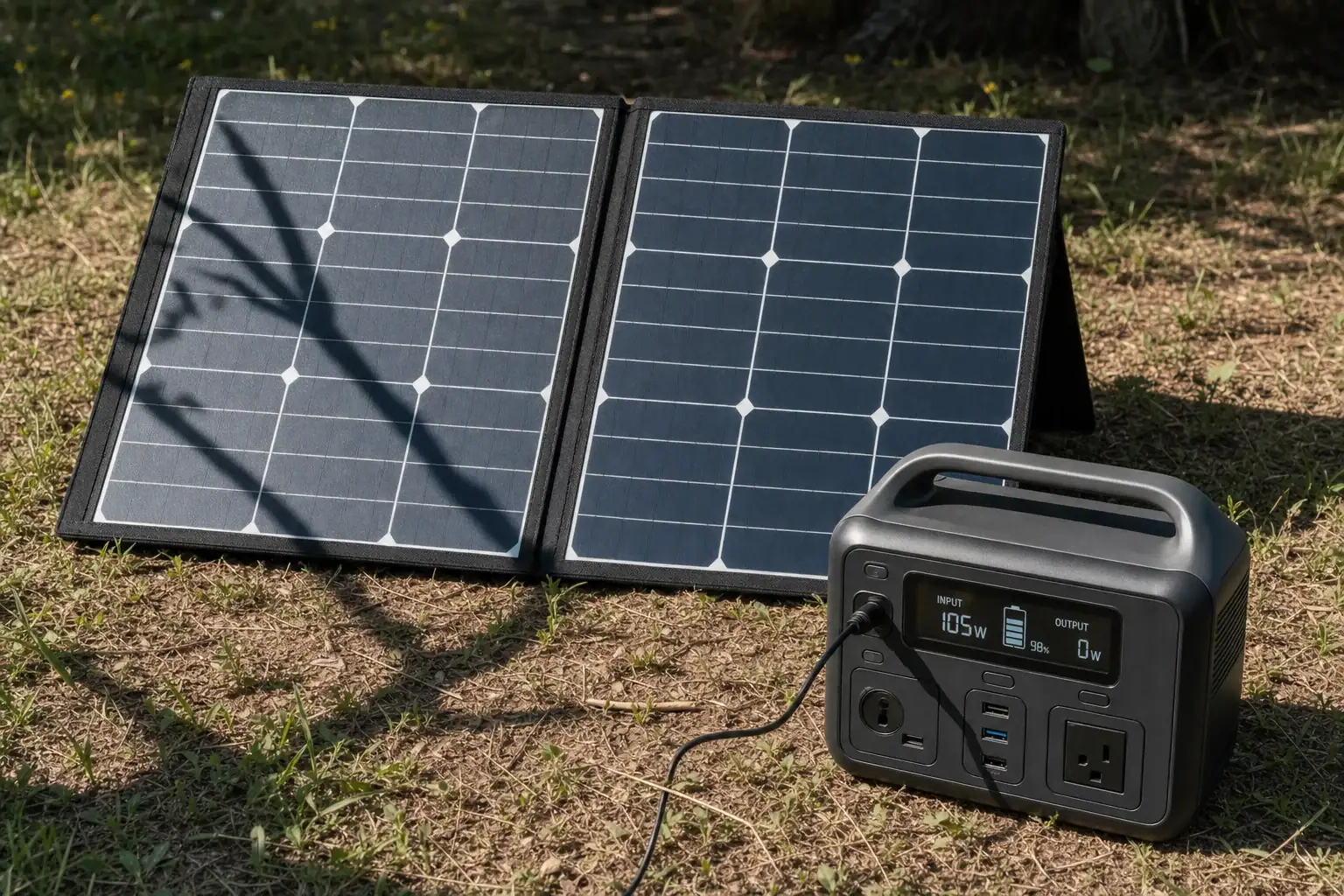
One small shadow can slow an entire solar charging setup because shaded cells may restrict current through a larger electrical section of the panel. The effect can be much greater than the percentage of panel area covered, especially when cells or panels are connected in series.
This is why solar charging in partial shade can produce sudden wattage drops, unstable solar input, or much longer charging time. Cell layout, bypass diodes, series wiring, parallel wiring, MPPT range, and the portable power station’s input limit all affect the result. A branch, handle, cable, roof edge, or corner of a building may be enough to disrupt output.
The practical solution is usually to remove narrow shadows, test panel position, and confirm that the array’s voltage and current match the power station’s solar input specifications. Understanding how shading changes current and voltage makes troubleshooting faster and helps identify which equipment features support more reliable charging.
What Partial Shade Means and Why It Matters
Partial shade occurs when direct sunlight reaches only part of a solar panel or array. It includes obvious conditions, such as half a panel being under a tree, as well as thin shadows from branches, poles, cables, panel stands, roof vents, or nearby equipment. Light cloud cover is different because it often reduces irradiance across most of the panel more evenly.
A solar cell produces electrical current according to the light it receives. Because many cells are connected into strings, the lowest-performing cell or section can constrain current through other cells in the same path. A shadow covering only a few cells may therefore reduce output from a much larger panel section.
This matters when charging a portable power station because lower solar wattage extends charging time. Shade can also move throughout the day, causing input to rise and fall even when the panel remains stationary. The power station’s display may show these fluctuations, although its reading can lag behind rapidly moving shadows.
How Cell Strings, Bypass Diodes, and Controllers Respond
Within a panel, cells are commonly arranged in series strings to build useful voltage. Series-connected cells carry the same current, so a shaded cell can become a bottleneck. Many panels include bypass diodes that allow current to route around a shaded group of cells. These diodes reduce severe mismatch losses and hot-spot risk, but they do not preserve the full output of the bypassed section.
Panel orientation relative to the shadow matters. A narrow shadow crossing multiple cell groups may activate several bypass paths, while the same shadow aligned with one section may have a smaller effect. This explains why rotating or shifting a panel can improve output without changing the amount of visible shade very much.
The array connection also changes the response. In a series array, panel voltages add, but current is generally constrained by the weakest panel. In a parallel array, currents add while voltage stays near that of one panel, allowing an unshaded panel to contribute more independently. Parallel operation requires higher current capacity and compatible connectors, cables, and input ratings.
An MPPT charge controller searches for a voltage and current combination that produces useful power. Complicated shade patterns can create multiple power peaks, and some controllers find the best point more effectively than others. If array voltage falls below the controller’s operating range after a bypass diode activates, charging may become intermittent or stop.
| Condition | Possible array output | Likely behavior |
|---|---|---|
| Full direct sun | 180 W from a 200 W-rated array | Stable input near the available maximum |
| Light, even haze | 100–140 W | Broad, relatively smooth reduction |
| Narrow shadow across cell groups | 45–110 W | Large drop despite limited covered area |
| One of two series panels shaded | 35–90 W | Shaded panel may restrict array current |
| One of two parallel panels shaded | 90–140 W | Unshaded panel may retain more contribution |
Real-World Partial-Shade Examples
A branch shadow moves across a folding panel
A 200-watt folding panel might deliver 150 to 180 watts in strong sun under favorable conditions. When a narrow branch shadow crosses several cell sections, input could drop below 100 watts. As the shadow moves, bypass diodes may switch different sections in and out, producing abrupt changes rather than a steady decline.
One panel in a series pair receives shade
Consider two similar panels connected in series. The setup provides enough voltage for the power station’s MPPT range, but one panel is shaded by a vehicle. Because series current is limited by the weaker part of the circuit, total power can fall sharply. Bypass diodes may help, yet their activation also reduces array voltage. If that voltage approaches the controller’s minimum, charging can cycle on and off.
Two panels are connected in parallel
With compatible panels in parallel, an unshaded panel can often continue producing close to its available current while the shaded panel contributes less. This may improve shade tolerance, but the combined current can be substantial. The power station, adapter, connector, and cable must all support that current without exceeding their ratings.
A panel is behind a window
Indoor placement can look shade-free while still producing weak results. Glass reduces and reflects some solar energy, and coatings, screens, window frames, or double-pane construction can create additional losses. A panel behind glass may charge slowly even when no distinct shadow is visible.
Common Mistakes and Troubleshooting Cues
Judging shade only by covered area: A shadow covering 5 percent of the surface does not always cause only a 5 percent power loss. Check whether it crosses multiple rows or cell groups.
Ignoring small objects: Charging cables, panel straps, handles, grass, and support legs can cast narrow shadows. Keep the active cell surface unobstructed and route cables behind or beside the panel where practical.
Testing while the battery is nearly full: A power station may intentionally reduce charging power near a high state of charge. Compare panel performance when the battery can accept substantial power, while staying within the manufacturer’s operating guidance.
Confusing input limits with panel problems: If a power station accepts a maximum of 200 watts, a larger array may still show only about 200 watts in ideal conditions. That flat ceiling is different from shade-related fluctuations.
Overlooking voltage range: A series array can have acceptable open-circuit voltage yet fall outside the MPPT operating range under load or after shaded sections are bypassed. Compare the panel array’s voltage specifications with both the input operating range and maximum voltage rating.
For basic diagnosis, record input watts in full sun, then observe the reading after removing visible shadows or slightly repositioning the panel. Test one panel at a time when possible, using only approved connections. If one panel remains unusually weak in clear direct sunlight, inspect accessible cables and connectors for damage rather than opening the panel or power station.
Safety Basics for Shaded Solar Charging
Never exceed the portable power station’s maximum solar input voltage, current, or power specifications. Voltage is especially important because cold panels can produce a higher open-circuit voltage than they do under warmer test conditions. Extra array wattage does not make an excessive voltage safe.
Use connectors, adapters, extension cables, and branch connectors with suitable voltage and current ratings. Keep connections dry, fully seated, and protected from dirt. Replace visibly damaged or overheated components instead of attempting internal repairs or bypassing protective devices.
Do not cover a hot panel to create test shade for extended periods. Uneven illumination can increase electrical stress in shaded cells. Allow airflow around panels and the power station, and keep the battery unit out of intense direct sun when practical. For permanent building-mounted equipment or any connection involving household electrical systems, use a qualified electrician.
Panel Care, Cable Maintenance, and Storage
Dust, pollen, bird droppings, and dried water spots can behave like persistent partial shade. Clean the panel according to its care instructions using nonabrasive methods, and allow it to dry before folding or storage. Avoid harsh chemicals that could damage surface coatings.
Inspect the front surface for cracks, delamination, cloudy areas, or deep scratches. Check accessible cables for crushed insulation, sharp bends, corrosion, or loose connector housings. A high-resistance connection can reduce input and generate heat even when the panel is fully illuminated.
Store folding panels dry, with cables loosely coiled and connectors protected. Avoid placing heavy objects on stored panels because cell damage may not be immediately visible. During use, support the entire panel so wind cannot twist it or drag it into shade. Periodically compare output under similar clear-sky conditions; a consistent downward trend can reveal contamination, cable deterioration, or panel damage.
| Check | Observation | Useful cue |
|---|---|---|
| Clean panel in direct sun | 165 W | Baseline for later comparisons |
| Dusty surface | 145 W | Broad reduction without a sharp shadow |
| Cable shadow across cells | 95 W | Sudden recovery when cable is moved |
| Warm or loose connector | Input varies from 80–130 W | Stop use and inspect compatible components |
| Stored panel after cleaning | Dry and undamaged | Protect connectors and avoid pressure |
Related guides: Shading and Angle: How Placement Changes Solar Charging Speed • How to Read Solar Panel Specs for Power Stations: Voc, Vmp, Imp, and Why It Matters • Solar Safety Basics: Cables, Heat, and Preventing Connector Melt
Practical Takeaways and Specs to Look For
Partial shade is most disruptive when it crosses electrically important cell groups or affects one part of a series-connected setup. Start by removing narrow shadows and repositioning the panel before assuming the equipment is defective. Compare performance in clear direct sunlight, account for battery state of charge, and verify that the array remains within the power station’s input limits.
If shade is unavoidable, panel layout and connection options matter. Parallel configurations may let unshaded panels contribute more independently, while series configurations can provide the voltage needed for an MPPT controller. The better choice depends on the full voltage, current, connector, and controller specifications rather than wattage alone.
Specs to look for
- MPPT operating voltage range: Look for a broad usable range, such as 15–60 V, that matches the array under load; this helps the controller continue operating when shade reduces panel voltage.
- Maximum solar input voltage: Confirm that the array’s cold-weather open-circuit voltage stays safely below the stated maximum, such as 60 V; exceeding this value can damage the input.
- Maximum solar input current: Compare limits such as 10–20 A with the array’s possible parallel current; adequate capacity prevents the input from clipping an otherwise useful configuration.
- Maximum solar input power: A rating such as 200–800 W indicates how much solar power the station can use; additional panel wattage may improve weak-light production but cannot raise input above this ceiling.
- Bypass diode design: Look for panels divided into multiple protected cell sections; more effective sectioning can limit losses when a narrow shadow covers only part of the surface.
- Panel voltage and current ratings: Check open-circuit voltage, operating voltage, short-circuit current, and operating current; all four are needed to plan safe series or parallel combinations.
- Connector and cable ratings: Seek clearly stated voltage, current, wire-gauge, and environmental ratings; undersized or poorly matched cables add loss and may overheat.
- Input monitoring: A display or app showing real-time solar watts, volts, and amps makes it easier to distinguish shade losses, input clipping, and voltage-range problems.
- Panel form factor and stand adjustment: Multiple tilt positions, secure supports, and manageable panel sections make it easier to avoid moving shadows and maintain better sun alignment.
The most useful setup is not necessarily the one with the highest advertised panel wattage. Reliable solar charging depends on compatible electrical ranges, effective shade management, safe cables, and a panel position that can remain in direct sunlight for as much of the charging window as possible.
Frequently asked questions
Why does a small shadow cause such a large drop in solar panel output?
Solar cells are connected in electrical groups, and a shaded cell or group can restrict current through a larger part of the panel. A thin shadow that crosses several cell strings may therefore reduce output far more than its visible area suggests. Bypass diodes can reduce the effect, but the bypassed section no longer contributes its full power.
Is solar charging in partial shade better with panels in series or parallel?
Parallel wiring can allow an unshaded compatible panel to keep contributing current when another panel is shaded. Series wiring adds voltage but is more likely to have its current limited by the weaker panel. The appropriate arrangement depends on the controller’s voltage range and the maximum voltage and current ratings of all connected equipment.
What solar charging specs and features matter most when shade is unavoidable?
Check the controller’s MPPT operating-voltage range, maximum input voltage, maximum input current, and maximum input power. Panels with multiple bypass-diode-protected sections may limit losses from localized shadows. Real-time input monitoring can also help identify shade-related changes and input limits.
Can a cable or panel handle really reduce solar charging power?
Yes. A cable, handle, strap, grass, or support leg can cast a narrow shadow across electrically important cell groups and cause a disproportionate power loss. Route cables behind or alongside the panel and keep the active cell surface clear while charging.
Why is my solar input low even though the panel looks sunny?
Possible causes include partial shade, poor panel angle, dirt on the surface, charging through glass, a nearly full battery, or the power station reaching its input limit. Compare readings after removing visible obstructions and testing in clear direct sunlight. Also confirm that the array remains within the controller’s usable voltage range under load.
Is it safe to test solar panels by covering part of them?
Briefly observing normal shade is generally preferable to deliberately covering a hot panel for an extended test. Do not exceed any input voltage, current, or power rating, and use only compatible, dry, undamaged cables and connectors. Stop using the setup if connectors become hot, damaged, or loose.
Recommended next:
- Are Portable Power Stations the Future of Backup Power?
- Portable Power Stations and Renewable Energy
- Solar Panel Series vs Parallel: Which Is Better for Charging a Power Station?
- How Many Solar Watts Do You Need to Fully Recharge in One Day?
- Overpaneling Explained: Can You Connect Bigger Solar Panels Than the Input Limit?
- Shading and Angle: How Placement Changes Solar Charging Speed
- More in Solar →
Related guides
Browse this topic →
- Beginner-friendly sizing, runtime & specs
- Solar & charging (MPPT, fast charging, cables)
- Batteries (LiFePO4, cycles, care & storage)
- Safety, cold-weather performance, real-world tips
More in Solar
See all →- Can You Charge a Portable Power Station Through a Window With Solar Panels?
- Best Solar Panel Angle for a Portable Power Station: Faster Charging Without Guesswork
- Bifacial Solar Panels and Portable Power Stations: When the Extra Output Helps
- Can You Mix Solar Panels With Different Wattages on a Portable Power Station?
- Series vs Parallel Solar Panels for Portable Power Stations: Simple Wiring Guide
Keep reading
About this site
Portable Energy Lab publishes practical, independent guides about portable power—clear sizing, safe use, and real-world expectations.
Affiliate disclosure
Some links on this site may be affiliate links. If you buy through these links, we may earn a small commission at no extra cost to you. This helps support our content. Learn more.