
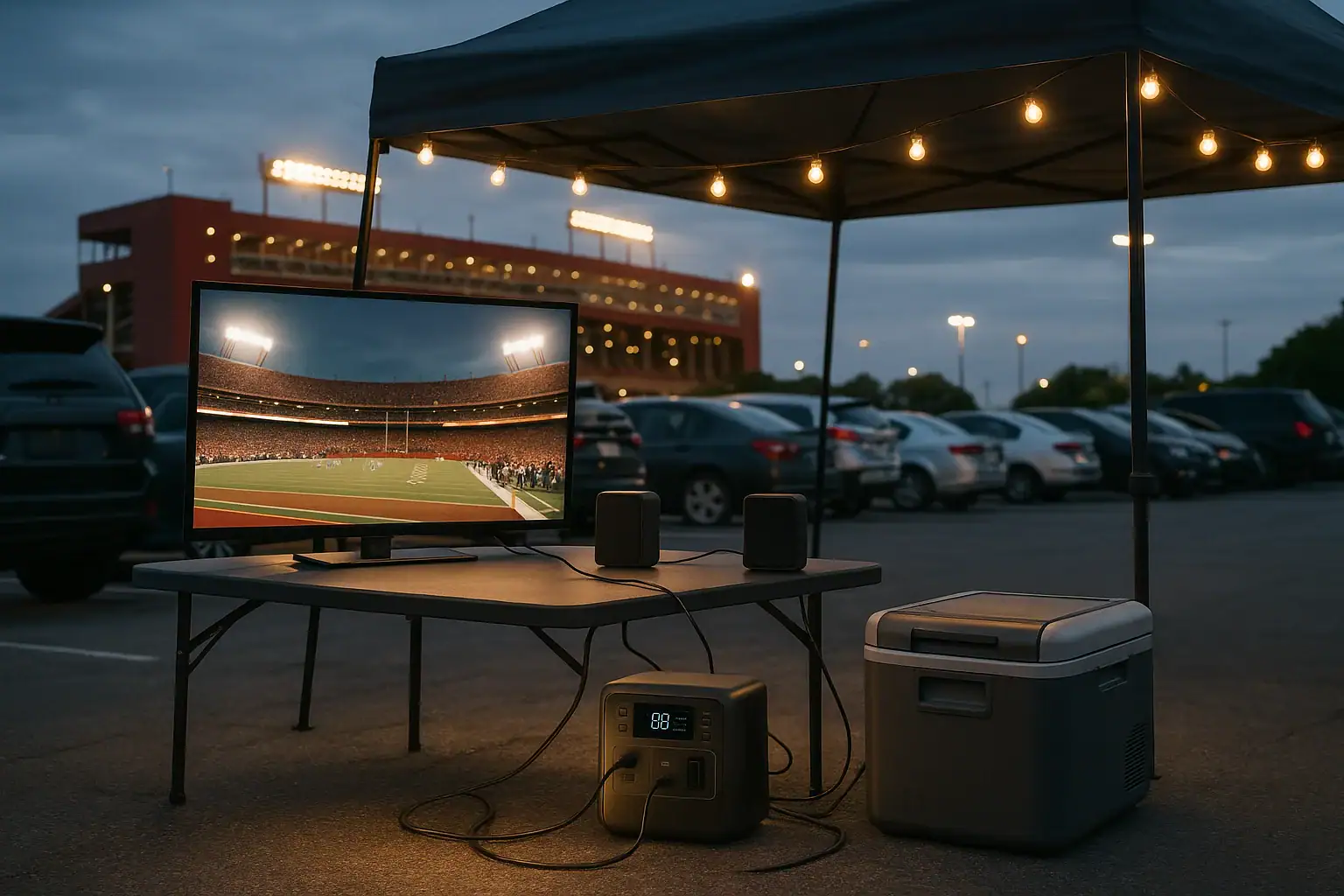
A portable power station can run a tailgating TV, speakers, cooler, and lighting if its watt-hours, inverter rating, outlets, and charging options match the total load.
For most game-day setups, the main questions are simple: how many watts the devices use, how long you need runtime, whether anything has surge watts, and whether the station has enough AC outlets and USB-C PD ports. A TV and LED lights are usually predictable loads. A cooler cycles on and off. Speakers vary widely depending on volume and whether they use AC, USB, or a built-in battery.
The right size depends less on the number of devices and more on the combined power draw over time. A small setup may need only a few hundred watt-hours, while an all-day tailgate with a TV, cooler, sound system, and lighting may need a larger battery capacity and a stronger pure sine wave inverter.
What a portable power station does at a tailgate and why it matters
A portable power station is a rechargeable battery system with built-in outputs for powering electronics away from a wall outlet. For tailgating, it replaces noisy fuel generators for many light-to-medium loads, especially entertainment and comfort items such as a TV, speakers, cooler, phone chargers, and LED lighting.
The reason it matters is control. In a parking lot, you may not have access to shore power, and vehicle outlets are not designed to run a full entertainment setup for hours with the engine off. A power station gives you a dedicated battery, a rated inverter for AC devices, DC ports for efficient low-voltage gear, and USB ports for phones, tablets, and small audio devices.
It also helps reduce common tailgating problems. TVs may shut off if the inverter is too small. Coolers may drain a battery faster than expected in hot weather. Speakers may create annoying hum if powered from a poor-quality AC source. Lights and phone chargers may use little power individually, but they still add up during a long pregame and postgame session.
For a reliable setup, think of the power station as the center of a small off-grid system. Every device connected to it needs three things: the right outlet type, enough running watts, and enough battery capacity for the time you plan to use it.
How to size power for a TV, speakers, cooler, and lights
The basic sizing formula is watts multiplied by hours equals watt-hours. If a 60-watt TV runs for 4 hours, it uses about 240 watt-hours before efficiency losses. Power stations are rated in watt-hours, but real usable energy is usually lower because inverters, voltage conversion, heat, cable losses, and standby consumption all take a share.
Start by listing each device and its typical watt draw. The label on the device or power adapter may show watts directly. If it shows volts and amps, multiply volts by amps to estimate watts. For example, a 12-volt cooler drawing 5 amps uses about 60 watts while running. However, compressor coolers cycle, so the average draw may be lower than the maximum. Thermoelectric coolers often run more continuously and can use more energy over a long day.
Next, check output type. A TV usually needs AC power unless it is a 12-volt travel model. Speakers may use AC, USB-C, or their own internal battery. Coolers may use 12-volt DC or AC. LED light strings may use USB, DC, or AC. Whenever possible, using DC or USB outputs can reduce conversion losses compared with running everything through the inverter.
Finally, compare the combined running watts with the continuous inverter rating. If the TV uses 80 watts, the cooler uses 60 watts while running, speakers use 40 watts, and lights use 20 watts, the live load is about 200 watts. A station with comfortable headroom is better than one operating at its limit, especially when a compressor starts or when volume, screen brightness, or ambient temperature increases.
| Tailgating device | Typical running draw | Planning note |
|---|---|---|
| 32 to 43 inch LED TV | 40 to 100 watts | Brightness, screen size, and outdoor visibility settings can change power use. |
| Compact powered speakers | 10 to 75 watts | Higher volume and bass-heavy playback increase draw. |
| 12-volt compressor cooler | 35 to 75 watts while running | Average use depends on cycling, shade, starting temperature, and how often it is opened. |
| Thermoelectric cooler | 45 to 90 watts | Often runs continuously, so energy use can be higher over time. |
| LED string lights or area lights | 5 to 30 watts | Efficient, predictable load that is easy to budget. |
| Phones and small devices | 5 to 30 watts each | USB charging is usually a small but steady add-on load. |
Real-world tailgating setup examples
A compact setup might include a small LED TV, one Bluetooth speaker that is mostly running from its own battery, a USB light, and a few phone charges. This type of setup may average under 100 watts most of the time. If the event lasts 4 to 5 hours, a station in the several-hundred-watt-hour range can often be enough, especially if the speaker is not drawing continuous AC power.
A moderate setup is more common for sports tailgating. It might include a 40-inch TV, powered speakers, a compressor cooler, LED lights after sunset, and several phones. The live load may average around 150 to 250 watts depending on the cooler and audio system. For a 5-hour event, that can mean roughly 750 to 1,250 watt-hours before allowing for inefficiency and reserve capacity. In this case, headroom matters because the cooler may cycle during the hottest part of the day and the TV may be set to high brightness.
A larger setup may include a bigger TV, soundbar or PA-style speaker, multiple lights, a cooler, a fan, and charging for many devices. This can move into the 300 to 600 watt range while everything is active. A larger power station may be appropriate, but the setup should still be kept realistic. Portable stations are excellent for electronics, cooling, and lighting, but high-heat appliances such as grills, hot plates, coffee makers, and space heaters can rapidly drain batteries and may exceed inverter limits.
If you want a simple planning target, estimate your expected watt load, multiply by the hours of use, then add a reserve. A reserve of 20 to 30 percent is practical for outdoor use because conditions change. Hot weather, poor ventilation, a brighter TV setting, more guests charging phones, or a cooler full of warm drinks can all increase energy use.
Common mistakes and troubleshooting cues
One common mistake is sizing only by battery capacity and ignoring inverter output. A station may have enough watt-hours on paper but still fail if the AC inverter cannot handle the combined load. If the TV turns off when the cooler starts, the issue may be a surge or peak load rather than total capacity.
Another mistake is assuming all coolers behave the same. A compressor cooler usually cycles and can be efficient once contents are cold. A thermoelectric cooler may draw a steady amount for the entire event. If runtime is much shorter than expected, the cooler is often the first device to investigate. Pre-chilling food and drinks at home, keeping the lid closed, and placing the cooler in shade can make a major difference.
TV problems often come from startup behavior, inverter quality, or brightness settings. If a TV flickers, shuts down, or shows power errors, check whether the station is near its AC limit, whether other AC loads can be moved to DC or USB, and whether the TV power adapter is fully seated. A pure sine wave inverter is generally preferred for sensitive electronics and audio equipment.
Speaker issues can show up as hum, static, sudden shutdowns, or unexpectedly fast battery drain. Hum may be related to AC adapters, cable routing, or shared power with other devices. Battery drain may be caused by high volume, powered subwoofers, or leaving the inverter on when only USB devices are needed.
Lighting is usually the easiest load, but it can still cause confusion when using long cords or multiple strings. If lights dim or shut off, check the power mode, total wattage, and whether the outlet being used has its own limit. USB light strings should be matched to the station’s USB output capability.
Safety basics for parking-lot power
Use the power station within its published output ratings and avoid overloading outlets. Continuous watts and surge watts are not the same. Continuous watts describe what the unit can supply steadily. Surge watts describe brief startup demand, often relevant for compressor coolers. A setup that runs comfortably below the continuous rating is usually more stable and generates less heat.
Keep the station off wet ground and protected from rain, spilled drinks, and cooler condensation. Most portable power stations are not meant to be exposed to water. If the weather turns, disconnect nonessential loads and move the unit to a dry, ventilated area. Do not place it inside a sealed cooler, under a pile of blankets, or in direct sun for hours, because heat can reduce performance and may trigger protective shutdown.
Use outdoor-rated extension cords when cords are needed, and keep walkways clear to reduce trip hazards. Do not daisy-chain multiple power strips or bury cords under heavy tailgate gear. Keep cable runs short and organized, especially around chairs, grills, vehicles, and foot traffic.
Avoid using a portable power station for improvised vehicle or building wiring. Do not open the unit, modify battery packs, bypass protections, or connect it into electrical panels. If a setup involves hardwired equipment or permanent power distribution, consult a qualified electrician. For normal tailgating, the safest approach is simple plug-in use within the station’s rated outlets.
Maintenance and storage before and after game day
Tailgating is easier when the power station is treated like essential gear, not an afterthought. Charge it before the event, verify that the screen or app shows the expected state of charge, and test the actual devices you plan to bring. A short test at home can reveal missing adapters, overloaded outlets, or a cooler that draws more than expected.
Store the station in a clean, dry place away from extreme temperatures. Long periods in a hot vehicle can age batteries faster, while very cold conditions can reduce available output and charging performance. If the unit will sit unused for weeks or months, follow the manufacturer’s storage guidance for charge level and check it periodically.
After a tailgate, wipe dust and moisture from the exterior, inspect cords and adapters, and recharge the unit before putting it away. If you used the power station heavily, let it cool in a ventilated area before charging. Keep a small kit with the needed power cords, USB cables, DC adapters, and extension cords so the next setup is not delayed by missing parts.
For battery longevity, avoid treating zero percent as a normal stopping point. It is better to plan enough capacity that the station finishes the event with a reserve. That reserve is also useful if the game runs long, traffic delays departure, or you need lighting and phone charging after the main setup is packed.
Practical takeaways and specs to look for
| Task | When to do it | Why it helps |
|---|---|---|
| Fully charge the station | One day before the tailgate | Confirms usable capacity and avoids last-minute charging limits. |
| Test TV, cooler, speakers, and lights together | Before the first event | Shows the real combined load and reveals outlet conflicts. |
| Pre-chill cooler contents | Before packing | Reduces compressor runtime and extends battery life. |
| Pack correct cables and adapters | Before leaving home | Prevents inefficient workarounds and unused ports. |
| Recharge and inspect gear | After the event | Keeps the system ready and catches damaged cords early. |
Related guides: Portable Power Station Basics: Outputs, Inputs, and What the Numbers Mean • Surge Watts vs Running Watts: How to Size a Portable Power Station • Pure Sine Wave vs Modified Sine Wave: Does It Matter for a Portable Power Station?
The best portable power station for tailgating is the one that fits your actual devices, event length, and parking-lot conditions. For most people, the priorities are enough watt-hours for the full event, enough continuous inverter output for the TV and cooler at the same time, and the right mix of AC, USB, and DC ports.
Keep the setup efficient. Use LED lighting, pre-chill the cooler, reduce TV brightness when possible, and avoid powering high-heat appliances from the same battery meant for entertainment. If runtime is uncertain, test the setup at home for one hour and use the battery percentage drop to estimate total time.
Specs to look for
- Battery capacity: Look for several hundred watt-hours for a compact setup and around 1,000 watt-hours or more for longer TV, cooler, speaker, and lighting use; this determines practical runtime.
- Continuous AC output: Look for enough running watts to cover all AC devices at once, often 300 to 800 watts for typical tailgates; this prevents overload shutdowns.
- Surge watt rating: Look for headroom above the cooler’s startup demand, such as 2 times the expected running draw; this helps compressor devices start reliably.
- Pure sine wave inverter: Look for a pure sine wave AC output for TVs, audio gear, and sensitive adapters; this can reduce compatibility problems and audio noise.
- Outlet mix: Look for multiple AC outlets plus USB-A, USB-C PD, and 12-volt DC options; this lets you power devices efficiently without unnecessary adapters.
- USB-C PD output: Look for 60 to 100 watts if you plan to charge tablets, laptops, or modern speakers; higher PD output can reduce the need for AC chargers.
- Recharge speed: Look for AC recharge that can refill the unit in a few hours if you tailgate often; faster charging makes back-to-back events easier.
- Display and load monitoring: Look for a clear screen showing watts in, watts out, percentage, and estimated runtime; this helps you manage power during the event.
- Operating temperature range: Look for outdoor-friendly performance in warm and cool conditions; parking lots can be hotter or colder than expected.
- Weight and handle design: Look for a size you can carry with other gear, such as compact units for short events or wheeled support for larger capacities; portability affects real use.
For a clean tailgating setup, plan the loads first, then choose capacity and outputs. A TV, speakers, cooler, and lighting can work well from one portable power station when the system has enough runtime, inverter headroom, and organized cabling.
Frequently asked questions
How long can a portable power station run a TV, speakers, cooler, and lights at a tailgate?
Runtime depends on the total watt draw, battery capacity, and how efficiently each device uses power. A small setup may last several hours, while a larger setup with a cooler and brighter TV can drain a battery much faster. The most reliable way to estimate runtime is to add the running watts of all devices and compare that to the station’s usable watt-hours.
What specs matter most when choosing a portable power station for tailgating?
The most important specs are battery capacity, continuous inverter output, surge rating, and outlet types. For a tailgate, it also helps to have a pure sine wave inverter, USB-C PD, and enough AC and DC ports for your gear. If you plan to run a cooler, make sure the unit can handle startup demand, not just average use.
What is the most common mistake people make with tailgating power setups?
A common mistake is focusing only on watt-hours and ignoring inverter limits or surge demand. That can lead to a TV shutting off when a cooler starts or when several devices run at once. Another frequent issue is underestimating how much power a cooler or high-brightness TV uses over several hours.
Is it safe to use a portable power station in a parking lot?
Yes, if you use it according to the manufacturer’s ratings and keep it dry, ventilated, and protected from damage. Avoid overloading outlets, exposing the unit to rain or spills, and running cords where people can trip. Do not modify the unit or connect it to building wiring.
Can a portable power station run a cooler all day at a tailgate?
It can, but only if the cooler type and battery capacity match the event length. Compressor coolers are usually more efficient than thermoelectric models because they cycle on and off instead of running constantly. Pre-chilling the contents and keeping the cooler in shade can significantly extend runtime.
Should I use AC, DC, or USB outputs for a tailgating setup?
Use the output type that matches the device whenever possible. DC and USB are often more efficient for lights, phones, and some coolers, while AC is needed for most TVs and some speakers. Using the most direct output available can reduce conversion losses and improve runtime.
Related guides
Browse this topic →
- Beginner-friendly sizing, runtime & specs
- Solar & charging (MPPT, fast charging, cables)
- Batteries (LiFePO4, cycles, care & storage)
- Safety, cold-weather performance, real-world tips
More in Beginners
See all →- Charging an Electric Wheelchair or Mobility Scooter From a Portable Power Station
- Portable Power Station for a Gaming PC: Runtime, Load Spikes, and UPS Considerations
- Portable Power Station for a Pop-Up Camper: Lights, Fans, Fridge, and Recharge Plan
- Portable Power Station for a Shed or Outbuilding: Lights, Chargers, and Security
- Portable Power Station for a Boat: 12V Loads, Salt Air, and Safer Storage
Keep reading
About this site
Portable Energy Lab publishes practical, independent guides about portable power—clear sizing, safe use, and real-world expectations.
Affiliate disclosure
Some links on this site may be affiliate links. If you buy through these links, we may earn a small commission at no extra cost to you. This helps support our content. Read our affiliate disclosure.