
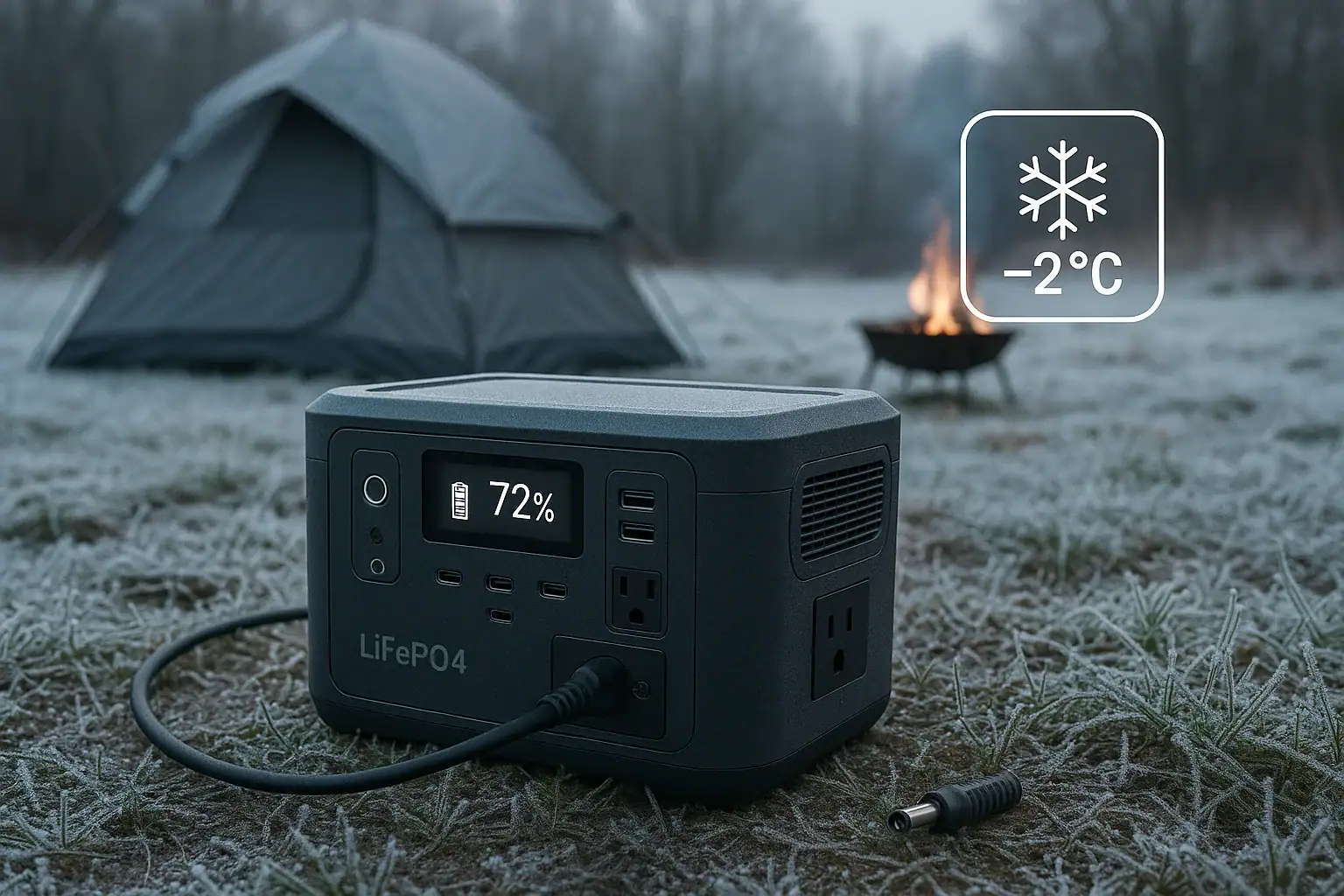
Low-temperature charging protection stops a LiFePO4 power station from accepting charge when the battery cells are too cold, usually near or below freezing, to help prevent permanent battery damage.
If your portable power station will run devices but refuses AC charging, solar input, car charging, or USB-C PD input in cold weather, the battery management system may be enforcing a cold charge cutoff. Users often describe this as a charging fault, input limit, cold battery warning, no solar charging, or reduced charge current, but in many cases the unit is working as designed.
This matters because lithium iron phosphate batteries are durable, long-lasting, and stable, but they still have a temperature window for safe charging. Understanding how low-temperature protection works helps you troubleshoot winter charging, plan solar use, protect runtime, and compare specifications before buying a power station for cold environments.
What Low-Temperature Charging Protection Means and Why It Matters
Low-temperature charging protection is a safety and longevity feature that blocks or limits charging when the internal LiFePO4 cells are below a set temperature threshold. It is controlled by the battery management system, often called the BMS, which monitors cell voltage, current, temperature, and other operating conditions.
The key point is that charging and discharging are not the same. A LiFePO4 power station may be able to discharge at temperatures below freezing, although output power and usable capacity can drop. Charging, however, is more sensitive. When cells are too cold, lithium ions do not move into the battery material as efficiently. If charge current is forced into the cells at low temperature, metallic lithium can form on the anode in a process commonly called lithium plating.
Lithium plating can reduce capacity, increase internal resistance, shorten cycle life, and in severe cases contribute to internal failure. The BMS cutoff is designed to avoid that risk. From a user perspective, this can be frustrating because the display may show sunlight available, a wall charger connected, or a car outlet active, yet the battery percentage does not rise. In cold weather, that behavior is often protection, not a defective charger.
For portable power stations used in cabins, vehicles, job sites, emergency kits, RVs, and winter camping, this feature can determine whether the unit recharges reliably. If the station sits overnight in freezing air, it may need to warm up before it accepts input again.
How LiFePO4 Cold-Charge Protection Works
A LiFePO4 power station usually has one or more temperature sensors placed near the battery pack or cell groups. The BMS reads those sensors and compares the temperature against programmed limits. If the cell temperature is below the low-temperature charge threshold, the BMS can block charging entirely, reduce the current, or delay charging until the cells warm back into the allowed range.
Many LiFePO4 systems use a low-temperature charging cutoff around 32°F, or 0°C. Some allow reduced-current charging slightly below that point, while others are stricter. The exact behavior depends on cell design, sensor placement, firmware, pack construction, and whether the power station includes battery heating.
Input type usually does not override the protection. If the BMS decides the battery is too cold, charging may be blocked from AC wall input, solar input, DC car input, and USB-C input alike. A solar panel may show voltage, the wall adapter may be plugged in, and the display may show an input icon, but the battery may still not accept energy.
Some power stations include internal battery heaters. These do not make cold charging irrelevant. Instead, the heater uses incoming power or stored battery energy to raise the cell temperature before normal charging begins. A heated unit may appear to charge slowly at first because some power is being used for warming rather than stored capacity.
The BMS may also use hysteresis, which means the battery may not restart charging the instant it reaches the cutoff temperature. For example, if charging stops near freezing, it may need to warm a few degrees above that point before input resumes. This prevents rapid on-off cycling around the threshold.
| Temperature condition | Typical charging behavior | What the user may notice |
|---|---|---|
| Above about 41°F to 50°F | Normal charging is usually available | Expected AC, solar, or DC input |
| Near 32°F to 40°F | Charging may continue, sometimes at reduced current | Slower input or a brief delay |
| At or below about 32°F | Charging may be blocked until the pack warms | No battery percentage increase despite connected input |
| Below freezing with built-in heating | Incoming power may warm the battery first | Input shown but charge level rises slowly at first |
Real-World Examples of Cold-Weather Charging Behavior
Consider a power station left in an unheated vehicle overnight. In the morning, the display turns on and the unit can run a small appliance. When plugged into a wall outlet, however, input remains at zero watts. The likely reason is that the internal battery cells are still below the charge threshold. Bringing the unit indoors and letting it warm gradually may allow charging to resume without any repair.
In a winter solar setup, panels may produce voltage on a bright cold day, but the power station may not store any energy until the battery warms. This can be confusing because solar panels often perform well in cold sunlight. The panel may be fine, the cable may be fine, and the charge controller may be fine, while the BMS is refusing to charge the cold battery.
At a campsite, a user may run lights and a small refrigerator overnight in below-freezing weather. Discharging works because many LiFePO4 packs allow output below 32°F at reduced performance. The next morning, solar input does not begin until the sun warms the case or the unit is moved inside a tent or vehicle. The difference between discharge temperature and charge temperature is the missing detail.
In a job-site scenario, a station stored in a cold trailer may power tools briefly but refuse to recharge from a generator or wall outlet. The charger may not be the problem. The practical fix is usually environmental: warm the power station within its safe operating range, then reconnect the input after the internal temperature rises.
For emergency backup, the same issue can affect readiness. A battery stored at a good state of charge in a cold garage may still deliver power during an outage, but recharging immediately afterward from solar or AC may be delayed if the pack is too cold.
Common Mistakes and Troubleshooting Clues
One common mistake is assuming that if a power station can discharge in freezing temperatures, it can also charge in the same conditions. LiFePO4 batteries generally tolerate cold discharge better than cold charge. Output working does not prove that charging should work.
Another mistake is focusing only on the air temperature. The BMS responds to internal cell temperature, not just the weather forecast. A power station stored on a concrete floor, in a vehicle, or in an unheated shed may stay cold long after the air warms. Conversely, a unit kept indoors may accept charging outdoors for a while because the cells start warm.
A third mistake is repeatedly disconnecting and reconnecting chargers without giving the battery time to warm. If the BMS is blocking input, cycling cables usually will not help. It may also make troubleshooting more confusing because displays can update slowly or show brief input spikes before protection engages again.
Useful troubleshooting cues include a battery temperature warning icon, zero-watt input despite a connected charger, input that starts and then quickly stops, charging that resumes after the unit warms indoors, or solar input that works later in the day as temperatures rise. Some units display a specific low-temperature message, while others simply show no charging progress.
High-level checks are reasonable: confirm the charger is connected, verify that the input source is within the power station’s normal input range, check whether other input types behave the same way, and note the storage temperature. If every input is blocked only when the unit is cold, low-temperature charging protection is a strong possibility.
Avoid trying to bypass the BMS, modify the pack, or heat the unit aggressively. If the behavior continues at normal room temperature after the power station has had time to warm, then the issue may involve a sensor, charger, port, firmware, or battery fault that requires qualified service.
Safety Basics for Cold Charging
The safest rule is simple: do not force-charge a LiFePO4 battery below its specified charging temperature range. The protection system exists because cold charging can cause damage that is not immediately visible. A battery may appear to work after improper cold charging while losing capacity or cycle life over time.
Warm the power station passively and evenly whenever possible. Move it to a dry indoor space, a temperature-controlled vehicle, or another moderate environment within the manufacturer’s operating limits. Let the internal battery temperature rise before charging. Avoid placing it directly against high heat, open flame, heaters, engine components, or other hot surfaces. Rapid uneven heating can create condensation, case damage, or inaccurate temperature readings.
Keep ventilation in mind. Power stations can generate heat while charging, discharging, or preheating their battery packs. Do not bury the unit under blankets while connected to high-power input. Insulating a unit for storage is different from blocking vents during operation.
Cold weather also increases the importance of dry connections. Snow, frost, and condensation can affect charging ports and cables. Allow wet surfaces to dry before connecting inputs. If a unit has been moved from a cold environment into warm humid air, condensation can form on the case and around ports. Waiting until moisture clears is safer than plugging in immediately.
For home backup systems, vehicle charging setups, or any installation tied into building wiring, use appropriate equipment and consult a qualified electrician where needed. This article does not cover wiring into electrical panels, transfer switches, or interlocks.
Maintenance and Storage in Low Temperatures
Good storage habits reduce cold-charging surprises. If you expect to recharge a portable power station during winter, store it somewhere that stays above the low-temperature charging cutoff when practical. A closet, insulated interior space, or climate-controlled room is usually better than an unheated garage or vehicle.
If cold storage is unavoidable, plan a warm-up period before charging. The larger the battery, the longer it may take for the internal cells to reach room temperature. A high-capacity unit can remain cold inside even after the outer case feels warmer.
State of charge also matters for storage. LiFePO4 power stations are often stored partially charged rather than completely full or empty, but the best range depends on the device. A moderate state of charge is commonly used for long-term storage because it reduces stress while leaving useful reserve capacity. Check the product documentation for storage guidance, but avoid leaving a power station deeply discharged in cold conditions for long periods.
During seasonal storage, inspect the unit periodically at a high level. Confirm that the display wakes, the state of charge has not fallen unexpectedly, ports are dry and clean, and there is no swelling, odor, or physical damage. Do not open the enclosure or attempt internal inspection.
For winter solar use, think about the whole energy path. Panels may produce well in cold sun, but the battery still needs to be warm enough to accept input. If the unit has a self-heating function, understand whether it uses incoming solar power, AC power, battery energy, or a combination. That detail affects how quickly charging starts after a freezing night.
| Storage or use situation | Practical approach | Reason |
|---|---|---|
| Stored indoors before outdoor use | Start with the battery warm | Improves the chance of immediate charging later |
| Left in a cold vehicle overnight | Allow a gradual warm-up before charging | Internal cells may remain below the cutoff |
| Winter solar charging | Expect delayed input after freezing nights | The panel may be ready before the battery is |
| Long-term cold storage | Store at a moderate charge and check periodically | Helps preserve battery health and readiness |
Practical Takeaways and Specs to Compare
Related guides: Battery Management System (BMS) Explained: Protections Inside a Power Station • Temperature Limits Explained: Safe Charging/Discharging Ranges and What Happens Outside Them • Do Portable Power Stations Work in Cold Weather?
Low-temperature charging protection is not a nuisance feature; it is a battery-preservation function. If a LiFePO4 power station refuses to charge in cold weather but works normally after warming, the BMS is likely doing its job. The best long-term approach is to buy and use a unit whose temperature specifications match the way you actually store, transport, and recharge it.
For occasional indoor backup, a standard low-temperature cutoff may be sufficient. For winter camping, off-grid cabins, field work, and vehicle storage, cold-weather charging behavior deserves closer attention. Look beyond capacity and surge output. Temperature ranges, heater behavior, and input limits can make the difference between a system that recharges when needed and one that waits for warmer conditions.
Specs to look for
- Charging temperature range: Look for a stated range such as about 32°F to 113°F or wider; this tells you when AC, solar, DC, or USB-C charging should be available.
- Low-temperature charge cutoff: Look for a clear cutoff near 32°F or a documented reduced-current range; this helps predict why charging may stop in freezing weather.
- Discharging temperature range: Look for a broader output range, often extending below freezing; this explains whether the station can still power devices when it cannot recharge.
- Built-in battery heating: Look for self-heating or battery preheat support and how it is powered; this matters for winter solar, vehicle storage, and off-grid use.
- Heater activation behavior: Look for details such as automatic preheating from AC input or solar input; this affects whether the unit warms itself before charging starts.
- Maximum solar input: Look for voltage, current, and wattage limits such as 12–60 volts and several hundred watts; cold panels can produce strong voltage, so input compatibility matters.
- Charge rate at low temperatures: Look for reduced-current charging notes around 32°F to 50°F; slower charging may be normal and safer in cool conditions.
- Display and warning information: Look for temperature icons, error codes, or app-free status messages; clear feedback makes cold-weather troubleshooting easier.
- Storage temperature range: Look for guidance that covers unheated spaces, for example below-freezing storage allowed but charging restricted; this helps plan seasonal storage.
In practical terms, treat LiFePO4 power stations as cold-tolerant but not cold-charge-proof unless the specifications say otherwise. Keep the battery warm when you need reliable recharging, allow time for internal cells to recover after cold storage, and compare cold-weather specifications as carefully as capacity, output watts, and runtime.
Frequently asked questions
Why won’t my LiFePO4 power station charge when it is cold?
It may be triggering low-temperature charging protection in the battery management system. Many LiFePO4 packs block charging near or below freezing to reduce the risk of lithium plating and long-term battery damage. The unit may still power devices even while refusing input.
Can I use solar panels to warm the battery and start charging?
Sometimes the incoming power can support a built-in heater, but solar input does not always override cold-charge protection. If the battery cells are below the allowed charging temperature, the system may delay normal charging until the pack warms enough. The exact behavior depends on the power station’s design and firmware.
What specs should I compare for cold-weather use?
Look at the charging temperature range, low-temperature cutoff, discharging temperature range, and whether the unit has battery heating. It also helps to check whether the heater can run from AC, solar, or battery power, since that affects winter charging behavior. Clear warning indicators or app messages can also make troubleshooting easier.
What is a common mistake people make with cold charging?
A common mistake is assuming that because the power station can discharge in freezing weather, it should also charge in the same conditions. Charging is usually more temperature-sensitive than discharging. Repeatedly reconnecting the charger without warming the battery usually does not fix the issue.
Is it safe to force-charge a cold LiFePO4 battery?
No, it is not recommended to force-charge below the manufacturer’s specified charging range. Cold charging can cause internal damage that may not be obvious right away, even if the battery seems to work afterward. The safer approach is to let the unit warm gradually before charging.
How do I know whether the problem is protection or a fault?
If charging fails only when the unit is cold and resumes after warming indoors, low-temperature charging protection is the likely cause. If the problem continues at room temperature, the charger, cable, port, sensor, firmware, or battery may need service. Consistent behavior across all input types is a useful clue.
Related guides
Browse this topic →
- Beginner-friendly sizing, runtime & specs
- Solar & charging (MPPT, fast charging, cables)
- Batteries (LiFePO4, cycles, care & storage)
- Safety, cold-weather performance, real-world tips
More in Battery
See all →- Portable Power Station Expansion Batteries: When Extra Capacity Makes Sense
- Lithium-Ion vs LiFePO4 Batteries Explained
- LiFePO4 vs Lithium-Ion in Cold Weather: Which Holds Up Better?
- Best Storage Charge Percentage: 40% vs 60% vs 80% for Different Battery Chemistries
- Why Battery Capacity Drops in Cold and Heat (and How to Get Better Runtime)
Keep reading
About this site
Portable Energy Lab publishes practical, independent guides about portable power—clear sizing, safe use, and real-world expectations.
Affiliate disclosure
Some links on this site may be affiliate links. If you buy through these links, we may earn a small commission at no extra cost to you. This helps support our content. Read our affiliate disclosure.