
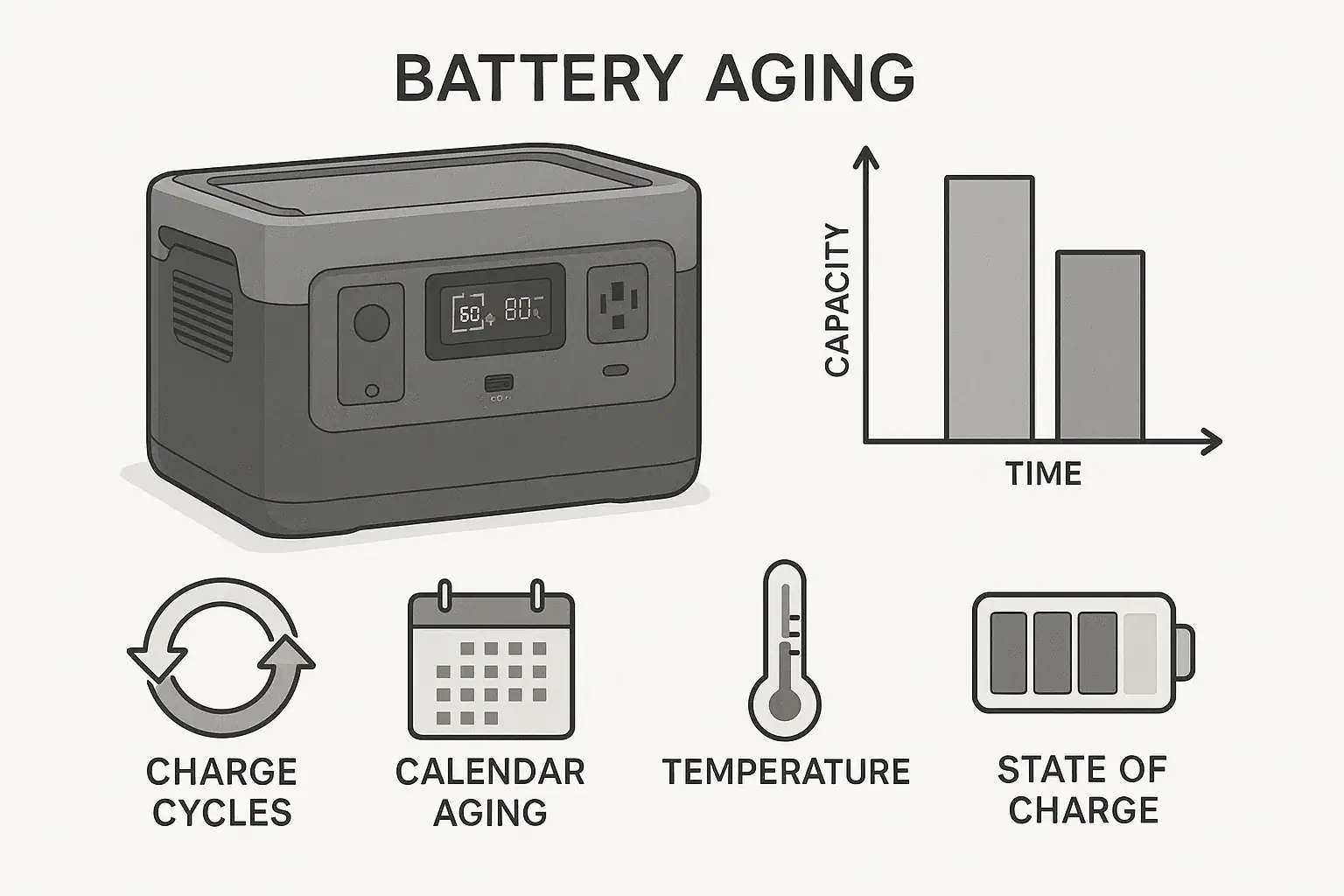
Power station lifespan is usually limited by both charge cycles and calendar aging, but calendar aging often explains capacity loss in units that sit unused for long periods.
A charge cycle is wear from using and recharging the battery. Calendar aging is wear from time, temperature, and state of charge even when the unit is not powering anything. Both reduce usable battery capacity, runtime, and peak performance over time. Search terms like battery cycles, cycle life, capacity loss, depth of discharge, and storage voltage all point to the same practical question: why does a portable power station hold less energy than it used to?
The short answer is that heavy daily use mainly stresses cycle life, while hot storage and long periods at 100% or 0% charge mainly accelerate calendar aging. Understanding the difference helps you choose better specs, store the unit correctly, and set realistic expectations for long-term backup power.
What charge cycles and calendar aging mean, and why they matter
A portable power station is built around a rechargeable battery pack, power electronics, a battery management system, and input and output hardware. When people talk about lifespan, they usually mean how long the battery can deliver useful capacity before runtime noticeably drops. A common reference point is when the pack reaches about 80% of its original usable capacity, although the station may still work after that.
Charge cycle aging is wear caused by moving energy in and out of the battery. If you discharge a battery from 100% to 0% and recharge it to 100%, that is roughly one full cycle. Two discharges from 100% to 50%, followed by recharges, can also add up to roughly one full equivalent cycle. The exact accounting is handled internally, but the idea is simple: deeper and more frequent use consumes more cycle life.
Calendar aging is chemical aging that happens with time. A battery can lose capacity while sitting on a shelf, especially if it is stored hot, fully charged, nearly empty, or exposed to repeated temperature swings. This is why a power station used only for emergencies can still age between outages.
This distinction matters because two owners can see very different results. One may cycle a unit daily for work and gradually reduce capacity through repeated use. Another may keep a unit in a hot garage at full charge and discover shorter runtime after a year of little use. In both cases the battery did not necessarily “fail”; it aged through different paths.
How battery aging works inside a power station
Portable power stations commonly use lithium-ion battery chemistries. Some emphasize higher energy density, while others emphasize longer cycle life and thermal stability. Regardless of chemistry, aging is influenced by voltage, temperature, current, time, and depth of discharge. The battery management system helps keep operation within safe limits, but it cannot stop normal chemical aging.
During cycling, microscopic changes occur inside the cells. Repeated charging and discharging can thicken internal layers, reduce available lithium, increase resistance, and generate heat during higher loads. As resistance rises, the station may show more voltage sag under load, slightly less usable capacity, or earlier shutdown at high output.
During calendar aging, similar losses can happen without daily use. High state of charge keeps cells at a higher voltage, which generally increases long-term stress. Very low state of charge can also be harmful because self-discharge may eventually push cells below a healthy range if the unit is neglected. Heat speeds most aging reactions, so a battery stored in a warm vehicle or unconditioned shed can age faster than one stored indoors.
Cycle life ratings are helpful, but they are not a complete lifespan promise. A rating such as hundreds or thousands of cycles usually assumes certain lab conditions, controlled discharge rates, and a defined capacity-retention target. Real-world use includes partial cycles, standby drain, inverter losses, fast charging, cold-weather use, and storage habits. That is why calendar aging and cycle aging must be considered together.
| Aging factor | What drives it | Common sign | How to reduce stress |
|---|---|---|---|
| Charge cycle aging | Frequent deep discharge and recharge | Shorter runtime after many uses | Use shallower cycles when practical |
| Calendar aging | Time, heat, and high or very low state of charge | Capacity loss despite light use | Store cool at a moderate charge level |
| Thermal aging | Charging, discharging, or storing in high temperatures | Faster capacity loss or reduced output | Keep vents clear and avoid hot storage |
| High-current stress | Loads near the inverter limit or repeated surge demand | Fan noise, warmth, or early shutdown | Leave headroom below rated output |
Real-world examples of what limits lifespan
Consider an emergency backup unit kept at home. It may be charged to 100% after purchase and then stored for months. If it sits in a cool interior closet and is checked periodically, calendar aging should be relatively slow. If it sits in a hot garage all summer at full charge, time and heat may matter more than charge cycles.
Now compare that with a power station used at a jobsite every weekday. It may run lights, chargers, small tools, or communications equipment and then recharge overnight. In that pattern, full equivalent cycles accumulate quickly. The battery chemistry and rated cycle life become more important because the pack is actively being used.
A camper using a station on weekends falls between those two cases. The unit may cycle partially during trips and then sit for several weeks. For this owner, both moderate cycle aging and storage habits matter. Avoiding unnecessary full discharge, preventing heat buildup in a vehicle, and storing at a moderate state of charge can preserve capacity over multiple seasons.
Solar charging adds another layer. Solar input may slowly recharge the station throughout the day, creating many shallow charge and discharge events. Shallow cycling is often easier on lithium batteries than repeated deep cycling, but high heat under direct sun can offset some of that benefit. The station may be rated for outdoor use during operation, but battery aging is still temperature-sensitive.
High-power appliances can also change the aging pattern. A refrigerator, medical device, router, or laptop dock may use modest wattage and create manageable discharge rates. A microwave, heater, power tool charger bank, or compressor can push the inverter closer to its output limit. Even if surge watts are supported, repeated high-current operation can increase heat and reduce efficiency. That does not mean the station cannot handle those loads; it means headroom matters for long-term use.
Common mistakes and troubleshooting cues
One common mistake is treating the cycle count as the only lifespan number. A power station with a high cycle rating can still age faster if stored hot or left fully charged for long periods. Conversely, a lower cycle rating may be less concerning for occasional backup use if the battery is stored correctly and rarely deeply discharged.
Another mistake is assuming that a displayed 100% charge means the battery has the same usable energy it had when new. The state-of-charge indicator estimates the current charge level of the aged pack. If total capacity has declined, 100% simply means full relative to its current condition. The practical symptom is shorter runtime, not necessarily a lower percentage reading.
Troubleshooting should start with load and runtime expectations. If a 500 watt-hour station powers a 50-watt device, theoretical runtime is 10 hours before losses. In practice, inverter overhead, device power variation, temperature, and reserve capacity can reduce that. If runtime has declined gradually over years, normal aging is likely. If runtime changed suddenly, check for a heavier load, colder conditions, blocked vents, a calibration issue, or an appliance with a higher startup surge than expected.
Leaving the unit at 0% for months is another avoidable problem. Even when turned off, electronics and cells can have small self-discharge. If the battery falls too low, the management system may prevent charging or reduce available capacity to protect the pack. At the other extreme, keeping the display at 100% all year can increase voltage-related calendar aging.
Fast charging is useful, but it can add heat. Occasional fast charging is not automatically harmful when supported by the unit, yet always using the maximum input in a warm environment can be harder on the pack than slower charging. If the station offers adjustable AC input or charge speed, using a moderate setting during routine charging may reduce thermal stress.
Watch for cues such as noticeably shorter runtime under the same load, faster percentage drops at higher wattage, more fan activity than usual, charging that pauses in hot or cold conditions, or shutdown when a device starts. These signs do not always mean the battery is worn out, but they do suggest that temperature, load size, surge demand, or aged capacity should be considered.
Safety basics when aging batteries are involved
Battery aging is normal, but safety still matters. Use the power station within its published input, output, temperature, and ventilation guidance. Do not cover cooling vents, stack blankets or gear around the unit while it is charging, or operate it in locations where heat cannot escape. Heat is both a performance issue and an aging accelerator.
Do not open the device, modify the battery pack, bypass the battery management system, or attempt cell-level repairs. Portable power stations contain high-energy cells and power electronics that can be dangerous if handled incorrectly. Internal service is not a normal user maintenance task.
If the station shows swelling, unusual odor, melted plastic, repeated fault messages, abnormal heat, or damage after impact or water exposure, stop using it and follow the manufacturer’s disposal or service guidance. Do not continue charging a visibly damaged battery-powered device.
For home backup, avoid improvised connections to household wiring. A portable power station can safely run appliances directly within its output limits, but connecting backup equipment to a home electrical panel requires proper transfer equipment and code-compliant installation. Use a qualified electrician for any permanent or panel-related electrical work.
Cold weather also deserves attention. Lithium batteries may deliver less power when cold, and charging below the supported temperature range can be restricted by the battery management system. Some units include low-temperature charging protection or internal heating. If cold-weather backup is important, those protections and operating ranges should be part of the buying criteria.
Maintenance and storage habits that extend useful life
The best storage habit is simple: keep the station cool, dry, and partially charged when it will not be used for a while. A moderate state of charge, often around 40% to 80%, reduces both high-voltage stress and deep-discharge risk. Fully charging before an expected outage or trip is reasonable, but long-term full-charge storage is not ideal for many lithium batteries.
Temperature is the strongest everyday variable. Indoor storage in a conditioned space is generally better than a garage, attic, shed, or vehicle. Avoid leaving the unit in direct sun, especially while charging. If it has been stored in a cold or hot place, allow it to return closer to room temperature before heavy charging or discharging when practical.
Check the battery periodically during storage. The right interval varies by design and standby drain, but a check every few months is a practical habit for emergency equipment. Recharge if the level has dropped too low, then return it to a moderate storage range unless you need it ready at full capacity.
For frequent users, smaller habits add up. Avoid unnecessary full discharges, leave output headroom instead of running at the inverter limit all the time, and keep cables and vents unobstructed. When possible, size the station so normal loads use a comfortable portion of its capacity and wattage rather than pushing it to maximum output every use.
Display calibration can sometimes make capacity appear inconsistent. Some power stations estimate state of charge based on voltage, coulomb counting, or a mix of methods. After many partial cycles, the display may be less precise. A controlled full charge and normal discharge within the device’s intended use may help the gauge relearn capacity, but it will not reverse true battery aging.
| Use case | Storage target | Check interval | Main lifespan risk |
|---|---|---|---|
| Emergency backup | Moderate charge until storm season or planned need | Every 2 to 3 months | Calendar aging from long storage |
| Weekend camping | Recharge after trip, then store partially charged | Monthly during active season | Heat in vehicles and repeated partial use |
| Daily work use | Charge only as much as needed when practical | Ongoing | High cycle accumulation |
| Solar-supported use | Avoid prolonged hot full-charge conditions | During each setup | Heat plus long time at high state of charge |
Related guides: Battery Cycle Life Explained: What “Cycles” Really Mean • Depth of Discharge (DoD) Explained: How Partial Cycles Extend Battery Life (LiFePO4 vs NMC) • Best Storage Charge Percentage: 40% vs 60% vs 80% (What Battery Chemistries Prefer)
Frequently asked questions
Do charge cycles or calendar aging matter more for a power station lifespan?
It depends on how the unit is used. Daily or near-daily use usually makes charge cycles the bigger factor, while occasional use with long storage periods makes calendar aging more important. Heat, state of charge, and storage conditions can make either one dominate over time.
What specs matter most when comparing portable power stations for long-term use?
Look at battery chemistry, rated cycle life with a stated capacity-retention target, usable capacity, output wattage, and charging options. Operating temperature range and battery management protections also matter because they affect both safety and aging. For backup use, storage guidance and standby drain are especially useful specs.
What is the most common mistake that shortens battery life?
Storing the unit hot and fully charged for long periods is one of the most common mistakes. That combination increases calendar aging even if the station is rarely used. Leaving it at 0% for months can also cause problems because the battery may self-discharge further.
Is it bad to keep a power station plugged in all the time?
It can be, depending on how the charging system works and how warm the unit gets. Keeping a battery at 100% for long periods can increase stress, especially in warm environments. If the device supports charge limits or storage modes, those features can help reduce wear.
How can I tell if reduced runtime is normal aging or a problem?
Gradual runtime decline over months or years is usually normal aging. A sudden drop is more likely to come from a heavier load, colder temperatures, blocked ventilation, a calibration issue, or a failing appliance. If the unit shows swelling, unusual heat, or fault messages, stop using it and inspect it safely.
Are there any safety basics I should follow as the battery gets older?
Yes. Keep vents clear, avoid heat buildup, and use the station within its published temperature and output limits. Do not open the battery pack or use a damaged unit with swelling, odor, or repeated faults. For home backup wiring, use proper transfer equipment and a qualified electrician.
Practical takeaways and specs that matter
Charge cycles and calendar aging both limit power station lifespan, but their importance depends on how you use the unit. If you cycle it every day, cycle life, chemistry, cooling, and output headroom matter most. If you keep it mainly for emergencies, storage temperature and state of charge may matter more than the advertised cycle count.
The most durable setup is not always the largest or fastest-charging one. It is the one sized correctly for the load, operated within comfortable limits, stored in a stable environment, and supported by clear battery management features. A realistic lifespan expectation should include gradual capacity loss, reduced runtime over time, and the possibility that the battery ages even when the station is rarely used.
Specs to look for
- Battery chemistry: Look for the chemistry type and expected cycle behavior, such as longer-cycle lithium iron phosphate or higher-energy lithium-ion variants, because chemistry strongly affects cycle life and storage tolerance.
- Rated cycle life: Look for a rating tied to capacity retention, such as cycles to about 80% capacity, because a cycle number without a retention target is less useful.
- Usable capacity: Look beyond watt-hours and consider practical runtime after inverter losses; a 700 to 1000 watt-hour class unit may not deliver every rated watt-hour to AC loads.
- Output wattage and surge watts: Look for continuous output comfortably above your normal load and surge capacity for motors or compressors, because operating at the limit adds heat and shutdown risk.
- Adjustable charging speed: Look for selectable AC input or lower-charge modes when available, because slower routine charging can reduce heat compared with always using maximum input.
- Operating and charging temperature range: Look for clear hot and cold limits, plus low-temperature charge protection if winter use matters, because temperature affects both safety and aging.
- Battery management system protections: Look for over-voltage, under-voltage, over-current, short-circuit, and temperature protection, because electronic safeguards help prevent abusive conditions.
- Storage guidance and standby drain: Look for stated storage recommendations and low standby consumption, because emergency units may sit for months between uses.
- Warranty length and capacity terms: Look for coverage that explains battery performance over time, because battery aging is gradual and warranty language may separate defects from normal capacity loss.
For most owners, the practical rule is to avoid extremes: extreme heat, extreme state of charge, extreme discharge depth, and extreme output loads. Use the station when you need it, but do not store it hot and full for months or run it at maximum output unnecessarily. That balance does more for long-term power station lifespan than focusing on charge cycles alone.
Related guides
Browse this topic →
- Beginner-friendly sizing, runtime & specs
- Solar & charging (MPPT, fast charging, cables)
- Batteries (LiFePO4, cycles, care & storage)
- Safety, cold-weather performance, real-world tips
More in Battery
See all →- Portable Power Station Expansion Batteries: When Extra Capacity Makes Sense
- Lithium-Ion vs LiFePO4 Batteries Explained
- LiFePO4 vs Lithium-Ion in Cold Weather: Which Holds Up Better?
- Best Storage Charge Percentage: 40% vs 60% vs 80% for Different Battery Chemistries
- Why Battery Capacity Drops in Cold and Heat (and How to Get Better Runtime)
Keep reading
About this site
Portable Energy Lab publishes practical, independent guides about portable power—clear sizing, safe use, and real-world expectations.
Affiliate disclosure
Some links on this site may be affiliate links. If you buy through these links, we may earn a small commission at no extra cost to you. This helps support our content. Read our affiliate disclosure.