
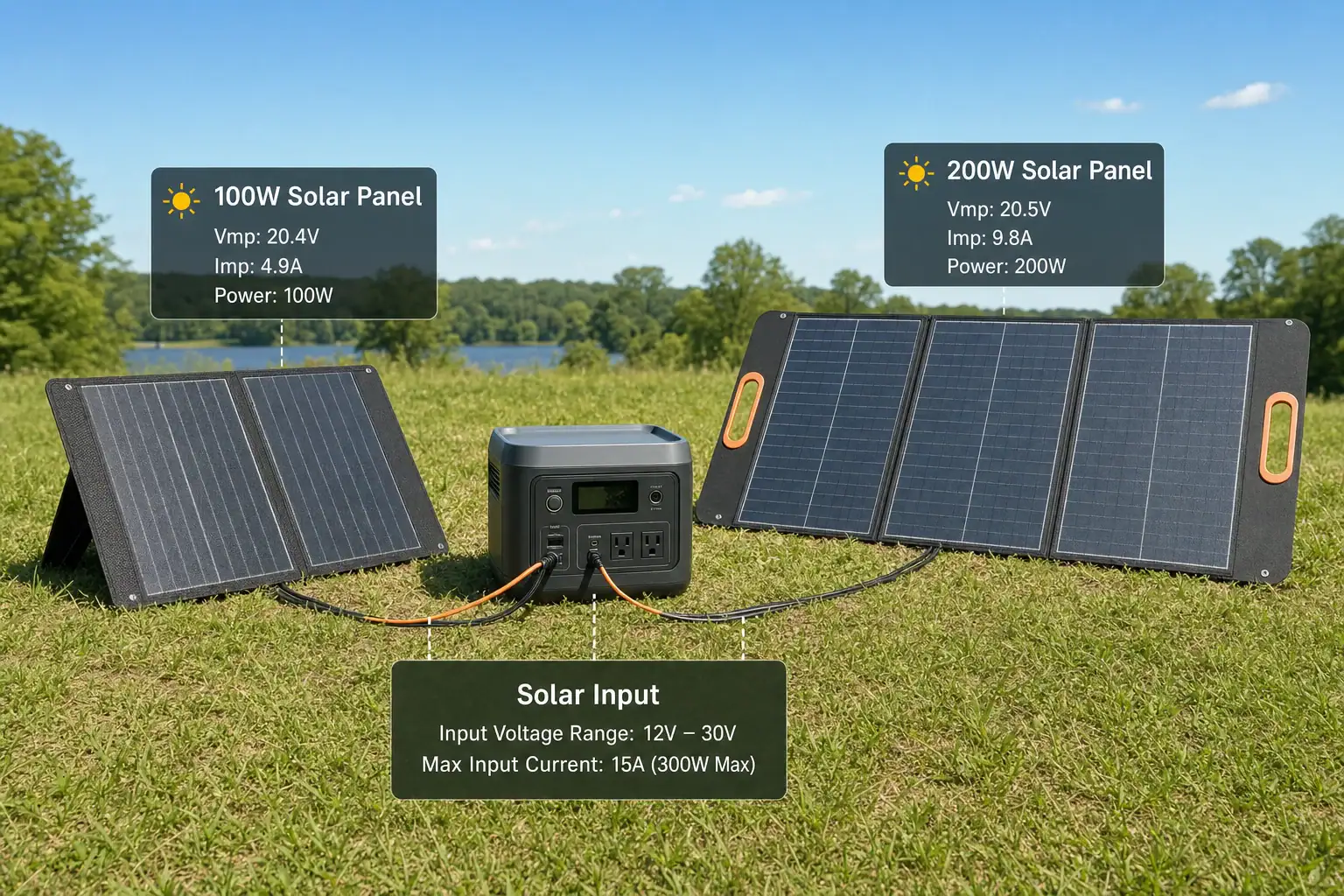
Yes, you can mix solar panels with different wattages on a portable power station, but only when their voltage, current, connector configuration, and the station’s solar input limit are compatible. Different power ratings alone do not make panels unsafe to combine. The electrical mismatch determines whether the system works efficiently.
The main specifications to check are open-circuit voltage, operating voltage, short-circuit current, maximum power current, connector polarity, and the portable power station’s MPPT input range. You must also decide between a series connection and a parallel connection. Series wiring adds voltage, while parallel wiring adds current, and mismatched panels behave differently in each arrangement.
A compatible combination can increase charging power under good sunlight. An incompatible one may deliver less than expected, trigger input protection, or exceed the controller’s safe voltage. Always evaluate the complete array rather than comparing wattage labels alone.
What Mixing Different-Wattage Solar Panels Means
Mixing panels means connecting solar modules with different rated maximum outputs to the same solar input. For example, a 100-watt panel and a 200-watt panel form a mixed-wattage array. Their combined nameplate rating is 300 watts, but that does not guarantee 300 watts at the power station.
Each panel has a current-voltage curve that changes with sunlight, temperature, shading, and load. The power station’s charge controller searches for an operating point that produces useful power without exceeding its accepted voltage or current. When panels have substantially different electrical characteristics, one panel can constrain the other or prevent the controller from finding each panel’s individual optimum.
This matters because wattage is only the product of voltage and current. Two panels can both be rated at 100 watts while having very different operating voltages. Conversely, panels with different wattages may have closely matched voltage characteristics and work reasonably well in parallel. Compatibility therefore depends more on the electrical ratings than on physical size or wattage alone.
How Series and Parallel Connections Affect Mixed Panels
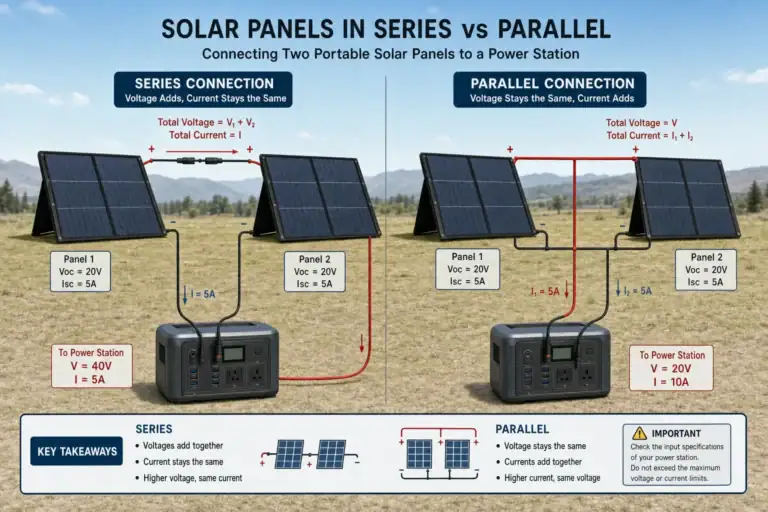
In a series connection, the positive lead of one panel connects through suitable solar cabling to the negative lead of the next, leaving one positive and one negative output for the power station. The panel voltages add, but the same current flows through every panel in the string. A lower-current panel can therefore restrict the current produced by a higher-current panel.
As a simplified example, placing a 20-volt, 5-amp panel in series with a 20-volt, 10-amp panel may produce around 40 volts at a current closer to the lower panel’s capability. The theoretical result may be nearer 200 watts than the 300-watt sum of their labels. Actual performance depends on the panels’ curves and the controller.
In a parallel connection, positive outputs are combined and negative outputs are combined using properly rated branch connectors. Current adds while operating voltage remains near the shared voltage. Parallel operation is generally more tolerant of wattage differences when the panels have similar operating voltages. If their voltages differ significantly, the lower-voltage panel may contribute poorly or the array may settle at a compromise point.
The power station must accept the array’s electrical output. For series arrays, add the panels’ open-circuit voltages and allow for voltage increases in cold weather. For parallel arrays, add the short-circuit currents when evaluating cables, connectors, and input limits. A controller may cap excess available current, but that behavior must be confirmed in the equipment documentation rather than assumed.
| Configuration | What adds | Main mismatch concern | Typical compatibility priority |
|---|---|---|---|
| Series | Voltage | Lower-current panel can limit the string | Match operating current closely |
| Parallel | Current | Different operating voltages reduce efficiency | Match operating voltage closely |
| Separate inputs | Controller-dependent | Inputs may share one total limit | Confirm whether inputs have independent MPPT control |
Real-World Mixed-Panel Examples
Similar voltage, different current in parallel
Consider a 100-watt panel rated at 20 volts and 5 amps and a 200-watt panel rated at 20 volts and 10 amps. In parallel, their matched operating voltages make them a relatively practical pair. The array could theoretically supply about 15 amps at 20 volts, or 300 watts, before normal losses.
If the power station accepts no more than 12 amps or 240 watts at that voltage, it will not use the array’s full potential. Depending on its controller design, it may cap input power or current. The panel combination can still be useful in weaker sunlight, but the input rating must not be treated as permission to connect any array size.
Similar current, different voltage in series
A 100-watt panel rated at 20 volts and 5 amps may pair reasonably in series with a 150-watt panel rated at 30 volts and 5 amps. Their operating currents are similar, so the string might approach 50 volts and 5 amps, or 250 watts. However, the sum of their open-circuit voltages—not their operating voltages—must remain below the power station’s maximum solar input voltage.
Poorly matched panels
Suppose one panel operates at 18 volts and 5.5 amps while another operates at 36 volts and 5.5 amps. They may work in series if the input voltage range allows it because their currents are similar. In parallel, however, the large voltage difference makes the pairing inefficient and potentially unsuitable.
Real output is commonly lower than the nameplate total because of panel temperature, sun angle, haze, wiring loss, conversion loss, and partial shading. A nominal 300-watt array might briefly approach its rating under favorable laboratory-like conditions but produce substantially less during normal use.
Common Mistakes and Troubleshooting Cues
A common mistake is adding panel wattages and checking only whether the sum is below the station’s watt limit. The maximum input voltage is often the stricter safety boundary. Exceeding it can damage the input stage even when the array’s wattage appears acceptable.
Another mistake is using maximum power voltage where open-circuit voltage is required. Open-circuit voltage, usually labeled Voc, is the higher voltage measured when the panel is illuminated but not supplying a load. Series Voc values must be added, and cold conditions can raise them further.
If charging starts and stops, the array voltage may be outside the MPPT operating range, a connector may be loose, polarity may be incorrect, or shifting shade may be disrupting the operating point. An input reading that is much lower than expected may indicate panel mismatch, heat, poor panel orientation, cable loss, current limiting, or a nearly full battery that no longer requests maximum charging power.
When one panel contributes little in parallel, compare the panels’ maximum power voltages. When a series string performs near the output of the smaller panel, compare maximum power currents and look for shading. Even a small shaded area can restrict a series string, although bypass diodes may reduce the severity under some conditions.
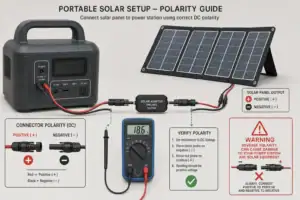
Do not assume connector shapes establish compatibility. Identical-looking connectors can have reversed polarity, different current ratings, or adapters wired for another application. Verify labels and documentation before connecting the array.
Safety Basics for Combining Solar Panels
Keep the total array open-circuit voltage below the portable power station’s absolute maximum solar input voltage, including a reasonable cold-weather margin. Voltage beyond that boundary is not simply unused; it can damage electronics or create an electrical hazard.
Cables, adapters, branch connectors, and extension leads must be rated for the array’s maximum voltage and current. Parallel connections can carry considerably more current than a single panel, increasing heat and voltage drop in undersized conductors. Avoid damaged insulation, corroded contacts, loose connectors, and cables placed where they can be crushed or submerged.
Confirm polarity before making the final connection. Keep connectors dry and avoid connecting or disconnecting damaged equipment under load. Position folding panels securely so wind cannot overturn them or pull on cables. Provide ventilation around the power station and keep it out of intense direct sun when its instructions call for shade.
Never open the power station, modify its battery pack, bypass protective electronics, or improvise connections to household electrical panels. Permanent building connections require appropriately listed equipment and a qualified electrician. If panel labels are missing or the input requirements are unclear, use a single known-compatible panel or obtain professional guidance.
Maintaining and Storing a Mixed-Panel Setup
Record each panel’s wattage, maximum power voltage, maximum power current, open-circuit voltage, and short-circuit current. Keeping these values together makes it easier to rebuild a compatible array after storage and prevents visually similar panels from being connected in the wrong configuration.
Inspect cables and connectors before use. Look for discoloration, pitting, looseness, cracked insulation, bent contacts, or moisture. A connection that becomes unusually warm may be loose, contaminated, damaged, or carrying more current than intended. Stop using the setup until the cause is identified.
Clean panel surfaces according to their care instructions because dirt can affect panels unevenly and worsen mismatch. Store portable modules dry, folded or supported as intended, without sharp pressure on cells or junction boxes. Protect connectors with suitable caps and avoid tightly bending cables near their ends.
Periodically compare output under similar sunlight. A gradual decline may reflect seasonal conditions or normal aging, while a sudden change can point to a failed cable, damaged cell area, poor connector, or altered power station setting. Battery state of charge also matters: input often tapers as the battery approaches full, so tests are more meaningful when the battery can accept substantial power.
| Panel | Rated power | Operating voltage | Operating current | Open-circuit voltage |
|---|---|---|---|---|
| Panel A | 100 W | 20 V | 5 A | 24 V |
| Panel B | 200 W | 20 V | 10 A | 24 V |
| Parallel array | 300 W nominal | About 20 V | Up to about 15 A | About 24 V |
Related guides: How to Read Solar Panel Specs for Power Stations: Voc, Vmp, Imp, and Why It Matters • Solar Panel Series vs Parallel: Which Is Better for Charging a Power Station? • Overpaneling Explained: Can You Connect Bigger Solar Panels Than the Input Limit? • Solar Safety Basics: Cables, Heat, and Preventing Connector Melt
Practical Takeaways and Specs to Look For
Different-wattage solar panels can share a portable power station when the array stays within every input limit and the panels are electrically suited to the chosen configuration. For parallel connections, closely matched operating voltage is the main goal. For series connections, closely matched operating current is more important.
Separate solar inputs can simplify mixed-panel use, especially when each input has an independent MPPT controller. Two physical ports do not always mean independent control, however. They may feed one shared controller or be subject to a combined power limit.
For the most predictable output, use panels with similar electrical characteristics, place them in comparable sunlight, and leave headroom below the maximum voltage. Treat nameplate wattage as a useful estimate rather than guaranteed charging power.
Specs to look for
- Solar input voltage range: Look for an MPPT window such as 12–60 volts that includes the array’s normal operating voltage; otherwise, charging may not start or may be inefficient.
- Maximum input voltage: Compare the limit with total series open-circuit voltage plus cold-weather headroom; this is a critical boundary that must not be exceeded.
- Maximum solar input current: Check whether the input accepts values such as 10, 12, or 15 amps; parallel panels add current and may exceed the usable amount.
- Maximum solar input power: Look for a rating appropriate to the intended array, such as 200–500 watts; output above this value may be clipped even when voltage is safe.
- Number of MPPT controllers: Independent controllers can operate mismatched arrays at separate optimal points; multiple ports connected to one controller offer less flexibility.
- Panel operating voltage and current: Favor similar voltage for parallel wiring or similar current for series wiring; closer matching usually reduces lost output.
- Open-circuit voltage rating: Use each panel’s Voc to calculate series voltage rather than relying on nominal voltage; Voc represents the higher no-load condition.
- Connector type and polarity: Look for clearly documented pin configuration and adequate voltage and current ratings; physical fit alone does not confirm compatibility.
- Cable current rating and length: Choose conductors rated above expected array current and keep practical runs short; undersized or long cables increase heat and voltage loss.
Before connecting mixed panels, verify all ratings from the panel labels and power station documentation. If the calculated voltage approaches the maximum, the panels lack readable specifications, or the proposed setup involves permanent electrical wiring, consult a qualified professional rather than relying on trial and error.
Frequently asked questions
Can I connect a 100-watt and 200-watt solar panel to the same portable power station?
Yes, provided their electrical ratings and the power station’s solar input limits are compatible. A 100-watt and 200-watt panel can work together, but the actual charging output depends on their operating voltages and currents, the wiring arrangement, sunlight conditions, and controller limits.
What solar panel specs matter most when combining panels?
Check maximum power voltage (Vmp), maximum power current (Imp), open-circuit voltage (Voc), short-circuit current (Isc), connector polarity, and the power station’s input voltage, current, and wattage limits. Similar Vmp values are generally preferred for parallel wiring, while similar Imp values are generally preferred for series wiring.
Is it better to wire different-wattage solar panels in series or parallel?
Neither arrangement is always better. Parallel wiring is usually more suitable when panels have similar operating voltages, while series wiring is usually more suitable when they have similar operating currents. The selected arrangement must also remain within the portable power station’s allowed solar input range.
What is the most common mistake when mixing solar panels?
A common mistake is checking only the combined panel wattage and ignoring voltage. For a series connection, panel open-circuit voltages must be added and kept below the power station’s maximum input voltage, with allowance for higher voltage in cold conditions.
Is it safe to combine solar panels with different wattages?
It can be safe when all panel, cable, connector, and power station ratings are compatible. Verify polarity, keep total voltage below the absolute input maximum, use appropriately rated connectors and cables, and do not use damaged or unmarked equipment.
Why do mixed solar panels produce less power than their combined wattage rating?
Different panels may operate most efficiently at different voltages or currents, forcing the array to run at a compromise point. Output can also be reduced by partial shade, panel temperature, sun angle, cable losses, charge-controller limits, and battery charging taper near full capacity.
Recommended next:
- Are Portable Power Stations the Future of Backup Power?
- Portable Power Stations and Renewable Energy
- Solar Panel Series vs Parallel: Which Is Better for Charging a Power Station?
- How Many Solar Watts Do You Need to Fully Recharge in One Day?
- Overpaneling Explained: Can You Connect Bigger Solar Panels Than the Input Limit?
- Shading and Angle: How Placement Changes Solar Charging Speed
- More in Solar →
Related guides
Browse this topic →
- Beginner-friendly sizing, runtime & specs
- Solar & charging (MPPT, fast charging, cables)
- Batteries (LiFePO4, cycles, care & storage)
- Safety, cold-weather performance, real-world tips
More in Solar
See all →- Can You Charge a Portable Power Station Through a Window With Solar Panels?
- Best Solar Panel Angle for a Portable Power Station: Faster Charging Without Guesswork
- Solar Charging in Partial Shade: Why One Shadow Can Slow the Whole Setup
- Bifacial Solar Panels and Portable Power Stations: When the Extra Output Helps
- Series vs Parallel Solar Panels for Portable Power Stations: Simple Wiring Guide
Keep reading
About this site
Portable Energy Lab publishes practical, independent guides about portable power—clear sizing, safe use, and real-world expectations.
Affiliate disclosure
Some links on this site may be affiliate links. If you buy through these links, we may earn a small commission at no extra cost to you. This helps support our content. Learn more.