
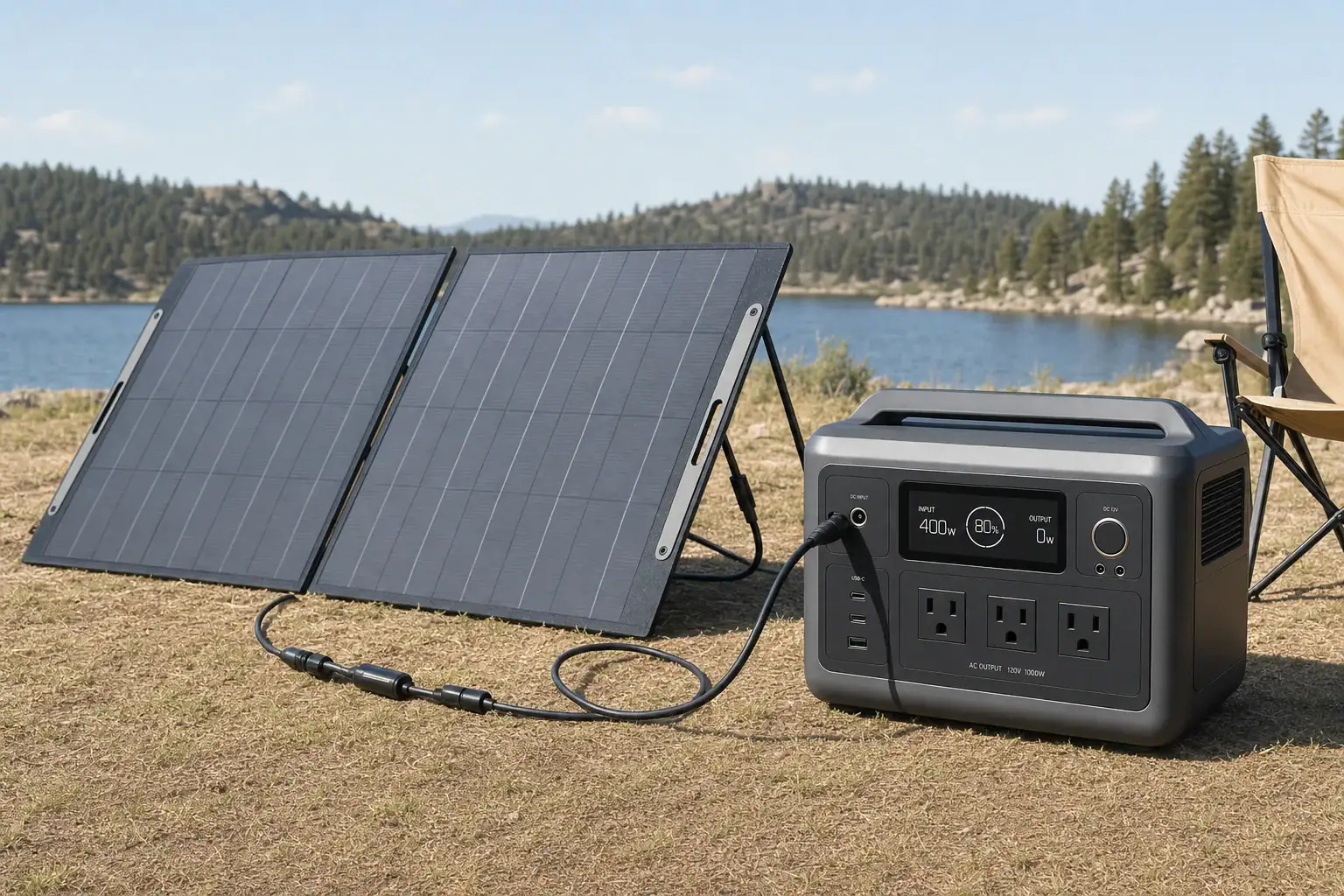
Most 1,000Wh power stations need one 400-watt panel, two 200-watt panels, or four 100-watt panels for a practical recharge in roughly one sunny day. The exact number depends on the station’s solar input limit, the panels’ rated wattage, available peak sun hours, and normal conversion losses.
Under favorable conditions, a 400-watt solar array may recharge a depleted 1,000Wh battery in about three to five hours of strong sunlight. A 200-watt array commonly needs six to eight equivalent hours, so it may require more than one day when sunlight is limited. Cloud cover, panel angle, temperature, shading, and cable losses can extend charging time.
Panel count alone does not determine charging performance. You must also compare the array’s open-circuit voltage, operating voltage, current, connector type, and total wattage with the power station’s MPPT input range. A larger array will not necessarily charge faster if the station caps incoming solar power.
1. What the Required Solar Panel Count Really Means
The required number of portable solar panels is the number needed to produce enough usable energy within your desired charging window. A 1,000Wh rating means the battery can nominally store approximately 1,000 watt-hours of energy. It does not mean that a 1,000-watt solar panel is required.
Solar panels are rated in watts, which describe power under standardized test conditions. Power stations are rated in watt-hours, which describe stored energy. Multiplying solar power by time gives theoretical energy. For example, a 200-watt panel operating at its full rating for five hours would theoretically produce 1,000Wh.
Real portable panels rarely sustain their nameplate rating all day. Heat, imperfect alignment, atmospheric conditions, charge-controller losses, and changing sun angles reduce output. A reasonable planning assumption is that a portable array may deliver about 65% to 85% of its rated energy during useful sunlight. Performance can be substantially lower in shade or heavy clouds.
For many users, two 200-watt panels represent a practical starting point because a 400-watt array can replenish around 1,000Wh during a good solar day. However, that answer only applies if the power station accepts close to 400 watts and the connected panels stay within its electrical limits.
2. How to Calculate the Number of Panels
Start with the amount of energy that must be replaced. A fully depleted 1,000Wh battery requires approximately 1,000Wh of stored energy, but the panels may need to produce more because charging is not perfectly efficient. Instead of trying to account for every individual loss, use a combined real-world production factor of about 0.65 to 0.85.
Estimated panel count = energy needed ÷ panel wattage ÷ peak sun hours ÷ production factor
Assume that you want to replace 1,000Wh using 200-watt panels, five peak sun hours, and a 75% production factor. One panel could provide approximately 750Wh in that period: 200 watts multiplied by five hours multiplied by 0.75. Dividing 1,000Wh by 750Wh gives 1.33, which must be rounded up to two panels.
Peak sun hours are not the same as total daylight hours. They express the day’s solar energy as an equivalent number of hours at strong standardized sunlight. A location may have ten hours of daylight but only four or five peak sun hours.
The power station’s input ceiling must also be applied. If a station accepts no more than 300 watts of solar input, a 600-watt array may improve production during weak light but cannot deliver 600 watts to the battery. When the array is producing more than the input can accept, the charge controller limits or clips the excess.
| Array size | Common panel combinations | Estimated energy in 5 peak sun hours at 75% | General result for 1,000Wh |
|---|---|---|---|
| 100W | One 100W panel | 375Wh | Usually requires multiple days |
| 200W | Two 100W panels or one 200W panel | 750Wh | May need more than one good day |
| 400W | Four 100W panels or two 200W panels | 1,500Wh | Often enough for one good day |
| 600W | Three 200W panels | 2,250Wh | Provides headroom for shorter or weaker sun |
| 800W | Four 200W panels | 3,000Wh | Useful only if input limits and electrical ranges allow it |
3. Real-World Solar Panel Sizing Examples
Two 200-watt panels for a one-day recharge
Consider a 1,000Wh power station that accepts up to 500 watts of solar input. With five peak sun hours and a 75% production factor, two 200-watt panels could generate approximately 1,500Wh before station-specific limitations. That provides enough planning margin to replace 1,000Wh despite ordinary losses and periods of reduced output.
The full recharge may still take most of the usable solar day because output is lower in the morning and afternoon. Charging while simultaneously operating appliances also increases the total energy the panels must supply.
Four 100-watt panels for flexible placement
Four 100-watt panels provide the same 400-watt nameplate capacity as two 200-watt panels. Smaller panels may be easier to move or position around minor obstacles, but they require more cables, connectors, and setup space. More connection points can also increase resistance or create additional opportunities for loose connections.
The panels cannot be combined arbitrarily. In a series arrangement, panel voltage adds while current generally remains similar. In a parallel arrangement, current adds while voltage generally remains similar. Only use configurations supported by the panel and power station documentation.
One 200-watt panel for occasional use
A single 200-watt panel can be sufficient when rapid recharging is not important. At a realistic average of 140 to 170 watts during strong conditions, replacing 1,000Wh can require roughly six to eight equivalent hours, plus additional time if loads are running. In many locations, that means charging across two days.
Extra array capacity with a low input limit
Suppose the station accepts 300 watts but is connected to 400 watts of panels within its voltage and current limits. The extra panel capacity may help the array reach the 300-watt ceiling earlier and maintain it longer. It will not make the station accept more than 300 watts. Adding still more panels produces diminishing returns and may violate voltage or current limits if the configuration is incompatible.
4. Common Sizing Mistakes and Troubleshooting Cues
Using nameplate wattage as guaranteed output: A 200-watt panel may produce less than 200 watts because of heat, haze, panel angle, clouds, or controller losses. Briefly seeing 140 to 180 watts from a nominal 200-watt portable panel can be normal under real conditions.
Ignoring the solar input limit: If displayed input stops rising after another panel is added, the station may have reached its wattage or current ceiling. Check the documented maximum input power, MPPT voltage window, and input current rather than assuming the new panel is defective.
Exceeding the voltage range: Connecting panels in series increases voltage. The combined open-circuit voltage must remain below the station’s maximum, including the tendency of panel voltage to rise in cold weather. An incompatible voltage can prevent charging or damage equipment.
Counting daylight instead of peak sun hours: Ten hours between sunrise and sunset does not provide ten hours of rated panel output. Solar harvest is strongest near midday and much lower when the sun is close to the horizon.
Allowing partial shade: A shadow across even part of a panel can reduce output significantly. Trees, roof racks, handles, cables, and nearby equipment are common sources. If input is unexpectedly low, check for shade, clean the panel surface, improve orientation, and inspect external connections.
Charging while using the station: A 150-watt load can consume much of the output from a 200-watt panel. The display may show solar input while the battery percentage rises slowly or remains steady. Compare incoming solar power with the total active load.
Mixing mismatched panels: Panels with different voltages, currents, or electrical characteristics may not operate efficiently together. Compatibility involves more than matching connector shapes. Use combinations specifically supported by the relevant equipment documentation.
5. Solar Charging Safety Basics
Keep the power station dry, ventilated, and out of prolonged direct sun when possible. The panels need sunlight, but the battery enclosure generally does not. High battery temperature can reduce charging speed as internal protection systems limit power.
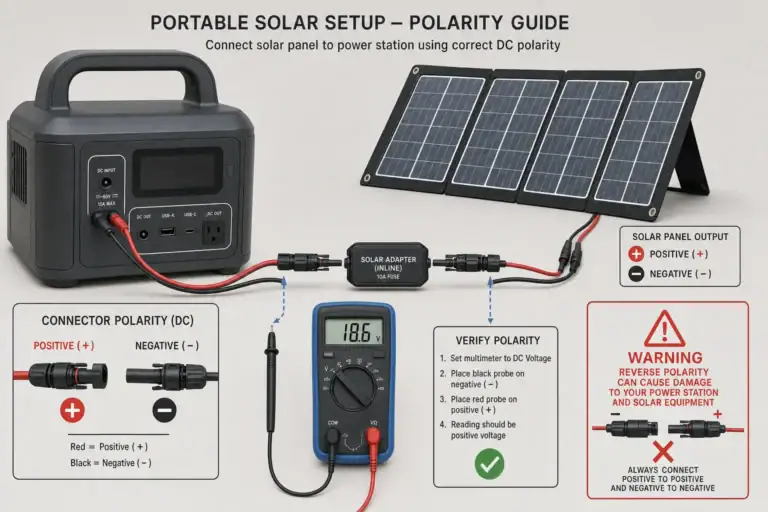
Confirm polarity, connector compatibility, voltage, and current before connecting an array. Do not force similar-looking connectors together or use improvised adapters. Cables should be fully inserted, undamaged, and rated for the expected outdoor conditions and current.
Do not exceed the station’s maximum open-circuit voltage. Include a cold-weather safety margin because panel voltage can increase as temperature falls. If the necessary series or parallel configuration is unclear, consult the equipment documentation or a qualified solar professional.
Place folding panels on stable surfaces and secure them against wind. Avoid pinching cables under doors, vehicle tires, or panel frames. Discontinue use if a cable, connector, panel junction, or input port becomes unusually hot, damaged, discolored, or wet.
Portable solar equipment should not be used to improvise connections to household wiring. Any integration with home circuits, transfer equipment, or permanent electrical systems should be designed and installed by a qualified electrician in accordance with applicable requirements.
6. Maintaining Panels for Reliable Charging
Dust, pollen, salt residue, bird droppings, and leaf debris can lower panel output. Inspect panel surfaces before use and clean them according to the manufacturer’s care guidance. A soft cloth and appropriate nonabrasive method are generally preferable to harsh chemicals or tools that could scratch the surface.
Check external cables and connectors for cuts, looseness, corrosion, bent contacts, or heat damage. Repeated folding and transport can stress cable entry points. Protective caps should be used when available to keep debris and moisture out of disconnected plugs.
Store portable panels dry, clean, and loosely folded along their intended seams. Do not stack heavy objects on folded panels because concentrated pressure can damage cells or internal conductors. Avoid long-term storage in locations with extreme heat, freezing moisture, or high humidity.
The power station also needs proper storage. Follow its specified storage temperature and periodically check its state of charge. Many battery systems are best stored partially charged rather than completely full or empty, but the recommended percentage and inspection interval vary by battery chemistry and design.
| Maintenance item | When to check | Why it matters |
|---|---|---|
| Panel surface | Before use and when output drops | Dirt and residue can block sunlight |
| Cables and plugs | Before each setup | Damage or loose contacts can cause losses and heat |
| Folding seams and supports | After transport | Wear can affect stability and internal conductors |
| Power station charge level | Periodically during storage | Deep self-discharge can affect availability and battery health |
| Stored environment | Seasonally | Heat and moisture can shorten equipment life |
Related guides: How to Read Solar Panel Specs for Power Stations: Voc, Vmp, Imp, and Why It Matters • Overpaneling Explained: Can You Connect Bigger Solar Panels Than the Input Limit? • Solar Safety Basics: Cables, Heat, and Preventing Connector Melt
7. Practical Takeaways and Specs to Look For
For a typical 1,000Wh power station, plan on approximately 400 watts of portable solar capacity if the goal is to recharge in one favorable solar day. That usually means one 400-watt panel, two 200-watt panels, or four 100-watt panels. A 200-watt array is workable when charging speed is less important, while 600 to 800 watts may help in limited sun only when the station supports that much input.
Size the array using energy demand, local peak sun hours, and a realistic production factor. Then verify that the proposed panel configuration remains within the station’s voltage, current, and power limits. If appliances will run during charging, add their energy consumption to the 1,000Wh refill target.
Specs to look for
- Maximum solar input power: Look for roughly 400 to 800 watts when faster charging is important; this determines how much array output the station can use.
- MPPT voltage range: Compare a range such as 12 to 60 volts with the panels’ operating voltage; the array must enter this window for efficient charging.
- Maximum open-circuit voltage: Select a limit with sufficient margin above the array’s combined open-circuit voltage; this is especially important in cold weather.
- Maximum input current: Values such as 10 to 15 amps are common examples; this limit affects how much current a parallel panel arrangement can deliver.
- Panel rated wattage: Compare sizes such as 100, 200, or 400 watts; higher wattage reduces panel count but may increase folded size and weight.
- Panel operating voltage and current: Confirm that the electrical values match the intended series or parallel configuration; connector compatibility alone is not enough.
- Connector and cable compatibility: Look for secure, correctly polarized connections and appropriately rated cables; unnecessary adapters and long undersized cables can add losses.
- Conversion efficiency and MPPT control: Look for documented solar charging performance across a useful input range; effective tracking helps capture more energy as sunlight changes.
- Folded dimensions and weight: Compare portability with output; a large array is useful only if it can be transported, positioned, and secured reliably.
- Environmental durability: Look for resistance to dust, light moisture, heat, and repeated folding appropriate to expected use; durable construction supports consistent long-term output.
The best panel count is therefore not a fixed universal number. It is the smallest compatible array that can replace your expected energy use within the sunlight and time available, without exceeding the power station’s input specifications.
Frequently asked questions
Can a 100-watt solar panel charge a 1,000Wh power station?
Yes, a 100-watt panel can charge a 1,000Wh power station if its voltage and connector are compatible with the solar input. However, it will usually produce only a few hundred watt-hours in a typical day, so a full recharge commonly takes several days. Actual results depend on peak sun hours, weather, panel angle, and charging losses.
How long does it take to charge a 1,000Wh power station with solar?
Charging time depends on usable solar input rather than panel rating alone. In strong sun, a compatible 400-watt array may replenish the battery in roughly three to five hours of high-output charging, while a 200-watt array may need six to eight equivalent hours. The time increases if the station is powering appliances at the same time.
What solar panel specs matter for a 1,000Wh power station?
Check the power station’s maximum solar input wattage, MPPT operating-voltage range, maximum open-circuit voltage, and maximum input current. Compare those limits with the combined electrical specifications of the panels in their intended series or parallel configuration. Connector type and cable polarity must also be compatible.
Is it a mistake to connect more solar watts than the power station can accept?
Adding modest extra panel capacity can help maintain useful charging output in less-than-perfect sunlight, but the station will not charge above its input limit. The important requirement is that the array remains within the station’s voltage and current limits at all times. Oversizing without checking those electrical limits can prevent charging or damage equipment.
Is it safe to leave portable solar panels connected all day?
It can be safe when the panels, cables, and power station are compatible, undamaged, and used according to their instructions. Keep the power station dry and ventilated, secure panels against wind, and avoid damaged connectors or pinched cables. Disconnect the system if components become unusually hot, wet, discolored, or damaged.
Do clouds and shade reduce portable solar panel output?
Yes, clouds reduce the sunlight reaching the panels, and partial shade can cause a substantial drop in output. Even small shadows from trees, roof racks, handles, or cables may affect performance. Repositioning the panels toward direct sunlight and keeping their surfaces clean can improve charging results.
Related guides
Browse this topic →
- Beginner-friendly sizing, runtime & specs
- Solar & charging (MPPT, fast charging, cables)
- Batteries (LiFePO4, cycles, care & storage)
- Safety, cold-weather performance, real-world tips
More in Solar
See all →- How to Clean Portable Solar Panels Without Damage
- Solar Charging on Cloudy Days: What Output Can a Portable Power Station Expect?
- Solar Adapter Polarity Mistakes: How to Avoid Reverse-Polarity Charging Problems
- Portable Solar Panel Waterproof Ratings: What Rain, Dew, and Splash Resistance Mean
- Can You Charge a Portable Power Station Through a Window With Solar Panels?
Keep reading
About this site
Portable Energy Lab publishes practical, independent guides about portable power—clear sizing, safe use, and real-world expectations.
Affiliate disclosure
Some links on this site may be affiliate links. If you buy through these links, we may earn a small commission at no extra cost to you. This helps support our content. Read our affiliate disclosure.