
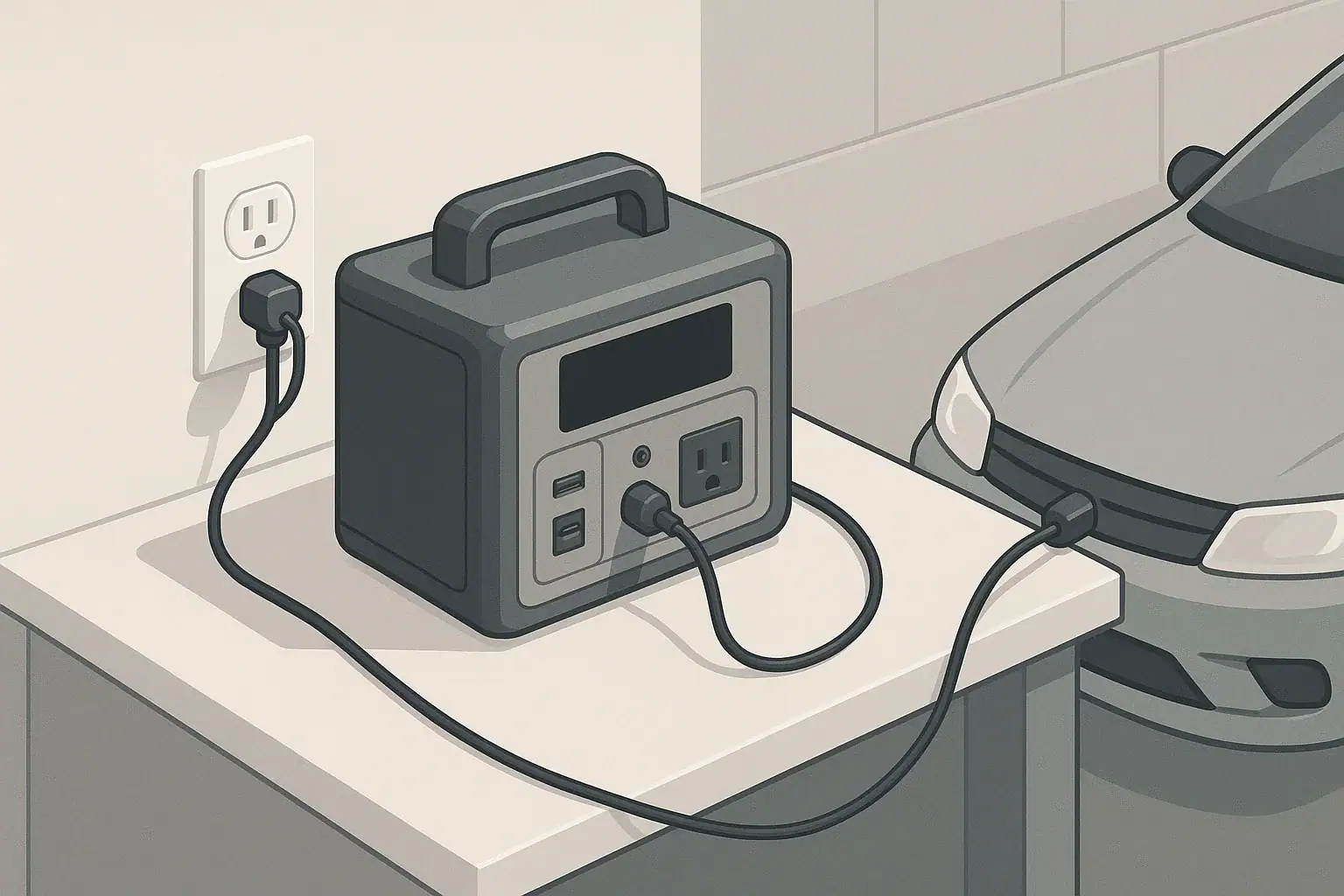
You can safely charge a portable power station from a car as long as the charging power stays within the limits of the vehicle’s wiring, fuses, and the power station’s DC input. The trade-off is that car charging is usually slow, especially for larger battery capacities.
This guide explains how to charge a portable power station from a car outlet, what “safe” really means in terms of volts, amps, and watts, and which setups are more likely to cause problems. It applies to most modern lithium and LiFePO4 portable power stations used in cars, SUVs, vans, and trucks.
By the end, you will know how to estimate realistic charge times from a 12 V accessory socket, when a hardwired setup makes sense, and how to avoid the common mistakes that damage sockets, alternators, or the power station itself.
What Car Charging a Portable Power Station Really Means (and Why It Matters)
When people talk about charging a portable power station from a car, they usually mean using the 12 V accessory socket while driving. In practice, there are several different ways to move energy from the alternator and starter battery into your power station, each with its own limits.
Understanding these options matters for three reasons:
- Safety: Staying within fuse, wiring, and input ratings avoids overheated plugs, damaged wiring, and failed electronics.
- Speed: Knowing realistic wattage from a car socket helps you plan whether car charging is a primary source or just a top-up method.
- Battery health: Both your car’s starter battery and the portable power station last longer when they are not repeatedly pushed outside their comfort zones.
Most vehicles use a 12 V system, but many vans, RVs, and trucks use 24 V. Most portable power stations accept a range of DC voltages, but not all inputs are designed for high current or for every vehicle system. Matching these pieces correctly is the foundation of safe car charging.
Key Concepts: How Charging From a Car Actually Works
Charging a portable power station from a car comes down to a few core ideas: voltage compatibility, current limits, and total charging power. Once you understand those, the different connection methods make more sense.
Main Ways to Charge From a Vehicle
- 12 V accessory socket (cigarette lighter): Easiest option. You plug a car charging cable into the dash or console outlet. Typical fuses are 10–20 A, so real-world power is often 60–150 W.
- Hardwired 12 V or 24 V DC line: A dedicated fused cable run from the battery or distribution block to the cargo area, often with a robust connector. This can safely supply higher current if wired correctly.
- Small inverter plus AC charger: A 12 V inverter plugs into the car socket, and you connect the power station’s AC brick to the inverter. This works when there is no DC input, but adds conversion losses and extra heat.
- DC–DC charger from alternator: A dedicated device regulates current and voltage from the alternator to a battery or power station. This is common in overland and van builds and is the most controlled but also the most complex option.
Voltage, Current, and Power Basics
Three numbers matter for car charging:
- Voltage (V): A typical 12 V system is about 12.6 V with the engine off and 13.5–14.4 V while running. Power station DC inputs usually accept a range such as 10–30 V or 12–28 V.
- Current (A): Limited by vehicle fuses, wiring, and connectors. Common accessory socket fuses are 10 A, 15 A, or 20 A.
- Power (W): Power = Voltage × Current. For example, 13.5 V × 10 A ≈ 135 W.
Because of voltage drop and protective limits, you rarely get the full theoretical wattage. A 15 A socket might practically deliver closer to 100–130 W continuously.
Estimating Charge Time From a Car
A simple way to estimate charge time is:
Charge time (hours) ≈ Battery capacity (Wh) ÷ Charging power (W) ÷ 0.85
The 0.85 factor accounts for typical conversion losses.
| Power station capacity (Wh) | Realistic car charging power (W) | Approximate charge time from car (hours) | Typical use case |
|---|---|---|---|
| 300 Wh | 80 W | 300 ÷ 80 ÷ 0.85 ≈ 4.4 h | Weekend trip, phones and cameras |
| 500 Wh | 100 W | 500 ÷ 100 ÷ 0.85 ≈ 5.9 h | Small fridge overnight plus devices |
| 1000 Wh | 120 W | 1000 ÷ 120 ÷ 0.85 ≈ 9.8 h | Road trip with fridge and laptops |
| 1500 Wh | 120 W | 1500 ÷ 120 ÷ 0.85 ≈ 14.7 h | Vanlife base system, heavy daily use |
What Is Generally Safe vs. Just “Possible”
- Generally safe: Using the supplied car charging cable, staying within socket fuse limits, and charging mostly while the engine is running.
- Slow but acceptable: Long, low-power charging sessions from a factory socket or small inverter, especially for large-capacity units.
- Risky: Upsizing fuses, using undersized DIY wiring, or feeding a DC input with the wrong voltage or reversed polarity.
Real-World Examples: What Typical Setups Look Like
Putting numbers on realistic scenarios makes it easier to choose a safe charging method and to set expectations about how fast your portable power station will refill from your vehicle.
Example 1: Small Power Station on a Weekend Road Trip
Setup:
- Power station: 300–500 Wh
- Vehicle: Passenger car with a 10–15 A accessory socket
- Connection: Included 12 V car charging cable
What happens in practice:
- Charging power is typically 60–100 W while driving.
- Three to six hours of driving can bring the power station from low to nearly full.
- Running phones, cameras, and a laptop while parked barely affects the car battery because the power station carries that load.
This is the easiest and lowest-risk use case. The main limitation is time: you need enough driving hours to refill the battery.
Example 2: Larger Power Station for Road Trips and Camping
Setup:
- Power station: 1000–1500 Wh
- Vehicle: SUV or crossover with a 15 A accessory socket
- Connection: Included 12 V car charging cable
What happens in practice:
- The car socket realistically delivers around 100–130 W.
- Reaching a full charge can take most of a driving day.
- If a 12 V fridge, lights, or other loads run from the power station during charging, net gain per hour is lower.
This is where expectations often clash with reality. The system works, but the power station may never hit 100% if you use it heavily every night and only drive short distances each day.
Example 3: Hardwired High-Current Setup for Frequent Off-Grid Use
Setup:
- Power station: 1000–2000 Wh with a higher-power DC input
- Vehicle: Van, truck, or SUV with room for additional wiring
- Connection: Dedicated fused cable from the starter battery or distribution block to the cargo area, using heavy-gauge wire and a robust connector
What happens in practice:
- Charging power can be significantly higher than a factory socket, depending on alternator capacity and input limits.
- Two to four hours of highway driving can restore a large portion of the power station’s capacity.
- The alternator and wiring need to be sized and protected correctly to avoid overheating.
This kind of setup is useful for vanlife, work trucks, or frequent boondocking, but it must be designed carefully to protect both the vehicle and the power station.
Example 4: Using a Small Inverter and the AC Charger
Setup:
- Power station: 300–1000 Wh that charges primarily via an AC brick
- Vehicle: Car with a 10–15 A accessory socket
- Connection: 12 V inverter plugged into the socket, AC charger plugged into inverter
What happens in practice:
- The inverter and AC charger add conversion losses, so more power is drawn from the socket than the power station actually receives.
- You must keep inverter output well below the socket’s fuse rating to avoid blown fuses and hot plugs.
- Charging is often limited to 80–120 W, similar to direct DC car charging, but with more heat and inefficiency.
This method is workable for occasional use when no DC input is available, but it is rarely the most efficient long-term solution.
Common Mistakes and How to Spot Trouble Early
Most problems with charging a portable power station from a car come from ignoring limits or using improvised wiring. Recognizing warning signs early can prevent expensive repairs.
Mistake 1: Overloading the 12 V Socket
Trying to pull the full advertised current (or more) from a car outlet for hours can overheat wiring and plugs.
- Warning signs: Hot plastic around the socket, a burning smell, plugs that feel soft or discolored, or fuses that blow repeatedly.
- Fix: Reduce charging power, use a different socket if available, or consider a dedicated hardwired line if you need more current.
Mistake 2: Draining the Starter Battery Too Far
Charging with the engine off for long periods can leave you with a power station that is full and a car that will not start.
- Warning signs: Slower cranking when you turn the key, dim interior lights, or a power station display showing very low input voltage.
- Fix: Limit engine-off charging to short, low-power top-ups and prioritize charging while driving.
Mistake 3: Incorrect Polarity or DIY Connectors
Reversed positive and negative leads can instantly damage electronics, including the power station’s input circuitry.
- Warning signs: Visible sparks when connecting, immediate error codes, or the DC input no longer working after a connection attempt.
- Fix: Use clearly marked connectors, double-check polarity with a multimeter before first use, and avoid homemade cables unless you are comfortable with DC wiring.
Mistake 4: Feeding the Wrong Voltage
Connecting a power station that expects 12–28 V to a 24 V truck system or a boosted DC source that exceeds its maximum rating can cause permanent damage.
- Warning signs: The power station refusing to charge, displaying an overvoltage error, or shutting down quickly after connection.
- Fix: Confirm the allowed DC input voltage range in the specifications before connecting to any 24 V or boosted source.
Mistake 5: Poor Ventilation and Heat Buildup
Placing a power station under a seat, stacked with luggage, or in direct sun on a hot day can cause it to overheat while charging.
- Warning signs: Loud or constantly running fans, reduced charging power, or thermal shutdown messages.
- Fix: Move the unit to a shaded, ventilated area and keep vents clear on all sides.
| Issue | Typical symptoms | Likely cause | Suggested action |
|---|---|---|---|
| Socket fuse keeps blowing | Power cuts out, no power at outlet | Charging power too high for fuse rating | Lower charging current; never install a larger fuse |
| Plug or socket feels very hot | Soft plastic, discoloration, burning smell | High current through marginal wiring or loose contacts | Stop charging, inspect wiring, consider hardwired solution |
| Car struggles to start | Slow crank, dim lights after charging | Starter battery deeply discharged by charging load | Reduce engine-off charging; allow alternator to recharge battery |
| Power station DC input stops working | No charging, possible error code | Reverse polarity or overvoltage event | Check cables with a multimeter; contact manufacturer support |
| Charging slows down unexpectedly | Power drops from advertised rate | Heat buildup, voltage drop, or nearing full charge | Improve ventilation; shorten cable runs; verify state of charge |
Safety Basics When Charging a Power Station From a Vehicle
A few high-level rules cover most safety concerns when charging a portable power station from a car, SUV, van, or truck.
Match Voltage and Polarity
- Confirm that the vehicle system voltage (12 V or 24 V) falls within the power station’s allowed DC input range.
- Use cables and connectors with clearly marked positive and negative terminals.
- Avoid stacking multiple adapters; each extra connection is another chance to reverse polarity or create a loose contact.
Respect Fuse and Wiring Limits
- Use the factory fuse ratings as hard limits for accessory sockets.
- Do not replace a blown 10 A fuse with a 20 A fuse to “get more power.” That only moves the weak point into hidden wiring.
- If you need more current than a socket can safely provide, install a separate fused circuit with appropriate wire gauge instead.
Protect the Starter Battery
- Prioritize charging while the engine is running so the alternator carries most of the load.
- Keep engine-off charging sessions short and low power, especially in cold weather when starting requires more current.
- If you regularly camp without driving, consider a dedicated auxiliary battery or DC–DC system rather than relying solely on the starter battery.
Watch for Heat
- Check plugs, sockets, and cables by touch during the first long charging session. Warm is normal; hot is not.
- Provide airflow around the power station so its internal fans can move heat away.
- Avoid placing the unit directly against soft materials that can block vents.
Consider Alternator Load
- Alternators must power the vehicle and any added charging loads at the same time.
- High continuous charging currents are more stressful at low engine RPM and in hot climates.
- If you plan to draw hundreds of watts for long periods, confirm alternator capacity and consider professional advice on wiring and protection.
Long-Term Use, Maintenance, and Storage Tips
Using a portable power station with a vehicle over months or years introduces a few extra considerations beyond basic safety.
Preserving the Starter Battery
- Avoid routinely running the starter battery down with engine-off charging; this shortens its lifespan.
- If the vehicle sits for long periods between trips, disconnect nonessential loads and consider a battery maintainer to keep the starter battery healthy.
- Listen for slower cranking over time; it can be an early sign that repeated deep discharges are taking a toll.
Care for the Portable Power Station Battery
- Most lithium and LiFePO4 power stations prefer moderate temperatures during charging and storage.
- Avoid leaving the unit fully discharged for long periods; recharge to a moderate level after each trip.
- For long-term storage, many manufacturers recommend storing around 30–60% state of charge in a cool, dry place.
Inspect Cables and Connectors Regularly
- Check for frayed insulation, bent pins, or loose connectors every few trips.
- Replace any car charging cable that shows melting, discoloration, or intermittent connection.
- Secure cables so they do not rub on sharp edges or get pinched in doors or seats.
Seasonal and Environmental Considerations
- Cold weather: Batteries accept charge more slowly and can be damaged if charged below the recommended temperature; keep the power station inside the cabin rather than in an exposed trunk when possible.
- Hot weather: Interior car temperatures can climb quickly; avoid leaving the power station in direct sun or sealed in a parked vehicle for long periods.
- Dust and moisture: Keep vents clear and avoid placing the unit directly on wet or dusty surfaces that can be drawn into the cooling system.
Practical Takeaways and Specs to Look For
Bringing everything together, charging a portable power station from a car works best when you treat the vehicle as a steady but modest power source, not a high-speed charger.
- Factory 12 V sockets are fine for topping up small and medium power stations, as long as you stay within fuse limits.
- Larger power stations can be charged from a car, but you should expect all-day or multi-day charge times at typical car-socket power levels.
- If you need fast, daily recharging while driving, a properly designed hardwired or DC–DC setup is usually more appropriate than pushing accessory sockets to their limits.
Specs to Look For When You Plan to Charge From a Car
When comparing portable power stations for vehicle charging, these specifications and features make a practical difference:
- DC car input voltage range: Look for an input that clearly supports your vehicle system (12 V, or both 12 V and 24 V if you use multiple vehicles).
- Maximum DC input power (W): Higher DC input limits allow faster charging from hardwired or DC–DC setups, but make sure your alternator and wiring can support it.
- Included car charging cable: A dedicated 12 V car cable with the correct connector is simpler and usually safer than third-party adapters.
- Adjustable charging rate: Some units let you reduce input power, which can prevent blown fuses and overheating when using weaker sockets.
- Clear input monitoring: A display showing real-time input watts and voltage helps you verify that your car is delivering what you expect.
- Protection features: Look for overvoltage, overcurrent, overtemperature, and reverse-polarity protections on the DC input.
- Battery chemistry and cycle life: LiFePO4 batteries often handle frequent deep cycles better, which is useful if you plan to charge and discharge daily from a vehicle.
- Operating temperature range: Check that the allowed charging temperatures match the climates where you typically drive and camp.
- Connector type: Robust DC connectors are better for repeated plug-unplug cycles and for higher-current hardwired setups.
With realistic expectations about charge speed, careful attention to vehicle limits, and a power station whose input specs match your car or truck, charging from a vehicle can be a reliable backbone of your off-grid power setup rather than a source of stress.
Frequently asked questions
What specifications and features should I check before using my car to charge a portable power station?
Check the power station’s allowed DC input voltage range to confirm compatibility with your vehicle (12 V or 24 V), the maximum DC input power (W), and the connector type. Also look for protective features like overvoltage, overcurrent, and reverse-polarity protection, plus a clear input-watts display if available.
How do I prevent overloading my vehicle’s accessory socket when charging a power station?
Keep charging current within the socket’s fuse rating and avoid prolonged high-current draws; if a socket is warm or fuses blow, stop and reduce power. For higher sustained currents, install a dedicated fused hardwired circuit sized to the correct wire gauge instead of upsizing fuses.
What safety precautions should I follow when charging a power station from a vehicle?
Match voltage and polarity, respect fuse and wiring limits, prioritize charging while the engine is running, and ensure adequate ventilation around the unit. Regularly inspect cables and connectors and avoid DIY wiring unless you understand DC electrical safety and proper fuse protection.
Can charging from my car damage the alternator or starter battery?
Long periods of high-current charging can add load to the alternator and, when the engine is off, can deplete the starter battery. To avoid damage, limit engine-off charging, confirm alternator capacity for sustained loads, and consider a DC–DC charger or auxiliary battery for frequent high-current use.
How long does it usually take to charge a medium or large portable power station from a car?
Typical factory accessory sockets deliver about 60–150 W, so a 300–500 Wh unit may take several hours while driving, and 1000–1500 Wh units can take most of a driving day or longer. Use the simple estimate: charge time ≈ Wh ÷ W ÷ 0.85 to include conversion losses.
Is it practical to use a small inverter and the power station’s AC charger from a car outlet?
You can use an inverter plus the AC charger, but conversion losses make this less efficient and it still must stay well below the socket’s fuse limit. This method is useful occasionally when no DC input exists, but for frequent or faster charging a DC hardwired or DC–DC approach is usually better.
Related guides
Browse this topic →
- Beginner-friendly sizing, runtime & specs
- Solar & charging (MPPT, fast charging, cables)
- Batteries (LiFePO4, cycles, care & storage)
- Safety, cold-weather performance, real-world tips
More in Charging
See all →- Can You Daisy-Chain Portable Power Stations? Why It Usually Isn’t a Good Idea
- USB-C Input vs AC Input on Portable Power Stations: Which Charging Method Makes Sense?
- Car Alternator Charging vs Cigarette Lighter Charging: What Changes for Power Stations?
- Charging a Portable Power Station From an RV Outlet: 12V, 24V, and Safety Limits
- Fast AC Charging vs Battery Longevity: Should You Use Turbo Mode Every Time?
Keep reading
About this site
Portable Energy Lab publishes practical, independent guides about portable power—clear sizing, safe use, and real-world expectations.
Affiliate disclosure
Some links on this site may be affiliate links. If you buy through these links, we may earn a small commission at no extra cost to you. This helps support our content. Read our affiliate disclosure.