
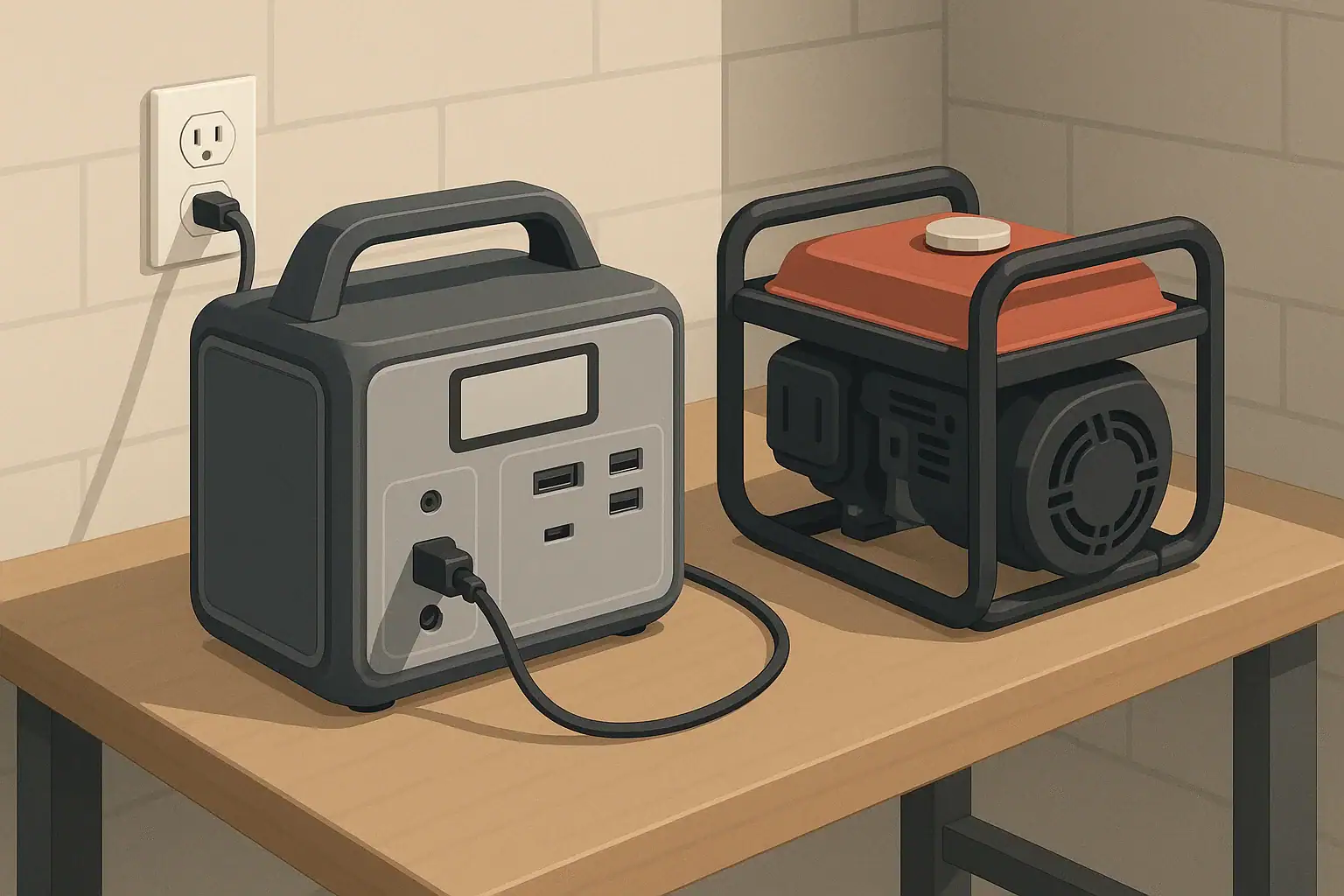
If your power station will not charge from a generator, it usually means the generator’s output is outside the power station’s safety limits for voltage, frequency, waveform, or grounding. The power station is protecting itself, not necessarily failing. You might see the input watts jump around, hear relays click on and off, get an error icon, or see no charging at all even though the generator runs normally.
This problem shows up in many situations: backup power during an outage, RV or van setups, camping, or job sites where a generator and battery power station are combined. From the outside, the plug looks just like a wall outlet, but the quality of generator power can be very different from grid power. Understanding what your power station expects and what your generator actually delivers is the key to fixing the issue safely.
The guide below explains why a power station rejects generator power, how to troubleshoot step by step, and how to choose generator and power station specs that play well together without unsafe workarounds.
What it means when a power station won’t charge from a generator
When a portable power station refuses to charge from a generator, the internal charger is detecting something “out of spec” and shutting itself down. Instead of accepting power like it does from a standard wall outlet, it may:
- Show zero or very low input watts on the display
- Start charging briefly, then stop and repeat in a loop
- Display a generic AC input or fault icon
- Stay completely idle even though the generator outlet works with other devices
Inside the power station, electronics constantly monitor:
- Voltage – Is it close to the expected 120 V (in North America) or within the rated range?
- Frequency – Is it near 60 Hz and reasonably stable?
- Waveform – Is it a clean sine wave or a distorted, choppy shape?
- Grounding and neutral reference – Are hot, neutral, and ground in a safe configuration?
If any of these are too far outside the design window, the charger shuts off to protect the battery and electronics. That is why a simple appliance like a light or resistive heater might work fine on the same generator outlet, while the power station refuses to charge. The light does not care about small frequency shifts or waveform distortion; the charger does.
This behavior matters because many people plan on using a generator to refill a power station during long outages or off-grid trips. If the two are not compatible, you can burn fuel for hours and still end up with a nearly empty battery.
Key concepts: power, energy, and electrical quality
To understand why a power station will or will not charge from a generator, it helps to separate three ideas:
- How big the power flow is (watts)
- How much energy you are storing (watt-hours)
- How clean and stable the electricity is (voltage, frequency, waveform, grounding)
Power vs. energy. Generator and charger ratings are usually in watts (W). Battery capacity is in watt-hours (Wh). A 1,000 Wh power station charged at a steady 500 W would need about 2 hours in a perfect world. In real use, conversion losses and tapering near full charge add time.
Efficiency and losses. When AC from the generator is converted to DC to charge the battery, some power is lost as heat. Many systems lose around 10–20%. That means a generator delivering 600 W might only produce 480–540 W of actual charging into the battery.
Surge vs. running power. Generators and inverters often list both a higher “starting” or “surge” watt rating and a lower “running” watt rating. The running rating is what really matters for continuous charging. If other loads share the generator, the combined running load can push the generator near its limit and cause voltage dips or frequency swings that upset the power station.
Electrical quality. Most power stations sold in North America are designed for something close to utility power: roughly 120 V, 60 Hz, and a reasonably clean sine wave. Small non-inverter generators can wander outside these limits, especially when loads cycle on and off. Some also have a floating neutral or unusual grounding arrangement that triggers safety checks inside the power station.
The table below gives a simple way to think about sizing and electrical quality when pairing a generator and power station.
| Item to compare | What to look for | Typical example target |
|---|---|---|
| Power station AC charge rate | Maximum watts it can draw from AC input | Example: 500 W AC charging |
| Generator running watts | Continuous output, not surge rating | At least 1.5× charge rate (e.g., 750+ W) |
| Other loads on generator | Appliances that run at the same time | Keep total below ~70% of running watts |
| Voltage stability | How much voltage sags under load | Stay roughly within 110–125 V while charging |
| Frequency stability | How close it stays to 60 Hz | Minimal drift when loads turn on/off |
| Waveform type | Sine wave quality from generator | Inverter-style outputs are usually cleaner |
| Grounding / neutral reference | Clear, documented configuration | Matches what the power station manual expects |
Real-world examples of generator and power station behavior
Concrete scenarios make it easier to see why a power station sometimes charges well and sometimes refuses.
Example 1: Mid-sized power station and a right-sized generator
Imagine a power station with about 1,000 Wh of capacity and a maximum AC charge rate of 600 W. It is paired with a generator rated for 2,000 running watts. No other loads are connected.
- The power station starts at 20% state of charge.
- It quickly ramps up to around 550–600 W of input.
- The generator’s engine note changes slightly as it takes the load, then stays steady.
- After roughly 1.5–2 hours, the power station begins to taper down to 300 W, then 150 W near full.
The generator is comfortably loaded, voltage and frequency stay stable, and the power station charges without interruption.
Example 2: Small generator plus cycling appliances
Now take the same power station, but pair it with a 1,000 running watt generator. At the same time, a refrigerator (with a compressor) and some lights are running from the generator.
- The power station tries to pull 500–600 W, the fridge runs at about 120 W, and lights add another 50 W.
- When the fridge compressor starts, it briefly needs several hundred extra watts.
- The generator voltage dips, frequency sags below 60 Hz, and the engine bogs down.
- The power station senses the disturbance and shuts off charging or drops to a much lower input.
To the user, it looks like the power station “won’t charge” or charges only in short bursts. In reality, the generator is being overloaded in short spikes, and the power station is reacting to unstable power.
Example 3: Waveform quality and light loads
Consider a non-inverter generator running a very light load: only the power station. Some generators produce a more distorted waveform at low loads. The power station’s charger samples the waveform and decides it is too noisy or irregular.
- The charging icon appears, input watts briefly climb to 100–200 W.
- Within a few seconds, the input drops back to zero.
- This cycle repeats, sometimes accompanied by quiet clicking from internal relays.
A simple work light plugged into the same generator outlet glows normally, so it is tempting to blame the power station. But the underlying cause is waveform distortion that the light does not care about and the charger does.
Example 4: Grounding and neutral reference confusion
In another scenario, a generator with a floating neutral is used to charge a power station through a transfer device or power strip. The power station checks the relationship between hot, neutral, and ground. Because the neutral is not bonded in the way the device expects, it flags a fault and refuses to draw current.
- A plug-in tester might show an unusual or “open ground” pattern.
- The power station may show an AC fault symbol but no detailed error code.
- Other basic tools or heaters run fine from the same outlet.
Here the issue is not wattage at all; it is the grounding and bonding arrangement. Solving it safely usually requires understanding the generator’s design and, where permanent connections are involved, help from a qualified electrician.
Common mistakes and troubleshooting cues
Most charging problems between a generator and power station boil down to a few repeatable mistakes. Recognizing them speeds up troubleshooting and reduces the temptation to use unsafe workarounds.
Mistake 1: Assuming watt rating alone guarantees compatibility
Seeing that a generator is “bigger” in watts than the power station’s charge rate does not guarantee stable charging. If the generator’s voltage and frequency wander significantly under load, the power station may still shut down.
How to check: Listen to the generator. If the engine repeatedly surges up and down or sounds like it is hunting for a steady speed while the power station is plugged in, the power output is probably unstable.
Mistake 2: Using eco / idle modes while charging
Economy or idle-down modes let the generator slow the engine when loads are light. When the power station changes its input current, the generator has to speed up or slow down, and frequency can briefly drift out of range.
- Charging may start, then stop when the generator changes speed.
- The power station may never reach its full rated input.
Fix: Temporarily turn off eco mode and run the generator at a constant speed while testing. If charging becomes stable, you have found the cause.
Mistake 3: Thin or very long extension cords
Undersized cords add resistance and cause voltage drop. When the power station tries to pull near its maximum input, the voltage at its plug can fall below the acceptable range, even though the generator itself is fine.
Fix: Use a short, heavy-gauge outdoor cord rated for the current. If charging improves when you switch cords or plug in directly, cord voltage drop was part of the problem.
Mistake 4: Stacking multiple cycling loads on one small generator
Refrigerators, freezers, pumps, and air conditioners have high startup surges. When they kick on while a power station is charging, the brief overload can cause enough disturbance for the power station to shut down.
Fix: Test with the power station as the only load. If it charges normally alone but not with other appliances, you need either a larger generator or a different load schedule.
Mistake 5: Trying to “force” charging by altering grounding
Some users are tempted to modify plugs, defeat safety features, or add improvised bonding jumpers to make a stubborn setup work. This can create shock and fire hazards and may still not solve the underlying compatibility issue.
Fix: Treat grounding and bonding as safety-critical. If grounding appears to be the issue (for example, GFCI outlets trip or testers show unusual patterns), consult documentation and, for permanent or whole-house setups, a licensed electrician.
The table below summarizes common symptoms and likely causes to guide your troubleshooting.
| What you see or hear | Likely cause | First thing to try |
|---|---|---|
| Charging starts, then stops every few seconds | Unstable voltage or frequency, often from eco mode or overload | Turn off eco mode and remove other loads |
| No charging, but simple tools work fine | Waveform distortion or grounding/neutral configuration | Test with a different generator or outlet if available |
| Generator engine surges or bogs when charging begins | Generator near capacity or poor engine tuning | Reduce charging rate if adjustable, or use larger generator |
| Input watts much lower than expected | Voltage drop in long/thin cords or generator running at low voltage | Use a shorter, heavier cord or plug in directly |
| GFCI outlet trips when power station is plugged in | Ground fault, leakage current, or incompatible bonding | Stop using that configuration and investigate grounding |
| Charging fine at first, then stops after warming up | Overheating in generator, cord, or power station | Improve ventilation and check for hot plugs or cables |
Safety basics when pairing a generator and power station
Charging a power station from a generator adds extra cords, equipment, and fuel into the picture. A few high-level safety practices make a big difference.
- Never run fuel-powered generators indoors. Operate them outside, far from doors, windows, and vents. Carbon monoxide is odorless and deadly.
- Keep the power station dry. Place it where rain, puddles, and spray cannot reach it. Moisture plus AC power is a shock and corrosion risk.
- Ensure good ventilation. Both generator and power station need clear airflow. Blocked vents can cause overheating and automatic shutdowns.
- Use proper cords. Heavy-duty, outdoor-rated extension cords sized for the current reduce overheating and voltage drop.
- Do not modify plugs or bypass safety devices. Cutting ground pins, using cheater adapters, or defeating GFCI protection can create serious hazards.
- Respect temperature limits. Charging batteries in very high or very low temperatures can shorten life or trigger protective shutdowns.
If you plan to integrate a generator and power station into a home backup system using transfer equipment, the design and installation should follow electrical codes and typically involve a licensed electrician. The goal is not only to make things work, but to keep people and property safe.
Maintenance and long-term reliability
Even a perfectly matched generator and power station can behave badly if one of them is poorly maintained. Small issues like stale fuel or clogged air filters can turn into voltage and frequency instability that the power station interprets as unsafe power.
Generator maintenance for stable output
- Run the generator periodically. Exercise runs with a moderate load keep carburetors cleaner and reveal problems before an emergency.
- Keep fuel fresh. Old fuel can cause rough running, surging, and stalling, all of which affect power quality.
- Follow oil and filter schedules. Poor lubrication and airflow can cause overheating and engine speed fluctuations.
Power station care for consistent charging
- Store at a partial state of charge. Many lithium-based batteries prefer storage around the middle of their charge range.
- Avoid extreme heat and cold. Very high or very low temperatures accelerate aging and can trigger protective limits.
- Inspect ports and cables. Dirt, corrosion, or bent pins can cause intermittent connections that look like charging problems.
It can be helpful to keep simple notes: which generator you used, approximate load, how many watts the power station showed while charging, and how long a typical recharge took. Over time, noticeable changes can point to developing issues before they become failures.
Practical takeaways and specs to look for
When a power station will not charge from a generator, it is almost always a compatibility or power-quality issue, not a random mystery. The power station is doing its job by rejecting voltage, frequency, waveform, or grounding conditions that fall outside its design window.
Before buying or pairing equipment, or when diagnosing a stubborn setup, use the following practical checklist.
Step-by-step troubleshooting checklist
- Test the power station as the only load on the generator.
- Turn off eco / idle modes and let the generator run at constant speed.
- Use a short, heavy-gauge cord or plug in directly to reduce voltage drop.
- Listen for engine surging; if it hunts or bogs, reduce load or service the generator.
- Feel cords and plugs for excess heat; warm is normal, hot is not.
- If GFCI devices trip or indicators show unusual grounding, stop and investigate rather than bypassing safety.
Specs to look for when planning a generator + power station setup
- Generator running watts: At least 1.5 times the power station’s maximum AC charge rate, plus headroom for any other loads.
- Generator type: Models designed to produce a stable, low-distortion sine wave are generally more compatible with sensitive chargers.
- Voltage regulation: Look for stable output within the expected range under varying loads.
- Frequency stability: The closer it stays to 60 Hz under changing loads, the better.
- Documented grounding/neutral configuration: Clear information on whether the neutral is bonded or floating helps avoid surprises with GFCI protection and power station safety checks.
- Power station AC input rating: Know the maximum watts it can accept and whether the charge rate is adjustable.
- Operating temperature range: Ensure both generator and power station will be used within their recommended temperature limits.
By matching these specs thoughtfully, maintaining both pieces of equipment, and following basic safety practices, you can turn a frustrating “won’t charge from generator” situation into a reliable, repeatable part of your backup or off-grid power plan.
Primary reference: OSHA’s portable-generator grounding guidance provides background on grounding and bonding. Accepted voltage, frequency, waveform, and neutral behavior remain model-specific and should be verified in both manuals.
Frequently asked questions
Which generator and power-station specifications most affect whether charging will work?
Key specs are the power station’s AC charge rate and the generator’s continuous (running) watts, waveform quality (inverter vs. non-inverter), voltage regulation, frequency stability, and the generator’s grounding/neutral configuration. Ensuring the generator has ample headroom (commonly 1.5× the charge rate) and a clean, stable sine-wave output reduces the chance the charger will reject the input.
Can running a generator in eco or idle mode prevent my power station from charging?
Yes. Eco or idle modes allow engine speed to change with light loads, which can cause brief voltage and frequency shifts when the charger changes current. Temporarily disabling eco mode and running the generator at a steady speed during testing often shows whether this is the problem.
Is it safe to modify grounding or use adapters to force a power station to charge?
No. Altering grounding, cutting ground pins, or bypassing safety devices can create serious shock and fire hazards and may not fix the underlying compatibility issue. For persistent grounding or bonding questions—especially in permanent or whole-house setups—consult documentation and a licensed electrician.
How can I tell if waveform distortion or frequency instability is causing the charger to refuse power?
Typical signs include charging that starts briefly and then stops, fluctuating input watts, and audible relay clicks inside the power station, while simple resistive loads run fine. To confirm, test the power station as the only load, try a different generator or outlet if available, and observe whether disabling eco mode or increasing load stability changes the behavior.
Will a small portable generator ever reliably charge a medium-sized power station?
Possibly, but only if the generator’s running watts comfortably exceed the power station’s maximum AC charge rate and its output remains stable under load. In practice, undersized generators or ones with poor regulation often cause intermittent charging, so choosing a generator with adequate headroom and good voltage/frequency control is important.
What are the quickest troubleshooting steps to get my power station charging from a generator?
Start by testing the power station as the only load, turn off eco/idle modes, and plug in with a short, heavy-gauge cord or directly into the generator. Listen for engine hunting, watch input watts, feel for hot plugs or cables, and stop if GFCI trips or grounding indicators show faults—investigate those rather than bypassing protection.
Related guides
Browse this topic →
- Beginner-friendly sizing, runtime & specs
- Solar & charging (MPPT, fast charging, cables)
- Batteries (LiFePO4, cycles, care & storage)
- Safety, cold-weather performance, real-world tips
More in Charging
See all →- Can You Daisy-Chain Portable Power Stations? Why It Usually Isn’t a Good Idea
- USB-C Input vs AC Input on Portable Power Stations: Which Charging Method Makes Sense?
- Car Alternator Charging vs Cigarette Lighter Charging: What Changes for Power Stations?
- Charging a Portable Power Station From an RV Outlet: 12V, 24V, and Safety Limits
- Fast AC Charging vs Battery Longevity: Should You Use Turbo Mode Every Time?
Keep reading
About this site
Portable Energy Lab publishes practical, independent guides about portable power—clear sizing, safe use, and real-world expectations.
Affiliate disclosure
Some links on this site may be affiliate links. If you buy through these links, we may earn a small commission at no extra cost to you. This helps support our content. Read our affiliate disclosure.