
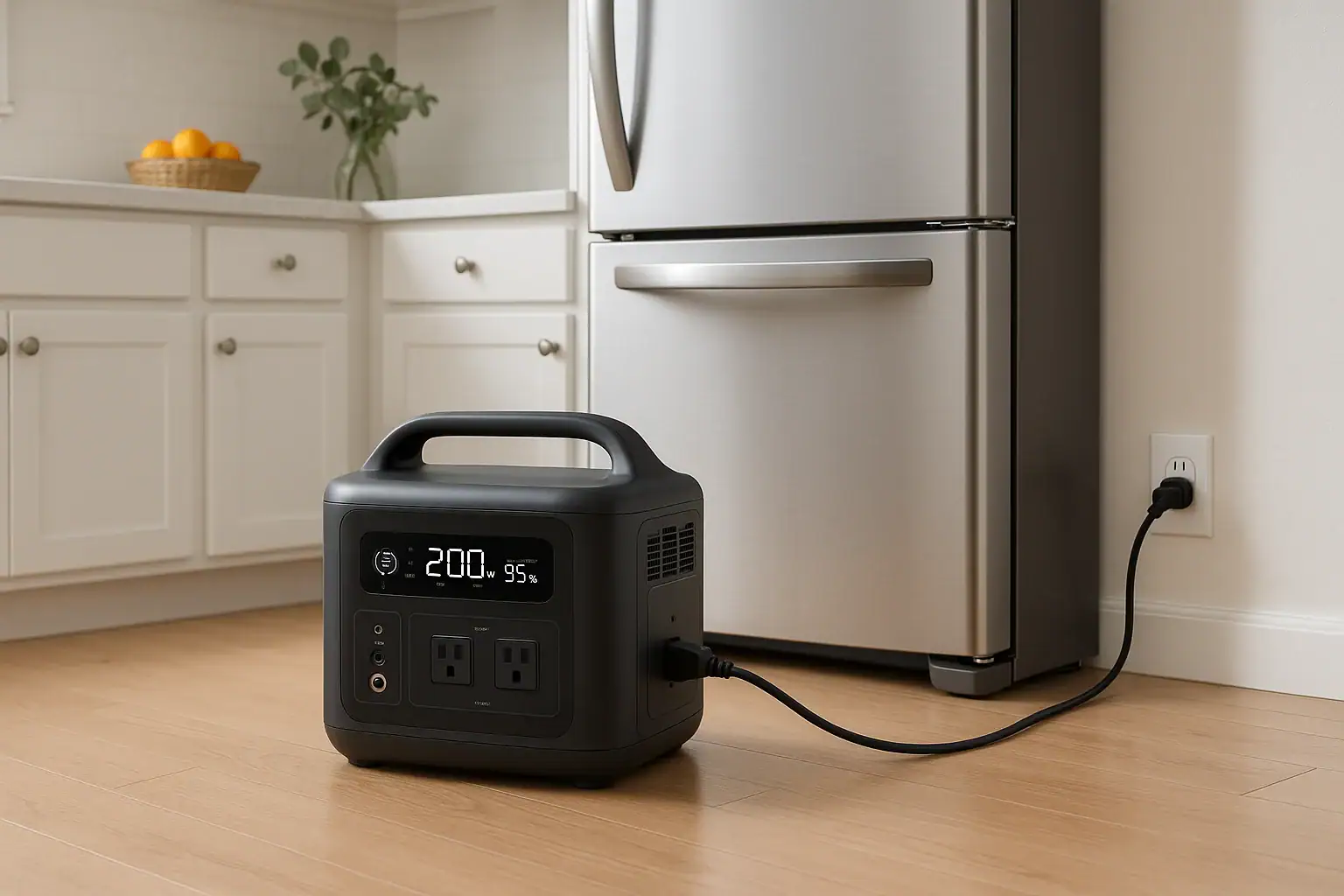
Yes, a portable power station can run a refrigerator, but only if its inverter wattage, surge watts, and battery capacity are matched to the fridge’s power draw and startup surge. To avoid overloads and short runtime, you need to understand running watts, surge watts, watt-hours, and duty cycle before you plug in. Many people search for terms like refrigerator wattage, power station size, surge rating, runtime calculator, and backup power for fridge because they want a simple, reliable answer.
In practical terms, small and efficient refrigerators are easy to run, while older or larger units may trip the inverter or drain the battery very quickly. The key is to compare your fridge’s label (or measured watts) to the portable power station’s continuous and peak output, then estimate runtime based on real-world cycling. Once you know what to look for, you can choose a setup that keeps food cold safely during outages or off-grid trips without guessing.
Understanding Whether a Portable Power Station Can Run Your Fridge
When people ask if a portable power station can run a refrigerator, they are really asking about three things: Can it start the compressor, can it keep it running, and for how long can it maintain safe temperatures? All three depend on the relationship between the refrigerator’s power needs and the power station’s capabilities.
A refrigerator does not draw a steady amount of power. It has two basic power levels:
- Startup (surge) watts: A short spike when the compressor kicks on.
- Running watts: The lower, steady draw once the compressor is running.
A portable power station has two matching ratings:
- Continuous (running) output: How many watts it can provide steadily.
- Peak (surge) output: A higher short-term wattage it can supply for startup surges.
It also has a battery capacity, usually listed in watt-hours (Wh), which tells you how much energy is stored. This is what determines runtime. If your refrigerator’s running watts are too close to the power station’s continuous limit, or its startup surge exceeds the peak output, the fridge may not start or may shut off the power station.
Understanding these basic definitions matters because it helps you quickly decide if your existing portable power station is suitable, or what size you would need for reliable home backup or off-grid use.
How Portable Power Stations Actually Run a Refrigerator
A portable power station is essentially a battery with a built-in inverter and charging electronics. To run a refrigerator, it must convert its internal DC battery power into AC power that mimics a household wall outlet.
Here is how the process works at a high level:
- Battery stores energy: The battery capacity in watt-hours tells you how much energy is available.
- Inverter outputs AC power: The inverter converts DC to AC at a specific voltage and frequency, providing continuous and surge watts.
- Fridge compressor cycles: The refrigerator’s compressor turns on and off, creating periods of higher and lower power draw.
- Duty cycle determines average draw: Over an hour, the fridge may only run its compressor part of the time, so its average watt draw is lower than its running watts.
To estimate whether a portable power station can run your refrigerator:
- Check fridge running watts: Many residential refrigerators use roughly 80–200 watts while running, though this varies.
- Check startup surge: Startup can be 2–3 times running watts, sometimes more for older units.
- Compare to inverter ratings: The power station’s continuous watts must exceed running watts, and surge watts must exceed startup watts.
- Estimate runtime from capacity: Divide battery watt-hours by the fridge’s average watt draw (not peak) to get a rough runtime in hours.
Because refrigerators cycle, their true energy use over time is better described in watt-hours per day or kWh per day. A portable power station with enough surge power but too little battery capacity may start the fridge just fine but only keep it cold for a short period.
| Appliance / Spec | Running Watts (approx.) | Startup Surge (approx.) | Daily Energy Use |
|---|---|---|---|
| Compact mini fridge | 50–80 W | 120–200 W | 0.3–0.6 kWh/day |
| Modern full-size fridge | 80–200 W | 300–800 W | 0.8–1.5 kWh/day |
| Older full-size fridge | 150–300 W | 600–1200 W | 1.5–2.5 kWh/day |
| Portable power station (example) | 500–1500 W continuous | 750–3000 W surge | 500–2000 Wh capacity |
Examples: What Size Power Station for Different Refrigerators?
Looking at real-world examples makes it easier to see what works and what does not. The exact numbers will vary by model and efficiency, but these scenarios show typical relationships between refrigerators and portable power stations.
Running a compact mini fridge
A small dorm-style fridge might use around 60 watts while running, with a 150-watt startup surge. If it runs its compressor 30% of the time, its average draw could be around 20 watts.
- Inverter requirement: A portable power station with at least 150–200 watts continuous and 250–300 watts surge should be able to start and run it comfortably.
- Runtime example: A 500 Wh power station divided by 20 watts average draw suggests about 25 hours of runtime, assuming the fridge is already cold and doors stay mostly closed.
Running a modern full-size refrigerator
A typical modern full-size unit might draw 120 watts running, with a 500-watt startup surge, and an average hourly draw around 40–60 watts depending on usage and ambient temperature.
- Inverter requirement: A power station with at least 300–500 watts continuous and 800–1000 watts surge is usually needed for reliable starting.
- Runtime example: With a 1000 Wh battery and 50 watts average draw, you might see around 20 hours of operation. Real-world results can be lower due to inverter losses and higher cycling in hot rooms.
Running an older or less efficient full-size fridge
Older refrigerators can be far more demanding, sometimes drawing 200–300 watts running and 800–1200 watts or more at startup.
- Inverter requirement: A portable power station with 800–1200 watts continuous and 1500–2000 watts surge may be needed. Some older units may be difficult to start with smaller inverters.
- Runtime example: With a 1500 Wh battery and 120 watts average draw, runtime might be around 10–12 hours, again reduced by system losses.
Adding other loads with the refrigerator
Many people want to power lights, routers, or small electronics along with a fridge. Every added device draws from the same limited continuous wattage and battery capacity.
- Continuous wattage margin: If your fridge uses 120 watts running and your power station is rated for 500 watts continuous, you have roughly 380 watts left for other devices.
- Battery sharing: A 1000 Wh battery powering a 50-watt average fridge plus 50 watts of other loads is now supporting 100 watts average, cutting runtime roughly in half.
These examples show why it is important not only to match surge watts but also to size the battery capacity to your expected outage length, fridge efficiency, and additional loads.
Common Mistakes When Running a Refrigerator on a Portable Power Station
Many problems people experience—like the fridge not starting, shutting off unexpectedly, or draining the battery much faster than expected—come from a few recurring mistakes.
Underestimating startup surge
- Issue: Choosing a portable power station based only on the fridge’s running watts.
- Result: The compressor tries to start, the surge exceeds the inverter’s peak rating, and the power station shuts down or never starts the fridge.
- Troubleshooting cue: The power station display spikes and then shows an overload or error code when the fridge cycles on.
Ignoring duty cycle and average draw
- Issue: Calculating runtime by dividing battery watt-hours by the fridge’s running watts instead of its average draw over time.
- Result: Expecting much longer runtimes than are realistic, especially in hot weather or when doors are opened frequently.
- Troubleshooting cue: Actual runtime is far shorter than your initial rough calculation.
Overloading the power station with extra devices
- Issue: Plugging in multiple high-draw devices (like microwaves or space heaters) along with the refrigerator.
- Result: The combined load exceeds continuous wattage, causing overload shutdowns or tripped protection.
- Troubleshooting cue: System works with just the fridge, but fails when other appliances are added.
Starting the fridge from warm instead of already cold
- Issue: Expecting the portable power station to cool a fully warm fridge or freezer from room temperature.
- Result: The compressor runs nearly continuously at higher power draw, draining the battery much faster.
- Troubleshooting cue: Battery level drops rapidly during the first few hours of operation.
Using long or undersized extension cords
- Issue: Running the fridge through very long, thin-gauge extension cords.
- Result: Voltage drop and heat in the cord, which can affect performance and safety.
- Troubleshooting cue: Cord feels warm, or the fridge behaves erratically when far from the power station.
Avoiding these mistakes starts with realistic power measurements, conservative sizing of the power station, and limiting extra loads when running a refrigerator.
Safety Basics When Powering a Refrigerator from a Portable Power Station
Running a refrigerator from a portable power station is generally safer than using a fuel-powered generator, but there are still important safety practices to follow.
- Use grounded outlets properly: Plug the refrigerator directly into the power station’s AC outlet or a suitable heavy-duty extension cord rated for the load.
- Avoid backfeeding house wiring: Do not attempt to connect the power station to household circuits or panels without a proper transfer mechanism installed by a qualified electrician.
- Maintain ventilation: Keep the power station in a well-ventilated area, away from heat sources and direct sunlight, to avoid overheating.
- Protect from moisture: Place the power station off the floor in case of spills or leaks from the refrigerator, and keep it away from sinks or damp areas.
- Monitor temperature and load: Watch the inverter temperature indicators and output wattage. If the unit becomes hot or shows repeated overloads, reduce the load and allow it to cool.
- Respect rated limits: Do not exceed the listed continuous or surge ratings, and avoid daisy-chaining multiple adapters or power strips with heavy loads.
If you plan to integrate a portable power station more permanently into your home backup setup, consult a licensed electrician for safe, code-compliant options that do not involve improvised connections.
Maintaining Your Portable Power Station for Reliable Fridge Backup
To trust a portable power station with something as critical as keeping food cold, you need it to be ready and reliable over time. Proper maintenance and storage practices directly affect how well it will perform during an outage.
Battery care and storage
- Keep charge within recommended range: Many units perform best when stored around a partial state of charge rather than 0% or 100% for long periods. Follow the manufacturer’s guidance.
- Recharge periodically: Top up the battery every few months if it is not in regular use so it does not self-discharge to damaging levels.
- Store in moderate temperatures: Avoid leaving the power station in very hot or freezing environments, such as attics or unconditioned sheds, which can shorten battery life.
Keeping the inverter and outlets in good condition
- Inspect ports and cables: Check AC outlets and cords for signs of wear, looseness, or heat discoloration before relying on them for refrigerator loads.
- Keep vents clear: Dust and debris can block cooling vents. Gently clean around vents so the inverter can dissipate heat effectively.
Testing your setup before you need it
- Do a trial run: Connect your refrigerator to the portable power station during normal conditions to confirm it starts, runs, and cycles without overloads.
- Measure real-world draw: Use the power station’s display or a plug-in power meter to see actual watts and estimate realistic runtime.
- Note startup behavior: Pay attention to how high the wattage spikes when the compressor kicks on and how the power station responds.
Fridge-side habits that extend runtime
- Pre-cool before outages: Keeping the refrigerator and freezer at proper temperatures before an outage reduces compressor run time on backup power.
- Minimize door openings: Each opening lets in warm air, increasing compressor workload and battery use.
- Load the fridge sensibly: A reasonably full fridge retains cold better than an almost empty one, but do not block airflow around internal vents.
Combining good power station maintenance with efficient refrigerator use can significantly extend how long your stored energy will keep food safe.
| Practice | Recommended Approach | Impact on Performance |
|---|---|---|
| Battery top-up interval | Every 3–6 months | Helps preserve capacity for emergencies |
| Storage temperature | Roughly 50–77°F (10–25°C) | Reduces battery aging and inverter stress |
| Test run duration | At least 1–3 full compressor cycles | Confirms surge handling and real runtime |
| Ventilation clearance | Several inches around vents | Prevents thermal throttling and shutdowns |
Related guides: Portable Power Station Buying Guide • Portable Power Station Terminology Explained • Portable Power Station Basics: Outputs, Inputs, and What the Numbers Mean
Key Takeaways and Specs to Look For When Matching a Power Station to a Refrigerator
Whether a portable power station can run your refrigerator depends on both power and energy: the inverter must handle the fridge’s startup surge and running watts, and the battery must hold enough watt-hours to cover the hours of runtime you need. Smaller, efficient fridges are relatively easy to support, while older or larger units may require higher-wattage inverters and larger batteries. Real-world factors like door openings, room temperature, and additional loads can significantly change runtime compared with simple calculations.
For home use, planning around your typical outage duration and your refrigerator’s actual energy use will help you decide if a single portable power station is enough, or if you should plan for supplemental charging or additional capacity. Careful sizing and realistic expectations are the best way to avoid overloads, short runtimes, and food spoilage when you rely on battery backup.
Specs to look for
- Continuous AC output (watts): Look for a rating comfortably above your fridge’s running watts (often 300–1000 W range). This ensures the compressor can run without overloading the inverter.
- Surge / peak output (watts): Aim for at least 2–3 times the fridge’s running watts (commonly 800–2000 W). Adequate surge capacity is critical for starting the compressor.
- Battery capacity (Wh): Choose enough watt-hours to cover your desired runtime (for many households, 1000–2000 Wh or more). Higher capacity means longer operation between charges.
- Inverter waveform: A pure sine wave inverter is preferable for compressors. It helps the refrigerator motor run smoothly and can reduce noise and heat.
- Display and monitoring: Look for a clear readout of watts in/out and state of charge. Real-time data makes it easier to manage runtime and avoid surprises.
- AC outlet rating and count: Ensure individual outlets are rated for the fridge’s draw and that you have enough outlets for any additional low-wattage devices.
- Recharging options: Consider AC, solar, and vehicle charging inputs. Multiple options make it easier to replenish energy during extended outages.
- Thermal management and protections: Overload, over-temperature, and short-circuit protection, plus good ventilation design, help protect both the power station and your appliances.
- Operating temperature range: Check that the unit can operate reliably in the temperatures typical for your storage and use locations, such as warm kitchens or garages.
By matching these specs to your refrigerator’s actual needs and your outage scenarios, you can select and use a portable power station that provides practical, dependable backup for keeping food cold.
For another motor load with an even more demanding start, compare these refrigerator calculations with high-inrush sump pump loads.
Frequently asked questions
What specifications and features matter when choosing a portable power station for a refrigerator?
Key specs are continuous (running) watts, surge/peak watts, and battery capacity in watt-hours. Look also for a pure sine wave inverter, clear load/SoC monitoring, adequate outlet ratings, and thermal and overload protections to ensure reliable starting and safe operation.
How long will a portable power station typically run my refrigerator?
Runtime depends on the fridge’s average watt draw and the station’s watt-hour capacity; divide the battery Wh by the average watts to estimate hours, and account for inverter losses. Real-world factors like ambient temperature and door openings can reduce actual runtime.
Why does my power station sometimes shut down when the refrigerator compressor starts?
That usually indicates the fridge’s startup surge exceeds the power station’s peak/surge rating or the combined load triggers overload protection. Choosing a unit with higher surge capacity and avoiding other heavy loads during startup prevents shutdowns.
Is it safe to run a refrigerator from a portable power station indoors?
Yes, it is generally safe if you use grounded connections, avoid backfeeding home wiring, keep the station ventilated and dry, and respect the unit’s rated limits. For any permanent integration or complex setups, consult a licensed electrician.
Can I use a standard extension cord or power strip to connect my refrigerator to a power station?
Use a short, heavy-gauge extension cord rated for the refrigerator’s draw; avoid thin, long cords and power strips for high-draw appliances. Undersized cords can cause voltage drop, heat buildup, and erratic performance.
Will running a refrigerator on a power station damage the fridge or the battery?
If the inverter and surge rating are appropriate and the station is not repeatedly overloaded or overheated, it should not damage the refrigerator. However, insufficient surge capacity, repeated thermal stress, or deep battery depletion can shorten component life or cause protection shutdowns.
Related guides
Browse this topic →
- Beginner-friendly sizing, runtime & specs
- Solar & charging (MPPT, fast charging, cables)
- Batteries (LiFePO4, cycles, care & storage)
- Safety, cold-weather performance, real-world tips
More in Home / Appliances
See all →Keep reading

About this site
Portable Energy Lab publishes practical, independent guides about portable power—clear sizing, safe use, and real-world expectations.
Affiliate disclosure
Some links on this site may be affiliate links. If you buy through these links, we may earn a small commission at no extra cost to you. This helps support our content. Read our affiliate disclosure.