
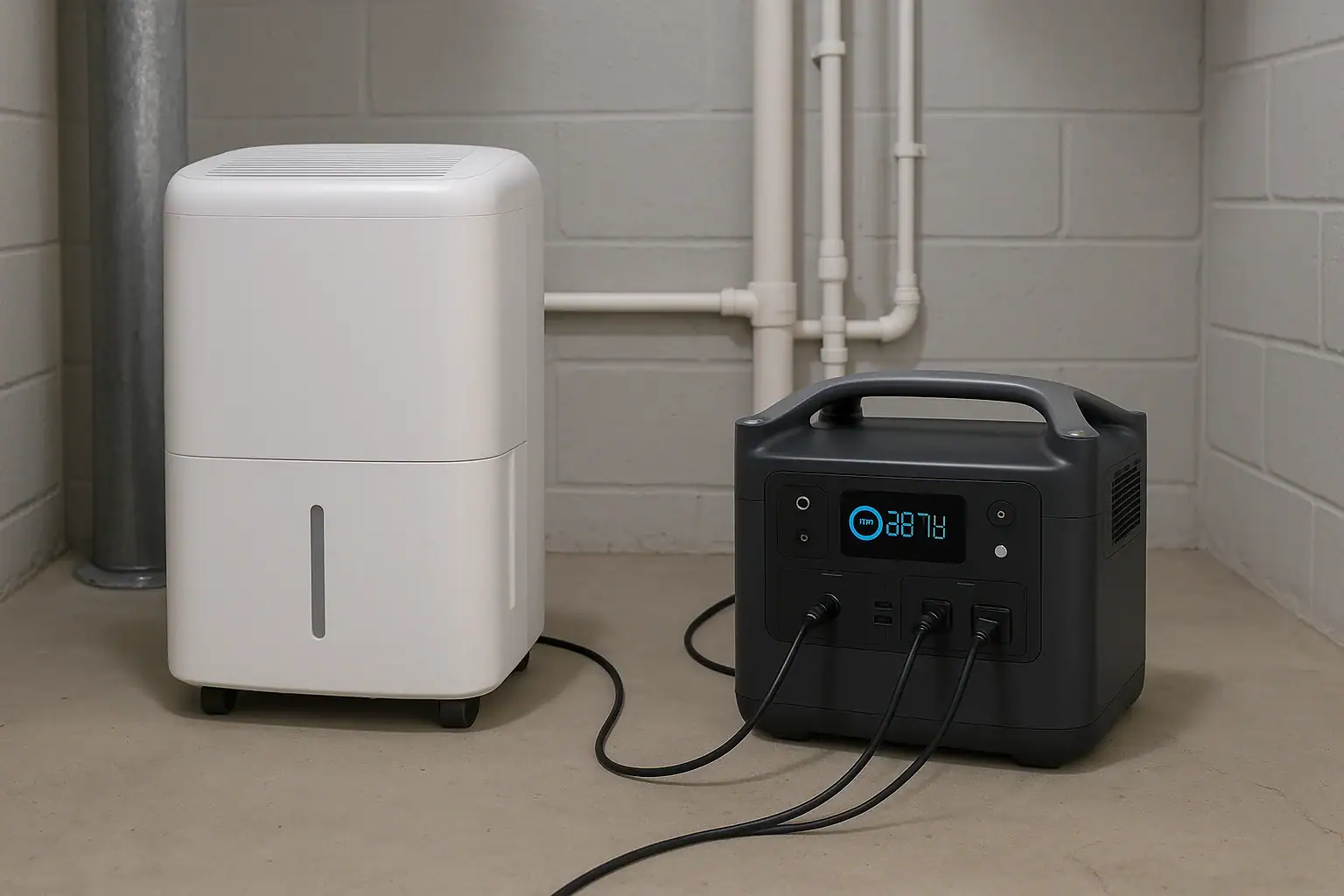
Yes, a portable power station can run a dehumidifier, but only if its inverter output, surge watts, and battery capacity match the dehumidifier’s power draw. The main limits are continuous watt rating, startup surge, and expected runtime on a single charge.
Before you plug in, you need to check the dehumidifier’s wattage or amperage, the power station’s AC output limit, and the battery’s watt-hours. These details determine whether it will start reliably, how long it will run, and whether you risk overload shutdowns. Understanding surge watts, duty cycle, and efficiency losses will help you set realistic expectations for backup power, off-grid use, or humidity control during outages.
This guide walks through what to look at on both devices, how to estimate runtime, common issues like tripping overload protection, and the safety and maintenance basics to keep both your portable power station and dehumidifier working reliably.
Can a Portable Power Station Run a Dehumidifier and Why It Matters
A portable power station can usually run a small or mid-size dehumidifier, but not every combination will work. The match depends on three core factors: the dehumidifier’s power requirements, the power station’s inverter output (continuous and surge), and the battery capacity measured in watt-hours (Wh).
Most home dehumidifiers are designed for standard wall outlets, drawing anywhere from about 200 watts for compact units to 700 watts or more for large, high-capacity models. They also use a compressor or fan motor that needs a brief surge of power at startup. Portable power stations, in contrast, have a defined maximum AC output and a finite battery that drains faster as the load increases.
This matters for several reasons:
- Outage planning: If you rely on a dehumidifier to control moisture in a basement or crawlspace, you need to know whether a power station can keep it running during blackouts.
- Mold and moisture control: In damp climates, even a few days without humidity control can lead to mold growth, musty odors, and damage to stored items.
- Off-grid and RV use: For cabins, RVs, or boats, matching your dehumidifier to your portable power station is key to avoiding drained batteries and tripped protection circuits.
Thinking in terms of watts and watt-hours instead of just “size” or “capacity” helps you answer a precise question: not just can your portable power station run a dehumidifier, but for how long and under what conditions.
Key Power Concepts: How Dehumidifiers and Portable Power Stations Match Up
To understand compatibility, you need a few basic power concepts and how they apply to both the dehumidifier and the portable power station.
Dehumidifier power ratings
Most dehumidifiers list one or more of the following on their labels or manuals:
- Watts (W): The power the unit consumes while running. Typical home units range from about 200 W to 700 W.
- Amps (A): The current draw. You can convert to watts using W = V × A. On a 120 V circuit, a 3 A unit uses roughly 360 W.
- Voltage (V): In North America, standard plug-in dehumidifiers are usually 120 V AC.
Many compressor-based dehumidifiers also have a startup surge, sometimes 2–3 times higher than their running watts, as the compressor motor kicks on.
Portable power station output ratings
Portable power stations include built-in inverters that convert DC battery power to AC power. Key specs include:
- Continuous AC output (W): The maximum wattage the power station can supply steadily. Your dehumidifier’s running watts must stay below this rating.
- Surge or peak watts: A higher short-term rating that covers motor/compressor startup. Ideally, this should be at least 2–3 times the dehumidifier’s running watts for reliable starts.
- AC voltage and waveform: Most home dehumidifiers expect 120 V pure sine wave AC. Many modern power stations provide this, but it is worth confirming in the specs.
Battery capacity and runtime
Portable power station batteries are rated in watt-hours (Wh). This number indicates how much energy the battery can store. To estimate runtime:
Estimated runtime (hours) ≈ Battery capacity (Wh) × Efficiency ÷ Load (W)
Because of inverter losses and other inefficiencies, a realistic efficiency factor is often around 0.8 (80%), though it varies by device and load.
For example, if you have a 1,000 Wh power station and a dehumidifier that draws 300 W while running:
- Effective capacity ≈ 1,000 Wh × 0.8 = 800 Wh
- Runtime ≈ 800 Wh ÷ 300 W ≈ 2.6 hours of active run time
Because dehumidifiers cycle on and off based on humidity (their duty cycle), the actual elapsed time may be longer. If it runs only half the time, your total elapsed time could be closer to 5 hours.
Duty cycle and humidity setpoints
Dehumidifiers do not usually run at full power continuously. Instead, they turn on when humidity rises above a setpoint and off when it drops below. In a very damp basement, the duty cycle may be high (70–90%). In a mildly humid room, it may be much lower (20–40%).
This cycling is why two homes with the same dehumidifier and power station can see very different runtimes. Ambient temperature, room size, and how leaky the space is to outside air all influence how often the compressor needs to run.
| Device | Typical Rating | What It Means |
|---|---|---|
| Small dehumidifier | 200–300 W running | Often suitable for mid-size portable power stations |
| Medium dehumidifier | 300–500 W running | Needs higher continuous output and surge capacity |
| Large dehumidifier | 500–800 W running | Best paired with larger, higher-output power stations |
| Portable power station | 500–2,000 W AC output | Must exceed dehumidifier running watts and startup surge |
| Battery capacity | 300–2,000+ Wh | Higher Wh provides longer dehumidifier runtime |
Putting it together
To decide if your portable power station can run your dehumidifier, you need to confirm:
- The dehumidifier’s running watts are below the station’s continuous AC output.
- The station’s surge watts comfortably cover compressor startup.
- The station’s battery capacity offers enough runtime for your needs, given how humid the space is.
Real-World Examples of Running a Dehumidifier on a Portable Power Station
Looking at a few realistic scenarios can help you understand what to expect in terms of compatibility and runtime.
Example 1: Small dehumidifier in a bedroom
Suppose you have a compact 25-pint dehumidifier rated at 220 W running, with an estimated startup surge around 400–500 W. You pair it with a portable power station rated for 600 W continuous output, 1,000 W surge, and 600 Wh of battery capacity.
- Compatibility: The dehumidifier’s 220 W is well under the 600 W continuous rating, and the 1,000 W surge rating can easily handle startup.
- Runtime: Effective capacity ≈ 600 Wh × 0.8 = 480 Wh. Runtime ≈ 480 ÷ 220 ≈ 2.2 hours of active run time.
- Real-world use: If the unit cycles about 50% of the time in a moderately humid bedroom, you might see around 4–5 hours of total elapsed time before the battery is depleted.
Example 2: Medium dehumidifier in a basement
Now consider a 40–50 pint dehumidifier rated at 420 W running, with an estimated 900–1,200 W startup surge. You use a 1,000 Wh portable power station rated for 800 W continuous, 1,600 W surge.
- Compatibility: The 420 W running draw fits within the 800 W continuous limit, and the 1,600 W surge capacity should cover compressor startup.
- Runtime: Effective capacity ≈ 1,000 Wh × 0.8 = 800 Wh. Runtime ≈ 800 ÷ 420 ≈ 1.9 hours of active run time.
- Real-world use: In a damp basement where the dehumidifier runs perhaps 70% of the time, you might see around 2.5–3 hours of total elapsed time.
Example 3: Large dehumidifier and undersized power station
Imagine a large 70-pint dehumidifier rated at 650 W running, with a 1,400–1,800 W startup surge. You try to run it on a 500 W continuous, 1,000 W surge portable power station with 800 Wh capacity.
- Compatibility: The 650 W running draw already exceeds the 500 W continuous rating. Even if it briefly starts, the power station is likely to shut down or display overload errors.
- Startup: The surge requirement can exceed 1,400 W, which is well above the 1,000 W surge rating. The unit may never start properly.
- Outcome: In this case, the answer is effectively “no” — the portable power station is undersized for this dehumidifier.
Example 4: Partial-day humidity control during an outage
Suppose you only need to keep humidity in check during the most humid part of the day. You have a 300 W dehumidifier and a 1,500 Wh power station rated for 1,000 W continuous, 2,000 W surge.
- Runtime: Effective capacity ≈ 1,500 Wh × 0.8 = 1,200 Wh. Runtime ≈ 1,200 ÷ 300 = 4 hours of active run time.
- Strategy: You might run the dehumidifier for a few hours mid-day when humidity peaks, then switch it off to conserve battery. This can be enough to prevent the space from becoming excessively damp, even if you cannot run it around the clock.
These examples show that the same portable power station can be a good match for one dehumidifier and a poor match for another. The key is always to compare wattage, surge, and battery capacity to your specific humidity control needs.
Common Mistakes and Troubleshooting When Powering a Dehumidifier
When pairing a portable power station with a dehumidifier, several recurring mistakes lead to short runtimes, overloads, or failure to start. Recognizing these issues can help you troubleshoot quickly.
Mistake 1: Ignoring startup surge
Many people only look at the dehumidifier’s running watts and assume that if it is below the power station’s continuous rating, everything will work. In reality, the compressor may need 2–3 times that power for a second or two at startup.
Symptoms:
- The dehumidifier clicks or hums but does not start.
- The portable power station beeps, shows an overload message, or shuts off when the compressor tries to engage.
What to check: Confirm the power station’s surge rating and compare it to typical startup demands for similar-sized dehumidifiers. If your surge rating is marginal, the combination may be unreliable.
Mistake 2: Underestimating runtime needs
Another common issue is assuming a dehumidifier can run “all day” on a portable power station simply because the battery capacity seems large. High continuous loads drain batteries quickly.
Symptoms:
- Battery depletes in a few hours instead of lasting through the day.
- You must frequently recharge the power station, reducing its practicality during extended outages.
What to check: Use the runtime equation (capacity × efficiency ÷ watts) and factor in duty cycle. In very humid spaces, plan for a high duty cycle and shorter total runtime.
Mistake 3: Overloading with multiple devices
Plugging additional loads into the same portable power station — such as fans, lights, or a small fridge — can push total wattage over the continuous rating.
Symptoms:
- Power station shuts off when multiple devices run together.
- Display shows wattage close to or above the maximum output rating.
What to check: Add up the running watts of all connected devices. Keep the total comfortably below the continuous rating, and consider leaving headroom for surge events.
Mistake 4: Using long, undersized extension cords
Very long or thin extension cords can cause voltage drop and additional resistance, which may affect motor startup.
Symptoms:
- Dehumidifier struggles to start or runs hot.
- Cord feels warm to the touch under load.
What to check: Use a reasonably short, appropriately rated extension cord if you must use one, and avoid coiling cords tightly under load.
Mistake 5: Running in extreme temperatures
Both portable power stations and dehumidifiers have recommended operating temperature ranges. Very cold or hot conditions can affect performance, battery capacity, and compressor operation.
Symptoms:
- Reduced runtime compared to expectations.
- Dehumidifier freezing up or shutting off unexpectedly.
What to check: Ensure the space is within the operating temperature ranges listed in the manuals. Cold basements, in particular, can reduce both battery output and dehumidifier efficiency.
Safety Basics When Running a Dehumidifier on a Portable Power Station
Using a portable power station is generally safer and simpler than using fuel-powered generators, but you still need to follow basic electrical and operational safety practices.
Avoid overloading the inverter
Consistently running a power station near or above its rated output can trigger protective shutdowns and stress components over time.
- Keep the dehumidifier’s running watts and any additional loads below the continuous rating.
- Account for startup surges and leave some headroom rather than sizing right at the limit.
Use appropriate outlets and cords
Plug the dehumidifier into the power station’s AC outlet as you would a normal wall outlet.
- Avoid daisy-chaining power strips or running multiple high-draw appliances from one outlet.
- If an extension cord is necessary, use one rated for at least the dehumidifier’s current draw and keep it as short as practical.
Keep equipment dry and ventilated
Dehumidifiers often sit in damp locations, but portable power stations should be kept away from standing water and excessive moisture.
- Place the power station on a stable, dry surface above floor level if the area is prone to minor flooding.
- Ensure the power station has adequate ventilation around its vents to avoid overheating.
Do not modify wiring or bypass protections
Portable power stations and dehumidifiers include built-in protections for a reason. Avoid opening the cases, altering cords, or attempting to hard-wire the power station into household circuits.
- If you need whole-home backup or complex wiring, consult a licensed electrician.
- Rely on the power station’s standard AC outlets and follow manufacturer guidelines.
Monitor for heat and unusual behavior
During extended use, periodically check both devices.
- Stop using the setup if you notice unusual smells, excessive heat, or intermittent shutdowns.
- Allow the power station to cool if its fans run constantly or its case feels hot.
Battery charging safety
When recharging the portable power station, follow recommended charging methods and environments.
- Avoid covering the unit while charging.
- Charge in a dry, well-ventilated area within the suggested temperature range.
| Safety Area | Key Practice | Why It Matters |
|---|---|---|
| Load management | Stay below continuous and surge ratings | Prevents overload shutdowns and component stress |
| Placement | Keep power station dry and elevated | Reduces risk in damp basements or utility rooms |
| Cabling | Use properly rated cords | Minimizes overheating and voltage drop |
| Ventilation | Leave space around vents | Helps maintain safe operating temperatures |
| Monitoring | Check for heat, smells, shutdowns | Early warning for potential problems |
Related guides: Portable Power Station Buying Guide • Portable Power Station Terminology Explained • How to Estimate Runtime for Any Device: A Simple Wh Formula + 5 Worked Examples
Maintenance and Storage Tips for Reliable Operation
To get consistent performance when running a dehumidifier from a portable power station, both devices need basic care and proper storage.
Maintaining the dehumidifier
- Clean the air filter: A clogged filter forces the fan and compressor to work harder, increasing power draw and shortening runtime. Check and clean or replace the filter according to the manufacturer’s schedule.
- Keep coils and vents clear: Dust and debris on the coils or intake/exhaust vents can reduce efficiency. Gently vacuum or wipe accessible areas while the unit is unplugged.
- Manage drainage: Ensure that the bucket or drain hose is positioned correctly to avoid leaks near the power station. Spills and standing water increase risk around electrical equipment.
- Check for icing: In cooler spaces, coils can ice up, causing the compressor to cycle inefficiently. If you see ice, allow the unit to defrost and review temperature and airflow conditions.
Maintaining the portable power station
- Periodic charging: Lithium-based batteries generally last longer if they are not stored completely full or empty for long periods. Many manufacturers recommend storing around a partial charge and topping up every few months.
- Firmware and settings: Some portable power stations allow firmware updates or configuration of eco modes and output settings. Keeping these up to date can improve efficiency and compatibility.
- Keep ports clean: Dust or moisture in AC outlets and DC ports can cause poor connections. Inspect and gently clean if necessary while the unit is off.
Storage conditions
- Temperature: Store both the power station and dehumidifier in a dry, moderate-temperature environment when not in use. Extreme heat or cold can degrade batteries and plastic components.
- Humidity: Ironically, long-term storage in very damp areas can damage electronics. If your basement is very humid, consider storing the power station in a drier part of the home when it is not actively in use.
- Physical protection: Avoid stacking heavy items on top of the power station or its cords. Keep the dehumidifier upright to protect internal components.
Testing before outages
Do not wait for a storm or extended outage to find out whether your setup works.
- Periodically test the dehumidifier on the portable power station under normal conditions.
- Observe startup behavior, wattage draw, and approximate runtime so you can plan realistically when you need backup power.
Practical Takeaways and Specs to Look For
Running a dehumidifier on a portable power station is entirely feasible, but it requires matching the right appliance to the right power source and setting realistic expectations for runtime. Small and medium dehumidifiers are generally better candidates than large, high-draw units, especially if your power station has modest output and battery capacity.
Think in terms of energy and load: wattage for compatibility, watt-hours for runtime, and duty cycle for how your specific space behaves. Pay attention to surge requirements, avoid overloading with extra devices, and use safe placement and cabling practices, particularly in damp basements or crawlspaces.
Specs to look for
- Continuous AC output (W): Look for a rating at least 25–50% higher than your dehumidifier’s running watts (for example, 600–800 W output for a 400 W unit) so it can run comfortably without constant overload risk.
- Surge/peak watt rating: Choose a power station with surge capacity roughly 2–3 times the dehumidifier’s running watts (for example, 1,200–1,500 W surge for a 500 W unit) to handle compressor startup reliably.
- Battery capacity (Wh): For meaningful runtime, look for at least 500–1,000 Wh for small units and 1,000–2,000 Wh or more for medium units; higher Wh directly translates into longer dehumidifier operation between charges.
- AC waveform and voltage: Prefer pure sine wave 120 V AC output, which closely mimics household power and is better suited for compressor motors and electronics inside dehumidifiers.
- Inverter efficiency: Higher efficiency (often around 80–90%) means more of the stored energy becomes usable runtime; this can add noticeable extra operating time over the life of the system.
- Display and monitoring: A clear wattage and remaining-time display helps you see real-time load and adjust usage, preventing unexpected shutdowns and allowing better planning during outages.
- Operating temperature range: Check that the power station’s recommended operating range matches the environment where you will run the dehumidifier, especially in cool basements or warm utility rooms.
- AC outlet count and rating: Ensure there are enough outlets and that each is rated for the dehumidifier’s current draw, leaving room for low-wattage accessories like a small fan or light if needed.
- Recharge options and speed: Faster AC charging or solar input capability can be useful if you need to run the dehumidifier day after day during extended outages or off-grid stays.
By comparing these specs with your dehumidifier’s label and your humidity control needs, you can determine whether a portable power station will be a practical and reliable way to keep your space dry when grid power is unavailable.
Frequently asked questions
What specifications and features should I check when pairing a portable power station with a dehumidifier?
Check the power station’s continuous AC output, surge/peak watt rating, battery capacity in watt-hours, AC waveform (prefer pure sine wave), and inverter efficiency. Also confirm outlet ratings and the unit’s operating temperature range to ensure reliable starts and expected runtime.
How do I calculate how long a portable power station will run a dehumidifier?
Estimate runtime using (battery Wh × efficiency) ÷ running watts, then factor in the dehumidifier’s duty cycle since it cycles on and off. Typical efficiency assumptions are around 0.8–0.9; adjusting for duty cycle gives elapsed time rather than just active runtime.
Why won’t my dehumidifier start when plugged into a portable power station?
Often the power station lacks sufficient surge capacity to handle the compressor’s startup current, causing the inverter to click or shut down. Voltage drop from an undersized or long extension cord and protective overload features can also prevent startup.
Is it safe to place a portable power station in a damp basement while running a dehumidifier?
Keep the power station on a dry, elevated surface with adequate ventilation and away from standing water or dripping hoses; moisture exposure increases risk to battery and electronics. Follow the manufacturer’s recommended operating ranges and avoid covering vents or placing the unit in direct contact with damp surfaces.
Can I run other appliances at the same time as my dehumidifier on the same power station?
Yes, if the combined running watts stay comfortably below the station’s continuous rating and you leave headroom for surge events; add the wattage of all connected devices to verify. Running multiple high-draw appliances together will shorten runtime and can trigger overload protections.
Will cold temperatures affect battery life and the dehumidifier’s performance?
Cold temperatures reduce battery capacity and can cause dehumidifier coils to ice up, which decreases effectiveness and may increase runtime. Check both devices’ recommended temperature ranges and avoid operating them outside those limits when possible.
Recommended next:
- Portable Power Stations for Apartments
- Portable Power Stations for RV and Motorhomes
- Can a Portable Power Station Run a Microwave? What to Check Before You Try
- Can a Portable Power Station Run a Space Heater? Realistic Limits
- Can a Portable Power Station Run an Air Conditioner? Sizing and Expectations
- Powering a Coffee Maker, Kettle, or Induction Cooktop: What Works and Why
- More in Home / Appliances →
Related guides
Browse this topic →
- Beginner-friendly sizing, runtime & specs
- Solar & charging (MPPT, fast charging, cables)
- Batteries (LiFePO4, cycles, care & storage)
- Safety, cold-weather performance, real-world tips
More in Home / Appliances
See all →- Running a Pellet Stove During a Power Outage: Starting Surge, Runtime, and Safe Setup
- What Size Portable Power Station for a Chest Freezer? Runtime Planning for Outages
- Portable Power Station for Starlink: Power Draw, Runtime, and What Specs Matter
- Powering a TV and Streaming Setup: Estimating Runtime Without Guessing
- Using a Portable Power Station as Emergency Lighting: Efficient Options
Keep reading
About this site
Portable Energy Lab publishes practical, independent guides about portable power—clear sizing, safe use, and real-world expectations.
Affiliate disclosure
Some links on this site may be affiliate links. If you buy through these links, we may earn a small commission at no extra cost to you. This helps support our content. Learn more.