
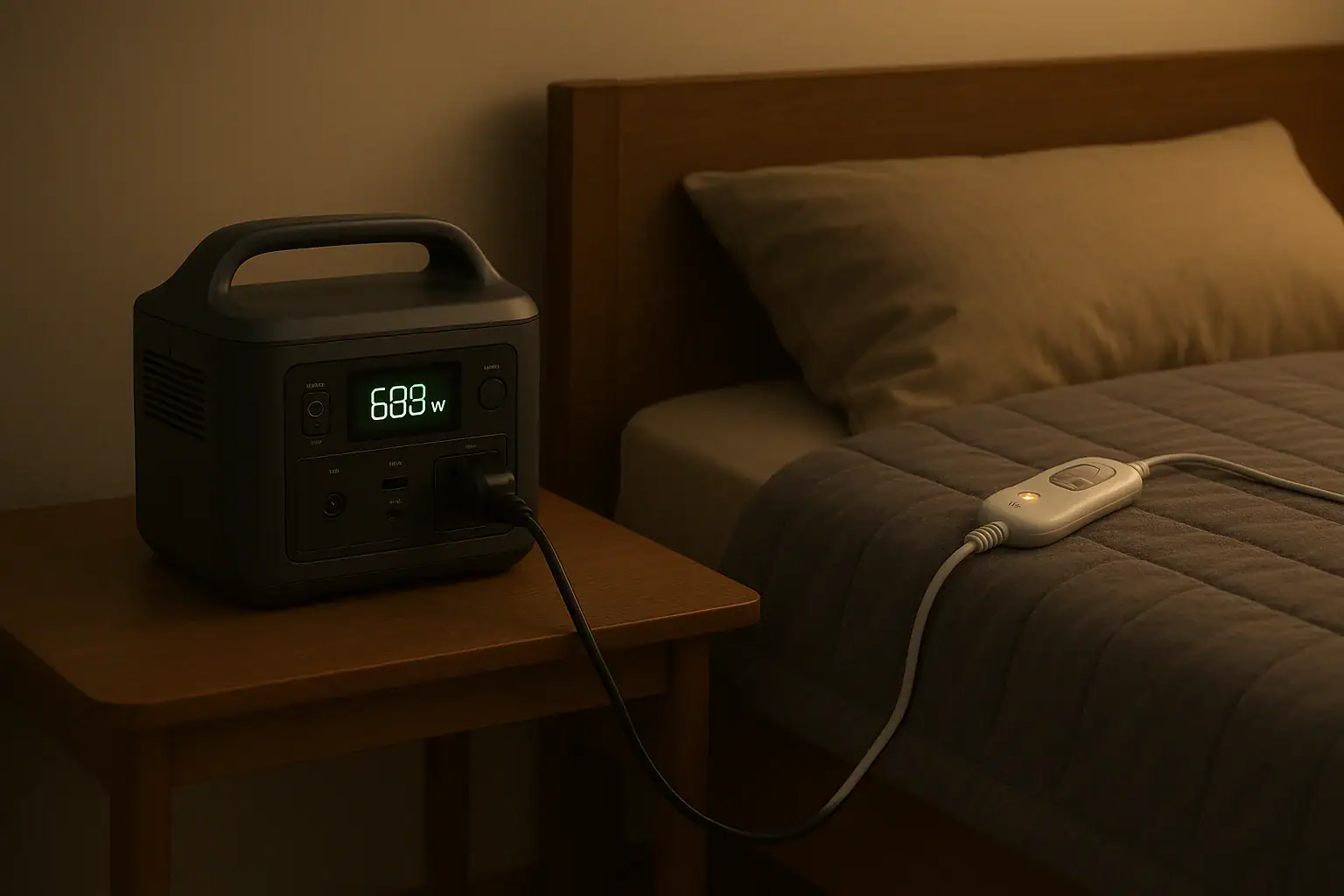
Most electric blankets can safely run on a compatible portable power station, but actual runtime is often much shorter than people expect and depends on wattage, battery capacity, and inverter efficiency. Understanding power draw, surge watts, and realistic runtime helps you avoid mid‑night shutdowns and overheating risks.
People search for terms like electric blanket runtime, Wh calculator, inverter limits, low‑power mode, and continuous output because they want to know if their power station can handle overnight heating. This guide explains how the setup works, how to estimate hours of use, and which safety notes matter most when you plug a heated throw or blanket into a battery-powered unit at home.
Below you will find clear explanations, example calculations, common overheating and shutdown causes, and a checklist of specs to look for when matching an electric blanket to a portable power station.
Using an Electric Blanket on a Power Station: What It Means and Why It Matters
Running an electric blanket on a portable power station simply means using stored battery energy to power a resistive heating device through the station’s AC outlet or DC output. Instead of plugging into a wall receptacle, you are plugging into a battery-backed inverter.
This matters for two main reasons: energy limits and safety limits. A home outlet can deliver power continuously as long as the grid is active. A power station, by contrast, has a fixed battery capacity (in watt-hours) and an inverter with a maximum continuous watt rating. Your blanket’s power draw (watts) and the time you run it directly drain that stored energy.
For home use—such as staying warm during outages, sleeping in a cool room without turning up the central heat, or heating a single bed in a shared house—knowing realistic runtime prevents disappointment and potential misuse. If the blanket demands more watts than the inverter can supply, the power station may shut down. If the blanket runs for too long on a nearly depleted battery, voltage can sag, again causing automatic shutdown.
On the safety side, a portable power station adds electronic protections (overload, short circuit, over-temperature), but you still need to respect the blanket’s own safety instructions. Using the wrong mode, covering the controller, or bunching the blanket too tightly can increase fire risk even if the power station itself is operating within spec.
Key Power Concepts: Watts, Watt-Hours, and How Runtime Is Determined
To understand how long an electric blanket can run on a power station, you need three basic numbers: blanket wattage, battery capacity, and inverter efficiency. Together, they explain why some people get only a few hours of runtime while others manage most of the night.
Blanket wattage (W) is the power draw. Many full-size electric blankets use roughly 60–120 W on a medium setting, while smaller throws may be in the 40–80 W range. Dual-zone blankets can draw more when both sides are on high. The label on the controller or tag usually lists a maximum watt rating or amperage at a given voltage.
Battery capacity (Wh) on the power station tells you how much energy is stored. A unit rated around 300 Wh has roughly enough energy to run a 100 W load for about 3 hours in ideal conditions. Larger home-focused stations may be 700–2000 Wh or more, extending runtime significantly.
Inverter efficiency describes how much energy is lost converting DC battery power to AC for your blanket. Typical efficiencies are around 80–90%. That loss means you cannot just divide Wh by blanket watts; you must also account for the overhead of the inverter and any idle consumption.
A simple runtime estimate is:
Estimated runtime (hours) ≈ (Battery Wh × 0.8 to 0.9) ÷ Blanket watts
For example, a 500 Wh power station with 85% efficiency powering a 70 W blanket would be: (500 × 0.85) ÷ 70 ≈ 6.1 hours. Real-world results may be lower due to cycling between heat levels, ambient temperature, and how the blanket’s thermostat behaves.
Two more concepts matter:
- Continuous vs. surge watts: Electric blankets are resistive loads and typically do not have large startup surges like compressors, but the inverter’s continuous rating must still exceed the blanket’s maximum wattage.
- Low-power cutoffs: Some power stations shut off automatically when load is very low. If your blanket’s controller cycles down or idles at low power, it may trigger these cutoffs, causing unexpected shutdown.
Understanding these basics lets you predict whether your power station can handle overnight heating or only a few hours of comfort before recharge.
| Battery capacity (Wh) | Blanket power (W) | Efficiency factor | Estimated runtime (hours) |
|---|---|---|---|
| 300 Wh | 60 W | 0.85 | ≈ 4.3 hours |
| 500 Wh | 80 W | 0.85 | ≈ 5.3 hours |
| 1000 Wh | 100 W | 0.85 | ≈ 8.5 hours |
| 1500 Wh | 120 W | 0.85 | ≈ 10.6 hours |
How Controller Settings Affect Power Draw
Electric blankets rarely pull their full rated wattage continuously. Most use internal thermostats or pulse-width modulation to cycle power on and off and keep a set temperature. Higher settings keep the heating elements energized more often, increasing average watt draw and reducing runtime.
Using a lower heat setting, preheating the bed before sleep, and then switching to a maintenance level can significantly extend runtime. For instance, a 100 W blanket that averages only 50 W over the night due to cycling may effectively double the runtime compared with a constant 100 W draw.
However, do not assume the average draw is always half or less; it depends on room temperature, bedding insulation, and how often you adjust the control. The safest approach is to treat the label wattage as a worst-case number and calculate runtime from there, then expect a modest improvement in practice.
Realistic Runtime Examples for Home Use
Putting numbers into context helps set realistic expectations for using an electric blanket on a power station at home. Below are illustrative scenarios using common blanket wattages and portable power station sizes.
Scenario 1: Small throw blanket on a compact power station
Imagine a 50 W heated throw and a 300 Wh power station. Applying the earlier formula with 85% efficiency:
- Usable energy ≈ 300 Wh × 0.85 = 255 Wh
- Runtime ≈ 255 Wh ÷ 50 W = 5.1 hours
In a cool but not freezing room, the controller may cycle, so you might see around 5–6 hours of warmth. This is usually enough for an evening on the couch, but not a full night’s sleep.
Scenario 2: Full-size blanket overnight on a mid-size station
Consider a 90 W queen-size blanket and a 700 Wh power station:
- Usable energy ≈ 700 Wh × 0.85 = 595 Wh
- Runtime ≈ 595 Wh ÷ 90 W ≈ 6.6 hours
If you preheat the bed on high for 30–60 minutes and then drop to a low or medium setting, the average draw might fall to 50–70 W. In that case, you might achieve 7–9 hours, but you should not plan on more than a single night without recharging.
Scenario 3: Dual-zone blanket with both sides on
A dual-zone blanket might be rated at 2 × 70 W (140 W total). With a 1000 Wh power station:
- Usable energy ≈ 1000 Wh × 0.85 = 850 Wh
- Runtime ≈ 850 Wh ÷ 140 W ≈ 6.1 hours
That is often enough for the coldest part of the night, but if both users run high settings continuously, the power station may shut off before morning. Using separate low or medium settings, or staggering usage, can stretch runtime closer to an 8-hour window.
Scenario 4: Power-saving strategy during outages
During a home power outage, many people want to conserve battery capacity. One approach is to preheat the bed for 30–45 minutes, then turn off the blanket for part of the night, relying on insulation from blankets and comforters. In this case, a 500–700 Wh unit can potentially provide multiple nights of partial use instead of a single full night on constant heat.
Real-world runtime is also influenced by ambient temperature. In very cold rooms, the controller may stay on more frequently to maintain temperature, increasing average watt draw. In milder conditions, it cycles less, effectively extending the usable hours even beyond simple calculations.
Common Mistakes, Short Runtime, and Troubleshooting Clues
Many users are surprised when their electric blanket drains a power station faster than expected or causes it to shut down unexpectedly. Most issues fall into a few repeatable patterns.
1. Overestimating battery capacity
People often divide battery Wh by blanket watts without considering inverter efficiency or reserve margins. This leads to optimistic runtime estimates. If your 500 Wh station seems to last only 4 hours instead of the 6–7 you expected, efficiency losses and higher-than-assumed average watt draw are likely responsible.
2. Ignoring controller and idle draw
Controllers and displays consume power even when the blanket is not heating at full strength. Some power stations also have their own idle draw to keep the inverter active. Over long periods, these small loads add up, especially on smaller-capacity units.
3. Using incompatible outputs
Most electric blankets are designed for AC mains voltage. Plugging them into a low-voltage DC port or a USB output using improvised adapters can cause malfunction or overcurrent. Always match the blanket’s voltage and plug type to the appropriate AC outlet on the power station, unless the blanket is specifically designed for DC use.
4. Overloading the inverter
While a single blanket rarely exceeds a few hundred watts, combining multiple heating devices—such as a blanket plus a space heater—can exceed the inverter’s continuous rating. Symptoms include immediate shutdown, overload error messages, or repeated restart attempts.
5. Low-load auto shutoff
Some power stations turn off AC output when they detect very low load for a certain period. If your blanket’s controller cycles down to a very small draw, the station may interpret this as “no load” and shut off. If you notice the blanket turning cold even though the battery gauge still shows plenty of charge, check whether a low-load timeout feature is active and whether it can be disabled.
6. Overheating or hot spots
Users sometimes fold or bunch the blanket to concentrate warmth, but this can create hot spots and trigger the blanket’s internal safety cutoff or the power station’s overcurrent protection. If you feel unusually hot areas, smell anything odd, or see discoloration, disconnect immediately and inspect the blanket per the manufacturer’s instructions.
When troubleshooting, look for indicators on the power station’s display: output watts, error codes, battery percentage, and whether AC output is enabled. These clues often point directly to either an overload, an under-voltage shutdown, or an auto-off feature rather than a defective blanket.
Safety Basics When Powering an Electric Blanket from a Portable Station
Using an electric blanket on a portable power station can be safe when you understand and respect the limits of both devices. The goal is to stay warm without creating fire hazards or stressing the battery system.
Follow the blanket’s safety instructions
Electric blankets typically include warnings about folding, tucking, and covering. These apply regardless of the power source. Keep the blanket flat and avoid placing heavy items on top that could trap heat. Do not use pins, clips, or anything that might damage heating wires.
Use the correct outlet and rated voltage
Only plug the blanket into an outlet that matches its voltage and plug type. If the blanket is designed for standard household AC, use the AC output of the power station. Avoid adapters that change voltage unless they are specifically rated and appropriate for the load.
Monitor for excessive heat
Check the blanket and controller periodically, especially during the first few uses with a power station. The blanket should feel warm but not scorching, and the controller should not become uncomfortably hot. If anything feels abnormal, turn everything off and inspect.
Keep ventilation around the power station
Portable power stations contain batteries and inverters that may generate heat under continuous load. Place the unit on a stable, dry surface with good airflow. Do not cover it with bedding, clothing, or curtains. Obstructed vents can lead to thermal shutdown or, in extreme cases, damage.
Avoid extension cords and daisy-chaining
Using long, thin, or coiled extension cords can introduce additional resistance and heat. When possible, plug the blanket directly into the power station or use a short, properly rated extension cord laid out flat. Never daisy-chain multiple power strips or adapters.
Do not leave damaged blankets in service
If the blanket shows signs of wear—exposed wires, frayed fabric, broken controllers—retire it. A portable power station’s protections cannot compensate for a compromised heating element or damaged insulation.
Supervise vulnerable users
For children, older adults, or anyone who may not sense overheating or move away from hot areas, extra supervision is important. Consider using lower heat settings and timers to reduce the risk of prolonged exposure.
Maintaining Your Power Station and Blanket for Reliable Home Use
Good maintenance practices extend both runtime performance and safety when pairing an electric blanket with a portable power station at home.
For the portable power station:
- Keep the battery within recommended charge ranges: Avoid leaving the battery at 0% or 100% for long periods. For long-term storage, many units perform best around 40–60% state of charge.
- Store in a cool, dry place: High temperatures accelerate battery aging. Do not leave the power station in hot attics, near heaters, or in direct sun.
- Exercise the battery periodically: If you only use the station during rare outages, run a moderate load like an electric blanket for a few hours every few months, then recharge. This helps keep the battery management system active and healthy.
- Keep vents and fans clear: Dust and lint can accumulate in vents, especially in bedrooms. Gently clean around intake and exhaust areas to maintain cooling performance.
- Use appropriate charging sources: Stick to charging methods and voltages specified by the manufacturer. Avoid improvised chargers that could overvoltage or stress the battery.
For the electric blanket:
- Inspect before seasonal use: Before winter, check the blanket for kinks, worn spots, or damaged cords. Run it briefly on a low setting and feel for even heating.
- Follow cleaning instructions: Many blankets allow gentle machine washing after disconnecting the controller, but harsh washing or drying can damage internal wires. Always follow the care label.
- Avoid tight folding and sharp bends: When storing, roll or loosely fold the blanket to avoid sharp creases that strain heating elements.
- Use timers where appropriate: Built-in or external timers can limit runtime and reduce wear on both the blanket and the power station by avoiding unnecessary all-night operation.
Combining these habits helps ensure that, when you do need warmth from battery power—whether during an outage or for targeted heating—you get predictable performance and minimize the risk of sudden failure.
| Item | Maintenance action | Suggested frequency |
|---|---|---|
| Power station battery | Charge to 40–60% for storage | Before off-season storage |
| Power station operation | Run a moderate load (e.g., blanket) then recharge | Every 3–6 months |
| Electric blanket fabric and wiring | Inspect for damage or hot spots | At the start of each heating season |
| Blanket cleaning | Wash per care label, dry fully | As needed, usually 1–2 times per season |
Related guides: Portable Power Station Buying Guide • How to Estimate Runtime for Any Device: A Simple Wh Formula + 5 Worked Examples • Indoor Use Safety: Ventilation, Heat, and Fire-Prevention Basics
Practical Takeaways and Specs to Look For When Pairing an Electric Blanket with a Power Station
Using an electric blanket on a portable power station at home is practical when you align blanket wattage, battery capacity, and safety practices. For short evening use, even small stations can provide several hours of comfort. For full-night heating or multi-night outages, you need larger capacity, conservative settings, and good energy management.
Start by confirming the blanket’s wattage and ensuring it is well below the power station’s continuous AC output rating. Estimate runtime using battery Wh and an efficiency factor, then plan for a bit less in real-world use. Use lower heat settings, preheat strategically, and avoid combining multiple high-draw heaters on the same small power station.
Safety-wise, treat the blanket as you would on grid power: keep it flat, undamaged, and properly supervised. Keep the power station ventilated and avoid covering it with bedding. Maintain both devices seasonally so they are ready when needed.
Specs to look for
- Battery capacity (Wh) – Look for enough capacity to cover your target hours: for example, 500–1000 Wh for 4–8 hours with a 60–100 W blanket. More Wh means longer runtime between charges.
- AC inverter continuous output (W) – Choose an inverter with at least 1.5–2× your blanket’s maximum wattage (e.g., 200–300 W for a 100 W blanket) to avoid overloads and allow for additional small devices.
- Inverter efficiency and idle draw – Higher efficiency (around 85–90%) and low idle consumption improve runtime. This matters most on smaller stations where every watt-hour counts.
- AC output voltage and waveform – A pure sine wave AC output at standard household voltage helps ensure compatible, stable operation with modern electronic controllers.
- Low-load auto shutoff behavior – Check whether the power station can keep AC on with low loads or allows disabling auto-off. This prevents blankets that cycle to low power from triggering unwanted shutdown.
- Battery chemistry and cycle life – Chemistries with higher cycle ratings (e.g., thousands of cycles) hold up better to repeated seasonal use for heating, preserving capacity over time.
- Thermal management and ventilation – Built-in fans and clear venting help the station handle continuous loads like blankets without overheating or derating.
- Display and monitoring features – A clear screen showing real-time watts, remaining percentage, and estimated runtime helps you manage energy and avoid unexpected cutoffs in the middle of the night.
- Built-in protections – Overload, short-circuit, over-temperature, and low-voltage protections add a layer of safety when running resistive heating devices for extended periods.
By checking these specs and applying the runtime concepts above, you can confidently match an electric blanket to a suitable portable power station for comfortable, controlled home heating when grid power is limited or when you simply want targeted warmth.
Frequently asked questions
Which power station specs and features matter most when running an electric blanket?
Prioritize battery capacity (Wh) for runtime, the inverter’s continuous output rating (W) so it comfortably exceeds the blanket’s maximum draw, and inverter efficiency/idle draw to reduce losses. Also check low-load auto-off behavior, ventilation/thermal management, waveform (pure sine preferred), and built-in protections like over-temperature and overload. A clear display that shows real-time watts and remaining runtime is helpful for management.
What common mistakes cause shorter-than-expected runtime?
Frequent errors include dividing battery Wh by blanket watts without accounting for inverter efficiency, ignoring controller cycling and idle draw, and combining multiple high-draw devices on one inverter. Using the wrong output type or triggering low-load auto-shutoff by running at very low average power also shortens usable time.
Is it safe to run an electric blanket on a power station overnight?
It can be safe if the power station and blanket are compatible and you follow safety practices: keep the blanket flat and undamaged, use the correct AC outlet, provide ventilation for the station, and monitor for excessive heat. Avoid damaged blankets, do not cover the power station, and supervise vulnerable users or use timers to reduce continuous operation.
How can I extend runtime without buying a larger power station?
Preheat the bed briefly on a higher setting then lower to a maintenance level, use additional insulating bedding, set timers, and avoid running other loads simultaneously. Choosing lower blanket settings and improving room insulation are simple ways to reduce average draw and stretch battery life.
Will running an electric blanket damage the power station’s battery over time?
Regular use consumes charge cycles like any load, so frequent deep discharges can reduce long-term battery capacity depending on chemistry and cycle life. Maintaining moderate charge ranges, avoiding repeated full discharges, and storing the unit in recommended conditions helps preserve battery health.
How do I tell if my power station will shut off due to low-load auto-off when using a blanket?
Check the user manual or settings for low-load auto-off thresholds and whether that feature can be disabled. You can also observe the station while the blanket cycles: if AC output turns off when the blanket is in a low-power state, the station’s low-load timeout is likely active and may require a workaround or a unit with a lower cutoff.
Recommended next:
- Portable Power Stations for Apartments
- Portable Power Stations for RV and Motorhomes
- Can a Portable Power Station Run a Microwave? What to Check Before You Try
- Can a Portable Power Station Run a Space Heater? Realistic Limits
- Can a Portable Power Station Run an Air Conditioner? Sizing and Expectations
- Powering a Coffee Maker, Kettle, or Induction Cooktop: What Works and Why
- More in Home / Appliances →
Related guides
Browse this topic →
- Beginner-friendly sizing, runtime & specs
- Solar & charging (MPPT, fast charging, cables)
- Batteries (LiFePO4, cycles, care & storage)
- Safety, cold-weather performance, real-world tips
More in Home / Appliances
See all →- Running a Pellet Stove During a Power Outage: Starting Surge, Runtime, and Safe Setup
- What Size Portable Power Station for a Chest Freezer? Runtime Planning for Outages
- Portable Power Station for Starlink: Power Draw, Runtime, and What Specs Matter
- Powering a TV and Streaming Setup: Estimating Runtime Without Guessing
- Using a Portable Power Station as Emergency Lighting: Efficient Options
Keep reading
About this site
Portable Energy Lab publishes practical, independent guides about portable power—clear sizing, safe use, and real-world expectations.
Affiliate disclosure
Some links on this site may be affiliate links. If you buy through these links, we may earn a small commission at no extra cost to you. This helps support our content. Learn more.