
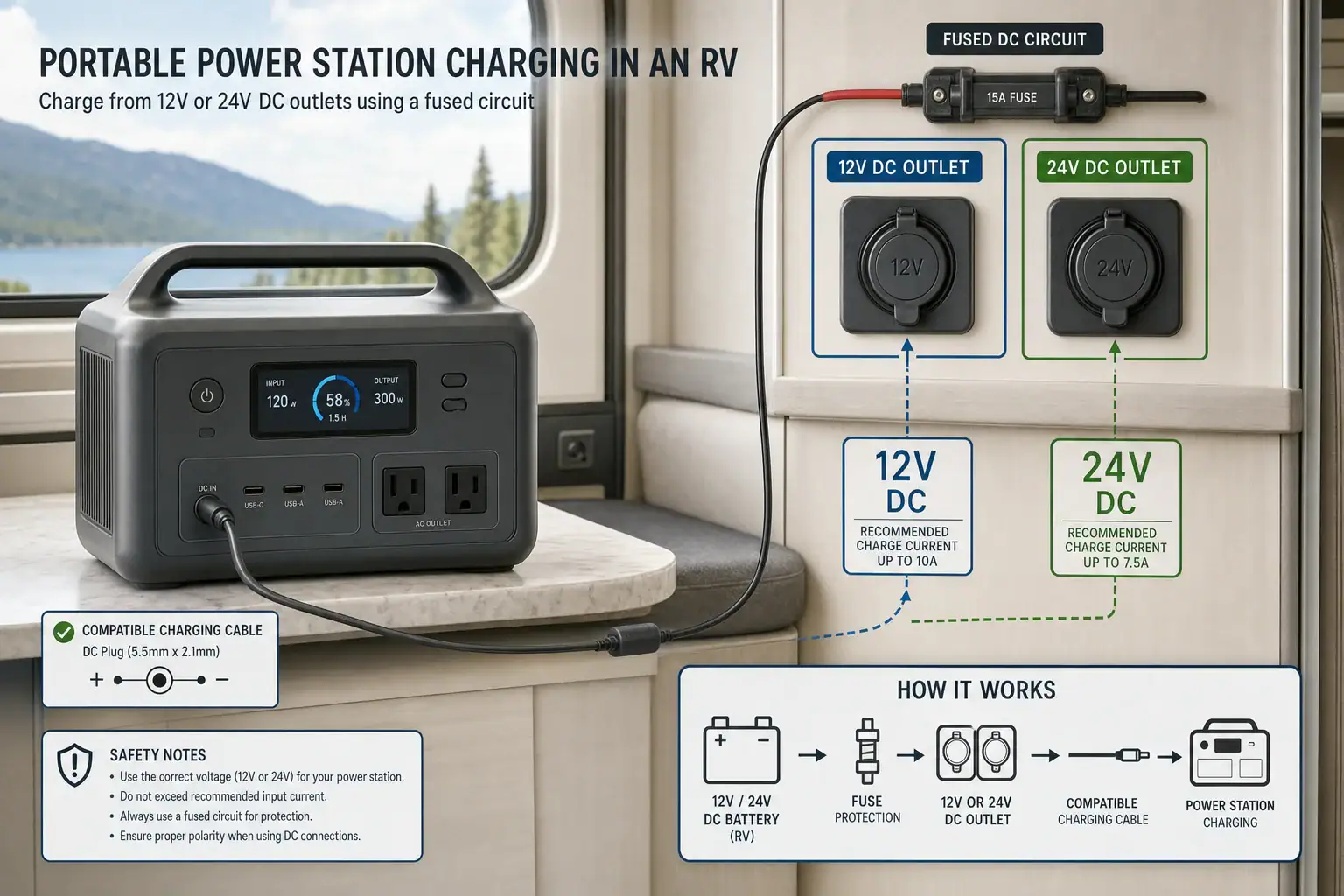
You can charge a portable power station from an RV outlet if the station’s DC input range, cable, connector, and polarity match the outlet.
Charging speed depends on more than whether the outlet is labeled 12V or 24V. The RV circuit’s fuse rating, the portable power station’s DC input limit, cable resistance, alternator output, and battery voltage all affect the available charging watts. A typical 12V outlet is usually slower than a compatible 24V source, but connecting the wrong voltage can damage equipment.
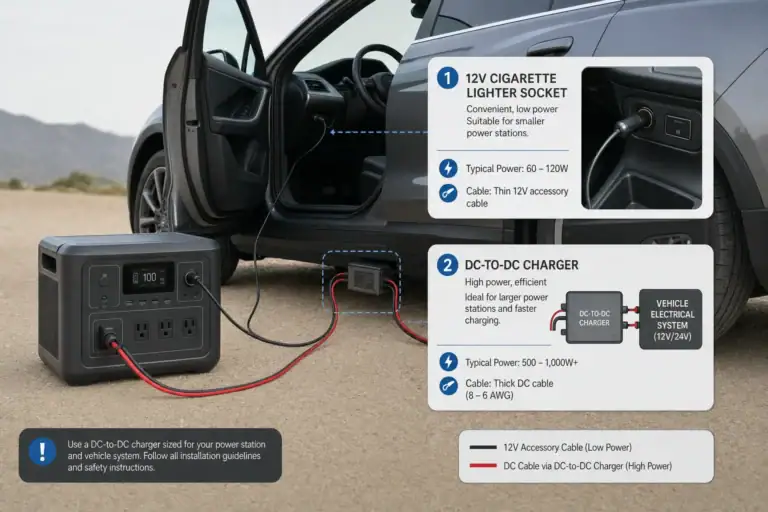
Before using a car charging cable or accessory socket, check both devices rather than relying on plug shape alone. A socket that physically fits may have an unsuitable voltage, polarity, or current capacity. The following guidance explains nominal voltage, expected charging time, troubleshooting signs, and practical safety limits. If “RV outlet” means a 120V AC receptacle, use the power station’s approved AC charger and observe the RV branch circuit rating instead.
1. What Charging From a 12V or 24V RV Outlet Means
A 12V or 24V RV outlet supplies direct current from the vehicle or house electrical system. The portable power station receives that electricity through its DC charging input, where an internal charge controller converts it into the voltage needed by the battery pack.
The voltage labels are nominal, not exact measurements. A 12V lead-acid system may operate near 12V when resting and rise to roughly 13.5–14.7V while charging. A nominal 24V system can operate at approximately twice those values. Lithium-based RV house batteries may have different operating ranges based on their chemistry and charging configuration.
This matters because every portable power station has an accepted input voltage window. A station designed only for a typical 12V vehicle source may reject a 24V supply or suffer damage if it lacks overvoltage protection. Conversely, a wide-range DC input may accept both systems and draw more watts from 24V, subject to current and power limits.
The outlet itself also has limits. Accessory sockets are commonly protected by a 10A, 15A, or similar fuse, but the usable continuous current may be lower because of connector quality, wire length, shared loads, and heat. The lowest limit in the complete charging path determines performance.
2. How Voltage, Current, and Input Limits Control Charging
DC charging power is estimated by multiplying voltage by current: watts equal volts times amps. A 12V source delivering 8A provides about 96W, while a 24V source delivering 8A provides about 192W. Actual battery charging power will be lower after cable and conversion losses.
Three different limits must be considered. The RV circuit has a maximum safe current, the cable and connector have current and voltage ratings, and the portable power station has maximum DC input voltage, current, and wattage. Increasing source voltage does not guarantee faster charging if the station caps input at 100W, for example.
Many power stations reduce input current when voltage falls, components become hot, or the battery approaches full charge. This tapering is normal. Charging may also pause if the RV battery voltage drops below a low-voltage threshold or if the source fluctuates while the engine starts.
Connector type does not establish electrical compatibility. Two cables with similar plugs can be wired differently or intended for different voltage ranges. Use a cable specified for the power station’s input and verify whether it contains a fuse, voltage converter, or identification circuitry.
| Nominal source | Example operating voltage | Example current | Approximate source power | Likely constraint |
|---|---|---|---|---|
| 12V RV outlet | 12.5V | 8A | 100W | Socket, fuse, or wiring |
| 12V with engine charging | 14.2V | 8A | 114W | Power station current limit |
| 24V RV outlet | 25V | 8A | 200W | Power station voltage or watt limit |
| 24V charging system active | 28.4V | 8A | 227W | Maximum accepted input voltage |
3. Real-World RV Charging Examples
Charging from a 12V accessory socket
Suppose an RV outlet provides 13V under load and the station draws 8A. Source power is approximately 104W. After conversion losses, the battery may receive around 85–95W. Adding 700Wh could therefore take roughly eight hours rather than the seven hours implied by dividing 700Wh by 100W. Charging slows further near full capacity.
Using a compatible 24V system
If a station accepts up to 30V and 10A, a 25V source at 8A could provide approximately 200W. The same 700Wh addition might take about four hours after accounting for losses and charge tapering. However, this example is safe only when the input, cable, connector, and source are all rated for the actual voltage.
Charging while driving
Charging with the engine running can reduce the chance of draining the RV starter battery, but alternator capacity still matters. Lights, climate controls, refrigerators, and other vehicle loads may already consume much of the available output. A portable power station that repeatedly starts and stops may be responding to voltage sag or a vehicle energy-management system rather than a defective battery.
Charging while parked
A 100W load running for five hours draws approximately 500Wh before losses. That can materially discharge a small RV house battery. The power station’s remaining runtime does not show the condition of the RV battery, so both systems require separate monitoring.
4. Common Mistakes and Troubleshooting Cues
The station does not begin charging: Check whether the outlet is switched, whether the RV battery disconnect is enabled, and whether the source voltage falls within the station’s published DC input range. Also inspect the relevant fuse without replacing it with a higher rating.
Charging starts and stops: Intermittent operation often indicates voltage sag, a loose plug, thermal protection, an overloaded circuit, or an input close to a cutoff threshold. Turn off other loads on the circuit and allow warm connectors or equipment to cool. Persistent cycling should be evaluated rather than ignored.
The displayed input is lower than expected: The advertised maximum input is not a guaranteed rate. A 12V socket, current-limited cable, partially discharged RV battery, or long wire run may prevent the station from reaching that figure. The station can also taper charging as its battery fills.
The fuse blows: A blown fuse can indicate excessive current, a short circuit, damaged wiring, or incorrect polarity. Do not install a larger fuse to keep the circuit operating. Disconnect the load and have recurring failures inspected by a qualified RV technician or electrician.
The plug becomes hot: Mild warmth can occur, but a connector that is painful to touch, discolored, softened, or smells like hot plastic requires immediate disconnection. Worn accessory sockets and poorly fitting plugs create resistance, which produces heat even when current remains below the fuse rating.
A 24V outlet is mistaken for 12V: Plug shape is not proof of voltage. Verify the labeled system voltage and acceptable input range before connecting. If the source can exceed the station’s maximum input voltage while the RV charging system is active, it is incompatible without a properly designed charging device.
5. Essential Safety Limits for RV DC Charging
- Match the complete voltage range: Compare the RV’s lowest and highest expected voltage with the station’s accepted DC input range, not just nominal labels.
- Respect the original fuse: The fuse protects the RV wiring. Never substitute a higher-amperage fuse to obtain faster charging.
- Avoid unknown adapters: An adapter may change plug shape without changing voltage, limiting current, or correcting polarity.
- Keep connections ventilated: Do not cover the power station, charger, or plug. Keep them away from bedding, paper, direct sun, moisture, and flammable materials.
- Prevent starter-battery depletion: Use a switched or low-voltage-protected source when appropriate, and do not assume every RV outlet turns off with the ignition.
- Secure equipment while traveling: Restrain the power station so it cannot fall, block ventilation, strain the cable, or become a projectile.
- Stop after warning signs: Disconnect the system after repeated fuse failures, burning odors, visible arcing, melted plastic, unusual noise, or battery warnings.
Do not splice into RV wiring, bypass battery-management protections, or create a higher-current circuit without appropriate system design. Permanent charging circuits, alternator-connected chargers, or unfamiliar 24V systems should be assessed and installed by a qualified professional familiar with conductor sizing, overcurrent protection, grounding, and the RV’s electrical architecture.
6. Cable Maintenance, Battery Care, and Storage
Inspect the charging cable and both connectors before long trips. Look for bent contacts, corrosion, cuts, crushed insulation, loose strain relief, and heat discoloration. Dirty or oxidized contacts increase resistance and can cause voltage drop or overheating. Clean only according to the equipment instructions and with all power disconnected.
Store cables loosely coiled in a dry location. Tight bends near a connector can break internal conductors even when the outer insulation appears intact. Protect removable adapters from dust and label them by voltage and intended device to reduce mix-ups.
Keep the RV battery in suitable condition. An aging battery may show normal resting voltage but sag sharply under load, causing unstable charging. During storage, disconnect unnecessary loads as directed by the RV manufacturer and maintain batteries according to their chemistry. Avoid leaving either battery deeply discharged for extended periods.
Portable power stations should generally be stored in a cool, dry location at a manufacturer-recommended state of charge. Periodically check stored units because displays, control circuits, and wireless features may consume energy. Before a trip, test the intended outlet and cable under supervision rather than discovering a problem during travel.
| Energy added to station | Average battery input | Ideal calculation | Practical planning range |
|---|---|---|---|
| 300Wh | 90W | 3.3 hours | 3.5–4.5 hours |
| 700Wh | 90W | 7.8 hours | 8–10 hours |
| 700Wh | 180W | 3.9 hours | 4–5 hours |
| 1,000Wh | 200W | 5 hours | 5.5–7 hours |
Related guides: Portable Power Stations for RV and Motorhomes • How Long Does It Take to Charge a Portable Power Station? • Car Charging Explained: 12V Socket vs DC-DC Charger vs Alternator (Speed + Safety)
7. Practical Takeaways and Specs to Compare
Safe RV charging depends on matching the source, circuit, cable, and power station. Confirm the actual voltage range first, then compare current and watt limits. A 24V source may charge faster than a 12V source, but only when the station explicitly accepts the higher operating voltage. Plan charging time from average input watts rather than the maximum number printed in specifications.
For routine use, monitor the first charging session for unstable input, excessive connector heat, or unexpected RV battery drain. If the outlet cannot safely provide the desired power, use a professionally designed charging solution rather than modifying the socket or increasing its fuse.
Specs to look for
- DC input voltage range: Look for a clearly stated range such as 11–30V that covers the RV’s resting and active charging voltage; this determines 12V and 24V compatibility.
- Maximum DC input current: Compare values such as 8A, 10A, or 15A with the outlet and cable rating; the lowest current limit controls charging speed.
- Maximum DC input watts: Look for a separate limit such as 100–300W; it shows whether higher source voltage can produce faster charging.
- Included cable rating: Confirm the cable’s supported voltage, current, connector type, polarity, and fuse; physical fit alone does not establish safe operation.
- Low-voltage cutoff: Look for automatic input shutdown near a configurable or documented threshold; it can help reduce excessive RV battery discharge.
- Input protections: Overvoltage, overcurrent, reverse-polarity, short-circuit, and thermal protection provide safeguards against common connection problems.
- Charging display detail: Real-time input watts, estimated time, temperature alerts, and error codes make voltage sag and limited charging easier to diagnose.
- Operating temperature range: Look for charging limits appropriate for expected RV conditions, often narrower than discharge limits; batteries may not accept a charge safely in extreme heat or cold.
- Battery capacity in watt-hours: Compare usable capacity with expected charging watts; a larger battery takes longer to replenish from a low-power 12V outlet.
The safest choice is not necessarily the station with the highest input rating. It is the one whose documented voltage range, current demand, cable requirements, and protections align with the RV’s available electrical system.
Frequently asked questions
Can I charge a portable power station from a 12V RV outlet?
Yes, if the power station accepts the outlet’s full operating voltage range and the cable, connector, and polarity are compatible. Charging from a 12V accessory outlet is often limited by the socket fuse, wiring, connector heat, or the station’s DC input rating. Check the equipment documentation before connecting.
Will a 24V RV outlet charge a portable power station faster?
A compatible 24V source can provide more charging power than a 12V source at the same current, but only if the power station accepts the actual 24V operating range. The station’s maximum input watts and amps may still cap charging speed. Never connect a 24V source to equipment rated only for 12V input.
What specifications and features matter when choosing a power station for RV charging?
Compare the station’s DC input voltage range, maximum input current, and maximum input wattage with the RV outlet and circuit ratings. Also verify cable voltage and current ratings, connector polarity, low-voltage cutoff behavior, and protections for overvoltage, overcurrent, reverse polarity, and overheating. A real-time input watt display can help identify voltage sag or a restricted circuit.
Can I use any cigarette-lighter adapter that fits the RV outlet?
No. A plug that fits an accessory socket may still have the wrong voltage rating, polarity, wiring quality, or current capacity for the power station. Use the cable specified for the station whenever possible, and avoid adapters that only change the connector shape without confirming electrical compatibility.
Is it safe to charge a portable power station while driving an RV?
It can be safe when the outlet, wiring, fuse, cable, and power station are correctly matched and the equipment is secured. Monitor the first session for hot plugs, unstable charging, warning messages, or excessive battery drain, and keep the station ventilated. Avoid overloading the alternator or a circuit already serving major RV loads.
Why does my portable power station stop charging from the RV outlet?
Charging may stop because of voltage sag, a loose connection, thermal protection, a low-voltage cutoff, or an overloaded circuit. The station may also reduce or pause input as its battery approaches full charge. Disconnect the system if a plug becomes very hot, a fuse repeatedly blows, or there is a burning odor or visible damage.
Related guides
Browse this topic →
- Beginner-friendly sizing, runtime & specs
- Solar & charging (MPPT, fast charging, cables)
- Batteries (LiFePO4, cycles, care & storage)
- Safety, cold-weather performance, real-world tips
More in Charging
See all →- Can You Daisy-Chain Portable Power Stations? Why It Usually Isn’t a Good Idea
- USB-C Input vs AC Input on Portable Power Stations: Which Charging Method Makes Sense?
- Car Alternator Charging vs Cigarette Lighter Charging: What Changes for Power Stations?
- Fast AC Charging vs Battery Longevity: Should You Use Turbo Mode Every Time?
- Solid-State Batteries and Portable Power Stations: What Could Change?
Keep reading
About this site
Portable Energy Lab publishes practical, independent guides about portable power—clear sizing, safe use, and real-world expectations.
Affiliate disclosure
Some links on this site may be affiliate links. If you buy through these links, we may earn a small commission at no extra cost to you. This helps support our content. Read our affiliate disclosure.