
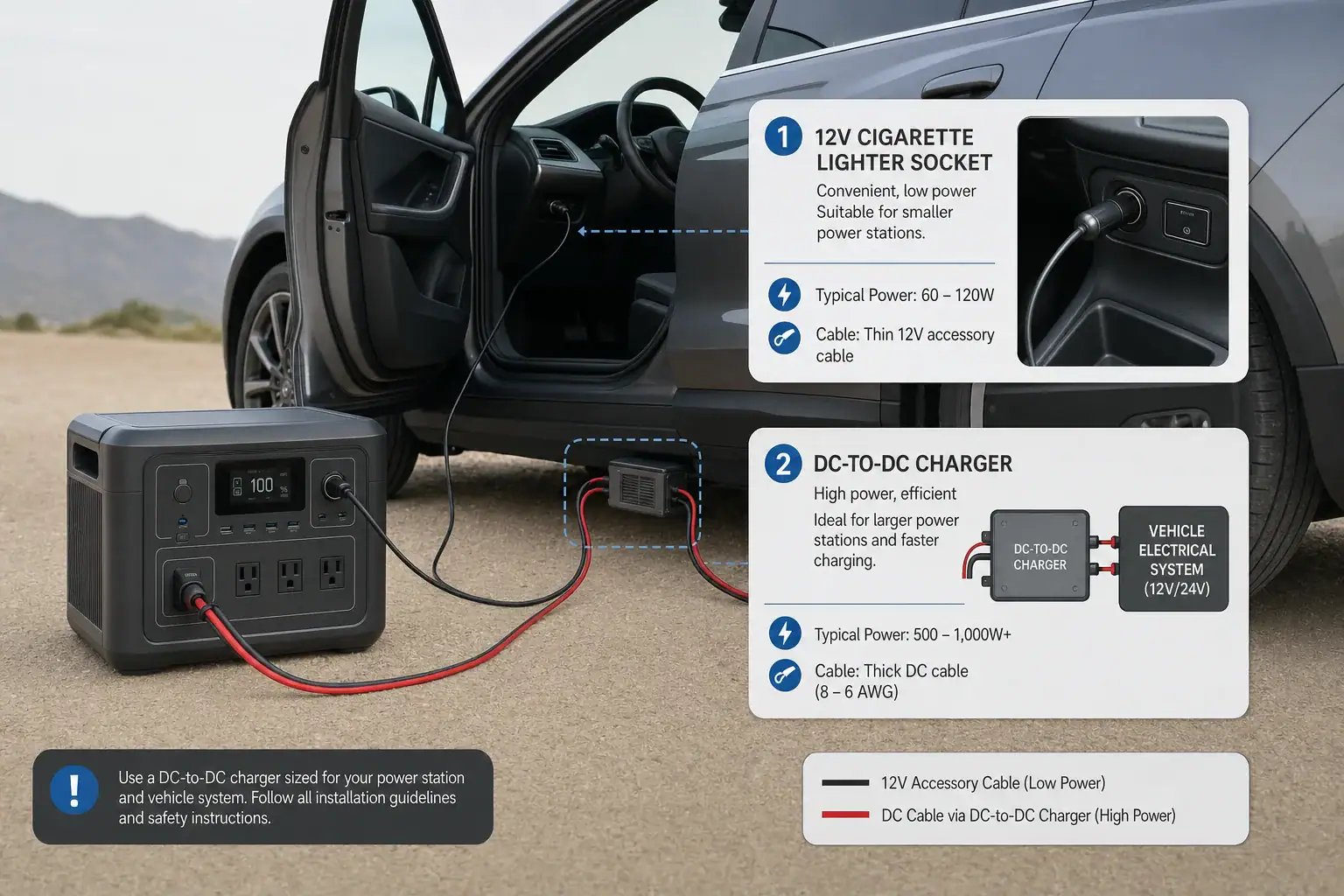
Car alternator charging can deliver substantially more power to a portable power station than cigarette lighter charging, but only when a compatible, regulated vehicle charging system is used. A dashboard 12-volt socket is limited by its fuse, wiring, connector, and the power station’s DC input limit. A dedicated alternator charger can use heavier cabling and controlled DC-to-DC conversion to support a higher charging rate.
In practical terms, cigarette lighter charging commonly supplies about 60 to 120 watts after conversion losses, while a properly designed alternator charging setup may provide several hundred watts. Actual performance depends on charging watts, input voltage range, current limit, cable gauge, alternator capacity, and engine speed.
The faster option is not automatically suitable for every vehicle or power station. The charging source must match the station’s supported input, and the vehicle must have enough electrical capacity for both charging and normal operation. Modern smart alternators, starter-battery protection, heat, and connector quality can also change the result.
1. What Alternator Charging and Cigarette Lighter Charging Mean
Cigarette lighter charging uses the vehicle’s factory-installed 12-volt accessory socket. A compatible cable connects that socket to a power station’s vehicle or DC input. Although the socket is ultimately supplied by the vehicle electrical system, the factory circuit is intentionally limited. Many accessory circuits have 10-amp or 15-amp fuses, and other loads may share the same circuit.
Alternator charging usually refers to a dedicated high-current charging path connected to the vehicle electrical system through an appropriate fuse, heavier cable, and a regulated DC-to-DC charger. That charger provides voltage and current the power station can accept. It may also offer ignition sensing or low-voltage protection so charging stops when the engine is off.
This distinction matters because a power station does not draw unlimited energy simply because the alternator has a high output rating. The lowest limit in the charging chain determines performance. That limit may be the socket fuse, cable, converter, connector, power station input, alternator output at idle, or the remaining capacity after the vehicle’s own electrical loads are supplied.
Directly attaching an ordinary power station input to an alternator or starter battery is not a substitute for a compatible charger. Vehicle voltage varies, electrical systems can produce transients, and a station’s solar or DC port may require a specific voltage range, polarity, connector, and current ceiling.
2. How the Two Charging Methods Work
With cigarette lighter charging, the alternator supports the vehicle’s electrical bus while the engine is running. Power passes through the starter battery and charging system, the accessory-circuit fuse, relatively small factory wiring, the socket, and the charging cable. The power station then regulates that input for its internal battery.
A nominal 12-volt, 10-amp socket might appear to offer 120 watts. In reality, voltage drop, conservative device limits, cable resistance, and conversion losses can reduce battery charging power. The plug may also become warm because its spring contacts have limited surface area.
A dedicated alternator charger takes a higher controlled current through wiring sized for the load. A DC-to-DC stage can stabilize or boost voltage to a level supported by the power station. For example, a charger could convert vehicle-side power into a regulated 24-volt or 48-volt output. Higher voltage allows the same wattage to travel at lower output current, although the vehicle-side input still carries substantial current.
Charging time depends on more than the advertised wattage. A rough estimate divides the energy needed in watt-hours by the effective charging watts, then allows extra time for conversion losses and charge-rate tapering near full capacity. Battery temperature, state of charge, simultaneous AC or USB loads, and the station’s battery management system can all reduce the observed rate.
| Characteristic | Cigarette lighter charging | Dedicated alternator charging |
|---|---|---|
| Typical charging range | About 60–120 watts | About 200–800 watts, system dependent |
| Vehicle connection | Factory accessory socket | Fused, heavier dedicated wiring |
| Voltage regulation | Usually handled by the station or cable | Usually handled by a DC-to-DC charger |
| Installation | Plug-and-use when compatible | Vehicle-specific installation may be required |
| Main limitation | Socket, fuse, wiring, and input current | Charger rating, station input, and vehicle capacity |
| Best general use | Slow charging during routine driving | Faster replenishment during longer drives |
3. Real-World Charging Examples
Small power station through a 12-volt socket
Consider a 500-watt-hour power station receiving 90 watts from an accessory socket. If it needs 400 watt-hours to reach the desired charge level, simple division suggests about 4.4 hours. Allowing for losses and charging taper, the trip may need to last roughly five hours. Running a 40-watt device from the station at the same time could reduce net battery charging to around 50 watts and significantly extend the time.
Medium power station with dedicated alternator charging
A 1,000-watt-hour station might accept 500 watts from a compatible regulated vehicle charger. Adding 800 watt-hours could take around two hours after accounting for normal losses and tapering. However, this result requires the station to accept that input power and the vehicle to sustain the charger’s demand without excessive voltage drop or alternator heating.
High-power charger limited by the station
A vehicle charger rated for 800 watts will not deliver 800 watts if the power station’s relevant input is capped at 400 watts. Some stations also have separate limits for vehicle, solar, and combined charging. Connector voltage may further constrain power. A 12-volt input limited to 10 amps cannot accept the same power as a regulated higher-voltage input rated for several hundred watts.
Alternator output that changes at idle
An alternator advertised with a high maximum rating may produce less current at idle. Headlights, climate-control blowers, window defrosters, engine electronics, and cooling fans receive priority. A charger may reduce output or disconnect if vehicle voltage falls. Smart alternators can also lower bus voltage when the starter battery is sufficiently charged, causing an unregulated charging source to slow or cycle.
4. Common Mistakes and Troubleshooting Cues
- Assuming the socket’s fuse rating equals charging power: A 15-amp fuse does not mean a station should continuously draw 15 amps. The device, cable, plug, wiring, and shared loads may impose lower limits.
- Using the wrong input mode: Some power stations distinguish between vehicle input and solar input. An incorrect setting or incompatible voltage can cause low charging power or prevent charging.
- Ignoring connector fit: A loose accessory plug increases resistance. Intermittent charging, a hot plug, discoloration, or charging that stops over bumps points to a poor connection.
- Expecting maximum watts at every state of charge: Charging power often drops near full capacity or when the battery is too hot or cold. A lower rate near 90% may be normal.
- Counting gross rather than net charging: Appliances connected to the power station consume part of the incoming energy. The display may show input power while the battery percentage rises slowly.
- Charging with the engine off: An always-on socket or improperly controlled dedicated charger can discharge the starter battery. If charging stops with the ignition, that behavior may be intentional.
- Overlooking cable voltage drop: Long, thin cables can cause low input voltage, reduced wattage, cycling, or shutdown. Dedicated high-current systems require cable sizing based on current, length, routing, and allowable voltage drop.
For troubleshooting, first compare the displayed input watts with the rated limit for the exact port being used. Then check whether the engine is running, other vehicle loads are active, the plug is fully seated, and the station is within a normal temperature range. Repeated fuse failures, burning odors, melted plastic, or unusually hot wiring require immediate disconnection and professional inspection rather than a larger fuse.
5. Safety Basics for Vehicle Charging
Use only charging equipment whose voltage range, polarity, connector, and current are compatible with the power station. A dedicated alternator charger should include suitable input and output protection, regulation, and a method of preventing starter-battery depletion. Installation quality matters because high current can create substantial heat at a loose terminal or undersized cable.
Fuses protect wiring and should be selected for the cable and equipment, not enlarged to stop nuisance blowing. A blown factory accessory fuse can indicate excessive current, a damaged plug, a short circuit, or another load on the same circuit. Replacing it with a higher rating can leave the original wiring unprotected.
Keep charging cables away from exhaust components, sharp edges, pedals, seat tracks, and moving engine parts. Maintain airflow around the power station and charger. Do not charge a station that is swollen, physically damaged, wet, leaking, or producing an unusual odor.
Alternator and DC-to-DC charger installations vary by vehicle, especially in vehicles with battery monitoring sensors, start-stop systems, smart alternators, multiple batteries, or high-voltage hybrid components. A qualified automotive electrician should assess any permanent high-current installation. Hybrid and electric vehicles may have a conventional low-voltage accessory system, but their traction batteries and high-voltage wiring are not user connection points.
6. Maintenance and Storage Considerations
Inspect accessory plugs and charging cables periodically for looseness, bent contacts, abrasion, corrosion, or heat damage. Dust and oxidation can increase resistance. Connectors should remain dry and should not require force to stay seated. A plug that becomes progressively hotter during similar trips may be deteriorating even if charging still works.
For a permanent alternator charging system, periodic checks should include visible cable routing, strain relief, fuse-holder condition, and secure mounting. Any terminal inspection requiring access to vehicle electrical connections should follow the vehicle and charger documentation or be handled by a professional. Do not open the power station, charger, or battery pack.
Before storing the vehicle, disconnect portable charging equipment if it has standby consumption or lacks reliable ignition control. Long-term parasitic draw can weaken the starter battery. Store the power station at the charge level and temperature recommended for its battery chemistry, and recharge it periodically if the manufacturer specifies a storage interval.
Extreme cabin temperatures can shorten battery life and may prevent charging. Avoid leaving a power station in a parked vehicle during very hot or freezing conditions. If the station has been exposed to temperature extremes, allow it to return to its permitted charging range before use.
| Observed symptom | Possible cause | Appropriate response |
|---|---|---|
| Input falls when headlights or blower start | Limited alternator reserve or voltage drop | Reduce charging demand and have system capacity checked |
| Accessory plug is hot | Loose contact, high resistance, or excessive current | Stop charging and inspect the plug and socket |
| Charging cycles on and off | Low voltage, smart alternator behavior, or thermal protection | Check displayed voltage, temperature, and charger compatibility |
| Battery percentage rises slowly | Connected loads or normal conversion losses | Compare input power with simultaneous output power |
| Starter battery is weak after parking | Charging continued with the engine off | Use ignition control or low-voltage cutoff |
Related guides: Car Charging Explained: 12V Socket vs DC-DC Charger vs Alternator (Speed + Safety) • Charging From a Car: What’s Safe, What’s Slow, and What Can Break • Can You Use a Higher-Watt Charger Than Rated? Understanding Input Headroom
7. Practical Takeaways and Specs to Look For
Cigarette lighter charging is the simpler option for modest energy needs and long drives. It requires no permanent installation when the socket, cable, and power station are compatible, but its charging speed is usually limited to roughly 60 to 120 watts. It works best for smaller stations, maintenance charging, or replacing energy used by light loads.
Dedicated alternator charging is more appropriate when a larger station must recover several hundred watt-hours during a drive. Its advantages come from regulated conversion, heavier wiring, and higher supported current—not from connecting the station directly to the alternator. The vehicle’s electrical reserve and the station’s input specification must support the intended charging rate.
Specs to look for
- Vehicle-input power: Look for a clearly stated rating such as 100, 400, or 800 watts; this indicates the maximum useful charging speed from the relevant vehicle setup.
- DC input voltage range: Check for a range that matches the charger output, such as approximately 12–30 volts or 16–60 volts; an incompatible range can prevent charging.
- Input current limit: Compare limits such as 8, 10, 15, or 20 amps with the cable and source; current caps often explain why actual watts are below expectations.
- Regulated DC-to-DC output: Look for stable voltage and current matched to the station; regulation helps manage smart alternator behavior and vehicle-voltage variation.
- Starter-battery protection: Ignition sensing or an adjustable low-voltage cutoff can stop charging when the engine is off or vehicle voltage falls.
- Adjustable charging rate: Settings such as 200, 400, and 600 watts allow demand to be reduced for smaller alternators, hot weather, or heavy vehicle loads.
- Cable length and gauge: Look for wiring sized for the maximum current and installation distance; adequate copper area reduces voltage drop and heating.
- Fuse and overtemperature protection: Properly coordinated protection helps safeguard cables, connectors, the charger, and the vehicle electrical system.
- Charging temperature range: A practical operating range should fit expected travel conditions; battery management may slow or block charging outside that range.
- Input monitoring: Displays or app-based readings for watts, volts, and charging status make it easier to identify current limits, voltage drop, and interrupted charging.
The best choice depends on how much energy must be replaced during a typical drive. Compare required watt-hours, available driving time, net charging power, and vehicle capacity. If a socket connection meets the need without excessive heat, it is usually the simplest approach. If it does not, a compatible dedicated charger installed with appropriate protection is the safer route to higher charging power.
Frequently asked questions
Is alternator charging faster than cigarette lighter charging for a power station?
Usually, yes. A cigarette lighter socket commonly limits charging to about 60 to 120 watts, while a dedicated regulated alternator charging system may provide several hundred watts. The actual rate is still limited by the power station input, charger rating, vehicle electrical capacity, and operating conditions.
Can I charge a power station from a car cigarette lighter while driving?
Yes, if the power station, cable, and accessory socket are compatible. This is generally suitable for modest charging during longer drives, but the socket circuit may be shared with other loads and can have a lower continuous-power limit than its fuse rating suggests.
What specs and features matter when choosing an alternator charger for a power station?
Check the power station’s supported DC input voltage range, maximum input current, connector type, polarity, and maximum input wattage. A suitable dedicated charger should provide regulated DC output and include correctly sized fusing, starter-battery protection, and ideally an adjustable charging rate. Cable gauge and installation length also matter because voltage drop can reduce charging performance.
Can I connect a power station directly to my car battery or alternator?
Not unless the power station manufacturer specifically permits that connection and the required regulation and protection are in place. Vehicle voltage can vary and experience electrical transients, while many power station DC inputs have strict voltage, current, polarity, and connector requirements. A compatible regulated DC-to-DC charger is the appropriate method for higher-power vehicle charging.
Why is my power station charging slowly from the 12-volt socket?
A common mistake is assuming that the accessory socket fuse rating equals usable continuous charging power. The station’s input limit, cable resistance, loose plug contacts, voltage drop, vehicle loads, and normal conversion losses can all lower the observed wattage. Charging may also taper as the power station approaches full capacity or when battery temperature is outside its preferred range.
Is it safe to charge a power station from a vehicle?
It can be safe when compatible equipment is used correctly and the vehicle circuit is not overloaded. Stop charging if plugs, cables, or sockets become unusually hot, damaged, discolored, or produce an odor. Permanent high-current installations should use appropriate fuses, cable sizing, regulation, and starter-battery protection, and may require assessment by a qualified automotive electrician.
Related guides
Browse this topic →

- Beginner-friendly sizing, runtime & specs
- Solar & charging (MPPT, fast charging, cables)
- Batteries (LiFePO4, cycles, care & storage)
- Safety, cold-weather performance, real-world tips
More in Charging
See all →- Can You Daisy-Chain Portable Power Stations? Why It Usually Isn’t a Good Idea
- USB-C Input vs AC Input on Portable Power Stations: Which Charging Method Makes Sense?
- Charging a Portable Power Station From an RV Outlet: 12V, 24V, and Safety Limits
- Fast AC Charging vs Battery Longevity: Should You Use Turbo Mode Every Time?
- Solid-State Batteries and Portable Power Stations: What Could Change?
Keep reading
About this site
Portable Energy Lab publishes practical, independent guides about portable power—clear sizing, safe use, and real-world expectations.
Affiliate disclosure
Some links on this site may be affiliate links. If you buy through these links, we may earn a small commission at no extra cost to you. This helps support our content. Read our affiliate disclosure.