
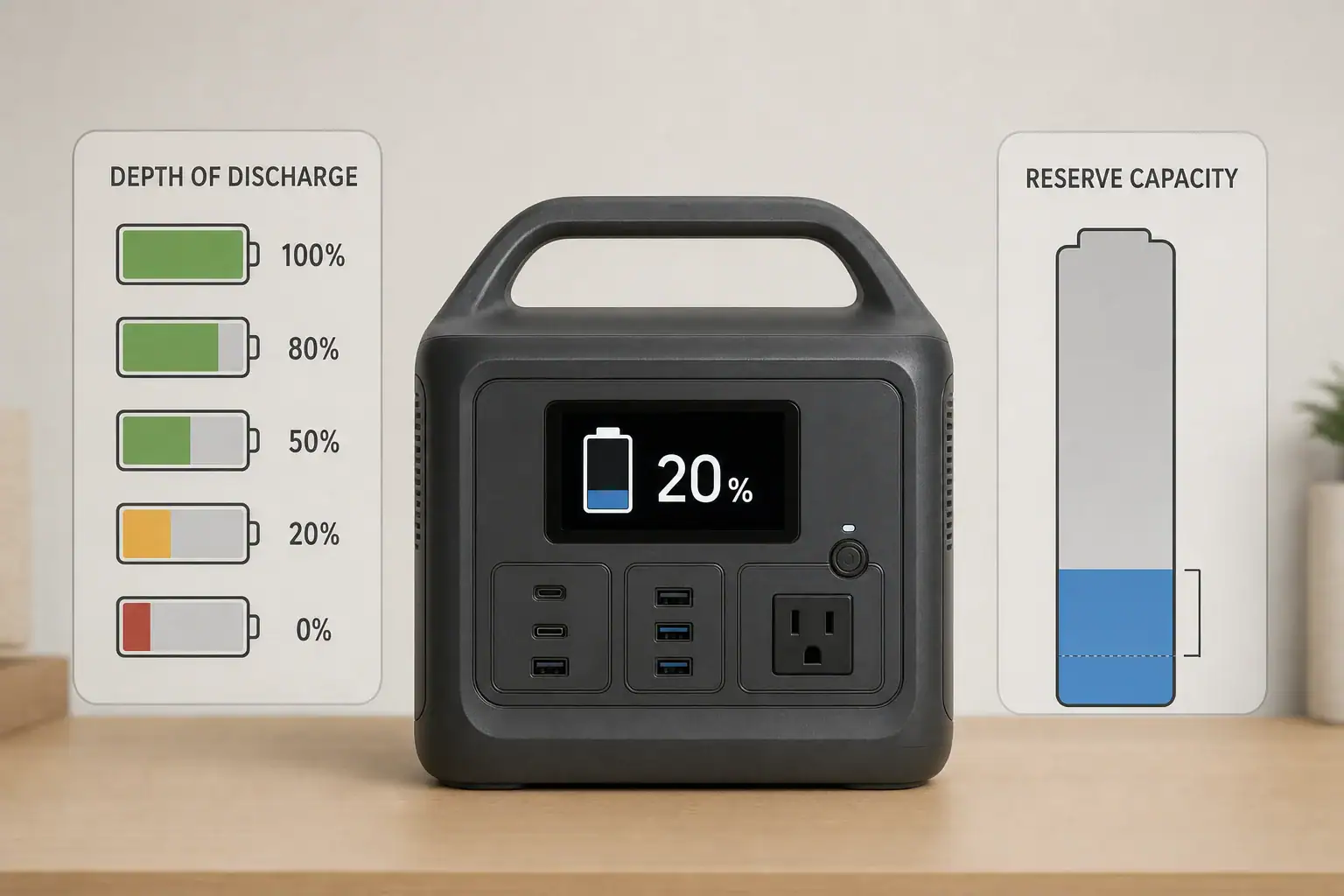
For routine use, it is generally sensible to stop draining a portable power station at about 10% to 20% remaining rather than running it to automatic shutdown every time. A larger 20% to 30% reserve may help reduce battery stress when maximizing cycle life is more important than extracting every watt-hour.
The best limit depends on battery chemistry, temperature, load size, discharge rate, and how often the battery is cycled. Lithium iron phosphate batteries usually tolerate deep discharge better than many nickel manganese cobalt batteries, but neither chemistry benefits from sitting empty for extended periods. The battery management system, or BMS, also keeps the cells from reaching a truly destructive electrical zero.
Understanding depth of discharge, state of charge, usable capacity, battery reserve, and cycle life makes runtime planning more reliable. These concepts also explain why the displayed percentage may fall quickly under a heavy load, recover after the load stops, or reach 0% before every advertised watt-hour has been delivered.
1. What depth of discharge and reserve capacity mean
Depth of discharge, commonly abbreviated as DoD, is the percentage of a battery’s capacity that has been used. If a fully charged power station falls to 70% state of charge, it has experienced roughly 30% depth of discharge. Reaching 20% remaining corresponds to about 80% DoD.
State of charge, or SoC, describes the opposite side of the same condition: how much estimated energy remains. These percentages are useful estimates rather than direct measurements of energy in a tank. The power station calculates them from voltage, current flow, temperature, battery history, and internal battery models.
In this context, reserve capacity means the energy intentionally left unused for unexpected needs, reduced battery stress, or protection against estimation error. This is different from the formal automotive lead-acid reserve-capacity rating, which is measured in minutes under a specified load. Portable power stations are more commonly rated in watt-hours.
Depth of discharge matters because repeated deep cycles generally cause more battery wear than repeated shallow cycles. However, using only a tiny fraction of the battery can defeat the purpose of portable storage. A practical reserve balances available runtime with longevity instead of treating one exact percentage as mandatory.
2. How discharge limits, usable capacity, and cycle life work
A power station’s advertised capacity is usually the nominal energy stored by its internal battery. The energy available at an AC outlet is lower because the inverter, electronics, cooling system, and internal resistance consume energy. DC and USB outputs also have conversion losses, although their efficiency may differ from AC efficiency.
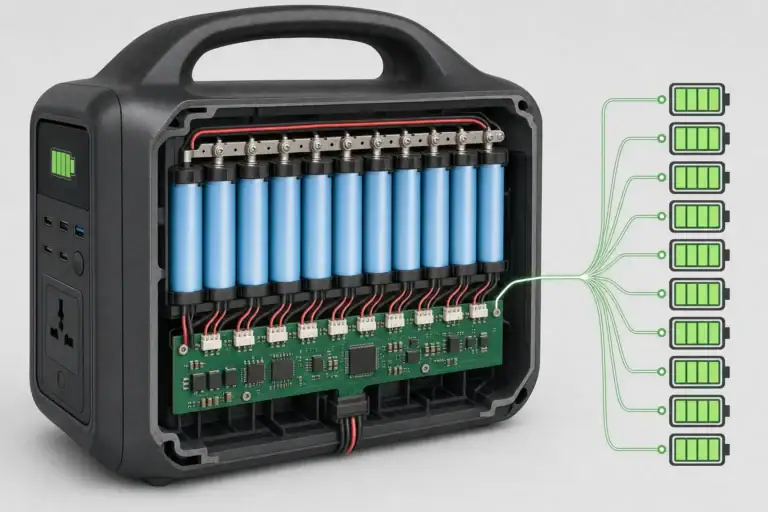
The BMS monitors cell voltage, current, and temperature. When a cell approaches its lower-voltage threshold, the system normally disconnects the output. Therefore, a display reading of 0% usually does not mean the cells have reached absolute electrochemical zero. A hidden protective buffer may remain, but it should not be treated as usable emergency energy.
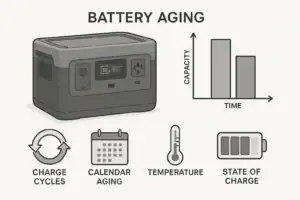
Battery cycle-life ratings are often based on equivalent full cycles. Two discharges from 100% to 50% add up to roughly one full cycle of energy throughput. Cycle aging is affected by more than the cycle count: high temperature, sustained high state of charge, deep discharge, rapid charging, and high-output operation can all contribute.
Lithium iron phosphate, often called LFP or LiFePO4, generally provides high cycle life and good tolerance for frequent use. Nickel manganese cobalt, often called NMC, can provide high energy density in a lighter package but may benefit more noticeably from moderate charge and discharge habits. Product-specific controls and cell quality still matter, so chemistry alone does not determine longevity.
| Use pattern | Illustrative stopping point | Reason for the reserve |
|---|---|---|
| Occasional emergency use | 5% to 15% remaining | Prioritizes available runtime when energy is scarce |
| Routine household or recreational use | 10% to 20% remaining | Balances usable energy and battery wear |
| Frequent cycling or longevity-focused use | 20% to 30% remaining | Reduces time spent near the lower operating boundary |
| Cold, hot, or high-load conditions | 20% or more remaining | Allows for voltage sag and less reliable percentage estimates |
3. Real-world depth-of-discharge examples
Running a refrigerator during an outage
Suppose a power station has a nominal capacity of 1,000 watt-hours. If inverter and system losses leave about 850 watt-hours available to an AC appliance, reserving 15% of the displayed capacity may leave roughly 720 watt-hours for planned use. A refrigerator averaging 60 watts over time might then operate for about 12 hours. Actual runtime will vary because compressor startup, room temperature, door openings, and cycling behavior affect consumption.
Powering a steady electronic load
A 100-watt device does not necessarily run for 10 hours from a nominal 1,000-watt-hour battery. If usable AC energy is 850 watt-hours and operation stops with 20% remaining, planned energy may be closer to 680 watt-hours. Runtime would then be approximately 6.8 hours. Low-load inverter overhead can also become significant when a device draws only a few watts.
Using a high-power appliance
A heater, kettle, or cooking appliance may draw 1,000 watts or more. Even when the load is below the continuous output rating, high current can produce greater conversion losses, internal heating, and voltage sag. The percentage indicator may drop faster than expected, and the system may shut down with apparent capacity remaining if a cell reaches its safe lower-voltage limit.
Occasionally draining to automatic shutdown
An occasional BMS-controlled shutdown is not normally the same as physically over-discharging unprotected cells. It can be useful when runtime is essential, but it should not become the default routine. Recharge the unit reasonably soon afterward rather than storing it at 0%, especially in a warm or freezing environment.
4. Common discharge mistakes and troubleshooting cues
Treating displayed capacity as exact: Battery gauges can drift, particularly after many partial cycles. A percentage that falls suddenly, stays unchanged for a long period, or rises after a load is removed may reflect estimation behavior rather than an immediate battery defect.
Assuming rated watt-hours equal outlet energy: Capacity labels describe stored energy under specified conditions. Inverter losses, standby consumption, cooling fans, and device power-factor characteristics reduce delivered AC energy. Compare measured runtime with realistic usable capacity, not only the nominal rating.
Repeatedly leaving the unit at 0%: The BMS may reserve a small buffer, but self-discharge and standby electronics can continue consuming energy. Long storage after shutdown can allow voltage to fall farther than intended.
Ignoring temperature: Cold batteries temporarily provide less power and may show stronger voltage sag. High temperatures accelerate aging and can trigger thermal protection. Let a unit return to its permitted charging temperature before charging if it has been exposed to extreme cold or heat.
Confusing an overload with an empty battery: If output stops while the display still shows substantial charge, check whether the appliance exceeded the continuous output, surge capability, port limit, or thermal limit. Reduce the load, allow the unit to cool if necessary, and consult its operating guidance before restarting.
Expecting calibration to repair capacity loss: A controlled full charge and discharge may help some gauges estimate capacity, but it does not restore chemically degraded cells. Do this only when the manufacturer describes a calibration process; repeated deep cycling solely to adjust the display can add unnecessary wear.
5. Battery safety when operating near empty
Use the power station within its specified temperature, output, charging, and ventilation limits. Keep air inlets and outlets clear, place the unit on a stable dry surface, and avoid enclosed spaces where heat can accumulate. Do not cover the unit while it is charging or supplying a substantial load.
Stop using the power station if it develops swelling, leaking, smoke, unusual odors, crackling sounds, excessive heat, or repeated unexplained shutdowns. Move away from the area if it is safe to do so and follow local emergency and battery-disposal guidance. Do not open the enclosure, replace internal cells, bypass the BMS, or attempt to revive a deeply discharged pack with an unapproved charger.
Only use charging sources and input ranges that the unit is designed to accept. A depleted battery may initially charge at a restricted rate while its protection system checks cell conditions. If it will not accept a charge after reaching a suitable temperature and using a compatible source, contact qualified service personnel rather than modifying cables or protections.
A portable power station should not be connected directly to household wiring or a breaker panel through improvised cords. Any arrangement intended to supply building circuits requires suitable listed equipment and a qualified electrician to prevent backfeeding, shock, and fire hazards.
6. Maintenance and storage practices that preserve capacity
For routine cycling, recharge before the battery remains near empty for an extended period. There is generally no need to charge immediately after every shallow use, but prompt recharging is prudent when the display is close to 0%. Avoid combining deep discharge with prolonged heat, since temperature and low state of charge can compound reliability concerns.
For long-term storage, many lithium power stations are best kept at a moderate state of charge, commonly around 40% to 60%, unless their instructions specify another range. Store the unit in a cool, dry location within its published limits. A permanently full battery may age faster in warm conditions, while an almost empty battery has less protection against self-discharge.
Check a stored unit periodically because battery cells and monitoring electronics consume a small amount of energy. Recharge it when the level approaches the lower end of the recommended storage range. If the unit has a storage mode, charge limit, or adjustable discharge floor, those features can make maintenance more consistent.
Keep a simple record of charge level, storage date, and unusual runtime changes. Gradual capacity decline is expected over years and cycles. A sharp decline, excessive self-discharge, or repeated early shutdowns may indicate a gauge issue, damaged cells, extreme operating conditions, or a load that exceeds the power station’s capabilities.
| Condition | Illustrative charge target | Suggested check interval |
|---|---|---|
| Long-term indoor storage | 40% to 60% | Every two to three months |
| Emergency standby | 60% to 80% | About monthly |
| Recently drained near shutdown | Recharge above the low range | As soon as practical |
| Storage in variable temperatures | Follow the specified storage range | More frequently than climate-controlled storage |
7. Practical takeaways and purchasing specifications
Related guides: Depth of Discharge (DoD) Explained: How Partial Cycles Extend Battery Life (LiFePO4 vs NMC) • Usable Capacity vs Advertised Capacity: Why 1,000Wh Doesn’t Mean 1,000Wh at the Outlet • Best Storage Charge Percentage: 40% vs 60% vs 80% (What Battery Chemistries Prefer) • Temperature Limits Explained: Safe Charging/Discharging Ranges and What Happens Outside Them
A 10% to 20% reserve is a practical default for many portable power station users. Consider stopping at 20% to 30% when the unit is cycled frequently, operated under heavy loads, or exposed to temperature extremes. Draining to the BMS cutoff can be reasonable during a genuine outage, but avoid storing the battery in that condition.
Runtime should be planned from usable output energy rather than advertised capacity alone. Include conversion loss, inverter overhead, appliance duty cycle, and the reserve you intend to keep. The power station’s operating instructions should take priority because battery design, display behavior, and protection thresholds vary.
Specs to look for
- Battery chemistry: Look for clearly identified LFP or NMC chemistry; it helps set expectations for weight, energy density, deep-cycle tolerance, and long-term cycle life.
- Cycle-life rating: Look for a rating such as 1,000 to 4,000 cycles to 70% or 80% retained capacity; the stated retention threshold and test conditions make comparisons more meaningful.
- Nominal battery capacity: Compare watt-hour ratings such as 500, 1,000, or 2,000 watt-hours; this establishes the starting point for runtime calculations before losses and reserves.
- Usable capacity or efficiency data: Look for measured or specified AC and DC output efficiency, often roughly 75% to 90% depending on load; this helps estimate energy actually delivered to devices.
- Adjustable discharge limit: Look for a configurable minimum state of charge, such as 10% to 30%; an automatic reserve reduces the need to monitor the display constantly.
- Charge limit or storage mode: Look for options such as an 80% charge ceiling or dedicated storage setting; these can reduce time spent at full charge during frequent standby use.
- Continuous and surge output: Match continuous watts and short-duration surge watts to the intended appliances; adequate headroom reduces overload shutdowns that can resemble low-battery behavior.
- Battery status information: Look for percentage, input and output watts, estimated runtime, temperature warnings, and fault indicators; detailed feedback makes discharge planning and troubleshooting easier.
- Low-temperature and thermal protection: Look for documented charging and discharging temperature ranges plus automatic protection; temperature controls help prevent unsafe charging and unexpected shutdowns.
The ideal reserve is not a single universal number. It is a planning margin based on the battery, the load, environmental conditions, and whether immediate runtime or long service life is the higher priority.
Frequently asked questions
How low should I drain a portable power station?
For routine use, stopping at about 10% to 20% remaining is a practical balance between available runtime and battery longevity. A 20% to 30% reserve can be useful for frequent cycling, high loads, or challenging temperatures. During an emergency, using the available energy down to the unit’s automatic cutoff can be reasonable.
Is it bad to let a power station reach 0%?
Occasionally reaching 0% on the display is usually not the same as damaging the cells, because the battery management system normally shuts output down before a destructive low-voltage condition. However, repeatedly draining to shutdown and leaving the unit empty for long periods can increase risk from self-discharge and battery stress. Recharge it as soon as practical after a near-empty shutdown.
Why does my power station shut off even though it still shows battery percentage?
A high-power load can cause voltage sag, internal heating, or an overload condition that triggers protection before the displayed percentage reaches zero. Cold temperatures and inaccurate state-of-charge estimates can also contribute. Reduce the load, let the unit return to a suitable temperature if needed, and check its output and fault guidance.
What power station specs and features matter for managing depth of discharge?
Useful features include clearly stated battery chemistry, cycle-life testing conditions, usable AC and DC efficiency, continuous and surge output ratings, and battery temperature protections. An adjustable minimum state-of-charge limit, charge ceiling, or storage mode can help maintain a consistent reserve. Detailed status information such as input watts, output watts, estimated runtime, and warnings also makes planning easier.
What is the most common power station runtime calculation mistake?
A common mistake is dividing the advertised watt-hour capacity directly by the appliance wattage and treating the result as exact runtime. AC inverter losses, standby consumption, appliance cycling, and a planned battery reserve all reduce the energy available to the load. Use realistic output efficiency and average appliance consumption for a better estimate.
Is it safe to use a power station when the battery is nearly empty?
It is generally safe when the unit is operated within its specified output, temperature, charging, and ventilation limits. Keep vents clear, use compatible charging equipment, and do not bypass built-in protections. Stop using the unit if there is swelling, leakage, smoke, unusual odor, excessive heat, or repeated unexplained shutdowns.
Related guides
Browse this topic →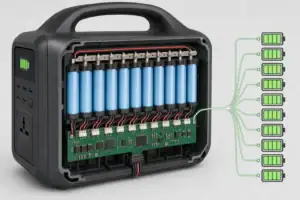
- Beginner-friendly sizing, runtime & specs
- Solar & charging (MPPT, fast charging, cables)
- Batteries (LiFePO4, cycles, care & storage)
- Safety, cold-weather performance, real-world tips
More in Battery
See all →- Portable Power Station Expansion Batteries: When Extra Capacity Makes Sense
- Lithium-Ion vs LiFePO4 Batteries Explained
- LiFePO4 vs Lithium-Ion in Cold Weather: Which Holds Up Better?
- Best Storage Charge Percentage: 40% vs 60% vs 80% for Different Battery Chemistries
- Why Battery Capacity Drops in Cold and Heat (and How to Get Better Runtime)
Keep reading

About this site
Portable Energy Lab publishes practical, independent guides about portable power—clear sizing, safe use, and real-world expectations.
Affiliate disclosure
Some links on this site may be affiliate links. If you buy through these links, we may earn a small commission at no extra cost to you. This helps support our content. Read our affiliate disclosure.