
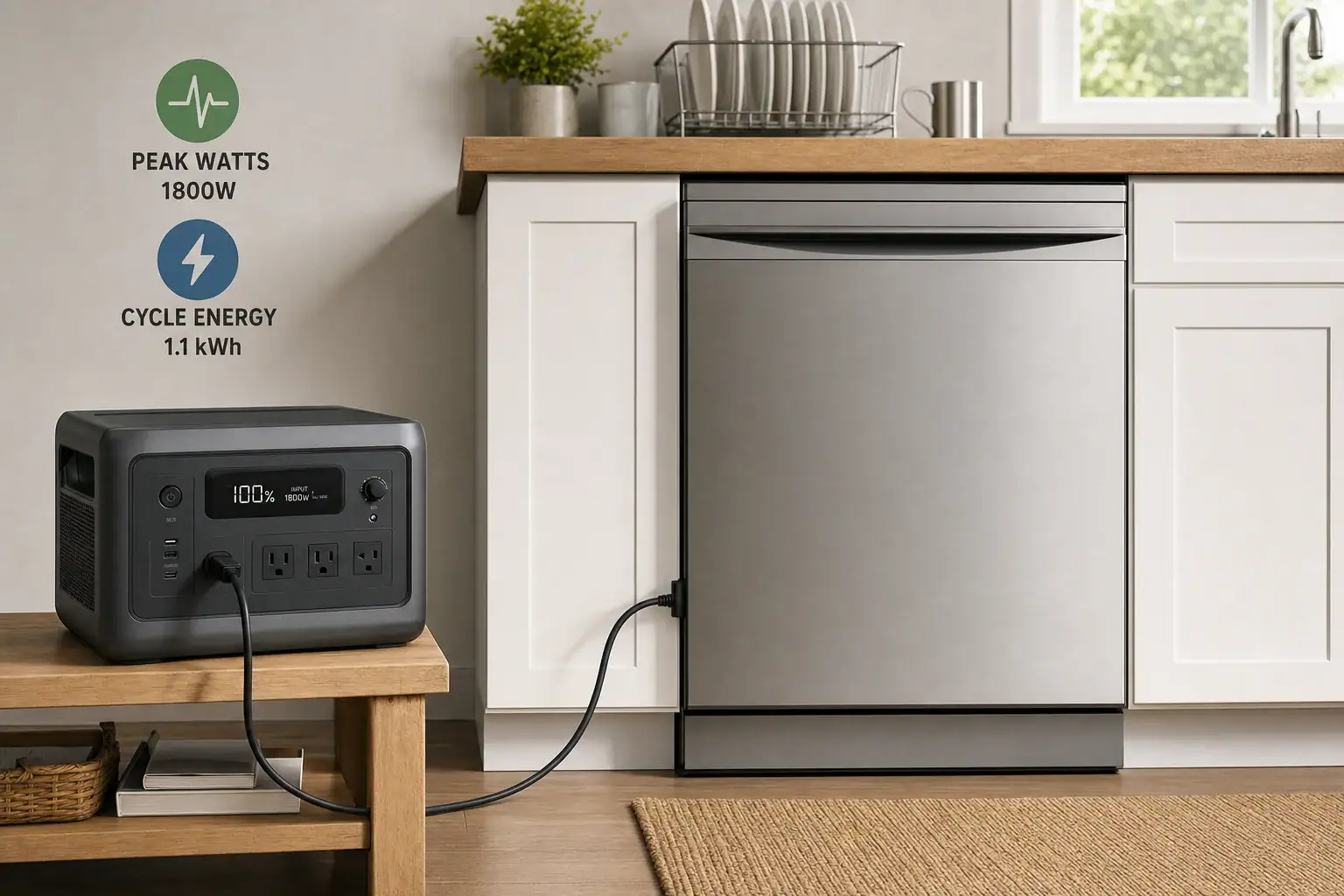
Yes, a portable power station can run some dishwashers—but only if its inverter can handle the dishwasher’s maximum power draw and motor-starting surge, while its battery stores enough energy for the entire cycle. The dishwasher must also have a compatible factory-installed plug and an electrical configuration permitted by both manufacturers.
A built-in dishwasher that is hardwired into the home is not a suitable candidate for an improvised connection. Do not add a cord, alter the appliance, connect a power station to a home panel, or attempt to backfeed household wiring.
Dishwasher watts and cycle energy are different requirements
Two power-station specifications determine whether a dishwasher will run:
- Output power, in watts: The inverter must support the dishwasher’s highest simultaneous load. Water heating and heated drying commonly create the largest sustained demand.
- Battery energy, in watt-hours: The battery must supply enough total energy to finish the selected wash and dry cycle.
A station rated for 1,000 watts and 2,000 watt-hours has substantial energy capacity but may still shut down if the dishwasher draws more than 1,000 watts at any moment. Conversely, a high-output station with a small battery might start the appliance but run out of energy before the cycle ends.
How to determine the required inverter output
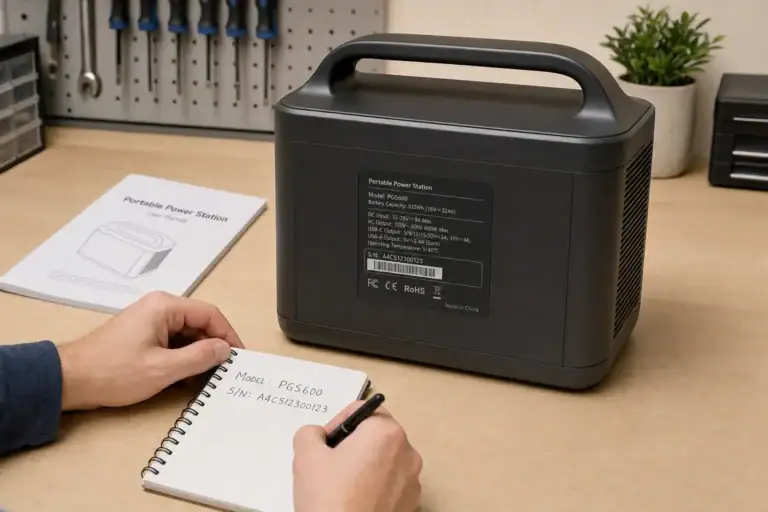
Check the dishwasher’s rating plate and manual for maximum input watts, rated current, voltage, and any stated circuit requirements. Manufacturer specifications vary by model, cycle, water temperature, and drying method.
If only rated current is provided, multiplying voltage by amperage offers a conservative screening estimate. For example, 120 volts × 12 amps equals 1,440 volt-amperes. That is not necessarily the appliance’s exact wattage because motors and electronic controls can affect power factor, but it indicates that a 1,000-watt inverter is unlikely to be appropriate. Verify compatibility with the appliance and power-station manufacturers rather than relying only on this estimate.
The power station’s continuous AC rating should exceed the dishwasher’s maximum simultaneous demand. Allowing roughly 15% to 25% headroom can reduce the chance of overload, but that margin is a practical sizing assumption rather than a universal manufacturer requirement.
Account for motor-starting surge
Dishwasher circulation and drain pumps may briefly draw more power when starting. The heating element is primarily a sustained resistive load rather than a major startup surge. Confirm that the station’s surge rating—and the time for which it can provide that output—covers the appliance’s starting demand. A high surge number is not useful if the station can sustain it only for less time than the motor needs.
Do not assume that an eco cycle eliminates the peak-load issue. It may reduce total energy consumption while still operating the same heater or pump at full power for shorter periods.
How much battery capacity is needed?
Use the dishwasher manufacturer’s cycle-energy figure when available. Because a dishwasher cycles its heater and pumps on and off, multiplying its maximum wattage by the full cycle duration usually overestimates energy use.
A useful sizing formula is:
Required nominal capacity in Wh ≈ cycle energy in kWh × 1,000 ÷ (AC efficiency × planned usable fraction)
AC conversion consumes some energy, so the battery’s advertised watt-hour capacity is not normally equal to the energy delivered at its outlet. Actual efficiency depends on load, inverter design, temperature, battery condition, and manufacturer rating methods. An 85% efficiency assumption is reasonable for an illustration, but it is not a guaranteed value for every station.
For example, suppose a dishwasher cycle is listed at 1.1 kWh. Assuming 85% AC efficiency and reserving 20% of the battery rather than planning a complete discharge:
1.1 × 1,000 ÷ (0.85 × 0.80) ≈ 1,620 Wh
Under those assumptions, about 1.6 kWh of nominal battery capacity is the calculated minimum for one cycle. A larger capacity provides room for a longer cycle, heated drying, battery aging, low temperatures, or differences between published and actual consumption. If a manufacturer states usable energy specifically at the AC outlet, avoid subtracting the same conversion loss twice.
Connection and safety limitations
- Use only a permitted plug connection. A factory cord-and-plug-connected dishwasher may be compatible. A hardwired unit should not be converted or disconnected for this purpose without guidance from the appliance manufacturer and a qualified electrician.
- Do not use home wiring as an intermediary. A portable power station must never be connected to a receptacle to energize household circuits or attached directly to an electrical panel.
- Keep the station dry. Position it on a stable surface away from the sink, hoses, leaks, steam, and wet floors while maintaining the ventilation clearances stated in its manual.
- Do not defeat grounding or protection. Portable stations differ in neutral-to-ground configuration and ground-fault protection. Confirm that the station’s outlet arrangement is compatible with the dishwasher, and never remove a grounding pin or bypass a protective device.
- Avoid extension cords and power strips. Dishwasher manuals commonly restrict them. Follow the appliance manufacturer’s current instructions rather than improvising a longer connection.
A power station also should not be assumed to function as a certified uninterruptible power supply. Transfer behavior varies, and some dishwashers may stop, drain, or restart their cycle after an interruption.
Compatibility checklist
- Dishwasher is factory cord-and-plug connected
- Correct AC voltage and frequency
- Pure sine wave output unless the appliance manufacturer specifies otherwise
- Continuous watts above the maximum appliance load
- Surge output sufficient for pump startup
- Enough usable watt-hours for the selected cycle and conversion losses
- Compatible grounding and ground-fault protection
- Direct, dry connection that follows both manuals
Bottom line
A sufficiently large portable power station may run a plug-connected dishwasher, but both output and battery capacity must be sized independently. Use the dishwasher’s maximum electrical input to select inverter power and its per-cycle energy consumption to estimate battery capacity. If the appliance is hardwired or its grounding requirements are unclear, do not improvise a connection.
Related guides
Browse this topic →
- Beginner-friendly sizing, runtime & specs
- Solar & charging (MPPT, fast charging, cables)
- Batteries (LiFePO4, cycles, care & storage)
- Safety, cold-weather performance, real-world tips
More in Home / Appliances
See all →Keep reading
About this site
Portable Energy Lab publishes practical, independent guides about portable power—clear sizing, safe use, and real-world expectations.
Affiliate disclosure
Some links on this site may be affiliate links. If you buy through these links, we may earn a small commission at no extra cost to you. This helps support our content. Read our affiliate disclosure.