
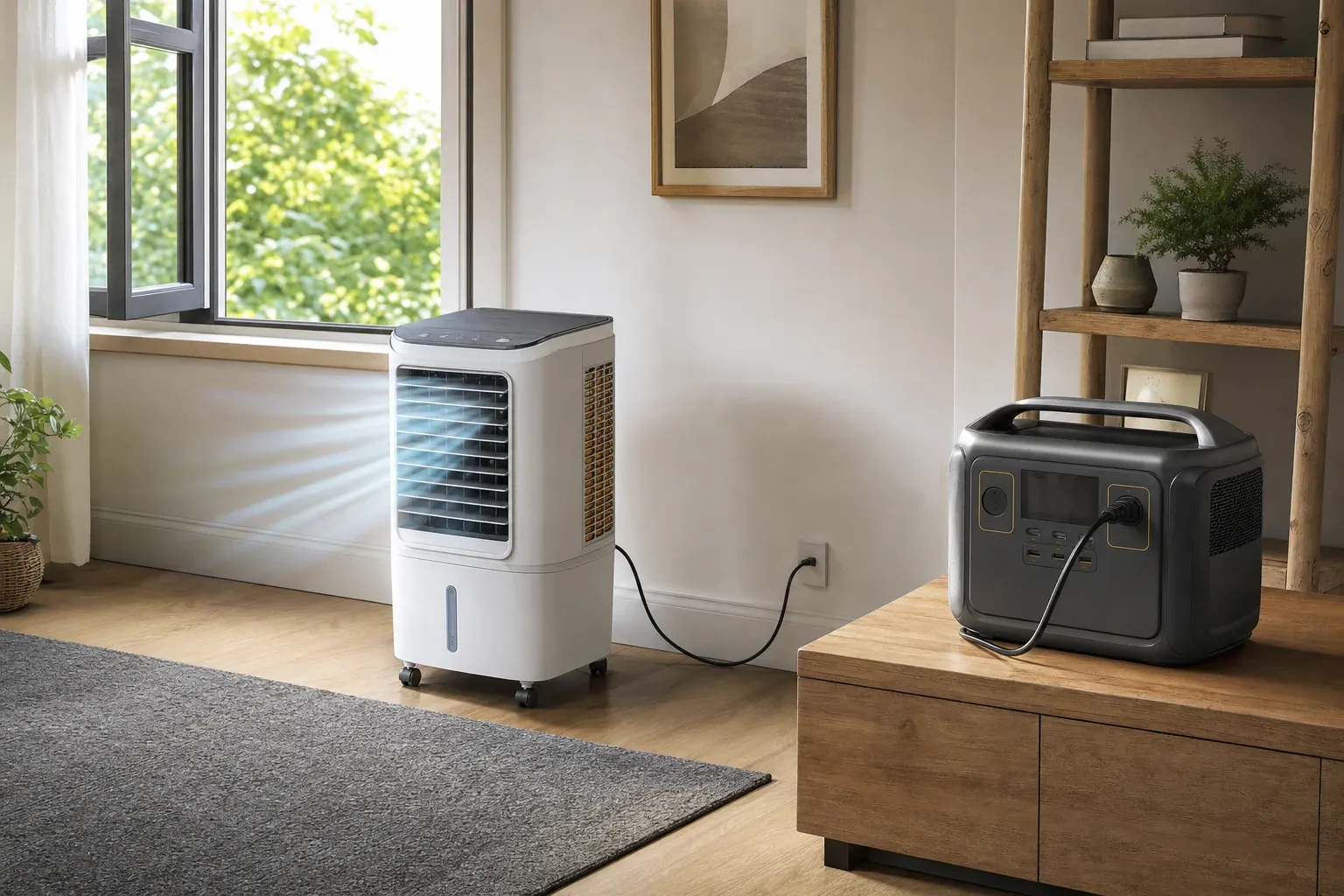
Quick answer: Usually, yes. A portable power station can run an evaporative cooler when its AC voltage and frequency match the cooler, its continuous and applicable surge ratings cover the actual load, and both manuals permit the setup. Estimate runtime with usable AC watt-hours divided by the cooler’s measured average watts.
How to size a portable power station for an evaporative cooler
An evaporative cooler can be a manageable portable-power load, but compatibility is not automatic. A direct evaporative cooler uses a blower to move air through wetted media and a pump to circulate water. The U.S. Department of Energy describes direct systems this way and notes that incoming air needs an exit, commonly through an open window or vent (DOE HVAC guide).
A portable power station for an evaporative cooler must pass five separate checks:
- Electrical match: The cooler’s required voltage and frequency must match the station’s AC output.
- Continuous output: The station’s continuous AC rating must cover the highest sustained wattage of the mode you intend to use.
- Startup output: Documented or safely observed motor-starting demand must remain within the station’s applicable surge capability.
- Energy capacity: Usable energy at the AC outlet must support the runtime you need.
- Permitted setup: Both manuals must allow the intended location, ventilation, cord arrangement, and proximity to moisture.
These checks apply to a cord-connected cooler plugged directly into the station. Do not modify a plug, improvise an adapter, backfeed a household outlet, or connect a station to permanently wired equipment. A fixed electrical installation needs equipment and professional work approved for that purpose.
Find the cooler’s actual power demand
Start with the cooler’s nameplate and manual. Record the exact model, input voltage, frequency, and listed watts. If it lists only amperes, volts multiplied by amps gives volt-amperes, not necessarily actual watts for a motor load. Obtain wattage from the manufacturer or measure the complete appliance with an appropriately rated plug-in power meter in a dry, manual-approved setup.
Model differences can be substantial, so a generic wattage range is not a dependable sizing method. As one model-specific example, Hessaire lists its MC18M mobile cooler at 85 W total consumption; that value applies to that model, not to evaporative coolers generally (Hessaire MC18M specifications).
Measure fan, pump, and accessory settings
Follow the cooler manual for filling and operation. Then record stable power for every mode you expect to use:
- Low, medium, and high fan settings, if provided
- Fan-only operation
- Fan plus water pump at each intended speed
- Oscillation and other powered features
- Automatic modes over a representative interval
For example, the MMBT12/MMBT14 owner’s manual documents blower settings that do not operate the pump, confirming that fan-only and pump-on modes can be distinct loads. The same manual specifies 120 V/60 Hz power and a GFCI-protected receptacle for those models (MMBT12/MMBT14 owner’s manual). Do not apply those requirements or operating details to another cooler without checking its manual.
Enabling the pump or changing fan speed can change power use, but the amount is model-specific. Measuring the complete appliance is more reliable than adding component amp ratings because motor power factor and operating conditions affect actual watts.
Check startup separately from running watts
Nameplate wattage may not describe brief motor-starting demand. Look for manufacturer documentation first. If both manuals permit testing, start the cooler with its normal controls in the most demanding intended mode while watching the meter’s maximum indication and the station’s overload indicators.
Many consumer plug-in meters can miss a short inrush event. A successful start shows that the tested combination worked under those conditions; it does not quantify every unseen peak. Repeated overloads, shutdowns, alarms, or unstable output mean the combination should not be used. Do not assume an evaporative cooler has zero startup surge. For more on that distinction, see surge watts vs. running watts.
Compare watts, watt-hours, and station limits
Watts (W) describe instantaneous power. Compare measured running watts with the station’s continuous AC rating, and compare documented or observed startup behavior with the station’s applicable surge rating.
Watt-hours (Wh) describe stored energy. Battery capacity and inverter output are separate specifications. For example, one specific power-station manual lists 288 Wh capacity, 300 W continuous AC output, and 600 W surge peak as separate ratings (Jackery Explorer 300 Plus manual). Those figures apply only to that model.
Do not treat advertised battery Wh as automatically available at the AC receptacle. Inverter conversion and the station’s operating limits reduce or reserve some energy. Use manufacturer-provided usable AC energy or a safe, documented discharge measurement when available. Otherwise, any reduction factor is only a planning assumption, not a guaranteed efficiency. See usable capacity versus advertised capacity for the distinction.
Evaporative-cooler power decision table
This table is an arithmetic illustration using 500 usable AC Wh after all assumed losses. The loads are examples, not a claimed typical range.
| Measured average load | Minimum continuous output | Estimated runtime from 500 usable Wh |
|---|---|---|
| 85 W | At least 85 W | About 5.9 hours |
| 150 W | At least 150 W | About 3.3 hours |
| 288 W | At least 288 W | About 1.7 hours |
| 500 W | At least 500 W | About 1.0 hour |
Passing the continuous-output check does not prove startup compatibility. The surge check is separate, and the station manual may set further operating limits.
Calculate runtime from measured watts
Use this equation:
Estimated runtime = usable AC watt-hours ÷ time-weighted average watts
If the cooler stays in one mode, use that mode’s stable measured watts. If settings change during use, measure energy over a representative interval or calculate a time-weighted average. Do not apply a compressor-air-conditioner duty-cycle assumption to an evaporative cooler; its blower and pump may run continuously, depending on its controls.
Illustrative calculation with stated assumptions
Suppose a hypothetical station is labeled 1,024 Wh. For planning only, assume 85% reaches the AC load after conversion and reserve losses. This is an assumption, not a universal efficiency or measured result:
1,024 Wh × 0.85 = 870 usable AC Wh
Suppose meter readings show the cooler using 180 W for 45 minutes of each hour and 90 W for the remaining 15 minutes:
(180 W × 0.75) + (90 W × 0.25) = 157.5 W average
870 Wh ÷ 157.5 W = about 5.5 hours
Actual runtime can differ with operating mode, battery state, temperature, inverter behavior, and automatic shutoff settings. Replace the assumed 85% factor with documented or measured usable AC energy whenever possible.
Keep the station dry and maintain airflow
An evaporative cooler combines electricity with a water reservoir, pump, fill connection, or wet media. Keep the power station outside every spill, spray, drainage, and refill path. Do not place it on the cooler, beside an overflow point, or where damp exhaust reaches it. Preserve the ventilation clearances required by both products.
Power-station restrictions vary. The cited Explorer 300 Plus manual, for example, calls for a dry, ventilated location and prohibits exposure to rain or wet environments. That is model-specific guidance, but it illustrates why the station’s own manual must control placement.
Confirm whether the cooler manual requires GFCI protection and whether the proposed supply arrangement actually provides it. Do not assume every power station has GFCI protection merely because it has an AC receptacle. Follow current local electrical requirements, or consult the authority having jurisdiction or a qualified electrician when the arrangement is unclear. See grounding and GFCI with portable power stations for related considerations.
Certification has a defined scope. UL Solutions explains that UL 2743 covers portable power packs for activities such as camping or temporary loss of normal power; that certification does not make a pack a permanently installed residential energy-storage system under UL 9540 (UL Solutions portable power pack guidance).
Nameplate and plug-in-meter checklist
- Cooler make and exact model number
- Required input voltage and frequency
- Nameplate watts or amperes
- Fan-only watts at each intended speed
- Fan-plus-pump watts at each intended speed
- Watts used by oscillation or other accessories
- Documented startup demand or safely observed maximum
- Any station overload, alarm, or shutdown during startup
- Station continuous and surge AC ratings
- Battery capacity and documented or assumed usable AC Wh
- Low-load or automatic AC shutoff behavior
- GFCI instructions for the cooler and supply
- Indoor/outdoor rating and dry-placement requirements
- Cooler exhaust-air and station ventilation clearances
The right station is not determined by battery capacity alone. Confirm the electrical match, measure the complete cooler in its intended modes, verify startup separately, and calculate runtime from usable AC energy. If either manual prohibits the location or power arrangement, choose a different setup rather than improvising around the restriction.
Related guides
Browse this topic →
- Beginner-friendly sizing, runtime & specs
- Solar & charging (MPPT, fast charging, cables)
- Batteries (LiFePO4, cycles, care & storage)
- Safety, cold-weather performance, real-world tips
More in Home / Appliances
See all →Keep reading
About this site
Portable Energy Lab publishes practical, independent guides about portable power—clear sizing, safe use, and real-world expectations.
Affiliate disclosure
Some links on this site may be affiliate links. If you buy through these links, we may earn a small commission at no extra cost to you. This helps support our content. Read our affiliate disclosure.