
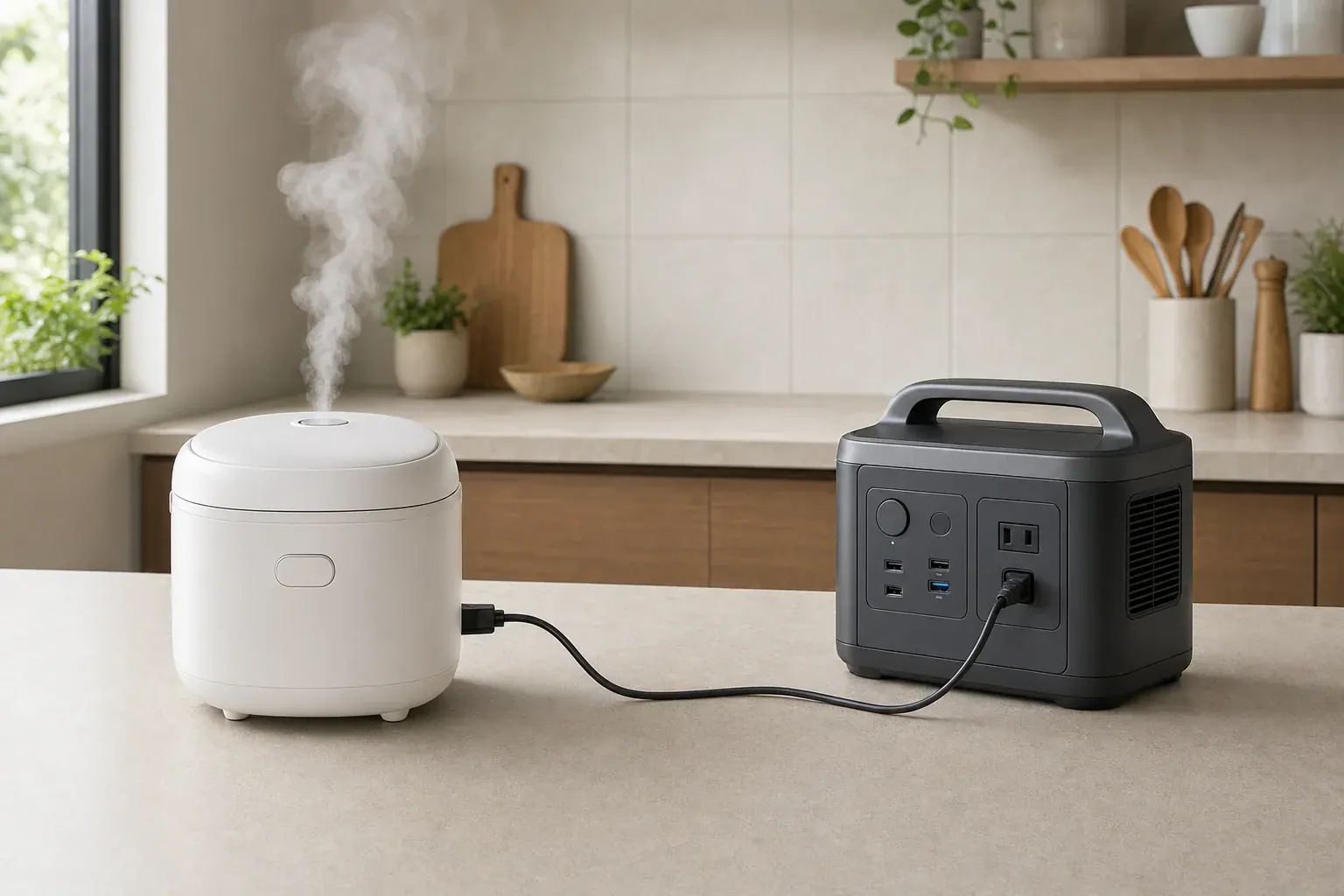
Quick answer: Yes, a portable power station can run a rice cooker when its AC voltage and frequency are compatible, its continuous AC output exceeds the cooker’s cooking load and other active loads, and its usable AC energy covers the selected cooking cycle. Calculate Keep Warm time separately using that cooker’s documented or measured average draw.
How to size a portable power station for a rice cooker
A portable power station for a rice cooker must satisfy two separate limits: power and energy. Watts (W) describe the load the cooker needs at a given moment. Watt-hours (Wh) describe the energy the station can deliver over the complete cooking cycle.
Use the labels and manuals for the exact cooker and station. Rice cooker ratings differ substantially. For example, Aroma lists its ARC-743-1NG at 120V, 60Hz and 350W, while the Zojirushi NS-WTC10 manual specifies 120V, 60Hz and 610W. Those figures apply only to the cited models, not to every cooker of a similar capacity. Sources: Aroma ARC-743-1NG product page and Zojirushi NS-WTC10 manual.
1. Match the AC supply
The station’s AC outlet must provide voltage and frequency compatible with the cooker’s requirements. For example, a cooker marked 120V, 60Hz requires compatible 120V, 60Hz AC output. Do not use the combination when the ratings conflict or when either manufacturer’s instructions prohibit the proposed use.
2. Compare cooking watts with continuous AC output
Compare the cooker’s cooking wattage with the station’s continuous AC-output rating, after adding every device that will run at the same time. A 610W cooker plus a 100W device creates a 710W combined load, so the station needs at least 710W of continuous AC output before allowing any margin.
A temporary surge or peak figure does not authorize operation above the continuous rating. Startup behavior is not established here for the cited cookers. If the cooker’s load is close to the station’s limit, consult both manufacturers’ documentation and confirm operation with an attended test rather than assuming the peak rating will solve the issue. See also surge watts versus running watts.
3. Confirm usable AC energy, not just battery capacity
Output power and stored energy are different specifications. A station can have sufficient AC output to operate a cooker yet lack enough usable AC watt-hours to complete the cycle. A larger battery also cannot compensate for an inverter whose continuous output is below the cooker’s load.
Do not treat nominal battery capacity as energy guaranteed at the AC outlets. Inverter conversion, the station’s own consumption, operating conditions and shutdown settings can reduce the energy available to an AC appliance. Prefer a manufacturer-documented usable-AC-energy figure; otherwise, use a measured result from a comparable load as a planning input. For background, see usable capacity versus advertised capacity.
Rice cooker compatibility decision table
| Check | What it means | Action |
|---|---|---|
| Voltage or frequency is incompatible | The AC supply does not match the cooker requirement. | Do not use the combination. |
| Cooking watts exceed available continuous AC output | The station can overload or shut down. | Use a station with adequate continuous output. |
| Startup behavior is undocumented near the station limit | Operation is uncertain even when nameplate watts appear to fit. | Check manufacturer information and perform an attended confirmation test. |
| Usable AC watt-hours are below the cycle estimate | The station may stop before cooking finishes. | Provide more usable energy or select a cycle supported by documented or measured energy use. |
| Low-load shutdown could occur during Keep Warm | The AC outlet may turn off while energy remains. | Check the station manual and its power-saving settings. |
| All checks fit with margin | The combination is a reasonable candidate for use. | Confirm one full, attended cooking cycle before relying on it. |
How many watt-hours does a rice-cooking cycle need?
For a conservative planning estimate based on a nameplate rating, multiply cooking watts by cooking time in hours:
Estimated cooking energy (Wh) = cooker watts × cooking time (hours)
The Zojirushi NS-WTC10 manual lists 610W electric consumption and estimates 50 to 60 minutes for white rice. It also says cooking time can vary with voltage, room temperature, season and water quantity. Using the full 610W rating for the entire stated time produces this conservative nameplate-based calculation:
610W × 50 ÷ 60 hours = about 508Wh
610W × 60 ÷ 60 hours = 610Wh
This 508–610Wh range is not a measured cycle result. It is a planning ceiling based on the rated power and listed time; the cooker’s actual power use over the cycle may differ. Compare the result with usable AC watt-hours, not merely the number printed as nominal battery capacity.
How long can Keep Warm run?
Keep Warm should be calculated separately because its average draw can be much lower than cooking draw and varies by model and conditions:
Estimated Keep Warm time = remaining usable AC Wh ÷ average Keep Warm W
The Zojirushi NS-WTC10 manual reports 29.5W average Keep Warm consumption, calculated at maximum rice capacity and 68°F room temperature. This is a model- and condition-specific value, not a universal rice-cooker figure.
Illustrative calculation: if 200Wh of usable AC energy remains after cooking, and the cooker averages 29.5W in Keep Warm under comparable conditions, then 200Wh ÷ 29.5W = about 6.8 hours. Actual time can be shorter because the station itself uses energy and may turn its AC output off at low load. Review the station manual and, where relevant, its power-saving settings. See why power stations turn off automatically.
Follow the cooker’s own food-holding instructions rather than treating battery runtime as a food-safety limit. For example, the Aroma ARC-743-1NG manual says not to leave food on Warm for more than 12 hours; that instruction is specific to that model. Source: Aroma ARC-743-1NG manual.
Optional power-meter checklist
A compatible plug-in power meter can make planning more specific than a nameplate-only estimate. Run the test on normal household power before depending on the station, following the cooker and meter instructions.
- Record the cooker’s nameplate voltage, frequency and watts.
- Verify that the meter is rated for the appliance and circuit involved.
- Cook the usual rice quantity with the program you expect to use.
- Record displayed watts, total cycle kWh and elapsed time.
- Measure a separate hour of Keep Warm to estimate its average draw.
- Repeat the test if the rice quantity or selected program changes materially.
- Convert measured kWh to Wh by multiplying by 1,000, then compare it with documented usable AC energy.
- Compare observed load with the station’s continuous output and any documented temporary limit, while allowing for other connected loads.
Safe setup for a rice cooker and power station
Follow both manufacturers’ instructions for placement, ventilation, moisture protection and operating temperature. Put the cooker on a level, dry, heat-resistant surface. Keep the power station away from steam, water and hot surfaces, and do not obstruct the cooker’s steam vent or the station’s vents.
Connect the cooker directly to the station’s AC outlet; never backfeed a wall outlet or home circuit. Follow appliance-specific cord instructions. The Aroma manual cited above says not to use an extension cord. If another appliance manual permits one, the U.S. Consumer Product Safety Commission advises checking the cord’s rating, because a cord can overheat when an appliance draws more watts than the cord can handle. Source: CPSC extension-cord guidance.
Bottom line
A rice cooker can be a suitable portable-power-station load only when AC supply compatibility, continuous output and usable AC energy all check out for the specific models. Treat cooking duration, startup behavior and Keep Warm draw as model-specific. An attended measurement of the intended cooking cycle is the best way to replace assumptions with useful planning data.
Related guides
Browse this topic →
- Beginner-friendly sizing, runtime & specs
- Solar & charging (MPPT, fast charging, cables)
- Batteries (LiFePO4, cycles, care & storage)
- Safety, cold-weather performance, real-world tips
More in Home / Appliances
See all →Keep reading
About this site
Portable Energy Lab publishes practical, independent guides about portable power—clear sizing, safe use, and real-world expectations.
Affiliate disclosure
Some links on this site may be affiliate links. If you buy through these links, we may earn a small commission at no extra cost to you. This helps support our content. Read our affiliate disclosure.