
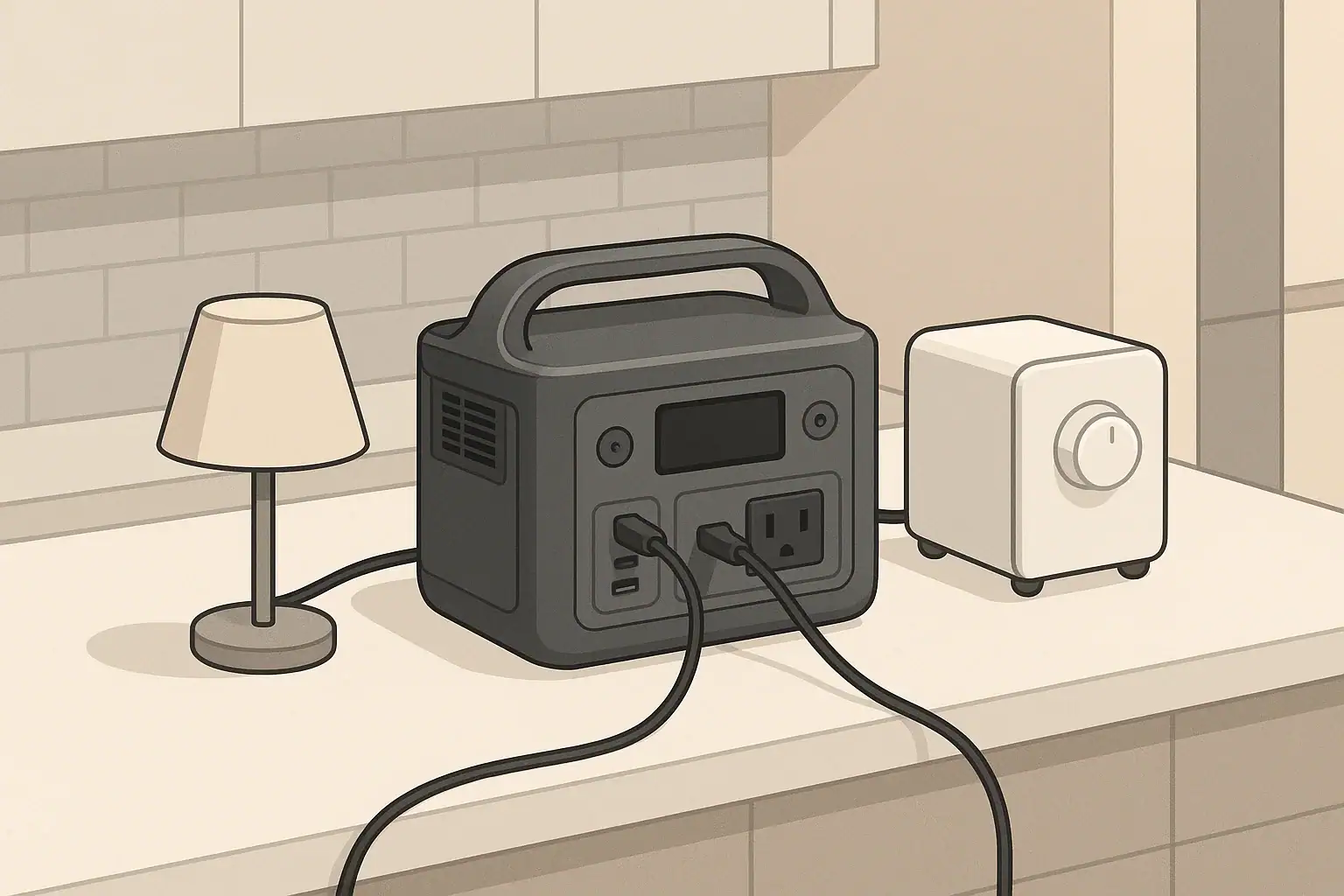
Yes, a portable power station can start some sump pumps, but only if its inverter has enough surge capacity for the pump’s high inrush load. The running watts printed on a pump label are not enough to answer the question, because many pump motors briefly need two to five times more power when they first start.
This startup demand is called inrush current, surge current, locked-rotor current, or motor starting load. It lasts only a short time, but it is often the reason a power station shuts off even though the pump seems to be within the advertised watt rating.
For sump pump backup, you need to check two things: whether the inverter can handle the pump’s startup surge, and whether the battery has enough watt-hours for the pump’s cycling pattern during an outage. Both matter, but surge capacity is usually the first pass-or-fail test.
What high inrush means for sump pumps
A sump pump is a motor-driven load. When the float switch rises and calls for pumping, the motor has to move from a dead stop to operating speed while pushing water through the discharge pipe. That moment can require far more current than steady operation. Once the motor is spinning, the demand usually drops to its normal running watts.
This is different from simple loads such as LED lights, phone chargers, or many laptops. Those devices may use a fairly predictable amount of power. A sump pump may look modest while running, then hit the inverter with a brief demand that is several times larger at startup. If the inverter cannot supply that peak, the pump may hum, fail to start, or cause the power station to display an overload fault.
High inrush matters because sump pumps often need to operate automatically during storms, when grid outages and heavy groundwater can happen at the same time. A setup that works once in a dry test may still struggle if the pump cycles repeatedly, the battery is partly drained, the basement is warm, or other appliances are connected to the same inverter.
The key point is that a sump pump is not just a runtime problem. It is also a starting problem. Any realistic backup plan must leave enough inverter headroom for the motor to start reliably, not just enough battery capacity to run it after it starts.
How to size a power station for startup and runtime
Start with the pump’s running watts or amps. If the nameplate lists amps instead of watts, estimate watts by multiplying volts by amps. A 120-volt pump drawing 5 amps while running is roughly a 600-watt load before accounting for power factor and real-world variation. If the pump documentation lists starting watts, use that number. If it does not, a cautious estimate is often three to five times the running watts.
Next, compare that estimate with the power station’s inverter ratings. The continuous output rating must cover the pump’s running watts with margin. The surge or peak rating must cover the starting demand. A close match is not ideal because voltage drop, warm inverter conditions, and other connected loads can reduce reliability.
Runtime is a separate calculation. Sump pumps usually cycle, meaning they run for short periods and sit idle between cycles. You need the total ON time, not just the outage length. A pump that runs 10 minutes per hour at 600 watts uses 100 watt-hours per hour before losses. After inverter losses and a reserve margin, the required battery capacity will be higher.
| Item to check | How to estimate it | Why it matters |
|---|---|---|
| Running watts | Use the pump label or multiply volts by running amps | Sets the minimum continuous inverter requirement |
| Startup surge | Use published starting watts, or estimate 3 to 5 times running watts | Determines whether the pump will start without overload |
| Continuous inverter output | Compare to running watts with at least practical margin | Prevents shutdown after the motor is already running |
| Surge inverter output | Compare to estimated starting watts, not average watts | Handles the brief motor startup demand |
| Duty cycle | Track minutes of pump runtime per hour during wet conditions | Turns nameplate watts into realistic battery use |
| Usable battery energy | Account for inverter losses and avoid planning to use every watt-hour | Gives a more realistic outage runtime estimate |
| Other connected loads | Add their running watts and consider their own startup surges | Reduces headroom available when the sump pump kicks on |
A simple sizing sequence works well: confirm the pump can start, confirm it can keep running, then estimate total energy. If the first step fails, extra battery capacity will not fix the problem. A larger battery with an undersized inverter may run lights for many hours but still be unable to start a sump pump.
Real-world examples
Consider a small sump pump that runs at about 400 watts. If its startup surge is roughly three times the running draw, it may need about 1,200 watts for a moment. A power station with a 600-watt inverter will not be a good match even if the pump only settles at 400 watts. A unit with a higher continuous rating and a surge rating above the estimated startup demand has a much better chance.
Now consider a mid-sized pump that runs near 700 watts. Its starting demand could be 2,100 to 3,500 watts. If the inverter’s surge rating is 2,000 watts, the result may be inconsistent: it might start once when conditions are favorable, then trip later when the battery is lower or the pump is pushing more water. For emergency flood protection, inconsistent starting is not good enough.
Runtime depends on how often the pump cycles. Suppose a 600-watt pump runs 15 minutes per hour during a storm. That is one quarter of an hour at 600 watts, or about 150 watt-hours per hour before losses. After accounting for inverter inefficiency, the battery may need to provide roughly 165 to 180 watt-hours per hour of operation. A 1,000 watt-hour power station might support that pattern for several hours, but not necessarily overnight with a comfortable reserve.
Heavy rain can change the calculation quickly. If the same pump runs 30 minutes per hour, energy use doubles. If it runs almost continuously, the power station becomes a short-duration bridge, not a full-night backup. This is why observing your actual sump pump during wet weather is more useful than relying on a generic pump size alone.
Multiple motor loads make the situation harder. A refrigerator, freezer, dehumidifier, and sump pump may each be reasonable on their own, but if two motors start at the same time, the combined surge can exceed the inverter limit. For sump pump backup, it is usually better to keep the pump on a dedicated power station or leave generous surge headroom if other loads must share the unit.
Common mistakes and troubleshooting cues
The most common mistake is sizing only by running watts. A pump that runs at 500 watts is not automatically compatible with a 600-watt inverter. The inverter must also survive the starting surge. If it cannot, the power station may shut off instantly or the pump may hum without moving water.
Another mistake is assuming a short successful test proves storm readiness. A quick test with a fully charged battery, no other loads, and a low water level is useful, but it may not represent a long outage. During a storm, the pump may start dozens or hundreds of times, the inverter may warm up, and the battery voltage may be lower.
Extension cords are another weak point. A thin or very long cord can cause voltage drop. Lower voltage makes the motor work harder at startup, which can increase current draw and trip the inverter more easily. Use a short, heavy-duty grounded cord that is appropriate for the pump load, and avoid damaged or coiled cords that can heat up.
| Symptom | Likely cause | Practical response |
|---|---|---|
| Power station immediately shows overload | Startup surge exceeds inverter capability | Reduce other loads or use a power station with higher surge output |
| Pump hums but does not pump water | Motor is not reaching operating speed | Disconnect promptly, check for blockage, and reassess surge capacity |
| Works once, then fails after several cycles | Heat buildup or reduced battery headroom | Improve ventilation and size with more margin |
| Runtime is much shorter than expected | Duty cycle is higher than assumed or losses were ignored | Measure actual minutes of pump runtime per hour |
| Cord or plug feels warm | Undersized cord, poor connection, or excessive current | Stop using that setup and inspect cord rating and condition |
| Other devices turn off when pump starts | Combined surge exceeds available inverter output | Give the sump pump priority or separate critical loads |
If troubleshooting points to surge capacity, do not repeatedly force restarts. Repeated failed starts can stress the pump motor and the inverter. Treat overload messages and humming starts as compatibility warnings, not minor annoyances.
Safety basics for wet basements and motor loads
Keep the power station dry, elevated, and away from any area that could flood. A sump pump lives in a wet environment, but a portable power station should not. Place it on a stable shelf, platform, or other raised location where cords can reach without being pulled tight or creating a trip hazard.
Ventilation is also important. Inverters create heat, especially when starting motors repeatedly. Do not cover the unit, place it in a sealed box, or crowd the cooling vents. Leave enough space around the power station for airflow, and keep combustible materials away from hot surfaces and exhaust paths from cooling fans.
Use grounded cords and intact plugs. Do not remove grounding pins, bypass protective devices, or use damaged adapters. If the power station has outlet limitations, follow them. If the sump pump circuit involves ground-fault protection, be aware that some combinations of pumps, cords, and portable power equipment may trip protection devices. A trip should be investigated rather than ignored.
Do not backfeed a home circuit by plugging a power station into a wall outlet or by making improvised cords. Connecting backup power to household wiring requires proper transfer equipment and code-compliant installation. If you want the sump pump circuit connected through a permanent backup arrangement, that is a job for a licensed electrician.
Finally, consider the consequence of failure. If your basement floods quickly, a portable power station may be only one part of the plan. A dedicated battery backup pump, secondary pump, water alarm, or generator strategy may be appropriate depending on the property and local risk.
Maintenance, storage, and long-term readiness
A power station used for sump pump backup may sit unused for months, then be expected to work during the worst weather of the year. Readiness depends on routine checks. Keep the battery within the storage range recommended by the manufacturer, and check state of charge every few months. Do not assume it is still full because it was charged last season.
Store the unit in a moderate, dry indoor location. Heat can accelerate battery aging, while very cold conditions can reduce available output and affect charging behavior. Damp basements can also encourage corrosion on outlets, plugs, and contacts. If the basement is humid, keep the unit off the floor and inspect it more often.
Test the actual pump with the actual power station under controlled conditions. A useful test is not just turning on the display. Run the pump long enough to confirm that it starts cleanly, moves water, and does not cause overload warnings. Also test with the extension cord you plan to use during an outage, because cord length and gauge can affect startup performance.
Keep a small readiness routine: charge check, cord inspection, vent cleaning, and a pump start test. Listen for changes. A pump that starts louder than usual, vibrates, or runs longer than normal may have a mechanical issue that increases electrical demand. A partially clogged pump, stuck check valve, or restricted discharge line can make startup harder and reduce backup runtime.
If the power station supports pass-through operation, understand its limits before relying on it. Some units can power loads while charging, but may reduce charge speed, limit output, or generate more heat under combined charging and discharge. For a critical pump, test the intended operating mode before a storm.
Practical takeaways and specs to look for
A portable power station can be a practical sump pump backup only when the inverter is sized for the pump’s startup surge and the battery is sized for realistic storm cycling. Running watts alone are not enough. The system must start the pump repeatedly, remain cool enough to operate, and provide enough usable energy for the outage window you care about.
When in doubt, use your actual pump as the reference. Nameplate numbers are helpful, but real-world conditions decide reliability. Watch how often the pump cycles during heavy rain, test startup from the power station, and avoid sharing the inverter with other high-inrush appliances unless there is plenty of margin.
Specs to look for
- Continuous AC output: comfortably above the pump’s running watts, not just equal to them.
- Surge or peak AC output: high enough for the pump’s estimated startup demand, with extra margin.
- Battery capacity in watt-hours: large enough for the expected duty cycle after inverter losses.
- Pure sine wave AC output: generally preferred for motor loads and sensitive equipment.
- Grounded AC outlets: important for typical sump pump plugs and safe cord use.
- Clear overload and temperature protection: helps identify when the setup is being pushed too hard.
- Ventilation design and operating temperature range: important for repeated cycling during storms.
- Recharge options: useful if outages last longer than one battery charge.
- Practical weight and placement: the unit must be easy to position safely above potential water.
The most useful takeaway is simple: treat sump pumps and high inrush loads differently from electronics. First prove the inverter can start the pump. Then calculate runtime from real cycling behavior. Finally, keep the equipment dry, tested, charged, and ready before the weather turns bad.
Frequently asked questions
How do I know if my power station can start my sump pump?
Compare the pump’s startup surge, not just its running watts, to the power station’s surge or peak AC output. The continuous inverter rating should also exceed the pump’s running load with margin. If the pump has no published starting watts, a cautious estimate is often several times the running watts.
What specs matter most for sump pumps high inrush loads?
The most important specs are continuous AC output, surge or peak output, and usable battery capacity in watt-hours. For motor loads, a pure sine wave inverter and grounded outlets are also important. Ventilation and overload protection matter because repeated starts can heat the inverter and reduce reliability.
What is the most common mistake people make with sump pump backup power?
The most common mistake is sizing the setup only by running watts and ignoring startup surge. A pump may seem compatible on paper but still trip the inverter when it starts. Another frequent error is assuming a short test proves it will work during a long storm outage.
Can I run other appliances at the same time as a sump pump?
Sometimes, but it depends on the inverter’s total continuous output and surge headroom. Motor-driven appliances can create their own startup spikes, so combined loads can exceed the limit even if each device seems reasonable alone. For the most reliable backup, give the sump pump priority or keep other loads minimal.
Is it safe to use a portable power station in a wet basement?
It can be safe only if the unit stays dry, elevated, and well ventilated. Keep it away from flood-prone areas, use intact grounded cords, and avoid improvised wiring or backfeeding a home circuit. If you need a permanent connection to household wiring, use proper transfer equipment and a licensed electrician.
How much battery capacity do I need for a sump pump outage?
That depends on how often the pump actually runs during the outage. A pump that cycles briefly may need far less energy than one that runs continuously in heavy rain. Estimate runtime from the pump’s duty cycle, then add inverter losses and a reserve margin.
Related guides
Browse this topic →
- Beginner-friendly sizing, runtime & specs
- Solar & charging (MPPT, fast charging, cables)
- Batteries (LiFePO4, cycles, care & storage)
- Safety, cold-weather performance, real-world tips
More in Home / Appliances
See all →Keep reading
About this site
Portable Energy Lab publishes practical, independent guides about portable power—clear sizing, safe use, and real-world expectations.
Affiliate disclosure
Some links on this site may be affiliate links. If you buy through these links, we may earn a small commission at no extra cost to you. This helps support our content. Read our affiliate disclosure.