
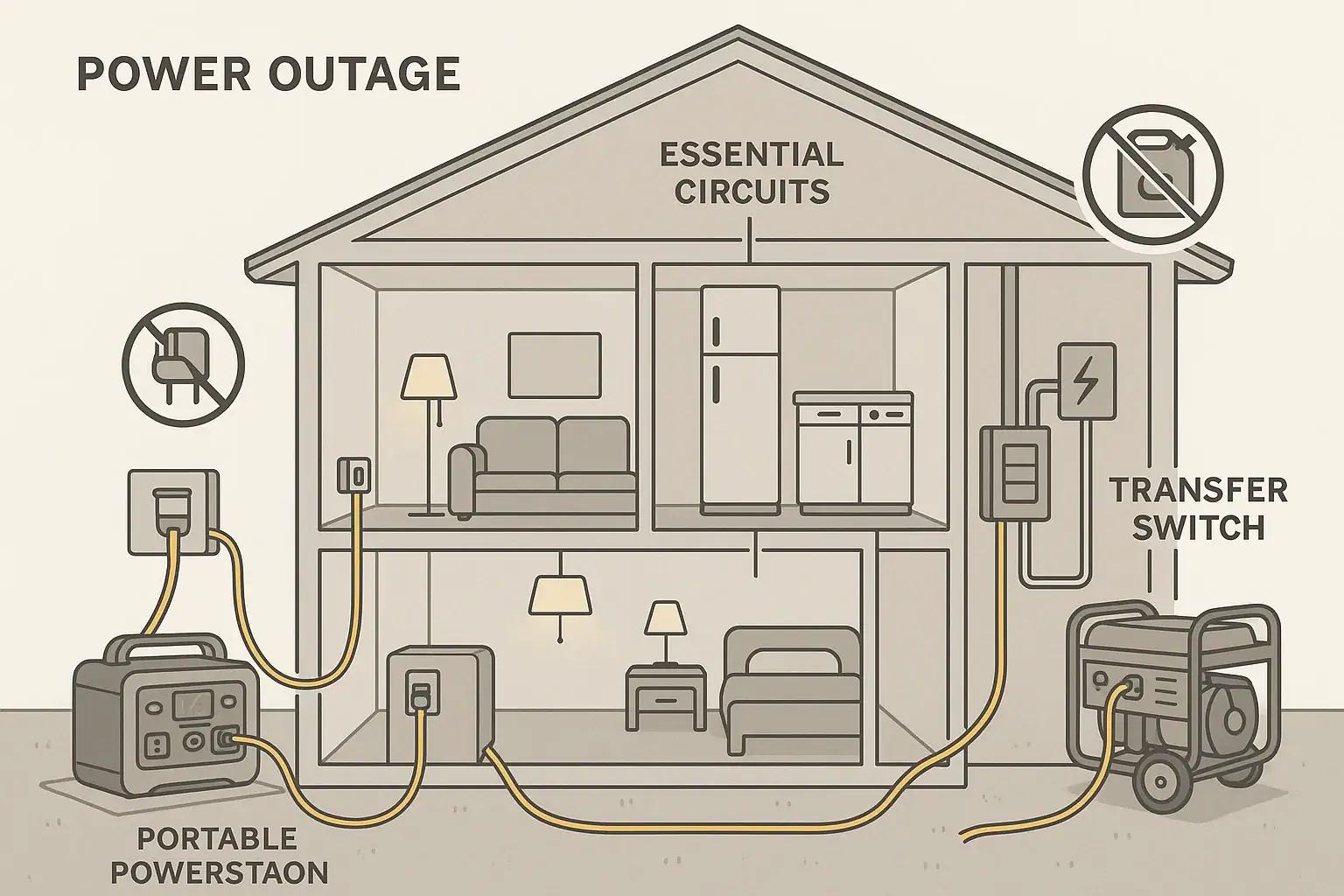
Using a transfer switch with a portable power station is usually not recommended and is often unsafe unless the system is specifically designed and approved for that use. Instead, most homeowners should power essential devices directly from the power station or use other safe backup options. Understanding limits like continuous watts, surge watts, inverter rating, input limit, and runtime will help you plan a backup setup that matches your home needs without risking damage or backfeed.
Many people search for ways to connect a portable power station to a house panel the same way they would a gas generator. While the goals are similar—running fridges, lights, and maybe a furnace during an outage—the internal electronics, grounding, and output profiles of battery stations are very different. This article explains why transfer switches and power stations rarely mix, what safer alternatives exist, and which specs matter when you compare models for home backup.
By the end, you will know how these systems work, what loads you can realistically power, how to avoid common wiring mistakes, and which features to look for if you want a power station that fits into a broader emergency power plan.
What a Transfer Switch Does and Why It Matters With Portable Power Stations
A transfer switch is a device that safely switches a home’s selected circuits between utility power and a backup source, such as a generator. It prevents backfeeding the grid, isolates loads, and simplifies powering hardwired circuits like well pumps, furnaces, and some lighting circuits during an outage.
Portable power stations, however, are not just “quiet generators.” They are self-contained battery-inverter systems with specific limits on continuous output, surge output, grounding configuration, and allowable fault currents. Many are designed to power plug-in devices only, not to serve as a substitute for a permanently installed generator feeding a transfer switch.
This difference matters because transfer switches and home panels are designed around typical generator behavior: rotating machines with defined fault currents, neutral-ground bonding schemes, and breaker trip characteristics. A portable power station may not behave that way, which can affect breaker operation, shock protection, and even the station’s internal safety circuits.
In practice, this means that connecting a portable power station directly to a transfer switch or inlet without explicit approval from the power station’s manufacturer and a qualified electrician can:
- Void warranties or violate electrical code
- Create unsafe neutral or ground paths
- Prevent breakers from tripping correctly during a fault
- Stress the inverter by overloading multiple home circuits at once
For most homeowners, the safer default is to treat a portable power station as a high-capacity extension cord hub: plug in essential appliances directly, or use clearly rated power strips and cords, instead of trying to energize branch circuits through a transfer switch.
How Portable Power Stations and Transfer Switches Work Differently
To understand why transfer switches and portable power stations rarely pair well, it helps to compare how each system operates. A transfer switch is essentially an automatic or manual selector that routes power from either the utility or a backup source to a set of home circuits, while preventing the two sources from ever being connected at the same time.
Portable power stations, by contrast, convert stored DC energy from lithium or other battery chemistries into AC power using an inverter. The inverter’s waveform, surge capacity, and protection logic are tuned for typical appliance loads plugged directly into its outlets, not for feeding an entire branch-circuit network with many unknown combinations of loads.
Key differences include:
- Output capacity: Power stations often provide hundreds to a few thousand watts of continuous output, far less than a typical home service. A transfer switch can connect multiple circuits whose combined draw can easily exceed the station’s inverter rating.
- Fault current behavior: Traditional generators can deliver high short-circuit currents that rapidly trip breakers. Many inverters limit short-circuit current, which can slow or prevent breaker operation under some fault conditions.
- Neutral and ground bonding: Some portable power stations have a floating neutral, some bond neutral to ground internally, and some expect bonding at the panel. Mismatches can lead to nuisance tripping, shock hazards, or code violations.
- Output profile and waveform: Many power stations use pure sine wave inverters, but their total harmonic distortion and voltage regulation under sudden load changes may differ from conventional generators that transfer switches are designed to accommodate.
- Charging behavior: Power stations may charge from wall outlets, solar, or vehicle ports. Incorrectly integrating charging sources into a transfer-switched system can create feedback paths or overload circuits.
Because of these factors, most portable power stations are intended for load-side connection only: you plug devices into the station, not the other way around. When a manufacturer does intend a power station to work with a transfer switch or home backup interface, it is usually clearly documented and may require a dedicated accessory or professionally installed interface.
| Feature | Typical Generator + Transfer Switch | Typical Portable Power Station |
|---|---|---|
| Primary use | Feed selected home circuits | Power plug-in devices directly |
| Continuous output | 3,000–10,000+ watts | 300–3,000 watts |
| Surge capability | High mechanical surge | Limited by inverter electronics |
| Neutral/ground scheme | Designed for panel integration | Varies; often floating neutral |
| Fault current | High; trips breakers quickly | Current-limited by inverter |
| Typical connection | Through transfer switch/inlet | Direct to devices/extension cords |
Real-World Backup Scenarios: When a Transfer Switch Helps and When It Does Not
In real homes, backup power needs fall into a few common patterns. Looking at these scenarios helps clarify where a transfer switch is useful and where a portable power station alone is a better fit.
Scenario 1: Whole-house or multi-circuit backup
A homeowner wants to keep a refrigerator, well pump, gas furnace blower, and several lighting circuits running. These loads are on different breakers, some hardwired, and may start at unpredictable times. A properly sized generator feeding a transfer switch is usually the right tool here, because it can handle high combined loads and starting surges, and the transfer switch safely isolates selected circuits.
A typical portable power station, even a larger one, is usually underpowered for this role if all those circuits are energized at once. Connecting such a station through the transfer switch could lead to overloads, tripped inverters, or incomplete protection if breakers do not trip as expected.
Scenario 2: Essential plug-in loads only
Another homeowner mainly wants to keep a refrigerator, a modem/router, phone chargers, a few LED lamps, and maybe a CPAP machine running. All of these use standard plugs and modest wattage. In this case, a portable power station is ideal when used directly with extension cords and plug-in power strips, with no transfer switch involved.
The user can manage loads manually, watching the station’s wattage display and battery percentage. Runtime can be extended by cycling appliances (for example, running the fridge intermittently) and prioritizing low-wattage devices.
Scenario 3: Mixed hardwired and plug-in loads
Some situations fall in between. For example, a home might have a gas furnace (hardwired), a fridge, and a few plug-in devices. Here are typical approaches:
- Use a traditional generator with a transfer switch for the hardwired furnace and a few circuits.
- Use a portable power station separately for sensitive electronics and low-watt plug-in loads.
- In some cases, a qualified electrician may install a dedicated outlet or interconnection device for a specific hardwired appliance that can be safely powered by a power station, but this is specialized work and must follow local code and manufacturer guidance.
Trying to make a single portable power station do both jobs—feed a transfer switch and power plug-in loads—often stretches it beyond its intended design.
Scenario 4: Apartment or condo backup
In multi-unit buildings, residents often cannot install transfer switches or inlet boxes at all. Here, portable power stations shine because they require no panel work and can be used entirely inside the unit to power small appliances, communication gear, and medical devices (within their rating).
In these environments, transfer switches are usually not an option, so the question becomes how to size and use the power station effectively rather than how to integrate it with building wiring.
Common Mistakes When Pairing Power Stations and Home Circuits
Many of the riskiest mistakes happen when users try to make a portable power station behave like a generator without understanding the electrical differences. Recognizing these pitfalls can help you avoid damage and hazards.
Backfeeding through improvised cords
One of the most dangerous practices is using a “suicide cord” or improvised adapter to backfeed a home panel or transfer switch from a power station. This can energize circuits unexpectedly, expose live prongs, and create shock risks. It may also violate code and void insurance coverage in the event of a fire.
Overloading the inverter via multiple circuits
Even when a transfer switch is present, it is easy to overload a portable power station by energizing several home circuits at once. A refrigerator, microwave, space heater, and well pump starting together can exceed the inverter’s continuous or surge watts, causing shutdowns. Unlike a generator, a power station cannot tolerate sustained overloads.
Neutral and ground confusion
Some users attempt to “fix” nuisance tripping or odd behavior by adding jumpers between neutral and ground or modifying cords. This can defeat built-in protections, create parallel neutral paths, and increase shock risk. Neutral-ground bonding should only be configured according to manufacturer instructions and local code, typically by a licensed electrician.
Ignoring input and output limits
Another common issue is misunderstanding the difference between output rating and input limit. A power station may output 2,000 watts but only accept 400–800 watts of charging input. Trying to charge it through home circuits while simultaneously powering heavy loads can trip breakers, overheat cords, or cause the station to cycle unexpectedly.
Troubleshooting cues to watch for
If you experiment with home integration and see any of the following, stop and reassess the setup with a professional:
- Frequent inverter overload alarms or automatic shutdowns
- Breakers that do not trip even when a clear fault is present (for example, shorted cord)
- Metal enclosures or appliance cases that feel tingly or show voltage on a non-contact tester
- Unexpected behavior when switching between utility and backup sources
These are signs that the system is not behaving as intended and may be unsafe or non-compliant with electrical standards.
Safety Basics: Safer Alternatives to Using a Transfer Switch
For most homeowners, the safest approach is to avoid connecting a portable power station directly to a transfer switch or home panel unless the station and all accessories are specifically designed and approved for that purpose. Instead, focus on load-side solutions that keep the power station’s outlets as the primary source of power.
Direct plug-in approach
The simplest and safest method is to plug essential devices directly into the power station or into high-quality, properly rated extension cords and power strips. This keeps the station’s protections in play and avoids the complexity of panel wiring. Prioritize devices like refrigerators, routers, medical devices, and LED lighting.
Use of dedicated circuits or inlets (professionally installed)
In some homes, a qualified electrician can install dedicated outlets or inlets for specific loads that you want to power from a portable power station, such as a furnace or sump pump. These are usually isolated from the rest of the panel and clearly labeled. The electrician can ensure correct neutral and ground handling and verify that the load’s starting watts are within the station’s surge capacity.
While this may look similar to a transfer switch solution, the design is often simpler and tailored to the limited capacity and behavior of an inverter-based power source.
Parallel use with traditional generators
Another safe alternative is to use a traditional generator with a transfer switch for high-wattage and hardwired loads, while using a portable power station separately for sensitive electronics and smaller plug-in devices. This avoids pushing the power station into roles it was not designed for and can improve overall fuel efficiency by letting you shut down the generator when only light loads are needed.
General safety practices
- Keep the power station in a dry, ventilated area away from flammable materials.
- Use cords rated for the expected current and length; avoid daisy-chaining multiple strips.
- Do not attempt to modify the power station, open its case, or bypass built-in protections.
- Follow all manufacturer instructions regarding maximum load, charging sources, and operating temperature ranges.
- Consult a licensed electrician before making any changes to home wiring or adding inlets, outlets, or switching devices.
| Method | Typical Use | Relative Safety |
|---|---|---|
| Direct plug-in to power station | Fridge, electronics, small appliances | High when within ratings |
| Dedicated, electrician-installed inlet | Specific hardwired load (e.g., furnace) | High when properly designed |
| Transfer switch with generator | Multiple home circuits, higher loads | High when correctly installed |
| Backfeeding panel with improvised cords | Attempted whole-house backup | Low; generally unsafe |
Related guides: Extension Cords and Power Strips: Safe Practices With Portable Power Stations • Surge Watts vs Running Watts: How to Size a Portable Power Station • Neutral-Ground Bonding Explained for Portable Power Stations: When It Matters (and When It Doesn’t)
Maintenance, Storage, and Long-Term Reliability for Home Backup Use
Even if you never connect your portable power station to a transfer switch, how you maintain and store it has a direct impact on performance and safety during an outage. Treat it as a critical appliance, not a gadget you can forget in a closet.
Battery health and charge management
Most modern power stations use lithium-based batteries that prefer partial charge storage and moderate temperatures. Common practices to extend life include:
- Storing the battery around 40–60% charge when not in use for long periods (if the manufacturer recommends it).
- Avoiding full discharge to 0% whenever possible; shallow cycles are easier on the battery.
- Keeping the unit in a cool, dry place away from direct sunlight and extreme heat or cold.
Check the state of charge every 1–3 months and top up as needed. Letting a power station sit fully depleted for long periods can permanently reduce capacity.
Exercise runs and load testing
Just as you would exercise a generator, it is wise to test your portable power station under realistic loads before you rely on it during a storm. Every few months:
- Power up the station and run key devices (fridge, lights, electronics) for an hour or two.
- Observe runtime, wattage draw, and any unusual noises or heat.
- Verify that cords and strips stay cool and that breakers or resettable fuses do not trip.
This practice helps you confirm that the station still meets your expectations and that your load plan is realistic.
Inspecting cords and accessories
Even if you avoid transfer switches, extension cords and power strips are part of almost every backup setup. Periodically check for:
- Cracked insulation, exposed conductors, or damaged plugs
- Loose outlets or strips that no longer grip plugs firmly
- Signs of overheating such as discoloration or soft spots
Replace any questionable accessories immediately. Poor connections can create hot spots and reduce the safety margin of your system.
Documentation and labeling
During an emergency, clear instructions matter. Consider:
- Labeling which appliances should be powered by the station and which should not.
- Keeping a simple load plan that lists approximate wattage for each device.
- Storing manuals and key specifications (continuous watts, surge watts, capacity in Wh) in a waterproof sleeve near the station.
This preparation reduces the temptation to improvise unsafe connections or overload the inverter when the lights go out.
Key Takeaways and Specs to Look For in a Home-Ready Portable Power Station
For most households, using a transfer switch with a portable power station is neither necessary nor advisable unless the equipment is explicitly designed for that purpose and installed by a professional. Instead, think of the station as a flexible, plug-in backup source for essential loads, and pair it with a conventional generator and transfer switch if you need to power multiple circuits or hardwired equipment.
When choosing a portable power station for home backup, focus on how well it supports your real-world loads and how safely it fits into your overall power strategy, rather than on whether it can mimic a whole-house generator.
Specs to look for
- Continuous AC output (watts): Look for enough capacity to cover your highest expected simultaneous load, often 500–2,000 watts for basic home backup. This determines what you can run at the same time without tripping the inverter.
- Surge or peak output (watts): Choose a unit whose surge rating comfortably exceeds the starting watts of your largest motor load (for example, refrigerator or small pump). This helps prevent shutdowns when compressors or motors start.
- Battery capacity (Wh or kWh): For outages, capacities from 500–2,000 Wh suit light loads, while 2–5 kWh or more support longer runtimes. Higher capacity means more hours of operation between charges at a given wattage.
- AC outlet count and type: Multiple grounded outlets and, if needed, a higher-amperage outlet can simplify powering several devices without overloading strips. More outlets reduce the need for adapters and splitters.
- Inverter waveform and quality: A pure sine wave inverter with low distortion is preferable for electronics and some appliances. Better waveform quality reduces noise, heat, and compatibility issues.
- Input charging options and limit (watts): Look for flexible charging (wall, vehicle, solar) and a practical input range, often 200–1,000 watts. Faster charging lets you recover capacity quickly between outages or generator runs.
- Display and monitoring: A clear display showing real-time watts in/out, remaining capacity, and estimated runtime makes load management easier and helps you avoid overloads.
- Operating temperature range: Check that the unit can safely operate in the temperatures typical for your region, especially if you plan to use it in unconditioned spaces.
- Safety certifications and protections: Look for overcurrent, overvoltage, overtemperature, and short-circuit protection, along with recognized safety certifications. These features add layers of protection when powering home devices.
- Expandability and integration options: If you anticipate growing needs, consider whether the system supports expansion batteries or has approved interfaces for limited home backup use. This can provide a path to a more robust setup without unsafe improvisation.
By matching these specifications to your actual loads and respecting the limits of portable power stations, you can build a safer, more reliable backup plan that complements, rather than replaces, traditional transfer switch and generator solutions.
Frequently asked questions
What specs and features should I prioritize when choosing a portable power station for home backup?
Prioritize continuous AC output (watts) to cover simultaneous loads, surge/peak watts to handle motor starts, and battery capacity in watt-hours for runtime. Also consider inverter waveform quality, outlet types and count, input charging limits, and recognized safety protections or certifications.
Is it safe to backfeed my home panel with an adapter or improvised cord?
No. Backfeeding with improvised cords can energize circuits unintentionally, create shock hazards, and prevent utility-side isolation, and it often violates electrical code and insurance terms. Use only approved interconnection methods installed by a qualified electrician.
How can I safely use a portable power station during a power outage?
Use the station as a load-side device: plug appliances directly into its outlets or into properly rated extension cords, keep it in a dry, ventilated area, and monitor wattage to avoid overloads. For any panel connections or inlets, consult a licensed electrician to ensure safe wiring and compliance with local codes.
Can I power hardwired appliances like a furnace or well pump with a portable power station through a transfer switch?
Generally no, unless the station and the transfer switch or inlet are explicitly designed and approved for that use and installed by a professional. Hardwired loads often have high starting watts and require correct neutral/ground handling and fault-current characteristics that many portable inverters do not provide.
How do I estimate how long a portable power station will run my essential devices?
Add the wattage of the devices you plan to run to get a total load, then divide the station’s battery capacity in watt-hours by that load to estimate runtime. Allow for inverter losses and inefficiencies (often 10–20%) and remember that actual runtime will vary with cycling loads and starting surges.
Related guides
Browse this topic →
- Beginner-friendly sizing, runtime & specs
- Solar & charging (MPPT, fast charging, cables)
- Batteries (LiFePO4, cycles, care & storage)
- Safety, cold-weather performance, real-world tips
More in Home / Appliances
See all →Keep reading
About this site
Portable Energy Lab publishes practical, independent guides about portable power—clear sizing, safe use, and real-world expectations.
Affiliate disclosure
Some links on this site may be affiliate links. If you buy through these links, we may earn a small commission at no extra cost to you. This helps support our content. Read our affiliate disclosure.