
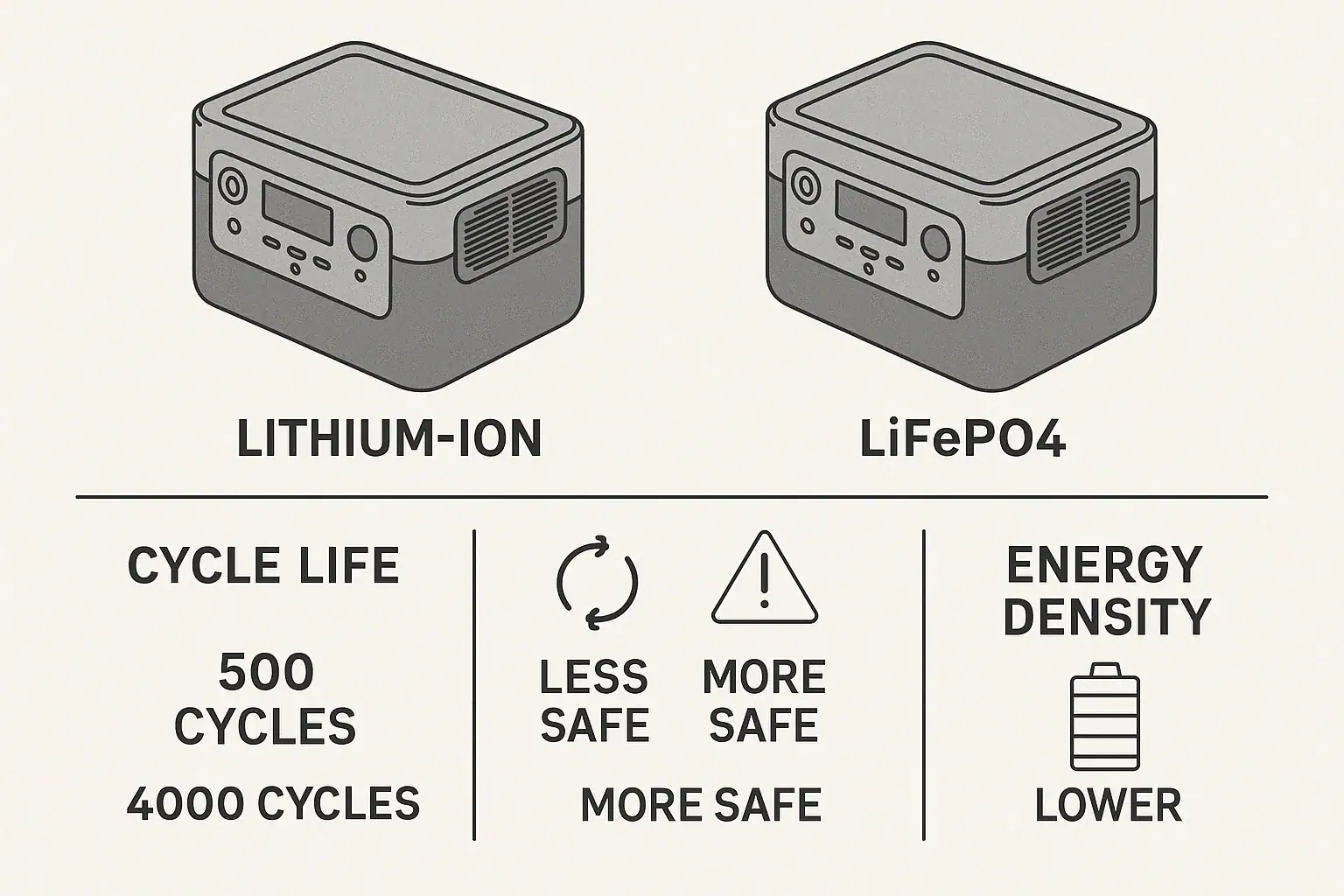
Lithium-ion and LiFePO4 batteries mainly differ in safety, cycle life, weight, and usable capacity, which directly affect runtime, recharge time, and long-term cost in portable power stations. Understanding these differences helps you choose the right battery chemistry for backup power, camping, off-grid use, and everyday charging.
When people compare lithium-ion vs LiFePO4, they are usually asking which lasts longer, which is safer, how many cycles they can expect, and whether the higher price is worth it. These factors influence watt-hour capacity, depth of discharge, charge rate, and how the battery behaves under heavy loads or surge watts from appliances.
This guide breaks down how each chemistry works, what it means for real-world runtime and performance, and which specs matter most so you can match a portable power station to your actual use instead of just buying by advertised watt-hours.
What Lithium-Ion and LiFePO4 Batteries Are and Why They Matter
Both lithium-ion and LiFePO4 are rechargeable lithium-based batteries used in portable power stations, but they use different cathode materials and have different strengths and trade-offs. In this context, “lithium-ion” usually refers to higher energy density chemistries such as nickel-manganese-cobalt or similar blends, while LiFePO4 stands for lithium iron phosphate.
For portable power stations, battery chemistry matters because it affects:
- Cycle life: How many charge/discharge cycles before noticeable capacity loss.
- Safety margin: How the battery handles abuse, high temperatures, and overcharge conditions.
- Energy density: How much energy (Wh) fits into a given size and weight.
- Voltage behavior: How stable the output voltage is as the battery discharges, which affects inverter performance and runtime.
- Cost per cycle: Total usable energy over the battery’s life relative to price.
Choosing between lithium-ion and LiFePO4 is less about which is “best” and more about which is better matched to your priorities: maximum capacity in a compact package, or long life and stability for frequent deep discharges.
How Lithium-Ion and LiFePO4 Batteries Work in Portable Power Stations
Both lithium-ion and LiFePO4 batteries operate by moving lithium ions between a positive electrode (cathode) and a negative electrode (anode) through an electrolyte. During charging, ions move into the anode; during discharging, they move back to the cathode, releasing electrical energy.
In mainstream lithium-ion chemistries, the cathode typically includes nickel, manganese, cobalt, or similar metals, which provide high energy density. LiFePO4 uses an iron-phosphate cathode, which is more thermally stable and less prone to runaway but stores slightly less energy per unit of weight and volume.
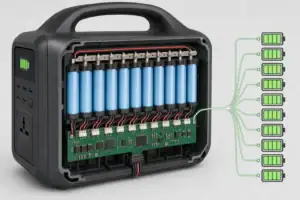
Inside a portable power station, individual cells are connected in series and parallel to create a battery pack with a suitable voltage and capacity. A battery management system (BMS) monitors cell voltages, temperatures, and currents. It controls charging profiles, protects against overcharge and over-discharge, and limits input and output current to safe levels.
Key operational differences include:
- Voltage curve: LiFePO4 has a flatter discharge curve, holding near its nominal voltage for most of the cycle, which can keep inverters operating efficiently longer. Many lithium-ion chemistries show a more gradual voltage drop.
- Cycle life behavior: LiFePO4 typically tolerates more deep cycles (e.g., 2,000–4,000+ at moderate depth of discharge) compared with many lithium-ion packs that may be rated in the hundreds to low thousands of cycles under similar conditions.
- Temperature sensitivity: Lithium-ion chemistries generally perform better in cold conditions but can be more sensitive to high temperatures; LiFePO4 is more stable at high temperatures but can see reduced charge acceptance at low temperatures.
- Charge rate: Both can support relatively fast charging when designed correctly, but the BMS will enforce limits based on cell chemistry, pack design, and long-term durability targets.
| Characteristic | Lithium-Ion | LiFePO4 |
|---|---|---|
| Typical cycle life range | ~500–2,000 cycles | ~2,000–6,000 cycles |
| Energy density (relative) | Higher (more Wh per lb) | Lower (fewer Wh per lb) |
| Thermal stability | Good, but more sensitive to abuse | Very high, more tolerant of abuse |
| Weight for same Wh | Lighter | Heavier |
| Cost per Wh (upfront) | Often lower | Often higher |
| Cost per Wh (lifetime) | Moderate | Often lower due to long life |
Real-World Examples: Which Battery Chemistry Fits Which Use Case
In practice, the choice between lithium-ion and LiFePO4 in a portable power station comes down to how you use it and how often.
Occasional Backup Power and Travel
If you mainly use a portable power station for occasional power outages, light camping, or as a travel charger, a lithium-ion based unit can make sense. The higher energy density means more watt-hours in a smaller, lighter package, which is easier to carry and store. For example:
- A compact 300–500 Wh lithium-ion unit can be light enough for carry-on luggage yet still power small devices, laptops, and low-wattage appliances for short periods.
- Because you are only cycling the battery a few dozen times per year, the shorter cycle life is less of an issue.
Frequent Cycling, Off-Grid, and RV Use
For daily or near-daily use—such as in RVs, van life, off-grid cabins, or as part of a small solar setup—LiFePO4 often provides better long-term value. The higher cycle life and stable voltage are beneficial when you regularly run the battery down and recharge it:
- A 1,000–2,000 Wh LiFePO4 power station used and recharged most days can remain serviceable for many years, even with deep discharges.
- The flatter voltage curve helps maintain consistent inverter output, so devices see less voltage sag as the battery empties.
High-Power Loads and Surge Demands
When powering tools, small air conditioners, or appliances with high surge watts, both chemistries can work well if the pack and inverter are correctly sized. However, LiFePO4’s ability to handle high discharge rates with less stress can be an advantage for repeated heavy use. In contrast, a lithium-ion pack might be more optimized for short bursts and lighter average loads.
Weight-Sensitive vs Longevity-Sensitive Scenarios
If you prioritize minimum weight—such as carrying the unit long distances—lithium-ion’s higher energy density is appealing. If you prioritize longevity and total cost of ownership over many years, LiFePO4’s extended cycle life can outweigh the extra weight and initial cost.
Common Misconceptions, Mistakes, and Troubleshooting Clues
Users often run into performance issues not because of the chemistry itself, but because of misunderstandings about how lithium-ion and LiFePO4 behave in real use.
Mistake 1: Assuming All Watt-Hours Are Equal
Two power stations can have the same rated watt-hours but deliver different usable runtime. Differences in depth of discharge limits, inverter efficiency, and BMS settings mean that a LiFePO4 unit might allow more frequent deep discharges without noticeable degradation, while a lithium-ion unit may be tuned for shallower cycles to protect cycle life.
Troubleshooting cue: If runtime seems shorter than expected, check the rated usable capacity, depth of discharge limits, and whether high loads are triggering early shutoff.
Mistake 2: Ignoring Temperature Effects
Both chemistries are sensitive to temperature, but in different ways. Charging at very low temperatures can be restricted or blocked by the BMS, especially with LiFePO4, to prevent damage. High temperatures can accelerate aging for lithium-ion packs.
Troubleshooting cue: If charging slows down, stops, or the unit displays an error icon in cold or hot environments, let the battery return to a moderate temperature and try again. Many systems intentionally limit input current when cells are outside the optimal temperature range.
Mistake 3: Overestimating Fast-Charge Benefits
Fast charging is limited by both the charger and the battery chemistry. Pushing a lithium-ion pack at its maximum input limit repeatedly can increase heat and long-term wear. LiFePO4 can often handle higher charge rates relative to capacity, but the BMS may still cap input to protect longevity.
Troubleshooting cue: If the unit does not reach the advertised input watts, check whether the state of charge is already high, the temperature is elevated, or the BMS is throttling current to preserve the battery.
Mistake 4: Treating Cycle Life Ratings as Absolute
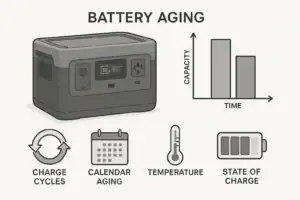
Cycle life ratings (for example, 500 cycles to 80% capacity, or 3,000 cycles to 80%) are estimates under specific test conditions. Real-world factors such as depth of discharge, average temperature, and charging habits can increase or decrease actual lifespan.
Troubleshooting cue: If capacity appears to drop faster than expected, review how deeply you are discharging the battery, how often you are fast charging, and whether the unit is frequently stored fully charged in high heat.
Safety Basics for Lithium-Ion and LiFePO4 Batteries
Both lithium-ion and LiFePO4 batteries used in portable power stations are designed with integrated safety systems. The BMS monitors voltage, current, and temperature to reduce the risk of overcharge, over-discharge, and overheating. Nonetheless, safe operation and storage are essential.
LiFePO4 chemistry is generally considered more thermally stable and less prone to thermal runaway than many lithium-ion chemistries. This does not mean it is immune to damage or misuse, but it provides a wider safety margin when properly designed and managed.
Key safety principles include:
- Use only approved chargers and inputs: Follow the manufacturer’s guidance for AC adapters, car charging, and solar input limits. Mismatched voltage or current can stress the pack and BMS.
- Avoid extreme temperatures: Do not operate or store portable power stations in direct sun inside vehicles or in freezing conditions without protection. Both chemistries age faster under heat, and charging in sub-freezing temperatures can damage cells.
- Keep ventilation clear: Ensure vents and cooling fans are unobstructed so the unit can dissipate heat under heavy load or during fast charging.
- Do not open or modify packs: Battery packs are not user-serviceable. Opening, rewiring, or bypassing protections can create fire and shock hazards.
- Monitor for unusual behavior: Swelling, strong odors, excessive heat, or repeated error codes can indicate a problem. In such cases, discontinue use and contact qualified service support.
For integrating a portable power station with home circuits, consult a qualified electrician. Avoid makeshift connections to breaker panels or household wiring, regardless of battery chemistry.
| Safety Aspect | Lithium-Ion | LiFePO4 |
|---|---|---|
| Thermal runaway tendency | Higher if abused or damaged | Lower due to stable chemistry |
| BMS reliance | Critical for safe operation | Critical, but chemistry is more forgiving |
| High-temperature tolerance | Moderate, aging can accelerate | Generally better, but still limited |
| Abuse tolerance | Less tolerant of overcharge/shorts | More tolerant, yet not immune |
| Typical use guidance | Careful with heat and fast charge | Similar guidance, more margin |
Related guides: LiFePO4 Charging Profile Explained (in Plain English) • Depth of Discharge (DoD) Explained • LiFePO4 vs NMC Batteries: Weight, Cold Performance, Safety, and Real Cycle Life Differences
Maintenance and Storage for Long Battery Life
Good maintenance practices extend the life of both lithium-ion and LiFePO4 batteries and help you get closer to their rated cycle life.
Depth of Discharge and Everyday Use
Both chemistries benefit from avoiding constant 0%–100% swings. While LiFePO4 tolerates deep cycles better, shallower discharges generally slow aging for any lithium-based battery. Keeping typical cycles in a moderate range—such as 20%–80% or 10%–90%—can improve long-term capacity retention.
Storage State of Charge
For long-term storage (weeks to months), storing at partial charge is usually better than leaving the battery full or completely empty. Many users aim for around 30%–60% state of charge when putting a portable power station away for a season. Check the battery level every few months and top up if it drops significantly.
Temperature Management
Store and use the power station in a cool, dry place away from direct sunlight and heat sources. High ambient temperatures accelerate capacity loss for both lithium-ion and LiFePO4, even when not in use. Extremely cold conditions can restrict charging and temporarily reduce available capacity.
Charging Habits
Using moderate charge rates when time allows can reduce heat buildup and stress. Fast charging is convenient, but relying on maximum input power for every cycle may shorten lifespan over many years. If the unit supports adjustable input limits, selecting a lower setting for everyday use can be beneficial.
Periodic Use and Self-Discharge
Lithium-based batteries have relatively low self-discharge, but they are not zero-loss systems. Cycling the power station periodically—rather than leaving it unused for very long periods—can help keep the BMS calibrated and the cells healthy. Avoid letting the battery sit at 0% for extended time, as very deep, prolonged discharge can trigger protective shutdowns that require specialized recovery.
Practical Takeaways and Specs to Look For
When comparing lithium-ion vs LiFePO4 portable power stations, start with how often you will cycle the battery, how much weight you can carry, and how critical safety margins and lifespan are for your use. Lithium-ion units often win on compactness and lower upfront cost, making sense for occasional or light-duty use. LiFePO4 units typically win on cycle life, thermal stability, and long-term value, especially for frequent deep discharges or semi-permanent off-grid setups.
Beyond the marketing labels, focus on measurable specs and how they align with your real-world needs—backup power duration, device wattage, surge watts, input charging time, and expected service life.
Specs to look for
- Battery chemistry (Lithium-ion vs LiFePO4): Choose lithium-ion for lighter weight and compact size; choose LiFePO4 for higher cycle life and added thermal stability, especially for frequent daily use.
- Usable capacity (Wh): Look for clear watt-hour ratings and, if available, usable capacity after BMS limits (for example, 90%–95% of nominal). More Wh means longer runtime for the same load.
- Cycle life rating: Compare ratings such as 500+ vs 2,000+ cycles to 80% capacity at a stated depth of discharge. Higher cycle counts suggest better long-term value when used regularly.
- Continuous and surge output (W): Ensure continuous watts comfortably exceed your typical load, and surge watts exceed startup demands of devices like fridges or power tools.
- Charge input power and options: Check maximum AC, car, and solar input (for example, 200–800 W total). Higher input allows faster recharge, but moderate rates can be gentler on the battery.
- Operating temperature range: Look for realistic charge and discharge temperature ranges. Wider ranges and built-in low-temperature charging protection are helpful in variable climates.
- BMS protections listed: Confirm protections for over-voltage, under-voltage, over-current, short circuit, and temperature. These are critical regardless of chemistry.
- Weight vs capacity ratio: Compare pounds per 100 Wh. Lithium-ion typically offers a lower weight per Wh; LiFePO4 will be heavier for the same capacity but may last more cycles.
- Recommended depth of discharge: Some manufacturers specify an ideal discharge range. A design that supports deeper discharge (for example, down to 10–20%) without severe cycle life penalties can be beneficial.
- Warranty duration and cycle terms: While not a performance spec, a longer warranty aligned with higher cycle life claims can provide added confidence in the stated ratings.
By aligning these specs with how often you plan to cycle the battery, the loads you need to power, and your tolerance for weight and cost, you can make an informed choice between lithium-ion and LiFePO4 portable power stations that fits your long-term needs.
Frequently asked questions
Which specs and features should I compare when choosing between lithium-ion and LiFePO4 batteries?
Compare usable watt-hours (not just nominal capacity), cycle life at a stated depth of discharge, continuous and surge output (W), charge input limits, operating temperature range, and listed BMS protections. These factors determine real runtime, how often the pack can be used over its life, and how it handles heavy loads and temperatures.
How can I avoid common mistakes when estimating real-world runtime?
Account for usable capacity after BMS limits, inverter efficiency, depth of discharge, and the impact of high loads or surge events rather than relying on nominal watt-hours alone. Also check whether advertised charge times assume ideal conditions—temperature and input power can change real performance.
Are LiFePO4 batteries safer than other lithium-ion chemistries?
LiFePO4 is generally more thermally stable and less prone to thermal runaway than many higher-energy-density lithium-ion chemistries, providing a wider safety margin. However, safe operation still depends on a properly designed BMS and correct charging, storage, and handling practices.
Is the higher upfront cost of LiFePO4 usually justified compared to lithium-ion?
LiFePO4 often costs more up front but can deliver lower cost per usable Wh over many years because of higher cycle life and better durability under deep discharges. Whether it’s justified depends on how frequently you’ll cycle the battery and whether longevity and safety margins are priorities.
Do extreme temperatures affect charging and performance for these batteries?
Yes. Charging can be limited or blocked at low temperatures (especially for LiFePO4) and high ambient heat accelerates aging for both chemistries. Look for realistic operating and charging temperature ranges and allow the unit to return to moderate temperatures if the BMS throttles input.
Which chemistry is generally better for frequent heavy loads and high-discharge use?
For repeated heavy loads and frequent deep discharging, LiFePO4 typically performs better due to higher cycle life and better tolerance for high discharge rates. Well-designed lithium-ion packs can handle high power too, but they may show faster capacity decline under the same demanding usage.
Related guides
Browse this topic →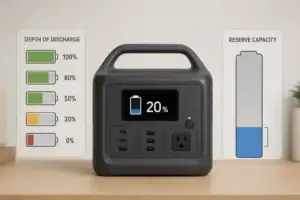
- Beginner-friendly sizing, runtime & specs
- Solar & charging (MPPT, fast charging, cables)
- Batteries (LiFePO4, cycles, care & storage)
- Safety, cold-weather performance, real-world tips
More in Battery
See all →- Low-Temperature Charging Protection in LiFePO4 Power Stations Explained
- Portable Power Station Expansion Batteries: When Extra Capacity Makes Sense
- LiFePO4 vs Lithium-Ion in Cold Weather: Which Holds Up Better?
- Best Storage Charge Percentage: 40% vs 60% vs 80% for Different Battery Chemistries
- Why Battery Capacity Drops in Cold and Heat (and How to Get Better Runtime)
Keep reading
About this site
Portable Energy Lab publishes practical, independent guides about portable power—clear sizing, safe use, and real-world expectations.
Affiliate disclosure
Some links on this site may be affiliate links. If you buy through these links, we may earn a small commission at no extra cost to you. This helps support our content. Read our affiliate disclosure.