
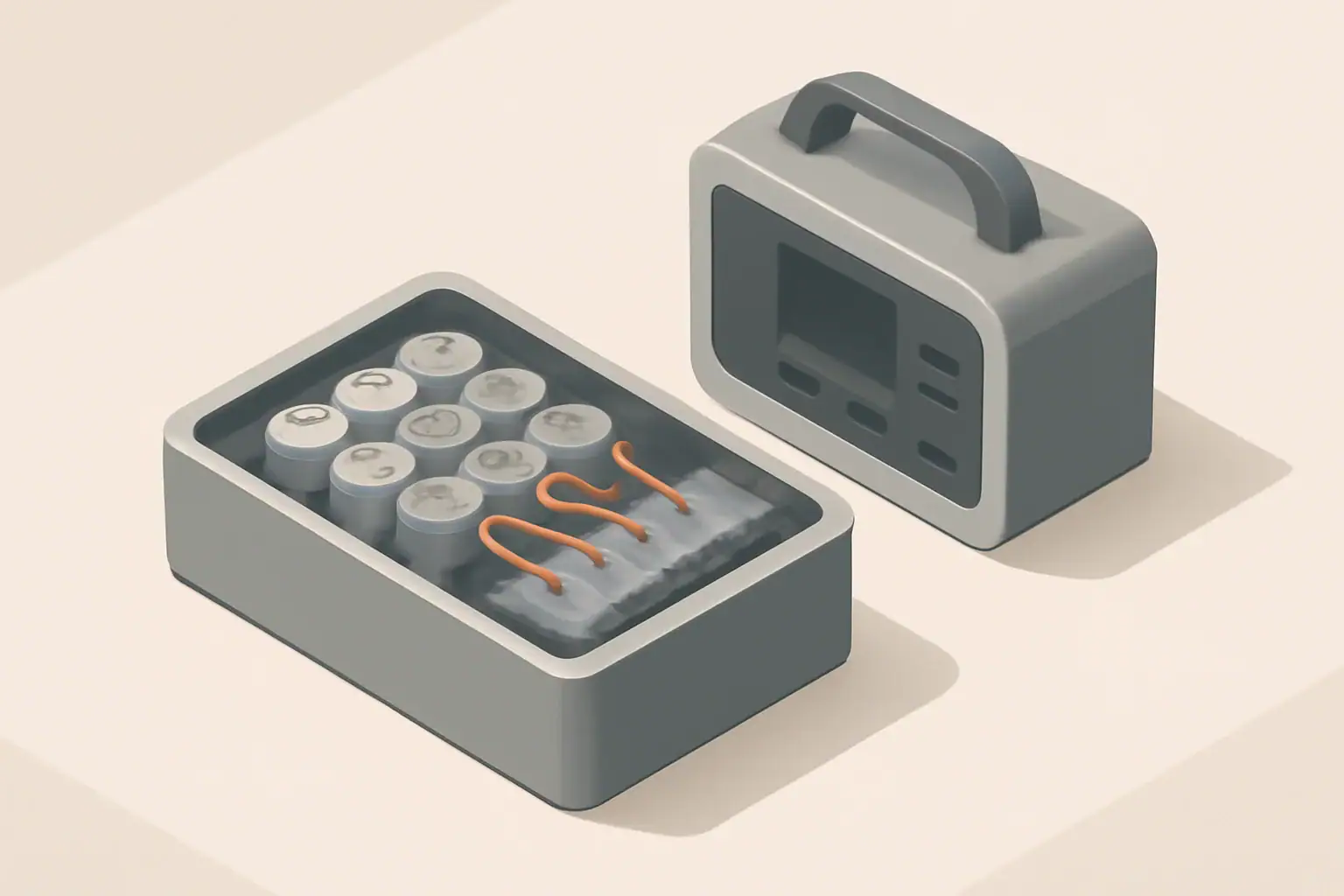
What is a Battery Management System (BMS)?
A Battery Management System (BMS) is the electronic control and protection system that monitors and manages the cells inside a battery pack. In a portable power station the BMS is the central subsystem that keeps the battery operating safely, extends cell life, and enables reliable charging and discharging.
Why a BMS Matters in Portable Power Stations
Portable power stations combine one or more cell modules with an inverter, charger, and output circuitry. Cells are sensitive to voltage, current, temperature, and state of charge. The BMS ensures those conditions stay within safe limits.
Without an effective BMS, the battery pack risks reduced capacity, accelerated aging, thermal events, and sudden failure. The BMS is the primary safety layer to prevent those outcomes.
Core Protections Provided by a BMS
A modern BMS implements multiple overlapping protections. Each addresses a different risk to cells or to the user.
Overcharge Protection
Overcharging raises cell voltage beyond safe limits and can cause oxygen release, increased pressure, and permanent damage. The BMS monitors per-cell voltages and stops charging at a defined cutoff.
Overdischarge Protection
Deep discharge can damage cell chemistry and reduce usable capacity. The BMS blocks further discharge when cells reach a minimum safe voltage, protecting long-term health.
Overcurrent and Short-Circuit Protection
High discharge currents and short circuits generate heat and stress. The BMS detects excessive current and responds by opening switches, tripping contactors, or blowing fuses to interrupt flow.
Thermal Protection
Temperature affects performance and safety. The BMS uses temperature sensors to limit charge/discharge at extreme temperatures and to shut down the pack if temperatures exceed safe thresholds.
Cell Balancing
Individual cells in a pack drift apart in voltage over time. Balancing redistributes or bleeds off energy so cells remain matched, maximizing capacity and preventing weak cells from limiting the pack.
State Estimation and SoC Limits
The BMS estimates state of charge (SoC) and state of health (SoH) using voltage, current, and time-based algorithms. These estimates inform charge and discharge limits and user displays.
Isolation and Ground Fault Detection
Some BMS implementations check for isolation resistance and ground faults, particularly when the power station connects to external sources like solar panels or AC mains. This prevents hazardous leakage paths.
Communications and Diagnostics
Many BMSs expose telemetry to chargers, inverters, or a user interface. Communications enable coordinated control, fault logging, and firmware updates for improved performance and diagnostics.
How Protections Are Implemented
BMS designs combine sensors, power electronics, embedded software, and safety components. Key elements include:
- Voltage sensing circuits that measure each cell or cell group.
- Current sensors (shunts or hall-effect) for accurate charge and discharge monitoring.
- Temperature sensors placed at cell groups or critical locations.
- Switching devices such as MOSFETs or contactors to connect and disconnect the pack.
- Passive or active balancing circuitry to equalize cell voltages.
- Microcontrollers and firmware that execute protection logic and communications.
- Hardware fuses or thermal fuses as last-resort fail-safes.
MOSFETs, Contactors, and Fuses
MOSFETs provide fast switching for charge/discharge control, while contactors or relays handle high-energy disconnects. Physical fuses provide irreversible protection in catastrophic events.
Passive vs Active Balancing
Passive balancing bleeds excess energy from high cells through resistors. It is simple and cost-effective. Active balancing transfers energy from higher cells to lower ones more efficiently, improving usable capacity especially on large packs.
Interaction with Charger and Inverter
The BMS must coordinate with the power station’s charger and inverter. Typical coordination tasks include:
- Signaling when charging can occur and when to stop (charge enable/disable).
- Limiting charger current based on pack temperature or cell imbalance.
- Permitting inverter operation only when state of charge and cell conditions are safe.
- Reporting faults and status to the user interface or remote monitoring system.
Monitoring, Logging, and Firmware
Logging events such as overcurrent trips, temperature excursions, and balancing activity is important for troubleshooting and warranty evaluation. Firmware implements algorithms for SoC/SoH estimation and must be validated to avoid erroneous shutdowns or missed faults.
Secure firmware update mechanisms are also important to fix bugs and improve algorithms over time.
Limitations and Failure Modes
A BMS reduces risk but does not eliminate it completely. Common limits and failure modes include:
- Sensor failures giving false readings and inappropriate responses.
- Firmware bugs that miscalculate SoC or miss fault conditions.
- Physical damage to wiring or cells outside the BMS’s sensing area.
- Component failures such as MOSFETs or current sensors failing short or open.
- Environmental factors (water ingress, extreme mechanical shock) that bypass safeguards.
Robust designs use redundant sensors, watchdog timers, and hardware-level failsafes (fuses, thermal cutouts) to guard against single-point failures.
Standards and Testing
Battery packs and BMSs are typically designed to meet industry safety standards and undergo testing for abuse conditions, short circuits, thermal stability, and electrical isolation. Look for products that reference recognized standards and independent testing to ensure compliance.
Maintenance and Best Practices
Users can help a BMS keep the pack healthy by following some basic practices:
- Store the power station at moderate state of charge (often 40–60%) if unused for long periods.
- Avoid charging or discharging at extreme temperatures. Let the unit warm or cool before use if necessary.
- Keep vents and cooling passages clean and unobstructed.
- Update firmware when vendor-supplied updates are available, following official instructions.
- Have cellular or battery pack service performed by trained technicians if the pack is damaged or shows repeated faults.
Common Misconceptions
Some users expect a BMS to be a cure-all. Clarify these points:
- A BMS cannot prevent damage from physical puncture or severe mechanical abuse.
- It cannot completely compensate for cells that are aged or defective; it can only limit operation to reduce risk.
- Not all BMSs are equivalent—features and robustness vary by design and validation.
Frequently Asked Questions about BMS
How does the BMS detect a short circuit?
The BMS monitors current continuously. A sudden spike beyond configured thresholds triggers immediate disconnect through MOSFETs or contactors and may also blow a fuse if present.
Can the BMS be reset after a fault?
Some faults clear automatically when conditions return to normal; others require manual reset or service. Critical faults often need professional inspection before reuse.
Does cell chemistry change BMS settings?
Yes. Different chemistries (for example lithium ion versus LiFePO4) have different voltage and temperature ranges, and the BMS must be configured accordingly.
Further Reading
For technical users, topics to explore next include cell balancing algorithms, SoC estimation methods (Coulomb counting and model-based approaches), and standards for battery safety testing.
The BMS is a critical component inside any portable power station. Understanding its protections and limitations helps owners use and maintain their equipment safely and effectively.
Frequently asked questions
How does cell balancing extend the life and usable capacity of a battery pack?
Cell balancing keeps individual cells at similar state-of-charge so that no single cell reaches overcharge or deep-discharge limits before the pack as a whole. By preventing cells from hitting extreme voltages repeatedly, balancing reduces stress and uneven aging, which helps preserve usable capacity and cycle life. Active balancing is more efficient for large packs, while passive balancing is simpler and commonly used in smaller systems.
Can a BMS completely prevent thermal runaway in a battery pack?
No. A BMS significantly reduces the probability of thermal runaway by limiting charge/discharge, monitoring temperature, and shutting down the pack on unsafe conditions, and hardware safeguards (fuses, contactors) act as additional layers. However, it cannot guarantee prevention in cases of severe mechanical damage, manufacturing defects, or external abuse that bypass electronic controls.
What steps should I take if the BMS reports repeated overcurrent or cell imbalance faults?
Stop charging or discharging the pack and disconnect external loads if it is safe to do so. Inspect for obvious issues such as damaged cables, loose connections, or blocked cooling; check for firmware updates and review fault logs, and if the problem persists, have the pack inspected and serviced by trained technicians.
How does the BMS communicate charge and discharge limits to the charger or inverter?
The BMS typically communicates via digital buses (for example CAN or SMBus/I2C) or through dedicated enable/limit signals and telemetry lines. It reports parameters such as SoC, temperature, cell imbalances, and fault states so upstream chargers or inverters can adjust current, stop charging, or refuse to run until conditions are safe.
How often should BMS firmware and diagnostic logs be checked or updated?
Review diagnostic logs whenever a fault occurs and include a firmware/log check in routine maintenance; for many consumer units an annual inspection is reasonable, while critical installations may require more frequent reviews. Apply vendor-supplied firmware updates when they address safety fixes or documented reliability improvements, following the manufacturer’s instructions.
Recommended next:
Related guides
Browse this topic →

- Beginner-friendly sizing, runtime & specs
- Solar & charging (MPPT, fast charging, cables)
- Batteries (LiFePO4, cycles, care & storage)
- Safety, cold-weather performance, real-world tips
More in Battery
See all →- Depth of Discharge (DoD) Explained: How Partial Cycles Extend Battery Life (LiFePO4 vs NMC)
- BMS Explained: What a Battery Management System Actually Does in a Portable Power Station
- Temperature Limits Explained: Safe Charging/Discharging Ranges and What Happens Outside Them
- State of Charge (SOC) and Battery Calibration: Why Percent Readings Drift
- Battery Cycle Life Explained: What “Cycles” Really Mean
Keep reading
About this site
Portable Energy Lab publishes practical, independent guides about portable power—clear sizing, safe use, and real-world expectations.
Affiliate disclosure
Some links on this site may be affiliate links. If you buy through these links, we may earn a small commission at no extra cost to you. This helps support our content. Learn more.