
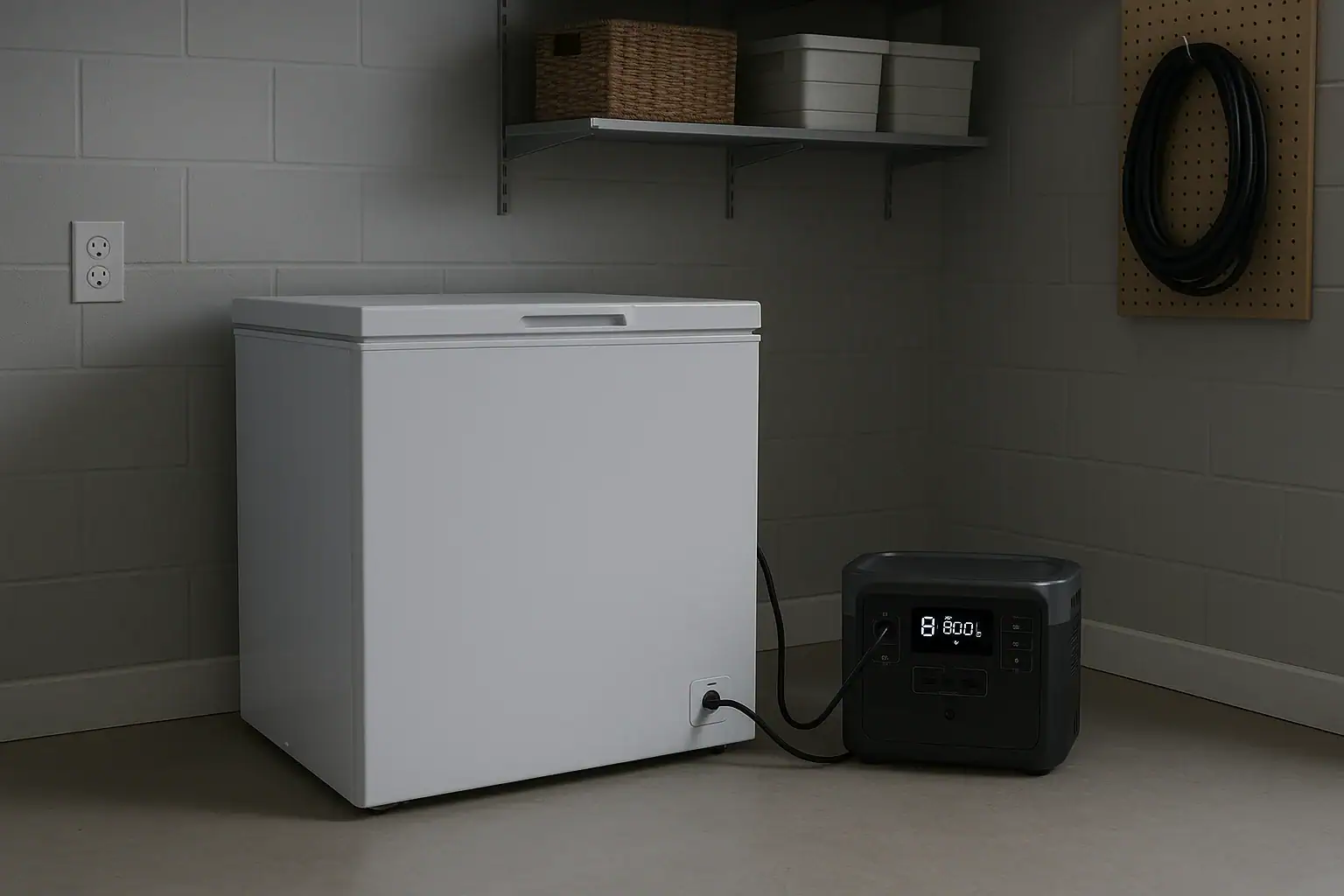
The right size portable power station for a typical chest freezer is usually in the 500–1500 Wh range, depending on freezer wattage and how many hours of runtime you need during an outage. To plan accurately, you need to understand running watts, surge watts, duty cycle, and battery capacity so you can estimate runtime and avoid spoiled food.
People often search for terms like “how many watts for a chest freezer,” “runtime calculator,” “surge watts,” “Wh capacity,” or “backup power for freezer” when trying to size a portable power station. The core idea is simple: match the inverter’s surge rating to the freezer’s startup load, and size the battery (in watt-hours) to cover your target outage hours with some safety margin. Once you know your freezer’s energy use per hour, you can pick a power station capacity that keeps it cold without overpaying for unused capacity.
This guide walks through how chest freezers draw power, how to estimate runtime, common sizing mistakes, and which specs matter most when choosing a portable power station for emergency backup.
How Chest Freezer Power Needs Affect Portable Power Station Size
Choosing the right size portable power station for a chest freezer starts with understanding what the freezer actually demands from the battery and inverter. Size is not just about the biggest number on the box; it is about matching power (watts) and energy (watt-hours) to your specific freezer and outage scenario.
A chest freezer has two key electrical characteristics that matter for sizing:
- Running power (running watts) – the steady power draw while the compressor is on.
- Surge power (starting watts or inrush current) – the brief higher draw when the compressor starts.
Portable power stations must handle both. The inverter needs enough surge watts to start the compressor cleanly, and the battery must have enough capacity (Wh) to keep the freezer cycling on and off over the duration of the outage. Because chest freezers are insulated and the compressor does not run constantly, the average hourly energy use is usually much lower than the nameplate wattage suggests.
This matters for runtime planning. If you only look at the maximum wattage, you might think you need a huge power station. In reality, a moderate-capacity unit can often run a chest freezer for many hours, especially if you keep the lid closed and the room is cool. Understanding these basics helps you avoid overbuying or underestimating runtime.
Key Power and Runtime Concepts for Chest Freezer Backup
To plan runtime and choose the right portable power station size, you need to connect a few basic electrical concepts: watts, watt-hours, surge, and duty cycle. Once you understand how they relate, sizing becomes a straightforward calculation instead of guesswork.
Watts vs. watt-hours
- Watts (W) measure power at a moment in time. Your freezer might draw 80–200 W while the compressor is running.
- Watt-hours (Wh) measure energy over time. A 1000 Wh portable power station can theoretically supply 100 W for 10 hours (100 W × 10 h = 1000 Wh).
Surge watts and inverter limits
Chest freezers use a compressor motor, which briefly draws extra power at startup. This is often 2–3 times the running watts. Your portable power station’s inverter must have:
- Continuous output higher than the freezer’s running watts.
- Surge output high enough to handle compressor startup without tripping.
Duty cycle and average consumption
Freezers do not run at full power all the time. They cycle:
- The compressor turns on to cool down (drawing near the rated watts).
- Then it shuts off while the insulation holds the cold (drawing very little power).
The percentage of time the compressor is on is the duty cycle. A 30% duty cycle means the compressor runs about 18 minutes out of each hour. This makes the average hourly consumption much lower than the running watt rating alone.
Battery usable capacity and efficiency
Portable power stations do not deliver 100% of their rated Wh to your freezer. Losses occur in the inverter and internal electronics. As a rough planning rule, many people assume about 80–90% of the rated capacity is usable for AC loads. For example, a 1000 Wh unit might effectively deliver 800–900 Wh to your freezer over time.
Runtime estimation formula
Once you know your freezer’s average hourly energy use, you can estimate runtime:
- Runtime (hours) ≈ (Usable battery Wh) ÷ (Freezer Wh per hour)
This is the core calculation that connects freezer consumption and power station size for outage planning.
| Item | Typical Range | What It Affects |
|---|---|---|
| Chest freezer running watts | 80–200 W | Inverter continuous rating needed |
| Chest freezer surge watts | 200–600 W | Inverter surge rating needed |
| Average hourly use | 30–120 Wh | Battery capacity and runtime |
| Portable power station capacity | 500–1500 Wh | Maximum backup hours for freezer |
| Usable capacity factor | 80–90% | Realistic energy available to loads |
Example Runtime Calculations for Different Chest Freezers
Seeing real-world style examples makes it easier to translate freezer wattage and power station capacity into expected runtime during an outage. The exact numbers for your setup will vary, but these scenarios show how to think through the math.
Small, efficient chest freezer on a 500 Wh power station
Assume a compact chest freezer with these characteristics:
- Running power: 80 W
- Estimated surge: 240 W (3× running)
- Duty cycle: 25% (compressor runs 15 minutes per hour)
Average hourly energy use:
- 80 W × 0.25 = 20 Wh per hour
Assume a 500 Wh portable power station with 85% usable capacity for AC loads:
- Usable energy ≈ 500 Wh × 0.85 = 425 Wh
Estimated runtime:
- 425 Wh ÷ 20 Wh/hour ≈ 21 hours
In this case, a relatively small power station could keep a small, efficient chest freezer cold for most of a day, especially if the lid stays closed and the room is cool.
Medium chest freezer on a 1000 Wh power station
Now consider a more common mid-size chest freezer:
- Running power: 120 W
- Estimated surge: 360 W
- Duty cycle: 35% (about 21 minutes per hour)
Average hourly energy use:
- 120 W × 0.35 = 42 Wh per hour
With a 1000 Wh power station and 85% usable capacity:
- Usable energy ≈ 1000 Wh × 0.85 = 850 Wh
Estimated runtime:
- 850 Wh ÷ 42 Wh/hour ≈ 20 hours
This setup could reasonably cover an overnight outage and into the next day, especially if you let the freezer coast (unplugged) part of the time while keeping the lid closed.
Large chest freezer on a 1500 Wh power station
For a larger, older, or less efficient chest freezer:
- Running power: 180 W
- Estimated surge: 450–540 W
- Duty cycle: 40% (about 24 minutes per hour)
Average hourly energy use:
- 180 W × 0.40 = 72 Wh per hour
With a 1500 Wh portable power station at 85% usable capacity:
- Usable energy ≈ 1500 Wh × 0.85 = 1275 Wh
Estimated runtime:
- 1275 Wh ÷ 72 Wh/hour ≈ 17.7 hours
This might comfortably bridge a typical overnight outage and give you a buffer into the next day. In very warm environments or with frequent lid openings, the duty cycle could increase, shortening runtime.
Planning for multi-day outages
For outages lasting several days, a single charge of even a large portable power station will not keep a freezer running continuously. Instead, you might:
- Run the freezer for a few hours to pull temperatures down, then unplug and let it coast for several hours.
- Use daytime solar charging (if available) to partially refill the power station.
- Prioritize the most valuable or perishable items and consolidate them in the coldest part of the freezer.
In these cases, larger capacities (1000–2000 Wh) and multiple charging options become more important, but the basic sizing and runtime math remains the same.
Common Sizing Mistakes and Troubleshooting Power Issues
Many problems with running a chest freezer from a portable power station trace back to sizing errors or misunderstanding how the freezer behaves. Recognizing these issues in advance helps you avoid spoiled food and unexpected shutdowns during an outage.
Underestimating surge watts
One of the most common mistakes is choosing a power station with enough continuous watts for the freezer’s running load but not enough surge capacity for compressor startup. Symptoms include:
- The freezer clicks but does not start when the compressor tries to run.
- The power station’s overload or fault indicator turns on.
- The inverter shuts off briefly and restarts.
To avoid this, make sure the inverter’s surge rating comfortably exceeds the freezer’s starting demand, often 2–3 times the running watts.
Ignoring duty cycle and using worst-case numbers
Another mistake is assuming the freezer’s rated watts apply 100% of the time. This leads to oversizing and unrealistic runtime expectations. While it is safer to be conservative, planning as if the compressor runs nonstop can make you think you need a much larger power station than you actually do. Estimating or measuring duty cycle gives a more accurate picture.
Not accounting for inverter and battery losses
On the other side, some users simply divide battery Wh by freezer watts and assume that is their runtime. This ignores:
- Inverter conversion losses.
- Battery management overhead.
- The fact that the freezer’s draw varies over time.
A more realistic approach is to assume 80–90% of rated capacity is usable for AC loads and to base calculations on average hourly energy use.
Overloading the power station with extra appliances
During an outage, it is tempting to plug in additional loads like lights, routers, or a small fan. Each of these reduces the runtime available for the freezer. If the combined load approaches the inverter’s continuous rating, you may see:
- Shorter than expected runtime.
- Inverter overheating or shutting down.
- Voltage drops that can stress the freezer’s compressor.
When sizing for a chest freezer, decide whether the power station will be dedicated to the freezer or shared with other devices, and size accordingly.
Freezer not staying cold long enough
If your freezer warms up too quickly even with a correctly sized power station, consider non-electrical factors:
- Room temperature is very high, increasing duty cycle.
- The lid is opened frequently during the outage.
- The freezer is mostly empty, so there is less thermal mass.
- The door gasket is worn or not sealing properly.
Improving these conditions can extend runtime more effectively than simply increasing battery size.
Safety Basics When Powering a Chest Freezer from a Portable Power Station
Using a portable power station for a chest freezer is generally safer than using a conventional fuel generator, but there are still important safety basics to follow. Treat the setup like any other AC power source and protect both people and equipment.
Avoid backfeeding and unsafe connections
Do not attempt to power household circuits by backfeeding through outlets or improvised connections. Plug the chest freezer directly into the portable power station’s AC outlet using an appropriate extension cord if needed. Any permanent or panel-level backup system should be designed and installed by a qualified electrician.
Use appropriate cords and avoid overloads
Use a heavy-duty extension cord rated for the freezer’s current draw and the distance involved. Avoid daisy-chaining multiple cords or power strips. Overloaded or undersized cords can overheat and create a fire risk. Check that the total load on the power station’s inverter stays within its continuous rating.
Ventilation and heat management
Both the freezer and the power station need adequate ventilation:
- Keep vents on the power station clear so internal fans can move air.
- Do not cover the unit with blankets or place it in confined, unventilated spaces.
- Ensure the freezer has the clearance recommended by its manufacturer for proper heat dissipation.
High temperatures reduce battery performance and can shorten lifespan, so a cool, dry location is ideal during outages.
Moisture and spill protection
Keep the portable power station off damp floors and away from standing water. If you are operating in a basement or garage during a storm, elevate the unit on a dry, stable surface. Avoid placing drinks or containers on top of the power station to prevent liquid spills into vents or outlets.
Monitoring and alarms
Many portable power stations include displays that show remaining battery percentage, estimated runtime, and output watts. Make a habit of checking these periodically during an outage so you are not surprised by a sudden shutdown. If the unit has audible alarms for low battery or overload, do not ignore them; reduce load or recharge as needed.
| Factor | Typical Guidance | Why It Matters |
|---|---|---|
| Operating temperature | 32–95°F (0–35°C) | Protects battery health and runtime |
| Storage charge level | 40–60% of capacity | Reduces long-term battery stress |
| Ventilation clearance | Several inches around vents | Prevents overheating and shutdown |
| Cord rating | Equal to or above freezer load | Prevents overheating of cables |
| Inspection interval | Every few months | Finds damage before emergencies |
Related guides: Surge Watts vs Running Watts: How to Size a Portable Power Station • Why a 1000Wh Power Station Doesn’t Give 1000Wh: Usable Capacity Explained (Efficiency + Cutoffs) • Inverter Efficiency Explained: Why Your Runtime Is Shorter Than Expected • Extension Cords and Power Strips: Safe Practices With Portable Power Stations
Maintaining Your Portable Power Station for Reliable Freezer Backup
A portable power station sized correctly for your chest freezer is only useful if it performs reliably during an actual outage. Basic maintenance and storage practices help preserve battery capacity, inverter health, and overall readiness.
Regular charging and cycling
Most modern portable power stations benefit from being charged and lightly cycled periodically. Leaving the unit at 0% or 100% for months at a time is not ideal. Instead:
- Top up the charge every few months if not in regular use.
- Occasionally run a small load to exercise the inverter and confirm proper operation.
- Avoid deep discharging to 0% unless necessary during an emergency.
This helps keep the internal battery management system active and calibrated.
Storage conditions
Store the power station in a cool, dry place away from direct sunlight and extreme temperatures. As a general guideline:
- Avoid prolonged storage in hot attics or unconditioned sheds.
- Keep it off bare concrete floors in damp basements to reduce moisture exposure.
- If the unit will be unused for several months, many manufacturers recommend storing it at a partial charge level rather than completely full or empty.
Inspection before storm seasons
Before seasons when outages are more likely, such as winter storms or hurricane periods, perform a quick check:
- Verify the power station holds charge and the display works.
- Inspect AC outlets and cords for wear, cracks, or damage.
- Test-run the chest freezer on the power station for at least one compressor cycle to confirm startup and operation.
This test is also a good time to observe actual watt draw and duty cycle if your power station shows real-time consumption.
Keeping accessories organized
During an outage, searching for the right cord or adapter wastes time and battery. Store the following together with your power station:
- A dedicated heavy-duty extension cord suitable for the freezer.
- Any charging cables you use (AC, vehicle, or solar).
- A simple label or note listing your freezer’s typical wattage and expected runtime.
Having these items packaged as a “freezer backup kit” reduces confusion when power fails unexpectedly.
Monitoring long-term battery health
Over years of use, you may notice reduced runtime compared with when the power station was new. This is normal battery aging. If runtime drops significantly below your planning assumptions, you may need to:
- Adjust your expectations for how many hours the freezer can run.
- Increase charging opportunities (for example, more frequent solar charging during the day).
- Consider a larger-capacity unit if outages are frequent and long.
Tracking performance over time helps ensure you still have enough reserve to protect your frozen food during critical outages.
Practical Sizing Guidelines and Key Specs to Look For
Putting all of this together, you can approach sizing a portable power station for a chest freezer in a structured way. Instead of guessing, base your decision on your freezer’s actual usage, your outage patterns, and your comfort level with risk.
Quick sizing guidelines by freezer type
- Small, efficient chest freezer (80–120 W running): For roughly 12–24 hours of backup, many households find that a 500–1000 Wh portable power station is sufficient, assuming moderate room temperatures and minimal lid opening.
- Medium chest freezer (120–150 W running): To cover an overnight outage with a margin, 800–1200 Wh is a common planning range.
- Large or older chest freezer (150–200+ W running): For similar coverage, consider 1200–1500 Wh or more, especially in warmer climates or if you expect frequent access during outages.
These ranges assume the power station is primarily dedicated to the freezer. If you also plan to run lights, electronics, or other appliances, you may want to move up one capacity tier.
Refining your own runtime estimate
For a more tailored plan:
- Check the freezer’s nameplate or manual for rated watts or amps.
- If your power station or a separate meter shows real-time watts, plug the freezer in during normal operation and note the running draw and how often the compressor cycles.
- Use these observations to estimate average Wh per hour and then apply the runtime formula with your chosen battery size.
This small amount of testing before an emergency can greatly improve your confidence in how long your backup will last.
Specs to look for
- Inverter continuous output (W) – Choose a rating comfortably above your freezer’s running watts (for example, 300–600 W for most chest freezers) so the inverter is not operating at its limit.
- Inverter surge output (W) – Look for surge capacity at least 2–3 times the freezer’s running watts (often 400–800+ W) to handle compressor startup without tripping.
- Battery capacity (Wh) – Match capacity to your desired runtime; for many freezers, 500–1500 Wh can provide 10–24 hours depending on efficiency and duty cycle.
- Usable capacity and efficiency – Prefer systems with clear AC efficiency or usable Wh information so you can plan on roughly 80–90% of rated capacity being available to your freezer.
- Display with real-time watt and runtime data – A screen that shows current watts, remaining percentage, and estimated runtime helps you adjust usage and extend backup during an outage.
- AC output waveform – A pure sine wave inverter is generally better for compressor motors, helping them start smoothly and run cooler compared with modified wave outputs.
- Charging options and speed – Multiple charging methods (wall, vehicle, solar) and reasonable input limits let you recharge between outages or during longer events, extending freezer protection.
- Operating temperature range – A unit rated for typical indoor garage or utility room temperatures (roughly 32–95°F) will perform more reliably where freezers are commonly located.
- Cycle life and battery chemistry – Higher cycle life ratings and stable chemistries support long-term reliability if you expect to use the power station frequently for outages.
- Port layout and outlet count – Sufficient AC outlets and a practical layout make it easier to dedicate one outlet to the freezer while leaving others available for critical low-wattage devices.
By focusing on these specs and aligning them with your freezer’s actual power needs and your typical outage duration, you can choose a portable power station that is neither oversized nor underprepared, giving you a balanced, reliable backup solution for your chest freezer.
Frequently asked questions
Which specs and features of a portable power station matter most when planning backup power for a chest freezer?
Focus on inverter continuous output, inverter surge output, and battery capacity in Wh (including usable capacity/efficiency). Also look for a pure sine wave output, a display that shows real-time watts and estimated runtime, and multiple charging options so you can recharge during longer outages.
What is a common sizing mistake people make when picking a portable power station for a freezer?
A frequent mistake is matching only the freezer’s running watts while underestimating the compressor’s startup (surge) watts, which can cause the inverter to trip or the compressor to fail to start. Always check surge ratings and allow a margin above the freezer’s peak startup demand.
Is it safe to power a chest freezer with a portable power station during an outage?
Yes — when used properly, portable power stations are generally a safe backup option. Avoid backfeeding into household circuits, use properly rated cords, keep the unit dry and ventilated, and do not exceed the inverter’s ratings.
Can I recharge a power station with solar while keeping my freezer running during multi-day outages?
Solar can extend runtime or sustain the freezer if the solar input (and battery/charge controller) provides equal or greater daily energy than the freezer consumes. In many cases you will need a fairly large solar array and sufficient input capacity to fully offset the freezer’s average hourly draw.
How can I estimate how long a portable power station will keep my freezer cold?
Estimate the freezer’s average Wh per hour using running watts multiplied by duty cycle, then divide the usable battery Wh by that hourly use (runtime ≈ usable Wh ÷ Wh per hour). Remember to account for inverter/battery losses (plan on ~80–90% usable) and include a safety margin.
What should I do if my freezer warms up faster than expected while on backup power?
Check non-electrical factors first: minimize lid openings, lower the ambient room temperature if possible, add frozen water bottles to increase thermal mass, and inspect the door gasket for leaks. These steps often extend cold time more effectively than simply increasing battery size; also verify the power station meets surge and continuous power needs.
Recommended next:
- Portable Power Stations for Apartments
- Portable Power Stations for RV and Motorhomes
- Can a Portable Power Station Run a Microwave? What to Check Before You Try
- Can a Portable Power Station Run a Space Heater? Realistic Limits
- Can a Portable Power Station Run an Air Conditioner? Sizing and Expectations
- Powering a Coffee Maker, Kettle, or Induction Cooktop: What Works and Why
- More in Home / Appliances →
Related guides
Browse this topic →
- Beginner-friendly sizing, runtime & specs
- Solar & charging (MPPT, fast charging, cables)
- Batteries (LiFePO4, cycles, care & storage)
- Safety, cold-weather performance, real-world tips
More in Home / Appliances
See all →- Backup Power for Security Cameras and Wi-Fi: Sizing a 24/7 Setup
- Running a Pellet Stove During a Power Outage: Starting Surge, Runtime, and Safe Setup
- Portable Power Station for Starlink: Power Draw, Runtime, and What Specs Matter
- Powering a TV and Streaming Setup: Estimating Runtime Without Guessing
- Using a Portable Power Station as Emergency Lighting: Efficient Options
Keep reading
About this site
Portable Energy Lab publishes practical, independent guides about portable power—clear sizing, safe use, and real-world expectations.
Affiliate disclosure
Some links on this site may be affiliate links. If you buy through these links, we may earn a small commission at no extra cost to you. This helps support our content. Learn more.