
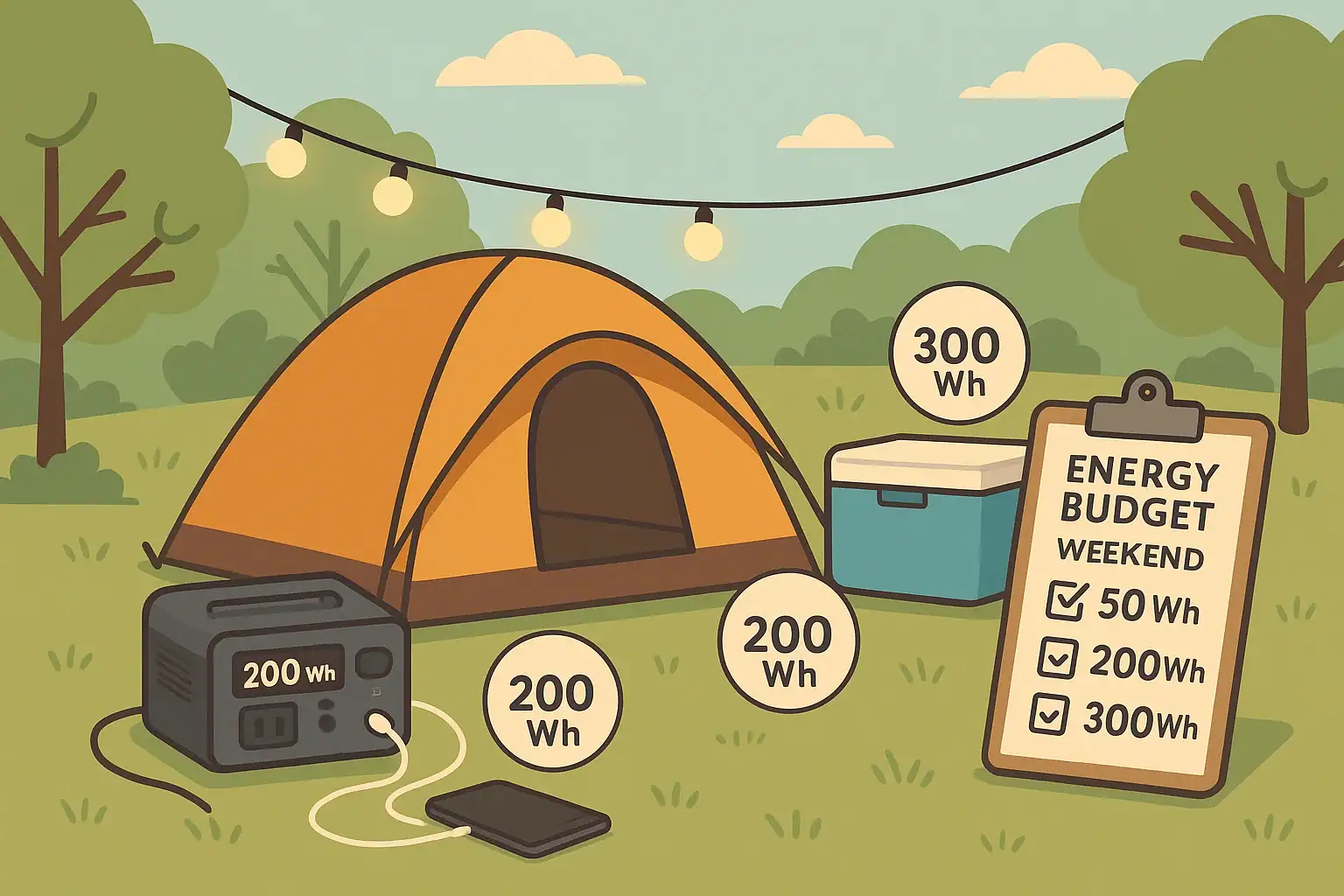
A simple weekend camping power plan starts with adding up how many watt-hours your gear will use, then matching that to a portable power station with enough capacity, output watts, and charging options. Once you understand basic terms like watt-hours, surge watts, runtime, and input limit, you can quickly tell if your setup will last two or three nights off-grid.
This guide shows how to make an easy energy budget for a weekend, so you are not guessing at battery percentage or wondering why your devices shut off early. You will learn how to estimate power draw, convert watts to watt-hours, and size a camping battery or solar generator for phones, lights, a fridge, or a CPAP. No advanced math, no brands—just clear steps and example numbers you can copy for your own trip.
Understanding a Weekend Camping Power Budget and Why It Matters
For camping, a power budget is a simple estimate of how much energy your devices will use over your trip, usually measured in watt-hours (Wh). It is like a spending plan for electricity: instead of dollars, you are spending stored energy from a portable power station or battery pack.
Watt-hours tell you how long a battery can run your gear. If you know your devices use about 500 Wh over a weekend, you can look for a power station with a usable capacity that meets or exceeds that number. This is more reliable than guessing based on amp-hours (Ah) or just looking at battery percentage bars.
Planning a camping power budget matters because:
- It prevents running out of power early. You know in advance if your battery can handle a second or third night.
- It helps you choose the right size power station. You avoid overspending on a huge unit or buying one that is too small.
- It clarifies what you can realistically run. For example, whether a mini-fridge plus lights and phone charging is practical.
- It guides your charging strategy. You can decide if you need solar input, vehicle charging, or just a full charge before leaving.
Instead of treating your camping battery like a mystery box, a basic energy budget turns it into a predictable resource you can manage confidently all weekend.
Key Power Concepts for Weekend Camping: Watts, Watt-Hours, and Runtime
To build a simple weekend energy budget, you only need a few key concepts: watts (W), watt-hours (Wh), runtime, and efficiency. Once you understand these, you can quickly estimate how long your portable power station will keep your camping gear running.
Watts (W): how fast power is used
Watts measure the rate of power use. A 10 W LED lantern uses power slowly; a 300 W mini-fridge uses power much faster. Device labels, user manuals, or power adapters usually list watts. If you only see volts (V) and amps (A), multiply them: V × A ≈ W.
Watt-hours (Wh): total energy over time
Watt-hours measure how much energy is used or stored. A 500 Wh battery can, in theory, power a 50 W device for about 10 hours (500 ÷ 50 = 10). Portable power stations are usually rated in Wh, which makes them easy to compare.
Runtime: how long your gear can run
To estimate runtime, you divide usable battery capacity by the load:
Runtime (hours) ≈ Usable Wh ÷ Device Watts
Usable Wh is slightly less than the rated capacity because of inverter and conversion losses. A rough rule is to assume 80–90% of the listed watt-hours for AC loads.
Continuous watts vs. surge watts
Portable power stations list two important output limits:
- Continuous output (W): The maximum power they can supply steadily (for example, 300 W).
- Surge or peak output (W): A higher short-term limit to handle startup spikes from devices like compressor fridges or small pumps.
If your device’s running watts exceed the continuous rating, it will not run. If its startup surge exceeds the surge rating, it may trip protection or shut off at startup.
Input limit and recharge time
The input limit tells you how many watts the power station can accept from wall charging, solar panels, or vehicle charging. Higher input means faster recharging, which is important if you plan to top up during the day with solar or from your car.
Putting it together for a weekend
For a weekend camping trip, you combine these ideas: estimate each device’s daily Wh use, multiply by the number of days, then compare the total to your portable power station’s usable capacity and recharge options.
| Concept | What It Means | Example Value |
|---|---|---|
| Device power (W) | How fast a device uses power | LED lantern: 10 W |
| Battery capacity (Wh) | Total stored energy | Portable power station: 500 Wh |
| Continuous output (W) | Max steady power the unit can supply | AC inverter: 300 W |
| Surge output (W) | Short spike for startup loads | AC inverter surge: 600 W |
| Input limit (W) | Max charging power accepted | Solar/AC charging: 100–200 W |
Real-World Weekend Camping Energy Budget Examples
To make camping power planning concrete, it helps to walk through a few realistic weekend scenarios. These examples assume two nights away, arriving Friday evening and leaving Sunday, with about 36–40 hours of actual use.
Example 1: Minimalist weekend (lights and phones only)
This setup is common for tent camping with basic comfort and safety lighting.
- 2 smartphones: About 10 Wh per full charge × 2 phones × 2 charges each ≈ 40 Wh.
- 1 tablet or e-reader: Around 15 Wh per charge × 1–2 charges ≈ 15–30 Wh.
- LED lantern: 8 W × 4 hours per night × 2 nights = 64 Wh.
- String lights: 5 W × 5 hours per night × 2 nights = 50 Wh.
Estimated total for the weekend: roughly 170–190 Wh.
A small portable power station with around 250–300 Wh of usable capacity comfortably handles this, even accounting for inverter losses and a bit of extra use.
Example 2: Family camping with cooler and devices
This scenario adds a small 12 V compressor cooler or low-power mini-fridge.
- Compressor cooler: A typical draw might average 40 W when cycling. Over 24 hours, that is roughly 40 W × 12 hours of active run time ≈ 480 Wh per day (duty cycle varies with temperature and insulation).
- Phones and tablets: 4 phones × 2 charges each at 10 Wh = 80 Wh; 1 tablet at 20 Wh × 2 charges = 40 Wh.
- LED lighting: 20 W total (lanterns and strips) × 4 hours per night × 2 nights = 160 Wh.
Estimated total for the weekend: cooler about 900–1,000 Wh plus devices and lights around 280 Wh, for roughly 1,200–1,300 Wh.
In this case, a mid-sized power station around 1,000–1,500 Wh usable capacity is more appropriate, especially if you do not plan to recharge with solar or from your vehicle.
Example 3: CPAP user plus basic camp power
Many campers use a CPAP machine overnight and want to keep lights and phones powered too.
- CPAP machine (DC mode, no heated hose/humidifier): Often averages 30–50 W. For 8 hours per night × 2 nights, that is about 480–800 Wh.
- Phones and a small fan: 2–3 phones at 10 Wh each × 2 charges ≈ 40–60 Wh; USB fan at 5 W × 4 hours per night × 2 nights = 40 Wh.
- LED lighting: 10–15 W × 4 hours per night × 2 nights ≈ 80–120 Wh.
Estimated total for the weekend: roughly 600–1,000 Wh depending on the CPAP’s actual draw.
A power station with around 800–1,200 Wh usable capacity is a common target for this type of trip, especially if the CPAP will be the primary load.
How to adapt these examples to your own trip
To use these examples for your own weekend:
- List your actual devices and look up their watt ratings.
- Estimate daily hours of use for each device.
- Calculate daily Wh (watts × hours), then multiply by the number of days.
- Add a 20–30% buffer for unexpected use, cold weather, or inverter losses.
This quick process gives you a realistic weekend energy budget that matches how you actually camp.
Common Camping Power Planning Mistakes and How to Spot Problems Early
Many campers either overshoot or undershoot their power needs. Understanding common mistakes helps you troubleshoot issues before they ruin your weekend.
Mistake 1: Confusing watt-hours with amp-hours
Some batteries list only amp-hours (Ah), which can be misleading without voltage. A 20 Ah battery at 12 V has about 240 Wh (20 × 12), not 20 Wh. When comparing to your devices, always convert to watt-hours so everything is in the same unit.
Mistake 2: Ignoring inverter losses
Using AC outlets on a portable power station is convenient, but the inverter wastes some energy as heat. If you ignore this, your runtime estimate will be too optimistic. As a rule of thumb, assume you only get about 80–90% of the rated Wh for AC loads. USB and DC outputs are usually more efficient.
Mistake 3: Underestimating fridge and cooler usage
Portable fridges and coolers do not draw their rated watts all the time, but they cycle on and off. Hot weather, frequent opening, and poor ventilation can increase their duty cycle dramatically. A cooler that averages 20–30 W in mild conditions might average double that in direct sun. If your portable power station seems to drain faster than expected, this is often the culprit.
Mistake 4: Overloading the continuous or surge rating
Plugging in a device that exceeds the power station’s continuous output or surge rating can cause shutdowns or error codes. Signs include the AC output turning off immediately when a device starts, beeping alarms, or warning lights. Check your devices’ watt ratings and keep total load under the continuous limit, with some margin for startup spikes.
Mistake 5: Forgetting about recharging options
Some campers assume they will “just recharge with solar” but bring panels too small for their actual use or ignore the input limit on the power station. If your input limit is 100 W and you bring 200 W of panels, you still only charge at 100 W. Cloud cover, shading, and short winter days further reduce real-world solar input.
Early warning signs your weekend budget is off
- Battery drops faster than expected during the first evening.
- Fans, fridges, or CPAP machines cause the inverter to click off or alarm.
- Solar or vehicle charging barely moves the battery percentage during the day.
- You find yourself turning off lights or unplugging devices to “save” power.
If you see these signs on day one, reduce non-essential loads, switch more devices to DC or USB where possible, and prioritize recharging during peak sunlight or while driving.
Safety Basics for Using Portable Power on Camping Trips
Even small portable power stations and camping batteries store significant energy. Using them safely keeps your trip trouble-free and protects your gear.
Ventilation and placement
- Place the power station on a stable, dry surface away from standing water and direct rain.
- Avoid covering the unit with blankets, clothing, or sleeping bags. Most units rely on airflow for cooling.
- Keep vents and fans unobstructed to prevent overheating and automatic shutdowns.
Temperature awareness
- Avoid leaving batteries in direct sun inside a closed vehicle or tent, where temperatures can rise quickly.
- In cold weather, keep the unit above freezing when possible, as low temperatures can temporarily reduce capacity and charging performance.
Cable and connection safety
- Use cables rated for the current your devices draw, especially for 12 V DC and high-wattage AC loads.
- Do not daisy-chain multiple power strips or extension cords from a small power station.
- Avoid running cords where people walk or where they can snag and pull the power station off a table.
Charging safety
- Use only compatible chargers and follow the manufacturer’s input limits for AC, DC, and solar charging.
- Do not attempt to modify charging cables, bypass built-in protections, or connect directly to vehicle or RV wiring without proper equipment.
- If you are unsure about integrating a portable power station with an RV electrical system, consult a qualified electrician or RV technician.
General battery precautions
- Do not open the power station or battery enclosure; internal components are not user-serviceable.
- Keep units away from open flames, campfires, and high-heat cooking areas.
- If you notice swelling, unusual smells, smoke, or excessive heat, disconnect loads, move the unit to a safe, open area if it is safe to do so, and stop using it.
Following these basic practices makes it much less likely that a power issue will interrupt your camping weekend.
Maintaining and Storing Your Camping Power Setup Between Trips
Good maintenance and storage habits help your portable power station deliver reliable runtime every camping season and extend its overall lifespan.
Regular use and partial cycling
- Use the power station periodically, even between camping trips, to keep the battery active.
- Avoid fully discharging the battery whenever possible; stopping around 10–20% remaining is gentler on most chemistries.
- Recharge to a comfortable level after each trip so it is ready for the next outing.
Storage state of charge
- For long-term storage (several months), many batteries prefer being stored around 40–60% charge rather than 100% or 0%.
- Check the charge level every few months and top up if it drops significantly.
Environment and handling
- Store your power station in a cool, dry place away from direct sunlight and moisture.
- Avoid dropping, crushing, or stacking heavy items on top of the unit.
- Keep dust and debris away from vents and ports; gently clean with a dry cloth as needed.
Monitoring performance over time
- Pay attention if your camping runtime noticeably decreases with the same loads; this can indicate normal battery aging.
- Test your setup at home before longer trips, especially if you rely on critical devices like a CPAP machine.
- Keep notes on approximate runtimes and charging times; this personal data is more useful than generic estimates.
With basic care, a portable power station can remain a dependable part of your camping kit for years, making your weekend energy budgeting more predictable.
| Maintenance Task | Recommended Frequency | Purpose |
|---|---|---|
| Top-up charge check | Every 2–3 months | Prevents deep discharge during storage |
| Full test run with camping loads | Before each season | Verifies runtime and identifies weak spots |
| Visual inspection of cables and ports | Before each trip | Catches damaged cords or loose connections |
| Cleaning vents and exterior | As needed | Maintains airflow and cooling performance |
Related guides: Portable Power Station Buying Guide • Surge Watts vs Running Watts: How to Size a Portable Power Station • Portable Power Stations for CPAP and Medical Devices: What to Look For • How Many Solar Watts Do You Need to Fully Recharge in One Day?
Practical Weekend Power Planning Tips and Specs to Look For
When you combine a simple energy budget with the right portable power station specs, weekend camping power becomes predictable instead of stressful. The process boils down to three steps: estimate your loads, choose enough usable watt-hours, and match your charging options to how and where you camp.
For a typical two-night trip:
- Minimal setups (lights and phones) often fall under 200–300 Wh.
- Family setups with a cooler and multiple devices often land around 800–1,500 Wh.
- CPAP-focused setups usually need 600–1,200 Wh depending on settings and temperature.
Add a buffer of about 20–30% above your calculated needs to account for weather, inverter losses, and unplanned use. If you plan to recharge with solar or your vehicle, factor in realistic daily input based on your panel size, input limit, and daylight hours.
Specs to look for
- Battery capacity (Wh): Look for 300–500 Wh for minimalist weekends, 800–1,500 Wh for fridges or CPAP. This directly sets your potential runtime.
- Continuous AC output (W): Aim for at least 200–300 W for basic lights and electronics, 500–1,000 W if you plan to run fridges or multiple devices. Ensures your loads do not overload the inverter.
- Surge or peak output (W): Choose a unit with surge roughly 1.5–2× your highest startup load. Helps handle compressor fridges and motors without tripping protection.
- Input limit and charging options: For solar, 100–300 W input is typical for weekend use; vehicle and AC charging should refill your battery within 4–8 hours. This affects how quickly you can recover from a low state of charge.
- Number and type of ports: Multiple USB-A and USB-C ports plus at least one or two AC outlets and a 12 V socket make it easier to power several devices without adapters.
- Display and monitoring: A clear screen showing watts in/out, remaining percentage, and estimated runtime helps you manage your energy budget in real time.
- Weight and form factor: For car camping, 10–30 lb units are common; choose a size you can comfortably move between home, vehicle, and campsite.
- Operating temperature range: Check that the unit is rated for the temperatures you expect when camping, especially in hot summers or cold shoulder seasons.
- Battery chemistry and cycle life: Higher cycle life ratings are useful if you camp frequently or use the unit for other purposes year-round.
By matching these specs to a realistic weekend energy budget, you can choose and use a portable power solution that keeps your campsite running smoothly from Friday night to Sunday afternoon.
Frequently asked questions
What specs and features matter most when choosing a portable power station for a weekend camping trip?
Battery capacity in watt-hours (Wh) and the continuous and surge watt ratings are the core specs, since they determine how long and what you can run. Also consider the input limit and charging options, the number and types of ports, weight and form factor, operating temperature range, and whether the unit provides clear monitoring of watts in/out and remaining charge.
How can confusing watt-hours and amp-hours lead to a planning mistake?
Watt-hours measure stored energy while amp-hours depend on voltage; comparing Ah without converting can make a battery look much larger or smaller than it really is. Always convert Ah to Wh using Wh = Ah × V so you compare capacities on the same basis and avoid underestimating your needs.
Is it safe to use a portable power station inside a tent or vehicle overnight?
Using a power station in a tent or vehicle is generally acceptable if the unit is placed on a stable, ventilated surface away from flammable materials and direct heat. Avoid covering vents, keep the unit out of confined hot spots, follow the manufacturer’s safety guidance, and do not leave a unit showing signs of damage or overheating unattended.
Can I rely on solar panels alone to recharge my power station during a weekend?
Solar can often top up a battery during a weekend, but real-world factors like panel size, the power station’s input limit, shading, cloud cover, and daylight hours determine how much energy you actually get. Match panel output to the unit’s input limit and plan conservatively; don’t assume ideal conditions will fully recharge your battery every day.
Why does my power station shut off when a fridge or CPAP starts, and what can I do?
Startup surges can exceed a unit’s surge rating or the combined load can exceed the continuous output, which triggers protective shutdowns. Check the continuous and surge watt ratings, reduce simultaneous loads during startup, and consider a unit with higher surge capacity or staggered device starts to avoid tripping protections.
How much extra buffer should I add to my energy budget to avoid running out of power?
Adding a buffer of about 20–30% above your calculated needs is a common practice to cover inverter losses, weather impacts, and unexpected use. Increase the buffer further if conditions are colder, if you have inefficient loads, or if you rely solely on intermittent solar charging.
Related guides
Browse this topic →
- Beginner-friendly sizing, runtime & specs
- Solar & charging (MPPT, fast charging, cables)
- Batteries (LiFePO4, cycles, care & storage)
- Safety, cold-weather performance, real-world tips
More in Beginners
See all →- Charging an Electric Wheelchair or Mobility Scooter From a Portable Power Station
- Portable Power Station for a Gaming PC: Runtime, Load Spikes, and UPS Considerations
- Portable Power Station for a Pop-Up Camper: Lights, Fans, Fridge, and Recharge Plan
- Portable Power Station for a Shed or Outbuilding: Lights, Chargers, and Security
- Portable Power Station for a Boat: 12V Loads, Salt Air, and Safer Storage
Keep reading
About this site
Portable Energy Lab publishes practical, independent guides about portable power—clear sizing, safe use, and real-world expectations.
Affiliate disclosure
Some links on this site may be affiliate links. If you buy through these links, we may earn a small commission at no extra cost to you. This helps support our content. Read our affiliate disclosure.