
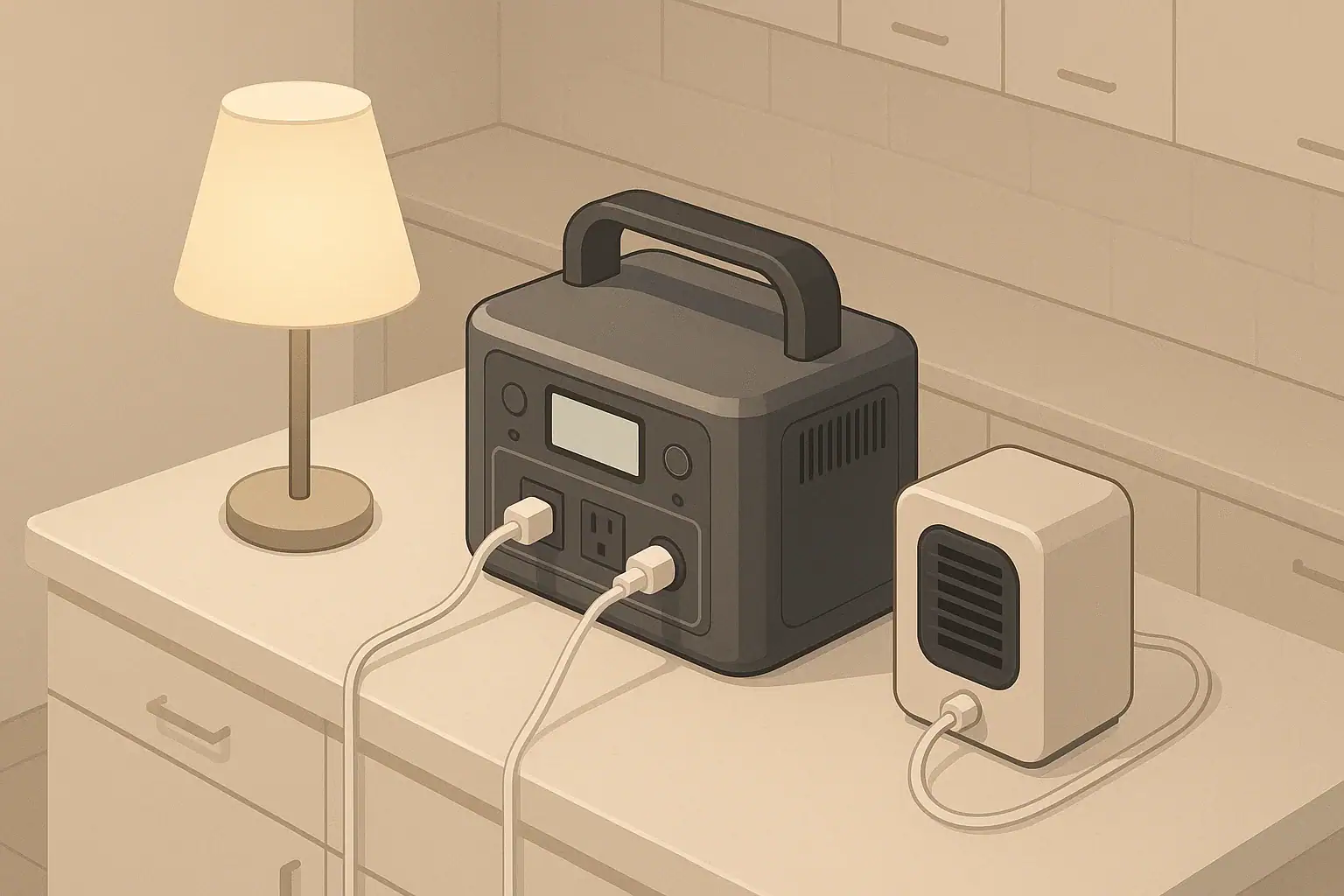
Using a portable power station as emergency lighting means relying on a rechargeable battery unit to keep lights on when grid power fails. Instead of candles or fuel generators, you use stored electrical energy to run efficient lamps, lanterns, or small light strings through AC outlets or DC/USB ports on the power station.
This approach matters because lighting is often the first and most important need in an outage. Being able to see clearly reduces the risk of trips, falls, and mistakes when moving around the home, checking breakers, or caring for family members. Consistent lighting also supports communication, since you can see phones, radios, and important documents.
Portable power stations are especially well suited for emergency lighting because LED lights draw relatively little power. With proper planning, a modest-capacity unit can keep essential areas lit for many hours or even multiple evenings. Understanding key concepts like watts and watt-hours helps you stretch that stored energy as efficiently as possible.
Thinking through emergency lighting in advance also helps you choose the right mix of lamps and placement. Instead of turning everything on at once, you can prioritize hallways, bathrooms, kitchen work areas, and one central room, using the power station as a quiet, indoor-friendly energy source.
What using a portable power station for emergency lighting really means
Using a portable power station as emergency lighting means relying on a rechargeable battery unit to keep lights on when grid power fails. Instead of candles or fuel generators, you use stored electrical energy to run efficient lamps, lanterns, or small light strings through AC outlets or DC/USB ports on the power station.
This approach matters because lighting is often the first and most important need in an outage. Being able to see clearly reduces the risk of trips, falls, and mistakes when moving around the home, checking breakers, or caring for family members. Consistent lighting also supports communication, since you can see phones, radios, and important documents.
Portable power stations are especially well suited for emergency lighting because LED lights draw relatively little power. With proper planning, a modest-capacity unit can keep essential areas lit for many hours or even multiple evenings. Understanding key concepts like watts and watt-hours helps you stretch that stored energy as efficiently as possible.
Thinking through emergency lighting in advance also helps you choose the right mix of lamps and placement. Instead of turning everything on at once, you can prioritize hallways, bathrooms, kitchen work areas, and one central room, using the power station as a quiet, indoor-friendly energy source.
Key concepts and sizing logic for emergency lighting
Planning emergency lighting with a portable power station starts with two core concepts: watts and watt-hours. Watts (W) describe how quickly a device uses power at any moment. Watt-hours (Wh) describe how much total energy is stored in the power station’s battery. To estimate runtime, you compare the power draw of your lights in watts to the battery capacity in watt-hours.
For example, if your light setup uses 20 W total and your portable power station has 300 Wh of usable capacity, a simple estimate is 300 Wh ÷ 20 W = 15 hours of runtime. In reality, you should assume less due to efficiency losses and changing battery behavior at higher or lower loads. A conservative rule of thumb is to plan for 70–85% of the rated capacity to be available for AC-powered lighting.
Most modern LED lights have low running wattage and no significant surge demand, which simplifies sizing. Surge watts matter more for devices like refrigerators or pumps that need a brief burst of higher power to start. For lighting, the running watts listed on the bulb or lamp are generally close to what the inverter must supply continuously, so the key limit is the power station’s continuous (running) watt rating, not surge capacity.
Efficiency losses enter in two main ways: inverter losses when converting DC battery power to 120 V AC, and losses in adapters or dimmers. Using DC or USB-powered lights where possible reduces conversion steps and can extend runtime. When you must use AC lamps, running them at lower brightness or choosing lower wattage bulbs helps offset inverter overhead and stretches each watt-hour further.
| If your goal is… | Typical total lighting load (example W) | Suggested minimum battery capacity (example Wh) | Notes |
|---|---|---|---|
| Lighting a single room and hallway for short outages | 10–20 W | 150–300 Wh | Focus on a few LED bulbs or a compact lantern. |
| Lighting key rooms for one evening | 20–40 W | 300–500 Wh | Plan for 4–6 hours of conservative use. |
| Lighting several rooms over a full night | 30–60 W | 500–800 Wh | Use dimmers or low-brightness modes when possible. |
| Multi-night lighting with recharging during the day | 20–50 W | 600–1000 Wh | Pair with wall, vehicle, or solar recharging. |
| Whole-room area lighting plus device charging | 40–80 W | 800–1200 Wh | Account for phones, routers, or radios as added load. |
| Minimal lighting only for safety pathways | 5–15 W | 100–200 Wh | Use nightlights or micro-LED strips at low power. |
Real-world examples of emergency lighting runtimes
To see how these numbers play out, consider a small apartment using three LED bulbs: one in the living area, one in a hallway, and one in a bathroom. If each bulb uses about 8 W, the total load is roughly 24 W. On a 300 Wh portable power station, planning for 75% usable capacity gives about 225 Wh. Dividing 225 Wh by 24 W suggests around 9 hours of light if all bulbs stay on continuously.
In practice, you might turn those lights off when not needed, or dim them if possible, which can extend runtime over multiple evenings. If you only keep one 8 W bulb on most of the time and occasionally switch on the others, the same 300 Wh unit could reasonably help with lighting across a full day of mixed use.
Another example is a larger home where the goal is to light a central family room, a kitchen work area, and a stairway. Suppose each area uses an equivalent of 10–15 W of LED light, for a total of 35–40 W. With a 600 Wh portable power station and a conservative 75% usable estimate (450 Wh), you could expect around 11–13 hours of continuous operation. By choosing which areas to light at any given time, you could cover an evening and early morning without draining the battery completely.
Some people also power small accent or strip lights for navigation at night. A 5 W LED strip or a pair of 1–2 W nightlights can keep hallways walkable while drawing very little power. Linked to a 500 Wh unit, those minimal lights could run for dozens of hours, leaving capacity available for charging phones or running a small radio.
Common mistakes and troubleshooting cues
One common mistake is assuming that the advertised watt-hour capacity translates directly to runtime with no losses. This can lead to disappointment when lights shut off earlier than expected. If you notice the power station depleting faster than your calculations, it may be due to inverter efficiency, standby power consumption, or additional devices quietly drawing power from USB or DC ports.
Another issue arises when people use high-wattage bulbs or fixtures meant for traditional grid power. A single 60 W incandescent bulb can consume as much energy as several LED bulbs combined. If your portable power station seems to empty quickly, check whether any older, high-wattage lamps are plugged in. Swapping them for low-wattage LEDs usually provides more light per watt-hour.
Users sometimes report that their power station shuts off even though the load seems small. Many units have a minimum load threshold for certain output modes, or an auto-sleep feature that switches off when power draw is extremely low. A single tiny nightlight on an AC outlet might not be enough to keep the inverter awake. In those cases, adding a second small device or using a DC/USB light rated for low power can help.
Slow charging or unexpected pauses in charging are also common concerns. If you are recharging the power station during the day while still using it for lights, the built-in management system may prioritize battery protection. Charging may slow or cycle if the unit is already warm, nearly full, or being powered from a limited source such as a vehicle outlet or a small solar panel. Monitoring the display for input and output values, and allowing cool-down periods, usually resolves these issues.
Safety basics when using a power station for lighting
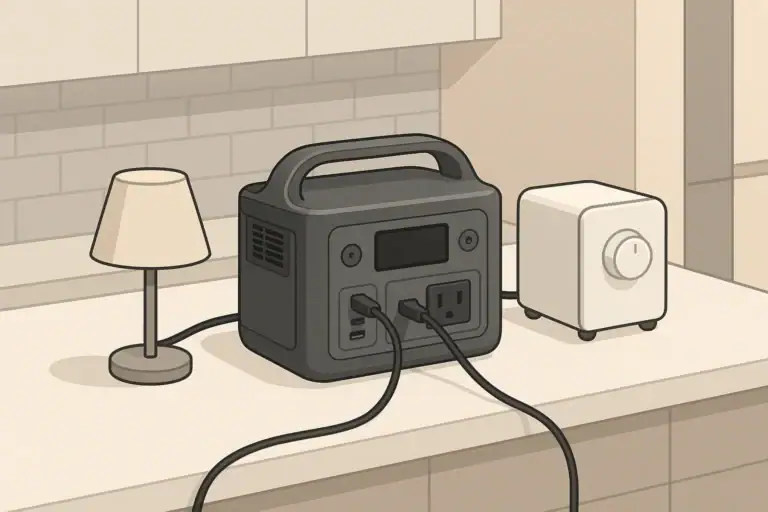
Portable power stations are generally safer indoors than fuel generators, but basic electrical and battery safety still apply. Place the unit on a stable, dry, nonflammable surface such as a table or countertop, and keep it away from sinks, bathtubs, or open windows where rain could reach it. Ensure that ventilation openings are not blocked by blankets, curtains, or stacks of items, as restricted airflow can lead to overheating under higher loads.
Extension cords and power strips are often used to route lighting to different rooms. Use cords rated for indoor use and for at least the total wattage of the connected lights. Avoid daisy-chaining multiple power strips, running cords under rugs, or pinching them in doorways where insulation could wear through. Coiling long cords tightly can trap heat, so it is better to loosely loop and lay them out where they will not be walked on.
Ground-fault protection is another consideration, especially for lighting in bathrooms, kitchens, basements, or outdoor areas. Many household outlets in those spaces use GFCI protection to reduce shock risk. When plugging your portable power station into or near those circuits for charging, or when running lights where moisture may be present, follow manufacturer guidance and keep all connectors dry. If in doubt about how to integrate emergency lighting with existing protected circuits, consult a qualified electrician rather than attempting any panel or wiring changes.
Heat from bulbs is less of a concern with low-wattage LEDs than with older incandescent lamps, but it is still wise to prevent hot surfaces from contacting flammable materials. Do not drape fabric over lamps to diffuse light, and keep paper, cardboard, and bedding away from fixtures that could warm up over hours of operation. Always follow the safety instructions for both the power station and the lighting devices, and avoid modifying plugs or bypassing built-in protections.
Maintenance and storage for reliable emergency lighting
Good maintenance habits ensure that your portable power station is ready when the lights go out. Most units slowly self-discharge over time, even when switched off. It is a sound practice to check the state of charge every few months and recharge to a recommended storage level, often around half to most of the battery’s capacity, depending on the manufacturer’s guidance. Keeping the battery neither completely full nor completely empty during long storage typically supports longevity.
Temperature is another key factor. Storing the power station in a cool, dry indoor location helps preserve capacity and reduce degradation. Avoid leaving it in very hot places such as attics or vehicles in summer, or in freezing conditions for extended periods. During an actual outage in cold weather, try to operate and recharge the unit at room-like temperatures when possible, since extreme cold can temporarily reduce available capacity and charging performance.
Routine checks should include examining cords, plugs, and adapters used with your emergency lighting setup. Look for frayed insulation, bent prongs, or discolored plastic that might indicate overheating. Test your chosen lights with the power station a few times per year, both to confirm compatibility and to remind yourself of typical runtimes under realistic conditions.
If the power station supports multiple charging methods—such as wall outlets, vehicle outlets, or solar input—practice using each one before you need it urgently. Keep any required cables or adapters stored in the same location as the power station and your emergency lights. Labeling or color-coding cords for specific purposes can reduce confusion when you are working in low light during an outage.
| Task | Suggested interval | What to check | Notes |
|---|---|---|---|
| Top up battery charge | Every 3–6 months | State of charge, charge time | Keep around mid to high charge for standby use. |
| Test emergency lighting setup | Every 6 months | All bulbs, switches, dimmers | Verify estimated runtimes and brightness levels. |
| Inspect cords and plugs | Every 6–12 months | Frayed insulation, loose connectors | Replace damaged components before next outage. |
| Check storage environment | Seasonally | Temperature, humidity, dust | Keep away from heat sources and damp areas. |
| Review charging methods | Annually | Wall, vehicle, solar cabling | Confirm all chargers and adapters still work. |
| Clean exterior surfaces | Annually or as needed | Dust buildup, blocked vents | Use a dry or slightly damp cloth, no harsh chemicals. |
Practical takeaways for efficient emergency lighting
Putting everything together, using a portable power station for emergency lighting works best when you plan for efficiency and safety. Focus on low-wattage LED lighting, realistic runtime estimates, and a simple, rehearsed setup that you can deploy quickly in the dark. Treat the power station like any other emergency tool: it should be stored safely, maintained regularly, and tested under controlled conditions before a real event.
Instead of trying to light your entire home, prioritize the spaces that matter most for movement, safety, and communication. Think in terms of pathways, one or two main rooms, and essential tasks like cooking or using the bathroom. The more intentionally you use each watt of stored energy, the longer your lighting will last and the more comfortable outages will feel.
- Use LED bulbs and low-power lamps to maximize runtime per watt-hour.
- Calculate approximate runtimes using total watts and battery watt-hours, then factor in efficiency losses.
- Test your chosen lights with the power station before emergencies to confirm compatibility.
- Keep extension cords tidy, properly rated, and away from moisture and foot traffic.
- Store the power station indoors at moderate temperatures and recharge it periodically.
- Prepare a simple lighting plan that covers key rooms and pathways rather than every fixture.
With thoughtful sizing, safe operation, and regular maintenance, a portable power station can provide reliable, quiet, and efficient emergency lighting for a wide range of short-term power interruptions.
Frequently asked questions
How do I estimate how long a portable power station will run my emergency lights?
Estimate runtime by dividing the power station’s usable watt-hours by the total watt draw of your lights; for AC loads, account for inverter and system losses by assuming roughly 70–85% of rated capacity is available. For example, a 300 Wh unit at 75% usable capacity gives about 225 Wh, so a 25 W lighting load would run for approximately 9 hours. Also consider dimming and intermittent use, which can extend effective runtime.
Can I plug LED or strip lights into DC/USB ports to get more runtime?
Yes — using DC or USB-powered lights avoids inverter conversion losses and can improve effective runtime. Ensure the light’s voltage and connector match the power station outputs or use the appropriate cable; always check the port’s maximum current rating to avoid overloading. Low-power USB lanterns and LED strips are often the most efficient emergency lighting options.
What safety steps should I take when using a portable power station indoors for lighting?
Place the unit on a stable, dry, nonflammable surface with ventilation clear, and keep it away from water and direct rain. Use properly rated extension cords, avoid running cords under rugs or pinching them, and follow GFCI guidance in wet areas; consult an electrician if you are unsure about integrating with household circuits. Do not modify plugs or bypass built-in safety features.
Why does my power station turn off even though my lights draw very little power?
Many power stations have a minimum load threshold or an auto-sleep feature that shuts off outputs when draw is extremely low, and some also have standby power behaviors that affect operation. A single tiny nightlight on an AC outlet may not meet the minimum; adding a second small device, using a DC/USB light, or checking the unit’s settings can keep it awake. Review the manual for idle power limits and auto-shutdown options.
How should I store and maintain a power station so it’s ready for emergency lighting?
Store the unit in a cool, dry place and top up the charge every few months per the manufacturer’s guidance, typically keeping it around mid to high charge for standby use. Inspect cords and connectors periodically, test your lighting setup every 6–12 months, and practice charging from available methods (wall, vehicle, or solar) so you’re familiar with recharging during an outage. Avoid long-term extremes of heat or cold to preserve battery health.
Recommended next:
- Portable Power Stations for Apartments
- Portable Power Stations for RV and Motorhomes
- Can a Portable Power Station Run a Microwave? What to Check Before You Try
- Can a Portable Power Station Run a Space Heater? Realistic Limits
- Can a Portable Power Station Run an Air Conditioner? Sizing and Expectations
- Powering a Coffee Maker, Kettle, or Induction Cooktop: What Works and Why
- More in Home / Appliances →
Related guides
Browse this topic →
- Beginner-friendly sizing, runtime & specs
- Solar & charging (MPPT, fast charging, cables)
- Batteries (LiFePO4, cycles, care & storage)
- Safety, cold-weather performance, real-world tips
More in Home / Appliances
See all →- Backup Power for Security Cameras and Wi-Fi: Sizing a 24/7 Setup
- Running a Pellet Stove During a Power Outage: Starting Surge, Runtime, and Safe Setup
- What Size Portable Power Station for a Chest Freezer? Runtime Planning for Outages
- Portable Power Station for Starlink: Power Draw, Runtime, and What Specs Matter
- Powering a TV and Streaming Setup: Estimating Runtime Without Guessing
Keep reading
About this site
Portable Energy Lab publishes practical, independent guides about portable power—clear sizing, safe use, and real-world expectations.
Affiliate disclosure
Some links on this site may be affiliate links. If you buy through these links, we may earn a small commission at no extra cost to you. This helps support our content. Learn more.