
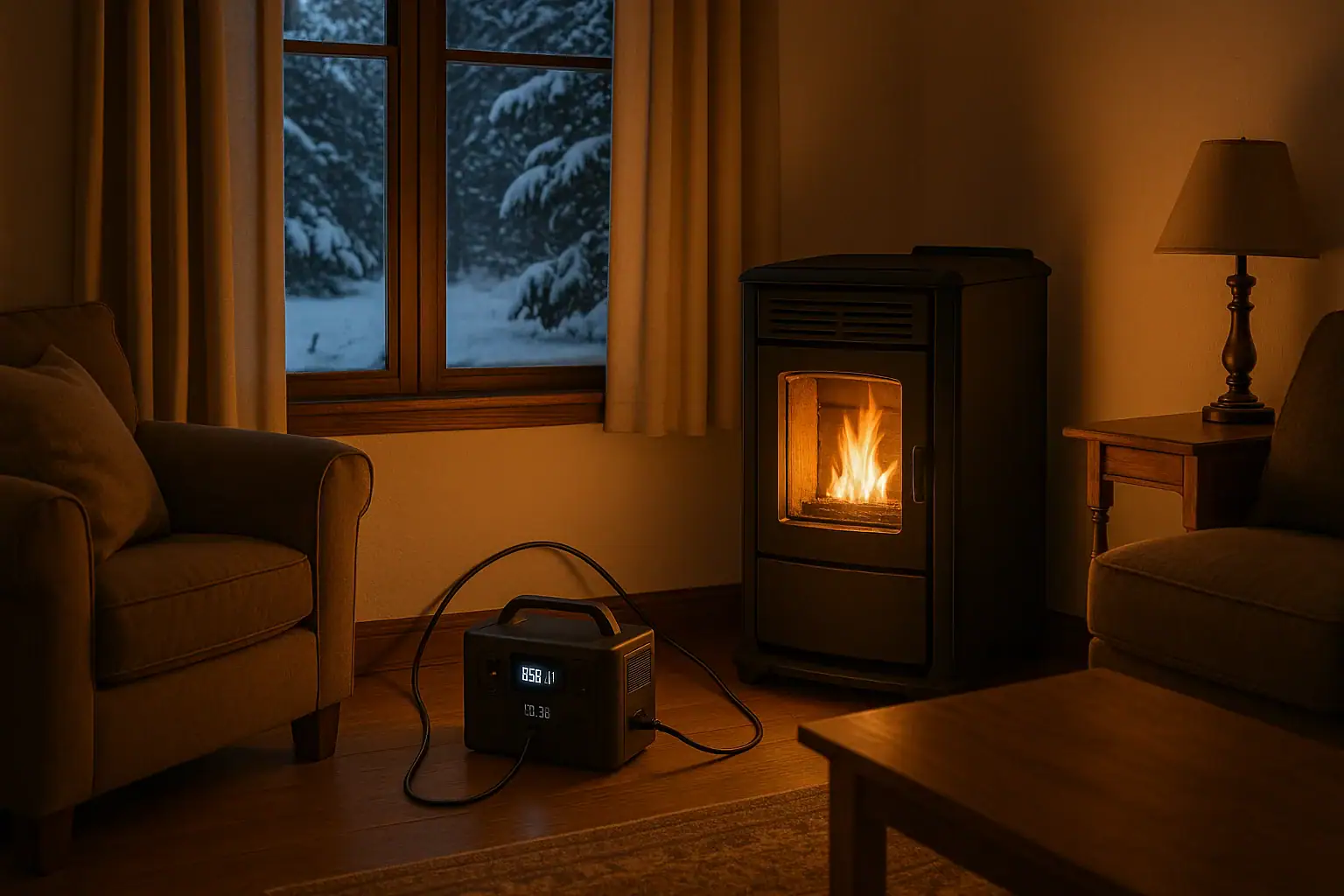
Running a pellet stove during a power outage is possible if you match its starting surge, running watts, and desired runtime with the right backup power setup. The key is understanding how much power the stove actually draws at startup and while running, then sizing a portable power station or generator safely around those numbers. People often search for terms like surge watts, inverter size, battery capacity, runtime calculator, and safe setup because pellet stoves are not truly “off-grid” heaters.
This guide explains how pellet stoves use electricity, why the startup surge matters, how long you can expect them to run on different backup power options, and how to connect everything safely. It also outlines the essential specs to compare when choosing a portable power solution, so you can make an informed decision later without guessing or overspending.
How Pellet Stoves Use Power in an Outage and Why It Matters
A pellet stove burns solid fuel, but it still depends on electricity for ignition, fans, and controls. During a power outage, that small but essential electrical load becomes the limiting factor for how long you can keep the stove running on backup power.
Most modern pellet stoves have three main electrical demands: an igniter (for automatic startup), one or more fans (combustion and room blower), and an auger motor that feeds pellets. These components do not all draw maximum power at the same time, but they create a short startup surge and a lower, steady running load afterward.
This matters for two reasons:
- Inverter sizing: The backup power source must handle the peak surge watts when the igniter and motors start, not just the lower running watts.
- Battery capacity and runtime: The total watt-hours (Wh) of your battery or portable power station determines how many hours of heat you can get before needing to recharge or refuel.
If you only look at the stove’s “average watts” and ignore startup surge, you risk tripping the inverter or shutting down the stove during ignition. If you only look at surge and ignore watt-hours, you might have plenty of power to start the stove but only for a short runtime.
Understanding both surge and runtime is the foundation of planning a safe, reliable backup power strategy for your pellet stove.
Key Electrical Concepts: Starting Surge, Running Watts, and Runtime
To run a pellet stove during a power outage using a portable power station or other backup source, you need to understand a few basic electrical terms and how they apply to your stove.
Starting surge vs. running watts
Running watts are the continuous power the stove needs once it is burning steadily. This usually includes the control board, combustion fan, room blower, and auger cycling on and off. Many pellet stoves draw somewhere in the range of 80–250 watts while running, depending on size and fan speed.
Starting surge (or surge watts) is the short burst of higher power when components like the igniter and motors first turn on. Electric igniters can draw several hundred watts for a few minutes, while fan motors may briefly spike above their normal running level.
Your backup power inverter rating must be higher than the stove’s maximum surge, or the stove may fail to ignite or trip the protection on your power station.
Watt-hours and estimating runtime
watt-hours (Wh)Battery-based backup power is usually rated in watt-hours (Wh). This is the total energy capacity. To estimate runtime:
Estimated runtime (hours) ≈ Usable battery Wh ÷ Average running watts of the stove
Because you rarely want to drain a battery to 0%, it is safer to assume you can use about 80–90% of the rated capacity for planning purposes.
For example, if your stove averages 150 W while running and you have 1000 Wh of usable capacity:
Runtime ≈ 1000 Wh ÷ 150 W ≈ 6.6 hours
Ignition cycles and fan speed changes will nudge that number up or down, but this simple calculation gives a reasonable planning estimate.
AC waveform and sensitive electronics
Pellet stoves include control boards and sometimes display screens. They are designed to run on standard household AC power. For battery-based backup, this means you want a pure sine wave inverter, which closely mimics grid power and is easier on motors and electronics than modified sine wave inverters.
Voltage, amperage, and the nameplate label
The data plate or manual for your pellet stove should list voltage (typically 120 V in North America) and either watts or amps. If only amps are listed, you can estimate watts using:
Watts ≈ Volts × Amps
This gives you the maximum rated draw; real-world running watts are often lower, but the rating is a safe upper bound for inverter sizing.
| Pellet Stove Power Aspect | Typical Range | How It Affects Backup Power |
|---|---|---|
| Running watts (steady burn) | 80–250 W | Determines average battery drain and runtime |
| Startup surge / ignition | 300–600+ W for a few minutes | Sets minimum inverter surge rating |
| Igniter duty | On at startup, sometimes for relights | Short-term spikes in power use |
| Combustion and room fans | 40–150 W combined | Continuous draw while stove is running |
| Control board & electronics | 5–20 W | Small but sensitive to power quality |
| Battery capacity | 500–3000+ Wh | Defines how many hours of operation you can expect |
Real-World Examples: Matching Pellet Stoves to Backup Power
Because every pellet stove model is slightly different, it helps to walk through some simplified examples of how pellet stoves pair with portable power stations and other backup options. These are illustrative only; always confirm your own stove’s specs.
Example 1: Small pellet stove with modest power draw
Imagine a compact pellet stove rated at 120 V, 2.0 A maximum. Using the volts × amps formula:
Max watts ≈ 120 V × 2.0 A = 240 W
In practice, it might run at around 120–180 W once fully burning, with a startup surge of 300–400 W when the igniter kicks on.
- Inverter requirement: A portable power station with at least 500 W continuous and 700–800 W surge capacity provides a comfortable margin.
- Runtime example: With a 1000 Wh usable battery and 150 W average draw, you could expect roughly 6–7 hours of heating.
This setup could cover a long evening outage or a cold night, especially if you manage ignition cycles carefully.
Example 2: Larger stove with powerful blower
Now consider a higher-output stove with a stronger room blower, rated at 120 V, 3.5 A max:
Max watts ≈ 120 V × 3.5 A = 420 W
Running draw might average 220–280 W, with a startup surge of 500–700 W.
- Inverter requirement: A unit rated around 800–1000 W continuous with higher surge capacity helps avoid nuisance shutdowns when the igniter and fans overlap.
- Runtime example: With 1500 Wh usable battery capacity and 250 W average draw, runtime is roughly 6 hours (1500 ÷ 250).
This is enough for many overnight outages, but multiple nights in a row would require recharging from solar, a vehicle, or a generator.
Example 3: Planning for multiple starts per day
If you plan to cycle the stove on and off to save pellets or battery, remember that each ignition uses more power than steady running. A setup that can handle one startup may struggle with repeated cycles if the battery is already low.
- Strategy: During an extended outage, it is often more efficient to run the stove at a low setting continuously rather than shutting it down and restarting several times a day.
- Battery planning: When estimating runtime, add a small buffer (for example, 10–20%) to account for ignition cycles and fan speed changes.
Example 4: Using a generator plus a portable power station
Some users combine a small generator with a portable power station. The generator runs a few hours to recharge the power station and possibly power other loads, then the stove runs quietly from battery the rest of the time.
This hybrid approach can reduce fuel consumption and noise while still giving you long-term heat. The same sizing rules apply: the portable power station must still handle the stove’s surge and running watts, and its watt-hours determine how long you can run between generator sessions.
Common Mistakes When Powering Pellet Stoves in Outages
Many pellet stove owners only realize the electrical requirements when the lights go out. Avoiding a few common mistakes can save you from frustration and unsafe setups.
Ignoring startup surge ratings
One of the most frequent errors is choosing a backup power source based solely on the stove’s average running watts. If the stove averages 150 W, some people assume a 200 W inverter is enough. When the igniter and fans start, the actual demand may briefly jump to 400–500 W, tripping the inverter.
What to watch for:
- Stove turns on, fans start, then everything shuts off abruptly.
- Portable power station displays “overload” or similar warning.
- Stove fails to complete the ignition cycle consistently.
Using modified sine wave inverters
Modified sine wave inverters are often cheaper, but they can cause motors to run hotter or noisier and may interfere with sensitive control boards. Some pellet stoves may not start at all or may behave erratically on poor-quality power.
Signs of a problem:
- Unusual humming from fans or motors.
- Display flickering or error codes during ignition.
- Intermittent shutdowns without clear mechanical cause.
Underestimating total runtime needs
It is easy to plan for a “few hours” of backup heat and then face a 12–24 hour outage. If your battery capacity is too small, you may need to shut down the stove to preserve power for essentials like lighting or communications.
Runtime red flags:
- Portable power station drops rapidly from high to low state of charge.
- Frequent low-battery or shutdown warnings overnight.
- Having to choose between running the stove and charging other devices.
Overloading circuits with multiple devices
During an outage, it is tempting to plug multiple appliances into the same backup power source. A pellet stove plus a refrigerator, lights, and electronics can quickly exceed the inverter’s rating.
Troubleshooting cues:
- Backup power shuts down when several devices start at once.
- Breaker or internal protection trips repeatedly.
- Noticeable dimming or flickering when large loads turn on.
Whenever possible, dedicate one backup power source to the pellet stove or at least calculate the combined load before plugging everything in.
Safety Basics for Running a Pellet Stove on Backup Power
Pellet stoves are generally safe when installed and operated correctly, but adding backup power introduces new safety considerations. The goal is to keep both the electrical system and the stove itself operating within their designed limits.
Use appropriate cords and connections
Always use grounded, heavy-duty extension cords rated for at least the maximum current of your pellet stove. Keep cords short, avoid daisy-chaining multiple extension cords, and ensure all connections are dry and secure.
Do not attempt to backfeed your home’s wiring by plugging a generator or portable power station into a wall outlet. This is dangerous for you and utility workers and is usually against electrical codes. Any whole-house connection should be handled by a qualified electrician using proper equipment.
Maintain proper ventilation and clearances
The stove’s venting system and clearances to combustibles do not change during a power outage. Make sure:
- Vents are not obstructed by snow, ice, or debris.
- Combustible materials are kept away from the stove and exhaust.
- Doors, gaskets, and seals are in good condition to prevent smoke leakage.
If power to the fans is lost unexpectedly, follow the manufacturer’s guidance for safely handling residual smoke or heat.
Monitor carbon monoxide and smoke detectors
Working carbon monoxide (CO) and smoke detectors are critical whenever you use combustion appliances. During an outage:
- Ensure detectors have fresh batteries or backup power.
- Test alarms before relying on the stove for heat.
- Do not ignore nuisance alarms; find and fix the cause.
Respect limits of your backup power system
Running an inverter or portable power station continuously at or near its maximum rating can cause overheating and shorten its life. Give it room to breathe, keep it off soft surfaces that block ventilation, and observe any manufacturer guidance on duty cycle and operating temperature.
If you smell hot wiring, see melted insulation, or notice unusual noises from your backup power equipment, shut everything down and investigate before continuing.
Consult professionals for complex setups
If you plan to integrate a pellet stove into a broader backup power system that includes panel connections, automatic transfer equipment, or large generators, involve a qualified electrician. High-level planning is fine on your own, but the actual wiring, overcurrent protection, and code compliance should be handled by a professional.
Maintaining Your Pellet Stove and Backup Power for Reliability
Reliable performance during a power outage depends on how well you maintain both the pellet stove and whatever backup power you plan to use. Routine care reduces the chance of failures when you need heat most.
Pellet stove maintenance for efficient electrical use
A clean, well-maintained stove typically uses less power and is less likely to trip a marginal backup system. Key tasks include:
- Cleaning fans and air passages: Dust and ash buildup can make motors work harder and draw more current.
- Inspecting gaskets and seals: Good seals help maintain proper combustion and reduce the need for higher fan speeds.
- Keeping the burn pot and ash traps clean: Efficient combustion can reduce ignition time and fan workload.
Following the manufacturer’s recommended maintenance schedule helps ensure the stove’s actual running watts remain close to expectations.
Storing and maintaining portable power stations
Portable power stations and batteries need periodic attention, even when not in use:
- Charge level during storage: Many lithium-based systems prefer being stored around 30–60% charge, then topped up every few months. Check your specific unit’s recommendations.
- Temperature considerations: Avoid storing batteries in very hot or very cold locations, such as unconditioned attics or unheated sheds in extreme climates.
- Exercise cycles: Occasionally running a partial discharge and recharge can help keep the battery management system calibrated.
Keep the unit clean, dry, and free from dust blocking vents or fans.
Generator care for hybrid setups
If you plan to use a generator to recharge a portable power station or power the stove directly:
- Run the generator periodically under load to keep it in working order.
- Store fuel safely and rotate it according to recommended timelines.
- Check oil, air filters, and spark plugs before storm seasons.
Always operate generators outdoors, away from windows and vents, to prevent carbon monoxide buildup.
Testing your-outage-plan-in-advance
Before relying on your setup during a real outage, perform a controlled test:
- Connect the pellet stove to your portable power station or backup source.
- Start the stove from cold and monitor wattage, surge behavior, and any error codes.
- Let it run for several hours to observe real-world runtime and battery drain.
Record the observed running watts and runtime so you can refine your expectations and know when to recharge during an actual emergency.
| Maintenance Task | Suggested Frequency | Why It Matters for Outages |
|---|---|---|
| Clean pellet stove burn pot and ash | Weekly to monthly (usage-dependent) | Helps maintain efficient combustion and stable power draw |
| Inspect and clean fans and vents | Every 1–3 months | Reduces motor strain and unexpected surges |
| Test portable power station with stove | Before storm season and annually | Confirms surge handling and realistic runtime |
| Recharge and check battery health | Every 3–6 months in storage | Ensures backup power is ready when needed |
| Run generator under load | Every few months | Verifies reliable starting and output |
| Test CO and smoke detectors | Monthly | Maintains safety during all heating operations |
Related guides: Portable Power Station Buying Guide • Portable Power Station Basics: Outputs, Inputs, and What the Numbers Mean • Inverter Efficiency Explained: Why Your Runtime Is Shorter Than Expected
Practical Takeaways and Backup Power Specs to Focus On
Running a pellet stove during a power outage comes down to three core questions: how much power the stove needs at startup, how many watts it uses while running, and how many hours of runtime you want from your backup system. Once you know those numbers, you can match them to a portable power station, generator, or hybrid setup that fits your home and climate.
In general, plan for a backup power source that can comfortably handle your stove’s highest surge while offering enough watt-hours to cover your typical outage length. Test the full setup in advance so there are no surprises on the coldest night of the year.
Specs to look for
- Continuous AC output (W): Choose an inverter rating at least 25–50% above your stove’s maximum running watts so it can handle normal operation without strain.
- Surge power rating (W): Look for surge capacity that exceeds your stove’s ignition and fan startup draw, often in the 500–1000+ W range, to prevent overloads during startup.
- Battery capacity (Wh): Match total watt-hours to your desired runtime; for example, 1000–2000 Wh can provide several hours to a full night for many stoves, depending on average watts.
- Pure sine wave output: Ensure the inverter is pure sine wave to protect control boards and motors and reduce noise or malfunction risks.
- AC outlet rating and quantity: Confirm each outlet can handle the stove’s current draw and that you have a dedicated outlet available during outages.
- Recharge options (AC, solar, vehicle): Multiple ways to recharge—such as wall charging, solar input, or vehicle DC—extend your ability to run the stove through multi-day outages.
- Operating temperature range: Check that the power station can safely operate in the temperatures expected near your stove area during winter.
- Display and monitoring: A clear display showing watts in use, remaining capacity, and estimated runtime helps you manage power during an outage.
- Built-in protections: Overload, over-temperature, and low-voltage protections help prevent damage to both the power station and your pellet stove.
By focusing on these specs and confirming your stove’s real-world power draw ahead of time, you can build a reliable, safe backup power plan that keeps your home warm even when the grid goes down.
Frequently asked questions
Which backup power specifications and features are most important for powering a pellet stove during an outage?
Prioritize continuous AC output (watts), surge power rating, battery capacity in watt-hours, and pure sine wave output. Also confirm outlet amp rating, available recharge methods, and the unit’s operating temperature range to ensure reliable, long-duration operation.
What is a common mistake that causes pellet stoves to trip backup power systems?
Many people size backup power only for the stove’s running watts and ignore the startup surge; the igniter and motors can briefly draw several times the steady load. Choosing an inverter without adequate surge capacity often leads to failed ignitions or overload shutdowns.
How can I minimize carbon monoxide and electrical hazards when operating a pellet stove on backup power?
Ensure proper venting, maintain working CO and smoke detectors with fresh batteries, and use correctly rated grounded cords and connections. Avoid backfeeding the house and consult an electrician for any whole-house or panel-tied installations.
How do I estimate how long a pellet stove will run on a portable power station or battery?
Estimate runtime by dividing usable battery watt-hours by the stove’s average running watts (Runtime ≈ usable Wh ÷ average W). Use 80–90% of rated capacity for planning and add a buffer for ignition cycles and fan speed changes.
Will a modified sine wave inverter work with a pellet stove, or should I use a pure sine wave inverter?
Pure sine wave inverters are recommended because they better match household AC and are gentler on motors and control electronics; modified sine wave units can cause motors to run hotter, produce noise, or trigger errors. If you see humming, flickering displays, or erratic behavior, switch to a pure sine wave source.
Can I run other appliances alongside the pellet stove on the same backup power source?
Possibly, but you must calculate the combined steady and startup loads to avoid overloading the inverter. It’s often safer to dedicate a backup source to the stove or stagger startup times for other large appliances.
Recommended next:
- Portable Power Stations for Apartments
- Portable Power Stations for RV and Motorhomes
- Can a Portable Power Station Run a Microwave? What to Check Before You Try
- Can a Portable Power Station Run a Space Heater? Realistic Limits
- Can a Portable Power Station Run an Air Conditioner? Sizing and Expectations
- Powering a Coffee Maker, Kettle, or Induction Cooktop: What Works and Why
- More in Home / Appliances →
Related guides
Browse this topic →
- Beginner-friendly sizing, runtime & specs
- Solar & charging (MPPT, fast charging, cables)
- Batteries (LiFePO4, cycles, care & storage)
- Safety, cold-weather performance, real-world tips
More in Home / Appliances
See all →- Backup Power for Security Cameras and Wi-Fi: Sizing a 24/7 Setup
- What Size Portable Power Station for a Chest Freezer? Runtime Planning for Outages
- Portable Power Station for Starlink: Power Draw, Runtime, and What Specs Matter
- Powering a TV and Streaming Setup: Estimating Runtime Without Guessing
- Using a Portable Power Station as Emergency Lighting: Efficient Options
Keep reading
About this site
Portable Energy Lab publishes practical, independent guides about portable power—clear sizing, safe use, and real-world expectations.
Affiliate disclosure
Some links on this site may be affiliate links. If you buy through these links, we may earn a small commission at no extra cost to you. This helps support our content. Learn more.