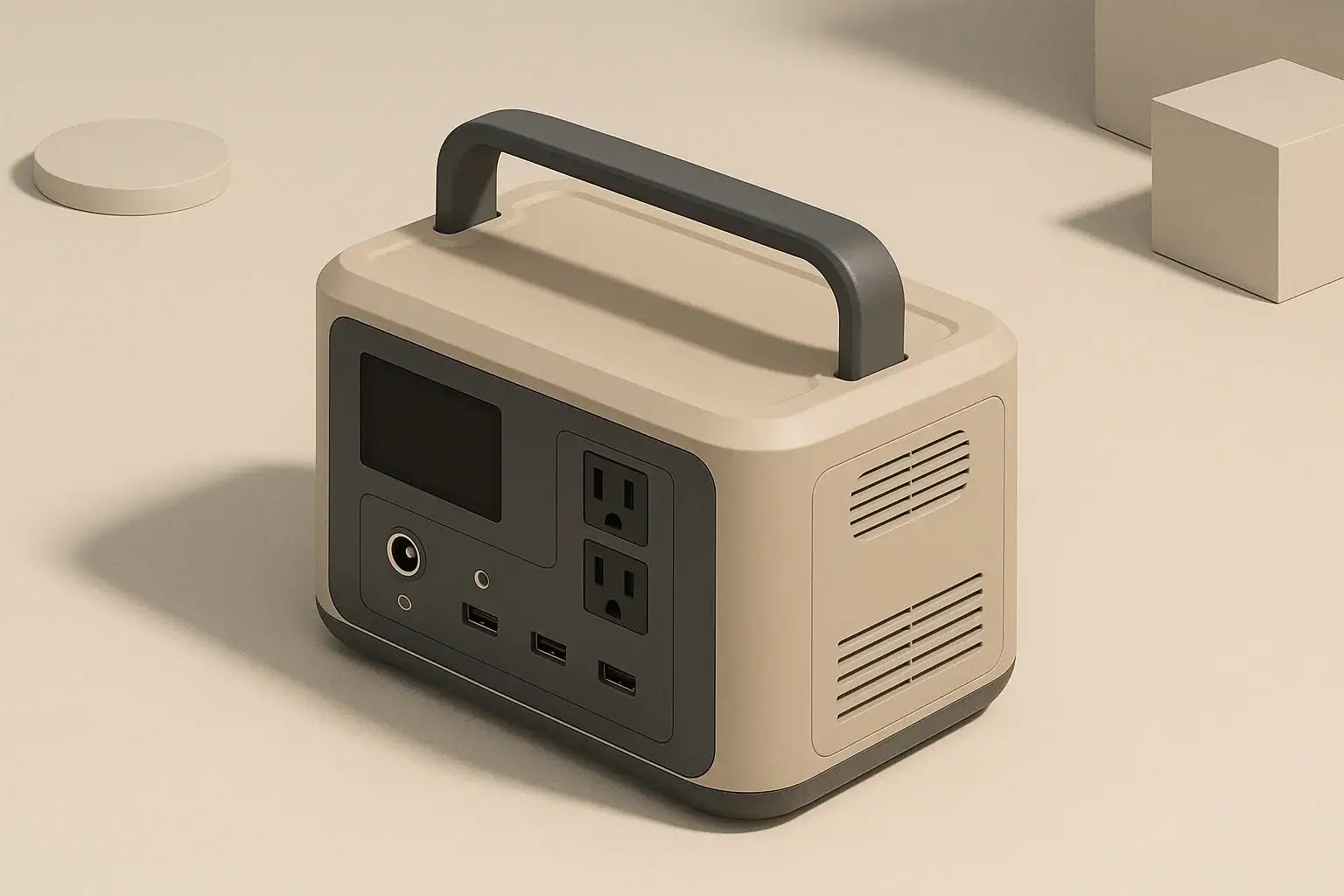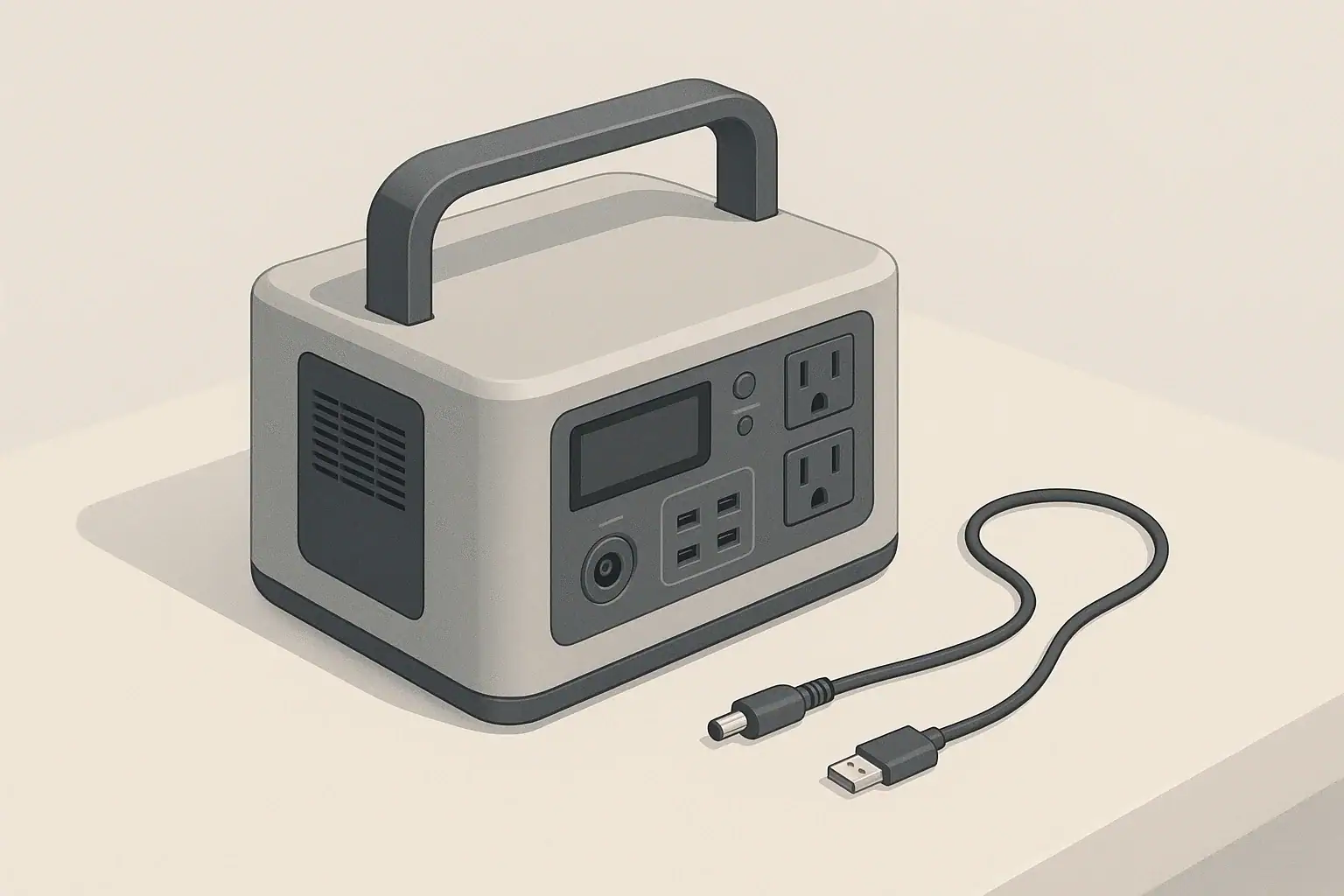
Do Portable Power Stations Work While Charging? Pass-Through vs UPS Mode Explained

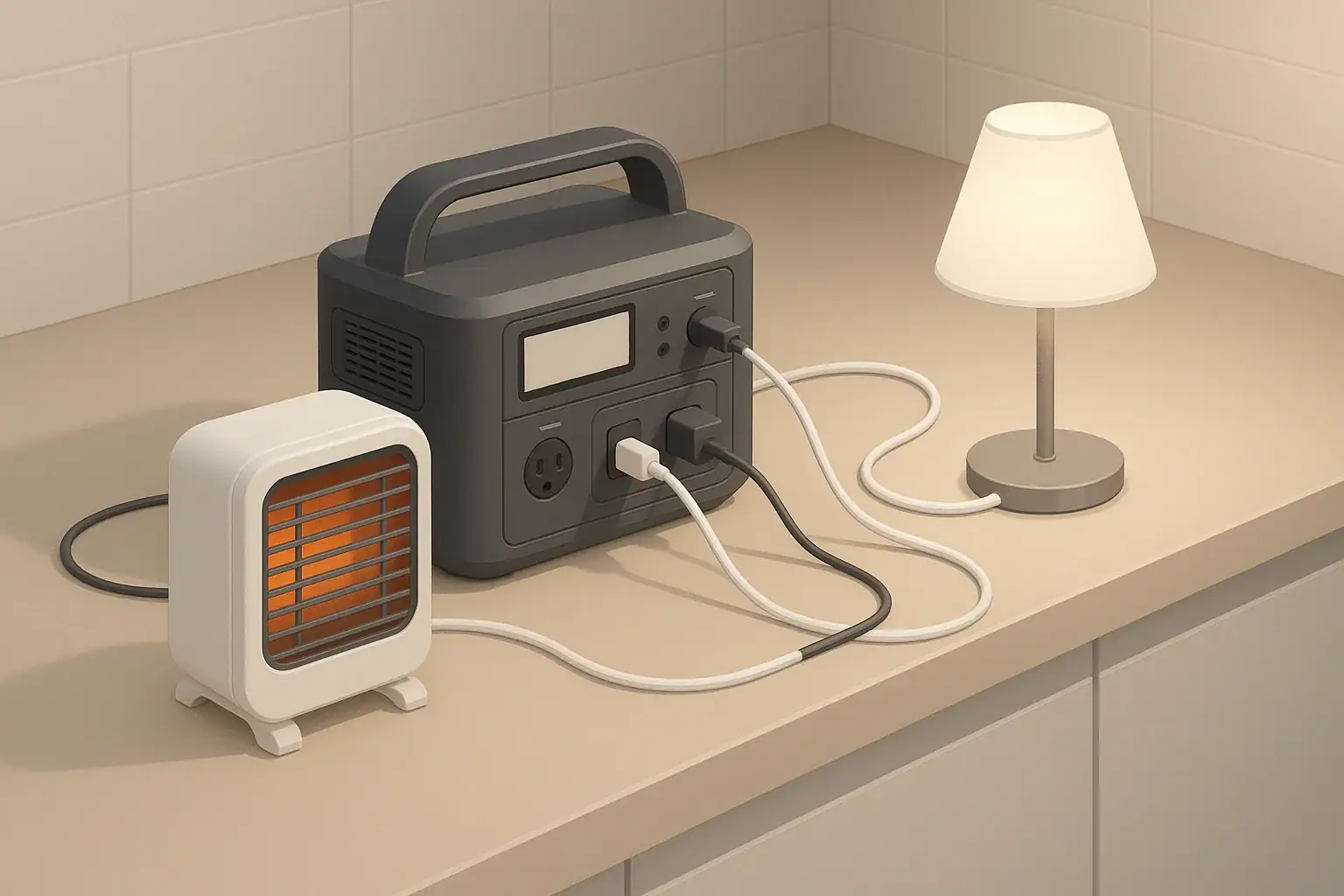
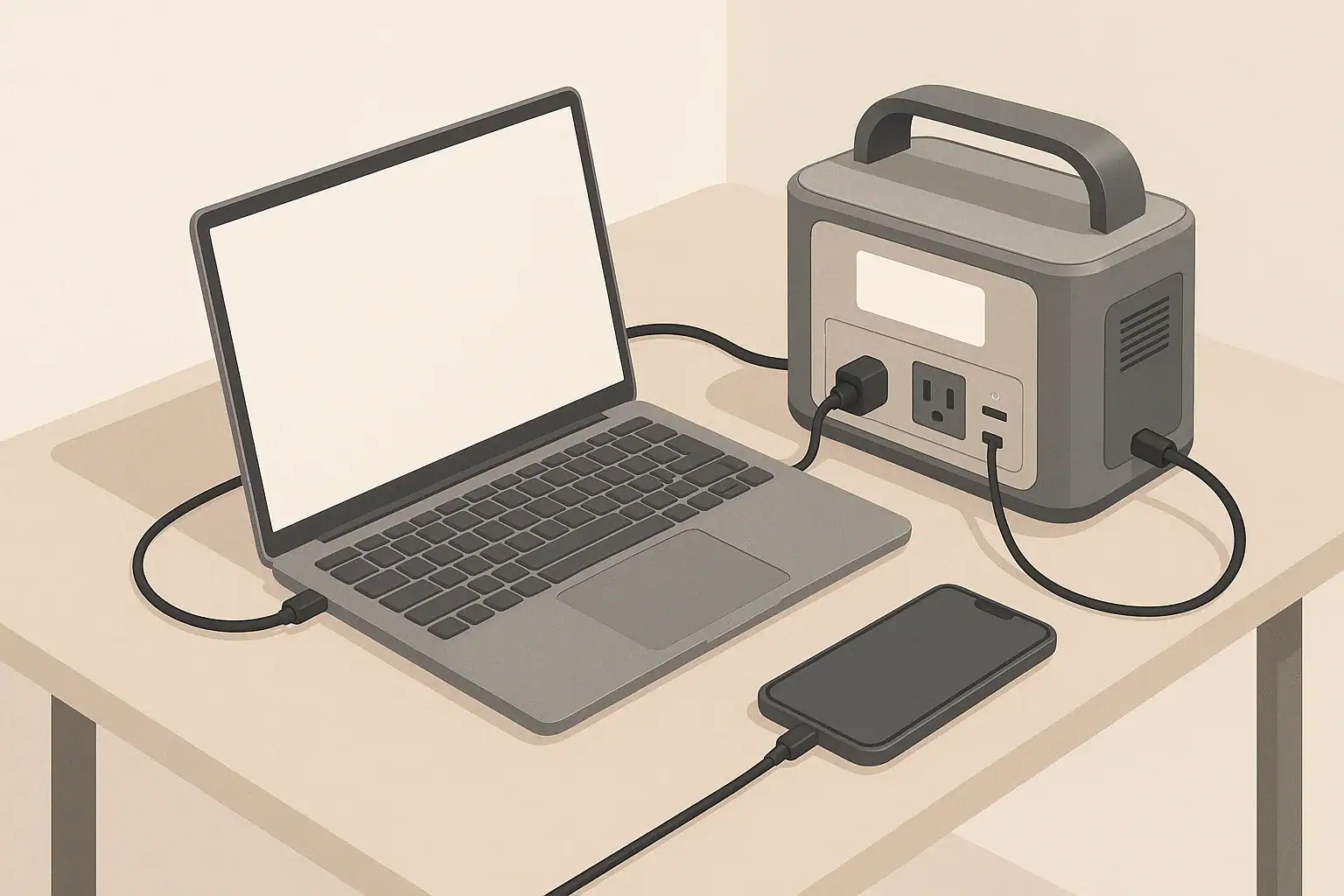
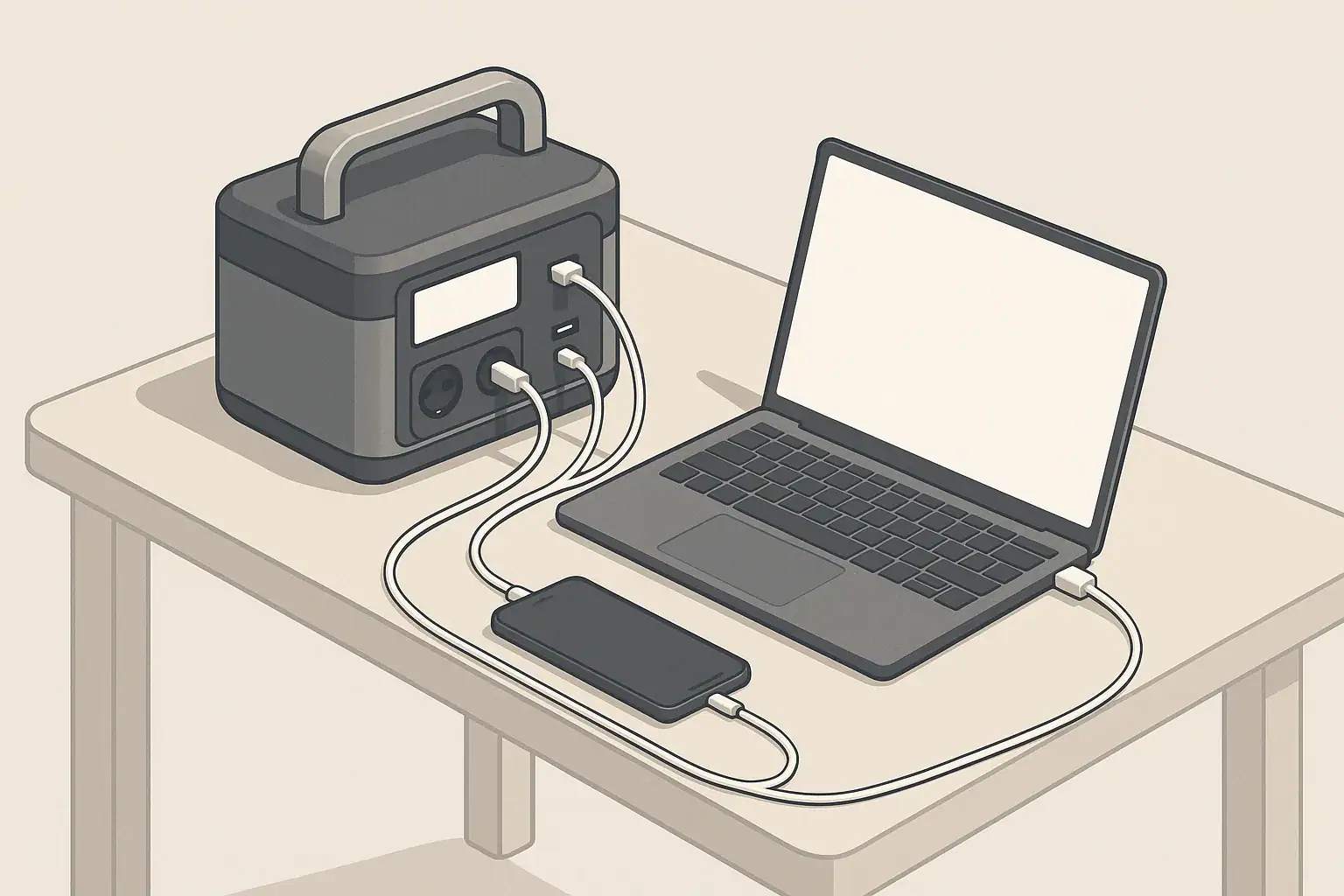
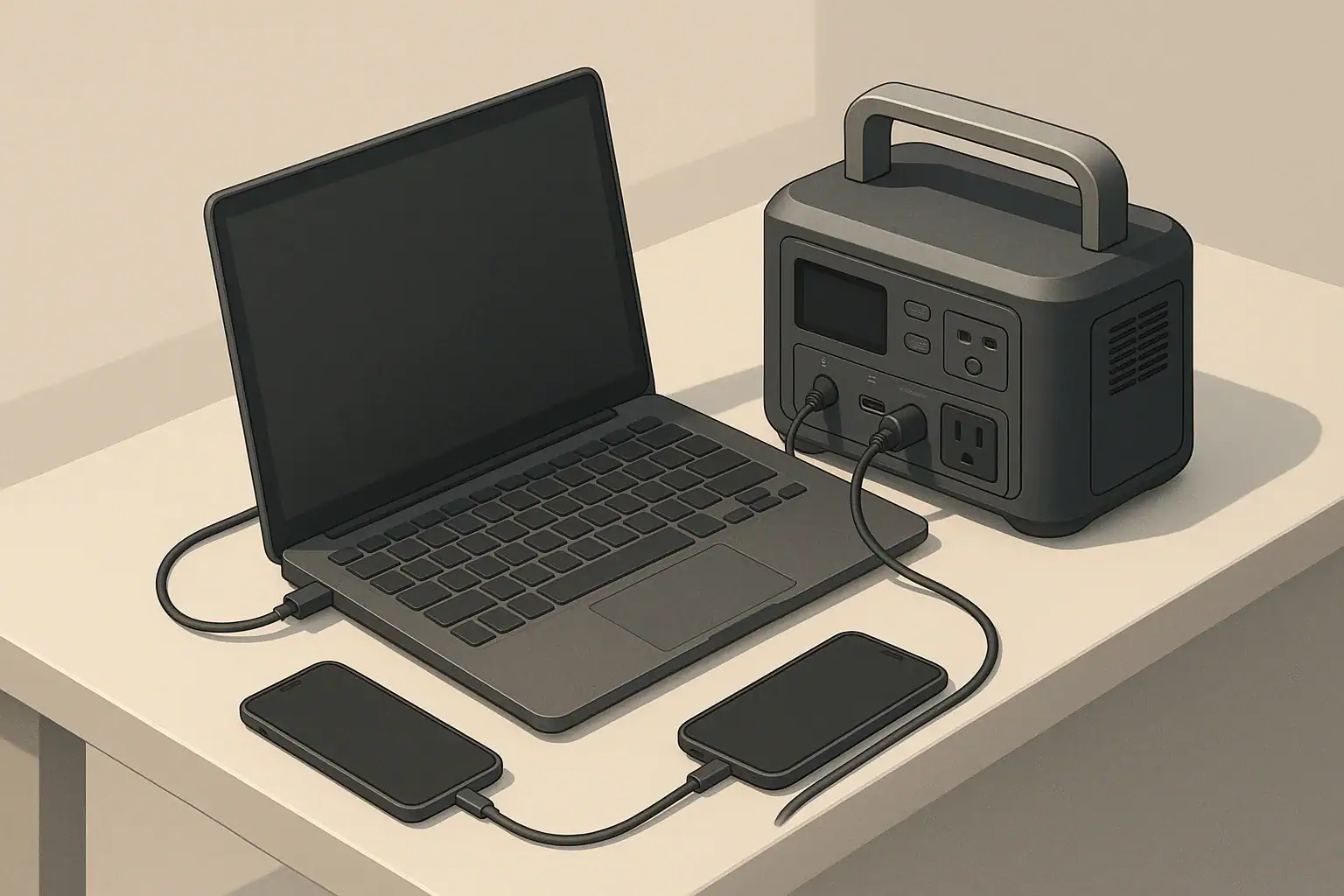
Portable power station on desk showing charging connections

Most portable power stations can power some devices while charging, but not all models support this and the details matter. Some only allow USB or DC outputs, others support full AC pass-through, and a few add UPS-style backup with automatic switchover during an outage. Knowing which behavior your unit offers is essential before relying on it for backup power, camping, or remote work.

This guide explains how running a power station while charging really works, what “pass-through charging” and “UPS mode” mean in practice, and how they affect runtime and battery life. You will see realistic examples, simple power calculations, common mistakes to avoid, and key specs to check before you plug in sensitive electronics or critical devices.

Use this as a practical reference when planning home backup, RV setups, or off-grid solar so you can match your loads, charging sources, and expectations to what your portable power station is actually designed to do.

Do Portable Power Stations Work While Charging and Why It Matters

Portable power stations behave in three main ways when they are plugged in and charging:

  • No output while charging: All or some outlets shut off whenever the input charger is active.
  • Pass-through charging: The station runs devices and charges its battery at the same time.
  • UPS-like mode: The station passes grid power to your devices, then switches to battery power automatically if the grid fails.

Manufacturers choose different designs to balance safety, cost, and battery life. Two models with similar capacity can behave very differently when plugged into the wall, a vehicle outlet, or solar panels.

Understanding this behavior matters for several common situations:

  • Home backup: Keeping a router, lights, or a small fridge running during short outages.
  • Remote work: Powering a laptop and monitor from a portable station while still topping it up from the wall or a vehicle.
  • Camping and RV use: Running a portable fridge and lights during the day while solar panels or an alternator are charging the battery.

If you assume the station will run like a wall outlet whenever it is plugged in, you can easily overload it, shorten battery life, or lose power unexpectedly. The rest of this guide walks through the mechanics so you can plan around the limits instead of discovering them during a blackout or trip.

Key Concepts: Pass-Through Charging, UPS Mode, and Power Balance

To use a portable power station effectively while it is charging, it helps to understand a few core ideas: pass-through behavior, UPS-like operation, and the balance between input and output power.

What Pass-Through Charging Actually Means

Pass-through charging means the power station can deliver power from one or more of its outlets while it is simultaneously taking in power from a wall adapter, vehicle outlet, or solar panels. In other words, it can charge and discharge at the same time.

However, pass-through can be limited in important ways:

  • Some models allow USB and DC outputs only while charging, but disable AC outlets.
  • Some reduce the maximum AC wattage when pass-through is active.
  • Some support pass-through only from specific input sources (for example, allowed on wall AC but not from a vehicle outlet).

Always confirm which ports stay live and what limits apply in your user manual before assuming full pass-through support.

How UPS-Like Mode Works

UPS-like behavior is a special case of pass-through where the power station is used as a backup for grid-powered devices. In this setup:

  • The power station is plugged into the wall and your devices are plugged into the station.
  • When grid power is available, your devices are powered from the wall and the station keeps its battery charged.
  • If the grid fails, the station detects the loss and switches its inverter to battery power.

Most portable stations have a nonzero transfer time measured in milliseconds. Many laptops, routers, and LED lights ride through this gap without turning off, but some desktop computers, gaming systems, or sensitive equipment may reboot if the transfer is too slow.

Power Balance: Input vs Output

When a power station is running loads while charging, the effective charge or discharge rate depends on whether input power is greater or smaller than output power:

  • Output > input: The battery still drains, just more slowly than if there were no input.
  • Input > output: The battery charges, but more slowly than if no devices were connected.
  • Input ≈ output: The state of charge may hover in a narrow band instead of moving quickly up or down.

On top of this, the inverter and charger electronics consume some power as heat, so real-world behavior is never perfectly balanced.

Example power balance scenarios for pass-through use – Example values for illustration.
Input source Approx. input power Connected load What happens to the battery?
Wall outlet (fast charger) 400 W Laptop + monitor (120 W) Battery charges fairly quickly while running devices
Wall outlet (moderate charger) 200 W Mini fridge cycling 60–120 W Battery charges slowly when fridge is off, holds steady or drains slowly when it runs
Vehicle 12 V outlet 120 W Laptop (90 W) + router (15 W) Battery charges very slowly; may hover near same level
Vehicle 12 V outlet 120 W Small cooker (300 W) Battery discharges; vehicle input only slows the drain
Portable solar (clear sun) 200 W LED lights + electronics (60 W) Battery charges during the day while powering loads
Portable solar (cloudy) 50 W Portable fridge averaging 50–70 W Battery slowly discharges over the day

Real-World Examples: Home Backup, Remote Work, Camping, and RV Use

Once you understand pass-through and UPS-like behavior, you can design setups that match your needs instead of guessing. Here are practical scenarios that show how portable power stations behave while charging.

Short Home Outages

For typical residential outages lasting a few hours, many people want to keep a few essentials online:

  • Internet router and modem (15–30 W)
  • Phone chargers (10–20 W total)
  • LED lamp or two (10–20 W each)

Before the outage, you might leave these devices plugged into the power station, with the station itself plugged into the wall. If your unit supports UPS-like mode, it will pass grid power through and keep the battery topped up. When the grid fails, it switches to battery power and your devices stay on.

After power returns, the station goes back to charging while running the same loads. If its AC charger is strong enough, the battery can recover to full between outages even with everything still plugged in.

Remote Work Setup

A simple remote work kit might include:

  • Laptop (60–90 W under load)
  • Portable monitor (15–30 W)
  • Mobile hotspot or router (10–15 W)

At a rental or coworking space, you can plug the station into the wall and run all devices from the AC outlets or DC ports. If the building power blinks, your work session continues on battery. When power is stable, the station recharges while powering the same devices.

On the road, you might run the same setup from a vehicle outlet while driving. In that case, the vehicle input often provides just enough power to offset most of the laptop and monitor draw, so the battery level changes slowly instead of dropping quickly.

Camping and Vanlife

For camping or vanlife, a common load mix might be:

  • Portable fridge averaging 30–60 W over 24 hours
  • LED string lights (5–15 W)
  • Phones, cameras, and small electronics (20–40 W while charging)

During the day, solar panels may provide enough input to cover most or all of these loads. In that case, the battery charges when the sun is strong and discharges at night. If clouds reduce the solar input, the battery slowly depletes even though pass-through is active.

On travel days, you might charge the station from the vehicle and run only the fridge. The alternator input can partially or fully offset the fridge draw, reducing how much stored energy you use between campsites.

RV and Trailer Use

In RVs and trailers, portable power stations are often used in parallel with the built-in electrical system, not hard-wired into it. Typical uses include:

  • Running laptops and chargers at a picnic table without using the main inverter.
  • Powering a CPAP-type device overnight when allowed by the manufacturer.
  • Providing quiet power for fans or lighting when shore power is not available.

A common pattern is to charge the station from shore power or a generator during the day, then unplug and run loads from the battery at night. If the station supports pass-through and your RV circuit allows it, you can also keep it plugged in and let it recharge while still powering low to moderate loads.

Example pass-through setups and how they behave – Example values for illustration.
Scenario Typical loads Charging source Practical outcome
Home office UPS-like use Laptop, monitor, router (~150 W) Wall AC (300–400 W charger) Battery stays near full; rides through brief outages smoothly
Evening outage backup LED lights, phone charging (~50 W) Wall AC before and after outage Battery discharges during outage, then recharges while still powering lights
Vanlife travel day Portable fridge (~40 W average) Vehicle 12 V outlet (~120 W) Battery level changes slowly; often close to stable while driving
Solar-powered campsite Fridge, lights, phones (~80 W daytime) Portable solar (150–200 W in sun) Battery gains charge on sunny days, loses charge on cloudy days
RV shore power plus station Laptops, fans (~120 W) Shore power via AC charger Station acts as buffer; can unplug and move loads outside easily

Common Mistakes and Troubleshooting When Running While Charging

Many frustrations with portable power stations come from a few predictable mistakes. Recognizing them makes troubleshooting much easier.

Mistake 1: Assuming All Ports Work During Charging

Some units disable AC outlets entirely while charging, or only allow low-power DC and USB outputs. If you plug in a device and nothing happens while the station is charging, check:

  • Whether the AC output switch is turned on.
  • Whether the manual states that AC is disabled during charging.
  • If a setting in the menu enables or disables pass-through behavior.

Mistake 2: Overloading the Inverter in Pass-Through Mode

Even if the station is plugged into the wall, you cannot exceed its continuous inverter rating. If you connect devices that draw more power than the inverter can handle, the station may:

  • Shut down the AC output to protect itself.
  • Show an overload or fault indicator on the display.
  • Restart repeatedly when loads cycle on and off (for example, a fridge compressor).

If this happens, reduce the number of devices or choose lower-wattage alternatives, then restart the AC output.

Mistake 3: Expecting a Weak Input to Run High-Wattage Loads Indefinitely

A common surprise is plugging a station into a vehicle outlet or small solar array and expecting it to run a high-wattage appliance without draining. If the input is much lower than the output, the battery will still empty, just more slowly.

Basic troubleshooting steps include:

  • Check the display for input watts and output watts.
  • If output is consistently higher, either reduce the load or increase input (for example, more solar).
  • Remember that cloudy weather or idling engines can reduce real input power.

Mistake 4: Treating a Portable Station as a 24/7 UPS Without Checking Limits

Some users leave a power station plugged in around the clock as a permanent UPS for a desktop or entertainment system. This can keep the battery at high state of charge and under constant cycling, which may accelerate wear.

If your station becomes noticeably hot, the fan runs almost constantly, or the manual warns against continuous UPS duty, consider:

  • Using it only for specific outage-prone seasons or events.
  • Reducing the number of devices connected 24/7.
  • Letting the battery rest at a moderate charge level when not needed for backup.

Mistake 5: Ignoring Warning Messages and Temperature Limits

Many modern stations display warnings for high temperature, low temperature, or overload. If you see repeated warnings when running and charging at the same time:

  • Move the unit to a cooler, shaded, well-ventilated area.
  • Reduce high-wattage loads, especially resistive heaters or cookers.
  • Allow the unit to cool down before resuming full-power operation.

Safety Basics When Using a Power Station While Charging

Running a portable power station while it is charging adds both electrical and thermal stress. A few high-level safety habits can reduce risk and extend the life of your equipment.

General Placement and Ventilation

  • Place the unit on a stable, dry, nonflammable surface.
  • Keep several inches of clearance around all vents and fans.
  • Avoid enclosing the station in cabinets, boxes, or under bedding while under load.
  • Keep it away from direct heat sources and prolonged direct sunlight.

Load and Cord Management

  • Use power cords and adapters rated for the expected current and voltage.
  • Avoid daisy-chaining multiple power strips, extension cords, or cube taps.
  • Do not exceed the station’s continuous watt rating, even when plugged into the wall.
  • Unplug high-wattage devices when not actively in use to reduce heat and wear.

Home and RV Electrical Systems

  • Do not feed power backward into a wall outlet or RV receptacle using improvised cables.
  • Avoid modifying breaker panels, transfer switches, or RV wiring unless done by a qualified professional.
  • If you want to power home circuits from a portable station, consult an electrician about appropriate hardware and isolation methods.

Temperature and Environment

  • Avoid charging lithium-based power stations when they are extremely cold or hot; follow the specified temperature range in the manual.
  • In vehicles or RVs, avoid leaving a station in a closed, sunlit cabin where temperatures can rise quickly.
  • If the case feels hot to the touch, reduce load and improve airflow.

Long-Term Use, Battery Health, and Storage

Pass-through and UPS-like use are convenient, but they can increase battery cycling and heat, which influence long-term capacity. With a few habits, you can still get good life from your portable power station.

How Pass-Through Affects Battery Wear

When charging and discharging at the same time, the battery may cycle through partial charge ranges more often than you realize. Over months and years, this can add up to many effective cycles.

To reduce unnecessary wear:

  • Avoid leaving the station at 100% charge with moderate or heavy loads connected for weeks on end.
  • Use pass-through heavily only when you actually need it (for example, during storm seasons or trips).
  • Where practical, allow the battery to rest at a moderate state of charge between uses.

Cold Weather, Heat, and Storage Practices

Temperature is one of the biggest factors in battery lifespan. For long-term health:

  • Store the station in a cool, dry place, not in a hot attic or uninsulated shed.
  • For long storage (several months), keep the battery at a partial charge rather than full or empty.
  • Check and top up the battery every few months to avoid deep discharge.

Usage Patterns for Different Roles

  • Occasional backup: Keep the station mostly charged, test it a few times per year, and store it at moderate temperature.
  • Frequent remote work: Expect more cycles; consider moderating heavy 24/7 UPS-style use and giving the battery breaks.
  • Seasonal camping or RV use: Charge fully before trips, use pass-through with solar or vehicle charging during the season, then store partially charged off-season.

Practical Takeaways and Specs to Look For

Once you understand how pass-through and UPS-like modes work, choosing and using a portable power station becomes more straightforward. The goal is to match the unit’s capabilities to your most likely use cases without overestimating what it can do.

Key Takeaways for Using a Power Station While Charging

  • Not all portable power stations can run devices while charging, and those that can may limit which ports work and how much power they can deliver.
  • Pass-through charging is most effective when input power (from wall, vehicle, or solar) is similar to or higher than your output load.
  • UPS-like mode can keep computers and networking gear online during brief outages, but transfer times and continuous-duty limits vary.
  • Continuous, high-load pass-through can increase heat and cycling, which may shorten battery lifespan over time.
  • Good ventilation, realistic load planning, and occasional rest periods at moderate state of charge help preserve the battery.

Specs to Look For Before Relying on Pass-Through or UPS Mode

When comparing or configuring portable power stations for running while charging, pay close attention to these specifications and notes in the manual:

  • Pass-through support by port: Confirm whether AC, DC, and USB outputs remain active while charging, and from which input sources.
  • Continuous and surge inverter ratings: Make sure your planned loads are well within the continuous rating, with room for startup surges.
  • Maximum AC charging power: Higher input wattage allows the battery to recharge faster while still powering devices.
  • DC and vehicle charging limits: Know the maximum watts or amps from 12 V inputs so you do not expect them to sustain high-wattage loads.
  • Solar input range and maximum power: Check the supported voltage, current, and wattage to size panels realistically for pass-through use.
  • UPS or transfer time rating: Look for the stated switchover time and any notes about suitable or unsuitable equipment.
  • Thermal protection and operating temperature: Understand at what temperatures the unit may limit output or charging.
  • Recommended duty cycle: See whether the manual encourages or cautions against 24/7 UPS-style operation.
  • Battery chemistry and cycle life: Check approximate cycle ratings and any guidance on storage and typical depth of discharge.

By matching these specs to your real-world loads and charging sources, you can decide when it is safe and practical to run your portable power station while charging, and when it is better to adjust your setup or expectations.

Frequently asked questions

Which specifications and features matter most when choosing a portable power station for pass-through or UPS use?

Key specs include whether pass-through is supported for AC, DC, and USB ports; the continuous and surge inverter ratings; maximum AC charging power; UPS transfer time; and thermal protection or recommended duty cycle. Also check the solar input range and battery chemistry/cycle life to match your intended charging sources and longevity expectations.

Can I leave a portable power station plugged in all the time to act as a permanent UPS?

While some stations are designed for regular UPS-like use, leaving a unit plugged in 24/7 can keep the battery at high state of charge and increase cycling and heat, which may accelerate wear. Check the manufacturer’s recommended duty cycle and thermal limits, and consider periodic rest or a secondary UPS for continuous critical loads.

How can I reduce electrical and thermal risks when running a power station while it charges?

Reduce risk by providing good ventilation and clearance around the unit, using properly rated cords, avoiding enclosures, and not exceeding the continuous watt rating. Monitor temperature and warning messages, and move the station to a cooler area or lower the load if it becomes hot or shows faults.

Will running devices while a station is charging shorten its battery lifespan?

Running devices during charging can increase partial cycling and heat exposure, both of which contribute to battery degradation over time. Occasional pass-through use is usually acceptable, but frequent high-load, continuous pass-through will generally reduce long-term capacity faster than conservative use.

What should I check if my station won’t power AC outlets while it is charging?

First consult the manual to confirm whether AC pass-through is supported and whether any switches or menu settings enable the AC output during charging. Also verify the input source is allowed for pass-through and check for overload or fault indicators that might have disabled outputs.

How do transfer times affect sensitive equipment when using UPS-like behavior?

Most portable stations have a nonzero transfer time measured in milliseconds; many routers, laptops, and LED lights tolerate this gap, but some sensitive or legacy equipment may reboot or disconnect. For critical systems, check the stated switchover time and test the setup, or consider a true online UPS if zero-transfer interruption is required.

Charging in Freezing Temperatures: Risks, Safe Limits, and How to Protect Your Power Station

Portable power station at a snowy campsite in winter

Charging a portable power station in freezing temperatures can permanently damage the battery, so you should warm the unit above its minimum charging temperature before plugging it in. Cold weather use is usually fine, but cold weather charging is where most of the risk lives.

When lithium batteries are charged below about 32°F (0°C), internal chemical reactions slow down and can cause lithium plating, capacity loss, and shorter battery life. You may still be able to discharge and run devices in the cold, but you need a different strategy for when and how you recharge.

This guide explains what happens inside a lithium battery in the cold, how much runtime you can realistically expect in winter, common cold‑weather mistakes, and practical steps to keep your portable power station safe, reliable, and ready for emergencies.

What “Charging in Freezing Temperatures” Really Means and Why It Matters

For portable power stations, “freezing” usually means around 32°F (0°C) and below, but the exact limits depend on the battery design. Many lithium batteries can discharge at temperatures well below freezing, yet their safe charging range is much narrower.

Manufacturers typically publish three separate temperature ranges:

  • Charging temperature – often something like 32–104°F (0–40°C).
  • Discharging temperature – often wider, for example 14–104°F (−10–40°C) or more.
  • Storage temperature – sometimes broader but still not intended for deep freeze long‑term.

Charging below the minimum charging temperature is where damage can occur. The pack may still “accept” charge if protections are weak or bypassed, but repeated cold charging can silently reduce capacity and increase internal resistance. Over time, that means shorter runtimes, more voltage sag, and a power station that feels much smaller than its original rating.

Understanding where these limits come from helps you plan winter camping trips, RV use, job‑site work, and home backup so that you charge warm, use cold, and keep the battery healthy for years.

How Cold Affects Lithium Batteries and Charging Behavior

Inside a lithium battery, energy moves as lithium ions travel through an electrolyte between the anode and cathode. Temperature changes the speed and efficiency of that movement.

In cold conditions:

  • Chemical reactions slow down – ions move more slowly, so the battery cannot accept or deliver current as easily.
  • Electrolyte becomes more viscous – the internal “liquid highway” gets thicker, raising internal resistance.
  • Voltage behavior changes – the same current causes more internal stress, and voltage drops faster under load.

These effects show up differently when you are discharging versus charging the battery.

Discharging in the Cold: Less Runtime, More Voltage Sag

When you run devices from a cold portable power station, you may notice:

  • Shorter runtimes than you get at room temperature.
  • Unexpected shutdowns under heavy loads, even when the display still shows remaining charge.
  • More frequent low‑battery or overload warnings.

This happens because the cold battery cannot deliver energy as efficiently. The inverter sees the battery voltage sagging and shuts down to protect the pack, even though some energy remains locked away until the cells warm back up.

Charging in the Cold: Lithium Plating and Permanent Damage

Charging in freezing conditions is more serious than simply losing runtime. At low temperatures, the anode cannot absorb lithium ions as quickly as the charger is trying to push them in. Instead of entering the anode structure, some lithium can deposit as metallic lithium on the surface. This is called lithium plating.

Over time, lithium plating can lead to:

  • Permanent capacity loss – part of the battery’s active material is no longer available for storing energy.
  • Higher internal resistance – the pack runs warmer under load and feels “weaker.”
  • Shortened lifespan – the battery reaches end of life sooner, even if it still appears to work.

Most modern power stations include a battery management system (BMS) that monitors temperature and will reduce or block charging when the pack is too cold. However, not all systems react the same way, and relying on protections alone is not a substitute for good habits.

Typical Temperature Ranges for Lithium Power Stations – Example values for illustration.
Use case Common temperature range What this means in practice
Charging 32–104°F (0–40°C) Aim to be comfortably above freezing before plugging in any charger.
Discharging (running devices) 14–104°F (−10–40°C) You can usually use the unit in light subfreezing conditions but expect less runtime.
Short‑term storage 14–95°F (−10–35°C) Okay for seasonal storage if you avoid deep freeze and high heat extremes.
Long‑term storage 41–77°F (5–25°C) Best range for long battery life when stored partially charged.

Because exact limits vary, treat your own product’s minimum charging temperature as a hard line and give yourself a safety margin above it.

Cold-Weather Examples: Camping, RV, Job Sites, and Home Backup

Understanding theory is helpful, but cold‑weather charging decisions are made in real situations: a tent at dawn, a frozen driveway, or a chilly workshop. These examples show how to apply the same principles in different scenarios.

Winter Camping and Vanlife

Imagine a weekend trip where overnight temperatures drop to 15°F (−9°C). Your power station spends the night in the tent vestibule powering a small fan and lights. In the morning you want to recharge from a folding solar panel.

  • The battery pack inside the unit is likely close to the outside air temperature.
  • The display may still show 40–50% remaining, but the internal cells are cold and sluggish.
  • Connecting solar right away may cause the BMS to refuse charging or accept only a trickle.

A better approach is to move the power station into the warmest part of the tent or vehicle, let it warm gradually while you make breakfast, and start charging once the interior has climbed above freezing.

RV and Remote Work Setups

In an RV or mobile office, the power station might live in a storage bay that drops below freezing overnight while you drive or park. The next morning you plug into shore power or start a generator and expect everything to charge as usual.

What actually happens:

  • The BMS may limit charge current until the pack warms, making “fast charging” much slower.
  • If sensors are not accurate or protections are minimal, the pack may accept high current while still too cold, increasing long‑term wear.
  • Voltage sag is more noticeable when running power tools or a coffee maker from a cold battery.

Planning to store the power station in the conditioned interior when hard freezes are expected, and opening cabinet doors around it while charging, can keep temperatures closer to the recommended range.

Cold Weather Home Backup and Short Outages

During a winter outage, you might grab a power station from an unheated garage where it has sat at 20°F (−6°C) for weeks. You bring it into the living room and immediately plug it into a small gasoline generator or wall outlet once power returns.

Safer practice looks like this:

  • Set the unit on a dry, stable surface away from heaters and stoves.
  • Allow it to slowly reach room temperature; wipe off any visible condensation.
  • Only then connect chargers and critical loads like lights, phones, or a modem.

Because cold reduces effective capacity, prioritize low‑wattage essentials instead of trying to run electric heaters or large appliances directly from the power station.

Outdoor Job Sites and Workshops

On a winter job site, it is common to leave a power station in the back of a truck overnight, then use it to run tools and charge batteries during the day. If you fast‑charge it from AC in an unheated workshop that is just above freezing, the cells are still cold even though the air feels “not that bad.”

In that situation, using a slower charging method or moving the unit into a slightly warmer space before fast charging can significantly reduce stress on the battery, especially if this pattern repeats all winter.

Common Cold-Weather Mistakes and Troubleshooting Cues

Most cold‑related battery problems come from a few repeatable mistakes. Recognizing them early can help you avoid permanent damage and troubleshoot odd behavior before it becomes serious.

Frequent Mistakes with Charging in Freezing Temperatures

  • Charging as soon as you come indoors – the outside of the case feels warmer than the internal cells, which may still be below freezing.
  • Leaving the unit on snow or concrete – it stays colder longer than you expect, especially in light wind.
  • Using the fastest charger in marginal temperatures – high current at just‑above‑freezing conditions increases stress on the cells.
  • Assuming the display temperature equals cell temperature – some sensors read air or case temperature, not the battery core.
  • Ignoring repeated charge throttling or error codes – the BMS may be warning you that the pack is too cold.

Cold exposure and improper charging do not always cause immediate failure. Look for patterns over time:

  • Noticeably shorter runtimes than when the unit was new, even at moderate temperatures.
  • More frequent low‑battery shutdowns under loads that used to be fine.
  • Longer charging times for the same input power.
  • Intermittent or new error messages when charging after cold storage.

These issues can have other causes, but if they show up after a season of winter use, cold charging is a likely contributor.

Cold-Weather Issues and What to Do Next – Example values for illustration.
Observed issue Likely cause Immediate action Longer‑term step
Unit will not start charging after a night in the car BMS blocking charge due to low temperature Bring indoors, let it warm to room temperature, then retry. Store above freezing when hard freezes are expected.
Fast shutdown when running a space heater in the cold Voltage sag and inverter overload Turn off the heater and switch to low‑wattage loads. Avoid running high‑draw heaters from small power stations.
Runtime much shorter than in summer Reduced effective capacity at low temperature Move the unit to a less exposed, insulated spot. Plan extra capacity for winter trips and outages.
Condensation on case after bringing it indoors Moisture from warm air hitting cold surfaces Let it dry fully before charging or heavy use. Use bags or covers to reduce moisture swings.
New clicking sounds or unusual smell while charging Possible internal fault or damage Stop charging immediately and power down. Contact the manufacturer or a qualified service provider.

When to Stop and Seek Help

If you notice swelling of the case, a sweet or chemical odor, visible damage, or repeated error codes that do not clear after warming and restarting the unit, stop using it. Do not attempt to open the enclosure or bypass safety systems. Contact the manufacturer or a qualified technician for guidance on inspection, repair, or recycling.

Cold-Weather Safety Basics for Portable Power Stations

Cold temperatures add extra stress to the battery, but most safety issues arise when cold is combined with moisture, poor ventilation, or improvised electrical connections. A few high‑level rules go a long way.

Temperature and Placement Safety

  • Avoid extreme swings – do not move the unit directly from deep freeze to high heat, such as next to a heater or stove.
  • Keep vents clear – even in winter, the inverter and BMS need airflow to shed heat while charging or under heavy load.
  • Elevate off snow and standing water – use a board, crate, or dry mat to reduce moisture exposure and shock risk.

Electrical and Load Safety

  • Use appropriate cords – cold makes many cables stiff and more prone to cracking; inspect insulation before use.
  • Avoid overloading – cold batteries sag more under load, so devices that were “borderline” in summer may now trip overload protection.
  • Do not backfeed building wiring – never connect a portable power station to household circuits without proper transfer equipment installed by a professional.

Ventilation and Indoor Use

  • Ensure adequate airflow – do not bury the unit under blankets or clothing to “keep it warm.”
  • Respect other heat sources – maintain clearance from gas heaters, fireplaces, and cooking appliances.
  • Follow device instructions – some connected loads, such as medical equipment, have their own temperature and ventilation requirements.

Most modern portable power stations include multiple layers of protection, but those systems are designed to work within published limits. Using the unit within its specified temperature range and avoiding improvised electrical setups is the foundation of safe cold‑weather operation.

Long-Term Cold-Weather Care, Storage, and Battery Health

How you store and maintain a portable power station between trips or seasons matters just as much as how you use it on any given winter day. Good habits can preserve capacity and reduce unpleasant surprises when you need backup power most.

Off-Season Storage in Cold Climates

  • Choose a moderate location – a closet, interior room, or conditioned basement is better than an unheated shed or vehicle.
  • Avoid full charge or full empty – many lithium batteries age best when stored around 30–60% state of charge.
  • Top up periodically – check and recharge every few months to prevent deep discharge from self‑drain.

If your only option is a space that occasionally dips below freezing, keep the unit off bare concrete and away from exterior walls. An insulated shelf or cabinet can reduce temperature swings and moisture exposure.

Post-Winter Inspection

After a season of cold use, a quick inspection can catch issues before they become failures:

  • Look for cracks in the housing, loose handles, or damaged feet from impacts in cold weather.
  • Inspect AC outlets and DC ports for corrosion, dirt, or moisture staining.
  • Check cords and adapters for stiff spots, nicks, or cracked insulation.

If any damage is found, retire the affected cords or accessories and follow the manufacturer’s guidance for the power station itself.

Planning Capacity for Winter Use

Because cold reduces effective capacity, it is reasonable to assume that real‑world winter runtimes may be noticeably lower than the nameplate watt‑hour rating suggests. Many users plan with a margin, such as treating a 1,000 Wh unit as if it were only 700–800 Wh in freezing conditions, depending on load type and exposure time.

That extra buffer can be the difference between running only essentials through a long winter night versus unexpectedly running out of power before morning.

Practical Takeaways and Specs to Look For

Cold weather does not mean you cannot rely on a portable power station. It does mean you need to think about when you charge, where you store the unit, and which specifications matter most for winter use.

Key Takeaways for Charging in Freezing Temperatures

  • Use your power station in the cold if needed, but avoid charging below the stated minimum temperature.
  • Warm the unit gradually to above freezing before plugging in any charger, whether AC, solar, or vehicle.
  • Expect shorter runtimes and more voltage sag in winter; plan extra capacity or reduce loads.
  • Store the unit in a cool, dry place that generally stays above freezing and avoid leaving it fully charged or fully empty for long periods.
  • Watch for warning signs like new error codes, unusual smells, or rapid capacity loss after cold exposure.

Specs to Look For When You Expect Cold-Weather Use

When comparing portable power stations for use in freezing climates, the spec sheet can tell you a lot about how they will behave in winter. Pay particular attention to:

  • Minimum charging temperature – the lower this value (within reason), the more flexible the unit is for cold‑weather charging.
  • Discharge temperature range – a wider range supports more reliable operation on cold nights.
  • Storage temperature range – important if the unit will live in a garage, RV, or cabin.
  • Battery chemistry – different lithium chemistries (for example, LiFePO4 versus other lithium‑ion types) have different cold‑weather behavior and cycle life characteristics.
  • BMS protections – look for explicit mention of low‑temperature charge protection, thermal sensors, and automatic charge throttling.
  • Available charge inputs – multiple input options (AC, DC, solar) let you choose slower or gentler charging methods in marginal conditions.
  • Usable capacity at low temperature (if stated) – some manufacturers provide performance graphs showing capacity versus temperature.

Matching these specifications to your climate and use case helps ensure that your power station remains dependable in winter, without relying on risky cold‑weather charging habits that shorten battery life.

Frequently asked questions

Which specifications and features most affect a power station’s performance when charging in freezing temperatures?

Minimum charging temperature, discharge and storage temperature ranges, and battery chemistry are the most important specs. Also look for explicit BMS low‑temperature protections, thermal sensors, and information about usable capacity at low temperatures. Multiple input options (AC, DC, solar) let you choose gentler charging methods in marginal conditions.

Can I charge a power station immediately after bringing it inside from the cold?

No — you should let the unit warm gradually above the minimum charging temperature before charging. Charging while the internal cells are still cold risks lithium plating and long‑term capacity loss, and the BMS may refuse to charge until the pack warms.

What immediate safety steps should I take if I suspect cold-related battery damage?

Stop charging and disconnect any loads, then move the unit to a well‑ventilated, moderate‑temperature area and avoid rapid heating. Do not open the enclosure or attempt repairs; contact the manufacturer or a qualified technician for inspection and disposal guidance if you see swelling, strong odors, or persistent error codes.

How much runtime loss is typical when using a power station in very cold conditions?

Runtime reduction varies with temperature, load, and exposure time, but many users see noticeably lower effective capacity — often on the order of 20–30% or more under severe cold. Plan additional capacity or reduce loads for winter use to avoid unexpected outages.

Are there safer ways to charge with solar or vehicle charging when temperatures are near freezing?

Yes — use lower charge currents or slower charge modes and, when possible, move the station into a warmer space before charging. Insulating the unit from wind and placing it in a sheltered, dry enclosure can help, but the best practice is to ensure internal cell temperature is above the manufacturer’s minimum before applying significant charge current.

How can I reduce condensation risk when bringing a cold power station indoors?

Bring the unit into a cool, dry room and let it warm gradually in a sealed bag or case to limit moisture contact, then open and dry any visible condensation before charging. Avoid placing it directly next to heaters or humid environments to prevent rapid temperature swings that create condensation.

Cold-Weather Capacity Loss: How Much Power You Really Lose

portable power station in a snowy campsite winter scene

Portable power stations typically lose about 10–30% of their usable capacity around freezing and up to 40–50% in very cold weather, even when fully charged. This cold weather capacity loss is normal behavior for lithium batteries, not usually a defect, but it can dramatically shorten the runtime you get for winter power outages, camping, or vanlife.

Understanding how low temperatures affect battery performance helps you plan realistic runtimes, avoid sudden shutdowns, and protect your investment. Instead of relying only on the rated watt-hours printed on the label, you can adjust for cold, load, and age to get a much closer estimate of what your portable power station will actually deliver.

This guide explains why batteries lose capacity in the cold, shows real-world examples, walks through common mistakes and troubleshooting cues, and finishes with safety basics, storage tips, and a practical specs checklist to use before your next winter trip or storm.

What Cold-Weather Capacity Loss Means and Why It Matters

Cold-weather capacity loss is the drop in usable energy you get from a portable power station when the battery is cold compared with its rated capacity at room temperature. The label might say 1,000 Wh, but in freezing temperatures you may only be able to use 600–800 Wh before the unit shuts down.

This matters because most people size their portable power station based on ideal conditions. In winter, that same setup can fall short for critical loads such as communication devices, medical equipment, or heating accessories. Knowing how much capacity you really lose lets you plan a margin of safety instead of being surprised by early cutoff.

Cold capacity loss is usually temporary and mostly reversible: when the battery warms back up, much of the apparent “missing” energy becomes usable again. However, repeatedly operating or charging at extreme low temperatures can contribute to long-term wear and permanent capacity loss over the life of the pack.

In practical terms, cold weather capacity loss affects:

  • How long your lights, router, or fridge will run during a winter outage
  • Whether your laptop and hotspot last through a remote workday in a cold cabin
  • How much backup you need for overnight camping when temperatures drop below freezing

How Cold Affects Battery Chemistry and Performance

Portable power stations typically use lithium-based batteries. These cells are designed and rated around room temperature, often about 68–77°F (20–25°C). As temperature drops, the internal chemistry slows and resistance increases, which changes how the battery behaves under load and during charging.

Slower Chemical Reactions and Higher Internal Resistance

Inside each cell, lithium ions move between electrodes through an electrolyte. Cold temperatures slow this movement and increase internal resistance. The result is:

  • Lower effective capacity under load: the pack cannot deliver as much energy before voltage drops to cutoff.
  • Reduced peak power capability: the battery struggles more with sudden or heavy loads.
  • More heat from internal losses: some energy is lost as heat instead of going to your devices.

Manufacturers rate capacity at a specific temperature and discharge rate. When you move away from those conditions—especially toward freezing or below—the real-world watt-hours you can draw decrease.

Voltage Sag and Early Shutoff

battery management system inside a power station constantly monitors voltage and temperature to keep operation within safe limits. In the cold, voltage under load sags more quickly. If voltage dips below a preset threshold, the system shuts output off to protect the cells, even if there is still some energy remaining.

This is why you might see a state-of-charge display that still shows 15–25%, but the unit suddenly turns off when you plug in a heavier device, especially in cold conditions. The cold exaggerates this effect, and high loads make it worse.

Cold Charging Limitations

Charging lithium batteries when they are very cold can cause internal damage, such as metallic lithium plating on the anode. To prevent this, most power stations:

  • Reduce charge current at low temperatures
  • Block charging entirely below a defined cutoff
  • Display warnings or error codes when the pack is too cold

These behaviors are protective features, not faults. If your unit will not charge after being in a cold car or shed, it usually needs time to warm up internally before normal charging resumes.

Typical Capacity Loss by Temperature

The exact numbers vary by battery chemistry, pack design, and load, but many users see patterns like these under light-to-moderate loads:

  • Around 50°F (10°C): small, often barely noticeable loss
  • Around 32°F (0°C): roughly 10–30% less usable capacity
  • Well below freezing: 30–50% or more loss, especially under higher loads

These effects stack on top of normal inefficiencies such as inverter losses, so the difference between the rated watt-hours and what you get in real winter use can be large.

Approximate cold-weather capacity vs. temperature – how much usable energy you may see compared with the rated watt-hours at room temperature. Example values for illustration.
Battery temperature Approx. usable capacity vs. rating What you might notice in use
77°F (25°C) 90–100% Performance close to spec sheet; minor losses only.
50°F (10°C) 85–95% Most users see little difference for light loads.
32°F (0°C) 70–90% Noticeable runtime reduction, especially with laptops or fridges.
14°F (-10°C) 50–70% Shorter runtimes; more early shutdowns with high-wattage devices.
-4°F (-20°C) 40–60% Hard to power heavy loads; frequent low-voltage cutoff.

Real-World Cold-Weather Runtime Examples

To make cold weather capacity loss more concrete, it helps to walk through specific scenarios. These examples assume a 1,000 Wh portable power station rated at room temperature and used after it has cooled to around freezing.

Example 1: Winter Power Outage With Home Essentials

Imagine a 1,000 Wh unit powering:

  • Wi-Fi router and modem: 20 W total
  • LED lamp: 10 W
  • Phone charging: 10 W average over time

Total load is about 40 W. At room temperature and assuming 85% overall efficiency, you might expect roughly:

  • 1,000 Wh × 0.85 ÷ 40 W ≈ 21 hours of runtime

At freezing, if usable capacity drops to about 80% of rated, the effective energy is closer to 800 Wh × 0.85 ≈ 680 Wh. That gives:

  • 680 Wh ÷ 40 W ≈ 17 hours of runtime

The difference—about 4 hours—can matter if you are planning for an overnight outage.

Example 2: Cold-Weather Camping With a Laptop and 12 V Fridge

Consider the same 1,000 Wh station used in a camper at 28°F (-2°C) to power:

  • Laptop for remote work: 60 W while in use
  • 12 V compressor fridge: 45 W while running, 30% duty cycle
  • Interior LED lights: 10 W

The average load is roughly:

  • Laptop: 60 W for 8 hours ≈ 480 Wh
  • Fridge: 45 W × 0.3 ≈ 14 W average over 24 hours
  • Lights: 10 W for 6 hours ≈ 60 Wh

With cold-related loss to around 70–80% usable capacity and normal inefficiencies, you might only have about 650–750 Wh realistically available. That means a full 24-hour day of work, cooling, and lighting may nearly drain the battery, whereas the same setup in mild weather would have more margin.

Example 3: High-Wattage Loads in the Cold

High loads exaggerate cold weather capacity loss. If you try to run a 500 W space heater from a 1,000 Wh station at 20°F (-7°C), the unit may:

  • Shut down early due to voltage sag
  • Deliver far less than the expected 1–2 hours of runtime
  • Run its fans hard while still not keeping up with the heating need

Even if the battery technically has enough watt-hours, the combination of cold, high current, and inverter losses can make the heater impractical. In most winter scenarios, prioritizing lower-wattage loads (insulation, sleeping bags, efficient clothing, and small electronics) is far more efficient than trying to heat air with battery power.

Cold-weather runtime planning examples – typical device loads and how cold capacity loss changes expectations. Example values for illustration.
Use case Approx. load (W) Room-temp runtime on 1,000 Wh Freezing runtime on 1,000 Wh
Router + lamp + phones 40 W ~20–22 hours ~15–18 hours
Laptop + lights 80 W ~10–11 hours ~7–9 hours
12 V fridge (average) 30–40 W ~22–28 hours ~16–22 hours
Small power tool use (intermittent) 150–300 W bursts Several hours of mixed use Noticeably fewer cuts/drills per charge
Compact space heater 400–600 W ~1–2 hours Often under 1 hour before cutoff

Common Cold-Weather Mistakes and Troubleshooting Cues

Most winter problems with portable power stations come from a few predictable mistakes. Recognizing the signs helps you decide whether you are seeing normal cold weather behavior or a true fault.

Mistake 1: Assuming Rated Capacity in Any Weather

Many users plan runtimes by dividing rated watt-hours by load watts without adjusting for temperature or inverter losses. In cold weather this leads to:

  • Unexpectedly short runtimes
  • Critical devices shutting off overnight
  • Misjudging how many days of power a setup can provide

Troubleshooting cue: If your math says you should get 10 hours but you only see 6–7 in freezing conditions, that gap is often normal cold weather capacity loss plus efficiency overhead, not necessarily a defective battery.

Mistake 2: Leaving the Unit Cold-Soaked Before Use

Storing the power station in an unheated garage, vehicle trunk, or shed and then using it immediately in a cold environment means the internal cells start the day cold. The pack may warm slightly under load, but initial capacity and power delivery will be reduced.

Troubleshooting cue: If you move the unit into a warmer space for a few hours and runtimes improve, the issue was temperature, not a failing pack.

Mistake 3: Charging When the Battery Is Very Cold

Trying to fast-charge a cold battery is one of the easiest ways to shorten its life. Some units will refuse to charge or limit input power; others may charge but at the cost of long-term capacity.

Troubleshooting cue: If charging is very slow or blocked and the display shows a low-temperature warning, bring the station indoors, let it sit unplugged until the case feels close to room temperature, then try again.

Mistake 4: Running High-Wattage Devices Continuously

Space heaters, hair dryers, kettles, and large power tools draw a lot of current. In the cold, this triggers stronger voltage sag and earlier protective shutdown.

Troubleshooting cue: If the station shuts off quickly with a heavy appliance but runs fine with lighter loads, the behavior is usually normal. Reduce load, use lower power settings, or run heavy devices for shorter bursts.

Mistake 5: Blocking Vents With Insulation

Insulating the unit to keep it warm is helpful, but covering vents or fans can cause overheating or derating, especially when the inverter is working hard.

Troubleshooting cue: If the unit runs hot, throttles output, or shows over-temperature warnings even in cold air, check that vents are completely unobstructed and that there is some airflow around the case.

Cold-Weather Safety Basics for Portable Power Stations

Cold weather does not remove electrical or battery risks. It simply changes which issues are most likely. A few high-level safety habits go a long way.

Temperature and Placement

  • Operate the power station within the manufacturer’s recommended temperature range whenever possible.
  • Avoid leaving the unit for long periods in locations that regularly drop well below freezing.
  • Keep the station on a dry, stable surface away from snow, ice melt, and standing water.

Ventilation and Enclosures

  • Do not fully enclose the power station in blankets, boxes, or bags that block fans or vents.
  • If you use an insulated cover, ensure there are clear openings for air intake and exhaust.
  • Leave space around the unit so warm air from the inverter and charger can escape.

Extension Cords and Loads

  • Use cords and power strips rated for the wattage you plan to draw.
  • Route cables to avoid trip hazards on snow or ice, and keep connectors off wet ground.
  • Avoid daisy-chaining multiple strips or adapters, especially with high-wattage devices.

Home Backup Considerations

  • Do not attempt to backfeed a home electrical panel with improvised connections.
  • Use dedicated, clearly labeled outlets on the power station to run individual appliances.
  • If you plan to integrate with home circuits via a transfer switch, consult a qualified electrician.

Maintenance and Storage for Winter and Long-Term Use

maintenance and storage habits reduce both temporary cold weather capacity loss and permanent long-term degradation.

Short-Term Winter Handling

  • Before a storm or trip, charge the station indoors to the recommended level.
  • Keep the unit in a heated area until shortly before use, then move it to the colder environment.
  • When possible, operate the station in a tent vestibule, vehicle cabin, or insulated compartment rather than fully exposed to the cold.

Off-Season and Between-Trip Storage

  • Store the power station in a cool, dry place—not in direct sun, not next to heaters, and not in damp basements.
  • Avoid long-term storage at 0% or 100% state of charge; a moderate charge level is often best for longevity.
  • In very cold climates, avoid leaving the unit in unheated sheds or vehicles for months at a time.

Periodic Checks and Top-Ups

  • Check the state of charge every few months during storage and top up if it has dropped significantly.
  • Exercise the battery occasionally by running a moderate load and then recharging within the recommended temperature range.
  • Inspect cables, ports, and the case for damage before winter season use.

Signs of Long-Term Degradation vs. Normal Cold Behavior

It is important to distinguish between normal cold weather performance and signs that the battery itself is aging or damaged.

  • Likely normal cold behavior: runtimes improve noticeably when used in warmer conditions; charging resumes after warming up; shutdowns mainly occur with high loads in the cold.
  • Possible long-term degradation: significantly reduced runtime even at room temperature; rapid drop from high to low state-of-charge; noticeable swelling, unusual noises, or persistent error codes.

If you observe symptoms that persist in mild temperatures, the issue is more likely wear, damage, or another fault rather than simple cold weather capacity loss.

Practical Takeaways and Specs to Look For

Cold weather does not have to make your portable power station unreliable. With realistic expectations, a bit of planning, and the right specs, you can get predictable winter runtimes and preserve long-term battery health.

Key Planning Takeaways

  • Expect 10–30% capacity loss around freezing and more at very low temperatures.
  • Use conservative runtime estimates that include both cold effects and inverter losses.
  • Prioritize low- and moderate-wattage devices over continuous high-wattage loads.
  • Keep the battery as close to room temperature as practical before and during use.
  • Avoid charging when the pack is very cold; let it warm up first.

Specs to Look For on a Cold-Weather-Friendly Power Station

When comparing portable power stations with winter use in mind, pay attention to more than just watt-hours and peak watts. The following specs and features help determine how well a unit will handle cold weather capacity loss:

  • Operating temperature range: especially minimum discharge and charge temperatures.
  • Battery chemistry: some chemistries handle cold better than others, though all lithium types lose capacity in low temperatures.
  • Battery management system protections: clear low-temperature charging and discharging safeguards.
  • Display and monitoring: temperature indicators, error codes, and accurate state-of-charge readings.
  • Inverter efficiency: higher efficiency means less wasted energy, which matters more when cold already reduces capacity.
  • Continuous vs. surge power ratings: realistic continuous output for the devices you plan to run in winter.
  • Pass-through charging behavior: how the unit behaves when powering devices while being charged in cold conditions.
  • Physical design: handles, size, and shape that make it easy to keep indoors or in insulated compartments.

By combining these specs with the planning ideas in this guide, you can better match a portable power station to your winter use cases and avoid being caught off guard by cold weather capacity loss when you need reliable backup the most.

Frequently asked questions

Which battery specs should I prioritize for winter use?

Look for a documented operating temperature range (minimum discharge and charge temps), a robust battery management system with low-temperature protections, and a high inverter efficiency rating. Also consider the unit’s continuous output rating and any thermal management features that help the pack retain or shed heat safely.

Is charging a cold battery safe, and what should I do instead?

Charging a very cold lithium battery can cause internal damage such as lithium plating, so many units will limit or block charging until they warm. If your station won’t accept full charge, move it to a warmer location or let it warm up naturally before charging to protect long-term capacity.

What safety precautions should I take when using a portable power station in cold weather?

Operate the unit within the manufacturer’s temperature and ventilation guidelines, keep it dry and elevated off wet ground, and use properly rated cords and outlets. Avoid improvised connections to home panels and ensure vents aren’t blocked by insulation or snow.

How much runtime reduction should I expect at freezing temperatures?

Many users see roughly 10–30% less usable capacity around 32°F (0°C), with larger losses below freezing—often 30–50% under heavier loads. Exact reduction depends on battery chemistry, load size, age of the pack, and the unit’s thermal design.

Can insulating the unit improve cold performance?

Insulation can help the pack retain heat and reduce short-term capacity loss, but it must not block vents or fans. Use an insulated enclosure that allows airflow and monitor the unit during high loads to avoid overheating or inverter derating.

How can I minimize long-term capacity loss from winter use?

Avoid charging when the battery is very cold, store the unit at a moderate state of charge in a temperate location, and limit repeated deep cycling at extreme temperatures. Warming the pack before charging and doing occasional exercise cycles in recommended temperature ranges also helps preserve capacity.

Extension Cords and Power Strips: Safe Practices With Portable Power Stations

Portable power station on table with neatly managed cords

You can safely use extension cords and power strips with portable power stations as long as the total load stays within the ratings of the station, the cord, and the strip, and nothing overheats. The goal is to extend reach and add outlets without creating hidden overloads, voltage drop, or fire hazards.

This refreshed guide explains safe extension cord use with portable power stations for home, office, vehicle, and camping setups. It covers how to size cords, plan loads, spot trouble, and choose power strips that match your inverter output. The focus is on practical, real-world scenarios using the built-in AC outlets on your power station, not on any permanent wiring or DIY electrical work.

If you want reliable backup power or off-grid convenience, treating cords and strips as part of the system—not as afterthoughts—will keep your portable power station running safely and efficiently.

Why Extension Cords and Power Strips Matter With Portable Power Stations

Portable power stations concentrate a lot of capability into a small box, but their built-in AC outlets are usually in one place. Extension cords and power strips let you move that power to where you actually need it: a workbench, a tent, a home office corner, or the far side of a living room.

Every extra cord, connector, and outlet adds resistance and potential failure points. If you ignore ratings or placement, you can end up with:

  • Tripped overload protection on the power station
  • Voltage drop that makes devices behave unpredictably
  • Overheated cords, plugs, or power strips
  • In extreme cases, risk of fire or electric shock

Used correctly, though, extension cords and power strips are powerful tools. They let you:

  • Keep the power station in a cool, ventilated, safe location
  • Distribute power to multiple small devices from a single outlet
  • Organize cables in a predictable way during outages or camping trips

Thinking about cords and strips as part of your power plan, rather than last-minute add-ons, is the first step toward safe, repeatable setups.

Key Concepts: Ratings, Loads, and How Everything Works Together

Safe use starts with understanding how the power station, extension cords, and power strips interact.

Know Your Power Station Limits

  • Battery capacity (Wh): Determines how long you can run devices. It does not change how many watts you can draw at once.
  • Inverter continuous power (W): The maximum steady AC output. All devices on all AC outlets, cords, and strips combined must stay under this.
  • Inverter surge power (W): Short bursts above the continuous rating to start motors or compressors.
  • Outlet ratings (A): Individual AC outlets may have their own amp limits, which can be lower than the inverter’s total rating.

Add up the running watts of everything you plan to plug in at the same time. Stay comfortably below the continuous watt rating of the power station, especially if any device has a motor or heating element.

Extension Cords vs. Power Strips

  • Extension cord: Extends reach. Its main safety factors are wire gauge, length, and jacket rating (indoor vs. outdoor).
  • Power strip: Adds outlets. It often includes a short cord, an on/off switch, sometimes surge protection, and a clearly marked amp or watt rating.

You can plug a power strip into a portable power station directly or into a single heavy-duty extension cord. Each added piece should be at least as robust as the load it carries. It is safer to use one appropriately rated strip on a heavy-duty cord than to build chains of light-duty strips and cords.

Amps, Watts, and Wire Gauge

  • Watts (W): Power. On 120 V systems, watts ≈ volts × amps.
  • Amps (A): Current. Cords and strips are usually rated in amps.
  • Wire gauge (AWG): Thickness of the copper conductors. Smaller numbers mean thicker wire (12 AWG is thicker than 16 AWG).

Thicker, shorter cords run cooler and waste less energy. Thinner, longer cords run hotter and drop more voltage. For higher loads or longer distances, choose a lower AWG number and avoid unnecessary length.

Choosing Extension Cord Gauge and Length for Portable Power Stations Example values for illustration.
Approx. Total Load on Cord Typical Use Case Suggested Minimum Gauge (up to ~25 ft) Suggested Minimum Gauge (25–50 ft)
Up to 150 W (≈1.3 A) Phone chargers, LED lamps, small speakers 16 AWG light-duty 16 AWG light-duty
150–500 W (≈1.3–4.2 A) Laptop, monitor, fan, router 16 AWG or 14 AWG 14 AWG
500–1000 W (≈4.2–8.3 A) Mini fridge, small power tools, small microwave 14 AWG 12 AWG
1000–1500 W (≈8.3–12.5 A) Space heater, hot plate, large kettle 12 AWG heavy-duty 12 AWG heavy-duty (shorter is strongly preferred)

Real-World Setups and Load Planning Examples

Seeing how extension cords and power strips work in actual setups makes the ratings easier to apply. The examples below assume a 120 V portable power station.

Example 1: Home Office During a Power Outage

You place the power station in a hallway where it is cool and out of the way, then run one 25 ft 14 AWG extension cord to your desk, ending in a power strip.

  • Laptop: 90 W charger
  • Monitor: 40 W
  • Desk lamp (LED): 10 W
  • Wi-Fi router: 15 W

Total load: about 155 W. This is well within the rating of most power strips and extension cords, and far below the continuous output of many portable power stations. The strip gives you enough outlets to keep the desk organized, and the cord lets you keep the power station away from your feet.

Example 2: Camping With a Small Fridge and Lighting

The power station sits under a canopy, protected from direct sun and rain. You run one outdoor-rated 12 or 14 AWG cord to a small power strip at a camp table.

  • Mini fridge: 70 W running, 200–300 W surge
  • Two LED lanterns with AC adapters: 10 W each
  • Occasional phone charger: 10–20 W (could also use the station’s USB ports)

Running load is around 100–110 W, but you plan for the fridge’s starting surge. You avoid plugging other motor loads (like an air pump) into the same strip so that the fridge can start reliably without nuisance shutdowns.

Example 3: High-Draw Appliance on a Dedicated Cord

You want to run a 1200 W electric kettle from a mid-sized power station. Instead of sharing a strip, you plug a short, heavy-duty 12 AWG extension cord directly into the power station and plug the kettle into that cord alone.

  • Total load: about 1200 W
  • Cord is short and thick, minimizing voltage drop and heat
  • No other devices on the same cord or strip

This approach keeps the high current off your lighter-duty cords and strips. You also verify that 1200 W is within the station’s continuous rating before you start.

Example Loads and Common Planning Decisions With Portable Power Stations Example values for illustration.
Device or Setup Approx. Total Watts Better Cord/Strip Strategy
Two laptops + monitor + lamp 180–250 W One quality power strip on a 14–16 AWG cord
Mini fridge + fan 120–200 W running Single strip on 14 AWG cord; avoid other motor loads
Space heater on high 1200–1500 W Dedicated short 12 AWG cord, no strip, no other loads
Phone and tablet charging only 20–60 W Use power station USB ports; minimal or no AC cords needed

Common Mistakes and Troubleshooting Cues

Most problems with extension cords and power strips on portable power stations come from the same few habits. Recognizing them early helps you fix issues before they become serious.

Overloading Cords or Strips

Symptoms:

  • Cord or strip feels hot to the touch (not just slightly warm)
  • Plastic around plugs looks discolored or soft
  • Strip’s reset button or breaker trips repeatedly

What to do:

  • Reduce the number of high-watt devices on that cord or strip
  • Upgrade to a heavier-gauge cord or higher-rated strip
  • Use a dedicated cord for any single device over about 1000 W

Daisy-Chaining Strips and Cords

Plugging one power strip into another, or building long chains of cords, makes it hard to see where the real limit is.

Risks:

  • Hidden overload on the first strip in the chain
  • Loose connections that heat up under load
  • Difficulty tracing which device is causing trips or shutdowns

Better approach: Use a single, appropriately rated strip at the far end of one heavy-duty extension cord. If you need more reach, move the power station or use a single longer heavy-duty cord instead of multiple cords joined together.

Ignoring Starting Surges

Devices with motors and compressors (fridges, some pumps, some tools) draw a short surge when they start. If several start at once on the same strip, they can trip the power station’s protection even if the running watts look safe.

Warning signs include:

  • Power station shuts down when the fridge or pump cycles on
  • Strip or cord clicks off briefly when a motor starts

Fixes:

  • Move motor loads to their own strip or cord
  • Start motors one at a time instead of all together
  • Leave extra headroom below the inverter’s continuous rating

Using Damaged or Inappropriate Cords

Old cords with cracked insulation, bent blades, or loose outlets are weak links in an otherwise safe setup.

  • Do not tape over damaged spots; replace the cord.
  • Avoid indoor-only cords in damp or outdoor areas.
  • Avoid adapters that defeat the grounding pin on three-prong plugs.

If you notice buzzing, sparking, or a burning smell from any connection, unplug immediately and retire the suspect cord or strip.

High-Level Safety Basics for Cords, Strips, and Portable Power Stations

A few high-level rules dramatically reduce risk when combining portable power stations with extension cords and power strips.

Stay Within the Lowest Rating in the Chain

The safe limit is always set by the weakest component:

  • If the power station can supply 1800 W but your strip is rated for 1200 W, treat 1200 W as your ceiling on that strip.
  • If a cord is rated for 10 A (about 1200 W at 120 V), do not exceed that load even if the station and strip are rated higher.

Check the printed labels on the power station, strip, and cord, and plan for the lowest number.

Use Grounded, Appropriately Rated Equipment

  • Prefer three-prong grounded cords and strips when your power station offers grounded outlets.
  • Match indoor or outdoor ratings to the environment you are using.
  • Use cords and strips that include built-in overload protection where possible.

Keep Everything Cool and Dry

  • Place the power station on a stable, level surface with several inches of clearance around vents.
  • Avoid coiling cords tightly while in use; lay them out loosely to dissipate heat.
  • Keep cords and strips out of puddles, off wet ground, and away from standing water.

Do Not Backfeed or Modify House Wiring

Portable power stations are not designed to energize household wiring through a wall outlet. Avoid any setup that involves feeding power into a home circuit or panel without proper, code-compliant equipment installed by a qualified professional.

Maintenance, Storage, and Long-Term Use

Extension cords and power strips are consumable items. Treating them as part of your portable power system and maintaining them over time improves safety and reliability.

Routine Inspection Habits

  • Before each use: Check for cuts, nicks, crushed sections, or exposed copper. Flex the cord lightly near the plugs to see if the jacket is splitting.
  • After heavy loads: Once you unplug, feel the cord and strip. If any section is noticeably hot, reconsider your load or upgrade the cord.
  • Annually: Retire cords or strips that are stiff, brittle, or discolored, even if they still work.

Storage Best Practices

  • Coil cords loosely in large loops to avoid kinks and internal conductor damage.
  • Store cords and strips in a dry, cool place away from direct sunlight and chemicals.
  • Separate outdoor cords from indoor cords so you do not mix them up during quick setups.

Planning for Repeated Use

If you regularly use a portable power station for the same task (such as a weekly outdoor workbench or recurring campsite), consider building a repeatable kit:

  • Label cords with their gauge and typical use (for example, “12 AWG – heater/fridge” or “16 AWG – lights/chargers”).
  • Bundle each setup (office, camping, emergency) with its own cords and strip so you are not guessing under time pressure.
  • Keep a small notepad or label on the power station listing typical loads and safe combinations you have already tested.

Practical Takeaways and Specs to Look For

Safe extension cord use with portable power stations comes down to matching ratings, minimizing heat, and keeping setups simple and visible.

Key Takeaways

  • Treat the entire chain (power station, cord, strip, devices) as one system and respect the lowest rating.
  • Use thicker, shorter cords for higher loads and longer runs; avoid unnecessary length and daisy-chains.
  • Group low-power devices on shared strips, but give high-draw appliances their own dedicated cords.
  • Watch for heat, smells, discoloration, or frequent tripping as early signs that something is undersized or failing.
  • Plan repeatable setups for your most common use cases so you are not improvising under stress.

Specs to Look For When Buying Cords and Power Strips

When you shop for gear to pair with a portable power station, these specifications matter most:

  • Wire gauge (AWG): Prefer 14 AWG or 12 AWG for higher loads and longer runs; 16 AWG is usually fine for light-duty use.
  • Amp rating: Look for clear amp and watt ratings on strips and cords; match them to your typical loads with extra headroom.
  • Grounding: Three-prong grounded plugs and outlets for grounded devices.
  • Indoor/outdoor rating: Outdoor-rated jackets for camping, garages, or any damp or rough environment.
  • Overload protection: Built-in resettable breakers or switches on power strips.
  • Cord length: Short enough to minimize voltage drop, long enough to route safely without tension or trip hazards.
  • Build quality: Firm, snug outlets; solid-feeling plugs; no loose parts or thin, flimsy jackets.

By matching these specs to how and where you use your portable power station, you can extend power safely, avoid nuisance shutdowns, and protect both your equipment and your surroundings over the long term.

Primary reference: The U.S. Consumer Product Safety Commission’s extension-cord guidance identifies minimum wire size, strain relief, polarity, continuity, and appropriate jacketing as important protections against shock and fire.

Frequently asked questions

Which cord and power-strip specifications most affect performance with a portable power station?

Wire gauge (AWG), amp and watt ratings, grounding, cord length, and indoor/outdoor jacket ratings are the most important. Thicker (lower AWG) and shorter cords reduce voltage drop and heat, and strips with clear amp ratings and overload protection provide safer, more reliable operation.

How can I tell if I’m overloading an extension cord or power strip?

Common signs include a cord or strip that feels hot to the touch, discolored or softened plastic, repeated tripping of breakers, buzzing, or a burning smell. If you notice any of these, unplug devices, reduce the load, and replace or upgrade the cord or strip before using it again.

What high-level safety precautions should I follow when using extension cords and power strips with a portable power station?

Respect the lowest-rated component in the chain, use grounded and appropriately rated equipment, keep the station and cords cool and dry, and avoid daisy-chaining. Also, never attempt to feed household wiring from a portable station without code-compliant equipment and a qualified electrician.

Can I use a long, thin extension cord if I keep the load low?

Long, thin cords still introduce voltage drop and can run hotter even at modest loads, so they are best limited to light-duty devices and short runs. For longer distances or higher loads, choose a thicker gauge to avoid inefficient operation and overheating.

Is it safe to plug motor-driven appliances like fridges or pumps into the same power strip as other devices?

Motor-driven appliances have starting surges that can trip protection or overload a strip. It’s safer to give them a dedicated heavy-duty cord or strip, or ensure the chosen strip and cord can handle the surge and start motors one at a time.

How often should I inspect and replace cords and power strips used with a portable power station?

Inspect cords before each use for cuts, nicks, or loose connections, feel for heat after heavy loads, and retire items at any sign of damage. As a rule of thumb, replace cords or strips that become stiff, brittle, discolored, or otherwise compromised, and treat outdoor- and indoor-rated cords separately to avoid mix-ups.

Indoor Portable Power Station Safety: Ventilation, Heat, and Fire-Prevention Basics

Portable power station on indoor table with tidy cables

Yes, you can safely use a portable power station indoors if you manage ventilation, heat, cords, and fire risks the right way. Indoor safety is less about fumes and more about where you place the unit, how hard you run it, and what you plug into it. With a few consistent habits, a power station can be a reliable backup for outages, remote work, and everyday charging without becoming a hidden hazard.

This guide explains indoor portable power station safety in plain language. It covers ventilation, heat management, fire-prevention basics, and how to avoid common mistakes in homes, apartments, RVs, and small workspaces. You will see practical examples, simple checklists, and what to watch for if something does not look or smell right.

Use these principles as a baseline alongside the instructions that come with your specific unit. The goal is to keep your backup power convenient, quiet, and safe to live around every day.

What Indoor Portable Power Station Safety Means and Why It Matters

Indoor portable power station safety is about controlling three main risks: excess heat, electrical faults, and nearby combustible materials. Unlike fuel generators, these battery-based units do not release exhaust gases, so you are not managing carbon monoxide. Instead, you are managing how a dense energy source behaves inside living spaces.

When safety is handled well, a power station can quietly run phones, laptops, lights, medical devices, and even some appliances without drawing attention. When it is handled poorly, the same unit can overheat, trip protection circuits, damage connected devices, or in rare cases contribute to an electrical fire.

Indoor safety matters most in situations where the unit is close to people for long periods, such as:

  • Running a CPAP machine or fan overnight in a bedroom.
  • Powering a router, laptop, and monitor in a home office all day.
  • Keeping a small fridge, lights, and chargers running during an outage.
  • Using the station inside an RV, camper, or van where space and airflow are limited.

In all of these scenarios, the same fundamentals apply: give the power station room to breathe, keep it off soft or flammable piles, use cords correctly, and pay attention to warning signs like unusual heat, smell, or noise.

Key Concepts: Ventilation, Heat, and Electrical Load Indoors

Portable power stations are sealed systems that combine batteries, inverters, and charging electronics. Indoors, the way you manage airflow and electrical load directly affects temperature and long-term safety.

Ventilation and Airflow Around the Unit

Even though a power station does not burn fuel, it still needs air movement to shed heat. The fans and vents are designed to move warm air away from the batteries and inverter. Blocking that airflow forces heat to build up inside the case.

  • Leave a few inches of open space on all sides and above the unit.
  • Keep vents and fan openings free of dust, pet hair, and clutter.
  • Avoid fully enclosed spaces such as sealed cabinets, tightly packed closets, or storage bins.
  • In RVs or vans, use ventilated compartments or leave cabinet doors open while the unit is under heavy load.

Think of the power station like a small desktop computer: it can sit in a room without special exhaust, but it should not be wrapped in blankets or wedged into a box.

Heat Generation and Electrical Load

Any time power flows in or out of the battery, some of that energy turns into heat. Higher electrical loads create more heat, and high ambient room temperature makes it harder for the unit to cool itself.

  • Low loads (phone chargers, LED lights, Wi‑Fi routers) typically keep the unit warm but not hot.
  • Moderate loads (laptops, TVs, small fans, small fridges) may cause the fans to run steadily.
  • High loads (space heaters, hair dryers, large power tools) can push the inverter close to its limits, causing rapid heat buildup.

Most power stations include over-temperature protection and will reduce output or shut down if they get too hot. Treat these shutdowns as a useful warning, not an inconvenience: lower the load, improve airflow, and let the unit cool before restarting.

Indoor Environment: Temperature, Humidity, and Dust

Room conditions can either help or fight against the power station’s cooling system.

  • High temperatures: Attics, sunrooms, or parked vehicles on hot days make cooling harder. Reduce heavy loads in these spaces.
  • High humidity: Bathrooms with frequent steam or damp basements can increase corrosion risk over time. Prefer drier rooms when possible.
  • Dust and pet hair: Dusty workshops or homes with shedding pets can clog vents. Periodic light cleaning helps maintain airflow.
Indoor placement options and relative safety – Example values for illustration.
Placement location Ventilation quality Heat / fire risk level Better practice
On a hard table in an open room Good airflow on all sides Low Keep a clear zone around vents and above the unit
On thick carpet in a corner Restricted at bottom and sides Medium Place on a board or low stand to lift off carpet
Inside a closed cabinet Poor; warm air trapped High Open doors while running or relocate to open space
On a bed under blankets Vents blocked by fabric High Move to a firm, uncovered surface away from bedding
In an RV storage compartment with vent holes Moderate; depends on vent size Medium Check compartment temperature during heavy use

Real-World Indoor Use Examples

Seeing how indoor safety plays out in everyday setups makes it easier to apply the principles. The following scenarios show what to do, what to avoid, and what to watch for.

Example 1: Bedroom Use for Overnight Breathing Devices

Many users rely on a portable power station to run a CPAP machine or other medical device overnight.

  • Safer setup: Place the power station on a firm nightstand or low table, not on the bed or carpeted floor. Leave a few inches of clearance behind and beside the unit so the fan can move air.
  • Cord routing: Run the CPAP power cord along the wall or behind the headboard instead of across the walking path to the door.
  • Monitoring: Before sleeping, make sure the unit shows enough remaining capacity for the night and that it is not already very warm.

If you notice the fan running unusually loud or hot air blowing steadily from the vents, reduce other connected loads (like extra chargers) to lower heat output.

Example 2: Home Office and Remote Work

In a home office, a portable power station might power a laptop, monitor, desk lamp, and router.

  • Device spacing: Avoid stacking the power station, laptop, and router on top of each other. Each device generates heat and needs its own airflow.
  • Power strips: Use a properly rated power strip if you need extra outlets, but do not daisy-chain multiple strips together.
  • Checkpoints: Once in a while, touch the side of the power station and the power strip. Warm is normal; hot enough to be uncomfortable is a sign to reduce load or improve ventilation.

This kind of setup often runs for many hours, so a small improvement in placement and cord management can significantly reduce long-term heat stress on the unit.

Example 3: Short Power Outages in a Living Room or Kitchen

During a short outage, you may want to run a few lights, charge phones, and possibly keep a refrigerator or chest freezer powered.

  • Prioritization: Decide which loads are essential. A refrigerator plus a few LED lamps is often more important than a TV and multiple small appliances.
  • Central location: Put the power station on a kitchen counter or sturdy table where you can easily see the display and hear any alarms.
  • Extension cords: Use one or two heavier-duty extension cords to reach distant appliances, rather than a tangle of thin cords and adapters.

Monitor the unit for the first 15–20 minutes after connecting higher-wattage appliances. If the fan runs constantly at high speed or the casing becomes very hot, unplug nonessential devices and let the unit cool.

Example 4: RV, Camper, and Van Interiors

In mobile setups, the power station often lives inside a cabinet, under a bench, or near a bed.

  • Dedicated spot: Choose a location that is not also used as general storage for pillows, clothing, or paper products.
  • Vent openings: If the unit is in a compartment, ensure there are intake and exhaust paths (such as vent grilles or gaps) that allow air to move.
  • Heat checks: During hot weather, periodically open the compartment and feel the air temperature inside. If it is significantly hotter than the rest of the RV, increase ventilation or move the unit.

Because these spaces are also sleeping areas, double-check that nothing can fall onto the unit at night, such as hanging blankets or loose curtains.

Common Indoor Mistakes and Troubleshooting Cues

Most indoor issues come from a few repeat patterns: blocked airflow, overloaded outlets, and ignoring early warning signs. Recognizing these patterns early can prevent more serious problems.

Frequent Mistakes to Avoid

  • Running the unit on soft bedding or piles of clothes: Fabrics can block vents, trap heat, and add fuel if something goes wrong.
  • Hiding the power station in a closet: This reduces noise and clutter but also traps heat and places the unit near dense combustible materials.
  • Daisy-chaining power strips and adapters: Stacking multiple strips, cube taps, or adapters on one outlet increases the chance of overload and overheated connections.
  • Using damaged cords: Frayed, pinched, or taped-together cords can arc, spark, and overheat under load.
  • Covering the unit to reduce fan noise: Any cover that blocks airflow makes overheating more likely, even if the fan noise is annoying.

Warning Signs Something Is Wrong

Stop using the power station and investigate if you notice any of the following:

  • Strong burning smell, melting plastic odor, or sharp chemical smell from the unit or cords.
  • Visible smoke, discoloration, or scorch marks on the case or outlets.
  • Unusual noises such as loud clicking, popping, or grinding from inside the unit.
  • The casing becomes too hot to touch comfortably in normal room conditions.
  • Frequent unexplained shutdowns or error codes even at modest loads.

In these cases, disconnect all devices, power the unit off if it is safe to do so, move it away from combustibles, and allow it to cool in a well-ventilated area. Do not open the casing or attempt internal repairs yourself.

Simple Indoor Troubleshooting Steps

For less severe issues, a few adjustments often restore safe operation.

  • Unit feels warmer than usual: Reduce the number of connected devices, increase clearance around the unit, and move it to a cooler room if possible.
  • Fans run at high speed constantly: Check for blocked vents or dust buildup. Clean gently with a dry cloth or soft brush around the openings.
  • Outlets feel loose: If plugs wobble or arcs are visible, stop using that outlet. Use another outlet on the unit if available and have the loose one inspected.
  • Extension cord is hot: Replace it with a cord rated for higher current, or shorten the run and reduce the load.
Common issues and safer indoor corrections – Example values for illustration.
Observed issue Likely cause Safer corrective action
Power station shuts down during use Overload or high internal temperature Unplug high-wattage devices, improve airflow, restart after cooling
Plastic smell near outlets Overheated plug or cord connection Disconnect, inspect plugs and cords, replace any damaged components
Extension cord is warm along its length Cord undersized for load or run too long Use a shorter, heavier-gauge cord or split loads across outlets
Fans run loudly even at low loads Blocked vents or dusty environment Clear space around vents, gently remove dust, relocate to cleaner area
Unit rocks or shifts when bumped Unstable or uneven surface Move to a flat, sturdy surface away from foot traffic

High-Level Indoor Safety Basics

Beyond specific scenarios, a few high-level safety principles apply to nearly every indoor setup. Treat these as your default rules whenever you move or use a portable power station inside.

Safe Surfaces and Clear Zones

  • Use stable, hard, level surfaces such as tables, shelves, or solid floors.
  • Avoid soft, unstable, or sloped surfaces that can tip, shift, or block vents.
  • Maintain a clear zone around the unit, free of paper stacks, clothing, curtains, and other combustibles.

Think ahead about what could fall onto the unit, not just what is beside it. Items on shelves or rods above the power station can become hazards if they slide or are knocked loose.

Cord Management and Trip Prevention

  • Route cords along walls or behind furniture instead of across walkways.
  • Avoid running cords under thick rugs or where doors close on them.
  • Group cords with simple organizers so a single tug does not pull multiple plugs loose.

Trip hazards are both a personal safety issue and an equipment issue: a pulled cord can topple the power station or damage outlets, increasing the chance of heat and arcing at the connection point.

Distance from Water and Heat Sources

  • Keep the unit away from sinks, bathtubs, humidifiers, and open windows during rain.
  • Do not place the power station directly beside radiators, baseboard heaters, or space heaters.
  • If a spill occurs nearby, disconnect power safely and let everything dry completely before reuse.

Liquid plus electricity can cause shorts and corrosion, even if there is no immediate visible damage. Heat sources can push the unit beyond its designed temperature range.

People, Pets, and Sleep Areas

  • Place the unit where children cannot easily press buttons or unplug devices.
  • Discourage pets from sleeping against the warm case or chewing cords.
  • Before sleeping, double-check that nothing flammable is resting on or against the unit.

In small spaces like studio apartments and RVs, consider a spot that is accessible but not in the main walking path or near bedding that can shift during the night.

Maintenance and Long-Term Indoor Use

Indoor use is usually gentler than outdoor use, but long-term safety still benefits from light maintenance and sensible storage. Treat the power station as a permanent appliance, not a disposable gadget.

Routine Checks

Every few months, or after any heavy-use period such as an extended outage, perform a quick inspection:

  • Look for cracks, warping, or discoloration on the case and around outlets.
  • Check that all buttons and ports operate normally and that the display is readable.
  • Inspect cords and power strips used with the unit for wear, kinks, or crushed sections.
  • Gently remove dust from vents with a dry cloth or soft brush.

Battery Care for Indoor Storage

Battery health affects both performance and safety. While specifics vary by model, these general practices help:

  • Store the unit in a cool, dry room away from direct sunlight.
  • Avoid leaving it fully discharged for long periods; keep some charge in the battery.
  • If the unit will sit unused for months, charge it to a moderate level and top it up periodically according to the manufacturer’s guidance.

Healthy batteries are less likely to swell, leak, or behave unpredictably under load.

Storage Placement Indoors

Where and how you store the power station between uses also matters:

  • Choose a shelf, cabinet, or closet that stays within normal indoor temperature ranges.
  • Do not bury the unit under heavy boxes or flammable items.
  • Keep the original packaging or a protective case if you need to move or transport it frequently.

Before the next outage season or trip, bring the unit out of storage, inspect it, and run a short test with light loads to confirm everything works as expected.

Practical Takeaways and Indoor Safety Specs to Look For

Indoor portable power station safety comes down to a few consistent behaviors: give the unit space to cool itself, use cords correctly, keep it away from flammable clutter and moisture, and respond quickly to unusual heat, smell, or noise. If you build these habits into your normal setup at home or in an RV, the power station can blend into daily life without adding unnecessary risk.

Quick Safety Takeaways

  • Place the unit on a firm, hard surface with several inches of clearance on all sides.
  • Keep fabrics, paper, and other combustibles off and away from the case and vents.
  • Use properly rated cords and avoid daisy-chaining power strips or adapters.
  • Do not hide the unit in tight, enclosed spaces during charging or heavy use.
  • Watch for warning signs: strong odors, unusual noises, excessive heat, or repeated shutdowns.

Indoor Safety Specs and Features to Look For

When comparing portable power stations for mostly indoor use, certain specifications and design features make safe operation easier:

  • Clear operating temperature range: Check that the stated range matches your typical indoor climate, especially if you use the unit in warm attics or cool basements.
  • Over-temperature and overload protection: Built-in protections that shut the unit down safely when limits are exceeded are important for indoor peace of mind.
  • Vent and fan design: Side or rear vents with visible airflow paths are easier to keep clear than hidden or bottom-only vents.
  • Sturdy housing and stable base: A wide, flat base and robust case reduce tipping and damage from minor bumps.
  • Clear display and status indicators: Easy-to-read error messages or icons help you respond quickly if something is wrong.
  • Outlet layout: Spaced-out AC outlets leave room for larger plugs without forcing awkward, stressed cord angles.
  • Indoor-friendly noise level: Quieter cooling fans are more comfortable in bedrooms and offices, reducing the temptation to cover the unit.

Combine these specs with the placement, cord management, and maintenance habits in this guide, and your portable power station can remain a safe, low-profile part of your indoor power plan for years of everyday use and emergency backup.

Primary reference: UL Solutions’ lithium-ion battery safety guidance explains why abnormal heat, physical damage, and charging outside specified limits require caution, inspection, and adherence to the manufacturer’s instructions.

Frequently asked questions

Which technical specs and design features should I prioritize for safe indoor use?

Look for a clear operating temperature range, reliable over-temperature and overload protections, and a vent/fan layout that stays exposed in your planned placement. A sturdy, flat base, spaced outlets, and an easy-to-read display or status indicators also make safe indoor operation easier to monitor and maintain.

What is a common indoor mistake people make with portable power stations?

One common mistake is placing the unit on soft bedding, carpets, or inside closed cabinets where vents are blocked, which traps heat and raises fire risk. Another frequent error is daisy-chaining power strips or using damaged cords, both of which can cause overheating at connections.

Is it safe to run a portable power station inside a bedroom overnight?

Yes, provided the unit has adequate clearance, is on a firm surface away from bedding, and is not overloaded by high-wattage devices. Also keep cords routed safely, check remaining battery capacity, and stop use if you notice strong odors, excessive heat, or unusual sounds.

How can I tell if the unit is overheating or at risk of a fault?

Watch for strong burning or chemical smells, excessive heat to the touch, visible smoke or discoloration, loud or unusual noises, and frequent unexplained shutdowns or error codes. If you see any of these signs, disconnect loads, move the unit away from combustibles, and allow it to cool before further use.

Can I charge and discharge the power station at the same time indoors?

Many units support pass-through charging, but running charge and discharge simultaneously increases internal heat and battery stress. If you do use pass-through, ensure good ventilation, avoid heavy simultaneous loads, and check the manufacturer’s guidance for any limitations.

What cords and extension practices are safe for indoor use?

Use cords and extension leads rated for the current you expect, prefer shorter and heavier-gauge cables for high-wattage appliances, and avoid running cords under rugs or daisy-chaining power strips. Inspect cords for damage regularly and route them along walls or behind furniture to reduce trip and strain risks.

Can a Portable Power Station Run a Microwave? What to Check Before You Try

Portable power station running a microwave and lamp on counter

Yes, a portable power station can run a microwave, but only if the inverter output and battery capacity are big enough for the microwave’s real power draw. Many compact power stations are designed for phones and laptops, not high‑wattage cooking, so you need to match the microwave to the power station carefully.

This guide walks through how to check watts, surge power, and watt‑hours so you can tell, before you plug in, whether your setup is realistic. You will see how long a portable power station can run a microwave, what usually goes wrong, and how to avoid damaging your gear or draining your battery too quickly.

If you are planning for power outages, camping, vanlife, or RV use, understanding how a microwave behaves on battery power helps you decide whether it is worth the energy cost or if another cooking option makes more sense.

Can a Portable Power Station Really Run a Microwave?

Running a microwave from a portable power station is possible, but it is not as simple as “plug it in and see what happens.” Microwaves are one of the highest‑draw appliances people try to power from batteries, and they put stress on both the inverter and the battery pack.

Whether your portable power station can handle a microwave comes down to three checks:

  • Inverter continuous watts: Must be higher than the microwave’s electrical input watts.
  • Inverter surge (peak) watts: Must tolerate the short startup spike when the magnetron turns on.
  • Battery capacity (Wh): Must be large enough to support the cooking time you actually need.

Because microwaves usually run for only a few minutes at a time, they are more about power (watts) than long runtimes. A portable power station that is just big enough on paper may still shut down if the microwave’s surge is high or if other devices are sharing the same inverter.

Understanding these basics helps you decide if using a microwave on portable power is a good use of your limited energy budget, or if you should reserve that capacity for refrigeration, communications, or medical equipment instead.

Key Power Concepts: Microwaves, Inverters, and Battery Capacity

To size a portable power station for microwave use, you need to translate the labels on both devices into a simple power budget. Three concepts matter most: input watts, surge power, and watt‑hours.

Microwave cooking watts vs. input watts

Microwave boxes often advertise “700 W” or “1,000 W,” but that number usually refers to cooking power (output), not the electrical input. The input watts are what the portable power station must actually supply.

Typical examples you might see on a label or in a manual:

  • Cooking power: 700 W, Input: 1,050 W
  • Cooking power: 1,000 W, Input: 1,500 W

When planning, always use the input watts. If you cannot find them, assume the input is noticeably higher than the cooking watts and give yourself extra inverter headroom.

Startup surge and cycling behavior

When a microwave starts, the magnetron and transformer (or inverter electronics) draw a short surge above the normal running watts. Some microwaves also cycle fully on and off at lower power settings, causing repeated mini‑surges.

This matters because a portable power station has two ratings:

  • Continuous watts: What it can supply steadily.
  • Surge or peak watts: What it can supply briefly during startup spikes.

If your microwave’s startup surge is too close to the inverter’s surge rating, the power station may shut down as soon as you press Start, or partway through a cooking cycle when the power cycles back on.

Battery capacity and runtime (watt‑hours)

Battery size is usually listed in watt‑hours (Wh). This tells you how much total energy you have to work with. A simple way to estimate runtime for one appliance is:

Runtime (hours) ≈ Battery Wh ÷ Appliance watts × 0.8

The 0.8 factor accounts for inverter losses and other inefficiencies. It is a planning number, not a guarantee.

Because microwaves draw so much power, even short cooking times can use a noticeable chunk of your battery. A few three‑minute runs can add up quickly on a small power station.

Microwave and power station sizing overview – Example values for illustration.
Item Example rating What you need from the power station
Small microwave Cooking 700 W, Input 1,050 W >1,050 W continuous AC, higher surge rating
Mid‑size microwave Cooking 900 W, Input 1,350 W >1,350 W continuous AC, strong surge margin
Large microwave Cooking 1,100 W, Input 1,600 W >1,600 W continuous AC, large surge capacity
Compact power station 500 W continuous, 800 W surge, 500 Wh Generally unsuitable for most microwaves
Mid‑size power station 1,200 W continuous, 2,000 W surge, 1,000 Wh Can support many small to mid microwaves briefly
Large power station 2,000 W continuous, 3,000 W surge, 2,000 Wh Better for frequent microwave use and other loads

Real‑World Examples: Can This Power Station Run That Microwave?

Putting the numbers together is easier with a few concrete, real‑world style scenarios. These examples use rounded values to show how to think about your own setup.

Example 1: Small microwave on a mid‑size power station

Assume:

  • Microwave input: 1,050 W
  • Power station: 1,200 W continuous, 2,000 W surge, 1,000 Wh battery

Inverter match: The microwave’s 1,050 W input is below the 1,200 W continuous rating, so running watts are acceptable. The 2,000 W surge rating gives a healthy buffer for startup.

Estimated runtime:

  • Runtime ≈ 1,000 Wh ÷ 1,050 W × 0.8 ≈ 0.76 hours (about 45 minutes total cooking time).
  • A single 3‑minute run uses roughly 1,050 W × 0.05 h ≈ 52.5 Wh, before losses.

This setup is realistic for occasional reheating during a short outage or on a camping trip, as long as you are not also powering other large appliances at the same time.

Example 2: Mid‑size microwave on a borderline inverter

Assume:

  • Microwave input: 1,350 W
  • Power station: 1,500 W continuous, 2,000 W surge, 1,500 Wh battery

Inverter match: On paper, 1,350 W is under 1,500 W continuous, but there is little headroom. If the microwave has a strong startup surge or if you plug in another device (like a coffee maker), the inverter may overload and shut down.

Estimated runtime:

  • Runtime ≈ 1,500 Wh ÷ 1,350 W × 0.8 ≈ 0.89 hours (about 53 minutes).
  • Each 5‑minute run uses roughly 1,350 W × 0.083 h ≈ 112 Wh, before losses.

This combination can work, but you should avoid running other heavy loads at the same time and watch the power station’s display for high‑load warnings or overheating.

Example 3: Trying a microwave on a small power station

Assume:

  • Microwave input: 900 W
  • Power station: 500 W continuous, 1,000 W surge, 600 Wh battery

Inverter match: The microwave’s 900 W input is far above the 500 W continuous rating. Even though the surge rating is 1,000 W, the inverter is not designed to hold 900 W for more than a brief moment. It will likely shut down immediately or within seconds.

Estimated runtime (if it could run): 600 Wh ÷ 900 W × 0.8 ≈ 0.53 hours (about 32 minutes), but in practice the inverter limit makes this combination impractical.

This scenario shows why you cannot rely on surge ratings alone. For microwaves, the continuous rating is usually the hard limit.

Example runtimes for a microwave on different battery sizes – Example values for illustration.
Battery size Microwave input Approx. total runtime (0.8 factor) Rough number of 3‑minute heats
500 Wh 800 W ≈ 0.5 h (30 min) About 10 cycles
1,000 Wh 1,000 W ≈ 0.8 h (48 min) About 16 cycles
1,500 Wh 1,200 W ≈ 1.0 h (60 min) About 20 cycles
2,000 Wh 1,200 W ≈ 1.3 h (80 min) About 26 cycles

Use‑case perspective: outages, camping, and remote work

Short power outages at home: A mid‑size power station can comfortably support a compact microwave for quick meals, but every few minutes of cooking can use a noticeable percentage of your stored energy. You may decide to limit microwave use to preserve charge for refrigeration and communications.

Camping, vanlife, and RV use: A microwave is convenient but energy‑hungry. If you rely mostly on solar or limited vehicle charging, you might only use the microwave for occasional reheats and rely on other cooking methods for daily meals.

Remote work and light backup: If your main goal is to run laptops, monitors, and networking gear, adding microwave use might push you into a much larger and more expensive power station than you otherwise need. In that case, it can be more practical to cook with fuel or other low‑electric options.

Common Mistakes and Troubleshooting When Running a Microwave

Even when the numbers look good on paper, real‑world use can reveal weak spots. Recognizing common mistakes and symptoms helps you troubleshoot quickly and avoid damaging your equipment.

Typical mistakes people make

  • Using cooking watts instead of input watts: This leads to under‑sizing the inverter and unexpected shutdowns.
  • Ignoring other loads: Running a microwave plus a coffee maker, toaster, or space heater can easily exceed the inverter’s continuous rating.
  • Relying on surge watts for steady running: Surge ratings are for seconds, not for holding a high load like a microwave.
  • Using long, undersized extension cords: Thin or very long cords can overheat and cause extra voltage drop, making overloads more likely.
  • Over‑discharging the battery: Running the battery to empty repeatedly with high‑wattage loads can shorten its lifespan.

What common symptoms usually mean

If something does not feel right when you start the microwave, the behavior often points to a specific issue.

Microwave on portable power: symptoms and likely causes – Example values for illustration.
Symptom Likely cause Practical next steps
Power station shuts off as soon as you press Start Startup surge exceeds inverter surge rating Try a lower‑watt microwave, unplug other loads, or use a larger inverter
Microwave runs a few seconds, then stops Continuous draw is near or over inverter limit; thermal or overload protection trips Reduce microwave power setting if available, or upgrade to a higher‑watt power station
Microwave light dims, cooking seems weak Inverter struggling, voltage sag, or modified wave output Use a lower‑power setting, shorten cook times, or use a power station with more headroom
Power station fan runs loudly and case feels hot High sustained load pushing inverter and battery hard Allow cool‑down between runs, improve ventilation, avoid running other heavy loads
Battery percentage drops faster than expected Microwave input watts higher than assumed; inverter losses; other loads active Re‑check label watts, monitor live watt draw, and adjust cooking habits

Simple troubleshooting sequence

  1. Check the labels: Confirm the microwave’s input watts and the power station’s continuous and surge ratings.
  2. Run the microwave alone: Unplug all other AC loads and try again.
  3. Shorten cook time: Test with 10–20 seconds instead of several minutes to see if startup alone is the problem.
  4. Lower power level: If the microwave allows lower power settings, try those to reduce average draw.
  5. Feel for heat: After a short test, carefully check for excessive warmth around vents or cords and allow time to cool.

If the power station still trips or overheats after these steps, the combination is likely too demanding for that inverter or battery size.

Safety Basics for Running a Microwave on a Portable Power Station

High‑wattage appliances deserve extra caution, especially when powered from a battery‑based system that may be used indoors, in vehicles, or in small spaces.

Placement and ventilation

  • Place the power station on a firm, level, dry surface with its vents unobstructed.
  • Do not stack items on top of the power station or press it against walls or soft materials.
  • Give the microwave the same clearances you would on a kitchen counter so its vents can move hot air away.
  • Avoid operating both devices in tightly enclosed cabinets or storage compartments.

Cords, outlets, and load limits

  • Plug the microwave directly into the power station when possible.
  • If you must use an extension cord, choose a short, heavy‑duty cord rated for the current draw of the microwave.
  • Avoid daisy‑chaining power strips, splitters, or multiple adapters for a high‑wattage appliance.
  • Do not exceed the power station’s rated AC output by running too many large appliances at once.

Environment and weather

  • Keep both the power station and microwave away from rain, splashes, and condensation.
  • Avoid placing the power station directly on wet ground or in standing water.
  • Follow recommended operating temperature ranges. Extreme heat increases the risk of overheating; extreme cold can reduce available battery capacity.

Respecting built‑in protections

  • Most portable power stations include protections for overload, short circuit, and temperature. If the unit shuts down, treat this as a warning, not an inconvenience.
  • Allow the power station to cool before restarting after a heavy microwave session.
  • Do not attempt to bypass fuses, modify the battery pack, or open the enclosure. Internal servicing should be left to qualified technicians.

Managing Battery Health and Long‑Term Use

Microwave use is one of the harsher tasks you can ask of a portable power station. With a few habits, you can still preserve battery health and keep performance predictable over time.

Limiting deep discharges

High‑wattage loads can pull the battery from a high state of charge down to low percentages quickly. Repeatedly running the battery to empty can shorten its lifespan.

  • Plan microwave use so you do not routinely drain the battery to 0%.
  • During outages, consider reserving a minimum “floor” (for example, 20–30%) for essentials.

Charging strategy after microwave use

After several microwave runs, it is common to see a large drop in state of charge. How you refill that energy matters, especially off‑grid.

  • Wall charging: When grid power is available, it is usually the fastest way to recover from heavy microwave use.
  • Vehicle charging: Often best for slow top‑ups during travel days, not for quickly recovering large amounts of energy.
  • Solar charging: Works well over a full day, but a few microwave sessions can easily consume a large share of what your panels collect.

Storage and periodic maintenance

  • Store the power station in a cool, dry place away from direct sunlight and moisture.
  • If the manufacturer recommends storing at a partial charge, follow that guidance and top up periodically.
  • Run a test session every so often: power the microwave for a short time and confirm that the inverter, display, and protections behave as expected.

Monitoring over time

As batteries age, available capacity slowly decreases. You may notice that the same microwave routine uses a larger percentage of the battery than it did when the power station was new.

  • Watch for signs like faster‑than‑expected percentage drops or more frequent overload warnings.
  • Adjust your cooking habits or consider a larger battery if microwave use is a regular part of your energy plan.

Practical Takeaways and Specs to Look For

When you put all of this together, running a microwave on a portable power station can be practical in short bursts, as long as the inverter and battery are sized with enough margin. The key is to treat the microwave as a high‑priority, high‑impact load instead of “just another appliance.”

In many setups, the most efficient strategy is to use the microwave sparingly for quick reheats, while relying on lower‑wattage or fuel‑based cooking methods for everyday meals. This keeps your battery available for refrigeration, communications, and other essentials during outages or off‑grid trips.

Specs to look for when pairing a portable power station with a microwave

  • Microwave input watts: Find the electrical input rating on the label or in the manual. Use this number, not just the advertised cooking watts.
  • Inverter continuous watts: Choose a power station with a continuous AC rating comfortably above the microwave’s input watts, especially if you plan to run other loads at the same time.
  • Inverter surge watts: Look for a surge rating significantly higher than the microwave’s running draw to handle startup spikes.
  • Battery capacity (Wh): Estimate how many minutes per day you will run the microwave and use the runtime formula (Wh ÷ watts × 0.8) to size the battery.
  • Inverter waveform: A pure or true sine wave output is preferable for high‑wattage kitchen appliances and can reduce noise and waste heat.
  • Number and type of AC outlets: Ensure there is at least one outlet dedicated to the microwave, with room to spare for other devices if needed.
  • Cooling and ventilation design: Fans, vents, and thermal protections should be robust enough for sustained high‑load operation.
  • Charging options: Consider how quickly you can recharge after heavy microwave use using wall, vehicle, or solar inputs.

If you match these specs carefully and monitor how your system behaves under real loads, you can use a microwave on a portable power station confidently, without guesswork or repeated overloads.

Frequently asked questions

What specs and features matter when choosing a portable power station for running a microwave?

Focus on the inverter’s continuous watt rating, its surge (peak) capacity, and the battery size in watt‑hours (Wh). A true sine wave output, adequate AC outlets, strong cooling, and practical recharge options (wall, vehicle, or solar) are also important.

What is a common mistake that causes unexpected shutdowns when using a microwave with a power station?

Relying on the microwave’s advertised cooking watts instead of its higher electrical input watts commonly leads to undersized inverters and shutdowns. Another frequent error is running other heavy loads simultaneously or depending on surge ratings for sustained operation.

What high‑level safety precautions should I follow when operating a microwave on a portable power station?

Ensure both devices have clear ventilation, avoid wet or confined spaces, and plug the microwave directly into the station or use a heavy‑duty short extension cord. Treat any shutdown, overheating, or unusual noises as a warning and allow cooling before retrying.

How long can a typical portable power station run a microwave?

Runtime depends on the battery Wh and the microwave’s input watts; estimate it with Wh ÷ watts × 0.8 to include losses. For example, a 1,000 Wh battery powering a 1,000 W microwave would run roughly 0.8 hours (about 48 minutes) under ideal conditions.

Can I run other appliances at the same time as the microwave?

Running other large appliances simultaneously can quickly exceed the inverter’s continuous rating and cause overloads, so it’s safest to run the microwave alone or ensure your station has significant headroom. Monitor the station’s live draw and avoid daisy‑chaining multiple high‑watt devices.

Portable Power Station vs Home Backup Battery: Best Choice for Apartments

Two portable power stations side by side in minimal scene

For most apartments, a portable power station is the better fit than a home backup battery because it is plug-and-play, requires no wiring, and easily powers essential devices during outages. A larger, semi-permanent home backup battery only makes sense in apartments with supportive building rules, long outages, and enough space for a fixed installation.

If you live in a rental or condo and want backup power for internet, work-from-home gear, lighting, and small appliances, a compact portable power station usually covers those needs with fewer headaches. Home backup batteries shine when you can legally integrate them with your electrical panel and need to support heavier loads like a refrigerator for longer periods.

This guide looks at apartment power backup in plain language, comparing portable power stations and home backup batteries in terms of capacity, runtime, charging, safety, and long-term practicality so you can match the system to your actual apartment life.

Apartment Backup Power: What These Systems Are and Why It Matters

Both portable power stations and home backup batteries are rechargeable battery systems designed to keep things running when the grid goes down. They replace noisy fuel generators, which are often banned on balconies and in shared buildings, with quieter, indoor-friendly battery storage.

Portable power station in this context means a self-contained, moveable unit with handles, built-in inverter, and AC/USB/DC outlets. You plug devices directly into it, just like a power strip. It is sized mainly for low to moderate loads and short to medium outages.

Home backup battery usually means a larger, heavier system that is meant to stay in one place. Some are wired into a home’s electrical panel to power selected circuits automatically. Others are large floor or wall units with multiple AC outlets that behave like oversized portable stations but are not meant to move often.

For apartment dwellers, the choice is less about maximum wattage and more about space, rules, and how you actually use power during an outage. Understanding those trade-offs up front prevents buying an impressive-looking battery that you cannot legally install or realistically use.

How Portable Power Stations and Home Backup Batteries Work

Under the covers, both options follow the same basic idea: store energy in a battery, then convert it back into usable AC and DC power when needed. The differences lie in scale, wiring, and how they integrate into your apartment.

Core Components and Power Flow

Most systems share these building blocks:

  • Battery pack: Measured in watt-hours (Wh). Higher Wh means more stored energy and longer runtimes.
  • Inverter: Converts DC battery power to AC, providing household-style outlets. Rated in watts (continuous and surge).
  • DC outputs: Often 12 V sockets or barrel jacks for certain electronics and coolers.
  • USB ports: USB-A and USB-C for phones, tablets, and some laptops.
  • Charging input: Accepts power from wall outlets, and sometimes car or solar.

When the grid is up, you charge the battery. When power fails, the battery discharges through the inverter and ports to keep devices running.

Portable Power Stations in Apartment Context

Portable power stations are designed for direct device connection, not panel wiring. In apartments, this has several practical effects:

  • No electrician required: You simply plug your devices into the unit.
  • Manual switchover: When the power goes out, you move the plugs from the wall to the station.
  • Flexible placement: You can keep it under a desk, in a closet, or roll it between rooms if it has wheels.

They are optimized for what apartment dwellers usually care about in a blackout: connectivity, lighting, and a few comfort items.

Home Backup Batteries in Apartment Context

Home backup batteries span a range from panel-integrated systems to large plug-in floor units:

  • Panel-integrated systems: Installed by an electrician with transfer switches or subpanels. They can power selected circuits (for example, the refrigerator circuit, some lights, and outlets) automatically when the grid fails.
  • Large plug-in units: Not wired into the panel but heavier and higher capacity than typical portable stations. They may sit in one corner and feed several devices or a small transfer switch via cords.

In apartments, panel integration is often limited by building ownership, common electrical rooms, and lease rules. That is why many residents end up treating even “home battery” products as large, mostly stationary portable units.

Capacity, Power, and Runtime Basics

Two numbers matter most when comparing systems:

  • Capacity (Wh): How much energy the battery can store. This controls total runtime.
  • Inverter power (W): How much power the system can deliver at once. This controls what you can plug in at the same time.

A simple way to estimate runtime is:

Estimated runtime (hours) ≈ Usable capacity (Wh) ÷ Total load (W)

Real runtimes are lower because of inverter and system losses. Many users assume about 10–20% overhead.

Typical apartment loads on portable power stations vs home backup batteries. Example values for illustration.
Device or load Approx. power draw (W) Better match Why it fits that option
Wi‑Fi router + modem 15–30 Portable power station Low, steady draw; easy to plug in directly near your desk
1–2 laptops + monitor 60–150 Portable power station Common work-from-home setup for short to medium outages
LED lamps (2–3) 10–40 Portable power station Very efficient; barely dents battery runtime
Small fan 20–50 Portable power station Useful for comfort; manageable draw for most units
CPAP or similar medical device 30–80 Portable or home battery Needs reliable runtime; sizing and redundancy matter more than type
Apartment refrigerator 80–200 running, higher surge Home backup battery Startup surge and longer runtimes favor higher-capacity, higher-power systems
Portable space heater 750–1500 Generally neither Drains batteries very quickly; usually not practical for backup
Window A/C (small) 400–800 Home backup battery High draw and startup surge; requires strong inverter and capacity

Real-World Apartment Examples and Sizing Scenarios

To see how portable power stations and home backup batteries behave in practice, it helps to walk through realistic apartment scenarios. These examples use approximate numbers so you can adapt them to your own devices.

Scenario 1: Short Outages in a Studio Apartment

Imagine a studio apartment where outages usually last a few hours. The resident mainly wants to keep working and stay connected:

  • Wi‑Fi router + modem: 25 W
  • Laptop: 50 W
  • LED desk lamp: 10 W

Total load is roughly 85 W. A portable power station with around 500 Wh of usable capacity could provide an estimated:

500 Wh ÷ 85 W ≈ 5.8 hours (before efficiency losses). With overhead, planning for about 4.5–5 hours is realistic.

In this scenario, a home backup battery would be overkill. The resident benefits more from a compact, easily stored portable unit that can also be used for travel or outdoor activities.

Scenario 2: One-Bedroom Apartment with Work-from-Home Setup

Consider a one-bedroom apartment where someone works from home and wants power for:

  • Router + modem: 25 W
  • Laptop + external monitor: 90 W
  • Two LED lamps: 20 W
  • Small fan: 30 W

Total load is about 165 W. A portable power station with around 1000 Wh usable capacity might provide:

1000 Wh ÷ 165 W ≈ 6.1 hours (ideal). Planning for 5–5.5 hours is more realistic.

If outages in this building are rare but sometimes stretch into the evening, a single mid-size portable power station or two smaller units rotated between rooms can comfortably cover essential needs without any panel work.

Scenario 3: Frequent Multi-Day Outages with Refrigerator Priority

Now imagine a ground-floor apartment in an older building where storms regularly cause 12–24 hour outages. The resident’s priorities include:

  • Apartment refrigerator: 120 W average, higher surge
  • Router + modem: 25 W
  • One laptop: 50 W
  • One LED lamp: 10 W

Average combined load might be around 200–230 W when the refrigerator cycles. A high-capacity home backup battery, possibly with panel integration or a dedicated circuit for the refrigerator, becomes more attractive here because:

  • The refrigerator’s startup surge could trip smaller portable inverters.
  • Daily energy use is high enough that a small portable unit would drain quickly.
  • Automatic switchover to keep food cold without moving cords is valuable.

However, this setup only works if the building allows installation, there is space for the equipment, and a qualified electrician can access the relevant circuits.

Scenario 4: Shared Apartment with Multiple Small Devices

In a shared apartment with several roommates, the combined load often comes from many small devices rather than one big appliance:

  • 3–4 phones and 2 tablets charging
  • 2 laptops
  • Router + modem
  • Two small fans

Here, a single large portable power station placed in a central location, or two smaller units assigned to different rooms, can work well. The flexibility to move units between bedrooms and the living area is often more useful than a fixed system in a building where you might not stay long term.

Common Apartment Backup Mistakes and How to Avoid Them

Many apartment residents buy a battery system, plug a few things in once, and do not think about it again until the next storm. That is when problems show up. Being aware of common mistakes helps you troubleshoot before the lights go out.

Mistake 1: Overestimating What the Battery Can Run

One of the biggest issues is assuming any “big-looking” battery can run anything in the apartment. Signs you are pushing the limits include:

  • Inverter shutting off when you start a device with a motor or compressor.
  • Battery percentage dropping much faster than expected.
  • Warning beeps or overload indicators on the display.

To avoid this, check the watt rating on each appliance and add them up. Keep your total well below the inverter’s continuous rating, and be especially careful with devices that have high startup surges, such as refrigerators or some fans.

Mistake 2: Ignoring Building Rules and Fire Codes

Some residents attempt DIY panel connections or store multiple large batteries in cramped closets without checking building policies. This can create safety and legal issues. If your plan involves anything beyond plug-in operation, check with management and, if needed, an electrician familiar with local regulations.

Mistake 3: Poor Placement and Cord Management

In small apartments, it is easy to end up with cords across walkways or units tucked into corners without airflow. Symptoms include:

  • Tripping over extension cords in the dark.
  • Units running hot to the touch during charging or discharge.
  • Fans on the battery running constantly or sounding unusually loud.

Address this by planning one or two “backup spots” in advance where the unit can sit on a hard surface with clear airflow and short, direct cord runs.

Mistake 4: Treating the Battery Like a Power Strip for High-Wattage Appliances

Plugging in a space heater, hair dryer, or electric kettle may technically work for a moment but will drain a battery extremely quickly or trigger an overload. In an apartment backup plan, it is usually better to:

  • Use battery power for low-wattage essentials only.
  • Rely on blankets, extra layers, or non-electric heating methods approved for indoor use instead of electric heaters.

Mistake 5: Never Testing the Setup Until an Emergency

Waiting for an actual outage to test your system often reveals problems at the worst time: wrong cables, incompatible plugs, or devices that draw more power than you thought. A simple test run while the grid is up helps you:

  • Confirm which outlets and ports you will use.
  • See how quickly the battery drains under your real load.
  • Adjust what you plan to power so you are not surprised later.
Common apartment backup issues and simple troubleshooting cues. Example values for illustration.
Symptom Likely cause What to check Simple next step
Battery shuts off when fridge or fan starts Startup surge exceeds inverter rating Inverter continuous and surge watt specs Move high-surge loads to a higher-power unit or remove them from the plan
Runtime is much shorter than expected Total load higher than assumed; efficiency losses Actual device wattage vs labeled values Reduce the number of devices or step up to a higher-capacity battery
Unit feels hot and fan runs constantly High load or poor ventilation Placement, clearance around vents Move to a cooler, open spot and reduce load if possible
Breaker trips when charging the battery High wall-charging input on a shared circuit Other devices on the same outlet or circuit Use a different outlet or schedule charging when other loads are off
Battery appears dead after long storage Self-discharge and deep depletion Last time it was charged; any status lights Try a full recharge and adopt a regular top-up schedule

Safety Basics for Battery Backup in Apartments

Using a battery system in a multi-unit building involves shared safety responsibilities. While modern lithium-based systems include protections, good habits reduce risk further and help you comply with building expectations.

Placement, Heat, and Ventilation

Safe placement is especially important in tight apartments:

  • Set units on a hard, flat surface such as a floor or sturdy shelf, not on beds or couches.
  • Keep at least a few inches of clear space around vents so cooling fans can move air.
  • Avoid direct sunlight, radiators, and other heat sources that can raise battery temperature.
  • Do not operate units in damp locations like bathrooms or directly next to kitchen sinks.

Fire and Overload Prevention

While serious incidents are rare with quality equipment used correctly, it is smart to treat batteries with the same respect you give other large electrical devices:

  • Use only manufacturer-approved charging cables and adapters.
  • Do not bypass built-in protections or modify the casing.
  • Avoid daisy-chaining power strips or plugging one strip into another.
  • Keep flammable materials (paper stacks, bedding, curtains) away from the unit.

If you notice unusual smells, swelling, smoke, or repeated unexplained shutdowns, disconnect the unit from the wall, unplug all devices, move it to a clear area if safe to do so, and contact the manufacturer or a qualified professional.

Respecting Building and Lease Rules

Building management may have policies about large batteries, storage in hallways or shared closets, and any changes to electrical systems. To stay compliant:

  • Keep portable units inside your rented space, not in common areas.
  • Get written approval before mounting any fixed battery to walls or tying into panels.
  • Clarify whether car charging is allowed in enclosed garages and under what conditions.

Using Pass-Through Power Safely

Some portable power stations support pass-through charging, where the unit charges from the wall while powering devices. In apartments, this can mimic an uninterruptible power setup for your router and laptop, but:

  • Do not exceed the manufacturer’s combined input and output limits.
  • Understand how the unit prioritizes charging vs powering loads, especially during brownouts.
  • Use a single, well-placed outlet rather than running long extension cords from other rooms.

Maintenance, Storage, and Long-Term Use in Apartments

Battery systems are relatively low maintenance, but a few habits keep them ready for the next outage and extend their useful life, especially when space and temperature vary across seasons.

Charging and Storage Habits

For most apartment users who rely on occasional backup:

  • Aim to keep the battery at a moderate state of charge when stored, not at 0% for long periods.
  • Top up every few months according to the manufacturer’s guidance.
  • Store in a cool, dry indoor location away from direct sun and heaters.

If you have a balcony or unheated storage room, avoid leaving the unit there for long stretches, especially in very hot or cold weather.

Cold and Hot Weather Considerations

Temperature affects both performance and longevity:

  • In cold conditions, expect reduced runtime and avoid charging if the unit is extremely cold unless allowed by the manufacturer.
  • In hot conditions, avoid leaving the unit in direct sun or near windows where temperatures can spike.
  • Bring the unit to room temperature before heavy use or charging whenever possible.

Periodic Testing and Inspection

Because apartment outages may be months apart, a simple routine helps ensure the system still works when you need it:

  • Every few months, plug in a lamp or laptop and confirm the unit powers it normally.
  • Check cables and plugs for nicks, bent prongs, or loose connections.
  • Lightly dust vents and surfaces so fans are not blocked by debris.

Planning for Moves and Upgrades

Apartment living often involves moving between units or cities. When choosing between a portable power station and a home backup battery, consider:

  • How easy the system will be to transport when you move.
  • Whether you can use the same unit in a future home or different building with stricter rules.
  • Whether adding a second portable unit later might be more flexible than installing one large fixed system now.

Which Fits Apartments Best and Specs to Look For

In most apartments, a portable power station is the practical starting point. It covers the core needs of internet, work devices, lighting, and a few comfort items without requiring landlord approval or permanent wiring. A home backup battery becomes attractive only when you:

  • Experience frequent, long outages.
  • Have clear permission for installation and panel work.
  • Need to support heavier loads like a refrigerator or small air conditioner.
  • Plan to stay in the same unit for many years.

Many apartment residents start with one mid-size portable unit, learn how it performs during real outages, and then decide whether to add a second unit or eventually upgrade to a larger, more integrated system if their living situation allows.

Specs to Look For When Choosing an Apartment-Friendly System

When you compare models, focus on a short list of specifications that directly affect apartment use rather than getting lost in marketing terms.

  • Capacity (Wh): Match this to your estimated daily energy needs. For basic connectivity and lighting, many apartments do well with moderate capacities; frequent long outages or refrigerator loads justify larger systems.
  • Inverter rating (continuous and surge W): Ensure continuous watts comfortably exceed the combined wattage of devices you plan to run at once, and that surge watts can handle motor or compressor startups if needed.
  • Number and type of outlets: Look for enough AC sockets and USB ports to power your actual mix of laptops, routers, lamps, and phones without relying on multiple power strips.
  • Charging options and input power: Check how fast the unit can recharge from a wall outlet and whether car or solar charging is realistically usable in your building.
  • Noise level and cooling behavior: Fan noise matters in small apartments, especially if the unit will sit near a bed or workspace.
  • Size, weight, and handles: Consider whether you can move the unit between rooms or carry it down stairs during a move.
  • Display and status information: A clear readout of remaining capacity, input/output watts, and estimated runtime makes managing power during outages much easier.
  • Safety certifications and protections: Look for built-in protections such as overcurrent, overtemperature, and short-circuit safeguards appropriate for indoor residential use.

By matching these specs to your apartment layout, outage history, and building rules, you can choose between a portable power station and a home backup battery with confidence—and avoid paying for capabilities you cannot use in your current space.

Frequently asked questions

What specs and features should I prioritize when choosing a backup battery for an apartment?

Prioritize usable capacity in watt-hours (Wh) for runtime, and the inverter’s continuous and surge watt ratings so it can handle your expected loads. Also consider the number and type of outlets, recharge options, physical size/weight, cooling/noise, and safety certifications to match apartment constraints.

What common mistake do people make when planning backup power for an apartment?

Many people overestimate a unit’s capability and try to run high-wattage appliances like space heaters or refrigerators on small portable stations. To avoid this, add up actual device wattages, account for startup surges, and test your setup before an outage.

How can I use a battery backup safely in a multi-unit building?

Use units on hard, ventilated surfaces, keep clearance around vents, and use manufacturer-approved cables and chargers. Check building or lease rules before installing anything permanent, avoid storing units in common areas, and do not block exits or pathways.

Can a portable power station run a refrigerator in an apartment?

Some high-capacity portable stations can run a refrigerator for a limited time, but startup surge and longer runtime needs often favor a larger, higher-power system or panel-integrated backup. Verify the inverter’s surge rating and total capacity before relying on a portable unit for refrigeration.

How long will a portable power station typically run a router and laptop?

A router draws roughly 15–30 W and a laptop 50–90 W, so combined loads are often 65–120 W. A 500 Wh unit would theoretically provide about 4–7 hours before losses; expect real-world runtimes to be shorter due to inverter inefficiency and device variability.

Portable Power Station vs DIY Solar Battery Box: When DIY Really Makes Sense

Two generic portable power stations shown side by side

A portable power station is usually the better choice for most people, while a DIY solar battery box only makes sense if you want customization, expansion, and are comfortable with electrical work. Both options can power the same devices, but they differ a lot in cost, complexity, safety, and long-term flexibility.

This guide walks through how portable power stations compare with DIY solar battery boxes for backup power, camping, RVs, and off-grid use. You will see how they work, what they realistically power, where DIY can save money, and where it can quietly get more expensive or risky.

If you are deciding between a ready-made portable power unit and building your own battery box with solar, use this as a practical checklist to size your system, avoid common mistakes, and choose the option that fits your skills, budget, and tolerance for tinkering.

What Each Option Is and Why It Matters

When you need electricity away from a standard wall outlet, you are basically choosing between an all-in-one portable power station or a custom DIY solar battery box built from separate parts. Both can keep phones, laptops, lights, and even fridges running, but they solve the problem in very different ways.

Portable power station: A factory-built, plug-and-play box that typically includes:

  • Built-in battery and battery management system (BMS)
  • Inverter for AC outlets
  • DC and USB outputs
  • Charging inputs for wall, vehicle, and often solar
  • Integrated protections and a single warranty

DIY solar battery box: A custom system you assemble yourself from individual components, such as:

  • Battery (deep-cycle or lithium)
  • Separate inverter for AC power
  • Solar charge controller
  • DC distribution, fuses, and wiring
  • Enclosure or battery box

This choice matters because it affects:

  • Total cost: Not just parts, but tools, wiring, and your time.
  • Reliability: How predictable runtimes and charging will be.
  • Safety: How much electrical risk you personally manage.
  • Future upgrades: Whether you can swap or scale pieces over time.

If you want a power tool you can trust out of the box, a portable power station usually wins. If you want a project you can grow and customize, a DIY solar battery box can be a better long-term fit.

Key Concepts: Capacity, Power, Cost, and Complexity

Whether you buy a portable unit or build a DIY box, the same basic ideas determine how useful your system will be: how much energy it stores, how much power it can deliver at once, how you charge it, and how complicated it is to install and maintain.

Capacity and Runtime (Watt-Hours)

Battery capacity is measured in watt-hours (Wh). A simple way to estimate runtime is:

Runtime (hours) ≈ Battery capacity (Wh) ÷ Load (W) ÷ 1.2

The 1.2 factor roughly accounts for inverter and system losses.

Example: A 500 Wh system powering a 100 W load:

500 ÷ 100 ÷ 1.2 ≈ 4.2 hours of realistic runtime.

Portable power stations list Wh directly. In a DIY box, you calculate it. For example, a 12 V, 100 Ah battery:

  • Theoretical capacity: 12 V × 100 Ah = 1200 Wh
  • Usable capacity may be less, depending on chemistry and how deep you discharge it.

Power Output: Continuous vs Surge Watts

Power output is measured in watts (W) and usually split into:

  • Continuous watts: What the inverter or AC outlets can supply steadily.
  • Surge watts: Short bursts to start motors or compressors.

For example, a 500 W inverter might handle 1000 W surge for a few seconds. A DIY system must be wired and fused so that the battery and cables can safely deliver that current at low voltage.

Cost and Complexity Tradeoffs

At a high level, you are trading money for convenience and safety certifications on one side, and time and flexibility on the other.

Portable power station vs DIY solar battery box decision overview
Example values for illustration.
Factor Portable power station tends to fit when… DIY solar battery box tends to fit when…
Technical skill You prefer plug-and-play and do not want to design wiring. You are comfortable with basic DC wiring, fuses, and diagrams.
Time available You want working backup power the same day you buy it. You can spend weekends planning, building, and testing.
Budget style You want one predictable purchase, even if cost per Wh is higher. You want to optimize cost per Wh and may already own some parts.
Expandability Replacing the whole unit in a few years is acceptable. You want to upgrade battery, inverter, or solar independently.
Use environment Mostly indoor, short trips, and occasional power outages. Permanent installs in vans, RVs, sheds, or small off-grid cabins.
Risk tolerance You prefer factory-tested protections and a single warranty. You accept responsibility for correct fusing, routing, and mounting.

Charging Paths: Wall, Vehicle, and Solar

Both options can usually charge from:

  • Wall power: Fastest and simplest. Portable units have built-in or matched chargers; DIY builds need a charger matched to battery type and voltage.
  • Vehicle power: Good for topping up while driving. Portable units often use a 12 V socket; DIY builds may use a DC-DC charger tied into the alternator.
  • Solar: Critical for off-grid or long trips. Portable units include a built-in solar charge controller with a fixed input range; DIY systems let you choose panel wattage and controller size.

For solar planning, a quick rule of thumb is:

Daily solar energy (Wh) ≈ Panel watts × 4–5 effective sun hours

So a 200 W array might provide 800–1000 Wh per sunny day, depending on angle and location.

Real-World Examples: What Each Option Looks Like in Use

It is easier to decide between a portable power station and a DIY solar battery box when you see how they behave in real situations. Below are typical scenarios and what each option looks like in practice.

Short Home Power Outages

Goal: Keep internet, phones, and a few lights running for several hours.

  • Router + modem: 20–30 W
  • Two LED lamps: 10 W each (20 W total)
  • Phone charging: 10–15 W average

Total continuous load: roughly 50–65 W.

Portable power station: A 500 Wh unit can typically run this setup for around 6–8 hours with no wiring work. You plug everything into AC and USB ports and monitor the screen for remaining runtime.

DIY solar battery box: A 12 V, 100 Ah battery (about 1200 Wh theoretical) with a small inverter could run the same loads much longer. But you must install the inverter, fuses, and outlets, then either connect to a wall charger or add solar to recharge after the outage.

Remote Work and Mobile Office

Goal: Run a laptop, monitor, and networking gear from a vehicle, cabin, or job site.

  • Laptop: 50–80 W while working
  • Monitor: 20–40 W
  • Router/hotspot: 10–20 W

Total load: around 80–140 W during heavy use.

Portable power station: Great if you move between locations. You can charge the unit at home, top up from the vehicle while driving, and plug into solar when parked. Clear state-of-charge indicators make it easy to plan your workday.

DIY solar battery box: Better if you are building out a trailer, shed, or semi-permanent workspace. You can hard-mount DC outlets at the desk, add dedicated USB-C chargers, and size the solar array to match your daily energy use without being limited by a built-in input rating.

Camping, Vanlife, and RV Use

Goal: Run a 12 V fridge, lights, fans, and occasional small appliances.

  • 12 V compressor fridge: 30–60 W while running, often 25–40% duty cycle
  • LED strip lights: 5–15 W
  • Small fan: 30–60 W
  • Occasional use of a coffee maker or small microwave: 600–1200 W for a few minutes

Portable power station: Works well for occasional camping or weekend van trips. You can set the unit on a counter, plug in the fridge and lights, and add a folding solar panel outside the vehicle. High-wattage appliances are possible if the inverter is large enough, but they will drain capacity quickly.

DIY solar battery box: Shines in full-time vanlife or RV setups. You can mount the battery low and secure, run hidden wiring to lights and fans, and put fixed solar panels on the roof. A larger battery bank and solar array can support daily fridge use and longer stays without shore power.

Example loads and approximate runtimes for a 1000 Wh system
Example values for illustration.
Device or setup Approx. power draw (W) Estimated runtime from 1000 Wh system*
Router + modem + 1 laptop 80 1000 ÷ 80 ÷ 1.2 ≈ 10 hours
12 V fridge (average over day) 25 1000 ÷ 25 ÷ 1.2 ≈ 33 hours
Two LED lights + small fan 70 1000 ÷ 70 ÷ 1.2 ≈ 12 hours
Coffeemaker (10 minutes per use) 800 About 130 Wh per 10 minutes; roughly 7 uses from 1000 Wh

*These are ballpark estimates and assume a reasonably efficient inverter and healthy battery.

Common Mistakes and Troubleshooting Cues

Whether you buy or build, most frustrations come from sizing errors, wiring issues, or unrealistic expectations about what the system can do. Watching for these early warning signs can save you money and headaches.

Undersizing Capacity and Solar

Common mistake: Choosing a battery that is too small or solar that is too weak for daily use.

  • Symptom: The system keeps shutting down overnight, even though it seemed fine during the day.
  • Likely cause: Average daily loads exceed what your battery and solar can supply.
  • Fix: Recalculate daily watt-hours used and compare to battery capacity and realistic solar input. You may need more capacity, more solar, or lower loads.

Overloading the Inverter

Common mistake: Plugging in a high-wattage appliance that exceeds the inverter rating.

  • Symptom: Inverter or portable power station shuts off when you start a microwave, coffee maker, or hair dryer.
  • Likely cause: Appliance startup or running watts are higher than the inverter’s continuous or surge rating.
  • Fix: Add up the maximum watts of devices you want to run at the same time and size the inverter accordingly. In DIY builds, also confirm cables and fuses can handle the DC current.

Weak or Incorrect Wiring in DIY Builds

Common mistake: Using wire that is too small, too long, or unfused between the battery and inverter or loads.

  • Symptom: Warm cables, voltage drop under load, flickering lights, or intermittent inverter shutdowns.
  • Likely cause: Undersized wire gauge or missing/incorrect fuses near the battery.
  • Fix: Recalculate expected DC current at full load, choose wire gauge based on current and run length, and install appropriately sized fuses close to the battery.

Ignoring Temperature Effects

Common mistake: Leaving the battery or portable unit in very hot or very cold environments.

  • Symptom: Noticeably shorter runtime in winter, or the system refuses to charge when cold or after being in a hot vehicle.
  • Likely cause: Battery chemistry limits charging and discharging outside recommended temperature ranges.
  • Fix: Keep the unit within the stated temperature range when charging and discharging. For DIY boxes, consider insulating the enclosure or relocating the battery.
Common problems and quick diagnostic checks
Example values for illustration.
Problem Likely cause First things to check
System shuts off under moderate load Undersized inverter or low battery voltage Inverter watt rating, battery state of charge, cable temperature
Battery seems to charge very slowly Charger or solar input is too small Charger wattage, solar wattage and sun hours, connection polarity
Fridge or fan runs but screen devices reset Startup surges causing brief voltage dips Surge watt rating, cable size, whether loads share the same inverter
DIY box gets warm near connections Loose or corroded terminals, undersized wire Tightness of lugs, signs of discoloration, correct wire gauge

Safety Basics for Portable and DIY Systems

Both portable power stations and DIY solar battery boxes can be very safe when used correctly, but the risk profile is different. With a portable unit, most safety engineering is done for you. With DIY, you become the designer and installer.

General Safety Practices

  • Avoid overloading: Stay within the published watt limits. If devices trip breakers or cause shutdowns, reduce the load or upgrade the system.
  • Keep units dry and ventilated: Avoid rain, standing water, and enclosed spaces without airflow. Heat is a major enemy of battery life and safety.
  • Protect from physical damage: Do not stack heavy items on the battery or portable unit, and avoid pinch points where cables can be crushed.

DIY-Specific Safety Points

  • Fuse close to the battery: Every positive cable leaving the battery should have a correctly sized fuse or breaker as close to the battery terminal as practical.
  • Correct polarity: Double-check positive and negative before connecting. Reverse polarity can instantly damage equipment and create arcs.
  • Secure mounting: In vehicles, mount batteries and inverters so they cannot move during sudden stops or impacts.
  • Enclosure choice: Use an enclosure that protects from accidental contact with terminals and provides any ventilation recommended for your battery type.

Home Integration Caution

Whether you use a portable power station or a DIY battery box, connecting to household circuits requires proper transfer equipment. Backfeeding through a wall outlet is dangerous and can endanger line workers. Any connection to a home electrical panel should be designed and installed by a qualified electrician.

Long-Term Use, Storage, and Maintenance

Good habits around charging, storage, and inspection have a big impact on how long your system lasts and how reliable it feels when you really need it.

Charging and Usage Habits

  • Avoid full discharge when possible: Regularly draining to 0% shortens battery life. Try to recharge before the battery is completely empty.
  • Use appropriate charge rates: Very high charge currents can stress batteries. Use chargers sized within the manufacturer’s recommendations.
  • Balance pass-through use: Running heavy loads while charging generates extra heat. It is fine in moderation but avoid pushing the system at maximum input and output for long periods.

Storage and Self-Discharge

  • Store in a cool, dry place: Avoid long-term storage in hot vehicles, attics, or damp sheds.
  • Partial charge for long storage: Many batteries prefer being stored around mid-charge rather than 100% or 0% for months at a time.
  • Top up periodically: Check and recharge every few months to prevent deep discharge from self-consumption or parasitic loads.

Inspection and Maintenance Routines

  • Portable power stations: Keep vents clear, check cords for damage, and visually inspect the case for cracks or swelling. If you notice unusual smells or heat, stop using the unit and investigate.
  • DIY solar battery boxes: Periodically check all screw terminals, lugs, and bus bars for tightness. Look for discoloration, melted insulation, corrosion, or moisture inside the enclosure.

Any signs of battery swelling, hissing, or strong chemical odor are red flags. Disconnect the system if it is safe to do so and do not continue using damaged components.

How to Decide and Key Specs to Look For

Choosing between a portable power station and a DIY solar battery box comes down to how you value time, flexibility, and safety responsibilities.

Portable power station usually makes more sense when you:

  • Need something that works immediately with minimal setup.
  • Move it between home, vehicle, and campsite.
  • Prefer integrated protections, a single warranty, and clear displays.
  • Are okay replacing the entire unit when capacity needs change.

DIY solar battery box usually makes more sense when you:

  • Already own components like panels or a suitable battery.
  • Want to customize layout for a van, RV, shed, or off-grid structure.
  • Plan to expand capacity or solar over time without replacing everything.
  • Enjoy learning and are comfortable taking responsibility for wiring and safety.

Specs to Look For (Checklist)

Use this checklist when comparing portable power stations or planning a DIY solar battery box:

  • Battery capacity (Wh): Sum up your daily watt-hour use and aim for at least one full day of autonomy, more if you expect cloudy weather or long outages.
  • Inverter size (W): Add the maximum watts of devices you want to run at the same time, then choose an inverter with some headroom for surges.
  • Battery chemistry: Consider cycle life, weight, and usable depth of discharge when choosing between different battery types.
  • Solar input rating: Check how many watts of solar the system can realistically accept and how that compares to your location’s sun hours.
  • Charging options: Confirm you have at least two charging paths (for example, wall plus solar, or vehicle plus solar) for flexibility.
  • Number and type of outputs: Count how many AC, DC, and USB ports you actually need and whether some loads can run more efficiently from DC.
  • Weight and form factor: Make sure the system is practical to move, mount, or store where you plan to use it.
  • Operating temperature range: Compare the specified range to your climate, especially for winter camping or hot garages.
  • Protections and monitoring: Look for clear state-of-charge indicators, overcurrent protection, and temperature protections. DIY builders should plan for fuses, breakers, and a way to monitor voltage and current.

Whichever path you choose, sizing the system to your real loads, planning charging carefully, and paying attention to safety will matter far more than any single feature on the box. A well-matched system, whether portable or DIY, will feel simple, predictable, and ready whenever you need power away from the grid.

Frequently asked questions

Which specs and features should I prioritize when choosing between a portable power station and a DIY solar battery box?

Prioritize battery capacity in watt-hours, inverter continuous and surge watt ratings, and the system’s solar input limits. Also consider battery chemistry (cycle life and usable depth of discharge), number and type of outputs, and operating temperature range. These factors determine runtime, what appliances you can run, and how the system performs in your climate.

How can I avoid undersizing the battery or solar array for my needs?

Calculate your average daily energy use in watt-hours and compare it to realistic solar production (panel watts × 4–5 effective sun hours) and usable battery Wh. Add margin for cloudy days and inverter/system losses, then size battery and solar to meet those revised needs. If in doubt, increase capacity or reduce loads to avoid chronic shortfalls.

Are portable power stations safer than DIY solar battery boxes?

Portable power stations generally reduce installation risk because they include factory-designed protections, integrated BMS, and a single warranty. DIY systems can be equally safe when properly designed with correct fusing, enclosures, and ventilation, but they require the builder to implement those protections. In short, portable units lower user-error risk while DIY gives more control and requires more attention to safety details.

Can building a DIY solar battery box save money compared with buying a portable power station?

DIY can lower cost per watt-hour for larger systems or when you already own parts, but tool costs, time, and potential mistakes can reduce or eliminate those savings. Small systems are often cheaper and simpler as factory-built units. Consider total cost including wiring, fuses, enclosures, and your labor before deciding.

What regular maintenance does each option require for long-term use?

Portable power stations need minimal maintenance—keep vents clear, inspect cords, and store within recommended temperature and charge levels. DIY boxes require periodic checks of terminal tightness, wire insulation, fuse condition, and enclosure integrity, plus battery health monitoring. In both cases, avoid deep long-term discharge and top up periodically.

Can these systems run high-wattage appliances like coffee makers or microwaves?

They can, but you must match the inverter’s continuous and surge ratings to the appliance’s startup and running watts and ensure cabling and fuses are sized appropriately. High-wattage appliances will drain capacity quickly and may require a large inverter and robust DC wiring in a DIY setup. For occasional short use it is feasible, but expect significant current draw and reduced runtime.

Portable Power Station vs Inverter + Car Battery: Pros, Cons, and Safety

Two generic portable power stations in comparison scene

If you want the simplest and safest option for most people, a portable power station is usually better than an inverter plus car battery, but the DIY inverter setup can win on cost and flexibility if you are comfortable with wiring and safety. This comparison applies whether you call it a portable power station, solar generator, car inverter system, or 12 V battery backup.

Both approaches can keep phones, laptops, lights, and small appliances running during power outages, camping trips, or vanlife. The main differences are how much work you must do yourself, how easy it is to use safely, and how well the system scales as your power needs grow.

The sections below explain how each system works, show realistic runtimes with simple numbers, highlight common mistakes, and end with a practical checklist so you can choose the option that fits your situation, budget, and comfort level with electrical gear.

What These Systems Are and Why the Choice Matters

When people compare a portable power station vs an inverter and car battery, they are really choosing between an all-in-one appliance and a custom-built 12 V power system.

Portable power station: A self-contained unit with an internal battery, built-in inverter, charge controller, and multiple output ports. You plug devices in and turn it on, much like using a wall outlet.

Inverter + car battery system: Separate pieces you assemble yourself: a 12 V battery, a standalone inverter, and the cables and fuses that connect everything. You also add a charger or solar charge controller if you want more than alternator charging.

This choice matters because it affects:

  • Ease of use: Whether anyone in the household can safely operate it, or only the person who built it.
  • Safety margin: How much built-in protection you get against overloads, short circuits, and overheating.
  • Total cost over time: Upfront price, battery replacements, and how easily you can upgrade parts later.
  • Portability: Whether you can grab one handle and go, or move multiple heavy components.

Understanding these trade-offs upfront helps you avoid buying a system that feels either overcomplicated or underpowered once you start using it in real situations.

How Each Option Works: Key Concepts

Both options turn stored battery energy into usable AC and DC power, but they package the parts differently.

Inside a Portable Power Station

A portable power station typically includes:

  • A rechargeable battery (often lithium-based for higher usable capacity and lower weight)
  • An integrated inverter that provides standard 120 V AC outlets
  • DC outputs such as 12 V car-style ports and barrel jacks
  • Multiple USB ports for phones, tablets, and small electronics
  • Internal charge controller and inputs for wall, vehicle, and sometimes solar charging
  • Built-in protections and monitoring (over-current, over-temperature, short-circuit, and battery management)

Most units show remaining battery percentage, input and output watts, and sometimes remaining runtime. Many support pass-through operation, where the unit can charge while powering devices, within its rated limits.

Inside an Inverter + Car Battery Setup

An inverter plus car battery system separates those same functions into different components:

  • A 12 V battery (starting battery, deep-cycle battery, or a dedicated house battery)
  • A standalone inverter that converts 12 V DC to 120 V AC
  • Cables, lugs, and fuses to connect the battery and inverter
  • Optional extras such as a battery charger, solar charge controller, fuse block, and monitoring gauge

You are responsible for choosing compatible parts, sizing cables, adding fuses near the battery, and ensuring adequate ventilation. The system can be simple (a small inverter clipped to a car battery) or complex (a multi-battery bank with high-power inverter and solar array).

Capacity, Power, and Runtime Basics

Two numbers matter in both systems:

  • Battery capacity (Wh): How much energy is stored. For a 12 V battery, approximate watt-hours = 12 V × amp-hours (Ah).
  • Power draw (W): How fast energy is used by your devices.

A simple way to estimate runtime is:

Runtime (hours) ≈ Usable battery capacity (Wh) ÷ Total load (W)

Real-world runtimes are lower than the math suggests because of inverter losses and limits on how deeply you should discharge the battery, especially for lead-acid types.

Portable Power Station vs Inverter + Car Battery: At-a-Glance Comparison
Factor Portable power station Inverter + car battery
Typical user Wants plug-and-play backup with minimal setup Comfortable with DIY wiring and system design
Ease of setup Very easy: charge and plug in Moderate to hard: sizing, wiring, fuses, mounting
Safety features Integrated protections and clear indicators Depends on components and installation quality
Port variety AC, 12 V DC, multiple USB ports Mainly AC; extra DC ports require added hardware
Expandability Usually fixed capacity, sometimes limited expansion Can upsize battery bank and inverter separately
Monitoring Built-in display with battery and wattage Often basic LEDs; detailed monitoring is optional add-on
Portability Single unit with handle(s) Separate heavy battery, inverter, and cables
Cost per watt-hour Higher due to integration and convenience Often lower, especially if reusing existing battery

Example values for illustration.

Real-World Examples and Runtime Planning

Looking at real scenarios makes the differences clearer than specs alone. The examples below assume moderate efficiency and conservative usable capacity.

Example 1: Short Home Outage Kit

Goal: Keep essentials running for a few hours during a typical evening outage: a Wi‑Fi router, one laptop, two phones, and an LED light.

  • Wi‑Fi router: ~10 W
  • Laptop: ~60 W while in use
  • Two phones charging: ~15 W combined
  • LED light: ~10 W

Total load: about 95 W

Portable power station scenario: A unit with about 500 Wh of usable capacity could power this for roughly 500 ÷ 95 ≈ 5 hours of continuous use. In practice, expect around 4 hours to account for inverter losses.

Inverter + car battery scenario: A 12 V, 60 Ah starting battery has a theoretical 12 × 60 = 720 Wh. To avoid deep discharging and battery damage, using about 50% (360 Wh) is more realistic. Runtime ≈ 360 ÷ 95 ≈ 3.8 hours, and you must monitor voltage to avoid draining the battery too far.

Example 2: Weekend Camping Trip

Goal: Two nights of camping with phone charging, a small 12 V cooler, a portable fan, and a few lights.

  • 12 V cooler (compressor type): ~50 W while running, ~30% duty cycle over 24 hours ≈ 360 Wh/day
  • Fan on low: ~20 W for 8 hours ≈ 160 Wh/night
  • Lights and phone charging: ~40 Wh/night

Approximate total per day: 360 + 160 + 40 ≈ 560 Wh

Portable power station: A 1000 Wh unit could roughly cover one day’s use with margin, especially if you add some daytime solar input or reduce fan use.

Inverter + car battery: A single 12 V, 100 Ah deep-cycle battery (about 1200 Wh theoretical) used to 50% depth of discharge offers around 600 Wh usable per day. This is similar capacity but heavier and less portable; adding solar or alternator charging becomes more important for multi-day trips.

Example 3: Powering a Small Appliance

Goal: Run a compact 700 W microwave briefly during outages or road trips.

  • The microwave may draw 900–1000 W from the inverter due to efficiency losses.
  • You only run it for a few minutes at a time.

Portable power station: You need a model with an inverter rated above the microwave’s peak draw (often 1000–1200 W or more). Short bursts are usually fine if within the continuous and surge ratings.

Inverter + car battery: You need a pure sine or compatible modified sine inverter rated above 1000 W, with thick, fused cables to the battery. The battery can handle the brief surge if it is in good condition, but repeated high loads will drain it quickly and create heat in wiring if undersized.

Example Loads and Rough Runtime Estimates
Use case Approximate load (W) Approximate runtime on 500 Wh usable Planning note
Router + laptop + light 80–100 W 4–5 hours Good fit for small power station or healthy car battery
Phone charging only (several phones) 10–25 W 20+ hours Very light load; either system works easily
12 V cooler + lights 40–80 W average 6–10 hours Plan for solar or alternator recharge on longer trips
Small fan overnight 20–40 W 10–20 hours Check noise level of power station fan in a tent or bedroom
700 W microwave (intermittent) 900–1000 W while running About 25–30 minutes total run time Requires higher-wattage inverter and robust wiring

Example values for illustration.

Common Mistakes and Troubleshooting Cues

Many problems with both portable power stations and inverter + car battery systems come from the same few issues. Knowing what to watch for helps you fix or avoid them quickly.

Undersizing the System

Mistake: Buying a unit based only on peak watts, not on battery capacity and typical runtime needs.

Warning signs:

  • Battery percentage drops very quickly when you plug in a few devices.
  • High-draw devices (like kettles or hair dryers) cause the inverter to shut down.

What to do: Add up your common loads and hours of use, then size for at least 20–30% more than the math suggests to account for losses and future needs.

Overloading Inverters and Outlets

Mistake: Plugging in too many devices or a single appliance that exceeds the inverter’s continuous rating.

Warning signs:

  • Inverter or power station beeps and shuts off when a device starts.
  • Display shows wattage very close to or above the rated maximum.
  • Cords or plugs feel hot to the touch.

What to do: Check the rated continuous watts; keep your typical load below about 80% of that rating. Avoid daisy-chaining power strips.

Running a Vehicle Starting Battery Too Low

Mistake: Using the car’s starting battery for long periods with the engine off.

Warning signs:

  • Engine cranks slowly or not at all after using the inverter.
  • Headlights dim noticeably when loads turn on.

What to do: Limit use from the starting battery, or install a separate deep-cycle battery isolated from the starter. Recharge before the battery voltage drops too low, and avoid repeated deep discharges.

Ignoring Heat and Ventilation

Mistake: Placing the power station or inverter in a closed cabinet, under bedding, or in direct sun.

Warning signs:

  • Cooling fans run constantly or get very loud.
  • Case feels hot, and output power may drop or shut off.

What to do: Keep vents clear, allow airflow around the unit, and avoid covering it with clothing or gear. In vehicles, avoid mounting in sealed spaces without ventilation.

Loose or Undersized Cables in DIY Systems

Mistake: Using thin jumper cables or long, undersized wires between the battery and inverter.

Warning signs:

  • Inverter shuts down under load even though the battery is charged.
  • Cables get warm or hot at higher loads.
  • Voltage drop readings are much lower at the inverter than at the battery terminals.

What to do: Use appropriately sized cables for the inverter’s maximum current, keep runs as short as practical, and install fuses close to the battery.

Safety Basics for Both Options

Both portable power stations and inverter + car battery systems can be used safely if you respect their limits and follow a few high-level rules.

Battery Placement and Environment

Portable power station:

  • Place on a stable, dry, level surface.
  • Keep away from flammable materials and direct heat sources.
  • Do not expose to rain, standing water, or heavy condensation.

Inverter + car battery:

  • Secure the battery so it cannot move or tip during driving or transport.
  • Provide ventilation, especially for lead-acid batteries that can release gas while charging.
  • Protect battery terminals from tools, loose metal objects, and accidental short circuits.

Electrical Load and Cord Safety

Regardless of system type:

  • Stay within the inverter’s rated continuous watts and surge rating.
  • Use extension cords only when necessary, and choose cords rated for the expected load and length.
  • Route cords to avoid pinching in doors, under furniture, or across walkways where they can become tripping hazards.
  • Stop using any cord, plug, or outlet that becomes hot, discolored, or smells like burning plastic.

Indoor vs Vehicle Use

Indoors: Portable power stations are generally designed for indoor use when kept dry and ventilated. DIY battery systems should only be used indoors if the battery type and ventilation are appropriate and the wiring is protected from accidental contact.

In vehicles: Mount inverters securely, protect cables with grommets or conduit where they pass through metal, and keep equipment clear of fuel containers and other flammables.

Long-Term Use, Maintenance, and Storage

How you treat the battery over months and years has a big impact on safety, runtime, and total cost.

Battery Care for Portable Power Stations

  • Avoid storing the unit completely full or completely empty for long periods; a moderate state of charge is usually recommended for storage.
  • Top up the charge every few months if the unit is not used, to offset self-discharge.
  • Keep the unit within its specified temperature range, especially during charging.
  • Use gentle loads when possible; repeated heavy discharges to very low state of charge can shorten battery life.

Battery Care for Inverter + Car Battery Systems

  • For lead-acid batteries, avoid deep discharges below recommended depth of discharge; recharge promptly after use.
  • Use a charger designed for the specific battery chemistry (flooded, AGM, gel, or lithium).
  • Check terminals periodically for corrosion and clean as needed.
  • Ensure mounting brackets and straps remain tight after rough roads or repeated moves.

Cold Weather and Heat Exposure

Both lithium and lead-acid batteries perform worse in the cold; available capacity drops and charging may be restricted at low temperatures. Excessive heat accelerates aging.

  • Avoid leaving systems in hot vehicles or direct sun for extended periods.
  • In cold conditions, keep the battery or power station in an insulated but ventilated area if possible.
Maintenance Habits That Extend Battery Life
Habit Applies to Why it matters Practical tip
Avoid deep discharges Both systems Reduces stress on cells and extends cycle life Recharge before the display or meter shows very low state of charge
Periodic top-up charging Both systems Offsets self-discharge during storage Plug in for a full charge every 1–3 months when not in use
Keep connections tight and clean Inverter + battery Prevents voltage drop and overheating at terminals Inspect lugs and clamps; clean corrosion and retighten as needed
Manage temperature Both systems Extreme heat or cold shortens battery life Avoid trunk or roof storage in hot sun; avoid charging below freezing
Use appropriate chargers Inverter + battery Wrong charging profile can damage batteries Match charger settings to battery chemistry and size

Example values for illustration.

Practical Takeaways and Specs to Look For

Choosing between a portable power station and an inverter plus car battery comes down to how much you value simplicity versus flexibility.

  • If you want a plug-and-play solution for outages, camping, and remote work, a portable power station is usually the better fit.
  • If you want a customizable, scalable system and are comfortable with wiring, fuses, and battery care, an inverter + battery setup can provide more capacity per dollar.

Specs to Look For in a Portable Power Station

  • Battery capacity (Wh): Match to your daily energy needs; many users find 500–1000 Wh a practical starting range for mixed light loads.
  • Inverter rating (W): Continuous and surge ratings should comfortably exceed your highest planned load.
  • Output ports: Enough AC outlets, at least one high-power USB-C port if you use modern laptops, and 12 V DC outputs if you run automotive devices.
  • Display and monitoring: Clear readouts for state of charge and input/output watts help manage runtime.
  • Charging options: Wall, vehicle, and solar input support if you plan to use it off-grid.
  • Weight and form factor: Consider how far and how often you will carry it.

Specs to Look For in an Inverter + Car Battery System

  • Battery type and capacity: Deep-cycle batteries are usually better for repeated discharge than starting batteries. Size in amp-hours based on your daily watt-hour needs.
  • Inverter type: Pure sine wave is often preferred for sensitive electronics and many appliances.
  • Inverter power rating: Continuous and surge ratings must cover your largest loads with margin.
  • Cable and fuse sizing: Appropriately thick cables and correctly sized fuses close to the battery improve safety and performance.
  • Charging method: Decide how you will recharge (alternator, dedicated charger, solar) and size those components accordingly.
  • Mounting and ventilation: Plan where the battery and inverter will live so they stay secure, dry, and cool.

With a clear picture of your typical loads, runtime expectations, and comfort level with electrical work, you can choose the portable power solution that delivers reliable energy without unnecessary complexity or cost.

Frequently asked questions

Which specs and features matter most when choosing between a portable power station and an inverter-based system?

Prioritize usable battery capacity (Wh), the inverter’s continuous and surge watt ratings, and the available output types (AC, DC, USB). Also consider charging options (wall, vehicle, solar), battery chemistry and management protections, and weight/portability for your use case.

What is a common sizing mistake people make with these power systems?

A frequent error is focusing only on peak or surge watts instead of actual battery capacity and expected runtime, which leads to systems that run out of energy quickly. Account for inverter losses and typical hours of use when sizing the battery capacity.

Are these systems safe to use indoors and what general precautions should I follow?

Both types can be safe indoors if kept dry, ventilated, and used within their rated limits. For inverter + battery setups, ensure proper ventilation for lead-acid batteries, secure mounting, terminal protection, and correctly sized fuses; portable units typically include integrated protections but should still be kept away from heat and moisture.

How do I estimate how long my devices will run on a given battery?

Use usable battery capacity in watt-hours divided by the total device load in watts as a starting point, then reduce the result for inverter inefficiency and recommended depth-of-discharge (for example, lead-acid often uses 50% DOD). This gives a realistic runtime estimate you can adjust with measured loads.

Can I charge the battery while using the power station or inverter system?

Many portable power stations support pass-through charging (charging while powering loads) within their rated input/output limits; check the unit’s specifications. For inverter + battery systems, you can run loads while charging if the charging source provides enough power and the charging equipment and wiring are sized appropriately.

Which option is usually more cost-effective per watt-hour?

Custom inverter and battery systems typically offer a lower cost per usable watt-hour, especially if reusing an existing battery, but they require more installation work and maintenance. Portable power stations cost more per Wh for the convenience, integrated protections, and compact form factor, so weigh upfront cost against usability and long-term maintenance.

Portable Power Station vs UPS for Computers and Networking: What Actually Changes?

Two portable power stations in a neutral comparison scene

A UPS is usually better for instant, seamless backup for computers and networking gear, while a portable power station is better for long runtimes and flexibility during longer outages. For many home offices, the ideal setup uses a UPS to prevent reboots and a portable power station to keep internet and laptops running for hours.

This guide explains how portable power stations and UPS units behave differently with desktops, laptops, routers, and small servers. You will see what changes in switchover time, power quality, runtime, and safety so you can choose the right backup power solution for your home office or remote work setup.

The focus here is on small-scale gear: single workstations, a few monitors, and typical home networking equipment. The same principles apply whether you call it computer backup power, home network backup, or a portable battery generator for tech.

What Portable Power Stations and UPS Units Actually Do (and Why It Matters)

At a glance, both a portable power station and an uninterruptible power supply (UPS) look like a box with outlets and a battery inside. In practice, they are optimized for different jobs, which becomes obvious the first time the lights go out while you are on a video call.

A UPS is designed to sit under a desk or in a rack, stay plugged in all the time, and instantly take over when grid power cuts out. It is mainly about continuity and protection, not long runtime.

A portable power station is designed as a general-purpose energy source. It focuses on higher battery capacity, multiple output types, and flexible charging from wall power, a vehicle outlet, or solar. Switchover speed is usually secondary.

For computers and networking equipment, this difference affects:

  • Whether your desktop or small server reboots when power fails
  • How long your router, modem, and Wi‑Fi can stay online
  • How well your gear is protected from brownouts and voltage spikes
  • Whether your backup power can also be used away from the desk or off‑grid

Understanding these roles helps you decide when you really need a UPS, when a portable power station is enough, and when using both together makes sense.

Key Concepts: Switchover, Power Quality, and Runtime

When comparing a portable power station vs UPS for computers, three technical ideas matter most: switchover behavior, power quality, and battery capacity. You do not need to be an engineer to use them; a few simple rules of thumb go a long way.

Switchover Behavior: What Happens the Instant Power Fails

A UPS is built around fast transfer time. When grid power drops, it switches to its internal battery and inverter in a few milliseconds. For most desktops and networking gear, this change is so fast that:

  • The operating system keeps running as if nothing happened
  • Open documents and browser tabs stay exactly where they were
  • Routers and switches keep passing traffic without rebooting

Portable power stations usually behave differently:

  • Some support pass-through charging but briefly interrupt AC output when wall power stops
  • Some do not support AC passthrough at all; you either charge the unit or run from the battery
  • Very few specify transfer times as low as traditional UPS units

That brief interruption might not matter for a router or a monitor, but it can be enough to reboot a desktop or small server. If you need truly seamless continuity, a UPS is normally the more predictable choice.

Power Quality: Sine Wave and Voltage Regulation

Both UPS units and portable power stations convert DC battery power into AC power using an inverter. For computers and networking gear, two aspects of this inverter matter:

  • Waveform: Pure sine wave outputs are closest to grid power and are generally preferred for modern computer power supplies and sensitive electronics.
  • Voltage handling: Many UPS models add surge protection and automatic voltage regulation (AVR) to smooth sags and spikes before they reach your devices.

Modern portable power stations often provide pure sine wave AC as well, which is usually fine for desktops, laptops, and networking hardware. However, they are not always marketed as surge protectors or voltage regulators. If your area has frequent brownouts, a UPS with AVR may provide more conditioning between the wall and your equipment.

Runtime and Capacity: How Long You Can Stay Online

Battery capacity is where portable power stations usually pull ahead. Capacity is expressed in watt-hours (Wh). As a rough guide:

  • Smaller UPS units often provide tens to low hundreds of watt-hours
  • Portable power stations commonly provide several hundred to over a thousand watt-hours

You can estimate runtime with a simple calculation:

  • Add up the wattage of your connected devices
  • Divide the battery capacity (Wh) by that total wattage
  • Reduce the result by about 10–20 percent to account for conversion losses
Table 1. Typical loads and approximate runtimes for UPS vs portable power station – Example values for illustration.
Use case Approx. load (W) Example UPS (300 Wh) Example portable power station (800 Wh)
Router + modem only 20 W 300 Wh ÷ 20 W ≈ 15 h (plan ~12–13 h) 800 Wh ÷ 20 W ≈ 40 h (plan ~32–36 h)
Laptop + router + modem 60 W 300 Wh ÷ 60 W ≈ 5 h (plan ~4 h) 800 Wh ÷ 60 W ≈ 13 h (plan ~10–11 h)
Desktop PC + monitor + router 200 W 300 Wh ÷ 200 W ≈ 1.5 h (plan ~1–1.2 h) 800 Wh ÷ 200 W ≈ 4 h (plan ~3–3.5 h)
Small server + switch + router 150 W 300 Wh ÷ 150 W ≈ 2 h (plan ~1.5–1.7 h) 800 Wh ÷ 150 W ≈ 5.3 h (plan ~4–4.5 h)

These are planning numbers, not guarantees. Real-world runtime depends on battery age, inverter efficiency, and how variable your load is.

Real-World Setups for Computers and Networking

Looking at a few typical home and small office configurations makes the trade-offs between a UPS and a portable power station much clearer.

Scenario 1: Desktop Workstation with Critical Uptime

In this setup, you have a desktop PC, one or two monitors, an external drive, and a router in the same room. You often have unsaved work open and cannot afford random reboots.

  • UPS role: Sits between the wall and the desktop, monitors, and external drives. If the power blinks, the system keeps running and you can save work or ride through a short outage.
  • Portable power station role: Optional add-on. During longer outages, you can move the router and modem to the portable power station, or plug the UPS into the portable power station to extend runtime, staying within both devices’ ratings.

This is a common pattern: UPS for instant continuity, portable power station for extended runtime and flexibility.

Scenario 2: Laptop-First Remote Work Setup

Here you mainly use a laptop with a built-in battery, plus a router, modem, and perhaps a small switch. Outages are annoying but a brief interruption is acceptable.

  • UPS-only option: A small UPS under the desk powers the router and modem. The laptop switches to its internal battery during an outage. This covers short events with minimal cost and complexity.
  • Portable power station-only option: The portable power station powers the networking gear and charges the laptop via AC or USB. Even if grid power is out for many hours, you can keep working as long as you manage screen brightness and heavy workloads.

If you rarely lose power but want protection from sags and spikes, a UPS alone may be enough. If you live in an area with multi-hour outages, a portable power station becomes more attractive.

Scenario 3: Networking Closet and Smart Home Gear

Some homes have a small networking corner or closet with a modem, main router, switch, and perhaps smart home hubs. There may not even be a computer nearby.

  • UPS approach: A compact UPS powers all networking gear. It keeps internet and local network services up through shorter outages and provides basic surge protection.
  • Portable power station approach: A modest-capacity unit sits on a shelf and powers the same devices. During long outages, you can unplug it and move it to charge phones, tablets, or a laptop elsewhere in the home, then bring it back.

Because networking gear usually draws little power, even small batteries can provide long runtimes. In this scenario, either device can work well; the choice depends on how important seamless transfer and always-on operation are.

Scenario 4: Small Server or NAS That Must Shut Down Gracefully

A small home server or network-attached storage (NAS) device may need time to shut down cleanly to avoid data loss or file system corruption.

  • UPS advantage: Many UPS units support USB or network signaling to tell the server to shut down automatically when battery capacity is nearly depleted.
  • Portable power station limitation: Most do not provide this kind of integration. You would need to monitor battery level yourself and shut down manually.

For any always-on storage device that writes data frequently, pairing it with a UPS is usually the safer approach, even if a portable power station supplies power to less critical devices elsewhere.

Common Mistakes and Troubleshooting Cues

Backup power problems often show up only during the first real outage. Recognizing common mistakes in how people use portable power stations and UPS units with computers and networking gear can help you avoid surprises.

Frequent Configuration Mistakes

  • Assuming a portable power station behaves exactly like a UPS: Many users plug their desktop into a portable power station expecting seamless switchover, only to see the system reboot when grid power fails.
  • Underestimating total load: Connecting a high-power desktop, multiple monitors, speakers, and peripherals can exceed a small UPS’s output rating and cause it to alarm or shut down.
  • Overloading AC outlets on the portable power station: Plugging in printers or other non-essential loads during an outage shortens runtime for critical gear.
  • Daisy-chaining too many devices: Running a surge strip into a UPS, then into a portable power station, or vice versa, increases complexity and the chance of tripping limits.
  • Ignoring battery age: Older UPS batteries may provide only a fraction of their original runtime, which is often first discovered during a storm.

What to Watch For During an Outage Test

A controlled test is the simplest troubleshooting tool. With your system idle and important work saved, briefly switch off the wall power feeding your UPS or portable power station and observe:

  • Does the desktop reboot? If it does, your setup is not providing seamless transfer. You may need a UPS or a different configuration.
  • Do monitors flicker or lose signal? A quick flicker can be normal; a full loss of signal suggests the interruption is too long.
  • Do routers and switches stay online? Many networking devices tolerate short gaps, but if they reboot, you may need a UPS or to reduce load.
  • Do you hear alarms or see warning lights? Beeps or flashing indicators often mean overload, low battery, or a configuration outside the device’s intended use.
Table 2. Common symptoms and likely causes in backup power setups – Example values for illustration.
Symptom during outage Likely cause Practical next step
Desktop reboots when power fails Switchover gap too long or no true UPS in path Place a UPS between wall and desktop, or move desktop off portable power station passthrough
UPS beeps and shuts off quickly Battery capacity too small or battery aged Reduce load, replace battery if possible, or size up to higher-capacity unit
Portable power station fan runs constantly High continuous load or poor ventilation Move unit to a cooler, open area and remove non-essential devices
Router drops connection but stays powered Brief voltage dip or overloaded outlet strip Plug router directly into UPS or portable power station instead of shared strip
Runtime much shorter than expected Load higher than estimated or battery no longer at full capacity Measure or re-estimate wattage and retest with fewer devices

Simple Ways to Improve Reliability

  • Test your setup twice a year under controlled conditions, not during a storm for the first time.
  • Prioritize loads: keep networking gear and one main screen on backup power; move printers and non-essential devices off.
  • Label which outlets on a UPS are battery-backed and which are surge-only to avoid confusion.
  • Keep a short written list of what is plugged into each device so you can troubleshoot faster in the dark.

Safety Basics for Backup Power Around Computers

Both UPS units and portable power stations contain high-energy batteries and inverters. Used correctly, they are straightforward. Used carelessly, they can overheat, trip breakers, or damage equipment.

Placement and Ventilation

  • Place units on a stable, dry, non-flammable surface.
  • Keep several inches of clearance around vents so fans can move air freely.
  • Avoid stacking items on top of a UPS or portable power station, especially fabrics or papers that can block airflow.
  • Do not place units directly against heaters, radiators, or in direct sunlight.

Electrical Safety Practices

  • Stay within the rated wattage and current for each outlet and for the unit as a whole.
  • Avoid long chains of power strips, extension cords, and adapters; keep the path from the backup device to your gear as simple as possible.
  • Do not attempt to power household circuits by backfeeding through a wall outlet.
  • Any permanent connection to a home electrical panel should be handled by a licensed electrician using appropriate transfer equipment.

Battery and Handling Precautions

  • Do not open the case or attempt to service internal batteries unless the device is specifically designed for user-replaceable batteries and you follow the instructions.
  • Keep liquids away from vents and outlets; immediately disconnect power if a spill occurs near the unit.
  • Do not use visibly damaged units, including those with swollen cases, burnt smells, or cracked housings.
  • Follow manufacturer guidance about operating temperature ranges, especially in attics, garages, or unheated rooms.

Maintenance and Long-Term Use

Backup power only helps if it works when you need it. A few simple habits keep both UPS units and portable power stations ready for the next outage.

UPS Maintenance for Computer and Network Protection

  • Battery replacement: Many UPS models use sealed lead-acid batteries with a limited lifespan. Expect to replace them after several years of regular use, or sooner in hot environments.
  • Self-tests: Use built-in self-test functions periodically. If the UPS reports a weak battery, address it before storm season.
  • Dust control: Vacuum or gently clean dust around vents to keep fans and circuitry cooler.
  • Load review: Once or twice a year, confirm which devices are plugged into battery-backed outlets and remove anything non-essential.

Portable Power Station Care

  • Regular top-ups: Even when not in use, lithium-based batteries slowly lose charge. Topping up every few months keeps them ready.
  • Partial-charge storage: Many manufacturers recommend storing at a moderate state of charge rather than fully full or empty. Check the manual for guidance.
  • Temperature-aware storage: Store in a cool, dry place away from freezing conditions and extreme heat, which can shorten battery life.
  • Occasional load tests: Every so often, power a small load such as a router or lamp for an hour to confirm that the unit charges and discharges normally.

Planning for Battery Aging

All rechargeable batteries lose capacity over time. When you size a UPS or portable power station for your computers and networking gear, it can be helpful to:

  • Plan for some capacity loss after a few years of use.
  • Aim for more runtime than you strictly need on day one, especially for critical systems.
  • Note the purchase date and set a reminder to review performance after several years.

Practical Takeaways and Specs to Look For

For most homes and small offices, a UPS and a portable power station are complementary rather than competing products. A UPS gives you seamless protection and graceful shutdown for desktops, servers, and storage. A portable power station gives you long runtimes and mobility for laptops, routers, and small devices during extended outages.

When choosing between them for your computers and networking equipment, start with three questions:

  • Do I need my desktop or server to ride through even very short power cuts without rebooting?
  • How long do typical outages last where I live?
  • Do I want backup power that can also be used away from the desk or off-grid?

Specs to Look For When You Compare Models

Whether you are shopping for a UPS or a portable power station to support your computers and networking gear, pay close attention to these specifications and features:

  • Battery capacity (Wh): Match this to your expected load and desired runtime using simple Wh ÷ W estimates.
  • Output power rating (W): Ensure the continuous watt rating comfortably exceeds the total draw of your connected equipment.
  • Waveform type: Prefer pure sine wave output for desktops, servers, and sensitive electronics.
  • Transfer time (UPS): For mission-critical desktops or servers, look for low transfer times and test behavior with your specific hardware.
  • Pass-through behavior (portable power station): Check whether AC passthrough is supported and whether there is an interruption when grid power fails.
  • Number and type of outlets: Count how many battery-backed AC outlets you actually need, plus USB and DC outputs for phones and networking gear.
  • Protection features: Look for surge suppression and voltage regulation in UPS units, and basic overcurrent and overvoltage protection in portable power stations.
  • Noise level: Consider fan noise if the unit will live under a desk or near a microphone.
  • Size and weight: For portable power stations, confirm that the weight and handle design are practical for how you plan to move it.
  • Charging options: Decide whether you need wall-only charging or also vehicle and solar charging for longer off-grid use.

By matching these specs to your actual computer and networking setup, you can build a backup power plan that prevents surprise reboots, keeps your internet online, and remains useful far beyond the occasional outage.

Frequently asked questions

Which specifications should I prioritize when choosing backup power for my computer and network?

Prioritize battery capacity (Wh) for the runtime you need and the continuous output power (W) to cover your total draw. Also check waveform (prefer pure sine for sensitive electronics), transfer time for UPS units or passthrough behavior for portable stations, and the number and type of outlets you require. UPS units often list volt-amperes (VA) as well as watts, and both ratings matter when sizing computer backup power.

Can I use a portable power station exactly like a UPS for a desktop PC?

Often no — many portable power stations briefly interrupt AC output when wall power fails or do not guarantee the millisecond transfer times of UPS units, which can cause desktops or small servers to reboot. If you need seamless continuity, a true UPS is the more reliable option.

How can I estimate how long a portable power station or UPS will run my devices?

Add up the wattage of all connected devices and divide the battery capacity in watt-hours (Wh) by that total, then reduce the result by about 10–20% to account for conversion losses. Remember that battery age, inverter efficiency, and variable loads will reduce real-world runtime.

What safety precautions should I follow when using UPS units or portable power stations near computers?

Place units on a stable, dry surface with clearance for ventilation, keep them away from heat and liquids, and stay within rated wattage and current limits. Do not backfeed wall circuits and have any permanent electrical connections done by a licensed electrician.

Will a portable power station protect my equipment from brownouts and voltage spikes like a UPS?

Some portable power stations provide pure sine wave output but many lack dedicated surge suppression or automatic voltage regulation. UPS units commonly include AVR and surge protection, so they tend to condition power better in areas with frequent brownouts or spikes.

How should I test and maintain backup power so it’s ready when an outage occurs?

Test your setup under controlled conditions a couple times a year, run occasional load tests, and follow manufacturer guidance on battery storage and replacement. For UPS units use self-tests and replace aged batteries; for portable stations, keep them partially topped up and store in a cool, dry place.