
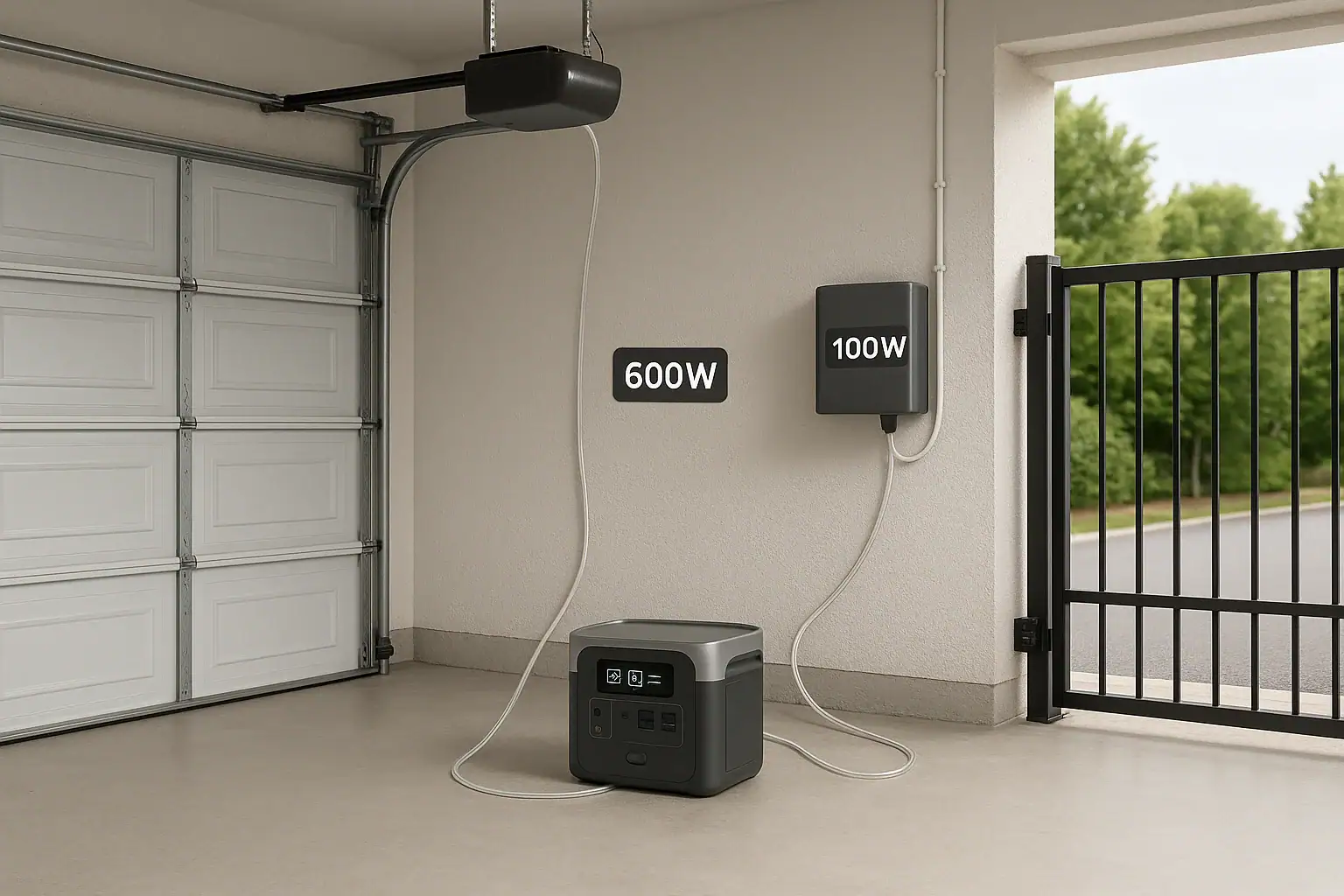
A portable power station can run a typical garage door opener or gate motor if it can handle the startup surge watts and has enough watt-hours for the runtime you need. The key is matching inverter output, surge capacity, and battery size to your opener’s power draw and duty cycle.
When people search how to power a garage door with a battery backup, they are usually trying to solve a power outage problem, estimate runtime, or understand why an inverter trips on startup. Terms like continuous watts, peak surge, motor inrush current, amp draw, and watt-hour capacity all decide whether your setup actually works in real life.
This guide explains how portable power stations interact with garage door openers and automatic gates, how to estimate runtime, why some units shut down under load, and what specs really matter so you can choose and use one safely and effectively.
What It Means to Power a Garage Door Opener or Gate with a Portable Power Station
Using a portable power station for a garage door opener or gate means supplying AC power from a battery-based inverter instead of the utility grid. The power station converts stored DC energy in its battery into 120 V AC (in most North American homes) through an inverter, then feeds that to the opener or gate controller through a standard outlet.
This matters because garage door openers and gate motors are not simple constant loads. They are motor-driven devices with a short, high-current inrush at startup and a lower running draw while moving. That behavior stresses the inverter differently than, for example, a laptop charger or LED light.
To get a useful, reliable setup, three things have to line up:
- Electrical compatibility: Voltage, plug type, and waveform must match what the opener expects.
- Power capacity: The power station must handle both the surge watts at startup and the continuous watts while running.
- Energy capacity: The battery must have enough watt-hours (Wh) to open or close the door or gate as many times as you need during an outage.
When those elements are balanced, a portable power station can act like a flexible, reusable backup battery for your access points, letting you get vehicles in and out even when the grid is down.
Key Power Concepts: Watts, Surge, and Runtime for Doors and Gates
To match a portable power station to a garage door opener or gate, you need to understand a few basic electrical concepts and how they apply to motor loads.
Continuous watts vs. surge watts
Continuous watts (or rated watts) describe how much power the inverter can supply steadily. Garage door openers often list a horsepower rating, but the actual electrical draw in watts is usually much lower than people assume.
Surge watts (or peak watts) describe how much short-term power the inverter can deliver for a brief period, usually a few seconds. Motorized devices like openers draw a high inrush current when they start moving. That spike can be 2–3 times the running watts, sometimes more for older or poorly lubricated systems.
If the surge exceeds the portable power station’s limit, the inverter may shut down, alarm, or fail to start the motor at all.
Estimating power draw from horsepower and amps
Many garage door openers are labeled in horsepower (HP). A rough conversion is:
Watts ≈ HP × 746 ÷ efficiency
But nameplate current (amps) is usually a better guide. For a 120 V system:
Watts ≈ Volts × Amps
So an opener nameplate of 4 A at 120 V suggests around 480 W running draw, with perhaps 800–1,000 W peak on startup. Gate motors may list similar or slightly higher current, depending on gate size and mechanism.
Watt-hours and how many cycles you get
Watt-hours (Wh) describe stored energy. If a power station is rated at 500 Wh and your opener uses 500 W while moving, you might think you only get one hour of continuous motion. But doors and gates run only for seconds per cycle.
For example, if a garage door uses 500 W for 15 seconds to open and 15 seconds to close, that is 30 seconds of runtime:
- Power: 500 W
- Time: 0.5 minutes (30 seconds) = 0.0083 hours
- Energy per open+close: 500 W × 0.0083 h ≈ 4.2 Wh
Even a modest power station can theoretically operate many cycles before its battery is depleted. Real-world results are lower due to inverter losses and battery management limits, but the concept holds: access devices are intermittent loads, not continuous drains.
Waveform and compatibility
Most modern openers and gate controls expect a pure sine wave AC supply, similar to the grid. Some inexpensive inverters output a modified sine wave, which can cause:
- Extra heat in motors
- Hum or buzzing noises
- Possible malfunction of sensitive electronics or safety sensors
For reliability and to protect electronics, a pure sine wave output is strongly preferred for garage and gate use.
Duty cycle and thermal limits
Portable power stations have internal limits on how long they can run near their maximum wattage before overheating. Similarly, garage door and gate motors are designed for intermittent duty. Repeated cycling under backup power can push both the inverter and the motor toward thermal limits, triggering shutdowns or protective pauses.
| Device | Typical Running Watts | Estimated Surge Watts | Notes |
|---|---|---|---|
| Single-car garage door opener | 300–600 W | 600–1,200 W | Short runs, 10–20 seconds per move |
| Double-car garage door opener | 400–800 W | 800–1,600 W | Heavier load, more surge margin needed |
| Residential swing gate motor | 200–500 W | 400–1,000 W | Varies with gate weight and wind |
| Residential sliding gate motor | 250–600 W | 500–1,200 W | Longer travel distance can increase runtime |
| Small control electronics only | 5–30 W | Same as running | Keypads, sensors, logic boards |
How Portable Power Stations Actually Run Doors and Gates
In practice, using a portable power station for a garage door opener or gate is about managing short bursts of relatively high power, not long continuous loads.
Startup: the critical moment
The most demanding part of the cycle is the instant when the motor starts moving the door or gate. At this moment:
- Inrush current spikes, drawing surge watts from the inverter.
- The inverter must maintain voltage without sagging below the opener’s minimum operating threshold.
- Any additional loads on the same power station (lights, chargers) add to the total draw.
If the inverter cannot supply enough surge, one of three things usually happens:
- The opener hums but does not move, then times out.
- The power station alarms or shuts down immediately.
- The lights dim and the opener trips its internal protection.
Once the door or gate is moving, power draw typically stabilizes at the running watt level, which is easier for most portable units to handle.
Short duty cycle and energy use
Each open or close cycle is short, often 10–30 seconds. That means total energy per cycle is low, but the power draw during that short time is relatively high. Portable power stations are well suited to this pattern because:
- They can deliver high power for short bursts without overheating.
- Battery impact per cycle is small, preserving capacity for many operations.
- The inverter can rest between cycles, allowing internal components to cool.
This is why a compact power station with adequate surge capacity can still provide dozens of door or gate operations on a single charge.
Gate specifics: travel length and resistance
Gates behave a bit differently from garage doors:
- Sliding gates may run longer per cycle because they travel farther.
- Swing gates may face variable wind resistance, increasing load.
- Hinges, rollers, and tracks in poor condition raise current draw.
All of these factors affect how a portable power station sees the load. A gate that moves freely will draw near its rated running watts; one that binds or fights wind may approach surge levels for longer, stressing the inverter and reducing the number of cycles per charge.
Control electronics vs. motor load
Many gate systems and some garage doors have separate low-wattage electronics that stay on continuously: keypads, safety sensors, logic boards, and wireless receivers. These typically draw very little power, but:
- They add a constant background load if left connected for hours.
- They may be more sensitive to poor waveform or voltage dips than the motor itself.
In some cases, you may choose to power only the opener when needed, rather than leaving the entire system energized from the portable power station for long periods.
Real-World Scenarios: Matching Power Stations to Doors and Gates
Translating specs into real-world behavior helps you choose a power station size and understand expectations during an outage.
Scenario 1: Single-car garage, occasional emergency use
Consider a single-car garage door opener with a running draw around 400 W and a surge requirement near 800–1,000 W. A portable power station with:
- Continuous output of at least 600–800 W
- Surge capability around 1,200–1,600 W
- Battery capacity of 300–500 Wh
could typically handle several dozen open/close cycles on a full charge. In an outage, you might only need to open the door once to get the car out and close it once for security, using a very small fraction of the battery.
Scenario 2: Double garage door and driveway gate on one unit
Now imagine a double-car garage door opener and a residential sliding gate, both reasonably efficient. If you try to power both from the same compact power station and run them close together in time, you might see:
- Combined running draw near 700–1,000 W
- Overlapping surge demands that exceed the inverter’s peak rating
- Voltage dips that confuse control boards or trip safety sensors
In this case, you would either need a larger power station with higher surge capacity or a strategy to run only one motorized device at a time, allowing the inverter to recover between operations.
Scenario 3: Older, stiff door with high startup resistance
An older garage door with worn rollers or poor lubrication can draw much higher current at startup. On grid power, this may go unnoticed, but on a portable power station you might see:
- Frequent inverter shutdowns exactly at the moment of startup
- Door stopping mid-travel as friction increases load
- Noticeable difference in performance between warm and cold weather
Here, mechanical maintenance (lubricating rollers, adjusting springs, ensuring tracks are aligned) can significantly reduce the electrical load, making the door easier to power from a modest portable unit.
Scenario 4: Gate used frequently during a prolonged outage
A residential gate that opens and closes many times per day will draw more total energy than a garage door used only a few times. In a multi-day outage, a mid-sized power station might be sufficient for:
- Dozens of gate cycles over several days, if you minimize other loads
- Even more cycles if you partially recharge during the day from solar or a vehicle outlet
But if the gate is in heavy use, you may need to prioritize which vehicles use the gate and consider manual override options to conserve battery capacity.
Common Mistakes and Troubleshooting When a Power Station Will Not Run the Opener
When a portable power station fails to run a garage door opener or gate, the cause is often predictable once you know what to look for.
Mistake 1: Ignoring surge watts
Choosing a power station based only on continuous watts and battery capacity is a common error. Symptoms include:
- Inverter beeps and shuts off the instant you press the opener button.
- The opener light comes on, but the motor does not move.
- The power station display shows a brief spike in watts before cutting out.
In these cases, the running watts may be within limits, but the surge rating is too low for motor startup.
Mistake 2: Overloading with extra devices
Plugging lights, chargers, or other tools into the same power station can push the total draw over the limit during door or gate operation. Troubleshooting cues:
- Systems work fine when nothing else is plugged in.
- Failures happen only when multiple loads are active at once.
- Reducing background loads restores reliable operation.
For access devices, it is often best to keep the power station dedicated to the opener or gate during motion.
Mistake 3: Underestimating extension cord losses
Long, thin extension cords can cause voltage drop, especially with motor loads. Signs include:
- Door or gate starts moving slowly and then stalls.
- Power station works fine when placed closer with a shorter cord.
- Warm extension cord under load, indicating high resistance.
Using a shorter, appropriately rated extension cord can reduce these issues and improve startup performance.
Mistake 4: Misreading labels and HP ratings
People often assume that a “1/2 HP” or “3/4 HP” opener must draw hundreds or thousands of watts continuously. In reality, modern openers can be quite efficient, and the HP label does not directly equal electrical demand. Better approaches include:
- Checking the opener’s nameplate for amperage at 120 V.
- Using a plug-in power meter on grid power to measure actual running watts.
- Adding a 2–3x safety margin for surge when sizing the power station.
Mistake 5: Expecting continuous operation
Garage door and gate motors are not meant to run continuously. If you attempt many back-to-back cycles on backup power, you may see:
- Thermal shutdowns in the opener motor.
- Inverter temperature warnings or fan running at high speed.
- Noticeable drop in available power as the battery voltage sags.
Allowing rest periods between cycles protects both the power station and the motor.
Safety Basics When Powering Doors and Gates from a Portable Unit
Using a portable power station with access equipment is generally safer than improvised generator setups, but there are still important safety practices to follow.
Avoid backfeeding the home electrical system
A portable power station should not be plugged into household wiring in a way that backfeeds the panel or circuits. Backfeeding can endanger utility workers and damage equipment. Instead:
- Plug the opener or gate control directly into the power station’s outlet or a properly rated extension cord.
- Leave permanent wiring and transfer equipment to a qualified electrician if you need whole-circuit backup solutions.
Respect load limits and thermal protections
Do not bypass or defeat any protective features on the power station or opener. If the unit shuts down or shows an over-temperature warning:
- Allow it to cool before trying again.
- Reduce the number of consecutive cycles.
- Check for mechanical binding that may be increasing load.
Overriding protections can lead to premature failure or, in extreme cases, fire risk.
Maintain clear travel paths and safety sensors
During outages, it can be tempting to rush. Still:
- Ensure the door or gate path is clear before operating on backup power.
- Confirm that safety sensors and auto-reverse features are functioning.
- Avoid standing in the path of moving equipment while testing on a new power source.
Even under backup power, the same mechanical hazards exist.
Use appropriate cords and dry locations
Place the portable power station in a dry, ventilated area away from standing water. When using extension cords:
- Choose cords rated for outdoor use if used outside.
- Keep connections off the ground where possible.
- Avoid running cords under doors in ways that could pinch or damage insulation.
Moisture and damaged insulation increase shock and fire risks.
Plan for manual override
Every powered door or gate should have a manual release or mechanical override. Even with a portable power station available, you should:
- Know where the manual release is and how to use it.
- Practice operating the door or gate manually in daylight before an emergency.
- Use backup power as a convenience, not the only access plan.
Maintenance and Storage: Keeping Your Backup Ready
For a portable power station to reliably run your garage door or gate when needed, both the power station and the mechanical systems must be maintained.
Maintaining the portable power station
Key practices include:
- Regular charging: Recharge the unit every few months if it is not used, or as recommended by the manufacturer, to prevent deep discharge damage.
- Moderate storage temperatures: Store in a cool, dry place away from direct sunlight and extreme temperatures to preserve battery health.
- Occasional test runs: Periodically connect the opener or gate and perform a test cycle to confirm compatibility and function.
These routines help ensure the power station delivers its rated wattage and runtime when the grid goes down.
Maintaining garage doors and gates to reduce load
Mechanical maintenance directly affects electrical demand. To keep loads manageable:
- Lubricate rollers, hinges, and tracks periodically with appropriate lubricants.
- Check spring tension and balance for garage doors; a properly balanced door should lift with modest force when disconnected from the opener.
- Inspect gate hinges, rollers, and tracks for rust, misalignment, or debris.
A smooth, well-maintained system draws less current, making it easier for a portable power station to start and run the motor.
Battery health and long-term capacity
Over years of use, all batteries lose some capacity. To slow this process in your portable power station:
- Avoid storing it fully discharged for long periods.
- Do not leave it at maximum charge in very hot environments.
- Use it periodically rather than letting it sit idle for years.
As capacity declines, you may still have enough power for several door or gate cycles, but total runtime for other loads will shrink.
Documenting your setup
It helps to keep simple notes near the power station, such as:
- Which outlet or cord to use for the garage door or gate.
- Approximate number of cycles you can expect on a full charge.
- Any special steps, such as unplugging other loads before operating the door.
Clear documentation makes it easier for all household members to use the system safely during an outage.
| Item | Recommended Practice | Typical Interval |
|---|---|---|
| Recharge portable power station | Top up to around 50–80% if stored; full charge before storms | Every 1–3 months if unused |
| Test run garage door on power station | Perform at least one open and close cycle | Every 3–6 months |
| Lubricate garage door moving parts | Use suitable lubricant on rollers, hinges, and tracks | Every 6–12 months |
| Inspect gate hinges and tracks | Check for rust, binding, and debris; clean as needed | Every 6–12 months |
| Review manual override procedure | Practice disengaging and reengaging opener or gate | Annually |
Related guides: Inverter Efficiency Explained: Why Your Runtime Is Shorter Than Expected • Extension Cords and Power Strips: Safe Practices With Portable Power Stations • Why Does AC Output Stop Under Load? Common Causes and Fixes
Practical Takeaways and Key Specs to Look For
Using a portable power station for a garage door opener or gate is mainly about handling motor surge and having enough stored energy for the number of cycles you care about. Most residential openers draw modest running watts, so even mid-sized units can provide many operations, but only if surge capacity, waveform quality, and mechanical condition are all in your favor.
For most homes, the practical approach is to size the power station so it can comfortably start the largest motorized access device you have, then treat each open or close as a short, high-power event rather than a continuous drain. Regular testing and basic mechanical maintenance will reveal problems in advance, not during a storm or outage.
Specs to look for
- Continuous AC output (W): Look for at least 1.5–2 times your opener’s measured running watts (often 600–1,000 W for typical setups). This ensures the inverter is not operating at its limit during motion.
- Surge/peak output (W): Aim for 2–3 times the opener’s running watts (often 1,000–2,000 W). Higher surge headroom helps the motor start reliably, especially for older or heavier doors and gates.
- Battery capacity (Wh): For occasional emergency use, 300–700 Wh is often enough; for frequent gate use or multi-day outages, 700–1,500 Wh provides more cycles and flexibility.
- Waveform type: Prefer a pure sine wave inverter. It better mimics grid power, reduces motor noise and heat, and improves compatibility with safety sensors and control electronics.
- AC outlet rating and count: Ensure at least one 120 V outlet rated to the unit’s full continuous wattage. Multiple outlets are useful, but avoid overloading by running several high-draw devices at once.
- Display and monitoring: A clear wattage and battery percentage display helps you see startup spikes, monitor runtime impact per cycle, and adjust usage during outages.
- Recharge options and speed: Look for flexible input methods (wall, vehicle, solar) and reasonable recharge times (for example, 3–8 hours from wall). Faster, flexible charging makes it easier to recover between storms or long outages.
- Operating temperature range: Check that the unit is rated for the temperatures typical in your garage or gate area. Cold can temporarily reduce capacity; heat can trigger thermal limits sooner.
- Portability and placement: Consider weight and handle design so you can safely move the unit near the opener or gate, minimizing extension cord length and voltage drop.
By focusing on these practical specs and aligning them with your specific door and gate loads, you can choose a portable power station that works reliably when you need it most, without overspending on capacity you will never use.
Frequently asked questions
Which specs and features matter most when choosing a portable power station for a garage door opener and gate?
Look for adequate continuous AC output, a high surge/peak rating, and sufficient battery capacity in watt-hours for the number of cycles you want. A pure sine wave inverter, correctly rated AC outlets, effective thermal protections, and convenient recharge options (wall, vehicle, or solar) are also important for reliable operation.
What common mistake causes a power station to fail at motor startup?
Ignoring surge watts is a frequent error: an inverter with enough continuous watts can still be unable to deliver the short inrush current motors need to start. Running other loads at the same time or using thin, long extension cords can make the problem worse.
Is it safe to plug a portable power station into household wiring or backfeed the electrical panel?
No. Backfeeding household wiring can endanger utility workers and damage equipment. Always plug the opener or gate control directly into the power station or consult a qualified electrician to install an approved transfer mechanism for whole-circuit backup.
How many open/close cycles can I expect from a typical 500 Wh unit?
Because each cycle often uses only a few watt-hours (commonly 4–10 Wh for many garage doors), a 500 Wh battery can theoretically provide dozens to hundreds of cycles. Real-world counts are lower due to inverter losses, higher startup energy on older or binding doors, and any background loads the unit must support.
Will a modified sine wave inverter harm my garage door opener or gate electronics?
Modified sine wave outputs can cause increased motor heat, humming, or erratic behavior in sensitive control electronics and sensors. For best compatibility and to reduce risk of malfunction, a pure sine wave inverter is recommended.
The opener hums but won’t move when powered by the station—what should I check?
First verify the power station’s surge capability and remove any other plugged-in loads. Next try a shorter, heavier-gauge extension cord and check the door or gate for mechanical binding or low battery in the opener. If problems persist, perform mechanical maintenance or test with a higher-surge unit.
Recommended next:
- Portable Power Stations for Apartments
- Portable Power Stations for RV and Motorhomes
- Can a Portable Power Station Run a Microwave? What to Check Before You Try
- Can a Portable Power Station Run a Space Heater? Realistic Limits
- Can a Portable Power Station Run an Air Conditioner? Sizing and Expectations
- Powering a Coffee Maker, Kettle, or Induction Cooktop: What Works and Why
- More in Home / Appliances →
Related guides
Browse this topic →
- Beginner-friendly sizing, runtime & specs
- Solar & charging (MPPT, fast charging, cables)
- Batteries (LiFePO4, cycles, care & storage)
- Safety, cold-weather performance, real-world tips
More in Home / Appliances
See all →- Running a Pellet Stove During a Power Outage: Starting Surge, Runtime, and Safe Setup
- What Size Portable Power Station for a Chest Freezer? Runtime Planning for Outages
- Portable Power Station for Starlink: Power Draw, Runtime, and What Specs Matter
- Powering a TV and Streaming Setup: Estimating Runtime Without Guessing
- Using a Portable Power Station as Emergency Lighting: Efficient Options
Keep reading
About this site
Portable Energy Lab publishes practical, independent guides about portable power—clear sizing, safe use, and real-world expectations.
Affiliate disclosure
Some links on this site may be affiliate links. If you buy through these links, we may earn a small commission at no extra cost to you. This helps support our content. Learn more.