How Battery Expansion Changes Runtime, Weight, and Charging Time

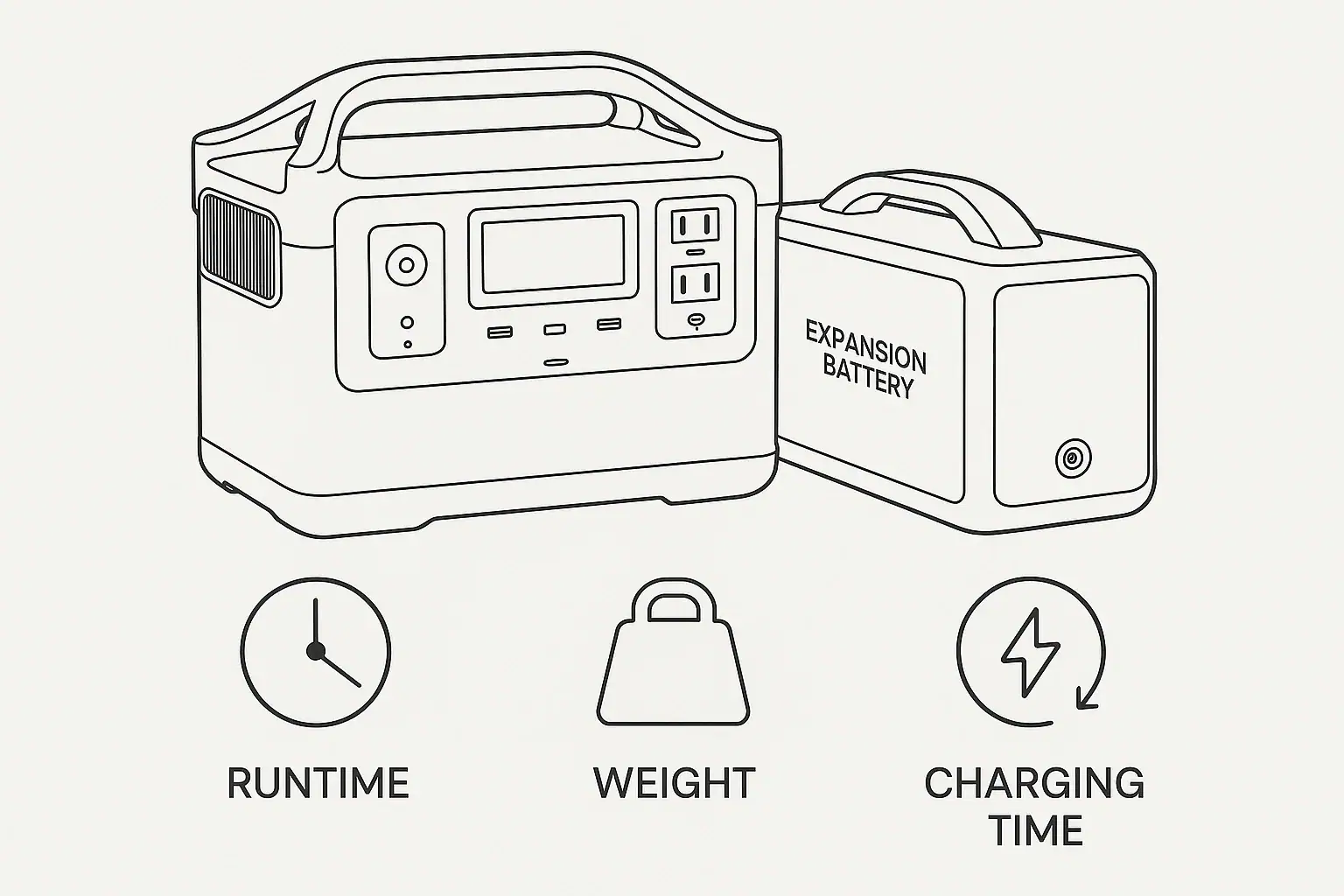
Portable power station connected to an expansion battery showing runtime, weight, and charging time changes

Battery expansion usually increases runtime in proportion to added watt-hours, while also adding weight and often lengthening charging time.

For a portable power station, an extra battery or expansion battery is mainly a capacity upgrade, not a magic power upgrade. It can help a refrigerator, CPAP machine, lights, router, or small tools run longer, but it does not always increase surge watts, inverter output, AC charging speed, solar input, or USB-C PD profile capability.

The important tradeoff is simple: more stored energy means longer runtime, more pounds to carry, and more energy that must be refilled. The exact result depends on usable capacity, inverter efficiency, input limit, battery chemistry, temperature, load size, and whether the system can charge the main unit and expansion module at the same time.

What Battery Expansion Means and Why It Matters

Battery expansion means connecting an approved add-on battery module to a compatible portable power station to increase total energy storage. The key number is watt-hours, often written as Wh. If the main unit stores about 1,000 Wh and the expansion battery adds about 1,000 Wh, the larger system may offer roughly twice the stored energy before accounting for losses.

This matters because many buyers confuse capacity with output. Capacity tells you how long something may run. Output tells you what the power station can run at one time. Adding battery capacity may let a 100-watt load run longer, but it may not let a 2,000-watt heater run if the inverter is rated below that load. Likewise, a larger battery may not make USB-C devices charge faster if the USB-C port is still limited to a certain PD profile.

Expansion also changes how practical the system feels. A larger setup may be excellent for backup power, camping with a vehicle, long workdays, or running medical support equipment with proper planning. It may be less convenient for short trips, stair carrying, apartment storage, or anyone who needs a single lightweight unit. The best capacity choice is not just the biggest number; it is the best balance of runtime, portability, recharge speed, and safe use.

How Added Capacity Changes the Math

The basic runtime formula is total usable watt-hours divided by the average watts used by your devices. A 100-watt average load on 900 usable Wh may run about 9 hours. If expansion raises usable capacity to 1,800 Wh, the same load may run about 18 hours. Real runtime varies because inverters, DC converters, standby electronics, temperature, and battery management systems all consume some energy.

Usable capacity is usually lower than nameplate capacity. A unit labeled 1,000 Wh may not deliver a full 1,000 Wh to AC outlets because converting battery DC power to household AC power creates heat and efficiency losses. Light DC loads may be more efficient than AC loads, while very small loads can be affected by idle drain if the inverter stays on for many hours.

Charging time changes in a related way. If total capacity doubles but charging input stays the same, charge time often nearly doubles. For example, a 1,000 Wh system charging at 500 watts may take a few hours, while a 2,000 Wh expanded system at the same 500-watt input may take roughly twice as long. Some systems allow higher combined AC input or higher solar input when expanded, but others do not. The input limit is one of the most important specs to compare before assuming a larger battery will be convenient.

ChangeWhat usually happensWhy it happens
RuntimeIncreases roughly with usable WhMore stored energy is available for the same load
WeightIncreases by the weight of each added moduleCells, case, cables, and electronics add mass
Charging timeOften increases unless input capacity also risesMore energy must be refilled through the same or similar input limit
Maximum AC outputOften stays the sameThe inverter rating is usually in the main power station
Solar chargingMay or may not improveIt depends on voltage range, amperage, and total solar input rating
Typical effects of expanding a portable power station battery. Example values for illustration.

Real-World Runtime, Weight, and Charging Examples

Consider a portable refrigerator that averages 45 watts over time. A 1,000 Wh power station with about 850 Wh usable through the outlet may run it for about 18 to 19 hours. Expanding the system to about 2,000 Wh nameplate capacity may provide roughly 1,700 usable Wh and extend runtime to about 37 hours. The load did not change; the energy tank became larger.

For a CPAP machine using 30 to 60 watts depending on humidity and pressure settings, added capacity can be especially useful. If the setup averages 40 watts and the power station can provide 900 usable Wh, runtime may be about 22 hours. With an added battery that brings usable energy close to 1,800 Wh, runtime may approach 45 hours. Medical users should still plan conservatively, test their exact setup in advance, and keep backup options available.

For high-draw devices, the result can feel different. A 1,500-watt space heater can drain 1,500 Wh in about one hour before losses. Expansion helps, but even a large battery can be depleted quickly by heat-producing appliances. In many cases, a lower-wattage device, insulation, or intermittent use has a bigger practical effect than simply adding another battery.

Weight is the visible tradeoff. If the main unit weighs 35 pounds and the expansion module weighs 25 pounds, the combined setup is 60 pounds before accessories. That may still be manageable in a vehicle or garage, but it changes carrying distance, stair safety, shelf strength, and storage options. For users who move the system often, modularity can be helpful because each piece may be carried separately, even if the total system is heavier.

Charging examples show why input specs matter. A 2,000 Wh expanded system charged at 400 watts from solar may need a long clear day or more, depending on sun conditions and panel output. The same system charging at 1,000 watts from AC may be much more practical for quick turnaround. Expansion is most useful when the recharge plan matches the way the power station will be used.

Common Mistakes and Troubleshooting Cues

One common mistake is assuming battery expansion increases the inverter rating. If a power station is rated for 1,800 running watts and 3,600 surge watts, adding capacity may not change those numbers. If a microwave, pump, compressor, or saw overloads the unit before expansion, it may still overload it after expansion. Look for overload warnings, immediate shutoff, or failure to start as signs that output, not capacity, is the limiting factor.

Another mistake is estimating runtime from nameplate capacity without accounting for average load. A device labeled 600 watts may not always draw 600 watts, while a refrigerator may cycle between high and low draw. A plug-in power meter or the display on the power station can help estimate actual average watts. Runtime calculations are more accurate when they use average consumption over several hours rather than a maximum label.

Slow charging after expansion is also commonly misunderstood. If the battery system is larger but the AC charger, car charger, or solar input is unchanged, longer charging is normal. This is not necessarily a fault. However, troubleshooting is worthwhile if charge speed is far below the input setting, if solar voltage is outside the accepted range, if the cable is loose, or if the unit limits charging due to temperature.

Compatibility is another key cue. Expansion batteries are not universal. Connectors, voltage, battery management communication, firmware, and current limits must match the power station design. If the system does not recognize an expansion module, shows an error, or refuses to charge, stop using it and consult the manufacturer documentation or qualified service support. Do not modify connectors, adapt unsupported packs, or bypass protections.

Users also misjudge idle drain. Leaving the AC inverter on overnight for a tiny load can waste energy. If a device can run from regulated DC or USB-C safely and efficiently, that path may improve runtime. The right output port can matter almost as much as the expanded capacity.

Safety Basics for Expanded Battery Systems

Battery expansion should be treated as a higher-energy system, even when it is designed for consumer use. More watt-hours means more stored energy in the same area. Use only compatible expansion modules, cables, and charging accessories intended for the power station. Keep connectors clean, dry, and fully seated before use.

Ventilation is important. Portable power stations and add-on batteries create heat while charging, discharging, and balancing cells. Do not bury the system under bedding, clothing, or tightly packed cargo while it is under load. Keep it away from direct water exposure, flammable materials, and areas where cords can be pinched or tripped over.

For home backup, avoid unsafe connection methods. Do not plug a power station into a wall outlet to energize household circuits. Do not attempt improvised wiring into an electrical panel, transfer switch, or interlock. If you want a power station integrated with selected home circuits, consult a qualified electrician and use equipment intended for that purpose.

Pay attention to load type. Motors and compressors can draw a short surge higher than their running watts. Heating appliances can drain batteries quickly and may push the inverter near its limit for long periods. Medical equipment should be tested with the exact settings and accessories that will be used, and critical users should follow professional guidance for backup planning.

Temperature affects both safety and performance. Many lithium battery systems limit charging when too cold or too hot. Discharging in extreme temperatures can reduce runtime and may trigger protection shutdowns. If the unit displays a temperature warning, reduce load, improve airflow, or move the system to a more moderate environment when safe to do so.

Maintenance and Storage After Adding Batteries

Expanded systems are easier to own when the main unit and add-on battery are kept at similar states of charge, especially before long storage. Many portable power stations are best stored partially charged rather than completely full or empty. A practical storage range is often around 40 to 80 percent, but users should follow the documentation for their specific battery chemistry and system.

Check stored batteries periodically. Even when turned off, electronics can slowly lose charge over time. For long storage, inspect the display or app reading occasionally if available, and recharge before the battery becomes deeply depleted. Deep discharge can shorten battery life or cause the system to enter a protective state.

Keep expansion cables and connector covers organized. Dust, corrosion, bent pins, or damaged locking mechanisms can cause recognition issues or intermittent charging. Do not force connectors. If a cable becomes hot, cracked, crushed, or loose, stop using it and replace it with a compatible part.

Battery expansion can also change storage logistics. A larger system may require stronger shelves, more floor space, and a location that stays dry and temperature stable. Avoid storing heavy modules where they may fall, block emergency exits, or strain cords. If the system is used for emergency backup, keep the charging accessories, solar adapters, and essential output cables in the same location.

Cycle life depends on chemistry, depth of discharge, temperature, and charge habits. Lithium iron phosphate batteries are often chosen for longer cycle life, while other lithium chemistries may offer different weight and energy density characteristics. Regardless of chemistry, avoiding unnecessary heat and repeated deep discharges can help preserve usable capacity over time.

Practical Takeaways and Specs to Look For

ScenarioExpansion benefitPlanning concern
Overnight essentialsLonger runtime for router, lights, fan, or CPAPUse average watts and leave reserve capacity
Refrigeration backupMore hours through compressor cyclingAccount for startup surge and warm weather
Vehicle campingMore energy for coolers and small electronicsTotal weight and recharge access matter
Solar-first useMore storage for cloudy periodsSolar input limit may become the bottleneck
High-watt appliancesMore minutes or hours, depending on loadInverter rating and heat management still limit use
Ways expansion changes practical use cases. Example values for illustration.

Related guides: Portable Power Station Expansion Batteries: When Extra Capacity Makes Sense • Portable Power Station Watt-Hours Explained • Inverter Efficiency Explained: Why Your Runtime Is Shorter Than Expected

The simplest way to evaluate battery expansion is to separate three questions. First, how many usable watt-hours do you need for the loads you actually run? Second, can you comfortably move and store the heavier system? Third, can you recharge the expanded capacity fast enough for your schedule?

If runtime is the main goal, expansion is often effective. If the problem is overload, tripping, slow USB-C charging, or insufficient solar input, added capacity alone may not solve it. Match the upgrade to the bottleneck: watt-hours for runtime, inverter watts for larger AC loads, surge watts for startup loads, and input watts for faster recharging.

Specs to look for

  • Total expandable capacity: Look for the main Wh rating plus supported added Wh, such as 1,000 Wh expandable to 2,000 to 5,000 Wh, because this sets the realistic runtime ceiling.
  • Usable capacity estimate: Look for efficiency information or real-world AC output expectations, often around 80 to 90 percent for AC loads, because nameplate Wh is not the same as delivered energy.
  • Continuous inverter output: Look for a running-watt rating that exceeds your largest simultaneous AC load, such as 1,500 to 3,000 watts for many household essentials, because expansion may not raise this limit.
  • Surge rating: Look for a short-term surge rating high enough for motors and compressors, often about 2 times the running watt draw, because startup loads can cause instant shutdowns.
  • AC charging input: Look for the maximum wall-charging watts, such as 600, 1,000, or 1,500 watts, because a larger battery can take much longer to refill through a low input limit.
  • Solar input range: Look for total solar watts plus voltage and amperage ranges, such as 400 to 1,200 watts input with a compatible voltage window, because panel matching determines real solar recharge speed.
  • Expansion battery weight: Look for the weight of each module, such as 20 to 50 pounds each, because total system weight affects carrying, vehicle loading, and storage safety.
  • Battery chemistry and cycle life: Look for chemistry and cycle ratings such as lithium iron phosphate with thousands of cycles, because long-term capacity retention affects ownership value.
  • Operating temperature range: Look for charging and discharging temperature guidance, because cold or heat can reduce runtime, slow charging, or trigger protection shutoffs.

Battery expansion is most successful when it is planned around actual loads, recharge time, and portability. Add capacity when you truly need longer runtime, but verify the output and input specs so the expanded system still fits the way you intend to use it.

Frequently asked questions

Does battery expansion increase runtime charging time at the same rate?

Usually, runtime increases roughly in proportion to added usable watt-hours, while charging time also increases if the input wattage stays the same. In practice, the relationship is not perfectly exact because inverter losses, idle drain, temperature, and charging limits can change the result. If the expanded system can accept more input power, charging time may not rise as much.

What specs matter most when choosing an expansion battery?

The most important specs are usable capacity, compatibility, charging input limit, inverter output, surge rating, and total weight. Solar input range and battery chemistry also matter if you plan to recharge outdoors or want longer cycle life. The best choice is the one that matches your actual load and recharge schedule, not just the largest Wh number.

What is the most common mistake people make with battery expansion?

A common mistake is assuming a bigger battery also increases AC output or surge power. Expansion usually adds runtime, but it does not automatically make the inverter stronger or faster to charge. Another frequent error is calculating runtime from nameplate capacity instead of average watts and usable capacity.

Is it safe to use a larger expanded battery system indoors?

Yes, many portable power stations and expansion batteries are designed for indoor use, but they still need proper ventilation and clear space around them. Keep the system away from water, heat sources, and anything that can block airflow or damage cables. Always follow the manufacturer’s temperature and placement guidance.

Why does my expanded battery take so long to charge?

Charging takes longer when total capacity increases but the charging input stays the same. Solar charging can be especially slow if panel output is below the system’s maximum input rating or if sunlight conditions are poor. Temperature limits, cable issues, and charge settings can also reduce charging speed.

Will battery expansion help high-watt appliances run longer?

Yes, but only to a point. Expansion can extend runtime for high-draw appliances, yet those devices may still drain the battery quickly and may be limited by the inverter rating or surge requirement. For very power-hungry loads, efficiency improvements or lower-watt alternatives can matter just as much as more capacity.

Modular vs All-in-One Portable Power Stations: Pros, Cons, and Best Use Cases

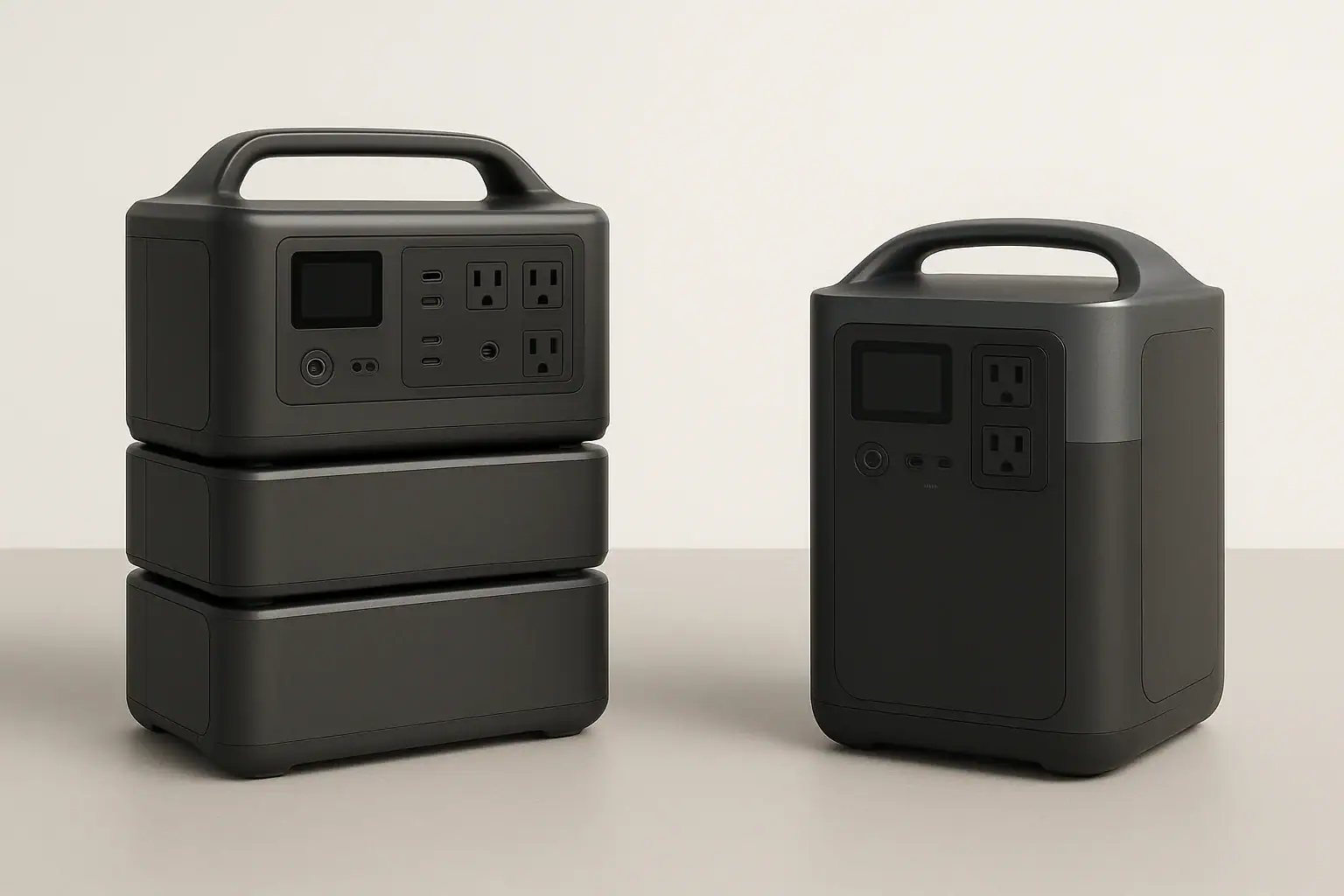
Modular and all-in-one portable power stations shown side by side for comparison

Modular portable power stations are better when you need expandable capacity or flexible runtime, while all-in-one units are better when you want simpler setup, lower bulk, and predictable performance. The best choice depends on how much energy you need, how often you move the unit, and whether your loads create high surge watts, long runtime needs, or frequent solar charging demands.

In search terms, the comparison comes down to battery expansion, input limit, AC inverter size, solar input, recharge time, and total system weight. A modular system can grow from a compact base unit into a larger backup setup, but it may require more cables, space, and planning. An all-in-one power station keeps the battery, inverter, charger, and outlets in one case, which is easier for camping, tailgating, short outages, and grab-and-go emergency use.

What modular and all-in-one power stations mean

A portable power station is a rechargeable battery system with built-in output ports. Most include AC outlets, USB ports, DC outputs, a charge controller, a battery management system, and an inverter that converts battery power into household-style AC power.

An all-in-one portable power station places the usable battery capacity, inverter, charger, display, controls, and outputs inside one enclosure. You buy one unit, charge it, and use it as a self-contained energy source. Some all-in-one models may accept solar panels or an accessory battery, but their main identity is one integrated box.

A modular portable power station uses a base unit with one or more optional expansion batteries. The base often contains the inverter, outlets, display, charging electronics, and control system. Expansion modules add watt-hours without requiring a completely separate power station. Some modular systems are small enough for recreational use, while larger systems are closer to home backup equipment.

This distinction matters because capacity and portability pull in opposite directions. More watt-hours can keep a refrigerator, medical device, router, fan, or lights running longer, but it also adds weight and storage volume. Modular design separates those decisions: you can carry the base unit alone for small jobs or attach battery modules for longer backup. All-in-one design favors simplicity: there are fewer pieces to manage and fewer compatibility questions.

How the designs work: capacity, inverter output, and charging

The main difference is where the energy is stored and how the system scales. In an all-in-one unit, the internal battery determines the maximum stored energy. If the unit has 1,000 watt-hours of usable capacity, your runtime is limited by that capacity, conversion losses, and the load you connect. A 100-watt load may run for several hours, while a 1,000-watt appliance may drain the battery quickly.

In a modular setup, the base unit may start with a modest internal battery or no large battery at all, then connect to expansion packs. The inverter output may stay the same even when capacity increases. For example, adding batteries may double runtime but not raise the maximum continuous watts the AC outlets can deliver. This is a common misunderstanding: capacity affects how long power lasts; inverter rating affects what you can run.

Charging also differs. Both designs may support wall charging, car charging, and solar charging. Modular systems often offer higher total charging potential when paired with additional batteries or larger solar arrays, but they may also have more input rules. All-in-one stations are usually easier to understand: one input limit, one battery gauge, and one expected recharge time.

When comparing either design, focus on usable watt-hours, continuous watts, surge watts, AC and solar input limits, charging speed, battery chemistry, and weight. These specs tell you more than marketing terms such as “whole-home capable” or “off-grid ready.”

Comparison pointModular power stationAll-in-one power station
Capacity growthCan often expand with add-on batteries for longer runtime.Usually limited to the built-in battery capacity.
PortabilityCan be split into pieces, but total system weight may be high.Single box is easier to grab, move, and store.
Setup complexityMore cables, modules, and compatibility checks.Simpler operation with fewer components.
Runtime planningFlexible for outages, work sites, and extended solar use.Predictable for short trips, light backup, and occasional use.
Cost patternMay start lower or higher, but expansion adds cost over time.Total cost is clearer at purchase because capacity is fixed.
Modular and all-in-one design differences at a glance. Example values for illustration.

Real-world examples and best use cases

Best use cases for modular power stations include longer outages, cabins, RV base camps, small business continuity, medical device backup where extended runtime is important, and solar-heavy setups where you want to store more daytime energy for nighttime use. Modular systems make sense when the same user sometimes needs a small portable battery and sometimes needs a larger backup bank.

Consider a refrigerator that averages 80 to 150 watts over time but surges higher when the compressor starts. An all-in-one unit with enough surge capability may keep it running for a limited period. A modular system with extra batteries can extend that runtime significantly without changing the refrigerator or the base power station. The key is matching both the surge watts and the total watt-hours.

Modular stations also work well when loads are predictable but long lasting. Examples include internet equipment, LED lighting, fans, CPAP-style devices, camera gear, communications equipment, and efficient coolers. The ability to add capacity helps when you do not know whether an outage will last one evening or multiple days.

Best use cases for all-in-one power stations include car camping, day trips, short blackouts, apartment emergency kits, charging phones and laptops, powering small fans, running lights, and supporting temporary outdoor work. If you value quick setup and easy storage over maximum expandability, an all-in-one model is often the more practical design.

All-in-one units are also better for users who do not want to think about module order, battery balancing, connector types, firmware behavior, or separate carry weights. A single compact station is easier to lend to a family member, carry to a tent, move between rooms, or keep in a closet for occasional backup.

Common mistakes and troubleshooting cues

One common mistake is comparing only watt-hours. Capacity is important, but a large battery with a small inverter may still be unable to run a microwave, power tool, kettle, or pump. Check both continuous watts and surge watts. Continuous watts describe steady output. Surge watts describe short startup demand, which matters for compressors, motors, and some appliances.

Another mistake is assuming expansion batteries increase AC output. In many systems, extra batteries increase runtime, not inverter size. If a base unit is rated for 1,800 continuous watts, adding modules usually does not turn it into a 3,000-watt inverter. If a device overloads the AC outlet before expansion, it will likely still overload it after expansion.

Charging speed can also disappoint users. A power station with 2,000 watt-hours of storage and a 400-watt wall input may take many hours to recharge. Solar charging depends on panel size, sun angle, weather, cable losses, and the unit’s solar input limit. If the input limit is 500 watts, connecting much more panel capacity may not increase actual charging beyond that limit.

Watch for troubleshooting cues. If the station shuts off immediately, the connected load may exceed the inverter rating or surge capability. If solar charging starts and stops, panel voltage, shading, temperature, or connector compatibility may be the issue. If runtime is much shorter than expected, the load may be higher than rated, the battery may be cold, or AC conversion losses may be significant.

With modular systems, confirm that each battery module is fully seated and compatible with the base. Do not force connectors, bypass communication cables, or attempt to adapt battery packs outside the manufacturer-intended system. With all-in-one systems, avoid running loads that repeatedly trigger overload protection, because frequent shutdowns indicate a mismatch between the appliance and the power station.

Safety basics for both designs

Portable power stations are generally designed with built-in protections, but they still store substantial energy. Use them in dry, ventilated areas and keep them away from standing water, excessive heat, and flammable materials. Do not cover cooling vents while charging or discharging, especially under high AC loads.

Never open the housing, modify battery packs, bypass fuses, defeat overload protection, or connect unapproved expansion batteries. Internal battery systems can deliver high current, and improper modifications can create fire, shock, or burn hazards. If a unit is swollen, cracked, noticeably hot at rest, smoking, or producing an unusual odor, stop using it and move it to a safe area if you can do so without risk.

For home backup, avoid improvised connections to household wiring. A portable power station should not be backfed into an outlet or connected to a panel without proper equipment and professional oversight. If you want to power selected home circuits, consult a qualified electrician about code-compliant options. This is especially important for larger modular systems that may be powerful enough to run major appliances.

Cable sizing matters at a high level. Undersized extension cords can overheat under heavy loads. Use cords rated for the expected wattage and keep runs as short as practical. For DC and solar connections, use compatible connectors and stay within the device’s stated voltage and current input range. When in doubt, choose a lower-risk setup rather than pushing limits.

Maintenance, battery health, and storage

Battery health depends on chemistry, temperature, charge level, cycling habits, and storage conditions. Many modern portable power stations use lithium-based batteries, commonly lithium iron phosphate or lithium-ion variants. In general, lithium iron phosphate tends to offer longer cycle life and better thermal stability, while other lithium chemistries may offer higher energy density in a smaller package.

For occasional emergency use, check the battery every few months instead of leaving it untouched for a year. Store the unit in a cool, dry place, away from direct sun and freezing temperatures when possible. A moderate state of charge, often around half to three-quarters full, is commonly better for long-term storage than keeping the battery completely full or completely empty for months.

Modular systems need one extra habit: keep modules reasonably synchronized. If expansion batteries sit unused for long periods, check their charge levels and inspect connectors for dust or damage before use. Store cables with the system so the correct parts are available during an outage.

All-in-one systems are easier to maintain because there are fewer separate pieces. Still, the same basics apply: recharge periodically, keep vents clean, avoid moisture, and test essential loads before an emergency. A short test with a refrigerator, router, light, or medical-related device can reveal runtime expectations and overload issues before you actually need backup power.

Maintenance taskTypical intervalWhy it matters
Check state of chargeEvery 2 to 3 months in storageHelps prevent deep discharge and surprise low battery.
Inspect vents and portsBefore charging or heavy useReduces heat buildup and connector problems.
Test essential loadsBefore storm season or travelConfirms runtime, surge handling, and outlet compatibility.
Review module charge levelsBefore using expansion batteriesHelps modular systems perform predictably.
Store in a cool, dry placeWhenever not in useSupports battery life and safer storage.
Simple care schedule for portable power station storage. Example values for illustration.

Related guides: Portable Power Station Expansion Batteries: When Extra Capacity Makes Sense • Portable Power Station Watt-Hours Explained • Surge Watts vs Running Watts: How to Size a Portable Power Station • Input Limits (Volts/Amps/Watts) Explained: How Not to Damage Your Unit

Practical takeaways and specs to look for

Choose a modular portable power station if your priority is expandable runtime, longer outage coverage, and the ability to scale capacity over time. It is the stronger fit for users who can manage extra modules and want one system to cover both small and larger energy needs.

Choose an all-in-one portable power station if your priority is simplicity, portability, and fast setup. It is the stronger fit for short outages, travel, apartments, light backup, and users who want one self-contained unit with minimal configuration.

The most practical approach is to list the devices you want to run, estimate their watts, note any startup surge, and decide how many hours of runtime you need. Then compare power stations by usable capacity, inverter rating, charging speed, and weight rather than by design label alone.

Specs to look for

  • Usable capacity: Look for watt-hours that match your runtime target, such as 500 to 1,000 Wh for light backup or 2,000 Wh and above for longer appliance support; this determines how long the station can power your loads.
  • Expansion capacity: For modular systems, check the maximum supported capacity, such as adding one to three battery modules; this matters if your outage or camping needs may grow over time.
  • Continuous AC output: Look for an inverter rating that exceeds your highest steady load, such as 600 W for small electronics or 1,800 to 3,000 W for heavier appliances; this determines what the unit can run without overload.
  • Surge watt rating: Look for short-term surge capability above motor or compressor startup needs, often roughly 2 times the running wattage; this matters for refrigerators, pumps, and power tools.
  • AC and solar input limits: Check wall input and solar input ranges, such as 400 to 1,500 W charging support; this affects how quickly you can refill the battery.
  • Battery chemistry and cycle life: Look for chemistry and cycle ratings that fit your use, such as longer-cycle lithium iron phosphate for frequent cycling; this affects long-term value and battery durability.
  • Weight per piece: Compare the base unit and each module, such as 25 to 50 lb for portable pieces or heavier for large backup modules; this determines whether you can move the system safely.
  • Port selection: Look for enough AC outlets, USB-C ports with suitable power levels, DC outputs, and regulated 12 V output if needed; this prevents adapter clutter and compatibility issues.
  • Pass-through and backup behavior: Check whether the station supports powering loads while charging and how quickly it switches during an outage; this matters for routers, computers, and sensitive equipment.

Both designs can be excellent when matched to the right job. Modular systems solve the problem of changing runtime needs. All-in-one systems solve the problem of convenience. The better choice is the one that meets your load, runtime, charging, safety, and storage requirements without adding unnecessary complexity.

Frequently asked questions

Which is better for home backup: modular or all-in-one portable power stations?

Modular systems are usually better for home backup when you need longer runtime or want to add capacity over time. All-in-one units can still work for short outages or a few essential devices, but they are less flexible if your backup needs grow. The better choice depends on the loads you want to support and how long you need them to run.

What specs matter most when comparing modular vs all-in-one portable power stations?

The most important specs are usable watt-hours, continuous AC output, surge watts, charging input limits, and total weight. For modular systems, also check the maximum expansion capacity and whether extra batteries change runtime only or also affect output. These details matter more than the design label alone.

What is a common mistake people make when choosing between these two designs?

A common mistake is focusing only on battery capacity and ignoring inverter output. A large battery does not help if the inverter cannot handle the appliance’s steady or startup wattage. Another mistake is assuming expansion batteries automatically increase AC power, when they often only increase runtime.

Are modular portable power stations harder to use than all-in-one units?

Usually yes, because modular systems can involve more cables, setup steps, and compatibility checks. That extra complexity is the tradeoff for longer runtime and expandability. If you want the simplest possible setup, an all-in-one unit is typically easier to manage.

Are portable power stations safe to use indoors?

They are generally safe indoors when used as directed, because they do not produce exhaust like gas generators. Keep them in a dry, ventilated area, do not block cooling vents, and avoid overloading the unit. Never modify the battery system or use unapproved expansion batteries.

Which type is better for camping or travel?

All-in-one portable power stations are usually better for camping and travel because they are simpler to carry, set up, and store. Modular systems can make sense for extended trips or base camps where extra runtime matters more than convenience. If you only need to charge phones, lights, or a laptop, an all-in-one unit is often the easier choice.

Portable Power Station for Field Research and Data Logging Equipment

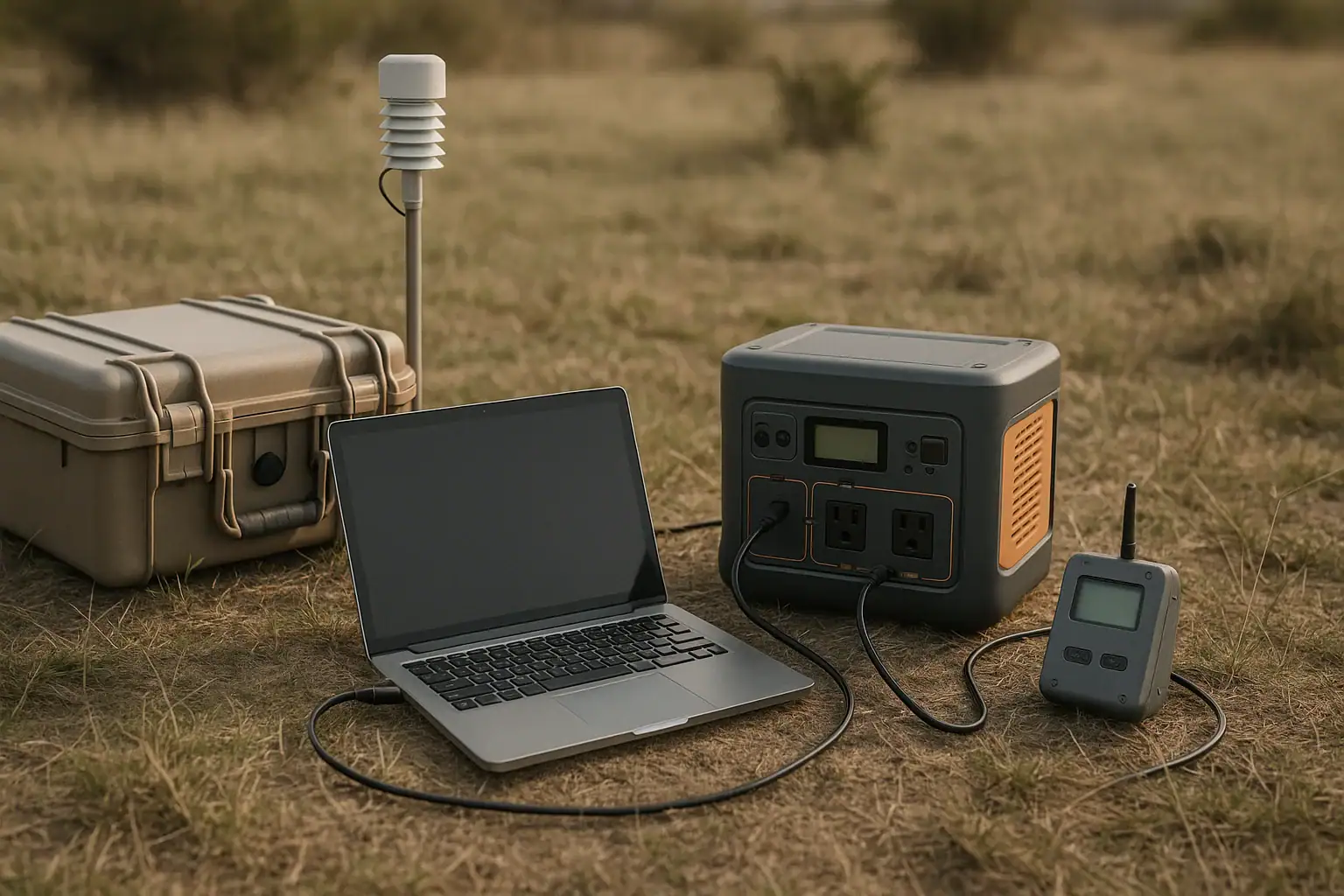
Portable power station powering field research and data logging equipment outdoors

A portable power station for field research and data logging equipment should provide stable, correctly matched power for sensors, laptops, gateways, and chargers for the full deployment window.

The right unit is not just the one with the largest battery. Researchers also need to match runtime, DC output, USB-C PD profile, AC inverter capacity, surge watts, solar input limit, and recharge time to the actual instruments being used. A station that works well for charging a laptop may be poorly matched for a 12-volt data logger that runs continuously for several days.

This guide explains how portable power stations fit into field research workflows, how to estimate power needs, what problems cause shutdowns or short runtimes, and which specifications matter most before choosing a unit.

What a Portable Power Station Means for Field Research

A portable power station is a rechargeable battery system with built-in outputs for running or charging electrical equipment away from fixed power. In field research, it can support data loggers, environmental sensors, GPS receivers, laptops, tablets, small pumps, camera traps, radio modems, satellite communicators, lighting, and battery chargers.

For data logging, the main value is continuity. Many research instruments draw modest power, but they may need to operate for hours, days, or repeated field shifts without interruption. A sudden power loss can create gaps in measurements, corrupt files, interrupt sensor warm-up cycles, or require a site visit that was not planned.

Portable power stations matter because they combine battery storage, power conversion, protection circuitry, and multiple ports in one transportable device. Instead of carrying loose batteries, separate inverters, and several chargers, a field team can plan around one central power source. The tradeoff is that every conversion has limits and losses. A careful match between the station and the equipment is more important than the headline capacity alone.

How Portable Power Works for Data Logging Loads

Most field research power planning starts with watts and watt-hours. Watts describe how much power a device uses at a moment in time. Watt-hours describe how much energy is needed over a period. A 10-watt data logger running for 24 hours uses about 240 watt-hours before conversion losses. If that logger is powered through an AC adapter from the station inverter, real use may be higher than the label suggests because the battery must convert stored DC energy into AC and then the adapter converts it back to DC.

Output type matters. Many data loggers, sensor hubs, and communications devices use 12-volt DC, while laptops and tablets may use USB-C Power Delivery or AC adapters. Using a native DC or USB-C output can reduce conversion losses when voltage and connector requirements match. AC outlets are flexible but often less efficient for small continuous loads, especially if the inverter has its own idle draw.

Runtime also depends on duty cycle. A weather station that logs continuously but transmits once per hour may consume very little most of the time and spike briefly during communication. A laptop used for data downloads may draw heavily during processing but sit idle at lower wattage. For remote deployments, average load over time is usually more useful than peak load, while surge capacity is important for motors, pumps, and devices with startup draw.

Load typeTypical planning factorWhy it matters
Low-power data logger2 to 10 watts continuousSmall loads can still use significant energy over multi-day deployments
Laptop or field tablet30 to 100 watts while charging or processingShort, high-use sessions can dominate daily energy needs
Cellular or radio gateway5 to 25 watts average with transmit peaksCommunication spikes can trigger weak or undersized outputs
Small pump or active sampler20 to 150 watts plus startup surgeMotors may need higher temporary power than the running wattage
Common field equipment load examples. Example values for illustration.

Real-World Field Research Use Cases

In a short field survey, a portable power station may serve as a mobile charging hub. A team collecting soil, water, vegetation, or wildlife data might use it to recharge tablets, GPS units, camera batteries, handheld meters, and a laptop used for backups. In this case, the key specifications are usable capacity, USB-C output strength, number of ports, and how quickly the station can recharge between field days.

For unattended data logging, the use case changes. A station may be placed in a shelter or protective case to power a logger, sensor array, and telemetry device. The goal is not rapid charging but predictable runtime and stable output. Low self-consumption, suitable DC voltage, cold-weather performance, and compatibility with solar input become more important than the number of AC outlets.

For mobile research stations, the power station may support equipment during setup, calibration, and data download sessions. Examples include a laptop connected to a logger, a portable monitor, a small network router, rechargeable tool batteries, or sample processing equipment. This mixed-use pattern requires headroom because several devices may be connected at the same time.

For remote environmental monitoring, solar charging can extend deployment time, but it should not be treated as guaranteed daily full recharge. Cloud cover, shade, panel angle, dust, snow, short winter days, and the station solar input limit all affect recovery. A conservative plan assumes lower-than-ideal solar harvest and includes enough battery reserve for poor weather or delayed site access.

Common Mistakes and Troubleshooting Cues

The most common mistake is estimating runtime from capacity without accounting for usable energy and conversion losses. If a station is rated at 500 watt-hours, that does not mean every connected device will receive exactly 500 watt-hours. AC inverter use, voltage conversion, temperature, aging, and built-in reserve can reduce practical runtime. For critical logging, it is better to plan with a margin than to run the battery near empty.

Another frequent issue is using the wrong output. A 12-volt logger connected through an AC adapter may run, but it may waste energy compared with a suitable DC output. Conversely, plugging a sensitive device into an output with the wrong voltage, connector polarity, or current behavior can create faults or damage. If the equipment documentation is unclear, use manufacturer guidance or a qualified technician rather than improvising.

Shutdowns under load often point to overload, surge draw, low battery, temperature protection, or an output auto-sleep feature. Some stations turn off low-power outputs if the load is below a detection threshold. That can be a problem for very efficient loggers. A troubleshooting cue is a logger that runs during setup but turns off later even though the battery still shows charge.

Shorter-than-expected runtime can also come from background loads. AC inverters consume energy even when connected equipment is small. Heated enclosures, modems searching for signal, laptops charging internal batteries, and sensors with warm-up cycles can raise average demand. Measuring actual wattage during a representative test is more reliable than using only nameplate ratings.

Charging problems usually relate to input limits, panel mismatch, cable losses, or environmental conditions. A solar panel may be capable of a certain wattage, but the station can only accept power within its allowed voltage and input range. Long or undersized cables can reduce performance. In cold conditions, many batteries charge more slowly or block charging until they warm enough to protect the cells.

Safety Basics for Field Power Stations

Field power should be treated as research infrastructure, not an afterthought. Keep the power station dry, stable, ventilated, and protected from direct contact with mud, standing water, conductive dust, and heavy impacts. Most portable units are not designed to sit uncovered in rain or snow. If an enclosure is used, it should allow heat to escape and should not block vents.

Use outputs only as intended. Do not open the power station, modify the battery pack, bypass internal protections, or combine batteries in improvised ways. Do not force incompatible connectors. If a research platform requires custom wiring, higher-voltage systems, or integration with building power, involve a qualified electrician or an appropriate technical specialist.

Load limits deserve attention. Stay below the continuous watt rating of the output being used, and allow headroom for startup surge from pumps, fans, compressors, or motorized samplers. Extension cords and outlet strips should be suitable for the load and environment. Damaged cables, loose connectors, and exposed conductors are not field inconveniences; they are safety hazards.

Temperature is also a safety and performance factor. Batteries can lose capacity in cold weather, and charging may be restricted when cells are cold. High heat can shorten battery life and may trigger shutdown. Shade, elevation from hot ground, and controlled storage between uses can help maintain reliable operation.

Maintenance and Storage Between Field Deployments

Good maintenance starts with documentation. Label which devices were powered, for how long, through which ports, and under what weather conditions. This creates a field-specific power history that is more useful than theoretical estimates. Over time, teams can refine deployment kits and avoid overpacking or underpowering critical sites.

Before each trip, charge the station, inspect cables, verify adapters, and test the complete chain with the actual equipment. A brief bench test can reveal sleeping outputs, wrong connectors, underpowered USB-C ports, noisy adapters, or equipment that draws more wattage than expected. Also confirm that the station display or app, if present, gives readings that are useful enough for field decisions.

For storage, avoid leaving the battery fully depleted. Many lithium-based systems are best stored at a partial state of charge in a cool, dry place, then checked periodically. Very hot vehicles, freezing locations, damp sheds, and long-term neglect can reduce reliability. Keep ports clean, caps closed when available, and accessories stored with the station so the correct cables are not missing on deployment day.

If the station has been exposed to heavy dust, moisture, impact, or unusual heat, remove it from service until it can be inspected externally and tested safely. Do not continue using equipment that smells burnt, has swelling, visible damage, abnormal heating, or repeated fault messages.

Maintenance taskSuggested timingReason
Full equipment runtime testBefore critical deploymentsConfirms real-world load, output behavior, and reserve margin
Cable and connector inspectionBefore and after field tripsFinds damage that can cause faults, heat, or intermittent shutdowns
Partial-charge storage checkEvery few months during storageReduces the risk of deep discharge and preserves readiness
Solar input verificationBefore remote solar-supported useConfirms panel, cable, and input compatibility under realistic light
Routine maintenance planning for field power kits. Example values for illustration.

Practical Takeaways and Specs to Look For

The best portable power station for field research is the one that matches the instruments, deployment time, environment, and charging plan. Start by listing every device, its voltage, its average and peak wattage, and the number of hours it must operate. Then add a reserve margin for conversion losses, weather, battery aging, and unexpected delays.

For data logging, reliability usually matters more than maximum outlet count. A station with suitable DC outputs, predictable low-load behavior, and enough reserve may be better suited than a larger unit used inefficiently through AC adapters. Test the full setup before relying on it in the field.

Specs to look for

  • Usable battery capacity: look for enough watt-hours to cover the total load plus roughly 20 to 50 percent reserve; this helps prevent data gaps from weather delays or underestimated runtime.
  • Continuous AC output: match the inverter watt rating to the combined AC loads with headroom, such as 300 watts for a 200-watt working load; this prevents overload shutdowns.
  • Surge watt rating: allow extra capacity for pumps, fans, and motorized samplers, often two to three times the running wattage; this matters during startup.
  • DC output options: look for regulated 12-volt or other required DC outputs with suitable current; native DC can improve efficiency for loggers and gateways.
  • USB-C PD profile: check for profiles such as 45, 65, or 100 watts when powering laptops or tablets; the right profile avoids slow charging or failure to charge.
  • Low-load behavior: confirm that outputs stay on for small continuous loads of only a few watts; auto-sleep can interrupt efficient data loggers.
  • Solar input range and limit: compare panel voltage, connector type, and input watts, such as 100 to 400 watts; this determines realistic recovery in remote deployments.
  • Recharge time: consider wall, vehicle, and solar recharge speeds; fast recovery matters when teams rotate between field sites.
  • Operating temperature range: choose a station suited to expected cold, heat, and storage conditions; temperature affects capacity, charging, and shutdown behavior.
  • Weight and enclosure practicality: balance capacity with carry distance, vehicle access, and protection from dust and moisture; an oversized station can be difficult to deploy safely.

For most research teams, the practical process is simple: measure or estimate the load, choose outputs that match the equipment directly, build in reserve, and test under realistic conditions. That approach makes a portable power station a dependable part of the field kit rather than a last-minute battery backup.

Frequently asked questions

What features matter most when choosing a portable power station for field research?

The most important features are usable battery capacity, the right output types for your equipment, and enough continuous and surge power for the full load. For data logging, native DC outputs, stable low-load behavior, and a suitable USB-C PD profile can matter more than a large AC inverter. Solar input range, recharge time, weight, and operating temperature range also affect how well the station fits field use.

How do I estimate how long a portable power station will run my data logger?

Start with the logger’s average watt draw and multiply it by the number of hours it must run to get watt-hours. Then account for conversion losses, built-in reserve, and any additional devices connected to the station. A bench test with the actual setup is the most reliable way to confirm runtime before deployment.

What is a common mistake people make with field research power setups?

A common mistake is assuming the battery capacity on the label equals usable runtime for every device. In practice, AC inverter losses, temperature, aging, and low-load shutdown behavior can reduce performance. Another frequent issue is using an AC outlet when a direct DC output would be more efficient for a continuous logger.

Is it safe to use a portable power station outdoors in remote field sites?

Yes, if it is kept dry, ventilated, and protected from impact, mud, and standing water. Most units are not meant to sit uncovered in rain or snow, and they should not be modified or overloaded. Use cables and enclosures that match the environment and the electrical load.

Can solar panels reliably keep a portable power station charged during field deployments?

Solar can extend runtime, but it is rarely reliable enough to assume a full recharge every day. Output depends on sun angle, shade, weather, cable quality, panel size, and the station’s input limit. For remote work, it is safer to plan for partial solar recovery and keep enough battery reserve for poor conditions.

Why does my portable power station shut off even though the battery is not empty?

This can happen when the load exceeds the output limit, startup surge is too high, or the station’s low-load auto-sleep feature turns off a small device. Temperature protection or a weak cable connection can also cause shutdowns. Testing the setup with the actual equipment usually helps identify the cause.

Portable Power Station for Festivals and Vendor Events: Quiet Power Planning

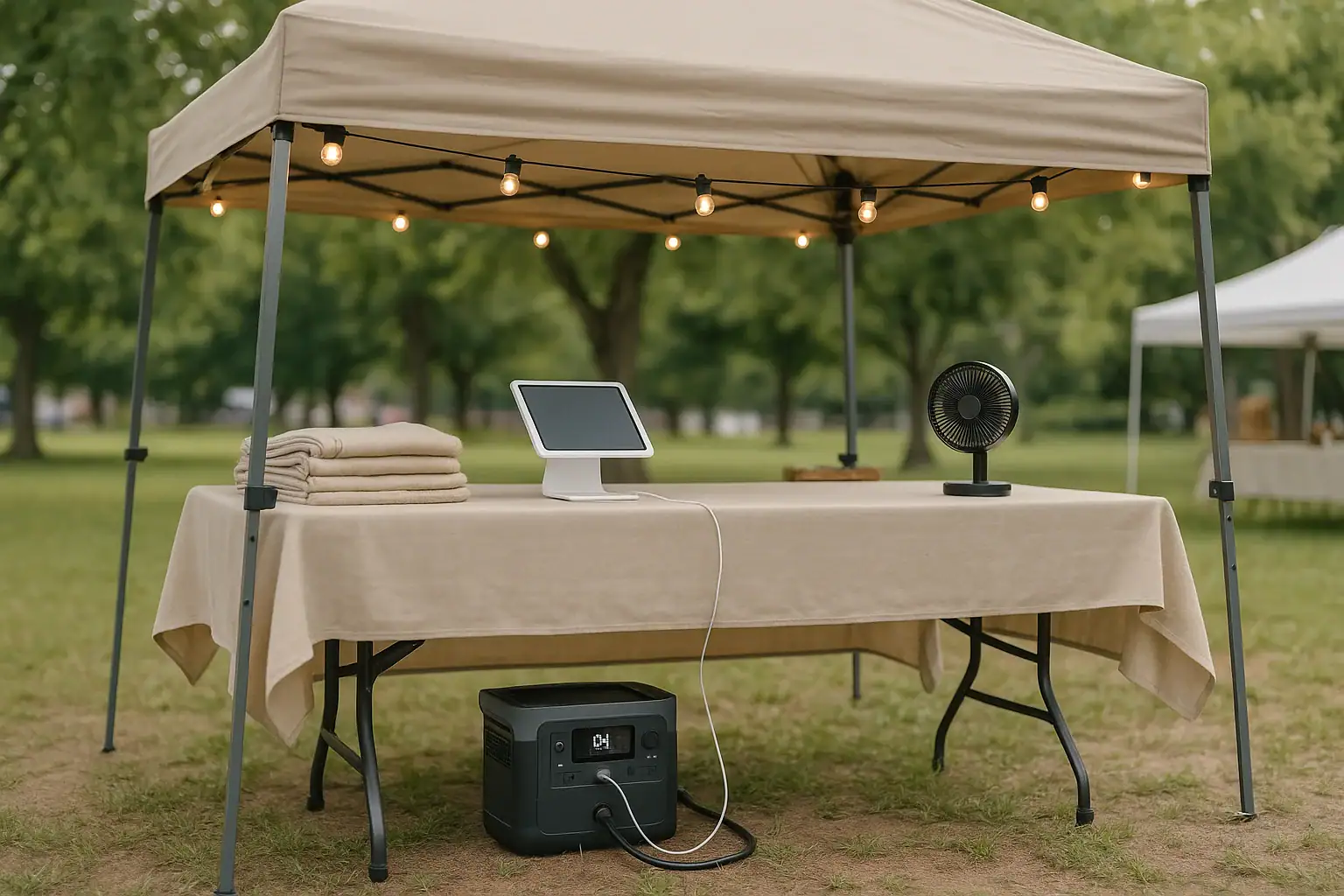
Portable power station powering a quiet festival vendor booth with lights and small electronics

A portable power station can run a festival booth or vendor setup quietly if its battery capacity, output watts, surge watts, and outlets match the equipment you plan to use.

For craft fairs, farmers markets, art festivals, food sampling booths, and pop-up vendor events, the goal is not just having power. The goal is predictable runtime without noise, fumes, tripped ports, or a dead battery before closing time. A good plan accounts for AC outlets, USB-C PD charging, solar input, peak loads, weather exposure, and how long each device will actually be used.

Unlike a fuel generator, a battery power station is silent during operation and can often be used where engine noise is restricted. The tradeoff is that you must estimate loads before the event. If you know your watt-hours, continuous watts, inverter capacity, and charging options, you can build a quiet power plan that feels boring in the best possible way.

What quiet power planning means for festivals and vendor events

Quiet power planning means matching your temporary power source to the real demands of your booth before the event begins. A portable power station stores energy in a rechargeable battery and delivers it through AC, DC, and USB ports. For festival vendors, it can power lights, phones, tablets, card readers, label printers, fans, small displays, sound-limited electronics, and some low-wattage appliances.

This matters because event sites are often unpredictable. Some venues offer paid electrical hookups, some provide shared outlets, and others do not allow fuel generators near vendor areas. Even when power is available, cords may be long, outlets may be limited, or access may cost more than expected. A portable power station gives you a self-contained option, but only if it is sized for the job.

The biggest planning question is simple: how many watts will your booth use, and for how many hours? A phone charger may use only a few watts, while a spotlight, fan, printer, or heated display can raise the load quickly. Runtime depends on total energy use, not just the number of devices plugged in. A small, efficient setup may run all day on a modest battery, while one heat-producing device can drain the same unit in a short time.

Quiet power planning also affects customer experience. A silent booth is easier to talk in, more professional near neighboring vendors, and less likely to violate event rules. It also reduces the need for extension cords crossing walkways, which can improve booth layout when used correctly.

How portable power stations deliver quiet event power

A portable power station works by storing energy in watt-hours and converting it into the type of power your devices need. The battery capacity, commonly listed in watt-hours, indicates the energy stored. A 500 watt-hour unit can theoretically supply 500 watts for one hour or 50 watts for 10 hours, but usable runtime is usually lower because of inverter losses, temperature, device cycling, and reserve capacity.

The inverter is the part that creates household-style AC power. Its continuous watt rating tells you how much load it can support steadily. Its surge watt rating tells you how much short startup demand it may handle for a short moment. Surge watts vs running watts matters for motors, compressors, pumps, and some appliances. It matters less for phones, tablets, LED lighting, and other electronics with steady low demand.

Ports matter as much as capacity. AC outlets are useful for standard plugs, but they are not always the most efficient option. USB-C Power Delivery portable power stations can charge phones, tablets, some laptops, and point-of-sale devices without using the AC inverter. DC ports may run certain lights or coolers more efficiently if the voltage and connector match the device. The fewer unnecessary conversions you use, the better your runtime tends to be.

Charging strategy is the final part of how it works. Many vendors charge fully at home, use the station during the event, and recharge afterward. For multi-day festivals, charge a portable power station with solar panels, vehicle charging while driving, or access to overnight AC charging may be important. Solar can extend runtime, but it should be treated as variable support rather than guaranteed power because shade, clouds, panel angle, and booth location can reduce output.

Booth itemTypical running wattsPlanning note
LED string lights or small display lights10 to 60 wattsOften efficient enough for all-day use if total lighting is modest.
Phone, tablet, or card reader charging5 to 45 wattsUSB-C or USB ports may be more efficient than AC adapters.
Small fan15 to 75 wattsRuntime depends heavily on speed setting and fan size.
Receipt or label printer20 to 150 watts while activeMay draw more during printing than while idle.
Small refrigerator or cooler40 to 120 watts cyclingStartup surge and duty cycle should be checked before relying on battery power.
Planning ranges for common festival loads. Example values for illustration.

Real-world vendor power examples

A jewelry booth may have a simple load: two LED display bars, a phone charger, a tablet, and a small card reader. If the lights use 30 watts total and the electronics average 15 watts, the booth may draw about 45 watts while open. Over an eight-hour day, that is roughly 360 watt-hours before conversion losses. A power station with extra capacity above that estimate can handle the day more comfortably than one sized to the exact number.

An art print booth may use brighter lighting, a tablet, a small label printer, and a fan. The label printer may not run continuously, so average draw is more useful than peak draw. If the booth averages 90 watts over six hours, it needs about 540 watt-hours plus a margin. If the fan is only used during afternoon heat, the load profile changes through the day. Planning by time block can give a more accurate estimate than assuming everything runs nonstop.

A farmers market vendor selling packaged foods may need a card reader, a scale, LED lighting, and possibly a small cooler. If the cooler has a compressor, startup surge and cycling behavior become important. Even if it averages 60 watts, it may briefly demand much more when the compressor starts. This is where inverter surge watts and appliance compatibility should be checked before event day.

A demonstration booth may use a laptop, monitor, small speaker at low volume, and occasional charging for visitors or staff. A laptop and monitor can create a steady draw, especially in bright outdoor settings where screen brightness is high. Reducing screen brightness, using efficient monitors, and charging devices before the event can noticeably extend runtime.

These examples show why vendor power is not one-size-fits-all. Two booths of the same size can have very different loads. The safest estimate comes from listing every device, checking its watt rating, deciding how many hours it will be used, and adding a realistic buffer.

Common mistakes and troubleshooting cues

The most common mistake is buying or bringing a power station based only on battery capacity while ignoring output watts. A large battery with an inverter that is too small may still shut off when a high-demand device starts. Capacity tells you how long power may last; output tells you whether the station can run the device at all.

Another frequent issue is underestimating heat-producing equipment. Kettles, coffee makers, hot plates, space heaters, heat sealers, and warming trays can use a lot of power. Many are poor fits for battery-only festival setups unless the power station is specifically sized for high continuous loads and the runtime expectation is short. If the event requires food preparation or heated service, review venue rules and power needs carefully.

If the station shuts down when a device turns on, look for overload, surge demand, or a port limit. Try removing other loads and checking whether the problem happens only at startup. If it does, the device may have a startup surge above the inverter capability. If the station runs for a while and then stops, the issue may be low battery, overheating, blocked ventilation, or a device cycling on and off with higher-than-expected draw.

If runtime is much shorter than expected, check whether AC outlets are being used for devices that could run from USB or DC. Also check idle loads. Printers, screens, chargers, and decorative lights can consume power even when they appear to be doing little. Bright sun can cause tablets and laptops to use more energy because screens run brighter and cooling fans work harder.

Charging confusion is another early warning sign. A station may have a maximum input limit that is lower than the combined rating of the panels or charger you hoped to use. Solar input also depends on voltage range, connector compatibility, and real sun conditions. For multi-day events, confirm the recharge schedule before assuming the battery will be full each morning.

Safety basics for crowded outdoor event spaces

Portable power stations are generally cleaner and quieter than fuel-powered options, but they still need basic electrical safety. Keep the unit dry, shaded when possible, and away from direct foot traffic. Do not place it where rain can pool, where drinks can spill into vents, or where customers can trip over cords. If weather is uncertain, plan a protected location that still allows ventilation.

Use cords rated for the environment and the expected load. safe extension cord use with portable power stations are preferable for outdoor booths, and cords should be routed to reduce trip hazards. Cable covers, booth edges, and taped-down low-traffic routes can help, but follow event rules. Avoid coiled extension cords under load because they can retain heat.

Do not overload a single outlet strip or adapter. The power station, outlet strip, and connected devices all have limits. If any plug, adapter, or cord feels hot, disconnect the load and investigate. Heat, buzzing, flickering power, repeated shutdowns, or burning smells are warning signs that the setup should not be used until the cause is understood.

Never open the power station, modify the battery pack, bypass protections, or attempt improvised wiring. If your booth needs fixed electrical distribution, hardwired equipment, or integration with venue power beyond normal plug-in use, involve event staff or a qualified electrician. High-level planning is appropriate for vendors; electrical installation work belongs to qualified professionals.

Also consider placement for theft prevention and emergency access. A power station should be accessible to staff but not easy for passersby to unplug or remove. Keep emergency exits, aisles, and neighboring booths clear.

Maintenance, charging, and storage between events

Good maintenance begins before the festival season. Test your complete booth setup at home with the same lights, chargers, printer, fan, and display devices you plan to use. Let it run for a realistic period and note the battery percentage used. This simple test often reveals hidden loads, noisy adapters, loose plugs, or equipment that draws more than expected.

Charge the station fully before event day unless the manufacturer recommends a different long-term storage level. For regular use, many vendors charge the night before and pack the unit where it will not be crushed or exposed to extreme heat. If you also use solar panels, inspect cables and connectors before leaving, because a missing adapter can make solar charging unavailable when you need it most.

Between events, store the station in a cool, dry place. Avoid leaving it in a hot vehicle for long periods, especially in summer. Extreme heat can reduce battery life and may trigger protective shutdowns. Extreme cold can reduce temporary output and charging performance. If the unit has a storage mode or recommended recharge interval, follow the general guidance provided with the device.

Keep ports clean and dry. Dust, lint, and debris can interfere with connections. Wipe exterior surfaces with a dry cloth and avoid harsh cleaning products. Check cords, adapters, and power strips for damage before each event. A reliable power plan includes the accessories, not just the battery.

It is also wise to keep a simple event power log. Record the event length, devices used, starting battery level, ending battery level, weather, and any problems. After a few events, you will know whether your setup has enough margin or whether your busiest days require more capacity or a different charging strategy.

Maintenance taskSuggested timingWhy it matters
Test the full booth loadBefore the first event and after major equipment changesReveals real runtime and overload issues before customers arrive.
Top off chargeBefore each event dayStarts the day with maximum available energy.
Inspect cords and adaptersDuring packing and setupReduces failures caused by damaged or missing accessories.
Clean and dry portsAfter dusty or wet eventsHelps maintain reliable connections.
Review power logAfter each eventImproves future capacity and runtime planning.
Simple care schedule for event power gear. Example values for illustration.

Practical takeaways and specs to look for


Related guides: Portable Power Station Basics: Outputs, Inputs, and What the Numbers Mean • Surge Watts vs Running Watts: How to Size a Portable Power Station • USB-C Power Delivery (PD) Explained for Portable Power Stations

The best portable power station for a festival booth is the one that runs your actual equipment for the full event with a comfortable buffer. Start by listing every device, estimating watts, multiplying by hours, and adding extra capacity for losses and surprises. Then compare that number with battery capacity, inverter output, port selection, and recharge options.

For quiet events, efficiency is often more valuable than raw size. Charge phones and tablets directly from USB when possible, choose LED lighting, pre-charge laptops, and avoid heat-producing appliances unless they are essential and properly planned. A lower average load means longer runtime, less stress, and a smaller chance of mid-event troubleshooting.

Specs to look for

  • Battery capacity: Look for enough watt-hours to cover your estimated load plus about 20 to 40 percent margin; this protects runtime when weather, screen brightness, or customer traffic increases use.
  • Continuous AC output: Match the inverter rating to the total watts of devices running at the same time, such as 300 to 1000 watts for many light-to-medium booths; this determines whether the station can support the active load.
  • Surge watts: Check startup capability for coolers, pumps, printers, or motorized equipment; a surge rating above the device startup demand helps prevent instant shutdowns.
  • Port mix: Look for enough AC outlets, USB-A, USB-C PD, and DC ports for your setup; using the right port can reduce adapter clutter and improve efficiency.
  • USB-C PD output: Consider 60 to 100 watts or more if charging tablets, laptops, or point-of-sale devices; higher PD output can keep work devices charged without using an AC brick.
  • Solar input limit: For multi-day events, compare panel plans with the station input range and watt limit, such as 100 to 400 watts; this affects how much energy you can recover during daylight.
  • Recharge time: Look at AC recharge time from empty to full or to 80 percent; faster recharging is useful when you have only overnight access to power.
  • Weight and form factor: Choose a size you can safely carry, roll, and secure in the booth; portability matters when parking is far from the vendor area.
  • Operating temperature range: Check that expected outdoor heat or cold fits typical operating conditions; temperature affects performance, charging, and protective shutdown behavior.

Before relying on any setup, run a realistic test. If your trial uses far less battery than expected, you have useful margin. If it ends close to empty, reduce loads, add charging options, or increase capacity before the event. Quiet power works best when it is planned early, tested once, and then kept simple on the day of the festival.

Frequently asked questions

How do I size a portable power station for a festival booth?

List every device you plan to run, note each device’s wattage, and estimate how many hours it will be used. Add the watts together to estimate total energy use in watt-hours, then choose a power station with extra margin for losses and unexpected demand. If any device has a motor or compressor, also check the inverter’s continuous and surge ratings.

What specs matter most when choosing a portable power station for festivals?

The most important specs are battery capacity in watt-hours, continuous AC output, surge watts, and the mix of ports available. USB-C PD output, recharge time, and solar input can also matter if you plan to charge devices directly or recover power during multi-day events. The right combination depends on whether your booth uses lights, electronics, a cooler, or other higher-draw equipment.

What is a common mistake people make with vendor event power?

A common mistake is focusing on battery size while ignoring inverter output. A large battery may still fail if the station cannot handle the startup demand or total watt load of the equipment. Another frequent issue is assuming devices will run all day without accounting for printers, screens, fans, and other hidden power use.

Is it safe to use a portable power station in a crowded outdoor booth?

Yes, if it is used with basic electrical and placement precautions. Keep the unit dry, ventilated, and out of walkways, and use outdoor-rated cords that are routed to reduce trip hazards. Do not overload outlets or modify the unit, and stop using the setup if cords or plugs become hot.

Can a portable power station run a cooler or small refrigerator at an event?

Sometimes, but it depends on the appliance’s running watts, startup surge, and cycling pattern. Compressor-based coolers can briefly draw much more power when starting, which may exceed a station’s surge limit. Check the appliance label and test the setup before relying on it for a full event.

How long will a portable power station last at a festival?

Runtime depends on battery capacity, total load, and how often devices cycle on and off. A small booth with efficient lighting and phone charging may last many hours, while a setup with a fan, printer, or cooler will drain faster. The most reliable way to estimate runtime is to test the full booth setup before the event.

Mobile Office Power Kit: Working From a Car With Laptop, Phone, and Hotspot

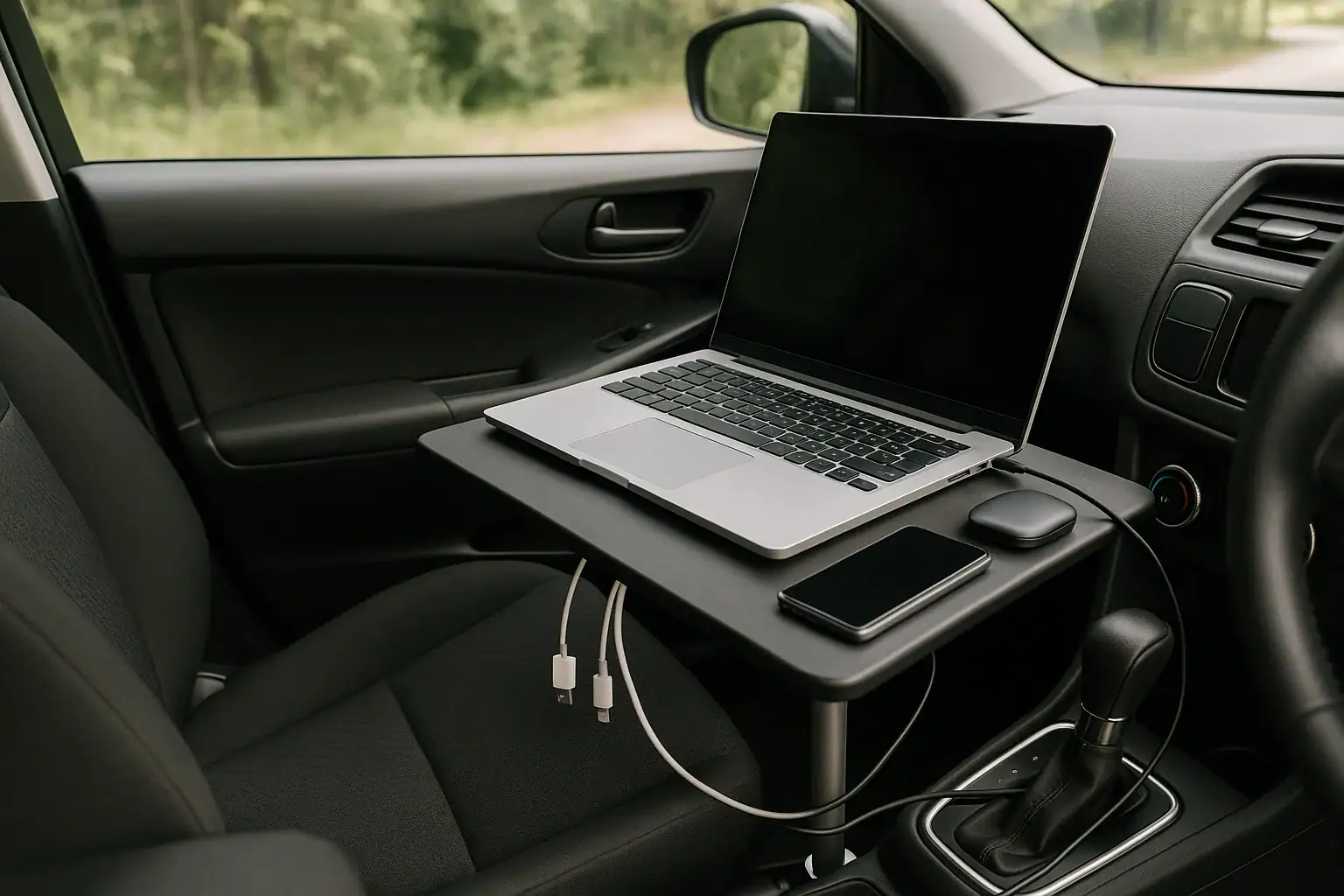
Mobile office power kit in a car with laptop, phone, hotspot, cables, and portable power station

A mobile office power kit lets you run a laptop, phone, and hotspot from a car by combining efficient USB-C charging, a safe 12-volt or portable power station source, and enough battery capacity for your runtime.

The right setup depends on your devices, workday length, and whether the vehicle will be parked, idling, or used between stops. The key search terms to understand are capacity, input limit, USB-C PD profile, inverter efficiency, surge watts, and runtime.

For most car-based work, the goal is not maximum power. It is stable, quiet, organized power that keeps you online without draining the starter battery, overheating electronics, or creating cable clutter that makes the workspace hard to use.

What a mobile office power kit is and why it matters

A mobile office power kit is a small power system for doing real work from a vehicle. It usually includes a power source, charging cables, a way to keep internet devices running, and basic organization so the setup can be used repeatedly without guesswork.

The power source might be the car 12-volt outlet, a portable power station, a dedicated laptop car charger, or a high-capacity power bank. Many people combine two options: the vehicle charges the power station while driving, and the power station runs the laptop, phone, and hotspot while parked.

This matters because a car is not automatically a good office. A laptop may need more power than a phone charger can provide. A hotspot may disconnect if its battery dies or overheats. A phone used for calls, navigation, and tethering can drain quickly. If everything relies on the vehicle starter battery while parked, the workday can turn into a no-start problem.

A good kit answers three questions before they become problems: how much power your devices need, how long the setup must run, and how it will recharge. Once those are clear, the rest is mostly choosing the right ports, cables, and capacity.

How car-based laptop, phone, and hotspot power works

Every device in a mobile office has a wattage demand. Phones often charge at 10 to 30 watts. Mobile hotspots often use 5 to 15 watts while charging or running. Laptops vary widely: an efficient ultraportable may work at 30 to 65 watts, while a larger workstation laptop may ask for 90 to 140 watts or more.

Capacity is usually listed in watt-hours. A 300 watt-hour power source does not deliver a full 300 watt-hours to devices in every situation because conversion losses occur. inverter efficiency is usually more efficient than using an AC inverter, because it avoids converting battery power to household AC and then back to device charging voltage.

USB-C Power Delivery, often called USB-C PD, is especially important for laptops. A charger and cable must both support the PD profile the laptop needs, such as 45 watts, 65 watts, 100 watts, or 140 watts. If the port is too weak, the laptop may charge slowly, drain while plugged in, or display a low-power charger warning.

AC outlets are useful for devices that cannot charge by USB-C, but they add inverter overhead. Even a small inverter consumes some power just by being on. For a simple laptop, phone, and hotspot setup, choose USB-C when possible and use AC only when needed.

Vehicle 12-volt outlets usually have a practical power ceiling. Some can power a modest laptop charger, while others are better suited to phones and small accessories. The vehicle manual and outlet labeling matter, especially because a loose plug or weak adapter can cause resets, heat, or intermittent charging.

Device or loadTypical working drawPlanning note
Phone charging10 to 30 wattsHigher draw is usually temporary, then it tapers as the battery fills.
Mobile hotspot5 to 15 wattsKeeping it plugged in can prevent mid-call shutdowns.
Efficient laptop30 to 65 wattsCommon for office apps, email, calls, and browser work.
Performance laptop90 to 140 wattsMay need a stronger USB-C PD port or an AC adapter.
Small AC inverter overhead5 to 15 wattsThis can reduce runtime even when the laptop is idle.
Example values for illustration. Actual power use depends on device settings, battery level, workload, temperature, and charging method.

Real-world mobile office examples

A light-duty mobile office might include an efficient laptop, a smartphone, and a dedicated hotspot. If the laptop averages 45 watts during document work, the hotspot uses 8 watts, and the phone averages 10 watts while topping up, the working load is about 63 watts. A usable 250 watt-hours after losses could provide roughly three to four hours of working time.

A longer workday needs a different plan. Suppose the laptop uses closer to 70 watts during video calls, with a hotspot at 10 watts and a phone at 15 watts. That is about 95 watts before conversion losses. In that case, a compact power source may cover a few meetings, while a larger portable power station may be needed for a half day or more. For longer deployments involving sensors and continuous recording, plan separately for field research and data logging equipment.

A field sales or service worker may drive between stops. This changes the equation because recharge time becomes part of the kit. If the power station or power bank can accept strong 12-volt or USB-C input while driving, it may recover a useful amount between appointments. If its input limit is low, it may not refill fast enough to matter.

A remote worker parked for calls has another concern: fuel, noise, heat, and ventilation if relying on the vehicle. Many users prefer a charged portable power station for quiet parked operation, then recharge while driving later. This keeps the internet connection and laptop charger separate from the starter battery and reduces the urge to idle unnecessarily.

A content creator or analyst using a high-performance laptop may need more than a basic kit. Running heavy software, external drives, or a portable monitor increases demand. In this case, the kit should be sized around peak work sessions, not just light email use.

Common mistakes and troubleshooting cues

The most common mistake is assuming that any USB-C port can charge any USB-C laptop. The connector shape does not prove the wattage. If the laptop reports slow charging, loses battery while plugged in, or only charges when sleeping, the likely issue is an underpowered PD profile, a cable that cannot carry the required wattage, or a port with limited output.

Another common problem is runtime that is shorter than expected. This often happens when people divide battery capacity by the laptop charger rating instead of the laptop actual draw, or when they forget inverter losses. A laptop with a 65-watt charger does not always use 65 watts, but an AC inverter may still add overhead. Measuring or estimating average load gives a better answer than relying only on charger labels.

Frequent power interruptions can point to loose 12-volt plugs, overloaded adapters, or heat. Car outlets were not designed as perfect office outlets, and some plugs wiggle during use. If a charger cuts on and off, stop using that setup until you identify whether the plug, outlet, cable, or device is the weak link.

If a hotspot keeps disconnecting, power may not be the only cause. Heat, weak cell signal, auto sleep settings, or a drained internal battery can all affect reliability. Still, keeping the hotspot powered from a stable USB port and placing it where it has airflow and signal can reduce many issues.

Cable clutter is also a real reliability problem. A laptop cable pinched under a seat, a phone cable stretched across controls, or a hotspot hidden in direct sun can create failures that look like battery problems. A dependable kit should be easy to plug in the same way every time.

Safety basics for working from a car

Use high-level caution with any mobile power setup. Do not open battery packs, bypass safety protections, modify charging circuits, or use damaged cables. If a device, adapter, or power station becomes unusually hot, smells odd, swells, sparks, or shuts down repeatedly, stop using it.

Keep electronics out of footwells where pedals, seat tracks, or passengers can crush cables. Avoid placing power stations or power banks in direct sunlight under glass, especially in warm weather. Cars can become much hotter than the outside air, and heat reduces battery performance and may trigger shutdowns.

Do not run combustion engines in enclosed spaces to power electronics. If the vehicle must be on for climate control or charging, it should be outdoors with safe ventilation. Carbon monoxide is not detectable by smell and can be deadly.

Protect the vehicle starter battery. Many 12-volt outlets shut off when the ignition is off, but some remain active. If you are unsure, assume the starter battery can be drained and use a separate power source for parked work. A portable jump starter is not a substitute for good power planning, but some drivers keep one as a backup.

Respect the limits of outlets and adapters. Avoid stacking multiple splitters and high-load devices on one socket. If you need unusually high power or a permanent vehicle power installation, consult a qualified professional rather than improvising wiring.

Maintenance and storage for reliable workdays

A mobile office kit works best when it is treated like work equipment, not a random bag of chargers. Keep a dedicated set of cables in the car or work bag so the kit is always complete. Labeling high-wattage USB-C cables can prevent accidentally using a low-power cable with a laptop.

Recharge the main power source after each workday. Portable power stations and power banks are most useful when they are ready before an outage, travel day, or unexpected parking-lot meeting. If the kit sits unused for weeks, check the charge level periodically and store it in a moderate temperature range.

Inspect cables and adapters for strain, bent connectors, exposed conductors, or melted plastic. Replace questionable accessories rather than troubleshooting them repeatedly. A failing cable can cause slow charging, intermittent operation, or heat buildup.

Keep the kit physically organized. A small pouch for cables, a stable place for the hotspot, and a short charging cable for the phone can make the difference between a clean setup and a distracting mess. During hot or cold seasons, avoid leaving sensitive electronics in the car longer than necessary.

Maintenance itemSuggested intervalWhy it helps
Recharge main battery sourceAfter each work session or tripKeeps the kit ready for unplanned work or delays.
Check stored charge levelEvery 1 to 3 monthsReduces the chance of finding an empty battery when needed.
Inspect USB-C and 12-volt cablesMonthly during regular useFinds wear before it causes heat or unstable charging.
Clean vents and keep airflow clearBefore long sessionsHelps chargers and power stations manage heat.
Review device power needsWhen adding gearPrevents overloads after adding monitors, drives, or new laptops.
Example values for illustration. A heavier travel schedule, high heat, or daily use may require more frequent checks.

Practical takeaways for building a dependable kit


Related guides: Portable Power Station Basics: Outputs, Inputs, and What the Numbers Mean • USB-C Power Delivery (PD) Explained for Portable Power Stations • Charging From a Car: What’s Safe, What’s Slow, and What Can Break • Portable Power Station vs Power Bank: Where the Line Really Is

The best mobile office power kit is sized for your actual work, not for the biggest number on a product box. Start with your laptop charging requirement, then add the phone and hotspot. Decide how many hours you need while parked, and choose charging methods that match your devices without relying too heavily on inefficient conversions.

For most people, the most useful features are adequate USB-C PD output, enough watt-hours for the work session, safe recharging while driving, clear battery status, and a compact layout that does not interfere with driving or passenger space. A quiet, reliable setup is usually better than an oversized one that is hard to store.

Specs to look for

  • Battery capacity: Look for roughly 250 to 700 watt-hours for common laptop, phone, and hotspot work sessions; this determines practical runtime while parked.
  • USB-C PD output: Look for at least 65 watts for many office laptops, 100 watts for higher-demand laptops, or 140 watts for newer high-power USB-C systems; this helps avoid slow-charging warnings.
  • Number of USB-C ports: Look for two or more useful USB-C outputs if you run a laptop and phone at the same time; this reduces adapter clutter.
  • AC inverter rating: Look for enough continuous watts for any device that cannot use USB-C, such as 150 to 300 watts for light office gear; this prevents overload shutdowns.
  • Surge watts: Look for a surge allowance above the continuous rating when using AC accessories; this helps with brief startup spikes from some electronics.
  • Vehicle charging input: Look for a 12-volt car input or USB-C input that can recover meaningful energy during drives; a low input limit may make recharging between stops too slow.
  • Display or battery meter: Look for estimated time remaining, watts in, and watts out; these readings make troubleshooting runtime much easier.
  • Operating temperature range: Look for a range suitable for parked-car conditions, while still avoiding extreme heat or cold; temperature affects safety, charging, and battery life.
  • Size and cable management: Look for a compact shape, stable placement, and ports that face a usable direction; a kit that is easy to set up is more likely to be used safely.

Before relying on the kit for important work, test it for a normal session at home or in a parked car. Run the laptop, phone, and hotspot together, watch the wattage, and confirm how long the setup lasts. That single test often reveals whether you need more capacity, a stronger USB-C port, a better cable, or simply a cleaner layout.

Frequently asked questions

How much battery capacity do I need for a laptop, phone, and hotspot in a car?

For light office use, a few hundred watt-hours may be enough for a short session, while longer workdays usually need more capacity. The right size depends on your laptop’s actual draw, how long you stay parked, and whether you can recharge while driving. It is better to estimate based on average watts used than on charger labels alone.

What specs matter most when choosing a mobile office power kit?

The most important specs are usable battery capacity, USB-C PD output, vehicle charging input, and whether the kit can run your laptop without relying on an inefficient inverter. A clear battery display and enough cable length also matter because they make the setup easier to monitor and use. If you run multiple devices at once, the number of ports becomes important too.

Can I charge a laptop from a car outlet while driving?

Yes, if the outlet and adapter can supply enough power for the laptop. Some vehicles support modest laptop charging well, while others are better for phones and small accessories only. Check the outlet rating, the charger wattage, and whether the connection stays stable during bumps or turns.

What is the most common mistake people make with car-based laptop charging?

One common mistake is assuming that any USB-C charger or cable will work at full speed with any laptop. Another is overestimating runtime by using the charger’s rated wattage instead of the device’s actual average draw. Both mistakes can lead to slow charging, unexpected shutdowns, or a battery that runs out sooner than planned.

Is it safe to run a mobile office power kit while the car is parked?

It can be safe if the setup uses proper equipment, stays within power limits, and does not overload the starter battery. Keep devices out of direct heat, avoid damaged cables, and do not run an engine in an enclosed space. If you are unsure whether the vehicle outlet stays live when the ignition is off, use a separate power source for parked work.

Why does my hotspot or laptop keep disconnecting in the car?

Intermittent power, heat, weak signal, or an underpowered charger can all cause disconnects. A loose 12-volt plug or a cable that cannot carry the needed wattage is a common cause for laptops. For hotspots, stable power plus better airflow often improves reliability.

Portable Power Station for Power Tools: Drills, Saws, and Battery Chargers

Portable power station powering a drill battery charger near saws and power tools

A portable power station can run many drills, saws, and battery chargers if its continuous watts, surge watts, outlet type, and battery capacity match the tool.

The key is to size the station for the load, not just the label on the tool box. A cordless tool charger may need only a modest AC output, while a corded circular saw or miter saw can demand a high peak load when the motor starts. Users commonly search for terms like inverter, runtime, surge watts, watt-hours, AC outlet, and battery charger compatibility because those specs determine whether the setup works reliably.

For garage work, mobile repairs, light construction, and remote jobsites, a portable power station can be a cleaner and quieter alternative to running an engine generator for small to medium tasks. It is not a universal replacement for high-amperage shop circuits, but it can be very practical when matched to the right tools.

What a Portable Power Station Does for Power Tools

A portable power station is a rechargeable battery system with built-in power electronics. For power tools, its most important job is converting stored battery energy into usable AC power for corded tools or battery chargers. Many units also provide DC and USB outputs, but drills, saws, and most tool chargers usually rely on a 120-volt AC outlet.

This matters because power tools are not all the same type of load. A small drill battery charger is typically predictable and steady. A corded drill draws more power while drilling under pressure. A saw may draw a sharp startup surge and then fluctuate as the blade meets material. The portable station must be able to handle both the initial peak and the running load without shutting down.

The best use case is usually charging cordless tool batteries, running small corded tools, or powering one moderate tool at a time. Heavy table saws, large compressors, welders, and high-draw dust collectors may exceed what many portable stations can support, especially when used continuously. Understanding this distinction prevents nuisance overloads and unrealistic runtime expectations.

Key Watts, Surge, and Charging Concepts

The first number to check is continuous AC output, usually expressed in watts. This is the power the station can supply while the tool is running. If a tool draws 900 watts in normal use, a station rated below that level may overload, even if the battery has plenty of stored energy.

The second number is surge or peak output. Motor-driven tools often need extra power for a fraction of a second at startup. A saw that runs at 1,200 watts may briefly demand much more when the blade starts. If the surge rating is too low, the station may beep, shut off the AC inverter, or refuse to start the tool.

Battery capacity is different from output. Capacity is usually shown in watt-hours. A 1,000 watt-hour station does not mean it can power any 1,000-watt tool; it means it stores about that amount of energy before conversion losses. Real runtime is lower because the inverter uses some energy and tool loads vary. A rough estimate is usable watt-hours divided by tool watts, then reduced for losses and stop-start use.

For chargers, also consider how many batteries will be charged at once. A single charger may be easy for a station, but several rapid chargers can add up quickly. The AC inverter must support the combined draw, and the station capacity must be large enough to make the charging session worthwhile.

Tool or charger typeIllustrative power rangeWhat it means for a power station
Single cordless drill charger50 to 150 wattsUsually easy for many stations, with runtime depending on battery capacity.
Multi-port or rapid chargers150 to 600 watts combinedCheck total AC draw when several chargers run at the same time.
Corded drill500 to 900 running wattsNeeds enough continuous output and some surge capacity under load.
Circular saw1,200 to 1,800 running wattsRequires a stronger inverter and higher surge capability.
Miter saw or heavy cutting tool1,500 to 2,000 plus running wattsMay exceed smaller stations, especially during startup and hard cuts.
Example values for illustration.

Real-World Examples for Drills, Saws, and Battery Chargers

For cordless drill users, the most practical setup is often simple: plug the charger into the AC outlet and recharge packs during the workday. If the charger draws 100 watts and the station has about 700 usable watt-hours after losses, it may support several hours of charger operation. The number of tool batteries charged depends on the charger efficiency, battery pack size, and how depleted each pack is.

For a cordless tool crew, the station becomes a mobile charging hub. Instead of sizing for the drill itself, size for the chargers. Two rapid chargers drawing 250 watts each create a 500-watt load. That is much easier than running a large saw, but it can still drain a station over a long day. If solar or vehicle charging is part of the plan, input power also matters because slow recharging may not keep up with battery use.

For corded drills and small sanders, a mid-range AC inverter may be enough if the tool is used intermittently. These loads often fluctuate with pressure. A drill boring through dense wood can demand much more than the same drill spinning freely. If the station shuts down only during hard use, the cause is often motor load rather than a defective outlet.

For saws, the margin needs to be larger. A circular saw, reciprocating saw, or miter saw can trip overload protection if the inverter cannot provide the starting surge. Even when it starts, forcing the cut can pull the voltage down or cause a shutdown. A station that works for quick trim cuts may not be suitable for repeated framing cuts or thick hardwood.

Common Mistakes and Troubleshooting Cues

The most common mistake is comparing battery capacity to tool wattage as if they are the same spec. A large battery capacity helps runtime, but it does not guarantee the inverter can start a saw. Always check AC continuous output and surge output separately.

Another mistake is ignoring the total load. A station may run one charger, but overload when a second charger, work light, and fan are added. If the station shuts off after adding another device, unplug everything, restart the AC output if needed, and test one load at a time. This identifies whether the issue is total wattage, startup surge, or a specific device.

If a charger does not power on, check whether the station AC outlet is enabled. Many units require the AC inverter to be turned on separately. Also confirm the charger is designed for the outlet voltage and frequency available from the station. Most standard tool chargers are straightforward, but unusual chargers or imported equipment may have different requirements.

If a saw starts and immediately stops, the likely issue is surge demand. If it runs for a few seconds and then stops during cutting, the likely issue is continuous load or overheating protection. If runtime is far shorter than expected, the tool may be drawing more power than the estimate, the station may be cold, or multiple hidden loads may be active.

Long, undersized extension cords can also create problems. Voltage drop can make motors work harder and may contribute to poor startup. For portable station use, keep cords as short and appropriately rated as practical, and avoid coiled cords under heavy load.

Safety Basics for Jobsite and Garage Use

Use a portable power station within its rated output and environmental limits. Power tools can create vibration, dust, sparks, and debris, so keep the station on a stable surface away from cutting paths and falling materials. Do not place it where sawdust can block vents or where metal shavings may enter openings.

Keep the station dry. Many portable stations are not designed to sit in rain, wet grass, or puddles. If work must happen outdoors, use a dry, protected location with adequate airflow. Do not cover the station tightly while it is running because the inverter and battery management system need to dissipate heat.

Do not modify power cords, bypass overload protection, open the station, or alter tool battery packs. Built-in protections are there to reduce fire, shock, and battery failure risks. If the station repeatedly trips with a specific tool, treat that as a sizing or compatibility problem rather than something to defeat.

Portable power stations should not be wired into home electrical panels, shop subpanels, or building circuits without proper equipment and professional guidance. For any fixed electrical connection, transfer equipment, or code-related installation, consult a qualified electrician. For normal tool use, plug tools and chargers directly into the station or into appropriately rated portable accessories.

Maintenance and Storage for Tool Use

For reliable tool use, keep the station charged enough for the work planned. Storing it completely empty for long periods can reduce readiness and may be hard on the battery. Many users store a lithium-based station at a moderate state of charge and top it off before a job. Follow the manufacturer instructions for the chemistry and storage range of the specific unit.

After dusty work, wipe the exterior with a dry cloth and check that vents are clear. Avoid blowing debris deep into openings with high pressure air. If the station was used near cutting, sanding, or grinding, inspect the area around outlets before storing it. Clean, dry outlets reduce the chance of poor contact later.

Temperature affects performance. Cold batteries may deliver less power and show shorter runtime, while heat can trigger protective shutdowns or accelerate wear. Store the station in a dry indoor area when possible, away from direct sun, freezing conditions, and flammable clutter. Let a very cold station warm up before asking it to power a high-draw tool.

Recharge planning is part of maintenance. If the station supports wall, vehicle, or solar input, know the input limit and realistic recharge time before relying on it at a remote site. A large station with a slow input may take many hours to recover after running chargers all day.

Care itemSuggested habitWhy it helps
State of chargeStore partially charged and top off before workImproves readiness and avoids starting a job with limited runtime.
Dust controlKeep vents and outlets clear after cutting or sandingSupports cooling and reduces contact problems.
TemperatureStore indoors when practicalHelps preserve battery performance and reduces shutdown risk.
Recharge planMatch input power to the next work sessionPrevents slow charging from becoming the limiting factor.
Example values for illustration.

Practical Takeaways and Specs to Look For


Related guides: Portable Power Station Basics: Outputs, Inputs, and What the Numbers Mean • Portable Power Station Watt-Hours Explained • How to Choose the Right Size Portable Power Station

A portable power station for power tools is most dependable when it is sized around the hardest job it will actually do. For many users, that means choosing enough capacity for cordless battery charging and enough inverter strength for occasional corded tools. For saws and other motor loads, leave a generous margin for startup surge and cutting resistance.

Think in three layers: output, capacity, and recovery. Output determines whether the tool starts and keeps running. Capacity determines how long the work can continue. Recovery determines how quickly the station can recharge from wall power, a vehicle, or solar input before the next use.

Specs to look for

  • Continuous AC output: Look for a rating above your highest running load, such as 1,000 to 2,000 watts for many corded tools; this prevents overload during normal operation.
  • Surge or peak output: Look for a meaningful short-term surge rating, often 2,000 to 4,000 watts for saw-capable setups; this helps motors start without tripping protection.
  • Battery capacity in watt-hours: Look for enough capacity for the work session, such as 500 to 1,500 watt-hours for charging and light tool use; this drives realistic runtime.
  • Pure sine wave inverter: Look for clean AC output for chargers and motor tools; this supports compatibility and smoother operation with sensitive electronics.
  • AC outlet count and spacing: Look for enough outlets for chargers without blocking adjacent plugs; this matters when running multiple battery chargers.
  • Recharge input limit: Look for wall or solar input that matches your turnaround needs, such as several hundred watts or more; slow input can delay the next job.
  • Display with watts in and out: Look for real-time load and remaining runtime estimates; this makes troubleshooting overloads and planning charge sessions easier.
  • Thermal and overload protection: Look for clear alerts and automatic shutdown behavior; these protections help prevent unsafe operation when tools exceed limits.
  • Portability and durability: Look for a weight, handle design, and casing style that fit garage or jobsite movement; the best specs are less useful if the station is too awkward to place safely.

The right match is not always the largest station. A small charging station may be ideal for keeping drill batteries ready, while a larger inverter and battery are needed for saws. Start with the tools and chargers you plan to use, add their realistic wattage, allow for surge, and choose specs that leave a comfortable operating margin.

Frequently asked questions

What specs matter most when choosing a portable power station for power tools?

The most important specs are continuous AC output, surge or peak output, battery capacity in watt-hours, and the type of inverter. For tool charging, AC outlet count and spacing also matter because multiple chargers can take up more room than expected. If you plan to run saws or other motor tools, surge rating is especially important.

Can a portable power station run a circular saw?

Sometimes, but only if the station has enough continuous output and a high enough surge rating for startup. Circular saws often draw a large peak load when the motor starts and can overload smaller units. The exact result depends on the saw, the material being cut, and how much reserve the station has.

What is the most common mistake people make with tool loads?

A common mistake is assuming watt-hours alone tell the whole story. Battery capacity affects runtime, but it does not guarantee the inverter can start or sustain a power tool. Another frequent error is forgetting to add the watt draw of multiple chargers or accessories at the same time.

Is it safe to use a portable power station in a garage or on a jobsite?

Yes, if it is used within its rated limits and kept dry, ventilated, and away from dust buildup and cutting paths. It should not be covered while operating, and vents should stay clear. For fixed wiring or panel connections, professional electrical guidance is needed.

How do I estimate runtime for a drill charger or saw?

Start with the station’s watt-hour rating, then subtract some margin for inverter losses and real-world variation. Divide the usable energy by the tool or charger’s watt draw to get a rough estimate. Runtime will be shorter if the load cycles, starts and stops often, or draws more power under pressure.

Why does my power station shut off when I start a tool?

That usually means the startup surge is higher than the station can supply. Motor-driven tools often need a brief burst of extra power before settling into normal running draw. If the station works with chargers but not with a saw, surge capacity is likely the limiting factor.

Portable Power Station for Electric Coolers: 12V vs AC Runtime Planning

Portable power station connected to an electric cooler with 12V and AC runtime planning symbols

A portable power station can run an electric cooler, but runtime is usually longer and more predictable when the cooler uses a 12V DC connection instead of an AC wall plug.

The reason is simple: most electric coolers already operate internally on low-voltage DC power, while AC mode requires the power station to run an inverter. That inverter adds conversion loss, standby draw, and sometimes startup behavior that can shorten runtime. For anyone planning a camping trip, road stop, tailgate, overlanding setup, or backup cooling for food and medicine, the important terms are watt-hours, running watts, surge watts, inverter efficiency, runtime, and state of charge.

This guide explains how 12V and AC operation differ, how to estimate runtime realistically, why some coolers cycle on and off, and which power station specs matter before you rely on one for cold storage.

What 12V vs AC Runtime Planning Means and Why It Matters

Runtime planning means estimating how long a portable power station can operate an electric cooler before the battery reaches a low state of charge or shuts off. The planning is different for 12V and AC because the power path is different.

With a 12V DC outlet, the power station sends low-voltage direct current to the cooler. With an AC outlet, the power station first converts battery power into household-style alternating current through an inverter, and the cooler or adapter then converts it back to a form the cooler can use. Every conversion uses some energy, so the same cooler may run fewer hours on AC than on 12V.

This matters most when cooling time is the priority. A cooler used for drinks at a picnic may only need several hours. A compressor cooler used for food on a weekend trip may need one to three days. A medicine cooler may need much more careful planning, extra battery capacity, and temperature monitoring.

Another key point is that electric coolers do not all draw power the same way. Thermoelectric coolers often draw a steady load whenever they are on. Compressor coolers cycle: they draw more power while the compressor runs, then much less while maintaining temperature. That cycling behavior makes average watts more important than the maximum label wattage for runtime estimates.

How Electric Cooler Power Draw Works

The basic runtime formula is straightforward: usable watt-hours divided by average watts equals estimated hours. If a power station has 600 watt-hours and the cooler averages 35 watts, the simple estimate is about 17 hours. In real use, the result may be lower because of inverter loss, battery reserve, heat, cable voltage drop, and how often the cooler cycles.

Watt-hours describe energy capacity. Watts describe the rate of energy use. A cooler that runs at 50 watts for 10 hours uses about 500 watt-hours. If it cycles and averages only 25 watts over time, it may use about 250 watt-hours in 10 hours.

For 12V operation, check the power station’s DC output rating and the cooler’s DC input requirement. Many cooler plugs are designed for vehicle-style sockets, but the actual draw can vary from a modest compressor load to a heavier thermoelectric load. The outlet must support the cooler’s required amps without tripping.

For AC operation, check the continuous AC output rating and any surge or startup watts. Compressor coolers may draw a brief startup current when the compressor starts. Most small coolers are not extreme surge loads compared with large refrigerators, but the power station still needs enough inverter capacity to start and run the unit reliably.

Inverter efficiency is the main reason AC runtime is often shorter. If the cooler needs 40 watts and the inverter is operating at 85 to 90 percent efficiency, the battery may supply roughly 44 to 47 watts before considering inverter standby draw. At light loads, standby draw can become noticeable over many hours.

Connection typeTypical power pathRuntime effectPlanning note
12V DC outletBattery to DC output to coolerUsually more efficientCheck DC amps and cable fit
AC outletBattery to inverter to AC adapter or coolerUsually shorter runtimeInclude inverter loss and standby draw
USB-C PD, if supportedBattery to regulated USB-C outputVaries by PD profileOnly use if the cooler is designed for it
Example values for illustration. Comparing power paths helps explain why the same cooler can run longer on 12V than on AC.

Real-World Runtime Examples for Cooler Planning

The following examples are illustrative, not guarantees. Actual runtime depends on ambient temperature, cooler size, insulation, set temperature, how often the lid is opened, food temperature at loading, and whether the power station keeps DC or AC outputs active at low loads.

Small compressor cooler on 12V

Assume a compact compressor cooler averages 25 watts after it reaches temperature. On a 500 watt-hour power station with about 85 percent usable energy after reserves and conversion, usable energy might be around 425 watt-hours. Dividing 425 by 25 gives about 17 hours. If the cooler is pre-chilled, kept in shade, and opened rarely, runtime may improve. In hot sun with frequent opening, it may drop.

Same cooler on AC

If the same cooler is run from the AC outlet and the inverter plus adapter losses increase battery demand to an average of 32 watts, the same 425 watt-hours may provide about 13 hours. The cooler did not necessarily become less efficient; the power path did.

Thermoelectric cooler

A thermoelectric cooler may draw close to a steady 45 to 60 watts whenever it is operating. On a 500 watt-hour station, even with efficient DC output, a 55-watt average load may run for roughly 7 to 8 hours after accounting for usable capacity. These coolers can be convenient, but they are often more demanding for all-day battery operation.

Larger compressor cooler or dual-zone unit

A larger compressor cooler may have a higher startup draw and a higher average draw, especially if one zone is set to freezing. If it averages 45 watts over time, a 1,000 watt-hour station with about 850 usable watt-hours may run it for about 18 to 19 hours. If freezing, high heat, or frequent access increases the average to 70 watts, runtime may fall closer to 12 hours.

The best estimate comes from measuring average power over several hours under realistic conditions. If you cannot measure it, plan with conservative assumptions and include a reserve instead of draining the power station to zero.

Common Mistakes and Troubleshooting Cues

The most common mistake is using the cooler’s maximum wattage as if it were the average wattage, or using the lowest advertised power figure as if it applied in all conditions. Maximum watts help with output sizing. Average watts drive runtime.

Another common issue is choosing AC by default. AC may be convenient, but if the cooler has a proper 12V input and the power station’s 12V output can support the load, DC is often the better runtime choice. AC is still useful when the cooler requires it, when the DC outlet is current-limited, or when the AC cord is the only safe supported connection.

If the cooler shuts off or the power station turns off unexpectedly, check whether the outlet is overloaded, whether the cooler has a low-voltage protection setting, and whether the power station has an auto-off feature for low loads. Some power stations shut down DC or AC outputs when they sense little or no draw. A compressor cooler’s cycling can sometimes look like a low-load condition during off cycles.

If the cooler runs but does not stay cold, power may not be the only problem. The cooler may be overloaded with warm items, placed in direct sun, set too low for the conditions, or opened too often. Air space around the vents also matters. A compressor needs airflow to reject heat; blocking vents can increase energy use and reduce cooling performance.

If a 12V plug becomes warm, loose, or intermittent, stop relying on that connection until it is checked. Vehicle-style sockets vary in fit and can vibrate loose. Poor contact can cause voltage drop and nuisance shutdowns. Do not defeat fuses or modify plugs to keep a weak connection working.

Safety Basics for Portable Power Stations and Electric Coolers

Use only power connections supported by the cooler and the power station. Do not open the cooler, modify the battery pack, bypass protective circuits, or improvise adapters that exceed the rated voltage, current, or connector type. A cooler that needs a regulated input should not be connected to an unverified output.

Keep the power station dry, ventilated, and away from direct heat. Many power stations can safely operate outdoors only when protected from rain, pooling water, dust, and excessive temperature. Heat reduces efficiency and may cause the station to limit output or shut down.

Respect output ratings. The AC inverter rating should exceed the cooler’s running watts and allow for startup draw. The 12V output should supply the needed amps continuously. For example, a cooler drawing 5 amps at 12 volts is using about 60 watts, and the outlet should be rated above that load with room to spare.

Food safety also matters. Battery runtime is not the same as safe cooling time. Use a thermometer when temperature matters, keep perishable food in the safe range, and avoid assuming that a running cooler is always maintaining the correct internal temperature.

If you plan to integrate backup power into a fixed building electrical system, use a qualified electrician. This article is about portable cooler connections only, not wiring into home panels, transfer switches, or interlocks.

Maintenance, Storage, and Efficiency Habits

Good maintenance improves both runtime and reliability. Store the power station within the manufacturer’s recommended charge range, especially during long periods of non-use. Avoid leaving it fully depleted. Recharge it before a trip and verify that the output mode you plan to use actually powers the cooler.

Inspect cords, plugs, and sockets before travel. A 12V cable that worked in a vehicle may not fit every portable power station socket equally well. A loose connector can cause voltage drop, heat, and shutdowns. Replace damaged cords with properly rated replacements rather than taping or bending them into working order.

Pre-chill the cooler and contents whenever possible. Cooling warm drinks or groceries from room temperature uses far more energy than maintaining already-cold items. Load frozen items together, reduce empty air space when practical, and minimize lid openings.

Place the cooler in shade and keep ventilation openings clear. A cooler sitting in a hot vehicle or direct sunlight can use much more energy than the same cooler in a shaded, ventilated area. Even a highly efficient compressor cooler will cycle more often when heat load increases.

For longer trips, plan recharging separately from cooler runtime. Solar input, vehicle charging, or wall charging may help, but charging rates vary. A station that can run a cooler for 20 hours may still need several hours to recharge, depending on input limit, sunlight, alternator setup, and charger wattage.

Habit or conditionLikely effect on runtimeWhy it matters
Pre-chilled food and coolerLonger runtimeLess energy is spent pulling temperature down
Direct sun or hot vehicleShorter runtimeCompressor or cooling element works harder
Frequent lid openingsShorter runtimeWarm air enters and cold air escapes
12V connection with adequate ampsOften longer runtimeReduces inverter conversion losses
AC inverter left on unnecessarilyShorter runtimeStandby draw continues even at low load
Example values for illustration. Small setup choices can change electric cooler runtime by several hours.

Related guides: Portable Power Station Watt-Hours Explained • Inverter Efficiency Explained: Why Your Runtime Is Shorter Than Expected • AC vs DC Power: How to Maximize Efficiency and Runtime

Practical Takeaways and Specs to Look For

For the longest runtime, use a supported 12V DC connection when the power station’s outlet has enough current capacity for the cooler. Use AC when the cooler requires it, when the DC output is not compatible, or when AC operation is the safer supported option. In either case, estimate runtime from usable watt-hours and average watts, not only from the power station’s advertised capacity.

A practical planning method is to start with the power station’s watt-hour rating, assume a usable portion such as 80 to 90 percent, then divide by the cooler’s estimated average watts. For AC operation, reduce the estimate further for inverter loss and standby draw. Add a reserve if food, medicine, or overnight use is important.

Specs to look for

  • Battery capacity: Look for watt-hours that match your trip length, such as 500 watt-hours for short use or 1,000 watt-hours and above for longer cooling; capacity is the main limit on runtime.
  • Usable energy estimate: Plan around roughly 80 to 90 percent of rated capacity; reserves and conversion losses mean the full label capacity is rarely available at the outlet.
  • 12V DC output rating: Look for an outlet rated above the cooler’s amp draw, such as 10 amps for many small loads; insufficient current can cause shutdowns.
  • AC continuous watts: Choose an inverter rating comfortably above the cooler’s running watts, such as several times a 40 to 80 watt load; this prevents nuisance overloads.
  • Surge watt capability: Look for enough headroom for compressor startup, even if it lasts only a moment; startup spikes can trip undersized inverters.
  • Inverter efficiency and idle draw: Favor low standby consumption if you must use AC for many hours; inverter idle draw can noticeably reduce overnight runtime.
  • Output auto-off controls: Look for settings that keep DC or AC active during low-load compressor cycles; auto-off behavior can stop a cooler even when battery remains.
  • Recharge input limit: Compare solar, vehicle, and wall charging watts, such as 100 to 500 watts depending on use; recharge speed determines whether daily operation is practical.
  • Operating temperature range: Look for a range suitable for summer vehicles, campsites, or winter storage; temperature affects both battery performance and cooler duty cycle.

The simplest rule is this: match the outlet to the cooler, use 12V when it is supported and adequately rated, and size battery capacity from average power draw with a reserve. That approach gives a more realistic runtime plan than relying on best-case estimates or advertised capacity alone.

Frequently asked questions

How do I estimate runtime for a portable power station and electric cooler?

Start with the power station’s usable watt-hours, then divide by the cooler’s average watts. For AC use, reduce the estimate further to account for inverter loss and standby draw. Because compressor coolers cycle on and off, average power is more useful than the peak label wattage.

What specs matter most when choosing a portable power station for an electric cooler?

The most important specs are battery capacity in watt-hours, 12V DC output rating, AC continuous watts, surge capability, and inverter efficiency. If the cooler supports 12V, that output is often the better choice for runtime. Also check whether the power station has auto-off behavior that could interrupt a cycling compressor.

Is it better to run an electric cooler on 12V or AC?

In most cases, 12V is better for runtime because it avoids inverter conversion losses. AC is still useful when the cooler requires it or when the DC output is not compatible or not strong enough. The best option is the one the cooler is designed to use safely and continuously.

What is the most common mistake people make when planning cooler runtime?

A common mistake is using the cooler’s maximum wattage instead of its average wattage. Another mistake is assuming AC and 12V will deliver the same runtime. Real-world runtime is usually shorter on AC and changes with temperature, lid openings, and how full the cooler is.

Are portable power stations safe to use with electric coolers?

Yes, if the cooler and power station are used within their rated voltage, current, and connector limits. Keep the power station dry, ventilated, and away from heat, and do not use improvised adapters or bypass safety features. For food or medicine, also monitor temperature rather than relying on runtime alone.

Why does my cooler shut off even though the battery is not empty?

This can happen if the outlet is overloaded, the connector is loose, or the power station has an auto-off feature for low loads. Compressor coolers also cycle, and that cycling can sometimes trigger low-load shutdown behavior. Check the output settings, cable fit, and load rating before assuming the battery is the problem.

Portable Power Station for E-Bike Charging: Capacity, Speed, and Safety Limits

Portable power station charging an e-bike battery with capacity and wattage considerations

A portable power station can charge an e-bike if its usable watt-hour capacity is large enough and its AC output can handle the e-bike charger’s watts.

The main limits are battery capacity, charger watts, inverter rating, input limit, surge watts, runtime losses, and battery safety conditions. Most e-bike owners use the standard wall charger plugged into the station’s AC outlet, then estimate how many watt-hours the charger will pull. A large station may refill one or more e-bike batteries; a small one may only add partial range.

The key is not just whether the plug fits. The station must support the charger continuously, have enough usable energy after conversion losses, and operate in a safe temperature range. Charging speed is usually set by the e-bike charger, not by the power station’s total capacity.

What a Portable Power Station Does for E-Bike Charging

A portable power station is a rechargeable battery system with built-in outputs such as AC outlets, DC ports, and USB ports. For e-bike charging, it acts like a temporary wall outlet when you are away from grid power, storing energy in watt-hours and delivering it through an inverter to the e-bike charger.

This matters because an e-bike battery is already a significant energy storage device. Charging one battery from another battery adds conversion losses, heat, and power limits. A power station that works well for phones, lights, or laptops may be too small for a full e-bike recharge.

The most important number is not peak watts alone. It is the combination of usable capacity and continuous output. Capacity determines how much energy is available. Continuous AC output determines whether the charger can run without tripping an overload protection circuit. Charging one 500 watt-hour e-bike battery may require roughly 550 to 650 watt-hours from the station after inverter and charger losses.

A portable power station is most useful for topping off an e-bike during camping, commuting gaps, van travel, emergency backup, or trailhead charging. It is less suitable if you need fast repeated charging for multiple high-capacity bikes unless the station is sized accordingly.

How Capacity, Charger Watts, and Charge Speed Work

E-bike batteries are commonly labeled by voltage and amp-hours, such as 48 volts and 14 amp-hours. Multiplying those numbers gives an approximate battery capacity: 48 volts times 14 amp-hours equals 672 watt-hours. Some batteries list watt-hours directly, which is easier for sizing.

The e-bike charger controls charging speed. A charger rated at 54.6 volts and 2 amps outputs about 109 watts to the battery before losses. A 4 amp charger may output about 218 watts. The power station must supply the charger’s wall-side demand, which is often higher than the charger’s DC output because no conversion process is perfectly efficient.

To estimate station size, start with the e-bike battery watt-hours and add a margin for losses. A practical planning range is about 15 to 30 percent extra. For example, a 500 watt-hour e-bike battery may need around 575 to 650 watt-hours from the station for a near-full charge. If the power station has 700 watt-hours of advertised capacity, its usable AC energy may be lower, so it may not always provide a complete refill from empty.

Charge time depends mostly on the charger’s output and the battery’s state of charge. A 500 watt-hour battery charged by a 100 watt class charger may take roughly 5 to 7 hours from low to full. A 200 watt class charger may take roughly 3 to 4 hours, but only if the e-bike battery management system accepts that rate and the charger is designed for that battery.

E-bike battery sizeTypical charger drawStation energy to plan forLikely result
360 Wh90 to 150 W425 to 475 WhOne full charge from a mid-size station may be possible
500 Wh120 to 220 W575 to 650 WhNeeds a larger compact station for a reliable full refill
672 Wh150 to 250 W775 to 875 WhOften requires a high-capacity station for one full charge
1,000 Wh200 to 400 W1,150 to 1,300 WhBest matched with a large station or partial-charge expectations
Capacity estimates for portable power station e-bike charging. Example values for illustration.

Real-World Charging Examples

Consider a commuter e-bike with a 500 watt-hour battery and a 2 amp charger. If the charger draws about 120 watts from the AC outlet, a full recharge from a low battery may take around 5 to 6 hours and use roughly 600 watt-hours from the station. A 300 watt-hour station would not fully recharge it, but could add meaningful range.

Now consider a cargo e-bike with a 48 volt, 20 amp-hour battery, which is about 960 watt-hours. Even with a modest charger, a full refill may require more than 1,100 watt-hours from the station after losses. This is a different use case than topping up a small folding e-bike. The charger may run for many hours, so ventilation and remaining station capacity become more important.

A two-bike camping scenario is even more demanding. If each bike has a 500 watt-hour battery and both riders want a full charge, the station may need roughly 1,200 watt-hours of usable AC energy. If the station is also running a fridge, lights, or device chargers, those loads must be added. The total energy budget should include everything connected, not only the e-bike charger.

Solar charging can help, but it should be treated as an input source, not guaranteed replacement energy. Solar output varies with sun angle, shade, panel temperature, and the power station’s solar input limit. A station with a 200 watt solar input may only average a fraction of that over a day in mixed conditions. If you plan to ride daily, compare expected solar harvest against the watt-hours your e-bike needs each day.

Common Mistakes and Troubleshooting Cues

One common mistake is sizing by AC watt rating alone. A station rated for 600 watts can usually run a 150 watt e-bike charger, but it may still have too little capacity for a full charge. Watts describe power at a moment. Watt-hours describe stored energy over time.

Another mistake is assuming advertised capacity equals usable AC energy. The inverter consumes energy and creates heat. The e-bike charger also has losses. A station with 500 watt-hours of stored energy may deliver less than that through AC. This is normal, not necessarily a defect.

If the power station shuts off shortly after charging begins, check whether the charger’s wall-side draw exceeds the station’s continuous AC rating. Some chargers have brief startup behavior, but most e-bike chargers do not create a large motor-like surge. If overload warnings appear, the charger may be too large for the station, the station may be too warm, or another load may be connected at the same time.

If charging is slower than expected, the cause is usually the charger, not the station. A larger station does not force the e-bike battery to charge faster. The charger output, battery management system, battery temperature, and state of charge determine the charging curve. Many lithium batteries slow near full to balance cells and reduce stress.

If the station turns off before the e-bike is full, its low-battery cutoff may have been reached. Even if the display shows a few percent remaining, the station may stop AC output to protect its own battery. Plan with a reserve instead of expecting 100 percent of displayed capacity to be usable.

If the e-bike charger does not start at all, confirm that the station’s AC outlet is turned on, the charger is the correct one for the battery, and the battery is within its allowed temperature range. Do not open the charger, modify connectors, bypass fuses, or attempt to adapt chargers to unsupported battery packs.

Safety Basics for Charging E-Bike Batteries from a Power Station

The safest approach is to use the e-bike manufacturer’s correct charger and connect it to a power station that can support the charger’s continuous power draw. Avoid improvised adapters, damaged cords, swollen batteries, liquid exposure, and charging in tightly enclosed spaces.

Charge on a stable, nonflammable surface with airflow around the power station, charger brick, and e-bike battery. Both the inverter and the charger create heat. A charger that feels warm is common, but excessive heat, odor, discoloration, buzzing, or repeated fault lights are warning signs to stop using the equipment until it is inspected or replaced.

Temperature matters. Lithium e-bike batteries should not be charged when they are too cold, overheated, or recently stressed by hard riding in hot weather. Let the battery return to a moderate temperature before charging. Charging outside the intended range can reduce battery life and may increase risk.

Keep the charging area dry. Portable power stations and e-bike chargers vary in weather resistance, but many are not intended for rain, puddles, or wet grass. Use covered, ventilated protection rather than sealing the equipment in a bag or box while charging.

Do not connect a portable power station to home wiring, panels, transfer switches, or interlocks unless the system is designed for that use and installed by a qualified electrician. For e-bike charging, a normal plug-in connection to the station’s outlet is the appropriate high-level use case.

Maintenance and Storage for Reliable E-Bike Charging

Good maintenance starts with keeping both battery systems within reasonable charge levels when stored. Avoid leaving an e-bike battery empty for long periods, and avoid storing a power station fully depleted. Many portable power stations should be checked every few months and recharged as needed, especially before a trip.

Store the station and e-bike battery in a cool, dry place away from direct sun, heaters, and freezing conditions. High heat accelerates battery aging. Cold storage may be acceptable for some batteries, but charging while cold is the bigger concern. Let equipment warm naturally to room temperature before use if it has been stored in a cold location.

Inspect cords, plugs, charger housings, and battery cases before charging. Look for crushed insulation, loose prongs, cracks, corrosion, or swelling. Do not continue using equipment that shows physical damage or abnormal behavior.

For trip planning, recharge the station before leaving and test the e-bike charger with the station at home. This confirms that the AC outlet, inverter, and charger are compatible before you rely on them at a trailhead or campsite. If solar panels are part of the plan, test solar input separately so you understand realistic daily recharge rates.

Item to checkWhat to look forWhy it matters
Power station state of chargeStored with a moderate charge and topped up before travelReduces surprise shutdowns and supports battery health
E-bike chargerNo damaged cord, cracked case, or unusual heatCharger faults can stop charging or create hazards
Battery temperatureNot frozen, overheated, or fresh from extreme ridingImproves safety and helps the battery accept charge properly
VentilationClear space around charger and stationHelps prevent heat buildup during long charging sessions
Solar input planExpected watt-hours, not just panel watt ratingShows whether daily riding energy can realistically be replaced
Maintenance checks for e-bike charging from a power station. Example values for illustration.

Related guides: Portable Power Station Watt-Hours Explained • How to Choose the Right Size Portable Power Station • Portable Power Station Basics: Outputs, Inputs, and What the Numbers Mean

Practical Takeaways and Specs to Look For

A portable power station can be a practical e-bike charging source when it is sized around watt-hours first and watts second. For a single partial top-off, a compact station may be enough. For a full charge on a 500 to 700 watt-hour e-bike battery, expect to need a station with substantially more advertised capacity than the battery label suggests. For multiple bikes or large cargo-bike batteries, plan for a much larger energy budget.

Charging speed is usually limited by the e-bike charger. Buying more station capacity does not automatically shorten charging time. A bigger station mainly increases how many watt-hours are available and how long the charger can run. If fast charging is important, the e-bike battery and charger must be designed for it; do not force mismatched charging equipment.

For most owners, the best planning method is simple: identify the e-bike battery watt-hours, add 15 to 30 percent for losses, confirm the charger’s wall-side watt draw is below the station’s continuous AC rating, and leave reserve capacity for other loads. If any equipment becomes unusually hot, shows errors, or behaves unpredictably, stop charging and inspect the setup.

Specs to look for

  • Usable capacity: Look for enough watt-hours to cover the e-bike battery plus about 15 to 30 percent; this accounts for inverter and charger losses.
  • Continuous AC output: Look for an output rating above the charger’s draw, such as a 300 watt or higher outlet for many 100 to 250 watt chargers; this prevents overload shutoffs.
  • AC outlet compatibility: Look for a standard grounded outlet layout that fits the charger plug securely; loose adapters add failure points.
  • Pure sine wave inverter: Look for pure sine wave AC output when available; it is generally preferred for charger electronics and long charging sessions.
  • Battery chemistry and cycle rating: Look for a cycle-life rating that matches how often you will recharge e-bike packs; frequent riders benefit from longer cycle endurance.
  • Solar input limit: Look for input such as 100 to 400 watts if off-grid recharging matters; the input limit controls how quickly the station can recover energy from panels.
  • Display and load readout: Look for real-time watts and remaining time estimates; these help confirm the charger’s draw and predict whether a full charge is possible.
  • Thermal and overload protections: Look for automatic shutdown protections and clear fault indicators; they help prevent unsafe operation when loads, heat, or battery levels are outside normal range.
  • Weight and portability: Look for a capacity-to-weight balance that fits your transport method; very large stations may be impractical for bike-only travel.

The practical limit is this: if the station can safely run the charger and has enough usable watt-hours, it can charge the e-bike. If either the output rating or the energy capacity is too low, the result will be slow, partial, or interrupted charging.

Frequently asked questions

How do I know if a portable power station can charge my e-bike battery?

Check two numbers: the e-bike battery’s watt-hours and the power station’s usable watt-hours. The station also needs a continuous AC output rating that is higher than the charger’s wall-side draw. If both capacity and output are sufficient, the setup should work for normal charging.

What specs matter most when choosing a power station for e-bike charging?

The most important specs are usable capacity in watt-hours, continuous AC output, inverter type, and solar input if you plan to recharge off-grid. A clear display showing watts and remaining runtime is also helpful. Weight matters too if you need to carry the station with the bike.

Can a bigger power station charge my e-bike faster?

Usually no. Charging speed is mainly set by the e-bike charger and the battery management system, not by the station’s total capacity. A larger station mainly gives you more runtime and more total energy available.

What is the most common mistake people make with e-bike charging from a power station?

The most common mistake is sizing the station by watts alone and ignoring watt-hours. A station may have enough output to run the charger but still not have enough stored energy for a full charge. Another frequent error is forgetting to account for conversion losses.

Is it safe to charge an e-bike battery from a portable power station?

Yes, if you use the correct charger and the station can handle the charger’s continuous load. Keep the setup dry, ventilated, and away from damaged batteries or cords. Stop charging if you notice unusual heat, odor, fault lights, or swelling.

Why does my power station stop before the e-bike battery is full?

The station may have reached its low-battery cutoff before all usable energy was delivered. Advertised capacity is not the same as usable AC energy because inverter and charger losses reduce what reaches the battery. This is more likely with smaller stations or larger e-bike batteries.

Portable Power Station for Amateur Radio and Emergency Communications

Portable power station powering amateur radio emergency communications equipment

A portable power station can run amateur radio and emergency communications gear when it provides clean output, enough watt-hours, and the right DC and AC ports for your station. For radio use, the most important factors are runtime, voltage stability, low electrical noise, recharge options, and whether the unit can handle both small receive loads and higher transmit bursts.

Unlike camping lights or phone charging, radio equipment can be sensitive to inverter noise, DC output limits, voltage drop, and grounding choices. Operators often search for terms such as pure sine wave, surge watts, input limit, solar charging, duty cycle, and noise floor because those details affect whether communications stay reliable during an outage, field exercise, or storm response.

The best choice is not simply the biggest battery. It is the power station whose usable capacity, ports, charging speed, and electrical behavior match the radios, accessories, and emergency plan you actually use.

What a Portable Power Station Does for Amateur Radio

A portable power station is a rechargeable battery system with built-in outputs for powering devices without a generator or wall outlet. For amateur radio, it can support handheld chargers, mobile transceivers, HF radios, tuners, small computers, LED lighting, hotspot devices, USB accessories, and limited household communication gear.

The main reason it matters is continuity. During emergency communications, the goal is not maximum power for a few minutes; it is predictable operation for hours or days. A station that can receive for long periods, transmit when needed, and recharge by AC, vehicle power, or solar is more useful than a high-output unit that drains quickly or creates radio-frequency interference.

Portable power stations also reduce fuel, noise, and ventilation concerns compared with engine-driven generators. They can be used indoors when operated according to the manufacturer’s instructions, and they are generally quiet enough for shelters, field day setups, public service events, and neighborhood emergency nets. However, they are still electrical devices with limits. Choosing one for radio service means looking beyond headline wattage and asking how the unit behaves with low-current loads, high transmit current, cold weather, charging cycles, and sensitive receivers.

How Portable Power Stations Support Radio Loads

Most power stations combine a battery pack, battery management system, inverter, DC outputs, USB outputs, charging inputs, and a display. The battery is usually rated in watt-hours, which estimates stored energy. A 500 watt-hour unit does not always deliver the full number to your radio because conversion losses occur, especially when running AC equipment through the inverter.

Radio loads vary by operating mode. Receive current is often modest, while transmit current can rise sharply. A VHF or UHF mobile radio may draw little while listening but much more at high power. An HF transceiver may have a low receive draw and a much higher transmit draw, especially at 100 watts output. Digital modes, packet, Winlink-style operation, and data interfaces can increase average consumption because transmit time may be longer than casual voice operation.

DC output is usually more efficient than AC when the radio accepts the available voltage and connector type. Many mobile and HF radios expect about 13.8 volts DC, while some power stations provide regulated 12-volt ports that may be limited in current. If the station cannot provide enough DC amperage, the radio may reset, reduce output, or fail during transmit. AC output can solve connector compatibility, but it adds inverter losses and can introduce electrical noise if the inverter or charger is noisy.

USB-C power delivery can be useful for laptops, tablets, hotspots, and some compact radio accessories. The PD profile matters because a port that supports only low wattage may not sustain a laptop or field computer. Solar input helps extend runtime, but the input limit controls how fast the battery can recharge from panels in good sun.

Radio setupIllustrative average loadPlanning note
Handheld radio charging and USB light10 to 25 wattsSmall stations can run a long time, but keep spare charged batteries if possible.
VHF or UHF mobile transceiver, mostly monitoring15 to 40 watts averageTransmit bursts raise current, so check the DC port rating.
HF transceiver, mixed receive and voice transmit35 to 100 watts averageDuty cycle changes runtime more than advertised transmit power alone.
HF digital station with laptop60 to 150 watts averageLaptop charging, interface devices, and longer transmit periods increase demand.
Typical amateur radio power planning examples. Example values for illustration.

Real-World Emergency Communications Examples

For a neighborhood VHF net, a portable power station might run a mobile radio at low or medium power, charge handheld batteries, and keep a phone or tablet available for logging. In this situation, the most valuable features are efficient 12-volt output, enough amperage for transmit, low idle drain, and a display that shows remaining watt-hours or estimated runtime.

For an HF field station, the power station may support a 100-watt transceiver, an antenna tuner, a small LED lamp, and a logging laptop. The operator may choose lower transmit power, shorter overs, and a higher-efficiency mode to extend runtime. If the inverter creates noise on the band, DC operation or physical separation between the power station and antenna feed line may help.

For a shelter or emergency operations table, the load may include radios, chargers, a hotspot, a small router, and administrative electronics. This kind of setup benefits from multiple outputs, clear load monitoring, and the ability to prioritize communications gear over comfort loads. A small fan, printer, or large laptop can consume more energy than expected, shortening radio runtime.

For a multi-day outage, recharge strategy becomes as important as capacity. A mid-size battery paired with practical solar input may outperform a larger unit that cannot recharge quickly. Solar charging is variable, so planning should assume partial production due to clouds, short winter days, panel angle, and shading. Vehicle charging can help, but it should be treated as a supplemental option and used safely according to vehicle and power station guidance.

Common Mistakes and Troubleshooting Cues

One common mistake is sizing by inverter watts instead of watt-hours. Inverter wattage tells you the maximum load the unit can run at one time. Watt-hours estimate how long it can run. A high-watt inverter does not guarantee long radio runtime if the battery capacity is small.

Another mistake is ignoring the 12-volt output rating. Many radios need more current during transmit than a small DC socket can deliver. If the radio powers on but shuts down, resets, or drops output when you transmit, the issue may be a current limit, voltage sag, an undersized cable, or a connector that is not meant for the load.

Noise is another troubleshooting clue. If the receiver noise floor rises when the power station, inverter, charger, or solar controller is connected, the source may be electrical interference. Try comparing battery-only operation against AC inverter operation, increasing physical separation, routing power leads away from antenna lines, and using ferrite chokes when appropriate. Avoid opening or modifying the power station or radio to chase noise problems.

Unexpectedly short runtime usually comes from average load being higher than assumed. Transmitting more often, charging a laptop, running an inverter with light loads, using bright lighting, or leaving accessories on can drain capacity quickly. Displays that estimate runtime can lag behind changing duty cycles, so manual calculations are still useful.

Charging problems often trace back to the input limit. A power station may accept only a certain wattage from solar or vehicle charging, even if the panel or adapter can produce more. Cold temperatures may also limit or prevent charging on many lithium-based systems. If the unit refuses to charge in winter conditions, temperature protection may be working as designed.

Safety Basics for Radio Use and Emergency Power

Use a portable power station within its rated limits and follow the manufacturer’s instructions for ventilation, charging, output use, and temperature range. Do not open the unit, modify the battery pack, bypass protection circuits, or use damaged cables. Battery systems can store significant energy even when they look compact.

For radio setups, protect cables from abrasion, foot traffic, moisture, and strain. Use appropriately sized power leads for the current involved, keep connectors secure, and avoid daisy-chaining multiple adapters that can loosen or overheat. If a connector feels hot, smells unusual, or shows discoloration, stop using it until the cause is identified.

Keep the power station away from standing water, blowing rain, and conductive surfaces. Outdoor emergency communications often happen in poor weather, so sheltering the power equipment is important. Water-resistant cases and covers can help protect accessories, but they should not block cooling vents or trap heat.

Do not connect a portable power station directly into home electrical wiring, panels, transfer equipment, or receptacles in a way that could backfeed utility lines. Whole-home or circuit-level backup arrangements require proper equipment and a qualified electrician. For communications readiness, it is usually simpler and safer to plug radio gear directly into the power station or into a properly rated power strip used within its limits.

Maintenance, Storage, and Readiness for Communications

Emergency communications gear should be ready before the outage starts. Store the power station at a moderate state of charge if it will sit unused, unless the manufacturer recommends a different approach. Check it periodically and top it up before storm season, field events, or planned drills.

Test the station with the actual radio load you expect to use. A short real-world test can reveal connector limitations, inverter noise, inaccurate runtime assumptions, laptop charging issues, and whether solar input is practical at your location. Keep a simple load list with estimated watts and priority levels so you know what to unplug first when capacity drops.

Temperature matters. Avoid storing the unit in very hot vehicles or freezing locations for long periods. In cold weather, charging may be restricted, while discharge performance can decline. If the power station has been stored in a cold area, let it reach an appropriate operating temperature before charging if the instructions call for it.

Keep supporting items together: DC cables, radio adapters, a compact watt meter if used, USB-C cables with sufficient rating, ferrites, extension cords for low-power accessories, solar cables, and printed operating notes. During an emergency, the missing adapter is often the weak link.

Readiness taskSuggested intervalWhy it matters
Check battery state of chargeEvery 2 to 3 monthsReduces the chance of finding an empty unit during an outage.
Run a radio load testBefore drills or storm seasonConfirms runtime, noise behavior, and connector compatibility.
Inspect cables and adaptersBefore each field useDamaged or undersized cables can cause heat, voltage drop, or resets.
Review solar charging setupSeasonallyPanel angle, shade, and input limits affect recharge expectations.
Readiness checks for emergency communications power. Example values for illustration.

Practical Takeaways and Specs to Look For


Related guides: Portable Power Station Watt-Hours Explained • Pure Sine Wave vs Modified Sine Wave: Does It Matter for a Portable Power Station? • Portable Power Station Basics: Outputs, Inputs, and What the Numbers Mean

A portable power station for amateur radio should be chosen as part of the whole communications system, not as a generic battery. Start with the radios, expected duty cycle, accessories, and likely outage duration. Then compare the required watt-hours, DC current, inverter quality, charging inputs, and portability.

For many operators, the best setup is a balance: enough capacity for core communications, efficient DC output, clean electrical behavior, and a recharge plan that works in real conditions. Oversizing can add weight and cost, while undersizing can leave the station unusable during the most important hours.

Specs to look for

  • Battery capacity: Look for a usable range such as 300 to 1000 watt-hours for many portable radio setups; this determines realistic runtime more than inverter wattage.
  • 12-volt DC output current: Look for enough amperage for your transceiver, often 10 to 30 amps depending on radio power; this helps prevent shutdowns during transmit.
  • Pure sine wave AC inverter: Look for a clean inverter if you must run AC chargers or a laptop supply; it reduces compatibility problems and may reduce electrical noise.
  • Low idle consumption: Look for efficient operation at small loads; radios often spend long periods receiving, so idle drain can waste capacity.
  • Solar input rating: Look for an input range such as 100 to 400 watts for field replenishment; the input limit controls how quickly panels can recharge the battery.
  • USB-C PD output: Look for ports that match laptop or tablet needs, such as 45, 65, or 100 watts; this avoids running an inverter just to power small electronics.
  • Recharge time: Look for AC and solar recharge times that fit your emergency plan; fast enough charging matters during short generator windows or limited sun.
  • Weight and form factor: Look for a size you can carry with radios, antennas, and cables; a powerful unit is less useful if it cannot be deployed.
  • Operating temperature range: Look for practical cold and heat performance; charging restrictions and capacity loss can affect winter or summer deployments.
  • Display and load monitoring: Look for watts-in, watts-out, state of charge, and estimated runtime; these help operators make better decisions during an event.

The practical goal is simple: keep essential communications running with predictable power. If the power station can support your radio’s transmit current, avoid adding noise, recharge from realistic sources, and remain ready in storage, it can be a strong foundation for amateur radio emergency preparedness.

Frequently asked questions

What size portable power station do I need for amateur radio?

The right size depends on your radio type, transmit power, duty cycle, and how long you need to operate without recharging. Many portable radio setups work well in the 300 to 1000 watt-hour range, but higher-power HF or digital stations may need more. The best way to size it is to estimate average watts, then add margin for transmit bursts and accessory loads.

What features matter most when choosing a portable power station for amateur radio?

Look for usable watt-hours, enough 12-volt DC output current, low idle drain, and a clean inverter if you need AC power. USB-C PD, solar input, recharge speed, and a clear display are also useful for field and emergency use. For radio service, stable output and low electrical noise are often more important than peak inverter wattage.

Why does my radio reset or shut off when I transmit from a power station?

This usually means the DC output cannot supply enough current, the cable is too small, or voltage is dropping under transmit load. Some power stations have 12-volt ports that are limited to a lower amperage than a mobile or HF radio needs. Using a properly rated DC connection and shorter, heavier cables often helps.

What is the most common mistake people make with portable power stations for radio use?

A common mistake is choosing by inverter watts instead of battery capacity and DC output capability. A unit can advertise high AC power but still have limited runtime or insufficient 12-volt current for transmit. Another frequent error is forgetting that laptops, lights, and chargers all reduce available radio runtime.

Is it safe to use a portable power station indoors for emergency communications?

Yes, it is generally safe indoors when the unit is used according to the manufacturer’s instructions and kept in a dry, ventilated area. Unlike fuel generators, it does not produce exhaust, but it still needs protection from heat, moisture, and damaged cables. Never modify the battery pack or connect it in a way that could backfeed household wiring.

How can I reduce electrical noise from a portable power station on my receiver?

First compare battery-only operation with inverter or charger operation to identify the source of the noise. If needed, increase physical separation, route power leads away from antenna cables, and use ferrites on problem lines. In some cases, running the radio directly from DC instead of AC can reduce interference.

Portable Power Station for Outdoor Movie Nights: Projector, Speakers, and Runtime

Portable power station running a projector and speakers for an outdoor movie night

A portable power station can run an outdoor movie night if its AC output can handle the projector and speakers, and its usable watt-hours are high enough for the full runtime.

For most backyard setups, the biggest factors are projector power draw, speaker load, battery capacity, inverter efficiency, and whether the station provides pure sine wave AC power. Terms like runtime, surge watts, watt-hours, AC outlet rating, and pass-through charging matter because they determine whether the movie plays smoothly or shuts off early.

The right size depends on the equipment, the length of the movie, and how much reserve power you want for setup time, previews, streaming devices, or a small fan. A compact projector and modest speakers may need far less power than a bright full-size projector with a soundbar and accessories.

What a portable power station does for outdoor movie nights and why it matters

A portable power station is a rechargeable battery system with built-in outlets for powering electronics away from a wall outlet. For an outdoor movie night, it acts as the central power source for the projector, speakers, media player, router or hotspot, and small accessories.

This matters because projectors and audio gear are more sensitive than many people expect. A projector may have a steady running wattage, a brief startup spike, and a cooling fan that needs stable power after the movie ends. Speakers may use little power at low volume but more when playing loud outdoor audio. If the battery is undersized, the setup may work at first and then shut down before the end credits.

The main sizing question is simple: how many watts will the equipment use, and for how many hours? A power station with enough continuous AC output and enough usable battery capacity can support a predictable movie experience. A station that only matches the average load with no reserve can be frustrating, especially when the movie is long, the projector brightness is high, or the weather is warm enough to require extra accessories.

Outdoor movie nights also introduce practical issues that do not matter indoors. Extension cord length, damp grass, uneven surfaces, dust, nighttime visibility, and trip hazards all affect how safe and convenient the system feels. A well-chosen power station reduces cable runs and makes the setup easier to place near the projector rather than near a distant outlet.

How runtime, watt-hours, and AC output work together

To estimate runtime, start with the total watts used by everything plugged in. Add the projector, speakers, streaming device, screen motor if used, and any supporting electronics. Then compare that load with the power station capacity in watt-hours. The basic idea is that a 500 watt-hour battery running a 100-watt load might seem like it should last five hours, but real runtime is lower because the inverter and electronics use some energy too.

A practical estimate is to multiply the listed battery capacity by 0.80 to 0.90 for AC loads. This accounts for inverter losses and normal operating overhead. For example, a 600 watt-hour unit may provide roughly 480 to 540 watt-hours of usable AC energy. If the outdoor movie setup draws 150 watts, that could mean about 3.2 to 3.6 hours of runtime under typical conditions.

Continuous AC output is different from battery capacity. Capacity tells you how long the system may run. Continuous AC output tells you how much load it can support at one time. A projector drawing 220 watts and speakers drawing 60 watts require at least 280 watts of continuous output, plus margin. Surge watts are also worth checking because some electronics draw a brief startup current when first powered on.

Pure sine wave AC output is generally preferred for projectors, powered speakers, media players, and chargers because it more closely resembles utility power. Many modern electronics are tolerant, but stable AC power helps reduce noise, overheating, unexpected shutdowns, or buzzing from audio equipment.

Example setupEstimated loadUsable energy needed for 3 hoursCapacity range to consider
Mini projector plus small Bluetooth-style speaker60 to 100 watts180 to 300 watt-hours250 to 400 watt-hours
LED projector plus powered stereo speakers120 to 200 watts360 to 600 watt-hours500 to 800 watt-hours
Bright projector plus soundbar and streaming device220 to 350 watts660 to 1050 watt-hours800 to 1200 watt-hours
Large projector plus audio system and fan350 to 600 watts1050 to 1800 watt-hours1200 to 2000 watt-hours
Example values for illustration.

Real-world outdoor movie night examples

A simple family movie night might use a compact LED projector rated around 70 watts, a small powered speaker drawing 15 watts, and a streaming stick powered by USB. The combined load may be under 100 watts. For a two-hour movie plus setup time, a small to mid-size power station can often provide enough runtime if it starts fully charged.

A more typical backyard setup might use a brighter projector in the 150 to 250 watt range, a pair of powered speakers at 30 to 80 watts combined, and a media device. This setup can draw 200 to 325 watts during normal operation. For a three-hour session, including time to focus the image and let the projector cool down afterward, a larger battery capacity becomes more important.

A neighborhood screening or sports watch party may use a high-brightness projector, an audio mixer, multiple speakers, a laptop, decorative lighting, and possibly a fan. Even if each item seems manageable, the total can climb quickly. In this case, both inverter output and total energy capacity need more margin. The power station should not be running near its maximum rating for hours if avoidable.

Runtime also changes with brightness settings. Many projectors use more power in bright or high-performance modes and less in eco mode. Audio volume has a similar effect, although it is usually smaller than projector demand. If the image is bright enough in a lower lamp or LED mode, reducing brightness can noticeably extend battery life.

Temperature can affect performance too. Batteries generally work best in moderate conditions. Very hot or cold evenings may reduce efficiency or trigger protection limits. For outdoor movie nights, it is wise to keep the unit shaded, dry, and ventilated rather than placing it under a blanket, inside a sealed box, or directly on wet ground.

Common mistakes and troubleshooting cues

Assuming the battery capacity equals usable runtime

The most common mistake is dividing battery watt-hours by equipment watts without allowing for inverter losses, idle consumption, or reserve time. If a power station is rated at 500 watt-hours, the usable AC energy may be closer to 400 to 450 watt-hours. Build in a buffer so the movie can finish even if the projector draws more than expected.

Ignoring the projector startup and shutdown behavior

Some projectors briefly draw more power when starting. Others keep fans running after the image turns off to cool internal components. If the station is nearly empty at the end of the movie, the projector may not complete its normal cooldown. That can be hard on the projector over time.

Using too many adapters or long light-duty cords

Multiple adapters, old extension cords, and thin cables can create voltage drop, heat, and clutter. If an extension cord is necessary, use one appropriate for outdoor conditions and for the load. Keep connections elevated and away from wet grass or foot traffic.

Overlooking outlet limits

A power station may have several outlets, but the total inverter limit still applies. If the AC output is rated for 300 watts continuous, plugging in three devices that total 420 watts can cause an overload shutdown. USB ports and DC outputs may also have their own limits.

Not testing the full setup before guests arrive

A projector may work alone, but the full setup may fail once speakers, a media player, and accessories are added. A short test at the same brightness and volume planned for the event is the easiest way to confirm expected runtime and catch buzzing, overload warnings, or connection problems.

Safety basics for backyard power and electronics

Outdoor power setups should be treated with more caution than indoor setups because moisture, people, pets, and darkness add risk. Place the portable power station on a stable, dry, elevated surface when possible. Keep it away from sprinklers, puddles, damp grass, pool areas, and drink tables.

Do not cover the unit while it is operating. Power stations need airflow to cool the inverter, battery management system, and charging electronics. If the unit becomes hot, shows an overload warning, or shuts down repeatedly, reduce the load and allow it to cool in a ventilated area.

Use outdoor-rated cords when cords are needed, and route them where people will not trip. Avoid pinching cords under furniture or running them through standing water. If the event requires permanent outdoor wiring, a dedicated outdoor receptacle, or integration with a building electrical system, consult a qualified electrician rather than improvising.

Keep children from pressing buttons, pulling plugs, or moving the power station during the movie. Also keep flammable materials away from vents and outlets. Most modern power stations include protective electronics, but those protections should not be treated as permission to overload, modify, or bypass the equipment.

Charging safety matters too. If you charge during the day with solar panels or from an outlet, use compatible charging inputs and cables. Do not force connectors, combine incompatible panels, or exceed the input limit. For movie night itself, starting with a full charge is usually simpler and more predictable than relying on charging while running the projector.

Maintenance, storage, and preparation before movie night

Good maintenance starts with charging the power station before the event and checking the display under load. Battery percentage indicators can be approximate, so a real test with the projector and speakers is more useful than relying only on a full icon.

Store the unit in a clean, dry, moderate-temperature location. Avoid long-term storage in a hot car, freezing shed, or humid garage corner. For many battery systems, storing at a partial charge when not in use is preferable to leaving the unit completely empty for months. Check the manual for the model-specific storage range, but as a general habit, recharge periodically and avoid deep discharge during storage.

Before guests arrive, inspect cords, plugs, and ports for damage or debris. Confirm that the projector, speakers, and media device all turn on from the station at the same time. If the power station has an estimated runtime display, watch it for several minutes after the load stabilizes. Early readings may change as the inverter calculates demand.

After the movie, let the projector complete its cooldown cycle before turning off the power station. Then unplug devices, wipe dust or moisture from the exterior, and recharge the station when practical. If the unit was used in a dusty yard, keep vents clear without opening the device or modifying it.

Preparation itemWhat to checkWhy it helps
Battery chargeStart near full for the eventReduces early shutdown risk
Combined loadRun projector, speakers, and media device togetherConfirms inverter capacity
Runtime estimateCompare display estimate with the movie lengthShows whether more reserve is needed
Cord placementKeep cords dry and out of walkwaysReduces trip and moisture hazards
VentilationLeave space around ventsHelps prevent heat-related shutdowns
Example values for illustration.

Related guides: Portable Power Station Basics: Outputs, Inputs, and What the Numbers Mean • Portable Power Station Watt-Hours Explained • Pure Sine Wave vs Modified Sine Wave: Does It Matter for a Portable Power Station? • Surge Watts vs Running Watts: How to Size a Portable Power Station

Practical takeaways and specs to look for

The best portable power station for an outdoor movie night is not necessarily the largest one. It is the one that matches the projector load, speaker demand, movie length, and outdoor conditions with enough reserve to avoid stress. For a small setup, a modest capacity may be enough. For bright projectors, larger speakers, or longer gatherings, prioritize both battery capacity and continuous AC output.

A useful sizing shortcut is to add the watts for every device, multiply by the number of hours you need, and then add 20 to 30 percent for inverter losses and reserve time. If the event matters, test the exact setup before the night of the screening. Real measurements beat guesses from labels, especially when projector brightness and speaker volume can change the load.

Specs to look for

  • Battery capacity: Look for roughly 300 to 600 watt-hours for compact setups, 700 to 1200 watt-hours for typical backyard projectors, and more for large systems; this determines how long the equipment can run.
  • Continuous AC output: Choose an output rating comfortably above the combined projector, speaker, and accessory load, such as 300 watts for light setups or 600 watts and higher for demanding ones; this prevents overload shutdowns.
  • Surge watts: Look for surge capacity above the expected startup draw of the projector and audio gear; this helps the system handle brief power spikes.
  • Pure sine wave inverter: Prefer pure sine wave AC for projectors, powered speakers, laptops, and media devices; it supports cleaner, more stable operation.
  • Usable runtime display: A display showing watts in, watts out, and estimated time remaining is helpful; it lets you monitor the event before the battery gets too low.
  • Number and type of outlets: Look for enough AC outlets plus USB-A, USB-C, or DC ports for media devices; this reduces adapter clutter and keeps the setup organized.
  • USB-C output: A 30 to 100 watt USB-C port can power many streaming devices, tablets, or laptops; using DC or USB where practical may reduce AC outlet congestion.
  • Recharge options: AC charging, vehicle charging, and compatible solar input add flexibility; solar is most useful for daytime recharging before the movie rather than nighttime operation.
  • Operating temperature range: Look for a range suitable for local evenings; heat and cold can reduce efficiency or trigger protection modes.
  • Weight and handle design: A manageable weight and sturdy handles matter if the setup moves between the house, yard, campsite, or community space.

For most outdoor movie nights, the winning approach is to size with margin, keep the power station dry and ventilated, and simplify the number of devices plugged in. A well-planned setup lets the projector, speakers, and media source run quietly in the background so the focus stays on the movie.

Frequently asked questions

What size portable power station do I need for a projector and speakers?

The right size depends on the combined watt draw of the projector, speakers, and any streaming device, plus how long you want them to run. For a small setup, a few hundred watt-hours may be enough, while brighter projectors and louder speakers often need 700 watt-hours or more. It is usually best to add a buffer for inverter losses and startup spikes.

What specs matter most when choosing a portable power station for outdoor movie nights?

The most important specs are battery capacity in watt-hours, continuous AC output, surge capacity, and pure sine wave AC power. Also look for enough outlets, a clear runtime display, and charging options that fit your setup. These features determine whether the projector and speakers can run smoothly for the full movie.

How long will a portable power station run a projector and speakers?

Runtime depends on the total load and the usable portion of the battery, not just the listed capacity. A simple setup drawing under 100 watts may run for several hours on a mid-size unit, while a brighter projector with larger speakers can use battery power much faster. The most accurate estimate comes from testing the actual equipment together.

What is the most common mistake people make with outdoor movie night power?

A common mistake is assuming the battery rating equals real AC runtime. In practice, inverter losses and reserve needs reduce the usable energy, so a station that looks large on paper may still fall short. Another frequent issue is forgetting to test the full setup before the event.

Is it safe to use a portable power station outside for a movie night?

Yes, if it is kept dry, ventilated, and placed on a stable surface away from water and foot traffic. Use outdoor-rated cords when needed and avoid covering the unit while it is running. Safety is mostly about preventing moisture exposure, overheating, and trip hazards.

Can I charge the power station while the projector is running?

Some units support pass-through charging, but it is not always the best choice for a movie night. Charging while powering the setup can add heat and complexity, and it may reduce available output on some models. Starting with a full charge is usually the simplest and most reliable option.