Portable Power Station for a Farmers Market Booth: Lights, Tablet, and Card Reader

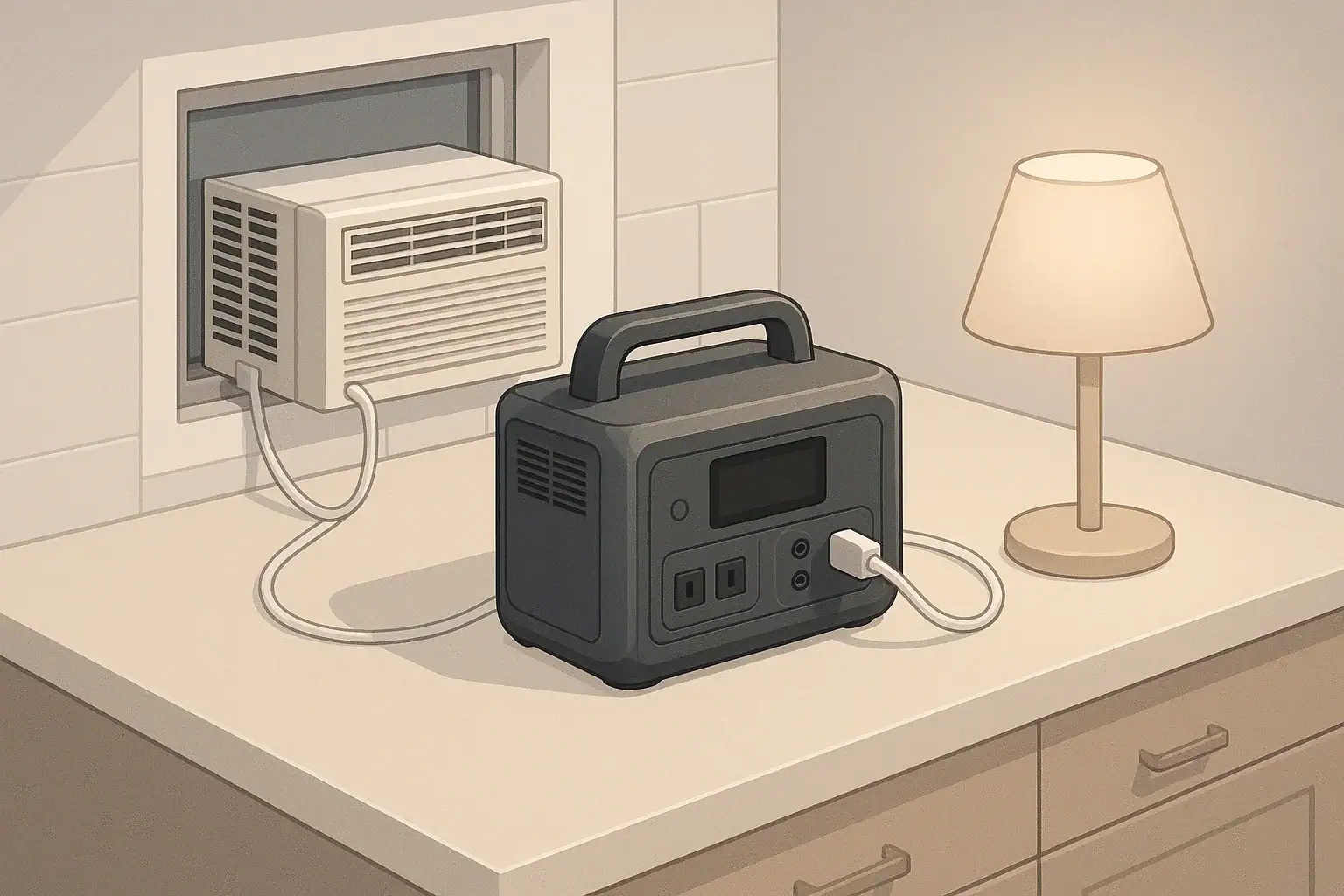
Portable power station running lights, tablet, and card reader at a farmers market booth

A portable power station can run a farmers market booth if its battery capacity, AC output, USB ports, and runtime match your lights, tablet, card reader, and any small accessories.

For most produce, craft, or bakery booths, the power needs are modest: LED lights, a tablet point-of-sale setup, a card reader, and maybe a receipt printer or small fan. The important terms are watt-hours, continuous watts, surge watts, USB-C PD profile, inverter efficiency, and runtime. If those specs are sized correctly, a compact or mid-size unit can often cover a full market day without using a gas generator.

The goal is not to buy the largest unit possible. It is to estimate your actual loads, allow a margin for weather and long sales days, and choose convenient outlets that keep payment devices charged and reliable.

What a portable power station does for a farmers market booth

A portable power station is a rechargeable battery system with built-in output ports. It may provide AC outlets for plug-in devices, USB-A or USB-C ports for phones and tablets, and 12-volt DC output for certain accessories. For a farmers market booth, it acts as a quiet, indoor-safe power source for low to moderate loads.

This matters because market booths often operate in places where electrical service is limited, shared, expensive, or unavailable. A booth may need reliable power for checkout more than for heavy equipment. If your tablet or card reader dies during peak hours, you may lose sales even if your display lighting is still working.

Compared with a fuel generator, a portable power station is usually quieter, produces no exhaust during use, and is easier to place near a table. It is best suited for electronics, LED lighting, small fans, labels, scales, and other light-duty booth equipment. It is not the right tool for high-draw appliances such as large refrigerators, commercial coffee machines, heat presses, or cooking equipment unless the unit is specifically sized for those loads.

For this use case, the most important question is simple: how many watt-hours do you need to get through setup, selling hours, teardown, and a reserve? Once you know that, outlet type and charging convenience become easier to evaluate.

How to estimate power needs for lights, tablet, and card reader

Start by listing every device that will run at the booth. Note its watt rating if available. If a device only lists volts and amps, multiply volts by amps to estimate watts. For example, a 5-volt device drawing 2 amps uses about 10 watts. Then estimate how many hours each device will be used.

Battery capacity is listed in watt-hours. A 300 watt-hour power station does not deliver every watt-hour at the outlet because the inverter and internal electronics use some energy. For AC loads, it is reasonable to allow for inverter efficiency loss. For USB loads, losses are often lower, but still present. A practical planning method is to calculate your expected energy use, then add 20% to 40% reserve.

Continuous watts describe how much power the station can provide steadily. Surge watts describe short bursts when some devices start up. Most booth electronics have little surge demand, but some printers, pumps, or fans may briefly draw more power than their running watts. A tablet and card reader usually matter more for port compatibility than surge capacity.

For tablets, USB-C Power Delivery can be useful because some tablets charge faster or only maintain battery level reliably when the port supports the right power profile. A low-output USB port may show charging but still let the battery drain during heavy screen use, cellular data, or point-of-sale activity.

Booth deviceExample running wattsExample use timeEstimated energy
LED string lights10 to 25 W5 hours50 to 125 Wh
Tablet point-of-sale device8 to 20 W6 hours48 to 120 Wh
Card reader2 to 5 W6 hours12 to 30 Wh
Small receipt printer10 to 40 W intermittent1 hour equivalent10 to 40 Wh
Small fan15 to 40 W4 hours60 to 160 Wh
Example values for illustration. Actual use depends on device settings, weather, brightness, and charging behavior.

Real-world booth examples and sizing scenarios

A simple morning booth with a tablet, card reader, and one set of efficient LED lights may only need a few hundred watt-hours. If the market runs four to five hours and the tablet begins the day fully charged, a smaller unit can often keep the checkout system stable and provide lighting during early setup or cloudy conditions.

A busier booth with a tablet, card reader, label printer, compact scale, LED lighting, and a fan should plan for a larger battery. The fan alone can use as much energy as the checkout equipment. If the booth operates from early setup through afternoon teardown, the difference between a 4-hour and 8-hour runtime becomes significant.

A booth that depends on display lighting after sunset should treat lights as a core load, not an accessory. LED lights are efficient, but multiple strands, spotlights, signs, or illuminated menu boards can add up. In that case, calculate lighting separately and verify that the station has enough AC outlets or DC ports without unsafe adapters.

A prepared-food booth may have very different needs. A tablet and card reader are still small loads, but warmers, pumps, blenders, induction plates, refrigerators, or espresso equipment can exceed the output rating of many portable power stations. For food equipment, check running watts, start-up behavior, and local market rules before assuming a battery station is enough.

For many non-cooking booths, a practical target is enough capacity for expected use plus reserve. If the booth estimate is 250 watt-hours, a unit in the 350 to 500 watt-hour range may provide a reasonable buffer. If the estimate is 500 watt-hours, a 700 to 1,000 watt-hour class may be more comfortable, especially when lights and fans run continuously.

Common mistakes and troubleshooting cues at the market

The most common mistake is assuming that a fully charged power station will run everything all day without doing the math. A rated capacity is not the same as usable runtime under your exact load. Bright tablet screens, cellular connections, hot weather, and AC inverter losses can shorten runtime.

Another mistake is using the AC outlet for devices that could run from USB. If a tablet or card reader can charge from USB-C or USB-A, using the DC output may reduce conversion losses compared with plugging a wall charger into the AC inverter. The difference may be small for one device, but it can matter over a long market day.

If the tablet says it is charging but the battery percentage keeps dropping, the USB port may not provide enough power. Look for a higher-wattage USB-C port and confirm the cable supports the needed charging rate. Some cables are charge-only, some are limited to low power, and worn connectors can cause intermittent charging.

If the power station shuts off unexpectedly, check for overload, low battery, heat, or auto-sleep behavior. Some units turn off low-power outputs when they detect very small loads. A tiny card reader by itself may not draw enough to keep a port active. Combining it with a tablet charger or using a different output mode may help, depending on the unit.

If LED lights flicker, the issue may be a low-quality light string, a dimmer mismatch, a weak adapter, or an overloaded output. Check whether the lights require AC or DC power and whether their adapter is rated for outdoor conditions if exposed near a booth edge. Do not bypass plugs, cut connectors, or modify packs to force compatibility.

Safety basics for outdoor booth power

At a farmers market, the power station should be kept dry, shaded, ventilated, and protected from foot traffic. Most portable power stations are not intended to sit in rain, puddles, direct sprinkler spray, or wet grass. Even when a unit has some environmental resistance, its outlets and connected chargers may not.

Place the station where customers cannot trip over cords or bump the unit. Keep cords routed behind tables when possible, and avoid running them across walking paths. If a walkway crossing is unavoidable, follow market rules and use appropriate cord covers. Do not overload extension cords or power strips, and avoid daisy-chaining multiple strips together.

Use only equipment in good condition. Cracked chargers, frayed cords, loose plugs, and damaged outlet strips should be removed from service. Outdoor markets can be rough on equipment because cords are packed, unpacked, dragged, and exposed to dust. A quick visual inspection before each market day can prevent many problems.

Heat is another safety issue. Batteries and inverters work harder in hot environments. Do not put the power station inside a sealed plastic tote while it is operating. Do not cover its vents with tablecloths, boxes, or signage. Shade is helpful, but airflow still matters.

If your booth uses high-draw appliances, refrigeration, cooking equipment, or any connection to site electrical infrastructure, follow market rules and consult a qualified electrician or appropriate professional. A portable power station should not be modified, opened, or used to bypass built-in protections.

Maintenance, charging, and storage between market days

Reliability starts before market morning. Charge the power station fully the day before the event, then confirm the display shows an expected state of charge. If the station has been stored for months, test it with your actual booth devices before relying on it for payment processing.

Keep a simple power kit packed with the station: the correct charging cable, tablet cable, card reader cable, any approved adapters, and a small checklist. Label cables if several look similar. Many market-day power problems come from forgetting one small cord rather than from the battery itself.

Store the unit in a cool, dry place away from direct sun, freezing conditions, and moisture. Long-term storage at a partial charge is often preferred for lithium batteries, but follow the product manual for your specific unit. Recharge periodically if it will sit unused between seasons.

Clean dust from the exterior with a dry cloth and keep vents clear. Do not wash the unit, spray it, or use solvents. Check that buttons, ports, and outlet covers still work smoothly. If the case is swollen, cracked, smells unusual, or becomes unusually hot during use, stop using it and follow the manufacturer’s service guidance.

For recurring markets, track actual performance. Note the starting charge, ending charge, weather, devices used, and hours of operation. After a few events, you will know whether your setup has enough reserve or whether you need to reduce loads, improve charging habits, or choose a higher-capacity station later. For larger or multi-day setups, use a dedicated festival and vendor-event power plan.

Maintenance itemWhat to checkWhy it matters
Before market dayCharge level, cables, ports, and planned loadsPrevents checkout interruptions and missing-cable problems
During setupDry placement, shade, airflow, and cord routingReduces heat, water, and trip hazards
During the eventBattery percentage and device charging statusShows whether runtime is matching expectations
After teardownRemaining charge and any error messagesHelps improve sizing for future markets
Off-seasonStorage charge, temperature, and periodic inspectionSupports battery health and readiness
Example values for illustration. A simple routine can make booth power more predictable across the season.

Related guides: Portable Power Station Watt-Hours Explained • USB-C Power Delivery (PD) Explained for Portable Power Stations • Surge Watts vs Running Watts: How to Size a Portable Power Station

Practical takeaways and specs to look for

For a farmers market booth, the best portable power station is the one that covers your real loads with reserve, has the right ports for your checkout equipment, and is easy to carry, charge, and protect outdoors. Lights, tablets, and card readers are usually manageable loads, but fans, printers, signs, and food equipment can change the sizing quickly.

Before comparing products, estimate watt-hours for the full market day. Include setup and teardown, not just posted selling hours. Then decide which devices should use AC outlets and which should use USB or DC ports. A good booth setup keeps payment devices powered first, display lighting steady second, and convenience accessories within the remaining energy budget.

Specs to look for

  • Battery capacity: Look for a capacity above your calculated use, such as 300 to 500 Wh for a light checkout-and-LED setup or 700 to 1,000 Wh for longer days with fans or printers; this determines practical runtime.
  • Continuous AC output: Look for enough steady wattage for all AC devices running together, often 300 to 600 W for basic booth electronics; this prevents overload shutdowns.
  • Surge watt rating: Look for a surge rating above any device with a motor or printer startup draw; this helps with short spikes even when average wattage is low.
  • USB-C Power Delivery: Look for a USB-C PD port around 30 to 100 W if using a tablet point-of-sale system; this helps the tablet charge while the screen and payment app are active.
  • Number and type of outlets: Look for enough AC, USB-A, USB-C, and 12 V ports without stacking adapters; this keeps the booth cleaner and reduces connection problems.
  • Recharge time: Look for a recharge time that fits your schedule, such as same-day or overnight charging; this matters for back-to-back market days.
  • Display and low-battery information: Look for a clear percentage, watts-in, watts-out, or runtime estimate; this helps you manage power before checkout equipment fails.
  • Operating temperature range: Look for a range suitable for hot summer markets and cool mornings; batteries may reduce performance outside comfortable conditions.
  • Weight and handle design: Look for a size you can lift and transport with the rest of your booth gear, often under 20 to 35 pounds for many small vendors; portability affects whether you will actually bring it.
  • Pass-through charging behavior: Look for clear support if you plan to charge the station while running devices; this can help during long events but should be used according to the product manual.

The practical approach is to size for reliability, not guesswork. Add up the lights, tablet, card reader, and accessories, add a reserve, and choose ports that match your actual devices. That gives your booth quieter power, fewer payment interruptions, and a cleaner setup without overspending on capacity you do not need.

Frequently asked questions

How long will a portable power station run a farmers market booth?

Runtime depends on the station’s usable watt-hours and the total watt draw of your devices. A small booth with LED lights, a tablet, and a card reader may run for a full market day on a modest unit, while adding a fan or printer can shorten runtime quickly. The best estimate comes from adding up each device’s watts and hours of use, then leaving a reserve.

What specs matter most when choosing a portable power station for a farmers market booth?

The most important specs are battery capacity in watt-hours, continuous AC output, USB-C Power Delivery, and the number of ports that match your devices. Recharge time, weight, and clear battery status display also matter because they affect how easy the unit is to use on market days. If you plan to run a tablet and card reader, port compatibility can be just as important as total capacity.

Can I use a portable power station for a tablet and card reader all day?

Yes, many booths can power a tablet and card reader for a full day if the station has enough capacity and the right USB output. A tablet that is heavily used for point-of-sale work may need a higher-watt USB-C port to keep up with screen brightness and cellular data use. Testing your exact setup before market day is the safest way to confirm runtime.

What is the most common mistake people make with booth power?

The most common mistake is assuming the rated battery size equals all-day usable power. In real use, inverter losses, bright screens, hot weather, and extra accessories reduce runtime. Another frequent issue is using AC power for devices that could run more efficiently from USB.

Is a portable power station safe to use outdoors at a market?

It can be safe when used correctly, but it should be kept dry, shaded, ventilated, and out of walkways. Use undamaged cords, avoid overloading outlets, and follow market rules for cord routing. Do not place the unit where it can sit in rain, puddles, or direct sprinkler spray.

Do I need a bigger unit if I use LED lights and a small fan?

Often yes, because a fan can use as much or more energy than the checkout devices. LED lights are efficient, but several strands or bright display lights can add up over several hours. If the fan will run for most of the market day, include it in your watt-hour estimate before choosing a unit.

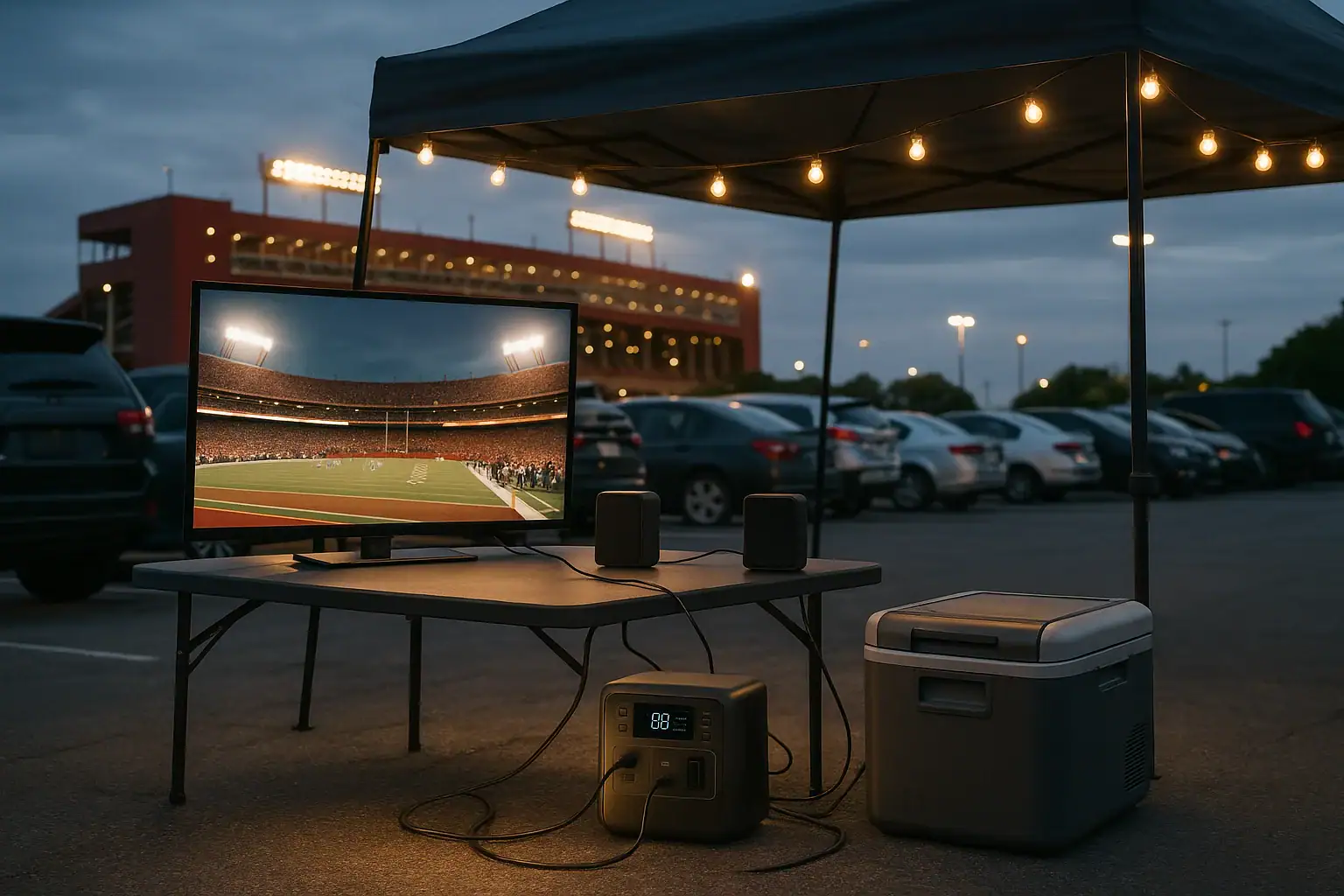
Portable Power Station for Tailgating: TV, Speakers, Cooler, and Lighting Setup

Portable power station running a tailgating TV, speakers, cooler, and lights

A portable power station can run a tailgating TV, speakers, cooler, and lighting if its watt-hours, inverter rating, outlets, and charging options match the total load.

For most game-day setups, the main questions are simple: how many watts the devices use, how long you need runtime, whether anything has surge watts, and whether the station has enough AC outlets and USB-C PD ports. A TV and LED lights are usually predictable loads. A cooler cycles on and off. Speakers vary widely depending on volume and whether they use AC, USB, or a built-in battery.

The right size depends less on the number of devices and more on the combined power draw over time. A small setup may need only a few hundred watt-hours, while an all-day tailgate with a TV, cooler, sound system, and lighting may need a larger battery capacity and a stronger pure sine wave inverter.

What a portable power station does at a tailgate and why it matters

A portable power station is a rechargeable battery system with built-in outputs for powering electronics away from a wall outlet. For tailgating, it replaces noisy fuel generators for many light-to-medium loads, especially entertainment and comfort items such as a TV, speakers, cooler, phone chargers, and LED lighting.

The reason it matters is control. In a parking lot, you may not have access to shore power, and vehicle outlets are not designed to run a full entertainment setup for hours with the engine off. A power station gives you a dedicated battery, a rated inverter for AC devices, DC ports for efficient low-voltage gear, and USB ports for phones, tablets, and small audio devices.

It also helps reduce common tailgating problems. TVs may shut off if the inverter is too small. Coolers may drain a battery faster than expected in hot weather. Speakers may create annoying hum if powered from a poor-quality AC source. Lights and phone chargers may use little power individually, but they still add up during a long pregame and postgame session.

For a reliable setup, think of the power station as the center of a small off-grid system. Every device connected to it needs three things: the right outlet type, enough running watts, and enough battery capacity for the time you plan to use it.

How to size power for a TV, speakers, cooler, and lights

The basic sizing formula is watts multiplied by hours equals watt-hours. If a 60-watt TV runs for 4 hours, it uses about 240 watt-hours before efficiency losses. Power stations are rated in watt-hours, but real usable energy is usually lower because inverters, voltage conversion, heat, cable losses, and standby consumption all take a share.

Start by listing each device and its typical watt draw. The label on the device or power adapter may show watts directly. If it shows volts and amps, multiply volts by amps to estimate watts. For example, a 12-volt cooler drawing 5 amps uses about 60 watts while running. However, compressor coolers cycle, so the average draw may be lower than the maximum. Thermoelectric coolers often run more continuously and can use more energy over a long day.

Next, check output type. A TV usually needs AC power unless it is a 12-volt travel model. Speakers may use AC, USB-C, or their own internal battery. Coolers may use 12-volt DC or AC. LED light strings may use USB, DC, or AC. Whenever possible, using DC or USB outputs can reduce conversion losses compared with running everything through the inverter.

Finally, compare the combined running watts with the continuous inverter rating. If the TV uses 80 watts, the cooler uses 60 watts while running, speakers use 40 watts, and lights use 20 watts, the live load is about 200 watts. A station with comfortable headroom is better than one operating at its limit, especially when a compressor starts or when volume, screen brightness, or ambient temperature increases.

Tailgating deviceTypical running drawPlanning note
32 to 43 inch LED TV40 to 100 wattsBrightness, screen size, and outdoor visibility settings can change power use.
Compact powered speakers10 to 75 wattsHigher volume and bass-heavy playback increase draw.
12-volt compressor cooler35 to 75 watts while runningAverage use depends on cycling, shade, starting temperature, and how often it is opened.
Thermoelectric cooler45 to 90 wattsOften runs continuously, so energy use can be higher over time.
LED string lights or area lights5 to 30 wattsEfficient, predictable load that is easy to budget.
Phones and small devices5 to 30 watts eachUSB charging is usually a small but steady add-on load.
Example values for illustration.

Real-world tailgating setup examples

A compact setup might include a small LED TV, one Bluetooth speaker that is mostly running from its own battery, a USB light, and a few phone charges. This type of setup may average under 100 watts most of the time. If the event lasts 4 to 5 hours, a station in the several-hundred-watt-hour range can often be enough, especially if the speaker is not drawing continuous AC power.

A moderate setup is more common for sports tailgating. It might include a 40-inch TV, powered speakers, a compressor cooler, LED lights after sunset, and several phones. The live load may average around 150 to 250 watts depending on the cooler and audio system. For a 5-hour event, that can mean roughly 750 to 1,250 watt-hours before allowing for inefficiency and reserve capacity. In this case, headroom matters because the cooler may cycle during the hottest part of the day and the TV may be set to high brightness.

A larger setup may include a bigger TV, soundbar or PA-style speaker, multiple lights, a cooler, a fan, and charging for many devices. This can move into the 300 to 600 watt range while everything is active. A larger power station may be appropriate, but the setup should still be kept realistic. Portable stations are excellent for electronics, cooling, and lighting, but high-heat appliances such as grills, hot plates, coffee makers, and space heaters can rapidly drain batteries and may exceed inverter limits.

If you want a simple planning target, estimate your expected watt load, multiply by the hours of use, then add a reserve. A reserve of 20 to 30 percent is practical for outdoor use because conditions change. Hot weather, poor ventilation, a brighter TV setting, more guests charging phones, or a cooler full of warm drinks can all increase energy use.

Common mistakes and troubleshooting cues

One common mistake is sizing only by battery capacity and ignoring inverter output. A station may have enough watt-hours on paper but still fail if the AC inverter cannot handle the combined load. If the TV turns off when the cooler starts, the issue may be a surge or peak load rather than total capacity.

Another mistake is assuming all coolers behave the same. A compressor cooler usually cycles and can be efficient once contents are cold. A thermoelectric cooler may draw a steady amount for the entire event. If runtime is much shorter than expected, the cooler is often the first device to investigate. Pre-chilling food and drinks at home, keeping the lid closed, and placing the cooler in shade can make a major difference.

TV problems often come from startup behavior, inverter quality, or brightness settings. If a TV flickers, shuts down, or shows power errors, check whether the station is near its AC limit, whether other AC loads can be moved to DC or USB, and whether the TV power adapter is fully seated. A pure sine wave inverter is generally preferred for sensitive electronics and audio equipment.

Speaker issues can show up as hum, static, sudden shutdowns, or unexpectedly fast battery drain. Hum may be related to AC adapters, cable routing, or shared power with other devices. Battery drain may be caused by high volume, powered subwoofers, or leaving the inverter on when only USB devices are needed.

Lighting is usually the easiest load, but it can still cause confusion when using long cords or multiple strings. If lights dim or shut off, check the power mode, total wattage, and whether the outlet being used has its own limit. USB light strings should be matched to the station’s USB output capability.

Safety basics for parking-lot power

Use the power station within its published output ratings and avoid overloading outlets. Continuous watts and surge watts are not the same. Continuous watts describe what the unit can supply steadily. Surge watts describe brief startup demand, often relevant for compressor coolers. A setup that runs comfortably below the continuous rating is usually more stable and generates less heat.

Keep the station off wet ground and protected from rain, spilled drinks, and cooler condensation. Most portable power stations are not meant to be exposed to water. If the weather turns, disconnect nonessential loads and move the unit to a dry, ventilated area. Do not place it inside a sealed cooler, under a pile of blankets, or in direct sun for hours, because heat can reduce performance and may trigger protective shutdown.

Use outdoor-rated extension cords when cords are needed, and keep walkways clear to reduce trip hazards. Do not daisy-chain multiple power strips or bury cords under heavy tailgate gear. Keep cable runs short and organized, especially around chairs, grills, vehicles, and foot traffic.

Avoid using a portable power station for improvised vehicle or building wiring. Do not open the unit, modify battery packs, bypass protections, or connect it into electrical panels. If a setup involves hardwired equipment or permanent power distribution, consult a qualified electrician. For normal tailgating, the safest approach is simple plug-in use within the station’s rated outlets.

Maintenance and storage before and after game day

Tailgating is easier when the power station is treated like essential gear, not an afterthought. Charge it before the event, verify that the screen or app shows the expected state of charge, and test the actual devices you plan to bring. A short test at home can reveal missing adapters, overloaded outlets, or a cooler that draws more than expected.

Store the station in a clean, dry place away from extreme temperatures. Long periods in a hot vehicle can age batteries faster, while very cold conditions can reduce available output and charging performance. If the unit will sit unused for weeks or months, follow the manufacturer’s storage guidance for charge level and check it periodically.

After a tailgate, wipe dust and moisture from the exterior, inspect cords and adapters, and recharge the unit before putting it away. If you used the power station heavily, let it cool in a ventilated area before charging. Keep a small kit with the needed power cords, USB cables, DC adapters, and extension cords so the next setup is not delayed by missing parts.

For battery longevity, avoid treating zero percent as a normal stopping point. It is better to plan enough capacity that the station finishes the event with a reserve. That reserve is also useful if the game runs long, traffic delays departure, or you need lighting and phone charging after the main setup is packed.

Practical takeaways and specs to look for

TaskWhen to do itWhy it helps
Fully charge the stationOne day before the tailgateConfirms usable capacity and avoids last-minute charging limits.
Test TV, cooler, speakers, and lights togetherBefore the first eventShows the real combined load and reveals outlet conflicts.
Pre-chill cooler contentsBefore packingReduces compressor runtime and extends battery life.
Pack correct cables and adaptersBefore leaving homePrevents inefficient workarounds and unused ports.
Recharge and inspect gearAfter the eventKeeps the system ready and catches damaged cords early.
Example values for illustration.

Related guides: Portable Power Station Basics: Outputs, Inputs, and What the Numbers Mean • Surge Watts vs Running Watts: How to Size a Portable Power Station • Pure Sine Wave vs Modified Sine Wave: Does It Matter for a Portable Power Station?

The best portable power station for tailgating is the one that fits your actual devices, event length, and parking-lot conditions. For most people, the priorities are enough watt-hours for the full event, enough continuous inverter output for the TV and cooler at the same time, and the right mix of AC, USB, and DC ports.

Keep the setup efficient. Use LED lighting, pre-chill the cooler, reduce TV brightness when possible, and avoid powering high-heat appliances from the same battery meant for entertainment. If runtime is uncertain, test the setup at home for one hour and use the battery percentage drop to estimate total time.

Specs to look for

  • Battery capacity: Look for several hundred watt-hours for a compact setup and around 1,000 watt-hours or more for longer TV, cooler, speaker, and lighting use; this determines practical runtime.
  • Continuous AC output: Look for enough running watts to cover all AC devices at once, often 300 to 800 watts for typical tailgates; this prevents overload shutdowns.
  • Surge watt rating: Look for headroom above the cooler’s startup demand, such as 2 times the expected running draw; this helps compressor devices start reliably.
  • Pure sine wave inverter: Look for a pure sine wave AC output for TVs, audio gear, and sensitive adapters; this can reduce compatibility problems and audio noise.
  • Outlet mix: Look for multiple AC outlets plus USB-A, USB-C PD, and 12-volt DC options; this lets you power devices efficiently without unnecessary adapters.
  • USB-C PD output: Look for 60 to 100 watts if you plan to charge tablets, laptops, or modern speakers; higher PD output can reduce the need for AC chargers.
  • Recharge speed: Look for AC recharge that can refill the unit in a few hours if you tailgate often; faster charging makes back-to-back events easier.
  • Display and load monitoring: Look for a clear screen showing watts in, watts out, percentage, and estimated runtime; this helps you manage power during the event.
  • Operating temperature range: Look for outdoor-friendly performance in warm and cool conditions; parking lots can be hotter or colder than expected.
  • Weight and handle design: Look for a size you can carry with other gear, such as compact units for short events or wheeled support for larger capacities; portability affects real use.

For a clean tailgating setup, plan the loads first, then choose capacity and outputs. A TV, speakers, cooler, and lighting can work well from one portable power station when the system has enough runtime, inverter headroom, and organized cabling.

Frequently asked questions

How long can a portable power station run a TV, speakers, cooler, and lights at a tailgate?

Runtime depends on the total watt draw, battery capacity, and how efficiently each device uses power. A small setup may last several hours, while a larger setup with a cooler and brighter TV can drain a battery much faster. The most reliable way to estimate runtime is to add the running watts of all devices and compare that to the station’s usable watt-hours.

What specs matter most when choosing a portable power station for tailgating?

The most important specs are battery capacity, continuous inverter output, surge rating, and outlet types. For a tailgate, it also helps to have a pure sine wave inverter, USB-C PD, and enough AC and DC ports for your gear. If you plan to run a cooler, make sure the unit can handle startup demand, not just average use.

What is the most common mistake people make with tailgating power setups?

A common mistake is focusing only on watt-hours and ignoring inverter limits or surge demand. That can lead to a TV shutting off when a cooler starts or when several devices run at once. Another frequent issue is underestimating how much power a cooler or high-brightness TV uses over several hours.

Is it safe to use a portable power station in a parking lot?

Yes, if you use it according to the manufacturer’s ratings and keep it dry, ventilated, and protected from damage. Avoid overloading outlets, exposing the unit to rain or spills, and running cords where people can trip. Do not modify the unit or connect it to building wiring.

Can a portable power station run a cooler all day at a tailgate?

It can, but only if the cooler type and battery capacity match the event length. Compressor coolers are usually more efficient than thermoelectric models because they cycle on and off instead of running constantly. Pre-chilling the contents and keeping the cooler in shade can significantly extend runtime.

Should I use AC, DC, or USB outputs for a tailgating setup?

Use the output type that matches the device whenever possible. DC and USB are often more efficient for lights, phones, and some coolers, while AC is needed for most TVs and some speakers. Using the most direct output available can reduce conversion losses and improve runtime.

How Many Watts Do You Really Need?

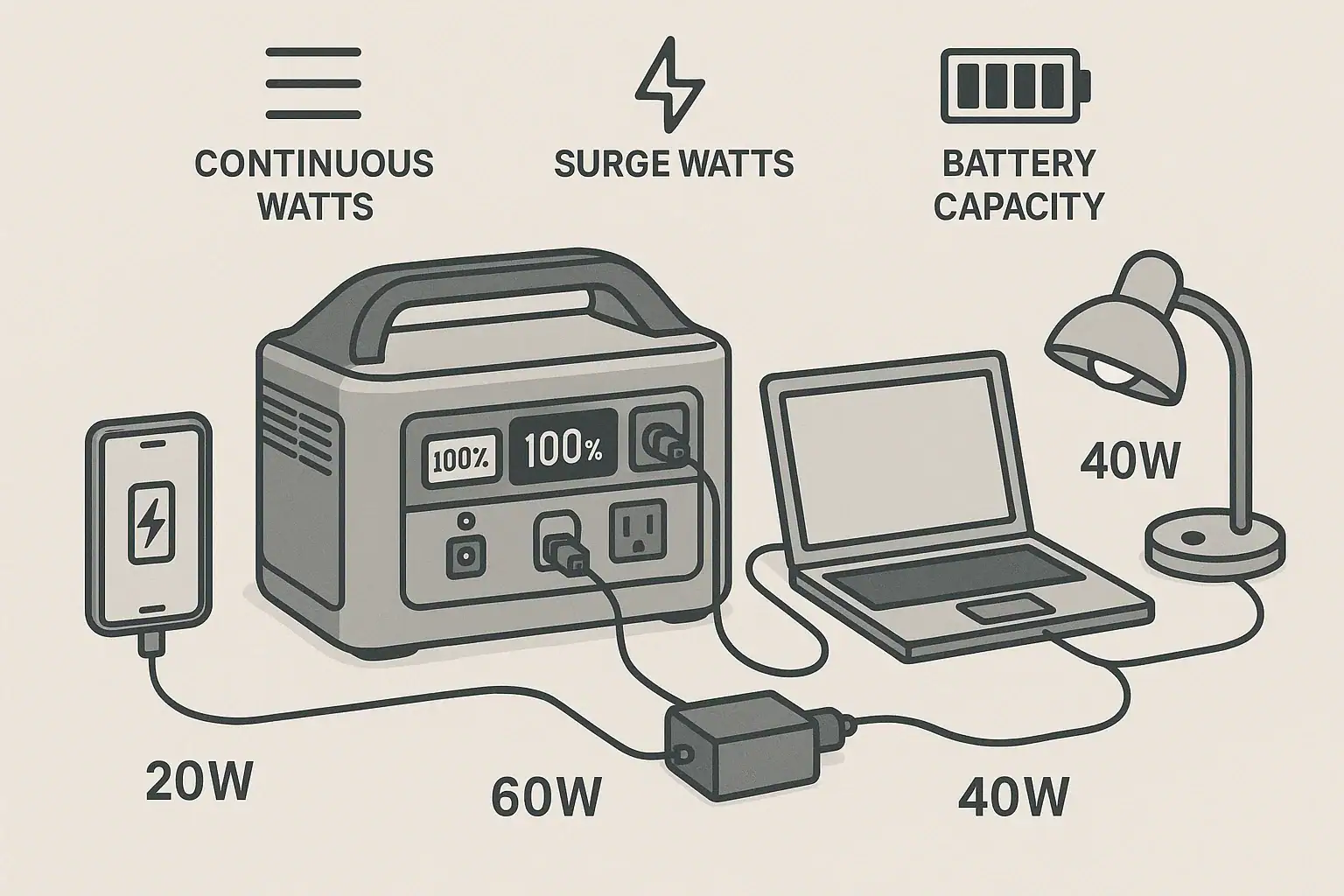
Portable power station showing watt usage for several devices

Most people need between 300 and 1,500 watts of usable power from a portable power station, depending on which devices they want to run and for how long. The right wattage depends on continuous watts, surge watts, battery capacity, and how you balance runtime with size and cost. Understanding your real watt needs helps you avoid overload errors, short runtimes, and confusing input limit or PD profile issues.

Instead of guessing, you can calculate your watt requirements based on the devices you actually use: phones, laptops, fridges, CPAP machines, power tools, and more. From there, you match those needs to a power station’s rated output watts and watt-hours of capacity.

This guide explains what watts really mean for portable power stations, how to read the specs, how to estimate runtime, and how to avoid common mistakes like mixing up surge watts and continuous watts. By the end, you will know how many watts you really need and which key specs to focus on.

Understanding Watts and Why They Matter for Portable Power Stations

Watts are a measure of power: how fast energy is being used or delivered at any moment. For portable power stations, watts tell you two critical things:

  • How much power you can draw at once (what you can plug in and run simultaneously).
  • How quickly you will drain the battery (which affects runtime).

When you ask, “How many watts do I need?” you are really asking two related questions:

  • Output power: What is the maximum continuous wattage the power station can safely deliver without tripping protection?
  • Energy capacity: How many watt-hours (Wh) are stored in the battery so you know how long devices can run?

These two ideas are easy to confuse. A unit with high output watts but low watt-hours can power big loads, but not for long. A unit with high watt-hours but low output watts can run smaller loads for a long time, but cannot start or run heavy appliances.

Knowing the difference between watts (W) and watt-hours (Wh), and between continuous and surge watts, is the foundation for sizing a portable power station correctly.

Key Power Concepts: Continuous Watts, Surge Watts, and Watt-Hours

To match a portable power station to your needs, you should understand a few key power and capacity terms that show up in spec sheets.

Continuous output watts

Continuous watts (sometimes called rated output) is the maximum power the inverter can supply steadily without overheating or shutting down. This tells you the total wattage of devices you can run at the same time.

Example: If your power station is rated for 600 W continuous, you can run up to 600 W of combined loads. A 300 W device plus a 200 W device plus a 50 W device (total 550 W) should be fine; adding another 200 W device (total 750 W) will likely trip the overload protection.

Surge watts (peak watts)

Surge watts (or peak watts) is the short burst of power the inverter can handle for a few seconds to start devices with high inrush current, like compressors and motors. Many appliances need more power to start than to run.

Example: A fridge might run at 80–120 W but need 400–600 W for a second or two when the compressor kicks on. If your surge rating is too low, the unit may shut down when the device starts, even though the running watts are within the continuous limit.

Battery capacity: watt-hours (Wh)

Watt-hours (Wh) measure stored energy. This tells you how long you can run a given load. In simple terms:

Runtime (hours) ≈ usable Wh ÷ device watts

Real runtime is always less than the math due to inverter losses and efficiency, so many users use 80–90% of the rated Wh as a realistic usable capacity.

AC vs DC output watts

Portable power stations often have multiple output types:

  • AC outlets: 110–120 V AC, used for most household devices; limited by inverter capacity.
  • DC outputs: 12 V car socket and barrel ports; more efficient for some devices.
  • USB-A and USB-C (including PD): 5–20 V DC, limited by each port’s watt rating and PD profile.

Manufacturers may also specify a total combined output limit across all ports. If you exceed it, the unit may reduce output or shut off ports.

Input watts and charging limits

Input watts describe how fast you can recharge the battery from AC, solar, or car charging. For off-grid or frequent-use scenarios, higher input watts mean faster turnaround time between discharges.

Example values for illustration.
TermWhat it MeansTypical Range
Continuous Output WattsMax sustained power to loads200–2,000 W
Surge WattsShort burst for startup1.5–2x continuous
Battery CapacityStored energy200–2,000 Wh
AC Input WattsMax charging rate from wall100–1,200 W
Solar Input WattsMax solar charging rate100–800 W

Real-World Wattage Examples: What Different Users Actually Need

The right wattage depends heavily on how and where you plan to use a portable power station. Here are typical scenarios and rough watt requirements to show how needs vary.

Light personal use: phones, tablets, and laptops

For basic everyday backup or travel use, loads are small and continuous watts can be modest.

  • Smartphone charging: 5–20 W (more with fast charging).
  • Tablet: 10–30 W.
  • Laptop (USB-C PD or AC): 45–100 W depending on model and workload.

If you plan to charge a phone (15 W), a tablet (20 W), and a laptop (60 W) at once, you only need around 100 W of continuous output, plus some headroom. A 200–300 W continuous inverter with 200–500 Wh of capacity is usually sufficient for this type of use.

Remote work or small office setup

Running a laptop, monitor, and networking gear requires more power but still stays in a moderate range.

  • Laptop: 60 W.
  • 24–27 inch monitor: 20–40 W each.
  • Router/modem: 10–20 W.
  • LED desk lamp: 5–10 W.

Total: roughly 100–150 W for a single-person setup. A power station with 300–600 W continuous and 500–1,000 Wh capacity gives reasonable runtime and flexibility to add a second monitor or charge other devices.

Camping and van life essentials

Off-grid camping often combines small electronics with a few larger items.

  • LED lights: 5–20 W total.
  • 12 V fridge or cooler: 30–60 W running, higher on startup.
  • Phone and camera charging: 20–40 W combined.
  • Occasional laptop use: 60–90 W.

Peak draw might be around 150–250 W, but the fridge cycling can cause short surges. A continuous rating in the 300–600 W range with 500–1,000 Wh capacity is common for this use. If you also want to run an induction cooktop, electric kettle, or microwave, your needs jump into the 1,000+ W range.

Home backup for small appliances

For short power outages, many people want to keep a few key appliances running:

  • Refrigerator: 80–150 W running, 400–800 W surge.
  • Wi-Fi router: 10–20 W.
  • LED room lighting: 10–40 W total.
  • Phone and laptop charging: 30–100 W.

Running a fridge plus a few small loads typically requires at least 500–800 W continuous and enough surge capacity to handle compressor startup. For several hours of runtime, 1,000–2,000 Wh of capacity is more realistic, especially if the fridge cycles frequently.

Power tools and jobsite use

Power tools and equipment often draw high watts and have strong surge demands.

  • Cordless tool battery charger: 50–150 W.
  • Small circular saw: 800–1,200 W surge, 500–800 W running.
  • Air compressor (small): 800–1,500 W surge, 300–800 W running.

For this type of use, a portable power station with 1,000–2,000 W continuous and robust surge capability is often necessary. Capacity needs depend on how long the tools will run; even 1,000 Wh can deplete quickly under heavy use.

Medical devices (high-level only)

Some users need portable power for critical medical devices such as CPAP machines. Power draw varies, but many CPAP units use 30–80 W depending on settings and whether a heated humidifier is enabled. For an 8-hour night at 50 W average, you might want at least 400–600 Wh of usable capacity, plus enough continuous output (typically 100+ W) for safety margin. Always check the device’s label and consult a qualified professional for critical medical applications.

Common Wattage Mistakes and Troubleshooting Overload Issues

Mismatching watts is one of the main reasons portable power stations shut down unexpectedly or deliver disappointing runtime. Understanding frequent errors can help you avoid frustration.

Confusing watts and watt-hours

Many users see a large Wh number and assume they can run anything. But watt-hours only tell you how long the battery can supply power, not how powerful the inverter is. A 500 Wh unit with a 300 W inverter cannot run a 700 W microwave, even briefly.

Ignoring surge watt requirements

Devices with motors or compressors, such as fridges, pumps, and some tools, may require 2–3 times their running watts at startup. If the surge exceeds the inverter’s limit, the unit may:

  • Click off or display an overload error.
  • Cycle the device on and off repeatedly.
  • Refuse to start the load at all.

If you see the display spike and then drop to zero when a device tries to start, surge watts are likely the issue.

Overloading by stacking small devices

It is easy to exceed continuous watts by adding many small loads. A few chargers, a fan, some lights, and a laptop can quietly add up. If your portable power station suddenly shuts off when you plug in “one last thing,” check the total watt draw shown on the display and compare it to the continuous rating.

Underestimating runtime at higher loads

Running near the maximum continuous watt rating drains the battery quickly and increases conversion losses. A 1,000 Wh unit powering a 1,000 W load will not run for a full hour in real-world conditions; 40–50 minutes is more typical. If your runtime is shorter than expected, consider:

  • Actual watts shown on the display vs the device label.
  • Inverter efficiency (usually 80–90%).
  • Battery management system keeping some capacity in reserve.

Troubleshooting cues

Common signs that your watts are mismatched include:

  • Overload or protection icons on the screen.
  • Repeated shutdowns when certain devices start.
  • AC output turning off while DC or USB still works.
  • Unusually short runtime compared to simple calculations.

When this happens, reduce the number of connected devices, unplug high-surge loads, and compare the total draw to the unit’s continuous and surge ratings. If problems persist, a higher-wattage power station may be required for your use case.

Safety Basics When Dealing With Watts and Loads

Portable power stations are designed with built-in protections, but using the correct wattage range is still important for safety and reliability.

Stay within rated output

Always keep your total load within the manufacturer’s continuous watt rating, with some margin. Running at the absolute limit for long periods can increase heat and wear. Aiming for 70–80% of the continuous rating for steady loads is a conservative approach.

Avoid daisy-chaining power strips and adapters

Plugging multiple power strips or high-draw adapters into one outlet can encourage overloads and make it harder to track total watts. Use the built-in outlets and ports as intended, and distribute loads across them when possible.

Use appropriate cords and connectors

Undersized extension cords or damaged cables can overheat even if your power station is within its watt rating. Use cables rated for the loads you plan to run, keep connections secure, and avoid pinching or sharply bending cords.

Respect surge loads and motor-driven devices

Repeatedly forcing a portable power station to start loads that exceed its surge rating can stress components. If a fridge, pump, or tool will not start reliably, do not keep trying to force it; instead, use a power source with adequate surge capability or consult a qualified electrician for alternatives.

Do not integrate directly into home wiring

Portable power stations are meant to power devices directly, not to be wired into a home’s electrical panel without proper transfer equipment. For any connection to household circuits, consult a licensed electrician and use approved transfer methods. Improper connections can create shock hazards and backfeed risks.

How Wattage Affects Maintenance, Charging, and Storage Habits

Your watt needs influence how often you cycle the battery, how fast you recharge, and how you care for the power station over time.

High-watt vs low-watt usage patterns

Running near maximum watt output frequently will cycle the battery more deeply and generate more heat. Over time, this can contribute to faster capacity loss compared to light, occasional use. If you regularly need high watt output, choosing a unit with some overhead can reduce stress on components.

Charging speed and input watts

If your usage regularly drains a large portion of the battery, higher input watts (from AC or solar) help you recover faster. However, fast charging can also generate more heat. Many users balance convenience and longevity by not always charging at the absolute maximum rate when time allows a slower charge.

Storage level and self-discharge

When storing a portable power station, most manufacturers recommend leaving the battery partially charged rather than full or empty. Because higher watt usage often means more frequent cycling, it is especially important to:

  • Top up the battery to a moderate level (often around 40–80%) before long storage.
  • Check and recharge every few months to counter self-discharge.

Staying aware of your typical watt draw helps you plan these maintenance charges before the battery gets too low.

Thermal management

High-watt loads warm the inverter and battery more quickly. Keep ventilation openings clear, avoid covering the unit during heavy use, and store it in a cool, dry place away from direct sun. Elevated temperatures can accelerate battery aging, especially if combined with high loads and fast charging.

Monitoring usage over time

Many portable power stations display real-time watts in and out. Watching these numbers during everyday use can teach you which devices are the biggest contributors to load. Over time, you may adjust habits, such as staggering high-watt devices instead of running them all at once, which reduces stress and can improve overall battery longevity.

Example values for illustration.
Usage PatternTypical LoadMaintenance Implication
Light Daily UseUnder 150 WLonger intervals between charges, slower aging
Moderate Mixed Use150–600 WRegular cycling, monitor temperature and charge level
Heavy High-Watt Use600+ WMore heat, more frequent cycling, benefit from higher input watts

Related guides: Surge Watts vs Running Watts: How to Size a Portable Power Station • How to Estimate Runtime for Any Device: A Simple Wh Formula + 5 Worked Examples • How to Choose the Right Size Portable Power Station

Practical Takeaways and How to Choose the Right Wattage

Choosing how many watts you really need comes down to listing your devices, adding up their running watts, accounting for surge, and deciding how long you want them to run on battery power. Then, you match those needs to a portable power station’s continuous output watts, surge watts, and watt-hour capacity.

For light personal use, a few hundred watts of output and a few hundred watt-hours of capacity may be enough. For home backup, camping fridges, or power tools, it is common to need 500–2,000 W of output and 500–2,000 Wh of capacity, depending on how many devices you use and for how long.

Specs to look for

  • Continuous AC output (W): Look for 200–500 W for light use, 500–1,000 W for fridges and small appliances, and 1,000+ W for tools; this sets what you can run at once.
  • Surge/peak watts: Aim for at least 1.5–2 times the continuous rating; higher surge helps start fridges, pumps, and some power tools without overloads.
  • Battery capacity (Wh): Choose 200–500 Wh for short sessions, 500–1,000 Wh for overnight use, and 1,000–2,000+ Wh for multi-device backup; higher Wh means longer runtime.
  • AC inverter type and efficiency: Look for a pure sine wave inverter with typical efficiency of 80–90%; better efficiency means more usable runtime from the same Wh.
  • Total DC and USB output watts: Ensure USB and 12 V ports can cover your phones, tablets, and 12 V devices simultaneously, often 60–200 W combined; this reduces reliance on AC outlets.
  • Input charging watts (AC/solar): For frequent or off-grid use, 200–600 W of input allows faster recharges; higher input is useful when you regularly drain most of the battery.
  • Display and monitoring: A clear screen showing real-time watts in/out and remaining percentage helps you avoid overloads and manage runtime more accurately.
  • Operating temperature range: A wide, clearly stated temperature range supports safe use in hot or cold environments; extreme temps can limit available watts and runtime.
  • Protection features: Built-in overload, over-temperature, and low-voltage protections help prevent damage when you approach watt limits or miscalculate loads.

By focusing on these watt-related specs and comparing them to your actual devices and usage patterns, you can select a portable power station that delivers the power you need without constant overloads or unexpectedly short runtimes.

Frequently asked questions

How do I calculate the wattage I need for my devices?

List the running watts of every device you plan to power and add them to get your total continuous load, then allow headroom (typically 20–30%). Estimate runtime by dividing usable watt-hours by the combined running watts and factor in inverter losses. Check surge requirements separately for motorized devices.

Which specs and features should I prioritize when choosing a portable power station?

Prioritize continuous AC output watts, surge/peak watts, and battery capacity in watt-hours because they determine what you can run and for how long. Also consider inverter type (pure sine), total DC/USB output, input charging watts, and monitoring features for real-time load and remaining runtime.

What is a common mistake that causes portable power stations to shut down unexpectedly?

A frequent error is underestimating surge watts or adding many small loads until the continuous rating is exceeded, both of which can trigger overload protection. Always compare the real-time draw to the unit’s continuous and surge ratings before adding more devices.

What safety precautions should I follow when using a portable power station?

Keep total loads within the continuous rating with some margin, use properly rated cords and avoid daisy-chaining power strips, and ensure good ventilation during heavy use. Do not wire the unit directly into home circuits without proper transfer equipment and a licensed electrician.

Can I charge a power station with solar while running appliances at the same time?

Some power stations support pass-through or simultaneous use while charging, but capabilities and efficiency vary by model and input limits. Check the unit’s specs for supported input watts and whether pass-through is allowed to avoid reduced charging speed or potential heat issues.

How much surge capacity do I need to start appliances with motors or compressors?

Many motorized appliances require 1.5–3 times their running watts at startup; check the appliance’s start-up current or manufacturer spec. Choose a power station with a surge rating that comfortably exceeds those startup needs to avoid startup failures.

Portable Power Station Watt-Hours Explained

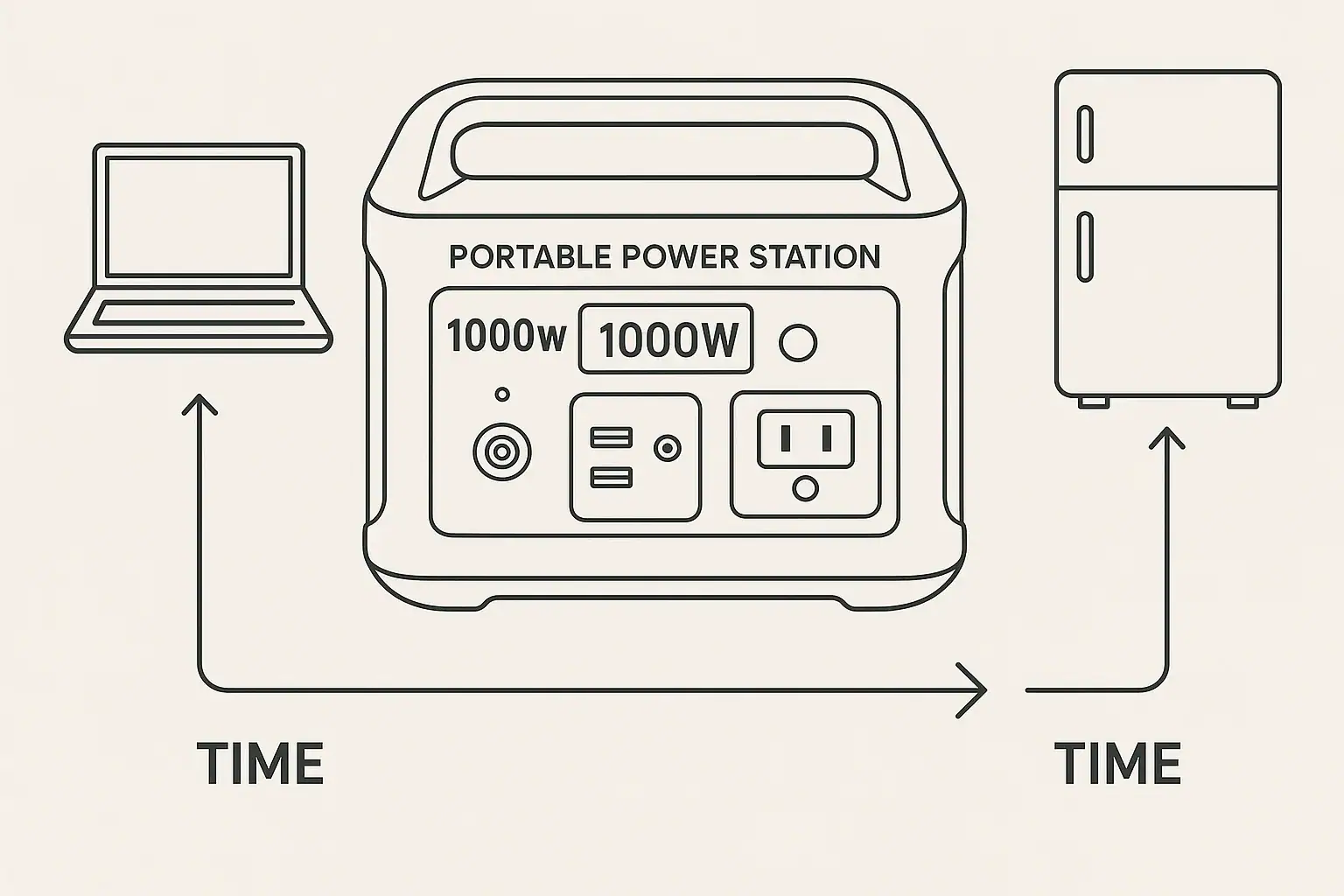
Diagram explaining portable power station watt-hours and device runtimes

Watt-hours on a portable power station tell you how much total energy the battery can deliver, and they are the key to estimating runtime and matching capacity to your devices. Understanding watt-hours, wattage, surge watts, and input limits helps you avoid running out of power too soon or overpaying for capacity you do not need. When you know how watt-hours work, you can compare models, plan off-grid use, and troubleshoot why your runtime does not match the marketing claims.

People often search for terms like battery capacity, Wh rating, runtime calculator, AC output watts, and power draw when trying to figure out if a portable power station can handle a fridge, CPAP, laptop, or power tools. This guide explains watt-hours in plain language, walks through real-world examples, and highlights the specs that matter most so you can size a unit correctly for camping, outages, and everyday backup power.

What Watt-Hours Mean on a Portable Power Station and Why They Matter

Watt-hours (Wh) are a measure of energy. On a portable power station, the watt-hour rating tells you how much total work the battery can do before it needs to be recharged. Think of it as the size of the fuel tank, but for electricity instead of gasoline.

One watt-hour is one watt of power used for one hour. If a device draws 50 watts continuously for one hour, it consumes 50 watt-hours of energy. If you have a 500 Wh battery and you run that 50 W device, the simple math suggests up to 10 hours of runtime (500 Wh ÷ 50 W = 10 hours), before accounting for losses and inverter efficiency.

Watt-hours matter because they directly influence:

  • Runtime: How long you can power a device or combination of devices.
  • Use cases: Whether a station is suitable for phones and laptops only, or also for fridges, CPAP machines, or power tools.
  • Size and weight: Higher Wh capacity usually means a larger, heavier unit.
  • Charging needs: Bigger batteries take longer to recharge unless they support higher input wattage.

Without understanding watt-hours, it is easy to misinterpret marketing numbers like peak watts or surge power and end up with a station that can technically start a device but cannot run it for long.

Key Watt-Hour Concepts and How Portable Power Capacity Really Works

To make sense of watt-hours on a portable power station, it helps to break down a few related concepts: power (watts), energy (watt-hours), voltage, and efficiency.

Power (Watts) vs. Energy (Watt-Hours)

Watts (W) describe the rate of energy use at a given moment. A 100 W light bulb uses energy faster than a 10 W LED. Watt-hours (Wh) describe the total amount of energy used over time. If that 100 W bulb runs for 3 hours, it uses 300 Wh.

Portable power stations usually list both:

  • Battery capacity in Wh (for example, 300 Wh, 500 Wh, 1000 Wh, 2000 Wh).
  • Output power in W (for example, 300 W continuous, 600 W surge).

The Wh rating tells you how long; the W rating tells you how much at once.

Battery Capacity vs. Usable Capacity

The stated watt-hour capacity is usually based on the internal battery cells at their nominal voltage. However, what you can actually use at the AC outlets is lower because of:

  • Inverter losses: Converting DC battery power to AC typically wastes 5–15% of energy.
  • Electronics overhead: The internal electronics consume some power even at low loads.
  • Discharge limits: To protect the battery, the system may not let you use 100% of the stored energy.

A practical rule of thumb is that usable AC energy is often around 80–90% of the rated Wh, depending on design and how you use it. DC outputs (like USB or 12 V ports) are usually more efficient than AC.

How Voltage and Amp-Hours Relate to Watt-Hours

Sometimes capacity is described in amp-hours (Ah) at a certain voltage. The relationship is:

Watt-hours = Volts × Amp-hours

For example, a 12 V battery rated at 50 Ah has about 600 Wh (12 V × 50 Ah). Portable power stations often use battery packs with nominal voltages around 12 V or 24 V internally, but they convert that to standard AC and DC outputs for your devices.

Continuous Watts, Surge Watts, and Watt-Hours

Continuous watts is the maximum power the station can supply steadily. Surge watts is the short burst available to start devices with high inrush current, such as compressors or motors. Watt-hours are independent of these limits but interact with them in practice:

  • A station might have enough surge watts to start a fridge but not enough Wh to run it for many hours.
  • A unit with high Wh but low continuous watts might run small devices for days but cannot power a microwave.

Input Limits and Charging Watt-Hours

Charging the battery also involves watts and watt-hours:

  • Input watts (from wall, solar, or car) determine how fast energy flows into the battery.
  • To estimate charge time, divide battery Wh by input W, then adjust for efficiency and tapering near full charge.

For example, a 1000 Wh station charging at 200 W might take around 5–6 hours from low to full, depending on losses and charge profile.

TermTypical UnitWhat It DescribesSimple Example
PowerWatts (W)Rate of energy use100 W bulb
EnergyWatt-hours (Wh)Total energy over time100 W for 3 h = 300 Wh
Battery CapacityWhSize of energy “tank”500 Wh station
Continuous OutputWMax steady load600 W continuous
Surge OutputWShort start-up burst1200 W surge
Input PowerWCharging rate200 W wall charger
Example values for illustration.

Real-World Watt-Hour Examples: How Long Will a Portable Power Station Last?

To turn watt-hours into something practical, you need to estimate how much power your devices draw and for how long you will use them. The basic formula is:

Runtime (hours) ≈ Usable Wh ÷ Device Power (W)

Remember to adjust the Wh rating for efficiency, especially when using AC outputs.

Example 1: Charging Phones and Laptops

Imagine a compact 300 Wh portable power station used for light electronics:

  • Smartphone charging: about 10 Wh per full charge.
  • Laptop charging: around 50–70 Wh per full charge, depending on size and usage.

If we assume 85% usable energy from 300 Wh, that is about 255 Wh available. You could roughly:

  • Charge a phone 10–15 times (10–15 × 10 Wh = 100–150 Wh).
  • Charge a laptop 2–3 times (2–3 × 60 Wh = 120–180 Wh).

In practice, you might mix both uses and still have some reserve, depending on screen brightness, background tasks, and whether you are using the devices while charging.

Example 2: Running a CPAP Machine Overnight

Consider a CPAP drawing an average of 40 W without a heated humidifier, running for 8 hours:

  • Energy needed ≈ 40 W × 8 h = 320 Wh.

With a 500 Wh station and 85% usable energy (425 Wh), you might get:

  • 425 Wh ÷ 40 W ≈ 10.6 hours of runtime.

That is typically enough for a full night plus some margin. If you enable a heated humidifier and the draw rises to 80 W, the same station would provide:

  • 425 Wh ÷ 80 W ≈ 5.3 hours.

This is why knowing your device’s actual watt draw is critical.

Example 3: Powering a Mini Fridge or Small Fridge

A compact fridge might average 40–70 W over time but draw several hundred watts briefly when the compressor starts. Suppose the average is 60 W over 24 hours:

  • Daily energy ≈ 60 W × 24 h = 1440 Wh.

A 1000 Wh station with about 850 Wh usable AC energy would not run that fridge for a full day. You might see:

  • 850 Wh ÷ 60 W ≈ 14 hours of runtime, assuming typical cycling.

For occasional use (for example, keeping food cool for part of a day during an outage), that might be acceptable. For continuous 24/7 operation, you would need significantly more capacity or supplemental charging such as solar.

Example 4: Running a Router and Laptop During an Outage

Assume:

  • Wi-Fi router: 10 W.
  • Laptop in light use: 30 W average.

Total load is about 40 W. On a 500 Wh station with 85% usable (425 Wh):

  • 425 Wh ÷ 40 W ≈ 10.6 hours.

That is generally enough for a workday of connectivity and computing during a power cut.

Example 5: Power Tools and High-Draw Appliances

A small microwave might draw 800–1000 W. A circular saw might draw 900–1200 W while cutting. Even if your station’s continuous watt rating can handle that, watt-hours determine how long:

  • Using a 1000 W microwave for 15 minutes (0.25 h) uses about 250 Wh.
  • On a 1000 Wh station (850 Wh usable), that is nearly 30% of your usable capacity.

This is why high-power appliances drain even large portable power stations quickly. For short, occasional use, the capacity may be fine; for frequent or extended use, you will need much higher Wh or alternate power sources.

Common Watt-Hour Mistakes and Troubleshooting When Runtime Seems Wrong

Many users are surprised when their portable power station does not last as long as they expect based on the watt-hour rating. Most discrepancies come from a few common misunderstandings.

Mistaking Watts for Watt-Hours

One frequent error is confusing the station’s output watt rating with its energy capacity. A unit labeled “1000 W” might only have 500 Wh of battery capacity. That means it can power up to 1000 W of load, but only for a short time. To estimate runtime, you need the Wh figure, not just the watts.

Ignoring Inverter and Conversion Losses

Marketing numbers often assume ideal conditions. In reality:

  • AC output usually has 5–15% losses.
  • Running multiple converters (for example, AC to laptop brick to DC) adds more inefficiency.

If your calculations assume 100% of the rated Wh is usable, your runtime estimate will be too optimistic. Applying an 80–90% factor to account for losses yields more realistic numbers.

Underestimating Device Power Draw

Device labels often show maximum rating, not typical usage. Conversely, some devices draw more than expected under certain conditions:

  • Laptops can spike when charging and under heavy processing loads.
  • Fridges and freezers draw more in hot environments or with frequent door openings.
  • CPAP machines use more power with heated humidifiers or higher pressure settings.

To troubleshoot, use a plug-in power meter or the station’s built-in display (if available) to observe real-time watt draw.

Not Accounting for Standby and Idle Loads

Even when devices seem “off,” they may still draw some power. The power station itself also consumes energy to keep the inverter and control electronics running. Over many hours, those small draws add up and reduce effective runtime.

Running Near Maximum Output Continuously

Operating close to the station’s continuous watt limit for long periods can increase heat and reduce efficiency. In some designs, the inverter may throttle or shut down if temperatures climb too high, cutting runtime short or causing unexpected shutdowns.

Signs Your Watt-Hour Expectations Need Adjusting

Clues that your assumptions about watt-hours and runtime may be off include:

  • The station shuts down much sooner than your simple Wh ÷ W math predicted.
  • The display shows higher watt draw than the device’s label suggests.
  • The battery gauge drops quickly when using AC, but slowly when using DC ports.
  • Runtime varies a lot with ambient temperature or device settings.

If you see these signs, revisit your calculations using realistic watt draw, efficiency factors, and actual usage patterns.

Watt-Hours and Safety Basics for Portable Power Stations

Watt-hours describe energy capacity, and higher capacity means more stored energy. While portable power stations are designed with multiple safety features, it is important to respect the amount of energy they contain and use them within their intended limits.

Respecting Output Limits

Never exceed the continuous watt rating of the station’s AC or DC outputs. Drawing more than the rated power can:

  • Trigger overload protection and shut the unit down.
  • Cause excessive heat buildup in cables or connectors.
  • Stress internal components over time.

Always check both the watt-hour capacity and the continuous watt rating when planning which devices to connect.

Using Appropriate Cables and Connectors

Higher wattage and longer runtimes mean more current flowing through wires. To reduce risk:

  • Use cables and adapters rated for the expected current and voltage.
  • Avoid daisy-chaining multiple extension cords or power strips.
  • Keep connections secure and avoid pinched or damaged cords.

Undersized or damaged cables can overheat, especially during extended high-power use.

Ventilation and Heat Management

Portable power stations convert stored watt-hours into usable power, and some of that energy becomes heat. To maintain safe operation:

  • Place the unit on a stable, dry surface with good airflow.
  • Keep vents clear of dust, fabric, or other obstructions.
  • Avoid operating in direct sunlight or inside tightly closed containers.

High ambient temperatures and poor ventilation can reduce efficiency, shorten runtime, and trigger thermal protection.

Safe Charging Practices

Charging also involves significant energy transfer. To stay within safe limits:

  • Use charging methods and input wattages recommended by the manufacturer.
  • Avoid mixing incompatible chargers, adapters, or homemade wiring solutions.
  • Do not cover the unit while charging, and keep it away from flammable materials.

If you are integrating a portable power station with other electrical systems or external batteries, consult a qualified electrician for safe, code-compliant solutions, rather than attempting custom wiring yourself.

Environment and Placement

Because watt-hours represent stored energy, treat the station with the same respect you would give to other high-capacity batteries:

  • Keep away from standing water and excessive moisture.
  • Avoid exposure to extreme cold or heat beyond specified operating ranges.
  • Protect from impacts or crushing forces that could damage the housing or internals.

These precautions help ensure that the energy stored in the battery is released only through the intended outputs, under controlled conditions.

How Watt-Hours Affect Maintenance and Storage of Portable Power Stations

Watt-hour capacity is closely tied to battery health. Over time, all rechargeable batteries lose some capacity, which effectively reduces the number of watt-hours you can use per charge. Proper maintenance and storage can slow this process and preserve usable Wh. Before regular use, follow a first-time portable power station setup that verifies charging, outputs, firmware, and storage settings.

State of Charge for Storage

Storing a portable power station fully charged or fully depleted for long periods can accelerate capacity loss. Many battery chemistries are happiest when stored around the middle of their charge range. As general guidance:

  • Aim to store the unit at roughly 40–60% charge if it will sit unused for months.
  • Check the charge level every few months and top up if it has dropped significantly.

Following these habits helps maintain more of the original watt-hour capacity over the life of the station.

Temperature and Capacity Loss

Temperature strongly affects both immediate performance and long-term capacity:

  • Cold conditions can temporarily reduce available Wh and output power.
  • High heat can permanently reduce capacity and shorten battery life.

For storage, choose a cool, dry place out of direct sunlight. For operation, keep within the temperature ranges listed in the user documentation so the station can deliver its rated watt-hours more consistently.

Regular Cycling and Calibration

Some portable power stations estimate remaining watt-hours and runtime based on internal measurements and assumptions. Over time, the accuracy of these estimates can drift. Periodically:

  • Use the station under a moderate load and allow it to discharge to a low but safe level.
  • Recharge it fully using a recommended charging method.

This can help the internal management system recalibrate, providing more accurate readings of remaining Wh and runtime.

Monitoring Capacity Fade

As units age, you may notice:

  • Shorter runtimes for the same devices and usage patterns.
  • Faster drop from full charge to mid-level on the battery gauge.

These signs indicate that the effective watt-hour capacity has decreased. While some loss is normal over hundreds of cycles, extreme or rapid loss may suggest heavy use at high temperatures, deep discharges, or other stress factors.

Cleaning and Physical Care

Keeping the station clean and physically protected also supports safe, efficient use of its watt-hours:

  • Wipe dust and debris from vents and ports with a dry cloth.
  • Inspect cables and connectors for wear before long trips or critical use.
  • Avoid dropping or striking the unit, especially larger, high-capacity models.

Good physical care helps ensure that the stored energy can be delivered reliably when you need it.

PracticeEffect on Watt-HoursSuggested Habit
Store at mid chargeSlower long-term capacity lossKeep around 40–60% when unused
Avoid high heatPreserves usable WhStore in cool, shaded areas
Moderate discharge depthExtends cycle lifeAvoid frequent full drain
Periodic full chargeImproves gauge accuracyFully charge every few months
Clean vents and portsMaintains efficiencyDust off surfaces regularly
Example values for illustration.

Related guides: Inverter Efficiency Explained: Why Your Runtime Is Shorter Than Expected • 300Wh vs 500Wh vs 1000Wh: Choosing Capacity for Your Use Case (With Examples) • How to Estimate Runtime for Any Device: A Simple Wh Formula + 5 Worked Examples

Practical Takeaways and Watt-Hour Specs to Look For

Understanding watt-hours turns the capacity number on a portable power station from a vague marketing claim into a practical planning tool. By combining Wh with your devices’ watt draw and expected usage time, you can estimate runtime, choose appropriate capacity, and avoid common surprises.

When comparing portable power stations, think in terms of your scenarios: how many hours of backup do you need for networking and a laptop, or how many nights of CPAP use without recharging, or how long you want to run a fridge during an outage. Then match those needs to realistic usable Wh, not just the printed capacity.

Specs to look for

  • Battery capacity (Wh) – Look for a watt-hour rating that covers your total daily energy use with some margin (for example, 1.3–1.5× your estimated need). This directly determines how long your devices can run.
  • Usable capacity estimate – Seek information or reviews that indicate real-world usable Wh (often 80–90% of rated). This helps you make more accurate runtime calculations than relying on the raw number alone.
  • Continuous AC output (W) – Choose a continuous watt rating comfortably above your maximum simultaneous load (for example, 30–50% headroom). This ensures the station can power everything you plan to run at once.
  • Surge / peak output (W) – Check that surge watts exceed the startup draw of inductive loads like fridges or pumps. Adequate surge capacity prevents nuisance shutdowns when motors start.
  • Charging input power (W) – Look for input wattage that can refill the battery in a reasonable time for your use (for example, 3–6 hours from wall or solar for daily cycling). Faster input makes large Wh capacity more practical.
  • Supported charging methods – Confirm compatibility with AC wall charging, vehicle DC, and solar input ranges that match your setup. Flexible charging options help you reliably replenish the watt-hours you use.
  • Display and monitoring – A clear screen showing remaining percentage, estimated runtime, and real-time watts in/out makes it easier to manage Wh usage and avoid unexpected shutdowns.
  • Battery chemistry and cycle life – Compare expected cycle counts at a given depth of discharge. Higher cycle life means the station will retain more of its original watt-hours after years of use.
  • Operating and storage temperature range – Check ranges that fit your climate and use cases. Staying within these limits helps preserve capacity and ensures the station can deliver its rated Wh when you need it.
  • Weight and form factor per Wh – Consider how much capacity you can realistically carry or move. A good balance of watt-hours to weight makes the station practical for camping, road trips, and home backup.

By focusing on these watt-hour related specs instead of just headline watt numbers, you can choose and use a portable power station that reliably meets your real-world power needs.

Frequently asked questions

What features and specifications should I prioritize when choosing a portable power station?

Prioritize battery capacity in watt-hours (Wh) for total energy, continuous AC output (W) for simultaneous device power, and surge watts for motor starts. Also consider usable capacity after inverter losses, input/charging wattage, cycle life, and weight/portability to match your use case.

How can mixing up power (watts) and energy (watt-hours) lead to wrong expectations?

Watts measure the rate of power at an instant, while watt-hours measure total energy over time. Confusing the two can make a unit that handles a high-watt load seem like it will run for long periods when its Wh capacity is actually small, producing overly optimistic runtime estimates.

What basic safety precautions should I follow when using and storing a portable power station?

Keep the unit on a stable, ventilated surface, avoid exceeding output limits, use cables rated for the expected current, and follow recommended charging practices. Store in a cool, dry place at mid state of charge for long-term storage and keep it away from water and heat sources.

How do I estimate runtime when running several devices at the same time?

Add the average power draw (watts) of all devices to get total load, then divide usable Wh by that total to estimate runtime (Usable Wh ÷ Total W). Remember to include inverter losses, standby loads, and a safety margin for more realistic results.

How does charging input wattage affect recharge time and daily use?

Higher input wattage charges the battery faster; estimate charge time by dividing battery Wh by input W and adjusting for efficiency and tapering near full. Also check the station’s maximum input limit and supported charging methods (AC, solar, vehicle) because practical recharge speed depends on both the charger and the unit’s input rating.

Why do runtimes sometimes differ between AC outlets and DC/USB ports?

DC and USB outputs bypass the inverter or use simpler conversion, so they typically have lower conversion losses and yield slightly longer runtimes. AC outputs require inverter conversion, which incurs additional energy loss and can make measured runtime shorter for the same stored Wh.

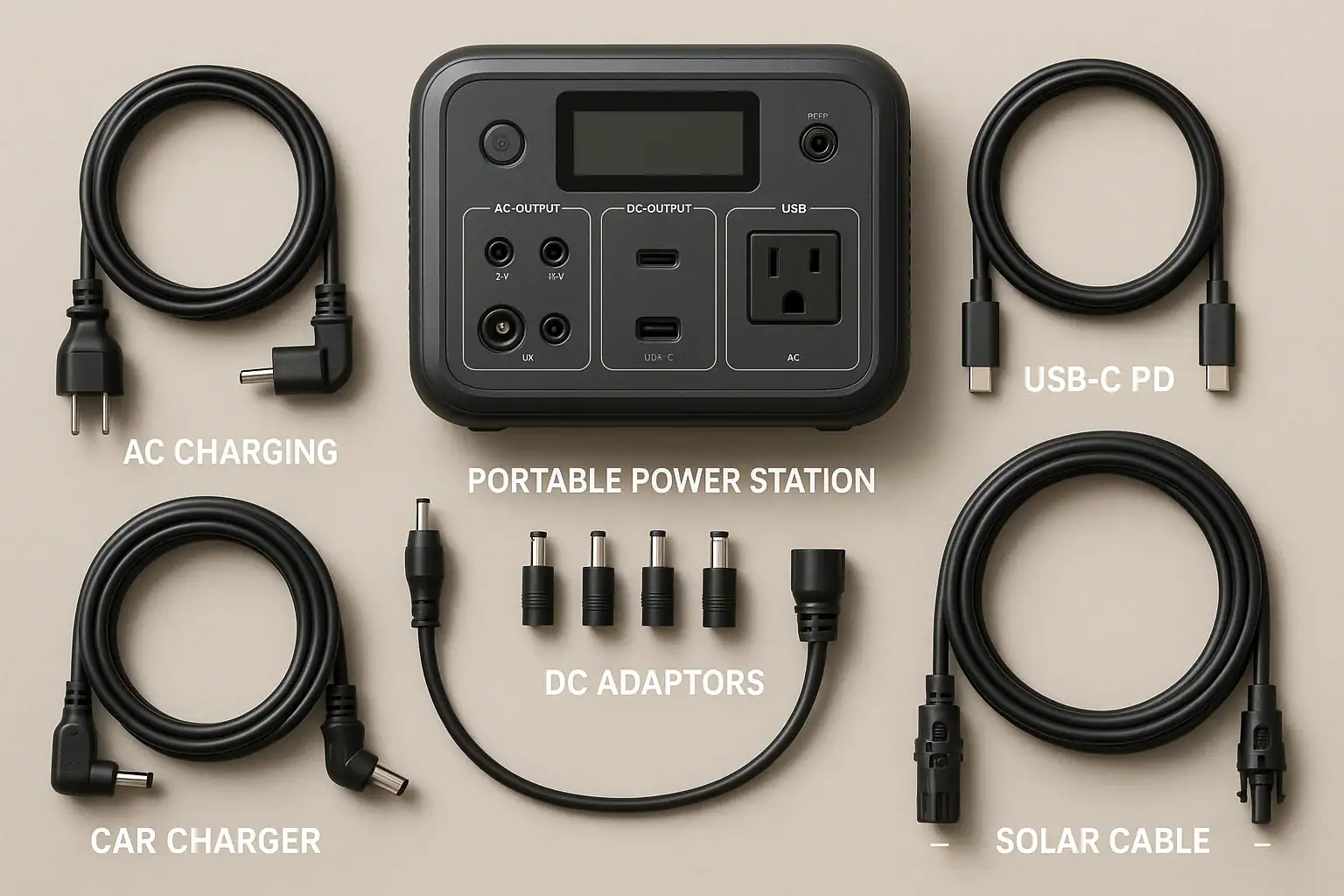
What’s in the Box? Essential Cables and Adapters You May Need

Portable power station with essential cables and adapters laid out in front

Most portable power stations include only a few basic cables in the box, so you may still need extra adapters or leads to match your devices and charging sources. Understanding what each cable does, which connector types you have, and how much power each port can safely handle helps you avoid slow charging, tripped protection circuits, or damaged gear. People often search for terms like input limit, PD profile, surge watts, runtime, and DC output when trying to figure out which cable or adapter they’re missing.

This guide walks beginners through the typical cables, plugs, and adapters used with portable power stations, the differences between them, and how to match specs to real-world needs. By the end, you’ll know what usually comes in the box, what you may need to buy separately, and which technical details matter most for safe, efficient charging at home, on the road, or at a campsite.

1. What “What’s in the Box” Really Means for Portable Power Stations

When you unbox a portable power station, the included cables and adapters determine what you can actually power or recharge on day one. The battery capacity and inverter rating might look impressive, but without the right AC cord, DC barrel plug, USB-C PD cable, or solar adapter, you may not be able to use that capacity effectively.

Manufacturers usually include only the essentials needed to charge the unit from a wall outlet and sometimes a vehicle socket. Everything else is considered optional, because users have different devices, plug types, and power needs. That is why beginners are often surprised to find that their fridge, CPAP, or solar panel will not connect directly, even though the power station has enough watt-hours and surge watts on paper.

Understanding the role of each cable and adapter matters because:

  • Compatibility: Connectors must physically fit and match voltage and current ratings.
  • Performance: Cable gauge, length, and PD profile can limit charging speed and runtime.
  • Safety: Underrated or improvised adapters can overheat, trip protections, or damage equipment.
  • Planning: Knowing what is included helps you budget for missing pieces before a trip or outage.

Thinking of the power station as a central hub and the cables as the “roads” in and out makes it clear: without the right roads, the power cannot reliably reach where you want it to go.

2. Core Cable Types and How They Work With Your Power Station

Most portable power station setups revolve around a small set of cable and adapter types. Each one serves a specific function: charging the station (inputs), powering your gear (outputs), or adapting between shapes and standards so everything fits together.

AC charging cables

AC charging cables connect your portable power station to a household wall outlet. On one end is a standard plug for your region, and on the other is usually a figure-eight, cloverleaf, or IEC-style connector that plugs into the power station’s AC input or power brick. Key specs include the maximum input watts the station can accept and the cable’s current rating. A wall cord that matches or exceeds the station’s input limit helps avoid overheating and ensures you can recharge as fast as the unit allows.

DC car charging cables

DC car charging cables plug into a 12 V vehicle socket (often called a cigarette lighter socket) and feed DC power into the power station’s car/DC input. These are useful for road trips and vehicle-based camping. They typically provide much lower watts than AC charging, so knowing the station’s DC input limit and your vehicle’s socket rating helps set realistic expectations for charge times.

Solar charging adapters and leads

Solar charging cables connect portable solar panels to the power station’s solar input. Common connectors include MC4 on the panel side and a barrel plug, Anderson-style connector, or proprietary plug on the power station side. Because solar voltage and current vary with sunlight, using correctly rated cables and matching the input voltage range of the station is critical to avoid protection shutdowns or inefficient charging.

DC output cables and barrel adapters

Many portable power stations provide DC outputs via barrel jacks or a regulated 12 V car socket. DC output cables may have barrel plugs on one end and a different barrel size or connector on the other, allowing you to power routers, LED lights, or small appliances. The key is matching voltage (for example, 12 V vs 24 V), polarity (center positive vs center negative), and current rating to the device’s label.

USB-A and USB-C PD cables

USB-A cables handle lower-power devices like phones and small accessories, while USB-C PD (Power Delivery) cables support higher power levels and different PD profiles. A high-quality USB-C cable rated for 60 W or 100 W can unlock the full output of a PD port, while a low-rated cable may limit charging speed or fail to negotiate the correct PD profile, leading to slower charging or no charge at all.

AC extension cords and plug adapters

Extension cords and plug adapters are often not included, but many users rely on them to reach distant devices or convert between outlet shapes. It is important to use cords with adequate gauge and current rating for the inverter’s continuous watts. Thin or very long extension cords can cause voltage drop, heat buildup, and nuisance shutdowns under higher loads.

Cable or Adapter TypeTypical UseKey Specs to Match
AC charging cableCharge from wall outletInput watts, plug type, current rating
DC car charging cableCharge from 12 V vehicle socketVehicle socket rating, DC input limit
Solar adapter/leadConnect solar panelVoltage range, connector type, max amps
DC barrel cablePower DC devicesVoltage, polarity, barrel size
USB-C PD cableFast-charge phones/laptopsPD watt rating, cable quality
AC extension cordExtend AC outletsWire gauge, length, amp rating
Example values for illustration.

Related guides: Extension Cords and Power Strips: Safe Practices With Portable Power Stations • Charging From a Car: What’s Safe, What’s Slow, and What Can Break • AC vs DC Power: How to Maximize Efficiency and Runtime

3. Real-World Setups: What You’ll Actually Need Beyond the Box

Once you understand the basic cable types, it becomes easier to plan what you need for specific scenarios. Here are common beginner use cases and the cables or adapters that often turn out to be essential.

Weekend camping with phones, lights, and a small fan

For a short camping trip, many people expect to plug everything straight into the portable power station. In practice, you may need:

  • Several USB-A or USB-C cables for multiple phones and power banks.
  • A USB-C PD cable rated for at least 60 W if you plan to charge a modern laptop.
  • A short, properly rated AC extension cord to position a small fan or light farther from the power station.
  • Optional 12 V DC cable if you are using a DC-powered camping fan or LED strip directly from the 12 V port.

The station likely includes an AC charging cable, but not the extra USB or DC leads for every device, so bringing your own matching cables is essential.

Road trip with car charging and fridge or cooler

On a road trip, you may want to keep the power station charged from the vehicle while it runs a 12 V fridge or cooler. In this scenario, you often need:

  • The DC car charging cable that fits the power station’s DC input.
  • A 12 V car-style cable for the fridge, plugged into the station’s 12 V socket.
  • Possibly a spare fuse or fused adapter if the fridge draws close to the socket’s limit.

Because vehicle sockets are usually limited to around 10–15 A, using cables and adapters rated for that current helps prevent blown fuses and intermittent shutdowns when the compressor starts (surge watts).

Home backup for router, CPAP, and small electronics

During power outages, many users want to run a Wi-Fi router, modem, CPAP machine, and phone chargers. To do this efficiently, you may need:

  • DC barrel cables or adapters that match your router or modem voltage and plug size, allowing you to run them from DC instead of the inverter, which can extend runtime.
  • A properly rated AC extension cord to place the CPAP near your bed while the power station stays in a safe location.
  • USB-C PD cables for tablets and phones to use the high-efficiency USB outputs.

Some CPAP machines also support direct DC input with a manufacturer-specific cable, which is usually not included with the power station. Using that instead of AC can reduce conversion losses and improve runtime.

Solar-powered off-grid weekend

If you plan to keep your portable power station topped up with solar panels, you will almost always need extra cables beyond what comes in the box. Typical needs include:

  • MC4 extension leads from the panels to a shaded area where the power station sits.
  • An MC4-to-barrel or MC4-to-Anderson adapter that matches the station’s solar input.
  • Possibly a Y-branch or parallel adapter if your station supports parallel panel connections within its voltage and current limits.

Without the correct solar adapters, your panels may sit unused, even though the power station supports solar charging on paper.

Worksite or DIY projects with power tools

Using a portable power station with power tools introduces higher surge watts and continuous load. You may need:

  • Heavy-duty AC extension cords with adequate gauge (lower AWG number) for the expected amps.
  • Shorter cords where possible to reduce voltage drop under load.
  • Plug adapters if your tools have different plug shapes than the station’s outlets.

While these accessories are simple, choosing the correct rating is vital to avoid nuisance tripping of the inverter or overheating cords when tools start up.

4. Common Cable Mistakes and How to Spot Problems Early

Many issues that users attribute to a “bad power station” actually come from mismatched or low-quality cables and adapters. Recognizing the warning signs early can save time and protect your equipment.

Underrated or overly long extension cords

Running high-wattage devices like kettles, heaters, or power tools through thin, very long extension cords can cause:

  • Warm or hot cable insulation.
  • Voltage drop, leading to devices stalling or shutting off.
  • Inverter overload or low-voltage protection trips, even when the device’s rated watts are within limits.

If you notice dimming lights, slow tool startup, or warm plugs, check the cord’s amp rating and consider a shorter, heavier-gauge cord.

Wrong barrel connector size or polarity

DC barrel connectors come in many sizes and polarity arrangements. Common mistakes include:

  • Using a plug that “almost fits” but is loose, causing intermittent power.
  • Reversing polarity when using generic adapters, potentially damaging the device.
  • Feeding 12 V into a device that expects 19 V or 24 V, which may cause failure to start.

Troubleshooting cues include devices that briefly power on then shut off, no response at all, or unusual heat near the connector. Always verify barrel size, voltage, and polarity markings before connecting.

Low-quality or mismatched USB-C PD cables

USB-C PD relies on communication between the power station, cable, and device to negotiate a PD profile. Problems arise when:

  • The cable is only rated for 3 A or 15–30 W, but you expect 60–100 W charging.
  • The cable is charge-only and does not support full PD communication.
  • The device requests a PD profile the port cannot provide, leading to fallback to lower power.

Symptoms include laptops charging very slowly, not charging while in use, or showing “plugged in, not charging.” Using a higher-rated PD cable that clearly lists its watt rating often resolves these issues.

Overloading car sockets and DC cables

Vehicle and 12 V sockets have limited current ratings. Drawing too much through an undersized DC cable or adapter can cause:

  • Blown fuses in the vehicle or power station.
  • Hot connectors or melted plastic around the plug.
  • Frequent shutdowns when a compressor or pump starts.

If a device repeatedly trips the socket or feels hot at the plug, reduce the load, shorten the cable, or use a higher-rated DC connector and fuse.

Using adapters that change shape but not voltage

Some plug adapters only change the physical shape of a plug without converting voltage or frequency. When combined with a portable power station’s AC output, this can lead to confusion about what is safe to connect. Always confirm that the device’s voltage and frequency requirements match the power station’s AC output before relying on a simple shape adapter.

5. Safety Basics for Using Cables and Adapters With Portable Power Stations

Portable power stations are designed with multiple layers of protection, but cable and adapter choices still play a major role in overall safety. Following a few high-level practices can reduce risks of overheating, shock, or damage to connected devices.

Match ratings, not just shapes

Two cables may look identical but have very different current or watt ratings. Always check:

  • The amp or watt rating printed on the cable or its packaging.
  • The maximum output of the port you are using (AC, DC, or USB).
  • The device’s voltage and current requirements on its label.

Use the lowest of these values as your safe operating limit. This prevents overloading a cable or adapter that could otherwise overheat.

Avoid daisy-chaining adapters and splitters

Stacking multiple plug adapters, splitters, or extension cords increases resistance and the chance of poor connections. This can lead to localized heating, arcing, and unreliable power delivery. Whenever possible, use a single, high-quality cable of the correct length instead of chaining several together.

Keep connections dry and off the ground

Moisture and conductive dust are major risks around power connections. For portable power stations used outdoors or in vehicles:

  • Keep cables and plugs off wet ground and away from puddles.
  • Avoid placing the power station directly on damp surfaces.
  • Use cable management to prevent tripping or pulling on connections.

If a cable or connector gets wet, disconnect it from all power sources and allow it to dry completely before reuse.

Do not modify or open cables or the power station

Cutting, splicing, or otherwise modifying power cables and adapters can defeat built-in protections and create shock or fire hazards. Similarly, opening the portable power station’s case or bypassing its internal protections is unsafe. If you need a different connector or length, purchase a properly rated cable or consult a qualified electrician for custom solutions.

Respect input and output limits

Every input (AC, DC, solar) and output (AC, DC, USB) on a portable power station has its own limit. Exceeding these can trip protections or, in extreme cases, damage the unit. Pay attention to:

  • AC inverter continuous watts and surge watts for short peaks.
  • DC port amp limits, especially for 12 V sockets.
  • Solar input voltage and current ranges.
  • USB and USB-C PD watt ratings per port.

If you are unsure whether a specific setup is safe, reduce the number of devices, shorten cables, and avoid running everything at maximum load simultaneously.

6. Caring for Your Cables and Adapters: Storage and Longevity

Good cable management and storage practices help maintain reliable connections and reduce the chance of failures at critical moments, such as during a power outage or while traveling off-grid.

Coiling and storing without stress

Repeatedly bending cables sharply or wrapping them too tightly around the power station can weaken internal conductors and strain reliefs. To extend cable life:

  • Use loose coils with gentle bends, avoiding tight loops.
  • Secure coils with soft ties or hook-and-loop straps instead of hard knots.
  • Avoid hanging heavy adapters by their cable, which can pull on connectors.

For USB-C and DC barrel cables, pay special attention to the connector ends, which are prone to damage from repeated flexing.

Labeling and organizing by function

As you add more cables and adapters for AC, DC, USB, and solar, it becomes easy to mix them up. Simple labeling and organization can prevent incorrect connections:

  • Use colored tags or labels to mark solar, car, and wall charging cables.
  • Group DC barrel adapters by voltage and plug size.
  • Keep high-wattage USB-C PD cables separate from low-power ones.

Storing everything in a dedicated pouch or case alongside the power station reduces the chance of leaving a critical cable behind.

Inspecting regularly for wear and damage

Before trips or storm seasons, visually inspect cables and adapters for:

  • Cracked or frayed insulation.
  • Loose, bent, or corroded pins.
  • Discoloration or melted areas near connectors.

If you notice any of these signs, retire the cable and replace it. It is better to discard a questionable cable than risk overheating or intermittent power during an emergency.

Protecting from heat, cold, and UV

Extreme temperatures and direct sunlight can degrade cable jackets over time. When storing your portable power station and accessories:

  • Keep them in a cool, dry location away from direct sun.
  • Avoid leaving cables in hot vehicles for long periods.
  • Use protective sleeves or conduit for cables that remain outdoors.

These steps help maintain flexibility and prevent cracking, especially for solar and outdoor extension cords.

Travel and vehicle storage tips

For users who keep their portable power station in a vehicle or RV, cable storage is especially important:

  • Use a small organizer or bag to keep AC, DC, USB, and solar cables separate.
  • Secure heavy adapters so they do not swing and stress connectors while driving.
  • Keep a spare basic charging cable (AC or DC) in case the primary one is misplaced.

Having a predictable place for every cable makes setup faster and reduces the chance of relying on improvised or unsafe substitutes.

Care PracticeApplies ToBenefit
Loose coilingAC, DC, USB, solarReduces internal conductor stress
Labeling by functionAll cables/adaptersPrevents misconnection and confusion
Regular inspectionHigh-use cablesEarly detection of wear and damage
Temperature controlOutdoor and vehicle-stored cablesPrevents jacket cracking and brittleness
Dedicated storage pouchTravel setupsKeeps critical cables with the power station
Example values for illustration.

7. Putting It All Together: Planning Your Cable and Adapter Kit

For beginners using portable power stations, the most effective approach is to treat cables and adapters as part of your core system, not afterthoughts. Start by listing the devices you want to power, how you plan to recharge the station (wall, car, solar), and where you will use it (home, vehicle, campsite, worksite). Then map each connection path from source to station to device, identifying which cables you already own and which you need to add.

In practice, a reliable kit usually includes: the original AC charging cable, a DC car charging cable, one or more solar adapters if you use panels, a few high-quality USB-C PD cables, several USB-A leads, at least one heavy-duty AC extension cord, and a small set of DC barrel adapters for routers, lights, or other DC devices. Keeping these organized and checked for wear ensures your portable power station is ready when you need it, with minimal surprises about what was or was not included in the box.

Specs to look for

  • AC charging input watts: Look for a wall charging cable and input that support roughly 150–800 W, depending on battery size, so the station can recharge in a reasonable time without overloading the cord.
  • DC car charging current rating: Choose car/DC cables rated for at least 10–15 A at 12 V to safely handle typical vehicle socket limits and avoid blown fuses during long drives.
  • Solar input voltage and connector type: Match solar cables and MC4 adapters to an input range around 12–50 V and ensure the connector type (barrel, Anderson-style, etc.) fits the station’s solar port.
  • USB-C PD cable watt rating: Use USB-C cables clearly rated for 60–100 W if you plan to fast-charge laptops or tablets, so the PD profile can deliver full power without throttling.
  • USB-A and USB-C port outputs: Check for 2–3 A at 5 V for basic USB-A and 18–65 W for USB-C PD ports, then match your cables so phones and laptops charge at their intended speeds.
  • AC extension cord gauge and length: For loads up to about 10–13 A, look for shorter cords with heavier gauge (for example, 14 AWG or thicker) to minimize voltage drop and heating when running appliances.
  • DC output voltage and barrel size: Confirm whether DC ports are regulated 12 V or higher (such as 24 V) and match barrel diameter and polarity to your devices to avoid no-start or damage.
  • Connector durability and strain relief: Prefer cables with reinforced ends and flexible jackets, especially for travel or outdoor use, to reduce failure at the connector over time.
  • Temperature and outdoor rating: For solar and extension cords used outside, look for insulation suitable for outdoor or higher-temperature environments so cables remain flexible and safe in the sun.

By focusing on these specs and planning your cable and adapter kit around how you actually use your portable power station, you can unlock its full potential while keeping your setup safe, efficient, and ready for future upgrades.

Frequently asked questions

What specs and features should I prioritize when choosing cables and adapters for a portable power station?

Prioritize matching amp/watt ratings, connector type and polarity, and the supported input/output voltage ranges. For USB-C, check the PD watt rating; for AC, confirm continuous and surge watt capability; for solar, verify compatible voltage range and connector type. Also consider cable gauge and length since thin or long cables increase voltage drop and limit performance.

How can I avoid common cable mistakes that lead to slow charging or tripped protections?

Always use cables and adapters rated for the port’s maximum watts and the device’s requirements, avoid undersized or overly long extension cords, and verify barrel size and polarity before connecting. Don’t daisy-chain adapters or rely on cheap, unmarked cables, since poor connections increase resistance and can cause thermal issues or protection trips.

What basic safety practices should I follow when using cables and adapters with a portable power station?

Check that every cable’s current or watt rating matches or exceeds the device and port limits, keep connections dry and off the ground, and avoid modifying cables or the power station. Regularly inspect cables for damage and replace any with frayed insulation, melted areas, or corroded pins to reduce fire and shock risks.

Are the cables included with a power station usually sufficient for connecting solar panels or specialty devices?

Often they are not; manufacturers typically include only basic wall and sometimes car charging cables, while solar panels and specialty devices frequently require MC4 adapters, Anderson connectors, or proprietary leads. Check the station’s input connector and voltage range and plan to buy matching adapters or extension leads if needed.

How do I choose the right USB-C PD cable for fast laptop charging?

Choose a USB-C cable explicitly rated for the wattage your laptop requires (commonly 60–100 W for laptops) and ensure it supports PD communication and the correct current (for example, an e‑marked 5 A cable for 100 W). Higher-quality, certified cables reduce negotiation failures and minimize the chance of the port falling back to lower power.

What maintenance steps extend the life of power cables and adapters?

Store cables in loose coils with gentle bends, keep them in a cool, dry place away from direct sunlight, and use soft ties or an organizer to prevent strain on connectors. Regularly inspect for cracks, fraying, or discoloration and replace any damaged items rather than attempting repairs.

How to Test Real Capacity at Home: A Simple Step-by-Step Method

Person cleaning a portable power station with a cloth

What the topic means (plain-English definition + why it matters)

Testing real capacity at home means checking how much usable energy your portable power station actually delivers compared with its listed watt-hour rating. Instead of relying only on the number printed on the label, you measure how long it can power known loads and calculate the energy that really comes out.

This matters because every power station loses some energy to heat, electronics, and inverter losses. The capacity you can actually use to run appliances is usually lower than the advertised value. Knowing the real capacity helps you plan runtimes during power outages, camping trips, remote work sessions, or RV use.

By running simple at-home tests, you can set realistic expectations for how long essentials like lights, routers, fans, and laptops will run. You can also compare your own results over time to notice changes in performance that may signal aging batteries or issues with how you use and store the unit.

Real capacity testing does not require advanced tools or technical expertise. With a few everyday appliances, a basic plug-in power meter if you have one, and some careful timing and math, you can create a repeatable process that works for your specific setup and climate.

Key concepts & sizing logic (watts vs Wh, surge vs running, efficiency losses)

Before testing, it helps to understand some basic terms. Watts (W) describe the rate at which a device uses power at any moment, similar to the speed of water flowing through a pipe. Watt-hours (Wh) describe the total amount of energy used over time, similar to the total volume of water that flowed. Your portable power station’s capacity is usually listed in watt-hours.

Surge watts refer to the brief, higher power draw when certain devices start up, like refrigerators, pumps, or some power tools. Running watts refer to the lower, steady draw after startup. Portable power stations must handle both, but surge ratings are usually tolerated only for a few seconds. When you test capacity, you are more interested in the running watts, because they dominate over the full test duration.

Efficiency losses mean that not all the energy stored in the battery becomes usable output. The inverter that turns DC battery power into 120 V AC, the internal wiring, and the power electronics all waste some energy as heat. The higher the load and the less efficient the system, the more you lose. As a result, many users see usable capacity that is only around 80–90% of the labeled watt-hours when using AC outlets.

To estimate runtimes, you use this basic logic: runtime in hours is approximately usable capacity in watt-hours divided by the average running watts of your devices. When you test at home, you are doing the reverse: you control the load and measure runtime to calculate how many watt-hours actually came out of the battery under your conditions.

Key checks before testing real capacity. Example values for illustration.
What to check Why it matters Typical example
State of charge before test Starting from 100% makes results comparable Charge fully until unit shows full or all LEDs lit
Ambient temperature Extreme cold or heat changes battery performance Room temperature around 60–77 °F as a reference
Load type Stable loads give easier calculations than cycling loads A constant small heater or incandescent lamp
Total power draw Too small or too large loads skew efficiency Roughly 15–40% of the station’s continuous rating
Measurement tools Simple tools improve accuracy and repeatability Wall timer, notebook, optional plug-in power meter
Safety conditions Reduces risk during a long discharge test Clear airflow, away from flammables and water
End-of-test point Consistent stop point makes results comparable Stop when unit shuts off or reaches 0% display

Real-world examples (general illustrative numbers; no brand specs)

Testing at home follows a straightforward pattern. First, charge your portable power station to 100% and let it rest for a short period so the display stabilizes. Then connect a known load, such as a small space heater on a low setting or a string of incandescent bulbs, and record the time when you start the test. Let the system run until the power station shuts off on its own or reaches 0% and turns off output.

Suppose you use a heater that draws about 200 W steadily, and your power station runs it for 3 hours before shutting down. The approximate usable capacity equals 200 W times 3 hours, or 600 Wh. If the labeled capacity is 750 Wh, your test suggests about 80% usable capacity with that particular load and test method. That is within a reasonable range for many systems under real-world AC use.

As another example, imagine running a 60 W light and a 40 W router together for a combined 100 W load. If your station runs them for 5 hours, that is about 500 Wh delivered. If the label says 600 Wh, you are seeing around 83% of rated capacity. Repeating this test a few times on different days can give you a more reliable average, especially if room temperature and starting conditions stay similar.

These examples are simplified on purpose and assume reasonably stable loads. Devices that cycle on and off, like refrigerators or some fans, make testing more complex because the power draw changes over time. For home testing, starting with steady loads makes it much easier to understand your results and build confidence before you test more complicated setups.

Common mistakes & troubleshooting cues (why things shut off, why charging slows, etc.)

Several common mistakes can cause confusing results when you test real capacity. One is starting from less than a full charge. If you begin at 70% instead of 100% but calculate as if you had used the entire battery, your estimated capacity will look lower than reality. Always note the start and end state of charge shown on the display, and try to test from full whenever possible.

Another mistake is using loads that are too small or too large. Very small loads, like a single phone charger, may run for many hours but exaggerate apparent capacity because idle electronics inside the power station waste proportionally less energy. Very heavy loads near the station’s maximum continuous rating can reduce efficiency and make capacity look worse than typical everyday use. A moderate load often gives the most representative results.

Unexpected shutdowns during testing sometimes cause concern. Power stations usually shut off to protect the battery if voltage gets too low, temperature gets too high, or the output is overloaded. If your unit turns off early, check whether the load briefly exceeded its limits, the vents were blocked, or the room was too hot. Many models also have an automatic sleep function that turns off AC output at very low loads after a period of time; in that case the station is protecting itself, not failing.

Charging slowdowns can also affect testing schedules. If you see charging suddenly slow or pause, the unit may be balancing cells, limiting current due to heat, or simply reducing power as it nears a full charge. For reliable back-to-back tests, allow extra time for the unit to cool between full discharge and recharge, and avoid testing in direct sun or enclosed spaces that trap heat.

Safety basics (placement, ventilation, cords, heat, GFCI basics at a high level)

Even though testing real capacity at home uses everyday appliances, you are still dealing with concentrated stored energy and household voltage. Place the portable power station on a stable, flat surface where it cannot tip or be covered by blankets, clothing, or paper. Keep the unit away from sinks, bathtubs, and outdoor puddles, and avoid testing in damp or wet areas.

Ventilation is important. Most power stations rely on internal fans and passive vents to control temperature. During a long discharge test at moderate to high loads, the unit may get warm. Leave several inches of space around the vents, do not block them with walls or clutter, and keep dust or pet hair from building up in the openings. If you notice very hot surfaces or unusual smells, stop the test and let the unit cool while unplugged.

Use cords and power strips that are in good condition and have appropriate ratings for the load. Avoid daisy-chaining multiple power strips or using damaged extension cords, especially with higher-wattage devices like heaters. For outdoor or damp uses, outlets protected by ground-fault circuit interrupters (GFCI) provide an added layer of protection by cutting power if they detect imbalance between hot and neutral conductors.

If you are ever unsure about how to connect your portable power station to a larger home system, such as existing circuits or a transfer device, do not attempt to design or wire it yourself. Testing capacity is best done with stand-alone appliances plugged directly into the station. For any changes to building wiring or panel-based connections, consult a licensed electrician who understands local codes and safe integration practices.

Maintenance & storage (SOC, self-discharge, temperature ranges, routine checks)

Good maintenance habits make your real capacity tests more meaningful over time because they slow down capacity loss. Batteries gradually lose some maximum capacity as they age, and their performance is sensitive to how full they are kept and the temperatures they experience. Many portable power stations are happiest when stored at a partial state of charge rather than fully full or completely empty for long periods.

Self-discharge means that batteries slowly lose charge even when turned off. The rate depends on chemistry, age, and temperature. Checking state of charge every couple of months and topping up when needed helps ensure the unit is ready for emergencies and keeps your test results from being skewed by unexpected low starting levels. Avoid letting the battery sit at 0% for long, as that can accelerate degradation.

Temperature management is also important. Most manufacturers recommend storage at moderate indoor temperatures, often in the range of roughly 50–77 °F for long-term storage, with use allowed over a somewhat wider range. Very high heat can permanently reduce capacity, while extreme cold can temporarily reduce runtime and charging efficiency. If you plan to test capacity in cold conditions, let the unit warm up indoors before charging to full.

Routine visual checks are simple but effective. Look for damage to cases, cords, and outlets, and keep dust away from vents and fans. Wiping the exterior with a dry or lightly damp microfiber cloth and keeping the unit in a dry location protect both safety and performance. Periodic capacity tests, done under similar conditions each time, can serve as a long-term health check for the power station’s battery.

Long-term storage and maintenance checklist. Example values for illustration.
Task Suggested timing Notes
Top up state of charge Every 2–3 months Keep around 40–60% if storing long term
Full charge and discharge test 1–2 times per year Track runtime to watch for capacity changes
Visual inspection of cords and outlets Every few months Check for cracks, discoloration, or loose fit
Vent and fan cleaning Every 6 months or as needed Gently remove dust with cloth or low suction
Storage location review Seasonally Confirm area is dry and temperature moderate
Label update with test results After each capacity test Note date, load, and runtime for reference
Battery health evaluation Annually Compare current test data with earlier records

Example values for illustration.

Practical takeaways (non-salesy checklist bullets, no pitch)

Testing real capacity at home gives you a clearer picture of what your portable power station can actually do in everyday situations. By combining simple measurements with basic math, you can turn the labeled watt-hours into realistic expectations for your own appliances and habits. That knowledge is especially useful when planning for short outages, camping trips, or remote work sessions where you cannot easily recharge.

You do not need specialized instruments to get useful data. Carefully chosen loads, accurate timekeeping, and consistent test conditions go a long way. Recording your results in a notebook or digital document makes it easier to repeat the test later and notice trends as the battery ages or your usage patterns change.

As you build up a small set of test results, you can create your own quick reference for how long certain combinations of devices tend to run. That information can help you decide which loads to prioritize during an outage, how often you need to recharge on trips, and when it may be time to adjust your maintenance or storage practices.

  • Charge to full and start tests from a known state of charge.
  • Use steady, moderate loads to simplify calculations.
  • Multiply average watts by runtime to estimate usable watt-hours.
  • Expect some difference between labeled and usable capacity.
  • Test under safe, well-ventilated, dry conditions.
  • Repeat tests occasionally and log your numbers for comparison.
  • Maintain moderate storage temperatures and partial charge for longevity.
  • Consult a qualified electrician for anything involving building wiring.

Over time, these straightforward steps turn your portable power station from a black box with a big number on the label into a tool you understand and can rely on with confidence.

Before running a full capacity test on a new unit, complete the first-time power station setup so the battery, display, and charging behavior have been checked first.

Frequently asked questions

How do I calculate usable watt-hours when I test real capacity at home?

Measure the average steady load in watts and the elapsed runtime in hours, then multiply watts by hours to get delivered watt-hours (W × h). Start the test from a known state of charge (ideally 100%) and stop at the same defined end point (unit shutdown or 0% display) so results are comparable. Record ambient conditions and start/end SOC to help interpret the result.

What type and size of load should I use for the most reliable home test?

Use a steady, resistive load in the moderate range (roughly 15–40% of the station’s continuous rating) because it gives consistent draw and representative efficiency. Examples include an incandescent lamp string or a low-setting space heater; avoid cyclical or highly variable loads like refrigerators for initial tests. Very small loads can overstate usable capacity and very large loads can understate it due to efficiency differences.

How do temperature and other environmental factors affect test results?

Battery performance drops in cold conditions and may be reduced temporarily until the unit warms up; high temperatures can lower capacity and trigger protective shutdowns. For comparable tests, perform them at moderate room temperatures and note ambient conditions so you can compare like with like over time. Poor ventilation during a long test can also increase internal heat and reduce delivered energy.

How often should I repeat capacity tests to monitor battery health?

Perform a full charge/discharge test one to two times per year to establish a baseline and watch for gradual capacity loss, and repeat sooner after events like deep discharges or exposure to extreme temperatures. Keep a simple log of date, load, runtime, and start/end SOC to track trends over time. More frequent testing may be useful if you suspect an issue or see unexpected runtime changes.

Is it safe to run a full discharge test at home, and what precautions should I take?

Yes, full discharge tests can be done safely if you follow basic precautions: place the unit on a stable, non-flammable surface with clear ventilation, use rated cords and avoid damaged power strips, and monitor for excessive heat or unusual smells. Stop the test immediately if you notice overheating or strange behavior, and do not attempt to wire the station into home circuits without a qualified electrician.

Can a Portable Power Station Run an Air Conditioner? Sizing and Runtime Guide

Portable power station running a small air conditioner and lamp

Yes, a portable power station can run an air conditioner if its inverter can handle the air conditioner’s running watts and startup surge, and if the battery has enough watt-hours for the runtime you expect.

The practical answer is more limited than the simple answer. A small efficient window AC, compact portable AC, or low-draw RV air conditioner may run from a large portable battery system for a useful period. A full-size room unit, older compressor AC, or central air system usually needs far more power than most portable power stations can provide.

Think of this as a sizing problem, not a guessing game. You need to compare watts, surge watts, battery capacity, heat load, and charging limits. A battery generator or solar generator can provide short cooling windows, but it is rarely a whole-home air conditioning replacement.

What it means and why it matters

When people ask whether a portable power station can run an air conditioner, they are really asking two separate questions. First, can the unit start the compressor without tripping an overload? Second, can it keep the air conditioner running long enough to matter?

Air conditioners are difficult loads for battery systems because they use a compressor motor. The compressor may need a brief burst of power at startup that is much higher than the power used after it is running. If the power station cannot supply that surge, the AC may click, beep, flash an error, or shut the power station down immediately.

This matters during outages, hot-weather emergencies, camping, RV use, van setups, and small-room cooling. In those situations, even one to four hours of focused cooling can be useful. It may help cool a bedroom before sleep, protect a pet in a small insulated space, or reduce heat stress during the hottest part of the day.

The key expectation is targeted cooling. A portable power station is best used with a small, efficient air conditioner in a limited area. Cooling an open floor plan, garage, large RV, sun-exposed room, or poorly insulated space will drain the battery quickly and force the compressor to run more often.

Key concepts and how the sizing works

Start with the air conditioner’s running watts. This is the power the AC uses after the compressor is operating. Some labels list watts directly. Others list amps. For a typical 120-volt appliance in the United States, estimated watts are amps multiplied by 120. For example, an AC rated at 6 amps uses roughly 720 watts while running.

Next, check startup surge. Many compressor-based air conditioners briefly draw two to five times their running power. Some newer inverter-style air conditioners ramp up more gently, while some older models surge harder. The power station’s surge rating must be higher than the AC’s startup demand, not just equal to the running watts.

Then calculate energy use. Battery capacity is measured in watt-hours. A 1,000 Wh power station does not usually deliver the full 1,000 Wh to an AC outlet because the inverter and electronics use some energy. A practical planning estimate is to use about 80 to 90 percent of the listed capacity for AC loads.

The basic runtime estimate is usable watt-hours divided by average watts. If a power station has 1,000 Wh and you assume 850 Wh usable, a 500-watt continuous load would run for about 1.7 hours. If the air conditioner cycles off half the time after the room cools down, the total clock time can be longer. If the compressor runs constantly because the room is hot, runtime will be shorter.

Portable power station sizing checks for air conditioners. Example values for illustration.
Item to check What it tells you Practical sizing cue
AC running watts Normal power draw after startup Keep it below about 70 to 80 percent of inverter continuous output when possible
AC startup surge Brief compressor starting demand Must be below the power station surge rating with some margin
Battery watt-hours Total stored energy Use 80 to 90 percent of rated Wh for rough AC-outlet runtime planning
Average AC draw Real energy use over time Lower if the compressor cycles off; higher in extreme heat
Other connected loads Total demand on the inverter Avoid running kettles, microwaves, heaters, or tools at the same time
Charging input How fast the battery can be refilled If input watts are lower than AC draw, the battery still drains while charging

Real-world examples and realistic runtime

A small 5,000 to 6,000 BTU window air conditioner might use about 400 to 600 running watts. With a 1,000 Wh power station and roughly 850 Wh usable through the inverter, continuous runtime may be around 1.4 to 2.1 hours. If the room is shaded, insulated, and already partly cooled, cycling may stretch the clock time to several hours.

A larger portable room air conditioner may use 800 to 1,200 running watts. This is a much heavier load. Even if the inverter can handle it, a 1,000 Wh class battery may provide less than an hour of compressor-heavy runtime. A larger 2,000 to 3,000 Wh unit would be more realistic, but heat load and surge still matter.

An RV rooftop air conditioner can be especially challenging. Many draw around 1,200 to 1,800 watts while running and may require a high startup surge unless equipped with a soft-start device or inverter compressor design. This kind of load usually calls for a high-output power station, a large battery reserve, and careful testing before relying on it in hot weather.

A compact AC used for spot cooling in a van, small office, or bedroom is more realistic. For example, a 500-watt average load on a 2,000 Wh power station with 1,700 usable Wh could run for about 3.4 hours of continuous draw. If the compressor averages 50 percent duty cycle after cooling the space, the total use window may be longer. If the sun is heating the space and the compressor runs constantly, use the shorter number.

Solar charging can help, but it does not erase the energy math. A panel array producing 300 watts in real conditions cannot indefinitely support a 700-watt AC load. It can slow the battery drain, extend runtime, or recharge after use. For daytime cooling, the most dependable plan is to pre-cool the space, reduce heat gain, and use solar as supplemental input rather than assuming it will fully carry the load.

Common mistakes and troubleshooting cues

The most common mistake is looking only at battery size. A large watt-hour number does not guarantee an air conditioner will start. The inverter must supply both the continuous running watts and the compressor surge. If the AC shuts off the power station the instant cooling begins, startup surge is the first thing to suspect.

Another mistake is using the air conditioner’s lowest advertised number instead of actual use. Some units list minimum, cooling mode, or seasonal efficiency information that does not match the draw you will see on a hot day. A plug-in power meter can help measure actual watts, but the power station display can also give useful clues once the AC is running.

A third mistake is assuming runtime calculations are exact. Battery displays are estimates, and air conditioners cycle differently depending on room temperature, humidity, insulation, thermostat setting, and airflow. A setup that runs three hours at night may run only one hour on a hot afternoon in direct sun.

Troubleshooting clues when an air conditioner will not run correctly. Example values for illustration.
Symptom Likely cause Practical response
Power station shuts off as compressor starts Startup surge exceeds inverter capability Try a smaller AC, use fan-only mode, or choose a system with higher surge capacity
AC runs briefly, then overloads Running watts plus other loads are too high Disconnect other devices and confirm the AC draw on the display
Battery percentage drops very quickly High continuous load or low starting charge Start from full charge and recalculate runtime from actual watts
Runtime is shorter on hot days Compressor duty cycle is higher Shade windows, close doors, pre-cool early, and raise the thermostat a few degrees
Charging while running still drains battery Input watts are below AC load Compare real input watts with output watts; do not rely on pass-through use alone
Extension cord feels warm Cord undersized, too long, or damaged Stop use and switch to a shorter, heavier-gauge cord rated for the load

Safety basics for running an AC from a power station

Place the portable power station on a dry, stable surface with open space around its vents. Air conditioners and inverters both produce heat, and blocked airflow can cause thermal shutdown or shorten equipment life. Do not cover the unit with blankets, clothing, curtains, or stored gear.

Use extension cords carefully. Air conditioners are high-draw appliances, so thin or very long cords can waste energy and overheat. Use a cord rated for the amperage and keep it uncoiled during operation so heat can dissipate. Avoid daisy-chaining power strips, adapters, and multiple cords between the station and the AC.

Keep the setup away from water. This includes rain, puddles, wet floors, dripping window units, and damp outdoor areas. If a protective outlet trips, do not keep resetting it without finding the cause. Check for moisture, damaged cords, loose plugs, or signs of overheating.

Do not backfeed a home panel, garage circuit, RV circuit, or wall outlet unless the system is specifically designed and installed for that purpose. Plugging a power station into building wiring incorrectly can create shock and fire hazards. For transfer equipment, dedicated circuits, or permanent wiring, use a qualified electrician.

Finally, respect thermal limits. High outdoor temperatures can reduce inverter performance and make battery cooling fans run harder. If the power station shows an over-temperature warning, reduce the load, improve ventilation, and allow it to cool before restarting the air conditioner.

Maintenance, storage, and long-term reliability

A power station that is expected to run an air conditioner during an outage should not sit forgotten for a year. Check the state of charge every few months, especially before storm season or summer heat waves. Batteries self-discharge slowly, and some units also consume a small amount of energy for standby electronics.

For long-term storage, many rechargeable battery systems prefer a partial charge rather than being stored completely full or completely empty. A common practical range is around 40 to 60 percent for storage, followed by charging to 100 percent before expected heavy use. Always follow the manual for the specific battery chemistry and model.

Temperature matters. Store the unit in a cool, dry location away from direct sun, hot vehicles, freezing sheds, and damp basements. Heat speeds battery aging, while cold can temporarily reduce available capacity and may limit charging. If the unit has been stored in very cold conditions, let it return to a moderate temperature before charging or applying a heavy AC load.

Inspect the system before relying on it. Look for dust-blocked vents, cracked cords, loose plugs, unusual fan noise, swollen casing, or error messages. Test the setup with the actual air conditioner before an emergency. A ten-minute test can reveal startup problems, overload warnings, and unrealistic runtime expectations before comfort or safety depends on it.

Long-term use also benefits from reducing the cooling load. Clean the air conditioner filter, seal window gaps, close blinds, use reflective shades, cool only one room, and set the thermostat a few degrees higher. These small steps can reduce compressor runtime and may add meaningful minutes or hours to a battery-powered cooling plan.

Practical takeaways and specs to look for

A portable power station can run an air conditioner when the system is sized correctly, but the best use case is short-term, focused cooling. The smaller and more efficient the AC, the easier it is to power. The larger, older, or harder-starting the compressor, the more likely you are to run into surge limits and short runtime.

For planning, treat the air conditioner as the main load. Do not assume you can also power cooking appliances, space heaters, power tools, or multiple high-draw devices at the same time. When cooling is the priority, every extra watt reduces runtime.

Specs to look for checklist

  • Continuous AC output: Choose an inverter rating comfortably above the air conditioner’s running watts.
  • Surge output: Confirm the surge rating can handle compressor startup with margin.
  • Battery capacity: Estimate usable watt-hours, then divide by expected average watts.
  • AC outlet rating: Make sure the outlet and total inverter output support the load you plan to use.
  • Charging input: Compare wall, vehicle, or solar input watts against the AC load and recharge goals.
  • Pass-through limitations: Verify whether the unit supports charging and discharging at the same time, and under what limits.
  • Operating temperature range: Check whether the power station can handle hot-weather use without derating or shutdown.
  • Display information: A clear watts-in, watts-out, and estimated-runtime display makes troubleshooting easier.
  • Weight and placement: Larger batteries are heavier, so plan where the unit will safely sit near the AC.

The practical sizing process is straightforward: measure or estimate the AC running watts, allow for startup surge, calculate runtime from usable watt-hours, and test the setup before you need it. If any one of those steps fails, choose a smaller cooling load, a larger power station, better insulation, or a different backup cooling strategy.

Frequently asked questions

How do I know if my portable power station is big enough for my air conditioner?

Check two numbers: the air conditioner’s running watts and its startup surge. The power station must support both, and the battery capacity must be large enough for the runtime you want. If the AC is a compressor-based unit, surge capacity is often the limiting factor.

What specs matter most when choosing a power station for an air conditioner?

The most important specs are continuous inverter output, surge output, and usable watt-hours. After that, look at charging input, pass-through limits, and operating temperature range. A clear display showing watts in and watts out also helps you verify real-world performance.

What is the most common mistake people make when trying to run an AC from a battery?

The most common mistake is focusing only on battery size and ignoring startup surge. A large battery still will not start an air conditioner if the inverter cannot handle the compressor’s brief power spike. Another frequent error is assuming advertised runtime will match hot-weather conditions.

Can a portable power station run an air conditioner overnight?

Usually only a very efficient small AC with a large battery system and favorable conditions. Overnight runtime depends on room insulation, outdoor temperature, thermostat setting, and how often the compressor cycles. For most setups, several hours is more realistic than a full night.

Is it safe to use an air conditioner with a portable power station indoors?

Yes, if the equipment is used according to the manufacturer’s instructions and kept dry, ventilated, and properly wired. Use a correctly rated cord, keep vents clear, and avoid overloading the inverter. Do not connect the power station to household wiring unless the system is designed for that purpose.

Will solar panels keep an air conditioner running all day?

Usually not by themselves, unless the AC load is very small and the solar array is large with strong sun. Solar can extend runtime or recharge the battery, but real-world output is often much lower than the panel’s rated maximum. For dependable cooling, treat solar as support rather than the only power source.

How to Estimate Runtime for Any Device: Simple Wh Formula + Clear Examples

Portable power station with abstract energy blocks in minimal scene

You can estimate runtime with watt hours by dividing the battery’s watt-hours (Wh) by the total watts (W) your devices use and then multiplying by a realistic efficiency factor. In simple terms: hours ≈ Wh × efficiency ÷ watts. This turns a capacity label into practical hours of use for real devices.

Knowing how long a portable power station can run a fridge, CPAP, laptop, or lights helps you plan for power outages, camping, RV trips, and remote work. With a basic Wh formula and a few device specs, you can build a rough power budget, decide what to run at the same time, and avoid surprises.

This guide walks through the core runtime formula, shows how to apply it step by step, and then checks it against real-world examples. You will also see common mistakes, safety basics, long-term care tips, and a simple checklist of specs to look for when comparing portable power options.

What runtime estimation means and why it matters

Runtime estimation is the process of predicting how long a battery-powered system can run a specific device or combination of devices before it needs recharging. For portable power stations, that usually means turning a watt-hour capacity number into hours of usable power for your own loads.

Most units list capacity in watt-hours (Wh) and output limits in watts (W). Those numbers are useful only if you can translate them into questions like: “Can I run my mini fridge all night?” or “Will this keep my router and laptop going through a workday?” A simple Wh-based formula makes that translation possible.

Accurate runtime estimates matter most when power is limited or critical. During an outage, you may need to prioritize medical devices, refrigeration, or communications. On a camping trip or in a van, you might be balancing lights, fans, and electronics against limited charging opportunities. Even for casual use, understanding runtime helps you avoid overloading the inverter, draining the battery faster than expected, and shortening battery life through deep discharges.

Because every system has losses, real runtime is always somewhat less than the pure Wh ÷ W calculation. Inverter efficiency, battery management limits, temperature, and how your devices cycle on and off all affect results. Treating the formula as a planning tool (with a built-in safety margin) rather than a guarantee keeps expectations realistic.

Key concepts and the simple Wh runtime formula

Estimating runtime with watt hours is easier when you separate three basic ideas: energy, power, and time.

  • Energy is stored in the battery and usually expressed in watt-hours (Wh).
  • Power is how fast energy is used, usually expressed in watts (W).
  • Time is how long the battery can supply a given power level, expressed in hours.

These three are linked by a simple relationship:

Runtime (hours) ≈ Battery capacity (Wh) × Efficiency ÷ Load (W)

The efficiency factor accounts for energy lost as heat in the inverter and electronics. For AC outlets on a portable power station, a planning value of about 0.8 (80%) is a reasonable starting point. For lower-voltage DC or USB outputs, effective efficiency can be a bit higher, but using 0.8 still gives a conservative estimate.

Sometimes devices list current (amps) and voltage instead of watts. In that case, you can convert to watts first:

Watts (W) = Volts (V) × Amps (A)

Another important distinction is between running watts and surge watts:

  • Running watts are the steady power draw once a device is operating.
  • Surge watts (also called starting or peak watts) are short bursts some devices need at startup, especially motors and compressors.

The Wh-based runtime formula uses running watts, because surge events are brief. However, your inverter still has to handle the surge without shutting down. If the surge rating of the power station is too low, the device may never start, regardless of how many watt-hours you have.

When you run multiple devices at once, you add their running watts to get the total load. The same formula then applies to this combined wattage. Higher loads can slightly reduce efficiency, so heavy usage may shorten runtime more than the math alone suggests. Planning with a modest buffer helps offset that effect.

Key inputs for the Wh runtime formula — Example values for illustration.
Input What it means Typical example
Battery capacity (Wh) Total stored energy available at 100% charge 300 Wh, 500 Wh, 1,000 Wh
State of charge (%) How full the battery is when you start 50% SOC gives roughly half the labeled Wh
Efficiency factor Fraction of Wh that becomes usable output 0.8 for AC loads, 0.85–0.9 for some DC/USB
Device running watts (W) Continuous power draw while operating 10 W light, 60 W laptop, 300 W appliance
Total load (W) Sum of all devices running at the same time 60 W laptop + 20 W monitor = 80 W total
Inverter continuous rating (W) Maximum watts the inverter can supply steadily Stay below this with your total load
Device surge watts (W) Short burst needed at startup Fridge may need 2–3× its running watts

How to apply the formula step by step

You can use the runtime formula in a short checklist:

  1. Find battery capacity in Wh. Use the labeled watt-hours on the power station.
  2. Adjust for state of charge. If the battery is not full, multiply Wh by the starting percentage (for example, 0.5 for 50%).
  3. List device running watts. Check labels or power adapters. Convert from volts and amps if needed.
  4. Add up total watts. Include every device you plan to run at the same time.
  5. Choose an efficiency factor. Use about 0.8 for AC outlets, or a similar conservative value.
  6. Calculate runtime. Runtime ≈ (Adjusted Wh) × efficiency ÷ total watts.
  7. Round down and add a buffer. Treat the result as a maximum and plan for slightly less.

Example: 500 Wh battery at 100% charge, 50 W light, efficiency 0.8.

  • Adjusted Wh = 500 Wh
  • Runtime ≈ 500 × 0.8 ÷ 50 = 8 hours

If you add another 50 W device at the same time (100 W total), runtime becomes:

  • Runtime ≈ 500 × 0.8 ÷ 100 = 4 hours

The same method works for any combination of devices, as long as the total watts stay within the inverter’s continuous and surge ratings.

Real-world runtime examples using the Wh formula

Worked examples make the Wh formula easier to use in everyday situations. The scenarios below assume a starting efficiency of 0.8 for AC-powered devices. Actual results will vary with temperature, inverter design, and how your devices cycle on and off.

Example 1: Laptop for remote work
Assume a laptop power adapter averages 60 W while you are actively working. With a 500 Wh power station and 0.8 efficiency:

  • Runtime ≈ 500 × 0.8 ÷ 60 ≈ 6.7 hours

If your workload is lighter and the laptop averages closer to 30 W, runtime could be roughly double. Features like automatic screen dimming and sleep modes help lower the average draw.

Example 2: CPAP machine overnight
Suppose a CPAP machine averages 40 W without a heated humidifier:

  • Runtime ≈ 500 × 0.8 ÷ 40 = 10 hours

If you enable a heated humidifier and the average draw rises to 70 W:

  • Runtime ≈ 500 × 0.8 ÷ 70 ≈ 5.7 hours

For critical medical equipment, many users plan extra capacity or a second charging source to avoid running the battery down to zero.

Example 3: Mini fridge during a short outage
Consider a small fridge with a running draw of 70 W that cycles on about half the time. The average power over an hour might be closer to 35 W. With a 1,000 Wh power station at 0.8 efficiency:

  • Runtime ≈ 1,000 × 0.8 ÷ 35 ≈ 22.8 hours

Opening the door frequently, high room temperatures, or placing hot items inside will increase the average draw and reduce runtime.

Example 4: LED lighting and phone charging while camping
Imagine two LED lanterns at 10 W each plus phones charging at a combined 10 W. Total load is 30 W. With a 300 Wh power station at 0.8 efficiency:

  • Runtime ≈ 300 × 0.8 ÷ 30 = 8 hours

If you only run the lanterns for 4 hours each evening and charge phones intermittently, the same battery could cover several nights.

Example 5: Work-from-anywhere setup
Consider a setup with a 60 W laptop, 10 W hotspot, and 20 W portable monitor. Total load is 90 W. With a 700 Wh power station at 0.8 efficiency:

  • Runtime ≈ 700 × 0.8 ÷ 90 ≈ 6.2 hours

Turning off the monitor when not needed, lowering screen brightness, or disabling unused peripherals can reduce the total watts and add an hour or more of runtime over a workday.

Sample runtimes for common setups — Example values for illustration.
Scenario Battery size (Wh) Total load (W) Assumed efficiency Estimated runtime (hours)
Single laptop 500 Wh 60 W 0.8 ≈ 6.7 h
CPAP without humidifier 500 Wh 40 W 0.8 ≈ 10 h
Mini fridge (averaged) 1,000 Wh 35 W 0.8 ≈ 22.8 h
Camping lights + phones 300 Wh 30 W 0.8 ≈ 8 h
Mobile office setup 700 Wh 90 W 0.8 ≈ 6.2 h

Common mistakes and troubleshooting cues

Many runtime surprises come from the same small set of errors. Watching for these issues will make your estimates more reliable and help diagnose problems when actual runtime is shorter than expected.

1. Ignoring efficiency and using Wh ÷ W directly
Using the full watt-hour rating without an efficiency factor often overstates runtime by 10–25% for AC loads. If your calculations always seem optimistic, introduce a factor of about 0.8 and compare again.

2. Forgetting surge or startup watts
A device may have modest running watts but high startup demand. If the inverter cannot supply the surge, you might see:

  • Device trying to start and then stopping
  • Overload or fault indicators on the power station
  • Beeping or automatic shutdown when the device turns on

In these cases, the problem is not runtime capacity but inverter surge capability.

3. Underestimating total load from small extras
It is easy to focus on the largest device and forget the smaller ones. A monitor, speaker, router, or extra lights can add 30–100 W to your total load. When runtime is shorter than expected, list every device that was plugged in and redo the math with their combined watts.

4. Starting from a partially charged battery
Runtime estimates assume a full battery unless you adjust for state of charge. If you start at 60% instead of 100%, you only have about 60% of the labeled watt-hours available. Many power stations display a percentage; use that to scale your Wh before applying the formula.

5. Overlooking temperature effects
In cold conditions, lithium batteries can temporarily deliver less usable capacity. In very hot conditions, the battery management system may limit output or shut down to protect the cells. If your runtime drops sharply in extreme temperatures, the battery may be operating outside its ideal range.

6. Expecting charging to fully offset loads
When you run devices while charging from solar or a vehicle, think in terms of net power:

  • If charging watts are less than load watts, the battery still discharges, just more slowly.
  • If charging watts are greater than load watts, the battery charges, but more slowly than it would with no load.

If you see the state of charge barely moving or slowly dropping even while charging, the load may be close to or above the incoming power.

Common runtime issues and quick checks — Example values for illustration.
Symptom Likely cause What to check
Runtime is 20–30% shorter than math No efficiency factor used Recalculate with 0.8 efficiency for AC loads
Device will not start, inverter overloads Startup surge too high Compare device surge needs to inverter peak rating
Battery drains faster than expected Extra devices left plugged in List all active loads and add their watts
Runtime drops in cold weather Reduced effective capacity Operate closer to room temperature if possible
Charging but SOC still falls slowly Load exceeds charging input Compare load watts to solar or vehicle input watts

Safety basics when planning and using runtime

Runtime planning should always be paired with safe operating habits. A few simple precautions go a long way toward preventing damage or injury.

Placement and ventilation
Place the power station on a stable, dry surface with enough space around it for air to circulate. Avoid stacking items on top or pressing it into tight corners where vents can be blocked. If the unit feels unusually hot during heavy use, reduce the load and give it time to cool.

Cords and extension use
Use cords and extension cables that are rated for the loads you plan to run. Damaged or undersized cords can overheat, especially when powering higher-wattage devices for long periods. Avoid running cords under rugs, through doorways, or anywhere they can be pinched or tripped over.

Dry conditions
Keep the power station and connected plugs away from standing water, heavy condensation, or direct rain. Even though there is no exhaust like a fuel generator, it is still an electrical device that should be kept dry.

Home wiring and backfeeding
Do not connect a portable power station directly to household wiring unless a proper transfer mechanism has been installed by a qualified electrician. Improvised backfeeding into wall outlets or panels can be dangerous to people and equipment.

Monitoring during long runtimes
When you plan to run devices for many hours, check the power station periodically. Look for warning icons, unusual noises, or heat buildup. If you rely on it for critical devices, consider setting reminders to verify that remaining capacity still matches your plan.

Maintenance and storage for reliable runtime

Over time, batteries naturally lose some capacity, but good maintenance and storage habits help keep runtime as close as possible to your original estimates.

Partial-charge storage
For long-term storage, many lithium-based systems do best when kept at a moderate state of charge rather than at 0% or 100%. A mid-range level (around 40–60%) is a common guideline if the unit will sit unused for several months.

Periodic top-ups
Batteries slowly self-discharge in storage. Topping up the charge every few months helps prevent the battery from sitting at a very low state of charge, which can accelerate aging.

Temperature management
Store the power station in a cool, dry place away from direct sun, heaters, or freezing conditions. High heat speeds up battery wear; deep cold temporarily reduces capacity and can limit charging until the battery warms up.

Regular checks
Before storm season, trips, or any planned use, do a quick functional check. Confirm that the unit charges, outlets work, and a small test load runs for a reasonable time. Comparing current runtime to previous notes can reveal gradual capacity loss.

Handling and cleaning
Keep vents and ports free of dust and debris. Avoid dropping or striking the unit, as impacts can damage internal cells or connections. If you notice sudden, unexplained drops in runtime, unusual swelling, or strong odors, discontinue use and follow the manufacturer’s guidance for inspection or recycling.

Practical takeaways and specs to look for

Estimating runtime with watt hours comes down to a short formula and a few key inputs. Once you know the battery’s Wh rating, your devices’ watts, and a realistic efficiency factor, you can build a simple power budget for outages, camping, RV use, or remote work.

A good rule of thumb for AC loads is:

Runtime (hours) ≈ Battery capacity (Wh) × 0.8 ÷ total running watts

Treat the result as a planning number, not a promise. Round down, allow a safety margin, and adjust your assumptions based on real-world experience with your own devices.

When you track your actual runtimes and compare them to your calculations, you can quickly refine your efficiency factor and understand how temperature, device settings, and usage patterns change your results over time.

Specs to look for when comparing portable power options

  • Battery capacity (Wh): The main number used in the runtime formula. Higher Wh means more potential hours of use.
  • Inverter continuous rating (W): Maximum steady load you can run. Make sure it comfortably exceeds your total planned watts.
  • Inverter surge rating (W): Short-term peak output. Important for starting fridges, pumps, or tools with motors.
  • Output types and limits: Number and rating of AC outlets, DC ports, and USB connectors you can use at the same time.
  • Display information: A clear readout of watts in, watts out, and remaining capacity makes runtime planning much easier.
  • Supported charging inputs: Wall, vehicle, and solar input ratings determine how quickly you can refill the battery.
  • Operating temperature range: Indicates how well the unit will perform in hot or cold conditions.
  • Weight and size: Important if you plan to move the power station frequently or travel with it.
  • Recommended storage practices: Manufacturer guidance on storage charge level and temperature for long-term reliability.

With these specs in hand and the simple Wh runtime formula, you can match a portable power station to your actual devices and confidently estimate how long it will keep them running.

Frequently asked questions

Which specifications and features should I prioritize when comparing portable power stations?

Prioritize battery capacity in watt-hours, the inverter’s continuous and surge watt ratings, and the types/limits of available outputs. Also consider supported charging inputs, display/readout clarity, operating temperature range, and weight — these affect how well the unit matches your intended use.

What’s the most common mistake people make when estimating runtime?

The most common mistake is using Wh ÷ W without an efficiency factor or failing to include all active loads and the actual state of charge. Use a conservative efficiency (about 0.8 for AC loads), include smaller devices, and adjust Wh for starting charge to get realistic estimates.

How should I account for device startup (surge) power when planning?

Use running watts for runtime calculations but separately verify the inverter’s surge rating because some motors and compressors need short startup bursts much higher than running watts. If the inverter can’t handle the surge, the device may not start even if enough watt-hours are available.

Is it safe to power medical equipment like a CPAP with a portable power station?

Portable power stations can safely power many medical devices when the unit reliably meets the device’s continuous and surge power needs and is in good condition. For critical equipment, plan additional capacity or a backup charging source and follow device manufacturer guidance.

Can I estimate runtime while charging from solar or a vehicle?

Yes — think in terms of net power: if charging input watts are less than your load, the battery will still discharge, just more slowly; if charging exceeds load, the battery may slowly charge. Compare incoming watts to total load to determine whether the state of charge will rise or fall over time.

How can I make my estimated runtime more accurate?

Measure actual device draw with a watt meter, track the power station’s state-of-charge, and run a timed test under typical conditions. Refine your efficiency factor from real results and account for temperature and device duty cycles for better precision.

Inverter Idle Consumption Explained: How Much Power You Lose With AC Left On

Portable power station with abstract energy blocks nearby

Inverter idle consumption is the power your portable power station wastes just by leaving the AC output turned on, even when nothing is plugged in. Any time the AC or “inverter” button is enabled, internal electronics stay awake and draw a small but constant load from the battery. Over hours or days, that idle draw can eat a surprising chunk of your available runtime.

Understanding this standby or no-load consumption helps explain why a battery seems to drain overnight with no obvious appliances running, and why real-world runtimes are often shorter than the marketing numbers. Once you know roughly how many watts your inverter uses at idle and how long you tend to leave AC enabled, you can predict and control that loss.

This guide walks through what inverter idle consumption really means, how it interacts with watts and watt-hours, and how it affects camping trips, outages, and remote work.

What Inverter Idle Consumption Means and Why It Matters

Inverter idle consumption is the power draw of the AC inverter when it is turned on but not doing useful work. The display might show 0 watts going to loads, yet the inverter itself can still be pulling 5–30 watts from the battery just to stay ready.

Think of it as the “idling engine” of your portable power station. Just like a parked car with the engine running burns fuel, an inverter with AC enabled burns battery capacity even if no appliances are running. That overhead is always there as long as AC is on.

This matters because portable power stations are usually sized for specific scenarios: keeping a fridge cold through a 10-hour outage, running a CPAP overnight, or powering small electronics over a weekend. If you ignore idle consumption, your estimates can be off by hours. For small or intermittent loads, idle draw can be as large as, or larger than, the devices you actually care about.

In practice, knowing about inverter idle consumption helps you:

  • Understand why the battery drops even when you think “nothing is on.”
  • Decide when to use AC versus DC or USB outputs for small devices.
  • Plan runtimes more realistically for camping, off-grid cabins, and emergencies.
  • Develop habits like turning AC off between tasks to stretch the same battery further.

Key Concepts: Watts, Watt-Hours, and How Idle Draw Adds Up

To see how inverter idle consumption affects runtime, it helps to separate power (watts) from energy (watt-hours) and do a few quick back-of-the-envelope calculations.

Power (W): The rate of energy use at a moment. A 10 W idle draw means the inverter is constantly using 10 watts as long as AC is on.

Energy (Wh): Power used over time. To get watt-hours, multiply watts by hours. This is the unit used to rate battery capacity in portable power stations.

For example, a 10 W idle draw running for 10 hours uses:

10 W × 10 h = 100 Wh

If your battery is rated at 500 Wh, that 100 Wh is about 20% of the total capacity spent on nothing but keeping the inverter awake.

Idle consumption also interacts with inverter efficiency. Inverters are less efficient at very low loads, so the percentage of power wasted as heat is higher when you are only running a small device. That means a 10 W phone charger on AC might cause the system to draw 20–25 W from the battery once you include idle overhead and conversion losses.

The table below shows how idle draw, battery size, and hours of AC-on time combine to affect runtime.

Estimating energy lost to inverter idle consumption. Example values for illustration.
Battery size (Wh) Idle draw (W) Hours AC left on Energy lost to idle (Wh) Approx. % of battery lost
300 8 12 8 × 12 = 96 ~32%
500 10 24 10 × 24 = 240 ~48%
1000 15 24 15 × 24 = 360 ~36%
1500 20 24 20 × 24 = 480 ~32%
2000 25 24 25 × 24 = 600 ~30%

Even modest idle draws become significant over long periods. The key takeaway is that every hour you leave AC on has a fixed cost. Reducing the number of hours AC stays enabled is usually more effective than making small changes to what you plug in.

Real-World Examples: How Idle Consumption Affects Runtime

Seeing how idle draw behaves in everyday scenarios makes it easier to set expectations and adjust your habits.

Example 1: Overnight phone charging

Imagine a 500 Wh power station with a 10 W idle draw:

  • You plug in a phone charger that uses 8 W at the wall.
  • The inverter overhead is 10 W, so the battery sees roughly 18 W total.
  • The phone finishes charging in 2 hours, then draws almost nothing.
  • You forget and leave AC on for another 8 hours overnight.

Approximate energy use:

  • During active charging: 18 W × 2 h = 36 Wh
  • Overnight idle: 10 W × 8 h = 80 Wh

You used more than twice as much energy on idle overhead as you did actually charging the phone.

Example 2: Router and modem during an outage

Consider a 1000 Wh power station running a 15 W router and modem through AC with a 10 W idle draw:

  • Total AC load: 15 W (devices) + 10 W (idle) = 25 W
  • Runtime estimate: 1000 Wh ÷ 25 W ≈ 40 hours (ignoring other losses)

Now imagine you could power the router and modem from DC outputs at 15 W without using the inverter:

  • Total DC load: 15 W (devices) + minimal DC overhead
  • Runtime estimate: 1000 Wh ÷ 15 W ≈ 66 hours

Simply avoiding inverter idle consumption can add a full extra day of connectivity in an extended outage.

Example 3: High-power appliance

Now take a 1500 Wh power station running a 300 W appliance for 3 hours, with the same 10 W idle draw:

  • Total draw: about 310 W
  • Energy used: 310 W × 3 h = 930 Wh
  • Idle portion: 10 W × 3 h = 30 Wh (about 3% of the total)

In this case, idle consumption is a small fraction of the total energy use. You will notice idle losses most when the loads are tiny or when AC is left on for long stretches with nothing running.

Common Mistakes and Troubleshooting Cues

Many runtime problems that look like “bad batteries” or “false advertising” are actually caused by inverter idle consumption and low-load inefficiency. Recognizing the patterns can save time and frustration.

Common inverter idle consumption pitfalls and how to spot them. Example values for illustration.
Symptom Likely cause What to check or try
Battery drops 20–40% overnight with “nothing plugged in” AC inverter left on, drawing 8–25 W idle Confirm AC icon is lit, turn AC off, repeat test for one night
Runtime for small devices is much shorter than expected Low-load inefficiency and fixed inverter overhead Compare runtime using DC/USB vs AC for the same device
AC output shuts off even though a small device is connected Eco/auto-sleep mode sees load as “zero” Check mode settings, increase load slightly, or disable eco mode
Power station barely charges while powering AC loads Input charger power ≈ loads + idle draw Temporarily unplug AC loads or use DC to see if SOC rises faster
Unit feels warm and fans cycle even with no visible load Inverter and cooling system running at idle Turn AC off and see if fan and heat decrease after a few minutes

Simple at-home test for idle draw

You can get a rough idea of your inverter’s idle consumption without special meters:

  1. Fully charge the power station.
  2. Turn AC on with nothing plugged in.
  3. Note the state of charge (SOC) percentage.
  4. Leave AC on for a known time, such as 4 or 8 hours.
  5. Record the new SOC, then turn AC off.

If a 1000 Wh unit drops from 100% to 90% over 4 hours with no load, it used about 100 Wh. That implies an average idle draw around 25 W (100 Wh ÷ 4 h).

When to suspect a problem vs normal behavior

  • Likely normal: 5–25 W idle draw, moderate warmth around vents, gradual SOC drop with AC left on.
  • Worth investigating: SOC plunging rapidly with AC on and no load, fans running constantly in cool conditions, or idle draw clearly higher than the specification.

If your rough test shows idle consumption far above typical values, double-check that no small standby devices are still plugged in, then repeat the test. Persistent high idle draw with no load can indicate an issue that may need professional support.

Safety Basics: Heat, Placement, and AC Use

Inverter idle consumption does more than just drain the battery; it also generates heat. Even a 10–20 W idle draw produces continuous warmth inside the unit, so safe placement and ventilation still matter when “nothing is running.”

Keep these safety basics in mind whenever AC is enabled:

  • Ventilation: Place the power station on a stable, dry, non-flammable surface with vents unobstructed. Avoid enclosing it in cabinets, boxes, or under bedding while AC is on.
  • Heat awareness: Light warmth around vents is expected, but surfaces should not become too hot to touch. If the case is very hot during idle or light loads, turn AC off and let it cool, then reassess placement and ambient temperature.
  • Cord selection: Use extension cords rated for your maximum expected load, and keep them as short as practical. Undersized or damaged cords can overheat even at moderate power levels.
  • Trip and pinch hazards: Route cords to avoid walking paths, sharp edges, and pinch points such as doors or windows. Do not run cords under rugs where heat can build up unnoticed.
  • Moisture and shock risk: Keep the power station and AC connections away from puddles, wet ground, and condensation. Use appropriate protection when operating in damp environments.
  • No backfeeding: Do not plug the power station into household outlets or attempt improvised connections to home wiring. That can be dangerous for you and for utility workers.

Idle consumption may seem small, but it still means the inverter is active. Treat an “idling” power station with the same basic respect you would when it is under load.

Maintenance and Storage: Preventing Silent Battery Drain

Because inverter idle consumption continues as long as AC is on, it can silently drain a stored power station over days or weeks. That is hard on batteries and can leave you with less backup power than you expect.

Good maintenance and storage habits help you avoid deep discharges caused by accidentally leaving AC enabled.

  • Before storage: Turn off all outputs (AC, DC, USB) and the main power if your unit has one. Verify that no status icons indicate active outputs.
  • State of charge for storage: Many lithium-based batteries are happiest stored around the middle of their range rather than full or empty. A moderate SOC reduces stress during long storage.
  • Periodic checks: Even with everything off, batteries slowly self-discharge. Plan to check SOC every few months and top up if it falls too low.
  • Temperature: Store in a cool, dry place within the recommended temperature range. High heat accelerates aging and can increase standby losses; extreme cold can temporarily reduce capacity.

When you bring the unit back into service after storage, do a quick functional check:

  • Turn it on and confirm the display and controls behave normally.
  • Test AC with a small load and listen for fans under load.
  • Watch for unusually rapid SOC drops with AC enabled and no load, which could indicate the inverter is drawing more idle power than expected.

Practical Takeaways and Specs to Look For

Managing inverter idle consumption is mostly about awareness and simple habits, not complicated math. Once you understand that “AC on” always has a cost, you can decide when that cost is worth paying.

  • Turn AC off whenever you are not actively using AC-powered devices.
  • Batch AC tasks together (for example, charge multiple laptops and camera batteries in one session) instead of many short sessions spread across the day.
  • Use DC or USB outputs for phones, tablets, small lights, and other low-power electronics whenever possible.
  • Pay extra attention to idle draw during long outages or multi-day trips, where hours of standby add up.
  • Test your own unit’s idle behavior so you can plan runtimes realistically.

Specs to look for when comparing or configuring a system

Whether you are choosing a new portable power station or trying to get the most from one you already own, a few key specifications and features have a big impact on idle consumption and real-world runtime.

  • Inverter idle draw (no-load power): Look for a clearly stated idle watt value. Lower is better, especially if you plan to leave AC on for hours at a time.
  • Inverter efficiency curve: Overall efficiency matters, but pay attention to performance at low loads (under about 50 W), where overhead is a larger share of total draw.
  • Battery capacity (Wh): A larger battery gives more room for both idle overhead and actual loads, but idle draw still scales with time, not capacity.
  • AC eco/auto-sleep modes: Check whether the unit can shut off AC automatically at very low loads, and how easily you can enable or disable that behavior.
  • DC output options: Multiple DC and USB ports, including higher-power USB outputs, make it easier to avoid using AC for small devices.
  • Display detail: A display that shows real-time watts and cumulative energy used can help you see idle draw directly and adjust your habits.
  • Thermal management: Well-designed cooling reduces unnecessary fan use and heat buildup during idle, which can slightly reduce losses and improve comfort.

If you already own a unit and the idle draw is higher than you would like, focus on behavior changes: keep AC off by default, move as many small loads as possible to DC, and use eco modes where they fit your needs. With those adjustments, you can often stretch the same battery to cover significantly more useful work instead of silently burning capacity on inverter idle consumption.

Frequently asked questions

Which inverter specifications and features most affect idle consumption?

Look for a stated no-load or idle watt value first, then check the inverter’s efficiency at low loads and whether it has an eco/auto-sleep mode. Good thermal management and informative real-time wattage or energy displays also help you manage and reduce idle losses.

Why does my power station lose charge overnight even when nothing appears plugged in?

That is commonly caused by the inverter remaining enabled and drawing a continuous idle current, plus any small standby devices that were left connected. Confirm AC is off and repeat a short SOC test to isolate idle draw from other causes.

Is it safe to leave the inverter (AC) enabled for long periods?

Leaving AC on is generally safe if the unit is well ventilated and within its rated temperature range, but it will produce continuous heat and use battery capacity. For safety and longevity, avoid enclosing the unit, monitor surface temperature, and turn AC off when not needed.

Can I estimate inverter idle draw without specialized meters?

Yes — use the unit’s state-of-charge readings over a known time with AC on and no load to estimate average wattage consumed (Wh used ÷ hours). Repeat the test to confirm results and ensure no small devices are accidentally connected.

Will using DC or USB outputs instead of AC reduce overall energy loss?

Yes. DC/USB paths avoid inverter conversion and its idle overhead, so small devices are usually more efficient when powered directly from DC or USB outputs. This can substantially extend runtime during long outages or for low-power devices.

How much does idle consumption typically affect runtime for small loads?

Idle consumption can be as large as or larger than small loads; a 10–20 W idle draw running for many hours can use more energy than a single low-power device. It becomes most significant when loads are tiny or when AC is left on for extended periods.

VA vs Watts Explained for Portable Power Stations, Computers, Power Supplies, and UPS Units

Portable power station with abstract energy blocks in isometric view

VA and watts are related but not the same: watts measure the real power your devices actually use, while VA (volt-amperes) measure apparent power and can be higher than the usable watts. For portable power stations, computers, and UPS units, you should always size and compare equipment using watts, not VA, to avoid overloads and surprise shutdowns.

This guide explains how VA and watts work together, how they show up on UPS labels and computer power supplies, and how to translate those numbers into practical choices for portable power stations. You will see how to convert between ratings, estimate runtime in watt-hours, and decide whether a power station can safely replace or supplement a UPS for your home office or remote work setup.

Along the way, you will find concrete examples, simple formulas, and troubleshooting cues. The goal is to help you confidently match inverter size and battery capacity to real-world loads like laptops, monitors, routers, and small electronics without needing a deep electrical engineering background.

What VA vs watts means and why it matters for portable power

When you shop for backup power, you quickly see three related terms: VA, watts (W), and watt-hours (Wh). They sound similar, but each answers a different question:

  • VA (volt-amperes) – apparent power: voltage multiplied by current, without considering how efficiently that power is used.
  • Watts (W) – real power: the portion that actually does work, like running a CPU, lighting a screen, or spinning a fan.
  • Watt-hours (Wh) – stored energy: how much work a battery can do over time.

For simple resistive loads (like many heaters), VA and watts are almost identical. For most electronics (computers, monitors, routers, chargers), they are not. The ratio between watts and VA is called power factor. A power factor of 0.6 means 600 VA only delivers about 360 W of real power.

This matters because:

  • UPS units are often labeled in VA, with a smaller watt rating in fine print.
  • Portable power stations advertise inverter output in watts, not VA.
  • Computer power supplies may list both VA and W, or just a watt rating.

If you treat VA as if it were watts, you can overload a UPS or misjudge whether a portable power station can handle your setup. Understanding the difference helps you avoid nuisance shutdowns, undersized equipment, and unrealistic runtime expectations.

Key concepts: power factor, inverter ratings, and runtime math

To use VA and watts correctly with portable power stations, there are four key ideas to keep in mind: power factor, inverter ratings, battery capacity, and efficiency losses.

Power factor: linking VA and watts

  • Power factor (PF) = watts ÷ VA.
  • For many computer and office loads, PF often falls between about 0.6 and 0.9.
  • Watts = VA × PF. If PF is unknown, assume the lower end (around 0.6–0.7) for safety when planning.

Example: A UPS labeled 1000 VA with a typical PF of 0.6 would support about 600 W of real load, not 1000 W.

Inverter ratings: continuous vs surge watts

  • Continuous watts – what the inverter can supply steadily.
  • Surge watts – a short-term higher limit (often a few seconds) for startup spikes.

Portable power stations usually list both. You should size your normal load below the continuous rating and only rely on the surge rating for brief inrush currents, such as when a desktop power supply or small compressor first starts.

Battery capacity and runtime

Battery capacity in watt-hours answers: “How long can I run my devices?” A quick estimate for AC loads is:

Runtime (hours) ≈ (battery Wh × 0.8) ÷ load watts

The 0.8 factor is a simple way to account for inverter and internal losses. Some setups may be a bit better or worse, but 0.8 is a practical starting point.

Bringing it together: VA, watts, and Wh

When you move from a UPS environment (VA-focused) to a portable power station (watt and Wh-focused), use this sequence:

  1. Find or estimate the watt draw of your devices (not just VA).
  2. Confirm your total watts are safely under the inverter’s continuous rating.
  3. Check if any devices have surge or startup spikes and compare to the surge rating.
  4. Use battery Wh and the runtime formula to decide if the capacity is enough.
Table 1: Translating VA, watts, and Wh into practical sizing decisions. Example values for illustration.
Step What to look at How to use it Illustrative example
1. From VA to watts UPS label (VA and PF or watts) Watts = VA × PF; if PF unknown, assume 0.6–0.7 1000 VA × 0.6 ≈ 600 W usable
2. Check inverter size Portable power station continuous watts Keep total load under about 70–80% of rating For 800 W inverter, target ≤ 560–640 W
3. Account for surge Devices with motors or high inrush Allow 20–50% headroom vs. running load 300 W desktop may briefly hit 400–450 W
4. Estimate runtime Battery Wh and total watts Runtime ≈ Wh × 0.8 ÷ load (W) 500 Wh × 0.8 ÷ 100 W ≈ 4 hours
5. Refine with real data Measured power draw (meter or device info) Update load watts and repeat runtime math If real load is 70 W, runtime ≈ 5.7 hours

Real-world examples: computers, home offices, and small loads

To make VA vs watts more concrete, it helps to walk through typical setups and compare UPS labels to portable power station ratings.

Example 1: Simple laptop workstation

  • Laptop charger: 65 W
  • External monitor: 30 W
  • Wi‑Fi router: 10 W

Total estimated load: 65 + 30 + 10 = 105 W.

A portable power station with a 300 W continuous inverter can easily handle this. With a 500 Wh battery:

  • Usable Wh ≈ 500 × 0.8 = 400 Wh
  • Runtime ≈ 400 ÷ 105 ≈ 3.8 hours

In practice, your laptop may not draw the full 65 W all the time, and the monitor may dim, so real runtime can be a bit longer.

Example 2: Comparing a small UPS to a power station

Suppose you have a UPS labeled 600 VA / 360 W supporting a desktop and monitor:

  • Desktop PC (typical while working): 150 W
  • Monitor: 30 W
  • Router: 10 W

Total load: 190 W. The UPS is fine because 190 W is well below its 360 W rating.

If you replace this UPS with a portable power station:

  • Any inverter with at least 300 W continuous can handle the load.
  • If the station has 700 Wh of capacity, usable energy is about 560 Wh (700 × 0.8).
  • Estimated runtime ≈ 560 ÷ 190 ≈ 2.9 hours.

If you mistakenly treated 600 VA as 600 W and added devices until you reached 550–600 W, the UPS would overload, even though the VA number seemed high enough. The portable power station’s watt rating is already “real power,” so the comparison must be done in watts.

Example 3: Small outage essentials

Consider a short power outage where you want just the essentials:

  • Internet router: 10 W
  • LED light strip: 20 W
  • Laptop (average while working): 40 W

Total load: 70 W.

With a 300 Wh portable power station:

  • Usable Wh ≈ 300 × 0.8 = 240 Wh
  • Runtime ≈ 240 ÷ 70 ≈ 3.4 hours

If you add a second monitor at 30 W, the load jumps to about 100 W and runtime drops to roughly 2.4 hours. A small change in connected devices can noticeably affect runtime.

Example 4: Desktop with higher startup surge

Some desktops and gaming systems have power supplies labeled 500–750 W, but their typical draw while working may be only 200–300 W. At startup or under brief heavy load, they can spike significantly higher.

  • If your desktop averages 250 W but can surge to 450 W for a second or two, a 500 W continuous / 800 W surge inverter is generally comfortable.
  • If you run that desktop plus a 100 W monitor and other accessories, your running load might approach 350–400 W. That is still under 500 W but leaves less headroom for spikes and heat.

In this case, staying near 70–80% of the inverter’s continuous rating (350–400 W on a 500 W inverter) helps reduce nuisance trips when the system briefly peaks.

Table 2: Example loads and what they mean for VA, watts, and runtime. Example values for illustration.
Scenario Approx. load (W) UPS label example Suggested inverter (continuous W) Estimated runtime on 500 Wh battery
Laptop + monitor + router ≈ 100–120 W 600 VA / 360 W ≥ 300 W 500 Wh × 0.8 ÷ 110 ≈ 3.6 h
Desktop + monitor + router ≈ 180–220 W 1000 VA / 600 W ≥ 500 W 500 Wh × 0.8 ÷ 200 ≈ 2.0 h
Router + LED light only ≈ 25–35 W 400 VA / 240 W ≥ 150 W 500 Wh × 0.8 ÷ 30 ≈ 13.3 h
Remote work with 2 laptops ≈ 120–160 W 700 VA / 420 W ≥ 400 W 500 Wh × 0.8 ÷ 140 ≈ 2.9 h

Common mistakes and troubleshooting when VA and watts do not match

Most problems people see with portable power stations and UPS units come from mixing up VA, watts, and real-world behavior. Here are frequent issues and what they usually mean.

Mistake 1: Treating VA as watts

Symptom: A UPS or power station shuts down or beeps even though your math says you are “under the rating.”

Likely cause: You used the VA number (for example, 1000 VA) as if it were watts. The unit’s actual watt limit is lower (for example, 600 W), and your devices exceeded that.

Fix: Always plan using the watt rating. If only VA is listed, multiply by a conservative power factor (around 0.6–0.7) to estimate watts.

Mistake 2: Ignoring inverter efficiency and idle draw

Symptom: Runtime is much shorter than expected when using AC outlets.

Likely cause: You divided battery Wh by load watts without subtracting losses. The inverter itself uses power, even at light loads.

Fix: Multiply battery Wh by about 0.8 before dividing by watts. For very light AC loads, efficiency can be even lower, so consider switching to DC or USB outputs when possible.

Mistake 3: Overloading with short surges

Symptom: The power station shuts off right when a device starts, but seems fine once everything is running.

Likely cause: Startup surge exceeded the inverter’s surge rating, even though the running load is under the continuous rating.

Fix: Identify which device has the high inrush (often desktops, pumps, or compressors). Start that device first with other loads unplugged, or size up to an inverter with higher surge capability.

Mistake 4: Misunderstanding pass-through-charging

Symptom: The power station appears to charge very slowly or not at all while powering devices.

Likely cause: Most of the incoming energy is going straight to the connected load, leaving little left to refill the battery.

Fix: Check the input wattage and output wattage. If they are similar, net charging will be minimal. Reduce the load or charge the power station separately when you need a full recharge.

Mistake 5: Misreading nameplate ratings

Symptom: A device labeled 500 W seems to run fine on a much smaller inverter.

Likely cause: The 500 W rating is the maximum the power supply can deliver to the device, not what it always draws from the wall. Real usage is often lower.

Fix: Treat nameplate wattage as an upper bound. For more accurate planning, measure real draw with a power meter or use manufacturer power consumption data when available.

Safety basics for portable power stations, UPS units, and computer loads

Even when VA and watts are sized correctly, safe use still matters. Portable power stations and UPS units concentrate significant energy in a small box, and careless placement or wiring can create risks.

Placement and ventilation

  • Place units on a stable, dry, non-flammable surface.
  • Leave several inches of clearance around vents; do not cover them with clothing, paper, or other equipment.
  • Avoid closed cabinets without airflow, especially under heavy load, to reduce heat buildup and thermal shutdowns.

Cords, power strips, and adapters

  • Use extension cords and power strips rated for at least the maximum watts you plan to draw.
  • Avoid daisy-chaining multiple power strips or adapters into a single outlet on the power station.
  • Inspect cords for cuts, frays, or crushed sections; replace damaged cords instead of taping them.

Moisture and outdoor use

  • Keep units away from puddles, condensation, and direct rain.
  • In damp areas, place the power station on a raised, dry platform rather than directly on the ground.
  • If your unit has GFCI outlets and they trip repeatedly, investigate the connected device and environment before resetting.

Connection to building wiring

  • Do not backfeed a house circuit by plugging a portable power station into a wall outlet.
  • Any connection to a home panel or transfer switch should be designed and installed by a qualified electrician.

Maintenance and storage for reliable long-term use

Portable power stations and UPS units rely on rechargeable batteries that slowly age and self-discharge. Good storage habits can extend usable life and make sure your backup power is ready when you need it.

State of charge and self-discharge

  • For long-term storage, many lithium-based systems do best at a moderate state of charge, often around 30–60%.
  • Check charge level every few months; top up if it has dropped significantly.
  • Avoid storing at 0% or leaving at 100% for many months, especially in warm environments.

Temperature and environment

  • Store units in a cool, dry area away from direct sun and heat sources.
  • A hot vehicle, attic, or shed can accelerate battery aging.
  • If the unit has been in freezing conditions, let it warm to room temperature before charging.

Routine checks and test runs

  • Every few months, power the unit on and run a small load (such as a lamp or laptop) for a short time.
  • Verify that AC and DC outputs work, and confirm that it still charges properly from your usual source.
  • Dust vents gently to keep airflow unobstructed.

These simple checks help you discover issues early instead of during a critical outage.

Practical takeaways and specs to look for

VA vs watts can feel abstract, but the practical rules are straightforward once you focus on real power, not just apparent power. Use watts to decide what your portable power station or UPS can actually run, and use watt-hours to decide how long it can run those devices.

  • Think in watts for load sizing and watt-hours for runtime.
  • Treat VA ratings as a starting point only; adjust with power factor to estimate watts.
  • Stay comfortably below the inverter’s continuous watt rating to allow for surges and heat.
  • Prefer DC or USB outputs for small electronics when you want to stretch runtime.

Specs to look for when comparing units

When you read spec sheets or labels for portable power stations, UPS units, or computer power supplies, these are the most important details to watch:

  • Inverter continuous watt rating – The real power limit for what you can run long term. Aim to use no more than about 70–80% of this value in regular use.
  • Inverter surge watt rating – Short-term capacity for startup spikes. Useful if you run desktops, pumps, or other loads with inrush current.
  • Battery capacity (Wh) – Use this with the runtime formula (Wh × 0.8 ÷ watts) to estimate how long your setup will run.
  • UPS VA and watt ratings – For UPS units, note both numbers. Use the watt rating for planning; treat VA as a maximum apparent power figure.
  • Power factor information – If listed for either the UPS or your load, it helps you convert VA to watts more accurately.
  • Number and type of outlets – Count how many AC, DC, and USB outputs you have and whether they match your devices without overloading a single outlet.
  • Supported input charging power – Higher input wattage can recharge the battery faster between outages or during the day.
  • Operating and storage temperature ranges – Check that they fit where you plan to use and store the unit.

If you build your plan around these specs, using watts and watt-hours as your main guideposts, you can match portable power stations and UPS units to your actual computer and home office loads with fewer surprises and more reliable runtime.

Frequently asked questions

Which specs and features matter most when choosing a portable power station for running computers and UPS-like loads?

Prioritize the inverter’s continuous watt rating, surge watt rating, and the battery capacity in watt-hours because they determine what you can run and for how long. Also check power factor (for VA-to-watt conversions), the number and type of outlets, supported input charging power, and operating temperature ranges. These together tell you whether the unit will handle your devices and recharge at a useful rate.

Can I size a UPS or power station using only the VA rating?

No. VA is apparent power and does not account for power factor, so it can overstate usable capacity for electronic loads. Use the watt rating for load sizing or multiply VA by a conservative power factor (around 0.6–0.7) if the watt number is not provided.

What are the main safety risks when using portable power stations and UPS units?

Key risks include overheating from poor ventilation, moisture exposure, overloaded or damaged cords, and improper connections to building wiring that could cause backfeeding. Follow placement, cord, and wiring guidance and consult a qualified electrician for panel connections to reduce these hazards.

How can I quickly estimate how long a power station will run my laptop and monitor?

Estimate device watts, add them up, then apply the runtime formula: Runtime ≈ (battery Wh × 0.8) ÷ total load (W). The 0.8 factor accounts for inverter and internal losses, so adjust if you have measured efficiency data or use DC/USB outputs for better efficiency.

Why does my UPS or power station shut off during device startup even though the running load is below the limit?

Startup surge or inrush current can exceed the inverter’s surge rating even when the steady-state draw is acceptable. Identify high-inrush devices, start them with other loads unplugged, or choose an inverter with a higher surge capacity to avoid these trips.

Are there ways to extend runtime without buying a larger battery?

Yes. Reduce the load by dimming displays, closing unnecessary peripherals, and using energy-saving modes; prefer DC or USB outputs which bypass inverter losses; and avoid powering high-draw accessories. These steps lower average watts and increase runtime from the same battery capacity.