Can a Portable Power Station Run a Clothes Dryer?

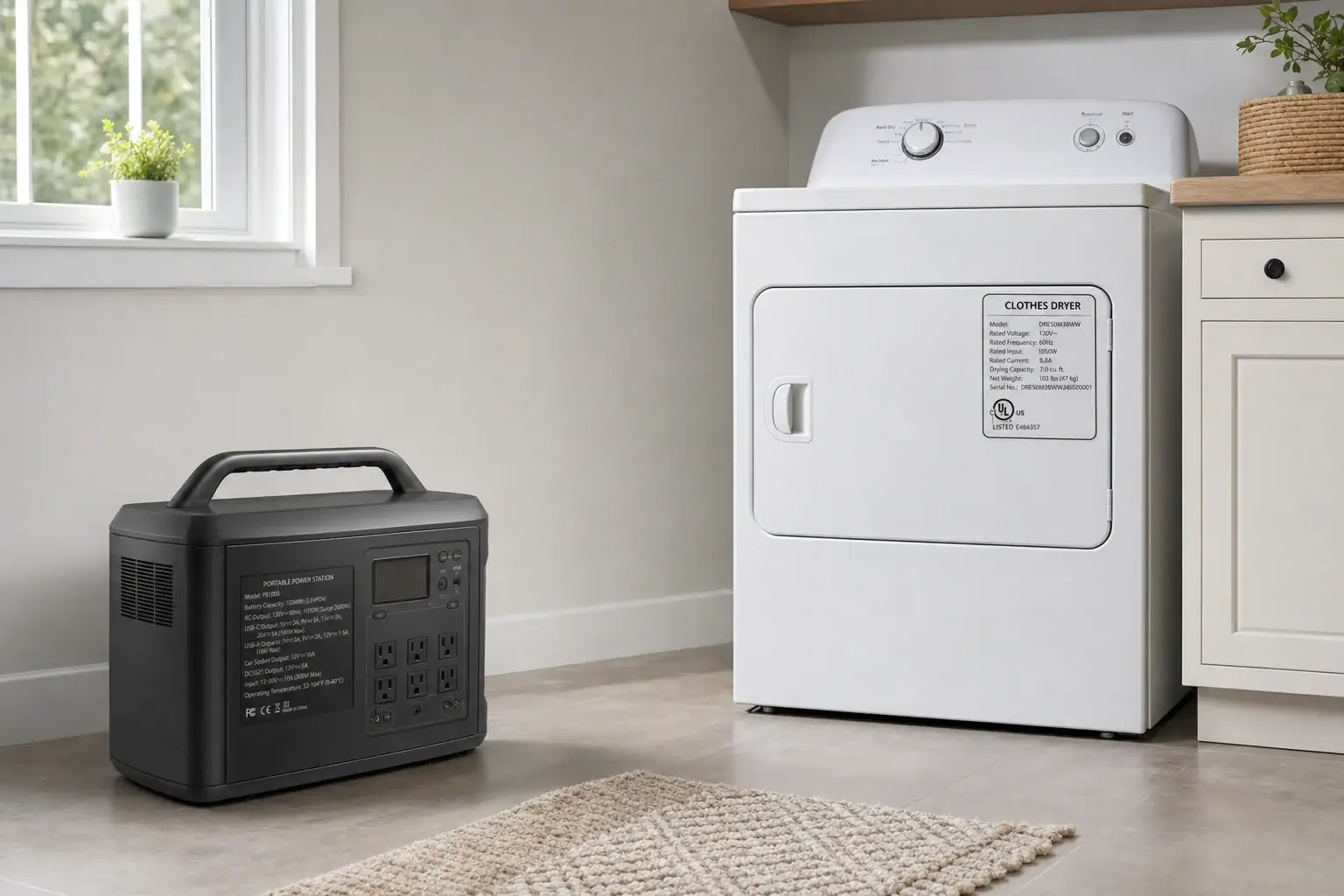
Portable power station near a clothes dryer in a bright laundry room

Most portable power stations cannot run a standard electric clothes dryer. A conventional dryer commonly needs 240-volt split-phase power and several thousand watts, while many portable stations provide only 120-volt AC output.

It is possible with certain high-output systems designed to supply the dryer’s exact voltage, continuous wattage, startup surge, receptacle, and grounding requirements. Compact 120-volt, heat-pump, and gas dryers may be easier to power, but their nameplates and manuals must still be checked individually.

Why dryer type matters

The heating method usually determines how demanding a dryer is. The following ranges are illustrative planning figures, not universal specifications:

Illustrative electrical requirements by dryer type
Dryer type Possible supply Illustrative input range Main compatibility issue
Conventional electric Usually 240 V About 4,000–6,000 W while heating High output and split-phase voltage
Compact electric Often 120 V About 1,200–1,800 W Long runtime and substantial battery use
Heat-pump 120 V or 240 V, depending on model About 700–2,000 W Compressor startup and model-specific voltage
Gas Often 120 V for controls and motor Several hundred watts Motor surge, ignition, controls, and proper gas operation

Check the dryer’s nameplate and current manufacturer documentation rather than selecting a station from these broad ranges. A dryer’s branch-circuit rating is not necessarily its actual operating wattage. For example, a 240-volt, 30-amp circuit represents up to 7,200 volt-amperes of circuit capacity, but the appliance may draw less.

Four requirements must match

1. Output voltage and configuration

A 240-volt dryer requires a power source specifically designed to provide the correct 240-volt split-phase output. Two ordinary 120-volt outlets do not become a compatible dryer supply through an adapter. Likewise, added battery capacity does not give a 120-volt inverter 240-volt capability.

The station must also have a manufacturer-approved outlet and operating configuration compatible with the appliance. Do not use improvised adapters, combine independent outputs, backfeed a receptacle, or connect a portable power station to a home electrical panel.

2. Continuous output power

The station’s continuous AC rating must exceed the dryer’s maximum simultaneous demand, not merely its average consumption. Heating elements, the drum motor, blower, controls, and—where present—a compressor may operate together.

If only voltage and current are listed, multiplying them provides a useful upper-bound estimate:

Apparent power in volt-amperes = volts × amperes

For motors and compressors, volt-amperes and watts are not always identical because of power factor. Use the manufacturer’s input-watt specification when available.

3. Startup or surge capacity

Resistance heating elements generally do not create a large startup surge, but motors and compressors can briefly draw more than their normal running power. The station’s surge rating must accommodate that event without shutting down.

Surge ratings are not directly comparable unless their permitted duration is known. A high surge number available for only a fraction of a second may not support a motor that takes longer to start. Dryer and power-station manufacturers may specify these values differently.

4. Battery energy

Output power, measured in watts, determines whether the dryer can operate. Battery capacity, measured in watt-hours or kilowatt-hours, determines approximately how long it can operate. A station can have enough inverter power to start a dryer yet too little stored energy to finish a load.

A simplified estimate is:

Usable AC energy = rated battery capacity × usable-capacity fraction × inverter efficiency

For example, assume a station has a 5,000 Wh battery, 90% usable capacity, and 90% inverter efficiency:

5,000 Wh × 0.90 × 0.90 = 4,050 Wh, or 4.05 kWh of estimated AC energy

If a dryer drew 4,500 W continuously for 45 minutes, the simplified energy requirement would be:

4,500 W × 0.75 hour = 3,375 Wh

That example leaves little practical margin after accounting for changing loads, battery temperature, conversion losses, aging, and cycle length. Real dryers cycle their heaters or compressors, so an appliance’s documented energy per cycle may provide a better estimate than multiplying maximum wattage by time. Use the dryer’s current manufacturer data when available.

When running a dryer is realistic

A conventional 240-volt electric dryer is realistic only with a large system that explicitly supports the required split-phase voltage, outlet, continuous load, surge, and enough usable energy for the drying cycle. Merely adding expansion batteries solves the runtime problem, not an inverter-output limitation.

A compact 120-volt dryer may work with a much smaller station, but its heating load can still be close to the limit of a typical household outlet-style inverter. A heat-pump dryer may consume less energy per cycle, although compressor surge and voltage requirements vary. A gas dryer usually has a lower electrical demand because gas supplies the heat, but it still requires a compatible electrical source and a properly installed, safely operating fuel and exhaust system.

Compatibility checklist

  • Confirm the dryer’s required voltage and phase configuration.
  • Find the appliance’s maximum input watts or rated current.
  • Account for motor or compressor startup demand.
  • Verify the station’s continuous and time-limited surge ratings.
  • Confirm that the outlet and grounding arrangement are manufacturer-approved.
  • Estimate usable AC energy after capacity and inverter losses.
  • Leave operating margin rather than sizing both devices to identical ratings.

Electronic controls can also be sensitive to waveform or grounding characteristics. Follow both manufacturers’ instructions, including any requirement for pure sine-wave power. Keep the station dry, ventilated, and clear of dryer heat and exhaust, and do not exceed the rating of any manufacturer-approved cord or accessory.

Bottom line

A standard 240-volt electric dryer is beyond the capabilities of most portable power stations, though certain large split-phase systems may support one. Lower-power compact, heat-pump, or gas dryers are more practical candidates. Compatibility depends on all four factors—voltage, continuous watts, startup surge, and usable battery energy—not battery capacity alone.
Air Fryer on a Power Station: Wattage and Runtime

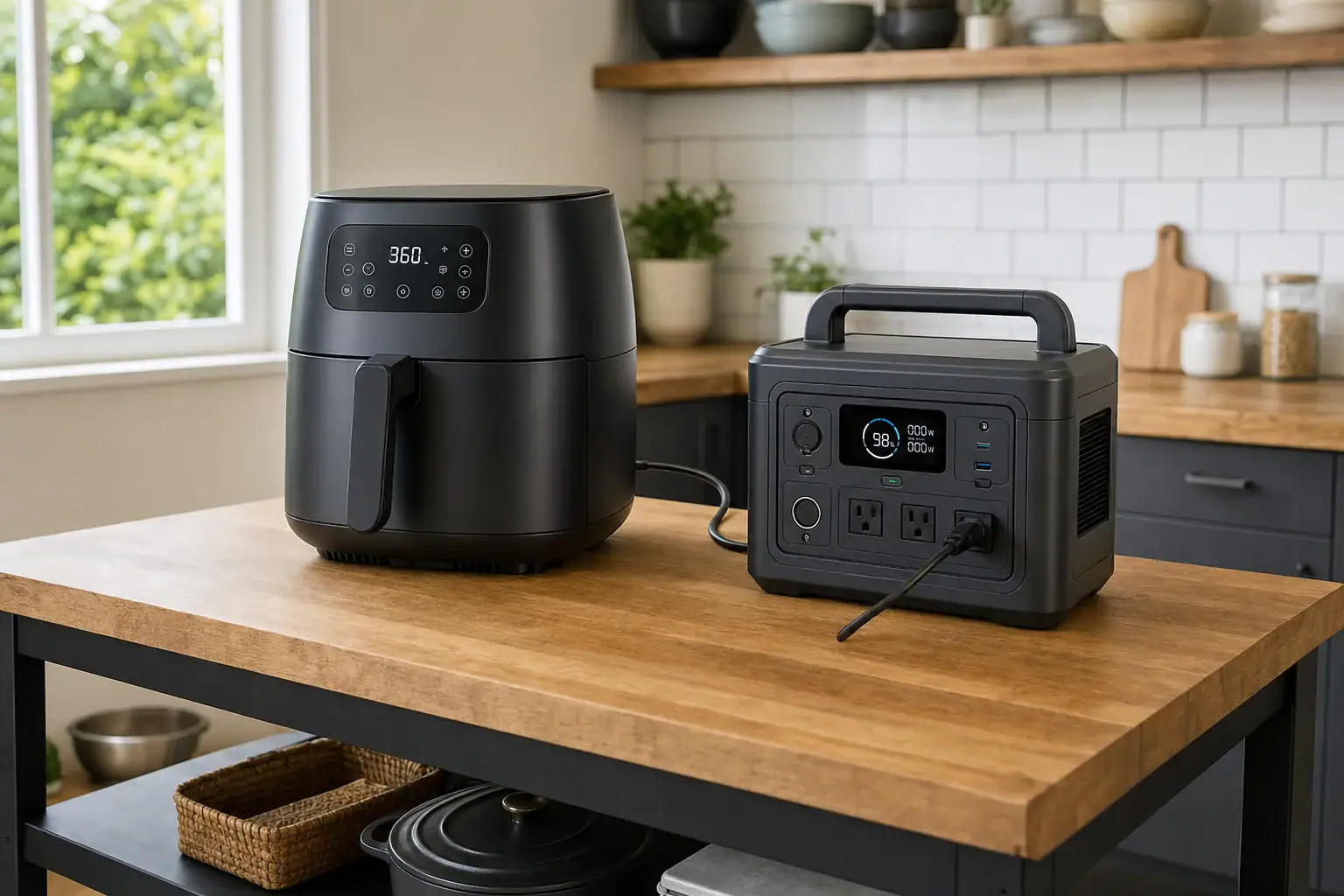
Countertop air fryer connected to a portable power station with ventilation space around both devices

An air fryer can run on a power station if the station’s continuous AC output exceeds the fryer’s maximum input wattage. Many countertop air fryers are rated around 1,200 to 1,800 watts, but the appliance nameplate or manual is the authority. A 1,000-watt power station, for example, cannot reliably operate a 1,500-watt air fryer even if its battery has plenty of watt-hours.

For runtime, divide usable battery energy by the air fryer’s power draw. As a quick example, a 1,000-watt-hour power station running a 1,500-watt fryer may provide roughly 30 to 35 minutes of full-power operation after allowing for inverter losses and the station’s reserve. Actual cooking time can differ because the heating element may cycle on and off.

Match the air fryer to the AC output rating

Check the air fryer’s label or manual for its rated input in watts. If only volts and amps are listed, approximate watts with volts × amps, but use the manufacturer’s stated maximum input when available. Control electronics, the fan and the heating element can make a simple calculation less exact.

Next, compare that figure with the power station’s continuous AC output. The continuous rating—not the battery capacity and not the short-duration surge rating—determines whether the inverter can keep the fryer running.

  • Continuous watts: The output the power station is designed to sustain under specified conditions.
  • Surge watts: Short-duration capacity intended for startup peaks. It does not make an undersized continuous inverter suitable for a high-wattage fryer.
  • Watt-hours: Stored energy used to estimate how long the load can run.

Air fryers are dominated by a resistive heating load, although the fan motor can create a brief startup increase. Choosing an inverter with some capacity above the appliance’s nameplate wattage reduces the chance of an overload shutdown. A margin of about 20% is a practical planning assumption, not a universal manufacturer requirement. Output capability may also be reduced by temperature, battery state of charge or model-specific operating limits.

Calculate estimated runtime

A useful planning formula is:

Runtime in minutes = battery capacity in Wh × usable fraction ÷ air fryer watts × 60

The usable fraction accounts for inverter conversion losses, the power station’s own consumption and any battery reserve enforced by its controls. If no model-specific AC energy figure is available, 0.80 to 0.90 can serve as an illustrative planning range. It is not a guaranteed efficiency rating.

The table below uses an 85% usable-energy assumption and assumes the air fryer draws its listed wattage continuously. Real results can be higher or lower.

Illustrative full-power air fryer runtime at 85% usable battery energy
Battery capacity 1,200 W fryer 1,500 W fryer 1,800 W fryer
500 Wh About 21 minutes About 17 minutes About 14 minutes
1,000 Wh About 43 minutes About 34 minutes About 28 minutes
1,500 Wh About 64 minutes About 51 minutes About 43 minutes

Capacity alone does not establish compatibility. A 500 Wh power station might have enough energy for a short cooking cycle but still lack the continuous inverter output needed to start or run the fryer.

Estimate energy for one cooking cycle

Multiply watts by operating hours to estimate the AC energy required. A 1,500-watt air fryer used for 15 minutes has a conservative full-power estimate of:

1,500 W × 0.25 hours = 375 Wh of AC energy

With an 85% usable-energy assumption, the battery capacity needed would be approximately:

375 Wh ÷ 0.85 = 441 Wh

This estimate treats the fryer as drawing full rated power for the entire cycle. Thermostat cycling may reduce actual consumption, while preheating, added cooking time, a cold battery or other connected loads can increase the capacity required. For dependable planning, include preheat time and avoid counting on unverified cycling savings.

What to check before cooking

  • Confirm the fryer’s maximum input wattage, voltage and frequency from its label or current manufacturer instructions.
  • Verify that the station’s continuous AC rating exceeds that input, preferably with reasonable headroom.
  • Calculate capacity from the total expected time, including preheating and any second cooking batch.
  • Subtract energy reserved for other devices and account for the station’s current state of charge.
  • Check the power station display during operation. An overload warning or shutdown indicates that the setup is not compatible under those conditions.

Use both appliances within their operating instructions

Place the air fryer on a stable, heat-resistant surface with the clearances required by its manufacturer. Keep the power station dry, ventilated and away from the fryer’s hot exhaust, grease and steam. Do not cover either device or operate it inside a closed compartment.

If an extension cord or power strip is being considered, follow the appliance and power-station manufacturers’ current instructions and use equipment rated for the full load. Pass-through operation—charging the station while powering the fryer—should be used only when the station manufacturer expressly permits it and its input, output and thermal limits can accommodate the load.

A portable power station should power the appliance through its normal AC receptacle. It is not a reason to modify the fryer, bypass protection features or connect the station to household wiring.

Bottom line

Size the inverter from the air fryer’s maximum watts and size the battery from the planned cooking time. For a 1,500-watt fryer, a station needs more than 1,500 watts of continuous AC output, while a 1,000 Wh battery offers roughly half an hour of conservative full-power runtime after typical conversion losses. The exact result depends on the two manufacturers’ specifications, battery conditions and how often the fryer’s heating element cycles.

How to Check Whether a Portable Power Station Was Recalled

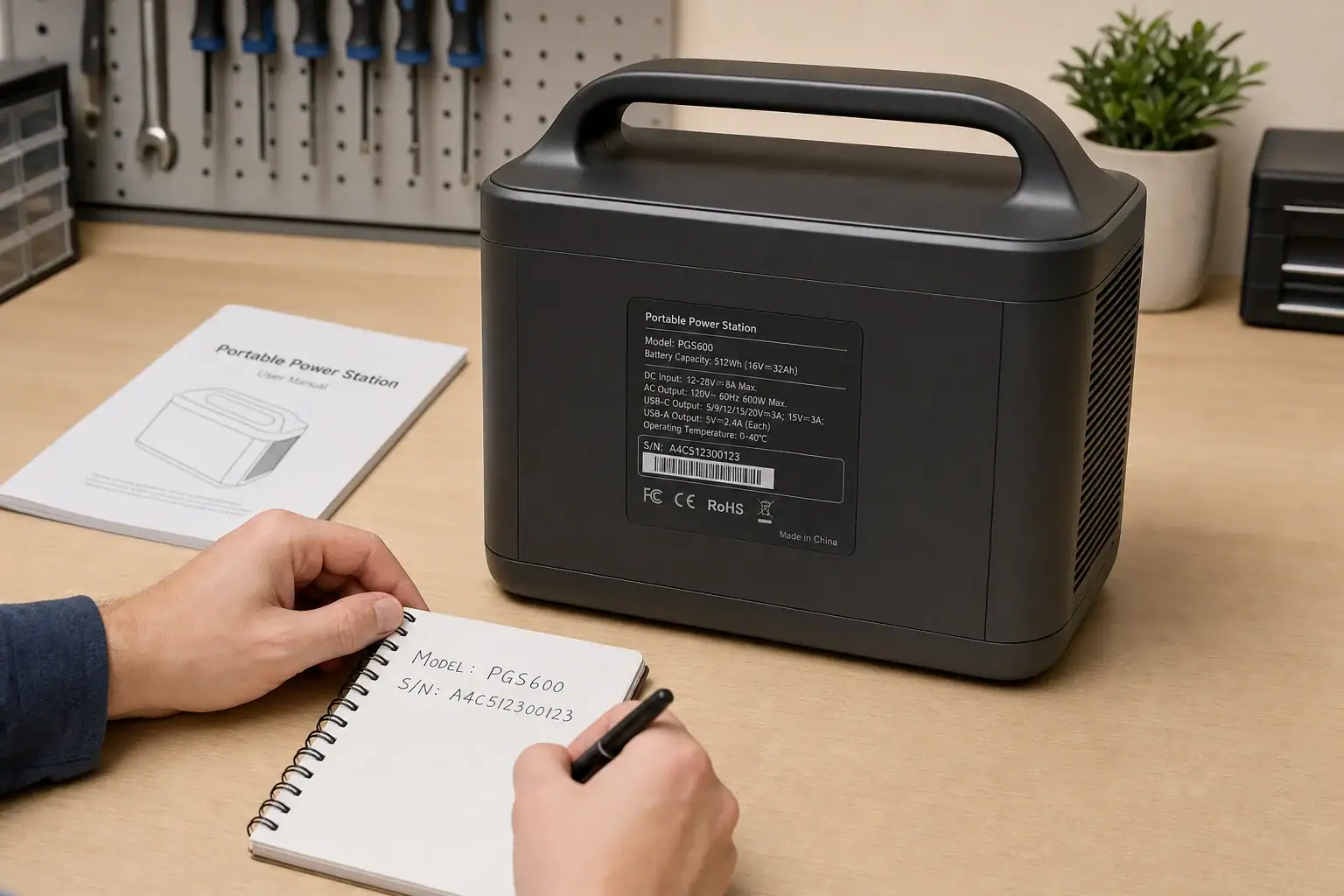
Person checking the model and serial number on a portable power station

To check whether a portable power station was recalled, find its exact model number and serial number, then compare them with current notices in the official government recall database for your country and on the manufacturer’s official support or recall page. Match every detail—including production dates, serial-number ranges, battery versions, and included accessories—because a recall may affect only part of a product line.

If your unit appears to be included, stop using and charging it and follow the recall notice exactly. Do not open the enclosure, remove internal cells, ship the unit, or discard it in household trash unless the manufacturer or the appropriate authority specifically instructs you to do so.

Record the product identifiers

Disconnect the power station from loads and charging sources if it is safe to do so. Without opening the enclosure, photograph or write down the identifying information printed on its exterior label. Look for:

  • Manufacturer name
  • Full product name
  • Model or type number
  • Serial number
  • Manufacturing date, date code, or batch number
  • Battery or hardware revision, if listed
  • Model numbers for the AC adapter, expansion battery, or other included components

The retail name alone is not enough. Products that look identical may use different batteries, electronics, or production runs. Conversely, one affected design may have been sold under more than one name. If the label is unreadable, check the original box, receipt, order history, registration record, or manufacturer app, but treat app data as secondary to the physical identifiers when both are available.

Search official recall sources

In the United States, search the current Consumer Product Safety Commission recall database and the manufacturer’s official website. The federal recall portal may also help identify which agency handles a product. Outside the United States, use the current product-safety recall database maintained by your national or regional government.

Search several terms rather than relying on one query:

  • The manufacturer name and exact model number
  • The product name plus “recall”
  • The serial or batch prefix, if the database supports it
  • “Portable power station,” “solar generator,” or “battery generator”
  • The model number of the charger or expansion battery

Also check the manufacturer’s current safety-notice and support pages. A company notice may provide a serial-number checker or more precise eligibility instructions than a short database summary. Verify that any message, form, phone number, or return label actually comes from the manufacturer or the government agency identified in the official notice.

Match the scope of the notice carefully

Finding the same product name does not automatically mean your unit is recalled. Compare the notice with your product point by point:

  • Model: Match the complete identifier, including suffixes and regional variants.
  • Serial or batch range: Check all characters and leading zeros.
  • Manufacturing window: Do not confuse the production date with your purchase date or the date the recall was announced.
  • Sales region or seller: Some notices cover specific markets or distribution channels.
  • Affected component: The recall may apply only to an adapter, cable, expansion battery, or battery module rather than the entire station.
  • Remedy: Confirm whether the notice calls for inspection, repair, replacement, refund, or another manufacturer-controlled process.

If the notice is unclear or your serial number is missing, contact the manufacturer through the contact details in the official recall notice. Provide photographs of the exterior label and proof of purchase if requested. Do not assume an unlisted serial number is safe when the label is incomplete or the product’s history is uncertain.

What to do if the power station is included

  1. Stop operating and charging it, unless the official notice gives different immediate instructions.
  2. Disconnect accessories and loads only if doing so presents no immediate risk.
  3. Keep people and combustible materials away from a unit that is unusually hot, swollen, leaking, hissing, smoking, or emitting a strong odor. Do not touch or move a smoking or burning battery; leave the area and contact emergency services.
  4. Follow the manufacturer’s recall process for storage, packaging, transport, repair, replacement, or refund.
  5. Keep copies of the notice, serial-number photograph, correspondence, and shipment or remedy confirmation.

Lithium-battery shipping and disposal are regulated and can vary by battery condition, carrier, and jurisdiction. A recalled or damaged power station may not be accepted through ordinary parcel service or routine battery recycling. Follow the current recall instructions and verify any transport or disposal requirements with the manufacturer, carrier, and relevant local authority.

If no recall appears

No search result is not proof that a unit has no safety issue. Recheck spelling and model variants, search included battery accessories separately, and ask the manufacturer to confirm the serial number in writing if you remain uncertain. Used products deserve extra attention because labels may be missing and prior recall messages may have gone to the original owner.

Stop using the power station and seek manufacturer guidance if it shows swelling, overheating, smoke, leakage, damaged ports, repeated protective shutdowns, or an unusual odor—even when no recall is listed. A defect affecting one unit can exist without a broader recall.

Keep future recall checks simple

Save a photograph of the product label, purchase record, and current owner’s manual. Register the product with the manufacturer if registration is available, but continue to rely on official recall databases and current manufacturer notices rather than assuming registration guarantees notification. Recheck those sources before selling, donating, transporting, or resuming use of a unit that has been stored for a long time.

Can a Portable Power Station Run a Dishwasher?

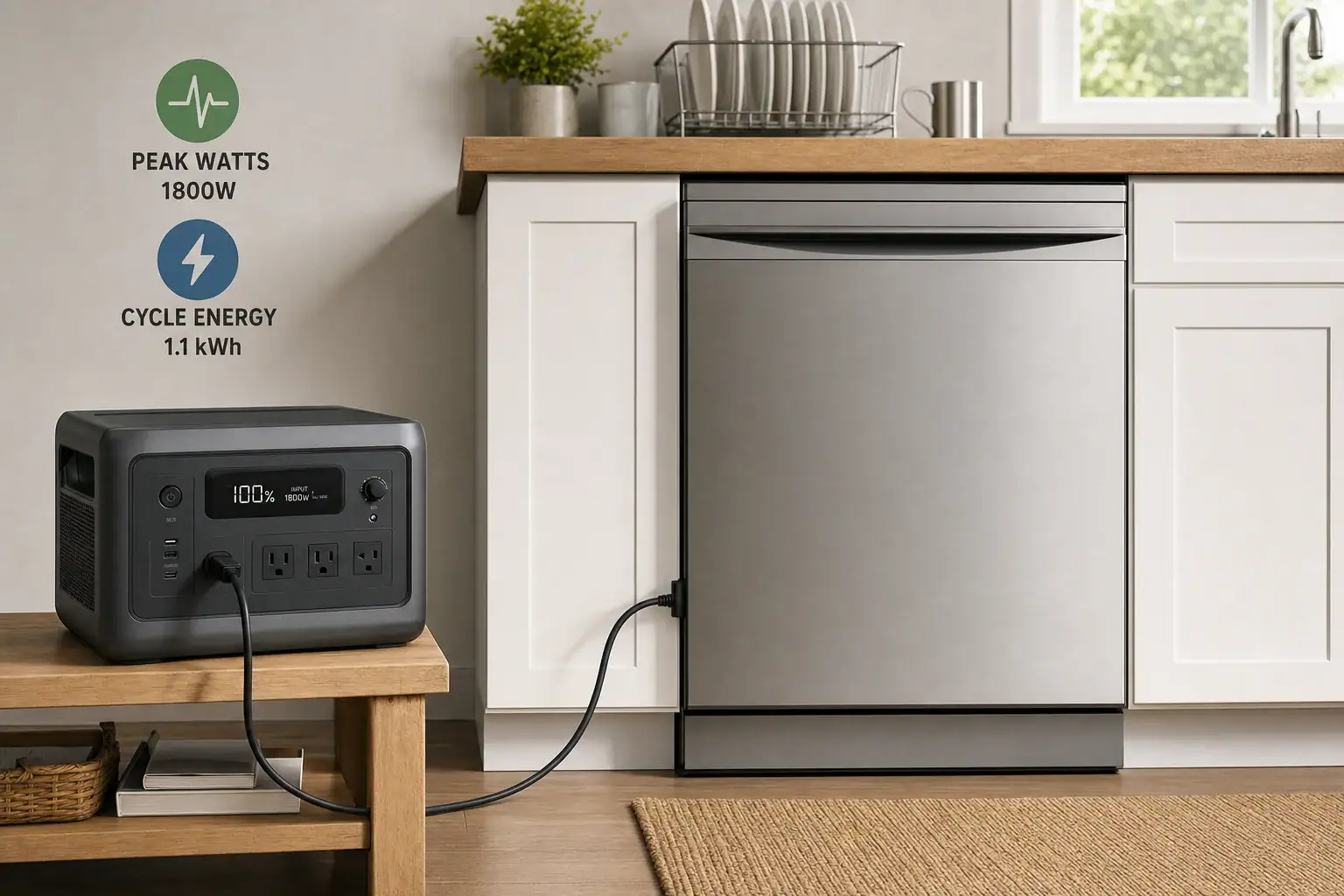
Cord-connected dishwasher powered by a portable power station kept safely away from water

Yes, a portable power station can run some dishwashers—but only if its inverter can handle the dishwasher’s maximum power draw and motor-starting surge, while its battery stores enough energy for the entire cycle. The dishwasher must also have a compatible factory-installed plug and an electrical configuration permitted by both manufacturers.

A built-in dishwasher that is hardwired into the home is not a suitable candidate for an improvised connection. Do not add a cord, alter the appliance, connect a power station to a home panel, or attempt to backfeed household wiring.

Dishwasher watts and cycle energy are different requirements

Two power-station specifications determine whether a dishwasher will run:

  • Output power, in watts: The inverter must support the dishwasher’s highest simultaneous load. Water heating and heated drying commonly create the largest sustained demand.
  • Battery energy, in watt-hours: The battery must supply enough total energy to finish the selected wash and dry cycle.

A station rated for 1,000 watts and 2,000 watt-hours has substantial energy capacity but may still shut down if the dishwasher draws more than 1,000 watts at any moment. Conversely, a high-output station with a small battery might start the appliance but run out of energy before the cycle ends.

How to determine the required inverter output

Check the dishwasher’s rating plate and manual for maximum input watts, rated current, voltage, and any stated circuit requirements. Manufacturer specifications vary by model, cycle, water temperature, and drying method.

If only rated current is provided, multiplying voltage by amperage offers a conservative screening estimate. For example, 120 volts × 12 amps equals 1,440 volt-amperes. That is not necessarily the appliance’s exact wattage because motors and electronic controls can affect power factor, but it indicates that a 1,000-watt inverter is unlikely to be appropriate. Verify compatibility with the appliance and power-station manufacturers rather than relying only on this estimate.

The power station’s continuous AC rating should exceed the dishwasher’s maximum simultaneous demand. Allowing roughly 15% to 25% headroom can reduce the chance of overload, but that margin is a practical sizing assumption rather than a universal manufacturer requirement.

Account for motor-starting surge

Dishwasher circulation and drain pumps may briefly draw more power when starting. The heating element is primarily a sustained resistive load rather than a major startup surge. Confirm that the station’s surge rating—and the time for which it can provide that output—covers the appliance’s starting demand. A high surge number is not useful if the station can sustain it only for less time than the motor needs.

Do not assume that an eco cycle eliminates the peak-load issue. It may reduce total energy consumption while still operating the same heater or pump at full power for shorter periods.

How much battery capacity is needed?

Use the dishwasher manufacturer’s cycle-energy figure when available. Because a dishwasher cycles its heater and pumps on and off, multiplying its maximum wattage by the full cycle duration usually overestimates energy use.

A useful sizing formula is:

Required nominal capacity in Wh ≈ cycle energy in kWh × 1,000 ÷ (AC efficiency × planned usable fraction)

AC conversion consumes some energy, so the battery’s advertised watt-hour capacity is not normally equal to the energy delivered at its outlet. Actual efficiency depends on load, inverter design, temperature, battery condition, and manufacturer rating methods. An 85% efficiency assumption is reasonable for an illustration, but it is not a guaranteed value for every station.

For example, suppose a dishwasher cycle is listed at 1.1 kWh. Assuming 85% AC efficiency and reserving 20% of the battery rather than planning a complete discharge:

1.1 × 1,000 ÷ (0.85 × 0.80) ≈ 1,620 Wh

Under those assumptions, about 1.6 kWh of nominal battery capacity is the calculated minimum for one cycle. A larger capacity provides room for a longer cycle, heated drying, battery aging, low temperatures, or differences between published and actual consumption. If a manufacturer states usable energy specifically at the AC outlet, avoid subtracting the same conversion loss twice.

Connection and safety limitations

  • Use only a permitted plug connection. A factory cord-and-plug-connected dishwasher may be compatible. A hardwired unit should not be converted or disconnected for this purpose without guidance from the appliance manufacturer and a qualified electrician.
  • Do not use home wiring as an intermediary. A portable power station must never be connected to a receptacle to energize household circuits or attached directly to an electrical panel.
  • Keep the station dry. Position it on a stable surface away from the sink, hoses, leaks, steam, and wet floors while maintaining the ventilation clearances stated in its manual.
  • Do not defeat grounding or protection. Portable stations differ in neutral-to-ground configuration and ground-fault protection. Confirm that the station’s outlet arrangement is compatible with the dishwasher, and never remove a grounding pin or bypass a protective device.
  • Avoid extension cords and power strips. Dishwasher manuals commonly restrict them. Follow the appliance manufacturer’s current instructions rather than improvising a longer connection.

A power station also should not be assumed to function as a certified uninterruptible power supply. Transfer behavior varies, and some dishwashers may stop, drain, or restart their cycle after an interruption.

Compatibility checklist

  • Dishwasher is factory cord-and-plug connected
  • Correct AC voltage and frequency
  • Pure sine wave output unless the appliance manufacturer specifies otherwise
  • Continuous watts above the maximum appliance load
  • Surge output sufficient for pump startup
  • Enough usable watt-hours for the selected cycle and conversion losses
  • Compatible grounding and ground-fault protection
  • Direct, dry connection that follows both manuals

Bottom line

A sufficiently large portable power station may run a plug-connected dishwasher, but both output and battery capacity must be sized independently. Use the dishwasher’s maximum electrical input to select inverter power and its per-cycle energy consumption to estimate battery capacity. If the appliance is hardwired or its grounding requirements are unclear, do not improvise a connection.

Can a Portable Power Station Run a Hair Dryer?

Hair dryer beside a portable power station in a dry indoor setting

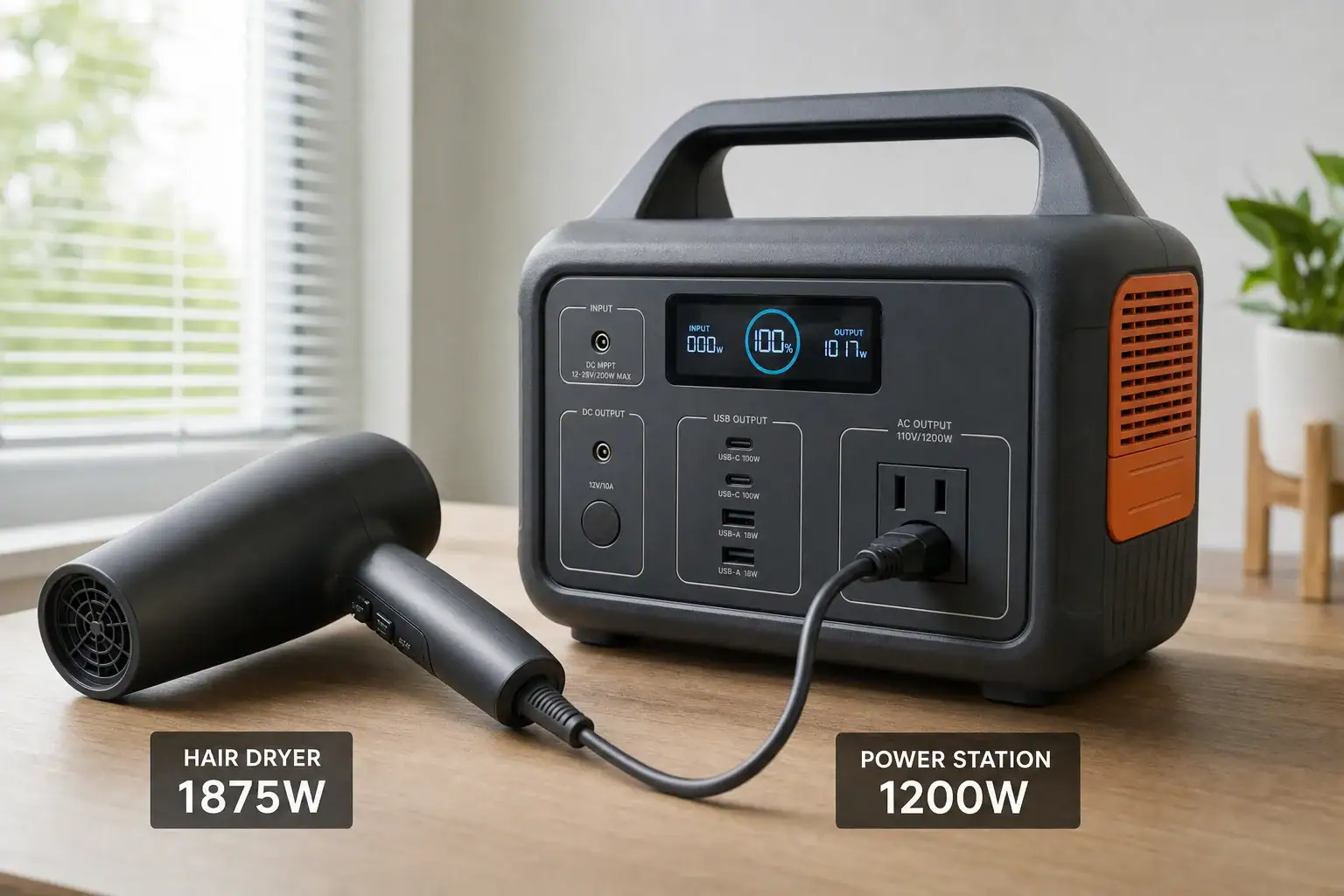
Yes, a portable power station can run a hair dryer if the station’s continuous AC output is at least as high as the dryer’s maximum input wattage. Hair dryers are demanding appliances: many full-size models draw roughly 1,200 to 1,875 watts, although the actual rating varies. A small power station with a 300- or 500-watt inverter will not run a typical full-size dryer.

Check the electrical label on the hair dryer rather than relying on a general wattage estimate. The power station must also provide the correct outlet voltage and frequency, have enough battery capacity for the intended drying time, and accommodate any brief startup demand from the dryer’s motor.

How to determine whether the power station is compatible

1. Compare continuous output with dryer wattage

Find the dryer’s rated watts on its label or in its manufacturer instructions. Then compare that number with the power station’s continuous AC output rating.

For example, a 1,500-watt dryer requires a power station rated for at least 1,500 watts of continuous AC output. A station advertised with a 1,500-watt surge rating but only 1,000 watts of continuous output is not sufficient. Surge or peak output is available only briefly and does not support the heating element during normal operation.

Ratings may apply to all AC outlets combined. If other devices are connected, add their wattage to the dryer’s demand and compare the total with the station’s continuous limit.

2. Allow for startup behavior

A hair dryer combines a resistive heating element with a fan motor. The heater generally does not create the large startup surge associated with compressors, but the motor and electronic controls can cause a brief increase or irregular demand when the dryer starts or changes settings.

The power station should therefore have some output headroom rather than matching the dryer’s rating exactly. Manufacturer designs vary, so a dryer near the station’s continuous limit may trigger overload protection even if the nameplate numbers appear compatible. The station’s published surge rating and appliance-compatibility guidance should be checked when available.

3. Confirm voltage and frequency

The dryer’s required voltage and frequency must match the power station’s AC output. In the United States, that commonly means a 120-volt, 60-hertz dryer and power station, but labels should still be verified.

Dual-voltage travel dryers must be set according to their manufacturer instructions. Do not assume that a plug adapter changes voltage, and do not use an improvised transformer or modified connection.

How long will the dryer run?

Battery capacity is usually listed in watt-hours (Wh). A simple runtime estimate is:

Runtime in hours = battery capacity in Wh × usable AC fraction ÷ dryer watts

The usable AC fraction accounts for inverter losses, internal power consumption, battery protection limits, temperature, and other variables. For illustration, an 85% usable fraction can provide a reasonable planning assumption, but it is not a guaranteed value. Check the power station manufacturer’s specifications when precise planning matters.

Illustrative runtime and energy calculations
Battery capacity Dryer load Assumption Estimated continuous runtime
500 Wh 1,200 W 85% usable AC energy About 21 minutes
1,000 Wh 1,500 W 85% usable AC energy About 34 minutes
1,000 Wh 1,875 W 85% usable AC energy About 27 minutes

These estimates assume uninterrupted operation at the stated wattage. Actual runtime can differ because heat settings may change power consumption, thermostats may cycle, and some stations reserve part of their stated capacity.

For a typical short session, energy use is often more useful than maximum runtime. A 1,500-watt dryer operated continuously for 10 minutes delivers:

1,500 W × 10 ÷ 60 = 250 Wh

At an illustrative 85% AC efficiency, that session would draw about 294 Wh from the battery: 250 Wh ÷ 0.85. Other loads and standby consumption would increase the total.

Do lower heat settings solve an output mismatch?

A lower setting may reduce consumption, but it should not be treated as a guaranteed way to operate a dryer that exceeds the station’s rating. Control designs vary: some settings reduce heater wattage, while others cycle full power on and off. The dryer may still briefly draw close to its maximum rating.

Use the dryer’s maximum labeled input when deciding whether the power station is compatible. A manufacturer-specified low-wattage mode can be considered only if the instructions explicitly state its electrical demand.

Safe operating considerations

  • Keep the power station, plugs, and connections dry. Do not place the station near a sink, tub, shower, or other source of splashing water.
  • Use the power station in the orientation and ventilation conditions specified by its manufacturer. A high-wattage load can create substantial inverter heat.
  • Do not defeat or remove an appliance leakage-current interrupter, ground-fault feature, polarized plug, or other safety device built into the dryer.
  • Inspect the dryer cord and plug before use. Do not operate equipment with damaged, loose, scorched, or unusually hot connections.
  • Avoid extension cords unless both equipment manufacturers permit them. Any cord used must be intact and appropriately rated for the full appliance load.
  • Stop using the setup if the station repeatedly reports an overload, shuts down from excessive temperature, smells unusual, or produces a hot connection. Repeatedly restarting it does not correct an output mismatch.

Some hair dryers use protective plugs that may behave differently with certain inverter grounding arrangements. Follow the instructions for both products, including any required plug test procedure. Do not bypass a protective plug if it will not reset or operate normally.

Quick compatibility checklist

  • Dryer maximum watts are below the station’s continuous AC rating.
  • Other connected loads are included in the total wattage.
  • The station has enough surge capacity and output headroom.
  • Voltage and frequency match the dryer’s requirements.
  • Estimated usable watt-hours cover the expected drying time.
  • The station can remain dry, stable, and properly ventilated during use.

Bottom line

A portable power station can run a hair dryer, but inverter output is usually the deciding factor. Compare the dryer’s maximum labeled wattage with the station’s continuous—not peak—AC rating, then estimate battery use in watt-hours after allowing for conversion losses. Because hair dryers combine high heat demand with a motor, choosing a station with reasonable output headroom is more reliable than operating at the inverter’s limit.

How to Measure Appliance Wattage for a Power Station

Plug-in electricity meter measuring the wattage of a small household fan

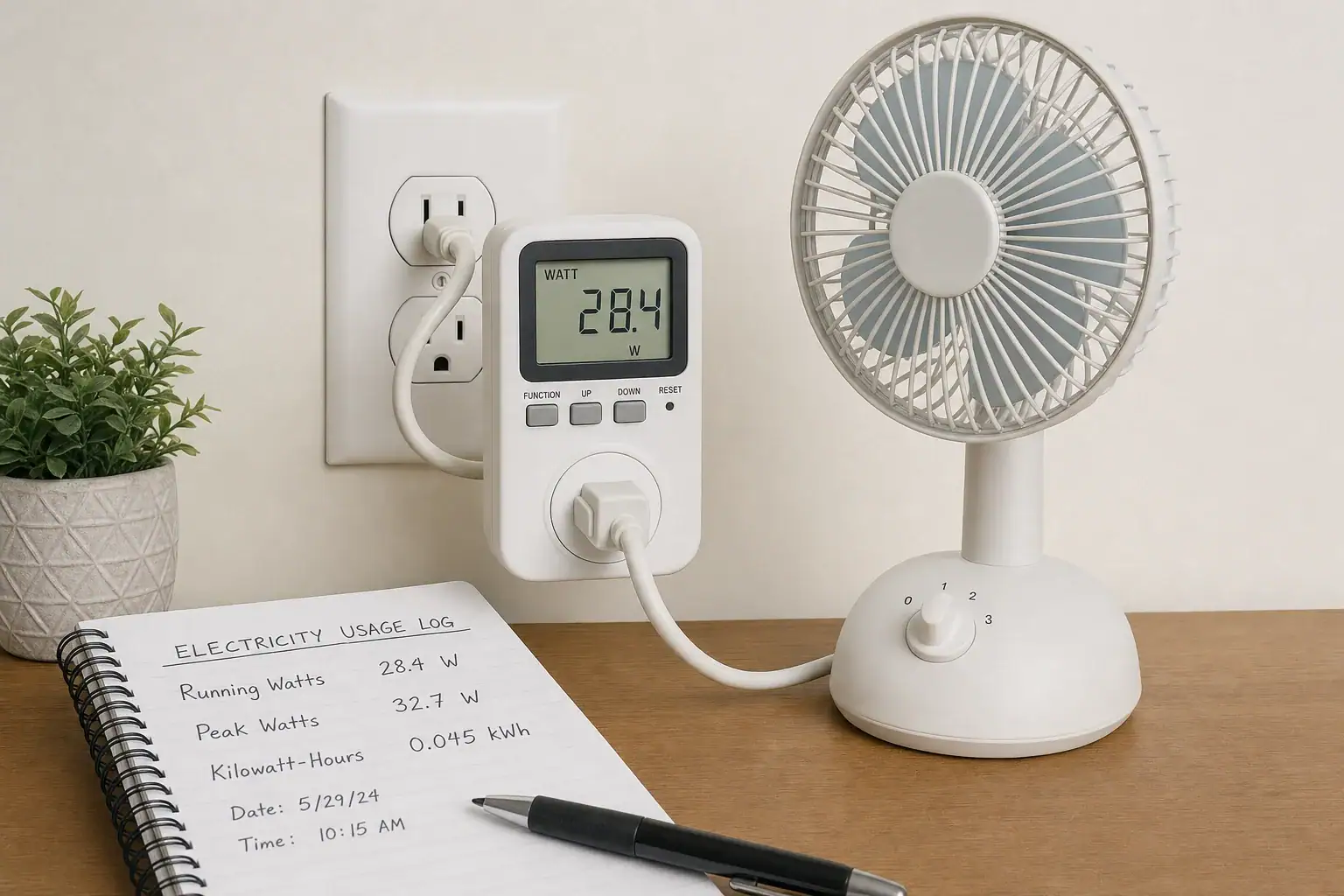
To measure appliance wattage before sizing a power station, use a properly rated plug-in electricity meter to record the appliance’s normal running watts, highest operating watts, and energy consumption in kilowatt-hours. Also check the appliance manual or manufacturer specifications for startup surge, because a basic meter may not capture a motor’s brief starting demand.

Use those readings for two separate decisions: running and startup watts determine the power station’s inverter rating, while watt-hours determine the battery capacity needed for the desired runtime. Measure every appliance you expect to operate, including loads that may run at the same time.

Start With the Appliance Label

Look for input watts on the appliance, power adapter, or manufacturer documentation. An input rating such as 120 V, 300 W provides a useful planning value, but it may represent maximum rather than typical consumption.

If the label lists only volts and amps, multiplying them gives volt-amperes:

Volts × amps = volt-amperes (VA)

VA and watts are not always equal for motors, compressors, and electronic power supplies because of power factor. For a simple resistive load, such as some heating elements, VA may be close to watts. For other appliances, measure real watts or use the manufacturer’s published wattage instead of assuming the two values are interchangeable.

Measure Real Power at the Outlet

A plug-in electricity meter is the most direct option for an ordinary cord-and-plug appliance. The meter must be rated for the outlet voltage, appliance current, plug type, and type of load. Follow its instructions, keep it dry, and do not use damaged cords or loose outlets.

  1. Connect the meter to the wall outlet according to its instructions.
  2. Connect the appliance to the meter.
  3. Run every mode you expect to use, including high heat, maximum speed, defrost, or other high-power settings.
  4. Record normal running watts and the highest displayed watts.
  5. For cycling appliances, leave the meter connected for a representative period and record kilowatt-hours.

Measure an appliance with its normal power adapter so the reading includes adapter losses. Do not use a household plug-in meter on hardwired equipment or circuits outside the meter’s rating. Hardwired or higher-voltage loads require appropriate instruments and qualified guidance. A portable power station should not be connected to home wiring, a panel, or a wall outlet as a power source unless a specifically designed, code-compliant system is installed under current official requirements.

Separate Running Watts From Startup Surge

Running watts are the power required after an appliance reaches normal operation. Startup surge is a short, higher demand produced when some motors, compressors, pumps, or transformers start.

A meter’s highest displayed value is not necessarily the true surge. Some meters update too slowly to capture a brief current spike. For a refrigerator, freezer, pump, or similar load, consult current manufacturer documentation for starting watts, locked-rotor information, or generator and inverter requirements. Do not repeatedly attempt to start an appliance from an undersized power station just to discover its limit.

The power station’s continuous AC rating must cover the combined running demand. Its surge rating must cover the relevant starting demand for the duration required by the appliance. Surge ratings vary in duration and test conditions among manufacturers, so two stations with the same advertised surge wattage may not behave identically.

Account for Simultaneous Loads

Add the running watts of appliances that may operate together. Then consider what happens when a motor starts while the other loads remain on:

Required startup power = existing running loads + starting demand of the appliance starting

If more than one motor can start at the same time, account for that overlap or manage the loads so their starts do not coincide. A planning margin can accommodate meter uncertainty, voltage variation, and differences between appliance samples, but it does not override either manufacturer’s limits.

Measure Energy for Battery-Capacity Sizing

Watts indicate instantaneous power; watt-hours indicate energy consumed over time. For a steady load:

Energy in Wh = watts × hours

A 100-watt appliance running continuously for six hours would use 600 Wh at the appliance. Cycling equipment should be measured in kilowatt-hours over a representative period instead of estimating from its running wattage.

Convert the meter reading with:

1 kWh = 1,000 Wh

For example, if a refrigerator uses an illustrative 0.9 kWh during a measured 24-hour period, its average energy use is 900 Wh per day. A 12-hour estimate would be 450 Wh only if that measured day is representative and consumption scales evenly enough for planning. Ambient temperature, thermostat setting, door openings, and operating mode can change the result.

Include Conversion Losses and Reserve

A power station’s stated battery capacity is generally not the same as the energy delivered to an AC appliance. The inverter consumes energy, conversion is not perfectly efficient, and the station may reserve some capacity for battery protection. Low-power loads can also be affected by the station’s own operating overhead.

If you are using an explicit delivery-efficiency assumption, estimate nominal capacity as:

Required nominal Wh = appliance energy ÷ (delivery efficiency × usable fraction)

For an illustrative calculation, suppose an appliance needs 600 Wh, assumed AC delivery efficiency is 85%, and 10% of nominal capacity is kept as a reserve:

600 ÷ (0.85 × 0.90) ≈ 784 Wh

This is a planning estimate, not a guaranteed runtime. Use manufacturer-provided usable-capacity or efficiency information when available, and note the conditions under which it was specified. Battery temperature, load level, battery age, inverter behavior, and automatic shutoff settings can all affect delivered energy.

Build a Useful Measurement Record

For each appliance, write down:

  • Normal running watts
  • Highest measured operating watts
  • Manufacturer-stated startup or surge requirement, if applicable
  • Measured Wh or kWh over a representative interval
  • Expected daily runtime or duty cycle
  • Other loads that may operate simultaneously

When matching those figures to a power station, verify its continuous output rating, surge rating and duration, battery watt-hours, AC voltage and frequency, and any per-port current limits. All must be compatible; sufficient battery capacity does not compensate for an undersized inverter.

Use the Highest Credible Number

If the label, meter, and documentation disagree, determine what each number represents. A label may show maximum input, a meter may show typical operation, and the manual may list a separate startup requirement. Size continuous output around the highest credible simultaneous running load, size surge output around reliable starting data, and size battery capacity from measured energy use with clearly stated loss and reserve assumptions.

Home Office Backup Power Runtime Plan

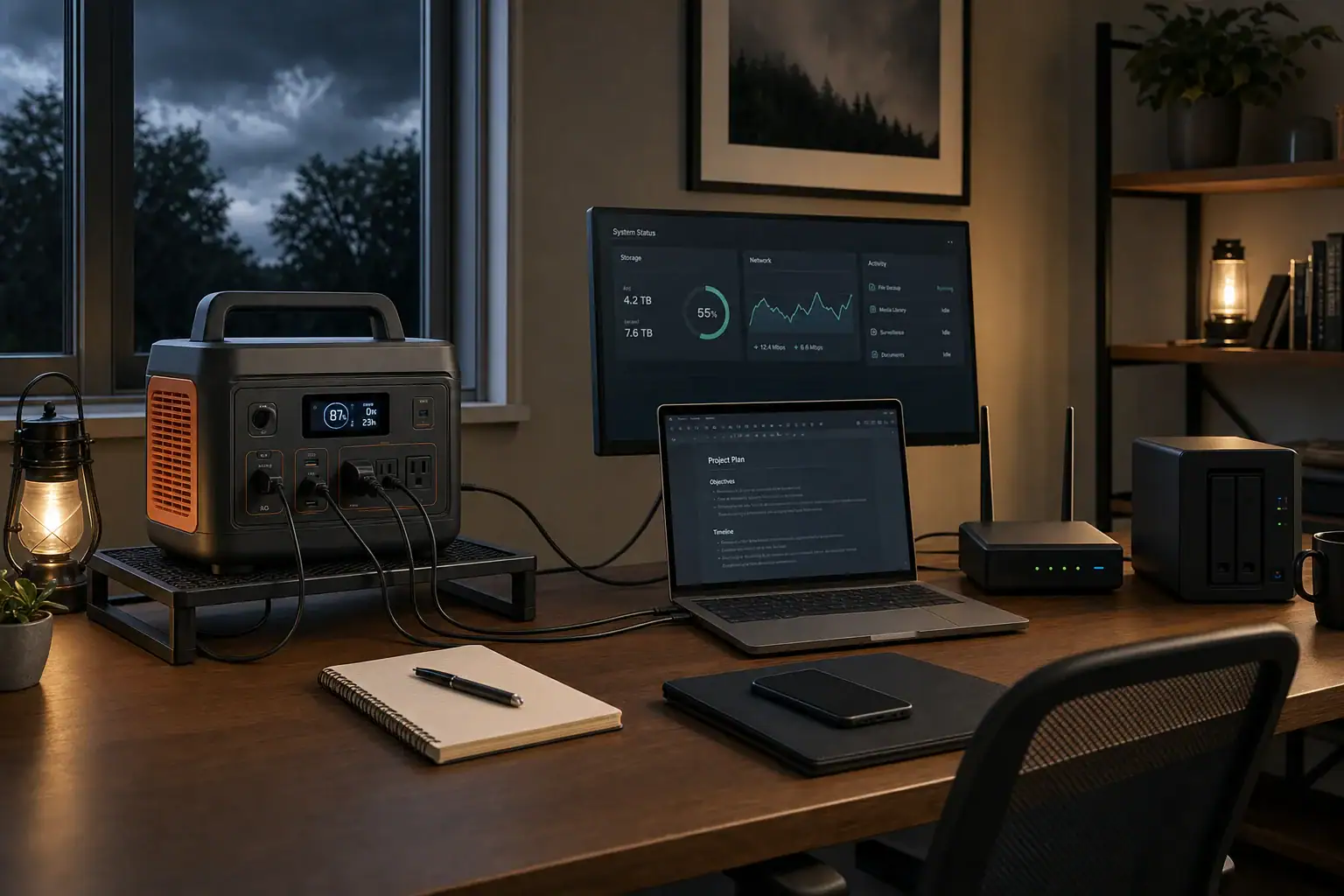
Portable power station supplying a laptop, monitor, router, and NAS in a home office

To plan backup power for a laptop, router, monitor, and NAS, add their average operating watts and multiply by the desired runtime. Then divide by a conservative planning factor—such as 0.80—to account for AC conversion losses, internal power use, battery limits, and a small reserve.

For an illustrative 110-watt office load, plan on about 275 watt-hours for two hours, 550 watt-hours for four hours, or 1,100 watt-hours for eight hours. Actual runtime can differ substantially, so measure the complete setup when possible and verify that the power station’s continuous output and changeover behavior suit the equipment.

Build an Average-Watt Load Budget

Use average operating draw rather than simply adding the maximum ratings printed on power adapters. Adapter labels describe what the adapter can supply, not necessarily what the device consumes continuously.

Illustrative home-office power budget
Device Assumed average draw What can change it
Laptop 45 W Charging state, processor workload, screen brightness
Router 10 W Model, connected radios and network activity
Monitor 25 W Size, brightness, resolution and sleep mode
NAS 30 W Drive count, drive activity, processor load and sleep settings
Total 110 W Average illustrative load, not a universal value

Include every device required for useful connectivity. A separate modem, fiber terminal, network switch, external drive or powered USB hub can materially change the total. Internet service may also fail upstream during a neighborhood outage even if local networking equipment remains powered.

Convert the Load into a Capacity Target

Portable power station capacity is normally stated in watt-hours, while output power is stated in watts. Use these planning formulas:

Required capacity in Wh = average load in W × desired hours ÷ planning factor

Estimated runtime in hours = rated capacity in Wh × planning factor ÷ average load in W

Using a 0.80 planning factor, the illustrative 110-watt setup produces these targets:

  • Two hours: 110 W × 2 ÷ 0.80 = 275 Wh
  • Four hours: 110 W × 4 ÷ 0.80 = 550 Wh
  • Eight hours: 110 W × 8 ÷ 0.80 = 1,100 Wh

The 0.80 factor is a planning assumption, not a guaranteed efficiency rating. It combines conversion losses with a modest operating reserve. Available AC energy varies with power-station design, load level, battery state, temperature, age, inverter overhead and manufacturer-defined shutdown thresholds. If the manufacturer publishes usable AC energy under conditions similar to yours, use that figure instead of applying a generic factor.

Plan a Reduced-Load Mode

The easiest way to extend runtime is to decide in advance which devices can be turned off. With a 500 Wh power station and the same 0.80 factor:

  • All four devices at 110 W: about 3.6 hours
  • Monitor off, 85 W remaining: about 4.7 hours
  • Monitor and NAS off, laptop plus router at 55 W: about 7.3 hours

These estimates assume the laptop continues averaging 45 watts. Runtime may be longer if its battery is already charged and power demand falls, or shorter during heavy work and rapid charging.

Give the NAS a Shutdown Deadline

A NAS does not necessarily need to run for the entire outage. A practical plan is to save active files, stop transfers and shut the NAS down using its normal software controls while enough backup energy remains. Follow the NAS manufacturer’s shutdown and power-loss guidance; do not simply disconnect it during disk activity.

After shutdown, the remaining capacity can support the laptop and network equipment longer. If continuous NAS availability or automatic safe shutdown is essential, use equipment specifically designed and documented for that function rather than assuming any portable power station will behave like a UPS.

Check Continuous Power, Startup Demand, and Waveform

Capacity determines approximate runtime, but the inverter’s watt rating determines whether it can run the load at all. Its continuous AC rating must exceed the highest simultaneous demand, including a laptop charging at high power and a NAS starting its drives.

NAS hard drives and some power adapters can briefly draw more power at startup than during normal operation. This is a surge, but surge ratings are manufacturer-specific and may apply for only a limited time. Do not size the system around the advertised surge number alone. Check the power station’s continuous rating, the NAS or adapter specifications, and—when available—the setup’s observed peak draw.

Also verify the waveform required by the connected equipment. Many modern switch-mode adapters tolerate a range of AC inputs, but compatibility should be confirmed in the equipment manufacturers’ current instructions.

Do Not Assume Seamless UPS Operation

A portable power station may offer pass-through power, an emergency power mode, or automatic changeover, but that does not automatically make it a certified or suitable UPS. A transfer interruption that seems brief can still reboot a router, interrupt a monitor, or cause a NAS shutdown.

If you intend to leave the office equipment connected while utility power is available, confirm all of the following in the current manufacturer documentation:

  • Whether simultaneous charging and AC output are supported
  • The specified transfer time for the relevant operating mode
  • Whether that mode is intended for continuous use
  • How the unit behaves when utility power returns or the battery becomes low
  • Whether AC output restarts automatically after an overload or shutdown

For work that cannot tolerate even a short interruption, use a power-continuity product documented for the required equipment and application. Keep important files saved regardless of the claimed transfer time.

Measure and Validate the Plan

A plug-in power meter can show the combined average draw of the office setup during representative work. Measure long enough to include laptop charging, monitor use and NAS activity. If possible, also observe startup demand when the NAS and other devices power on together.

Run a controlled practice session before relying on the plan. Confirm that the station supports the expected load, the NAS starts normally, and low-load settings do not turn off the AC output after higher-draw devices are removed. Keep the power station ventilated and follow its specified temperature, charging and storage instructions.

Use only compatible outputs and cables. A manufacturer-approved direct DC connection may avoid some inverter losses, but voltage, polarity, connector type and charging protocol must all match exactly. When uncertain, use the device’s normal AC adapter. Never connect a portable power station to home wiring or an electrical panel unless a specifically approved system is installed according to current manufacturer instructions and applicable electrical requirements.

A Practical Runtime Plan

  1. List every device required for work and internet access.
  2. Measure or conservatively estimate average operating watts.
  3. Calculate capacity with watts × hours ÷ 0.80, adjusting the factor if reliable manufacturer data supports a different assumption.
  4. Verify continuous output, startup demand, waveform requirements and outlet compatibility.
  5. Set a NAS shutdown point and a reduced-load mode for longer outages.
  6. Confirm changeover behavior instead of assuming seamless UPS operation.
  7. Test the complete setup under controlled conditions and revise the estimate using observed power consumption.

This approach sizes backup power around the work that must continue, while preserving a clear fallback plan when an outage lasts longer than expected.

Portable Power Station for a Mini Fridge: Runtime and Setup

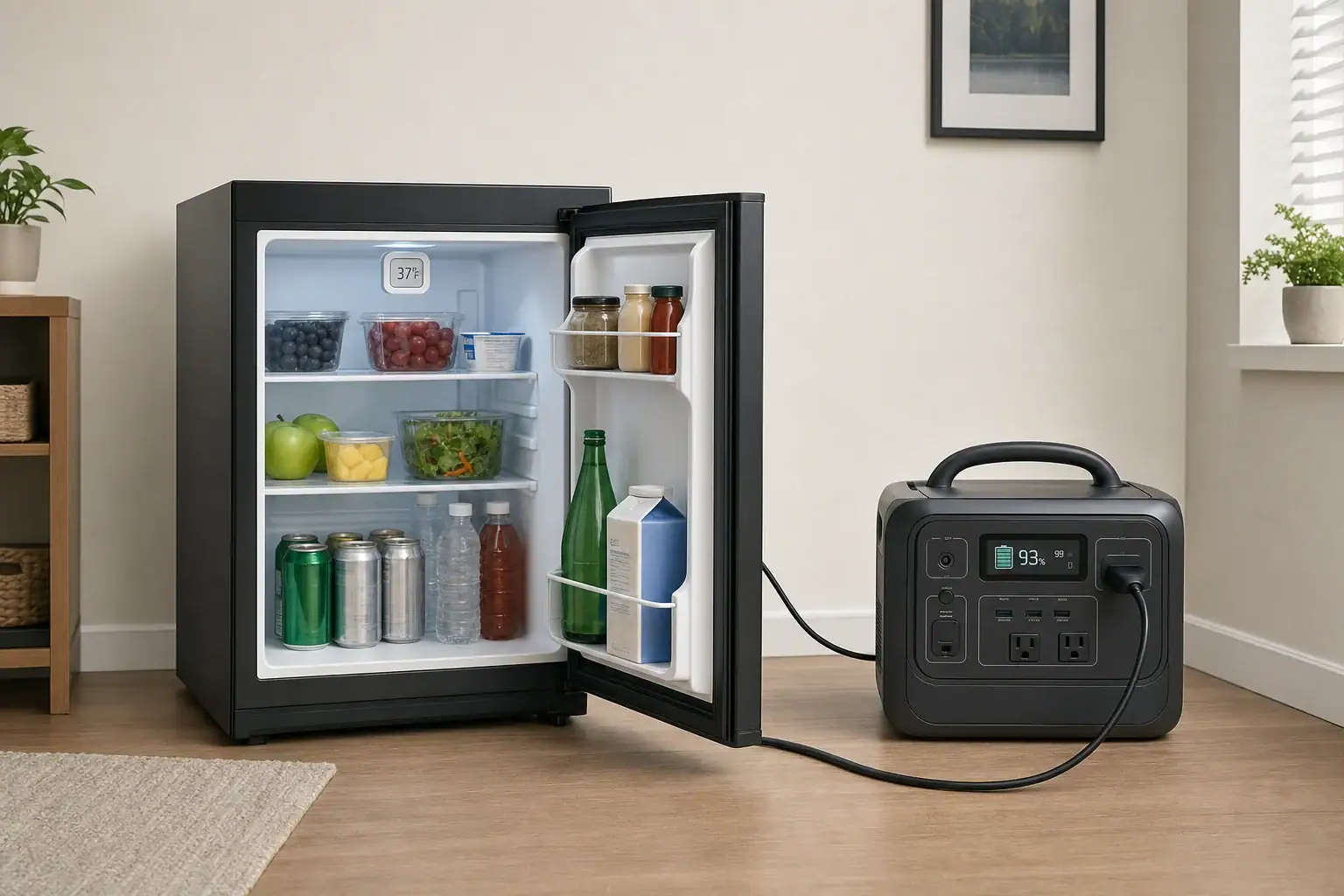
Mini fridge connected to a portable power station with ventilation space around both devices

A portable power station can run a mini fridge if its inverter supports both the fridge’s running wattage and its brief compressor-starting surge. Runtime depends mainly on the station’s watt-hour capacity and the fridge’s actual energy consumption—not simply the wattage printed on the fridge label.

For a practical estimate, convert the fridge’s daily energy use to average watts, account for AC conversion losses, and then compare the result with the power station’s usable capacity. Leave additional capacity for hot weather, frequent door opening, battery aging, and other variables.

How to estimate mini-fridge runtime

The most useful input is the refrigerator’s measured or published energy consumption in watt-hours per day or kilowatt-hours per year. A compressor fridge cycles on and off, so its nameplate wattage usually represents power while operating rather than its average draw over a full day.

Using daily energy consumption

Estimate runtime with this formula:

Runtime in hours = usable AC energy ÷ average fridge watts

Calculate the two values as follows:

  • Usable AC energy: power-station capacity in watt-hours × assumed AC efficiency.
  • Average fridge watts: watt-hours consumed per day ÷ 24.

AC efficiency varies with the inverter, load, temperature, and battery state. For planning purposes, an illustrative assumption of 80% to 90% may be reasonable, but the power-station manufacturer’s data should take priority. Keeping a reserve rather than planning to reach 0% also provides a more conservative result.

For example, suppose a power station is rated at 500 Wh and you assume 85% reaches the fridge through the AC outlet:

500 Wh × 0.85 = 425 Wh of estimated usable AC energy

Illustrative runtime for a 500 Wh power station at 85% assumed AC efficiency
Fridge energy use Average load Estimated runtime
300 Wh/day 12.5 W About 34 hours
600 Wh/day 25 W About 17 hours
1,000 Wh/day 41.7 W About 10 hours

These are planning estimates, not guaranteed runtimes. A warm fridge that has just been loaded may run continuously for a while, reducing runtime substantially.

Using an annual energy figure

If the refrigerator documentation lists kilowatt-hours per year, convert it to daily use:

Annual kWh × 1,000 ÷ 365 = estimated Wh/day

For example, 220 kWh per year equals about 603 Wh per day under the conditions used for that published estimate. Real consumption can differ because of room temperature, thermostat setting, ventilation, food load, door opening, and frost buildup.

Using running watts when no energy figure is available

Dividing battery capacity by the fridge’s running watts gives a conservative continuous-operation estimate, but it does not account for normal compressor cycling. A plug-in energy meter can provide a more useful 24-hour consumption figure if its ratings and instructions permit use with the refrigerator.

Why compressor surge matters

A compressor motor can draw substantially more power for a brief period when it starts than it uses while running. The power station therefore has two relevant inverter ratings:

  • Continuous output: the sustained power available while the compressor is running.
  • Surge or peak output: the short-duration output available during startup.

The fridge nameplate may show rated current or running watts without identifying the startup peak. Do not assume a universal surge multiplier: compressor design, starting components, voltage, temperature, and restart timing all affect the peak. Check the refrigerator manufacturer’s specifications or obtain appropriate startup-current data when possible.

The station’s continuous rating should exceed the fridge’s running requirement plus any simultaneous loads. Its surge rating and permitted surge duration must also cover the compressor’s startup demand. Two products may advertise the same peak wattage but support that peak for different lengths of time, so consult the current manufacturer documentation.

Thermoelectric mini coolers behave differently because they generally do not have a compressor-starting surge. However, they may run nearly continuously, so a modest wattage can still consume significant energy over a day.

Compatibility checklist

  • The power station’s AC voltage and frequency match the refrigerator’s requirements.
  • Continuous inverter output exceeds the total sustained load.
  • Surge output is adequate for compressor startup.
  • The inverter waveform meets the refrigerator manufacturer’s requirements.
  • Estimated usable watt-hours provide the needed runtime with a reserve.
  • The AC outlet and any permitted cable are rated for the appliance load.

Do not treat a watt-hour rating as an inverter-power rating. Capacity in Wh indicates stored energy; output in W indicates how much power the inverter can deliver at one time. A large-capacity station can still be incompatible if its inverter cannot start the compressor.

Setup tips for longer, more reliable operation

  1. Pre-chill the refrigerator on normal utility power. Cooling a warm interior requires much more energy than maintaining an already-cold compartment.
  2. Charge the power station beforehand. Confirm its state of charge and enable its AC output before relying on it.
  3. Connect the fridge directly when practical. Avoid power strips and daisy-chained cables. If an extension cord is necessary and permitted by both manufacturers, use one properly rated for the appliance and environment.
  4. Provide ventilation. Keep the fridge’s condenser area and the power station’s air inlets and outlets unobstructed. Do not place either unit in a sealed cabinet.
  5. Keep equipment dry and stable. Protect the station and connections from liquids, condensation, heat sources, and impact.
  6. Limit door opening. Organize contents in advance so cold air is not repeatedly lost.
  7. Check power-saving behavior. Some stations shut off AC output when a cycling appliance draws little or no power. If the manual provides an appropriate always-on or low-load setting, use it as directed.
  8. Monitor temperature. A refrigerator thermometer helps show whether food remains adequately cold. Follow current public-health guidance for food temperatures and disposal after an outage.

If the fridge will not start or keeps shutting down

An immediate overload warning usually points to startup surge, excessive combined load, or inverter incompatibility. Disconnect other loads and compare the fridge’s requirements with both the continuous and surge specifications. Do not repeatedly force restart attempts if either device reports a fault.

If the fridge starts but the station later turns off, check for a low-load shutdown setting, depleted battery, blocked ventilation, high temperature, or an overloaded outlet. Some compressors also have a protective delay before restarting after power is interrupted; follow the refrigerator manual rather than rapidly switching power off and on.

Pass-through charging does not automatically make a power station an uninterruptible power supply. Transfer behavior, interruption time, output limits, and charging restrictions vary. Use that arrangement only when the current manufacturer instructions explicitly support the intended appliance and configuration.

Bottom line

Size a portable power station from the mini fridge’s daily energy consumption, then separately verify the inverter’s continuous and surge ratings. Include conversion losses and a reserve, start with a cold refrigerator, maintain ventilation, and confirm that low-load power-saving features will not switch off the cycling compressor. Keep the setup isolated from household wiring; never connect a portable power station to a home panel or attempt to backfeed a circuit.

What Size Power Station for a Well Pump? Surge and Runtime

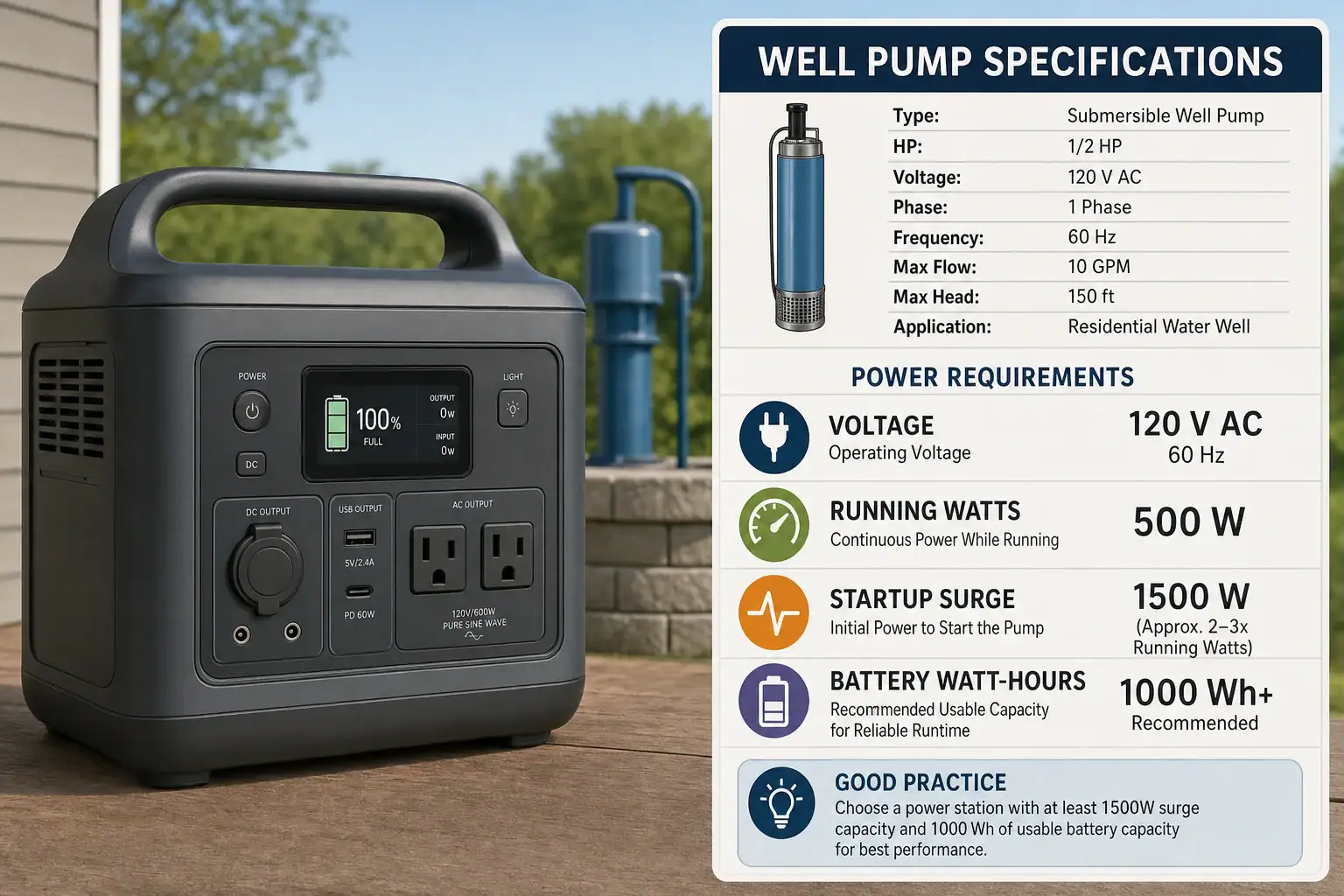
Portable power station sizing diagram showing well pump voltage, running load, startup surge, and battery capacity

Choose a portable power station that matches the well pump’s voltage and frequency, supplies more than its continuous running load, and can sustain its full startup surge. Battery capacity then determines runtime. A pump that uses 1,000 watts while running and needs 3,000 watts at startup requires an inverter rated above 1,000 watts continuously and at least 3,000 watts for the required starting duration.

For runtime, divide the station’s usable AC energy by the pump’s average load. A 2,000-watt-hour station does not normally deliver all 2,000 Wh through its AC outlets because some capacity may be reserved and some energy is lost in the inverter. Voltage compatibility comes first: a high-capacity 120-volt station cannot operate a 240-volt pump merely because its watt rating appears sufficient.

Start With the Pump’s Electrical Requirements

Do not size from horsepower alone. Horsepower describes mechanical output, while portable power stations must handle the motor’s electrical input and starting current. Pumps with the same horsepower can have different voltage, running-current, and startup requirements.

Use the pump or controller manufacturer’s documentation and an accessible nameplate to identify:

  • Required AC voltage, such as 120 or 240 volts
  • Frequency, usually stated in hertz
  • Single-phase or other phase requirement
  • Running watts or full-load current
  • Starting watts, starting current, or locked-rotor amps
  • Any waveform or power-quality requirements for electronic controls

If starting information is unavailable, contact the pump manufacturer or have a qualified electrician obtain appropriate inrush data without opening or modifying the equipment yourself. Multiplying volts by amps gives volt-amps, not necessarily true watts, because an AC motor’s power factor affects the relationship. Manufacturer-provided running and starting specifications are preferable.

Continuous Output and Startup Surge Are Different

The power station has to meet two separate inverter requirements:

  • Continuous output: The power it can supply for the entire time the pump runs.
  • Surge output: The short burst available while the motor starts.

Leave continuous-output headroom instead of selecting an inverter whose rating exactly equals the pump’s stated running watts. Account for the pump controller and any other device powered at the same time. Operating pressure, water depth, motor design, supply voltage, and control equipment can all affect demand.

Surge ratings also vary by manufacturer. One station may support its advertised surge for several seconds, while another may allow it only briefly or may use a voltage-reducing mode that is unsuitable for some motors. Confirm that the surge rating applies at the pump’s required voltage and lasts long enough for that specific motor to start. A large watt-hour battery does not compensate for an inverter that trips during startup.

Illustrative Surge Example

Suppose a pump requires 240 volts, draws 1,000 watts while running, and has a 3,000-watt startup requirement. A compatible station would need:

  • A genuine 240-volt output with the correct frequency and phase
  • Continuous output comfortably above 1,000 watts
  • Surge output of at least 3,000 watts for the specified starting interval
  • An output receptacle and current rating suitable for the intended direct connection

Two ordinary 120-volt outlets must never be combined to create 240 volts. Likewise, an adapter cannot convert a 120-volt inverter into a proper 240-volt source.

Calculate Battery Capacity and Runtime

For a pump that runs continuously, use this planning formula:

Runtime in hours = rated battery Wh × usable fraction × AC efficiency ÷ running watts

The usable fraction represents capacity the station actually makes available before shutdown. AC efficiency accounts for inverter losses. Use manufacturer-supplied usable AC energy when available; otherwise, any percentages used are planning assumptions rather than guaranteed performance.

Illustrative Continuous-Run Calculation

Assume a 2,000 Wh station, 90% usable capacity, 90% AC conversion efficiency, and a 1,000 W pump:

2,000 Wh × 0.90 × 0.90 ÷ 1,000 W = 1.62 hours

The resulting 1.62 hours is an idealized estimate. Actual runtime can differ because of temperature, battery state, motor load, controller consumption, inverter behavior, and manufacturer-specific capacity reserves.

Account for an Intermittent Pump Duty Cycle

Many pressure-tank systems run only part of the time. Estimate the average load with:

Average pump load = running watts × duty cycle

If the illustrative 1,000 W pump runs 25% of the time, its average pump load is 250 W. Using the same assumed 1,620 Wh of usable AC energy:

1,620 Wh ÷ 250 W = 6.48 elapsed hours

This estimate assumes the 25% duty cycle continues throughout the outage. Actual water use, pressure-tank condition, well recovery, and pump controls can change that percentage. Repeated starts may also cause shutdown even when the average-energy calculation suggests sufficient runtime, so surge compatibility must still be checked separately.

Voltage and Connection Can Rule Out a Power Station

Many submersible well pumps are hardwired, and many operate at 240 volts. This guide applies only when the pump is designed for a direct connection to a compatible portable source under its manufacturer’s instructions. Do not backfeed a receptacle, improvise a cord, combine outputs, or connect a portable power station to a home electrical panel.

A hardwired pump requires a backup arrangement specifically designed for the installation. Any such design should be evaluated by a qualified electrician under the equipment instructions and current local electrical requirements. Do not assume that a station’s outlet, advertised voltage, or grounding arrangement makes it appropriate for permanent wiring.

Practical Compatibility Checklist

  • The station’s AC voltage, frequency, and phase exactly match the pump and controller.
  • Continuous inverter output exceeds the pump’s maximum running demand with reasonable headroom.
  • Surge output meets the motor’s starting requirement for the necessary duration.
  • The battery has enough usable AC watt-hours for the expected duty cycle and outage length.
  • The waveform and power quality satisfy the pump or electronic controller manufacturer’s instructions.
  • The individual receptacle and output circuit can supply the required current; do not rely only on the station’s combined watt rating.
  • The proposed connection is explicitly permitted by both equipment manufacturers and does not involve home-panel backfeeding or improvised wiring.

The most reliable sizing process is therefore voltage first, inverter output second, and battery capacity third. If any one of those requirements is missing—especially the correct voltage or adequate startup surge—a larger watt-hour rating alone will not make the station compatible with the well pump.

Frequently asked questions

Can solar charging extend a power station’s well-pump runtime?

Solar charging can replace some energy while the station is operating, but the amount depends on the solar input, weather, panel setup, and the pump’s average energy use. Confirm the station’s supported solar input and charging limits in its current manufacturer instructions.

Should I test the power station with the well pump before an outage?

If the pump is designed for a permitted direct connection, a planned test can reveal whether the station starts and runs the actual load. Follow both manufacturers’ instructions, and use a qualified electrician for any hardwired or permanently installed pump arrangement.

Aquarium Backup Power: Sizing for Heaters and Pumps

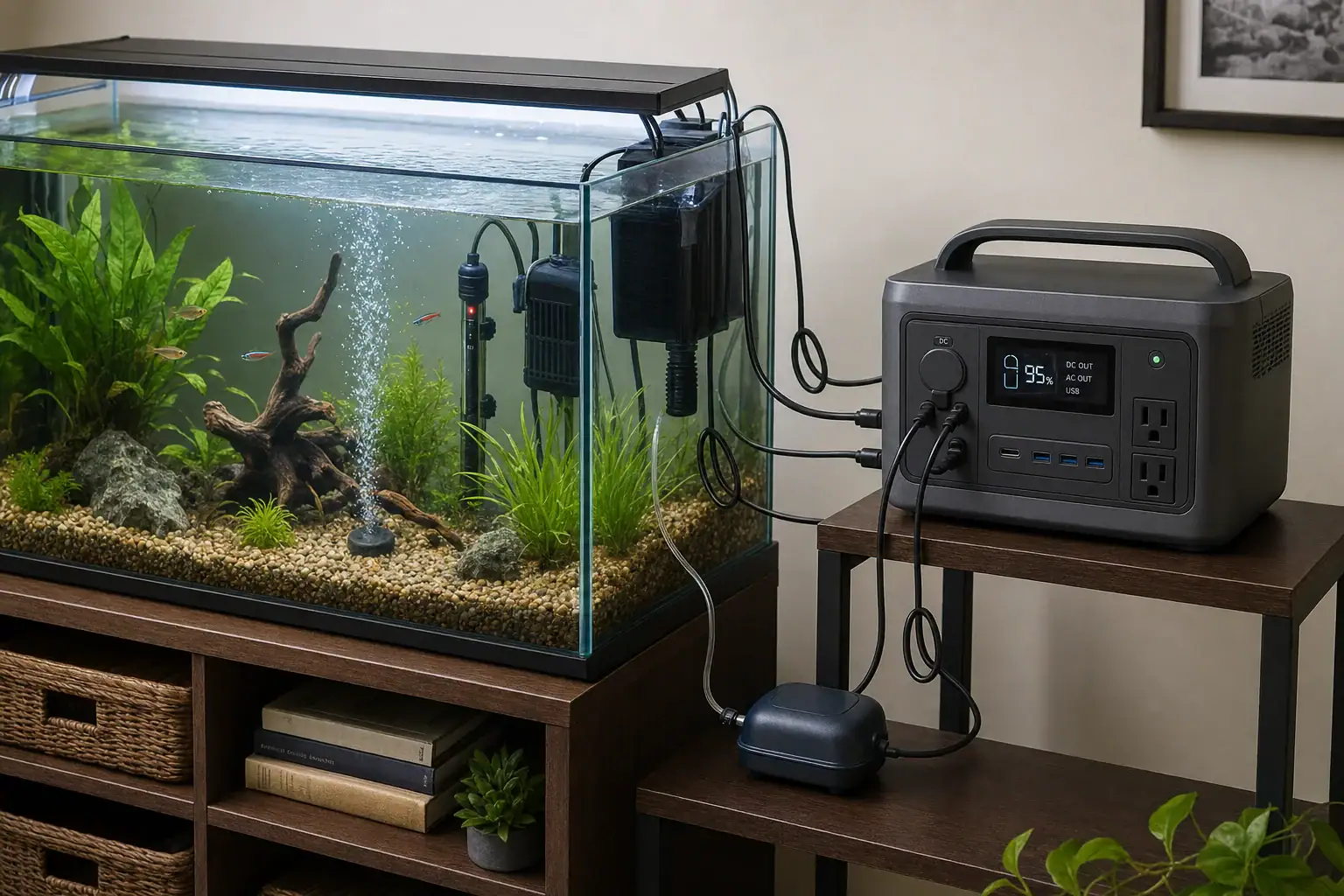
Portable power station supplying backup power to an aquarium heater, filter, and air pump

To keep an aquarium heater, filter, and air pump running, choose a portable power station based on both output watts and battery watt-hours. Its continuous output must support all connected equipment at once, while its surge rating must accommodate pump startup. Battery capacity then determines how long the system can run.

For runtime planning, add each device’s energy use over the expected outage and divide by an estimated AC efficiency. Heater cycling is the biggest uncertainty: a heater rated at 100 watts may run intermittently in normal conditions but nearly continuously as the room cools.

Calculate the aquarium’s backup-power requirement

Read the input wattage from the label or manual for the heater, filter pump, and air pump. If a device lists only amps, calculate approximate watts as volts multiplied by amps, but use the manufacturer’s stated input watts when available. Nameplate figures and actual consumption can differ.

Required battery capacity in watt-hours = total load energy ÷ estimated conversion efficiency

For a device that cycles, calculate its load energy as:

Rated watts × duty cycle × outage hours

A 50% heater duty cycle means the heater is assumed to run for half of each hour. This is only a planning assumption, not a guarantee. Tank size, room temperature, insulation, heater controls, livestock requirements, and the length of the outage all affect heater runtime.

Illustrative 10-hour calculation

Illustrative aquarium loads; use the ratings for your own equipment.
Equipment Rated power Assumed duty cycle Energy for 10 hours
Heater 100 W 50% 500 Wh
Filter 15 W 100% 150 Wh
Air pump 5 W 100% 50 Wh
Total delivered to equipment 120 W maximum 70 W average 700 Wh

Assuming 85% overall AC efficiency, the estimated station capacity is 700 Wh ÷ 0.85 = about 824 Wh. The 85% figure is illustrative. Inverter losses, the station’s own operating consumption, battery temperature, battery age, and manufacturer reserve settings can all change usable runtime.

For a colder worst case in which the 100-watt heater runs continuously, the same setup would consume 1,200 Wh over 10 hours. At 85% efficiency, that would require about 1,412 Wh of nominal capacity. This large difference is why heater duty cycle should not be treated as a fixed specification.

Check continuous output and startup surge

The example system has a maximum running load of 120 watts, so the station’s continuous AC rating must exceed 120 watts. Select additional headroom if other aquarium devices could be connected or equipment labels show higher maximum inputs.

Heaters are generally steady resistive loads, but filter and air-pump motors can draw extra power when starting. The surge magnitude and duration vary by motor design, and power-station manufacturers define surge capability differently. Compare the equipment manufacturer’s available startup information with both the station’s continuous rating and its stated surge conditions. Do not assume a large peak-watt number can be sustained for more than the period specified by the manufacturer.

Equipment may also restart simultaneously when the inverter turns on. Size for that possibility rather than assuming the pumps will start one at a time.

Account for usable capacity and low-power losses

A station’s advertised watt-hours may describe nominal battery capacity rather than energy available from its AC outlets. Battery management reserves and inverter losses reduce the amount delivered to aquarium equipment. If the manufacturer publishes usable AC energy under relevant conditions, use that figure instead of applying a generic efficiency estimate.

Inverter overhead matters especially when powering only a small air pump. A 5-watt load does not necessarily provide the runtime predicted by dividing nominal watt-hours by 5 watts, because the inverter itself also consumes energy. Manufacturer runtime data for comparable low loads can improve the estimate, although actual conditions will still vary.

Native DC operation may avoid some inverter loss, but only use it when the aquarium device is explicitly designed for the station’s output voltage, polarity, connector, and current range. Do not improvise adapters or connect an AC aquarium device directly to a DC port.

Prioritize loads if the outage outlasts the battery

The safest priority depends on the species, water temperature, stocking level, filtration design, and room conditions. In many tanks, aeration and water movement become urgent because dissolved oxygen can decline, while cold-sensitive livestock may also require uninterrupted heat. Seek species-specific guidance rather than relying on a universal order.

  • Air pump: Often provides substantial oxygenation for relatively little power, provided the air stone and pump arrangement are appropriate for the tank.
  • Filter or circulation pump: Supports water movement and biological filtration, but may consume more power than a small air pump.
  • Heater: Usually the largest load. Its importance rises as the room and aquarium cool, particularly for temperature-sensitive livestock.

If capacity is limited, leave nonessential lights, decorative pumps, and unrelated electronics disconnected unless the animals or system specifically require them. Avoid allowing a filter to remain stagnant for a prolonged period and then restarting it without checking the filter manufacturer’s instructions; conditions inside an idle filter can deteriorate.

Aquarium-specific compatibility and safety

  • Keep the power station dry, raised above floor-level water risks, and outside the aquarium’s splash zone. Maintain required ventilation clearance.
  • Arrange cords with drip loops where appropriate, and never handle plugs, outlets, or the station with wet hands.
  • Keep the heater submerged to the depth specified by its manufacturer. Follow its instructions before exposing, moving, or restarting it.
  • Confirm that pumps restart and re-prime correctly after power loss. Some filters require manual priming, while sump systems must safely accommodate normal drain-down whenever the return pump stops.
  • Do not defeat grounding pins, protective devices, or required ground-fault protection. Outlet and grounding designs vary, so follow the aquarium equipment and power-station manuals along with current local electrical guidance.
  • Do not connect a portable power station to home wiring or an electrical panel. Power the aquarium equipment directly from approved station outlets and properly rated accessories.

Do not assume automatic backup operation

A portable power station is not automatically a certified uninterruptible power supply. Pass-through charging, transfer behavior, interruption time, and automatic recovery after depletion vary by model. Some units may turn off after a low-load period, while aquarium controllers or pumps may not restart after even a brief interruption.

For unattended operation, verify in the current manufacturer documentation that the station supports the intended backup mode and that every connected aquarium device automatically resumes safely. Stay within all charging, load, temperature, and placement requirements.

Bottom line

Add the heater’s duty-adjusted energy to the filter and air pump energy, divide by a realistic AC-efficiency assumption, and include capacity headroom for colder conditions and battery variability. Then confirm that the station’s continuous and surge ratings cover all devices starting together. Because the heater can dominate consumption, calculate both a normal cycling scenario and a conservative continuous-heating scenario before choosing capacity.