Camping Power Planning: A Simple Energy Budget for a Weekend

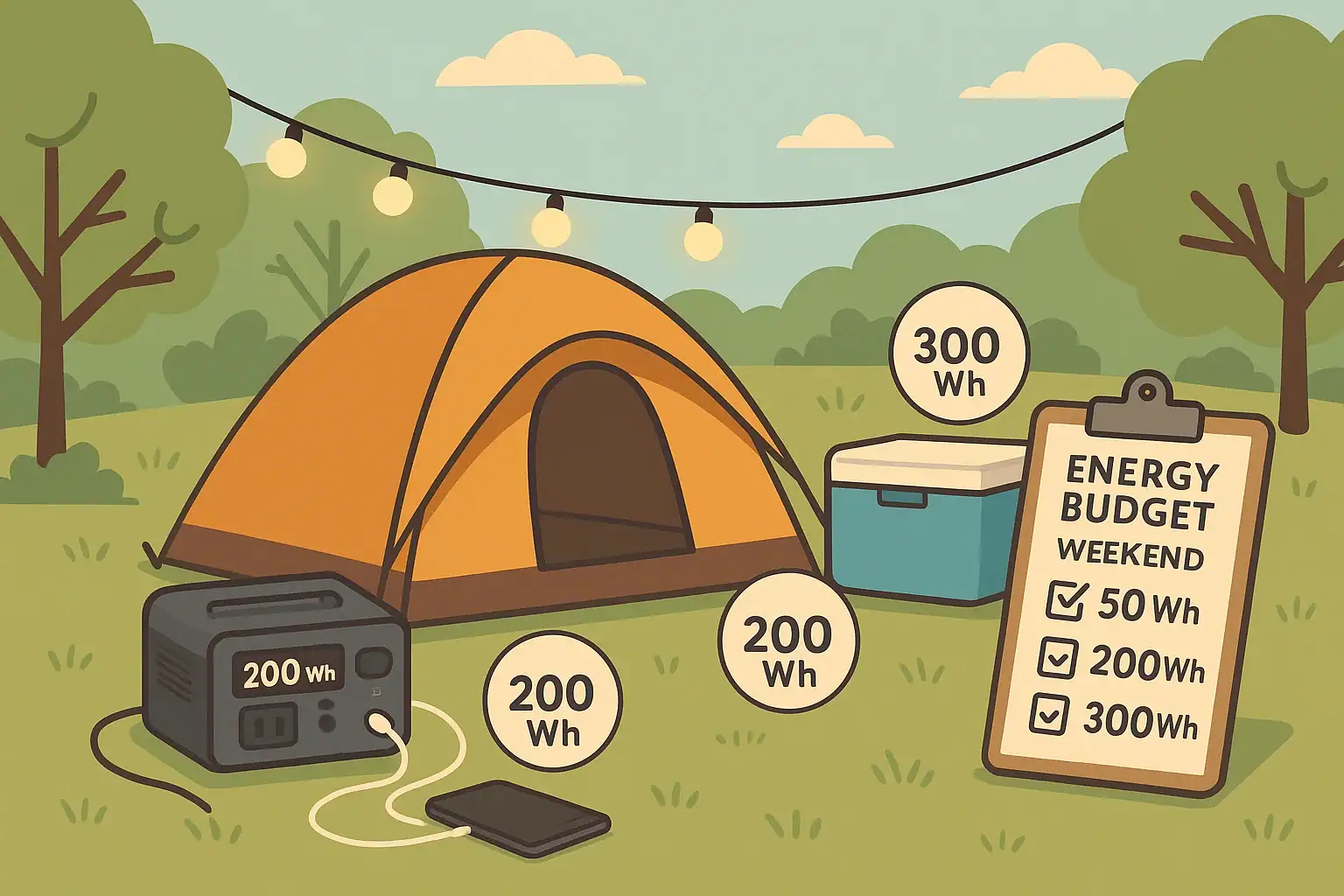
Weekend camping setup with portable power station and devices showing an energy budget plan

A simple weekend camping power plan starts with adding up how many watt-hours your gear will use, then matching that to a portable power station with enough capacity, output watts, and charging options. Once you understand basic terms like watt-hours, surge watts, runtime, and input limit, you can quickly tell if your setup will last two or three nights off-grid.

This guide shows how to make an easy energy budget for a weekend, so you are not guessing at battery percentage or wondering why your devices shut off early. You will learn how to estimate power draw, convert watts to watt-hours, and size a camping battery or solar generator for phones, lights, a fridge, or a CPAP. No advanced math, no brands—just clear steps and example numbers you can copy for your own trip.

Understanding a Weekend Camping Power Budget and Why It Matters

For camping, a power budget is a simple estimate of how much energy your devices will use over your trip, usually measured in watt-hours (Wh). It is like a spending plan for electricity: instead of dollars, you are spending stored energy from a portable power station or battery pack.

Watt-hours tell you how long a battery can run your gear. If you know your devices use about 500 Wh over a weekend, you can look for a power station with a usable capacity that meets or exceeds that number. This is more reliable than guessing based on amp-hours (Ah) or just looking at battery percentage bars.

Planning a camping power budget matters because:

  • It prevents running out of power early. You know in advance if your battery can handle a second or third night.
  • It helps you choose the right size power station. You avoid overspending on a huge unit or buying one that is too small.
  • It clarifies what you can realistically run. For example, whether a mini-fridge plus lights and phone charging is practical.
  • It guides your charging strategy. You can decide if you need solar input, vehicle charging, or just a full charge before leaving.

Instead of treating your camping battery like a mystery box, a basic energy budget turns it into a predictable resource you can manage confidently all weekend.

Key Power Concepts for Weekend Camping: Watts, Watt-Hours, and Runtime

To build a simple weekend energy budget, you only need a few key concepts: watts (W), watt-hours (Wh), runtime, and efficiency. Once you understand these, you can quickly estimate how long your portable power station will keep your camping gear running.

Watts (W): how fast power is used

Watts measure the rate of power use. A 10 W LED lantern uses power slowly; a 300 W mini-fridge uses power much faster. Device labels, user manuals, or power adapters usually list watts. If you only see volts (V) and amps (A), multiply them: V × A ≈ W.

Watt-hours (Wh): total energy over time

Watt-hours measure how much energy is used or stored. A 500 Wh battery can, in theory, power a 50 W device for about 10 hours (500 ÷ 50 = 10). Portable power stations are usually rated in Wh, which makes them easy to compare.

Runtime: how long your gear can run

To estimate runtime, you divide usable battery capacity by the load:

Runtime (hours) ≈ Usable Wh ÷ Device Watts

Usable Wh is slightly less than the rated capacity because of inverter and conversion losses. A rough rule is to assume 80–90% of the listed watt-hours for AC loads.

Continuous watts vs. surge watts

Portable power stations list two important output limits:

  • Continuous output (W): The maximum power they can supply steadily (for example, 300 W).
  • Surge or peak output (W): A higher short-term limit to handle startup spikes from devices like compressor fridges or small pumps.

If your device’s running watts exceed the continuous rating, it will not run. If its startup surge exceeds the surge rating, it may trip protection or shut off at startup.

Input limit and recharge time

The input limit tells you how many watts the power station can accept from wall charging, solar panels, or vehicle charging. Higher input means faster recharging, which is important if you plan to top up during the day with solar or from your car.

Putting it together for a weekend

For a weekend camping trip, you combine these ideas: estimate each device’s daily Wh use, multiply by the number of days, then compare the total to your portable power station’s usable capacity and recharge options.

Concept What It Means Example Value
Device power (W) How fast a device uses power LED lantern: 10 W
Battery capacity (Wh) Total stored energy Portable power station: 500 Wh
Continuous output (W) Max steady power the unit can supply AC inverter: 300 W
Surge output (W) Short spike for startup loads AC inverter surge: 600 W
Input limit (W) Max charging power accepted Solar/AC charging: 100–200 W
Key power terms for planning a camping energy budget. Example values for illustration.

Real-World Weekend Camping Energy Budget Examples

To make camping power planning concrete, it helps to walk through a few realistic weekend scenarios. These examples assume two nights away, arriving Friday evening and leaving Sunday, with about 36–40 hours of actual use.

Example 1: Minimalist weekend (lights and phones only)

This setup is common for tent camping with basic comfort and safety lighting.

  • 2 smartphones: About 10 Wh per full charge × 2 phones × 2 charges each ≈ 40 Wh.
  • 1 tablet or e-reader: Around 15 Wh per charge × 1–2 charges ≈ 15–30 Wh.
  • LED lantern: 8 W × 4 hours per night × 2 nights = 64 Wh.
  • String lights: 5 W × 5 hours per night × 2 nights = 50 Wh.

Estimated total for the weekend: roughly 170–190 Wh.

A small portable power station with around 250–300 Wh of usable capacity comfortably handles this, even accounting for inverter losses and a bit of extra use.

Example 2: Family camping with cooler and devices

This scenario adds a small 12 V compressor cooler or low-power mini-fridge.

  • Compressor cooler: A typical draw might average 40 W when cycling. Over 24 hours, that is roughly 40 W × 12 hours of active run time ≈ 480 Wh per day (duty cycle varies with temperature and insulation).
  • Phones and tablets: 4 phones × 2 charges each at 10 Wh = 80 Wh; 1 tablet at 20 Wh × 2 charges = 40 Wh.
  • LED lighting: 20 W total (lanterns and strips) × 4 hours per night × 2 nights = 160 Wh.

Estimated total for the weekend: cooler about 900–1,000 Wh plus devices and lights around 280 Wh, for roughly 1,200–1,300 Wh.

In this case, a mid-sized power station around 1,000–1,500 Wh usable capacity is more appropriate, especially if you do not plan to recharge with solar or from your vehicle.

Example 3: CPAP user plus basic camp power

Many campers use a CPAP machine overnight and want to keep lights and phones powered too.

  • CPAP machine (DC mode, no heated hose/humidifier): Often averages 30–50 W. For 8 hours per night × 2 nights, that is about 480–800 Wh.
  • Phones and a small fan: 2–3 phones at 10 Wh each × 2 charges ≈ 40–60 Wh; USB fan at 5 W × 4 hours per night × 2 nights = 40 Wh.
  • LED lighting: 10–15 W × 4 hours per night × 2 nights ≈ 80–120 Wh.

Estimated total for the weekend: roughly 600–1,000 Wh depending on the CPAP’s actual draw.

A power station with around 800–1,200 Wh usable capacity is a common target for this type of trip, especially if the CPAP will be the primary load.

How to adapt these examples to your own trip

To use these examples for your own weekend:

  1. List your actual devices and look up their watt ratings.
  2. Estimate daily hours of use for each device.
  3. Calculate daily Wh (watts × hours), then multiply by the number of days.
  4. Add a 20–30% buffer for unexpected use, cold weather, or inverter losses.

This quick process gives you a realistic weekend energy budget that matches how you actually camp.

Common Camping Power Planning Mistakes and How to Spot Problems Early

Many campers either overshoot or undershoot their power needs. Understanding common mistakes helps you troubleshoot issues before they ruin your weekend.

Mistake 1: Confusing watt-hours with amp-hours

Some batteries list only amp-hours (Ah), which can be misleading without voltage. A 20 Ah battery at 12 V has about 240 Wh (20 × 12), not 20 Wh. When comparing to your devices, always convert to watt-hours so everything is in the same unit.

Mistake 2: Ignoring inverter losses

Using AC outlets on a portable power station is convenient, but the inverter wastes some energy as heat. If you ignore this, your runtime estimate will be too optimistic. As a rule of thumb, assume you only get about 80–90% of the rated Wh for AC loads. USB and DC outputs are usually more efficient.

Mistake 3: Underestimating fridge and cooler usage

Portable fridges and coolers do not draw their rated watts all the time, but they cycle on and off. Hot weather, frequent opening, and poor ventilation can increase their duty cycle dramatically. A cooler that averages 20–30 W in mild conditions might average double that in direct sun. If your portable power station seems to drain faster than expected, this is often the culprit.

Mistake 4: Overloading the continuous or surge rating

Plugging in a device that exceeds the power station’s continuous output or surge rating can cause shutdowns or error codes. Signs include the AC output turning off immediately when a device starts, beeping alarms, or warning lights. Check your devices’ watt ratings and keep total load under the continuous limit, with some margin for startup spikes.

Mistake 5: Forgetting about recharging options

Some campers assume they will “just recharge with solar” but bring panels too small for their actual use or ignore the input limit on the power station. If your input limit is 100 W and you bring 200 W of panels, you still only charge at 100 W. Cloud cover, shading, and short winter days further reduce real-world solar input.

Early warning signs your weekend budget is off

  • Battery drops faster than expected during the first evening.
  • Fans, fridges, or CPAP machines cause the inverter to click off or alarm.
  • Solar or vehicle charging barely moves the battery percentage during the day.
  • You find yourself turning off lights or unplugging devices to “save” power.

If you see these signs on day one, reduce non-essential loads, switch more devices to DC or USB where possible, and prioritize recharging during peak sunlight or while driving.

Safety Basics for Using Portable Power on Camping Trips

Even small portable power stations and camping batteries store significant energy. Using them safely keeps your trip trouble-free and protects your gear.

Ventilation and placement

  • Place the power station on a stable, dry surface away from standing water and direct rain.
  • Avoid covering the unit with blankets, clothing, or sleeping bags. Most units rely on airflow for cooling.
  • Keep vents and fans unobstructed to prevent overheating and automatic shutdowns.

Temperature awareness

  • Avoid leaving batteries in direct sun inside a closed vehicle or tent, where temperatures can rise quickly.
  • In cold weather, keep the unit above freezing when possible, as low temperatures can temporarily reduce capacity and charging performance.

Cable and connection safety

  • Use cables rated for the current your devices draw, especially for 12 V DC and high-wattage AC loads.
  • Do not daisy-chain multiple power strips or extension cords from a small power station.
  • Avoid running cords where people walk or where they can snag and pull the power station off a table.

Charging safety

  • Use only compatible chargers and follow the manufacturer’s input limits for AC, DC, and solar charging.
  • Do not attempt to modify charging cables, bypass built-in protections, or connect directly to vehicle or RV wiring without proper equipment.
  • If you are unsure about integrating a portable power station with an RV electrical system, consult a qualified electrician or RV technician.

General battery precautions

  • Do not open the power station or battery enclosure; internal components are not user-serviceable.
  • Keep units away from open flames, campfires, and high-heat cooking areas.
  • If you notice swelling, unusual smells, smoke, or excessive heat, disconnect loads, move the unit to a safe, open area if it is safe to do so, and stop using it.

Following these basic practices makes it much less likely that a power issue will interrupt your camping weekend.

Maintaining and Storing Your Camping Power Setup Between Trips

Good maintenance and storage habits help your portable power station deliver reliable runtime every camping season and extend its overall lifespan.

Regular use and partial cycling

  • Use the power station periodically, even between camping trips, to keep the battery active.
  • Avoid fully discharging the battery whenever possible; stopping around 10–20% remaining is gentler on most chemistries.
  • Recharge to a comfortable level after each trip so it is ready for the next outing.

Storage state of charge

  • For long-term storage (several months), many batteries prefer being stored around 40–60% charge rather than 100% or 0%.
  • Check the charge level every few months and top up if it drops significantly.

Environment and handling

  • Store your power station in a cool, dry place away from direct sunlight and moisture.
  • Avoid dropping, crushing, or stacking heavy items on top of the unit.
  • Keep dust and debris away from vents and ports; gently clean with a dry cloth as needed.

Monitoring performance over time

  • Pay attention if your camping runtime noticeably decreases with the same loads; this can indicate normal battery aging.
  • Test your setup at home before longer trips, especially if you rely on critical devices like a CPAP machine.
  • Keep notes on approximate runtimes and charging times; this personal data is more useful than generic estimates.

With basic care, a portable power station can remain a dependable part of your camping kit for years, making your weekend energy budgeting more predictable.

Maintenance Task Recommended Frequency Purpose
Top-up charge check Every 2–3 months Prevents deep discharge during storage
Full test run with camping loads Before each season Verifies runtime and identifies weak spots
Visual inspection of cables and ports Before each trip Catches damaged cords or loose connections
Cleaning vents and exterior As needed Maintains airflow and cooling performance
Simple maintenance habits to keep camping power stations reliable. Example values for illustration.

Related guides: Portable Power Station Buying GuideSurge Watts vs Running Watts: How to Size a Portable Power StationPortable Power Stations for CPAP and Medical Devices: What to Look ForHow Many Solar Watts Do You Need to Fully Recharge in One Day?

Practical Weekend Power Planning Tips and Specs to Look For

When you combine a simple energy budget with the right portable power station specs, weekend camping power becomes predictable instead of stressful. The process boils down to three steps: estimate your loads, choose enough usable watt-hours, and match your charging options to how and where you camp.

For a typical two-night trip:

  • Minimal setups (lights and phones) often fall under 200–300 Wh.
  • Family setups with a cooler and multiple devices often land around 800–1,500 Wh.
  • CPAP-focused setups usually need 600–1,200 Wh depending on settings and temperature.

Add a buffer of about 20–30% above your calculated needs to account for weather, inverter losses, and unplanned use. If you plan to recharge with solar or your vehicle, factor in realistic daily input based on your panel size, input limit, and daylight hours.

Specs to look for

  • Battery capacity (Wh): Look for 300–500 Wh for minimalist weekends, 800–1,500 Wh for fridges or CPAP. This directly sets your potential runtime.
  • Continuous AC output (W): Aim for at least 200–300 W for basic lights and electronics, 500–1,000 W if you plan to run fridges or multiple devices. Ensures your loads do not overload the inverter.
  • Surge or peak output (W): Choose a unit with surge roughly 1.5–2× your highest startup load. Helps handle compressor fridges and motors without tripping protection.
  • Input limit and charging options: For solar, 100–300 W input is typical for weekend use; vehicle and AC charging should refill your battery within 4–8 hours. This affects how quickly you can recover from a low state of charge.
  • Number and type of ports: Multiple USB-A and USB-C ports plus at least one or two AC outlets and a 12 V socket make it easier to power several devices without adapters.
  • Display and monitoring: A clear screen showing watts in/out, remaining percentage, and estimated runtime helps you manage your energy budget in real time.
  • Weight and form factor: For car camping, 10–30 lb units are common; choose a size you can comfortably move between home, vehicle, and campsite.
  • Operating temperature range: Check that the unit is rated for the temperatures you expect when camping, especially in hot summers or cold shoulder seasons.
  • Battery chemistry and cycle life: Higher cycle life ratings are useful if you camp frequently or use the unit for other purposes year-round.

By matching these specs to a realistic weekend energy budget, you can choose and use a portable power solution that keeps your campsite running smoothly from Friday night to Sunday afternoon.

Frequently asked questions

What specs and features matter most when choosing a portable power station for a weekend camping trip?

Battery capacity in watt-hours (Wh) and the continuous and surge watt ratings are the core specs, since they determine how long and what you can run. Also consider the input limit and charging options, the number and types of ports, weight and form factor, operating temperature range, and whether the unit provides clear monitoring of watts in/out and remaining charge.

How can confusing watt-hours and amp-hours lead to a planning mistake?

Watt-hours measure stored energy while amp-hours depend on voltage; comparing Ah without converting can make a battery look much larger or smaller than it really is. Always convert Ah to Wh using Wh = Ah × V so you compare capacities on the same basis and avoid underestimating your needs.

Is it safe to use a portable power station inside a tent or vehicle overnight?

Using a power station in a tent or vehicle is generally acceptable if the unit is placed on a stable, ventilated surface away from flammable materials and direct heat. Avoid covering vents, keep the unit out of confined hot spots, follow the manufacturer’s safety guidance, and do not leave a unit showing signs of damage or overheating unattended.

Can I rely on solar panels alone to recharge my power station during a weekend?

Solar can often top up a battery during a weekend, but real-world factors like panel size, the power station’s input limit, shading, cloud cover, and daylight hours determine how much energy you actually get. Match panel output to the unit’s input limit and plan conservatively; don’t assume ideal conditions will fully recharge your battery every day.

Why does my power station shut off when a fridge or CPAP starts, and what can I do?

Startup surges can exceed a unit’s surge rating or the combined load can exceed the continuous output, which triggers protective shutdowns. Check the continuous and surge watt ratings, reduce simultaneous loads during startup, and consider a unit with higher surge capacity or staggered device starts to avoid tripping protections.

How much extra buffer should I add to my energy budget to avoid running out of power?

Adding a buffer of about 20–30% above your calculated needs is a common practice to cover inverter losses, weather impacts, and unexpected use. Increase the buffer further if conditions are colder, if you have inefficient loads, or if you rely solely on intermittent solar charging.

Car Charging Explained: 12V Socket vs DC-DC Charger vs Alternator (Speed + Safety)

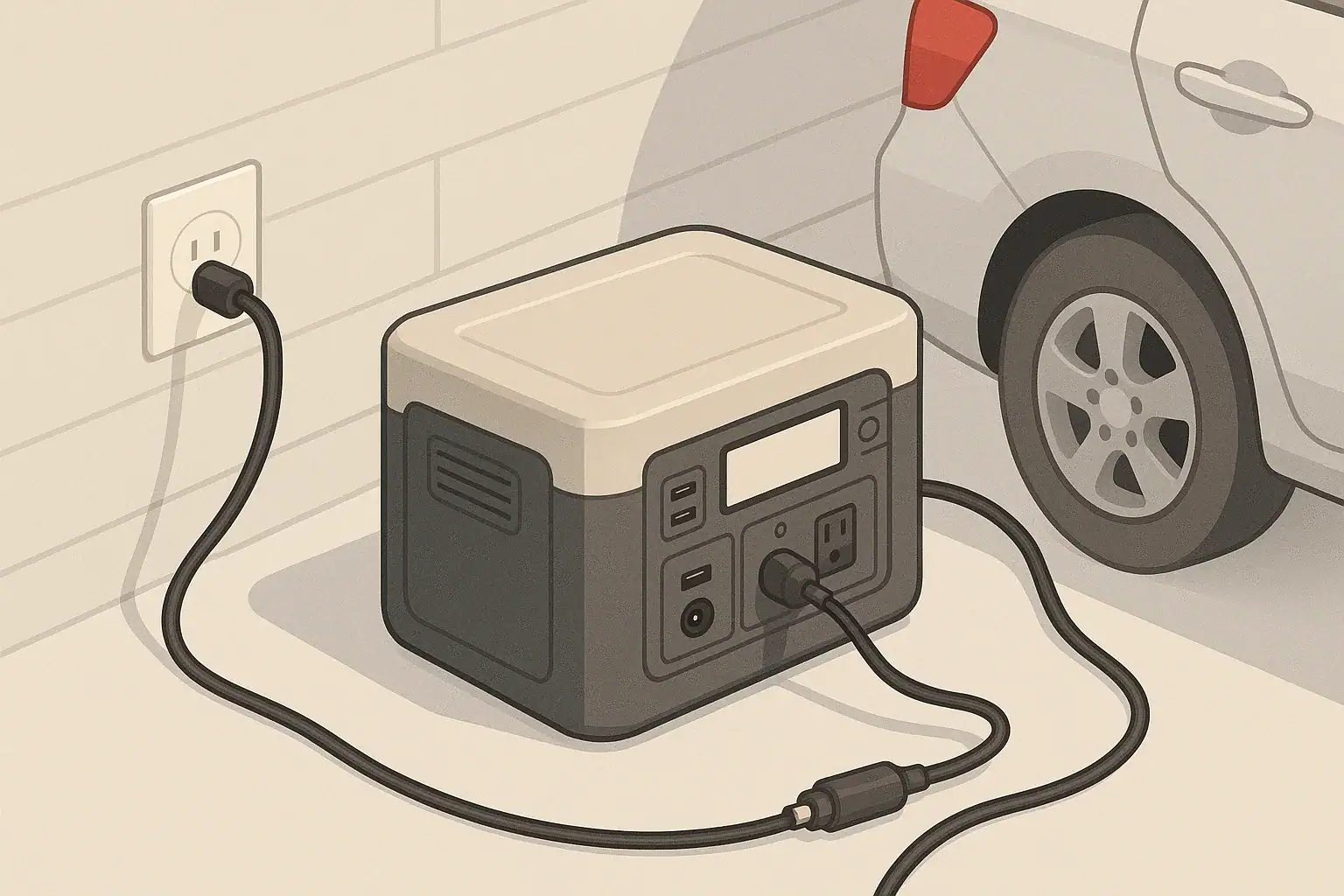
Portable power station charging from car and wall outlets

What the topic means (plain-English definition + why it matters)

When people talk about car charging for portable power stations, they often mix up three related but different things: the 12V socket, a dedicated DC-DC charger, and the vehicle alternator itself. All three are part of the same system, but they behave very differently in speed, efficiency, and safety.

The 12V socket is the familiar outlet on the dashboard or console. A DC-DC charger is a separate device that converts power from the vehicle’s 12V system into a controlled charge for another battery or portable power station. The alternator is the engine-driven generator that actually produces electrical power while the engine is running.

Understanding how these pieces fit together matters when you are planning to charge a portable power station on the road. It affects how long charging will take, how much fuel you may burn idling, how much load you put on your vehicle’s electrical system, and how safely you can power devices during road trips, camping, or vanlife.

Good planning helps you avoid surprises like a dead starter battery, a portable station that never fully charges while driving, or overloaded wiring. The goal is not to modify your vehicle, but to use what it already provides in a realistic and safe way.

Key concepts & sizing logic (watts vs Wh, surge vs running, efficiency losses)

Before comparing 12V sockets, DC-DC chargers, and alternators, it helps to separate power from energy. Power is measured in watts (W) and describes how fast energy is moving at a given moment. Energy is measured in watt-hours (Wh) and describes how much work can be done over time, such as the capacity of a portable power station battery.

When charging from a car, the charging power is limited by the weakest part of the chain: the vehicle socket rating, wiring, fuse size, DC-DC charger design, and the maximum input rating of the power station. For example, a typical 12V accessory socket in a passenger vehicle may be fused somewhere around 10–15A. At around 12–13.8V, that often works out to something in the range of roughly 120–180W of usable charging power, and sometimes less depending on the vehicle’s design.

Inverters and internal electronics add efficiency losses. If you use a 12V socket to power an inverter, then plug the portable power station’s AC charger into that inverter, energy passes through several conversions: DC to AC in the inverter, then AC back to DC inside the power station. Each step loses some energy as heat, so you might see only about 70–85% of the alternator’s output end up stored in the battery. Direct DC-DC charging, when supported, usually wastes less.

Surge and running power matter more on the output side of a portable power station than on the charging side, but they still affect planning. If you charge slowly in the car (low watts in) but run high-wattage appliances from the power station (high watts out), the battery can drain faster than it refills. Sizing a system means matching your expected daily energy use (Wh) to how much energy you can realistically put back into the battery during driving or from other sources.

Comparison of car charging paths for portable power stations – Example values for illustration.
Charging path Typical complexity Approximate power level (example) Main pros Main trade-offs
12V socket direct DC input Very low 50–120W Simple, plug-and-play, uses existing socket Slow charging, limited by fuse and wiring
12V socket to small inverter to AC charger Low 60–150W Works with power stations that only accept AC Extra losses through inverter, more heat
Hardwired DC-DC charger (example car) Medium (professional install recommended) 200–400W Faster charging, better voltage control Higher cost, adds load to alternator
Alternator direct to power station DC input Medium to high Varies widely Can use alternator capacity efficiently Requires careful design to protect vehicle system
Idle charging (engine running, parked) Low use effort Similar to driving levels Top up battery without moving Fuel use, engine wear, exhaust safety concerns
Driving plus supplementary solar Medium Car plus solar combined Reduces alternator load and fuel use More gear to manage and store

Real-world examples (general illustrative numbers; no brand specs)

To see how these limits play out, consider a portable power station with a battery capacity of about 500Wh. If you plug it into a 12V car socket that provides roughly 100W of charging power, it might take around 5–6 hours of driving to go from empty to full, assuming the vehicle maintains voltage, the socket can handle the current, and there are typical efficiency losses.

Now imagine a larger 1,000Wh power station. With that same 100W 12V socket input, you might be looking at 10–12 hours of driving time for a full charge, which for many people means multiple days of typical commute driving. A DC-DC charger supplying about 300W of power from the alternator could cut that to roughly 3–4 hours of continuous driving, if both the vehicle and the power station are rated to handle that input.

On the usage side, assume you are running a laptop that averages 50W and a small 10W light for six hours in the evening. That is about 360Wh of energy. A 500Wh portable power station could run those loads for one evening and still have some reserve. If you then drive for three hours the next day with 100W of car charging, you would be able to put back about 300Wh, not counting losses, which might nearly refill what you used.

These kinds of back-of-the-envelope estimates help you decide whether the 12V socket is sufficient for your style of travel, or whether you should plan on faster charging from a higher-power DC input, shore power at campsites, or supplementary solar. None of these example numbers are official limits; they are simply a way to visualize how much driving time you may need.

Common mistakes & troubleshooting cues (why things shut off, why charging slows, etc.)

One common surprise is the 12V socket shutting off when the engine stops. Many modern vehicles cut power to accessory outlets when the ignition is off to protect the starter battery. If your portable power station suddenly stops charging when you park, this is often the reason and not a fault with the power station itself.

Another frequent issue is slow or inconsistent charging from the car. This can happen if the 12V socket voltage sags under load, the vehicle uses smart alternator controls that reduce output at times, or the portable power station automatically reduces charging current to stay within its safe limits. Symptoms include the input wattage on the power station’s display dropping, pulsing up and down, or the device switching from charging to not charging repeatedly.

Tripped fuses are also common when people try to draw more power than the 12V outlet was designed for, especially when using inverters. If a fuse blows, the socket will stop working entirely until the fuse is replaced. Repeated fuse failures are a sign that the load is too high for that circuit and that you should reduce demand or use a different charging approach, not simply install a larger fuse.

Other cues include unusual heat at connectors or cables, fans on the portable power station running at high speed for long periods, or error messages indicating over-voltage or under-voltage. These are all hints that the charging setup is operating near its limits. In those cases, scaling back the load, improving ventilation, or using a more direct DC-DC charging method can help.

Safety basics (placement, ventilation, cords, heat, GFCI basics at a high level)

Safety with car charging starts with where you place the portable power station. It should sit on a stable, flat surface where it will not become a projectile during braking or sudden turns. Avoid locations that block airbags, vents, or access to pedals. Many people use the cargo area or a flat floor section where the unit can be restrained.

Ventilation is equally important. Both the portable power station and any connected inverter need airflow to shed heat. Do not cover vents with blankets, luggage, or clothing. In hot weather, interior vehicle temperatures rise quickly, especially in direct sun. Excessive heat can trigger reduced charging rates, thermal shutdowns, or long-term battery degradation.

Use cords and adapters rated for automotive 12V use, and avoid routing cables where they can be pinched by seats or doors. Coiled cables can trap heat; loosely run them instead, and inspect connectors for discoloration or looseness. If you use an inverter to produce 120V AC power in a vehicle, plug devices into grounded outlets when possible and keep cords away from moisture. For outdoor use near damp areas, ground-fault protection on AC circuits is a key layer of defense, but the specifics depend on the equipment design.

Finally, consider exhaust and carbon monoxide risk if you are idling the engine just to charge a portable power station. Never leave a running vehicle in an enclosed space. Charging while driving is usually safer from an exhaust standpoint than charging at idle in a closed garage or closely surrounded area.

Maintenance & storage (SOC, self-discharge, temperature ranges, routine checks)

Portable power stations used for car charging benefit from regular checks, especially if they are part of an emergency or camping kit stored in a vehicle. Batteries slowly lose charge over time, even when turned off. Many manufacturers suggest topping them up every few months to keep the state of charge within a healthy range and to prevent deep discharge during storage.

Temperature is a major factor in both battery life and safety. Long-term storage in a hot vehicle can accelerate aging, while extremely cold conditions can reduce available capacity and make charging less efficient. As a general guideline, aim to store the unit in moderate temperatures when possible and avoid leaving it in direct sun on a dashboard or in a closed trunk for extended periods.

Routine inspections should include checking cables for cuts or kinks, making sure 12V plugs and sockets are free of debris, and verifying that cooling vents are not clogged with dust or pet hair. If the portable power station has a display, occasionally powering it on to check its stored charge level helps ensure it will be ready when needed.

For vehicle-side maintenance, keeping the 12V outlet clean and verifying fuses are in good condition support reliable charging. If you notice dimming headlights or slow cranking from the starter battery when using a portable power station, that may be a sign that the vehicle’s battery or charging system should be inspected by a professional.

Storage and maintenance planning for car-charged power stations – Example values for illustration.
Task Suggested frequency What to look for Why it matters
Check state of charge Every 2–3 months Battery above minimum storage level Prevents deep discharge during storage
Top up charge from wall or car When below preferred storage range Battery returns to mid-to-high range Keeps battery ready for emergencies and trips
Inspect 12V cables and plugs Before long trips No cracks, burns, or loose contacts Reduces risk of overheating and failures
Clean vents and exterior surfaces Every 6 months Dust-free vents, intact case Maintains cooling performance and durability
Test car charging function Before seasonal use Stable input wattage, no error messages Confirms cables, fuses, and sockets are working
Review vehicle battery health Per service schedule Normal starting behavior and voltage Ensures car can safely support accessory loads
Adjust storage location With changing seasons Avoid extreme heat or cold spots Improves long-term battery life

Example values for illustration.

Practical takeaways (non-salesy checklist bullets, no pitch)

Using a car to charge a portable power station is convenient, but it works best when you understand the limits of 12V sockets, DC-DC chargers, and alternators. This lets you size your expectations, avoid stressing the vehicle’s electrical system, and keep both the car and the power station within safe operating ranges.

When planning, think in terms of daily energy use and available driving time. Combine car charging with other options, such as wall charging before a trip or solar during the day, to reduce reliance on any one source. Pay attention to heat, ventilation, cable quality, and the condition of your vehicle battery to maintain reliability over the long term.

  • Estimate your daily energy use in watt-hours and compare it to your power station’s capacity.
  • Check your vehicle manual for 12V socket limits and avoid overloading those circuits.
  • Use direct DC charging when possible instead of going through an inverter for better efficiency.
  • Monitor for warning signs such as hot connectors, blown fuses, or fluctuating input power.
  • Store the power station at a moderate state of charge and avoid prolonged extreme temperatures.
  • Have a backup charging plan for cloudy days, short drive times, or unexpected outages.

With these points in mind, car charging can be a practical part of a broader power strategy for road trips, camping, remote work, and short-term home backup without placing undue strain on your vehicle or your portable power station.

Frequently asked questions

Can I safely charge a portable power station from a car’s 12V socket with the engine off?

Often not reliably. Many vehicles cut accessory power when the ignition is off to protect the starter battery, and drawing significant current with the engine off can drain the starter and leave you unable to start the car. If you must charge while parked, check the vehicle manual for socket behavior, use low currents, and monitor both the starter battery and the power station state of charge.

How much faster does a DC-DC charger charge compared with using the vehicle 12V accessory socket?

Typical 12V accessory sockets commonly provide on the order of 50–120W for charging, while a properly installed DC-DC charger can often supply 200–400W depending on the vehicle and alternator. That means a DC-DC charger can be roughly two to four times faster in many real-world cases, though exact speed depends on alternator capacity and the power station’s input limit.

Will drawing high charging power from the alternator damage my car?

Not if the system is designed and installed correctly, but careless setups can risk alternator overheating, premature wear, or problems with smart alternator systems. Use properly rated wiring, fuses, and a DC-DC charger or isolation device as recommended; if in doubt, have installations done or inspected by a qualified technician to match alternator capacity and protect the vehicle electrical system.

Why does charging slow, pulse, or stop when charging from my vehicle?

Charging can slow or cycle because of voltage sag in the 12V circuit, the vehicle’s smart alternator reducing output, thermal throttling in the power station, or the station limiting its input current to stay safe. Symptoms include fluctuating input wattage or repeated connect/disconnect behavior; remedies include reducing draw, improving ventilation, checking connections, or switching to a higher-capacity DC charging method.

What practical steps prevent blown fuses and overheated connectors when charging from a car?

Check the fuse rating for the accessory circuit before pulling significant current, use cables and connectors rated for the expected current, and avoid drawing high loads through a cigarette-style socket unless it is explicitly rated and fused for that use. For higher-power charging, prefer a hardwired DC-DC charger with proper gauge wiring and inline fusing, and routinely inspect connectors for heat damage or looseness.

Portable Power Stations for RV and Motorhomes

Isometric illustration of power station charging devices

Portable power stations are compact energy systems used by RV and motorhome owners to run appliances, charge devices, and provide backup power away from shore connections. They combine batteries, inverters, and charging circuitry in a single, transportable unit. This article explains how they work, how to size one for RV use, charging options, safety and maintenance, and common use scenarios.

The inverter determines what AC appliances you can run. Two technical aspects matter most: waveform and power ratings.

This information provides the technical foundation and practical considerations needed to evaluate portable power stations for RV and motorhome use. Use device power ratings, daily energy estimates, and realistic charging assumptions to choose a system that meets your travel and comfort needs.

How portable power stations work

A portable power station typically contains a rechargeable battery pack, a battery management system (BMS), an inverter to produce AC power, and multiple output ports for AC, USB, and 12V DC loads.

Key components

  • Battery pack: Stores energy in watt-hours (Wh). Chemistry varies, commonly lithium-ion or lithium iron phosphate (LiFePO4).
  • BMS: Protects the battery from overcharge, over-discharge, overheating, and short circuits.
  • Inverter: Converts DC battery power to AC for household-style outlets. Inverter ratings include continuous power and surge (peak) power.
  • Charge controller/Input: Manages incoming power from solar panels, shore power, or vehicle alternator.
  • Output ports: AC outlets, 12V DC ports, USB-A/USB-C ports for smaller devices.

Sizing and capacity for RV and motorhome use

Choosing the right size depends on what you plan to run and for how long. watt-hours (Wh) is how capacity is expressed. To estimate needs, list each device and its power draw in watts, then multiply by hours used.

Simple sizing formula

Estimated energy use (Wh) = device wattage (W) × hours used. Add up all devices for a total daily Wh. Allow for inverter losses (typically 10–15%), and avoid draining the battery fully—most users limit depth of discharge to extend battery life.

Example load categories

  • Small loads (phone, lights, laptop): 5–200 Wh per day. A 500–1000 Wh unit covers several days of light use.
  • Medium loads (mini fridge, CPAP, fans): 200–800 Wh per day. A 1000–2000 Wh unit handles basic refrigeration and devices for a day or more.
  • High loads (microwave, induction cooktop, rooftop air conditioner): 1000+ Wh per use and high surge current. These often require larger stationary systems or generator support.

Always check both continuous watt rating and surge rating for appliances with motors or compressors. A refrigerator may need modest continuous watts but a high startup surge.

Inverters and AC capability

Waveform: pure sine wave vs modified

Pure sine wave inverters produce smooth AC suitable for sensitive electronics and motor-driven appliances. Modified or stepped sine wave inverters are cheaper but can cause inefficient operation, extra heat, or compatibility issues with some devices.

Power ratings

  • Continuous power: The maximum load the inverter can sustain indefinitely (for example 1500W).
  • Surge power: Short-term peak capacity for starting motors (often 2–3× continuous rating).

For RV refrigerators, microwaves, and air conditioners, check that both continuous and surge ratings meet appliance requirements. Many portable stations are best suited for electronics, lights, CPAP machines, and small refrigerators rather than large air conditioners.

Charging options while on the road

Portable power stations accept several charging sources. Choosing the right combination speeds recharge and supports off-grid use.

Typical charging methods

  • Shore/AC charging: Fast and simple when connected to campground power. Charging speed depends on the station’s AC input limit.
  • Solar charging: Useful for boondocking and extending off-grid time. Effective solar charging depends on panel wattage, placement, and sun hours.
  • Vehicle/12V charging: Uses the RV alternator or cigarette outlet. Slower than AC and may be limited by vehicle output and charging circuitry.
  • Hybrid or pass-through charging: Some stations can be charged while simultaneously powering loads. Confirm pass-through capabilities and whether it affects lifespan.

Charge time considerations

Charge time depends on input power (watts) and battery capacity. For example, a 1000 Wh battery charged at 500 W input ideally takes about 2 hours, but real-world times are longer due to inefficiencies and tapering near full charge.

Safety and maintenance for RV installations

Proper installation and regular maintenance help maximize safety and battery life.

Safety practices

  • Install the station on a stable, level surface and secure it to prevent movement while driving.
  • Allow adequate ventilation. Batteries and inverters produce heat during heavy use or charging.
  • Avoid exposing the unit to extreme temperatures. Most batteries perform poorly or are damaged below freezing or above recommended temperatures.
  • Follow manufacturer guidance for connecting external loads and chargers. Use proper cables and fuses where required.

Maintenance tips

  • Keep contacts clean and dry. Inspect terminals and cables periodically.
  • Store at partial state of charge for long-term storage and recharge every few months to limit self-discharge.
  • Monitor battery health via any available diagnostics and follow recommended maintenance intervals.

Proper installation and regular maintenance can prevent common issues and extend service life.

Installation, placement, and wiring in RVs

Placement is important for safety, convenience, and weight distribution.

  • Choose a low, secure location close to expected loads to minimize cable runs.
  • Keep the station away from direct heat sources and moisture.
  • Use appropriately rated cables and connectors for high-current DC lines. Fuse protection near the battery is recommended.
  • Consider integrating the station with the RV’s electrical system through a transfer switch or designated inverter connection kit if you need seamless transition from shore power to battery power.

Common RV use cases and sizing examples

Below are sample scenarios and general capacity guidance. These are illustrative; calculate based on actual device power draws.

Weekend boondocking

  • Typical loads: LED lights, smartphone and laptop charging, small fridge, water pump, fans.
  • Suggested capacity: 1000–2000 Wh for 1–3 days depending on refrigerator efficiency and usage.

CPAP and electronics for overnight trips

  • Typical loads: CPAP machine (30–70 W depending on model), phone, small light.
  • Suggested capacity: 500–1000 Wh to cover multiple nights with margin.

Extended off-grid travel or partial home backup

  • Typical loads: Larger fridge, cooking appliances, sustained electronics use.
  • Suggested capacity: 2000–5000 Wh combined with solar charging or a generator for extended autonomy.

Choosing features to prioritize

When comparing units for RV use, prioritize based on how you travel and which appliances you need to run.

  • Capacity (Wh): More Wh gives longer run time.
  • Inverter continuous and surge rating: Match to appliance startup requirements.
  • Charging inputs: Higher input wattage and multiple input types reduce downtime.
  • Portability and weight: Balance capacity with what you can comfortably transport and safely secure in the RV.
  • Durability and thermal management: Look for units designed for frequent cycling and varied temperatures.

Key terms to know

  • Watt-hour (Wh): Energy capacity indicating how much energy is stored.
  • Inverter: Device that converts DC battery power to AC power used by household appliances.
  • Continuous vs surge power: Continuous is sustained output, surge covers short startup demands.
  • Depth of discharge: How much of the battery capacity is used before recharging.

Frequently asked questions

How do I size a portable power station to run my RV refrigerator?

Estimate the refrigerator’s average running watts and daily run hours, then multiply to get daily watt-hours. Add 10–15% for inverter losses and ensure the station’s surge rating covers the fridge startup current. Choose a capacity that provides the needed daily Wh plus a safety margin and avoid discharging to 0% to preserve battery life.

Can portable power stations run an RV rooftop air conditioner?

Most small to mid-size portable stations cannot reliably run rooftop air conditioners because those units require high continuous and very high surge power. Running an A/C typically needs a large inverter with several kilowatts of continuous output or a generator. For short bursts, some very large stations may cope, but check continuous and surge ratings carefully before attempting.

How long does it take to recharge a portable power station using RV solar panels?

Recharge time depends on battery capacity, total solar panel wattage, sun hours, and system losses. As a rough guide, divide battery Wh by effective solar input watts to get ideal peak-sun hours; a 1000 Wh battery on 200 W of panels needs about 5 peak sun hours plus extra for inefficiencies. Orientation, shading, and charge controller limits can significantly increase real-world times.

Is it safe to store and use a portable power station inside an RV while driving?

Yes, provided the unit is secured to prevent movement, placed where ventilation is adequate, and kept within the manufacturer’s temperature range. Use proper mounting or straps and ensure cables and ventilation paths are not obstructed. Follow the manufacturer’s installation and safety recommendations to reduce risk.

Can I charge a portable power station from my RV alternator while driving?

You can often charge from an alternator, but charging speed is limited by the alternator’s output and the station’s DC input limits. Long or heavy charging loads may stress the vehicle charging system, so use proper wiring, fusing, and any recommended DC-to-DC charge controllers. Verify compatibility and charging specifications before relying on alternator charging for full recharges.