How Many Solar Watts Do You Need to Fully Recharge in One Day?

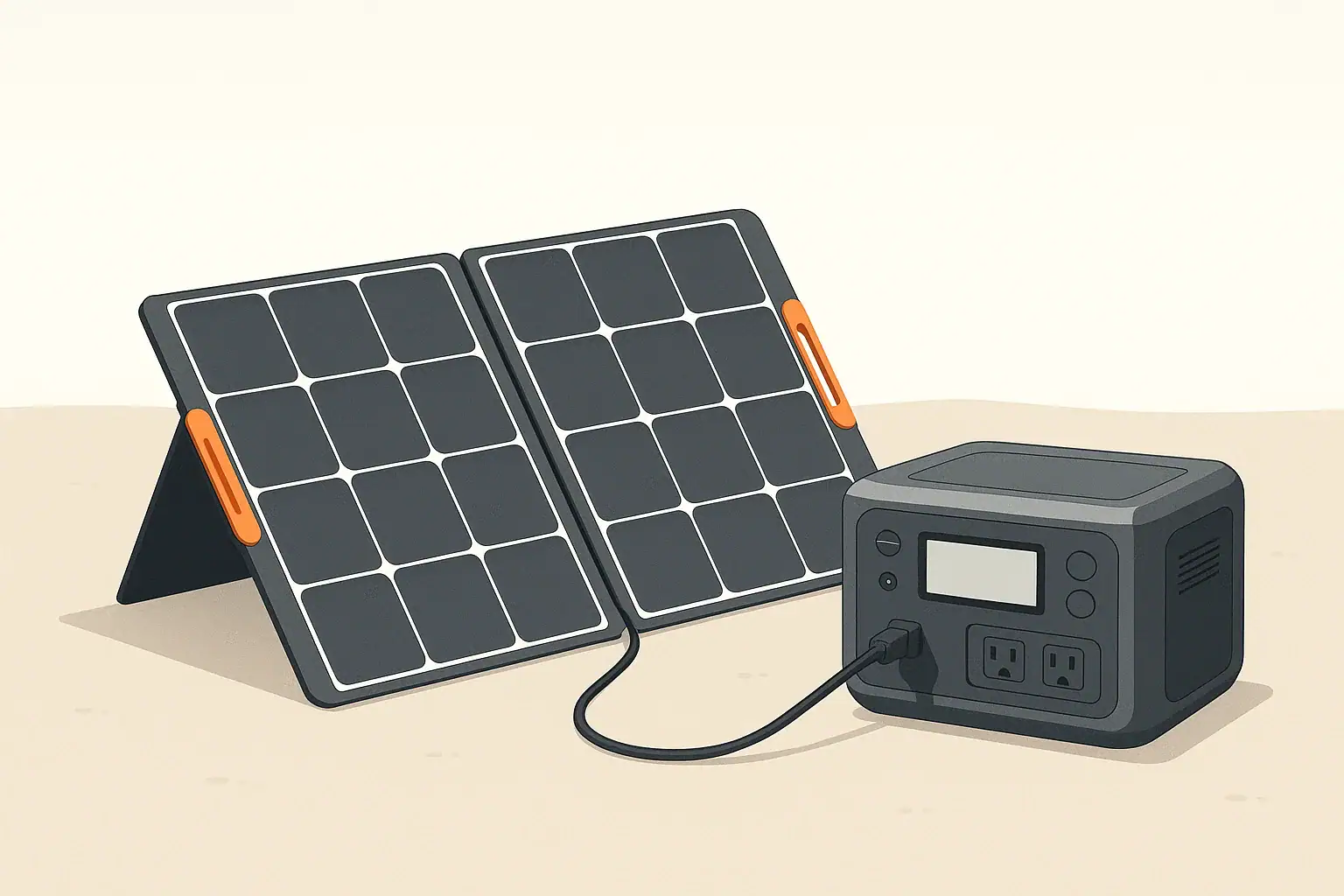
portable power station charging from solar panel outdoors

When you rely on a portable power station, knowing how many solar watts you need to fully recharge in one day is crucial. It affects:

  • How many solar panels you buy
  • How long you can stay off-grid
  • Whether you can keep up with your daily energy use
  • How quickly you recover after a cloudy day or heavy usage

This guide walks through the step-by-step math and the real-world factors that determine how many solar watts you actually need for a “full charge in one day.”

Why Solar Watts per Day Matter for Portable Power Stations

When you rely on a portable power station, knowing how many solar watts you need to fully recharge in one day is crucial. It affects:

  • How many solar panels you buy
  • How long you can stay off-grid
  • Whether you can keep up with your daily energy use
  • How quickly you recover after a cloudy day or heavy usage

This guide walks through the step-by-step math and the real-world factors that determine how many solar watts you actually need for a “full charge in one day.”

Key Terms: Watts, Watt-Hours, and Solar Input

Watts (W)

Watts measure power — how fast energy is being used or produced at a given moment.

  • A 100 W solar panel can produce up to 100 watts of power in ideal conditions.
  • A device drawing 50 W uses 50 watts of power while it is on.

Watt-hours (Wh)

Watt-hours measure energy — how much work can be done over time.

  • A 500 Wh portable power station can, in theory, run a 50 W device for 10 hours (50 W × 10 h = 500 Wh).
  • Battery capacity for portable power stations is usually given in Wh.

Solar input rating

Portable power stations usually list a maximum solar input in watts, such as:

  • Max solar input: 200 W
  • Input voltage/current range: for example, 12–30 V, 10 A max

This is the maximum solar power the station can accept. Even if you have more panel watts than this, the power station will typically cap the input at the rated maximum.

The Basic Formula: Solar Watts Needed for a Full Recharge

At the simplest level, you can estimate the solar watts required with three pieces of information:

  • Battery capacity (Wh)
  • Usable peak sun hours per day
  • System efficiency (to account for losses)

Step 1: Start with battery capacity

Let’s call your battery capacity C in watt-hours (Wh). For example:

  • Small station: 300 Wh
  • Medium station: 600–1,000 Wh
  • Large station: 1,500–2,000+ Wh

Step 2: Estimate peak sun hours

Peak sun hours are not the same as daylight hours. They represent the equivalent number of hours per day of full-strength sun (1,000 W/m²). Typical ranges:

  • Cloudy regions / winter: 2–3 peak sun hours
  • Moderate climates: 3–5 peak sun hours
  • Sunny regions / summer: 5–6+ peak sun hours

Use a conservative estimate that matches your typical season and location. We will call peak sun hours per day H.

Step 3: Account for system losses

Not all solar energy makes it into the battery. Losses come from:

  • Panel temperature (hot panels are less efficient)
  • Suboptimal angle or partial shading
  • Wiring and connector losses
  • Charge controller and internal electronics

A realistic overall efficiency is usually around 70–80%. We will use an efficiency factor, η, between 0.7 and 0.8.

Step 4: The core equation

The solar watts needed to fully recharge in one day can be approximated by:

Required solar watts ≈ C ÷ (H × η)

Where:

  • C = battery capacity in Wh
  • H = peak sun hours per day
  • η = system efficiency (0.7–0.8 typical)

Worked Examples for Common Portable Power Station Sizes

Example 1: 300 Wh power station

Assumptions:

  • C = 300 Wh
  • H = 4 peak sun hours
  • η = 0.75

Required solar watts:

300 ÷ (4 × 0.75) = 300 ÷ 3 = 100 W

Interpretation: A 100 W solar array in good sun can roughly recharge a 300 Wh station in one clear day. If you expect more clouds or shorter days, a 120–160 W array would give extra margin.

Example 2: 600 Wh power station

Assumptions:

  • C = 600 Wh
  • H = 4 peak sun hours
  • η = 0.75

Required solar watts:

600 ÷ (4 × 0.75) = 600 ÷ 3 = 200 W

Interpretation: Around 200 W of solar can recharge a 600 Wh station in one good-sun day. A pair of 100 W panels, or one 200 W panel, is a common setup.

Example 3: 1,000 Wh (1 kWh) power station

Assumptions:

  • C = 1,000 Wh
  • H = 4 peak sun hours
  • η = 0.75

Required solar watts:

1,000 ÷ (4 × 0.75) = 1,000 ÷ 3 ≈ 333 W

Interpretation: A 300–400 W solar array is a reasonable match for a 1,000 Wh portable power station if you want a full daily recharge in decent conditions.

Example 4: 2,000 Wh power station in a cloudy region

Assumptions:

  • C = 2,000 Wh
  • H = 3 peak sun hours (cloudier or higher latitude)
  • η = 0.7 (more conservative)

Required solar watts:

2,000 ÷ (3 × 0.7) = 2,000 ÷ 2.1 ≈ 952 W

Interpretation: In less favorable climates, a 2,000 Wh station might require close to 1,000 W of solar to reliably recharge in one day. Many portable power stations have lower solar input limits than this, so fully recharging from solar alone in a single day may be unrealistic without ideal conditions.

Checking Against Your Power Station’s Solar Input Limit

Even if the math says you “need” a certain number of solar watts, your portable power station may not be able to use all of it. Two key specs matter:

  • Maximum solar input power (W)
  • Supported voltage and current range

Maximum solar input power

If your station’s maximum solar input is 200 W, any extra panel capacity above 200 W will be capped by the internal charge controller. You could still use more panel wattage to help in low-light conditions, but you will never exceed the 200 W input limit under full sun.

Voltage and current limits

Solar panels must operate within the input voltage and current range specified by the power station. When configuring multiple panels:

  • Series wiring increases voltage, keeps current the same.
  • Parallel wiring increases current, keeps voltage the same.

Always check that your combined array voltage and current stay within the allowed ranges to avoid damage and ensure proper operation.

Adjusting for Real-World Conditions

So far, the calculations assume average good conditions. Real situations vary. To size your solar setup more accurately, consider the factors below.

Season and location

Peak sun hours change by season and latitude.

  • Summer, lower latitudes: Typically more stable sunshine and longer days.
  • Winter, higher latitudes: Shorter days and lower sun angle reduce solar output.

If you intend to use solar mostly in winter or in regions with frequent clouds, use a lower peak sun hour value (for example, 2–3 instead of 4–5) in the formula.

Panel angle and orientation

Portable panels are often moved around and not always pointed perfectly at the sun. Performance drops when:

  • The sun is low on the horizon
  • The panel is lying flat when it should be tilted
  • The panel is not facing south in the northern hemisphere (or north in the southern hemisphere)

Tilting and orienting the panel toward the sun, and adjusting it a few times per day, can significantly improve real-world output.

Shading and obstructions

Even small shadows can dramatically cut panel output, especially on certain panel types or wiring layouts. Common obstructions include:

  • Tree branches
  • Nearby tents or vehicles
  • Cables or ropes across the panel

When using multiple panels, ensure all are fully exposed to the sun as much as possible during peak hours.

Heat and panel performance

Solar panels deliver their rated power at a standard temperature in test conditions. In hot sun, cell temperature rises and output falls. It is normal for real output to be 10–25% below the panel’s rated watts at midday, even in clear conditions.

Battery charging behavior

Portable power stations may not charge at full speed across the entire charge cycle. As the battery approaches full charge, the charge controller can taper the input to protect the battery, reducing effective charging power in the final part of the cycle.

Daily Usage vs. Daily Solar Input

Charging the battery from empty every day is not always the right way to think about solar sizing. Instead, compare:

  • Your daily energy use (in Wh)
  • Your daily solar production (in Wh)

Estimating daily energy use

List the devices you plan to run and estimate their usage:

  • Device wattage (W) × hours per day = energy use in Wh

Example daily usage:

  • LED lights: 10 W × 5 h = 50 Wh
  • Laptop: 60 W × 3 h = 180 Wh
  • Phone charging: 10 W × 2 h = 20 Wh
  • Small fan: 30 W × 4 h = 120 Wh

Total daily use = 50 + 180 + 20 + 120 = 370 Wh

Estimating daily solar production

Solar panels produce energy, in Wh, roughly equal to:

Panel watts × peak sun hours × η

For a 200 W setup in a 4 peak sun hour location at 75% efficiency:

200 W × 4 h × 0.75 = 600 Wh per day (approximate)

In that case, a 600 Wh daily solar input can comfortably cover a 370 Wh daily load and still top up the battery.

How Aggressive Should Your Solar Sizing Be?

There is a balance between cost, portability, and reliability. You can think of solar sizing in three broad tiers.

Minimal solar: Occasional top-ups

Goal: Extend battery life for light usage, not necessarily recharge to full every day.

  • Panel watts ≈ 25–50% of the simple “full recharge” calculation
  • Useful for weekend trips or occasional emergency backup
  • Battery may gradually drain if daily loads exceed solar

Balanced solar: Typical full-day recovery

Goal: On most clear days, recharge close to a full cycle.

  • Panel watts ≈ 70–120% of the calculated requirement
  • Good for camping, vanlife, or regular outdoor work
  • Provides some cushion for slightly cloudy days

Heavy solar: High reliability or poor weather

Goal: Maintain battery despite heavy loads or challenging weather.

  • Panel watts ≥ 150% of the calculated requirement
  • Useful in winter, at high latitudes, or for critical loads
  • More likely to hit solar input limits of the power station

Quick Reference: Approximate Solar Watts by Capacity

The table below provides rough guidance for aiming to recharge in one day under reasonable sun (around 4 peak hours, 75% efficiency). These are approximate targets before considering input limits.

  • 200–300 Wh station: ~80–120 W of solar
  • 400–500 Wh station: ~130–180 W of solar
  • 600–800 Wh station: ~200–270 W of solar
  • 1,000–1,200 Wh station: ~330–400 W of solar
  • 1,500–2,000 Wh station: ~500–650 W of solar

Always cross-check these values with your power station’s maximum solar input rating. If the required watts exceed the input rating, you will not be able to consistently recharge from empty to full in one day using solar alone, except under exceptional conditions.

Practical Tips for Getting the Most from Your Solar Watts

Prioritize peak sun hours

Try to expose panels fully to the sun during the strongest hours (usually late morning to early afternoon). Clear obstructions and adjust tilt and angle during this period.

Reduce unnecessary loads while charging

When possible, avoid running high-wattage devices from the power station while it is charging from solar. Otherwise, a portion of your solar input will go directly to the load instead of refilling the battery.

Monitor real charging power

Many portable power stations display input power from solar. Comparing the displayed watts to the panel’s rated watts helps you understand how much real power you are getting and whether your configuration or placement needs improvement.

Plan for cloudy days

Even with well-sized solar, stretches of poor weather will reduce charging. Build some margin into your system:

  • Use a battery with capacity for more than one day of typical usage when possible.
  • Consider alternate charging methods (vehicle, grid) for backup.
  • Moderate your loads during extended cloudy periods.

Revisit assumptions over time

After using your portable power station and solar panels for a while, you will have real-world data about:

  • How much energy you actually use daily
  • Typical solar input in your locations and seasons
  • How often you fully recharge in one day

Use this experience to refine your panel sizing, adjust your usage patterns, or add more panel capacity if your power station supports it.

Frequently asked questions

How many solar watts do I need to fully recharge a 600 Wh portable power station in one day?

Use the core equation: Required watts ≈ C ÷ (H × η). For example, with C = 600 Wh, H = 4 peak sun hours, and η = 0.75, you need about 200 W of solar; however, always check the power station’s maximum solar input and allow extra margin for clouds or inefficiencies.

What value should I use for peak sun hours when calculating how many solar watts to recharge in one day?

Peak sun hours represent equivalent full-strength sun hours and vary by season and location; typical ranges are 2–3 in cloudy/winter conditions, 3–5 in moderate climates, and 5–6+ in very sunny regions. Use a conservative estimate that matches your usual season and latitude to avoid under-sizing.

Can I just add more panel watts than my station’s listed maximum solar input to charge faster?

Adding more panel wattage can help in low-light conditions, but the station will usually cap input at its maximum solar rating in full sun, so you won’t get faster charging beyond that limit. Also ensure the array’s voltage and current remain within the station’s allowed ranges to avoid damage.

How much do system losses change the number of solar watts I need to recharge in one day?

System losses from temperature, shading, wiring, and the charge controller typically reduce usable solar energy by 20–30%; that is why an efficiency factor (η) of about 0.7–0.8 is commonly used in calculations. Accounting for these losses increases the panel wattage required compared with the theoretical ideal.

If I can’t fully recharge in one day, what practical options do I have to maintain power?

You can reduce loads while charging, prioritize critical devices, add panel capacity within the station’s input limits, or use alternate charging methods like vehicle or grid chargers as backups. Choosing a larger battery to cover multiple days of use or increasing panel capacity for cloudy conditions are other common strategies.

Solar Panel Series vs Parallel: Which Is Better for Charging a Power Station?

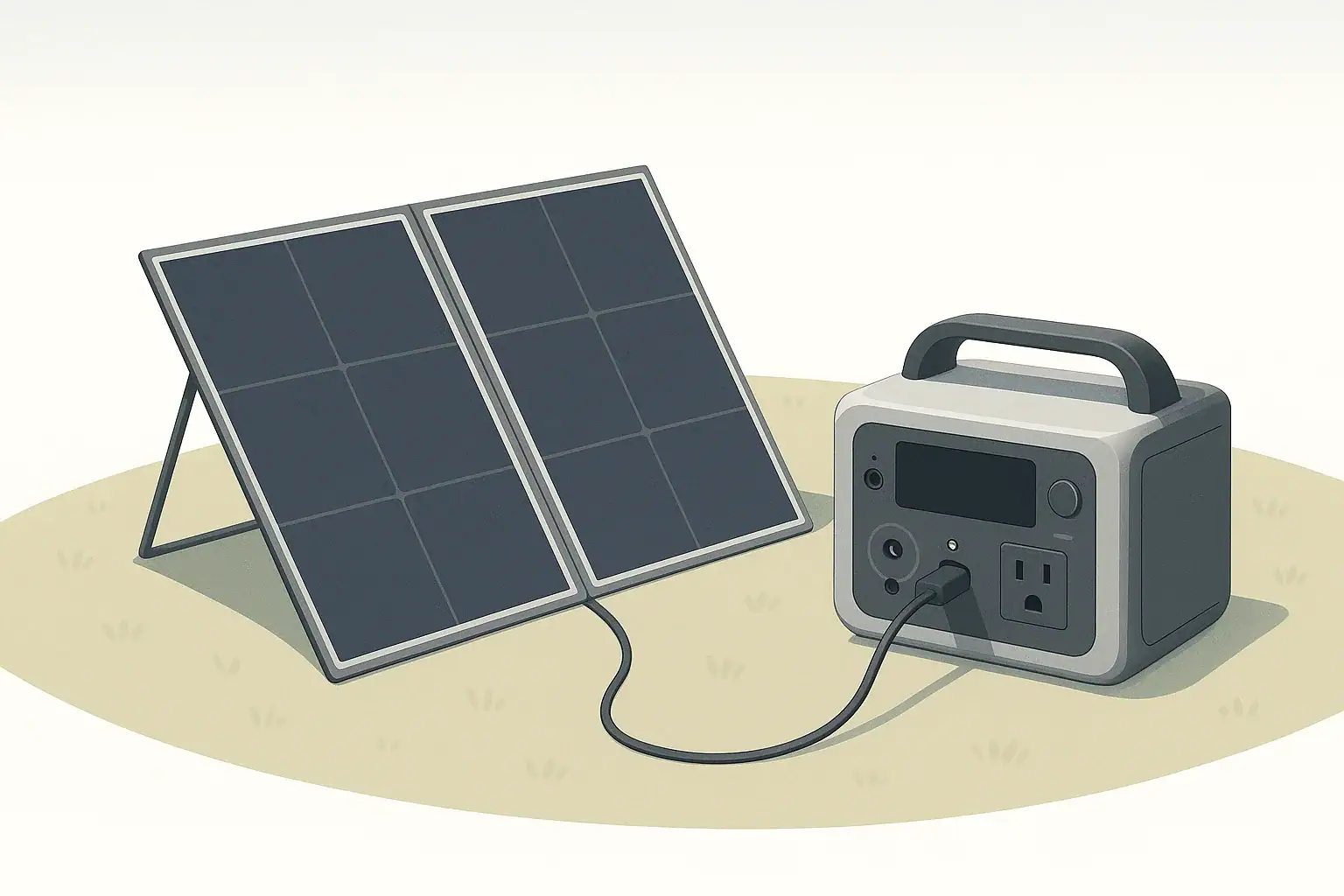
portable power station charging from solar panels outdoors

Solar panels and portable power stations are commonly paired for camping, remote work, emergency backup, and vehicle setups. Before you combine panels or purchase adapters, it helps to understand how wiring choices affect the voltage and current that reach the station. This article explains the practical differences between series and parallel connections, and how those differences influence compatibility, charge speed, cable sizing, and behavior under shade or changing temperatures. It also walks through how typical power station input limits — maximum voltage, wattage, and sometimes current — constrain your wiring options, and offers guidance for small portable setups up to larger RV and off-grid systems. Rather than prescribing a single answer for every scenario, the goal here is to equip you with the checks and trade-offs needed to choose the safest and most effective configuration for your gear and use case.

Why Solar Wiring Method Matters for Power Stations

How you connect solar panels together has a big impact on how well they charge a portable power station. The two basic options are series and parallel wiring. Each changes the voltage and current the power station sees, which affects:

  • Whether the panels are compatible with the power station input
  • How fast the battery can charge in good sun
  • Performance in shade and mixed conditions
  • Cable size and heat
  • Safety margins around maximum voltage ratings

Most portable power stations are designed to accept a limited voltage range and a maximum solar wattage. Understanding series vs parallel helps you stay within those limits and get reliable charging at campsites, RV setups, and during power outages.

Series vs Parallel: The Core Electrical Differences

Solar panels produce direct current (DC) electricity. When you connect more than one panel, you can wire them in series, parallel, or a combination (series-parallel). The choice changes how voltage (V) and current (A) add up, while total watts (W) remain roughly the same under ideal conditions.

Series Connection

In a series connection, you connect the positive of one panel to the negative of the next, forming a chain. The remaining free positive and negative leads go to the power station or solar input controller.

With series wiring:

  • Voltage adds (Vtotal ≈ V1 + V2 + …)
  • Current stays roughly the same as one panel
  • Power (watts) is voltage × current

Example (for illustration only): two similar 100 W panels with about 20 V and 5 A each:

  • Series: ~40 V and ~5 A → ~200 W potential in ideal sun

This higher voltage can be useful if your power station allows it, because it helps overcome some voltage drop in longer cable runs.

Parallel Connection

In a parallel connection, all panel positives are tied together and all negatives are tied together. The combined pair then goes to the power station or controller.

With parallel wiring:

  • Voltage stays about the same as one panel
  • Current adds (Atotal ≈ A1 + A2 + …)
  • Power (watts) remains total V × total A

Using the same example panels:

  • Parallel: ~20 V and ~10 A → ~200 W potential in ideal sun

Parallel keeps voltage lower, which can be safer with devices that have a modest maximum input voltage, but it increases current, which affects connector ratings and cable sizing.

Table 1. Comparing series vs parallel for portable power stations

Example values for illustration.

Factor Series wiring Parallel wiring
Voltage at power station Increases with each panel; must stay below max input voltage Similar to a single panel; usually easier to keep under limits
Current (amps) Similar to one panel; often easier on connectors and cables Adds with each panel; can approach connector or cable ratings
Performance with partial shade One shaded panel can limit the whole string more noticeably Each panel contributes more independently; shade impact is localized
Long cable runs Higher voltage helps reduce voltage drop over distance Lower voltage is more affected by cable length and resistance
Risk of exceeding voltage rating Higher; more attention needed to open-circuit voltage and cold weather Lower; usually within input voltage range for small systems
Typical small portable setups Used when power station supports higher input voltage Common when devices have low max voltage inputs
Complexity when mixing panel sizes Generally best with closely matched panels only Also prefers matched panels but can be a bit more forgiving

How Power Station Solar Inputs Limit Your Choice

Portable power stations specify solar input limits. These usually include:

  • Maximum input voltage (often listed as V or VOC max)
  • Maximum input power (W)
  • Sometimes maximum input current (A)
  • Supported connection types (barrel, DC aviation, MC4 via adapter, etc.)

Voltage Window: The First Check

The maximum solar input voltage is a hard limit. If your series string voltage can exceed that limit (especially open-circuit voltage in cold weather), it can damage the device or cause it to shut down for protection.

When reviewing your setup:

  • Look at each panel’s open-circuit voltage (VOC) specification.
  • Multiply VOC by the number of panels in series.
  • Ensure the result is comfortably below the power station’s max solar input voltage.

Parallel wiring usually stays closer to a single panel’s voltage, which often fits smaller power stations better. But parallel still must stay within any stated voltage minimums and maximums.

Maximum Solar Wattage and Practical Charging Speed

Power stations also cap usable solar watts. Even if your panels can produce more, the device will only accept up to its maximum rated solar input.

For planning, you can estimate charge time in full sun with:

  • Charge time (hours) ≈ Battery capacity (Wh) ÷ Solar input (W)

This is a rough best-case estimate and does not include losses, shading, or weather. Series vs parallel generally does not change the total wattage potential from the panels in perfect conditions, but it can affect how often you hit the power station’s optimal input range in real-world conditions.

Current Limits, Connectors, and Cable Ratings

Parallel wiring raises current. Higher current:

  • Increases cable heating if wires are undersized
  • Can exceed connector ratings
  • Leads to more power lost as heat in long cables

Series wiring increases voltage instead, so current remains closer to that of a single panel. This can be easier on connectors and cables if the power station is designed for higher-voltage solar input.

Shade, Weather, and Real-World Solar Performance

Perfect lab conditions rarely match real outdoor use. Clouds, shadows, temperature, and panel angle all affect solar output. Wiring choice changes how your system behaves under imperfect conditions.

Partial Shade Effects

Panels in a series string share the same current. If one panel is shaded and its current drops, the entire string current is limited to the weakest panel, even if others are in full sun. Many modern panels include bypass diodes that help, but shade still hurts series performance more noticeably.

In parallel wiring, each panel has its own path to the power station input. If one panel is shaded, its contribution drops, but the others can still output closer to their own best performance. This can make parallel preferable in locations with:

  • Tree branches casting moving shadows
  • Roof racks or antennas creating partial shade
  • Campsites where only some panels can be placed in full sun

Temperature and Voltage Margins

Solar panel voltage varies with temperature; voltage tends to increase in cold weather and decrease when hot. A series string that is safe in mild weather can get closer to the power station’s voltage limit on cold, clear days with strong sun.

To maintain a safety margin:

  • Avoid designing a series string that nearly equals the device’s max voltage rating.
  • Consider some extra headroom to account for temperature swings.

Angle, Orientation, and Moving the Panels

Regardless of wiring, panel placement matters. Practical tips include:

  • Face panels generally toward the sun’s path in the sky.
  • Avoid placing panels flat on cold or hot surfaces that may cause uneven heating.
  • Reposition folding panels a few times per day during camping or remote work sessions to keep them in better alignment with the sun.

These simple steps often yield larger gains than changing the wiring alone.

Series vs Parallel for Common Portable Power Station Setups

There is no single “best” wiring method. The right choice depends on your power station’s specifications, how many panels you have, and how you use the system.

Small Power Stations with Modest Solar Inputs

Smaller units used for phones, laptops, lights, and a few small AC loads often have:

  • Lower maximum solar input voltage
  • Lower maximum wattage (for example, a few hundred watts)

With these, parallel is often more straightforward because:

  • Series may exceed the voltage limit with just two panels.
  • Parallel lets you add another panel while staying in the safe voltage range.
  • Partial shade performance tends to be better for casual, variable setups.

Mid-Sized Stations for Short Outages and Remote Work

Medium-capacity power stations used to run home essentials, networking gear, or remote work equipment may support higher solar input voltage and wattage. For these, series wiring becomes more attractive when:

  • The manual lists a relatively high maximum solar voltage.
  • You want to keep cable runs longer (for example, panels in the yard, unit indoors) while controlling voltage drop.
  • You use two or more equal-wattage panels that match the recommended voltage range in series.

Parallel can still be useful if the device’s voltage limit is modest or if you frequently camp or park in areas with partial shade.

Larger Systems for RVs and Extended Off-Grid Use

Larger power stations with bigger battery capacity are often paired with multiple panels. These systems may use a series-parallel combination to balance voltage and current within the device’s limits. For RV or vanlife applications:

  • Check whether the built-in solar controller specifies an ideal voltage window.
  • Consider roof layout to minimize partial shading from vents or racks.
  • Think about how many panels you realistically set up and transport.

In many RV scenarios, keeping roof-mounted panels wired to stay within the controller’s voltage limit while avoiding very high currents is a typical goal. This often means some panels in series and some of those strings in parallel, but that configuration should follow the controller’s documentation or be designed by a qualified installer.

Portable Foldable Panels for Camping

Foldable panels used mainly for camping and road trips are frequently designed to plug directly into a power station with minimal additional wiring. For these setups:

  • The panel’s built-in connectors and ratings usually drive whether multiple panels should be combined in series or parallel.
  • Parking position and campsite trees can cause frequent partial shade, which tends to favor parallel connections when more than one panel is used.
  • Keep wiring simple, labeled, and easy to set up and pack away.

Safety and Practical Wiring Considerations

Any solar setup should prioritize safety and the long-term health of your gear. Portable power stations offer built-in protections, but correct wiring and component choices still matter.

Staying Within Component Ratings

Every part of the system has limits:

  • Panels: maximum current and voltage, usually shown on a label.
  • Cables: rated for a certain current and insulation voltage.
  • Connectors and adapters: have maximum current ratings.
  • Power station input: specified maximum voltage, wattage, and sometimes current.

Series wiring stresses voltage limits more, while parallel stresses current limits more. In both cases:

  • Avoid using damaged, frayed, or overheated cables.
  • Use connectors and adapters intended for outdoor solar use.
  • Keep connectors dry and off the ground when possible.

Fuses, Disconnects, and Basic Protection

For small, portable setups directly feeding a power station, often there is minimal external protection because the power station manages many safety aspects internally. Still, some users add inline fuses or simple DC disconnects to:

  • Protect wiring from accidental shorts.
  • Provide a quick way to disconnect panels before adjusting wiring.

For anything beyond basic plug-and-play panel use, or for semi-permanent mounting (such as on an RV roof), consulting a qualified electrician or solar professional is recommended.

Never Bypass Built-In Safety Systems

Portable power stations are designed as sealed systems. Avoid:

  • Opening the unit or modifying internal wiring.
  • Bypassing built-in charge controllers with unapproved connections.
  • Attempting to feed solar inputs beyond published limits.

Doing so can create fire risk, shock hazards, or permanent equipment damage.

Placement, Ventilation, and Weather

Panels are meant to be outdoors, but the power station usually is not fully weatherproof. Good practices include:

  • Keep the power station under shade, cover, or indoors while panels stay in the sun.
  • Avoid placing the unit directly on hot surfaces or in closed cars on hot days.
  • Allow air to circulate around ventilation grilles during charging and discharging.

Planning Solar Charging Around Your Use Cases

Choosing series vs parallel is part of a bigger picture: how you size solar for the way you actually use your power station. Different use cases put different demands on solar charging.

Short Power Outages at Home

During brief outages, you may want to power:

  • Routers and modems
  • Phones and laptops
  • A few LED lights
  • Possibly a small fan or low-wattage appliance

In urban or suburban settings with limited outdoor space, total solar wattage may be modest. Parallel setups with one or two panels often suit these conditions, especially where shading from nearby buildings and trees is common.

Remote Work and Travel

For working remotely with laptops, monitors, and networking gear, you may:

  • Consume a steady amount of power throughout the day.
  • Rely on the power station both for AC and DC outputs.

Larger, more efficient solar arrays become more important. If campsites allow you to position panels in clear sun, a series configuration tuned to the power station’s preferred input voltage can be helpful for better performance with longer cables.

Camping, Vanlife, and RV Basics

For camping and RV use, consider:

  • Whether panels are roof-mounted, portable, or both.
  • How often you move the vehicle and whether you can aim panels toward the sun.
  • Seasonal sun availability where you travel.

Parallel wiring can perform better in shaded campgrounds, while series or series-parallel configurations may shine in open, sunny locations with longer cable runs.

Table 2. Example solar planning for common devices

Example values for illustration.

Device type Typical draw (watts, example) Daily use example Planning note
Smartphone 5–10 W 2–3 hours total charging Small load; even a modest panel can cover this easily.
Laptop 40–80 W 4–8 hours work session Often a main daily draw; size solar so you can replace several hundred watt-hours.
Portable fridge 40–70 W when running Cycles on and off all day Average daily energy can be significant; benefits from higher total panel wattage.
LED lighting 5–20 W per light Evening use for several hours Efficient but can add up; easy to support with modest solar if managed.
Wi‑Fi router 10–20 W Many hours or continuous Small but long-duration load; consider it in outage planning.
Small fan 20–50 W Several hours in warm weather Comfort device; can noticeably increase energy use in hot climates.
Television (small) 40–100 W 1–3 hours Occasional use; can be supported easily if solar is sized for work devices first.

Putting It All Together: Choosing Series or Parallel

To decide between series and parallel for charging a portable power station, work through these points:

  • Start with the manual: note maximum solar voltage, current (if listed), and wattage.
  • Check panel specs: especially open-circuit voltage and current ratings.
  • Model both options: estimate resulting string voltage (for series) and total current (for parallel).
  • Consider shade patterns: more shade often favors parallel; consistently open sun may favor series.
  • Account for cable length: longer runs may benefit from higher voltage (series) to reduce losses.
  • Leave safety margins: avoid pushing up against maximum voltage or current ratings.

In many small portable systems, parallel wiring is simpler and more forgiving for occasional use, while in larger or more permanent setups, series or series-parallel configurations can offer better performance if designed within the power station’s limits. Keeping the system well within published ratings and adapting to your environment will matter more than any single wiring choice.

Frequently asked questions

Can I connect solar panels in series to any portable power station?

Not necessarily. You must check the power station’s maximum solar input voltage and compare it to the panels’ open-circuit voltage (Voc) multiplied by the number of panels in series; if the string Voc can exceed the device’s max, series wiring is not safe. Also allow extra headroom for cold-weather voltage increases.

Does parallel wiring perform better when panels are partially shaded?

Often yes; in parallel each panel feeds the input independently so a shaded panel reduces only its own contribution rather than limiting the entire array. However, bypass diodes and controller behavior can influence results, so parallel is usually preferable in moving-shade environments.

Will series or parallel wiring change the theoretical maximum charging speed?

Under ideal conditions total panel wattage is roughly the same regardless of wiring, so theoretical maximum charging power doesn’t change. In practice wiring affects whether the power station’s MPPT input sees the voltage and current range where it can extract full power, so one configuration may reach the device’s max input more reliably than the other.

What cable size and connector limits should I consider for parallel panel connections?

Parallel increases current, so you must choose wire gauge and connectors rated for the combined short-circuit and operating current of all panels to avoid overheating and voltage loss. Use outdoor-rated connectors and consider inline fusing and limiting cable length to reduce losses.

How do I account for temperature when checking series string voltage against a power station’s limit?

Panel open-circuit voltage rises in cold temperatures, so calculate worst-case Voc by multiplying the panel Voc by the number of series panels and add a safety margin rather than designing right at the device’s max. If available, use the panel’s temperature coefficient to estimate Voc in cold conditions and keep the string comfortably below the power station’s maximum input voltage.

MPPT vs PWM in Portable Power Stations: What It Changes in Real Life

Two portable power stations shown side by side for comparison

Portable power stations are increasingly charged from solar panels, but how the built-in charge controller manages panel-to-battery power can make a big difference in day-to-day performance. This article compares the two common controller strategies — PWM (Pulse Width Modulation) and MPPT (Maximum Power Point Tracking) — and explains what those differences mean for charging speed, energy harvest, panel choices, and system design in real-life use. Read on to see how each approach behaves under changing sunlight, variable temperatures, and longer cable runs, plus practical tips on when the added cost and complexity of MPPT are worth it. The sections below break down quick definitions, real-world examples, system implications, and guidance to help you pick the right portable power station setup for your solar needs.

Why MPPT vs PWM Matters for Portable Power Stations

When you charge a portable power station from solar panels, a built-in solar charge controller manages how energy flows from the panels into the battery. Most modern units use one of two controller types:

  • PWM (Pulse Width Modulation)
  • MPPT (Maximum Power Point Tracking)

On spec sheets this often appears as a small line, but it has clear effects on how quickly and efficiently your power station charges from solar in real-world conditions. Understanding the difference helps you size your solar setup correctly and avoid unrealistic expectations about charging time.

Quick Definitions: PWM and MPPT

What a Solar Charge Controller Does

A solar charge controller sits between your solar panels and the battery in a portable power station. Its main jobs are to:

  • Protect the battery from overcharging
  • Match the panel output to the battery voltage
  • Control charging stages (bulk, absorption, float) for battery health

MPPT and PWM are two different control strategies for doing this.

PWM in Simple Terms

A PWM controller connects the solar panel directly to the battery and then rapidly switches the connection on and off (modulation) to control the charging current.

Key characteristics:

  • Simple electronics and usually lower cost
  • Operates the panel close to the battery voltage
  • Wastes potential panel voltage above battery voltage

MPPT in Simple Terms

An MPPT controller is more sophisticated. It continuously measures the panel voltage and current and adjusts the operating point to extract the maximum possible power from the panels.

Key characteristics:

  • Uses DC-DC conversion to transform higher panel voltage into extra charging current
  • Actively tracks the “maximum power point” as sunlight changes
  • Improves energy harvest, especially in suboptimal conditions

How MPPT and PWM Behave With Solar Panels

Voltage Matching and What It Means

Solar panels have a voltage at which they produce the most power (often called Vmp). Batteries also have a nominal voltage (for example, around 12 V, 24 V, or internal pack voltages inside a power station).

What each controller does with this mismatch is the core difference:

  • PWM: Pulls the panel voltage down close to the battery voltage. If the panel is rated for a much higher voltage than the battery, that extra voltage is mostly lost as heat or unused potential.
  • MPPT: Lets the panel operate at or near Vmp, then converts the higher voltage down to the battery voltage while increasing the current. This preserves more of the panel’s potential wattage.

Simple Real-World Example

Assume a solar panel has these approximate ratings under good sun:

  • Voltage at max power (Vmp): 18 V
  • Current at max power (Imp): 5.5 A
  • Panel power: 18 V × 5.5 A ≈ 99 W

Now connect it to a battery that is charging at around 13 V:

  • With PWM: Panel is pulled down to roughly 13 V. Maximum power becomes about 13 V × 5.5 A ≈ 71.5 W. You lose the remainder as unused potential.
  • With MPPT: Controller keeps panel near 18 V and converts it to battery voltage. In an ideal case, you could get close to 99 W into the battery (minus small conversion losses).

Over the course of a full day of sunlight, that difference adds up to noticeably more watt-hours stored with MPPT.

Efficiency and Energy Harvest in Real Life

Typical MPPT vs PWM Gain

Under many conditions, MPPT controllers can harvest about 15–30% more energy than PWM controllers from the same solar array. The actual gain depends on factors like:

  • Panel voltage relative to battery voltage
  • Cell temperature
  • Shading and cloud cover
  • Time of day (angle of the sun)

The benefit is largest when there is a significant voltage difference between the solar panel and the battery and when conditions are not ideal.

Partial Shade and Changing Conditions

Portable power stations often see variable conditions:

  • Panels moved around a campsite or yard
  • Clouds passing overhead
  • Panels tilted at non-optimal angles

An MPPT controller can respond to these changes by constantly seeking the best operating point. When the sun weakens, the voltage-current curve of the panel changes; MPPT tracks this and keeps power output closer to the maximum. PWM simply follows the battery voltage and does not adapt to the changing shape of the curve.

Cold and Hot Weather Impact

Panel voltage rises in cold temperatures and falls in hot temperatures. This is where the technology differences show up again:

  • In cold weather: Voltage can be significantly higher than nominal. MPPT can turn that higher voltage into more current, boosting wattage harvested. PWM cannot use the extra voltage and simply wastes it.
  • In hot weather: Panel voltage drops closer to battery voltage. The advantage of MPPT shrinks somewhat, but it still generally does better at maintaining optimal power.

Impact on Charging Time

Translating Efficiency Into Hours

Charging time for a portable power station from solar depends on:

  • Battery capacity (in watt-hours)
  • Total solar array power (in watts)
  • Average sun hours per day
  • System efficiency, including controller type

Because MPPT harvests more energy from the same panels, it shortens charging time compared to PWM in many real-world setups.

Illustrative Scenario

Consider a 500 Wh portable power station and a 100 W solar panel in reasonably good sun:

  • Assume about 5 peak sun hours in a day
  • Assume wiring and conversion losses outside the controller are similar

Approximate daily energy into the battery:

  • With PWM: Effective panel power might average ~70 W → 70 W × 5 h = 350 Wh
  • With MPPT: Effective panel power might average ~90 W → 90 W × 5 h = 450 Wh

In this simplified model, MPPT could bring the power station close to full in one good day, while PWM may need closer to a day and a half under similar conditions.

The exact numbers will vary in reality, but the pattern—shorter charging times with MPPT from the same panel—is typical when using modest to large solar panels compared to the battery size.

System Design: Panel Choices and Cable Runs

Panel Voltage Flexibility

MPPT controllers work best with solar panels that have a higher voltage than the battery. In the context of portable power stations, this has practical effects:

  • With PWM: You generally want panel voltage close to the battery-equivalent input voltage to minimize wasted potential.
  • With MPPT: You can use higher-voltage panels or combine panels in series (within the unit’s voltage limits) and still capture most of the extra voltage as useful power.

This flexibility can be useful when repurposing existing panels or scaling up an array.

Cable Length and Voltage Drop

Running low-voltage DC over longer cables causes voltage drop and power loss. MPPT can help manage this:

  • Higher input voltage: MPPT allows you to run panels at a higher voltage (within spec), which reduces current for the same power and therefore reduces losses in the cables.
  • PWM limitation: Because PWM forces panel voltage nearer to battery voltage, current is higher for the same power. That means thicker cables or shorter runs are needed to limit voltage drop.

For many small portable setups with short cables, this may not be a significant factor. For larger panels located farther from the power station (for example, to reach a sunny spot), MPPT can preserve more energy.

Cost, Complexity, and Reliability Considerations

Price and Internal Complexity

MPPT controllers use more complex electronics and control algorithms than PWM controllers. Inside a portable power station, that generally translates into:

  • Higher component cost for the manufacturer
  • More sophisticated firmware and control circuits

PWM controllers are simpler and often less expensive to implement. This is one reason some lower-cost or smaller-capacity portable power stations use PWM for their solar input.

Reliability in Practice

Both PWM and MPPT controllers can be highly reliable when designed and built well. The reliability differences in real-world portable power stations tend to depend more on overall product design and component quality rather than solely on the choice of PWM vs MPPT.

However, there are a few practical points:

  • More complex electronics (MPPT) can theoretically have more failure modes, but proper engineering and thermal management mitigate this.
  • PWM controllers are simpler and may run cooler at lower power levels, but can still be stressed if used near or beyond their design limits.

When MPPT Makes a Noticeable Difference

Larger Solar Arrays Relative to Battery Size

The more solar panel capacity you have relative to the battery size, the more meaningful the efficiency gain from MPPT becomes. For example:

  • Small power station with a modest 50 W panel: the difference between MPPT and PWM may be modest in absolute watt-hours per day.
  • Mid-size power station with 200–400 W of panels: the daily energy gain from MPPT can be significant, especially if you rely mostly on solar.

Situations With Limited Sunlight

When sunlight is scarce or inconsistent, more efficient energy capture matters:

  • Short winter days
  • Cloudy climates
  • Heavily shaded campsites or urban balconies

In these scenarios, MPPT can help you make the most of brief or weak sun windows, improving the odds of reaching a useful state of charge.

Long-Term Off-Grid or Heavy Solar Dependence

If your portable power station is part of a frequent or semi-permanent off-grid setup—such as a van, RV, remote cabin, or regular camping with solar as the main energy source—MPPT’s improved harvest typically pays off in convenience and system performance.

When PWM Can Be Acceptable

Occasional or Light Solar Use

If you use solar only occasionally, or primarily as a backup to wall charging or vehicle charging, a PWM-based solar input can still be adequate. Examples include:

  • Charging the power station from the wall most of the time
  • Using a small panel just to slow battery drain on trips
  • Rarely relying on solar as the sole energy source

In these cases, the extra efficiency of MPPT may not dramatically change your day-to-day experience.

Very Small Setups

For compact portable power stations with small batteries and small panels, the absolute difference in watt-hours can be relatively small. If your expectations are modest—such as topping up phones, tablets, or a small laptop—PWM may perform adequately within those limits.

Reading Portable Power Station Specs

Identifying MPPT vs PWM in Specifications

Product documentation or spec sheets typically mention the solar charging type. Look for phrases like:

  • “MPPT solar charge controller” or “built-in MPPT”
  • “PWM charge controller” or no explicit mention of MPPT

If the controller type is not clearly stated, detailed manuals or technical datasheets may provide more information, including:

  • Maximum solar input wattage
  • Supported input voltage range (for example, 12–30 V)
  • Maximum charging current

Higher allowable input voltages and explicit references to “tracking” or “MPPT” are indicators of an MPPT design.

Solar Input Limits Still Apply

Even with MPPT, you cannot exceed the maximum solar input specifications of the portable power station. Key limits include:

  • Maximum input power (W): The upper bound of solar wattage the unit can safely use.
  • Maximum input voltage (V): A hard limit you must not exceed with panel configurations, especially when wiring panels in series.
  • Connector type and rating: The physical plug and wiring must handle the current.

The controller type does not override these constraints; it simply changes how efficiently energy is used within them.

Practical Tips for Choosing Between MPPT and PWM

Questions to Ask Yourself

When evaluating a portable power station’s solar charging, consider:

  • How often will I rely primarily on solar charging?
  • How large a solar array do I plan to use, now or later?
  • Will my panels be in suboptimal conditions (shade, winter sun, long cables)?
  • Is faster solar charging important for my use case?

If you expect frequent or heavy solar use, MPPT usually offers more flexibility and better real-world performance for the same panel investment.

Designing Around a PWM Input

If you already own or choose a power station with PWM solar charging, you can still optimize performance:

  • Use panels with voltage close to the recommended input voltage to reduce wasted potential.
  • Keep cable runs short and use appropriately thick wire to minimize voltage drop.
  • Position panels for the best sun exposure and adjust tilt during the day if practical.
  • Manage expectations about charging speed, especially in marginal sunlight.

Designing Around an MPPT Input

With an MPPT-equipped power station, you can often:

  • Use higher-voltage panels or series combinations (within voltage limits) to reduce current and cable loss.
  • Get more usable energy on cloudy, cold, or partially shaded days.
  • Scale up your solar array more effectively if the input wattage rating allows it.

Summary: Real-Life Changes You Will Notice

In everyday use, the difference between MPPT and PWM in portable power stations shows up as:

  • Faster solar charging: MPPT generally fills the battery more quickly from the same panels.
  • Better performance in less-than-ideal sun: MPPT maintains higher output under changing conditions.
  • More flexibility in panel choice and cable length: MPPT handles higher voltages and longer runs more efficiently.
  • Simpler, often cheaper hardware with PWM: Adequate for light or occasional solar use with realistic expectations.

Choosing between MPPT and PWM is ultimately about matching your solar charging expectations and environment to how you plan to use your portable power station over time.

Frequently asked questions

How much faster will MPPT charge my portable power station compared to PWM?

MPPT typically harvests about 15–30% more energy than PWM under many real-world conditions, which often translates to roughly 15–30% shorter charging times. For example, with a 100 W panel in decent sun you might get ~450 Wh with MPPT versus ~350 Wh with PWM over a day, so MPPT can sometimes fill a medium-size station in one day that PWM would need more than a day to reach.

Can I use higher-voltage solar panels with a PWM-equipped portable power station?

Physically you can only use panels that stay within the unit’s stated input voltage limits, but PWM will pull panel voltage down toward the battery voltage and waste the excess. For PWM systems you should choose panels with a Vmp close to the battery input voltage to avoid losing potential power.

Will MPPT still provide benefits in hot weather or partial shade?

Yes; MPPT is especially beneficial in partial shade, cloudy conditions, and cold weather because it actively tracks the panel’s maximum power point. In hot weather the panel voltage falls and the relative advantage shrinks, but MPPT usually still extracts more usable energy than PWM in varying conditions.

Is MPPT worth the extra cost if I only use solar occasionally?

If solar use is occasional or you rely mainly on wall or vehicle charging, PWM can be adequate and the added cost of MPPT may not be justified. However, if you expect to scale up panels, depend on solar in poor conditions, or want faster charging, MPPT typically pays off over time.

How do cable length and voltage drop influence the MPPT vs PWM decision?

Longer cable runs increase voltage drop; using higher input voltage with an MPPT controller reduces current for the same power and therefore lowers cable losses. PWM forces panels to operate near battery voltage so current is higher and cable losses become more significant unless thicker wiring or very short runs are used.

Portable Power Stations and Renewable Energy

Isometric illustration of power station with solar panel

Introduction

Portable power stations are modular battery-based devices designed to store and deliver electricity for mobile, remote, or backup use. When paired with renewable energy sources such as solar panels, wind chargers, or vehicle-based systems, they provide a flexible way to capture and use clean energy without a wired grid connection.

This article explains how portable power stations work with renewables, the key components involved, practical charging options, sizing considerations, and recommended practices for reliable and safe operation.

How portable power stations work with renewable sources

At a basic level, a portable power station stores electrical energy from a charging source and makes it available through output ports (AC outlets, DC ports, USB). When used with renewables, it acts as the intermediary between intermittent generation and steady loads.

Basic components

  • Battery pack: the energy storage medium measured in watt-hours (Wh).
  • Battery management system (BMS): protects against overcharge, deep discharge, and imbalance.
  • Inverter: converts DC battery power to AC for household appliances.
  • Charge controller: manages solar or wind input to optimize charging and protect the battery.
  • Input/output ports: for solar panels, wall charging, 12V sources, and appliance outputs.

Energy flow: solar to battery to load

Renewable generation is variable. A typical flow is:

  • Solar panel or turbine generates DC power.
  • A charge controller (MPPT or PWM) conditions and maximizes energy sent to the battery.
  • The battery stores the energy until needed.
  • The inverter provides AC power to loads or DC outputs supply devices directly.

Charging options from renewable sources

Portable power stations can accept energy from multiple renewable inputs. The most common are solar panels, but other methods are possible depending on the system design.

Solar panels

Solar is the most common pairing. Key considerations:

  • Panel type and wattage determine potential charging power.
  • Matching voltage and current to the station’s input specifications is essential.
  • Use of an MPPT charge controller improves efficiency, especially under variable irradiance.
  • Environmental factors (angle, shading, temperature) affect charging rates.

Small wind turbines and microgeneration

Compact wind turbines can charge portable stations when wind resource exists. They typically require a charge controller compatible with the turbine’s output characteristics and may produce more variable power than solar.

Vehicle and alternative charging

Vehicles, fuel-powered generators, and hydro sources can also charge portable stations. Many units support 12V car charging or AC input from alternators and generators, offering flexibility when renewables are insufficient.

Battery chemistry and renewable integration

Battery chemistry affects cycle life, depth of discharge, weight, and how the battery interacts with renewable charging profiles.

Common chemistries

  • Lithium-ion: high energy density and lighter weight. Good for portable use but sensitive to deep discharge and high temperatures.
  • LiFePO4 (lithium iron phosphate): lower energy density but longer cycle life and improved thermal stability. Often preferred for frequent charge/discharge from renewables.
  • Other chemistries: lead-acid and AGM are heavier and have shorter cycle lives but may appear in low-cost or legacy systems.

Choose a chemistry based on expected charging cadence, lifetime, and weight requirements.

Inverters, charge controllers, and system components

Understanding supporting electronics helps ensure efficient renewable integration.

MPPT vs PWM charge controllers

  • MPPT (Maximum Power Point Tracking) controllers optimize energy harvest by matching panel output to battery voltage. They are more efficient in varied conditions.
  • PWM (Pulse Width Modulation) controllers are simpler and less expensive but can leave potential solar output unused, especially when panel voltage is significantly higher than battery voltage.

Sizing the inverter for appliances

Inverter capacity is measured in continuous watts and surge watts. Match the inverter to the largest loads you plan to run:

  • Resistive loads (lights, heaters) use rated power continuously.
  • Inductive loads (motors, pumps, refrigerators) require higher surge capacity at startup.
  • Don’t exceed continuous rating for sustained loads to prevent overheating or shutdowns.

Sizing a portable power station for renewable use

Correct sizing ensures the system meets daily energy needs and charging capability from renewables.

Steps to size a system

  1. List the devices you want to power and their wattage.
  2. Estimate hours of use per day for each device to calculate daily watt-hours (Wh = watts × hours).
  3. Add a margin for inefficiencies (inverter losses, battery depth of discharge). A common multiplier is 1.2–1.4.
  4. Choose a battery capacity (Wh) that covers daily needs after the efficiency factor.
  5. Ensure the renewable charging source (solar array wattage) can replenish that Wh in the available sun hours.

Example

If devices total 500 watts and run 3 hours per day, daily energy is 1,500 Wh. Applying a 1.3 multiplier gives 1,950 Wh required. A portable station rated at 2,000 Wh or greater would be appropriate, and solar panels must be sized to deliver at least that energy in typical sun hours.

Typical use cases and scenarios

Renewable-charged portable power stations support a range of activities.

  • Camping and van life: solar panels on a campsite or roof can keep devices and small appliances powered for extended trips.
  • Home backup: short-term outage support for lights, communications, and essential medical devices when recharged by rooftop solar or portable panels.
  • Remote work and field operations: power for tools, laptops, and equipment where grid access is limited.
  • Emergency response: mobile charging and lighting systems that can be recharged by portable solar or vehicle alternators.

Best practices for charging and maintaining with renewables

Following good practices extends battery life and improves reliability.

  • Use the correct charge controller type (prefer MPPT for most solar pairings).
  • Avoid deep discharges when possible; operate within recommended depth-of-discharge limits.
  • Keep panels clean and positioned to maximize sun exposure throughout the day.
  • Monitor temperature; extreme heat or cold reduces battery performance. Store and operate within manufacturer temperature ranges.
  • Regularly check connections for corrosion, tightness, and clean contacts to reduce energy losses.
  • Schedule periodic full charging cycles if the station is stored for long periods to maintain charge balance and reduce self-discharge effects.

Safety and environmental considerations

Working with batteries and renewable power requires attention to safety and environmental impact.

  • Ensure the BMS and charger include protections for overvoltage, overcurrent, and thermal shutdown.
  • Avoid charging batteries in enclosed spaces without ventilation if using external generators or fuel-based chargers.
  • Dispose of or recycle batteries and solar components according to local regulations to minimize environmental harm.
  • Follow manufacturer guidance for transporting batteries, especially by air where restrictions apply.

Further reading and resources

When integrating portable power stations with renewable sources, focus on matching energy needs, proper component selection, and maintenance routines. Exploring detailed calculators for energy consumption and solar yield can help refine system size and configuration for specific use cases.

Frequently asked questions

Can I charge a portable power station directly from solar panels without a separate charge controller?

Many portable power stations include a built-in solar charge controller and accept a PV input that matches their specifications; in those cases no external controller is required. If a station lacks an internal controller or if panel voltage or current exceed the unit’s input range, use a compatible external charge controller to prevent overvoltage and to optimize charging.

How do I size solar panels to fully recharge a specific portable power station in a day?

Calculate required panel wattage by dividing the station’s usable watt-hours by typical peak sun hours for your location, then divide by system efficiency (accounting for charge controller and conversion losses) to determine panel wattage. For example, a 2000 Wh battery with 5 peak sun hours and 80% overall efficiency needs roughly 500 W of panels (2000 / 5 / 0.8 ≈ 500).

Are small wind turbines a reliable charging option for portable power stations?

Small wind turbines can be reliable where a consistent wind resource exists, but their variable and sometimes high-voltage output requires a compatible charge controller or rectifier and proper system protection. Expect more variability than solar, and design the system with battery capacity and regulation to handle intermittent or gusty inputs.

What battery chemistry is best when pairing portable power stations with renewable sources?

LiFePO4 batteries are often preferred for frequent renewable charging because they tolerate deeper cycle depths, have longer cycle life, and better thermal stability; lithium-ion offers higher energy density for lighter systems but typically shorter cycle life. Choose chemistry based on trade-offs between weight, expected charge/discharge frequency, and longevity.

Can I run a refrigerator during an outage using a portable power station charged by solar panels?

Possibly, but you must confirm the station’s continuous and surge inverter ratings are sufficient for the refrigerator’s startup and running power, and ensure installed solar and battery capacity supply the refrigerator’s daily energy needs. Refrigerators have high startup surges and continuous consumption, so sizing for both peak and total watt-hours plus considering solar replenishment is essential.