Can a Power Station Start a Sump Pump? High-Inrush Load Guide

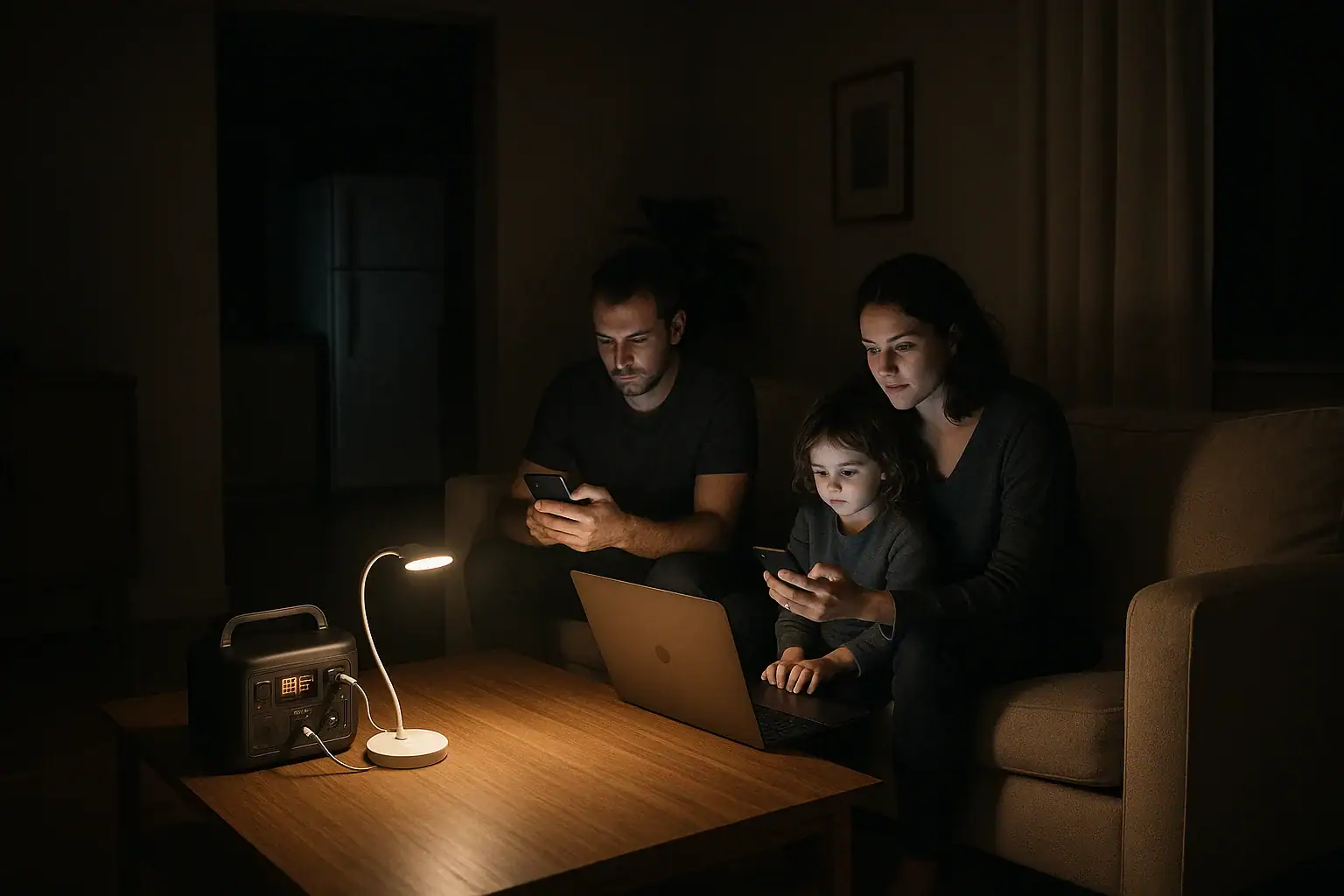
Portable power station running a lamp and small appliance indoors

Yes, a portable power station can start some sump pumps, but only if its inverter has enough surge capacity for the pump’s high inrush load. The running watts printed on a pump label are not enough to answer the question, because many pump motors briefly need two to five times more power when they first start.

This startup demand is called inrush current, surge current, locked-rotor current, or motor starting load. It lasts only a short time, but it is often the reason a power station shuts off even though the pump seems to be within the advertised watt rating.

For sump pump backup, you need to check two things: whether the inverter can handle the pump’s startup surge, and whether the battery has enough watt-hours for the pump’s cycling pattern during an outage. Both matter, but surge capacity is usually the first pass-or-fail test.

What high inrush means for sump pumps

A sump pump is a motor-driven load. When the float switch rises and calls for pumping, the motor has to move from a dead stop to operating speed while pushing water through the discharge pipe. That moment can require far more current than steady operation. Once the motor is spinning, the demand usually drops to its normal running watts.

This is different from simple loads such as LED lights, phone chargers, or many laptops. Those devices may use a fairly predictable amount of power. A sump pump may look modest while running, then hit the inverter with a brief demand that is several times larger at startup. If the inverter cannot supply that peak, the pump may hum, fail to start, or cause the power station to display an overload fault.

High inrush matters because sump pumps often need to operate automatically during storms, when grid outages and heavy groundwater can happen at the same time. A setup that works once in a dry test may still struggle if the pump cycles repeatedly, the battery is partly drained, the basement is warm, or other appliances are connected to the same inverter.

The key point is that a sump pump is not just a runtime problem. It is also a starting problem. Any realistic backup plan must leave enough inverter headroom for the motor to start reliably, not just enough battery capacity to run it after it starts.

How to size a power station for startup and runtime

Start with the pump’s running watts or amps. If the nameplate lists amps instead of watts, estimate watts by multiplying volts by amps. A 120-volt pump drawing 5 amps while running is roughly a 600-watt load before accounting for power factor and real-world variation. If the pump documentation lists starting watts, use that number. If it does not, a cautious estimate is often three to five times the running watts.

Next, compare that estimate with the power station’s inverter ratings. The continuous output rating must cover the pump’s running watts with margin. The surge or peak rating must cover the starting demand. A close match is not ideal because voltage drop, warm inverter conditions, and other connected loads can reduce reliability.

Runtime is a separate calculation. Sump pumps usually cycle, meaning they run for short periods and sit idle between cycles. You need the total ON time, not just the outage length. A pump that runs 10 minutes per hour at 600 watts uses 100 watt-hours per hour before losses. After inverter losses and a reserve margin, the required battery capacity will be higher.

Sump pump sizing checks. Example values for illustration.
Item to check How to estimate it Why it matters
Running watts Use the pump label or multiply volts by running amps Sets the minimum continuous inverter requirement
Startup surge Use published starting watts, or estimate 3 to 5 times running watts Determines whether the pump will start without overload
Continuous inverter output Compare to running watts with at least practical margin Prevents shutdown after the motor is already running
Surge inverter output Compare to estimated starting watts, not average watts Handles the brief motor startup demand
Duty cycle Track minutes of pump runtime per hour during wet conditions Turns nameplate watts into realistic battery use
Usable battery energy Account for inverter losses and avoid planning to use every watt-hour Gives a more realistic outage runtime estimate
Other connected loads Add their running watts and consider their own startup surges Reduces headroom available when the sump pump kicks on

A simple sizing sequence works well: confirm the pump can start, confirm it can keep running, then estimate total energy. If the first step fails, extra battery capacity will not fix the problem. A larger battery with an undersized inverter may run lights for many hours but still be unable to start a sump pump.

Real-world examples

Consider a small sump pump that runs at about 400 watts. If its startup surge is roughly three times the running draw, it may need about 1,200 watts for a moment. A power station with a 600-watt inverter will not be a good match even if the pump only settles at 400 watts. A unit with a higher continuous rating and a surge rating above the estimated startup demand has a much better chance.

Now consider a mid-sized pump that runs near 700 watts. Its starting demand could be 2,100 to 3,500 watts. If the inverter’s surge rating is 2,000 watts, the result may be inconsistent: it might start once when conditions are favorable, then trip later when the battery is lower or the pump is pushing more water. For emergency flood protection, inconsistent starting is not good enough.

Runtime depends on how often the pump cycles. Suppose a 600-watt pump runs 15 minutes per hour during a storm. That is one quarter of an hour at 600 watts, or about 150 watt-hours per hour before losses. After accounting for inverter inefficiency, the battery may need to provide roughly 165 to 180 watt-hours per hour of operation. A 1,000 watt-hour power station might support that pattern for several hours, but not necessarily overnight with a comfortable reserve.

Heavy rain can change the calculation quickly. If the same pump runs 30 minutes per hour, energy use doubles. If it runs almost continuously, the power station becomes a short-duration bridge, not a full-night backup. This is why observing your actual sump pump during wet weather is more useful than relying on a generic pump size alone.

Multiple motor loads make the situation harder. A refrigerator, freezer, dehumidifier, and sump pump may each be reasonable on their own, but if two motors start at the same time, the combined surge can exceed the inverter limit. For sump pump backup, it is usually better to keep the pump on a dedicated power station or leave generous surge headroom if other loads must share the unit.

Common mistakes and troubleshooting cues

The most common mistake is sizing only by running watts. A pump that runs at 500 watts is not automatically compatible with a 600-watt inverter. The inverter must also survive the starting surge. If it cannot, the power station may shut off instantly or the pump may hum without moving water.

Another mistake is assuming a short successful test proves storm readiness. A quick test with a fully charged battery, no other loads, and a low water level is useful, but it may not represent a long outage. During a storm, the pump may start dozens or hundreds of times, the inverter may warm up, and the battery voltage may be lower.

Extension cords are another weak point. A thin or very long cord can cause voltage drop. Lower voltage makes the motor work harder at startup, which can increase current draw and trip the inverter more easily. Use a short, heavy-duty grounded cord that is appropriate for the pump load, and avoid damaged or coiled cords that can heat up.

Symptoms that point to sump pump and inverter mismatch. Example values for illustration.
Symptom Likely cause Practical response
Power station immediately shows overload Startup surge exceeds inverter capability Reduce other loads or use a power station with higher surge output
Pump hums but does not pump water Motor is not reaching operating speed Disconnect promptly, check for blockage, and reassess surge capacity
Works once, then fails after several cycles Heat buildup or reduced battery headroom Improve ventilation and size with more margin
Runtime is much shorter than expected Duty cycle is higher than assumed or losses were ignored Measure actual minutes of pump runtime per hour
Cord or plug feels warm Undersized cord, poor connection, or excessive current Stop using that setup and inspect cord rating and condition
Other devices turn off when pump starts Combined surge exceeds available inverter output Give the sump pump priority or separate critical loads

If troubleshooting points to surge capacity, do not repeatedly force restarts. Repeated failed starts can stress the pump motor and the inverter. Treat overload messages and humming starts as compatibility warnings, not minor annoyances.

Safety basics for wet basements and motor loads

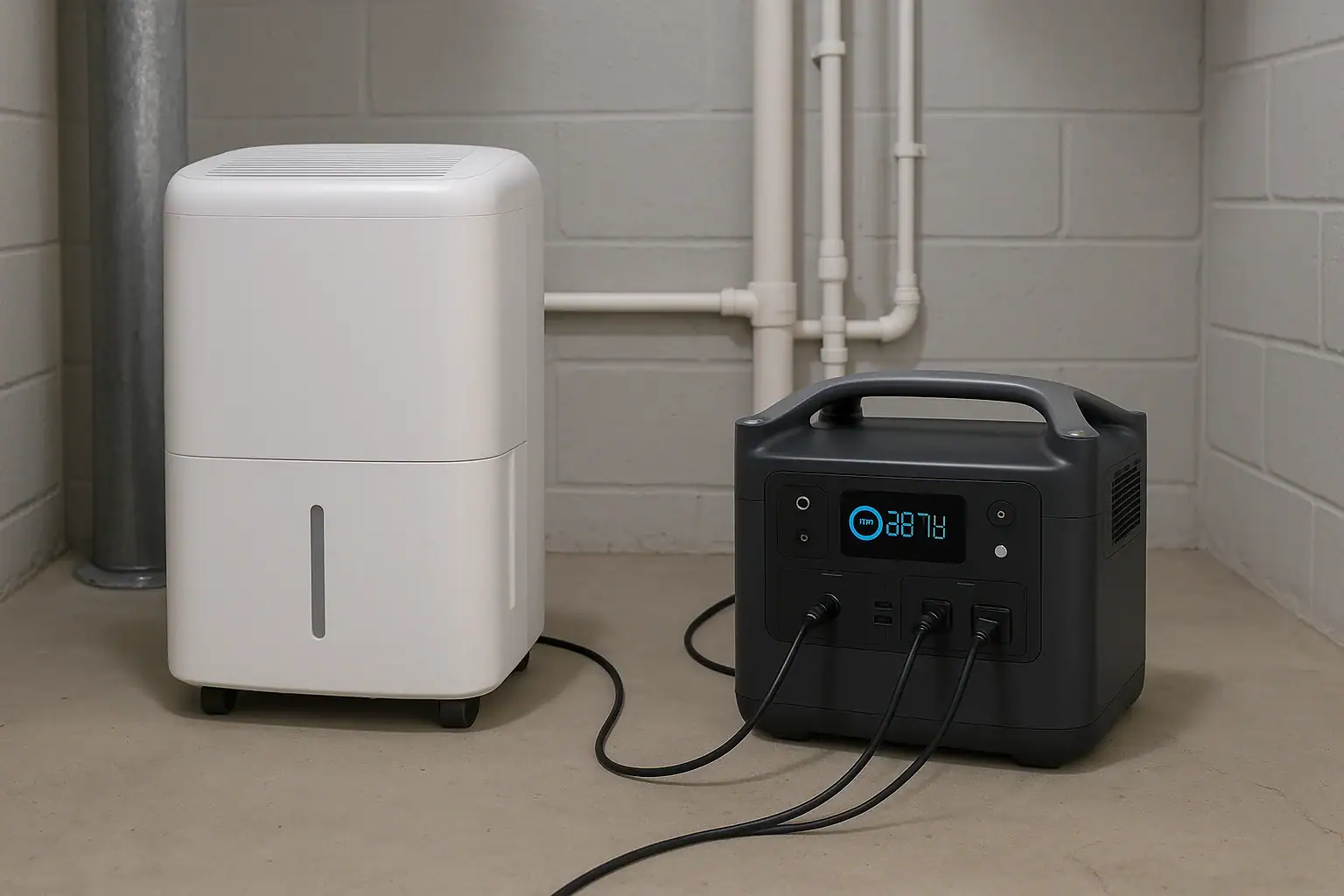
Keep the power station dry, elevated, and away from any area that could flood. A sump pump lives in a wet environment, but a portable power station should not. Place it on a stable shelf, platform, or other raised location where cords can reach without being pulled tight or creating a trip hazard.

Ventilation is also important. Inverters create heat, especially when starting motors repeatedly. Do not cover the unit, place it in a sealed box, or crowd the cooling vents. Leave enough space around the power station for airflow, and keep combustible materials away from hot surfaces and exhaust paths from cooling fans.

Use grounded cords and intact plugs. Do not remove grounding pins, bypass protective devices, or use damaged adapters. If the power station has outlet limitations, follow them. If the sump pump circuit involves ground-fault protection, be aware that some combinations of pumps, cords, and portable power equipment may trip protection devices. A trip should be investigated rather than ignored.

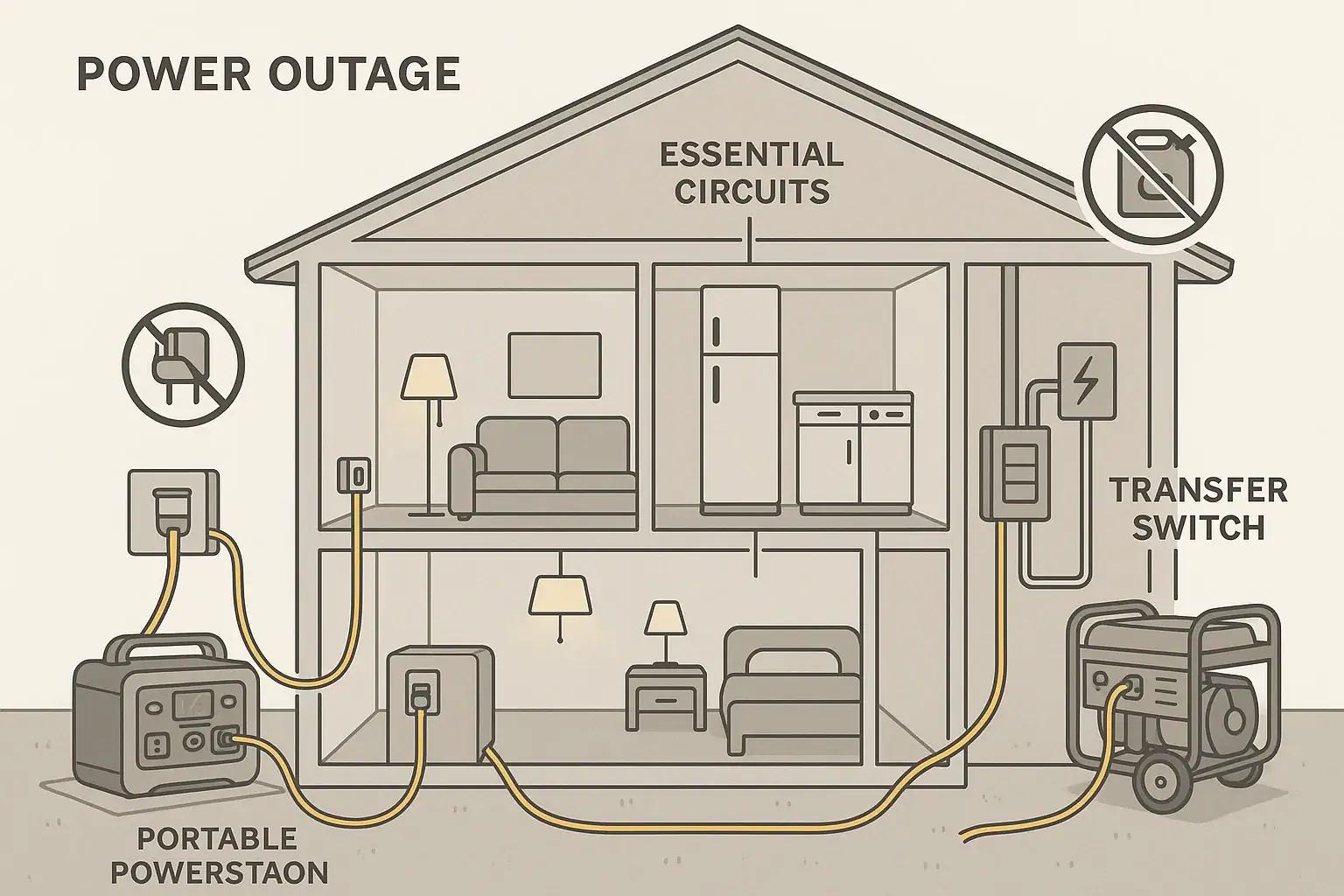
Do not backfeed a home circuit by plugging a power station into a wall outlet or by making improvised cords. Connecting backup power to household wiring requires proper transfer equipment and code-compliant installation. If you want the sump pump circuit connected through a permanent backup arrangement, that is a job for a licensed electrician.

Finally, consider the consequence of failure. If your basement floods quickly, a portable power station may be only one part of the plan. A dedicated battery backup pump, secondary pump, water alarm, or generator strategy may be appropriate depending on the property and local risk.

Maintenance, storage, and long-term readiness

A power station used for sump pump backup may sit unused for months, then be expected to work during the worst weather of the year. Readiness depends on routine checks. Keep the battery within the storage range recommended by the manufacturer, and check state of charge every few months. Do not assume it is still full because it was charged last season.

Store the unit in a moderate, dry indoor location. Heat can accelerate battery aging, while very cold conditions can reduce available output and affect charging behavior. Damp basements can also encourage corrosion on outlets, plugs, and contacts. If the basement is humid, keep the unit off the floor and inspect it more often.

Test the actual pump with the actual power station under controlled conditions. A useful test is not just turning on the display. Run the pump long enough to confirm that it starts cleanly, moves water, and does not cause overload warnings. Also test with the extension cord you plan to use during an outage, because cord length and gauge can affect startup performance.

Keep a small readiness routine: charge check, cord inspection, vent cleaning, and a pump start test. Listen for changes. A pump that starts louder than usual, vibrates, or runs longer than normal may have a mechanical issue that increases electrical demand. A partially clogged pump, stuck check valve, or restricted discharge line can make startup harder and reduce backup runtime.

If the power station supports pass-through operation, understand its limits before relying on it. Some units can power loads while charging, but may reduce charge speed, limit output, or generate more heat under combined charging and discharge. For a critical pump, test the intended operating mode before a storm.

Practical takeaways and specs to look for

A portable power station can be a practical sump pump backup only when the inverter is sized for the pump’s startup surge and the battery is sized for realistic storm cycling. Running watts alone are not enough. The system must start the pump repeatedly, remain cool enough to operate, and provide enough usable energy for the outage window you care about.

When in doubt, use your actual pump as the reference. Nameplate numbers are helpful, but real-world conditions decide reliability. Watch how often the pump cycles during heavy rain, test startup from the power station, and avoid sharing the inverter with other high-inrush appliances unless there is plenty of margin.

Specs to look for

  • Continuous AC output: comfortably above the pump’s running watts, not just equal to them.
  • Surge or peak AC output: high enough for the pump’s estimated startup demand, with extra margin.
  • Battery capacity in watt-hours: large enough for the expected duty cycle after inverter losses.
  • Pure sine wave AC output: generally preferred for motor loads and sensitive equipment.
  • Grounded AC outlets: important for typical sump pump plugs and safe cord use.
  • Clear overload and temperature protection: helps identify when the setup is being pushed too hard.
  • Ventilation design and operating temperature range: important for repeated cycling during storms.
  • Recharge options: useful if outages last longer than one battery charge.
  • Practical weight and placement: the unit must be easy to position safely above potential water.

The most useful takeaway is simple: treat sump pumps and high inrush loads differently from electronics. First prove the inverter can start the pump. Then calculate runtime from real cycling behavior. Finally, keep the equipment dry, tested, charged, and ready before the weather turns bad.

Frequently asked questions

How do I know if my power station can start my sump pump?

Compare the pump’s startup surge, not just its running watts, to the power station’s surge or peak AC output. The continuous inverter rating should also exceed the pump’s running load with margin. If the pump has no published starting watts, a cautious estimate is often several times the running watts.

What specs matter most for sump pumps high inrush loads?

The most important specs are continuous AC output, surge or peak output, and usable battery capacity in watt-hours. For motor loads, a pure sine wave inverter and grounded outlets are also important. Ventilation and overload protection matter because repeated starts can heat the inverter and reduce reliability.

What is the most common mistake people make with sump pump backup power?

The most common mistake is sizing the setup only by running watts and ignoring startup surge. A pump may seem compatible on paper but still trip the inverter when it starts. Another frequent error is assuming a short test proves it will work during a long storm outage.

Can I run other appliances at the same time as a sump pump?

Sometimes, but it depends on the inverter’s total continuous output and surge headroom. Motor-driven appliances can create their own startup spikes, so combined loads can exceed the limit even if each device seems reasonable alone. For the most reliable backup, give the sump pump priority or keep other loads minimal.

Is it safe to use a portable power station in a wet basement?

It can be safe only if the unit stays dry, elevated, and well ventilated. Keep it away from flood-prone areas, use intact grounded cords, and avoid improvised wiring or backfeeding a home circuit. If you need a permanent connection to household wiring, use proper transfer equipment and a licensed electrician.

How much battery capacity do I need for a sump pump outage?

That depends on how often the pump actually runs during the outage. A pump that cycles briefly may need far less energy than one that runs continuously in heavy rain. Estimate runtime from the pump’s duty cycle, then add inverter losses and a reserve margin.

Running a Router and Modem During a Power Outage: Runtime Guide

Portable power station running a router and lamp during outage

Running a router and modem during a power outage usually works for many hours because most home internet equipment draws only about 10 to 30 watts combined.

In practical terms, a 300 Wh portable power station may keep a typical modem and Wi-Fi router online for roughly 8 to 13 hours, while a 600 Wh unit may support about 16 to 26 hours if you do not add heavier loads. The exact runtime depends on your equipment wattage, battery size, inverter efficiency, starting charge, and whether your internet provider’s local network equipment still has power.

This guide explains how backup power for home internet works, how to estimate runtime, what can go wrong, and what specs to check before relying on a portable power station for Wi-Fi during storms, utility outages, or short emergency shutdowns.

What running a router and modem during a power outage means

Running your router and modem during a power outage means using stored battery energy, usually from a portable power station or uninterruptible power supply, to keep your home networking equipment powered when wall outlets stop working. The goal is simple: maintain Wi-Fi and wired internet access for phones, laptops, tablets, security hubs, or basic communication devices.

The modem is the device that connects your home to the internet service coming from cable, fiber, fixed wireless, or another provider. The router distributes that connection through Wi-Fi or Ethernet. Some homes use two separate boxes, while others use a single gateway that combines both functions. Either setup can often be backed up because the power demand is usually small compared with appliances such as refrigerators, microwaves, heaters, or air conditioners.

Keeping home internet online can be more useful than it first appears. During an outage, cellular networks may become crowded, indoor signal may be weak, and phone batteries may need to be conserved. If your internet provider’s upstream equipment remains active, backup power for your modem and router can support Wi-Fi calling, work messages, outage maps, weather alerts, and short remote-work tasks.

There is one important limitation: powering your own router and modem does not guarantee internet service. If the provider’s local cabinet, node, fiber equipment, or neighborhood infrastructure loses power and has no backup, your home Wi-Fi may stay on but the internet connection may still drop. A test during a real or simulated outage is the best way to understand what happens in your area.

Key concepts and how router backup power works

The runtime calculation is based on two values: watts and watt-hours. Watts measure how quickly your equipment uses energy. Watt-hours measure how much energy the battery can store. A router and modem that draw 20 watts use about 20 watt-hours every hour before conversion losses are considered.

The basic estimate is: usable battery watt-hours divided by device watts equals runtime in hours. Because a power station must convert battery energy into AC outlet power, you should not assume the full rated capacity is available. A conservative estimate often uses 80% to 90% usable energy when powering AC adapters from the power station’s outlets.

For example, a 300 Wh unit at 85% usable energy provides about 255 Wh for your equipment. If your modem and router draw 20 watts combined, 255 divided by 20 equals 12.75 hours. Real-world runtime may be lower if the battery is cold, old, partially charged, or powering other devices at the same time.

Surge power is usually not a major issue with networking gear. Unlike refrigerators or pumps, routers and modems do not have large motors that demand a high startup wattage. The more important spec is continuous output, and nearly any properly functioning power station with AC outlets can handle a 10 to 30 watt network load. The main sizing question is battery capacity, not peak watt rating.

If your power station has compatible DC outputs, powering networking gear directly from DC can sometimes reduce conversion losses. However, voltage, connector size, polarity, and current rating must match the equipment requirements. Using the wrong DC cable can damage a router or modem, so AC adapters are often the safer default unless you are certain the DC setup is correct.

Runtime estimate table for router and modem backup power.
Example values for illustration.
Battery capacity Estimated usable energy at 85% 15 W network load 20 W network load 30 W network load
200 Wh 170 Wh About 11 hours About 8.5 hours About 5.5 hours
300 Wh 255 Wh About 17 hours About 12.5 hours About 8.5 hours
500 Wh 425 Wh About 28 hours About 21 hours About 14 hours
600 Wh 510 Wh About 34 hours About 25.5 hours About 17 hours
1000 Wh 850 Wh About 56 hours About 42.5 hours About 28 hours

Real-world examples of router and modem runtime

A small apartment setup might use a combined modem-router gateway that draws about 12 to 18 watts. With a 300 Wh power station and an 85% efficiency estimate, that setup may run for roughly 14 to 21 hours if the battery starts full and no other devices are plugged in. For many short outages, that is more than enough to keep phones connected through Wi-Fi.

A typical home with a separate cable modem and Wi-Fi router may draw about 18 to 25 watts combined. On a 300 Wh unit, a fair expectation is around 10 to 13 hours. On a 600 Wh unit, that same load may run for about 20 to 28 hours. If the router has multiple Wi-Fi bands, mesh features, or powered USB accessories, the draw may land toward the high end of that range.

A larger home network may include a modem, router, mesh node, and small Ethernet switch. If the total load is around 35 watts, a 500 Wh power station at 85% usable energy may provide about 12 hours. A 1000 Wh unit may provide roughly 24 hours. In this setup, deciding which devices are essential matters. You may be able to power only the main router and modem instead of every mesh node to stretch runtime.

Adding a laptop changes the math quickly. If your router and modem draw 20 watts and your laptop averages 40 watts while charging or working, the total becomes 60 watts. A 300 Wh power station with 255 Wh usable energy would drop from about 12.5 hours for internet equipment alone to about 4 hours with the laptop included. Charging a phone for a short period is usually minor, but leaving multiple devices connected all day can noticeably reduce runtime.

The most reliable way to size your setup is to measure it. Many power stations show real-time output wattage on the display. Plug in only the modem and router, wait a few minutes after startup, and note the steady running watts. If the display fluctuates between 17 and 23 watts, use the higher number when planning. A plug-in power meter can also measure AC loads if your power station does not show output.

Common mistakes and troubleshooting cues

One common mistake is assuming Wi-Fi equals internet. Your wireless network can remain visible even if the service connection is down. If devices connect to Wi-Fi but pages do not load, check the modem status lights. A powered router with a disconnected modem will often show Wi-Fi bars but no internet access.

Another mistake is sizing the backup battery from the power station’s inverter rating instead of its watt-hour capacity. A unit that can output hundreds of watts may still have a small battery. For routers and modems, output wattage is rarely the limiting factor; runtime is controlled by stored energy.

Auto-shutoff is another frequent issue with light loads. Some portable power stations turn off AC outlets when the load is below a minimum threshold. A modem and router together may be enough to keep the output awake, but a single low-power device may not. If the station shuts off unexpectedly, look for an eco mode, AC timeout setting, or minimum-load note in the manual. Using a compatible DC output may help if the unit’s AC inverter is the part that sleeps.

Startup order can also matter. After power is restored from the battery, a modem may need several minutes to reconnect before the router receives an internet connection. If everything is powered but the internet still fails, restart the modem first, wait for its connection lights to stabilize, then restart the router. For a combined gateway, unplug it for about a minute, reconnect it to backup power, and allow it to fully boot.

Do not overlook hidden loads. A power strip may also feed a voice adapter, smart speaker, external drive, home automation hub, or mesh satellite. Each extra device may draw only a few watts, but together they can cut hours from runtime. During an outage, unplug nonessential accessories and keep the battery dedicated to communication.

Common router backup problems and what to check first.
Example values for illustration.
Symptom Likely cause Practical check
Wi-Fi name appears but internet does not work Provider connection or modem link is down Check modem lights and restart modem before router
Power station turns off after a few minutes Low-load auto sleep or eco mode Review settings, disable timeout if available, or use compatible DC output
Runtime is much shorter than expected Extra devices, lower efficiency, partial charge, or battery aging Measure actual watts with only network gear connected
Battery percentage does not rise while recharging Input power is close to output load Reduce loads or use a stronger approved charging source
Router reboots repeatedly Loose adapter, bad cable, wrong DC voltage, or unstable output Use the original AC adapter and inspect connectors
Connection works near the router but not far away Mesh nodes or extenders are unpowered Power the most important node or move closer to the main router

Safety basics for powering networking gear

Portable power stations are generally well suited to low-power electronics, but they still require normal electrical care. Place the unit on a stable, dry, ventilated surface. Do not cover vents, seal it in a cabinet, or place it next to heaters, direct sun, wet floors, or dripping pipes.

Use the original router and modem AC adapters when possible. They are designed to provide the correct voltage and current to the equipment. If you use a power strip, keep it simple and avoid daisy-chaining multiple strips or extension cords. The load is small, but messy wiring increases the chance of loose plugs, tripping hazards, or accidental disconnection during an emergency.

Keep the power station away from standing water, especially in basements, garages, and storm-prone areas. If the outage is related to flooding or leaks, elevate the unit and networking gear on a dry surface. Do not handle plugs with wet hands, and do not continue using any adapter that smells hot, buzzes, sparks, or shows melted plastic.

Never backfeed a wall outlet or connect a portable power station directly into household wiring unless the system is specifically designed and installed for that purpose. For this use case, the cleanest approach is simple: plug the modem and router directly into the battery unit or into a single appropriate power strip connected to the unit.

Also consider information security. During an outage, you may rely heavily on Wi-Fi calling, banking apps, or work systems. Keep your router password protected and avoid resetting network equipment to default settings unless necessary. A working but unsecured network is not a good emergency solution.

Maintenance, storage, and long-term readiness

A backup internet plan only works if the battery is charged when the outage starts. Store the power station where it is easy to reach, not buried behind seasonal items. For long-term storage, many lithium-based units are commonly kept at a partial state of charge rather than completely full or empty. Follow the instructions for your specific device, especially for storage temperature and recharge interval.

Check the charge level every few months. Batteries slowly self-discharge, and a unit that was ready in spring may be much lower by storm season. If outages are likely in your area, consider a more frequent check during high-risk months. A quick habit, such as checking the battery when you test smoke alarms or replace emergency supplies, can prevent surprises.

Run a short functional test with your actual modem and router. Plug them into the power station, confirm the internet reconnects, and note the wattage shown on the display. Let the setup run long enough to confirm it remains stable. This test can reveal auto-shutoff behavior, loose adapters, weak cables, or a battery that no longer performs as expected.

Label the right cords. In a dark room during an outage, it is easy to unplug the wrong adapter or forget which cable powers the modem. A small label on each plug can save time and avoid powering only the router while the modem remains off. If your networking equipment is in a cramped area, arrange cables so the backup power connection is easy to access.

If your power station supports pass-through operation, understand its limits before relying on it like a permanent UPS. Some units can charge while powering devices, but switching behavior, heat, fan noise, and battery wear vary. For critical work-from-home needs, test whether the modem and router stay online during the moment grid power drops and the battery takes over.

Practical takeaways and specs to look for

The simplest way to plan for running a router and modem during a power outage is to measure or estimate the combined wattage, choose a realistic efficiency factor, and divide usable watt-hours by watts. If your network load is 20 watts, every 100 usable watt-hours gives about five hours of runtime. That rule of thumb makes it easy to compare battery sizes without overcomplicating the decision.

For short outages, a small power station may be enough. For overnight internet access, remote work, or storm-prone areas, a larger watt-hour capacity gives more margin. Keep in mind that phones, laptops, mesh nodes, and security hubs all share the same energy supply. The more you plug in, the fewer hours remain for your core internet connection.

Specs to look for checklist

  • Battery capacity in watt-hours: This is the main runtime spec. Higher Wh means longer router and modem operation.
  • Low idle consumption: A power station that wastes less energy while its AC inverter is on can extend runtime for small electronics.
  • AC outlet support: Standard outlets let you use the original modem and router adapters with fewer compatibility concerns.
  • Useful DC outputs: DC can improve efficiency if voltage, polarity, connector size, and current rating match your devices.
  • Configurable auto-sleep settings: The ability to disable or adjust eco mode helps prevent shutdowns under light network loads.
  • Clear wattage display: Real-time output readings make it easier to measure your actual router and modem draw.
  • Safe indoor operation: Look for stable construction, ventilation, overload protection, and clear operating temperature guidance.
  • Recharge options: Wall charging is most important, but approved car or solar charging may help during extended outages.
  • Practical size and noise level: A compact, quiet unit is easier to keep near networking equipment.

Before the next outage, do one full practice run. Charge the power station, plug in only the modem and router, confirm the internet works, and record the wattage. Then decide which extra devices, if any, are worth powering. That small test turns a vague backup plan into a realistic runtime estimate you can trust.

Frequently asked questions

How long can a portable power station keep a router and modem running?

It depends mainly on the battery’s watt-hour capacity and the combined wattage of the modem and router. Many home setups draw about 10 to 30 watts total, so a mid-size power station can often keep them running for several hours to more than a day. Actual runtime is usually lower than the label suggests because of inverter losses and battery conditions.

What size power station do I need for running a router and modem during a power outage?

For short outages, a smaller unit may be enough if your network gear uses little power. For overnight coverage or longer outages, look for higher watt-hour capacity rather than just a high watt output rating. The best choice is the smallest unit that still gives you the number of hours you want with some margin.

What specs or features matter most for backup internet power?

The most important spec is battery capacity in watt-hours, since that determines runtime. Helpful features include low idle consumption, a clear wattage display, configurable auto-sleep settings, and AC outlets that work with your original adapters. If you plan to use DC output, make sure the voltage, connector, and polarity match exactly.

What is a common mistake people make when backing up a router and modem?

A common mistake is assuming that a visible Wi-Fi signal means the internet is working. The router can stay on even when the modem or provider connection is down. Another frequent error is buying a power station based on its watt output instead of its battery capacity, which leads to shorter runtime than expected.

Is it safe to power networking equipment from a portable power station during an outage?

Yes, it is generally safe when you use the correct adapters and keep the equipment dry, ventilated, and stable. Avoid backfeeding household wiring, do not overload the unit, and keep it away from water or heat sources. If any cable, adapter, or outlet looks damaged or overheats, stop using it.

Why does my router stay on but the internet still stops working?

That usually means the local internet infrastructure outside your home has lost power or connectivity. Your modem and router can still run from backup power, but they cannot restore service if the provider’s upstream equipment is offline. In that case, your home network is powered, but the internet path is not available.

Powering an Aquarium During an Outage: Pumps, Heaters, and Runtime Tips

portable power station running an aquarium filter and lamp

Powering an aquarium during an outage means using backup power first for water movement and oxygen, then for heat when temperature risk requires it. In most tanks, pumps, filters, and air pumps are the priority because stagnant water can lose oxygen faster than it loses heat.

A portable power station can keep essential aquarium life-support equipment running through a short blackout, overnight outage, or storm-related interruption. The key is not simply buying the largest battery. It is knowing which devices matter most, how many watts they use, and how heater cycling changes real runtime.

This guide explains how to estimate aquarium backup power needs, what to run first, when to conserve battery, and how to avoid common mistakes around heaters, cords, and wet locations.

What Powering an Aquarium During an Outage Really Means

An aquarium is a small controlled ecosystem. When household power stops, the tank immediately loses active filtration, circulation, aeration, heating, and lighting unless you have backup power. Some of those losses matter much more than others.

For most freshwater and saltwater aquariums, the first concern is oxygen exchange. Fish, invertebrates, beneficial bacteria, and other organisms consume oxygen. Surface agitation from a filter return, air stone, powerhead, or return pump helps oxygen enter the water and carbon dioxide leave it. When water sits still, oxygen can decline, especially in warm, heavily stocked, or densely planted tanks at night.

The second concern is temperature. A tropical community tank may tolerate a slow temperature drop for several hours if the room is mild, while a sensitive reef tank, breeding setup, or warm-water species tank may need closer temperature control. Cold-water tanks may face the opposite issue during a summer outage if the room becomes hot.

Lights are usually not essential during an outage. In fact, leaving aquarium lights off often helps conserve battery and may reduce heat buildup. Protein skimmers, UV sterilizers, automatic feeders, dosing equipment, and decorative devices may be important in normal operation, but they are usually secondary to circulation, oxygen, and safe temperature.

How to Size Backup Power for Pumps, Filters, and Heaters

Portable power sizing starts with two numbers: watts and watt-hours. Watts show how much power equipment uses while running. Watt-hours show how much stored energy a battery can deliver over time. A 10-watt air pump running for 10 hours uses about 100 watt-hours before conversion losses.

The basic formula is simple: battery capacity in watt-hours divided by total running watts equals theoretical runtime. Real runtime is lower because an inverter uses some energy converting battery power to AC power. A practical estimate is to subtract about 10 to 25 percent, depending on load size, inverter efficiency, and whether the power station is running AC or DC outputs.

Heaters need special attention. A heater rated at 150 watts does not usually draw 150 watts all the time. It cycles on and off based on tank temperature, room temperature, setpoint, water volume, lid coverage, and airflow. If that 150-watt heater runs half the time, its average draw is roughly 75 watts. If the room gets cold and it runs almost continuously, it can drain a battery very quickly.

Use a plug-in watt meter before an emergency if possible. Label each device with its measured running watts, then write down two outage plans: one for life support only and one for life support plus controlled heater use.

Aquarium backup power sizing priorities. Example values for illustration.
Device or decision Typical power range Outage priority Runtime impact
Air pump with air stone 2 to 8 watts Very high Excellent oxygen support for low energy use
Hang-on-back or internal filter 5 to 25 watts High Useful for circulation and biological filtration
Powerhead or circulation pump 5 to 40 watts High Important for reef tanks and high-flow systems
Return pump 20 to 100 watts or more High, depending on system Can be essential but may use more energy than an air pump
Aquarium heater 50 to 300 watts Conditional Often the largest battery drain when active
Aquarium light 10 to 150 watts or more Low Usually kept off to conserve backup power
Optional accessories Varies widely Low Disconnect unless needed for animal health

Real-World Aquarium Runtime Examples

Runtime examples are only planning estimates, but they show why load selection matters. The same power station may run a small air pump for days, a filter for much of a day, or a heater for only a few hours if the heater runs often.

For a small freshwater tank, imagine a 10-watt filter and a 50-watt heater. If you run only the filter from a 300 watt-hour power station, the simple estimate is 30 hours. After losses, a more realistic expectation may be about 22 to 27 hours. If the heater averages 25 watts because it cycles about half the time, the combined average load becomes 35 watts and practical runtime may fall to roughly 6 to 8 hours.

For a medium community tank, a 20-watt canister filter plus a 5-watt air pump gives a 25-watt life-support load. On a 500 watt-hour station, practical runtime may land around 15 to 18 hours. Add a 150-watt heater that averages 75 watts overnight, and the total average load becomes about 100 watts. Runtime may fall to about 4 to 5 hours.

For a reef or sump-based system, the return pump and circulation pumps may be more important than the display lights. If the full system normally uses 250 watts, moving only the most important flow devices to backup power may cut the emergency load to 40 to 90 watts. That difference can turn a short backup window into an overnight plan.

Example aquarium outage runtime scenarios. Example values for illustration.
Scenario Essential load used for estimate Battery capacity Practical runtime expectation
Small tank, oxygen only 5-watt air pump 300 Wh About 45 to 50 hours
Small tank, filter only 10-watt filter 300 Wh About 22 to 27 hours
Small tank, filter plus cycling heater 35-watt average load 300 Wh About 6 to 8 hours
Medium tank, filter plus air 25-watt load 500 Wh About 15 to 18 hours
Medium tank, filter, air, and cycling heater 100-watt average load 500 Wh About 4 to 5 hours
Reef tank, reduced flow plan 60-watt circulation load 1000 Wh About 12 to 15 hours

Common Mistakes and Troubleshooting Cues

The most common mistake is treating the heater rating like a minor detail. A pump that uses 10 watts is a small load. A heater that pulls 200 watts while on is not. If your power station drains much faster than expected, check whether the heater is running continuously because the room is cold, the tank is uncovered, or the setpoint is too aggressive for backup operation.

Another mistake is trying to power the aquarium exactly as if utility power were still available. During an outage, lights, decorative features, extra pumps, UV sterilizers, and noncritical electronics may shorten runtime without improving immediate survival. Build an emergency power strip with only the devices you intend to run, and avoid plugging in unrelated household loads.

Overload shutdowns are another clue that the inverter limit is being exceeded. If the power station clicks off, flashes an overload warning, or refuses to start when several devices are connected, unplug everything and restart with the smallest essential load first. Add equipment one device at a time. Pumps can have startup surges, and multiple devices starting together may briefly exceed the unit’s rating.

If a filter does not restart after power is restored, check for lost siphon, trapped air, clogged intake, or an impeller that needs cleaning. Some filters are easier to restart if they are filled with water before the pump is powered. During a long outage, confirm that water is actually moving rather than assuming a plugged-in filter is functioning.

Watch the animals and the water surface. Fish gasping near the top, reduced surface movement, unusual coral behavior, or a strong stagnant smell are warning signs that oxygen and circulation need attention. In many cases, adding a low-watt air pump provides more emergency value than running a high-watt device that drains the battery quickly.

Safety Basics for Backup Power Around Aquariums

Water and electricity require conservative habits. Keep the power station on a dry, stable surface away from splashes, water changes, sump overflow risk, salt spray, and wet floors. Do not place it under a tank stand where a leak or siphon accident could drip directly onto the unit.

Use drip loops on every cord leaving the aquarium. A drip loop lets water run down the cord and fall off before it reaches a plug, outlet, or power station socket. Keep plug connections elevated when possible, and avoid loose adapters that can be bumped or pulled by pets, children, or maintenance activity.

Use cords and power strips rated for the total load. Short, appropriately rated cords are safer than long, thin extension cords. If a cord, plug, or power strip feels warm under load, disconnect it and reduce the load or replace the component. Warmth can indicate resistance, poor contact, or undersized wiring.

Ventilation matters. Portable power stations generate heat when discharging, especially through AC outlets. Do not cover the unit with blankets, towels, foam, or tank insulation. Do not operate it in standing water, outdoors in rain, or in a closed cabinet with poor airflow.

Ground-fault protection is commonly used around aquariums because wet environments increase shock risk. If your normal aquarium setup uses a ground-fault protected power strip, you may be able to keep that layer of protection by plugging the strip into the power station, provided the equipment operates correctly. Do not modify wiring or defeat safety devices to make a backup setup work.

Maintenance, Storage, and Long-Term Readiness

A backup power plan only helps if it is ready before the outage. Store the power station indoors in a cool, dry location, away from direct sun, freezing temperatures, and high heat. Extreme storage conditions can reduce battery life and may limit available capacity when you need it.

Follow the manufacturer’s storage guidance for state of charge. Many lithium-based units are commonly stored partially charged for long periods and topped up before expected storms or planned utility work. If severe weather is forecast, fully charge the unit early rather than waiting until lights flicker.

Test the setup periodically with the actual aquarium equipment you plan to run. A 15-minute test can reveal noisy pumps, overloaded outputs, bad cords, or a heater strategy that drains too quickly. If you change filters, add a sump, upgrade lights, or increase heater size, update your written load list.

Keep emergency items together. A labeled bag or small bin near the tank can hold the air pump, airline tubing, air stone, extension cord, spare check valve, and your written runtime estimates. In a nighttime outage, having everything in one place is more useful than a perfect plan stored only in your memory.

Also think beyond electricity. A fitted lid, reduced room drafts, and temporary insulation around the sides of the aquarium can slow heat loss without consuming battery power. Leave vents and electrical devices uncovered, and never wrap a running power station or power strip for warmth.

Practical Takeaways and Specs to Look For

The best outage plan is simple: keep oxygen and circulation going, control temperature only as much as needed, and avoid wasting battery on nonessential equipment. A small, efficient air pump can be one of the most valuable emergency tools because it provides surface agitation with very low power draw.

For short outages, running a filter, air pump, or circulation pump may be enough. For longer outages, decide when to cycle the heater instead of leaving it on continuously. Monitor tank temperature with a separate thermometer, and let temperature change slowly rather than chasing a perfect number with limited battery capacity.

Specs to Look For

  • Watt-hour capacity: Choose enough usable capacity for your target outage length after allowing for 10 to 25 percent losses.
  • Continuous AC output: Make sure the power station can handle the combined running watts of pumps, filters, and any heater use.
  • Surge output: Leave margin for pumps starting up, especially if several devices may restart at the same time.
  • Pure sine wave AC output: This is generally preferred for aquarium pumps and other motor-driven equipment.
  • Clear display: A useful screen should show remaining charge, input, output, and overload warnings.
  • Quiet cooling and ventilation: Fan noise is less important than safe airflow, but the unit should have unobstructed vents.
  • Recharge options: Consider how you will recharge after a long outage, including wall charging before storms and compatible off-grid charging if relevant.
  • Port layout: Confirm there are enough AC outlets for your emergency setup without stacking multiple adapters.

Write your plan in plain numbers: essential watts, heater strategy, estimated runtime, and which plugs go into backup power. Review it annually and after every equipment change. With that preparation, powering an aquarium during an outage becomes a controlled process instead of a rushed guess when livestock are already under stress.

Frequently asked questions

How long can a power station run an aquarium during an outage?

It depends on the battery capacity, the equipment you run, and whether a heater cycles on. A small air pump may run for many hours or even days, while a heater can cut runtime sharply. The most accurate estimate comes from your measured watt load and the power station’s usable watt-hours.

What should I power first in an aquarium blackout?

Start with water movement and oxygenation, such as an air pump, filter, or circulation pump. These devices help maintain gas exchange and keep water from becoming stagnant. Add heat only if the tank temperature is dropping enough to threaten the livestock.

What specs matter most when choosing backup power for an aquarium?

Focus on usable watt-hour capacity, continuous output, surge capacity, and a pure sine wave AC output if you are powering motor-driven equipment. A clear display and enough outlets also help you manage the setup during an emergency. The best unit is the one that can safely handle your essential load for your target outage length.

What is the most common mistake people make with aquarium backup power?

The biggest mistake is underestimating the heater. A heater may not draw full power all the time, but when it does, it can drain a battery much faster than pumps or air stones. Another common error is running nonessential equipment that shortens runtime without improving survival.

Is it safe to run aquarium equipment from a portable power station?

Yes, if the equipment, cords, and power station are set up correctly and kept dry. Use drip loops, keep the unit away from splashes, and avoid overloading the inverter. Never place backup power where a leak or spill could reach it.

Should I leave the aquarium light on during an outage?

Usually no. Lights are typically low priority compared with circulation and oxygen, and turning them off helps conserve battery. In some tanks, leaving the light off can also reduce heat and stress during the outage.

Powering a Coffee Maker, Kettle, or Induction Cooktop With a Portable Power Station

Portable power station running a coffee maker and kettle

Yes, a portable power station can run a coffee maker, electric kettle, or induction cooktop if its AC inverter can supply the appliance’s wattage and the battery has enough usable watt-hours for the job.

The catch is that these are heating appliances, not light-duty electronics. A phone charger may use 10 to 30 watts, while a kettle or induction burner can demand 1,200 to 1,800 watts in seconds. That difference is why a station with a large battery can still shut down if the inverter is too small.

For practical off-grid cooking, camping, van travel, or outage backup, the goal is to match three things: the appliance’s running watts, the station’s continuous AC output, and the energy needed for each brew, boil, or meal.

What powering these heating appliances really means

Powering a coffee maker, kettle, or induction cooktop from a battery means converting stored DC battery energy into household-style AC power. The appliance does not care whether the power comes from a wall outlet or a portable power station, but it does require enough voltage, current, and stability to operate normally.

These appliances matter because they are some of the highest-demand items people try to use during outages and travel. Coffee and hot water are short-duration needs, so they can be realistic with a mid-size power station. Induction cooking is more demanding because it can run at high wattage for longer periods, especially when boiling, searing, or cooking for more than one person.

The most important distinction is between stored energy and output power. Battery capacity tells you how much energy is available over time. Inverter output tells you how much power can be delivered right now. A station can have enough energy to make coffee in theory but still fail if the coffee maker’s heating element exceeds the inverter’s continuous rating.

This is also why the same power station may run one appliance well and struggle with another. A compact 700-watt drip coffee maker may be easy. A 1,500-watt kettle may push the station to its limit. A single-burner induction cooktop may work on medium but trip protection on high.

Key concepts: watts, watt-hours, inverter limits, and losses

Start with watts. Watts measure how much power the appliance draws at a given moment. A label that says 1,200 W means the appliance can draw about 1,200 watts when heating. For a portable power station, the AC inverter’s continuous watt rating should be higher than that number, preferably with a margin of 15 to 25 percent for real-world variation.

Next, look at watt-hours. Watt-hours describe stored energy. A 1,000 Wh unit does not necessarily deliver a full 1,000 Wh to an AC appliance because the inverter and battery management system use some energy along the way. A reasonable planning estimate is that 80 to 90 percent of rated capacity may be usable for AC loads, depending on the unit, load size, temperature, and age of the battery.

Surge rating is less important for heating elements than it is for compressors or pumps, but it still matters. Coffee makers with pumps, electronic controls, or thermostats may momentarily draw above their average rating. Induction cooktops can also pulse power as they regulate temperature. If a power station shuts off immediately at startup, the surge or continuous limit may have been exceeded.

Use this simple planning formula: appliance watts multiplied by hours of use equals watt-hours consumed before losses. Then add about 10 to 20 percent for inverter and system losses. For example, a 1,200-watt kettle running for 5 minutes uses 1,200 × 0.083, or about 100 Wh before losses. In practice, plan for roughly 110 to 125 Wh from the battery.

Portable power station sizing guide for coffee makers, kettles, and induction cooktops. Example values for illustration.
Appliance or use case Typical running draw Minimum AC inverter to consider Practical battery range What to expect
Small drip coffee maker 600 to 900 W 1,000 W 500 to 1,000 Wh Good fit for occasional brewing if no other large loads are running.
Large drip or single-serve brewer 900 to 1,400 W 1,500 W 800 to 1,500 Wh Works best with inverter headroom because pumps and heaters may cycle.
Compact electric kettle 800 to 1,200 W 1,500 W 800 to 1,500 Wh Short, heavy draw; usually practical for hot water on a mid-size station.
Full-size electric kettle 1,200 to 1,500 W 1,800 W 1,000 to 2,000 Wh Often near the limit of smaller power stations.
Induction cooktop on low or medium 500 to 1,000 W 1,500 W 1,000 to 2,000 Wh Useful for simmering, reheating, oatmeal, rice, and simple meals.
Induction cooktop on high 1,200 to 1,800 W 2,000 W or higher 1,500 to 3,000 Wh Best for larger systems; high heat drains a battery quickly.

Real-world examples: coffee, hot water, and induction cooking

A simple drip coffee maker is often the easiest of the three. If it draws 800 watts while heating and the brew cycle lasts 10 minutes, the raw energy use is about 133 Wh. After losses, plan on about 150 Wh. A 1,000 Wh station with roughly 850 Wh usable for AC loads could handle several brew cycles, though not if it is also running a refrigerator, heater, or other large appliance.

A single-serve coffee brewer may look small but can draw 1,200 to 1,400 watts while heating water. It may run for only a few minutes, so total energy use can be modest, but the inverter still needs to tolerate the peak draw. If your unit has a 1,000-watt AC output, this type of brewer may overload it even though one cup would not use much battery.

An electric kettle is efficient for hot water because it heats only what you pour in. A 1,200-watt kettle boiling one liter for about 5 minutes uses around 100 Wh before losses. If you only need enough water for instant coffee, tea, or oatmeal, boiling half a liter may take less time and use much less energy. Filling the kettle to the maximum every time is one of the fastest ways to waste battery capacity.

Induction cooking is practical when you manage heat settings. Boiling a full pot of water on high may demand 1,500 watts or more and run long enough to use several hundred watt-hours. However, simmering soup, reheating food, or cooking eggs at 600 to 900 watts can be reasonable. A 20-minute session at 900 watts uses about 300 Wh before losses, so it can consume a large share of a mid-size station.

If you want a realistic meal plan, think in tasks. One morning routine might include one coffee brew at 150 Wh, one kettle boil at 120 Wh, and 15 minutes of induction cooking at a moderate 800 watts, or about 230 Wh after losses. Together that could approach 500 Wh. On a 1,000 Wh station, that is not a small load; it is roughly half a useful charge in one breakfast period.

Common mistakes and troubleshooting cues

The most common mistake is buying for watt-hours only. A 1,500 Wh battery sounds large, but if the AC inverter is rated for only 600 watts, it will not run most kettles or induction cooktops. Always check AC output first for high-wattage appliances, then use battery capacity to estimate how long the appliance can run.

Another mistake is running several heating appliances at the same time. A coffee maker and kettle running together may exceed 2,000 watts. Add an induction cooktop and the load can climb far beyond what many portable power stations can deliver. Even if the station does not shut down immediately, high combined loads create more heat, more fan noise, more voltage stress, and faster battery drain.

Confusing display readings can also lead to wrong assumptions. A station may show plenty of battery remaining but still beep and shut down because the inverter is overloaded. Conversely, when charging and discharging at the same time, the battery percentage may barely move because incoming power is being consumed by the appliance as fast as it arrives.

Use the symptoms below to narrow down likely causes before assuming the power station or appliance is defective.

Troubleshooting high-wattage appliance problems on a portable power station. Example values for illustration.
Symptom Likely cause What to try first
Station shuts off as soon as appliance starts Inverter overload or startup spike Use a lower-watt appliance or a station with higher continuous output.
Cooktop works on low but not high High setting exceeds inverter rating Cook at medium power and allow more time.
Battery drains much faster than expected Wattage, runtime, or losses were underestimated Track watt-hours used per task and reduce water volume or cook time.
Fans run loudly and output stops after several minutes Thermal protection from sustained heavy load Improve ventilation, reduce load, and let the unit cool.
Charging seems slow during cooking Appliance is consuming incoming power Pause cooking while charging or expect slower net battery gain.

Safety basics for high-heat appliances

High-heat appliances should be treated as serious loads. Place the power station on a stable, dry, level surface with open space around its vents. Do not put it behind a kettle, beside a hot pan, or under cabinets where heat and steam can collect. Batteries and inverters perform best when they can stay cool.

Keep liquids away from the power station. Coffee makers and kettles create splashes, condensation, and steam. Induction cooking can involve boiling water or hot oil. Position the appliance far enough away that a spill will not run into outlets, ports, vents, or display panels.

Cords matter. Plug high-wattage appliances directly into the station when possible. If an extension cord is necessary, use a short, heavy-duty cord rated for the current. Avoid thin household cords, damaged plugs, coiled cords under load, and daisy-chained power strips. Warm plugs, discoloration, or a burning smell are warning signs to stop immediately.

Do not cover the power station to reduce fan noise. Fan noise under a heavy kettle or induction load is normal because the inverter is shedding heat. Blocking airflow may cause shutdowns or create unsafe temperatures. Also avoid operating power equipment in standing water, heavy rain, or very damp conditions unless the full setup is specifically designed and protected for that environment.

Maintenance, storage, and long-term reliability

A portable power station that is expected to handle coffee, hot water, or cooking should be tested before an outage or trip. Run the actual coffee maker, kettle, and cooktop settings you plan to use, then record the wattage and watt-hours shown on the display if available. Real measurements are more useful than appliance labels because thermostats, water volume, and cooking settings change the load.

For storage, most lithium power stations prefer a moderate state of charge rather than sitting empty or completely full for months. A common practical range is around 40 to 60 percent for long-term storage, with a top-off before storm season, camping season, or planned travel. Follow the unit’s manual if it specifies a different range.

Temperature has a large effect on reliability. Avoid storing the unit in a hot vehicle, direct summer sun, or a freezing shed for long periods. Cold batteries may deliver less power and may charge slowly or not at all until warmed. If you plan to use induction cooking in cold weather, keep the unit indoors or insulated until it is needed, then give it ventilation during use.

Inspect the station and cords periodically. Look for cracked insulation, loose receptacles, bent prongs, melted plastic, or debris in vents. Clean the exterior with a dry or slightly damp cloth while the unit is off and unplugged. Do not open the case or attempt internal repairs, because battery packs and inverter components can remain hazardous even when the unit appears off.

Practical takeaways and specs to look for

Related sizing, appliance, and backup-power guides can be added here when planning a complete setup.

The practical answer is simple: coffee makers and kettles are usually realistic on a properly sized portable power station, while induction cooktops require more output and more careful energy planning. If the appliance draws more watts than the inverter can supply, it will not work reliably. If the appliance runs too long, it will drain the battery quickly even when the inverter is large enough.

For small daily comfort needs, choose efficient routines. Brew one pot instead of keeping a warming plate on for an hour. Boil only the water you need. Use induction at medium power and lid-covered cookware when possible. These habits reduce watt-hours without giving up hot drinks or basic meals.

Specs to look for before buying or pairing equipment:

  • Continuous AC output: Match this to the appliance’s running watts with realistic headroom.
  • Surge rating: Helpful for brewers with pumps and for appliances that cycle abruptly.
  • Battery capacity in watt-hours: Use this to estimate how many brews, boils, or cooking sessions are possible.
  • Usable AC capacity: Plan for conversion losses instead of assuming the full rated Wh is available.
  • AC outlet rating: Confirm that the outlet itself supports the load, not just the battery pack.
  • Thermal design: Look for clear ventilation requirements and expect fans under heavy loads.
  • Pass-through behavior: If charging while cooking matters, verify whether output is limited during charging.
  • Display data: A live wattage and watt-hour display makes testing and planning much easier.
  • Extension cord compatibility: Use only cords rated for the appliance’s current draw.
  • Storage guidance: Check recommended charge range and temperature limits for long-term readiness.

Before relying on a setup, perform a full test at home. Brew coffee, boil your usual amount of water, and cook a simple meal on the exact settings you expect to use. Note whether the station stays stable, how loud the fans get, and how many watt-hours each task consumes. That test will tell you more than a label ever will.

With the right inverter size, enough usable watt-hours, safe cord practices, and realistic cooking habits, a portable power station can handle coffee, hot water, and simple induction cooking without guesswork.

Frequently asked questions

What size portable power station do I need for a coffee maker, kettle, or induction cooktop?

The right size depends on both inverter output and battery capacity. For coffee makers and kettles, the inverter should exceed the appliance’s running watts with some headroom, while induction cooktops usually need even more continuous output. Battery capacity in watt-hours determines how many brews, boils, or cooking sessions you can complete before recharging.

Can a 1,000-watt power station run a kettle or induction cooktop?

Usually not for full-size models. Many kettles and induction cooktops draw 1,200 watts or more, which can exceed a 1,000-watt inverter even if the battery is large. A smaller kettle or low-power cooking setting may work, but the appliance label and inverter rating should be checked first.

What specs matter most when powering these appliances?

The most important specs are continuous AC output, surge rating, and battery capacity in watt-hours. For heating appliances, continuous output is often the limiting factor, while watt-hours determine runtime. It also helps to check usable AC capacity, outlet rating, and whether the unit limits output during charging.

What is the most common mistake people make with high-watt appliances?

The most common mistake is focusing on battery size and ignoring inverter output. A large battery can still fail to run a kettle or cooktop if the AC inverter is too small. Another frequent issue is running multiple heating appliances at once and exceeding the station’s total output.

Is it safe to use a portable power station with a kettle or induction cooktop?

It can be safe if the station is used within its electrical limits and kept in a dry, well-ventilated area. Keep liquids away from the unit, use properly rated cords, and do not block the cooling vents. If the station or cords become hot, smell burnt, or shut down repeatedly, stop using the setup and reassess the load.

How can I make a portable power station last longer while cooking?

Use only the amount of water or heat time you need, and avoid keeping appliances on high longer than necessary. Induction cooking at medium power with a lid can reduce energy use, and boiling smaller water volumes saves a lot of watt-hours. Turning off warming plates and avoiding simultaneous high-watt loads also helps preserve battery life.

Can a Portable Power Station Run an Air Conditioner? Sizing and Runtime Guide

Portable power station running a small air conditioner and lamp

Yes, a portable power station can run an air conditioner if its inverter can handle the air conditioner’s running watts and startup surge, and if the battery has enough watt-hours for the runtime you expect.

The practical answer is more limited than the simple answer. A small efficient window AC, compact portable AC, or low-draw RV air conditioner may run from a large portable battery system for a useful period. A full-size room unit, older compressor AC, or central air system usually needs far more power than most portable power stations can provide.

Think of this as a sizing problem, not a guessing game. You need to compare watts, surge watts, battery capacity, heat load, and charging limits. A battery generator or solar generator can provide short cooling windows, but it is rarely a whole-home air conditioning replacement.

What it means and why it matters

When people ask whether a portable power station can run an air conditioner, they are really asking two separate questions. First, can the unit start the compressor without tripping an overload? Second, can it keep the air conditioner running long enough to matter?

Air conditioners are difficult loads for battery systems because they use a compressor motor. The compressor may need a brief burst of power at startup that is much higher than the power used after it is running. If the power station cannot supply that surge, the AC may click, beep, flash an error, or shut the power station down immediately.

This matters during outages, hot-weather emergencies, camping, RV use, van setups, and small-room cooling. In those situations, even one to four hours of focused cooling can be useful. It may help cool a bedroom before sleep, protect a pet in a small insulated space, or reduce heat stress during the hottest part of the day.

The key expectation is targeted cooling. A portable power station is best used with a small, efficient air conditioner in a limited area. Cooling an open floor plan, garage, large RV, sun-exposed room, or poorly insulated space will drain the battery quickly and force the compressor to run more often.

Key concepts and how the sizing works

Start with the air conditioner’s running watts. This is the power the AC uses after the compressor is operating. Some labels list watts directly. Others list amps. For a typical 120-volt appliance in the United States, estimated watts are amps multiplied by 120. For example, an AC rated at 6 amps uses roughly 720 watts while running.

Next, check startup surge. Many compressor-based air conditioners briefly draw two to five times their running power. Some newer inverter-style air conditioners ramp up more gently, while some older models surge harder. The power station’s surge rating must be higher than the AC’s startup demand, not just equal to the running watts.

Then calculate energy use. Battery capacity is measured in watt-hours. A 1,000 Wh power station does not usually deliver the full 1,000 Wh to an AC outlet because the inverter and electronics use some energy. A practical planning estimate is to use about 80 to 90 percent of the listed capacity for AC loads.

The basic runtime estimate is usable watt-hours divided by average watts. If a power station has 1,000 Wh and you assume 850 Wh usable, a 500-watt continuous load would run for about 1.7 hours. If the air conditioner cycles off half the time after the room cools down, the total clock time can be longer. If the compressor runs constantly because the room is hot, runtime will be shorter.

Portable power station sizing checks for air conditioners. Example values for illustration.
Item to check What it tells you Practical sizing cue
AC running watts Normal power draw after startup Keep it below about 70 to 80 percent of inverter continuous output when possible
AC startup surge Brief compressor starting demand Must be below the power station surge rating with some margin
Battery watt-hours Total stored energy Use 80 to 90 percent of rated Wh for rough AC-outlet runtime planning
Average AC draw Real energy use over time Lower if the compressor cycles off; higher in extreme heat
Other connected loads Total demand on the inverter Avoid running kettles, microwaves, heaters, or tools at the same time
Charging input How fast the battery can be refilled If input watts are lower than AC draw, the battery still drains while charging

Real-world examples and realistic runtime

A small 5,000 to 6,000 BTU window air conditioner might use about 400 to 600 running watts. With a 1,000 Wh power station and roughly 850 Wh usable through the inverter, continuous runtime may be around 1.4 to 2.1 hours. If the room is shaded, insulated, and already partly cooled, cycling may stretch the clock time to several hours.

A larger portable room air conditioner may use 800 to 1,200 running watts. This is a much heavier load. Even if the inverter can handle it, a 1,000 Wh class battery may provide less than an hour of compressor-heavy runtime. A larger 2,000 to 3,000 Wh unit would be more realistic, but heat load and surge still matter.

An RV rooftop air conditioner can be especially challenging. Many draw around 1,200 to 1,800 watts while running and may require a high startup surge unless equipped with a soft-start device or inverter compressor design. This kind of load usually calls for a high-output power station, a large battery reserve, and careful testing before relying on it in hot weather.

A compact AC used for spot cooling in a van, small office, or bedroom is more realistic. For example, a 500-watt average load on a 2,000 Wh power station with 1,700 usable Wh could run for about 3.4 hours of continuous draw. If the compressor averages 50 percent duty cycle after cooling the space, the total use window may be longer. If the sun is heating the space and the compressor runs constantly, use the shorter number.

Solar charging can help, but it does not erase the energy math. A panel array producing 300 watts in real conditions cannot indefinitely support a 700-watt AC load. It can slow the battery drain, extend runtime, or recharge after use. For daytime cooling, the most dependable plan is to pre-cool the space, reduce heat gain, and use solar as supplemental input rather than assuming it will fully carry the load.

Common mistakes and troubleshooting cues

The most common mistake is looking only at battery size. A large watt-hour number does not guarantee an air conditioner will start. The inverter must supply both the continuous running watts and the compressor surge. If the AC shuts off the power station the instant cooling begins, startup surge is the first thing to suspect.

Another mistake is using the air conditioner’s lowest advertised number instead of actual use. Some units list minimum, cooling mode, or seasonal efficiency information that does not match the draw you will see on a hot day. A plug-in power meter can help measure actual watts, but the power station display can also give useful clues once the AC is running.

A third mistake is assuming runtime calculations are exact. Battery displays are estimates, and air conditioners cycle differently depending on room temperature, humidity, insulation, thermostat setting, and airflow. A setup that runs three hours at night may run only one hour on a hot afternoon in direct sun.

Troubleshooting clues when an air conditioner will not run correctly. Example values for illustration.
Symptom Likely cause Practical response
Power station shuts off as compressor starts Startup surge exceeds inverter capability Try a smaller AC, use fan-only mode, or choose a system with higher surge capacity
AC runs briefly, then overloads Running watts plus other loads are too high Disconnect other devices and confirm the AC draw on the display
Battery percentage drops very quickly High continuous load or low starting charge Start from full charge and recalculate runtime from actual watts
Runtime is shorter on hot days Compressor duty cycle is higher Shade windows, close doors, pre-cool early, and raise the thermostat a few degrees
Charging while running still drains battery Input watts are below AC load Compare real input watts with output watts; do not rely on pass-through use alone
Extension cord feels warm Cord undersized, too long, or damaged Stop use and switch to a shorter, heavier-gauge cord rated for the load

Safety basics for running an AC from a power station

Place the portable power station on a dry, stable surface with open space around its vents. Air conditioners and inverters both produce heat, and blocked airflow can cause thermal shutdown or shorten equipment life. Do not cover the unit with blankets, clothing, curtains, or stored gear.

Use extension cords carefully. Air conditioners are high-draw appliances, so thin or very long cords can waste energy and overheat. Use a cord rated for the amperage and keep it uncoiled during operation so heat can dissipate. Avoid daisy-chaining power strips, adapters, and multiple cords between the station and the AC.

Keep the setup away from water. This includes rain, puddles, wet floors, dripping window units, and damp outdoor areas. If a protective outlet trips, do not keep resetting it without finding the cause. Check for moisture, damaged cords, loose plugs, or signs of overheating.

Do not backfeed a home panel, garage circuit, RV circuit, or wall outlet unless the system is specifically designed and installed for that purpose. Plugging a power station into building wiring incorrectly can create shock and fire hazards. For transfer equipment, dedicated circuits, or permanent wiring, use a qualified electrician.

Finally, respect thermal limits. High outdoor temperatures can reduce inverter performance and make battery cooling fans run harder. If the power station shows an over-temperature warning, reduce the load, improve ventilation, and allow it to cool before restarting the air conditioner.

Maintenance, storage, and long-term reliability

A power station that is expected to run an air conditioner during an outage should not sit forgotten for a year. Check the state of charge every few months, especially before storm season or summer heat waves. Batteries self-discharge slowly, and some units also consume a small amount of energy for standby electronics.

For long-term storage, many rechargeable battery systems prefer a partial charge rather than being stored completely full or completely empty. A common practical range is around 40 to 60 percent for storage, followed by charging to 100 percent before expected heavy use. Always follow the manual for the specific battery chemistry and model.

Temperature matters. Store the unit in a cool, dry location away from direct sun, hot vehicles, freezing sheds, and damp basements. Heat speeds battery aging, while cold can temporarily reduce available capacity and may limit charging. If the unit has been stored in very cold conditions, let it return to a moderate temperature before charging or applying a heavy AC load.

Inspect the system before relying on it. Look for dust-blocked vents, cracked cords, loose plugs, unusual fan noise, swollen casing, or error messages. Test the setup with the actual air conditioner before an emergency. A ten-minute test can reveal startup problems, overload warnings, and unrealistic runtime expectations before comfort or safety depends on it.

Long-term use also benefits from reducing the cooling load. Clean the air conditioner filter, seal window gaps, close blinds, use reflective shades, cool only one room, and set the thermostat a few degrees higher. These small steps can reduce compressor runtime and may add meaningful minutes or hours to a battery-powered cooling plan.

Practical takeaways and specs to look for

A portable power station can run an air conditioner when the system is sized correctly, but the best use case is short-term, focused cooling. The smaller and more efficient the AC, the easier it is to power. The larger, older, or harder-starting the compressor, the more likely you are to run into surge limits and short runtime.

For planning, treat the air conditioner as the main load. Do not assume you can also power cooking appliances, space heaters, power tools, or multiple high-draw devices at the same time. When cooling is the priority, every extra watt reduces runtime.

Specs to look for checklist

  • Continuous AC output: Choose an inverter rating comfortably above the air conditioner’s running watts.
  • Surge output: Confirm the surge rating can handle compressor startup with margin.
  • Battery capacity: Estimate usable watt-hours, then divide by expected average watts.
  • AC outlet rating: Make sure the outlet and total inverter output support the load you plan to use.
  • Charging input: Compare wall, vehicle, or solar input watts against the AC load and recharge goals.
  • Pass-through limitations: Verify whether the unit supports charging and discharging at the same time, and under what limits.
  • Operating temperature range: Check whether the power station can handle hot-weather use without derating or shutdown.
  • Display information: A clear watts-in, watts-out, and estimated-runtime display makes troubleshooting easier.
  • Weight and placement: Larger batteries are heavier, so plan where the unit will safely sit near the AC.

The practical sizing process is straightforward: measure or estimate the AC running watts, allow for startup surge, calculate runtime from usable watt-hours, and test the setup before you need it. If any one of those steps fails, choose a smaller cooling load, a larger power station, better insulation, or a different backup cooling strategy.

Frequently asked questions

How do I know if my portable power station is big enough for my air conditioner?

Check two numbers: the air conditioner’s running watts and its startup surge. The power station must support both, and the battery capacity must be large enough for the runtime you want. If the AC is a compressor-based unit, surge capacity is often the limiting factor.

What specs matter most when choosing a power station for an air conditioner?

The most important specs are continuous inverter output, surge output, and usable watt-hours. After that, look at charging input, pass-through limits, and operating temperature range. A clear display showing watts in and watts out also helps you verify real-world performance.

What is the most common mistake people make when trying to run an AC from a battery?

The most common mistake is focusing only on battery size and ignoring startup surge. A large battery still will not start an air conditioner if the inverter cannot handle the compressor’s brief power spike. Another frequent error is assuming advertised runtime will match hot-weather conditions.

Can a portable power station run an air conditioner overnight?

Usually only a very efficient small AC with a large battery system and favorable conditions. Overnight runtime depends on room insulation, outdoor temperature, thermostat setting, and how often the compressor cycles. For most setups, several hours is more realistic than a full night.

Is it safe to use an air conditioner with a portable power station indoors?

Yes, if the equipment is used according to the manufacturer’s instructions and kept dry, ventilated, and properly wired. Use a correctly rated cord, keep vents clear, and avoid overloading the inverter. Do not connect the power station to household wiring unless the system is designed for that purpose.

Will solar panels keep an air conditioner running all day?

Usually not by themselves, unless the AC load is very small and the solar array is large with strong sun. Solar can extend runtime or recharge the battery, but real-world output is often much lower than the panel’s rated maximum. For dependable cooling, treat solar as support rather than the only power source.

Can a Portable Power Station Run a Space Heater? Realistic Limits and Runtimes

Portable power station running a small space heater and lamp

Yes, a portable power station can run a space heater, but usually only on lower settings and for a short time before the battery is drained. Electric heaters are one of the most power-hungry loads you can plug into a battery power source, so realistic expectations are essential.

If you are planning backup heat for power outages, RV or van life, or cold-weather camping, it is important to know how long a battery power station can actually run a space heater. The same unit that powers lights, phones, and a small fridge all evening may only run a 1500 watt heater for well under an hour.

This guide walks through how portable power stations and space heaters interact, how to estimate runtime, and how to avoid common overload and shutdown problems. You will see concrete examples, simple rules of thumb, and a practical checklist so you can decide when electric space heating from a battery makes sense and when to focus on other ways to stay warm.

What this question really means and why it matters

When you ask whether a portable power station can run a space heater, you are really asking whether the heater’s power demand fits within the station’s inverter limits and battery capacity. Space heaters convert electrical energy directly into heat using resistance elements, which means nearly all of the power they draw is turned into heat. That also means they draw far more watts than typical electronics.

In many homes, a plug-in portable heater is rated for 750–1500 watts on 120 volts. By comparison, a laptop might use 60 watts, a phone charger 10 watts, and an efficient LED bulb 10 watts or less. A heater can easily draw 10–100 times more power than these devices, which is why it can drain a battery pack so quickly.

This matters because portable power stations are often marketed using their watt-hour capacity and maximum watt output, but those numbers can be misleading if you do not connect them to real-world loads. Someone might see a “1000 Wh” label and assume it will keep a room warm all night. In practice, that same unit might only support an hour of continuous heating on a medium setting.

Understanding the limits helps you choose a realistic strategy: perhaps using the heater briefly for spot warmth, keeping the power station for critical loads like communications and medical devices, and relying on insulation, clothing, and other non-electric heat sources for long-duration comfort.

Key power concepts and sizing logic for running a heater

To decide if your portable power station can run a specific space heater, you need three basic numbers: the heater’s watt rating, the power station’s continuous AC watt rating, and the battery’s watt-hour capacity. With those, you can quickly estimate whether the combination is safe and how long it might run.

1. Heater watts: Check the label or manual on your heater. Common settings include around 500 watts (low), 750–1000 watts (medium), and 1500 watts (high). Use the actual number printed on the device whenever possible. If it lists amperes (A) instead of watts, you can approximate watts as volts × amps (for example, 120 V × 12.5 A ≈ 1500 W).

2. Power station AC output: Look for the continuous (running) watt rating of the AC inverter. Ignore the higher surge or peak number for this purpose. The heater’s watt draw should be comfortably below the continuous rating for reliable operation. Running right at the limit often leads to nuisance shutdowns or overheating.

3. Battery capacity in watt-hours (Wh): This tells you how much total energy the battery can store. A simple theoretical runtime is:

Runtime (hours) ≈ Battery Wh ÷ Heater watts

However, this calculation assumes 100% efficiency. In reality, you lose some energy in the inverter and battery management system, especially at high loads. A common planning rule is to assume about 80–85% of the rated watt-hours are usable for a large AC load like a heater.

For a quick mental estimate, you can multiply the theoretical runtime by 0.8. For example, if the math says 2 hours, expect more like 1.5–1.7 hours of continuous operation in practice.

Heater and power station compatibility guide Example values for illustration.
Heater setting (approx.) Minimum inverter continuous rating to start Recommended inverter rating for reliability Typical outcome on a matching battery
500 W (small / eco) ≥ 500 W 600–800 W Usually starts and runs; drains a 500 Wh battery in under an hour.
750 W (low) ≥ 750 W 900–1200 W Works on many mid-size units; 1000 Wh battery lasts around 1 hour.
1000 W (medium) ≥ 1000 W 1200–1500 W High draw; 1000 Wh battery drains in well under 1.5 hours.
1500 W (high) ≥ 1500 W 1800 W or more Requires a large inverter and battery; short runtimes unless capacity is several kWh.
Any of the above Rating equal to or below heater watts Not recommended Likely overload warnings, shutdowns, or failure to start the heater.

Beyond raw numbers, consider how you will use the heater. Continuous high-power heating is much harder on both the battery and inverter than short bursts on a lower setting. Directing heat at people (for example, under a desk or near a sitting area) is usually more efficient than trying to raise the temperature of an entire room.

Real-world runtime examples for heaters on portable power

Putting the math into concrete scenarios makes it easier to set expectations. The following examples assume about 80% usable capacity for high-wattage AC loads and continuous operation without thermostat cycling.

Example 1: Small power station with a 500 W personal heater

  • Power station: 500 Wh battery, 600 W continuous inverter
  • Heater: 500 W setting
  • Theoretical runtime: 500 Wh ÷ 500 W = 1.0 hour
  • Realistic runtime (80% efficiency): 0.8 hours, or about 45–50 minutes

This setup is often adequate for short bursts of heat at a work desk or in a small tent, but it will not keep a room warm for an evening.

Example 2: Mid-size power station with a 750 W heater setting

  • Power station: 1000 Wh battery, 1200 W continuous inverter
  • Heater: 750 W setting
  • Theoretical runtime: 1000 Wh ÷ 750 W ≈ 1.33 hours
  • Realistic runtime: about 1.0–1.1 hours of continuous heating

If the heater’s thermostat cycles on and off in a well-insulated room, the total elapsed time before the battery is empty might be 2–3 hours, but the heater will not be running the whole time.

Example 3: Large heater on a high setting

  • Power station: 2000 Wh battery, 2000 W continuous inverter
  • Heater: 1500 W setting
  • Theoretical runtime: 2000 Wh ÷ 1500 W ≈ 1.33 hours
  • Realistic runtime: roughly 1.0–1.1 hours

To run the same 1500 W heater for 4 hours continuously, you would need around 6000 Wh of usable capacity. That is more than many portable units can provide and typically means a much heavier, more expensive system.

Example 4: Choosing between heat and other essentials

  • Power station: 1000 Wh battery
  • Option A: 750 W heater on low, about 1 hour of runtime
  • Option B: 10 W LED light for 8 hours, 60 W laptop for 4 hours, 10 W router for 8 hours, plus several phone charges

Both options use a similar amount of energy, but Option B keeps communications, work, and lighting running for an evening. This comparison highlights why many users treat electric heating as a short-term comfort measure rather than a primary use for a battery power station.

Illustrative heater runtime scenarios on battery power Example values for illustration.
Battery capacity Heater setting Theoretical runtime (Wh ÷ W) Realistic continuous runtime (80% of rated Wh)
500 Wh 500 W 1.0 hours 0.8 hours (about 45–50 minutes)
1000 Wh 750 W 1.33 hours ≈ 1.0–1.1 hours
1500 Wh 1000 W 1.5 hours ≈ 1.1–1.2 hours
2000 Wh 1500 W 1.33 hours ≈ 1.0–1.1 hours
3000 Wh 1500 W 2.0 hours ≈ 1.5–1.7 hours

These examples show that even relatively large-capacity power stations provide limited runtime for full-size heaters. Planning around lower heater settings, shorter usage windows, and supplemental non-electric insulation is usually more effective than trying to replicate central heating from a battery.

Common mistakes and troubleshooting cues

Many problems people encounter when trying to run a space heater from a portable power station come down to a few predictable mistakes. Recognizing them makes troubleshooting much easier.

Mistake 1: Ignoring the heater’s watt rating

Assuming that “if it plugs in, it will work” is a common error. If your heater draws 1500 watts and your power station’s inverter is rated for 1000 watts continuous, the station will likely shut down immediately, flash an overload warning, or refuse to start the heater at all.

What you might see: The heater clicks on briefly, the power station beeps, and the AC output turns off. Some units display an overload icon or error code.

Mistake 2: Overestimating runtime from watt-hours

Simply dividing watt-hours by heater watts and assuming that number is guaranteed leads to disappointment. Heavy AC loads are where inverter losses and battery protection limits are most noticeable.

What you might see: The battery percentage drops much faster than your calculation suggested, even though the heater seems to be working normally. This does not usually indicate damage; it just reflects real-world efficiency.

Mistake 3: Running the inverter at its limit continuously

Running a heater that is very close to the inverter’s maximum continuous rating stresses the electronics and generates more internal heat. Over time, this can lead to more frequent thermal shutdowns or reduced performance.

What you might see: The power station’s cooling fans run at full speed, the case feels warm, and the unit shuts down after a period of heavy use even though the battery is not empty.

Mistake 4: Placing the power station in the heater’s airflow

Positioning the heater so that hot air blows directly on the power station can quickly raise its internal temperature, triggering protective shutdowns or shortening lifespan.

What you might see: The heater stops, and the power station shows a temperature warning or refuses to turn the AC output back on until it cools down.

Mistake 5: Misunderstanding pass-through use

Some users expect that plugging the power station into a wall outlet or another charger while running a heater will keep the battery at 100%. If the heater draws more power than the charger supplies, the battery will still discharge.

What you might see: The display shows that the unit is charging, but the overall state of charge slowly decreases or barely increases while the heater is on.

Quick troubleshooting checks

  • Compare heater watts to inverter continuous watts; reduce heater setting if they are close.
  • Check for overload or temperature icons on the display if the unit shuts down.
  • Move the power station away from heat sources and improve airflow around its vents.
  • Test the AC output with a smaller load (such as a lamp) to confirm the inverter still works.
  • If problems persist even with small loads, stop using the unit and contact a professional service provider.

Safety basics when using a heater with a power station

Space heaters carry fire and burn risks regardless of how they are powered. Adding a portable power station introduces high current draw and concentrated energy storage, so safety deserves extra attention.

Placement and clearance

  • Place the heater on a stable, flat, non-flammable surface.
  • Keep clear space around the heater, especially in front of the hot air outlet.
  • Keep bedding, curtains, paper, clothing, and furniture well away from the heater.

Supervision and duration

  • Avoid running a space heater unattended or while sleeping, especially on battery power.
  • Use shorter, supervised heating sessions to warm up a space or specific area, then turn the heater off.

Power station ventilation

  • Ensure the power station has adequate airflow around its cooling vents.
  • Do not cover the unit with blankets or clothing to “keep it warm”; this can trap heat.
  • Keep the power station out of direct heater airflow and away from other heat sources.

Cords and connections

  • Plug the heater directly into the power station when possible rather than using power strips.
  • If an extension cord is necessary, use one rated for at least the heater’s wattage and intended for indoor use.
  • Inspect cords for damage, and avoid running them under rugs or through tight doorways where they can overheat or be pinched.

Environment and moisture

  • Avoid using electric space heaters powered by a portable unit in wet or very humid areas.
  • Keep both the heater and power station away from sinks, tubs, and other water sources.

Following these basics reduces the risk of fire, overheating, and electrical hazards while still allowing you to use a heater briefly when it is genuinely needed.

Maintenance and storage for reliable cold-weather use

Because heaters are often used during winter storms and cold-weather trips, the way you maintain and store your portable power station has a direct impact on whether it will perform when you need it.

Temperature and battery performance

Lithium-based batteries do not like extreme temperatures. Very cold conditions can temporarily reduce available capacity and discharge rates, while high heat accelerates long-term aging. Whenever possible, store and operate the unit within the temperature range specified in its documentation.

In practice, this means avoiding long-term storage in freezing vehicles, unheated sheds, or hot attics. During winter, try to keep the power station indoors and bring it into a moderate environment for a while before charging or using it heavily.

State of charge during storage

Most portable power stations are happiest when stored partially charged rather than at 0% or 100% for long periods. A common approach is to store the battery around 40–60% state of charge if it will sit unused for months, then top it up before storm season or a trip.

Periodic checks and test runs

Even when turned off, many units slowly self-discharge. Checking the battery every 1–3 months and recharging as needed helps ensure that the battery is not unexpectedly empty when a winter outage hits. Running a small AC load for a short time is also a good way to confirm that the inverter and outlets are still working properly.

Visual inspections and cleaning

High-draw loads like heaters put extra stress on internal components. Regular visual inspections can catch problems early.

  • Look for cracks in the housing, swelling, or deformation.
  • Inspect AC outlets and DC ports for looseness or discoloration.
  • Keep cooling vents free of dust and debris.

If you notice anything unusual beyond minor dust, avoid opening the unit or attempting internal repairs yourself. Instead, stop using the power station and seek professional service.

Cold-weather readiness and care checklist Example values for illustration.
Maintenance item Suggested practice Benefit for heater use
Storage charge level Store around 40–60% if unused for several months. Preserves battery health so peak power is available for high-draw heaters.
Recharge interval Check and top up every 1–3 months. Reduces chance of finding a dead battery during a winter outage.
Storage location Keep in a cool, dry indoor area away from extremes. Limits capacity loss from heat and performance loss from deep cold.
Pre-season test Run a small AC load for 10–20 minutes. Confirms inverter operation before connecting a high-watt heater.
Vent and fan cleaning Periodically remove dust from vents. Improves cooling so the unit can handle sustained heater loads.
Usage tracking Note how often you fully discharge the battery. Helps avoid frequent deep cycles that can shorten lifespan.

Practical takeaways and specs to look for

Portable power stations can run space heaters, but only within clear limits. Matching heater wattage to inverter capacity, and heater runtime expectations to battery watt-hours, is essential if you want predictable performance instead of surprise shutdowns.

For most people, the most effective approach is to treat electric space heating as a short, targeted comfort measure and reserve most of the battery for lights, communications, and critical small appliances. Lower heater settings, shorter sessions, and good insulation usually deliver more comfort per watt-hour than trying to heat an entire room continuously from a battery.

When you are comparing portable power stations for occasional heater use, it helps to focus on a few key specifications and design details.

Specs to look for when planning to run a space heater

  • AC inverter continuous watt rating: Choose a unit with a continuous rating comfortably above your intended heater setting (for example, at least 20–30% higher). Avoid operating continuously at the inverter’s absolute limit.
  • Battery capacity (Wh): Estimate runtime using battery Wh ÷ heater watts, then multiply by about 0.8 for a realistic figure. Decide if that runtime is acceptable for your use case.
  • Thermal management: Look for designs with clear ventilation paths and active cooling, which are better suited to sustained high-wattage loads.
  • Display and monitoring: A clear readout of input, output, and remaining capacity helps you see how fast the heater is draining the battery and adjust your usage.
  • AC outlet count and rating: Ensure there are enough outlets and that they share the inverter capacity appropriately if you plan to run a heater plus other devices.
  • Supported operating temperature range: Check that the specified range fits your expected winter conditions, especially if you plan to use the unit in unheated spaces.
  • Charging options and speed: Faster charging from wall power, vehicle power, or solar can partially offset the rapid drain from heater use during multi-day outages.
  • Battery chemistry and cycle life: Higher cycle life can be useful if you regularly draw large amounts of energy for heat, as this places more wear on the battery.

By combining realistic runtime estimates with these spec checks, you can quickly determine whether a given power station and heater pairing fits your needs. In many situations, the best comfort comes from using the heater briefly and intelligently while letting the power station focus on the essential loads that truly require electricity.

Frequently asked questions

Which power station specifications should I prioritize to run a space heater?

Prioritize the inverter’s continuous AC watt rating to ensure it comfortably exceeds the heater’s running watts, and the battery capacity in watt-hours to estimate runtime. Also consider thermal management (venting and fans) and clear monitoring of input/output so you can track drain and avoid overheating.

Why won’t my space heater start when plugged into a portable power station?

Most commonly the heater’s starting or running watts exceed the inverter’s continuous or surge capability, causing an immediate overload or shutdown. Check the heater’s watt rating against the station’s continuous output and try a lower heater setting or a larger inverter-rated unit.

Is it safe to run a space heater from a portable power station overnight?

Running a heater unattended overnight from battery power is generally not recommended due to fire and overheating risks and the potential for inverter thermal shutdown. Use short, supervised heating sessions and follow placement, ventilation, and cord-safety guidance to reduce hazards.

How can I maximize runtime when using a heater on battery power?

Use lower heater settings, target heat to people rather than whole-room heating, improve insulation, and rely on thermostat cycling rather than continuous operation. Combining these steps with supplemental non-electric measures (blankets, clothing) gives more effective comfort per watt-hour.

Will charging the power station while running a heater prevent the battery from draining?

Only if the charger’s input power equals or exceeds the heater’s draw; otherwise the battery will still discharge slowly. Many chargers cannot supply enough continuous power to fully offset a high-wattage heater, so check input vs. output ratings before relying on pass-through charging.

What common mistakes shorten power station or heater performance?

Frequent mistakes include running the inverter at or above its continuous limit, placing the power station in the heater’s hot airflow, and storing batteries in extreme temperatures. These practices increase thermal stress, trigger protective shutdowns, and accelerate battery aging.

Can a Portable Power Station Run a Microwave? What to Check Before You Try

Portable power station running a microwave and lamp on counter

Yes, a portable power station can run a microwave, but only if the inverter output and battery capacity are big enough for the microwave’s real power draw. Many compact power stations are designed for phones and laptops, not high‑wattage cooking, so you need to match the microwave to the power station carefully.

This guide walks through how to check watts, surge power, and watt‑hours so you can tell, before you plug in, whether your setup is realistic. You will see how long a portable power station can run a microwave, what usually goes wrong, and how to avoid damaging your gear or draining your battery too quickly.

If you are planning for power outages, camping, vanlife, or RV use, understanding how a microwave behaves on battery power helps you decide whether it is worth the energy cost or if another cooking option makes more sense.

Can a Portable Power Station Really Run a Microwave?

Running a microwave from a portable power station is possible, but it is not as simple as “plug it in and see what happens.” Microwaves are one of the highest‑draw appliances people try to power from batteries, and they put stress on both the inverter and the battery pack.

Whether your portable power station can handle a microwave comes down to three checks:

  • Inverter continuous watts: Must be higher than the microwave’s electrical input watts.
  • Inverter surge (peak) watts: Must tolerate the short startup spike when the magnetron turns on.
  • Battery capacity (Wh): Must be large enough to support the cooking time you actually need.

Because microwaves usually run for only a few minutes at a time, they are more about power (watts) than long runtimes. A portable power station that is just big enough on paper may still shut down if the microwave’s surge is high or if other devices are sharing the same inverter.

Understanding these basics helps you decide if using a microwave on portable power is a good use of your limited energy budget, or if you should reserve that capacity for refrigeration, communications, or medical equipment instead.

Key Power Concepts: Microwaves, Inverters, and Battery Capacity

To size a portable power station for microwave use, you need to translate the labels on both devices into a simple power budget. Three concepts matter most: input watts, surge power, and watt‑hours.

Microwave cooking watts vs. input watts

Microwave boxes often advertise “700 W” or “1,000 W,” but that number usually refers to cooking power (output), not the electrical input. The input watts are what the portable power station must actually supply.

Typical examples you might see on a label or in a manual:

  • Cooking power: 700 W, Input: 1,050 W
  • Cooking power: 1,000 W, Input: 1,500 W

When planning, always use the input watts. If you cannot find them, assume the input is noticeably higher than the cooking watts and give yourself extra inverter headroom.

Startup surge and cycling behavior

When a microwave starts, the magnetron and transformer (or inverter electronics) draw a short surge above the normal running watts. Some microwaves also cycle fully on and off at lower power settings, causing repeated mini‑surges.

This matters because a portable power station has two ratings:

  • Continuous watts: What it can supply steadily.
  • Surge or peak watts: What it can supply briefly during startup spikes.

If your microwave’s startup surge is too close to the inverter’s surge rating, the power station may shut down as soon as you press Start, or partway through a cooking cycle when the power cycles back on.

Battery capacity and runtime (watt‑hours)

Battery size is usually listed in watt‑hours (Wh). This tells you how much total energy you have to work with. A simple way to estimate runtime for one appliance is:

Runtime (hours) ≈ Battery Wh ÷ Appliance watts × 0.8

The 0.8 factor accounts for inverter losses and other inefficiencies. It is a planning number, not a guarantee.

Because microwaves draw so much power, even short cooking times can use a noticeable chunk of your battery. A few three‑minute runs can add up quickly on a small power station.

Microwave and power station sizing overview – Example values for illustration.
Item Example rating What you need from the power station
Small microwave Cooking 700 W, Input 1,050 W >1,050 W continuous AC, higher surge rating
Mid‑size microwave Cooking 900 W, Input 1,350 W >1,350 W continuous AC, strong surge margin
Large microwave Cooking 1,100 W, Input 1,600 W >1,600 W continuous AC, large surge capacity
Compact power station 500 W continuous, 800 W surge, 500 Wh Generally unsuitable for most microwaves
Mid‑size power station 1,200 W continuous, 2,000 W surge, 1,000 Wh Can support many small to mid microwaves briefly
Large power station 2,000 W continuous, 3,000 W surge, 2,000 Wh Better for frequent microwave use and other loads

Real‑World Examples: Can This Power Station Run That Microwave?

Putting the numbers together is easier with a few concrete, real‑world style scenarios. These examples use rounded values to show how to think about your own setup.

Example 1: Small microwave on a mid‑size power station

Assume:

  • Microwave input: 1,050 W
  • Power station: 1,200 W continuous, 2,000 W surge, 1,000 Wh battery

Inverter match: The microwave’s 1,050 W input is below the 1,200 W continuous rating, so running watts are acceptable. The 2,000 W surge rating gives a healthy buffer for startup.

Estimated runtime:

  • Runtime ≈ 1,000 Wh ÷ 1,050 W × 0.8 ≈ 0.76 hours (about 45 minutes total cooking time).
  • A single 3‑minute run uses roughly 1,050 W × 0.05 h ≈ 52.5 Wh, before losses.

This setup is realistic for occasional reheating during a short outage or on a camping trip, as long as you are not also powering other large appliances at the same time.

Example 2: Mid‑size microwave on a borderline inverter

Assume:

  • Microwave input: 1,350 W
  • Power station: 1,500 W continuous, 2,000 W surge, 1,500 Wh battery

Inverter match: On paper, 1,350 W is under 1,500 W continuous, but there is little headroom. If the microwave has a strong startup surge or if you plug in another device (like a coffee maker), the inverter may overload and shut down.

Estimated runtime:

  • Runtime ≈ 1,500 Wh ÷ 1,350 W × 0.8 ≈ 0.89 hours (about 53 minutes).
  • Each 5‑minute run uses roughly 1,350 W × 0.083 h ≈ 112 Wh, before losses.

This combination can work, but you should avoid running other heavy loads at the same time and watch the power station’s display for high‑load warnings or overheating.

Example 3: Trying a microwave on a small power station

Assume:

  • Microwave input: 900 W
  • Power station: 500 W continuous, 1,000 W surge, 600 Wh battery

Inverter match: The microwave’s 900 W input is far above the 500 W continuous rating. Even though the surge rating is 1,000 W, the inverter is not designed to hold 900 W for more than a brief moment. It will likely shut down immediately or within seconds.

Estimated runtime (if it could run): 600 Wh ÷ 900 W × 0.8 ≈ 0.53 hours (about 32 minutes), but in practice the inverter limit makes this combination impractical.

This scenario shows why you cannot rely on surge ratings alone. For microwaves, the continuous rating is usually the hard limit.

Example runtimes for a microwave on different battery sizes – Example values for illustration.
Battery size Microwave input Approx. total runtime (0.8 factor) Rough number of 3‑minute heats
500 Wh 800 W ≈ 0.5 h (30 min) About 10 cycles
1,000 Wh 1,000 W ≈ 0.8 h (48 min) About 16 cycles
1,500 Wh 1,200 W ≈ 1.0 h (60 min) About 20 cycles
2,000 Wh 1,200 W ≈ 1.3 h (80 min) About 26 cycles

Use‑case perspective: outages, camping, and remote work

Short power outages at home: A mid‑size power station can comfortably support a compact microwave for quick meals, but every few minutes of cooking can use a noticeable percentage of your stored energy. You may decide to limit microwave use to preserve charge for refrigeration and communications.

Camping, vanlife, and RV use: A microwave is convenient but energy‑hungry. If you rely mostly on solar or limited vehicle charging, you might only use the microwave for occasional reheats and rely on other cooking methods for daily meals.

Remote work and light backup: If your main goal is to run laptops, monitors, and networking gear, adding microwave use might push you into a much larger and more expensive power station than you otherwise need. In that case, it can be more practical to cook with fuel or other low‑electric options.

Common Mistakes and Troubleshooting When Running a Microwave

Even when the numbers look good on paper, real‑world use can reveal weak spots. Recognizing common mistakes and symptoms helps you troubleshoot quickly and avoid damaging your equipment.

Typical mistakes people make

  • Using cooking watts instead of input watts: This leads to under‑sizing the inverter and unexpected shutdowns.
  • Ignoring other loads: Running a microwave plus a coffee maker, toaster, or space heater can easily exceed the inverter’s continuous rating.
  • Relying on surge watts for steady running: Surge ratings are for seconds, not for holding a high load like a microwave.
  • Using long, undersized extension cords: Thin or very long cords can overheat and cause extra voltage drop, making overloads more likely.
  • Over‑discharging the battery: Running the battery to empty repeatedly with high‑wattage loads can shorten its lifespan.

What common symptoms usually mean

If something does not feel right when you start the microwave, the behavior often points to a specific issue.

Microwave on portable power: symptoms and likely causes – Example values for illustration.
Symptom Likely cause Practical next steps
Power station shuts off as soon as you press Start Startup surge exceeds inverter surge rating Try a lower‑watt microwave, unplug other loads, or use a larger inverter
Microwave runs a few seconds, then stops Continuous draw is near or over inverter limit; thermal or overload protection trips Reduce microwave power setting if available, or upgrade to a higher‑watt power station
Microwave light dims, cooking seems weak Inverter struggling, voltage sag, or modified wave output Use a lower‑power setting, shorten cook times, or use a power station with more headroom
Power station fan runs loudly and case feels hot High sustained load pushing inverter and battery hard Allow cool‑down between runs, improve ventilation, avoid running other heavy loads
Battery percentage drops faster than expected Microwave input watts higher than assumed; inverter losses; other loads active Re‑check label watts, monitor live watt draw, and adjust cooking habits

Simple troubleshooting sequence

  1. Check the labels: Confirm the microwave’s input watts and the power station’s continuous and surge ratings.
  2. Run the microwave alone: Unplug all other AC loads and try again.
  3. Shorten cook time: Test with 10–20 seconds instead of several minutes to see if startup alone is the problem.
  4. Lower power level: If the microwave allows lower power settings, try those to reduce average draw.
  5. Feel for heat: After a short test, carefully check for excessive warmth around vents or cords and allow time to cool.

If the power station still trips or overheats after these steps, the combination is likely too demanding for that inverter or battery size.

Safety Basics for Running a Microwave on a Portable Power Station

High‑wattage appliances deserve extra caution, especially when powered from a battery‑based system that may be used indoors, in vehicles, or in small spaces.

Placement and ventilation

  • Place the power station on a firm, level, dry surface with its vents unobstructed.
  • Do not stack items on top of the power station or press it against walls or soft materials.
  • Give the microwave the same clearances you would on a kitchen counter so its vents can move hot air away.
  • Avoid operating both devices in tightly enclosed cabinets or storage compartments.

Cords, outlets, and load limits

  • Plug the microwave directly into the power station when possible.
  • If you must use an extension cord, choose a short, heavy‑duty cord rated for the current draw of the microwave.
  • Avoid daisy‑chaining power strips, splitters, or multiple adapters for a high‑wattage appliance.
  • Do not exceed the power station’s rated AC output by running too many large appliances at once.

Environment and weather

  • Keep both the power station and microwave away from rain, splashes, and condensation.
  • Avoid placing the power station directly on wet ground or in standing water.
  • Follow recommended operating temperature ranges. Extreme heat increases the risk of overheating; extreme cold can reduce available battery capacity.

Respecting built‑in protections

  • Most portable power stations include protections for overload, short circuit, and temperature. If the unit shuts down, treat this as a warning, not an inconvenience.
  • Allow the power station to cool before restarting after a heavy microwave session.
  • Do not attempt to bypass fuses, modify the battery pack, or open the enclosure. Internal servicing should be left to qualified technicians.

Managing Battery Health and Long‑Term Use

Microwave use is one of the harsher tasks you can ask of a portable power station. With a few habits, you can still preserve battery health and keep performance predictable over time.

Limiting deep discharges

High‑wattage loads can pull the battery from a high state of charge down to low percentages quickly. Repeatedly running the battery to empty can shorten its lifespan.

  • Plan microwave use so you do not routinely drain the battery to 0%.
  • During outages, consider reserving a minimum “floor” (for example, 20–30%) for essentials.

Charging strategy after microwave use

After several microwave runs, it is common to see a large drop in state of charge. How you refill that energy matters, especially off‑grid.

  • Wall charging: When grid power is available, it is usually the fastest way to recover from heavy microwave use.
  • Vehicle charging: Often best for slow top‑ups during travel days, not for quickly recovering large amounts of energy.
  • Solar charging: Works well over a full day, but a few microwave sessions can easily consume a large share of what your panels collect.

Storage and periodic maintenance

  • Store the power station in a cool, dry place away from direct sunlight and moisture.
  • If the manufacturer recommends storing at a partial charge, follow that guidance and top up periodically.
  • Run a test session every so often: power the microwave for a short time and confirm that the inverter, display, and protections behave as expected.

Monitoring over time

As batteries age, available capacity slowly decreases. You may notice that the same microwave routine uses a larger percentage of the battery than it did when the power station was new.

  • Watch for signs like faster‑than‑expected percentage drops or more frequent overload warnings.
  • Adjust your cooking habits or consider a larger battery if microwave use is a regular part of your energy plan.

Practical Takeaways and Specs to Look For

When you put all of this together, running a microwave on a portable power station can be practical in short bursts, as long as the inverter and battery are sized with enough margin. The key is to treat the microwave as a high‑priority, high‑impact load instead of “just another appliance.”

In many setups, the most efficient strategy is to use the microwave sparingly for quick reheats, while relying on lower‑wattage or fuel‑based cooking methods for everyday meals. This keeps your battery available for refrigeration, communications, and other essentials during outages or off‑grid trips.

Specs to look for when pairing a portable power station with a microwave

  • Microwave input watts: Find the electrical input rating on the label or in the manual. Use this number, not just the advertised cooking watts.
  • Inverter continuous watts: Choose a power station with a continuous AC rating comfortably above the microwave’s input watts, especially if you plan to run other loads at the same time.
  • Inverter surge watts: Look for a surge rating significantly higher than the microwave’s running draw to handle startup spikes.
  • Battery capacity (Wh): Estimate how many minutes per day you will run the microwave and use the runtime formula (Wh ÷ watts × 0.8) to size the battery.
  • Inverter waveform: A pure or true sine wave output is preferable for high‑wattage kitchen appliances and can reduce noise and waste heat.
  • Number and type of AC outlets: Ensure there is at least one outlet dedicated to the microwave, with room to spare for other devices if needed.
  • Cooling and ventilation design: Fans, vents, and thermal protections should be robust enough for sustained high‑load operation.
  • Charging options: Consider how quickly you can recharge after heavy microwave use using wall, vehicle, or solar inputs.

If you match these specs carefully and monitor how your system behaves under real loads, you can use a microwave on a portable power station confidently, without guesswork or repeated overloads.

Frequently asked questions

What specs and features matter when choosing a portable power station for running a microwave?

Focus on the inverter’s continuous watt rating, its surge (peak) capacity, and the battery size in watt‑hours (Wh). A true sine wave output, adequate AC outlets, strong cooling, and practical recharge options (wall, vehicle, or solar) are also important.

What is a common mistake that causes unexpected shutdowns when using a microwave with a power station?

Relying on the microwave’s advertised cooking watts instead of its higher electrical input watts commonly leads to undersized inverters and shutdowns. Another frequent error is running other heavy loads simultaneously or depending on surge ratings for sustained operation.

What high‑level safety precautions should I follow when operating a microwave on a portable power station?

Ensure both devices have clear ventilation, avoid wet or confined spaces, and plug the microwave directly into the station or use a heavy‑duty short extension cord. Treat any shutdown, overheating, or unusual noises as a warning and allow cooling before retrying.

How long can a typical portable power station run a microwave?

Runtime depends on the battery Wh and the microwave’s input watts; estimate it with Wh ÷ watts × 0.8 to include losses. For example, a 1,000 Wh battery powering a 1,000 W microwave would run roughly 0.8 hours (about 48 minutes) under ideal conditions.

Can I run other appliances at the same time as the microwave?

Running other large appliances simultaneously can quickly exceed the inverter’s continuous rating and cause overloads, so it’s safest to run the microwave alone or ensure your station has significant headroom. Monitor the station’s live draw and avoid daisy‑chaining multiple high‑watt devices.

Portable Power Station vs Home Backup Battery: Best Choice for Apartments

Two portable power stations side by side in minimal scene

For most apartments, a portable power station is the better fit than a home backup battery because it is plug-and-play, requires no wiring, and easily powers essential devices during outages. A larger, semi-permanent home backup battery only makes sense in apartments with supportive building rules, long outages, and enough space for a fixed installation.

If you live in a rental or condo and want backup power for internet, work-from-home gear, lighting, and small appliances, a compact portable power station usually covers those needs with fewer headaches. Home backup batteries shine when you can legally integrate them with your electrical panel and need to support heavier loads like a refrigerator for longer periods.

This guide looks at apartment power backup in plain language, comparing portable power stations and home backup batteries in terms of capacity, runtime, charging, safety, and long-term practicality so you can match the system to your actual apartment life.

Apartment Backup Power: What These Systems Are and Why It Matters

Both portable power stations and home backup batteries are rechargeable battery systems designed to keep things running when the grid goes down. They replace noisy fuel generators, which are often banned on balconies and in shared buildings, with quieter, indoor-friendly battery storage.

Portable power station in this context means a self-contained, moveable unit with handles, built-in inverter, and AC/USB/DC outlets. You plug devices directly into it, just like a power strip. It is sized mainly for low to moderate loads and short to medium outages.

Home backup battery usually means a larger, heavier system that is meant to stay in one place. Some are wired into a home’s electrical panel to power selected circuits automatically. Others are large floor or wall units with multiple AC outlets that behave like oversized portable stations but are not meant to move often.

For apartment dwellers, the choice is less about maximum wattage and more about space, rules, and how you actually use power during an outage. Understanding those trade-offs up front prevents buying an impressive-looking battery that you cannot legally install or realistically use.

How Portable Power Stations and Home Backup Batteries Work

Under the covers, both options follow the same basic idea: store energy in a battery, then convert it back into usable AC and DC power when needed. The differences lie in scale, wiring, and how they integrate into your apartment.

Core Components and Power Flow

Most systems share these building blocks:

  • Battery pack: Measured in watt-hours (Wh). Higher Wh means more stored energy and longer runtimes.
  • Inverter: Converts DC battery power to AC, providing household-style outlets. Rated in watts (continuous and surge).
  • DC outputs: Often 12 V sockets or barrel jacks for certain electronics and coolers.
  • USB ports: USB-A and USB-C for phones, tablets, and some laptops.
  • Charging input: Accepts power from wall outlets, and sometimes car or solar.

When the grid is up, you charge the battery. When power fails, the battery discharges through the inverter and ports to keep devices running.

Portable Power Stations in Apartment Context

Portable power stations are designed for direct device connection, not panel wiring. In apartments, this has several practical effects:

  • No electrician required: You simply plug your devices into the unit.
  • Manual switchover: When the power goes out, you move the plugs from the wall to the station.
  • Flexible placement: You can keep it under a desk, in a closet, or roll it between rooms if it has wheels.

They are optimized for what apartment dwellers usually care about in a blackout: connectivity, lighting, and a few comfort items.

Home Backup Batteries in Apartment Context

Home backup batteries span a range from panel-integrated systems to large plug-in floor units:

  • Panel-integrated systems: Installed by an electrician with transfer switches or subpanels. They can power selected circuits (for example, the refrigerator circuit, some lights, and outlets) automatically when the grid fails.
  • Large plug-in units: Not wired into the panel but heavier and higher capacity than typical portable stations. They may sit in one corner and feed several devices or a small transfer switch via cords.

In apartments, panel integration is often limited by building ownership, common electrical rooms, and lease rules. That is why many residents end up treating even “home battery” products as large, mostly stationary portable units.

Capacity, Power, and Runtime Basics

Two numbers matter most when comparing systems:

  • Capacity (Wh): How much energy the battery can store. This controls total runtime.
  • Inverter power (W): How much power the system can deliver at once. This controls what you can plug in at the same time.

A simple way to estimate runtime is:

Estimated runtime (hours) ≈ Usable capacity (Wh) ÷ Total load (W)

Real runtimes are lower because of inverter and system losses. Many users assume about 10–20% overhead.

Typical apartment loads on portable power stations vs home backup batteries. Example values for illustration.
Device or load Approx. power draw (W) Better match Why it fits that option
Wi‑Fi router + modem 15–30 Portable power station Low, steady draw; easy to plug in directly near your desk
1–2 laptops + monitor 60–150 Portable power station Common work-from-home setup for short to medium outages
LED lamps (2–3) 10–40 Portable power station Very efficient; barely dents battery runtime
Small fan 20–50 Portable power station Useful for comfort; manageable draw for most units
CPAP or similar medical device 30–80 Portable or home battery Needs reliable runtime; sizing and redundancy matter more than type
Apartment refrigerator 80–200 running, higher surge Home backup battery Startup surge and longer runtimes favor higher-capacity, higher-power systems
Portable space heater 750–1500 Generally neither Drains batteries very quickly; usually not practical for backup
Window A/C (small) 400–800 Home backup battery High draw and startup surge; requires strong inverter and capacity

Real-World Apartment Examples and Sizing Scenarios

To see how portable power stations and home backup batteries behave in practice, it helps to walk through realistic apartment scenarios. These examples use approximate numbers so you can adapt them to your own devices.

Scenario 1: Short Outages in a Studio Apartment

Imagine a studio apartment where outages usually last a few hours. The resident mainly wants to keep working and stay connected:

  • Wi‑Fi router + modem: 25 W
  • Laptop: 50 W
  • LED desk lamp: 10 W

Total load is roughly 85 W. A portable power station with around 500 Wh of usable capacity could provide an estimated:

500 Wh ÷ 85 W ≈ 5.8 hours (before efficiency losses). With overhead, planning for about 4.5–5 hours is realistic.

In this scenario, a home backup battery would be overkill. The resident benefits more from a compact, easily stored portable unit that can also be used for travel or outdoor activities.

Scenario 2: One-Bedroom Apartment with Work-from-Home Setup

Consider a one-bedroom apartment where someone works from home and wants power for:

  • Router + modem: 25 W
  • Laptop + external monitor: 90 W
  • Two LED lamps: 20 W
  • Small fan: 30 W

Total load is about 165 W. A portable power station with around 1000 Wh usable capacity might provide:

1000 Wh ÷ 165 W ≈ 6.1 hours (ideal). Planning for 5–5.5 hours is more realistic.

If outages in this building are rare but sometimes stretch into the evening, a single mid-size portable power station or two smaller units rotated between rooms can comfortably cover essential needs without any panel work.

Scenario 3: Frequent Multi-Day Outages with Refrigerator Priority

Now imagine a ground-floor apartment in an older building where storms regularly cause 12–24 hour outages. The resident’s priorities include:

  • Apartment refrigerator: 120 W average, higher surge
  • Router + modem: 25 W
  • One laptop: 50 W
  • One LED lamp: 10 W

Average combined load might be around 200–230 W when the refrigerator cycles. A high-capacity home backup battery, possibly with panel integration or a dedicated circuit for the refrigerator, becomes more attractive here because:

  • The refrigerator’s startup surge could trip smaller portable inverters.
  • Daily energy use is high enough that a small portable unit would drain quickly.
  • Automatic switchover to keep food cold without moving cords is valuable.

However, this setup only works if the building allows installation, there is space for the equipment, and a qualified electrician can access the relevant circuits.

Scenario 4: Shared Apartment with Multiple Small Devices

In a shared apartment with several roommates, the combined load often comes from many small devices rather than one big appliance:

  • 3–4 phones and 2 tablets charging
  • 2 laptops
  • Router + modem
  • Two small fans

Here, a single large portable power station placed in a central location, or two smaller units assigned to different rooms, can work well. The flexibility to move units between bedrooms and the living area is often more useful than a fixed system in a building where you might not stay long term.

Common Apartment Backup Mistakes and How to Avoid Them

Many apartment residents buy a battery system, plug a few things in once, and do not think about it again until the next storm. That is when problems show up. Being aware of common mistakes helps you troubleshoot before the lights go out.

Mistake 1: Overestimating What the Battery Can Run

One of the biggest issues is assuming any “big-looking” battery can run anything in the apartment. Signs you are pushing the limits include:

  • Inverter shutting off when you start a device with a motor or compressor.
  • Battery percentage dropping much faster than expected.
  • Warning beeps or overload indicators on the display.

To avoid this, check the watt rating on each appliance and add them up. Keep your total well below the inverter’s continuous rating, and be especially careful with devices that have high startup surges, such as refrigerators or some fans.

Mistake 2: Ignoring Building Rules and Fire Codes

Some residents attempt DIY panel connections or store multiple large batteries in cramped closets without checking building policies. This can create safety and legal issues. If your plan involves anything beyond plug-in operation, check with management and, if needed, an electrician familiar with local regulations.

Mistake 3: Poor Placement and Cord Management

In small apartments, it is easy to end up with cords across walkways or units tucked into corners without airflow. Symptoms include:

  • Tripping over extension cords in the dark.
  • Units running hot to the touch during charging or discharge.
  • Fans on the battery running constantly or sounding unusually loud.

Address this by planning one or two “backup spots” in advance where the unit can sit on a hard surface with clear airflow and short, direct cord runs.

Mistake 4: Treating the Battery Like a Power Strip for High-Wattage Appliances

Plugging in a space heater, hair dryer, or electric kettle may technically work for a moment but will drain a battery extremely quickly or trigger an overload. In an apartment backup plan, it is usually better to:

  • Use battery power for low-wattage essentials only.
  • Rely on blankets, extra layers, or non-electric heating methods approved for indoor use instead of electric heaters.

Mistake 5: Never Testing the Setup Until an Emergency

Waiting for an actual outage to test your system often reveals problems at the worst time: wrong cables, incompatible plugs, or devices that draw more power than you thought. A simple test run while the grid is up helps you:

  • Confirm which outlets and ports you will use.
  • See how quickly the battery drains under your real load.
  • Adjust what you plan to power so you are not surprised later.
Common apartment backup issues and simple troubleshooting cues. Example values for illustration.
Symptom Likely cause What to check Simple next step
Battery shuts off when fridge or fan starts Startup surge exceeds inverter rating Inverter continuous and surge watt specs Move high-surge loads to a higher-power unit or remove them from the plan
Runtime is much shorter than expected Total load higher than assumed; efficiency losses Actual device wattage vs labeled values Reduce the number of devices or step up to a higher-capacity battery
Unit feels hot and fan runs constantly High load or poor ventilation Placement, clearance around vents Move to a cooler, open spot and reduce load if possible
Breaker trips when charging the battery High wall-charging input on a shared circuit Other devices on the same outlet or circuit Use a different outlet or schedule charging when other loads are off
Battery appears dead after long storage Self-discharge and deep depletion Last time it was charged; any status lights Try a full recharge and adopt a regular top-up schedule

Safety Basics for Battery Backup in Apartments

Using a battery system in a multi-unit building involves shared safety responsibilities. While modern lithium-based systems include protections, good habits reduce risk further and help you comply with building expectations.

Placement, Heat, and Ventilation

Safe placement is especially important in tight apartments:

  • Set units on a hard, flat surface such as a floor or sturdy shelf, not on beds or couches.
  • Keep at least a few inches of clear space around vents so cooling fans can move air.
  • Avoid direct sunlight, radiators, and other heat sources that can raise battery temperature.
  • Do not operate units in damp locations like bathrooms or directly next to kitchen sinks.

Fire and Overload Prevention

While serious incidents are rare with quality equipment used correctly, it is smart to treat batteries with the same respect you give other large electrical devices:

  • Use only manufacturer-approved charging cables and adapters.
  • Do not bypass built-in protections or modify the casing.
  • Avoid daisy-chaining power strips or plugging one strip into another.
  • Keep flammable materials (paper stacks, bedding, curtains) away from the unit.

If you notice unusual smells, swelling, smoke, or repeated unexplained shutdowns, disconnect the unit from the wall, unplug all devices, move it to a clear area if safe to do so, and contact the manufacturer or a qualified professional.

Respecting Building and Lease Rules

Building management may have policies about large batteries, storage in hallways or shared closets, and any changes to electrical systems. To stay compliant:

  • Keep portable units inside your rented space, not in common areas.
  • Get written approval before mounting any fixed battery to walls or tying into panels.
  • Clarify whether car charging is allowed in enclosed garages and under what conditions.

Using Pass-Through Power Safely

Some portable power stations support pass-through charging, where the unit charges from the wall while powering devices. In apartments, this can mimic an uninterruptible power setup for your router and laptop, but:

  • Do not exceed the manufacturer’s combined input and output limits.
  • Understand how the unit prioritizes charging vs powering loads, especially during brownouts.
  • Use a single, well-placed outlet rather than running long extension cords from other rooms.

Maintenance, Storage, and Long-Term Use in Apartments

Battery systems are relatively low maintenance, but a few habits keep them ready for the next outage and extend their useful life, especially when space and temperature vary across seasons.

Charging and Storage Habits

For most apartment users who rely on occasional backup:

  • Aim to keep the battery at a moderate state of charge when stored, not at 0% for long periods.
  • Top up every few months according to the manufacturer’s guidance.
  • Store in a cool, dry indoor location away from direct sun and heaters.

If you have a balcony or unheated storage room, avoid leaving the unit there for long stretches, especially in very hot or cold weather.

Cold and Hot Weather Considerations

Temperature affects both performance and longevity:

  • In cold conditions, expect reduced runtime and avoid charging if the unit is extremely cold unless allowed by the manufacturer.
  • In hot conditions, avoid leaving the unit in direct sun or near windows where temperatures can spike.
  • Bring the unit to room temperature before heavy use or charging whenever possible.

Periodic Testing and Inspection

Because apartment outages may be months apart, a simple routine helps ensure the system still works when you need it:

  • Every few months, plug in a lamp or laptop and confirm the unit powers it normally.
  • Check cables and plugs for nicks, bent prongs, or loose connections.
  • Lightly dust vents and surfaces so fans are not blocked by debris.

Planning for Moves and Upgrades

Apartment living often involves moving between units or cities. When choosing between a portable power station and a home backup battery, consider:

  • How easy the system will be to transport when you move.
  • Whether you can use the same unit in a future home or different building with stricter rules.
  • Whether adding a second portable unit later might be more flexible than installing one large fixed system now.

Which Fits Apartments Best and Specs to Look For

In most apartments, a portable power station is the practical starting point. It covers the core needs of internet, work devices, lighting, and a few comfort items without requiring landlord approval or permanent wiring. A home backup battery becomes attractive only when you:

  • Experience frequent, long outages.
  • Have clear permission for installation and panel work.
  • Need to support heavier loads like a refrigerator or small air conditioner.
  • Plan to stay in the same unit for many years.

Many apartment residents start with one mid-size portable unit, learn how it performs during real outages, and then decide whether to add a second unit or eventually upgrade to a larger, more integrated system if their living situation allows.

Specs to Look For When Choosing an Apartment-Friendly System

When you compare models, focus on a short list of specifications that directly affect apartment use rather than getting lost in marketing terms.

  • Capacity (Wh): Match this to your estimated daily energy needs. For basic connectivity and lighting, many apartments do well with moderate capacities; frequent long outages or refrigerator loads justify larger systems.
  • Inverter rating (continuous and surge W): Ensure continuous watts comfortably exceed the combined wattage of devices you plan to run at once, and that surge watts can handle motor or compressor startups if needed.
  • Number and type of outlets: Look for enough AC sockets and USB ports to power your actual mix of laptops, routers, lamps, and phones without relying on multiple power strips.
  • Charging options and input power: Check how fast the unit can recharge from a wall outlet and whether car or solar charging is realistically usable in your building.
  • Noise level and cooling behavior: Fan noise matters in small apartments, especially if the unit will sit near a bed or workspace.
  • Size, weight, and handles: Consider whether you can move the unit between rooms or carry it down stairs during a move.
  • Display and status information: A clear readout of remaining capacity, input/output watts, and estimated runtime makes managing power during outages much easier.
  • Safety certifications and protections: Look for built-in protections such as overcurrent, overtemperature, and short-circuit safeguards appropriate for indoor residential use.

By matching these specs to your apartment layout, outage history, and building rules, you can choose between a portable power station and a home backup battery with confidence—and avoid paying for capabilities you cannot use in your current space.

Frequently asked questions

What specs and features should I prioritize when choosing a backup battery for an apartment?

Prioritize usable capacity in watt-hours (Wh) for runtime, and the inverter’s continuous and surge watt ratings so it can handle your expected loads. Also consider the number and type of outlets, recharge options, physical size/weight, cooling/noise, and safety certifications to match apartment constraints.

What common mistake do people make when planning backup power for an apartment?

Many people overestimate a unit’s capability and try to run high-wattage appliances like space heaters or refrigerators on small portable stations. To avoid this, add up actual device wattages, account for startup surges, and test your setup before an outage.

How can I use a battery backup safely in a multi-unit building?

Use units on hard, ventilated surfaces, keep clearance around vents, and use manufacturer-approved cables and chargers. Check building or lease rules before installing anything permanent, avoid storing units in common areas, and do not block exits or pathways.

Can a portable power station run a refrigerator in an apartment?

Some high-capacity portable stations can run a refrigerator for a limited time, but startup surge and longer runtime needs often favor a larger, higher-power system or panel-integrated backup. Verify the inverter’s surge rating and total capacity before relying on a portable unit for refrigeration.

How long will a portable power station typically run a router and laptop?

A router draws roughly 15–30 W and a laptop 50–90 W, so combined loads are often 65–120 W. A 500 Wh unit would theoretically provide about 4–7 hours before losses; expect real-world runtimes to be shorter due to inverter inefficiency and device variability.

Are Portable Power Stations the Future of Backup Power?

isometric portable power station charging devices

Portable power stations are becoming a core part of backup power, but they will complement rather than completely replace generators and whole‑home batteries. For many households, they are now the most practical way to keep essentials running during short outages, power camping setups, and support remote work off‑grid.

These compact battery power packs combine a rechargeable battery, inverter, and multiple outlets (AC, DC, and USB) in one box. Unlike traditional fuel generators, they are quiet, produce no exhaust at the point of use, and can often be recharged from solar panels. As power grids face more extreme weather and more people work from home, interest in portable backup power, solar generators, and battery stations has grown quickly.

This guide explains how portable power stations work, where they make sense, and where they fall short. You will see concrete runtime examples, common sizing mistakes, safety basics, and a practical checklist of specs to compare when deciding if a portable power station belongs in your backup plan.

What Portable Power Stations Are and Why They Matter for Backup Power

A portable power station is a self‑contained battery system that stores electricity and delivers it through built‑in outlets. Think of it as a large, rechargeable power bank with enough capacity and inverter power to run household devices instead of just phones.

For backup power, portable stations matter because they fill a gap between small uninterruptible power supplies and permanently installed generators or home batteries. They are especially well suited for:

  • Short to medium power outages where you only need to run a few essential loads.
  • Apartment or condo living where fuel storage and hard‑wired generators are impractical.
  • Mobile use cases like camping, RVs, vanlife, and field work.
  • Supplementing existing systems, for example keeping networking and electronics up while a generator covers heavy loads.

However, portable power stations are usually not sized to run an entire home with central air conditioning, electric water heating, or electric cooking for many hours. Their strengths are flexibility, portability, and clean operation, not unlimited energy.

Key Concepts: How Portable Power Stations Work

To decide whether a portable power station fits your backup strategy, it helps to understand the main components and ratings you will see on spec sheets.

Battery capacity and chemistry

The battery is the energy tank. Capacity is usually given in watt‑hours (Wh). Roughly speaking:

  • 300–600 Wh: occasional charging, small lights, short router backup.
  • 700–1,500 Wh: basic essentials for several hours, small fridge for part of a day.
  • 2,000+ Wh: larger fridges, more devices, or longer runtimes.

Common chemistries include lithium‑ion and lithium iron phosphate. While the details differ, both are lighter and more energy‑dense than lead‑acid batteries. Cycle life (how many full charge‑discharge cycles the battery can handle before losing capacity) is an important factor for long‑term value.

Inverter power and surge

The inverter converts DC power from the battery into AC power for household devices. Two ratings matter:

  • Continuous watts: how much power the station can deliver steadily.
  • Surge watts: short bursts for startup spikes, such as compressors and motors.

If your combined running loads exceed the continuous rating, the unit may shut down. If a device’s startup surge exceeds the surge rating, it may fail to start or cause an overload error.

Charging inputs and power management

Most portable power stations support several charging methods:

  • Wall charging: fastest and most convenient before a storm.
  • Vehicle charging: useful while driving but usually slower.
  • Solar charging: essential for extending runtime during long outages or off‑grid use.

Internal charge controllers and battery management systems regulate how the battery charges and discharges, protect against over‑current and over‑temperature, and may allow you to prioritize certain outputs or limit charge rates to preserve battery health.

Use case Example devices Approx. load (W) Estimated daily energy (Wh) Suggested battery size (Wh)
Basic communications Router (24h), 2 phones, 1 laptop 40–60 300–500 500–700
Essentials during outage Router, 2 LED lights (6h), laptop (4h), fan (4h) 120–180 600–900 1,000–1,500
Fridge + essentials Energy‑efficient fridge, router, lights 150–250 avg. 1,200–1,800 1,500–2,500
RV / van weekend 12 V fridge, lights, phones, laptop, small fan 80–150 800–1,200 1,000–2,000
Typical energy needs and suggested portable power station sizes for common scenarios. Example values for illustration.

Real‑World Backup Power Examples

Abstract watt‑hours can be hard to visualize. The examples below show how portable power stations behave in practical situations. Actual results will vary with device efficiency, ambient temperature, and depth of discharge.

Keeping internet and lighting on during a short outage

Scenario: You want to stay connected and keep a couple of rooms lit during a 6‑hour evening outage.

  • Wi‑Fi router and modem: 20 W.
  • Two LED bulbs: 10 W each (20 W total), used for 6 hours.
  • Phone charging: 10 W average over 3 hours.

Energy use estimate:

  • Router: 20 W × 6 h = 120 Wh.
  • Lights: 20 W × 6 h = 120 Wh.
  • Phones: roughly 30 Wh.

Total is about 270 Wh. Allowing for inverter losses and some buffer, a station with around 400–500 Wh usable capacity can comfortably cover this scenario.

Running a refrigerator through an overnight outage

Scenario: A modern, efficient refrigerator that averages around 120 W over time (including compressor cycling) needs to stay cold for 10 hours.

  • Fridge: 120 W × 10 h = 1,200 Wh.
  • Router and a light: add another 200–300 Wh.

You are now in the range of 1,400–1,500 Wh or more. A portable power station with at least 1,500–2,000 Wh capacity is more appropriate, especially if you cannot recharge during the outage.

Supporting remote work and small appliances

Scenario: You work remotely and need to keep a laptop, monitor, and networking equipment powered for an 8‑hour workday during an outage.

  • Laptop: 60 W × 8 h = 480 Wh.
  • Monitor: 30 W × 8 h = 240 Wh.
  • Router: 15 W × 8 h = 120 Wh.
  • Occasional phone charging and a small desk fan: 100–150 Wh.

Total is roughly 950–1,000 Wh. A station around 1,200–1,500 Wh gives a comfortable margin, particularly if you want to avoid fully draining the battery.

Extending runtime with solar

If your portable power station supports solar charging, even a modest solar array can significantly extend runtime in a multi‑day outage. For example, a 200 W solar panel in good sun might produce 800–1,000 Wh per day. That is enough to offset light loads like communications and lighting indefinitely, but not enough to run high‑draw appliances continuously without careful load management.

Scenario Symptom Likely cause Practical next step
Fridge will not start Unit clicks or shows overload error Startup surge exceeds inverter surge rating Test with smaller loads; consider a higher‑power station or running fewer devices at once
Shorter than expected runtime Battery drains in a few hours Loads underestimated or capacity quoted is nominal, not usable Measure or re‑check device wattage; assume 10–20% losses when sizing
Slow solar charging Battery barely gains charge during the day Panel under‑sized, poor sun angle, or input limit reached Improve panel orientation, reduce loads while charging, or add panel wattage within input specs
Unit shuts down in cold weather Warning icon or no output Battery management system protecting against low temperature Move the station indoors or into a temperature‑moderated space before use
Fan runs constantly Noticeable noise even at low loads High ambient temperature or internal heat buildup Provide better ventilation, keep away from direct sun, and avoid enclosing the unit
Typical portable power station issues, likely causes, and quick troubleshooting steps. Example values for illustration.

Common Mistakes and Troubleshooting Cues

Many disappointing experiences with portable power stations come from planning errors rather than hardware failures. Being aware of common pitfalls helps you avoid overspending or under‑preparing.

Undersizing capacity and inverter power

A frequent mistake is buying a unit based on peak advertised watts instead of actual energy needs. Signs you may be undersized include:

  • The station shuts down when a fridge or power tool starts.
  • Runtime is only a fraction of what you expected.
  • You constantly juggle which devices can be plugged in.

Fix: Add up the running watts of devices you want to power at the same time, check their startup surges, and size both inverter power and battery capacity with a margin.

Ignoring usable capacity and efficiency losses

Not all of the quoted watt‑hours are usable. Battery management systems may reserve a portion to protect the battery, and inverters are not 100% efficient. If you rely on the printed Wh number without accounting for 10–20% losses, runtimes will fall short.

Fix: When planning, multiply the rated capacity by about 0.8–0.9 to estimate usable energy, then divide by your expected average load.

Overloading AC outlets or mixing incompatible loads

Plugging too many devices into a single AC bank or running inductive loads (like pumps and compressors) alongside sensitive electronics can trigger overload or cause voltage dips.

Fix: Spread loads across outlets where possible, avoid starting multiple heavy loads at the same time, and keep critical electronics on separate ports from large motors when feasible.

Expecting generator‑like performance without a recharge-plan

Portable power stations cannot run large resistive loads such as electric ovens, baseboard heaters, or central air conditioning for long. Treating them like fuel generators leads to rapid depletion.

Fix: Reserve the station for high‑value loads (communication, refrigeration, medical devices that are compatible, and essential lighting) and pair it with a recharge strategy such as solar or grid pre‑charging.

Basic troubleshooting checklist

  • If a device will not power on: Check that the correct output (AC, DC, or USB) is enabled and that the device’s wattage is below the port limit.
  • If runtime is unexpectedly short: Confirm actual device wattage with a plug‑in meter or manufacturer specs, and compare to your earlier estimates.
  • If charging seems slow: Verify input wattage on the display, panel orientation, and that cables are fully seated and undamaged.
  • If the unit feels hot: Move it to a shaded, ventilated area and reduce high‑draw loads until the fan cycles down.

Safety Basics When Using Portable Power Stations

Portable power stations remove many hazards associated with fuel generators, but they still store significant energy and must be treated with care.

Ventilation and placement

  • Operate the unit on a stable, dry surface away from flammable materials.
  • Allow space around air vents so internal fans can move heat away effectively.
  • Avoid placing the station in direct sunlight or enclosed cabinets during heavy use.

Temperature limits

Battery performance and safety are closely tied to temperature. Extreme cold can reduce available capacity and trigger low‑temperature protection, while extreme heat accelerates wear and can cause automatic shutdowns.

  • Do not charge or discharge outside the temperature range listed in the manual.
  • Bring the station indoors or into a moderated environment during very hot or very cold weather.

Cable and load safety

  • Use appropriately rated extension cords and avoid daisy‑chaining power strips.
  • Do not attempt to back‑feed a home electrical panel without a proper transfer mechanism installed by a professional.
  • Inspect cords and connectors for damage before use; replace damaged cables instead of taping them.

Using portable power with sensitive or critical equipment

Some devices, especially certain medical or laboratory equipment, have strict power quality and uptime requirements. Portable power stations may not be tested or certified for those uses.

  • Verify voltage and frequency requirements of critical devices.
  • Confirm that the station’s output waveform and transfer behavior are compatible.
  • Where uninterrupted power is essential, dedicated and appropriately rated backup systems may still be required.

Maintenance and Long‑Term Use

Unlike fuel generators, portable power stations need relatively little routine maintenance, but a few habits can significantly extend their useful life.

Regular cycling and state of charge

Batteries last longer when they are not left fully charged or fully empty for long periods. For most chemistries used in portable stations:

  • Store the unit partially charged when it will sit unused for months.
  • Top it up a few times per year and run a light load to exercise the battery.
  • Avoid repeatedly draining to 0% if you do not need the absolute maximum runtime.

Environmental storage conditions

Heat is a major driver of battery degradation. Long‑term storage in hot garages or vehicles can reduce capacity noticeably over time.

  • Store in a cool, dry place away from direct sunlight.
  • Avoid leaving the unit in a closed vehicle during hot weather.
  • Keep vents clear of dust; gently clean with a dry cloth if needed.

Periodic functional checks

Waiting until a storm hits to discover a problem is avoidable. A simple quarterly check can confirm everything still works as expected.

  • Charge the station to a moderate level.
  • Plug in a few representative devices and verify they power on normally.
  • Confirm the display, ports, and fans behave as usual.
  • Note any changes in noise, heat, or runtime and adjust your plans accordingly.

Battery aging expectations

All rechargeable batteries slowly lose capacity with use and time. After several hundred or thousand cycles (depending on chemistry and depth of discharge), the station may still function but run for fewer hours. Planning with some margin in your original sizing helps maintain useful performance even as capacity gradually declines.

Practical Takeaways and Specs to Look For

Portable power stations are likely to remain a major part of the future of backup power, especially for targeted, high‑value loads and mobile use. They are not a universal replacement for whole‑home systems or large generators, but they offer a flexible, low‑maintenance way to add resilience.

When deciding how a portable power station fits into your overall backup strategy, think in terms of roles: communications and lighting, refrigeration, remote work, or mobile living. Matching the station to a clear role leads to better sizing, more realistic expectations, and better value.

Use the checklist below to compare models and ensure the specs align with your needs.

Specs to look for checklist

  • Battery capacity (Wh): Does the usable capacity (after losses) cover your estimated daily energy needs with some margin?
  • Inverter continuous watts: Is it higher than the total running watts of all devices you plan to power at the same time?
  • Surge watts: Can it handle the startup surge of fridges, pumps, or other motor loads you intend to run?
  • Number and type of outlets: Are there enough AC, DC, and USB ports for your devices without relying on unsafe adapters?
  • Charging options: Does it support wall, vehicle, and solar input at rates that fit your recharge plan?
  • Solar input limits: Are the maximum input watts and voltage compatible with the solar panels you plan to use?
  • Battery chemistry and cycle life: Is the rated cycle life appropriate for how often you expect to use the station?
  • Weight and portability: Can you comfortably move the unit where you need it, especially in an emergency?
  • Display and controls: Is it easy to see remaining capacity, input/output watts, and error indicators at a glance?
  • Built‑in protections: Look for over‑current, over‑voltage, over‑temperature, and short‑circuit protection.

By focusing on these specifications and grounding your choice in realistic load estimates, you can decide where portable power stations belong in your backup power mix and how they can best support you during outages, travel, and everyday off‑grid tasks.

Frequently asked questions

What specifications and features should I prioritize when comparing portable power stations?

Prioritize usable battery capacity (Wh) after accounting for efficiency losses, inverter continuous and surge watt ratings, and the available charging inputs (wall, vehicle, and solar). Also check the number and types of outlets, solar input limits, battery chemistry and cycle life, and the unit’s weight and portability to match your intended use.

How can I avoid the common mistake of buying a unit that’s too small?

Calculate the combined running watts of devices you plan to power at the same time and note any startup surges for motors or compressors. Size both the battery capacity and inverter rating with a safety margin and account for usable capacity by subtracting roughly 10–20% for losses and reserves.

Are portable power stations safe to use indoors?

Portable power stations are generally safe indoors because they produce no exhaust, but they still store significant energy and must be used according to manufacturer guidelines. Ensure adequate ventilation for heat dissipation, avoid charging or discharging outside the recommended temperature range, and inspect cables and connections before use.

How long will a portable power station run my devices?

Runtime is roughly the station’s usable Wh capacity divided by the combined load in watts; for example, a 1,000 Wh usable capacity driving a 100 W load will last about 10 hours before losses. Remember to include inverter and conversion losses and avoid fully draining the battery to preserve cycle life.

Can solar panels reliably recharge a portable power station during a multi‑day outage?

Solar can extend runtime and sustain light loads, but daily recharge depends on panel wattage, available sun hours, and the station’s solar input limit. A modest 200 W array might produce 800–1,000 Wh on a good day, so plan for reduced output on cloudy days and confirm the station accepts the panel’s voltage and wattage.

Is it safe to power sensitive or medical equipment with a portable power station?

Possibly, but you must verify the equipment’s voltage, frequency, and power quality requirements and ensure the station’s output waveform and certifications are compatible. For critical medical devices or equipment with strict uptime needs, use dedicated, certified backup systems or consult a professional before relying on a portable station.