LiFePO4 vs NMC Batteries: Weight, Cold Performance, Safety, and Real Cycle Life Differences

Two portable power stations compared side by side illustration

When people talk about LiFePO4 vs NMC batteries in portable power stations, they are comparing two common lithium-ion chemistries: lithium iron phosphate (LiFePO4) and lithium nickel manganese cobalt oxide (NMC). Both store energy in a compact form, but they behave differently in areas that matter for real-world use, such as weight, cold weather performance, safety, and long-term durability.

LiFePO4 batteries are known for long cycle life and strong thermal stability. They tend to be heavier and bulkier for the same watt-hour capacity but can tolerate many more charge and discharge cycles while staying relatively stable. NMC batteries, by contrast, usually pack more energy into less weight and volume, which makes devices lighter and easier to carry, but they generally have a shorter practical cycle life and are more sensitive to heat and deep discharges.

These differences matter when you choose a portable power station for camping, remote work, RV trips, or short home outages. If you value low weight and portability, NMC may appeal more. If you want a unit that you can cycle heavily for years, or leave at partial charge for long periods, LiFePO4 has advantages. Understanding these tradeoffs helps you match the battery chemistry to your real use patterns instead of just looking at headline capacity or peak watt ratings.

What the topic means

Because both chemistries are used behind the same user interface, marketing material often glosses over the underlying behavior differences. Taking time to understand how LiFePO4 and NMC differ in efficiency, cold performance, safety margins, and aging can prevent disappointment, unexpected shutoffs, or prematurely worn-out batteries.

Key concepts & sizing logic

No matter which chemistry you choose, some core sizing concepts apply: watt-hours (Wh), watts (W), surge vs running loads, and efficiency losses. Watt-hours describe how much energy the battery can store. Watts describe how fast you are using that energy at any moment. If you run a 100 W device from a 500 Wh battery, an ideal system would provide about 5 hours of runtime. In practice, both LiFePO4 and NMC systems lose some energy as heat in the inverter and internal electronics, so you usually plan for 10–20% less.

LiFePO4 and NMC batteries can both power high-wattage devices through an inverter, but the inverter has a rated continuous output (running watts) and a higher short-term surge output. Many appliances draw a brief surge when starting up: for example, compressor fridges or power tools may need 2–3 times their running watts for a second or two. A power station may have enough battery capacity but still shut off or fault if the surge is higher than the inverter can handle.

Chemistry affects how consistently the battery can deliver power across its state of charge and temperature range. LiFePO4 tends to maintain a flatter voltage curve during discharge, which can help the inverter deliver stable output until the battery is close to empty. NMC often has stronger energy density, so a smaller and lighter pack can reach the same watt-hour rating but might experience more voltage sag under heavy loads and at low temperatures, which can reduce usable capacity and cause earlier low-voltage cutoffs.

Efficiency losses vary slightly with chemistry and design. LiFePO4 systems can have minor efficiency advantages during moderate discharge rates because of their lower internal resistance, while NMC may show more variability depending on load and temperature. In everyday use, it is more important to consider that using AC outlets through the inverter is less efficient than using DC outputs (like 12 V car ports or USB). This means chemistry is only part of the runtime picture; how you connect devices and how heavily you load the system can matter just as much.

Portable power station sizing checklist – Example values for illustration.
What to checkWhy it mattersTypical example
Total daily watt-hoursHelps right-size capacity for your devicesAdd up device watts × hours of use
Highest surge loadAvoids inverter overload and shutoffsCompressor fridge or small tool startup
Continuous inverter ratingEnsures it can run your largest applianceExample: 800 W heater vs 600 W inverter
Chemistry cycle lifeIndicates how long the pack may last under heavy useLiFePO4 often higher cycles than NMC
Cold-weather behaviorAffects runtime and charging limits in winterLiFePO4 usually tighter charging temp limits
Weight vs capacityImpacts portability for camping or RV tripsNMC often lighter per watt-hour
Available charging methodsDetermines how quickly you can refill capacityWall, vehicle, and solar inputs
Expected efficiency lossesHelps set realistic runtime expectationsPlan for 10–20% overhead

Real-world examples

To see the practical differences between LiFePO4 and NMC batteries, it helps to walk through typical use cases rather than focus only on laboratory numbers. Consider a mid-sized portable power station used for home essentials during a brief outage. If you run a Wi​-Fi router (about 10 W), a laptop (50–70 W while working), and a few LED lights (10–20 W total), your total draw might be around 80–100 W. On a 500 Wh LiFePO4 unit, assuming 15% losses, you might see about 4.2 hours of runtime. On a similar-capacity NMC unit, real runtime is similar at these modest loads, but the NMC unit may be physically smaller and a few pounds lighter.

For camping or vanlife, weight and volume may be more important. A person carrying their station between a vehicle and campsite might choose an NMC-based system simply because it is easier to handle, especially in higher capacities. However, someone who cycles their battery deeply every day, such as an off-grid worker constantly charging tools, may prefer LiFePO4 because it tends to handle a higher number of deep discharge cycles before noticeable capacity loss. Over years of frequent use, this can offset the initial size and weight penalty.

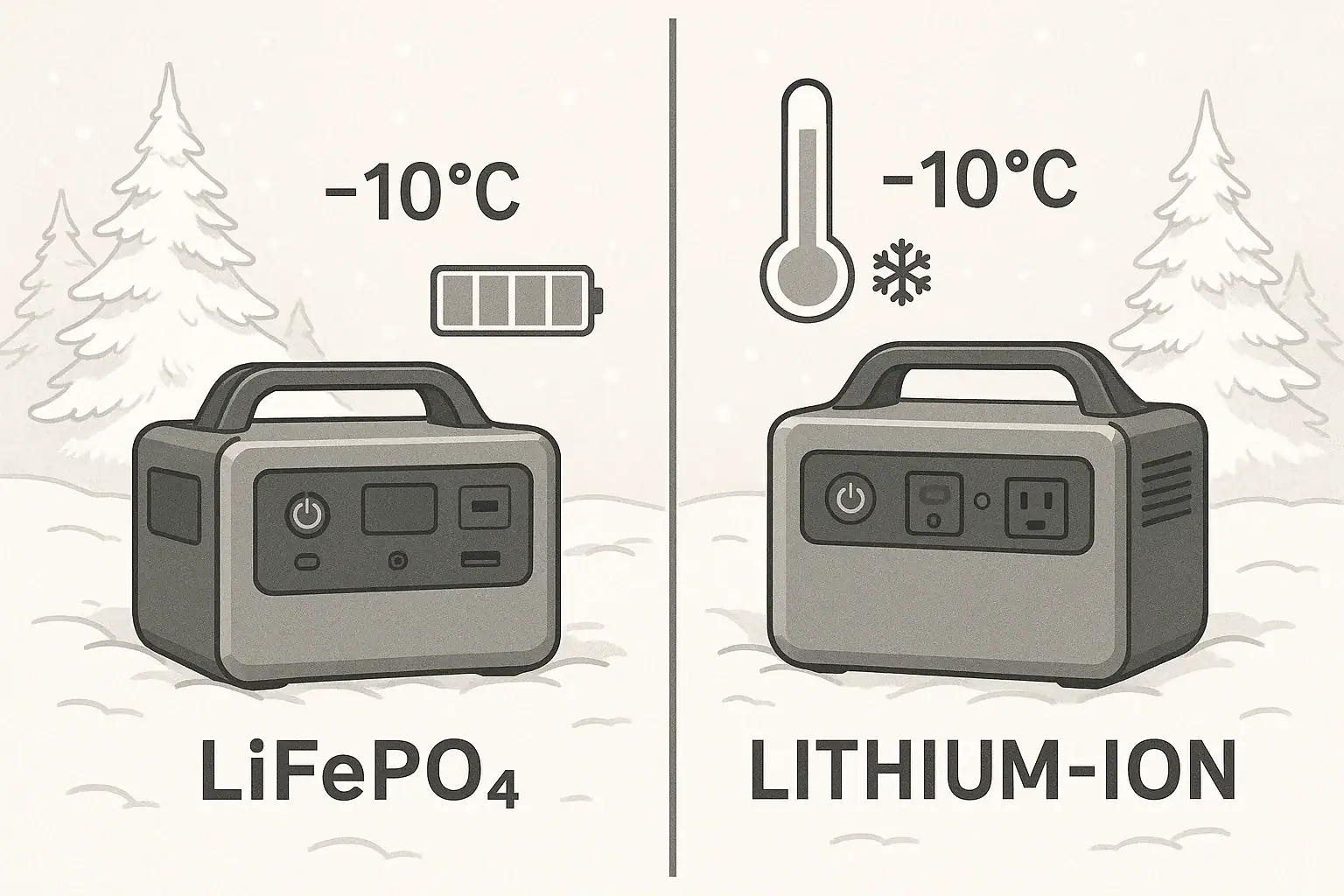
Cold performance is another area where the differences emerge. NMC batteries generally retain more usable capacity in moderately cold conditions, though they still experience reduced performance below freezing. LiFePO4 batteries may lose usable capacity more abruptly in the cold, and charging them at or below freezing can be more restrictive. Some power stations address this with built-in battery management and, in some cases, internal heating. Even then, users often see shorter runtimes in winter and slower charging, regardless of chemistry.

In RV or remote-work scenarios where the unit stays mostly in one place, the extra weight of LiFePO4 may not be a concern. The longer cycle life can be valuable if you run heavy AC loads such as small space heaters or induction cooktops on a regular basis, because these quickly add to the cycle count. In contrast, a more occasional user who mainly wants backup for brief outages may never approach the cycle life limits of either chemistry, making weight, price, and cold behavior more important decision factors.

Common mistakes & troubleshooting cues

Both LiFePO4 and NMC-based power stations can shut off unexpectedly if the system is pushed outside its design limits. A frequent mistake is sizing capacity based on watt-hours alone and ignoring the inverter’s continuous and surge ratings. For example, trying to start a high-draw appliance like a microwave or hair dryer on a small power station can trigger overload protection. This behavior is not a flaw in the battery chemistry; it is an inverter and power budget issue.

Another common issue is misinterpreting low-temperature behavior as a defective battery. In cold weather, NMC packs may show reduced capacity but still charge with fewer restrictions, while LiFePO4 packs may refuse to accept a charge until they warm up above a certain threshold. Users sometimes see slow or halted charging and assume the unit is broken. In reality, the battery management system is protecting the pack from damage caused by charging when the internal cells are too cold.

Charging slowdowns can also occur at high states of charge or when the internal temperature is elevated. NMC and LiFePO4 chemistries both rely on protective logic that tapers charging as the battery approaches full. If your power station charges rapidly at first and then slows significantly near the top, this is usually normal. Running heavy AC loads while charging can also slow the net charge rate or even hold the state of charge steady, because much of the input power is diverted to the inverter output.

Over time, users might notice that a fully charged battery no longer lasts as long as when it was new. NMC batteries often show faster capacity fade if they have been stored at full charge in high heat or cycled very deeply and frequently. LiFePO4 batteries tend to age more slowly under the same conditions, but they are not immune to degradation. Early signs include reduced runtime, faster drops from 100% to around 80%, and more noticeable voltage sag under heavy loads. These cues can guide you to adjust usage patterns, such as avoiding long-term storage at full charge or high temperatures.

Safety basics

Safety considerations differ slightly between LiFePO4 and NMC, but many best practices are the same. Place portable power stations on stable, dry surfaces with good airflow around the vents. Avoid enclosing them in tight cabinets, under bedding, or near heat sources where heat buildup could accelerate wear or, in extreme cases, lead to thermal issues. LiFePO4 chemistry is generally more thermally stable and less prone to runaway reactions than NMC, which can offer an added margin of safety, but neither should be operated outside the manufacturer’s recommended temperature or moisture ranges.

Use appropriately rated extension cords and avoid daisy-chaining multiple power strips or running cords under rugs where heat can build up. Because portable power stations typically provide 120 V AC, they should be treated like a standard household outlet. Do not exceed the unit’s rated output by plugging in too many devices or high-wattage appliances simultaneously. Both chemistries rely on internal battery management and inverter protections; bypassing or ignoring those protections undermines the inherent safety design.

Moisture exposure is a concern regardless of chemistry. Keep the unit away from standing water, rain, and snowmelt. In RVs and vans, mount or place the power station where it is protected from spills and where vents are not blocked by gear or bedding. If you need to use a power station near sinks, basements, or outdoor locations, a properly rated GFCI-protected circuit or outlet provides an additional layer of protection against shock. When in doubt, consult a qualified electrician about safe ways to integrate a portable power station with existing circuits without modifying panels or wiring yourself.

Finally, never open the battery enclosure or attempt to repair the cells yourself. LiFePO4’s relative stability does not make it safe to tamper with compressed packs, and NMC cells can be especially unforgiving if punctured or shorted. If you observe swelling, strong odors, visible damage, or repeated overheat warnings, discontinue use and contact the manufacturer or a qualified service provider for guidance.

Maintenance & storage

Good maintenance and storage practices can stretch the usable life of both LiFePO4 and NMC batteries, but each chemistry responds slightly differently. LiFePO4 packs are generally more tolerant of regular deep cycles and long-term partial states of charge, which suits frequent users who discharge the power station deeply before recharging. NMC packs are more sensitive to high states of charge and heat, so it is especially helpful to avoid leaving them fully charged in hot environments for long periods.

For longer-term storage, a moderate state of charge is usually recommended for both chemistries. Many users aim for roughly 40–60% charge if the unit will sit unused for several weeks or months. At this level, the cells are under less stress than at 100%, and self-discharge over time is less likely to reach damaging low voltages. LiFePO4 typically has lower self-discharge than NMC, so it can often sit longer between top-ups, but checking the charge every few months is still wise.

Temperature control is an important part of storage. Try to store power stations in a cool, dry place, away from direct sun and freezing conditions. High heat accelerates aging for both chemistries, but it is particularly tough on NMC. Extreme cold can lead to very low internal voltage and difficulty charging without warming the pack first, especially for LiFePO4. If a unit has been stored in a cold vehicle or unheated garage, allow it to warm gradually to room temperature before charging.

Routine checks should include verifying that the unit powers on, outlets function correctly, and fans and vents are unobstructed and relatively clean. Light dusting around vents and ensuring cords are not frayed can prevent minor problems from becoming bigger issues. Running a brief functional test every few months—plugging in a small load and confirming normal behavior—helps you discover problems before you rely on the power station during an outage or trip.

Maintenance and storage plan – Example values for illustration.
TaskSuggested frequencyNotes
Check state of chargeEvery 2–3 monthsKeep around 40–60% for long-term storage
Top up the batteryWhen below ~30–40%Prevents deep discharge during storage
Visual inspectionEvery 3–6 monthsLook for damage, swelling, or loose cords
Vent and fan cleaningEvery 6 monthsLight dusting to maintain airflow
Functional test with small loadEvery 3–6 monthsConfirm AC and DC outputs work normally
Temperature check for storage spotSeasonallyAvoid extended high heat or freezing locations
Firmware or settings reviewAnnuallyAdjust eco/sleep modes if they affect your use
Label next service or replacement reviewEvery few yearsPlan around expected cycle life for chemistry

Example values for illustration.

Practical takeaways

Choosing between LiFePO4 and NMC batteries in a portable power station comes down to your priorities and usage patterns. LiFePO4 generally offers longer cycle life, strong thermal stability, and predictable voltage behavior, at the cost of more weight and bulk for the same capacity. NMC usually provides higher energy density and lighter units but can age faster under high temperatures, frequent deep discharges, or long storage at full charge.

Cold performance is nuanced: NMC often retains more usable capacity in moderate cold, while LiFePO4 requires more cautious charging at low temperatures but can still deliver reliable output when warmed. Safety is largely a function of design and battery management, but LiFePO4 has an inherent edge in thermal stability, which can add comfort for users who cycle their systems heavily or store them in variable environments.

For portable power station users in the United States thinking about outages, camping, or remote work, it helps to treat chemistry as one factor among several. Capacity in watt-hours, inverter ratings, charging options, and environmental conditions all interact with chemistry to determine real-world performance. A carefully chosen system, used within its limits and maintained thoughtfully, will typically provide years of dependable service regardless of whether it is based on LiFePO4 or NMC.

  • Match chemistry to use: LiFePO4 for frequent deep cycling and long life, NMC when low weight and compact size are more important.
  • Size by both watt-hours and inverter ratings, not just battery capacity, to avoid overload shutdowns.
  • Plan for efficiency losses and reduced cold-weather capacity when estimating runtime.
  • Store at moderate charge in cool, dry conditions and avoid long periods at full charge, especially with NMC.
  • Follow all safety guidance, avoid tampering with the battery pack, and consult qualified professionals before integrating with home wiring.

Frequently asked questions

Are LiFePO4 batteries significantly heavier than NMC for the same watt-hour capacity?

Yes. LiFePO4 cells have a lower energy density than NMC, so packs built with LiFePO4 are typically heavier and larger for the same watt-hour rating. The exact difference depends on pack design and supporting electronics, but users commonly notice a weight penalty when choosing LiFePO4 for equivalent capacity.

Can I charge LiFePO4 batteries in freezing temperatures?

Charging LiFePO4 at or below freezing is generally not recommended; many power stations prevent charging until cells warm above a safe threshold. Discharging at low temperatures may still work but with reduced usable capacity, and it’s best to follow the manufacturer’s temperature limits or allow the unit to warm before charging.

Which chemistry is safer for indoor use: LiFePO4 or NMC?

LiFePO4 has inherently better thermal and chemical stability and a lower risk of thermal runaway compared with NMC, giving it an edge for safety. However, overall safety also depends on pack construction, battery management systems, and proper use, so follow manufacturer guidance regardless of chemistry.

How do cycle lives typically compare between LiFePO4 and NMC?

LiFePO4 generally offers a much longer practical cycle life and can tolerate many more deep discharge cycles before noticeable capacity loss, while NMC typically reaches significant capacity fade sooner under heavy cycling or high-temperature storage. Exact cycle life varies by cell quality, depth of discharge, and operating conditions.

What are the best storage practices for each chemistry to maximize lifespan?

For both chemistries, store in a cool, dry place at a moderate state of charge (around 40–60%) and avoid prolonged storage at full charge or high temperatures. NMC is more sensitive to high heat and full-charge storage, while LiFePO4 tolerates partial charge and long storage somewhat better but still benefits from periodic checks and a stable environment.

Why Capacity Drops in Cold and Heat: Battery Chemistry + Simple Rules for Better Runtime

Portable power station with abstract battery cells in isometric view

When people say a portable power station “loses capacity” in the cold or seems to “drain faster” in hot weather, they are talking about how much usable energy the battery can actually deliver at that moment. The battery’s rated capacity is measured in watt-hours under controlled test conditions, but real-world temperature and usage can make the effective capacity meaningfully higher or lower.

Inside every portable power station is a battery made of electrochemical cells. These cells move ions between electrodes to store and release energy. That chemical process is sensitive to temperature and how quickly energy is being drawn. Cold slows the reactions down, while excessive heat increases internal resistance and accelerates wear. Both can reduce how much of the rated capacity you can access during a single discharge.

This matters because capacity is the foundation for planning runtime. If you expect a 1,000 Wh power station to give you 1,000 Wh in freezing conditions or in a hot, closed car, you will almost always be disappointed. Knowing how temperature and battery chemistry change the usable energy helps you size your system correctly and avoid surprises during outages, camping trips, and remote work.

Understanding these effects also helps you interpret unexpected behavior: the unit shutting off early, the display showing less runtime than usual, or charging slowing down in the cold. None of these necessarily mean the power station is “bad”; they may just reflect the physics of how batteries behave outside ideal lab conditions.

What the topic means (plain-English definition + why it matters)

Key concepts & sizing logic (watts vs Wh, surge vs running, efficiency losses)

To make sense of capacity drops in heat and cold, it helps to separate power from energy. Power, measured in watts (W), is how fast you are using energy at any moment, like the speedometer of a car. Energy, measured in watt-hours (Wh), is how much total work the battery can do before it needs recharging, like the size of a gas tank. A portable power station’s “capacity” rating is given in watt-hours, but its outlets are limited in watts.

Appliances have two important power values: surge and running. Surge is the brief, higher power draw when a device starts up, common with compressors, pumps, and some tools. Running watts are what the device uses once it is operating normally. The inverter inside a power station has a maximum continuous rating (for running loads) and a short-term surge rating. If either rating is exceeded, the unit may shut down to protect itself, even if the battery still has plenty of energy left.

Efficiency losses further reduce usable capacity. Converting battery DC power to 120 V AC through the inverter wastes some energy as heat. Charging from AC, DC, or solar also has conversion losses, and running small DC devices through USB or a car-style port is usually more efficient than converting to AC and back again. In cold conditions, where battery chemistry already limits output, these losses become more noticeable because you are working with less effective capacity to begin with.

Temperature influences internal resistance and reaction rates inside the cells. In cold weather, higher resistance and slower ion movement can reduce how much energy the battery can deliver at a given discharge rate. In heat, reactions may be easier in the short term but cause faster aging over time, so the total lifetime capacity slowly shrinks. Good sizing includes a margin for these real-world effects instead of assuming the printed watt-hour number will always be available.

Checklist for accounting for real-world battery capacity. Example values for illustration.
What to consider Why it matters Typical planning rule (example only)
Conversion losses (DC to AC) Inverter heat reduces usable watt-hours from the battery Assume 10–20% loss when using AC outlets
Cold weather operation Lower temperatures limit chemical reactions inside cells Plan for 20–40% less usable capacity below freezing
High discharge rate (many watts at once) Pulling power quickly increases internal losses Expect shorter runtime when running near inverter max
Partial vs deep discharges Very deep discharges can shorten long-term battery life Aim to avoid hitting 0% regularly when possible
High ambient heat Heat accelerates aging and can cause protective throttling Try to keep the unit below roughly hot car temperatures
Display estimates and indicators Runtime predictions adjust based on recent load and temp Treat displayed runtime as an estimate, not a guarantee
Battery age and cycle count Capacity gradually declines with use over years Expect noticeable loss after many hundreds of cycles

Real-world examples (general illustrative numbers; no brand specs)

Imagine a portable power station rated at 1,000 Wh. On a mild day at room temperature with modest loads and mostly DC outputs, you might reasonably plan on 800–900 Wh of usable energy once you account for inverter losses, display overhead, and safety reserves the manufacturer keeps in the battery management system. That could power a 50 W laptop setup for roughly 14–16 hours of actual runtime, not counting breaks or standby periods.

Now place the same unit in a cold garage at around 20°F. The internal battery chemistry slows, and the management system may further limit charging or output to protect the cells. In that scenario, you might only see 60–70% of the rated capacity available in practice. The same 50 W laptop load might now run closer to 9–11 hours. The power station has not “shrunk” permanently; it is just unable to tap its full stored energy until conditions improve.

At the other extreme, consider using that 1,000 Wh power station inside a sun-heated vehicle interior where temperatures rise well above typical room temperature. In the short term, it may still deliver close to its usual runtime, but the unit may run its cooling fan more often or reduce charging speed to avoid overheating. Over months and years, repeated high-heat exposure will accelerate capacity fade. After many cycles and seasons, you might find that a full charge now only yields, for example, 700–800 Wh, even back at normal temperatures.

Load size also changes the picture. If you run a 600 W space heater from a 1,000 Wh unit at room temperature, you might think you should get roughly 1.5 hours of runtime (1,000 Wh ÷ 600 W). In reality, running close to the inverter’s upper limit increases internal losses and heat, so the effective runtime might be closer to 1.1–1.3 hours. In cold weather, that same heavy load combined with reduced chemical performance could cut usable runtime even further.

Common mistakes & troubleshooting cues (why things shut off, why charging slows, etc.)

A frequent mistake is confusing the inverter’s power rating with the battery’s energy capacity. Users sometimes assume that as long as the total wattage of their appliances is below the inverter’s continuous limit, the runtime will automatically match a simple watt-hour calculation. In practice, if the load is near the inverter’s maximum for extended periods, extra heat and internal resistance can cause voltage sag and protective shutdowns, especially in cold weather.

Another common issue is expecting the unit to charge or discharge normally in temperature extremes. Many portable power stations have built-in limits that slow or prevent charging when the internal battery is too cold or too hot. If you see charging stop at a partial state of charge on a freezing morning, this often indicates the system is protecting itself, not that the charger or cable has failed. Warming the battery into its recommended range usually restores normal behavior.

People also misinterpret state-of-charge indicators. A percentage readout is an estimate based on voltage, current, and previous usage patterns. In cold conditions, the same voltage can correspond to a different usable capacity than at room temperature. As a result, the display may drop faster than expected under load, or the unit may shut off with some percentage still showing because the battery cannot safely maintain the required voltage.

Troubleshooting cues to watch for include the inverter clicking off under heavy loads in cold temperatures, fans running continuously in hot conditions, charging pausing or slowing without an obvious reason, and noticeable differences in runtime between warm and cold days using the same devices. These signs point to temperature and load-related constraints rather than simple “battery failure.”

Safety basics (placement, ventilation, cords, heat, GFCI basics at a high level)

Safe operation starts with where you place the power station. Set it on a stable, dry surface away from standing water, flammable materials, and direct heating sources. Leave clearance around vents so cooling fans can move air freely. In cold environments, avoid placing the unit directly on ice or snow; a small insulating layer under the unit can help keep the internal temperature more moderate, which improves both safety and performance.

Heat management is especially important. Do not cover the power station with blankets, clothing, or gear while it is charging or powering loads, and avoid operating it inside closed, unventilated spaces that can trap heat. Prolonged operation in hot conditions can trigger thermal protections or, in extreme cases, contribute to overheating. Allowing the unit to cool if its casing feels very warm, and keeping it out of direct midday sun, helps reduce risk.

Use cords and extension cables that are appropriately rated for the load they will carry. Undersized or damaged cords can overheat, particularly when running high-wattage appliances, adding unnecessary risk on top of the heat already generated by the inverter. Inspect cords for cuts, fraying, or crushed insulation, and avoid coiling them tightly under heavy load, as that can trap heat.

When powering devices near water (such as outdoors, in basements, or near sinks), it is generally safer to plug equipment into outlets protected by ground-fault circuit interrupter (GFCI) devices. Many portable applications rely on GFCI power strips or existing building outlets for this protection. If you plan to power fixed home circuits from a portable source, consult a qualified electrician rather than attempting any direct wiring yourself.

Maintenance & storage (SOC, self-discharge, temperature ranges, routine checks)

Battery chemistry and temperature sensitivity do not stop when the power station is turned off. For storage, manufacturers typically recommend keeping the battery at a moderate state of charge rather than at 0% or 100% for long periods. A middle range helps slow long-term capacity loss. Because all batteries self-discharge slowly over time, long-term storage at very low charge combined with cold temperatures can risk dropping below the minimum voltage the battery management system expects.

Temperature during storage also matters. Leaving a power station for months in a hot attic or vehicle can accelerate aging, even if you rarely use it. Storing in a cool, dry place away from direct sunlight is generally better for preserving capacity. Extremely cold storage can be acceptable if the battery is not being charged or discharged, but you will want to bring it back toward room temperature before heavy use or charging.

Routine checks help ensure the unit will perform reliably during outages or trips. Every few months, verify the state of charge, top it up if needed, and briefly run a small load to confirm that the inverter and outlets operate as expected. This light cycling also helps the battery management system keep its capacity estimates more accurate, so percentage readings and runtime predictions remain reasonably trustworthy across seasons.

Visual inspection is part of basic maintenance. Check the casing for cracks, verify that vents are unobstructed and relatively dust-free, and listen for unusual noises from fans during operation. Do not open the battery enclosure or attempt internal repairs; modern packs include complex safety systems that should only be serviced by qualified professionals or the manufacturer.

Example storage and maintenance plan across the year. Example values for illustration.
Time or condition Suggested action Reason and notes
Every 3–6 months Check charge level and recharge to a mid-high range Helps offset self-discharge and keeps pack ready for emergencies
Before winter Test runtime with a typical load indoors Confirms performance before cold-weather outages
Before summer heat Confirm fans and vents are clear and operational Improves cooling when ambient temperatures rise
Long-term storage (months) Store at moderate charge in a cool, dry area Reduces long-term capacity loss from heat and high voltage
After heavy use Allow the unit to cool before recharging fully Minimizes time spent hot and fully charged
Visible damage or swelling Stop using and contact support or a professional Physical changes can indicate internal battery issues
Unusual smells or noises Disconnect loads and move to a safe, ventilated area May signal overheating or component failure

Practical takeaways (non-salesy checklist bullets, no pitch)

Portable power stations cannot escape the basic rules of battery chemistry: cold and heat change what the cells can safely and efficiently deliver. Instead of relying on a single watt-hour number printed on a box, it is more realistic to think in terms of a range of usable capacity that shifts with temperature, discharge rate, and age. Planning within that range helps prevent disappointment and extends the life of the system.

By adjusting expectations for winter and summer, using loads efficiently, and placing the unit in temperature-friendly locations, you can maintain better runtime and reliability. Simple habits like testing before storm seasons, avoiding prolonged exposure to extreme heat, and storing at a moderate charge all contribute to keeping the battery performing as well as it reasonably can over time.

  • Assume real-world usable capacity is lower than the rated watt-hours, especially in cold weather.
  • Plan extra capacity for winter use and for high-wattage appliances that run near the inverter’s limit.
  • Keep the power station off very hot surfaces and out of sealed, sun-heated spaces when operating or charging.
  • Use appropriately sized cords and avoid overloading a single outlet or extension.
  • Store at partial charge in a cool, dry place and check the battery every few months.
  • Let the unit warm up toward room temperature before charging or heavy use in freezing conditions.
  • Treat runtime estimates on the display as guides, not guarantees, and adjust based on temperature and load.

Approaching portable power stations with this temperature-aware mindset turns capacity drop from a frustrating surprise into one more factor you can plan around. With a bit of margin and simple habits, you can get more reliable runtime and longer service life from the same hardware.

Frequently asked questions

Why does battery capacity in cold and heat change?

Cold temperatures slow ion movement and increase internal resistance, which reduces the battery’s ability to deliver usable energy under load. High temperatures can temporarily improve output but accelerate chemical degradation and may trigger thermal protection that lowers usable capacity over time.

How much capacity loss can I expect in freezing conditions?

As a general planning guideline, many batteries can show 20–40% less usable capacity at temperatures below freezing, though the exact amount depends on the cell chemistry, age, and discharge rate. Heavier loads and older packs typically see larger reductions.

Can I restore lost capacity by warming or cooling the battery?

Yes — performance lost to cold is often restored when the battery returns to a moderate temperature, and cooling a hot battery can reduce thermal throttling. However, heat damage from repeated overheating is cumulative and cannot be fully reversed by later cooling.

How should I size a portable power system for winter or hot climates?

Include margin in your sizing: add extra watt-hours to cover expected temperature-related losses (for example, 20–40% for cold) and account for inverter/conversion inefficiencies. Also consider load profiles and avoid designing systems that regularly run near the inverter’s continuous limit.

Why does charging slow or stop in extreme temperatures, and what should I do?

Many battery management systems limit or pause charging outside safe temperature ranges to protect the cells, so reduced charging in very cold or hot conditions is usually intentional. Bring the unit into a recommended temperature range before charging or follow manufacturer temperature guidelines to restore normal charging speeds.

Depth of Discharge (DoD) Explained: How Partial Cycles Extend Battery Life (LiFePO4 vs NMC)

portable power station beside abstract battery modules isometric

Depth of discharge, often shortened to DoD, describes how much of a battery’s stored energy has been used compared with its total usable capacity. A 100% DoD means you have drained the battery from full down to its minimum safe level. A 50% DoD means you have used half of its usable energy and still have half remaining.

DoD matters because rechargeable batteries do not last forever. Each time you discharge and then recharge, you complete a cycle. The deeper the average discharge, the fewer total cycles the battery can typically handle before its capacity noticeably fades. Shallow or partial cycles generally allow a battery to deliver many more total cycles over its life.

In portable power stations, understanding DoD helps you plan runtimes, protect the battery, and choose between chemistries such as LiFePO4 and NMC. These chemistries behave differently under high DoD, temperature extremes, and heavy loads, which affects how long your power station will remain useful.

What Depth of Discharge Means and Why It Matters

Most modern units have built-in protection to prevent you from truly over-discharging the battery. However, how far you regularly let the battery run down still has a strong influence on long-term performance and the cost of ownership over years of use.

Key Concepts: DoD, Capacity, and Sizing Logic

Before comparing LiFePO4 and NMC, it helps to connect DoD to capacity and power. Capacity is usually listed in watt-hours (Wh), which tells you how much energy the battery can store. Power draw is listed in watts (W), which tells you how fast that energy is being used. If you divide Wh by W, you get an approximate number of hours of runtime, ignoring losses.

Portable power stations also specify an inverter rating, usually with separate running and surge figures. Running watts describe how much continuous power the inverter can supply. Surge watts describe a short burst it can handle when devices like refrigerators or pumps first start. DoD does not change the surge capability directly, but repeated heavy surges can stress the battery and electronics, especially at high DoD and low state of charge.

No system is perfectly efficient. Inverters, internal wiring, and voltage conversion all waste some energy as heat. Real runtimes are often 10–20% lower than a simple Wh ÷ W calculation would suggest. Discharging at very high power levels can also reduce usable capacity somewhat, especially in NMC packs running close to their limits.

For sizing and long-term life, two ideas are key: partial cycling and usable capacity. Operating between, for example, 20% and 80% state of charge (SOC) is a 60% DoD cycle. Many LiFePO4 batteries can tolerate frequent deep cycles better than NMC, but both chemistries generally last longer when average DoD is lower and temperatures are moderate.

Decision matrix: using DoD and power needs to size a portable power station. Example values for illustration.
Situation Typical Load Level Target DoD Range Capacity Planning Hint
Short outages (1–3 hours) Low to moderate (phone, router, lights) Aim for ≤ 70% DoD per event Size for about 2× your expected Wh use
Remote work days Low (laptop, monitor, small router) 30–60% DoD cycles Choose capacity to cover a full day at 50% DoD
Camping weekends Mixed small devices, occasional higher draw Up to 80% DoD, not daily Plan for two days of use plus 20% reserve
RV fridge and fans Moderate continuous load 50–80% DoD with regular recharging Size so daily use is ≤ 70% of capacity
Tool use on jobsite High, intermittent Keep DoD moderate when possible Favor higher capacity and short, frequent recharges
Essential medical-related electronics Low to moderate Conservative DoD, with ample reserve Plan for at least two full cycles of expected load
Frequent daily cycling Low to moderate 30–70% DoD for longest life Select capacity that keeps daily use within this band

Real-World Examples: DoD, LiFePO4 vs NMC, and Runtimes

Consider a portable power station rated at 1,000 Wh. If you run a 100 W load, a simple estimate says it could run for about 10 hours (1,000 Wh ÷ 100 W). After accounting for efficiency losses, the real runtime might be closer to 8–9 hours. If you routinely let it drop from full to nearly empty, you are using close to 100% DoD every time.

With LiFePO4 chemistry, many batteries can tolerate frequent deep discharges while still delivering a large number of cycles before the capacity noticeably drops. With NMC, frequent deep discharges usually reduce cycle life more quickly. For example, using only 50–60% of the capacity on each cycle instead of 90–100% often translates into a significantly longer service life, even though such numbers are examples rather than fixed rules.

Now imagine a 500 Wh unit used for remote work, powering a laptop (50 W) and a small monitor (30 W) for about 6 hours. That is 480 Wh of use (80 W × 6 hours), or roughly 96% of the capacity on paper. In practice, the system might shut down earlier due to inverter losses and voltage limits, so you might see 75–85% of the labeled capacity before it stops. If you want to keep daily DoD closer to 50–60%, choosing a larger capacity unit or reducing runtime can help.

Appliances with surge loads create a different pattern. A compact refrigerator might use only 60–80 W while running, but draw several times that briefly on startup. A LiFePO4-based power station may handle those surges with less voltage sag than a similar NMC pack at the same DoD, especially as the battery nears empty. This can be the difference between a fridge successfully starting and the inverter shutting down under low-battery or overload protection.

Common Mistakes and Troubleshooting Cues

One common mistake is confusing power and energy. People often buy a unit based on a high surge wattage number, then discover it cannot run their equipment as long as expected because the actual energy capacity in watt-hours is modest. Running a high-wattage appliance at a high DoD will drain the battery far faster than anticipated and can cause early shutdowns when the inverter hits its low-voltage cutoff.

Another issue is assuming that a power station will always deliver its labeled Wh in every situation. Discharging very quickly, running in hot or cold environments, or operating near maximum inverter output will all reduce usable capacity. This is especially noticeable with NMC chemistries at high discharge rates or low temperatures. LiFePO4 generally handles partial and deep cycles more consistently, but it is still affected by temperature and high loads.

Users may also misinterpret protective shutdowns as “faults.” If the unit powers off suddenly under load, it could be hitting low-battery protection, inverter overload, or temperature limits rather than having a defect. These protections are designed to prevent damage from over-discharge, overheating, or excessive current draw, all of which are more stressful when the battery is already at a high DoD.

Charging behavior can also be confusing. Charging often slows down as the battery approaches higher SOC levels. If you have been cycling to deep DoD, the first portion of charging may be fast, then taper off as the battery management system protects the cells near the top of the charge. Cold or hot conditions cause additional throttling. Recognizing that changing charge rates and early cutoffs are often protective behavior can help you troubleshoot without assuming something is broken.

Safety Basics: Placement, Heat, and Electrical Protection

Whether a power station uses LiFePO4 or NMC, safe operation follows similar principles. Place the unit on a stable, dry surface with enough space around it for ventilation. Avoid stacking items on top that could block vents or trap heat. Heat builds faster at high DoD and high load, so maintaining clear airflow helps the internal components manage temperature safely.

Keep the unit away from flammable materials, open flames, and direct, intense sunlight. High ambient temperatures shorten battery life over time and can force the system to throttle power or charging. In very cold conditions, some systems restrict charging to protect the cells, especially when the battery is deeply discharged and more vulnerable to damage.

Use cords and extension cables that are appropriately rated for the loads you intend to run. Long, undersized cords can overheat and drop voltage, especially when drawing high current. This can trigger the power station’s protections or cause devices to behave erratically. For outdoor scenarios, use cords marked for outdoor use and keep connections out of standing water.

If you plug into household circuits, use grounded outlets and, where appropriate, GFCI-protected receptacles, especially near kitchens, bathrooms, garages, or outdoor areas. Avoid any attempt to backfeed a home’s electrical system through standard outlets or improvised connections. Any permanent or semi-permanent integration with home wiring should be evaluated and installed by a qualified electrician who understands local codes and safe transfer methods.

Maintenance and Storage for Longer Battery Life

Good maintenance practices help you get the most from the battery, regardless of chemistry. For storage longer than a few weeks, keep the power station in a cool, dry place away from direct sunlight. Moderate temperatures are best; prolonged exposure to heat is one of the fastest ways to shorten both LiFePO4 and NMC battery life, especially if stored at a very high or very low SOC.

For many systems, storing the battery partially charged is beneficial. As a general example, keeping long-term storage around a mid-range SOC rather than 100% or near empty can reduce stress on the cells. Some manufacturers recommend a specific range, such as 30–60% SOC, for extended storage. Topping off to full right before anticipated use is often a better strategy than leaving the unit full for months.

All batteries self-discharge slowly over time, even when not in use. The built-in electronics in a portable power station also draw a small amount of power when idle. Plan to check and recharge the unit every few months so it does not drift into very low SOC, which can be harder on the battery and may trigger deep-sleep protections that require a longer recharge to recover.

Routine checks should include verifying that vents are free of dust, cords and plugs are in good condition, and there are no signs of swelling, strong odors, or unusual heat during use or charging. Avoid opening the case or tampering with internal components. If you notice persistent abnormal behavior, contact the manufacturer or a qualified service provider rather than attempting your own internal repairs.

Storage and maintenance plan examples for portable power stations. Example values for illustration.
Timeframe Suggested SOC Range Suggested Action
Weekly use 20–80% between sessions Recharge after use; avoid leaving at 0% or 100% for long
Monthly use 30–70% when stored Top up to desired level a day before expected use
Seasonal storage (1–3 months) 30–60% Store in a cool, dry place; check SOC at least once midway
Long-term storage (over 3 months) 40–60% Check and recharge every 2–3 months to stay within range
High-heat environments Lower end of recommended range Minimize heat exposure and avoid storing at full charge
Cold environments Mid-range SOC Allow the battery to warm toward room temperature before charging
Before a major storm Charge to high SOC for readiness After the event, discharge slightly and return to normal storage range

Practical Takeaways and Checklist

Depth of discharge is one of the most important yet overlooked concepts in getting reliable performance from a portable power station. Understanding how DoD interacts with chemistry, temperature, and load size allows you to balance runtime needs with long-term battery life. LiFePO4 chemistry usually tolerates deeper cycling with less wear than NMC, but both benefit from moderate DoD and reasonable operating conditions.

When planning for outages, camping, or remote work, think in terms of watt-hours, not just watts, and remember that surge ratings do not guarantee long runtimes. Estimate your daily energy use, then select a battery size and DoD strategy that leave some margin rather than running at the edge of capacity on every cycle.

Consistent care also matters. Storing at moderate SOC, avoiding extreme temperatures, checking the unit periodically, and recognizing that protective shutdowns are a safeguard rather than a failure will help you get more years of practical use from the system. Over time, thousands of shallow or moderate cycles can often be achieved if you stay within reasonable DoD and temperature ranges.

Use the following simple checklist as a reference:

  • Think in watt-hours for runtime planning, watts for power draw.
  • Aim for moderate DoD (for example, 30–70%) for frequent daily cycling when possible.
  • Expect less than the labeled Wh in real use due to efficiency losses and protections.
  • Keep the unit in a well-ventilated, dry, and temperature-moderate location.
  • Use properly rated cords, and avoid improvised connections to home wiring.
  • Store at partial charge for long periods; avoid leaving it empty or full for months.
  • Check and recharge every few months to prevent very low SOC during storage.
  • If behavior changes suddenly, consider DoD, temperature, and load before assuming a fault.

Frequently asked questions

What is Depth of Discharge (DoD) and how does it differ from state of charge (SOC)?

Depth of discharge (DoD) measures how much of a battery’s usable energy has been consumed relative to its capacity, while state of charge (SOC) is the remaining usable energy expressed as a percentage. DoD and SOC are complementary metrics (DoD = 100% − SOC), and both are useful for planning use and storage.

How does DoD affect the cycle life of LiFePO4 compared to NMC batteries?

LiFePO4 batteries typically tolerate deeper and more frequent discharges with less capacity loss than NMC chemistry, so the same DoD generally yields more cycles on LiFePO4. NMC tends to degrade faster at high DoD, especially under high discharge rates and elevated temperatures.

What DoD range should I aim for to balance runtime and battery longevity in a portable power station?

A practical target for frequent use is often in the 30–70% DoD range, which gives useful runtime while limiting wear on the cells. Occasional deeper discharges are acceptable, but routine 90–100% DoD will shorten overall cycle life.

How do high discharge rates and temperature interact with DoD to influence usable capacity?

High discharge rates and extreme temperatures reduce usable capacity and increase stress on cells, effectively making the battery behave as if it is at a deeper DoD. This effect is more noticeable with NMC chemistry and at low SOC, so moderating power draw and keeping temperatures moderate helps preserve usable energy.

How should I store a battery to minimize DoD-related degradation during long-term storage?

Store batteries at a moderate SOC (many systems recommend roughly 30–60%) in a cool, dry place and check/recharge every few months. Avoid leaving the unit at 0% or 100% for long periods and minimize exposure to high ambient temperatures to reduce capacity loss.

BMS Explained: What a Battery Management System Actually Does in a Portable Power Station

Isometric illustration of portable power station and battery module

Inside every modern portable power station is a hidden controller called a battery management system, often shortened to BMS. It is the electronic “overseer” that constantly monitors the battery cells, controls charging and discharging, and decides when to allow or cut off power. Without it, high-capacity lithium batteries would be unsafe and unreliable.

In plain terms, the BMS makes judgment calls thousands of times per second. It watches voltage, current, and temperature and compares them to safe limits set by the manufacturer. If something goes outside an acceptable range, the BMS steps in and either reduces or stops power flow to protect the battery and connected devices.

This matters because the headline numbers you see on a portable power station—watt-hours, watts, and charge times—only tell part of the story. The BMS affects how much of that capacity you can actually use, how long the battery will last over its lifetime, and how the unit behaves under stress, like during a power outage or while camping in extreme temperatures.

What a Battery Management System Means and Why It Matters

Understanding the basics of what a BMS does helps set realistic expectations. It explains why your power station sometimes shuts off earlier than the math suggests, why charging may slow down, and why certain outlets might refuse to power a particular appliance. These behaviors are usually signs of the BMS doing its job, not that the unit is failing.

Key Concepts, Sizing Logic, and How the BMS Fits In

To understand how a battery management system influences a portable power station, it helps to separate a few common terms. Watt-hours (Wh) describe stored energy, while watts (W) describe power, or how fast that energy is used. A 500 Wh battery can theoretically supply 500 watts for 1 hour, or 250 watts for 2 hours, and so on, before losses and BMS limits are considered.

Most portable power stations also have an inverter that turns the battery’s DC power into AC outlets similar to standard 120 V household power. The inverter has a continuous rating, sometimes called running watts, and a surge rating, which is the brief extra power it can supply to start motors or compressors. The BMS and inverter work together: even if the inverter can handle a certain load on paper, the BMS may limit output or shut down if it senses the battery is being stressed too much.

Efficiency losses are another key factor. Energy is lost as heat in the inverter, wiring, and internal electronics, so you never get 100 percent of the rated Wh out of the battery. The BMS may also reserve a portion of the capacity to avoid fully charging or fully discharging the cells, which helps prolong battery life. In real use, the accessible energy might be noticeably lower than the printed capacity, especially at high loads or in hot or cold conditions.

The BMS also controls charging. It limits charging current to keep temperatures in check, adjusts behavior based on state of charge, and may slow or stop charging when using pass-through power (charging while powering devices) to avoid overloading the system. When you plan runtimes or charge times, the BMS’s protective decisions are a built-in part of the equation.

Portable Power Station Sizing and BMS Behavior Overview – Example values for illustration.
What you are planningKey number to look atHow the BMS can change the outcomeNotes (example only)
Running small electronics (laptop, phone)Battery capacity in WhMay allow use of most of stored energy at moderate loadsExample: 500 Wh battery might give several hours of 80–120 W use
Starting a device with a motor (mini fridge, fan)Inverter surge wattsCan shut off if surge current exceeds safe battery limitsBMS may trip even if brief surge watt rating seems sufficient
Powering devices for long periodsContinuous (running) wattsMay reduce available capacity at higher continuous loadsHigher loads create more heat, so BMS may limit duration
Charging from wall outletMax charge watt ratingCan slow charging if battery is hot or nearly fullCharge rate often tapers during final part of charge
Charging from vehicle outletDC input ratingMay prevent high current draw to protect car socketLower current means longer charge times from a car
Charging and using at the same timePass-through capabilityCan reduce charge speed or cycle outputs to reduce stressNot all units support full-power pass-through on every outlet
Cold weather use or storageOperating and storage temp rangesMay restrict charging or discharging at low temperaturesCharging is often limited or blocked below freezing

Example values for illustration.

Real-World Examples of How the BMS Affects Use

Consider a remote work setup where you run a laptop, a monitor, and a Wi‑Fi router from a portable power station. Together they might draw around 120 watts. With a 500 Wh unit, simple math suggests just over 4 hours of runtime. In real life, you might see more like 3 to 3.5 hours because of inverter losses and the BMS reserving some capacity at the top and bottom of the charge range to protect the battery.

For a short power outage at home, you might want to power a small refrigerator and a few LED lights. The refrigerator’s compressor might need a brief surge of several times its running wattage to start. Even if the listed surge rating looks adequate, the BMS may trip if it senses that the initial inrush current is too high for the battery. The result is an instant shutoff when the fridge tries to start, even though other smaller loads work fine.

On a camping trip, you might charge phones, run a small fan, and occasionally power a portable air pump. These are light to moderate loads, so the BMS will likely allow deeper use of the battery capacity. However, if the unit sits in direct sun in a hot tent, the internal temperature can climb. The BMS may respond by throttling output or charging speed to keep the battery within its safe temperature range, extending cell life at the expense of immediate performance.

In an RV or vanlife situation, some people expect to run high-draw appliances such as microwaves or hair dryers from a compact power station. The combined demands of the inverter and the battery can push things to their limits. The BMS might permit a short burst but then shut down to prevent overheating or overcurrent. Understanding that behavior helps you size the system realistically, often by choosing lower-power alternatives or accepting shorter run times for heavy loads.

A frequent misunderstanding is assuming that if the wattage of your appliances is below the inverter’s continuous rating, everything should run smoothly until the battery is mathematically empty. In practice, the BMS may shut off early when the battery voltage drops under load, especially near the end of the charge. This is more noticeable with high-power devices like space heaters or power tools, which can cause voltage sag that triggers an early low-voltage cutoff.

Another common issue is unexpected charging behavior. Users may expect the power station to accept full input power from a wall outlet or solar panel at all times. The BMS often reduces charge current when the battery is nearly full, when the unit is hot, or when many devices are plugged in. This can look like “stuck” charging or very slow progress, but it is usually a protective tapering, not a malfunction.

If outputs suddenly shut off, it can be tempting to assume a defect. In many cases, the BMS is simply enforcing limits. Causes can include overcurrent (too many devices or one device drawing more than the outlet allows), overtemperature (unit in a confined or hot space), or undervoltage (battery near empty, especially at high load). Some units require you to manually reset or power the outputs back on after such an event.

Using long, undersized extension cords or power strips can create additional resistance and heat, causing voltage drops that further stress the system. The BMS may react by shutting down or refusing to start certain devices. Watching for patterns—such as the unit shutting off only when a specific appliance starts, or only in hot weather—can help you distinguish between normal BMS protection and an actual fault that needs service.

Safety Basics: How the BMS Helps and What It Cannot Do

The BMS is a critical safety layer, but it is not a replacement for safe operating habits. It can prevent overcharging, protect against short circuits, and shut the unit down if the internal temperature becomes too high. These protections are especially important when using high-energy lithium batteries in portable devices that can be moved, bumped, or exposed to varying conditions.

Placement still matters. Portable power stations should be used on stable, dry surfaces with adequate ventilation around intake and exhaust vents. The BMS can sense temperature and current, but it cannot move air or clear dust. Keeping the unit out of enclosed spaces, away from direct heat sources, and off soft surfaces that block airflow reduces the chance that the BMS will need to intervene due to overheating.

Extension cords and power strips should be rated for the load you plan to run. The BMS can shut down the power station if it detects certain electrical issues, but it does not protect downstream wiring from being overloaded or damaged. For outdoor use, a cord with appropriate weather resistance and, where applicable, a ground-fault circuit interrupter (GFCI) outlet helps reduce shock risk, especially around damp areas. The BMS focuses on the battery; it does not replace the protections built into proper cords and outlets.

For any connection involving household circuits, such as backup power for home devices, it is important not to backfeed a building’s wiring by improvising adapters or connections. The BMS is not designed to manage grid interactions or code requirements. If you plan to integrate backup power with home circuits, consult a qualified electrician who can design a safe, code-compliant solution using appropriate transfer equipment.

Maintenance and Storage: How the BMS Influences Battery Life

The BMS plays a central role in how a portable power station ages. It limits how far the battery charges and discharges, which directly affects long-term capacity. Repeatedly pushing the battery to its absolute minimum and maximum can shorten its life, so many systems keep a protective buffer, even if the display reads 0 percent or 100 percent. This is one reason you might notice the unit turning off before you expect or taking longer to top up at the end of a charge cycle.

For storage, the BMS often draws a tiny amount of power even when the unit is off, to power internal monitoring and safety circuits. Over weeks or months, this can gradually reduce the state of charge (SOC). Storing the unit completely full or completely empty is usually not ideal; many manufacturers recommend keeping it around a moderate SOC range and checking it periodically. The BMS helps prevent over-discharge during storage, but it cannot keep the battery at a fixed level forever.

Temperature is a major factor. Most portable power stations specify a recommended operating and storage temperature range. The BMS will limit charging in cold conditions, sometimes blocking it altogether when temperatures are near or below freezing. In high heat, it may slow charging or reduce output to prevent damage. Storing the unit in a cool, dry place, away from direct sunlight or heat sources, gives the BMS more room to operate without hitting its protective thresholds.

Routine checks are simple but helpful. Periodically verify that the unit charges normally, that fans and vents are unobstructed, and that there are no warning indicators on the display. Avoid opening the case or trying to “reset” the BMS by disconnecting internal components; that can defeat safety measures and is not recommended. If you see recurring error codes or unusual behavior that does not match the user manual, contact the manufacturer or a qualified service provider.

Storage and Maintenance Habits for Portable Power Stations – Example values for illustration.
Maintenance taskTypical frequencyHow the BMS is involvedExample notes
Top-up charge during storageEvery 1–3 monthsPrevents deep discharge cutoffBring SOC back to a moderate level before storing again
Short functional test under loadEvery few monthsConfirms BMS still controls charge and discharge normallyRun a small device briefly to verify stable operation
Vent and fan inspectionA few times per yearReduces overheating events that trigger BMS shutdownsGently clear dust from intake and exhaust areas
Check for error messages or warningsWhenever powering upUses BMS diagnostics to spot issues earlyRefer to user documentation if codes persist
Adjust storage temperatureSeasonallyKeeps battery within BMS’s ideal temperature rangeAvoid hot attics, vehicles, or unheated sheds when possible
Inspect cables and connectorsPeriodicallyHelps prevent faults that might cause BMS shutdownsLook for bent pins, damaged insulation, or loose plugs
Avoid full discharges when not necessaryOngoingLets BMS maintain protective capacity buffersRecharge before the unit remains near empty for long

Example values for illustration.

Practical Takeaways for Using BMS-Equipped Portable Power Stations

Knowing that a battery management system is constantly protecting and optimizing your portable power station helps explain many everyday behaviors. Shutdowns, slow charging, and reduced performance in extreme temperatures are often signs that the BMS is working as intended, not failing. Planning around these behaviors can make your power setup more predictable and less stressful.

When sizing a unit, think beyond the advertised watt-hours and inverter watts. Consider your typical loads, how long you need to run them, and how environmental factors like heat or cold might affect performance. Matching your expectations to what the BMS will allow, rather than to theoretical maximums, leads to better decisions for outage preparedness, camping, RV use, or remote work.

  • Estimate runtime using both capacity (Wh) and realistic efficiency losses.
  • Check surge and continuous watt ratings, and be cautious with devices that have motors or heating elements.
  • Expect charging to slow as the battery nears full or if the unit is hot.
  • Place the power station on a stable, ventilated surface away from direct heat sources.
  • Use appropriately rated cords and avoid overloading power strips or adapters.
  • Store the unit at a moderate state of charge in a cool, dry area.
  • Perform occasional checks: brief test under load, visual inspection, and top-up charging during long storage.
  • Consult qualified professionals for any connection involving household electrical systems.

By treating the BMS as an essential partner instead of a mystery box, you can use your portable power station more safely, extend its lifespan, and get more reliable performance across a wide range of everyday and emergency situations.

Frequently asked questions

How does the battery management system decide when to stop charging or discharging?

The BMS continuously monitors cell voltages, pack current, and temperatures and compares those readings to manufacturer-set safety limits. It will taper charging as cells approach full state of charge and cut charging or discharging if it detects overvoltage, undervoltage, overcurrent, or unsafe temperatures. Some BMS implementations also use state-of-charge algorithms and cell balancing to keep cells within safe ranges.

Why does my portable power station sometimes shut off before the display shows 0%?

Most BMSs reserve a protective buffer at the top and bottom of charge to prevent full overcharge or deep discharge, so the usable capacity can be less than the displayed percentage. Additionally, under high loads voltage sag can trigger the BMS low-voltage cutoff earlier than simple Wh math predicts. This behavior protects the cells and helps extend battery life.

Is it safe to use pass-through charging (charge while powering devices) with a BMS-equipped unit?

Many units allow pass-through but the BMS may limit charge or discharge currents during pass-through to prevent overheating or overcurrent conditions. Continuous pass-through can increase internal heat and, depending on design, may reduce long-term battery life if done frequently at high power. Check the unit’s specifications for supported pass-through behavior and recommended limits.

How does temperature affect BMS behavior and battery performance?

The BMS restricts charging and often disallows charging below freezing to protect lithium cells, and it will throttle or cut output at high temperatures to prevent damage. Cold temperatures increase internal resistance and reduce available capacity, while heat accelerates aging—both conditions cause the BMS to intervene. Storing and operating the unit in the manufacturer’s recommended temperature range minimizes these limits.

How can I tell if a shutdown or charging issue is the BMS protecting the battery or an actual hardware fault?

Typical BMS interventions are patterned: shutdowns under very high load, charging taper when near full or when hot, or recovery after cooling indicate protection at work. Persistent error codes, inability to power on after normal reset procedures, or visible damage to components suggest a hardware fault. Consult the user manual for diagnostic codes and contact the manufacturer or a qualified service provider if behavior persists.

Why Charging Slows Down Near 80–100%: A Simple Explanation

portable power station charging from a wall outlet on desk

Why Charging Feels Fast at First and Slow at the End

If you use a portable power station or any modern lithium battery, you have probably noticed this pattern:

  • The battery jumps from low to around 60–70% quite quickly.
  • It takes much longer to go from about 80% to 100%.

This is not a flaw or a sign that something is wrong. The slowdown near the top is built into how lithium batteries are charged and protected. Understanding this behavior can help you plan charging time, reduce unnecessary stress on your battery, and use your portable power station more effectively.

The Two Main Phases of Lithium Battery Charging

Most portable power stations use lithium-ion or lithium iron phosphate (LiFePO4) batteries. These are charged using a method often described as CC/CV:

  • Constant Current (CC) phase
  • Constant Voltage (CV) phase

Phase 1: Constant Current – The Fast Part

In the constant current phase, the charger sends a steady flow of current into the battery. This is typically where you see the fastest charging speed, often from around 0–10% up to somewhere between 50% and 70–80%, depending on the battery design.

During this phase:

  • The charger tries to deliver a fixed power level (for example, a fixed number of watts).
  • The battery voltage gradually rises as it stores more energy.
  • The battery management system monitors temperature, voltage, and current to keep everything inside safe limits.

This is why many portable power stations advertise how quickly they can go from a low percentage to 80%. That portion of the charge usually happens in the constant current phase and feels impressively quick compared to older battery technologies.

Phase 2: Constant Voltage – The Slow Top-Off

Once the battery voltage reaches a preset level, the charger switches to the constant voltage phase. Instead of pushing in as much current as possible, it now holds the voltage steady and gradually reduces the current.

In this top-off phase:

  • Charging current starts to taper down sharply as the battery approaches full.
  • The percentage climbs more slowly, especially from around 80–90% up to 100%.
  • The last few percent may take as long as the jump from 20% to 60% did.

This is the main technical reason charging seems to “crawl” near the end. The system is intentionally easing off on power to avoid overstressing the battery as it gets full.

Why Chargers Do Not Blast Power All the Way to 100%

Your portable power station includes a Battery Management System (BMS) that controls how the battery is charged and discharged. The BMS slows charging near the top for several important reasons.

Reason 1: Battery Safety and Overcharge Protection

Lithium-based cells are sensitive to overcharging. Pushing too much current into a nearly full cell can:

  • Increase internal pressure and heat.
  • Accelerate chemical side reactions inside the cell.
  • In extreme cases, create safety hazards.

To avoid this, the BMS sets a maximum voltage for the battery pack and each individual cell. As this limit is approached, the BMS directs the charger to reduce the current. The slower pace gives the cells time to equalize and reach their final voltage safely.

Reason 2: Cell Balancing Inside the Battery Pack

Portable power stations contain many individual cells connected in series and parallel. These cells are never perfectly identical. Over time they drift slightly in voltage and capacity.

Near the top of the charge:

  • Some cells may hit their safe maximum voltage earlier than others.
  • The BMS may activate balancing circuits that bleed off a small amount of energy from higher cells to match the lower ones.
  • This balancing process works more effectively when the current is low.

Because of this, the BMS slows down charging so all cells can reach full safely and evenly. If the charger kept supplying high current, some cells could be pushed beyond their limits while others lag behind.

Reason 3: Battery Longevity and Cycle Life

Charging quickly when the battery is low has less impact on its long-term health than charging quickly when it is nearly full. Staying at very high states of charge and at high temperature can shorten the life of lithium batteries.

To help preserve longevity, many systems:

  • Limit how aggressively the battery is charged when above roughly 80–90%.
  • Use lower current near 100% to reduce stress on battery materials.
  • Accept a longer time to reach absolute full in exchange for lower wear.

This is particularly important for power stations that may be stored at a high state of charge for emergencies or backup use.

How This Behavior Appears in Real-World Use

The slow-down near 80–100% affects how you experience charging time in several practical ways.

Time to 80% vs Time to 100%

Manufacturers often state numbers such as “0–80% in X hours.” The remaining 20% usually takes proportionally much longer. For example, a portable power station might:

  • Charge from 10% to 80% in about 1 hour.
  • Take another 30–60 minutes to go from 80% to 100%.

The exact numbers depend on the charger power, battery chemistry, temperature, and how the BMS is programmed. But the pattern is consistent: the last part of the charge curve is stretched out.

Why the Percentage Seems to “Stick” Near the Top

State-of-charge (SoC) estimation is not a simple fuel gauge. The BMS uses voltage, current, temperature, and sometimes advanced algorithms to estimate remaining capacity. At high SoC:

  • Voltage changes become smaller and harder to interpret accurately.
  • Balancing activity may cause small fluctuations.
  • The display may step through the last few percentages slowly to avoid overshooting.

As a result, you might see the battery sit at 99% for quite a while, or climb from 96% to 100% in tiny, slow increments even though earlier percentages increased quickly.

Differences Between Lithium-Ion and LiFePO4

Both conventional lithium-ion and LiFePO4 cells use the same general CC/CV approach, but their voltage curves and behavior differ slightly:

  • Lithium-ion (NMC, NCA, etc.) tends to have a more sloped voltage curve, with the voltage rising more gradually as it charges.
  • LiFePO4 packs has a flatter voltage plateau over much of its charge range, with a sharper rise near the top of the capacity.

Because of this, LiFePO4 packs may appear to hold a constant voltage over a wide range, then the voltage (and displayed percentage) shifts more noticeably near the end. However, both chemistries still slow down in the high state-of-charge region to manage safety and longevity.

How Temperature Affects Charging Near 80–100%

Temperature also plays a major role in how fast your battery can safely charge, especially near the top.

Cold Conditions

In cold environments, lithium batteries are more sensitive to high charging currents. The BMS may:

  • Limit the maximum current during the constant current phase.
  • Switch to the constant voltage phase earlier.
  • Reduce current even more aggressively near full.

This can make the entire charging process slower and can make the taper near the end feel even more pronounced.

Hot Conditions

High temperatures increase chemical activity and can accelerate battery wear, especially at high state-of-charge. To protect the cells, the BMS may:

  • Reduce charging power as the battery heats up.
  • Manage internal fans if they are present.
  • Extend the time spent in the slow end phase to minimize additional heating.

If your portable power station feels warm and the last few percent are slow, this is usually a sign that the system is actively protecting itself.

What This Means for Everyday Charging Habits

Once you understand why charging slows down near 80–100%, you can tailor your usage to save time and reduce wear when appropriate.

When You Do Not Need 100%

In many situations, you do not actually need the battery to be completely full. Examples include:

  • Routine daily use for light loads.
  • Short camping trips when you can recharge regularly.
  • Using the power station as a temporary power source in a workshop or office.

In these cases, unplugging around 80–90% can:

  • Save you significant time waiting for the top-off phase.
  • Reduce the time the battery spends at very high state-of-charge.
  • Potentially support better long-term battery health.

Some devices even allow you to configure a charge limit below 100%. If available, this feature can be useful when you know you do not need maximum runtime.

When a Full 100% Charge Makes Sense

There are times when waiting through the slow final phase is worthwhile:

  • Before a long trip without access to power.
  • Preparing for a predicted power outage or storm.
  • Running larger appliances for extended periods.

In those situations, planning ahead helps. Start charging early so the extended time from 80–100% finishes before you need to leave or before a possible outage.

Avoiding Constant Float at 100%

Unlike some older battery types, lithium batteries generally do not need to be kept at 100% all the time. Keeping a power station plugged in at full charge for long periods can:

  • Keep the cells at their highest voltage state longer than necessary.
  • Add gradual stress, especially in warm environments.

Depending on how your specific device is designed, it may periodically top off from 99% to 100% or allow a small discharge window. Either way, if you only rely on the power station occasionally, storing it closer to a moderate state-of-charge (often around 40–60%) is commonly recommended for long-term health. Check your manual for specific guidance.

Why High-Watt Chargers Still Slow Down Near Full

Many portable power stations support high-wattage charging from wall outlets, car adapters, or solar panels. These can dramatically reduce the time it takes to reach 60–80%, but they do not eliminate the taper near the top.

Charger vs. Battery Limitations

It is useful to distinguish between the power the charger can provide and the power the battery is willing to accept:

  • The charger (or input source) defines the maximum potential charging power.
  • The BMS decides how much of that power the battery should actually use at each moment.

At low to mid states-of-charge, the BMS may allow near the maximum charging rate. As the pack gets close to full, the BMS progressively reduces the allowable current, regardless of how powerful the charger is. This behavior is by design and does not indicate a weak or faulty charger.

Solar and Variable Inputs

With solar charging, the input power can vary with sunlight, shading, and panel angle. Even then, you will notice the same pattern:

  • The power station may take in as much solar power as conditions allow while under about 70–80%.
  • Above that, the BMS will start to limit current, so the effective charging power drops even if the sun is strong.

This is simply the CC/CV pattern playing out under a fluctuating energy source.

Recognizing Normal Behavior vs. Possible Issues

Although slowing near 80–100% is normal, there are a few signs that might suggest a problem with the charger, cable, or battery system.

Normal Signs

The following behaviors are usually normal for modern portable power stations:

  • Fast rise from low percentage to around 60–80%.
  • Gradual taper with noticeable slowdown in the high range.
  • Long dwell around 99–100% while current becomes very low.
  • Device warming slightly during heavy charging, then cooling as current tapers.

Potential Problem Signs

Situations that may warrant further investigation include:

  • Charging remains extremely slow at low percentages, even with a suitable charger.
  • Battery percentage jumps erratically or resets unexpectedly.
  • Device becomes excessively hot, or fans run loudly for long periods at the end of charging.
  • Battery never reaches full or stops at an unusually low maximum percentage.

If you observe these issues, checking your cables, charger output, and user manual is a good first step. The manual usually lists expected input power levels, operating temperatures, and any protective behaviors programmed into the BMS.

Key Takeaways About the 80–100% Slowdown

The slowdown you see as your portable power station moves from about 80% toward 100% is a built-in feature of lithium battery technology. It results mainly from:

  • The transition from fast constant current charging to slower constant voltage top-off.
  • Protective limits on cell voltage and temperature.
  • Cell balancing inside the battery pack.
  • Design choices aimed at preserving long-term battery health.

Understanding this pattern helps you interpret what you see on the display, plan your charging schedule, and decide when it is worth waiting for a full 100% and when charging to around 80–90% is sufficient.

Frequently asked questions

Why does charging slow down near 80% on portable power stations?

Charging slows because the charger switches from constant-current to constant-voltage as the pack approaches its maximum voltage, and the battery management system (BMS) progressively reduces current. The taper lets cells balance and avoids overvoltage, which protects safety and extends battery life.

Can I safely stop charging at 80% to save time and improve battery longevity?

Yes — stopping around 80–90% is fine for routine daily use and reduces time spent at high state-of-charge, which can help long-term health. However, for long trips or emergency preparedness you should finish to 100% to get full runtime.

Will using a higher-wattage charger prevent the slowdown near 80–100%?

No. A more powerful charger can shorten the fast constant-current phase, but the BMS still controls how much current the battery accepts and will taper near full to protect the cells. The slowdown is a battery-side behavior, not just a charger limit.

How does temperature affect the slow top-off from 80–100%?

Cold temperatures often force the BMS to limit charging current earlier and extend the taper, while high temperatures can also reduce charging power to avoid overheating. In both cases, extreme temperatures make the final percent take longer than at moderate temperatures.

When should I wait for a full 100% charge despite the slow final phase?

Wait for 100% before long trips without access to charging, anticipated power outages, or when you need maximum runtime for heavy appliances. For everyday short uses, charging to about 80–90% is usually sufficient and faster.

State of Charge (SOC) and Battery Calibration: Why Percent Readings Drift

Isometric illustration of portable power station and internal battery cells

Why State of Charge on Portable Power Stations Is Not Exact

The battery percentage on a portable power station looks simple: 100% means full, 0% means empty. In reality, that number is an estimate based on internal measurements and calculations. Over time, this estimate can drift, so the state of charge (SOC) reading no longer matches the true amount of energy in the battery.

Understanding why SOC drifts helps explain common questions, such as:

  • Why the display might drop from 100% to 90% quickly, then slow down
  • Why a unit may shut off even though it still shows 5–10% remaining
  • Why the same battery seems to last different amounts of time between charges

This article explains how SOC is estimated in modern lithium-ion and LiFePO4 portable power stations, why readings drift, and what battery calibration really means.

What State of Charge (SOC) Actually Means

State of charge is a way to express how full a battery is relative to its usable capacity.

In basic terms:

  • 100% SOC: the battery is at its allowed upper charge limit
  • 0% SOC: the battery has reached its allowed lower discharge limit
  • 50% SOC: about half of the usable capacity is available

Important details:

  • SOC refers to usable capacity, not the absolute chemical limits of the cells.
  • Battery management systems (BMS) keep a safety margin at the top and bottom to protect the cells.
  • The percentage you see is already shaped by those safety limits and internal assumptions.

SOC vs. State of Health (SOH)

SOC is often confused with state of health (SOH).

  • SOC: how full the battery is right now.
  • SOH: how much capacity the battery can store compared to when it was new.

As SOH declines with age, 100% SOC can represent less total energy than it did when the battery was new. SOC may still read accurately as a percentage, even though runtime is shorter.

How Portable Power Stations Estimate SOC

Modern portable power stations use a combination of methods to estimate SOC. None of these can measure the exact number of remaining watt-hours directly, so the BMS relies on models and assumptions.

Method 1: Voltage-Based Estimation

The most basic method uses battery voltage. A charged lithium-ion or LiFePO4 battery sits at a higher voltage than a discharged one. The BMS compares the measured voltage to an internal lookup table that maps voltage to SOC.

However, voltage is affected by many factors:

  • Load current: high loads cause voltage sag
  • Temperature: cold batteries show lower voltage
  • Cell chemistry: different chemistries have different voltage curves
  • Rest time: voltage recovers after the load is removed

LiFePO4 batteries in particular have a very flat voltage curve over much of their SOC range. That means a small change in voltage may correspond to a large change in SOC, which makes pure voltage-based estimation unreliable.

Method 2: Coulomb Counting (Current Integration)

To improve accuracy, many systems use coulomb counting. The BMS measures current going in and out of the battery and integrates it over time to track the net charge.

Conceptually:

  • When charging, the BMS adds amp-hours (Ah) to the internal counter.
  • When discharging, it subtracts amp-hours from the counter.
  • The counter is referenced to a known full or empty point to express SOC as a percentage.

Coulomb counting works well over short periods, but:

  • Measurement errors accumulate over time.
  • Actual usable capacity changes with temperature, age, and discharge rate.
  • Self-discharge during storage may not be perfectly tracked.

Method 3: Hybrid Algorithms and Battery Models

Most portable power stations use a hybrid approach that combines coulomb counting, voltage measurements, temperature sensing, and predefined battery models.

Typical behavior:

  • During active use, SOC follows coulomb counting, adjusted for efficiency losses.
  • When the battery rests, the system compares resting voltage to its model and may correct the SOC estimate.
  • At well-defined points, such as a controlled full charge or low-voltage shutdown, the BMS sets reference points for 100% or 0% SOC.

These internal models are designed around expected behavior of lithium-ion or LiFePO4 cells, but every real battery deviates slightly from the model. Over many cycles, these deviations cause SOC errors unless the system is periodically recalibrated.

Why SOC and Battery Percentage Drift Over Time

SOC drift is the gradual mismatch between the displayed percentage and the true remaining capacity of the battery. This is normal and expected for all batteries that rely on estimation.

1. Measurement and Rounding Errors Add Up

The BMS measures current, voltage, and temperature at discrete intervals. Each measurement is subject to:

  • Sensor accuracy limits
  • Rounding inside the microcontroller
  • Sampling delays, especially under rapidly changing loads

Over dozens of cycles, even small errors in coulomb counting accumulate, especially if the battery is rarely taken to clear reference points like a full charge.

2. Capacity Changes with Age and Use

As a lithium-ion or LiFePO4 battery ages, its total usable capacity gradually decreases. However, the BMS’s internal model may still assume a higher capacity unless the firmware adapts or is recalibrated.

This leads to issues such as:

  • Battery reaching low-voltage cutoff before the display hits 0%
  • Unexpectedly short runtime at low SOC
  • Power station shutting down earlier than the percentage suggests

3. Temperature Effects

Temperature has a major influence on both voltage and effective capacity:

  • Cold temperatures reduce available capacity and lower the voltage curve.
  • High temperatures can temporarily increase capacity but accelerate aging.

If the BMS uses temperature-compensated models, it may still not perfectly match the real behavior of the particular cells. SOC estimated at one temperature may not align well when conditions change.

4. Self-Discharge and Storage

When a portable power station sits unused, the battery slowly self-discharges. The BMS itself consumes a small standby current, and connected devices in low-power modes may draw additional energy.

If the system does not fully track these small, continuous currents, SOC may be overestimated after long storage periods. Users may see:

  • Display still showing a high percentage after weeks or months
  • Rapid drop in SOC once power draw resumes

5. Irregular Charge and Discharge Patterns

Many users operate their power stations in partial cycles: topping up from 40% to 80%, or discharging only from 100% to 60% repeatedly. While this can be gentle on the battery, it provides fewer clear reference points for the SOC algorithm.

Over time, this can cause:

  • SOC staying “stuck” around certain ranges
  • Percentage suddenly jumping after an unusually deep discharge or full charge
  • Mismatch between the displayed percentage and expected runtime from experience

What Battery Calibration Really Means

Battery calibration in the context of portable power stations is about calibrating the SOC estimate, not changing anything inside the cells.

Calibration aligns the BMS’s internal model with the actual behavior of the battery pack by providing clear reference points.

Common Calibration Steps in Practice

Although specific procedures vary, many systems benefit from a periodic controlled cycle:

  1. Charge to 100%
    Allow the unit to charge until it reaches a stable full state and remains there for a while (often 1–2 hours after first reaching 100%). This lets the BMS confirm its top-of-charge reference.
  2. Discharge under a moderate load
    Use the power station at a moderate, continuous load (not extremely high or extremely low) down to a low SOC level or until it shuts off normally. This helps the BMS observe the full discharge curve.
  3. Recharge fully without interruption
    After shutdown, recharge to 100% again in one session if possible. The full cycle gives the BMS data points to adjust its estimates.

Some devices have built-in learning algorithms that automatically refine SOC over time without a deliberate calibration cycle. Others benefit from an intentional recalibration if you notice persistent inaccuracies.

What Calibration Cannot Fix

Calibration cannot:

  • Restore lost capacity from aging or heavy use
  • Change the battery’s chemistry or safety limits
  • Override low-temperature or high-temperature protections

It only improves how well the displayed percentage matches the real usable energy under typical conditions.

How Drift Appears in Everyday Use

SOC drift often shows up as specific behaviors that users notice when running appliances or charging devices from a portable power station.

Nonlinear Percentage Drop

A common observation is that the first 10–20% seems to drop quickly, then the percentage appears to move slowly through the middle, and then may drop quickly again near the bottom.

This nonlinearity comes from:

  • The shape of the voltage curve for lithium-ion and LiFePO4 chemistries
  • How the SOC algorithm smooths or averages readings
  • Different loads at different times (for example, starting a high-wattage appliance briefly)

Even with perfect calibration, SOC will not always decrease at a steady rate because power draw and internal efficiency are not constant.

Early Shutdown with Percentage Remaining

Another common concern is a power station shutting down with 5–15% still showing on the display. This usually indicates that:

  • The battery has reached its low-voltage cutoff under the current load.
  • Actual capacity is lower than assumed, often from age or temperature.
  • The SOC algorithm has drifted and is overestimating remaining energy.

After cooling or resting, the battery’s voltage may recover, and the display might still show a nonzero percentage, even though the BMS will not allow further discharge.

Different Runtime at the Same SOC

Users may notice that 50% SOC sometimes powers a device for several hours, and other times only for a short period. Factors include:

  • Load level: high wattage draws reduce effective capacity due to internal resistance and heat.
  • Temperature: cold reduces usable capacity, especially for lithium-ion chemistries.
  • Recent usage: a heavily loaded battery may experience more voltage sag at the same SOC.

SOC is a snapshot of remaining charge, not a guarantee of runtime. Runtime always depends on power draw and conditions.

Best Practices to Keep SOC Readings Reasonably Accurate

Some drift is inevitable, but you can help your portable power station maintain more reliable SOC estimates through your usage patterns.

Occasionally Run a Full Calibration Cycle

If the manufacturer’s guidance allows it, consider:

  • Charging fully to 100% until the charger clearly stops
  • Discharging to a low percentage or automatic shutdown with a moderate, steady load
  • Recharging to 100% in one uninterrupted session

Doing this a few times per year can give the BMS better data to align its internal model with reality.

Avoid Extreme Temperatures During Critical Measurements

If you want the most reliable reading:

  • Charge and discharge near room temperature when possible.
  • Avoid calibrating in very cold or very hot environments.
  • Let a cold or hot unit rest indoors before relying on the SOC reading.

Store at Moderate SOC and Check Periodically

For storage:

  • Many lithium-ion and LiFePO4 batteries prefer storage around 30–60% SOC.
  • If left unused for months, expect SOC to be less accurate due to self-discharge and standby loads.
  • Periodically power the unit on and top it up if needed.

Long-term storage at 100% or near 0% SOC can increase degradation, which in turn complicates accurate SOC estimation as the battery’s capacity changes.

Understand That SOC Is an Estimate, Not a Fuel Gauge

Unlike a tank of liquid fuel, a battery’s energy content is not directly measurable with a simple sensor. Treat SOC as an educated estimate that:

  • Is very helpful for planning
  • Will never be mathematically perfect
  • Can shift slightly as the BMS refines its model

Key Takeaways for Portable Power Station Users

Portable power stations rely on complex algorithms to display state of charge. Lithium-ion and LiFePO4 batteries change over time with use, temperature, and age, so some drift in SOC is normal.

By recognizing that SOC is an estimate, occasionally allowing full charge and controlled discharge cycles, and operating within reasonable temperatures, you help the battery management system stay better calibrated. This leads to more predictable runtimes and fewer surprises, even as the battery naturally ages and its true capacity gradually declines.

Frequently asked questions

Why does my power station drop from 100% to 90% quickly?

That behavior is usually caused by how the SOC estimate is calculated: initial voltage and coulomb-counting corrections, rounding, and the battery model can make the top percentiles move faster. A brief voltage sag under load or the BMS applying efficiency corrections can make the displayed percentage fall quickly at first and then stabilize.

Why can the unit shut off while the display still shows 5–15% remaining?

The BMS enforces a low-voltage cutoff to protect cells, and under real load the battery can reach that cutoff before the SOC estimate reaches 0%. This can be due to capacity loss from age, temperature-related capacity reduction, or SOC drift that overestimates remaining energy.

How often should I run a calibration cycle to reduce SOC drift?

For most users, performing a full charge→controlled discharge→full recharge cycle a few times per year is sufficient, or whenever you notice persistent inaccuracies. Follow the manufacturer’s guidance and avoid extreme temperatures during calibration for the best results.

Can calibration restore lost battery capacity?

No — calibration only improves the accuracy of the SOC estimate by aligning the BMS model to observed full and empty points. It cannot reverse capacity loss caused by age, cycling, or cell degradation.

Does temperature make SOC readings unreliable?

Yes. Temperature changes affect cell voltage and usable capacity, so SOC estimated at one temperature may not match performance at another. Avoid calibrating in very hot or cold conditions and expect shorter runtimes in cold environments.

LiFePO4 Charging Profile Explained (in Plain English)

Isometric illustration of power station charging

LiFePO4 (lithium iron phosphate) is a lithium‑ion battery chemistry commonly used in portable power stations. It behaves differently from lead‑acid and other lithium chemistries when it comes to voltages, charging stages, and temperature sensitivity.

Understanding the charging profile helps you charge safely, extend cycle life, and get predictable run times from your equipment.

A charging profile describes how voltage and current are controlled during charge. Most modern chargers use a CC‑CV approach: constant current (CC) followed by constant voltage (CV).

Key ideas:

  • CC (Constant Current): Charger supplies a steady current until the battery reaches a target voltage.
  • CV (Constant Voltage): Charger holds a target voltage while current gradually tapers down.
  • Charge termination: Charging ends when current falls below a threshold or a timer expires.

What LiFePO4 means for charging

Basic charging concepts in plain English

A charging profile describes how voltage and current are controlled during charge. Most modern chargers use a CC‑CV approach: constant current (CC) followed by constant voltage (CV).

Key ideas:

  • CC (Constant Current): Charger supplies a steady current until the battery reaches a target voltage.
  • CV (Constant Voltage): Charger holds a target voltage while current gradually tapers down.
  • Charge termination: Charging ends when current falls below a threshold or a timer expires.

LiFePO4 CC‑CV profile: what it looks like

LiFePO4 follows the CC‑CV pattern, but with different voltage targets and tolerances than other battery types. The battery accepts a high current in the CC phase and then the charger reduces current as the battery approaches the CV voltage.

Typical stages

  • Bulk/CC: Apply a steady charging current (often expressed as a fraction of capacity, e.g., 0.2C).
  • Absorption/CV: Hold the pack voltage at the recommended value while the current tapers.
  • Float: Rare for LiFePO4—most systems do not use a continuous float charge the way lead‑acid does.

LiFePO4 cells have nominal voltages near 3.2–3.3 volts per cell. Most packs are series configurations of 4 cells for 12.8V nominal, 8 cells for 25.6V nominal, etc.

Common voltage targets

  • Per cell full charge voltage: about 3.60–3.65 V.
  • 12.8V (4S) pack CV voltage: roughly 14.4–14.6 V.
  • 24–26V packs and higher scale similarly (multiply cell voltage by series cell count).

Charging current guidelines

  • Recommended charge current: often 0.2C to 0.5C (where C is the battery capacity). For a 100 Ah pack, 20–50 A.
  • Maximum charge current: some cells tolerate 1C, but pack design and manufacturer limits may be lower.
  • Slow charging (≤0.2C) reduces stress and can improve longevity.

How charge termination and balancing work

battery management system (BMS) LiFePO4 packs are usually protected by a battery management system (BMS). The BMS enforces safe voltages, balancing, and temperature limits.

Charge termination

Unlike lead‑acid, LiFePO4 charging is often terminated when the charge current falls to a low percentage of the CC current (for example 1–3% of C) while the pack is at CV voltage. Some chargers also use a timer.

Cell balancing

Cell balancing equalizes voltages across series cells. LiFePO4 is tolerant of imbalance, but balancing is still useful to maintain capacity and prevent overvoltage on individual cells.

Balancing can be passive (bleeding off a bit of charge from higher cells) or active. Many BMS units provide passive balancing during or after full charge.

BMS, protections, and temperature effects

The BMS is the gatekeeper. It prevents overcharge, overdischarge, overcurrent, and charging below safe temperatures. Relying on the BMS as part of your charging strategy is essential.

Temperature limitations

  • LiFePO4 should not be charged below approximately 0°C (32°F) unless the pack has a built‑in heater or the BMS allows low‑temperature charging—charging at subfreezing temperatures risks lithium plating and permanent damage.
  • High temperatures accelerate aging. Chargers and pack enclosures should avoid excessive heat during charge.

Typical BMS protections

  • Cell overvoltage lockout (stops charging if any cell exceeds safe voltage).
  • Low‑temperature charge inhibit.
  • Charge current and short‑circuit protection.
  • Balancing during or near full charge.

Charging from different sources

Portable power stations often receive charge from wall chargers (AC), car outlets (DC), or solar panels via MPPT controllers. Each source affects the charging profile in practice.

AC (wall) charging

AC chargers are usually designed to provide the CC‑CV profile appropriate for the pack voltage. They often integrate with the unit’s internal BMS and stop when charge termination conditions are met.

DC fast charging

DC charging can provide higher currents for faster charging. The pack and BMS must support the higher power. Fast charging increases heat and can shorten cycle life if used repeatedly at high rates.

Solar charging and MPPT

Solar inputs are variable. MPPT charge controllers try to supply the optimal current given the panel output and the battery’s charging stage. On cloudy days the charger may remain in CC longer or never reach CV.

When using solar:

  • Expect slower transitions to CV due to variable input.
  • MPPT controllers should be set or configured for LiFePO4 pack voltages.
  • Ensure the controller recognizes LiFePO4 so it doesn’t apply lead‑acid float behavior.

Practical tips for charging portable power stations with LiFePO4

  • Use chargers and controllers that support LiFePO4 chemistry and the pack voltage target.
  • Charge at conservative currents (0.2–0.5C) to balance speed and longevity.
  • Avoid charging below freezing unless the BMS and pack include heating or cold‑charge capabilities.
  • Avoid continuous float charging; LiFePO4 does not need float like lead‑acid does.
  • Monitor pack temperature during fast charging and reduce current if overheating occurs.
  • Allow the charger to finish the CV taper — stopping partway leaves the pack with less stored energy and can increase imbalance over many cycles.

How long will charging take?

Estimate charging time roughly with this simple formula: time (hours) = usable capacity (Wh) ÷ input power (W). For a capacity‑based estimate use time (hours) = capacity (Ah) ÷ charge current (A).

Example: a 100 Ah 12.8 V pack at 0.5C (50 A) would go from near empty to CV in about 2 hours, plus additional time for the taper in CV stage.

Common myths and clarifications

  • Myth: LiFePO4 needs a float charge. Fact: LiFePO4 has low self‑discharge and doesn’t require continuous float charging; a periodic top‑up is sufficient.
  • Myth: All chargers for lithium batteries are the same. Fact: Voltage targets and charge termination differ across lithium chemistries — use a charger set for LiFePO4 voltages.
  • Myth: Faster is always better. Fact: High‑rate charging stresses cells and raises temperature; moderate rates prolong life.

Storage and long‑term care

For long‑term storage keep LiFePO4 packs at a partial state of charge, typically around 30–50% SOC. This minimizes calendar aging while allowing for BMS monitoring and occasional balancing.

LiFePO4 self‑discharge is low, so infrequent topping‑up is usually adequate. Periodically check voltage and cycle if necessary to maintain health.

Frequently asked quick questions

Is float charging safe for LiFePO4?

Continuous float is unnecessary and generally not recommended. If float is used, it must be at an appropriate low voltage tailored for LiFePO4 and monitored by the BMS.

Can I use a lead‑acid charger?

Not directly. Lead‑acid chargers typically use higher CV voltages and float schemes that are inappropriate for LiFePO4. Use a charger configured for LiFePO4 or programmable to correct voltage/current.

What happens if a LiFePO4 cell exceeds CV voltage?

The BMS should prevent overvoltage by cutting charge or disconnecting the pack. Repeated overvoltage on any cell shortens life and can trigger safety mechanisms.

Is cell balancing required?

Balancing is recommended to maintain capacity and prevent individual cell overvoltage. LiFePO4 tolerates imbalance well, but regular balancing extends useful life over many cycles.

Key takeaways

LiFePO4 charging uses a CC‑CV profile with lower voltage targets than many other battery types. Proper voltage, controlled current, BMS protections, and attention to temperature are the main factors that keep charging safe and maximize battery life.

Follow manufacturer recommendations for pack voltage and charge current, avoid charging in freezing conditions unless designed for it, and prefer chargers or MPPT controllers that explicitly support LiFePO4 chemistry.

Frequently asked questions

What is the correct CV voltage for a 12.8 V (4S) LiFePO4 charging profile?

A typical CV target for a 12.8 V (4S) LiFePO4 pack is about 14.4–14.6 V (approximately 3.60–3.65 V per cell). Always confirm the exact value with the pack manufacturer or BMS documentation because tolerances and recommended setpoints can vary by design.

How should I choose the charging current for a LiFePO4 pack?

Set the charge current relative to capacity; common routine rates are 0.2C–0.5C (for example, 20–50 A on a 100 Ah pack). Some cells and packs tolerate up to 1C, but using lower currents (≤0.2C) reduces stress and typically extends cycle life.

Can I leave a LiFePO4 battery on float charge long term?

Continuous float charging is generally unnecessary and not recommended for LiFePO4 packs. If float is required by a specific system, it must use a low, LiFePO4‑appropriate voltage and be supervised by the BMS to avoid overcharge and cell imbalance.

How does temperature influence the LiFePO4 charging profile?

Do not charge LiFePO4 below about 0°C unless the pack includes a heater or the BMS explicitly allows cold charging, because low‑temperature charging risks lithium plating. High temperatures accelerate aging and can trigger BMS limits, so monitor temperature and reduce charge current if the pack overheats.

Is cell balancing necessary for LiFePO4 packs, and when does it occur?

Cell balancing is recommended to keep series cells within safe voltage differences and preserve usable capacity over many cycles. Most BMS units perform passive balancing near or after the CV stage; regular balancing prevents small imbalances from growing and risking individual cell overvoltage.

Battery Management System (BMS) Explained: Protections Inside a Power Station

Isometric illustration of battery cells inside module

What is a Battery Management System (BMS)?

A Battery Management System (BMS) is the electronic control and protection system that monitors and manages the cells inside a battery pack. In a portable power station the BMS is the central subsystem that keeps the battery operating safely, extends cell life, and enables reliable charging and discharging.

Why a BMS Matters in Portable Power Stations

Portable power stations combine one or more cell modules with an inverter, charger, and output circuitry. Cells are sensitive to voltage, current, temperature, and state of charge. The BMS ensures those conditions stay within safe limits.

Without an effective BMS, the battery pack risks reduced capacity, accelerated aging, thermal events, and sudden failure. The BMS is the primary safety layer to prevent those outcomes.

Core Protections Provided by a BMS

A modern BMS implements multiple overlapping protections. Each addresses a different risk to cells or to the user.

Overcharge Protection

Overcharging raises cell voltage beyond safe limits and can cause oxygen release, increased pressure, and permanent damage. The BMS monitors per-cell voltages and stops charging at a defined cutoff.

Overdischarge Protection

Deep discharge can damage cell chemistry and reduce usable capacity. The BMS blocks further discharge when cells reach a minimum safe voltage, protecting long-term health.

Overcurrent and Short-Circuit Protection

High discharge currents and short circuits generate heat and stress. The BMS detects excessive current and responds by opening switches, tripping contactors, or blowing fuses to interrupt flow.

Thermal Protection

Temperature affects performance and safety. The BMS uses temperature sensors to limit charge/discharge at extreme temperatures and to shut down the pack if temperatures exceed safe thresholds.

Cell Balancing

Individual cells in a pack drift apart in voltage over time. Balancing redistributes or bleeds off energy so cells remain matched, maximizing capacity and preventing weak cells from limiting the pack.

State Estimation and SoC Limits

The BMS estimates state of charge (SoC) and state of health (SoH) using voltage, current, and time-based algorithms. These estimates inform charge and discharge limits and user displays.

Isolation and Ground Fault Detection

Some BMS implementations check for isolation resistance and ground faults, particularly when the power station connects to external sources like solar panels or AC mains. This prevents hazardous leakage paths.

Communications and Diagnostics

Many BMSs expose telemetry to chargers, inverters, or a user interface. Communications enable coordinated control, fault logging, and firmware updates for improved performance and diagnostics.

How Protections Are Implemented

BMS designs combine sensors, power electronics, embedded software, and safety components. Key elements include:

  • Voltage sensing circuits that measure each cell or cell group.
  • Current sensors (shunts or hall-effect) for accurate charge and discharge monitoring.
  • Temperature sensors placed at cell groups or critical locations.
  • Switching devices such as MOSFETs or contactors to connect and disconnect the pack.
  • Passive or active balancing circuitry to equalize cell voltages.
  • Microcontrollers and firmware that execute protection logic and communications.
  • Hardware fuses or thermal fuses as last-resort fail-safes.

MOSFETs, Contactors, and Fuses

MOSFETs provide fast switching for charge/discharge control, while contactors or relays handle high-energy disconnects. Physical fuses provide irreversible protection in catastrophic events.

Passive vs Active Balancing

Passive balancing bleeds excess energy from high cells through resistors. It is simple and cost-effective. Active balancing transfers energy from higher cells to lower ones more efficiently, improving usable capacity especially on large packs.

Interaction with Charger and Inverter

The BMS must coordinate with the power station’s charger and inverter. Typical coordination tasks include:

  • Signaling when charging can occur and when to stop (charge enable/disable).
  • Limiting charger current based on pack temperature or cell imbalance.
  • Permitting inverter operation only when state of charge and cell conditions are safe.
  • Reporting faults and status to the user interface or remote monitoring system.

Monitoring, Logging, and Firmware

Logging events such as overcurrent trips, temperature excursions, and balancing activity is important for troubleshooting and warranty evaluation. Firmware implements algorithms for SoC/SoH estimation and must be validated to avoid erroneous shutdowns or missed faults.

Secure firmware update mechanisms are also important to fix bugs and improve algorithms over time.

Limitations and Failure Modes

A BMS reduces risk but does not eliminate it completely. Common limits and failure modes include:

  • Sensor failures giving false readings and inappropriate responses.
  • Firmware bugs that miscalculate SoC or miss fault conditions.
  • Physical damage to wiring or cells outside the BMS’s sensing area.
  • Component failures such as MOSFETs or current sensors failing short or open.
  • Environmental factors (water ingress, extreme mechanical shock) that bypass safeguards.

Robust designs use redundant sensors, watchdog timers, and hardware-level failsafes (fuses, thermal cutouts) to guard against single-point failures.

Standards and Testing

Battery packs and BMSs are typically designed to meet industry safety standards and undergo testing for abuse conditions, short circuits, thermal stability, and electrical isolation. Look for products that reference recognized standards and independent testing to ensure compliance.

Maintenance and Best Practices

Users can help a BMS keep the pack healthy by following some basic practices:

  • Store the power station at moderate state of charge (often 40–60%) if unused for long periods.
  • Avoid charging or discharging at extreme temperatures. Let the unit warm or cool before use if necessary.
  • Keep vents and cooling passages clean and unobstructed.
  • Update firmware when vendor-supplied updates are available, following official instructions.
  • Have cellular or battery pack service performed by trained technicians if the pack is damaged or shows repeated faults.

Common Misconceptions

Some users expect a BMS to be a cure-all. Clarify these points:

  • A BMS cannot prevent damage from physical puncture or severe mechanical abuse.
  • It cannot completely compensate for cells that are aged or defective; it can only limit operation to reduce risk.
  • Not all BMSs are equivalent—features and robustness vary by design and validation.

Frequently Asked Questions about BMS

How does the BMS detect a short circuit?

The BMS monitors current continuously. A sudden spike beyond configured thresholds triggers immediate disconnect through MOSFETs or contactors and may also blow a fuse if present.

Can the BMS be reset after a fault?

Some faults clear automatically when conditions return to normal; others require manual reset or service. Critical faults often need professional inspection before reuse.

Does cell chemistry change BMS settings?

Yes. Different chemistries (for example lithium ion versus LiFePO4) have different voltage and temperature ranges, and the BMS must be configured accordingly.

Further Reading

For technical users, topics to explore next include cell balancing algorithms, SoC estimation methods (Coulomb counting and model-based approaches), and standards for battery safety testing.

The BMS is a critical component inside any portable power station. Understanding its protections and limitations helps owners use and maintain their equipment safely and effectively.

Frequently asked questions

How does cell balancing extend the life and usable capacity of a battery pack?

Cell balancing keeps individual cells at similar state-of-charge so that no single cell reaches overcharge or deep-discharge limits before the pack as a whole. By preventing cells from hitting extreme voltages repeatedly, balancing reduces stress and uneven aging, which helps preserve usable capacity and cycle life. Active balancing is more efficient for large packs, while passive balancing is simpler and commonly used in smaller systems.

Can a BMS completely prevent thermal runaway in a battery pack?

No. A BMS significantly reduces the probability of thermal runaway by limiting charge/discharge, monitoring temperature, and shutting down the pack on unsafe conditions, and hardware safeguards (fuses, contactors) act as additional layers. However, it cannot guarantee prevention in cases of severe mechanical damage, manufacturing defects, or external abuse that bypass electronic controls.

What steps should I take if the BMS reports repeated overcurrent or cell imbalance faults?

Stop charging or discharging the pack and disconnect external loads if it is safe to do so. Inspect for obvious issues such as damaged cables, loose connections, or blocked cooling; check for firmware updates and review fault logs, and if the problem persists, have the pack inspected and serviced by trained technicians.

How does the BMS communicate charge and discharge limits to the charger or inverter?

The BMS typically communicates via digital buses (for example CAN or SMBus/I2C) or through dedicated enable/limit signals and telemetry lines. It reports parameters such as SoC, temperature, cell imbalances, and fault states so upstream chargers or inverters can adjust current, stop charging, or refuse to run until conditions are safe.

How often should BMS firmware and diagnostic logs be checked or updated?

Review diagnostic logs whenever a fault occurs and include a firmware/log check in routine maintenance; for many consumer units an annual inspection is reasonable, while critical installations may require more frequent reviews. Apply vendor-supplied firmware updates when they address safety fixes or documented reliability improvements, following the manufacturer’s instructions.

Battery Cycle Life Explained: What “Cycles” Really Mean

isometric illustration of battery cells inside portable power station

What Battery Cycle Life Really Means

When you shop for a portable power station, you will often see specifications like ‘3,000 cycles to 80%’ or ‘500 cycles to 70%’. These numbers are describing battery cycle life, one of the most important factors in how long your power station will remain useful.

Understanding what a ‘cycle’ is, how it is measured, and what those percentages mean will help you estimate long-term value, choose the right chemistry, and take care of your battery.

What Is a Battery Cycle?

A battery cycle is a complete use of energy equal to 100% of the battery’s rated capacity, followed by recharging. It is not necessarily one full discharge from 100% down to 0% in a single event.

Full cycles vs partial cycles

In practical use, you may rarely drain a portable power station from full to empty in one go. Instead, you might:

  • Discharge from 100% down to 60% one day (40% used)
  • Recharge to 100%
  • Discharge from 100% down to 60% again the next day (another 40% used)

Those two partial discharges (40% + 40% = 80%) plus another small discharge later would together count as roughly one full cycle. Battery cycle counting is based on the total energy moved in and out, not how many times you press the power button.

Depth of discharge (DoD)

Cycle life is closely tied to depth of discharge (DoD), which is how much of the battery’s capacity you use in each cycle.

  • 100% DoD: using the full capacity (for example, 100% down to near 0%)
  • 50% DoD: using half the capacity (for example, 100% down to 50%)
  • 20% DoD: shallow cycling (for example, 80% down to 60%)

In general, the shallower each cycle (lower DoD), the more total cycles the battery can deliver over its life.

How Manufacturers Define Cycle Life

Cycle life numbers in technical specifications are not guesses; they come from standardized test procedures performed under controlled conditions. However, real-world use often differs from the lab.

Typical cycle life specification format

Most data sheets express cycle life in a format similar to:

  • ‘X cycles to Y% capacity’

For example:

  • ‘500 cycles to 80% capacity’
  • ‘3,000 cycles to 80% capacity’

This means that after the stated number of cycles, the battery is expected to retain the given percentage of its original capacity, not that it will suddenly stop working.

End-of-life capacity threshold

Cycle life is usually defined up to an end-of-life (EOL) capacity threshold. Common thresholds are:

  • 80% of original capacity (most common)
  • 70% or sometimes 60% for certain applications

So if a battery starts with 1,000 Wh of usable capacity and is rated for 2,000 cycles to 80%, then at around 2,000 cycles it is expected to hold about 800 Wh. It may still operate for many more cycles, but with reduced runtime.

Standard test conditions

Cycle life testing is typically done with:

  • Controlled temperature (often around 25°C / 77°F)
  • Controlled charge and discharge currents (C-rate)
  • Fixed depth of discharge (for example, 100% or 80% DoD)

Manufacturers follow various international standards or internal protocols. In the field, portable power stations will face different temperatures, different power draws, and irregular use patterns, so actual cycle life can be higher or lower than the lab rating.

Cycle Life and Battery Chemistries

Portable power stations commonly use two broad categories of lithium-based batteries. Each has different typical cycle life characteristics.

Lithium-ion (NMC and similar)

Many compact or lightweight models use lithium-ion chemistries such as nickel manganese cobalt (NMC) or related blends.

Typical characteristics:

  • Energy density: higher, meaning more capacity for a given weight and size
  • Typical rated cycle life: often a few hundred to around 1,000 cycles to 80% under standard conditions
  • Sensitivity: more affected by high temperatures and deep discharges

Lithium iron phosphate (LiFePO4)

Many newer portable power stations use lithium iron phosphate (LiFePO4) cells.

Typical characteristics:

  • Energy density: lower than many other lithium-ion types, so units can be heavier
  • Typical rated cycle life: often in the thousands of cycles to 80% under standard conditions
  • Robustness: generally more tolerant of frequent cycling and higher temperatures

The exact numbers depend on cell quality, design, and how conservative the manufacturer is in its rating. Still, as a broad trend, LiFePO4 is associated with longer cycle life, while other lithium-ion chemistries tend to offer higher energy density.

How Cycle Life Affects Portable Power Station Lifespan

Cycle life is one of the main determinants of how long a portable power station will deliver useful runtime. The more often you cycle the battery and the deeper you discharge it, the faster capacity will decline.

High-use vs occasional-use scenarios

Consider two different usage patterns:

  • Daily use: running tools, appliances, or devices every day, for example during off-grid living or full-time vanlife
  • Occasional use: backup for power outages or weekend camping

A battery rated for 3,000 cycles to 80% could look very different in these scenarios:

  • At one cycle per day: 3,000 cycles is roughly 8+ years to reach 80% capacity
  • At one cycle per week: 3,000 cycles would span many decades, but calendar aging will limit practical life before that

For occasional emergency backup use, calendar aging (years of existence) can dominate over the cycle count. For intensive daily use, cycle life becomes the critical factor.

Calendar life vs cycle life

Batteries age in two main ways:

  • Cycle aging: capacity loss from charging and discharging
  • Calendar aging: capacity loss over time, even with minimal use

Calendar aging is influenced by:

  • Average state of charge (keeping batteries full or near empty for long periods)
  • Ambient temperature during storage
  • Time since manufacture

Portable power station manufacturers sometimes mention both cycle life and an expected calendar life (for example, certain capacity retained after a number of years). Both should be considered, especially for backup-only use.

What Actually Counts as a Cycle in Real Use

Cycle counting in a portable power station’s battery management system (BMS) is not always visible to the user, but the principle is the same: it tracks the amount of energy that flows in and out.

Example of multiple small discharges

Imagine the following usage pattern on a 1,000 Wh portable power station:

  • Morning: use 100 Wh to power a laptop
  • Afternoon: use 200 Wh for tools
  • Evening: use 300 Wh for lighting and a fan

Total discharge for the day: 600 Wh.

If you then recharge back to 100%, you have completed about 0.6 of a cycle (600 Wh out of 1,000 Wh). Over several days, the BMS will add these partial cycles together to estimate total cycle count.

Does turning the unit on and off matter?

Turning your portable power station on or off does not create cycles by itself. Cycles are all about energy throughput, not power button presses. However, devices that draw power in standby mode will still slowly discharge the battery, contributing to cycle usage over time.

Factors That Reduce or Extend Cycle Life

Cycle life ratings assume controlled conditions. Real-world conditions can either shorten or extend actual cycle life.

Factors that reduce cycle life

  • High temperatures: storing or operating the unit in hot environments accelerates chemical degradation
  • Very deep discharges: frequent discharges close to 0% state of charge (SoC) stress cells more
  • Staying at 100% for long periods: long-term storage or parking at full charge can increase calendar aging
  • High charge/discharge rates: repeatedly pushing the maximum output or fastest charging modes can increase wear

Factors that support longer cycle life

  • Moderate temperatures: storing and operating around room temperature is ideal
  • Moderate depth of discharge: cycling between, for example, 20–80% or 10–90% instead of 0–100% every time
  • Avoiding constant full charge storage: storing long term around 30–60% SoC when not in use (if supported by the device)
  • Smooth load profiles: using the unit within its comfortable continuous power range rather than near peak capacity

Cycle Life and Portable Power Station Sizing

Understanding cycle life can also inform how you size a portable power station for your needs. Choosing capacity that is too small may mean you push the battery to deeper discharges more often.

Using a larger battery for shallow cycling

If your daily energy needs are close to the full capacity of a small power station, you will routinely cycle at high depth of discharge. A larger-capacity unit lets you use the same amount of energy while cycling more shallowly.

Example:

  • Daily usage: 500 Wh
  • 1,000 Wh power station: about 50% DoD per day
  • 600 Wh power station: about 83% DoD per day

The unit with larger capacity will experience less stress per cycle, potentially extending its usable lifespan, even though both deliver the same daily energy.

Balancing weight, cost, and cycle life

Higher-capacity and longer-cycle-life batteries generally weigh more and cost more. Finding the right balance depends on:

  • How frequently you plan to use the power station
  • Whether it is for mobile use (where weight and size matter)
  • How many years of heavy service you expect

For rare emergency use, extreme cycle life might be less crucial. For daily off-grid power, high cycle life can be a key selection criterion.

How To Read Cycle Life Specs When Comparing Models

Not all cycle life claims are presented the same way. Paying attention to the details helps you compare models more accurately.

Key points to look for

  • End-of-life percentage: Is the rating to 80% capacity, 70%, or something else?
  • Number of cycles: How many cycles are claimed under that EOL definition?
  • Test conditions (if provided): Temperature, depth of discharge, and C-rates used for testing
  • Battery chemistry: Whether the unit uses LiFePO4 or another lithium-ion chemistry

Realistic expectations vs marketing numbers

Cycle life ratings are not a guarantee that at exactly that cycle count the battery will suddenly drop to the specified capacity. Instead, they are a benchmark based on standardized tests.

In real use:

  • Some units will retain more capacity than the spec suggests
  • Others may wear faster if operated in harsher conditions
  • Capacity generally declines gradually, not all at once

Practical Tips To Maximize Cycle Life

While you cannot stop battery aging, you can influence the rate with a few simple habits.

Storage and environment

  • Store the power station in a cool, dry place away from direct sunlight
  • Avoid leaving it inside hot vehicles or unventilated spaces
  • For long-term storage, aim for a moderate state of charge if the manual recommends it

Charging and discharging habits

  • Use recommended chargers and input settings provided by the manufacturer
  • Avoid running the battery to absolute empty whenever possible
  • Try not to leave the unit at 100% for months if it is not being used
  • Stay within the continuous power rating rather than near peak output for long periods

Routine checks

  • Turn the unit on periodically during long storage periods to check state of charge
  • Top up the battery as needed to prevent very low SoC over months
  • Follow any specific maintenance or firmware update guidance from the manufacturer

Why Cycle Life Matters in a Portable Power Station

Understanding battery cycle life helps you answer practical questions about a portable power station:

  • How many years of daily use can I expect before capacity noticeably drops?
  • Is this model better suited for occasional emergency backup or heavy routine use?
  • Does the battery chemistry align with my needs for longevity, weight, and size?

By looking beyond marketing phrases and examining cycle life specifications, chemistry type, and test assumptions, you can select and use a portable power station in a way that aligns with how often you plan to rely on it and how long you want it to last.

Frequently asked questions

How does depth of discharge (DoD) affect battery cycle life?

Depth of discharge significantly impacts cycle life: deeper discharges generally cause more wear per cycle than shallow discharges, so using a lower DoD typically yields more total cycles over the battery’s life. Manufacturers often specify cycle life at a fixed DoD (for example, 80% or 100%), so compare ratings that use the same DoD to get an accurate sense of longevity.

What typical cycle life can I expect from LiFePO4 compared with other lithium-ion chemistries?

LiFePO4 cells commonly offer thousands of cycles to a specified end-of-life threshold (often 80% capacity), whereas other lithium-ion chemistries like NMC typically offer several hundred to around a thousand cycles under similar test conditions. Actual numbers vary with cell quality, testing parameters, and real-world operating conditions such as temperature and charge rates.

Does storing a battery at 100% state of charge shorten its cycle life?

Yes — long-term storage at or near 100% state of charge accelerates calendar aging for many lithium-based batteries and can reduce effective cycle life over time. When storing a unit for extended periods, follow the manufacturer’s recommendation (often around 30–60% SoC) and store in a cool, dry environment.

How much does temperature affect battery cycle life in portable power stations?

Temperature has a large effect: high temperatures accelerate chemical degradation and reduce both cycle life and calendar life, while very low temperatures can temporarily reduce usable capacity and increase stress during charging. Operating and storing the battery near room temperature generally provides the best balance of performance and longevity.

Can charging behavior, like fast charging or staying at full charge, change the battery’s cycle life?

High charge and discharge rates (fast charging or sustained high power draw) and prolonged periods at full charge tend to increase wear and can shorten cycle life; avoiding repeated maximum-rate charging and not leaving the battery at 100% for long periods can help preserve capacity. Use the manufacturer’s recommended charging settings and avoid routinely operating at the battery’s limits when longevity is a priority.