Portable Power Station vs Power Bank vs UPS: Which One You Actually Need for Home/Travel

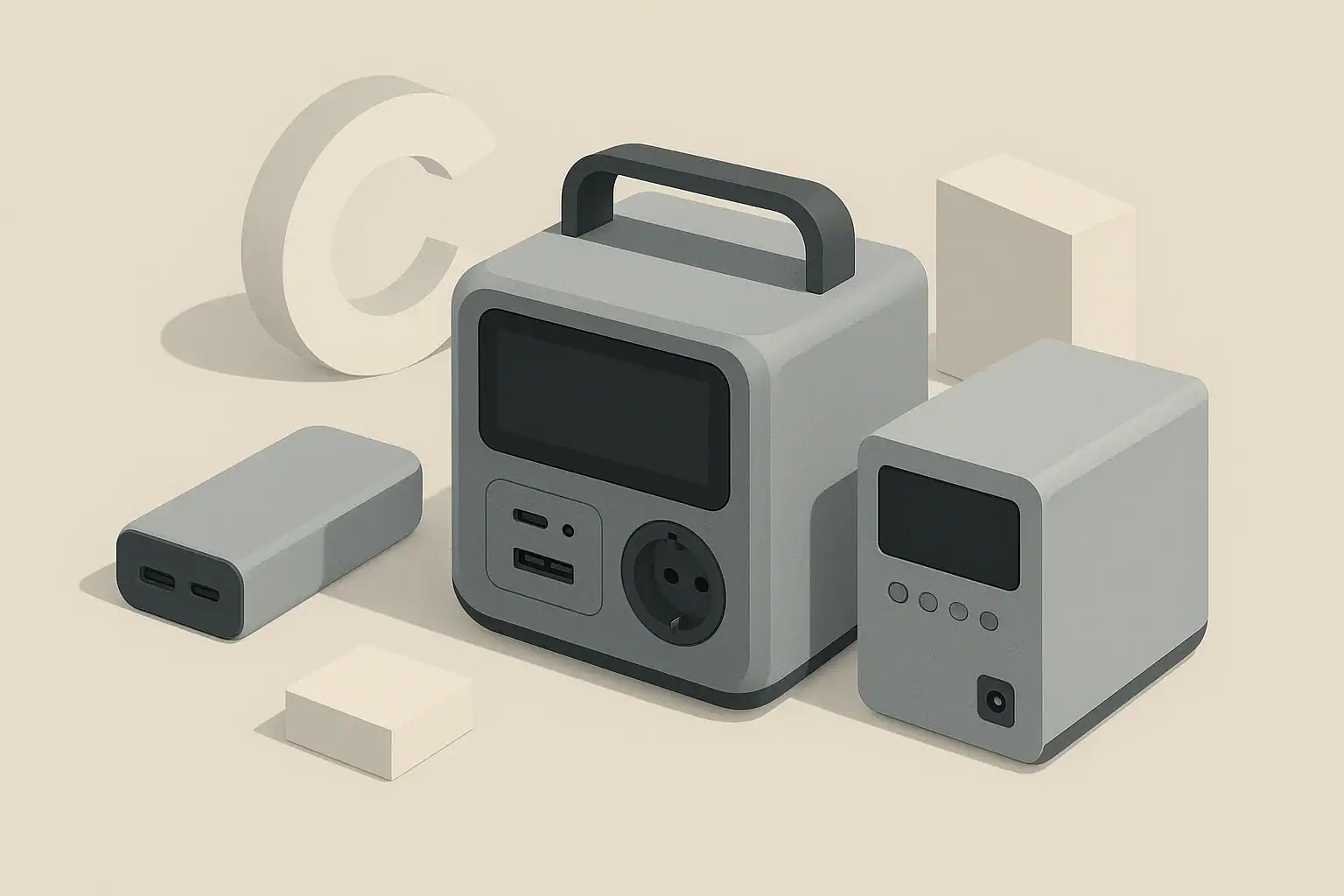
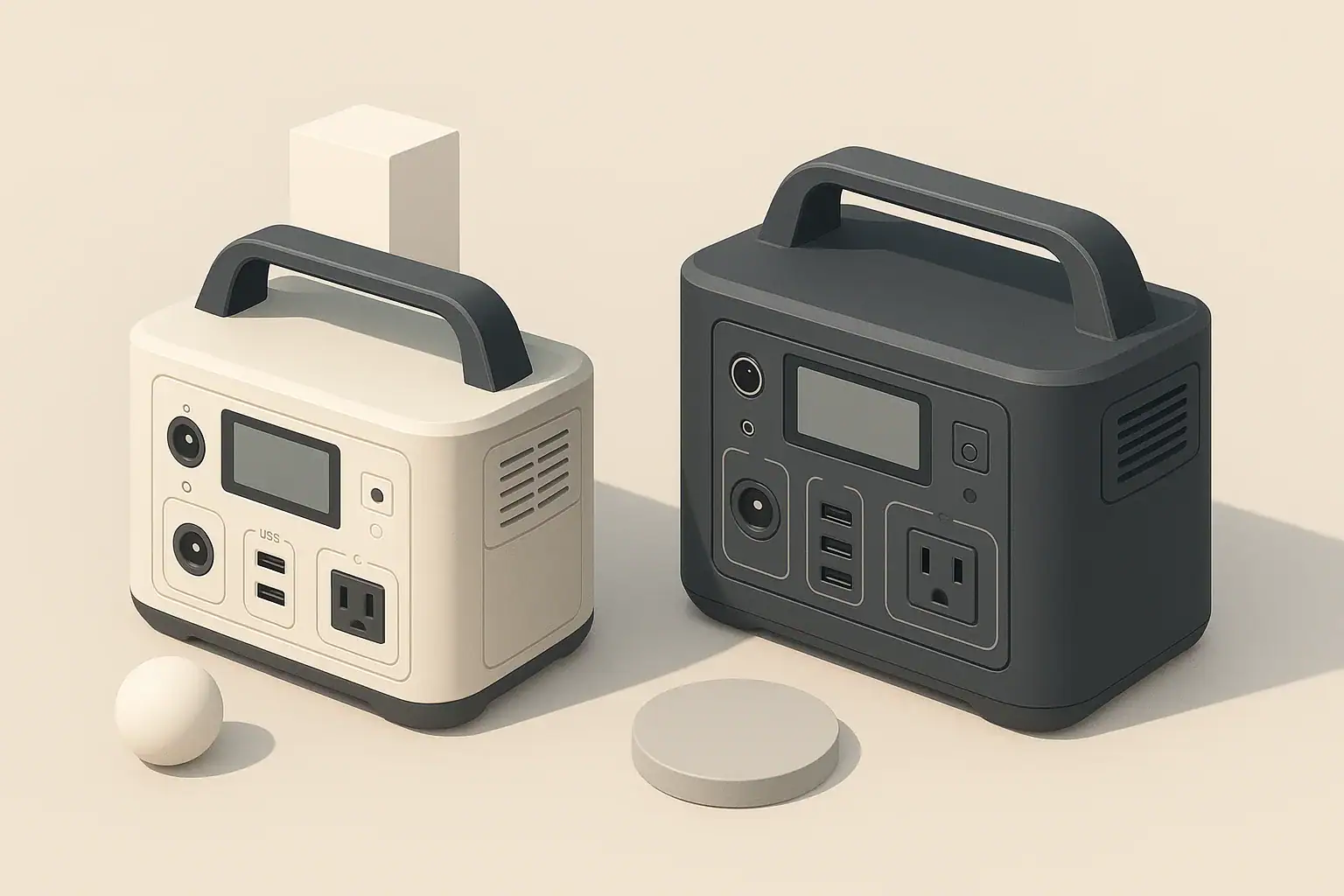
Isometric illustration comparing power bank portable power station and UPS

What the topic means (plain-English definition + why it matters)

Portable power station vs power bank vs UPS sounds like three versions of the same thing, but each one solves a different problem. All are ways to keep electricity available when a wall outlet is not an option or when power is unreliable, yet they differ in capacity, output type, and how they behave during outages.

A power bank is usually a small, lightweight battery pack designed mainly to charge phones, tablets, earbuds, and sometimes laptops over USB or USB-C. A portable power station is a larger, self-contained unit with a built-in battery and inverter that can provide AC outlets, DC outputs, and USB ports to run appliances, tools, and electronics. A UPS, or uninterruptible power supply, is a backup device that sits between the wall outlet and your equipment and switches to battery automatically if grid power drops.

Understanding the difference matters because each category is optimized for a different use case. For travel and day-to-day mobile use, overbuying a large power station may be expensive and inconvenient. For home backup or camping, relying only on a small power bank can leave you without enough power for essentials. For sensitive electronics that must never drop out, such as desktop computers or networking gear, a UPS behaves differently than a typical portable power station.

Choosing correctly starts with two questions: what do you need to power, and for how long? From there, you can match the right type of device and size it appropriately using basic concepts like watts, watt-hours, surge vs running load, and overall system efficiency.

Key concepts & sizing logic (watts vs Wh, surge vs running, efficiency losses)

Power banks, portable power stations, and UPS units are all limited by two key numbers: how fast they can deliver power and how much total energy they can store. The rate of power delivery is measured in watts (W). The energy stored in the battery is measured in watt-hours (Wh). Many confusion issues come from mixing up these two values or ignoring efficiency losses between the battery and the device being powered.

Watts describe how much power a device needs at any moment. For example, a phone might draw 10 W while fast charging, a laptop 60 W, and a small space heater 1000 W. A power station or UPS must be rated to supply at least the total watts of all devices running at the same time. If you exceed that rating, the unit may shut off or refuse to start a high-demand appliance. This is especially important for portable power stations and UPS units with AC outlets.

Watt-hours describe how long you can run a given load. If a portable power station has a 500 Wh battery and you run a 100 W device, ignoring losses, you might expect around 5 hours of runtime (500 Wh / 100 W). In reality, inverter and conversion losses reduce usable runtime, so planning with a safety margin is wise. With power banks, the same logic applies, but at lower power levels and usually rated in milliamp-hours (mAh), which can be converted to Wh for consistent comparisons.

Surge vs running power is another key concept. Some devices, especially those with motors or compressors, draw a higher surge current when starting, then settle to a lower running wattage. A portable power station or UPS usually lists both continuous (running) watts and a higher surge rating. The surge rating helps determine whether the unit can start a fridge or power tool briefly, while the continuous rating ensures it can keep that load running safely. Efficiency losses in inverters and DC-DC converters typically mean you can expect around 80–90% of the battery’s rated Wh as usable AC energy under real conditions.

Choosing between a power bank, portable power station, and UPS. Example values for illustration.
Need / Situation Better Fit Why Example considerations
Daily phone & tablet charging on the go Power bank Small, light, optimized for USB Capacity in Wh or mAh, number of USB ports, airline rules
Weekend camping with small appliances Portable power station AC outlets plus DC/USB, higher capacity Total watts of devices, Wh needed for hours of use per day
Brief home outages for internet and laptops Portable power station or UPS Both can run electronics; UPS gives instant switchover Runtime target in hours, surge vs running load from router and PC
Protecting desktop PC from sudden shutdowns UPS Automatic, seamless transfer on power loss VA/W rating of UPS vs PC and monitor, expected outage duration
Remote work in an RV or van Portable power station Flexible charging (wall, car, solar), multiple outputs Daily Wh consumption, charging time from vehicle or solar
Short backup for critical medical-related devices UPS plus consultation Continuous power and professional guidance Discuss with a professional for sizing, safety, and redundancy
Traveling by air with backup power Power bank Easier to meet typical airline battery limits Check capacity limits in Wh and rules on carrying batteries

Real-world examples (general illustrative numbers; no brand specs)

Thinking in real-world terms helps clarify what each device can realistically do. As an example, a compact power bank might store around 20–30 Wh of energy. That could recharge a typical smartphone one to two times, depending on the phone battery size and charging losses. For a tablet or laptop, that same power bank might only provide a partial charge or one light-use session before needing to be recharged itself.

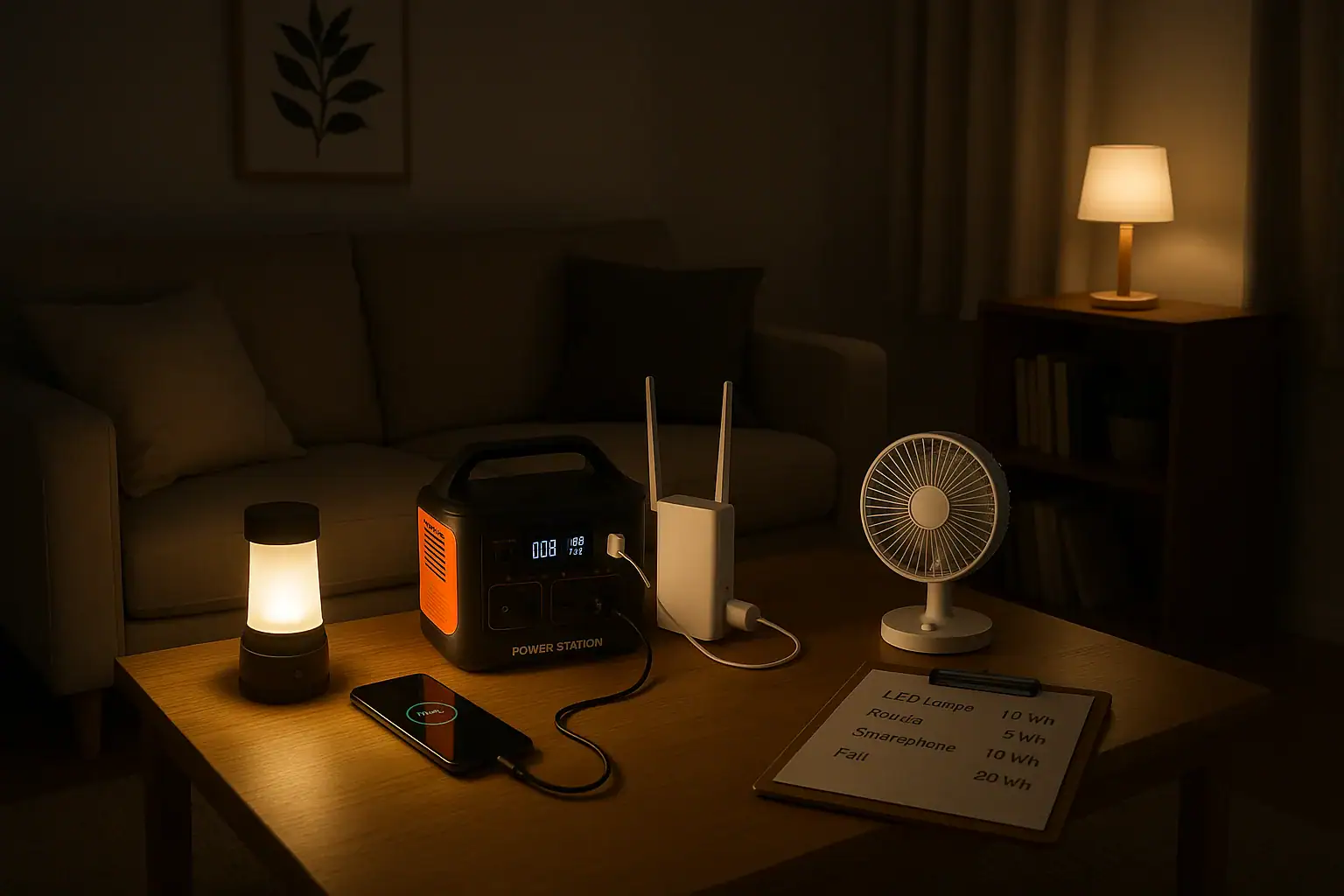
A mid-sized portable power station might store several hundred watt-hours. Suppose one has 500 Wh of nominal capacity. Running a 50 W laptop plus a 10 W router and a 5 W LED light totals about 65 W. In theory, 500 Wh / 65 W suggests around 7–8 hours of runtime. Allowing for conversion losses, a reasonable expectation might be closer to 5–6 hours. If you only used the router and laptop for a few hours a day, you might stretch that across more than one day between charges.

Now consider a basic home office UPS with, for example, around 200–300 Wh of usable energy. Used to support a 150 W desktop computer and monitor, you might get 1–2 hours of runtime at most, often less, because many UPS units are designed to bridge short outages and give enough time to save work and shut down, not provide all-day power. On the other hand, the same UPS on a 10–20 W modem and router could potentially keep internet up for several hours during a short outage.

For camping, pairing a portable power station with solar can extend runtime significantly. If a station has 500 Wh and you use 250 Wh per day for lights, a small fan, and charging devices, a solar panel providing around 200–300 Wh of energy on a good day could nearly replace what you used. Actual results vary with weather, panel orientation, temperature, and system losses, so planning with conservative estimates and backup charging from a car or wall outlet remains important.

Common mistakes & troubleshooting cues (why things shut off, why charging slows, etc.)

Many frustrations with power banks, portable power stations, and UPS units trace back to sizing or usage assumptions. One common mistake is focusing only on battery capacity while ignoring output limits. A portable power station might have enough Wh to run a device for hours, but if the inverter cannot handle the device’s surge power, it may shut down immediately when you turn that appliance on. This is especially noticeable with refrigerators, pumps, and some power tools.

Another frequent issue is underestimating conversion losses. People sometimes calculate runtime as battery Wh divided by device watts and expect that number of hours. In practice, inverters and voltage converters generate heat and waste some energy. If a device shuts off earlier than expected, it may not be a fault; it can simply be normal efficiency loss plus any additional overhead from internal cooling fans and displays.

Slow charging or charging that stops prematurely can have several causes. With power banks, small or low-quality cables, limited USB power profiles, or using the wrong port can reduce charging speed. On portable power stations, input limits from wall, car, or solar charging can cap how fast you can refill the battery. If solar charging seems weak, shading, poor panel angle, high temperatures, or clouds often reduce actual output far below the panel’s nameplate rating.

With UPS units, users sometimes assume they can plug in multiple high-wattage devices without issue. When a UPS is overloaded, it may beep, display an overload indicator, or shut down to protect itself. If the UPS seems to drop power instantly during an outage, it may already be overloaded in normal operation, leaving no margin. Checking the VA/W rating of the UPS against the total load and unplugging nonessential items during outages can help.

Safety basics (placement, ventilation, cords, heat, GFCI basics at a high level)

Safety considerations are similar across power banks, portable power stations, and UPS devices, but the stakes increase with size and power level. All of them contain batteries and electronic circuits that can generate heat, so they should be used on stable, dry surfaces with adequate airflow. Covering vents or stacking items on top of units can trap heat and stress internal components.

Placement matters. Avoid using portable power stations or UPS units in wet or excessively dusty environments, or where they can be splashed. For outdoor use, they should be kept under cover, away from direct rain or standing water. Power banks should be kept out of pockets or bags where sharp objects could damage them, and none of these devices should be left in hot cars where interior temperatures can exceed recommended limits.

Extension cords and power strips can introduce additional risk. Overloading a cord by running high-wattage appliances, chaining multiple strips together, or using damaged cables can lead to overheating. For powered AC outlets on a portable power station, use cords rated for the loads you are running and inspect them periodically for cuts, loose plugs, or discoloration. GFCI protection in wet or outdoor areas is important for shock protection; if you need to power loads in damp locations, using outlets or adapters with built-in GFCI protection and following applicable codes reduces risk.

Finally, do not attempt to integrate these devices directly into your home’s electrical panel or hardwire circuits without a qualified electrician. Backfeeding power improperly can endanger utility workers and damage equipment. If you want a more permanent backup configuration, such as using a portable power station or UPS to supply selected home circuits, consult a licensed electrician about appropriate transfer equipment and safe connection methods.

Maintenance & storage (SOC, self-discharge, temperature ranges, routine checks)

Routine care extends the life and reliability of power banks, portable power stations, and UPS units. Batteries slowly lose charge over time even when not in use, a behavior known as self-discharge. Checking state of charge (SOC) periodically helps ensure that your backup power is ready when needed. Many devices include indicators that show approximate charge levels; keeping them within a moderate range is generally better than leaving them at empty or full for long periods.

Temperature has a major impact on battery performance and longevity. Most consumer devices are designed to be stored and used within moderate temperature ranges. Very cold conditions can temporarily reduce available capacity and power output, while high heat can permanently age the battery faster. For cold-weather use, it is often better to keep devices and batteries in insulated spaces and only bring them into colder environments when needed, allowing them to warm back up before recharging.

For portable power stations and UPS units, periodic functional checks are useful. Testing them under light load every few months confirms that the inverter, outlets, and internal electronics still operate as expected. Many UPS units also have self-test functions and replaceable batteries that need attention after a number of years. Recording the installation date, approximate test dates, and any warnings or alarms can help you plan battery replacement or service before a failure occurs.

Storage practices matter as well. Avoid storing any of these devices fully discharged for long periods, and do not leave them permanently plugged in if the manufacturer advises against it. Light topping up every few months, avoiding extreme temperatures, and keeping vents and ports clean and dust-free can support both performance and safety over the life of the product.

Example maintenance and storage planning timeline. Example values for illustration.
Time interval Action Applies to Notes
Every month Quick visual inspection for damage or swelling Power banks, power stations, UPS Check cases, ports, and cords; stop using if damaged
Every 2–3 months Top up charge if stored and below mid-level Power banks, power stations Aim for a moderate SOC when in long-term storage
Every 3–6 months Test under light load for 10–20 minutes Portable power stations, UPS Confirm outlets, inverters, and indicators work correctly
Seasonal Adjust storage location for temperature extremes All devices Move away from hot attics or unheated sheds if needed
Every 1–2 years Review runtime vs original expectations Portable power stations, UPS Shorter runtimes can indicate aging batteries
Manufacturer’s suggested interval Replace internal battery or UPS battery pack UPS, some power stations Follow documentation or seek professional service if required
Before major trips or storm seasons Fully charge and test critical backup units Power banks, power stations, UPS Verify cables and adapters are ready and labeled

Practical takeaways (non-salesy checklist bullets, no pitch)

Choosing between a portable power station, power bank, and UPS is simpler when you match the device to your actual needs rather than the largest or most feature-rich option. For daily mobile use, a power bank typically covers phones, tablets, and light USB-C laptop charging. For camping, vanlife, and home essentials during brief outages, a portable power station with AC, DC, and USB outputs usually offers the right balance of capacity and flexibility. For sensitive electronics that cannot lose power abruptly, a UPS provides automatic switchover and surge protection.

Once you decide which category fits your situation, sizing comes down to basic math and realistic expectations. Estimate the watts of what you want to run, multiply by hours to get watt-hours, then add a margin for conversion losses. Consider how you will recharge: wall outlet between outages, vehicle charging while driving, or solar during the day. Finally, factor in safety, maintenance, and storage practices so that your backup power is reliable when you actually need it.

  • List the devices you want to power and note their watt ratings.
  • Decide how many hours of runtime you want for each device or group.
  • Calculate estimated Wh needs and add a buffer for losses and growth.
  • Match the device type: power bank for small electronics, portable power station for mixed loads and AC, UPS for seamless backup.
  • Plan a realistic recharging strategy for home, travel, and emergencies.
  • Store and use devices within recommended temperature ranges.
  • Test backup systems periodically so you are not surprised during an outage.

By approaching the choice methodically and keeping expectations grounded in basic power concepts, you can select the right mix of power bank, portable power station, and UPS to cover everyday tasks, remote work, and unplanned outages without overcomplicating your setup.

Frequently asked questions

Can I use a power bank to run a laptop or small appliance?

Power banks intended for USB devices can run many laptops that accept USB-C Power Delivery if the bank’s output wattage matches the laptop’s input. Small AC appliances and high-draw devices typically require an inverter and higher continuous wattage, so a portable power station is usually the appropriate choice for those loads.

Will a portable power station switch over instantly during a grid outage like a UPS?

Most portable power stations do not provide the instantaneous transfer that a UPS is designed for; some have a brief transfer time which can interrupt sensitive equipment. If you need seamless, no-drop switching for a desktop, server, or networking gear, choose a UPS specifically rated for that use.

How do I size a portable power station to keep my router and laptop running overnight?

Add the continuous wattage of each device to get a total load, then multiply by the number of hours you want to run them to calculate required watt-hours (Wh). Include a 10–25% buffer for inverter and conversion losses and pick a station with at least that usable Wh capacity and an AC output able to handle the combined wattage.

Are portable power stations and power banks safe to use indoors and while charging?

Yes, when used according to manufacturer guidance: keep vents clear, use on stable dry surfaces, avoid extreme temperatures, and use proper charging cables and adaptors. Larger units can get warm; do not cover vents or place them in confined, unventilated spaces, and follow any specific storage and charging recommendations to reduce fire or thermal risks.

Can I bring a power bank or portable power station on an airplane?

Small power banks that meet airline lithium battery limits and are carried in the cabin are commonly allowed, but rules vary so always check the airline’s policy and declare batteries if required. Larger portable power stations often exceed carry-on limits and are frequently prohibited or restricted, so confirm airline and regulatory guidance before traveling.

Neutral-Ground Bonding Explained for Portable Power Stations: When It Matters (and When It Doesn’t)

portable power station on indoor table with tidy cords

Neutral-ground bonding describes the electrical relationship between the neutral conductor and the equipment grounding path in an AC power system. In most permanent home wiring in the United States, the neutral and ground are bonded together at a single point in the main service panel. That bond defines what is considered 0 volts, and it provides a low-resistance return path that allows protective devices like breakers and fuses to operate quickly during a fault.

Portable power stations also produce AC output, usually 120V at 60Hz, but they do not always treat neutral and ground the same way a home electrical panel does. Some units have a floating neutral, where neutral is not bonded to ground inside the device. Others provide a bonded neutral internally or via a special adapter. This design choice affects how certain safety devices behave, especially GFCI outlets, surge protectors, and transfer switches.

Understanding neutral-ground bonding matters because it can explain why some loads trip, why a GFCI might not work as expected, or why a power station manual warns against certain connection methods. For typical plug-in use, such as running small appliances, lights, or electronics directly from the outlets on the power station, the internal bonding scheme is usually already accounted for by the manufacturer. Concerns grow mainly when users start connecting a power station into larger wiring systems, such as RV distribution panels or home backup setups.

In short, neutral-ground bonding is about how the reference point of the AC output is defined and how faults are cleared. Most everyday users never have to modify anything, but knowing what it is—and when not to interfere with it—helps you operate a portable power station more safely and more predictably.

What the topic means (plain-English definition + why it matters)

Key concepts & sizing logic (watts vs Wh, surge vs running, efficiency losses)

Neutral-ground bonding does not change how much power a portable power station can supply, but sizing still matters for safely running the things you care about. Two related ratings are important: watts and watt-hours. Watts describe power, or how fast energy is used at a moment in time. Watt-hours describe total stored energy, or how long the power station can sustain a load before the battery is depleted.

Running watts are the continuous power your devices draw during normal operation, while surge watts are the short spikes that occur when motors, compressors, or power supplies start up. A refrigerator, for example, might run at a few hundred watts but briefly surge to several times that when the compressor kicks on. The inverter in the power station must tolerate those surges without shutting down. Neutral-ground bonding does not increase capacity; it only affects how the AC waveform relates to ground and safety protection devices.

Efficiency losses also play a role in realistic runtime. Converting DC battery energy to AC output involves inverter losses, often around 10–15% depending on load level. There can be additional losses in any extension cords, adapters, or power strips. These inefficiencies mean that you rarely get the full, labeled watt-hour capacity in usable AC energy. When planning runtimes, it is helpful to assume that only a portion of the rated capacity is practically available.

When portable power stations are connected to other systems—such as an RV, a power strip with surge protection, or a transfer device for selected home circuits—neutral-ground bonding and sizing interact indirectly. For example, undersizing a power station for a load that frequently surges can cause frequent inverter shutdowns, and if those loads are on GFCI outlets or other protective devices, misinterpreted bonding can complicate troubleshooting. A well-sized unit, with appropriate cords and a clear understanding of how the neutral is treated, tends to run more reliably.

Neutral-ground and sizing checklist – Example values for illustration.
Checklist for planning AC loads on a portable power station
What to check Why it matters Example guidance (not limits)
Total running watts of planned loads Avoids continuous overload of the inverter Keep total running load at or below about 70–80% of inverter rating
Largest motor or compressor surge Prevents shutdowns when devices start Choose a power station whose surge rating comfortably exceeds the biggest single start-up load
Approximate daily energy use (Wh) Helps estimate runtime between charges Compare your expected daily Wh to roughly 70–85% of battery capacity for AC use
Neutral-ground bonding behavior Affects compatibility with GFCI outlets and transfer devices Check the manual for floating vs bonded neutral notes and any adapter requirements
Extension cord type and length Impacts voltage drop and heat buildup Use appropriately sized, outdoor-rated cords for higher loads and longer runs
Use with RV or home circuits Incorrect bonding can be unsafe Do not alter bonding yourself; consult a qualified electrician for any panel or transfer switch work
Environment temperature Influences battery performance and inverter limits Expect shorter runtimes and reduced charging performance in very hot or cold conditions

Real-world examples (general illustrative numbers; no brand specs)

Consider a common scenario: running a few home essentials during a short outage. Suppose you want to power a refrigerator, a Wi-Fi router, a few LED lights, and charge some electronics. The refrigerator might average around 150 watts with a surge of several hundred watts when the compressor starts. The router and lights together may use 30–50 watts, and electronics charging another 30–60 watts. In this case, the total running load might be around 250 watts, with a startup surge under 800 watts.

If your portable power station’s inverter can handle 1,000 watts continuous with a higher surge rating, this setup should be within its comfort zone. Assuming a 1,000 watt-hour battery and about 80% practical AC efficiency, you might expect roughly 800 usable watt-hours. At 250 watts average draw, that suggests around three hours of runtime before needing to recharge. Neutral-ground bonding will not change that runtime, but it will influence how this power station behaves if you plug it into a household circuit selector or a transfer device instead of plugging loads directly into the unit.

Another example is remote work in an RV or van. You might run a laptop (60 watts), a monitor (40 watts), some interior LED lighting (20 watts), a small fan (30 watts), and a low-draw router or hotspot (15 watts). That totals around 165 watts of running load. On a 500 watt-hour battery with similar efficiency assumptions, you may get roughly 3–4 hours of use before recharging. In this mobile scenario, neutral-ground bonding becomes relevant if you plug the power station into the RV’s shore-power inlet. Many RVs bond neutral and ground at the distribution panel or at the plug connection, and combining this with a bonded-neutral power station can create multiple bonds, which is something an electrician or RV technician should evaluate.

For camping, you might only be powering a cooler, lights, and phone charging, staying under 150 watts most of the time. A moderate-size power station could realistically keep those loads running through an evening or overnight. Here, neutral-ground bonding mostly matters when adding devices like portable GFCI strips near water or using the power station inside a tent or small camper. A floating neutral design can reduce shock risk relative to earth in some situations, but it behaves differently than a home circuit if a fault occurs. Following the manufacturer’s guidance on where the unit should be placed and how cords are routed is more important than trying to change how the neutral is bonded.

Common mistakes & troubleshooting cues (why things shut off, why charging slows, etc.)

One common mistake is assuming that every portable power station behaves exactly like a household receptacle. In reality, many have internal protections that shut down the inverter under conditions that would not necessarily trip a standard home breaker. These include overloads, sustained surges, internal temperature limits, or certain fault conditions detected on the output. If your devices suddenly turn off, the unit may have detected too much combined load, a short, or a spike that exceeded inverter limits.

Charging can also slow or pause unexpectedly. When the battery reaches a higher state of charge, most power stations reduce charging power to protect battery health, which can make the last portion of charging take longer than the first. High ambient temperatures or blocked ventilation can cause thermal throttling on both charging and discharging. Neutral-ground bonding does not cause slower charging, but if you are using complex power strips or surge protectors while the unit is charging and powering loads, extra heat and minor voltage drops in cords can add to stress on the system.

Another confusion point appears when using GFCI-protected outlets or transfer devices. Some GFCI testers assume a specific relationship between neutral and ground. On a floating-neutral power station, plug-in testers may show readings that look “wrong” compared to a home circuit, even though the power station is functioning as designed. Similarly, a transfer device that expects a bonded neutral might not behave correctly when fed by a floating-neutral source, or vice versa. Without changing anything internally, the safe approach is to follow the power station manual and have a qualified electrician evaluate any permanent or semi-permanent connection to a panel, RV distribution system, or transfer switch.

A final common mistake is improvising neutral-ground bonding adapters or modifying plugs to “fix” nuisance tripping. Defeating built-in protections or creating unapproved bonds can introduce shock and fire hazards, especially in wet locations or with long extension cords. If you see frequent shutdowns, tripping, or odd behavior from protective devices, treat those as troubleshooting cues: reduce the load, simplify the cord and strip setup, move the power station to a cooler and drier area, and consult the device documentation rather than bypassing safety features.

Safety basics (placement, ventilation, cords, heat, GFCI basics at a high level)

Safe placement is the foundation of using a portable power station, regardless of how the neutral and ground are handled. Position the unit on a stable, dry surface with enough clearance for air to flow around vents. Avoid enclosed spaces where heat can build up, such as tightly packed cabinets or under piles of fabric. Heat accelerates wear on electronic components and batteries, and it can trigger automatic shutdowns or derating while the device protects itself.

Cords and extension cables should be rated appropriately for the load, length, and environment. Undersized cords can overheat, especially with higher-wattage appliances or in hot conditions. Avoid daisy-chaining multiple power strips, and keep cords out of walkways to prevent tripping and accidental unplugging. If you must run cords outdoors, use outdoor-rated cables and keep connection points off the ground and away from standing water. Good cord management is just as important as understanding neutral-ground bonding in preventing shocks and equipment damage.

From a GFCI perspective, think of portable power stations as a unique kind of source. Built-in outlets may or may not include GFCI protection, and external GFCI devices may respond differently depending on whether the power station has a floating or bonded neutral. GFCIs work by monitoring the balance of current between hot and neutral; they are designed to trip when a small imbalance suggests current is flowing to ground through an unintended path, such as water or a person. The presence or absence of a neutral-ground bond can influence how quickly or reliably they detect certain fault conditions.

Because of that, treat wet locations with extra caution. Use equipment rated for damp or wet environments, keep the power station itself away from splashes, and avoid touching conductive surfaces when handling plugs near water. Do not attempt to change internal bonding to “match” household behavior. Instead, rely on properly rated cords and devices, and seek professional help for any applications involving permanent wiring, transfer equipment, or complex RV systems.

Maintenance & storage (SOC, self-discharge, temperature ranges, routine checks)

Good maintenance practices help keep both the inverter electronics and the battery in healthy condition. Most portable power stations benefit from being stored at a partial state of charge, commonly somewhere in the mid-range rather than at 0% or 100% for long periods. Storing fully charged or completely drained for months can accelerate cell aging. Check the manufacturer’s guidance for the preferred storage range, and aim to top up the battery periodically to stay within those recommendations.

Self-discharge occurs even when the unit is turned off. Internal electronics and the chemistry of the cells slowly reduce the state of charge over time. In many cases, checking and recharging every three to six months is enough to keep the battery ready for use, though more frequent checks may be wise if you live in a very hot or cold climate. Neutral-ground bonding does not affect self-discharge, but periodically exercising the inverter by powering moderate loads can help confirm that the AC output, including any ground-fault or bonding-related behavior, still functions normally.

Temperature is another critical factor. Extreme heat can permanently reduce battery capacity, while extreme cold can temporarily reduce available power and slow charging. Storing your power station in a climate-controlled space when not in use is ideal. Avoid leaving it in a hot vehicle or unconditioned shed for extended periods. If you need to operate the unit in cold weather, allow it to warm gradually to a moderate temperature before charging at high rates, and expect shorter runtimes compared to mild conditions.

Routine checks should include inspecting cords and plugs for nicks, loose blades, or discoloration; ensuring vents are free of dust and debris; and verifying that outlets still hold plugs firmly. If you use the power station with RV or home systems, periodic professional inspection of those connection points is wise. Never open the power station enclosure or attempt to modify internal bonding or wiring. Internal maintenance and any bonding changes belong in the hands of the manufacturer or qualified service technicians.

Storage and maintenance planner – Example values for illustration.
Typical maintenance and storage considerations for portable power stations
Item What to do Example interval or condition
State of charge before storage Store at a moderate charge level, not empty or full Roughly 40–60% charge for multi-month storage
Periodic top-up charge Recharge to the recommended range if SOC drifts low Check every 3–6 months or before storm seasons
Temperature during storage Keep in a cool, dry, well-ventilated space Avoid prolonged storage in very hot vehicles or direct sun
AC outlet and cord inspection Check for loose outlets, damaged cords, or heat marks Before and after heavy use or seasonal use
Vent and fan cleanliness Gently remove dust to maintain airflow Inspect every few months or in dusty environments
Functional test of inverter Power a small AC load to confirm operation Every few months and before trips or outages
RV or home connection points Have wiring and bonding evaluated when in doubt Consult a qualified electrician for any changes or issues

Example values for illustration.

Practical takeaways (non-salesy checklist bullets, no pitch)

Neutral-ground bonding in portable power stations is mostly about compatibility and safety, not about how much power you have. For everyday plug-in use, you typically do not need to alter or customize anything; the device is designed to handle its own bonding scheme internally. Problems arise when users try to make the power station behave exactly like a home panel or generator without understanding how it is built.

For planning, focus on realistic power needs, appropriate cords, and a clear idea of where and how you will use the power station. When your setup involves anything beyond plugging devices directly into the unit—such as RV shore-power inlets, transfer devices, or complex surge strips—treat neutral-ground bonding as a flag that professional advice may be warranted. The goal is to maintain a single, properly located bond point and preserve the function of protective devices.

Use the following checklist as a quick reference when planning or reviewing your setup:

  • Identify your key loads and estimate both running and surge watts before choosing or using a power station.
  • Stay within a comfortable margin of the inverter’s continuous rating to reduce shutdowns and heat.
  • Use appropriately rated, shortest-practical extension cords and avoid daisy-chaining strips and adapters.
  • Place the power station on a stable, dry surface with good ventilation, away from direct sun and moisture.
  • Do not attempt to add or remove neutral-ground bonds yourself; follow the manual and use a qualified electrician for any panel, RV, or transfer connections.
  • For wet or outdoor use, rely on properly rated equipment and cautious cord routing rather than bypassing GFCI or other protections.
  • Store the unit at a moderate state of charge, check it periodically, and keep it in a temperature-controlled environment when possible.
  • Treat any unusual tripping, shutdowns, or tester readings as a cue to simplify the setup and, if needed, seek expert help.

By keeping these points in mind, you can use neutral-ground bonding as a concept to inform safer decisions without needing to modify the power station itself or compromise its built-in protections.

Frequently asked questions

What’s the difference between a floating neutral and a bonded neutral in a portable power station?

A floating neutral is not tied to the equipment grounding conductor inside the unit, while a bonded neutral connects neutral to ground at a single point inside the device. This changes the reference of the AC output and can affect how protective devices detect faults and how plug-in testers report wiring. Neither design is inherently unsafe when used as intended, but compatibility with external panels, GFCIs, and transfer equipment differs.

When should I worry about neutral-ground bonding when connecting a power station to an RV or home backup system?

Worry about bonding when the power station is tied into any larger wiring system—such as an RV shore inlet, a transfer switch, or a home subpanel—because multiple bond points or unexpected bonding schemes can create unwanted fault currents and protective-device issues. Before making semi-permanent connections, consult the power station manual and have a qualified electrician verify that there will be a single, correct bond point. For simple plug-in use of the unit’s own outlets, bonding is usually already handled by the manufacturer.

Can I use a neutral-ground bonding adapter to stop nuisance GFCI trips?

No. Using adapters or creating an aftermarket bond can defeat built-in protections and create shock or fire hazards by introducing multiple or improper bond points. Instead of using an adapter, simplify the setup, reduce leakage paths, and consult the manufacturer or an electrician to address nuisance tripping safely. Repeated nuisance trips are a troubleshooting cue, not a reason to defeat safety features.

How does neutral-ground bonding affect GFCIs and plug-in testers?

Neutral-ground bonding can change how plug-in testers display wiring status and how external GFCI devices respond; a floating neutral may make a tester show nonstandard readings even when the output is safe. GFCIs detect imbalance between hot and neutral, so they still provide protection, but their behavior and nuisance-trip susceptibility can vary depending on bonding and any leakage paths. Treat unusual tester results as a sign to follow the manual and seek professional evaluation for permanent connections.

Do I need a licensed electrician to change bonding or connect my power station to household wiring?

Yes. Any work that alters neutral-ground bonding, modifies panels, or connects backup power into household or RV distribution systems should be done by a qualified electrician. Incorrect bonding or DIY changes can impair protective devices and create serious safety risks. For plug-in portable use, no electrician is typically required; for transfer switches, shore power inlets, or panel ties, get professional help.

VA vs Watts Explained for Portable Power Stations: Computers, Power Supplies, and UPS Confusion

Portable power station with abstract energy blocks in isometric view

When choosing backup or portable power for computers, home offices, or outdoor work, people often encounter two different measurements that seem interchangeable but are not: VA and watts. This article walks through the practical differences, how they show up on UPS units, power supplies, and portable power stations, and what that means for sizing and real-world use. Read this overview to learn how to convert between rated values, estimate runtimes, and avoid common mistakes that lead to unexpected shutdowns or shortened battery life. The guidance is aimed at helping you pick the right inverter size and battery capacity, account for surge needs, and keep equipment protected and properly ventilated. No product endorsements are included — just clear, actionable explanations and examples to make decisions easier for remote work, camping, or emergency preparedness.

What the topic means (plain-English definition + why it matters)

When you compare portable power stations, computer power supplies, and UPS units, you see two different ways of describing power: watts (W) and volt-amperes (VA). They sound similar, but they are not the same thing. Understanding the difference helps you size a portable power station correctly and avoid overloading its inverter or your connected devices.

Watts measure the real power a device actually uses to do work, like running your laptop or monitor. VA describes apparent power, which is the product of voltage and current without considering how efficiently that power is used. Many computer power supplies and UPS units are rated in VA because they deal with complex loads that do not draw power in a simple way.

Portable power stations almost always advertise their inverter output in watts and their battery capacity in watt-hours. UPS units often advertise capacity in VA and also list a lower watt rating. This mix of VA and watts can create confusion when you try to figure out whether a portable power station can replace or supplement a UPS, or how long it can keep your computer running in a power outage.

Knowing how VA relates to watts, and how both relate to watt-hours, helps you estimate runtime, choose which devices you can safely plug in, and recognize why a power station or UPS might shut off unexpectedly. It is especially important when you rely on portable power for remote work, home office backups, or short power outages.

Key concepts & sizing logic (watts vs Wh, surge vs running, efficiency losses)

Watts describe how much instantaneous power a device needs to run. If a laptop charger is labeled 60 W, it can draw up to about 60 watts from the outlet. Portable power stations rate their AC inverter output in watts, usually with a continuous (running) watt rating and a higher surge rating for short bursts of extra load.

VA comes from multiplying voltage by current (for example, 120 V × 5 A = 600 VA). For purely resistive loads like many heaters, VA and watts are nearly the same. For electronics such as computers and monitors, power factor enters the picture. A power supply might be rated 600 VA but only 360 to 480 W of real power, depending on its power factor. Many UPS units list both values, such as 600 VA / 360 W.

Battery capacity is usually given in watt-hours (Wh). Watt-hours describe how much energy is stored, not how fast it can be delivered. To estimate runtime, you compare watt-hours to the watts your devices draw. A simple approximation is: runtime in hours ≈ (battery Wh × efficiency factor) ÷ load watts. The efficiency factor accounts for inverter and electronics losses, which often means you only get around 80 to 90% of the listed capacity when running AC loads.

Surge versus running watts matters for devices that briefly draw more power when starting up, like some desktop computer power supplies or small compressors. A power station’s surge rating allows it to handle that short spike without shutting down. However, you still need to keep the steady, running watt load under the continuous rating. If you size only by surge, you risk tripping the inverter once everything is running together.

Checklist-style decision matrix for sizing portable power station output and capacity. Example values for illustration.
Decision matrix for watts, VA, and Wh sizing
What you are decidingWhat to checkWhy it mattersExample guideline (not a limit)
Can the inverter handle the load?Sum of device watt ratingsInverter overload can cause shutdownKeep total running watts at or below 70–80% of inverter continuous rating
Can it handle startup surges?Devices with motors or high inrush (e.g., some desktops)Startup spikes may exceed surge ratingAllow extra 20–50% headroom if you expect surges
UPS to power station comparisonUPS VA and W vs device WVA is higher than usable wattsUse the UPS watt rating, not VA, when comparing to inverter watts
Rough runtime estimatePower station Wh and load wattsDetermines how long you can run devicesRuntime (h) ≈ Wh × 0.8 ÷ load W for AC devices
Running laptops and small electronicsTotal charger wattage plus overheadPrevents overloading smaller invertersFor a 300 W inverter, stay near or under 200–220 W continuous
Adding more devices laterFuture devices you might plug inHelps avoid outgrowing the power stationReserve 20–30% inverter and capacity margin for expansion
Choosing DC vs AC outputsWhether a DC or USB output is availableDC is usually more efficient than going through the inverterPrefer DC/USB for laptops and phones when possible

Real-world examples (general illustrative numbers; no brand specs)

Consider a home office setup with a laptop (65 W charger), a monitor (30 W), and a small internet router (10 W). If everything is running at or near maximum draw, that is about 105 W total. A portable power station with a 300 W inverter can easily handle this load. If the battery is around 500 Wh, and you assume about 80% usable capacity with inverter losses, you might see roughly (500 × 0.8) ÷ 105 ≈ 3.8 hours of runtime, depending on actual usage and power-saving features.

Now compare that to a small UPS labeled 600 VA / 360 W. If your computer system really draws only 150 W while you work, the UPS has a comfortable margin and can bridge short outages for several minutes to perhaps an hour, depending on its internal battery size. If you tried to equate 600 VA directly to 600 W and plugged in too many devices, you could overload the UPS even though you stayed below 600 in your calculations. The true limit is the watt rating, not the VA rating.

For a portable power station used during a brief power outage, you might prioritize your internet router (10 W), LED lighting (20 W), and a laptop (40 W average while in use). That is about 70 W. On a 300 Wh unit, with 80% effective capacity, you get about (300 × 0.8) ÷ 70 ≈ 3.4 hours. If you add a second monitor or charge multiple devices at once, your load could quickly climb above 100 W and reduce runtime.

Surge power becomes more noticeable with devices like small air pumps, compact refrigerators, or desktop computers that draw a high inrush current. A computer power supply labeled 500 W might only use 150–250 W in regular use but can briefly spike higher as it starts. A portable power station with a 500 W continuous / 800 W surge inverter might handle the short spike without issues, but if you run that computer plus other loads close to 500 W continuously, the inverter may trip.

Common mistakes & troubleshooting cues (why things shut off, why charging slows, etc.)

One common mistake is confusing VA and watts when moving from a UPS environment to a portable power station. Someone may think, “My UPS is 1000 VA, so any 1000 W power station is equal or better.” In practice, the UPS might only support 600 W of real load, while the power station’s 1000 W inverter rating is already in watts. If you mix these numbers, you may oversize or undersize equipment and be surprised by shorter runtime or shutdowns.

Another frequent issue is ignoring inverter efficiency and idle consumption. A portable power station must convert DC from its battery to AC for outlets. This conversion wastes some energy as heat. If your AC load is light, the inverter’s own draw can be a noticeable part of the total. Users often overestimate runtime by dividing battery watt-hours directly by the load watts without reducing for efficiency losses. When the station shuts down earlier than expected, it seems like a problem, but the estimate was optimistic.

Charging behavior can also be confusing. Some portable power stations support pass-through charging, meaning they can charge their battery while powering devices at the same time. If the load is heavy, the net charging rate slows or stops because much of the incoming energy is going straight to the devices. People sometimes think the unit is “charging slowly” when in reality it is mostly just keeping up with the output. High ambient temperature or built-in battery management may further reduce charge rate to protect the battery.

Finally, many inverters and UPS units have protective shutdown thresholds. These include low battery voltage, high internal temperature, overload, or ground fault detection. If your portable power station shuts off abruptly when you plug in a particular device or combination of devices, it may be due to a brief surge, poor power factor, or total load exceeding the continuous rating. Watching which devices are running when the shutdown occurs is often the first clue to solving the issue.

Safety basics (placement, ventilation, cords, heat, GFCI basics at a high level)

Portable power stations and UPS units both contain electronics and batteries that produce heat under load. They should be placed on a stable, dry surface with clearance around vents so air can move freely. Blocking the vents or stacking items on top can lead to higher internal temperatures, which may trigger protective shutdowns or shorten component life.

Use properly rated extension cords and power strips with any portable power source. Overloading a thin or damaged cord can cause excess heat and fire risk. Cords that are kinked, crushed under furniture, or run through high-traffic areas are more likely to be damaged. For outdoor or damp locations, use cords and outlets rated for that environment and keep connections off the ground where possible.

Some portable power stations include GFCI (ground-fault circuit interrupter) outlets, especially for outdoor or potentially wet settings. A GFCI is designed to reduce shock risk by quickly disconnecting power if it detects a ground fault. If a GFCI outlet on your power station trips repeatedly, there may be an issue with the connected cord, device, or environment that needs attention. GFCI protection is not a replacement for safe placement and dry conditions, but it can add a layer of protection.

Never attempt to connect a portable power station directly into a building’s electrical system through a wall outlet or improvised cords. This can create dangerous backfeed conditions and is generally unsafe. Any integration with a home electrical panel or transfer equipment should be planned and installed by a qualified electrician familiar with codes and the specific equipment involved.

Maintenance & storage (SOC, self-discharge, temperature ranges, routine checks)

Portable power stations and UPS units both rely on rechargeable batteries that slowly lose charge over time, even when not in use. This self-discharge is normally modest, but over many months it can leave the battery nearly empty. Storing a lithium-based power station at a moderate state of charge, often around 30–60%, and rechecking it every few months helps preserve battery health.

Temperature has a large effect on performance and aging. High heat accelerates battery wear, while freezing temperatures temporarily reduce available capacity and may limit charging. Most manufacturers specify a recommended storage temperature range, typically around typical indoor conditions. Avoid leaving a power station in a hot vehicle, near heaters, or in direct sun for prolonged periods. If it has been stored in cold conditions, allow it to warm gradually to room temperature before charging.

Routine checks are simple but important. Every few months, power the unit on, verify the display and outputs work, and confirm that charging still behaves normally from your preferred sources (wall, car, or solar). Inspect cords and plugs for damage, and make sure vents are free of dust buildup. Running a small load occasionally can help you notice problems early, rather than discovering them during an outage.

For longer-term storage, fully discharging and then leaving the battery empty is generally not recommended. Instead, charge to a moderate level, disconnect any devices or parasitic loads, power the unit completely off if it has a hard-off mode, and store it in a dry, temperature-controlled area. Check the charge level on a schedule and top it up if it has fallen significantly.

Storage and maintenance planning overview for portable power stations. Example values for illustration.
Storage and maintenance planning examples
ScenarioRecommended state of chargeCheck intervalNotes
Seasonal camping useAround 40–60% before off-seasonEvery 3 monthsTop up if display shows notably lower charge
Home outage backupHigher, around 60–80%Every 1–2 monthsEnsures more runtime when an unexpected outage occurs
Stored in warm roomLower half of charge rangeEvery 2–3 monthsHeat speeds aging; avoid leaving at 100% for very long
Stored in cool, dry basement30–60%Every 4–6 monthsCooler temps can extend life if humidity is controlled
Frequent remote work use70–100%Weekly glanceRegular cycling is normal; avoid running to zero whenever possible
RV or van kept in variable climatesAbout 50–70%MonthlyWatch for extreme heat and consider shade or ventilation
Long-term storage with infrequent useAround 40–50%Every 6 monthsRecord a reminder date so it is not forgotten

Example values for illustration.

Practical takeaways (non-salesy checklist bullets, no pitch)

VA and watts are related but not interchangeable. Watts describe the real power you can actually use, while VA describes apparent power and is higher when power factor is less than one. When estimating what you can plug into a portable power station, always work in watts and be cautious about relying on VA ratings from UPS labels or power supplies.

Battery capacity in watt-hours tells you how much energy is stored, but inverter efficiency and idle draw mean you will get less than the printed number when running AC loads. Basic math, combined with realistic assumptions, goes a long way: sum your devices’ watts, compare them with the continuous inverter rating, and then divide usable watt-hours by that load to estimate runtime.

  • Use the watt rating, not VA, when comparing UPS loads to portable power station capabilities.
  • Keep your continuous load comfortably under the inverter’s continuous watt rating to avoid nuisance shutdowns.
  • Remember that AC output is less efficient than DC or USB; choose DC outputs when possible.
  • Plan for surge power if you run devices with motors or high inrush current.
  • Place your power station in a cool, dry, ventilated area and use cords rated for the load and environment.
  • Store at a moderate state of charge and check the battery level on a schedule, especially before storm seasons or trips.
  • Consult a qualified electrician for any plans involving connection to home wiring or transfer equipment.

By separating VA from watts and thinking in terms of both power (W) and energy (Wh), you can make clearer decisions about portable power stations, UPS units, and computer loads. That clarity helps you get reliable runtime, avoid overloads, and extend the life of your equipment.

Frequently asked questions

How do I convert a UPS VA rating to usable watts when comparing it to a portable power station?

Watts = VA × power factor, so you need the device’s power factor to convert accurately. If the manufacturer lists both VA and watts, use the stated watt number; otherwise assume a typical power factor between about 0.6 and 0.9 for computer/UPS loads and use the lower end for safety. When in doubt, size to the listed watt rating or add margin rather than relying on VA alone.

Can I treat a UPS labeled in VA as equivalent to a power station rated in watts?

No. VA is apparent power and can be higher than the usable watts if the power factor is less than 1. Always compare your devices’ watt draw to the inverter’s continuous watt rating rather than to a VA number to avoid overloading the unit.

How much headroom should I allow for surge or startup currents when sizing an inverter?

Plan for a surge headroom of roughly 20–50% above steady-state load for devices with motors or high inrush currents, and verify the power station’s surge rating covers short spikes. Also keep sustained loads at or below about 70–80% of the inverter’s continuous rating to reduce the chance of thermal or protective shutdowns.

What’s the simplest way to estimate runtime for my laptop and monitor from a power station?

Use runtime (hours) ≈ (battery Wh × efficiency factor) ÷ load watts; an efficiency factor of about 0.8 is a practical starting point to account for inverter losses and idle draw. For a more accurate result, measure the actual load with a meter or check device power meters rather than relying on nameplate values alone.

Is it more efficient to use DC/USB outputs instead of the AC inverter to charge laptops and phones?

Yes—using DC or USB outputs typically avoids inverter conversion losses and is therefore more efficient, which extends runtime. Use direct DC charging when the voltage and connector match your device’s requirements, and confirm compatibility to ensure safe charging.

Do Portable Power Stations Work While Charging? Pass-Through vs UPS Mode

Portable power station on desk showing charging connections

Do Portable Power Stations Work While Charging?

Many people buy a portable power station expecting it to run devices while it is plugged into the wall or a vehicle outlet. Whether it can do this safely and effectively depends on how it is designed and what the manufacturer allows.

In general, there are three common behaviors:

  • No output while charging: Some units disable AC or all outputs whenever the input charger is active.
  • Pass-through charging: The station can power devices and charge its battery at the same time.
  • UPS-like mode: The station acts like an uninterruptible power supply, switching from grid power to battery when the grid fails.

Understanding which behavior your unit supports is important for planning outages, remote work setups, and camping or RV use.

What Is Pass-Through Charging?

Pass-through charging means a portable power station can deliver power from its outlets while it is also taking in power from a wall adapter, vehicle outlet, or solar panel. In simple terms, it can charge and discharge at the same time.

This is useful in common situations such as:

  • Running a laptop and monitor during the day while the station charges from the wall.
  • Powering a Wi-Fi router and phone chargers in a short outage while still plugged into the grid.
  • Using solar panels to run small appliances during the day while slowly topping up the battery.

However, pass-through charging is not guaranteed. Some manufacturers limit or disable it to reduce heat and wear on the battery. Always check the user manual to confirm:

  • Which ports (AC, DC, USB) can operate during charging.
  • Any wattage limits while in pass-through mode.
  • Recommended use patterns to avoid excessive battery stress.
Key features to check before relying on pass-through or UPS behavior

Example values for illustration.

What to check Why it matters Notes
Pass-through support for AC outlets Determines if you can run household-style plugs while charging Some models only allow DC or USB pass-through
Maximum output watts in pass-through Prevents overloading when input power is limited Example: may limit to a portion of rated inverter output
Maximum input watts Sets how quickly the battery can recharge Important for planning between outages or trips
Supported input sources Shows if wall, car, or solar can be used for pass-through Not all inputs behave the same when outputs are active
Continuous vs surge output ratings Helps match loads like fridges or tools to the inverter Surge rating covers short startup spikes only
Thermal and fan behavior Indicates how the unit handles heat under combined load Expect fans to run more in pass-through mode
Warranty terms on pass-through use Clarifies if heavy 24/7 use is recommended Some guides treat it as occasional, not continuous

How Pass-Through Charging Affects Runtime and Battery Health

When a portable power station is in pass-through mode, power flows in and out at the same time. This changes how you think about runtime, charging time, and long-term battery health.

Power balance: input vs output

The effective charge or discharge rate depends on the balance between input and output power:

  • Output higher than input: The battery still drains, just more slowly than if there were no input.
  • Input higher than output: The battery charges, though more slowly than if no devices were connected.
  • Input roughly equals output: Battery state of charge may hover in a narrow range.

As a simplified example, if a station can accept about 200 W from the wall and you run a 150 W load, the battery will charge slowly. If you run a 300 W load on the same input, the battery will gradually discharge even though it is plugged in.

Battery wear and heat

Pass-through use can mean the station is working harder:

  • The battery cycles more often, even if only between partial states of charge.
  • The inverter and charging circuitry create heat while running simultaneously.
  • Fans may run more frequently and at higher speed.

High temperatures and constant cycling tend to age lithium batteries faster. For long-term battery health:

  • Avoid leaving the unit at 100% charge under heavy load for long periods.
  • Do not block vents; give it open space for airflow.
  • Keep it out of direct sun or hot vehicle interiors when running and charging.

When pass-through is helpful vs when to avoid it

Pass-through charging is especially helpful when:

  • You need to keep a laptop, monitor, or router running through short outages.
  • You are working remotely and want to top up from a vehicle outlet while driving.
  • You are camping with solar and want to use power during the day without waiting for a full charge.

It may be better to avoid continuous pass-through use when:

  • You want to maximize battery lifespan over many years.
  • The unit becomes hot to the touch or frequently shows temperature warnings.
  • You are running near the maximum rated output for long stretches.

What Is UPS Mode on a Portable Power Station?

Some portable power stations offer a feature often described as a UPS mode or “uninterruptible power supply” behavior. In this mode, the unit can switch from utility power to battery power automatically when the grid fails.

This is commonly used for:

  • Desktop computers and monitors.
  • Wi-Fi routers and modems.
  • Small home office setups.
  • Low-wattage medical-related devices that cannot tolerate frequent interruptions (always follow medical guidance and manufacturer instructions).

How UPS-like behavior works

Exact designs vary, but many UPS-like portable stations work in one of two ways:

  • Online/line-interactive style: Grid power flows through the unit to your devices while also charging the battery. If the grid fails, the inverter instantly supplies power from the battery.
  • Standby style: Your devices draw directly from grid power, and the unit switches to battery when it detects a loss of power.

Most consumer portable power stations have a transfer time measured in milliseconds, not zero. This is often acceptable for many electronics, but timing can matter for some sensitive equipment.

Limitations of using a portable power station as a UPS

Before relying on UPS mode, consider these points:

  • Transfer time: There may be a brief moment where power drops while switching to battery. Devices with very strict power requirements may not tolerate this.
  • Wattage limits: The UPS mode is usually limited by the station’s continuous inverter rating, not just its advertised peak rating.
  • Runtime: Compared to dedicated large UPS units, portable power stations can offer longer runtime, but it depends on their capacity and your loads.
  • Duty cycle: Many portable power stations are not designed for 24/7, year-round UPS duty. Check the manual for any warnings about constant connection.

For critical or life-sustaining equipment, it is important to follow manufacturer guidance and consult a qualified professional. Portable power stations can be helpful, but they are not always a substitute for dedicated, properly sized UPS systems designed for that purpose.

Using a Portable Power Station During Power Outages

During short residential power outages, portable power stations are often used to keep a few essentials running. Pass-through and UPS-like features can make this more seamless.

Simple plug-in use vs home circuits

The safest and simplest approach is to plug individual devices directly into the portable power station:

  • Lamps or small LED lighting.
  • Phone and laptop chargers.
  • Internet router and modem.
  • Compact fans or low-power medical-related devices (as directed by their manufacturer).

Some homeowners want backup power for entire circuits or multiple outlets. Any connection between a portable power source and a home electrical system can introduce shock and backfeed hazards if done incorrectly. For safety:

  • Do not create improvised cables that feed power backward into wall outlets.
  • Avoid any modifications to breaker panels or wiring unless done by a licensed electrician.
  • If you want a portable power station to supply specific circuits, consult an electrician about appropriate hardware and safe configurations.

Prioritizing loads during an outage

Portable power stations have limited capacity, so prioritizing what you power matters more than whether pass-through is available. For typical home essentials, many people focus on:

  • Communications: phones, laptop, router.
  • Lighting: efficient LED lamps.
  • Food safety: a small refrigerator or cooler (intermittent operation).
  • Comfort: a small fan or low-wattage heater alternatives where safe and appropriate.

High-wattage devices such as resistance heaters, large space heaters, and full-size electric ovens usually drain batteries too quickly to be practical on most portable stations.

Remote Work, Camping, and RV Use

Outside the home, pass-through charging and UPS-like behavior can help manage limited power sources such as vehicle alternators and solar panels.

Remote work setups

For remote work, a typical setup might include:

  • Laptop and monitor.
  • Mobile hotspot or router.
  • Occasional phone or tablet charging.

Pass-through charging lets you run this setup while connected to:

  • A wall outlet in a coworking space or rental.
  • A vehicle outlet while parked or driving.
  • Solar panels during the day.

UPS-like behavior can help avoid data loss if power from a wall outlet is unstable, keeping your devices running during brief drops without you needing to intervene.

Camping and vanlife

For camping or vanlife, portable power stations often power:

  • LED lights and lanterns.
  • Phones, cameras, and small speakers.
  • Portable fridges or coolers.
  • Small fans or low-power electronics.

Pass-through charging is particularly useful when:

  • Solar panels are producing power during the day and you want to use devices without waiting.
  • You charge the station from a vehicle alternator while driving and use it at camp when parked.

Be mindful of energy balance. For example, a portable fridge cycling between 30–60 W over many hours may consume more than a small solar panel can replace on cloudy days. In that case, the battery slowly depletes despite pass-through charging.

RV basics

In RVs, portable power stations are often used separately from the built-in electrical system to:

  • Power electronics at a picnic table or outside seating area.
  • Run laptops and chargers without using the main inverter.
  • Provide quiet overnight power for fans or CPAP-type devices (when allowed by the manufacturer).

Some RV owners explore tying portable power into existing RV circuits. Any such integration can introduce safety concerns if not done correctly. Work with an RV technician or electrician who understands both the RV’s wiring and the portable power station’s limits.

Charging Methods and Their Impact on Pass-Through Use

Different charging methods change how practical pass-through and UPS-like use will be in real life. The main options are wall charging, vehicle charging, and solar.

Wall charging

Wall charging usually offers the highest and most stable input power. This makes it the most suitable option for:

  • UPS-like setups for computers or home offices.
  • Running small appliances while still getting a meaningful recharge.
  • Topping up the battery quickly between outages or trips.

When plugged into the wall, many units can run close to their inverter rating while also charging, though this depends on how large the charger is and how the unit manages input and output internally.

Vehicle charging

Vehicle 12 V outlets typically provide modest power. As a result:

  • They are well suited to topping up the battery while driving.
  • They are less suited to running high-wattage AC devices in pass-through mode.

For example, a typical vehicle outlet might support on the order of 100–150 W of input to a power station. If you plug in a 90 W laptop charger and a 20 W router, the battery may charge slowly. If you plug in a 300 W device, the battery will still drain even though you are “charging” from the vehicle.

Solar charging

Solar input varies with sun angle, weather, and panel size. In bright conditions, a modest portable array can supply enough power to:

  • Run low to moderate loads during the day.
  • Slowly recharge the battery for nighttime use.

On cloudy days or in shaded campsites, solar input may be much lower. In those cases, pass-through charging can keep devices running while slowly depleting the battery, so planning for margin is important.

Example charging methods and when they are most useful

Example values for illustration.

Charging method Typical input range (example) Best use cases Planning notes
Wall outlet (AC) Hundreds of watts, depending on charger Fast recharges, UPS-like use at home or office Often most reliable for pass-through with moderate loads
Vehicle 12 V outlet Dozens to low hundreds of watts Charging while driving, light pass-through for electronics Avoid relying on it for high-wattage AC devices
Portable solar panels Varies with panel size and sun Off-grid camping, vanlife, remote work Plan for weather; output can drop significantly on cloudy days
Generator-powered AC Similar to wall when properly sized Recharging during extended outages Follow safe generator placement and ventilation practices
USB-C input (where supported) Tens to low hundreds of watts Supplemental charging from laptops or adapters Useful but usually slower than dedicated AC adapters
RV 12 V or DC source Depends on RV wiring and limits Integrating with existing RV power for topping up Confirm current limits to avoid overloading circuits

Safety Tips for Using Portable Power Stations While Charging

Running a portable power station while it charges adds electrical and thermal stress. A few practical habits can reduce risks and extend equipment life.

Placement and ventilation

  • Operate the unit on a stable, dry surface away from flammable materials.
  • Keep vents and fans unobstructed; leave several inches of space on all sides.
  • Avoid enclosed cabinets or tightly packed shelves during heavy use.
  • Do not place the unit on soft bedding or cushions that can block airflow.

Cord and load management

  • Use cords and adapters rated for the loads you are running.
  • Avoid daisy-chaining multiple power strips and adapters.
  • Do not exceed the continuous watt rating of the power station’s inverter.
  • Unplug devices you are not using, especially high-wattage appliances.

Cold weather and storage

  • Avoid charging lithium-based power stations when they are extremely cold; consult the manual for safe temperature ranges.
  • Store the unit at a partial charge rather than fully depleted if it will sit unused for months.
  • Check and top up the battery every few months to reduce deep-discharge stress.

Understanding limits and documentation

  • Read the user manual sections on pass-through, UPS mode, and load limits.
  • Follow any guidance on maximum continuous connection time when used as a UPS.
  • If specifications are unclear, treat continuous 24/7 pass-through use as a heavy-duty scenario and consider lighter use patterns.

Used with realistic expectations and basic precautions, portable power stations can be effective for running devices while charging, whether in pass-through or UPS-like modes.

Frequently asked questions

Do portable power stations work while charging without harming the battery?

Some models support pass-through charging safely, but simultaneous charging and discharging increases heat and battery cycling which can hasten capacity loss over time. Occasional pass-through use is typically fine, but continuous 24/7 pass-through may shorten battery lifespan—check the manufacturer’s guidance.

How can I tell if my portable power station supports pass-through charging or UPS mode?

Review the user manual and product specifications for explicit mentions of pass-through, UPS mode, supported input sources, and any wattage or time limits. Also check which ports remain active while charging and whether a transfer-time is specified for UPS behavior.

Will using pass-through charging affect runtime and charging speed?

Yes. If the output power exceeds the input, the battery will still drain (albeit more slowly), whereas if the input exceeds the output the battery will charge while powering devices. Input and inverter limits determine the practical charging speed and effective runtime.

Is it safe to use a portable power station as a UPS for sensitive equipment?

Many stations offer UPS-like features but may have nonzero transfer times and limits on continuous duty; some sensitive equipment may not tolerate brief interruptions. For critical or life-sustaining devices, follow manufacturer recommendations and consult a professional to ensure proper protection and configuration.

Which charging method is best when I want devices to run while the station charges?

Wall AC charging generally provides the highest and most stable input, making it best for UPS-like use and meaningful recharging under load. Vehicle and solar inputs can work but are typically lower and more variable, so plan for power balance and environmental factors like sun and temperature.

Portable Power Station vs UPS: What Changes for Computers and Networking?

Two portable power stations in a neutral comparison scene

Why Compare a Portable Power Station and a UPS for Tech Gear?

When you think about keeping computers and networking equipment running during an outage, two devices usually come up: the uninterruptible power supply (UPS) and the portable power station. They both store energy and provide AC power, but they are designed for different jobs.

For desktops, small servers, network switches, and internet routers, the choice between a portable power station and a UPS affects:

  • How your equipment behaves when the power fails
  • Whether you get true “instant” switchover
  • How long your system can stay online
  • How protected your electronics are from surges and brownouts
  • How portable and flexible your backup solution is

This article focuses on practical differences for home offices, remote work, and small networking setups, not large data centers.

Core Differences: What Each Device Is Designed to Do

A UPS and a portable power station may both look like a box with outlets, but their primary design goals are different. Understanding these design goals makes the trade-offs much clearer.

What a UPS Is Optimized For

A typical home or small office UPS is engineered primarily for power continuity and equipment protection, not long runtime. Key characteristics include:

  • Instant switchover: Most UPS units keep your computer and router powered with a transfer time so short that many devices never shut down or reboot.
  • Power conditioning: Many models provide voltage regulation and surge protection, smoothing out sags and spikes from the grid.
  • Short runtime by design: Battery capacity is usually modest, intended to keep systems running long enough for automatic shutdown or a brief outage.
  • Permanently plugged in: A UPS is normally placed under a desk or in a rack and left connected to the wall and your devices 24/7.
  • Limited portability: They are not meant to be carried around as general-purpose power sources.

What a Portable Power Station Is Optimized For

A portable power station is built around energy storage and versatility, not millisecond switching. Its typical design priorities are:

  • Large battery capacity: Often several times the energy of a small office UPS, measured in watt-hours (Wh).
  • Multiple output types: AC outlets plus DC outputs, USB-A, USB-C, and sometimes 12 V automotive-style sockets.
  • Flexible charging methods: Charging from a wall outlet, vehicle outlet, or solar panel, depending on the model.
  • Portability: Built to be moved around the home, taken on trips, or used outdoors.
  • General-purpose use: Used for remote work, camping, small appliances, and light backup power during outages.

Some portable power stations support pass-through charging—allowing devices to run from the AC outlets while the unit itself is charging—but they are not always engineered to behave exactly like a traditional UPS.

Table 1. Portable power station vs UPS: quick role comparison

Example values for illustration.

Comparison of typical characteristics for home tech use
Aspect UPS (typical home/office) Portable power station
Main design goal Instant backup and protection for electronics Portable energy storage and flexible power
Switchover when power fails Very fast; usually seamless for computers Varies; may not be instantaneous
Typical battery capacity Often tens to low hundreds of Wh Often hundreds to thousands of Wh
Voltage regulation / conditioning Common feature on many models Basic inverter output; less focused on conditioning
Best primary use Short outages, graceful shutdown, surge protection Extended runtime, off-grid and mobile uses
Placement Fixed near desk or rack Moved between rooms, vehicles, or outdoors
Ability to charge from solar Rare Common on many models

Power Quality, Switchover, and Sensitive Electronics

For computers and networking hardware, how the power is delivered can matter just as much as how much is available. Sudden drops, spikes, and waveform quality can all influence system stability and longevity.

Switchover Behavior During Outages

A UPS is designed so that when grid power fails, it keeps providing AC power with minimal interruption. For many models, the transfer time is short enough that:

  • Desktop computers keep running without rebooting
  • Monitors flicker minimally or not at all
  • Routers and switches remain online

Portable power stations often behave differently:

  • Some provide pass-through charging but will briefly interrupt AC output if the wall power fails.
  • Others may not support AC passthrough at all; you either run from the battery or charge it, not both concurrently.
  • Even with passthrough, not all units specify a transfer time comparable to a true UPS.

For mission-critical desktops or small servers that must not reboot, a dedicated UPS is typically the more predictable choice.

Power Waveform and Inverter Type

Many modern portable power stations use pure sine wave inverters, which are generally suitable for electronics, including computer power supplies. However, there are still differences to be aware of:

  • Pure sine wave UPS / inverters: Output closely approximates utility power and is usually preferred for sensitive electronics.
  • Modified sine wave (less common in newer gear): Can work with many devices, but may cause additional heat, noise, or compatibility issues with some power supplies and adapters.

When using a portable power station with desktops or network gear, a pure sine wave output is generally advisable.

Surge Protection and Voltage Regulation

Many UPS units include:

  • Surge suppression: To help absorb spikes from lightning or grid events.
  • Automatic voltage regulation (AVR): To boost low voltage or trim high voltage without switching to battery.

Portable power stations often provide basic overcurrent and overvoltage protection on their outputs, but they are not always marketed as surge protectors or power conditioners. If surge protection is a concern, users may still place a surge protector between the wall and their devices (and follow manufacturer guidance about daisy-chaining).

Runtime and Capacity: How Long Can Your Tech Stay Online?

Capacity is one of the biggest practical differences between a UPS and a portable power station. It is usually expressed in watt-hours (Wh). Roughly speaking:

  • A small UPS may keep a typical home router and modem online for quite a while but may only power a gaming desktop for minutes.
  • A mid-size portable power station can keep a networking stack and a laptop running for many hours, even through an extended outage.

Estimating Runtime for Computers and Networking Gear

To get a very rough estimate of runtime, you can use this approach:

  • Estimate total power draw in watts (W) for all connected devices.
  • Divide the battery capacity in watt-hours (Wh) by that wattage.
  • Account for efficiency losses; actual runtime will be lower than the simple calculation.

For example, if a portable power station has a capacity in the mid-hundreds of Wh and your combined router, modem, and laptop use around a few dozen watts, you may get many hours of runtime. In contrast, a small UPS with lower capacity may provide only an hour or less for the same load.

Desktops vs Laptops on Backup Power

Laptops are usually much more power-efficient than desktop computers. They also have built-in batteries, which change how you plan backup power:

  • Laptops: Can ride out very short outages on their internal batteries; a portable power station can recharge them and power networking gear for extended periods.
  • Desktops: Depend on external power at all times; a UPS is useful for short, seamless backup while a portable power station can provide longer-term runtime if you can tolerate a brief switchover or manual change.

Using a Portable Power Station as a UPS Alternative

Some people consider replacing or supplementing a traditional UPS with a portable power station, especially in home offices. This approach has advantages and trade-offs.

Advantages for Home Offices and Remote Work

When used thoughtfully, a portable power station can offer:

  • Extended runtime: Enough capacity to work through longer outages, especially with efficient laptops and networking gear.
  • Flexibility: The same device that powers your router during an outage can also be used for camping, travel, or powering small appliances.
  • Multiple outputs: Ability to power AC devices and charge phones, tablets, or laptops via USB at the same time.
  • Off-grid charging: When paired with compatible solar panels or vehicle charging, it can be recharged away from the grid.

Limitations Compared to a Dedicated UPS

However, a portable power station is not a drop-in replacement for all UPS functions:

  • Switchover time: It may not provide truly seamless transition when grid power fails, which can cause reboots.
  • Continuous connection: Not all units are designed to be permanently plugged in and fully charged 24/7; check manufacturer guidance.
  • Less integrated protection: They may not include the same level of surge suppression and voltage regulation as many UPS units.
  • Size and noise: Some models are larger or may use fans that become noticeable in quiet offices.

Practical Use Patterns

Common setups for home tech include:

  • UPS on the desktop PC, portable power station on networking: The UPS keeps the desktop from rebooting during brief events, while the portable power station powers router, modem, and maybe a laptop for extended outages.
  • Portable power station only for a laptop-based setup: If you work primarily on a laptop, the station can power networking gear continuously and recharge the laptop as needed, even without a conventional UPS.
  • UPS feeding from a portable power station (with care): Some users plug a small UPS into a portable power station during outages. This can be workable, but it adds conversion losses and complexity. It is important to stay within both devices’ ratings and follow all safety recommendations.

Avoid daisy-chaining in complex ways that are not recommended by manufacturers, and do not attempt to backfeed a home electrical panel from a portable power station or UPS. Any connection to household wiring beyond regular plug-in use should be handled by a qualified electrician and suitable equipment.

Networking Equipment: Keeping Routers and Switches Online

For many households, keeping internet access running is just as important as keeping a computer powered. Routers, modems, and switches often draw relatively low power, making them ideal loads for both UPS and portable power stations.

Typical Loads and Priorities

Home networking stacks commonly include:

  • Modem or fiber terminal
  • Wi‑Fi router or mesh base station
  • Optional switch or additional access points

These devices together may use far less power than a single desktop computer. That means a modest-capacity UPS can sometimes provide an hour or more of runtime, while a portable power station with larger capacity can keep them going much longer.

Backup Strategies for Networking Only

If your main goal is just to keep the internet up during outages:

  • Small UPS only: Simple, low-maintenance choice for short outages.
  • Portable power station only: Helpful if outages can last many hours or you also need power for phones, laptops, or small devices.
  • Combination: A UPS can provide seamless continuity, while a portable power station can take over if an outage becomes extended.

Some users plug only their networking gear into a portable power station and leave it there full time, especially in areas with frequent outages. When doing this, check guidance on ventilation, duty cycle, and whether long-term pass-through operation is supported.

Safety, Placement, and Operating Practices

Both UPS units and portable power stations contain batteries and inverters. Basic safety and sensible placement help protect both equipment and people.

General Safety Guidelines

  • Ventilation: Place units where air can circulate around cooling vents. Avoid enclosing them in tight cabinets or covering them.
  • Heat sources: Keep away from radiators, heaters, and direct sunlight that can cause overheating.
  • Cord management: Arrange cables to avoid tripping hazards and to prevent strain on plugs and sockets.
  • Rated limits: Stay within the rated wattage of both AC and DC outputs. Overloading can cause shutdowns or stress components.
  • No modifications: Do not open the units, bypass safety systems, or attempt to modify internal battery packs.

Home Electrical System Considerations

It may be tempting to connect portable power stations or UPS units to household circuits to backfeed multiple outlets. This can be hazardous and may violate electrical codes if done improperly.

  • Do not attempt to energize home wiring by “backfeeding” through an outlet.
  • Do not modify transfer switches, generator inlets, or the service panel yourself.
  • If you want a more integrated backup system, consult a licensed electrician for suitable, code-compliant options.

Storage and Maintenance Basics

For portable power stations in particular:

  • Charge level during storage: Many manufacturers recommend storing at a partial charge rather than completely full or empty; follow the specific guidance for your unit.
  • Periodic top-up: Batteries self-discharge over time. A periodic recharge helps keep them ready for outages.
  • Temperature during storage: Store in a cool, dry place, away from freezing or very hot conditions.
Table 2. Example device loads for runtime planning

Example values for illustration.

Illustrative power draw ranges for common tech devices
Device type Example watts range Planning notes
Modem + Wi‑Fi router 10–30 W Often highest priority; low draw allows long runtimes.
Laptop (working, screen on) 20–80 W Power use varies with workload and brightness.
Desktop PC (light office use) 60–150 W Spikes higher during intensive tasks or gaming.
Desktop monitor 15–40 W Multiple monitors add up; consider using only one.
Small network switch 5–20 W PoE switches can draw more due to powered devices.
Phone or tablet charging 5–20 W USB charging is efficient; schedule during outages as needed.
External hard drive 5–15 W Consider disconnecting when not actively in use.

Choosing What Fits Your Setup

For most homes, a UPS and a portable power station fill different roles. A UPS focuses on instant protection and brief continuity for sensitive electronics, while a portable power station focuses on longer runtime and portability for a wider variety of devices.

When deciding what to use with your computers and networking equipment, consider:

  • How critical seamless switchover is for your systems
  • How long typical outages last in your area
  • Whether you prefer a fixed or portable solution
  • How much total power your devices actually draw
  • How you might also use the portable power station beyond outages

Thoughtful planning around capacity, runtime, and operating practices can help you maintain connectivity and protect your equipment without overcomplicating your backup power setup.

Frequently asked questions

Can I use a portable power station as a UPS for a desktop PC?

Possibly, but most portable power stations are not designed to provide truly seamless transfer and may briefly interrupt AC output when switching from grid power to battery. If your desktop or small server cannot tolerate even short outages, a dedicated UPS with a very low transfer time is the safer, more predictable choice.

What transfer time should I expect for computers and networking gear?

Typical UPS units switch in under 10 milliseconds and are essentially imperceptible to most computers, while portable power stations can have transfer times that range from very short interruptions to a second or more depending on passthrough design. Routers and switches often tolerate short gaps, but mission-critical desktops and servers may reboot without the instantaneous switching that a UPS provides.

Do portable power stations offer the same surge protection and voltage regulation as UPS units?

Not always; many UPS models include surge suppression and automatic voltage regulation (AVR) to smooth sags and spikes, whereas portable power stations commonly provide basic overcurrent and overvoltage protection but may not advertise AVR or dedicated surge suppression. If surge protection or voltage conditioning is required, use an appropriate surge protector or select equipment that specifies those features.

How do I estimate how long my router and laptop will run on a portable power station?

Add the devices’ power draw in watts, divide the station’s watt-hour capacity by that total, then reduce the result to account for inverter and conversion losses (commonly around 10–20%). For example, a 500 Wh unit powering a 50 W load might run roughly 8–9 hours after accounting for typical losses.

Is it safe to keep a portable power station plugged in and powering devices continuously?

Safety and intended duty cycle vary by model; some units support continuous pass-through charging while others advise against permanent full-time connection. Always follow the manufacturer’s guidance on ventilation, charging practices, and storage, and avoid daisy-chaining or attempting to backfeed household wiring.

Pure Sine Wave vs Modified Sine Wave: Does It Matter for a Portable Power Station?

Isometric illustration of two portable power stations

Portable power stations are widely used for camping, backup power, and mobile work. One key spec buyers encounter is the inverter waveform: pure sine wave or modified sine wave. This choice affects which appliances run reliably, how efficiently energy is used, and potential noise or heating in connected devices. Some devices tolerate modified waveforms, while sensitive electronics, medical equipment, and certain motors perform best with a pure sine output. Understanding the practical differences, compatibility considerations, and safety implications helps you choose the right power station for your needs. This article explains what each waveform is, technical differences that matter, examples of sensitive equipment, testing tips, and guidance on when the extra cost and weight of pure sine technology are justified.

Overview: why waveform type matters

Portable power stations convert stored DC battery energy into AC power with an inverter. The waveform the inverter produces matters because many electrical devices expect a clean alternating current similar to utility power. The two common inverter output types are pure sine wave and modified (or modified sine) wave. Understanding their differences helps you decide which is suitable for specific appliances and situations.

Basic definitions

What is a pure sine wave?

A pure sine wave is a smooth, continuous AC waveform that matches the shape of mains electricity from the grid. It alternates smoothly between positive and negative voltage and has low harmonic distortion. This waveform is the ideal reference for most electronic and electrical equipment.

What is a modified sine wave?

A modified sine wave approximates the sine wave using stepped or square-like segments. It is sometimes called a quasi-sine wave. The waveform changes in discrete jumps rather than a smooth curve, and typically has higher harmonic content and more abrupt transitions.

Technical differences that affect devices

Waveform shape and harmonics

Pure sine wave: smooth, low total harmonic distortion (THD). Clean for motors and sensitive electronics.

Modified sine wave: stepped waveform with higher THD. Creates more electrical noise and can interfere with devices designed for a smooth sine wave.

Voltage and frequency accuracy

High-quality pure sine inverters maintain stable voltage and frequency closer to utility standards. Modified sine inverters may still keep average voltage and frequency within limits but can have rapid transitions that stress some components.

Surge capability

Both inverter types can be engineered to supply surge current for short motor starts, but pure sine inverters often handle induction motor starting more reliably without overheating or tripping protective electronics.

Which devices are sensitive to waveform?

Some equipment requires or performs significantly better on a pure sine wave. These include:

  • Medical devices such as CPAP machines and certain home medical equipment
  • Variable-speed motor drives and some pumps
  • Audio equipment and amplifiers (distortion and hum can occur)
  • Modern electronics with active power supplies or power factor correction
  • Appliances with digital timers, microwaves, laser printers, or some LED drivers

Modified sine wave inverters can work for simpler resistive loads such as incandescent lights, heaters, and many basic power tools, but performance varies.

Practical impacts in a portable power station

Efficiency and battery drain

Pure sine wave inverters are usually more efficient when powering sensitive electronics because the waveform matches the load better. Modified sine wave inverters can introduce additional losses in connected devices, potentially increasing power draw and reducing run time.

Heat and noise

Higher harmonic content from modified sine outputs can lead to extra heating in motors and transformers. Some devices may produce audible buzzing, humming, or increased electromagnetic interference when powered by modified waveforms.

Device longevity and reliability

Using a waveform that stresses internal power supplies or motors may reduce lifetime or induce intermittent faults. Critical or expensive equipment is usually safer on pure sine wave output.

Compatibility checklist for common uses

Use the lists below as a quick guide when choosing a portable power station or deciding whether an inverter type matters for a particular device.

Prefer pure sine wave for:

  • Medical devices (CPAP machines, home oxygen concentrators where specified)
  • Computers and sensitive electronics
  • Refrigerators and freezers with electronic controls
  • Variable-speed power tools, pumps, and compressors
  • Microwave ovens and laser printers
  • High-fidelity audio systems and sensitive AV gear

Modified sine wave is often acceptable for:

  • Simple resistive loads such as incandescent heaters and basic light bulbs
  • Some power tools with simple AC motors
  • Charging USB devices via a DC port or dedicated charger (these often have their own regulation)
  • Basic camping appliances where manufacturers specify compatibility

How to test and verify compatibility

Before relying on a portable power station for critical equipment, test the device if possible. Steps to take:

  • Review the device manual for inverter compatibility recommendations.
  • Start the device on the inverter and watch for abnormal sounds, error messages, or failure to start.
  • Measure power draw and heat if you have a wattmeter or thermal probe; excessive draw or heating is a red flag.
  • For intermittent or timed devices, run a full cycle to ensure timers and sensors function correctly.

When modified sine wave might cause problems

Common symptoms of incompatibility include:

  • Buzzing, humming, or excessive motor noise
  • Device overheating or protective shutdowns
  • Distorted audio or flickering lights
  • Failure to power digital controls or sensors correctly

If any of these occur, switch to a pure sine wave inverter or a different power source.

Safety considerations

For medical devices and life-supporting equipment, always follow manufacturer guidance. Some medical devices require a true pure sine wave and/or a certified uninterruptible power supply (UPS) rated for medical use. Using an incompatible inverter can risk device malfunction or safety hazards.

Cost and weight trade-offs for portable power stations

Pure sine wave inverters typically add cost and slightly more weight due to higher-quality components and filtering. Modified sine inverter systems are often less expensive and lighter, which can matter for compact portable stations meant for simple tasks. Consider total system needs rather than just upfront cost.

When to choose one over the other

Choose pure sine wave if you plan to run sensitive electronics, medical gear, appliances with electronic controls, or audio equipment. Choose modified sine wave only when cost, weight, and simplicity outweigh the risk of incompatibility and you plan to power only simple resistive or robust inductive loads.

Practical tips for users

  • Check equipment manuals for inverter compatibility recommendations before connecting to a portable power station.
  • Use the DC ports on a power station when possible for charging phones and laptops via their original adapters, as many chargers handle DC well.
  • Test noncritical devices first to identify issues before attaching expensive or essential equipment.
  • For critical loads, consider a dedicated pure sine wave inverter or a UPS designed for that equipment.
  • Monitor temperature and performance during early use to catch problems early.

Further reading and resources

Understanding inverter specifications such as total harmonic distortion, continuous and surge watt ratings, and efficiency curves helps match a portable power station to your needs. Look for documentation that explains compatibility and performance under different loads.

Summary of key points

Pure sine wave outputs closely match grid power and are generally better for sensitive electronic and motor-driven devices. Modified sine wave outputs can work for many simple loads but may cause noise, inefficiency, or malfunction with more complex equipment. Assess your devices, test when possible, and prioritize safety for medical and critical applications.

Frequently asked questions

Can I run a CPAP machine on a modified sine wave portable power station?

Some CPAP machines and other medical devices require a true pure sine wave and can produce alarms, overheat, or behave erratically on a modified sine wave. Always check the device manual and for sleep-apnea equipment prefer a pure sine inverter or a medical-grade UPS to ensure reliable and safe operation.

Will a modified sine wave inverter damage my laptop or phone chargers?

Most modern phone and laptop chargers use switch-mode power supplies that tolerate modified sine wave power, though they may run warmer or be slightly less efficient. To be safe, use the device’s original charger and test briefly; using a power station’s DC output for USB charging often avoids inverter waveform issues.

How do I know if a motor will start on modified sine wave power?

Induction motors and compressor motors can sometimes start on modified sine wave power but with reduced starting torque, higher inrush current, and increased heating. Check the inverter’s surge rating, test the motor under observation, and choose a pure sine inverter if frequent motor starts are required.

Does using a modified sine wave inverter reduce battery runtime compared to pure sine?

Yes, in some cases modified sine wave output increases losses in the connected device (especially those with active electronics or motors), which can raise power draw and shorten runtime. The effect varies by load, so measure actual power consumption when possible to estimate runtime accurately.

How can I check an inverter’s waveform quality and surge capability before buying?

Review specifications such as total harmonic distortion (THD), continuous and surge watt ratings, and frequency stability. Where possible, request oscilloscope traces or independent test results, and read reviews that measure THD and real-world performance to ensure the inverter meets your device needs.

Can a Portable Power Station Replace a UPS?

Isometric illustration of two power stations

Overview

Both portable power stations and uninterruptible power supplies (UPS) provide battery-backed power, but they are engineered for different roles. Understanding the technical differences and typical use cases helps determine whether a portable power station can replace a UPS in a given situation.

What a UPS is designed for

A UPS is primarily intended to protect sensitive electronics from power interruptions and disturbances. Key characteristics include short transfer times and power conditioning.

  • Fast transfer or continuous online operation so connected devices do not reboot.
  • Power conditioning (voltage regulation, surge protection, and filtering).
  • Relatively small battery capacity optimized for minutes of runtime to allow safe shutdown or ride-through brief outages.
  • Form factors and certifications aimed at IT equipment, network gear, and medical-support devices.
  • Often designed with monitoring, alarms, and controlled shutdown interfaces.

What a portable power station is designed for

Portable power stations are battery-inverter systems built for mobile and off-grid use. They prioritize usable energy capacity, multiple output types, and flexible recharging.

  • Higher watt-hour capacities intended for hours of runtime powering appliances, tools, or multiple devices.
  • Multiple output ports: AC outlets, USB, 12V DC, and sometimes 120V/240V variants.
  • Rechargeable from wall outlets, vehicle outlets, or solar panels.
  • Built-in inverters that produce AC power; waveform and transfer behavior vary by model.
  • Often portable with integrated handles, but not always intended for continuous indoor installation.

Key technical differences

Transfer time and continuity

UPS units are engineered for continuity. An online (double-conversion) UPS provides uninterrupted AC output; line-interactive and standby UPS types switch to battery in milliseconds. Many portable power stations use an inverter that provides AC output when the unit is on; some have a passthrough mode allowing simultaneous charging and output. However, not all portable stations are specified for seamless, zero-transfer switching in case of mains loss.

Inverter type and waveform

UPS devices commonly produce a clean sine wave or are designed to emulate mains characteristics for sensitive electronics. Portable power stations may provide pure sine wave inverters, modified sine wave, or varying quality depending on cost and design. Sensitive loads such as medical devices, variable-speed motors, and some servers may require true sine wave output.

Surge capacity and peak power

Starting currents for motors and compressors can be several times steady-state draw. UPS units tailored for IT gear provide defined surge handling for short peaks. Portable power stations typically quote continuous and peak (surge) power; verify surge capacity if you plan to run inductive loads like refrigerators or pumps.

Battery capacity and runtime

UPS batteries are sized for short-duration ride-through, often measured in minutes. Portable power stations are sized in watt-hours to deliver longer runtime. If your goal is extended runtime for appliances or multiple devices, portable stations generally provide more usable energy.

Charging speed and recharge options

UPS batteries recharge from the AC mains slowly in many designs, whereas portable power stations often support fast AC charging, solar input, and vehicle charging. Recharge time affects how quickly the unit returns to full capacity after an outage.

Pass-through charging and UPS mode

Some portable power stations support pass-through charging (charging while supplying loads) and advertise an “UPS mode” that automatically switch when mains power fails. Implementation quality varies; some units introduce a short switchover or require manual mode selection. Always check the specification for transfer time, continuous output during charging, and recommended loads for UPS operation.

Form factor, ventilation, and noise

UPS are often compact and designed for indoor rack or floor placement with quieter operation. Portable power stations may use active cooling fans that ramp up under load or during charging, making them potentially noisier in indoor settings.

When a portable power station can replace a UPS

In some scenarios, a portable power station can functionally replace a UPS. Useful cases include:

  • Short outages for non-critical equipment where a brief transfer or restart is acceptable.
  • Powering household appliances, lights, or tools where runtime matters more than instantaneous transfer.
  • Remote or mobile setups where solar or vehicle charging is advantageous.
  • Temporary setups for home office or media equipment where the portable station has a fast automatic transfer or continuous output and provides a true sine wave.

To use a portable power station as a UPS substitute, verify these specifications:

  • Transfer time or confirmation of continuous inverter output while mains present.
  • Pure sine wave output if powering sensitive electronics.
  • Surge/peak power rating sufficient for connected devices.
  • Pass-through charging capability if you want simultaneous charging and powering.

When you should stick with a UPS

A UPS remains the preferred solution for certain environments:

  • Servers, network gear, and equipment that cannot tolerate any interruption or reboot during transfer.
  • Medical devices or life-supporting equipment where certification and guaranteed continuity are required.
  • Mission-critical IT systems that need integrated monitoring, managed shutdown, and predictable short ride-through behavior.
  • Environments sensitive to electrical noise where power conditioning and surge suppression matter.

How to decide: a practical checklist

Use this checklist to evaluate whether a portable power station will meet your needs in place of a UPS.

  • Transfer time: Does the portable station guarantee immediate switchover or continuous inverter output?
  • Waveform: Is the AC output a pure sine wave if your equipment needs it?
  • Surge handling: Can the unit handle start-up currents of motors or compressors?
  • Runtime requirement: Calculate watt-hours required (see sizing example below).
  • Recharge needs: Do you need fast recharge or solar/vehicle recharging?
  • Pass-through/UPS mode: Is pass-through supported and rated for continuous use?
  • Noise and ventilation: Is the expected noise acceptable for indoor use?
  • Safety and certifications: Does the unit have appropriate battery and electrical safety features?

Sizing example

Estimate capacity using this straightforward method:

  • List devices and their steady-state wattage (W).
  • Add them to get total continuous power required.
  • Decide desired runtime in hours.
  • Calculate required watt-hours: total watts × hours.
  • Adjust for inverter efficiency (typical 85–95%); divide required watt-hours by efficiency (for example, 0.9).
  • Add a margin (20–30%) for unexpected loads or battery aging.

Example: A home router and a small desktop draw 50 W combined. For 2 hours runtime: 50 W × 2 h = 100 Wh. Adjusting for 90% inverter efficiency: 100 Wh / 0.9 ≈ 111 Wh. A 200–300 Wh portable station would provide comfortable margin.

Additional considerations

Battery chemistry matters for longevity and safety. Lithium-based chemistries provide higher energy density but require proper battery management. Cold temperatures can reduce available capacity; plan accordingly if deploying outdoors or in unheated spaces.

Maintenance varies: UPS batteries may need periodic replacement and testing, while portable power stations often have sealed batteries with recommended storage and periodic cycling. Both require safe storage and adherence to manufacturer safety guidance.

Finally, verify warranty and support terms for both types of devices, especially if you plan to use them for critical applications.

Final notes

A portable power station can replace a UPS in many non-critical and mobile scenarios if the unit’s specifications meet the technical requirements for transfer time, waveform, surge capacity, and runtime. For mission-critical systems or equipment that cannot tolerate any interruption, a purpose-built UPS remains the appropriate choice.

Frequently asked questions

Can a portable power station provide seamless, zero-transfer switching like a UPS?

Most portable power stations do not guarantee true zero-transfer switching; however, models with continuous inverter output will keep AC output running while mains are present and when mains fail. If the unit specifies transfer time, confirm it meets your equipment’s tolerance; otherwise choose a purpose-built UPS for interruption-sensitive loads.

How do I calculate the watt-hours needed if I want a portable station to replace my UPS?

Add the steady-state wattage of all devices, multiply by the desired runtime in hours, then divide by inverter efficiency (typically 85–95%) and add a 20–30% margin for safety. Also verify the unit’s continuous and surge power ratings match your devices’ requirements.

Is pass-through charging on portable power stations safe for continuous UPS-like use?

Pass-through charging can be convenient, but continuous use may increase heat and stress the battery and charging circuitry unless the manufacturer rates the feature for continuous operation. Check the specifications and follow ventilation and usage guidance before relying on pass-through for long-term use.

Can portable power stations handle motor-driven appliances like refrigerators or pumps?

Some portable stations can if their peak (surge) rating exceeds the motor’s start-up current; always confirm both continuous and surge ratings before connecting inductive loads. For frequent or heavy motor loads, consider systems with higher surge capacity or soft-start solutions to avoid overload and premature battery wear.

Are portable power stations suitable for medical devices or critical servers?

No. Medical devices and critical servers usually require certified UPS systems with guaranteed continuity, integrated monitoring, and regulatory approvals. Use portable power stations only for non-critical or temporary needs unless the unit explicitly meets the required certifications and transfer specifications.