Battery Calibration Explained: When (and How) to Do a Full Discharge Without Damaging the Pack

portable power station with abstract energy blocks in isometric view

Battery calibration, in the context of portable power stations, is about aligning the internal battery management system with the actual usable capacity of the battery pack. Modern lithium batteries do not need calibration to work, but the electronics that estimate remaining runtime and state of charge can drift over time. Calibration helps the percentage meter and runtime estimates become more accurate again.

When people talk about doing a “full discharge” for calibration, they usually mean running the power station down close to empty and then charging it back to full in a controlled way. This does not create new capacity inside the battery; it simply helps the device learn where “empty” and “full” really are. If done too often or too aggressively, deep discharges can stress the pack, so it is important to understand when it is useful and when it is unnecessary.

For most portable power stations used around the home, for camping, or for remote work, frequent calibration is not required. The internal battery management system is designed to protect the cells and provide safe operating limits. You usually only consider a calibration cycle when the percentage reading or runtime predictions become obviously inaccurate, such as shutting off with 20% still showing or staying at 100% for a very long time before dropping.

Understanding how calibration fits with capacity, power draw, and charging behavior helps you plan realistic runtimes and avoid habits that shorten battery life. Instead of chasing perfect percentage readings, focus on correct sizing, safe operation, and gentle use patterns that preserve the pack over many years.

What Battery Calibration Really Means and Why It Matters

Key Concepts: Capacity, Power, and Why Meters Drift

To make sense of battery calibration and full discharge cycles, it helps to separate power (watts) from energy (watt-hours). Wattage describes how fast you are using energy at any moment, like the speed of water flowing from a hose. Watt-hours describe how much energy is stored in the battery, like the size of the tank. A portable power station with 500 watt-hours of storage can, in theory, run a 100-watt device for about five hours, before considering losses.

Real-world runtimes are always lower than simple math suggests because of inverter and conversion losses. Most portable power stations convert the battery’s DC power to AC for household-style outlets, and that conversion is not perfectly efficient. You might only get 80–90% of the rated watt-hour capacity as usable output, depending on load size, temperature, and how the unit is designed. Calibration does not change these losses; it only helps the meter report them more accurately.

Another key distinction is between running watts and surge watts. Many devices, especially those with motors or compressors, require a short burst of higher power at startup. Your portable power station’s inverter has limits on both continuous power and short surges. If a load exceeds those limits, the power station may shut down even if the battery still has plenty of energy. Users sometimes misinterpret this as a battery problem when it is actually a power (wattage) issue, not capacity.

The state-of-charge meter can drift over time because the system estimates capacity based on current, voltage, and past usage patterns. Small errors accumulate, especially if the power station is often used in partial cycles, stored at high or low temperatures, or rarely allowed to reach full charge. A purposeful, controlled discharge followed by a full charge can give the system clear reference points for “top” and “bottom,” improving the accuracy of the remaining percentage and runtime estimates.

Portable power station sizing and calibration checklist. Example values for illustration.
What to review Why it matters Typical example
Total wattage of planned loads Prevents inverter overload and shutdowns Phone (10 W) + laptop (60 W) + router (10 W) ≈ 80 W
Surge vs running watts of appliances Avoids trips when motors or compressors start Small fridge: 60–100 W running, several times higher surge
Energy (Wh) vs expected hours of use Helps determine if capacity meets your scenario 500 Wh pack powering 100 W for about 4 hours, after losses
Inverter efficiency and conversion losses Explains why real runtime is less than basic math Plan on 10–20% less than rated Wh for AC loads
Observed meter accuracy Signals if a calibration discharge may help Shuts off at 15–25% displayed charge repeatedly
Usage pattern over last few months Frequent small top-offs can increase meter drift Many partial charges, rarely below 50% before recharging
Battery age and cycle count Helps separate normal aging from calibration issues Older unit with many cycles may show reduced runtime

How Calibration Relates to Portable Power Station Sizing

If your power station is undersized for your loads, no amount of calibration will prevent shutdowns when you exceed inverter limits or drain the pack quickly. The most reliable way to reduce surprises is to size capacity and output appropriately from the start. Calibration is a fine-tuning tool for the meter, not a fix for poor sizing or heavy loads.

Real-World Examples of Calibration and Full Discharge

Consider a remote work setup using a laptop, monitor, and internet router drawing around 120 watts combined. With a 600 watt-hour portable power station, basic math suggests five hours of runtime. After factoring in conversion losses, realistic runtime might be closer to four hours. If the display initially shows eight hours remaining and then suddenly drops to two, that inconsistency may indicate that the meter would benefit from recalibration.

In another scenario, a household uses a portable power station for short power outages to run a small refrigerator and a few LED lights. The fridge may draw about 80 watts running, with occasional higher surges, while the lights use around 10 watts total. With a 1000 watt-hour unit, they might expect around eight to nine hours of combined operation after losses. If the unit begins shutting off when the display still shows 25% charge in repeated outages, a controlled discharge and full recharge can help the state-of-charge estimate line up better with reality.

Cold-weather camping provides a different set of challenges. A power station used to run a small 12-volt heater fan and charge phones might appear to drain much faster in low temperatures. Part of this is real, because lithium batteries are less efficient and provide less usable capacity when cold. The state-of-charge meter can also become less accurate if the unit spends long periods in low temperatures and partial charge. A calibration cycle performed later at moderate room temperature can help restore more reliable readings.

It is important to distinguish between normal battery aging and meter drift. Over years of use, any lithium battery will gradually lose capacity. If your once-new power station used to power a device for six hours and now lasts four, even after a careful full charge and a calibration discharge, that is likely normal wear rather than a calibration problem. Calibration can correct the gauge, but it cannot reverse chemical aging in the cells.

Common Mistakes and Troubleshooting Cues

A frequent mistake is treating full discharge as routine maintenance. Modern lithium-based portable power stations are generally healthier when kept away from extreme high and low states of charge. Regularly running the battery to zero for no clear reason can add unnecessary stress and may shorten its overall lifespan. Calibration cycles should be occasional, not part of everyday use.

Another common issue is assuming any unexpected shutdown is a sign the battery is “bad” or needs calibration. If the power station turns off as soon as a high-draw device starts, the inverter may be hitting its surge limit. If the unit heats up and reduces output or charging speed, it may be protecting itself from high temperature, not misreading remaining capacity. These are normal safety behaviors, and calibration will not change their thresholds.

Slow charging is another area where users sometimes suspect a calibration problem. In reality, charging can slow down for several reasons: the power source may be limited (such as a car outlet), the battery may be near full and tapering current to protect itself, or the unit may be warm and reducing charge rate to manage temperature. If the percentage climbs steadily but slowly, that usually reflects real limits of the power source or battery protection, not a miscalibrated meter.

Signs that may point toward a useful calibration cycle include repeated shutdowns with a relatively high state of charge displayed, long periods where the percentage appears “stuck” at a certain level, or runtime estimates that are obviously out of proportion to your typical loads. Before assuming calibration is needed, it is wise to review your load wattage, inverter limits, and ambient temperature to rule out other causes.

Safety Basics: Using Power Stations and Calibration Wisely

Safe operation of a portable power station begins with placement. Use the unit on a stable, dry surface with adequate space around it for ventilation. Batteries and inverters generate heat during charging and discharging, and blocking vents can lead to higher internal temperatures, faster fan cycling, or protective shutdowns. Avoid placing the power station in enclosed cabinets, near heaters, or where direct sunlight can significantly raise its temperature.

Cords and connected devices deserve just as much attention. Use appropriately rated power cords and avoid daisy-chaining multiple power strips or extension cords in ways that can overload wiring. Check that plugs are fully seated in outlets, both on the power station and on your devices. During any intentional calibration discharge, monitor connected loads and make sure that critical devices, such as medical or safety equipment, are not relying solely on a battery that is being purposefully run low.

Electrical safety also extends to moisture and grounding. Keep the power station away from standing water, rain, and very humid conditions unless it is specifically designed for outdoor exposure. When using near sinks, garages, or outdoor outlets, look for receptacles protected by ground-fault circuit interrupters (GFCI). These are typically installed and maintained by qualified electricians and help reduce the risk of shock in damp environments. Portable power stations themselves may have protective circuitry, but they do not replace properly installed building wiring.

It is crucial not to backfeed home wiring or attempt to connect a portable power station directly into household circuits without appropriate equipment and professional installation. Some households use transfer switches or dedicated inlets to safely connect backup power, but any design or installation related to the main electrical panel should be handled by a licensed electrician. Battery calibration and full discharge procedures should always be done with portable, plug-in loads, not through improvised connections to home wiring.

Maintenance and Storage: Protecting Capacity and Meter Accuracy

Good maintenance practices help both battery health and calibration accuracy. Portable power stations generally prefer being stored at a moderate state of charge, often somewhere in the middle range rather than at 0% or 100% for long periods. Many users aim to leave the battery around 40–60% if it will sit unused for several months, though you should also consider the manufacturer’s guidance for your particular unit. This reduces stress on the cells and slows capacity loss.

Self-discharge is another factor. Even when switched off, batteries gradually lose charge over time. The rate depends on design and temperature, but it is common for a stored power station to slowly drop several percentage points per month. Periodically checking and topping up the charge prevents it from drifting all the way to empty in storage. Very deep, unintentional discharge during long storage can be harder on the pack than normal shallow cycling.

Temperature during storage and use has a big impact on performance and lifespan. Extreme heat accelerates aging and can cause protective circuits to limit charging or discharging. Very low temperatures reduce available capacity and can lead to sluggish performance until the battery warms up. Storing your power station in a cool, dry indoor area, away from direct sunlight and unheated outbuildings that swing between hot and cold, helps preserve both the cells and the accuracy of the meter.

A calibration discharge, when needed, can be woven into normal maintenance rather than treated as a separate, frequent task. For example, once or twice a year, during regular use, you might allow the battery to run down under light to moderate load until the unit shuts itself off, then recharge it fully without interruptions. Between these rare calibration cycles, prioritize gentle use: avoid routinely running to empty, avoid leaving the battery at full for weeks on end, and keep the unit within comfortable room temperatures whenever possible.

Storage and maintenance planning for portable power stations. Example values for illustration.
Situation Suggested approach Notes
Storing for a few weeks Keep at moderate charge in a cool, dry place Avoid leaving at 0% or 100% for extended time
Storing for several months Charge to mid-level and check every 1–3 months Top up if display drops significantly
Using in hot environments Provide shade and ventilation, avoid closed cars High heat can increase aging and trigger slowdowns
Using in cold environments Keep unit insulated, warm gradually before heavy use Expect reduced runtime until temperature normalizes
Noticing meter inaccuracy Plan a careful discharge and full recharge Limit calibration cycles to occasional use
After many partial charges Allow a full cycle during normal use Helps the system re-learn top and bottom points
Before storm or outage season Fully charge, test runtime with typical loads Confirms capacity and reveals possible meter drift

Practical Takeaways: When and How to Use Full Discharge

Battery calibration is mainly about making the percentage and runtime estimates more trustworthy, not about fixing or expanding the battery’s real capacity. Most portable power station users do not need frequent calibration cycles. Instead, focus on correctly sizing your unit for the wattage and surge requirements of your devices, understanding that real runtimes will be somewhat lower than simple watt-hour math because of conversion losses.

Full discharge should be occasional and deliberate. Letting the unit run down naturally under light to moderate loads, then recharging it fully without interruptions, can help reset the meter if you see clear signs of drift. Avoid repeatedly forcing the battery to zero, especially with heavy loads or in very hot or very cold conditions, because that can add unnecessary wear.

  • Match your power station’s continuous and surge watt ratings to your planned loads.
  • Use watt-hours as a planning tool, then apply a margin for inverter and efficiency losses.
  • Treat unexpected shutdowns as a cue to check load size, temperature, and inverter limits before assuming a calibration issue.
  • Store the battery at a moderate state of charge in a cool, dry location, and avoid long periods at 0% or 100%.
  • Plan calibration discharges only when the meter behaves inconsistently, not as routine maintenance.
  • Keep safety first: ensure good ventilation, appropriate cords, dry conditions, and avoid any improvised connections to building wiring.

By combining right-sized capacity, sensible operating habits, and occasional calibration when truly needed, you can keep your portable power station both accurate and reliable across a wide range of everyday and emergency uses.

Frequently asked questions

Is a full discharge necessary for battery calibration on portable power stations?

No. Routine full discharges are not required for modern lithium-based power stations. A controlled full discharge and subsequent full charge are only useful occasionally when the state-of-charge display or runtime estimates show consistent, obvious errors.

How often should I perform a calibration full discharge?

Perform calibration discharges sparingly—typically only when you notice persistent meter drift such as repeated shutdowns at a seemingly high displayed charge or long periods where the percentage is “stuck.” For many users, once a year or after long periods of partial charging is sufficient; don’t make it a regular maintenance routine.

Will doing a full discharge restore the battery’s real capacity?

No. A full discharge only helps the battery management system better estimate top and bottom points; it does not reverse chemical aging or recover lost cell capacity. Frequent deep discharges can actually accelerate capacity loss, so limit them to diagnostic or calibration needs.

What is the safest way to perform a calibration discharge?

Use light to moderate resistive loads, monitor the unit and ambient temperature, avoid running critical devices on the battery being discharged, and allow the unit to shut off on its own before fully recharging without interruption. Perform the cycle in a ventilated, dry area at moderate room temperature for best results.

Does temperature affect meter accuracy and calibration timing?

Yes. Cold reduces apparent capacity and can cause inaccurate state-of-charge readings, while heat accelerates aging and may alter charging behavior. Perform calibration at moderate room temperature and avoid calibrating while the unit is very cold or very hot to get useful reference points.

Inverter Idle Consumption Explained: How Much Power You Lose Just Having AC On

Portable power station with abstract energy blocks nearby

Inverter idle consumption is the power a portable power station uses just to keep its AC output turned on, even when nothing is plugged in or your devices are drawing very little. Any time the AC outlet or “inverter” switch is enabled, internal electronics stay awake, convert DC battery power to AC, and consume energy in the process.

This idle draw is usually small compared to running a large appliance, but it can add up over hours or days. For short bursts of use, you may barely notice it. For overnight runs, camping weekends, or longer power outages, idle consumption can noticeably reduce your available runtime.

Understanding inverter idle consumption helps you estimate how long your portable power station will last in real use, not just on paper. It explains why a battery may drain faster than expected when you leave AC on for convenience, and it helps you decide when to use AC versus DC outputs for small devices.

What Inverter Idle Consumption Means and Why It Matters

Knowing how much power is lost just by having AC enabled also guides habits like turning the inverter off when not needed, grouping AC usage into fewer time blocks, and choosing the most efficient way to power certain loads. These small decisions can significantly extend usable runtime from the same battery capacity.

Key Concepts: Watts, Watt-Hours, Surge, and Efficiency Losses

To understand inverter idle consumption, it helps to separate power (watts) from energy (watt-hours (Wh)). Power in watts (W) is the rate at which electricity is used at any moment. Energy in watt-hours (Wh) is how much electricity is used over time. Portable power stations are usually rated in watt-hours, which tells you how much load they can support for how long.

For example, if an inverter draws 10 watts of idle power, that is the continuous rate. If you leave AC on for 10 hours, it will use about 10 W × 10 h = 100 Wh of battery capacity, even before powering anything else. This is why a small continuous idle load can be significant over long periods.

Surge and running power ratings are also important to understand. The running rating (sometimes called continuous) is how many watts they can supply steadily. The surge rating is a short burst of higher power that some appliances need when starting, such as a refrigerator or a pump. Idle consumption happens well below either rating, but every bit of capacity spent on idle draw is capacity you cannot use for surge or running loads.

Finally, all inverters have efficiency losses. They convert DC battery power to AC power, and some energy becomes heat during this process. At low loads, efficiency is often worse, meaning more percentage of the power goes to overhead and heat. Idle consumption is essentially pure overhead: power spent to keep the AC system ready, not to do useful work. Factoring in these losses is critical when sizing a power station and planning runtimes for low or intermittent loads.

Checklist table for understanding inverter idle consumption. Example values for illustration.
What to check Why it matters Notes (example values)
Idle power draw in watts Shows how much power is used with AC on and no load Example: 8–25 W typical idle range
Battery capacity in Wh Determines how long idle draw can be sustained Example: 500–1500 Wh portable units
Expected AC-on hours per day Converts idle watts into real energy loss Example: 10 W × 12 h = 120 Wh used
Typical AC load level Affects inverter efficiency at low vs high loads Example: 30 W phone and router vs 300 W appliance
Use of DC/USB outputs Can bypass inverter losses for small electronics Example: phone charging over USB instead of AC brick
Auto-sleep or eco modes May reduce idle draw by turning AC off with no load Example: AC shuts down after several minutes at 0 W
Ambient temperature Impacts cooling needs and efficiency Example: higher fan use in hot environments

Real-World Examples: How Idle Consumption Affects Runtime

Idle consumption becomes most noticeable with small or intermittent loads, where the inverter overhead is a large share of total power use. Consider a mid-size portable power station with a 1000 Wh battery and an inverter that draws 10 W with AC turned on but no load connected. If you left the AC switch on for 24 hours straight, the idle draw alone would consume about 240 Wh, or roughly one quarter of the battery capacity.

Now add a small continuous load, such as a Wi-Fi router and modem drawing 15 W together through AC. The inverter still consumes its 10 W overhead, so the total AC load becomes about 25 W. Over 24 hours, that uses 25 W × 24 h = 600 Wh. In this example, idle consumption is 10 W × 24 h = 240 Wh of that total. Idle draw accounts for 40% of the energy used, which is a major share of the battery.

Compare that with powering a larger device, such as a 300 W appliance running for 3 hours. If the same inverter overhead of 10 W applies, total draw might be about 310 W during those 3 hours. The inverter overhead then uses about 30 Wh (10 W × 3 h) versus 900 Wh for the appliance. Idle consumption is only a small fraction of the total, and you may hardly notice its effect on runtime.

Short, sporadic use also matters. If you flip AC on to charge a laptop for 30 minutes, then forget to turn it off, the inverter may sit idle at 10–20 W for hours afterward. Over an evening or night, that wasted energy can equal or exceed what you actually used to charge the laptop. Recognizing these patterns helps you adjust habits, such as batching AC tasks together and turning off AC output when devices are done.

Common Mistakes and Troubleshooting Cues

A frequent mistake is assuming that a portable power station only uses energy when something is plugged in. People are often surprised to find that the state of charge drops overnight even though they unplugged devices, but left the AC output switch on. In reality, inverter idle consumption has been slowly draining the battery the entire time.

Another common issue is misreading runtime estimates. Many users size their power stations based solely on the appliance wattage and battery watt-hours. They may ignore efficiency losses and idle draw, then wonder why a system cuts out earlier than expected. This is especially true with low loads like phone chargers or small fans, where overhead is a large percentage of total draw.

Unexpected shutoffs can also be related to idle behavior. Some units have eco or auto-sleep modes that turn off the inverter when the AC load drops below a threshold for a set time. If you are powering a device that has a very low standby draw—such as a clock, small charger, or some routers—the inverter may read this as “no load” and shut down AC, even though you wanted it to stay on.

Slow charging of the power station itself can be indirectly related to idle consumption. If you are pass-through charging (charging the battery while powering devices), a portion of the input power goes to inverter overhead and AC loads before any net energy reaches the battery. If your charger provides modest power and your loads plus inverter idle draw use most of that, the battery may charge very slowly or even hold steady instead of gaining energy.

Safety Basics: Placement, Ventilation, Cords, Heat, and GFCI

Because inverter idle consumption adds heat as well as using stored energy, safe placement and ventilation are important. Even when AC is on with no load, internal components can get warm. Place portable power stations on a stable, dry, non-flammable surface with clear airflow around vents. Avoid covering the unit or placing it in tightly enclosed spaces while AC power is active.

Use extension cords that are properly rated for your expected loads, keeping them as short as practical and avoiding damage, pinching, or tripping hazards. Long, undersized cords can overheat, especially when running higher-power appliances. Check plugs and receptacles periodically for warmth; consistent heat at connections can indicate a poor contact or undersized cord.

GFCI (ground-fault circuit interrupter) protection helps reduce the risk of shock in damp or outdoor environments. Many indoor extension cords are not GFCI-protected. When using a portable power station near moisture—such as in a garage, workshop, or campsite with damp ground—consider routing AC power through a GFCI-protected device or outlet rated for portable use. Do not modify the power station or bypass any built-in protection features.

Avoid creating ad-hoc wiring schemes to share power between the portable unit and building wiring. Do not plug a portable power station into a household outlet to backfeed circuits, and do not attempt to integrate it with home wiring without a properly designed solution. For any connection that interacts with a home electrical system, consult a qualified electrician and follow applicable codes and manufacturer guidance.

Maintenance and Storage: SOC, Self-Discharge, and Routine Checks

Inverter idle consumption ties directly into how you maintain and store your portable power station. If you forget to switch AC off before storage, the inverter can slowly drain the battery even when the unit is not actively used. Over weeks, this can lead to a very low state of charge (SOC), which is not healthy for most lithium-based batteries and can shorten their lifespan.

Most portable power stations also experience natural self-discharge, where the battery slowly loses charge over time even when powered off. Self-discharge is usually lower than inverter idle draw, but the two effects can combine if AC is left enabled. A practical approach is to store the unit at a moderate SOC—often around 40–60% is suggested in general battery guidance—and verify that all outputs, including AC, are switched off.

Temperature matters for both storage and operation. Storing or running a power station in very hot environments can accelerate aging and increase inverter cooling loads, while very cold conditions can reduce usable capacity and affect performance. Aim to store the unit in a cool, dry place within the temperature range recommended by the manufacturer, and avoid charging at extreme low or high temperatures.

Routine checks help catch issues early. Periodically power the unit on, confirm that AC, DC, and USB outputs behave normally, and verify that fans operate when the inverter is under load. If you notice the battery dropping faster than expected while AC is on with no or very light load, that can be a clue that idle consumption is higher than you assumed, or that an unnoticed standby device is drawing power.

Storage and maintenance planning table. Example values for illustration.
Task Suggested interval Example notes
Check state of charge (SOC) Every 1–3 months Top up to around mid-range if below about 30–40%
Verify AC output is off before storage Every time you put it away Prevents slow drain from inverter idle draw
Test AC and DC outputs with a small load Every 3–6 months Confirm inverter starts, fans run, and devices power correctly
Inspect vents and clean dust Every 3–6 months or before long trips Use a dry cloth or gentle air to keep airflow clear
Check cords and plugs for wear Before major use or trips Look for nicks, crushed sections, or hot spots after use
Store in moderate temperature Ongoing Aim for cool, dry locations away from direct sun
Full charge-discharge exercise (if recommended) Occasionally, per manual guidance Some units benefit from periodic full cycles for calibration

Practical Takeaways: Reducing Wasted Power from Idle Inverters

Managing inverter idle consumption is less about complex calculations and more about everyday habits. Turning off the AC output when you are not actively using it is the single most effective step to reduce wasted energy. If you tend to leave AC on for convenience, especially overnight or between brief tasks, consider whether you can group AC-powered activities into fewer, longer sessions instead of many small ones.

Whenever possible, use DC or USB outputs for small electronics like phones, tablets, and some lights. These paths often bypass the inverter and avoid its idle overhead entirely. For devices that must use AC, be aware that very small loads can be relatively inefficient due to fixed inverter overhead and that some eco modes may shut off AC if the load is too low.

  • Make a habit of checking that the AC switch is off before storage or sleep.
  • Estimate idle losses by multiplying idle watts by expected AC-on hours.
  • Use DC/USB outputs for small devices when practical.
  • Watch for eco modes that may turn AC off with very low loads.
  • Plan runtimes with both load watts and inverter overhead in mind.
  • Keep the unit ventilated so idle and load heat can dissipate safely.

By understanding that keeping AC on has a constant cost in watts, you can plan more realistic runtimes for camping, outages, and remote work. With a few simple adjustments, the same portable power station can cover more hours of the loads that truly matter, rather than quietly burning capacity just to keep the inverter awake.

Frequently asked questions

How much power does inverter idle consumption typically use?

Most portable power station inverters draw roughly 8–25 watts when AC is enabled with no load, though some high-efficiency models can be lower and older or feature-rich units can be higher. Check the unit’s specification sheet or measure directly to know your inverter’s exact idle draw.

How can I measure inverter idle consumption myself?

Use an inline AC power meter to read watts while the AC output is switched on and no devices are plugged in, and record the energy used over several hours to get Wh. Some units also provide built-in monitoring that reports instantaneous watts and cumulative energy while AC is active.

Does inverter idle consumption change with temperature or battery state of charge?

Yes—higher ambient temperatures can cause fans to run and increase idle draw, and efficiency can shift slightly at different states of charge, affecting overhead. Extreme temperatures have a larger effect on cooling needs and usable capacity, so expect modest variation under typical conditions.

Will eco or auto-sleep modes remove idle consumption completely?

Eco or auto-sleep modes reduce idle consumption by shutting the inverter off when load falls below a threshold, but they do not eliminate all standby draw and can cause unwanted shutdowns for very low-draw devices. Review the mode behavior and threshold values so they match how you intend to use the AC output.

What are the best ways to minimize losses from inverter idle consumption?

Turn the AC output off when not needed, use DC/USB outputs for small electronics, batch AC tasks, and choose a unit with a low idle specification if long standby runtime matters. These habits and choices can meaningfully extend available battery hours.

Car Charging Explained: 12V Socket vs DC-DC Charger vs Alternator (Speed + Safety)

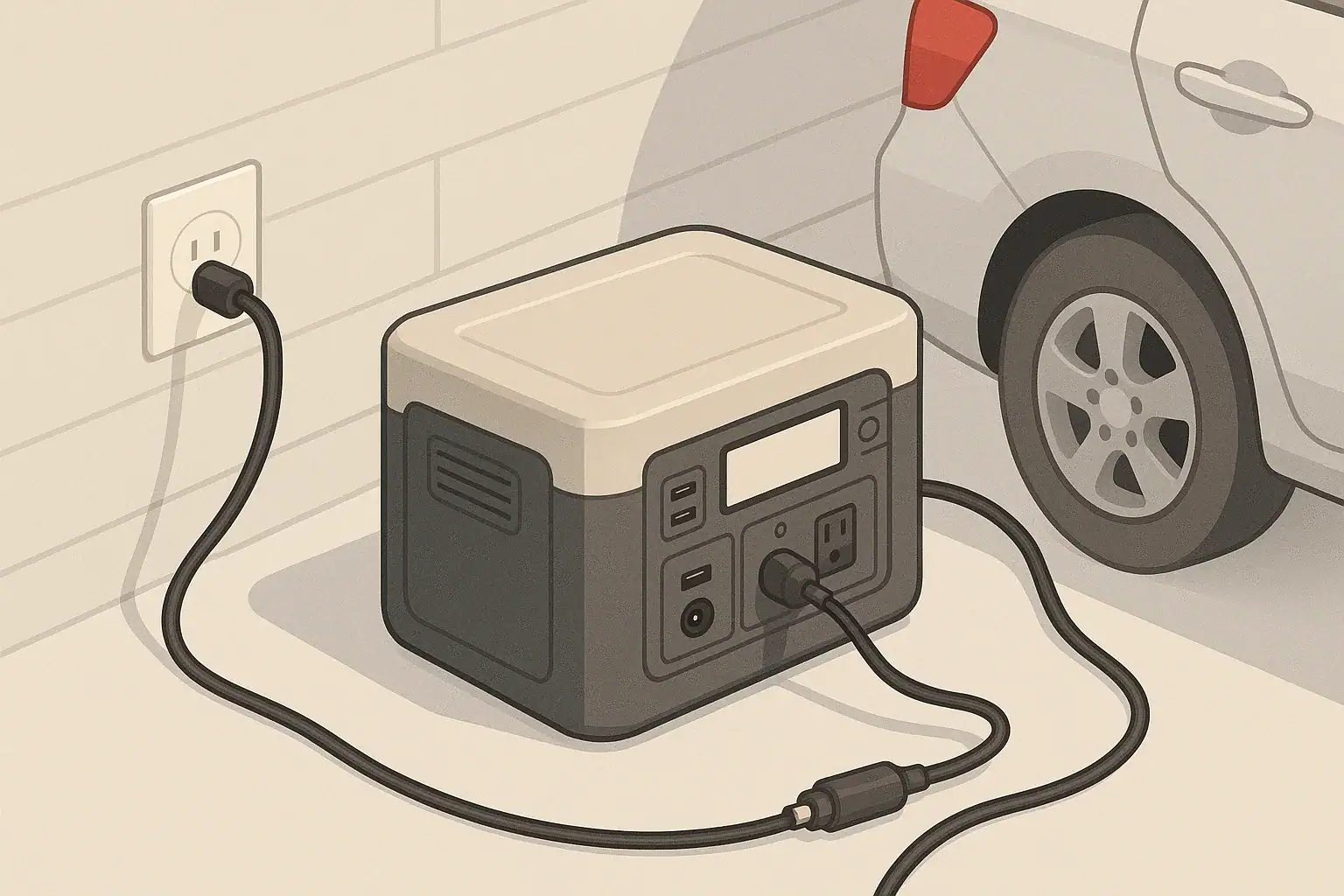
Portable power station charging from car and wall outlets

What the topic means (plain-English definition + why it matters)

When people talk about car charging for portable power stations, they often mix up three related but different things: the 12V socket, a dedicated DC-DC charger, and the vehicle alternator itself. All three are part of the same system, but they behave very differently in speed, efficiency, and safety.

The 12V socket is the familiar outlet on the dashboard or console. A DC-DC charger is a separate device that converts power from the vehicle’s 12V system into a controlled charge for another battery or portable power station. The alternator is the engine-driven generator that actually produces electrical power while the engine is running.

Understanding how these pieces fit together matters when you are planning to charge a portable power station on the road. It affects how long charging will take, how much fuel you may burn idling, how much load you put on your vehicle’s electrical system, and how safely you can power devices during road trips, camping, or vanlife.

Good planning helps you avoid surprises like a dead starter battery, a portable station that never fully charges while driving, or overloaded wiring. The goal is not to modify your vehicle, but to use what it already provides in a realistic and safe way.

Key concepts & sizing logic (watts vs Wh, surge vs running, efficiency losses)

Before comparing 12V sockets, DC-DC chargers, and alternators, it helps to separate power from energy. Power is measured in watts (W) and describes how fast energy is moving at a given moment. Energy is measured in watt-hours (Wh) and describes how much work can be done over time, such as the capacity of a portable power station battery.

When charging from a car, the charging power is limited by the weakest part of the chain: the vehicle socket rating, wiring, fuse size, DC-DC charger design, and the maximum input rating of the power station. For example, a typical 12V accessory socket in a passenger vehicle may be fused somewhere around 10–15A. At around 12–13.8V, that often works out to something in the range of roughly 120–180W of usable charging power, and sometimes less depending on the vehicle’s design.

Inverters and internal electronics add efficiency losses. If you use a 12V socket to power an inverter, then plug the portable power station’s AC charger into that inverter, energy passes through several conversions: DC to AC in the inverter, then AC back to DC inside the power station. Each step loses some energy as heat, so you might see only about 70–85% of the alternator’s output end up stored in the battery. Direct DC-DC charging, when supported, usually wastes less.

Surge and running power matter more on the output side of a portable power station than on the charging side, but they still affect planning. If you charge slowly in the car (low watts in) but run high-wattage appliances from the power station (high watts out), the battery can drain faster than it refills. Sizing a system means matching your expected daily energy use (Wh) to how much energy you can realistically put back into the battery during driving or from other sources.

Comparison of car charging paths for portable power stations – Example values for illustration.
Charging path Typical complexity Approximate power level (example) Main pros Main trade-offs
12V socket direct DC input Very low 50–120W Simple, plug-and-play, uses existing socket Slow charging, limited by fuse and wiring
12V socket to small inverter to AC charger Low 60–150W Works with power stations that only accept AC Extra losses through inverter, more heat
Hardwired DC-DC charger (example car) Medium (professional install recommended) 200–400W Faster charging, better voltage control Higher cost, adds load to alternator
Alternator direct to power station DC input Medium to high Varies widely Can use alternator capacity efficiently Requires careful design to protect vehicle system
Idle charging (engine running, parked) Low use effort Similar to driving levels Top up battery without moving Fuel use, engine wear, exhaust safety concerns
Driving plus supplementary solar Medium Car plus solar combined Reduces alternator load and fuel use More gear to manage and store

Real-world examples (general illustrative numbers; no brand specs)

To see how these limits play out, consider a portable power station with a battery capacity of about 500Wh. If you plug it into a 12V car socket that provides roughly 100W of charging power, it might take around 5–6 hours of driving to go from empty to full, assuming the vehicle maintains voltage, the socket can handle the current, and there are typical efficiency losses.

Now imagine a larger 1,000Wh power station. With that same 100W 12V socket input, you might be looking at 10–12 hours of driving time for a full charge, which for many people means multiple days of typical commute driving. A DC-DC charger supplying about 300W of power from the alternator could cut that to roughly 3–4 hours of continuous driving, if both the vehicle and the power station are rated to handle that input.

On the usage side, assume you are running a laptop that averages 50W and a small 10W light for six hours in the evening. That is about 360Wh of energy. A 500Wh portable power station could run those loads for one evening and still have some reserve. If you then drive for three hours the next day with 100W of car charging, you would be able to put back about 300Wh, not counting losses, which might nearly refill what you used.

These kinds of back-of-the-envelope estimates help you decide whether the 12V socket is sufficient for your style of travel, or whether you should plan on faster charging from a higher-power DC input, shore power at campsites, or supplementary solar. None of these example numbers are official limits; they are simply a way to visualize how much driving time you may need.

Common mistakes & troubleshooting cues (why things shut off, why charging slows, etc.)

One common surprise is the 12V socket shutting off when the engine stops. Many modern vehicles cut power to accessory outlets when the ignition is off to protect the starter battery. If your portable power station suddenly stops charging when you park, this is often the reason and not a fault with the power station itself.

Another frequent issue is slow or inconsistent charging from the car. This can happen if the 12V socket voltage sags under load, the vehicle uses smart alternator controls that reduce output at times, or the portable power station automatically reduces charging current to stay within its safe limits. Symptoms include the input wattage on the power station’s display dropping, pulsing up and down, or the device switching from charging to not charging repeatedly.

Tripped fuses are also common when people try to draw more power than the 12V outlet was designed for, especially when using inverters. If a fuse blows, the socket will stop working entirely until the fuse is replaced. Repeated fuse failures are a sign that the load is too high for that circuit and that you should reduce demand or use a different charging approach, not simply install a larger fuse.

Other cues include unusual heat at connectors or cables, fans on the portable power station running at high speed for long periods, or error messages indicating over-voltage or under-voltage. These are all hints that the charging setup is operating near its limits. In those cases, scaling back the load, improving ventilation, or using a more direct DC-DC charging method can help.

Safety basics (placement, ventilation, cords, heat, GFCI basics at a high level)

Safety with car charging starts with where you place the portable power station. It should sit on a stable, flat surface where it will not become a projectile during braking or sudden turns. Avoid locations that block airbags, vents, or access to pedals. Many people use the cargo area or a flat floor section where the unit can be restrained.

Ventilation is equally important. Both the portable power station and any connected inverter need airflow to shed heat. Do not cover vents with blankets, luggage, or clothing. In hot weather, interior vehicle temperatures rise quickly, especially in direct sun. Excessive heat can trigger reduced charging rates, thermal shutdowns, or long-term battery degradation.

Use cords and adapters rated for automotive 12V use, and avoid routing cables where they can be pinched by seats or doors. Coiled cables can trap heat; loosely run them instead, and inspect connectors for discoloration or looseness. If you use an inverter to produce 120V AC power in a vehicle, plug devices into grounded outlets when possible and keep cords away from moisture. For outdoor use near damp areas, ground-fault protection on AC circuits is a key layer of defense, but the specifics depend on the equipment design.

Finally, consider exhaust and carbon monoxide risk if you are idling the engine just to charge a portable power station. Never leave a running vehicle in an enclosed space. Charging while driving is usually safer from an exhaust standpoint than charging at idle in a closed garage or closely surrounded area.

Maintenance & storage (SOC, self-discharge, temperature ranges, routine checks)

Portable power stations used for car charging benefit from regular checks, especially if they are part of an emergency or camping kit stored in a vehicle. Batteries slowly lose charge over time, even when turned off. Many manufacturers suggest topping them up every few months to keep the state of charge within a healthy range and to prevent deep discharge during storage.

Temperature is a major factor in both battery life and safety. Long-term storage in a hot vehicle can accelerate aging, while extremely cold conditions can reduce available capacity and make charging less efficient. As a general guideline, aim to store the unit in moderate temperatures when possible and avoid leaving it in direct sun on a dashboard or in a closed trunk for extended periods.

Routine inspections should include checking cables for cuts or kinks, making sure 12V plugs and sockets are free of debris, and verifying that cooling vents are not clogged with dust or pet hair. If the portable power station has a display, occasionally powering it on to check its stored charge level helps ensure it will be ready when needed.

For vehicle-side maintenance, keeping the 12V outlet clean and verifying fuses are in good condition support reliable charging. If you notice dimming headlights or slow cranking from the starter battery when using a portable power station, that may be a sign that the vehicle’s battery or charging system should be inspected by a professional.

Storage and maintenance planning for car-charged power stations – Example values for illustration.
Task Suggested frequency What to look for Why it matters
Check state of charge Every 2–3 months Battery above minimum storage level Prevents deep discharge during storage
Top up charge from wall or car When below preferred storage range Battery returns to mid-to-high range Keeps battery ready for emergencies and trips
Inspect 12V cables and plugs Before long trips No cracks, burns, or loose contacts Reduces risk of overheating and failures
Clean vents and exterior surfaces Every 6 months Dust-free vents, intact case Maintains cooling performance and durability
Test car charging function Before seasonal use Stable input wattage, no error messages Confirms cables, fuses, and sockets are working
Review vehicle battery health Per service schedule Normal starting behavior and voltage Ensures car can safely support accessory loads
Adjust storage location With changing seasons Avoid extreme heat or cold spots Improves long-term battery life

Example values for illustration.

Practical takeaways (non-salesy checklist bullets, no pitch)

Using a car to charge a portable power station is convenient, but it works best when you understand the limits of 12V sockets, DC-DC chargers, and alternators. This lets you size your expectations, avoid stressing the vehicle’s electrical system, and keep both the car and the power station within safe operating ranges.

When planning, think in terms of daily energy use and available driving time. Combine car charging with other options, such as wall charging before a trip or solar during the day, to reduce reliance on any one source. Pay attention to heat, ventilation, cable quality, and the condition of your vehicle battery to maintain reliability over the long term.

  • Estimate your daily energy use in watt-hours and compare it to your power station’s capacity.
  • Check your vehicle manual for 12V socket limits and avoid overloading those circuits.
  • Use direct DC charging when possible instead of going through an inverter for better efficiency.
  • Monitor for warning signs such as hot connectors, blown fuses, or fluctuating input power.
  • Store the power station at a moderate state of charge and avoid prolonged extreme temperatures.
  • Have a backup charging plan for cloudy days, short drive times, or unexpected outages.

With these points in mind, car charging can be a practical part of a broader power strategy for road trips, camping, remote work, and short-term home backup without placing undue strain on your vehicle or your portable power station.

Frequently asked questions

Can I safely charge a portable power station from a car’s 12V socket with the engine off?

Often not reliably. Many vehicles cut accessory power when the ignition is off to protect the starter battery, and drawing significant current with the engine off can drain the starter and leave you unable to start the car. If you must charge while parked, check the vehicle manual for socket behavior, use low currents, and monitor both the starter battery and the power station state of charge.

How much faster does a DC-DC charger charge compared with using the vehicle 12V accessory socket?

Typical 12V accessory sockets commonly provide on the order of 50–120W for charging, while a properly installed DC-DC charger can often supply 200–400W depending on the vehicle and alternator. That means a DC-DC charger can be roughly two to four times faster in many real-world cases, though exact speed depends on alternator capacity and the power station’s input limit.

Will drawing high charging power from the alternator damage my car?

Not if the system is designed and installed correctly, but careless setups can risk alternator overheating, premature wear, or problems with smart alternator systems. Use properly rated wiring, fuses, and a DC-DC charger or isolation device as recommended; if in doubt, have installations done or inspected by a qualified technician to match alternator capacity and protect the vehicle electrical system.

Why does charging slow, pulse, or stop when charging from my vehicle?

Charging can slow or cycle because of voltage sag in the 12V circuit, the vehicle’s smart alternator reducing output, thermal throttling in the power station, or the station limiting its input current to stay safe. Symptoms include fluctuating input wattage or repeated connect/disconnect behavior; remedies include reducing draw, improving ventilation, checking connections, or switching to a higher-capacity DC charging method.

What practical steps prevent blown fuses and overheated connectors when charging from a car?

Check the fuse rating for the accessory circuit before pulling significant current, use cables and connectors rated for the expected current, and avoid drawing high loads through a cigarette-style socket unless it is explicitly rated and fused for that use. For higher-power charging, prefer a hardwired DC-DC charger with proper gauge wiring and inline fusing, and routinely inspect connectors for heat damage or looseness.

Fast Charging vs Battery Life: C-Rate Explained for Portable Power Stations (No Hype)

Portable power station charging from wall and car outlets

Portable power stations store energy in rechargeable batteries and let you run devices when wall power is not available. Two ideas often get mixed together when people compare models: how fast the battery can be charged, and how long the battery will last over months and years. The connection between the two is largely governed by something called the C-rate.

C-rate is a way to describe how quickly a battery is charged or discharged relative to its capacity. A 1C charge rate means charging a battery from empty to full in about one hour in theory. A 0.5C rate would take about two hours, and 2C would be about half an hour. Real charge times are longer because charging slows down as the battery approaches full, but the C-rate gives a useful comparison point.

For portable power stations, higher C-rate charging can mean less time plugged into the wall, car, or solar, which is helpful during short stops or power outages. However, regularly pushing batteries at very high C-rates can increase heat and stress, which may reduce long-term battery health. Understanding C-rate helps you balance fast charging convenience with reasonable expectations for battery life.

Instead of chasing the highest advertised charging speed, it is more practical to understand how C-rate, capacity, and your actual usage fit together. That way, you can tell whether a power station will realistically recharge between uses and how hard you are asking the battery to work.

What fast charging and C-rate really mean for portable power stations

Portable power stations store energy in rechargeable batteries and let you run devices when wall power is not available. Two ideas often get mixed together when people compare models: how fast the battery can be charged, and how long the battery will last over months and years. The connection between the two is largely governed by something called the C-rate.

C-rate is a way to describe how quickly a battery is charged or discharged relative to its capacity. A 1C charge rate means charging a battery from empty to full in about one hour in theory. A 0.5C rate would take about two hours, and 2C would be about half an hour. Real charge times are longer because charging slows down as the battery approaches full, but the C-rate gives a useful comparison point.

For portable power stations, higher C-rate charging can mean less time plugged into the wall, car, or solar, which is helpful during short stops or power outages. However, regularly pushing batteries at very high C-rates can increase heat and stress, which may reduce long-term battery health. Understanding C-rate helps you balance fast charging convenience with reasonable expectations for battery life.

Instead of chasing the highest advertised charging speed, it is more practical to understand how C-rate, capacity, and your actual usage fit together. That way, you can tell whether a power station will realistically recharge between uses and how hard you are asking the battery to work.

Key concepts and sizing logic: watts, watt-hours, and C-rate

When planning a portable power setup, it helps to separate three basic ideas: power, energy, and charge rate. Power is measured in watts (W) and describes how quickly energy is being used at a moment in time. Energy capacity is measured in watt-hours (Wh) and describes how much total work the battery can do before it needs to be recharged. C-rate ties the two together when you look at how quickly that stored energy moves in or out of the battery.

Battery capacity in watt-hours tells you how long a load can run in theory. For example, a 500 Wh battery feeding a 100 W load could supply that load for about 5 hours: 500 Wh divided by 100 W equals 5 hours. In practice, inverter losses, internal resistance, and other inefficiencies reduce this runtime. A reasonable planning assumption is that you may see 80–90% of the rated watt-hour capacity delivered to AC outlets, depending on how heavily they are loaded.

C-rate uses the battery’s amp-hour (Ah) rating to express charge or discharge current relative to size, but you can think of it in watt-hour terms for power stations. If a 500 Wh battery is being charged at 250 W, that is roughly a 0.5C charge rate: at that pace, a full empty-to-full charge would take about two hours in an ideal case. If the same battery were charged at 500 W, that would be about 1C. Higher C-rate means higher power moving through the system, which increases heat and may require the power station’s fans to run more often.

Inverter ratings add another important layer: the continuous (running) watt rating and the surge (peak) watt rating. The continuous rating is what the inverter can supply steadily. Surge rating describes short bursts to handle motor start-up or inrush current, such as from a refrigerator compressor or power tool. Running devices close to the continuous rating tends to reduce efficiency and increase heat, which also affects effective C-rate on discharge and can shorten runtime.

Decision matrix for balancing charge rate, capacity, and usage – Example values for illustration.
Scenario Example battery size Example charge power Approx. C-rate What this usually means
Occasional home backup for small essentials 500–700 Wh 150–250 W 0.2C–0.5C Slower charges, gentler on battery, easier on household circuits
Daily remote work and electronics 700–1200 Wh 250–400 W 0.3C–0.6C Balanced charge time and battery stress for regular use
Frequent fast top-offs between errands 300–600 Wh 300–600 W 0.5C–1C Shorter charge windows, more fan noise and heat
RV or vanlife with solar emphasis 1000–2000 Wh 200–600 W solar ~0.1C–0.3C mid-day Longer charge cycles, more battery-friendly if shaded heat is managed
High-demand tools used briefly 700–1500 Wh 400–800 W wall charging 0.3C–0.8C Need faster recharge, but avoid using maximum rate constantly
Emergency-only, long shelf life priority 300–1000 Wh 100–200 W 0.1C–0.3C Slower charging, less stress, better for occasional use

Efficiency losses and real-world charge times

When planning charge time, it is helpful to remember that power stations are not 100% efficient. Some power is lost as heat in the AC adapter or built-in charger, in the battery’s internal resistance, and in the inverter if it is running during pass-through use. A simple rule of thumb is that you may need 10–25% more watt-hours from the wall than the battery’s rated capacity to fill it from low to full.

Charge curves are also not flat. Most systems charge quickly up to a certain percentage, then taper off to protect the battery as it nears full. That means a power station might go from 20% to 80% much faster than from 80% to 100%. From a C-rate perspective, the initial phase uses a higher effective C-rate, and the final top-off phase uses a lower rate. If you only need enough energy to ride through a short outage or finish a workday, stopping around 80–90% can save time and reduce heat.

Real-world examples of C-rate, fast charging, and runtime

Relating C-rate to real-life situations makes it easier to judge what is “fast enough.” Imagine a portable power station with about 500 Wh of capacity. If it can charge from the wall at about 250 W, that is roughly a 0.5C rate. In simple terms, that means you could go from low to near full in a bit over two hours under typical conditions, allowing for efficiency losses and tapering.

Take that same 500 Wh unit on a camping trip. If you run a 50 W portable fridge and 20 W of lights for 8 hours overnight, that is about 560 Wh of load. Accounting for losses, you might use most of the battery in one night. To be ready for the next evening, you would want to recharge at least 400–500 Wh during the day. With a 250 W wall or generator charger, that might take around 2–3 hours; with a 100 W solar input, it might take most of a sunny day.

For remote work, consider a 700–1000 Wh power station running a 60 W laptop, 10 W router, and a few watts of phone charging and small accessories. At a 90 W total draw, a 900 Wh battery might deliver around 7–8 hours of runtime once you factor in inverter losses. If that same unit supports 400 W wall charging, you could restore a large portion of that capacity in a long lunch break, operating at around a 0.4C–0.5C charge rate.

In an RV, a larger 1500–2000 Wh power station might be recharged mainly through solar. Suppose you have 400 W of panels and get about 4–5 effective hours of good sun. That could provide 1600–2000 Wh of input on a clear day, corresponding to roughly a 0.2C–0.3C rate for a 2000 Wh battery. This slower C-rate is gentle on the battery, but you need to manage your loads so that daily use does not consistently exceed daily solar input.

Common mistakes and troubleshooting cues

Many charging and runtime issues come from misunderstandings about C-rate, load size, and what a portable power station is designed to do. One common mistake is assuming the advertised “from 0% to 80% in X minutes” claim applies under all conditions. In reality, temperature, state of charge, and input source (wall vs car vs solar) all influence the actual C-rate the battery sees.

Another frequent issue is overloading the inverter by confusing surge watts with continuous watts. If you plug in a device whose steady draw is close to or above the continuous rating, the power station may shut down or repeatedly trip its protection circuits. Motors, compressors, and some electronics can draw several times their running wattage during startup. If that surge exceeds the inverter’s short-term peak rating, you may see flickering, beeping, or immediate shutdown.

Charging can also slow down or pause when the power station gets hot. Fast charging at a high C-rate, especially in a warm room or vehicle, builds heat quickly. Internal temperature sensors may reduce charge power well below the maximum rating to protect the battery, or even stop charging until the system cools. If you notice the fan running constantly or feel the case getting warm, that is a cue to improve airflow or consider lowering the input power if the device allows it.

Pass-through charging, where the power station is charging while powering devices, can be confusing. If the output load is high, much of the incoming energy is immediately used by the connected devices rather than replenishing the battery. The display may show that it is charging, but the state of charge might climb very slowly or even drop. In extreme cases, the system may throttle charging or shut off outputs to stay within safe C-rate and thermal limits.

Signals your system is being pushed too hard

There are several warning signs that your portable power station is operating at a higher C-rate or load level than it comfortably supports. These are not necessarily failures, but they are cues to reduce stress on the system.

  • Fans running at high speed most of the time during charging or heavy use
  • Frequent thermal or overload warnings on the display or indicator lights
  • Charging power starting high, then dropping sharply after a short time
  • Noticeable case warmth, especially near vents or the charging side
  • Shorter runtimes than expected at a given load, due to elevated temperatures and losses

When you see these signs, try moving the unit to a cooler, shaded area with better airflow, reducing the load, or allowing the battery to cool before another full-power charge. These simple adjustments can reduce unnecessary battery stress and help preserve long-term capacity.

Safety basics: heat, placement, cords, and GFCI context

Fast charging and high C-rates mean more heat inside a compact enclosure, so placement and ventilation are important. Always use your portable power station in a dry, well-ventilated area where air can move freely around the vents. Avoid covering the unit with blankets, clothing, or gear, and do not place it in enclosed cabinets or tight spaces where hot air cannot escape.

Heat is one of the main factors that shortens battery life. Charging or discharging at high C-rates in hot environments raises internal temperatures and can accelerate aging. Keeping the unit out of direct sun and away from heaters, dashboards, or enclosed vehicle trunks during use and charging can significantly reduce thermal stress. When possible, operate the power station on a firm, non-flammable surface rather than carpets or bedding.

Extension cords and adapters also matter. Undersized or damaged cords can heat up under high loads, especially when running close to the power station’s continuous rating. Use cords rated for at least the maximum current you expect to draw, keep them fully uncoiled to avoid heat buildup, and inspect them regularly for nicks, loose plugs, or discoloration. For outdoor or damp environments, use cords and power strips designed for those conditions.

Many household circuits and outdoor outlets are protected by GFCI devices, which are designed to reduce shock risk in wet or grounded locations. Plugging a portable power station into a GFCI-protected outlet for charging is typically acceptable, but avoid daisy-chaining multiple power strips, cords, and adapters. If you encounter tripping or unusual behavior, disconnect everything and simplify the setup. For any connection involving a building’s wiring beyond standard plug-in use, consult a qualified electrician instead of attempting your own modifications.

Maintenance and storage for long battery life

How you treat a portable power station between uses can matter almost as much as how you charge it. Batteries slowly lose charge even when turned off, a process called self-discharge. The rate varies, but it is normal to see a few percent of charge fade per month. Plan to check the state of charge periodically, especially if the unit is stored for emergencies.

Most lithium-based batteries prefer to be stored partially charged rather than completely full or empty. A common recommendation is to keep long-term storage in the middle range, such as around 40–60% state of charge. This reduces stress on the cells while still keeping enough energy on hand for short-notice use. If you store the unit at a very low charge for too long, the battery may fall below its safe voltage range and the protection circuitry can prevent normal charging.

Temperature during storage is another key factor. Moderate, dry conditions are best. Extremely hot environments, such as attics or parked vehicles in summer, can accelerate aging even when the battery is not in use. Very low temperatures do not usually damage the battery by themselves, but charging at or below freezing can be harmful. If the power station has been stored in the cold, let it warm to room temperature before charging.

Routine checks help you catch small issues before they become larger problems. Inspect cables, wall adapters, and ports for wear or debris. Gently clean dust from vents with a dry cloth or low-pressure air so the cooling system can work properly during high C-rate charging or discharging. Turn the unit on occasionally to verify that the display, ports, and outlets function as expected, especially if you rely on it for backup power.

Storage and maintenance plan by usage pattern – Example values for illustration.
Usage pattern Suggested storage charge level Check/charge interval Key maintenance focus
Emergency-only home backup 40–60% Every 3–6 months Top up charge, test a small load, inspect cords and outlets
Seasonal camping or RV 40–70% Before and after each season Clean vents, verify solar inputs, confirm charge settings
Weekly remote work use 50–80% between sessions Weekly Monitor runtime changes, watch for excess heat or fan noise
Daily mobile power (vanlife) 30–80% cycling Monthly deep check Inspect all cables, clean dust, review charging sources and limits
Tool and jobsite backup 50–80% Monthly or before major jobs Check inverter output under load, inspect cords for damage
Mixed household and travel 40–70% Every 2–3 months Test various ports, ensure adapters and accessories are stored together

Practical takeaways: balancing fast charging and battery life

Understanding C-rate turns fast charging claims into useful planning tools instead of marketing numbers. Higher C-rate charging and discharging give you flexibility during outages, travel, and short charge windows, but they also increase heat and long-term wear. For most users, a moderate C-rate that refills the battery over a few hours offers a good balance of convenience and longevity.

Rather than focusing only on maximum charging watts, match your portable power station’s capacity and charge rate to your actual loads and schedules. Think about how long you need to run key devices, how much time you have between uses to recharge, and what energy sources you can rely on. Planning with realistic runtimes and charge times will help you avoid surprises when you need power most.

  • Size the battery in watt-hours to cover your typical loads with a buffer for inefficiencies.
  • View maximum charge power as an upper limit, not a requirement to use at every cycle.
  • Watch for signs of thermal stress such as constant fan noise and warm casing during use.
  • Store the unit partially charged in a cool, dry place and check it periodically.
  • Use appropriate cords and outlets, and avoid stacking adapters or modifying wiring.
  • Allow extra time for charging in hot weather or when using pass-through power.

With these habits, you can take advantage of fast charging when it truly helps, while giving the battery conditions that support a long, reliable service life.

Frequently asked questions

What C-rate is recommended for daily charging of a portable power station?

A moderate C-rate around 0.3C–0.6C is a good balance for daily use because it refills most capacity in a few hours without causing excessive heat. Exact safe rates vary by battery chemistry and manufacturer guidance, so follow the unit’s specifications when available.

How does charging at a high C-rate affect long-term battery lifespan?

Higher C-rates increase internal heat and mechanical stress on cells, accelerating capacity loss and reducing cycle life over time. Occasional fast charges are acceptable, but frequent high-C charging will generally shorten the battery’s useful life compared with gentler charging.

How can I estimate real-world charge time from C-rate and watt-hours?

Divide charge power (W) by battery capacity (Wh) to find approximate C-rate (for example, 250 W into 500 Wh ≈ 0.5C). The theoretical empty-to-full time is about 1/C hours, but real-world charging takes longer due to tapering and inefficiencies—add roughly 10–25% extra time and expect the final 10–20% to take disproportionately longer.

Is pass-through charging (charging while powering devices) safe to use often?

Pass-through is typically safe for occasional use, but when loads are high much of the incoming power goes to running devices rather than charging the battery, which raises heat and can trigger throttling. Frequent pass-through at high loads or in warm conditions can increase wear and reduce battery lifespan.

What signs show my power station is being charged too fast?

Look for constant high fan speed, thermal or overload warnings, rapid drops in displayed charge power, and a noticeably warm case near vents—these indicate heat-related stress or throttling. If observed, reduce input power, improve ventilation, or allow the unit to cool before further high-rate charging.

Can solar fast-charging deliver high C-rates safely for portable power stations?

Solar can provide substantial charge power, but effective C-rate depends on panel wattage, sun conditions, and the station’s charge controller. High daytime solar input spread over several hours is usually gentle, but pairing large solar input with hot temperatures or a small battery can raise internal temperatures and accelerate wear, so use MPPT control and manage ventilation.

PPS vs Fixed USB-C PD Profiles: Why Some Laptops Charge Slowly (and How to Fix It)

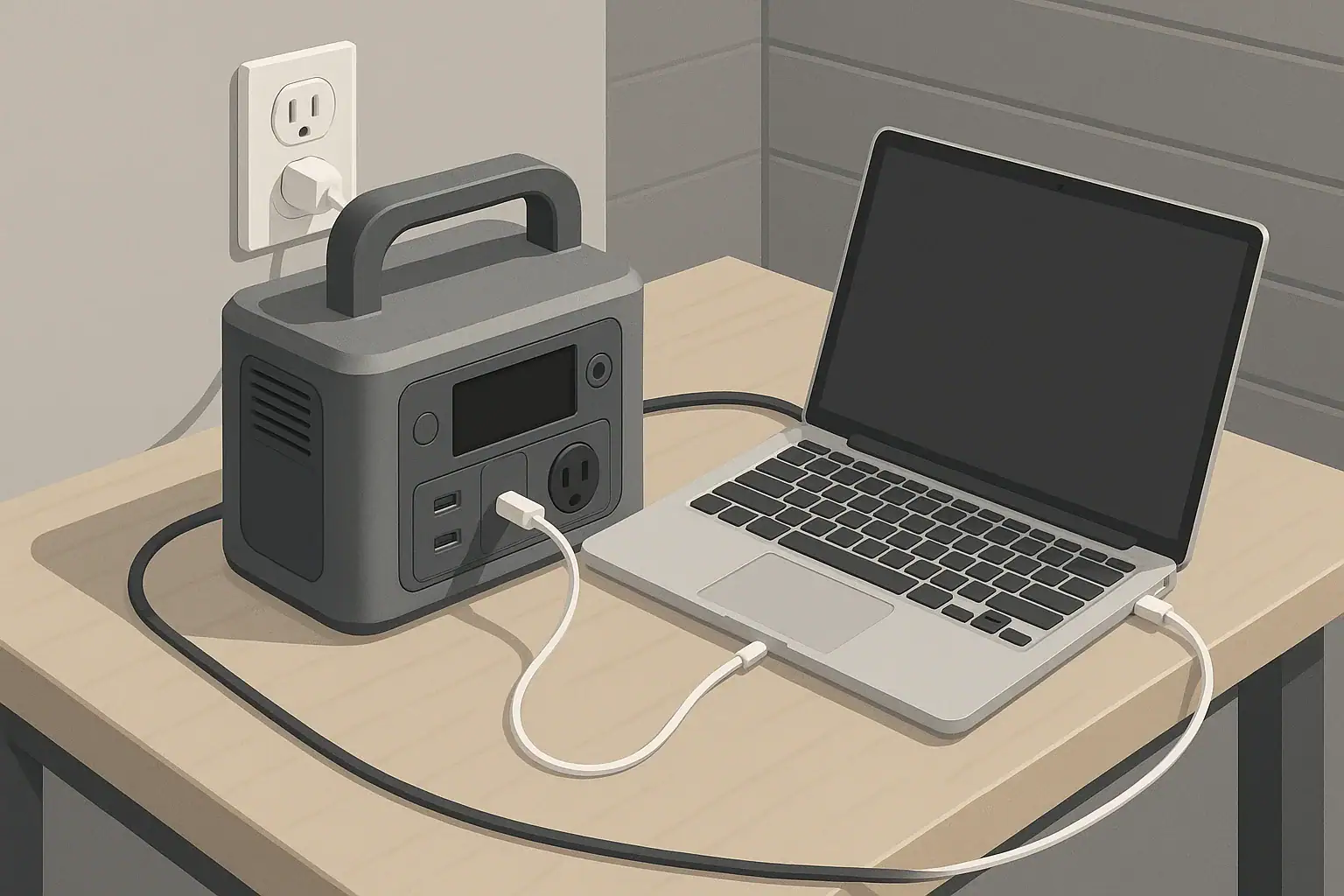
Portable power station charging a laptop with USB-C

USB-C Power Delivery (PD) is a standard that lets devices and chargers negotiate how much power to use over a single cable. Many modern portable power stations now include USB-C PD ports to charge laptops, tablets, and phones without using the AC outlets. However, not all PD ports behave the same. Some offer fixed voltage profiles only, while others support PPS, or Programmable Power Supply.

Fixed USB-C PD profiles use a handful of standard voltage steps such as 5 V, 9 V, 15 V, or 20 V. Your laptop chooses one of those steps and pulls current up to the power station’s limit. PPS adds the ability to fine-tune both voltage and current in small increments, allowing more efficient and stable charging, especially for devices that prefer specific voltages or that actively control battery temperature and charging curves.

This becomes important when using a portable power station because laptop charging speed, heat, and run time depend on how well the power station’s USB-C port matches what the laptop expects. If the port only offers fixed profiles and your laptop is optimized for PPS, it may fall back to a lower power mode. That can mean slower charging, or even a battery that still drains slowly while plugged in under heavy use.

What PPS vs fixed USB-C PD profiles means and why it matters

Understanding the basics of PPS versus fixed PD helps you choose a power station with the right USB-C features, estimate realistic run times, and troubleshoot slow or inconsistent laptop charging. It also connects directly to sizing decisions: the watt rating of each port, the overall battery capacity in watt-hours, and how efficiently DC power is delivered all determine whether your portable setup feels seamless or frustrating.

Key concepts: watts, watt-hours, surge vs running, and efficiency losses

Two basic units drive most charging and runtime questions: watts (W) and watt-hours (Wh. Watts describe power at a moment in time, while watt-hours describe energy stored or used over time. When a laptop charges from a USB-C PD port on a portable power station, the USB-C port’s watt rating and the laptop’s draw in watts determine charging speed, while the station’s capacity in watt-hours determines how long you can keep everything running.

On the energy side, the power station’s battery capacity is typically listed in watt-hours. If your laptop averages 50 W while charging and running, and the station has 500 Wh of usable capacity, the theoretical run time is 500 Wh ÷ 50 W = 10 hours. In practice, you have to subtract efficiency losses. DC-to-DC conversion from the internal battery to USB-C is usually more efficient than going out through an AC inverter and then back into a laptop charger, but there are still losses in cables, electronics, and heat. A realistic rule of thumb is that you may only get 80–90% of the rated capacity in real use.

Most USB-C PD ports on power stations are rated somewhere around 30–140 W. A laptop that can accept 65 W over USB-C will usually charge quickly if the port can deliver at least 65 W at a compatible voltage. With fixed PD profiles, the port might offer, for example, 20 V at up to 3.25 A (about 65 W. With PPS, the laptop can request something like 18 V at a specific current to manage heat and internal battery charging more precisely. If the laptop wants PPS but only finds fixed steps, it may choose a lower power profile, such as 45 W, causing slower charging.

Surge versus running power is less of a concern for USB-C than for large AC loads, but it still matters at the whole-station level. If other devices on AC are pulling near the inverter’s limit, the station might throttle or prioritize loads, which can reduce the available power on USB-C PD ports or even shut them off. Higher instantaneous draws, such as a laptop ramping up CPU and GPU while charging, can cause brief spikes. A well-sized power station with headroom above your combined loads is less likely to sag or shut down, and PPS can help smooth those variations by letting the laptop adjust draw more gracefully within the port’s limits.

The key sizing logic is to match your laptop’s maximum USB-C charging power with the port rating and to size the battery in watt-hours for the total time you want to run, then discount for efficiency. If PPS support is present, the laptop and power station can often find a more efficient operating point, translating into slightly longer runtimes, less heat, and more stable behavior.

USB-C laptop charging checklist for portable power stations – Example values for illustration.
What to checkWhy it mattersExample notes
USB-C PD watt ratingLimits maximum laptop charging speedLook for a port rating at or above your laptop’s charger wattage, such as 60–100 W.
PPS support on USB-C portImproves compatibility and efficiency for newer devicesIf your laptop supports PPS, a PPS-capable port can help maintain higher, more stable power.
Power station battery capacity (Wh)Determines how long you can run and charge devicesEstimate total runtime using laptop watt draw and factor in 10–20% efficiency loss.
Number of active devicesMultiple devices share limited power budgetRunning phones, tablets, and a laptop from the same unit reduces available power per port.
AC inverter vs USB-C directImpacts overall efficiency and heatUSB-C direct from the power station is usually more efficient than using a separate AC brick.
Cable quality and ratingInfluences maximum power and stabilityUse a USB-C cable rated for the required wattage, such as 60 W or 100 W.
Ambient temperatureAffects battery and charging performanceHigh heat or extreme cold can cause slower charging or throttling.

Example values for illustration.

Real-world examples of PPS vs fixed PD with portable power stations

Consider a laptop that normally uses a 65 W USB-C charger. On a power station with a 60 W fixed PD port and no PPS, the laptop may choose a 20 V profile at up to 3 A. Because the port tops out near 60 W, the laptop may charge close to full speed at idle, but if you start a demanding task, the laptop’s total power use can exceed what the port can supply. The system may reduce battery charging speed or even begin to drain the battery slowly while plugged in.

Now compare that with a similar power station whose USB-C port supports PPS up to 100 W. If your laptop also supports PPS, it can request a voltage and current combination tuned to its internal charging circuitry, staying near its ideal 65 W even as workload changes. The result is that the battery continues to gain charge while you work, instead of hovering or dropping. On a long workday powered entirely from the station, that difference can decide whether you run out of power before finishing.

Portable power station run time also shifts based on how you connect the laptop. If you plug the original AC charger into an AC outlet on the station, the laptop may still get full 65 W charging, but the station’s inverter has to convert DC to AC and your charger converts it back to DC. This double conversion adds overhead. For example, that same laptop might effectively cost the power station 70–80 W instead of about 60–65 W via direct USB-C. Over several hours, the difference adds up to noticeably shorter overall runtime.

These differences become more obvious when you combine loads. Imagine running a laptop, a small monitor, and a Wi-Fi router during a power outage. With a moderate-size power station, direct USB-C charging using supported PPS can keep the laptop closer to its rated power while leaving more capacity for the other devices. If the station only offers fixed profiles and the laptop falls back to a lower power mode, you might see the battery percentage rise slowly or even stall when the laptop is busy, even though everything appears to be connected correctly.

Common mistakes and troubleshooting cues for slow laptop charging

Slow or inconsistent laptop charging on a portable power station often traces back to a handful of common issues. One frequent mistake is assuming that any USB-C port will provide full laptop power. Many ports on power stations are designed primarily for phones or small tablets and may be limited to 18–30 W, which is far below what most modern laptops expect. Even if the station has a high-watt USB-C port, using the wrong port or a lower-rated one can cap charging speed.

Another source of trouble is ignoring PPS compatibility. Some newer laptops behave best when they can negotiate fine-grained voltages. If the power station only offers fixed profiles, the laptop may request a conservative level like 45 W for safety or thermal reasons. In everyday use, that shows up as slow charging, or a laptop that charges well at idle but cannot gain battery percentage during intensive tasks. In some cases, the laptop may briefly connect and disconnect from charging as it tests different profiles.

Cable issues can also mimic power station problems. A USB-C cable not rated for higher wattage may limit current or cause the devices to fall back to lower PD profiles. This can look like a port limitation even when the power station is fully capable. Likewise, long or damaged cables can introduce enough resistance to cause voltage drops, prompting the laptop to draw less power to stay within safe limits.

Troubleshooting cues include watching how the laptop behaves under different combinations: testing one device at a time, moving the cable to a different USB-C port on the power station, or switching between USB-C direct and the laptop’s AC charger plugged into the station’s AC outlet. If the laptop charges normally from wall power but slowly from USB-C on the power station, the issue is usually port wattage, PD profile support, or cabling rather than the laptop itself. If sudden shutoffs occur when multiple AC loads run alongside USB-C charging, you may be hitting the station’s total output limit, causing protective shutdowns.

Safety basics: placement, ventilation, cords, heat, and GFCI context

Using a portable power station for USB-C laptop charging is generally safer than improvising with extension cords or unprotected adapters, but basic safety practices still matter. Place the power station on a stable, dry, and level surface, with enough space around the vents for airflow. Blocking vents or placing the unit in a confined space can cause heat buildup, which can trigger throttling or shutdowns and reduce battery life over time.

Pay attention to cord routing. USB-C cables and AC cords should not be pinched under furniture, run through doorways that close on them, or stretched in ways that strain connectors. Tripping hazards are a safety risk to both people and equipment; a sudden pull on a cable can dislodge plugs or damage ports. Using appropriately long, undamaged cables rated for the loads you need helps maintain both safety and charging performance.

Heat management is especially important when charging larger devices like laptops. Both PPS and fixed PD profiles are designed with safety in mind, but high power transfer still generates heat in cables, connectors, and devices. If you notice connectors becoming hot to the touch, reduce the load, improve ventilation, or switch to a higher-rated cable. Avoid covering the power station or laptop with blankets, cushions, or other insulating materials while charging.

For use near sinks, garages, or outdoor spaces, be mindful of moisture and grounding. Some power stations include GFCI-type protection on AC outlets, which can add a layer of safety against ground faults. However, they are not a replacement for properly installed household wiring. If you plan to use a power station in conjunction with home circuits or transfer equipment, consult a qualified electrician. Use the station as a standalone power source for laptops and small electronics unless your setup has been professionally designed and installed.

Maintenance and storage for reliable USB-C laptop power

Good maintenance and storage habits help ensure your portable power station will deliver stable USB-C PD power when you need it. Keeping the battery within a moderate state of charge during storage is often recommended; many manufacturers suggest around 40–60% as a balance between readiness and long-term battery health. Avoid leaving the station either completely full or completely empty for long periods when not in use.

Self-discharge means that the battery will slowly lose charge over time even when turned off. Check the charge level every few months and top it up as recommended by the manufacturer to prevent deep discharge. Periodically exercising the unit by running a few typical loads, such as a laptop and a lamp, can also help confirm that USB-C PD ports and AC outlets are working correctly before you rely on them during a power outage or trip.

Temperature is another key factor. Store the power station in a cool, dry place away from direct sunlight, heaters, or very cold environments. Extreme temperatures during storage can accelerate battery aging or lead to reduced capacity. During use, particularly with high-power USB-C laptop charging, keep the station where air can circulate freely and where it will not be exposed to rain or condensation.

Inspect USB-C cables and connectors regularly for fraying, bent pins, or loose fits. Because PPS and high-watt PD depend on clean electrical connections and solid signaling, a damaged cable can reduce charging speed or cause erratic behavior. Wiping down the exterior of the station with a dry or slightly damp cloth, keeping dust out of vents, and following any manufacturer-recommended firmware updates or checks help maintain safe, reliable power delivery.

Portable power station maintenance plan – Example values for illustration.
TaskSuggested frequencyWhy it matters
Check state of chargeEvery 2–3 monthsPrevents deep discharge and confirms readiness for outages or trips.
Top-up charging during storageWhen charge falls near mid-rangeKeeps battery in a healthy range without sitting full or empty.
Inspect USB-C and AC cablesBefore extended useDamaged cables can limit PD power, including PPS, or create hazards.
Test run typical loadsEvery few monthsVerifies ports, inverter, and PD negotiation work as expected.
Clean vents and surfacesAs needed based on dustMaintains airflow and reduces heat buildup during high-power charging.
Review operating and storage temperaturesSeasonallyHelps avoid storing or running the unit in extreme heat or cold.
Check for firmware or guidance updatesOccasionallyEnsures you follow current recommendations for safe battery use.

Example values for illustration.

Practical takeaways and checklist for better laptop charging

Getting dependable laptop charging from a portable power station comes down to understanding how PPS and fixed USB-C PD profiles interact with your devices, and sizing the station around your real-world needs. While the technical details can be complex, you can usually avoid slow charging and surprise shutdowns by checking a few key specifications and using the right cables and ports.

Think about how and where you use your laptop: remote work, travel, camping, or backup during outages. In each case, a direct USB-C PD connection that matches your laptop’s expected wattage is usually more efficient than running the AC charger, and PPS support can add a margin of comfort for newer devices. Combine that with basic safety, storage, and maintenance habits, and a portable power station can be a reliable part of your everyday and emergency power plan.

  • Confirm your laptop’s typical USB-C charging wattage and whether it supports PPS.
  • Match that wattage with a power station USB-C PD port that can deliver equal or higher power.
  • Prefer direct USB-C charging over using the laptop’s AC brick when practical for better efficiency.
  • Use short, high-quality USB-C cables rated for the wattage you need, and replace damaged ones.
  • Allow good ventilation around both the power station and laptop to limit heat-related throttling.
  • Store the station partially charged in a cool, dry place and top it up periodically.
  • Test your full setup periodically so slow charging or port issues are discovered before you depend on it.

With these practices, PPS and fixed USB-C PD profiles become tools you can plan around rather than mysteries that cause unexpected slowdowns. That preparation pays off whether you are working off-grid, riding out a brief outage, or simply keeping your laptop powered wherever you need it.

Frequently asked questions

How can I tell if my laptop supports PPS?

Check the laptop’s technical specifications or the power adapter documentation for mentions of PPS or “Programmable Power Supply” and the PD revision (PD 3.0+ often indicates PPS support). If the documentation is unclear, look in system power settings or the manufacturer’s support resources for supported charging profiles.

If a power station only offers fixed PD profiles, can my laptop still charge at full speed?

It can, but only if one of the fixed voltage/wattage steps matches your laptop’s required charging profile; otherwise the laptop may fall back to a lower safe profile. Laptops optimized for PPS may reduce charging speed or prioritize running power over battery charging when they cannot negotiate a finely tuned voltage/current combination.

Does charging through the power station’s AC outlet use more battery than charging over USB-C PD?

Yes. Using the AC outlet requires the station to invert DC to AC and then the laptop’s charger converts AC back to DC, creating extra conversion losses. That double conversion typically increases the effective power draw compared with direct USB-C PD, shortening overall runtime.

What kind of USB-C cable should I use for high-watt PPS or fixed PD charging?

Use a cable rated for the wattage you need (for example, 60 W or 100 W) and ideally one that is e-marked or certified for high-current PD use. Shorter, high-quality cables reduce voltage drop and heat; damaged or low-rated cables can force a device to fall back to lower PD profiles.

What quick troubleshooting steps help resolve slow charging from a power station?

Test with the laptop idle and under load, try different USB-C ports and the laptop’s AC charger in the station’s AC outlet to compare behavior, and swap in a known-good, properly rated cable. Also confirm the station’s port wattage and PD/PPS support and ensure other devices aren’t exceeding the station’s total output.

VA vs Watts Explained for Portable Power Stations: Computers, Power Supplies, and UPS Confusion

Portable power station with abstract energy blocks in isometric view

When choosing backup or portable power for computers, home offices, or outdoor work, people often encounter two different measurements that seem interchangeable but are not: VA and watts. This article walks through the practical differences, how they show up on UPS units, power supplies, and portable power stations, and what that means for sizing and real-world use. Read this overview to learn how to convert between rated values, estimate runtimes, and avoid common mistakes that lead to unexpected shutdowns or shortened battery life. The guidance is aimed at helping you pick the right inverter size and battery capacity, account for surge needs, and keep equipment protected and properly ventilated. No product endorsements are included — just clear, actionable explanations and examples to make decisions easier for remote work, camping, or emergency preparedness.

What the topic means (plain-English definition + why it matters)

When you compare portable power stations, computer power supplies, and UPS units, you see two different ways of describing power: watts (W) and volt-amperes (VA). They sound similar, but they are not the same thing. Understanding the difference helps you size a portable power station correctly and avoid overloading its inverter or your connected devices.

Watts measure the real power a device actually uses to do work, like running your laptop or monitor. VA describes apparent power, which is the product of voltage and current without considering how efficiently that power is used. Many computer power supplies and UPS units are rated in VA because they deal with complex loads that do not draw power in a simple way.

Portable power stations almost always advertise their inverter output in watts and their battery capacity in watt-hours. UPS units often advertise capacity in VA and also list a lower watt rating. This mix of VA and watts can create confusion when you try to figure out whether a portable power station can replace or supplement a UPS, or how long it can keep your computer running in a power outage.

Knowing how VA relates to watts, and how both relate to watt-hours, helps you estimate runtime, choose which devices you can safely plug in, and recognize why a power station or UPS might shut off unexpectedly. It is especially important when you rely on portable power for remote work, home office backups, or short power outages.

Key concepts & sizing logic (watts vs Wh, surge vs running, efficiency losses)

Watts describe how much instantaneous power a device needs to run. If a laptop charger is labeled 60 W, it can draw up to about 60 watts from the outlet. Portable power stations rate their AC inverter output in watts, usually with a continuous (running) watt rating and a higher surge rating for short bursts of extra load.

VA comes from multiplying voltage by current (for example, 120 V × 5 A = 600 VA). For purely resistive loads like many heaters, VA and watts are nearly the same. For electronics such as computers and monitors, power factor enters the picture. A power supply might be rated 600 VA but only 360 to 480 W of real power, depending on its power factor. Many UPS units list both values, such as 600 VA / 360 W.

Battery capacity is usually given in watt-hours (Wh). Watt-hours describe how much energy is stored, not how fast it can be delivered. To estimate runtime, you compare watt-hours to the watts your devices draw. A simple approximation is: runtime in hours ≈ (battery Wh × efficiency factor) ÷ load watts. The efficiency factor accounts for inverter and electronics losses, which often means you only get around 80 to 90% of the listed capacity when running AC loads.

Surge versus running watts matters for devices that briefly draw more power when starting up, like some desktop computer power supplies or small compressors. A power station’s surge rating allows it to handle that short spike without shutting down. However, you still need to keep the steady, running watt load under the continuous rating. If you size only by surge, you risk tripping the inverter once everything is running together.

Checklist-style decision matrix for sizing portable power station output and capacity. Example values for illustration.
Decision matrix for watts, VA, and Wh sizing
What you are decidingWhat to checkWhy it mattersExample guideline (not a limit)
Can the inverter handle the load?Sum of device watt ratingsInverter overload can cause shutdownKeep total running watts at or below 70–80% of inverter continuous rating
Can it handle startup surges?Devices with motors or high inrush (e.g., some desktops)Startup spikes may exceed surge ratingAllow extra 20–50% headroom if you expect surges
UPS to power station comparisonUPS VA and W vs device WVA is higher than usable wattsUse the UPS watt rating, not VA, when comparing to inverter watts
Rough runtime estimatePower station Wh and load wattsDetermines how long you can run devicesRuntime (h) ≈ Wh × 0.8 ÷ load W for AC devices
Running laptops and small electronicsTotal charger wattage plus overheadPrevents overloading smaller invertersFor a 300 W inverter, stay near or under 200–220 W continuous
Adding more devices laterFuture devices you might plug inHelps avoid outgrowing the power stationReserve 20–30% inverter and capacity margin for expansion
Choosing DC vs AC outputsWhether a DC or USB output is availableDC is usually more efficient than going through the inverterPrefer DC/USB for laptops and phones when possible

Real-world examples (general illustrative numbers; no brand specs)

Consider a home office setup with a laptop (65 W charger), a monitor (30 W), and a small internet router (10 W). If everything is running at or near maximum draw, that is about 105 W total. A portable power station with a 300 W inverter can easily handle this load. If the battery is around 500 Wh, and you assume about 80% usable capacity with inverter losses, you might see roughly (500 × 0.8) ÷ 105 ≈ 3.8 hours of runtime, depending on actual usage and power-saving features.

Now compare that to a small UPS labeled 600 VA / 360 W. If your computer system really draws only 150 W while you work, the UPS has a comfortable margin and can bridge short outages for several minutes to perhaps an hour, depending on its internal battery size. If you tried to equate 600 VA directly to 600 W and plugged in too many devices, you could overload the UPS even though you stayed below 600 in your calculations. The true limit is the watt rating, not the VA rating.

For a portable power station used during a brief power outage, you might prioritize your internet router (10 W), LED lighting (20 W), and a laptop (40 W average while in use). That is about 70 W. On a 300 Wh unit, with 80% effective capacity, you get about (300 × 0.8) ÷ 70 ≈ 3.4 hours. If you add a second monitor or charge multiple devices at once, your load could quickly climb above 100 W and reduce runtime.

Surge power becomes more noticeable with devices like small air pumps, compact refrigerators, or desktop computers that draw a high inrush current. A computer power supply labeled 500 W might only use 150–250 W in regular use but can briefly spike higher as it starts. A portable power station with a 500 W continuous / 800 W surge inverter might handle the short spike without issues, but if you run that computer plus other loads close to 500 W continuously, the inverter may trip.

Common mistakes & troubleshooting cues (why things shut off, why charging slows, etc.)

One common mistake is confusing VA and watts when moving from a UPS environment to a portable power station. Someone may think, “My UPS is 1000 VA, so any 1000 W power station is equal or better.” In practice, the UPS might only support 600 W of real load, while the power station’s 1000 W inverter rating is already in watts. If you mix these numbers, you may oversize or undersize equipment and be surprised by shorter runtime or shutdowns.

Another frequent issue is ignoring inverter efficiency and idle consumption. A portable power station must convert DC from its battery to AC for outlets. This conversion wastes some energy as heat. If your AC load is light, the inverter’s own draw can be a noticeable part of the total. Users often overestimate runtime by dividing battery watt-hours directly by the load watts without reducing for efficiency losses. When the station shuts down earlier than expected, it seems like a problem, but the estimate was optimistic.

Charging behavior can also be confusing. Some portable power stations support pass-through charging, meaning they can charge their battery while powering devices at the same time. If the load is heavy, the net charging rate slows or stops because much of the incoming energy is going straight to the devices. People sometimes think the unit is “charging slowly” when in reality it is mostly just keeping up with the output. High ambient temperature or built-in battery management may further reduce charge rate to protect the battery.

Finally, many inverters and UPS units have protective shutdown thresholds. These include low battery voltage, high internal temperature, overload, or ground fault detection. If your portable power station shuts off abruptly when you plug in a particular device or combination of devices, it may be due to a brief surge, poor power factor, or total load exceeding the continuous rating. Watching which devices are running when the shutdown occurs is often the first clue to solving the issue.

Safety basics (placement, ventilation, cords, heat, GFCI basics at a high level)

Portable power stations and UPS units both contain electronics and batteries that produce heat under load. They should be placed on a stable, dry surface with clearance around vents so air can move freely. Blocking the vents or stacking items on top can lead to higher internal temperatures, which may trigger protective shutdowns or shorten component life.

Use properly rated extension cords and power strips with any portable power source. Overloading a thin or damaged cord can cause excess heat and fire risk. Cords that are kinked, crushed under furniture, or run through high-traffic areas are more likely to be damaged. For outdoor or damp locations, use cords and outlets rated for that environment and keep connections off the ground where possible.

Some portable power stations include GFCI (ground-fault circuit interrupter) outlets, especially for outdoor or potentially wet settings. A GFCI is designed to reduce shock risk by quickly disconnecting power if it detects a ground fault. If a GFCI outlet on your power station trips repeatedly, there may be an issue with the connected cord, device, or environment that needs attention. GFCI protection is not a replacement for safe placement and dry conditions, but it can add a layer of protection.

Never attempt to connect a portable power station directly into a building’s electrical system through a wall outlet or improvised cords. This can create dangerous backfeed conditions and is generally unsafe. Any integration with a home electrical panel or transfer equipment should be planned and installed by a qualified electrician familiar with codes and the specific equipment involved.

Maintenance & storage (SOC, self-discharge, temperature ranges, routine checks)

Portable power stations and UPS units both rely on rechargeable batteries that slowly lose charge over time, even when not in use. This self-discharge is normally modest, but over many months it can leave the battery nearly empty. Storing a lithium-based power station at a moderate state of charge, often around 30–60%, and rechecking it every few months helps preserve battery health.

Temperature has a large effect on performance and aging. High heat accelerates battery wear, while freezing temperatures temporarily reduce available capacity and may limit charging. Most manufacturers specify a recommended storage temperature range, typically around typical indoor conditions. Avoid leaving a power station in a hot vehicle, near heaters, or in direct sun for prolonged periods. If it has been stored in cold conditions, allow it to warm gradually to room temperature before charging.

Routine checks are simple but important. Every few months, power the unit on, verify the display and outputs work, and confirm that charging still behaves normally from your preferred sources (wall, car, or solar). Inspect cords and plugs for damage, and make sure vents are free of dust buildup. Running a small load occasionally can help you notice problems early, rather than discovering them during an outage.

For longer-term storage, fully discharging and then leaving the battery empty is generally not recommended. Instead, charge to a moderate level, disconnect any devices or parasitic loads, power the unit completely off if it has a hard-off mode, and store it in a dry, temperature-controlled area. Check the charge level on a schedule and top it up if it has fallen significantly.

Storage and maintenance planning overview for portable power stations. Example values for illustration.
Storage and maintenance planning examples
ScenarioRecommended state of chargeCheck intervalNotes
Seasonal camping useAround 40–60% before off-seasonEvery 3 monthsTop up if display shows notably lower charge
Home outage backupHigher, around 60–80%Every 1–2 monthsEnsures more runtime when an unexpected outage occurs
Stored in warm roomLower half of charge rangeEvery 2–3 monthsHeat speeds aging; avoid leaving at 100% for very long
Stored in cool, dry basement30–60%Every 4–6 monthsCooler temps can extend life if humidity is controlled
Frequent remote work use70–100%Weekly glanceRegular cycling is normal; avoid running to zero whenever possible
RV or van kept in variable climatesAbout 50–70%MonthlyWatch for extreme heat and consider shade or ventilation
Long-term storage with infrequent useAround 40–50%Every 6 monthsRecord a reminder date so it is not forgotten

Example values for illustration.

Practical takeaways (non-salesy checklist bullets, no pitch)

VA and watts are related but not interchangeable. Watts describe the real power you can actually use, while VA describes apparent power and is higher when power factor is less than one. When estimating what you can plug into a portable power station, always work in watts and be cautious about relying on VA ratings from UPS labels or power supplies.

Battery capacity in watt-hours tells you how much energy is stored, but inverter efficiency and idle draw mean you will get less than the printed number when running AC loads. Basic math, combined with realistic assumptions, goes a long way: sum your devices’ watts, compare them with the continuous inverter rating, and then divide usable watt-hours by that load to estimate runtime.

  • Use the watt rating, not VA, when comparing UPS loads to portable power station capabilities.
  • Keep your continuous load comfortably under the inverter’s continuous watt rating to avoid nuisance shutdowns.
  • Remember that AC output is less efficient than DC or USB; choose DC outputs when possible.
  • Plan for surge power if you run devices with motors or high inrush current.
  • Place your power station in a cool, dry, ventilated area and use cords rated for the load and environment.
  • Store at a moderate state of charge and check the battery level on a schedule, especially before storm seasons or trips.
  • Consult a qualified electrician for any plans involving connection to home wiring or transfer equipment.

By separating VA from watts and thinking in terms of both power (W) and energy (Wh), you can make clearer decisions about portable power stations, UPS units, and computer loads. That clarity helps you get reliable runtime, avoid overloads, and extend the life of your equipment.

Frequently asked questions

How do I convert a UPS VA rating to usable watts when comparing it to a portable power station?

Watts = VA × power factor, so you need the device’s power factor to convert accurately. If the manufacturer lists both VA and watts, use the stated watt number; otherwise assume a typical power factor between about 0.6 and 0.9 for computer/UPS loads and use the lower end for safety. When in doubt, size to the listed watt rating or add margin rather than relying on VA alone.

Can I treat a UPS labeled in VA as equivalent to a power station rated in watts?

No. VA is apparent power and can be higher than the usable watts if the power factor is less than 1. Always compare your devices’ watt draw to the inverter’s continuous watt rating rather than to a VA number to avoid overloading the unit.

How much headroom should I allow for surge or startup currents when sizing an inverter?

Plan for a surge headroom of roughly 20–50% above steady-state load for devices with motors or high inrush currents, and verify the power station’s surge rating covers short spikes. Also keep sustained loads at or below about 70–80% of the inverter’s continuous rating to reduce the chance of thermal or protective shutdowns.

What’s the simplest way to estimate runtime for my laptop and monitor from a power station?

Use runtime (hours) ≈ (battery Wh × efficiency factor) ÷ load watts; an efficiency factor of about 0.8 is a practical starting point to account for inverter losses and idle draw. For a more accurate result, measure the actual load with a meter or check device power meters rather than relying on nameplate values alone.

Is it more efficient to use DC/USB outputs instead of the AC inverter to charge laptops and phones?

Yes—using DC or USB outputs typically avoids inverter conversion losses and is therefore more efficient, which extends runtime. Use direct DC charging when the voltage and connector match your device’s requirements, and confirm compatibility to ensure safe charging.

Why a 1000Wh Power Station Doesn’t Give 1000Wh: Usable Capacity Explained (Efficiency + Cutoffs)

portable power station with abstract energy blocks in a clean scene

When a portable power station is labeled as 1000Wh, that number describes its nominal battery capacity, not the exact amount of energy you can actually use. In real-world operation, you will always get less than the printed watt-hour rating. This gap between rated and usable energy often surprises people the first time they rely on a power station during a power outage or camping trip.

Usable capacity is the portion of stored energy that can be delivered to your devices before built-in protections and efficiency losses stop the discharge. Battery management systems, inverter electronics, and safety limits all reduce the energy that makes it to your outlets. Knowing this helps you plan runtimes more realistically.

Understanding usable capacity matters because it directly affects how long you can run essential loads such as a fridge, CPAP, laptop, or small heater. A 1000Wh unit might only provide something like 700–850Wh of usable AC output depending on how you use it. If you size your system based only on the label, you may run short when you need power the most.

By learning why a 1000Wh power station does not give a full 1000Wh, you can choose more appropriate sizes, avoid overloading the inverter, and manage expectations for outages, remote work, or off-grid trips. This knowledge also makes it easier to compare models and understand what features actually improve real-world performance.

What usable capacity really means for a 1000Wh power station

When a portable power station is labeled as 1000Wh, that number describes its nominal battery capacity, not the exact amount of energy you can actually use. In real-world operation, you will always get less than the printed watt-hour rating. This gap between rated and usable energy often surprises people the first time they rely on a power station during a power outage or camping trip.

Usable capacity is the portion of stored energy that can be delivered to your devices before built-in protections and efficiency losses stop the discharge. Battery management systems, inverter electronics, and safety limits all reduce the energy that makes it to your outlets. Knowing this helps you plan runtimes more realistically.

Understanding usable capacity matters because it directly affects how long you can run essential loads such as a fridge, CPAP, laptop, or small heater. A 1000Wh unit might only provide something like 700–850Wh of usable AC output depending on how you use it. If you size your system based only on the label, you may run short when you need power the most.

By learning why a 1000Wh power station does not give a full 1000Wh, you can choose more appropriate sizes, avoid overloading the inverter, and manage expectations for outages, remote work, or off-grid trips. This knowledge also makes it easier to compare models and understand what features actually improve real-world performance.

Key concepts & sizing logic: watts, watt-hours, surge, and efficiency

To understand usable capacity, it helps to separate two key ideas: power and energy. Power is measured in watts (W) and describes the rate at which electricity is used at any moment. Energy is measured in watt-hours (Wh) and describes how much electricity is used over time. A 100W device running for 5 hours uses about 500Wh of energy.

A 1000Wh power station has a battery that can theoretically deliver 1000 watts for 1 hour, 500 watts for 2 hours, or 100 watts for 10 hours. However, conversion losses and cutoffs mean you rarely see those perfect numbers. Each time energy passes through electronics such as the inverter or DC converters, some is lost as heat.

Portable power stations typically offer two AC power ratings: a continuous (running) watt rating and a higher surge rating. The running watt rating is what the inverter can support continuously without overheating or shutting down. The surge rating is a short burst capacity designed to handle startup spikes from devices like refrigerators or power tools. Even if you never hit the surge rating, running close to the continuous limit can increase heat and reduce efficiency.

Efficiency losses are a major reason why a 1000Wh battery does not translate to 1000Wh at the outlets. AC output usually passes through an inverter that may be around 85–90% efficient under moderate loads, sometimes worse at very light or very heavy loads. DC ports like USB or 12V outputs also use converters, which each have their own losses. In addition, the battery management system prevents full charge and full discharge to protect battery health, trimming energy at both the top and bottom.

Checklist for interpreting power station capacity ratings – Example values for illustration.
What to check Why it matters Notes (example guidance)
Battery capacity in Wh Base energy storage available Usable AC output may be roughly 70–90% of this number.
AC inverter continuous watts Determines total running load you can support Keep average load below this to avoid shutdowns and high heat.
AC inverter surge watts Handles short startup spikes from motors and compressors Motors may need 2–3× their running watts for a brief moment.
Inverter efficiency (if listed) Indicates how much energy is lost converting DC to AC Real-world efficiency often varies with load level.
DC output options (12V, USB) May be more efficient than using AC for some devices DC loads can reduce conversion losses compared to AC use.
Low-voltage cutoff behavior Controls when the battery stops discharging Protects the battery but leaves some energy unused.
Display or app energy readouts Helps track real consumption and runtime Use as a guide, not as a perfect meter.

Real-world examples: why the numbers shrink

To see how this plays out, consider a 1000Wh power station running only AC loads. If the inverter and other electronics are around 85% efficient in this scenario, then roughly 850Wh might reach your devices. If the battery management system also reserves a small buffer at the top and bottom of the charge range, the usable AC energy might land in the 750–850Wh range, depending on design choices and operating conditions.

DC loads usually do better. If you power a laptop through USB-C instead of a plug-in charger on AC, you skip the main inverter and lose less energy in conversion. In practice, you might get a somewhat higher usable percentage of the battery’s rated Wh when more of the load is DC. However, converters for USB and 12V ports still have their own inefficiencies, so it is never a perfect 100% transfer.

Temperature also affects usable capacity. Batteries can deliver less energy in cold conditions, and internal resistance changes with temperature and load. If you operate a power station in a chilly garage, for example, it may shut down sooner than you expect even though the label still says 1000Wh. High temperatures can also trigger protective limits that reduce output power or stop charging temporarily.

Different devices interact with inverters in different ways. Some appliances with motors or compressors draw higher current at startup, which can stress the inverter and increase heat losses. Electronic loads such as computers or LED lights are usually gentler and may yield better efficiency. This variation is one reason real runtimes can differ from simple paper calculations.

Real-world examples of a 1000Wh power station in use

Because a 1000Wh unit rarely delivers a full 1000Wh to your devices, it helps to think in terms of typical usable ranges and approximations. Many users find that planning around 70–85% of the label capacity for AC loads leads to more realistic expectations. The exact number depends on how you use the power station and what you plug into it.

Imagine a simple outage scenario where you want to run a refrigerator that averages 80W over time, plus a few LED lights drawing 20W total. That is a 100W average load. If you get roughly 800Wh of usable AC energy from a 1000Wh battery, your fridge and lights might run for about 8 hours before the unit shuts down. If the refrigerator cycles more heavily or ambient temperatures are high, real runtime may be shorter.

For remote work, you might run a laptop using 50W and a monitor using 30W, for a total of 80W. With the same assumption of about 800Wh usable, you could expect around 10 hours of runtime. If you connect your laptop over USB-C and your monitor is energy efficient, the actual runtime may be slightly longer because DC and lower loads can be more efficient than higher AC loads.

On a camping trip, smaller electronics dominate. Phones, tablets, cameras, and small fans usually draw modest power. A 1000Wh power station used mostly for charging devices through USB and running a few low-wattage items can last several days, especially if you top it up periodically with solar panels or a vehicle outlet. In this case, the gap between rated and usable capacity still exists but is less noticeable because your total consumption per day is lower.

Common mistakes & troubleshooting cues

A frequent misunderstanding is assuming that 1000Wh means you can simply divide 1000 by your load in watts and get runtime. That ignores efficiency losses, cutoffs, and how different loads affect the inverter. If your power station shuts off earlier than expected, it is often because the real usable capacity is lower than the rated capacity, or because the load profile is more demanding than the average wattage suggests.

Another common mistake is running the inverter close to its maximum continuous watt rating for long periods. High loads increase internal heat, and many units will reduce output or shut down to protect components and the battery. This can look like the battery depleting faster, but in reality the electronics are working harder and wasting more energy as heat.

Users also misinterpret low-battery behavior. When the state-of-charge indicator reaches a low value, the battery management system may trigger a cutoff before the display hits 0%. This reserves a protective buffer to prevent the battery from being over-discharged, which would shorten its life. If you see the power station turn off while the display still shows a few percent remaining, this is usually normal behavior, not a defect.

Charging slowdowns are another troubleshooting cue. As a battery approaches full, charging current is often reduced automatically, and efficiency declines. High temperatures or cold conditions can further slow charging or temporarily prevent it. If you notice the last portion of the charge taking a long time, that is typically the system balancing cells and protecting the battery, rather than a sign that your charger is failing.

Safety basics: placement, ventilation, cords, and overheat risks

The same factors that reduce usable capacity, such as heat and high loads, can also raise safety concerns. Portable power stations contain high-energy batteries and power electronics that need room to breathe. Placing a unit in a confined space or covering its vents can trap heat, reduce efficiency, and increase the risk of thermal stress on components.

In typical home use, keep the power station on a stable, dry, and level surface with adequate clearance around vents and fans. Avoid direct sunlight and areas that can get very hot or very cold, such as uninsulated attics or enclosed car interiors. During high-power use, it is normal for the case to feel warm, but it should not become dangerously hot to the touch.

Cord selection and routing matter both for safety and for efficient power delivery. Use cords rated for the load you are running, and avoid daisy-chaining multiple power strips or extension cords, which can introduce voltage drop and additional heat at connections. For outdoor use, choose cords rated for outdoor environments and keep connections out of standing water.

For applications near water or in damp areas, it is generally advisable to plug sensitive equipment into outlets protected by ground-fault circuit interrupter (GFCI) devices. Some portable power stations may be used to feed appliances that are already on GFCI-protected circuits, but you should avoid any do-it-yourself connections to home wiring. For any integration with home circuits, consult a qualified electrician instead of attempting to wire the power station directly into your panel.

Maintenance & storage: preserving capacity over time

Usable capacity is not only affected by efficiency and cutoffs; it also changes over the life of the battery. All rechargeable batteries gradually lose capacity with age and use. Proper maintenance and storage can slow this process, helping your 1000Wh unit stay closer to its original performance for more years.

Most power stations prefer being stored at a partial state of charge rather than completely full or fully empty. Many manufacturers recommend keeping the battery somewhere in the mid-range when storing for long periods, and then topping it up every few months to offset self-discharge. Letting the battery sit at 0% for extended periods can accelerate degradation and permanently reduce usable capacity.

Temperature has a strong influence on both short-term performance and long-term health. Storing a power station in a cool, dry location away from direct sunlight is generally better than keeping it in a hot garage or trunk. Extremely cold storage can also be problematic, especially if you attempt to charge the battery when it is below its minimum recommended temperature range.

Routine checks help you catch small issues before they affect usability. Periodically inspect the case, vents, and ports for dust buildup, debris, or damage. Test the unit under a modest load a few times per year to confirm that it charges and discharges normally. This simple practice ensures that when you need the power station in a sudden outage, it is more likely to deliver the best usable capacity it can.

Long-term storage and maintenance plan – Example values for illustration.
Maintenance task Suggested interval Purpose and example notes
Top up battery charge Every 3–6 months Offset self-discharge and prevent the battery from sitting near 0%.
Operate under light load Every 3–6 months Verify outputs work and keep electronics active.
Visual inspection of case and vents Every 3–6 months Look for cracks, swelling, debris, or blocked airflow.
Dust removal around ports As needed Use a dry cloth or gentle air to keep connections clear.
Check cords and adapters Every 6–12 months Ensure insulation is intact and plugs fit securely.
Review storage location Seasonally Avoid extreme heat or cold; keep area dry and ventilated.
Confirm indicator accuracy Yearly Compare estimated runtimes against simple load calculations.

Practical takeaways for getting realistic runtimes

The label on a 1000Wh power station is only the starting point. Because of inverter losses, DC conversion, battery management cutoffs, temperature effects, and aging, you should expect usable AC energy to be something less than the printed capacity. Planning around a conservative usable range helps avoid surprises during outages or trips.

For everyday users, the goal is not to calculate every watt-hour perfectly but to develop a practical sense of what a given unit can do. Estimating your loads, adding some margin for efficiency losses, and periodically testing your setup under real conditions will give you much more confidence than relying on the rated Wh alone.

  • Assume a 1000Wh unit will usually deliver less than 1000Wh, especially on AC loads.
  • Use DC outputs where practical to reduce conversion losses and extend runtime.
  • Keep continuous loads comfortably below the inverter’s running watt rating.
  • Account for cold or hot environments, which can reduce usable capacity and affect charging.
  • Store the power station partially charged in a cool, dry place and cycle it periodically.
  • Use appropriate cords and avoid unsafe modifications or attempts to tie into home wiring.
  • Test critical setups, such as medical or work equipment, before you rely on them in an emergency.

By treating the rated 1000Wh as a theoretical maximum and planning for the real-world usable capacity, you can size your system more accurately, protect your equipment, and make better use of the energy your power station can safely deliver.

Frequently asked questions

How much usable energy should I expect from a 1000Wh power station when using AC outlets?

For AC loads, expect roughly 70–85% of the rated 1000Wh to be usable in real conditions, which is about 700–850Wh. Actual usable energy depends on inverter efficiency, low-voltage cutoffs, temperature, and how close you run to the inverter’s continuous rating.

Will using DC outputs (USB or 12V) increase the usable capacity compared to AC?

Yes—using DC ports can be more efficient because you bypass the main AC inverter, so a higher percentage of the battery’s energy reaches the device. However, DC converters still have losses, so you should expect improvement but not a full 100% transfer.

Why does my power station sometimes shut off even though the display shows remaining charge?

Most units reserve a small buffer and include a low-voltage cutoff to protect battery health, so the system may stop discharging before the display hits zero. This protective behavior prevents over-discharge that would shorten battery life and is usually normal operation.

How does temperature affect the usable capacity of a 1000Wh power station?

Cold temperatures increase internal resistance and reduce the battery’s usable energy, so runtime typically decreases in cold conditions. Very high temperatures can also reduce usable capacity or trigger protective limits that reduce output or charging until temperatures normalize.

What practical steps give the biggest improvement in real runtime from a 1000Wh unit?

Run loads below the inverter’s continuous rating, use DC ports when feasible, keep the unit in a moderate temperature range, and maintain the battery with periodic top-ups and storage at partial state-of-charge. These steps reduce losses, avoid protective cutoffs, and help preserve usable capacity over time.

Can a Portable Power Station Run a Space Heater? Realistic Limits

Portable power station running a small space heater and lamp

Asking whether a portable power station can run a space heater is really a question about how much power heat requires and what these battery-powered units are designed to do. Space heaters use electric resistance to create heat, and that process demands a lot of watts compared with most electronics and small appliances.

Portable power stations excel at running lower-power devices such as lights, laptops, phones, small fans, or a compact fridge for short periods. A typical plug-in space heater, by contrast, is one of the hungriest loads you can connect. Matching the heater’s needs to the power station’s limits is essential if you want to avoid instant shutdowns, tripped protection circuits, or draining the battery in minutes.

This matters for backup heat during outages, RV or vanlife planning, and winter camping. Many people assume that a large-looking battery pack can keep a room warm all night, only to discover that realistic runtimes are much shorter. Understanding the numbers helps you decide whether to rely on electric space heat at all, or whether to focus on other ways to stay warm while using your power station for essentials.

By breaking down power (watts), energy (watt-hours), and real-world efficiency losses, you can estimate how long a power station might safely run a heater on different settings. From there, you can make practical choices about when it is feasible and when it is better to reserve battery power for lighting, communications, or medical and food-related needs.

What the topic means and why it matters

To understand whether a portable power station can run a space heater, start with two core numbers on the heater’s label: watts and voltage. In the United States, most portable heaters are designed for around 120 volts AC and draw between about 500 watts on low and up to 1500 watts on high. The watt rating tells you how much power the heater needs while it is operating.

Next, look at the power station’s AC output rating in watts. This is often split into continuous (running) watts and a higher surge or peak watts number. Continuous watts is what the unit can supply steadily. Surge watts is what it can briefly provide when a device first turns on. A space heater is mostly a resistive load and usually does not need a large surge, but the continuous rating still must be higher than the heater’s setting or the power station will shut off or refuse to start the heater.

Energy capacity is measured in watt-hours (Wh). This indicates how much total energy the battery can store. A simple estimate of runtime is battery Wh divided by the heater’s watts. For example, 1000 Wh divided by 1000 watts equals 1 hour. However, this is an idealized number. In reality, AC inverter losses, battery management limits, and not discharging fully to 0% reduce usable energy. A rough planning rule is to assume maybe 80–85% of the rated watt-hours are available for high-power AC loads.

Efficiency losses increase as power draw approaches the inverter’s maximum output. Running a heater near the top of the power station’s rating not only shortens runtime but can also generate more heat inside the power station itself. This stresses the electronics and may trigger protective shutdowns sooner. For realistic estimates, use the heater’s lower settings when possible and factor in that the effective runtime will usually be shorter than the theoretical calculation suggests.

Decision matrix: Can this power station realistically run this heater? Example values for illustration.
If your heater setting is… And your power station AC rating is… Then the basic outcome is…
1500 W (high) < 1000 W continuous Power station will likely shut off or refuse to start the heater.
1500 W (high) 1500–1800 W continuous May run, but battery drains very fast and inverter runs near its limit.
1000 W (medium) 1000–1200 W continuous Generally compatible; expect short runtimes and noticeable fan noise.
750 W (low) 800–1000 W continuous More comfortable margin; better efficiency and lower stress on components.
500 W (eco or small heater) 500–700 W continuous Often workable; still high draw but more manageable for mid-size units.
Any of the above Output rating equal to or just under heater watts Expect nuisance shutdowns, overload warnings, or failure to start the heater.
Any of the above Significantly higher than heater watts Power station can supply the load; runtime will depend on battery Wh.

Real-world examples of heater runtimes on portable power

Consider a power station with about 500 watt-hours of capacity and an AC inverter rated around 500–600 watts continuous. Pair that with a small 500-watt personal heater. In theory, 500 Wh divided by 500 W gives one hour of runtime. After accounting for inverter losses and not draining the battery fully, a more realistic expectation might be 35–45 minutes of continuous heating before the battery is low.

Scale that up to a 1000 Wh power station and a heater set to 750 watts. The simple math gives around 1.3 hours. With real-world efficiency, that may translate to around 1 to 1.1 hours of continuous use. If the heater has a thermostat and cycles on and off in a well-insulated space, the actual elapsed time before the battery is drained could be longer, but the heater will not be on the whole time.

At the high end, consider a 1500-watt space heater on its maximum setting. To run that heater for two full hours, you would need over 3000 Wh of usable energy, which generally means an even larger rated capacity once you factor in efficiency losses and reserve. Many consumer-grade portable power stations do not offer that combination of very high AC output and large battery capacity, and those that do are heavy and slower to recharge.

These examples illustrate why portable power is rarely the best primary heat source. A modest power station might operate a heater for only part of an evening, while the same battery could instead run LED lights, charge phones, power a router, and keep a laptop running for many hours. For many users, the most practical approach is to use the heater briefly for targeted warmth and rely on non-electric insulation and clothing for staying comfortable.

Common mistakes and troubleshooting cues

One frequent mistake is ignoring the heater’s watt rating and assuming that if the plug fits, the power station can handle it. If the heater’s draw exceeds the inverter’s continuous watt rating, you may see instant overload warnings, the AC output shutting off, or the heater never starting. In some cases, the power station will beep or flash an overload indicator to signal that the load is too high.

Another issue is misreading runtime estimates. Many people divide the power station’s watt-hours by the heater’s watts and treat the result as guaranteed. In reality, losses in the inverter and internal wiring, plus safety margins in the battery management system, can reduce usable energy significantly. If you see the battery percentage dropping faster than expected, that is usually not a sign of damage; it simply means the heater is drawing a lot of power and the theoretical math was optimistic.

Charging behavior can also be confusing. Running a high-wattage heater while charging the power station, often called pass-through use, may cause the state of charge to rise very slowly or even fall if the heater’s draw is close to or above the input charging power. Users sometimes think the unit is “not charging” when, in fact, the heater is consuming power faster than it can be replenished.

Finally, some power stations enforce temperature limits to protect the battery. If you run a heater in a warm room or place the power station too close to the heater’s hot air stream, internal temperatures may climb. The unit may respond by reducing output, speeding up internal fans, or shutting down until it cools. If your heater suddenly turns off and the power station feels warm or shows a temperature warning, overheating is a likely cause.

Safety basics when using a heater with a power station

Space heaters carry inherent fire risk, whether powered from a wall outlet or a portable power station. Always place the heater on a stable, flat, non-flammable surface with clear space around it. Keep it away from bedding, curtains, furniture, and any materials that could ignite or melt. Do not leave a heater running unattended or while sleeping, especially when it is fed from a battery that can quietly discharge over time.

Ventilation and placement of the power station itself are also important. The unit contains internal electronics and cooling fans that need airflow. Do not cover it with blankets or clothing, and do not place it directly in the heater’s hot airflow. Keep it on a dry, level surface where cords cannot create a tripping hazard. For indoor use, position the power station where it is unlikely to be knocked over or exposed to spilled liquids.

Use appropriate cords and connections. Plug the heater directly into the power station’s AC outlet whenever possible rather than daisy-chaining multiple power strips. If you must use an extension cord, select one rated for the heater’s wattage and intended for indoor use. Inspect cords for damage and avoid running them under rugs or through doorways where they can overheat or be pinched.

Some heaters designed for use in bathrooms or damp areas include ground-fault protection. Portable power stations may or may not offer similar protection on their AC outlets. As a general rule, avoid operating space heaters in wet or highly humid environments when powered from a portable unit. If you have questions about safe use around water or special circuits like GFCI outlets, consult product documentation or a qualified electrician for guidance.

Maintenance and storage for reliable cold-weather use

Because heating is often needed during cold weather, the condition and storage of your power station directly affect how well it can support a space heater. Lithium-based batteries perform best within moderate temperature ranges. Extreme cold can temporarily reduce available capacity and discharge rates, while high heat accelerates aging. Try to store and operate the power station within the temperature limits in its manual, and avoid leaving it in freezing vehicles or hot attics for long periods.

State of charge during storage also matters. Keeping a power station at 0% or 100% for months can stress the battery. A common practice is to store it around 40–60% charge if you will not use it for a while, then top it up before storm season or planned trips. Many units slowly self-discharge over time, even when turned off, due to internal monitoring circuits.

To stay ready for occasional heater use, check the charge every one to three months and recharge as needed. This helps ensure that when you do need backup power, the battery is not unexpectedly empty. Periodically running the AC output with a smaller load, such as a lamp or fan, can also help you confirm that the inverter and outlets are working correctly before you rely on them for a high-demand heater.

Routine visual inspections are simple but useful. Look for damaged cords, cracked housings, or signs of swelling or deformation. If the power station has cooling vents, keep them free of dust and debris. Do not open the unit or attempt internal repairs; if something seems wrong beyond basic cleaning or charging, contact the manufacturer or a professional service provider rather than bypassing safety features.

Storage and maintenance planning checklist Example values for illustration.
Item Suggested practice Why it matters for heater use
Long-term state of charge Store around 40–60% if unused for several months. Helps preserve battery health for high-draw loads like heaters.
Top-up schedule Check and recharge every 1–3 months. Reduces risk of finding an empty battery during a winter outage.
Storage temperature Keep in a cool, dry indoor space. Extreme heat or cold can reduce capacity or shorten life.
Pre-season test Run a small AC load for 10–20 minutes. Confirms inverter outputs work before relying on the unit for heat.
Visual inspection Look for cracks, swelling, or damaged ports. Catches physical issues that could worsen under heavy current.
Vent cleaning Gently remove dust from cooling vents. Improves airflow to handle the stress of high-wattage loads.
Usage log Note roughly how often deep discharges occur. Frequent full drains can shorten lifespan, impacting heater capability.

Practical takeaways and planning checklist

Portable power stations can run space heaters, but usually only for short periods and under specific conditions. The heater’s watt rating must be comfortably below the inverter’s continuous AC rating, and the battery’s watt-hour capacity must be large enough to provide meaningful runtime. Even then, high current draw, inverter losses, and temperature limits all work together to shorten real-world heating time.

For many users, the most practical strategy is to treat electric space heating as a supplemental or emergency-only use of battery power, not the primary way to keep a room warm. Prioritize running essentials such as lights, communications, and small appliances, and rely on insulation, clothing, and non-electric heat sources that are safe and appropriate for indoor use according to their own instructions. Use lower heater settings, direct heat toward people instead of entire rooms, and monitor battery status closely.

When planning for outages, camping, or RV use, think in terms of realistic runtimes and recharge opportunities rather than all-night heating. Match your expectations to the numbers, and you can use your portable power station more effectively without overloading it or draining it unexpectedly fast.

  • Confirm the heater’s wattage and choose a setting safely below the inverter’s continuous rating.
  • Estimate runtime using battery Wh, then reduce that estimate to account for efficiency losses.
  • Avoid leaving heaters unattended or running while asleep, especially on battery power.
  • Keep both the heater and power station on stable, clear surfaces with good airflow.
  • Store the power station partly charged, indoors, and check it periodically before winter.
  • Reserve battery capacity for critical loads if your energy supply or recharging options are limited.

By approaching space heater use with these limits in mind, you can decide when it is worth drawing heavily on your portable power station and when other heating strategies are a better fit.

Frequently asked questions

Can a typical portable power station run a 1500 W space heater?

Most consumer portable power stations cannot run a 1500 W heater reliably unless the inverter is rated for at least 1500 W continuous and the battery capacity is several kilowatt-hours. Even when the inverter rating is sufficient, the battery will usually drain very quickly, so this setup is generally impractical for extended heating.

How long will a 1000 Wh power station run a 750 W heater?

The theoretical runtime is about 1.33 hours (1000 Wh ÷ 750 W), but real-world runtime is shorter due to inverter losses and reserve limits; expect roughly 1 to 1.1 hours of continuous operation. If the heater cycles with a thermostat in a well-insulated space, the elapsed time before the battery is depleted can be longer because the heater is not on continuously.

Is it safe to run a space heater from a portable power station overnight?

Running a heater overnight on battery power is not recommended because of fire risk, unattended operation, and rapid battery depletion. If you must use a heater, keep it short-term, monitored, placed on a non-flammable surface, and positioned so the power station stays cool and well-ventilated.

Can I charge a power station while running a heater (pass-through use)?

Some units support pass-through charging, but whether the station’s input power can keep up with a heater’s draw depends on the relative wattages. If the heater uses more power than the charger supplies, the battery state of charge will still fall or only creep up slowly; check the manufacturer’s guidance and avoid assuming the unit will maintain charge under heavy load.

What practical steps maximize heater runtime from a limited battery?

Use the heater on lower settings, direct heat toward people rather than whole rooms, improve insulation and close doors, and let the heater cycle with a thermostat instead of running continuously. Also prioritize other loads, avoid running the inverter at its maximum rating, and arrange for recharge options (solar, generator, or shore power) if extended heat is required.

Is It Normal for Battery Percent to Jump? Display Accuracy Explained

Portable power station on a table with blank display

Why Battery Percentages Jump on Portable Power Stations

Many people notice their portable power station jump from, for example, 32% to 28% or 80% to 90% in a short time. This can feel alarming, especially when you are planning for a power outage or camping trip. In most cases, this behavior is normal and is related to how the device estimates and displays remaining battery capacity.

The number on the screen is not a literal fuel gauge. It is an estimate called state of charge (SoC). The internal battery management system (BMS) uses voltage readings, current measurements, and built-in assumptions to calculate that percentage. Because real-world use rarely matches those assumptions perfectly, the reading can move in steps, recalibrate, or appear to jump.

Understanding why this happens helps you use your portable power station more confidently, plan runtimes more realistically, and avoid unnecessary worry about battery health.

How Portable Power Stations Estimate Battery Percent

Portable power stations usually rely on a combination of methods to estimate state of charge. None of these methods are perfect, and each has tradeoffs that show up as jumps or small inaccuracies on the display.

Voltage-based estimation

Voltage-based estimation reads the battery pack voltage and maps it to a percentage. This is simple and fast, but it has limitations:

  • Voltage sag under load: When you run a high-wattage device, the voltage temporarily drops, making the percentage appear lower than it really is.
  • Voltage recovery at rest: After you unplug devices, the voltage rises again, and the percentage may climb, sometimes in noticeable steps.
  • Flat voltage curves: Many lithium chemistries hold a nearly steady voltage across much of their capacity, so small voltage changes represent large percentage changes.

This is why you might see the percentage fall quickly right after turning on a heavy load, then creep back up when that load stops. The battery did not magically recharge; the voltage simply relaxed.

Coulomb counting (tracking energy in and out)

Some power stations track how many amp-hours or watt-hours go in and out of the battery over time. This is often called coulomb counting. It can improve accuracy, but it is also imperfect:

  • Measurement drift: Tiny errors add up over many cycles, so the BMS periodically needs to recalibrate.
  • Assumed capacity: The system starts with an assumed total capacity. As the battery ages, the true capacity changes, and the model needs adjustment.

When the system recognizes that its previous estimate is off, it may correct the displayed percentage noticeably, which feels like a jump.

Blended approaches and smoothing

In practice, many portable power stations blend voltage readings, coulomb counting, and internal models. They may also smooth the display so it does not flicker constantly. That smoothing can delay changes and then show them in larger chunks (for example, dropping 3% at once instead of three 1% steps).

Temperature, recent load history, and battery age are often factored in as well. Under unusual conditions (very cold weather, intermittent heavy loads, or near empty), the algorithm may adjust more abruptly, again causing jumps on the display.

Checklist for Understanding Battery Percentage Behavior

Example values for illustration.

Key factors that influence SoC display behavior
What to check Why it matters Typical observation
Current load level (watts) Higher loads cause voltage sag and faster apparent drop. Display may fall 2–5% soon after a big appliance starts.
Recent load changes Going from heavy use to idle lets voltage recover. Percent can bounce back a few points when a device is unplugged.
Battery near full or near empty Algorithms are more conservative at the extremes. Jumps of 3–10% may occur around 90–100% or under 10%.
Temperature conditions Cold reduces apparent capacity; warm improves it (within safe limits). Percent may drop quickly in cold, then look higher once warmed.
Age and cycle count Capacity slowly shrinks over years of use. Runtime shortens even if the display goes from 100% to 0% as before.
Time since last full charge Some systems recalibrate near a full charge. Display accuracy often improves after a full charge and rest.

Common Situations Where Battery Percent Jumps

Certain use patterns are more likely to trigger noticeable jumps in the percentage. Recognizing these helps distinguish normal behavior from warning signs.

Starting or stopping high-wattage devices

Devices like electric kettles, hair dryers, space heaters, or power tools draw high power. When they switch on:

  • Battery voltage sags under the sudden demand.
  • The BMS updates its estimate and the percent may drop quickly.
  • When the device stops, voltage recovers and the percent may rise again.

This can look like a sudden 5–10% drop followed by a partial bounce-back. It is usually normal and does not mean the battery is damaged.

Using small loads for long periods

Running a few small devices (router, LED lights, phone chargers) for many hours may make the percentage appear to “stick” for a while, then step down more suddenly. That happens because:

  • The load is small relative to total capacity, so changes are slow.
  • Display smoothing hides tiny fluctuations until they add up.

In these cases, the percentage is less important than overall runtime experience. If your planned devices run for as long as expected, the occasional percent jump is not a concern.

Charging from wall, car, or solar

When charging, percent jumps are also common, especially:

  • Near the top: Many devices slow charging around 80–90% to protect the battery. The display may linger, then climb in larger steps.
  • With variable solar: Passing clouds or shading cause the input power to rise and fall. The SoC estimate updates as the charging rate changes.
  • With car charging: Input power may be modest, so the percentage stays steady for a while and then ticks up in chunks.

In all of these cases, the key metric is the total energy delivered over time, not each small movement on the display.

Cold weather use and storage

Cold temperatures significantly affect lithium batteries:

  • Capacity appears lower in the cold.
  • Voltage under load drops faster.
  • The BMS may limit power or charging to protect the cells.

When you bring a cold portable power station into a warmer environment, or it warms up during use, the system may recalculate state of charge. This can make the percentage climb without any additional charging, simply because conditions improved.

Normal vs Problem: When to Worry About Jumps

While many jumps are normal, some patterns can signal issues. It helps to separate expected behavior from possible faults.

Patterns that are usually normal

These behaviors are common and typically not signs of damage:

  • Small jumps (2–10%) when large devices start or stop.
  • Percentage rising slightly after you stop using power and let the unit rest.
  • Display moving in 1–5% increments instead of every single percent.
  • Slow or stepped movement near 100% while charging.
  • More rapid drop in very cold conditions, followed by better performance when warmed.

Patterns that may indicate a problem

The following situations deserve attention and possibly manufacturer support:

  • Very abrupt drops under light load: For example, going from 60% to shutoff in minutes while running only a small device.
  • Unit turning off well before 0%: If the power station shuts down repeatedly at, say, 20–30% remaining under moderate loads.
  • Wild fluctuations at rest: Large swings (20% or more) while the unit is idle and not charging or discharging.
  • Unusual heat or smell: Hot casing, strong odors, or visible swelling are safety concerns; stop using the device and follow the manufacturer’s guidance.

If you see these signs, documenting the conditions (approximate load, temperature, and time) can help technical support diagnose the issue.

How to Read Battery Percent More Realistically

Because the display is an estimate, you can get more reliable results by combining it with a basic understanding of power and energy. This helps you plan runtimes and interpret jumps more calmly.

Think in watt-hours and watts, not just percent

Portable power stations are usually rated in watt-hours (Wh), which is a measure of stored energy. Devices draw power in watts (W). Rough runtime estimates are based on these two numbers:

  • Available energy (Wh): Roughly the station’s rated capacity multiplied by the current percent (as a decimal).
  • Load power (W): The total of all devices you are running.
  • Estimated runtime (hours): Available Wh ÷ load W, adjusted down somewhat for conversion losses.

For example, if a 500 Wh station shows 50% and you are running a 50 W load, a rough estimate is around 500 × 0.5 ÷ 50 = 5 hours, minus some losses. Even if the display jumps a few percent, your practical runtime will stay in the same ballpark.

Watch the power draw on the display

Many portable power stations show real-time input and output power in watts. That information is more stable and directly useful than single-digit SoC changes. When you see a percent jump, check:

  • Whether the load changed (someone turned something on or off).
  • Whether the input changed (clouds for solar, car engine on or off, etc.).
  • How long you have already been running the current load.

Over time, you will build a feel for how certain loads drain the battery, regardless of minor display swings.

Use full charges for informal recalibration

Some power stations refine their estimates when the battery is taken near full and then allowed to rest. Without opening the device or changing any settings, you can:

  • Charge to 100% using a normal recommended method.
  • Let the unit rest off-load for a short period so voltage stabilizes.
  • Then use it normally and observe whether percentage behavior seems more consistent.

This kind of informal recalibration can help the internal algorithm line up better with the actual battery capacity, especially after many partial cycles.

Practical Tips for Everyday Use Cases

How you interpret battery percentage jumps depends on what you are using the portable power station for. Here are practical approaches for common scenarios.

Short power outages at home

During brief outages, people often power:

  • Internet modem and router
  • LED lamps or small table lights
  • Phones, tablets, or a laptop

These loads are typically light. A percent drop might be slow and then step down. Instead of focusing on each percent, track how many hours your essentials stay on. If a modest setup runs comfortably through the outage, small display jumps are mostly cosmetic.

Remote work setups

Using a portable power station for remote work often involves a laptop, monitor, and networking gear. Tips:

  • Check the combined wattage of your gear; many office setups draw 50–150 W.
  • Expect the battery percent to drop more steadily than with tiny loads, but still in steps.
  • Plan work blocks using watt-hours and watts instead of relying on the percent alone.

If the percent appears to jump when you plug in a second monitor or a dock, that is typically the BMS adjusting its estimate to the new load.

Camping and vanlife

Off-grid use often mixes small and large loads: fans, lights, phones, maybe a portable fridge. In this environment:

  • Expect more visible jumps when compressor fridges start and stop.
  • Solar charging will make the percent move up and down with sun conditions.
  • Focus on daily energy balance: how much you use versus how much you recharge.

Keeping a mental (or written) log of typical daily use and charging can be more helpful than watching the display minute by minute.

RV basics and higher loads

When powering RV appliances, such as microwaves or small heaters, loads can approach the inverter’s limits. In these cases:

  • Expect fast percent drops while the appliance runs.
  • Understand that running large AC loads may not be sustainable for long, even if the percent initially looks high.
  • Use the wattage readout to avoid overloading the inverter or cords.

If the unit shuts down suddenly, it may be an inverter protection cutoff rather than a battery problem. Let it cool, reduce the load, and restart according to the user manual.

Cold Weather, Storage, and Display Accuracy Over Time

Battery percent behavior also changes with season, storage habits, and overall battery age. Good practices help keep the display reasonably accurate and the battery healthy.

Cold weather considerations

To reduce confusing jumps and protect the battery in cold conditions:

  • Operate and charge the power station within the temperature range recommended in its manual.
  • Avoid fast charging when the unit is very cold; let it warm gradually in a safe, dry place.
  • Expect less runtime in winter than in mild weather, even at the same starting percent.

Some users keep the unit in an insulated area (but not sealed or overheated) when camping or in an RV to moderate temperature swings and improve both performance and display stability.

Storage and self-discharge

When a portable power station sits unused, the battery slowly self-discharges and the electronics consume a small standby current. Over weeks or months:

  • The actual charge level drops.
  • The BMS may update its estimate only when you power the unit on.

This can create the impression of a sudden jump downwards when you check the unit after long storage. It did not instantaneously lose energy; the display simply caught up with the gradual decline.

Battery aging and recalibration needs

All rechargeable batteries lose capacity over time. As the portable power station ages:

  • The same 100% reading corresponds to fewer actual watt-hours.
  • The BMS may adjust how quickly the percent falls.
  • In some cases, you may notice the unit going from high percent to cutoff faster than when it was new.

Occasional full charges and typical use often give the BMS enough information to adapt. If the display becomes very inconsistent, checking the manual or contacting support can help determine whether a deeper diagnostic is needed.

Example Storage and Maintenance Plan for Portable Power Stations

Example values for illustration.

Simple storage and maintenance tasks to support display accuracy
Task Interval idea Why it matters Quick note
Top up charge before storage Leave at around 40–60% if storing for weeks Helps limit stress from very high or low SoC. Avoid long-term storage at 0% or 100%.
Check charge level in storage Every 1–3 months Catches self-discharge before the battery gets too low. Briefly power on, verify percent, recharge if needed.
Full charge cycle Every few months of use Gives the BMS a reference point for SoC estimation. Charge to 100% under normal conditions.
Moderate storage temperature Ongoing Reduces capacity loss and display anomalies. Avoid very hot attics or freezing sheds.
Inspect for damage or swelling At each use after long storage Identifies safety issues early. Do not use if casing is deformed or very hot.
Update settings or firmware (if available) Occasionally Some models refine SoC algorithms over time. Follow manufacturer instructions only.

Safety and When to Seek Expert Help

Battery percentage jumps are usually a display behavior, not a direct safety issue. However, certain symptoms should be taken seriously:

  • Visible swelling, cracks, or leaks from the unit
  • Strong chemical smells or smoke
  • Excessive heat during light use or while idle
  • Loud sounds such as popping or hissing

If you notice any of these, stop using the portable power station, move it to a safe, well-ventilated area away from flammable materials if it is safe to do so, and follow the manufacturer’s safety guidance. For disposal or recycling, use authorized collection points that handle batteries; do not place the unit in regular household trash.

When connecting a portable power station to household circuits or larger RV systems, avoid any do-it-yourself wiring into breaker panels or permanent wiring. For any integration beyond plugging appliances into standard outlets, consult a qualified electrician who understands both local electrical codes and battery-based power systems.

By treating the battery percentage as an informed estimate rather than an absolute truth, you can focus on what matters most: matching your portable power station’s capabilities to your real-world needs, operating it safely, and planning your power use with a comfortable margin.

Frequently asked questions

Why does the battery percent drop suddenly when I start a high-power appliance?

Starting a high-power appliance causes a temporary voltage sag under the heavy current draw, so the BMS recalculates state of charge and the displayed percent can fall quickly. When the appliance stops, voltage recovers and the percentage may climb back a few points. This behavior is usually normal unless it causes repeated shutdowns or extreme drops.

Is a large percent drop while the unit is idle a sign of battery failure?

A large drop at rest (for example, many percent or sudden shutoff under a light load) can indicate calibration drift, self-discharge during storage, or an emerging battery fault. Document the conditions (load, temperature, time) and contact technical support if it recurs, since persistent large swings may require inspection or replacement.

Can cold weather make the percent show lower than the actual capacity?

Yes. Cold temperatures reduce apparent capacity and lower voltage under load, so the displayed percent will often be lower in the cold and improve as the unit warms. This is typically reversible, but avoid charging or discharging aggressively at extremes to protect the battery.

What practical steps improve the accuracy of the displayed percent?

Occasional full charge cycles with a rest period, storing at moderate SoC (around 40–60%), keeping the unit within recommended temperature ranges, and installing firmware updates (if available) help the BMS recalibrate and maintain more consistent SoC estimates. Also track runtime using watt-hours and watts rather than relying solely on percentage.

Should I plan runtimes using percent or watt-hours?

Plan runtimes using the station’s watt-hour capacity and your total load in watts; percent is an estimate and can jump under varying conditions. Calculate Available Wh × percent (as a decimal) ÷ load W, and include a margin for conversion losses, temperature effects, and battery aging.

Can You Take a Portable Power Station on a Plane? Travel and Capacity Rules

portable power station on table in airport-style setting

Can You Fly With a Portable Power Station?

Portable power stations use large rechargeable batteries, most often lithium-ion or lithium iron phosphate (LiFePO4). Because of their energy density and fire risk if damaged or shorted, airlines and regulators treat them differently from small power banks or laptop batteries.

In many cases, you cannot take a typical portable power station on a commercial passenger flight, especially in checked baggage. Whether a specific unit is allowed depends on its battery chemistry, how the battery is installed, and its watt-hour (Wh) capacity.

In the United States, rules are shaped by federal hazardous materials regulations and enforced by transportation security and airlines. Other countries use similar principles, though the details can vary. Always confirm with your airline before you fly.

Key Battery Rules That Affect Portable Power Stations

When airlines decide what is allowed on a plane, they focus on the battery, not the marketing term “portable power station.” Most models rely on lithium batteries, which have stricter limits than non-spillable sealed lead-acid batteries of similar capacity.

Lithium Battery Capacity Limits

Instead of amp-hours (Ah), aviation rules usually reference watt-hours (Wh), which measure stored energy. Many modern power stations list Wh directly on the case or specification label. If you only see voltage (V) and amp-hours (Ah), you can estimate:

Estimated watt-hours: V × Ah ≈ Wh

Common policy patterns for lithium batteries on passenger flights include:

  • Under about 100 Wh: Usually allowed in carry-on in reasonable quantities, similar to laptop batteries or small power banks.
  • 100–160 Wh range: Often allowed in carry-on only with airline approval, sometimes with a limit on how many you can bring.
  • Above about 160 Wh: Commonly not allowed on passenger aircraft as personal baggage, whether checked or carry-on.

Many full-size portable power stations for camping, RV use, or home backup are well above 160 Wh. That makes them difficult or impossible to bring on most flights as a passenger.

Carry-On vs. Checked Baggage

Small lithium batteries, including most consumer power banks, generally must be in carry-on baggage, not checked. This allows crew to respond quickly if a battery overheats or malfunctions.

Important considerations:

  • Carry-on only for lithium: High-capacity lithium devices are usually prohibited in checked bags.
  • Terminals protected: Ports and exposed contacts should be covered or protected from short circuits.
  • Device switched off: Power stations should be turned completely off and not actively charging anything during the flight.

Installed vs. Spare Batteries

Rules sometimes distinguish between:

  • Installed batteries: Batteries permanently installed in a device, with a case designed for that battery.
  • Spare or loose batteries: Individual battery packs or modules not inside a device.

Some portable power stations have removable battery packs. These may be treated as spare batteries if transported outside the housing, which can bring additional quantity and packaging limits. Never disassemble a power station to try to “fit” a rule; this can be unsafe and may violate airline policies.

Pre-flight checklist for portable power station air travel — Example values for illustration.
What to check Why it matters Notes
Lithium vs. non-lithium battery Lithium has strict aviation limits Most modern units are lithium-based.
Watt-hour capacity label Determines if airline limits are exceeded Under ~100 Wh is more likely to be accepted.
Carry-on vs. checked policy Improper placement can lead to confiscation Lithium is usually restricted to carry-on only.
Airline approval for mid-size batteries Some sizes require pre-approval Contact the airline before travel when near limits.
Device condition Damaged batteries pose higher fire risk Swollen, cracked, or wet units should not be flown.
Ports and switches protected Prevents accidental activation or shorting Turn off outputs and cover exposed connectors.
Local rules at destination Import or safety rules may differ Check regulations if flying internationally.

Example values for illustration.

How to Tell if Your Portable Power Station Is Too Large to Fly

Because portable power stations vary widely in size, it helps to know where your unit falls compared with common travel limits.

Estimating Capacity From the Label

Look for a specification label on the device or in the manual. Common ways capacity may be listed include:

  • Wh directly: For example, “Capacity: 500 Wh”
  • Voltage and amp-hours: For example, “12 V, 40 Ah”

If only voltage and amp-hours are shown, multiply them to estimate watt-hours. For instance, a 12 V, 40 Ah battery would be roughly 480 Wh (12 × 40). If your calculation shows several hundred watt-hours or more, the device is likely too large for most passenger flight rules.

Typical Sizes vs. Airline-Friendly Ranges

Very broadly, you can group portable power sources like this:

  • Small power banks: Often 20–100 Wh. Made mainly for phones and tablets. These are usually acceptable in carry-on baggage, though airlines may limit how many you bring.
  • Compact power stations: Roughly 150–300 Wh examples. Often used for small electronics, light camping loads, or short outages. Many are above the most common 160 Wh limit and may not be allowed.
  • Mid to large power stations: Roughly 500–2,000+ Wh. Designed for heavier loads like appliances, tools, or longer backup. These are typically far beyond passenger flight allowances.

These are only general ranges, not official categories. Always verify your exact unit’s capacity and compare it to the latest airline and regulatory guidance.

Installed Handles and Size Are Not Reliable Indicators

Some smaller units look bulky due to their cases, while some higher-capacity lithium packs are very compact. Visual size is not a reliable way to guess whether your power station is airline-compliant. Capacity labeling and chemistry matter far more than physical dimensions.

Practical Travel Alternatives to Flying With a Power Station

In many situations, the most realistic approach is to avoid flying with a high-capacity portable power station entirely. Instead, consider options that stay within typical airline rules or avoid those limits altogether.

Use Smaller Power Banks for Flights

If your main goal is keeping phones, tablets, or a lightweight laptop running during travel, a standard power bank can be more practical and compliant than a full power station. Look for:

  • Clearly labeled Wh capacity that fits under typical carry-on limits.
  • Built-in protections like overcurrent, overvoltage, and temperature control.
  • USB-C or USB-A outputs sufficient for your devices.

Power banks do not offer AC outlets but fit more easily within capacity limits and baggage rules.

Rent or Borrow at Your Destination

For camping trips, remote work, or events, it may be easier to arrange power at your destination:

  • RV parks and campgrounds often provide electrical hookups.
  • Tool rental shops in some areas rent small generators or power equipment.
  • Local friends or organizations may lend a power station for short use.

This approach avoids baggage uncertainty and can be more convenient for large, heavy units.

Ship Larger Units Separately

For longer stays or professional projects, some people choose to send large batteries or power stations through freight or ground carriers instead of taking them as baggage. Carrier rules still apply, and labeling must be accurate, but ground or cargo transport often has different limits from passenger flights.

When shipping:

  • Check the carrier’s hazardous materials rules for batteries.
  • Use robust packaging to prevent impact or crushing.
  • Keep documentation of battery type and capacity accessible.

Follow the carrier’s instructions closely and avoid any modifications to the device or labeling.

Capacity, Outputs, and Why Airlines Care

Understanding how a portable power station is designed helps explain why airlines are cautious with them.

Energy Capacity vs. Output Power

Two important specifications often cause confusion:

  • Capacity (Wh): How much energy is stored. This mostly affects airline rules and how long the unit can run devices.
  • Output power (W): How much power can be delivered at once through AC or DC outlets.

A device with modest output (for example, enough to run a laptop) can still have a large capacity battery that exceeds common air travel limits. Airline rules focus on energy storage because it relates directly to potential heat and fire risk.

AC vs. DC Outputs on a Plane

Most portable power stations offer a mix of:

  • AC outlets from an internal inverter.
  • DC outputs such as 12 V ports.
  • USB ports for phones and small electronics.

On a flight, you are generally not allowed to use large AC outlets or high-power DC ports from a power station during takeoff, landing, or sometimes at any time. Airlines want to avoid tripping cabin power outlets, interfering with onboard systems, or creating tripping hazards with cords. Even if the device is technically allowed onboard, plan on keeping it off and stored during most of the flight.

Charging Behavior and Pass-Through Use

Some portable power stations support pass-through charging, where you plug the power station into a wall outlet and power your devices from the station at the same time. On an aircraft, this is typically discouraged or prohibited because:

  • Cabin outlets are often limited in wattage.
  • Continuous charging and discharging can increase heat.
  • Loose cords around seats can be a safety issue.

Expect to charge your devices directly from in-seat power or from small power banks, rather than running a full power station in pass-through mode during the flight.

Safety and Good Practices When Traveling With Batteries

Whether you bring a small compliant unit or ship a larger one separately, safe handling and storage are important.

Before You Travel

Take simple steps to reduce risk and avoid problems at security checkpoints:

  • Inspect the case: Do not travel with a power station that is swollen, cracked, or has been exposed to water or crushing impacts.
  • Check for recalls: Occasionally, battery-powered products are recalled for safety issues. Verify that your unit has no outstanding recall actions.
  • Reduce charge level if recommended: Some manufacturers suggest storing or transporting lithium batteries at partial charge.
  • Secure cables: Use cable ties or pouches to prevent accidental disconnection or shorting.

During the Flight

If your small power unit is allowed onboard and you choose to bring it in your carry-on:

  • Keep it where cabin crew can easily access it if needed.
  • Do not bury it deep under heavy objects where heat could build up.
  • Ensure it remains switched off, unless crew specifically allows use.

If you notice unusual heat, smell, or visible smoke from any battery, alert crew immediately and follow their instructions.

After You Land

Once you arrive at your destination:

  • Let the power station acclimate if you moved between very different temperatures.
  • Avoid charging immediately if the unit feels cold or hot to the touch; let it reach room temperature first.
  • Use only the recommended charger and cords in a stable, ventilated area away from flammable materials.

Routine inspection and proper storage (cool, dry, and out of direct sun) help extend battery life and reduce safety risks.

Planning Power Use at Your Destination Without Flying With a Station

If you leave your larger portable power station at home, planning becomes more important once you arrive.

Matching Wh Capacity to Realistic Loads

At your destination, whether you rent a unit or rely on smaller batteries, estimate how long it can run your devices:

  • Add up the wattage of the devices you want to power.
  • Compare that to the watt-hour capacity of the battery.
  • Account for inverter losses and real-world conditions by building in a margin instead of assuming perfect efficiency.

For example, if a power source has a few hundred watt-hours of usable capacity, constantly running a 100 W device will use that energy in just a few hours. Lower-power devices like LED lights or routers will run much longer from the same energy store.

Charging Options at the Destination

Portable power stations can often be recharged by:

  • Wall outlets: Fast and convenient in most accommodations.
  • Vehicle 12 V outlets: Slower, but useful on road trips or in RVs.
  • Solar panels: Helpful for camping or remote work, but dependent on weather and daylight.

When flying to a location and acquiring a power source there, check that the charging methods match what will be available to you, and that the input voltage and plug type are compatible with local outlets.

Example device power planning for travel — Example values for illustration.
Device type Typical watt range (example) Planning notes
Smartphone 5–15 W Multiple full charges from even a small power bank.
Tablet or e-reader 10–25 W Plan for 1–3 charges per day on trips with heavy use.
Lightweight laptop 30–65 W High screen brightness and heavy apps increase draw.
Portable Wi‑Fi router 5–10 W Low draw but often used continuously; budget time accordingly.
LED camping light 3–10 W Can run many hours from modest battery capacity.
Small DC fan 10–30 W Continuous use can add up over long nights.

Example values for illustration.

Key Takeaways: Power Stations and Air Travel

Most full-size portable power stations are not practical to bring on passenger flights due to lithium battery capacity limits, carry-on requirements, and safety rules. Smaller power banks designed for personal electronics are typically the better option for air travel, while larger power solutions are best rented, borrowed, or shipped by appropriate ground or cargo services.

Before you fly, confirm your battery’s watt-hour rating, review current airline policies, and plan how you will power devices at your destination if you leave large power stations behind. This approach keeps you within regulations while maintaining the portable power you need for phones, laptops, and other essentials.

Frequently asked questions

Can I bring a portable power station on a plane in my carry-on?

Possibly, but it depends on the battery’s watt-hour (Wh) rating and your airline’s rules. Batteries under about 100 Wh are commonly allowed in carry-on, 100–160 Wh may require airline approval, and units above about 160 Wh are generally not permitted on passenger aircraft; always confirm with your carrier.

How do I calculate watt-hours if my power station lists only voltage and amp-hours?

Multiply the nominal voltage (V) by the amp-hour (Ah) rating to estimate watt-hours (Wh ≈ V × Ah). If the manufacturer lists Wh directly, use that value and check the manual for any notes about usable versus nominal capacity.

Are removable battery packs treated differently than batteries installed in the device?

Yes. Removable packs carried outside their housing are typically treated as spare batteries and are subject to stricter quantity, packaging, and carry-on rules. Do not disassemble a power station to try to meet rules, as this is unsafe and may violate airline policies.

Can I use a portable power station to power devices during the flight?

Generally no—airlines usually require such units to remain switched off and stored, and pass-through charging or running high-power AC/DC loads is typically discouraged or prohibited. Crew may permit limited use in rare cases, so ask if unsure.

What is the safest way to transport a large power station to my destination if I cannot fly with it?

Ship the unit via ground freight or cargo and follow the carrier’s hazardous materials requirements: declare battery chemistry and Wh capacity, use robust packaging, and include any required documentation and labels. Ground and cargo services often accept larger batteries than passenger airlines, but limits and paperwork still apply.