Cold-Weather Capacity Loss: How Much Power You Really Lose

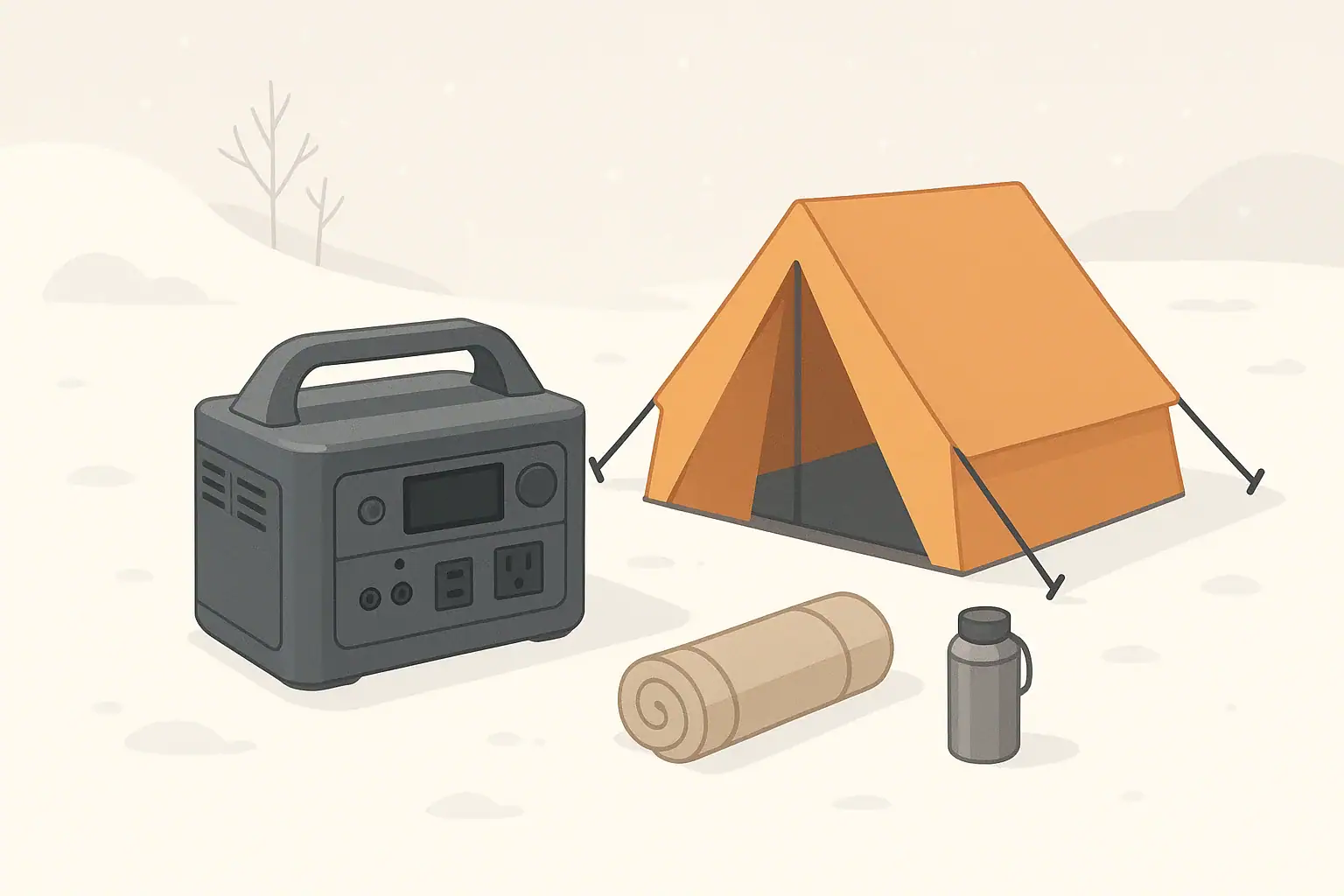
portable power station in a snowy campsite winter scene

Portable power stations rely on lithium-based batteries, which are sensitive to temperature. When it gets cold, many users notice that their station runs devices for less time than expected, even if it was fully charged indoors. This is not usually a defect; it is a normal characteristic of how batteries behave in low temperatures.

Most portable power stations are designed and rated around room temperature, often in the range of about 68–77°F (20–25°C). Once you move well below that range, especially near or below freezing, the available capacity and power output can drop noticeably.

The important point is that cold temperatures temporarily limit how much energy you can draw and how quickly you can draw it. When the battery warms back up, much of that capacity is effectively restored, as long as the battery has not been damaged by extreme conditions.

Why Portable Power Stations Lose Capacity in the Cold

Portable power stations rely on lithium-based batteries, which are sensitive to temperature. When it gets cold, many users notice that their station runs devices for less time than expected, even if it was fully charged indoors. This is not usually a defect; it is a normal characteristic of how batteries behave in low temperatures.

Most portable power stations are designed and rated around room temperature, often in the range of about 68–77°F (20–25°C). Once you move well below that range, especially near or below freezing, the available capacity and power output can drop noticeably.

The important point is that cold temperatures temporarily limit how much energy you can draw and how quickly you can draw it. When the battery warms back up, much of that capacity is effectively restored, as long as the battery has not been damaged by extreme conditions.

How Cold Affects Battery Chemistry and Performance

Inside a portable power station, lithium ions move through an electrolyte between the positive and negative electrodes. This movement enables charging and discharging. Cold temperatures slow down the chemical reactions and ion movement, which leads to several practical effects you will notice during winter use.

Slower Chemical Reactions

At lower temperatures, the internal resistance of the battery increases. Higher resistance means the battery has to work harder to deliver the same current, which leads to:

  • Lower effective capacity under load
  • More voltage sag when powering higher-wattage devices
  • Potential early low-battery cutoff by the power station’s protections

This is why a battery that is rated for a certain number of watt-hours at room temperature will appear to have less usable energy when used in the cold.

Voltage Sag and Early Cutoff

Portable power stations use built-in electronics to keep output voltage safe and stable. As the battery gets colder, voltage under load can drop faster. If voltage dips below safe thresholds, the management system may shut down output even though some energy remains in the cells.

The result is that you may see the display show a decent state-of-charge percentage, but the station shuts off earlier than you would expect in warmer weather. This is especially noticeable when running higher-power devices like space heaters or power tools.

Cold Charging Limitations

Charging lithium batteries when they are very cold can cause permanent damage, so most power stations limit or block charging below certain temperatures. In practice, this may look like:

  • Very slow charging when the unit is cold-soaked
  • A warning indicator and no charging until the battery warms
  • Reduced input power to protect the battery

This is a protective feature, not a malfunction. Warming the unit to a moderate indoor temperature before charging is generally recommended for long-term battery health.

Cold-weather portable power checklist – key factors that affect how much capacity you actually get when temperatures drop. Example values for illustration.
Checklist of cold-weather factors and why they matter
What to check Why it matters Practical note
Ambient temperature range Colder air reduces effective capacity and output Expect noticeable loss around freezing and below
Battery temperature, not just air Battery may stay cold even if air warms briefly Allow time for the unit to warm before use
Discharge rate (load watts) Higher loads amplify cold-related capacity loss Use lower-wattage settings when possible
Charging conditions Charging when very cold can stress the battery Charge indoors or in a moderate environment
Storage location Long-term cold storage affects self-discharge and life Avoid unheated sheds in severe winters
Physical insulation Helps keep battery closer to its own operating warmth Insulate the unit but leave vents and inlets clear
Runtime expectations Overestimating warm-weather runtimes can cause outages Plan a buffer for winter use cases

How Much Capacity You Really Lose at Different Temperatures

The exact amount of capacity loss in the cold depends on battery type, design, and load, but some general patterns are commonly observed. The figures below are approximate examples, not guaranteed values for any specific product.

Typical Capacity Loss Ranges

At moderate cool temperatures, such as around 50°F (10°C), you might barely notice any change for light loads. As you move closer to freezing, effects become more obvious. Many users report:

  • Light to moderate loads: modest capacity loss, especially around 32°F (0°C)
  • Higher loads: more severe loss due to combined effect of cold and high discharge rate
  • Very low temperatures: substantial reduction and difficulty sustaining high-power devices

Because of these combined factors, the same power station that runs a laptop and light for many hours indoors might run them for much less time during a cold overnight camping trip.

Example: Winter Runtime vs. Rated Capacity

Consider a portable power station with a rated capacity around 1000 Wh at room temperature. In mild weather, you might realistically plan for somewhat less than the rated capacity due to inverter losses and normal usage. In cold conditions, the available energy can drop further:

  • Near room temperature: often close to the expected runtime based on simple watt-hour math
  • Around 32°F (0°C): a noticeable reduction in usable runtime
  • Well below freezing: a significantly larger reduction, especially under heavier loads

These effects are cumulative with other inefficiencies, so the practical runtime in freezing weather can feel much shorter than the numbers on the spec sheet suggest.

Cold and High Loads Compound Each Other

Cold weather capacity loss is not just about temperature; it is strongly influenced by what you are powering. High-wattage appliances draw more current, accentuating voltage sag and causing the battery management system to intervene earlier. This results in:

  • Shorter runtimes than low-power use at the same temperature
  • More pronounced differences between warm and cold performance
  • Greater benefit from moderating loads or staggering device use

Planning Winter Runtimes for Real-World Use Cases

To make your portable power station more reliable in cold weather, it helps to plan runtimes based on conservative assumptions. Instead of using idealized math from the rated watt-hours, factor in cold-related and normal conversion losses together.

Adjusting Your Capacity Expectations

When estimating runtime, many users already account for inverter losses by assuming they will get less than the full rated watt-hours. In winter, you can add an extra margin for temperature effects. For example, you might:

  • Estimate runtime using a reduced capacity instead of the full rating
  • Plan shorter sessions for high-power tools or appliances
  • Schedule recharging sooner, before the battery is deeply discharged in the cold

This approach helps avoid surprises during a short power outage or an overnight camping trip when you are depending on the station for critical items like lights or communication devices.

Short Outages and Home Essentials

During winter power outages, portable power stations are often used for:

  • LED lights and small lamps
  • Phone and laptop charging
  • Small networking gear like a modem or router

These are usually low- to moderate-wattage loads, which are less demanding on the battery. Even with cold-weather capacity loss, a station sized appropriately for your needs can still cover several hours of critical essentials. You can improve reliability by keeping the unit in a moderately warm room and avoiding unnecessary high-power devices.

Remote Work, Camping, and Vanlife

In cold weather camping or vanlife scenarios, portable power stations often run:

  • Laptops and monitors
  • Portable Wi-Fi hotspots
  • 12 V fridges or coolers
  • Interior LED lighting

Cold-related capacity loss matters more here because you may be outdoors or in a minimally heated space for long periods. Storing the station inside an insulated area (like a sleeping compartment or under a blanket with clear ventilation for cooling vents) can help keep its temperature closer to a comfortable range once it is in use and generating a little internal heat.

Minimizing Capacity Loss and Protecting the Battery

You cannot completely eliminate cold-weather capacity loss, but you can reduce its impact and avoid unnecessary stress on the battery. Simple handling and placement choices make a noticeable difference.

Keep the Battery as Warm as Safely Practical

The battery works best close to typical room temperatures. In winter, you can:

  • Store and charge the power station indoors before using it outside
  • Transport it in the cabin of a vehicle instead of an exposed cargo area
  • Place it in an insulated bag or box during use, keeping vents clear
  • Avoid leaving it unused in freezing temperatures for long stretches

These steps help the battery stay within its more efficient operating range, which improves both capacity and overall lifespan.

Avoid Charging When the Battery Is Very Cold

If a power station has been in a cold environment, it is better to let it warm up gradually before charging. Many models restrict charging automatically at low temperatures, but you should still:

  • Bring the unit into a moderate environment before connecting chargers
  • Allow some time for the internal pack to warm, not just the case
  • Use typical charging methods (wall, vehicle, or solar) within recommended temperature ranges

This helps prevent stress to the battery and supports long-term capacity retention.

Moderate Your Loads in the Cold

Because high loads intensify voltage sag and capacity loss, especially in cold conditions, you can extend runtime by:

  • Running fewer devices at once
  • Choosing lower-power settings on appliances where possible
  • Avoiding continuous operation of heavy loads like resistive heaters
  • Scheduling heavier tasks when the battery is warmer and more charged

This approach reduces the risk of sudden shutdowns and helps your available capacity stretch further in winter.

Cold-weather runtime planning examples – approximate device loads and notes for winter operation. Example values for illustration.
Example device loads and winter planning notes
Device type Typical watts range (example) Winter planning note
LED lamp or string lights 5–20 W Low draw; cold has modest impact, but still plan a runtime buffer.
Phone or small tablet charging 5–15 W Short, intermittent loads; capacity loss is usually not critical.
Laptop for remote work 40–90 W Expect shorter sessions in the cold; keep the station warm indoors or in a vehicle.
12 V fridge or cooler 30–70 W while running Compressor cycles; cold reduces battery capacity but may reduce fridge runtime too.
Small space heater (not generally recommended) 300–800 W Very demanding; cold plus high wattage can drain capacity quickly and trigger shutoff.
Router and modem 10–30 W Good candidate for outages; keep the power station in a heated room.
Power tools (intermittent use) 200–800 W spikes Short bursts are more manageable; avoid continuous heavy cutting in deep cold.

Storage, Safety, and Long-Term Winter Care

How and where you store a portable power station in winter affects both safety and long-term capacity retention. Even when you are not actively using the station, cold temperatures still matter.

Off-Season and Between-Trip Storage

For winter storage, many manufacturers recommend keeping batteries:

  • In a cool, dry place away from direct sunlight
  • Out of prolonged freezing conditions when possible
  • Partially charged rather than at 0% or 100% for long periods

If you must store a unit in an unheated location, consider insulating it and checking it periodically. Self-discharge over months can leave batteries deeply empty, which is not ideal for long-term health.

Safe Placement and Ventilation in Winter

During use, portable power stations need adequate ventilation, even in cold weather. When insulating or sheltering the unit, make sure:

  • Air vents and fans are not covered or blocked
  • The station is kept away from liquid water, slush, or melting snow
  • Cords are routed to avoid tripping hazards in dark or icy areas

If you are using the station indoors, place it on a stable, dry surface away from heat sources and combustible materials. Do not enclose it tightly in blankets or containers that trap heat and block airflow.

High-Level Guidance for Home Backup Setups

Some users pair portable power stations with home circuits for winter outages. Any connection to a home’s electrical system involves safety and code considerations. For this reason:

  • Use clearly labeled outlets and extension cords rated for the load
  • Do not attempt to backfeed house wiring through improvised connections
  • Consult a qualified electrician for any transfer switch or inlet installation

Keeping the setup simple and external to the main panel reduces risk, especially during stressful winter outage conditions.

By understanding how cold weather affects battery capacity and taking basic steps to keep your station within a reasonable temperature range, you can plan more accurate runtimes and preserve long-term battery health, whether you are dealing with a short outage, a remote work trip, or a winter camping weekend.

Frequently asked questions

How much capacity loss should I expect around freezing temperatures?

Around 32°F (0°C), many lithium-based portable power stations experience a noticeable reduction in usable capacity — commonly in the range of about 10–30% for light to moderate loads. The exact amount depends on battery chemistry, state of charge, age, and how heavily you are discharging the pack.

Can cold weather permanently damage my power station’s battery?

Short-term exposure to cold typically causes temporary capacity loss that returns as the battery warms, but charging or repeatedly operating a very cold battery can cause long-term harm such as lithium plating or reduced cycle life. To avoid permanent damage, follow the manufacturer’s temperature guidelines and avoid charging while the pack is below recommended limits.

Is it safe to charge my power station when it’s cold outside?

Many power stations restrict or slow charging below certain temperatures to protect the cells. It’s safer to bring the unit into a moderate environment and allow the internal pack to warm before charging to prevent stress and preserve long-term capacity.

What practical steps reduce cold weather capacity loss in the field?

Keep the unit warm by storing and charging it indoors before use, use insulation or an insulated bag while keeping vents clear, moderate loads, and stagger high-draw devices. Transporting the station inside a vehicle cabin and avoiding prolonged exposure to subfreezing temperatures also helps preserve available capacity.

How should I plan runtimes for winter outages or cold-weather trips?

Use conservative runtime estimates by reducing the rated capacity to account for cold-weather capacity loss and inverter inefficiencies, avoid relying on high-wattage appliances, and schedule recharges earlier. Planning with a buffer and keeping the station in a moderately warm location when possible improves reliability.
Extension Cords and Power Strips: Safe Practices With Portable Power Stations

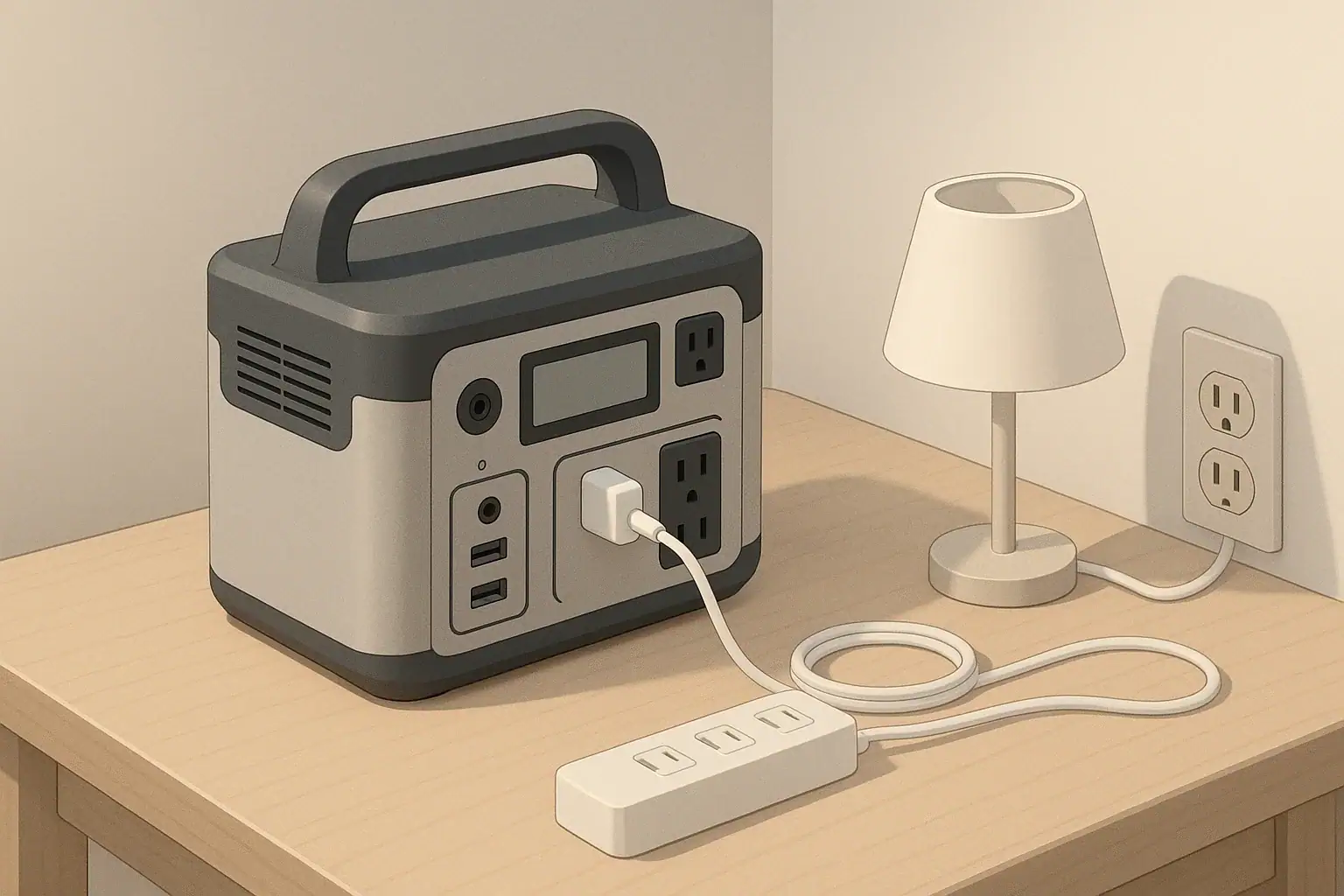
Portable power station on table with neatly managed cords

Portable power stations often sit in one place while the devices you power are spread around a room, campsite, or vehicle. Extension cords and power strips make that possible, but they also introduce extra heat, resistance, and potential overload points. Using them incorrectly can cause tripped protection, damaged equipment, or in the worst case, fire risk.

This guide explains how to choose and use extension cords and power strips safely with portable power stations. It focuses on typical home, office, and light camping scenarios, not industrial or permanent wiring. It also assumes you are plugging devices into the power station’s built-in outlets, not modifying the power station or your home wiring in any way.

Before adding cords and power strips, it helps to understand the limits of your portable power station and what you plan to run from it.

Why Extension Cords and Power Strips Matter With Portable Power Stations

Portable power stations often sit in one place while the devices you power are spread around a room, campsite, or vehicle. Extension cords and power strips make that possible, but they also introduce extra heat, resistance, and potential overload points. Using them incorrectly can cause tripped protection, damaged equipment, or in the worst case, fire risk.

This guide explains how to choose and use extension cords and power strips safely with portable power stations. It focuses on typical home, office, and light camping scenarios, not industrial or permanent wiring. It also assumes you are plugging devices into the power station’s built-in outlets, not modifying the power station or your home wiring in any way.

Key Safety Basics Before You Plug Anything In

Know Your Power Station’s Limits

Every portable power station has several important ratings:

  • Battery capacity (Wh): Tells you how much total energy is stored. This affects how long you can run devices, not how many you can plug in at once.
  • Inverter continuous power (W): The maximum steady AC output. Adding a power strip does not increase this limit.
  • Inverter surge power (W): A short-term higher output for starting motors or compressors. Multiple devices starting at once can exceed this.
  • Number and type of outlets: AC, DC, USB, and any built-in protection (such as overload and over-temperature shutoff).

Add up the running watts of what you want to power at the same time. Stay below the continuous watt rating of the power station, with extra margin if anything has a motor (fans, small pumps, some fridges).

Understand Extension Cords vs. Power Strips

Extension cords and power strips are not the same thing:

  • Extension cord: A flexible cable with a plug on one end and one or more outlets on the other. Its main job is to extend reach.
  • Power strip: A device with multiple outlets, often with a short cord. It may include surge protection and an on/off switch.

You can plug a power strip into an extension cord, or directly into a power station, but every added connection is another potential weak point. Using fewer, higher-quality components is generally safer than chaining many cheap ones.

Respect Amp, Watt, and Gauge Ratings

Each component has its own limits:

  • Power station outlet rating: Often 10–15 A per outlet (example values), but always check the printed rating near the outlet.
  • Power strip rating: Commonly listed as a maximum amp and watt value. Do not exceed whichever limit is reached first.
  • Extension cord wire gauge: Lower gauge number means thicker wire and higher capacity (for example, 12 AWG is thicker than 16 AWG).

Heat is a sign something is overloaded or poorly connected. Cords, plugs, and power strips should never become uncomfortably hot in normal use.

Checklist for Choosing Cords and Power Strips for Portable Power Stations

Example values for illustration.

What to Check Why It Matters Notes
Power strip amp/watt rating Prevents overload and tripping Keep device total below strip rating and below station rating
Extension cord gauge (AWG) Controls voltage drop and heating Thicker wire (smaller AWG number) for higher loads or longer runs
Indoor vs. outdoor rating Protects insulation from environment Use outdoor-rated cords only in damp or exterior locations
Grounding (3-prong) Supports grounded appliances Avoid adapters that defeat the grounding pin
Condition of plugs and jacket Reduces risk of shorts and shock Do not use cords with cracks, cuts, or bent blades
Built-in overload protection Adds another safety layer Some strips include resettable breakers for added protection
Cord length Longer cords increase resistance Use the shortest practical length for the load

Choosing the Right Extension Cord for a Portable Power Station

The right extension cord depends on how far you need to reach and what you plan to plug in. Using an undersized or inappropriate cord is one of the most common mistakes with portable power stations.

Gauge and Length: Balancing Convenience and Safety

Two factors go together: wire thickness (gauge) and length.

  • Short, light loads: For low-power devices (phone chargers, LED lamps) over short distances, a typical household extension cord is usually adequate.
  • Higher loads or longer runs: For heavier appliances (space heaters, kettles, small microwaves) or runs over a few yards, use a thicker cord designed for higher amps.
  • Avoid unnecessary length: Longer cords increase resistance and heating. Use the shortest cord that comfortably reaches.

Extension cord packages typically list their maximum amp rating and recommended use. Treat these as practical limits and leave extra margin rather than pushing to the maximum.

Grounded vs. Ungrounded Cords

Many portable power stations provide three-prong (grounded) AC outlets. When using grounded devices, use cords and power strips that maintain that ground connection:

  • Use three-prong cords: These support devices that rely on a ground for safety, such as some computer equipment and metal-bodied appliances.
  • Avoid ground adapters: “Cheater” adapters that defeat the ground pin remove a safety feature and are not recommended with portable power stations.

Indoor vs. Outdoor Rated Cords

If your portable power station is used outdoors, or indoors near damp areas like patios or garages, cord type matters:

  • Outdoor-rated cords: Have insulation designed to withstand moisture, abrasion, and temperature swings.
  • Indoor-only cords: Should stay dry and off the ground. Do not run them through doors or windows where they may be pinched.

Even with a robust portable power station, the weakest component in the chain sets the safety limit.

Using Power Strips With Portable Power Stations

Power strips let you plug several devices into one AC outlet on the power station. This is convenient for desks, media centers, and remote work setups, but it also makes it easy to silently overload the system if you are not paying attention.

Power Strip Ratings and Load Planning

Treat the power strip as its own device with limits:

  • Check the strip rating: It should list a maximum amps and/or watts. Never exceed this, even if the power station could theoretically supply more.
  • Count total load: Sum the typical wattage of all devices you plan to plug into that strip. Include chargers, which may draw more than expected when devices charge from low battery.
  • Add margin: Aim to stay below both the strip rating and the power station’s continuous output by a comfortable margin, especially for longer runtimes.

Remember that some devices draw an initial surge. If multiple devices with motors start at once from the same power strip, you may see the power station briefly trip or shut down to protect itself.

Avoid Daisy-Chaining Strips and Cords

Daisy-chaining means plugging a power strip into another power strip, or building long chains of cords. This is widely discouraged for safety reasons:

  • Uneven loading: One strip in the chain may carry more current than its design assumes.
  • Extra resistance: Each plug and connection adds points of potential heating.
  • Harder to inspect: Long chains get tucked behind furniture or under gear, where problems can go unnoticed.

A safer approach is to use a single, appropriately rated power strip connected directly to the portable power station, and then use individual cords only as needed for distance.

Surge Protectors With Portable Power Stations

Many power strips add surge protection. With portable power stations, surge protection can still be useful, particularly for sensitive electronics, but keep a few points in mind:

  • Redundant protection: Many power stations have built-in inverter protections. A surge-protecting strip adds another layer but does not replace careful load planning.
  • Indicator lights: Surge strips often have lights to show if protection is active. If the light is off when the strip is energized, its surge components may be spent.
  • End-of-life: Surge protection can degrade over time after voltage spikes. Replace old or suspect units rather than relying on them indefinitely.

Placement, Routing, and Ventilation

Where you place your portable power station and how you route cords affect both safety and usability. Good cable management prevents trips, strain on outlets, and accidental damage.

Keep the Power Station Stable and Ventilated

Portable power stations contain batteries and inverters that generate heat under load.

  • Stable surface: Place the unit on a flat, solid surface where it cannot tip or slide.
  • Vent clearance: Keep vents and fans unblocked. Leave a few inches of open space around air inlets and outlets.
  • Dry, cool location: Avoid direct sunlight, heaters, and damp or puddled areas.

Do not coil extension cords tightly near the power station. Coils trap heat and can cause the cord to run much warmer than if it were loosely laid out.

Safe Routing of Cords and Strips

Once everything is plugged in, check how your cords lie in the real space you are using:

  • Avoid trip hazards: Do not stretch cords across walkways without protection. Use cord covers or route along walls where practical.
  • Protect from pinch and crush: Do not run cords under rugs, through door gaps, or under heavy furniture. Pressure can damage insulation and cause hidden hot spots.
  • Strain relief: Avoid putting tension on the power station’s outlets. If a cord is pulled tight, reposition the station or use a slightly longer cord.

Indoor vs. Camping and RV Use

In homes and offices, cords are usually protected from the elements. In camping and RV scenarios, conditions are harsher:

  • Outdoor placement: If the power station is near a tent or under an awning, keep it off bare ground and protected from rain and splashes.
  • Vehicle doors and windows: Avoid sharply pinching cords in door seals or windows. Repeated closing can cut through insulation.
  • Temporary only: Resist the urge to build semi-permanent cord runs through walls or cabinetry. Permanent wiring modifications should be planned and installed by a qualified professional, not improvised with extension cords.

What Not to Plug In: High-Draw Devices and Risky Loads

Portable power stations are great for lights, communications gear, and many household essentials. However, some devices draw enough power to overwhelm both the power station and the cords you use.

High-Wattage Appliances

Be especially cautious with devices that convert electricity into heat:

  • Space heaters
  • Hair dryers
  • Toasters and toaster ovens
  • Electric kettles and some coffee makers
  • Hot plates

These can easily draw hundreds to over a thousand watts, sometimes more than a smaller portable power station can safely deliver. Even if the power station can handle the load, your extension cord and power strip also need to be appropriately rated.

Motor Loads and Starting Surges

Devices with motors or compressors have two power numbers: a lower running wattage and a higher starting surge. Examples include:

  • Refrigerators and freezers
  • Small air conditioners
  • Well pumps
  • Some power tools

If several motor loads start at once on the same power strip or cord, the combined surge can exceed what the power station and cords can handle, at least briefly. This may cause nuisance shutdowns or stress on components.

Resist Using Portable Stations as Whole-Home Backups

It can be tempting to use a portable power station like a whole-house generator. However, safely powering multiple circuits or your main panel requires equipment and methods that go beyond extension cords and power strips.

  • Do not backfeed: Plugging a power station into a wall outlet to energize house wiring is unsafe and may be illegal in many places.
  • No DIY panel wiring: Any connection to a home electrical system, including transfer switches or dedicated inlets, should be assessed and installed by a qualified electrician.

For short outages, it is usually safer to run specific extension cords from the portable power station directly to the devices you need, rather than trying to energize entire circuits.

Example Loads and Planning Considerations With Portable Power Stations

Example values for illustration.

Device Type Typical Watt Range (Example) Planning Notes
LED lamp 5–15 W Low load; multiple lamps can share one strip comfortably
Laptop and monitor 60–150 W Good candidate for a single power strip at a desk
Phone and tablet chargers 10–40 W total Prefer direct USB outputs when available to free AC capacity
Mini fridge 50–100 W running Allow for higher starting surge; avoid sharing strip with other motor loads
Fan 30–80 W Generally fine on a shared strip; start fan before other high loads
Space heater 1000–1500 W Use extreme caution; often too much for small stations or light-duty cords

Practical Checklists for Everyday Use

Before each use, it helps to run through a quick mental or written checklist. This keeps cords, power strips, and your portable power station working safely together.

Before You Turn On the Power Station

  • Confirm that total expected watts are within the power station’s continuous rating.
  • Check that each power strip and extension cord is rated for at least the portion of the load it will carry.
  • Inspect cords and plugs for damage, discoloration, or loose blades.
  • Place the power station where vents are clear and the surface is stable.
  • Lay cords where they will not be walked on, pinched, or driven over.

While in Use

  • Periodically feel cords and power strips with the back of your hand; they should be warm at most, not hot.
  • Listen for unusual sounds from the power station, such as fans running excessively hard, which may indicate heavy load or poor ventilation.
  • Watch the power station’s output indicators, if available, to avoid sustained operation near maximum capacity.
  • Shut down and unplug if you detect burning odors, visible arcing, or melted plastic, and replace faulty components.

After You Are Done

  • Turn off or unplug high-draw devices before switching off the power station.
  • Coil cords loosely, not tightly, to avoid kinks and internal damage.
  • Store cords and power strips in a dry area away from direct sunlight and sharp objects.
  • Recharge the portable power station according to the manufacturer’s recommendations so it is ready for the next use.

Thoughtful planning and simple inspections go a long way toward safe, reliable use of extension cords and power strips with portable power stations in homes, offices, vehicles, and campsites.

Frequently asked questions

Can I use any extension cord with a portable power station?

No. Use an extension cord rated for the current and wattage you expect to draw, with a suitable wire gauge and length for the load. Prefer three-prong grounded cords for grounded appliances and choose outdoor-rated jackets if the cord will be exposed to moisture or abrasion.

How do I choose the right gauge and length for an extension cord?

Match the cord’s amp rating to the device(s) you plan to power and use a thicker (lower AWG number) cord for higher loads or longer runs to reduce voltage drop and heat. When in doubt, pick a heavier-duty cord and keep the run as short as practical.

Is it safe to plug a power strip into an extension cord or vice versa?

Daisy-chaining is discouraged because each connection adds resistance and potential heating; it also makes overloads harder to spot. If you must extend reach, use a single, appropriately rated heavy-duty cord connected directly to the power station and then attach one properly rated power strip, avoiding chains.

Should I use a surge protector with a portable power station?

Surge-protecting strips can add protection for sensitive electronics, but they don’t replace proper load planning or the power station’s internal protections. Check the protector’s indicator light and replace the strip if the protection has been expended or if the unit shows signs of wear.

What are warning signs that a cord or power strip is overloaded or failing?

Warning signs include cords or plugs that feel hot to the touch, discoloration, melting, burning smells, frequent tripping of protection, or visible damage to insulation or blades. If you observe any of these, unplug the device immediately and replace the faulty component before reuse.

Indoor Use Safety: Ventilation, Heat, and Fire-Prevention Basics

Portable power station on indoor table with tidy cables

Portable power stations are designed to be safer and cleaner than fuel-powered generators, especially for indoor use. They produce no exhaust and usually have built-in protections. However, they still store and move significant amounts of energy, which means heat, electrical, and fire risks must be managed carefully.

Understanding basic indoor safety helps you use a power station for outages, work, or everyday charging without creating hidden hazards. Good habits around ventilation, heat, cords, and placement go a long way toward preventing problems.

This guide focuses on practical, non-technical steps you can apply in apartments, houses, RVs, and small workspaces.

Portable power stations do not emit combustion gases, so you do not need the same ventilation you would for a fuel generator. Instead, indoor ventilation is about giving the device enough airflow to manage heat and avoiding confined spaces where heat can build up.

Why Indoor Safety Matters for Portable Power Stations

Portable power stations are designed to be safer and cleaner than fuel-powered generators, especially for indoor use. They produce no exhaust and usually have built-in protections. However, they still store and move significant amounts of energy, which means heat, electrical, and fire risks must be managed carefully.

Understanding basic indoor safety helps you use a power station for outages, work, or everyday charging without creating hidden hazards. Good habits around ventilation, heat, cords, and placement go a long way toward preventing problems.

This guide focuses on practical, non-technical steps you can apply in apartments, houses, RVs, and small workspaces.

Ventilation Fundamentals for Indoor Use

Portable power stations do not emit combustion gases, so you do not need the same ventilation you would for a fuel generator. Instead, indoor ventilation is about giving the device enough airflow to manage heat and avoiding confined spaces where heat can build up.

Why Airflow Still Matters

Most portable power stations contain lithium-based batteries and an inverter that converts battery power to AC. Both can generate heat, especially at higher loads or while charging. If the unit cannot shed this heat, internal temperatures may rise and trigger protective shutdowns or, in extreme cases, contribute to damage.

Basic airflow principles:

  • Allow space around vents and fan openings.
  • Avoid blocking intake and exhaust grilles with walls, fabrics, or clutter.
  • Do not run the unit inside enclosed cabinets, drawers, or tightly sealed boxes.
  • Use it in a room with normal air circulation rather than in small, sealed closets.

Room Placement vs. Enclosures

Choose locations where air can move freely around the power station:

  • Better: On a hard surface in an open room, with several inches of clearance on all sides.
  • Worse: Inside a storage bin, wedged between pillows, or pushed tight against a wall.

If you must place it in a more confined area, such as an RV cabinet, ensure there is a clear path for air to get in and out and check that the surrounding surfaces do not get hot during use.

Humidity, Dust, and Indoor Air Quality

While power stations do not produce fumes, the surrounding environment still matters:

  • Humidity: Very damp spaces (like bathrooms with frequent steam or basements with condensation) can increase corrosion risk and affect electronics over time.
  • Dust: Dust buildup can clog vents and reduce cooling efficiency. Avoid placing the unit on the floor in dusty workshops without occasional cleaning.
  • Odors or unusual smells: If you notice persistent burning or sharp chemical odors from the unit, stop using it and disconnect loads. Let it cool and contact the manufacturer or a qualified professional.
Indoor portable power station placement checklist – Example values for illustration.
What to check Why it matters Practical notes
Space around vents Prevents overheating and fan strain Aim for open space on all sides, not tight corners
Surface material Avoids heat buildup and tipping Use stable, hard, level surfaces instead of soft bedding
Nearby combustibles Reduces fire fuel around the unit Keep away from paper piles, curtains, and fabrics
Cord routing Prevents tripping and plug damage Run cords along walls, not across walkways
Children and pets access Limits tampering and accidental unplugging Place where small hands and paws are less likely to reach
Moisture sources Protects against short circuits Avoid sinks, open windows during rain, and floor-level spills
Vent cleanliness Maintains airflow over time Lightly dust vents periodically as needed

Example values for illustration.

Managing Heat: Surfaces, Loads, and Room Conditions

Heat is a natural byproduct of moving energy. With portable power stations, managing that heat is about three main factors: how hard you are pushing the unit, where it sits, and what the room is like.

Choosing Safe Surfaces Indoors

The surface you place the power station on affects cooling and fire risk:

  • Preferred surfaces: Tile, hardwood, laminate, or sturdy tables and shelves.
  • Less ideal: Thick carpets, rugs, or bedding that can block vents or trap heat.
  • Unacceptable: On top of flammable piles (clothing, papers, cardboard boxes) or unstable stacks that may tip.

Avoid covering the unit with blankets or clothes, even if you are trying to reduce fan noise. This can restrict airflow and raise temperatures.

Load Levels and Heat Generation

Higher power draws generally create more heat. For example, powering a few small devices will create less heat than running an electric heater or hair dryer. While each device has its own limits, general practices include:

  • Stay within the rated continuous wattage of the power station.
  • Avoid running at maximum load for long periods if not necessary.
  • Use high-draw appliances (like power tools) for shorter intervals when possible.
  • Give the unit rest periods if it feels unusually warm to the touch.

Some models will reduce output or shut down automatically if internal temperatures rise too much. If that happens, let the unit cool in a well-ventilated space before restarting.

Room Temperature and Indoor Climate

Room temperature affects how easily the power station can shed heat. A unit used in a cool, dry room will typically run cooler than one used in a hot, closed-off attic.

  • Avoid using or charging the power station in very hot spaces, such as next to radiators or in direct sunlight inside a car.
  • If you are using it in a warm room, limit heavy loads and monitor it more often for heat buildup.
  • In cold climates, avoid placing the device directly on very cold surfaces (like concrete near open garage doors) when charging; follow the manufacturer’s guidance on operating temperature ranges.

Fire-Prevention Basics for Indoor Operation

Fire risk with portable power stations mainly comes from heat, damaged wiring, overloaded circuits, and nearby combustible materials. Simple preventive steps significantly reduce these risks.

Understanding Common Indoor Fire Risks

Typical indoor scenarios that raise risk include:

  • Running the unit on or under piles of clothing or blankets.
  • Using damaged extension cords or power strips.
  • Overloading multi-outlet adapters with many high-wattage devices.
  • Placing the unit near curtains that could drape over vents.
  • Leaving flammable items such as paper stacks against the unit.

Most power stations include internal protection for short circuits and overcurrent conditions, but they cannot manage the condition of your cords, outlets, or the items stored nearby.

Safe Indoor Charging Habits

Charging is when batteries are taking in energy, which can create heat inside the pack. Safer indoor charging involves:

  • Use only compatible chargers: Stick to the manufacturer-supplied or approved charging methods.
  • Normal surfaces and airflow: Follow the same surface and ventilation guidance you use for discharging.
  • Supervision: Avoid charging in completely unattended spaces for long periods, such as inside a closet while you are away for days.
  • Monitoring: Occasionally check for unusual warmth, swelling, noises, or odors while charging.

Do not attempt to open the unit, modify the battery pack, or bypass safety features. Internal repairs and diagnostics should be left to the manufacturer or qualified technicians.

Distance from Flammable Materials

Provide a clear zone around the power station:

  • Keep paper, cardboard, fabric, and plastics from resting against the case or vents.
  • Avoid storing aerosols, solvents, or fuels near the unit.
  • Do not place scented candles, space heaters, or other heat sources directly beside or on top of the unit.

In small rooms, think about what could accidentally fall onto the unit—curtains, wall hangings, or items on shelves above it—and choose a location with fewer chances for items to drop or drape over it.

Basic Preparedness: Extinguishers and Detection

General household fire-prevention measures support safer use of any electrical equipment:

  • Install and maintain working smoke alarms in living areas and near sleeping spaces.
  • Consider having a household fire extinguisher rated for electrical fires, and learn how to use it.
  • Keep escape paths clear in case of emergency.

These measures are not specific to power stations but are part of a safer indoor environment overall.

Safe Use of Cords, Outlets, and Extension Accessories

Even if the power station itself is well-designed, poor cord management can lead to shock, fire, or tripping hazards. Indoor setups often involve multiple devices, which increases the chance of tangles and damage.

Choosing and Using Extension Cords Indoors

When the device you are powering is far from the power station, an extension cord or power strip may be involved. Basic indoor cord safety includes:

  • Use cords rated for at least the expected load of your devices.
  • Prefer shorter cords when possible to reduce voltage drop and tangling.
  • Do not run cords under thick rugs where heat can build up and damage may go unnoticed.
  • Avoid pinching cords in doorways, windows, or under heavy furniture.
  • Inspect cords regularly for cuts, fraying, or crushed sections and replace damaged ones.

Check the labeling on cords and power strips to see their current and power ratings, and keep high-wattage appliances on separate cords or outlets rather than sharing a small strip with many devices.

Keeping Connections Secure and Dry

Loose or partially inserted plugs can arc and create heat. Good practices include:

  • Push plugs fully into outlets until they seat firmly.
  • If a plug wobbles excessively in the outlet, avoid using that outlet until it is inspected or replaced.
  • Keep drinks and other liquids away from the power station and connected devices.
  • If a spill occurs nearby, disconnect the power station safely and let everything dry thoroughly before reuse.

Do Not Backfeed or Modify Your Home Wiring

Some users want to power household circuits during an outage. Connecting a portable power station directly into home wiring, especially through improvised methods, is dangerous and often not code-compliant.

General high-level guidance:

  • Do not plug a power station into a wall outlet to energize home circuits (backfeeding).
  • Do not build custom cables to connect directly to a breaker panel or dryer outlet.
  • If you want a whole-circuit solution, consult a licensed electrician about appropriate equipment and local code requirements.

For most users, the safer approach is to power essential devices directly from the power station’s built-in AC and DC outlets using appropriate cords.

Indoor Use Around People, Pets, and Sleep Areas

Because portable power stations are often used in bedrooms, living rooms, and RVs, it is important to consider how they interact with daily life, including children, pets, and overnight use.

Children and Pet Safety

Children and pets may be curious about the device, buttons, and cables. To reduce risk:

  • Place the power station where it is not easy for small children to reach or operate it unsupervised.
  • Use cable organizers or clips to reduce dangling cords that may invite pulling or chewing.
  • Teach older children not to cover the unit or place items on top of it.
  • Watch for pets that might chew cables or sleep against warm surfaces on the unit.

Nighttime and Unattended Operation

Many people rely on power stations overnight to run devices like CPAP machines, fans, or phone chargers. Practical steps include:

  • Before sleeping, check that the unit is on a stable, clear surface with no fabrics covering it.
  • Verify that cords are not stretched across walkways where someone may trip in the dark.
  • If a device is critical for health or safety, consider having backup options available in case of unexpected shutdowns or faults.

Leaving the unit running while you leave home for a short period is common, but avoid leaving long, high-wattage loads running unattended for extended times if you do not need to.

Practical Safety Scenarios and Planning

Thinking through common indoor scenarios helps you apply the ventilation, heat, and fire-prevention basics in real life. Different uses—such as short outages, remote work, or camping indoors in an RV—create different patterns of risk.

Short Power Outages at Home

During brief outages, people often plug in lamps, phone chargers, routers, and sometimes a refrigerator. Indoors, you can reduce risk by:

  • Keeping the power station on a table or counter away from foot traffic.
  • Using one or two well-rated extension cords instead of many daisy-chained strips.
  • Resisting the urge to power every possible device at once; prioritize essentials.

Remote Work and Electronics Use Indoors

For laptops, monitors, and networking equipment, indoor safety focuses on cord management and heat around electronics:

  • Route cords behind desks and along walls instead of across floors.
  • Avoid stacking laptops, routers, and the power station tightly together; each needs airflow.
  • Periodically touch-check for hot spots on power bricks, surge strips, and the power station itself.

RV, Camper, and Van Use Indoors

In RVs and vans, space is tighter and ventilation can vary:

  • Ensure there is a dedicated spot for the power station that is not a general storage pile.
  • Provide open space around vents even if the unit is inside a cabinet or bench.
  • Be cautious with high-draw appliances in small enclosed interiors, where heat accumulates faster.

Because these spaces are also sleeping areas, especially at night, double-check clearances and placement before bed.

Indoor safety scenarios and safer practices – Example values for illustration.
Scenario Key risk Safer practice Note
Running a space heater from a power station High heat and heavy load Use lower-wattage heaters sparingly or avoid; monitor closely Check power ratings and keep clear space around both devices
Power station on bedroom carpet Restricted airflow and dust Place on a low table or hard board instead Improves cooling and reduces dust intake
Cords across a dark hallway Trip hazard and plug damage Route cords along walls; use shorter lengths Helps prevent falls during outages at night
Charging in a packed closet Heat buildup and combustibles nearby Charge in an open, ventilated room Closets often contain dense flammable materials
Children playing near the unit Cable pulling and tipping Place out of reach and secure cords Consider elevated or tucked-away locations
Using damaged extension cord Sparking and overheating Replace with properly rated, intact cord Never tape over severe damage as a fix
Stacking blankets on top of the unit Blocked vents and trapped heat Keep top and sides clear Warm air must escape freely

Example values for illustration.

Ongoing Habits for Safer Indoor Use

Indoor portable power station safety is less about one-time setup and more about consistent, simple habits:

  • Keep the device on stable, hard surfaces with clear airflow around it.
  • Route and inspect cords regularly, replacing any that show wear.
  • Store the unit in a cool, dry indoor place when not in use.
  • Follow the manufacturer’s guidelines for operating temperature and charging.
  • Pay attention to unusual sounds, smells, or heat and stop using the device if something seems wrong.

By combining ventilation awareness, heat management, careful cord use, and basic fire-prevention measures, you can use portable power stations indoors with greater confidence and fewer hidden risks.

Frequently asked questions

Can I use a portable power station indoors without the same ventilation needed for fuel generators?

No. Portable power stations do not produce combustion exhaust, so you do not need generator-style exhaust ventilation, but you do need adequate airflow around the unit to manage heat. Keep vents clear and avoid enclosing the unit in tight cabinets or under fabrics where heat can accumulate.

Is it safe to charge a portable power station overnight or while sleeping?

Charging overnight is common but should follow safety practices: place the unit on a stable, hard surface with good airflow, keep cords tidy and dry, and avoid leaving high-wattage charging unattended for long periods. If the unit becomes unusually hot, emits odors, or shows swelling, stop charging and seek professional advice.

How far should a power station be kept from flammable materials?

Maintain clear space around all sides and the top of the unit — typically several inches (about 10–30 cm) as a practical guideline — and never let papers, fabrics, or other combustibles rest against vents. Also avoid storing aerosols or fuels nearby and ensure nothing can drape over the unit and block airflow.

Can I run a space heater or other high-wattage appliances from a portable power station indoors?

Generally, high-wattage appliances like space heaters draw a lot of power and produce substantial heat, which many portable power stations cannot support continuously. Check the station’s rated continuous wattage; if a device approaches or exceeds that rating, avoid running it or run it only briefly while monitoring temperature and system behavior.

What are the best practices for using extension cords and avoiding home-wiring modifications?

Use extension cords rated for the expected load and avoid running cords under rugs or pinched in doorways. Never connect a power station to house wiring by backfeeding a wall outlet or using improvised wiring; consult a licensed electrician for whole-home or panel-level solutions.

Can a Portable Power Station Run a Microwave? What to Check Before You Try

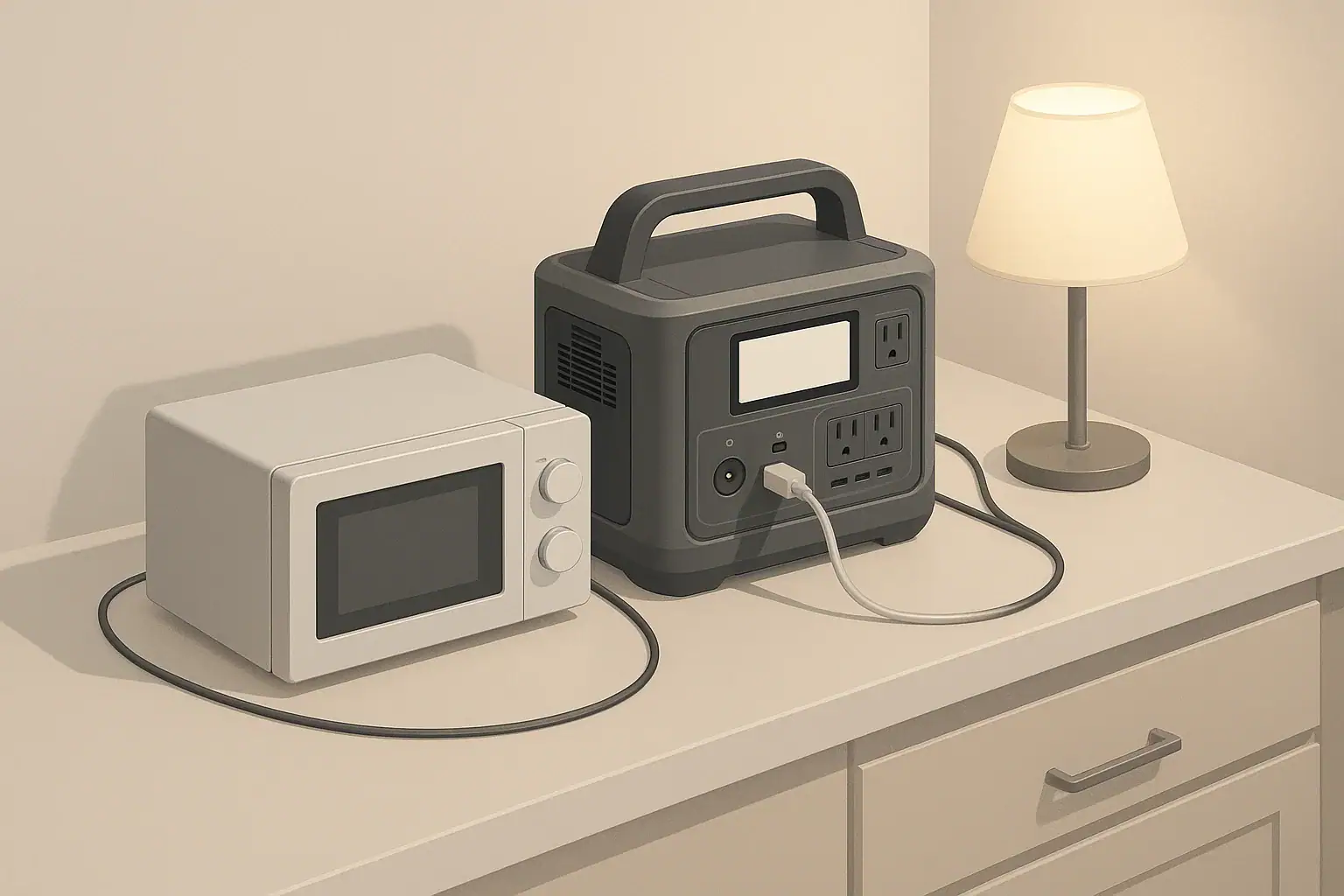
Portable power station running a microwave and lamp on counter

Can a Portable Power Station Run a Microwave?

A portable power station can run a microwave if its inverter and battery are large enough. Microwaves are high-wattage appliances with a short but intense power demand when they start. That means you need to check more than just the appliance label before you plug in.

Most compact microwaves draw somewhere between a few hundred watts and over 1,000 watts while running. Larger models can pull significantly more. Many portable power stations are sized for phones, laptops, and lights, not heavy kitchen appliances, so it is easy to overload a smaller unit.

Whether it is realistic or not comes down to three questions:

  • Can the inverter handle the microwave’s running watts?
  • Can it survive the microwave’s surge (startup) watts?
  • Does the battery have enough capacity (Wh) to run it for the time you need?

Understanding Microwave Power Ratings

The numbers printed on a microwave can be confusing because you may see two different watt ratings: one for cooking power and another for electrical input. For portable power station sizing, you care about the electrical input, not the advertised “cooking” watts.

Cooking watts vs. input watts

Microwave boxes and marketing materials often highlight a “700 W” or “1,000 W” rating. This usually refers to output or cooking power, not the electrical power it draws from the outlet. The input power is typically higher because the oven is not 100% efficient.

The input wattage is usually on the rear label or in the manual and may look like:

  • Input: 1,050 W
  • Input: 1,500 W

To size a portable power station, use that higher input number or, if you cannot find it, assume the real electrical draw is noticeably higher than the advertised cooking watts.

Startup surge and cycling behavior

Microwaves use a magnetron and transformer (or inverter-style electronics) that cause a brief surge when they start. This can be higher than the listed running watts. Many portable power stations list both a continuous (running) watt rating and a surge (or peak) rating.

Additionally, some microwaves cycle their power on and off to achieve lower power settings. When they cycle back on, you can see repeated small surges. A borderline-sized power station might trip during one of these cycles even if it survived the initial start.

Checklist of what to verify before running a microwave from a portable power station

Example values for illustration.

What to check Why it matters What to look for
Microwave input watts Determines minimum inverter size needed Label or manual; assume higher than cooking watts
Power station continuous watts Must meet or exceed microwave running watts Continuous AC output rating in watts
Power station surge watts Helps handle brief startup current spikes Peak or surge rating, usually above continuous
Battery capacity (Wh) Limits how long you can run the microwave Watt-hour rating; larger means longer runtime
Inverter type True sine wave is friendlier to appliances Look for pure/true sine wave AC output
Extension cords Undersized cords can overheat under high load Short, heavy-duty cords if one is needed at all
Ventilation and placement Reduces heat buildup and fume exposure Firm, dry surface with clear airflow around devices

Matching Inverter Output to Microwave Demand

The inverter inside a portable power station converts the battery’s DC power to the AC power your microwave expects. This is where most sizing problems show up.

Continuous power rating

The continuous AC rating is the amount of power the inverter can supply steadily. As a general rule, your portable power station’s continuous watt rating should be comfortably above the microwave’s input watts.

For example (illustrative only):

  • If your microwave label says 1,000 W input, a power station rated around 1,000 W continuous is cutting it close.
  • Having extra headroom (for instance, a unit rated several hundred watts above the microwave’s input) reduces the chance of overloads and heating.

Remember that any other devices plugged into the power station at the same time add to the total load. Phone chargers are small, but a coffee maker, toaster, or electric kettle can easily push the total draw well past the inverter’s limit.

Surge / peak power rating

Many inverters can briefly supply more than their continuous rating to help with startup surges. This surge rating is often available for a few seconds. While you do not need to match the exact surge wattage of the microwave, it helps to have a healthy gap between the microwave’s expected draw and the inverter’s maximum surge rating.

If the microwave causes the power station to shut down immediately on start, the surge may be too high for that unit. Repeated tripping can also create extra heat and stress on the electronics.

Inverter waveform

Microwaves generally prefer a pure (true) sine wave AC output. Some older or budget power devices use modified sine wave outputs that can cause:

  • extra noise or hum from the microwave
  • reduced heating performance
  • more waste heat in the appliance

Pure sine wave inverters are better suited for high-wattage kitchen appliances, even if modified sine units can sometimes run them at reduced efficiency.

How Long Can a Portable Power Station Run a Microwave?

Once you know that your power station can handle the load, the next question is runtime. Microwaves do not usually run continuously for hours, but they can still drain a battery quickly because of their high power draw.

Using watt-hours to estimate runtime

Portable power station capacity is usually listed in watt-hours (Wh). A rough runtime estimate for a single appliance is:

Runtime (hours) ≈ battery Wh ÷ appliance watts × efficiency factor

Because of inverter losses and real-world conditions, many people use an efficiency factor of around 0.8 as a simple planning number.

Example (illustrative only):

  • Battery capacity: 1,000 Wh
  • Microwave input: 1,000 W
  • Estimated runtime ≈ 1,000 ÷ 1,000 × 0.8 ≈ 0.8 hours (about 48 minutes)

But in practice, you are more likely to run the microwave for a few minutes at a time. Three minutes of use is only 1/20 of an hour, so that same microwave would use roughly 50 Wh per three-minute burst in this example.

Multiple devices and standby loads

If you are running other devices at the same time, add their wattage to the calculation. A laptop at 60 W and a light at 10 W do not change the total much, but a small electric heater or coffee maker can significantly reduce your available runtime.

Some power stations and appliances also have small standby draws, even when they are not actively heating. Over several hours or days, these add up, so it can be helpful to switch off devices at the outlet or use the power station’s AC output switch when not needed.

Is It Practical to Run a Microwave from a Portable Power Station?

Running a microwave on battery power is technically possible but not always the best use of capacity. Whether it makes sense depends on your situation.

Short power outages at home

For occasional short outages, a portable power station that can manage a few minutes of microwave use can be convenient. You might use it to:

  • warm up a quick meal or drink
  • heat water when the stove is unavailable

The tradeoff is battery percentage. A few short microwave sessions can use a large share of your stored energy—power that you might prefer to reserve for essentials like refrigeration, communication devices, or medical equipment (following the device’s manufacturer guidance).

Camping, vanlife, and RV use

In mobile situations, microwaves offer convenience but are not always the most energy-efficient choice. Consider:

  • Space and weight: Both the microwave and a larger-capacity power station take up room.
  • Charging opportunities: If you rely mostly on solar or limited vehicle charging, high-wattage cooking may deplete the battery faster than you can recharge it.
  • Alternative cooking methods: Propane stoves or low-wattage induction plates (when appropriately sized and used safely) can sometimes be better fits for long stays off-grid.

Remote work and light backup power

If your main goal is to power laptops, networking gear, and a few lights, adding microwave use may push you into needing a much larger power station. In that case, it may be more practical to rely on non-electric food options or brief use of a gas stove where allowed and safe.

Charging Considerations After Using a Microwave

High-wattage loads draw down a battery bank rapidly, so planning how you will recharge after microwave use is important, especially during extended outages or trips.

Wall charging

When grid power is available, wall charging is typically the fastest and simplest way to recharge a portable power station. If you use the microwave heavily during an outage but can recharge once power returns, you mainly need enough capacity to bridge that gap.

Vehicle charging

Charging from a vehicle 12 V outlet is slower and better suited for topping off the battery over time rather than quickly refilling after heavy microwave use. It can help maintain charge during travel days but may struggle to keep up with frequent high-wattage cooking.

Solar charging

Solar can be very effective over a sunny day, but the total energy harvested depends on panel size, sun hours, and conditions. A few microwave sessions in the morning can consume a large part of what your panels collect over the entire day, so it pays to align your cooking habits with your energy budget.

Example runtime planning for common devices on a portable power station

Example values for illustration.

Device type Typical watts range (example) Planning notes
Compact microwave 700–1,200 W input Use in short bursts; quickly drains smaller batteries
Coffee maker 600–1,000 W Similar impact as microwave; limit daily cycles
Mini fridge 50–100 W running Low running watts but long daily runtime
Laptop 40–100 W Modest draw; many hours of use on mid-size units
LED light 5–15 W Very efficient; minor effect on total runtime
Electric kettle 800–1,500 W Brief but heavy load; plan like microwave use
Phone charger 5–20 W Negligible compared with cooking appliances

Safety Tips When Using a Microwave on a Portable Power Station

High-wattage appliances deserve extra attention to safe operation, especially when powered from a battery-based system.

Placement and ventilation

Heat is one of the main concerns. Both the microwave and the power station need airflow:

  • Place the power station on a firm, level, dry surface.
  • Keep vents clear on all sides; avoid stacking items on or around it.
  • Give the microwave its normal clearance per the manufacturer’s instructions.

Cords and connections

Avoid daisy-chaining power strips or using lightweight extension cords for a microwave. Where an extension cord is unavoidable, select a heavy-duty cord rated for the appliance’s current draw, and keep it as short as practical to limit voltage drop and heating.

Environment and weather

Most portable power stations and standard household microwaves are designed for dry, indoor-type environments. Protect them from:

  • rain, splashes, and condensation
  • direct ground contact outdoors
  • extreme heat or cold outside the manufacturer’s recommended range

Cold weather can reduce battery performance and available capacity, while high temperatures can accelerate wear and increase the risk of overheating. Follow the device manuals for storage and operating temperature ranges.

Battery and inverter protection

Most modern portable power stations include built-in protections that shut the unit down if you overload it or if it gets too hot. If you repeatedly trigger these protections while using a microwave, consider:

  • reducing the microwave power setting (if available)
  • shortening cooking times and allowing cool-down periods
  • using a lower-wattage cooking method instead

Do not attempt to bypass safety features, modify the battery pack, or open the power station enclosure. Internal servicing and repairs should be left to qualified service centers or technicians recommended by the manufacturer.

Using portable power with home wiring

Some people consider using portable power stations to back up parts of their home electrical system. Connecting any portable power source directly into household wiring involves significant safety and code considerations.

Do not attempt to backfeed a home panel or wire a portable power station into household circuits without proper equipment and permits. If you are interested in a more integrated backup solution, consult a licensed electrician who can discuss transfer switches, interlocks, and other code-compliant options appropriate to your home.

For most users, the safest approach is to power microwaves and other appliances directly from the AC outlets on the power station using appropriate cords, rather than trying to integrate them into the building wiring.

Monitoring and maintenance

When you run a high-wattage appliance like a microwave, periodically check the power station’s display (if available) for battery percentage and any warning indicators. After heavy use, allow the unit to cool and store it in a cool, dry place.

Follow the manufacturer’s recommendations for storage charge level and periodic top-ups during long-term storage. Proper maintenance helps preserve battery health so the power station is ready when you need it for cooking, communication, or other essentials.

Frequently asked questions

What size portable power station is needed to run a typical microwave?

Use the microwave’s electrical input rating (not cooking watts) as your baseline and choose a power station with a continuous AC rating comfortably above that number and a higher surge rating. Compact microwaves often draw 700–1,200 W input, so a unit rated well above that range (plus surge capacity) is advisable. Also confirm battery Wh to ensure the runtime you need.

Can a 500 W portable power station run a microwave?

Most household microwaves draw more than 500 W input, so a 500 W station will usually be insufficient. Even if a microwave’s running watts are below 500 W, its startup surge and cycling behavior can trip the inverter. Check both continuous and surge ratings before attempting to run one.

How long will a 1,000 Wh power station run a microwave?

Estimate runtime by dividing battery watt-hours by the microwave’s input watts and applying an efficiency factor (commonly ~0.8). For example, a 1,000 Wh battery powering a 1,000 W microwave gives roughly 0.8 hours (about 48 minutes) in ideal conditions, though real use tends to be short bursts, so each three-minute session consumes roughly 50 Wh in this example.

Will running a microwave damage my portable power station?

Not if you stay within the inverter’s continuous and surge ratings and allow proper ventilation. Repeated overloads, overheating, or ignoring safety shutoffs can shorten component life or cause the unit to shut down; do not bypass protection features or attempt internal repairs yourself.

Is a pure sine wave inverter necessary for running a microwave?

A pure (true) sine wave inverter is recommended because it provides cleaner AC power and reduces the risk of humming, reduced heating performance, or extra waste heat in the microwave. Some modified sine wave inverters can run microwaves at reduced efficiency, but pure sine is the safer, more reliable choice for high-wattage kitchen appliances.

Portable Power Station vs Home Backup Battery: Which Fits Apartments Best?

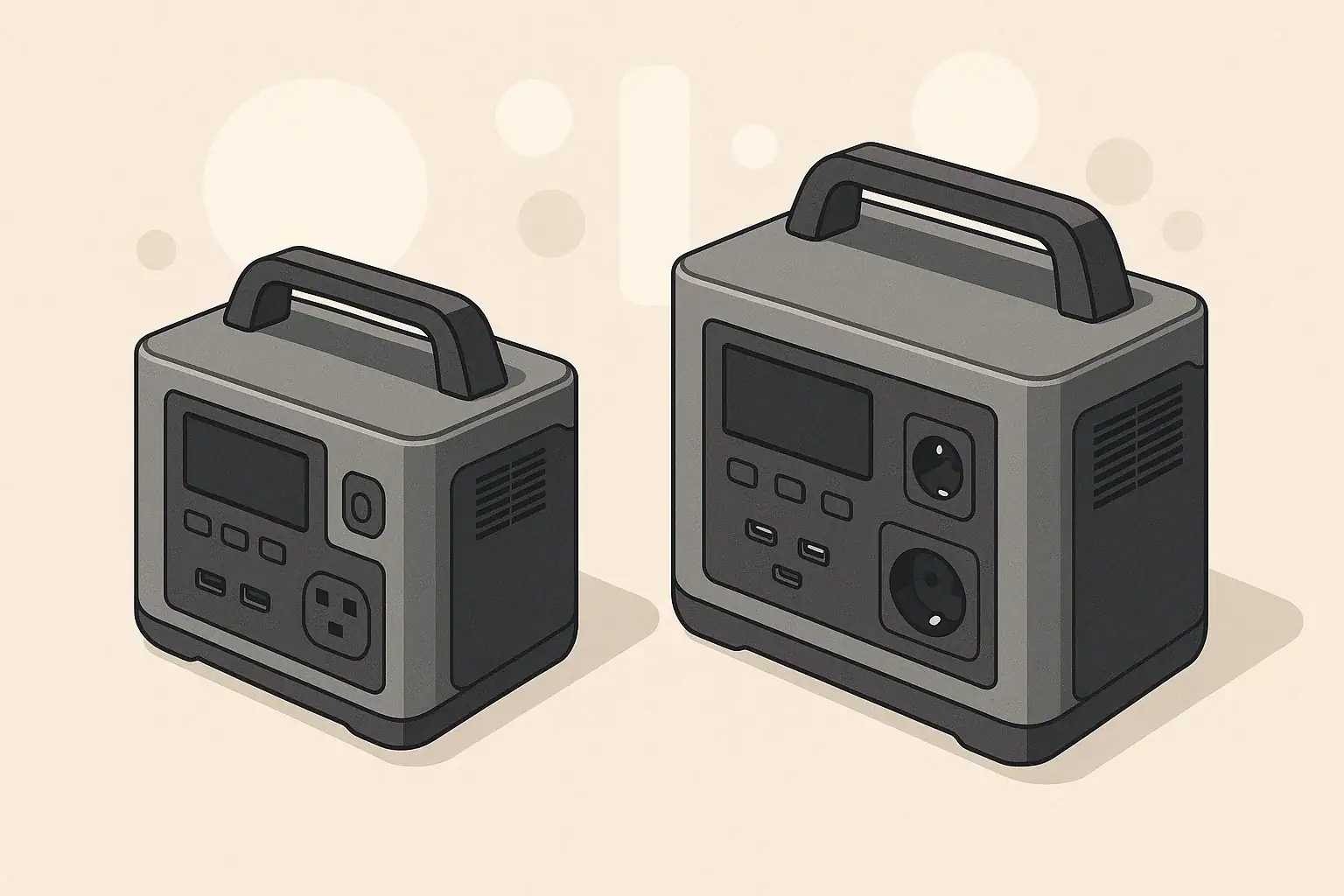
Two portable power stations side by side in minimal scene

Choosing between a portable power station and a home backup battery in an apartment is less about maximum power and more about space, noise, safety, and building rules. Both options use rechargeable batteries, but they are designed for different types of backup.

In most apartments, you cannot install fuel-powered generators on balconies or wire major equipment into the building electrical system without permission. That makes battery-based solutions attractive, but the right setup depends on what you need to keep running, how long typical outages last, and how much room you can give up to equipment.

This guide compares portable power stations and home backup battery systems specifically from an apartment perspective, focusing on capacity, outputs, charging, safety, and everyday practicality.

Apartment Power Backup: The Real-World Constraints

Choosing between a portable power station and a home backup battery in an apartment is less about maximum power and more about space, noise, safety, and building rules. Both options use rechargeable batteries, but they are designed for different types of backup.

In most apartments, you cannot install fuel-powered generators on balconies or wire major equipment into the building electrical system without permission. That makes battery-based solutions attractive, but the right setup depends on what you need to keep running, how long typical outages last, and how much room you can give up to equipment.

This guide compares portable power stations and home backup battery systems specifically from an apartment perspective, focusing on capacity, outputs, charging, safety, and everyday practicality.

What Is a Portable Power Station?

A portable power station is a self-contained battery unit with built-in inverter, multiple output ports, and simple plug-and-play operation. It is usually designed to be moved easily and used indoors or outdoors.

Key Components

Most portable power stations include:

  • Battery pack measured in watt-hours (Wh), which represents total stored energy.
  • Inverter that converts battery DC power to household-style AC outlets.
  • DC outputs such as 12 V car-style sockets and barrel connectors.
  • USB ports for phones, tablets, and small electronics.
  • Charging inputs for wall charging, vehicle charging, and often solar.

Typical Apartment Use Cases

Portable power stations are commonly used in apartments for:

  • Short power outages (several hours to a day).
  • Remote work continuity for laptops, monitors, and a modem/router.
  • Keeping phones, tablets, and small devices powered.
  • Running low-wattage appliances such as desk lamps or small fans.
  • Occasional portable use outside the apartment, such as camping or travel.

Advantages for Apartment Dwellers

  • Plug-and-play: No permanent installation or wiring into your panel.
  • Portable and compact: Easier to store in a closet or under a desk.
  • Flexible: Can be used both for backup and for mobile power.
  • No building modifications: Usually does not require landlord approval when used as a standalone device.

Limitations to Consider

  • Limited capacity compared to whole-home systems; best for essentials, not everything at once.
  • Finite output power: Each unit has a maximum continuous watt rating and surge rating.
  • Manual operation: You typically move cords and plug devices in when the power goes out.
Checklist for Choosing an Apartment-Friendly Backup Power Option
What to check Why it matters Notes
Available floor and closet space Both systems occupy physical space Measure where you plan to keep the unit
Typical outage length in your area Determines needed battery capacity (Wh) Longer outages may justify larger or multiple units
Critical devices and their watt usage Prevents overloading and disappointment List items like router, laptop, lamp, fan, CPAP as needed
Building and landlord rules Some systems may require approval Ask about restrictions on fixed batteries or wiring
Noise and heat tolerance Fans and inverters make some noise Consider placement away from sleeping areas if possible
Budget and upgrade path Costs vary between portable and fixed systems Plan for future devices or a potential move

Example values for illustration.

What Is a Home Backup Battery System?

When people refer to a “home backup battery,” they often mean a larger battery system intended to support multiple household circuits or even an entire home. These are usually stationary, wall- or floor-mounted, and often integrated with a home electrical panel and sometimes solar panels.

Key Characteristics

  • Higher capacity: Typically several times the watt-hours of a portable power station.
  • Panel integration: Often connected to specific household circuits via transfer equipment.
  • Automatic operation: Many systems can switch on automatically when the grid goes down.
  • Fixed location: Not intended to be carried around.

Apartment-Specific Challenges

In detached houses, these systems can be mounted in a garage or utility room and wired directly to a panel by an electrician. In apartments, there are several extra considerations:

  • Building ownership: You rarely control the main electrical infrastructure.
  • Space limitations: Many apartments do not have dedicated utility spaces.
  • Installation rules: Wall mounting, conduit runs, and panel work often require landlord and building approvals.
  • Common-area panels: Some apartments have shared panels that are not easily modified for individual units.

Because of these factors, full-scale home backup systems are less common in apartments, although smaller, non-panel-integrated “home battery” units that plug into outlets or have multiple AC sockets do exist. Those behave more like large portable power stations but are not designed to be moved often.

Pros and Cons in an Apartment Context

Potential advantages:

  • Can provide more energy for longer outages if allowed and properly installed.
  • Less manual switching if integrated with selected circuits.
  • May support higher loads such as multiple rooms of lighting or a refrigerator.

Potential drawbacks:

  • Requires professional installation when tied into a panel.
  • May not be permitted in some buildings or rental agreements.
  • Less flexible if you move to a new apartment or different city.
  • Upfront cost and installation complexity are usually higher.

Capacity, Runtime, and Sizing for Apartment Use

Whether you choose a portable power station or a home backup battery, the core concept is the same: capacity in watt-hours (Wh) determines how long you can run devices of a given wattage.

Understanding Watt-Hours and Watts

  • Watt-hours (Wh): Total energy stored in the battery.
  • Watts (W): How fast energy is used or delivered at a given moment.

As a rough example, if a battery has 1000 Wh of usable capacity and you run a 100 W load continuously, you might expect around 10 hours of runtime, minus efficiency losses. Real runtimes are lower because inverters and electronics use some energy.

Prioritizing Apartment Essentials

To size a system for an apartment, start with the devices you consider essential:

  • Internet modem/router.
  • One or two laptops.
  • Phone chargers.
  • One or two LED lamps.
  • A small fan, if needed for comfort.
  • Medical or sleep-related devices, if applicable (consult the device manufacturer for power requirements).

Most of these draw relatively low power compared to large appliances. That is why portable power stations are often a good match for apartments: they target exactly these smaller loads that matter most during short outages.

When a Larger Home Battery Might Make Sense

A higher-capacity home battery may be more appropriate if:

  • Your area experiences frequent, multi-day outages.
  • Your building and landlord allow installation and panel work.
  • You want to support higher loads such as a refrigerator or multiple rooms.
  • You plan to stay in the same unit long term, making permanent installation more reasonable.

In many apartments, however, a moderate-size portable power station (or a pair of them) is easier to justify and manage.

Outputs, Inverters, and What You Can Safely Power

For apartment use, output types and inverter capabilities are often more important than sheer capacity. You need the right ports and enough continuous wattage to run your chosen devices safely.

AC, DC, and USB Outputs

Most portable power stations and home backup batteries include a mix of outputs:

  • AC outlets: To plug in lamps, laptops, small appliances, and power strips (within rated limits).
  • DC outputs: 12 V car-style sockets and barrel jacks for some electronics and coolers.
  • USB-A and USB-C: Ideal for phones, tablets, wireless speakers, and some laptops.

For apartment backup, having several AC outlets plus multiple USB ports helps avoid using too many extension cords. However, avoid daisy-chaining power strips or overloading any single outlet.

Inverter Basics: Continuous vs Surge

Inverters are rated for:

  • Continuous watts: Power the unit can supply steadily.
  • Surge watts: Short bursts to start devices with higher startup draw, such as some fans.

For typical apartment electronics, continuous power is the key number. Sum the watt ratings of the devices you want to run at the same time and keep that total under the inverter’s continuous rating. Always leave some margin instead of running at the absolute maximum.

What Not to Run in an Apartment Backup Setup

High-wattage appliances can drain batteries quickly or overload inverters. Use caution or avoid running:

  • Space heaters.
  • Electric stoves and ovens.
  • Large air conditioners.
  • Clothes dryers and irons.

Even if a battery could technically support these for a short time, they usually are not an efficient use of limited stored energy in an apartment backup plan.

Charging Options and Apartment-Friendly Strategies

How you recharge your portable power station or home backup battery matters just as much as capacity. In apartments, the most practical charging methods are wall outlets and, in some cases, small portable solar panels.

Wall Charging

Wall charging is the default for most systems. Key ideas:

  • Charging rate: Higher input watts mean faster charging, but also more strain on circuits if several high-draw devices share the same outlet.
  • Planning window: After an outage, you may have limited time before the next one. Knowing roughly how many hours it takes to recharge is helpful.
  • Dedicated outlet where possible: Avoid using the same outlet for other heavy loads while charging.

Car Charging

Some portable power stations can recharge from a vehicle 12 V outlet. In an apartment, this is only practical if:

  • Your parking spot is close enough and accessible.
  • You are able to safely run the cable and supervise charging.

Running a vehicle engine for long periods just to charge a battery is usually inefficient and may not be allowed in enclosed parking areas, so check building rules and ventilation conditions.

Solar Charging in Apartments

Portable solar panels are attractive but tricky in apartments. Consider:

  • Sun exposure: Balconies can work if they receive several hours of direct sun.
  • Safety: Panels must be secured so they cannot fall or blow away.
  • Rules: Some buildings restrict items mounted on railings or exterior walls.

Solar can extend runtime during prolonged outages but rarely replaces wall charging entirely for most apartment residents.

Pass-Through Charging Concepts

Many portable power stations offer pass-through charging, where the unit can be plugged into the wall while powering devices. For apartment use, this can turn the station into a kind of advanced surge strip with battery backup.

However, pass-through behavior varies between products. Some prioritize powering loads first, then charging the battery. Others may limit output while charging. Consult the manufacturer’s documentation and avoid overloading the unit just because it is plugged in.

Safety, Placement, and Building Rules

Battery safety and proper placement are especially important in multi-unit buildings where a problem can affect neighbors as well.

Ventilation and Heat

Most modern battery systems are sealed and do not require open-air ventilation the way fuel generators do, but they still produce heat. Good practices include:

  • Place units on a hard, flat surface.
  • Keep them away from radiators, heaters, and direct sunlight.
  • Do not cover with blankets or store in tightly packed closets while operating.
  • Leave clearance around cooling vents so internal fans can do their job.

Cord Management

In tight apartment spaces, tripping hazards and overloaded outlets are common risks. To keep things safer:

  • Avoid running cords where people walk frequently.
  • Use heavy-duty extension cords only when necessary and within rated limits.
  • Do not daisy-chain power strips or plug one power strip into another.
  • Keep cords away from water sources like sinks and bathtubs.

Panel Integration and Professional Help

Some home backup batteries are designed to connect to a home electrical panel through transfer switches or similar hardware. In an apartment setting:

  • Do not attempt any panel wiring or modifications yourself.
  • Consult building management before planning any permanent installation.
  • Use a qualified electrician familiar with local codes if integration is permitted.

Many apartment residents choose stand-alone portable power stations specifically to avoid the need for panel work and associated approvals.

Cold Weather, Storage, and Maintenance

Even in apartments, temperature and long-term storage conditions affect battery health and performance.

Cold Weather Performance

Battery capacity usually decreases in cold conditions. If your apartment is well heated, this is less of a concern indoors, but it matters if you keep a unit in a colder storage area or use it on a balcony. In general:

  • Avoid charging batteries at very low temperatures unless the manufacturer states it is safe.
  • Bring the unit into a moderate temperature environment before charging.
  • Expect shorter runtimes if the unit is used in cold spaces.

Storage and Self-Discharge

All batteries slowly lose charge over time when stored. For apartment users who mainly rely on backup power during occasional outages:

  • Store the unit in a cool, dry place away from direct sun.
  • Top up the charge every few months, according to the manufacturer’s guidance.
  • Avoid leaving the battery at 0% for long periods.

Basic Maintenance Practices

Battery systems are generally low maintenance, but you can extend their useful life by:

  • Keeping vents free of dust.
  • Inspecting cords and plugs for visible damage.
  • Testing the system briefly every few months so you know it’s ready for an outage.
Storage and Maintenance Planning Examples for Apartment Battery Systems
Task Interval idea Why it matters Quick note
Top up battery charge Every 2–3 months Reduces stress from sitting at very low charge Unplug after it reaches a full or near-full level
Short functional test Every 3–6 months Confirms outputs and display operate normally Run a lamp or laptop for a short time
Visual inspection of cords Every 6 months Catches frayed or damaged insulation early Replace damaged cords instead of taping them
Dusting vents and surfaces Every 3–6 months Helps cooling fans work efficiently Use a dry cloth; avoid liquid cleaners on ports
Check storage location Once a year Ensures it stays dry and within temperature limits Move away from heaters or direct sun if needed
Review building rules When lease renews Reflects any updated safety or equipment policies Confirm that your setup still complies

Example values for illustration.

Which Fits Apartments Best: Portable Power Station or Home Backup Battery?

In most apartments, a portable power station is the more practical choice. It requires no permanent installation, can be stored in small spaces, and is well suited to the lower-power essentials that matter most during short to moderate outages.

A home backup battery system may be appropriate if your building explicitly allows it, you can work with a qualified electrician, and you need higher capacity for frequent or prolonged outages. Even then, many residents prefer to start with a portable power station and adjust their setup over time based on real-world experience.

By mapping your critical loads, understanding capacity and charging options, and respecting building rules and safety basics, you can choose a backup approach that fits both your apartment and your daily life.

Frequently asked questions

Can a portable power station run a refrigerator in an apartment?

It depends on the refrigerator size and the power station’s continuous and surge ratings as well as its capacity in watt-hours. Many full-size refrigerators have high startup currents that can overload small inverters, and even if they run, they will deplete the battery quickly, so verify appliance wattage and expected runtime before attempting it.

Do I need landlord or building permission to keep or use a battery backup in my apartment?

Small, standalone portable power stations are often allowed without formal approval, but rules vary by building and lease terms. Always check with your landlord or building management if you plan a permanent installation, panel integration, or to store equipment in common areas.

How do I estimate runtime for my essential devices?

Divide the battery’s usable watt-hours by the combined wattage of the devices to get a rough runtime, and then factor in inverter and system losses of around 10–20%. For example, a 1000 Wh usable battery powering a 50 W router and laptop might run roughly 15–18 hours after accounting for efficiency losses.

Can I charge a portable power station with solar panels from my balcony?

Solar charging is possible from a balcony if you have adequate sun exposure and a safe, secure setup, but output is often limited compared with wall charging. Check building rules about mounting or securing panels, and expect solar to supplement rather than fully replace wall charging for most apartment use cases.

Are multiple small portable power stations better than one larger battery for apartment living?

Multiple units offer portability, redundancy, and flexible placement, while a single larger battery can provide higher capacity and simpler management if installation is permitted. Choose based on space, budget, and whether you prioritize ease of use or maximum runtime and integration.

Portable Power Station vs DIY Solar Battery Box: When DIY Makes Sense

Two generic portable power stations shown side by side

Overview: Two Very Different Ways to Get Portable Power

When you need electricity away from standard wall outlets, you have two broad choices: buy a portable power station or assemble a DIY solar battery box using separate components. Both can run laptops, lights, and small appliances, but they differ in cost structure, complexity, safety, and flexibility.

A portable power station is an all-in-one device that typically includes:

  • Built-in battery
  • Battery management system (BMS) and protections
  • Inverter for AC outlets
  • DC and USB outputs
  • Charging inputs (wall, car, and often solar)

A DIY solar battery box is a custom setup you assemble from individual parts, such as:

  • Battery (often deep-cycle or lithium)
  • Separate inverter (if you need AC power)
  • Charge controller for solar input
  • DC distribution, fuses, and wiring
  • A box or enclosure

Understanding the tradeoffs between these paths helps you decide when DIY makes sense and when a portable power station is the more practical option.

Core Differences: Cost, Complexity, and Safety

Both options can deliver similar watt-hours of energy, but how you get there is very different. The main differences show up in how much you spend, how much time and skill you need, and how much risk you are willing to accept.

Cost: Upfront Device vs Separate Components

Portable power stations bundle everything into one purchase. You pay for integration, convenience, and certification, but you avoid sourcing and matching individual parts. For many users, this is the lowest total cost of time and effort, even if the dollars-per-watt-hour seem higher.

A DIY solar battery box gives you more control over where your money goes. You can:

  • Choose battery chemistry (for example, lead-acid vs lithium) based on budget and needs.
  • Start smaller and expand later by adding more capacity or solar.
  • Reuse existing parts (such as panels or an inverter) if you already own them.

However, DIY often involves “hidden” costs: extra cables, tools, mounting hardware, fuses, heat-shrink, and test equipment. If you value your time highly or need to buy tools, the apparent savings can shrink quickly.

Complexity: Plug-and-Play vs System Design

Portable power stations are designed to be plug-and-play. You typically get:

  • Clear labeled ports (AC, DC, USB, solar input)
  • Simple screens or indicators for battery status
  • Built-in protections against overcharge, over-discharge, and short circuits

With a DIY solar battery box, you take on system design decisions, such as:

  • Matching battery voltage to inverter and charge controller
  • Choosing appropriate wire gauges and fuse sizes
  • Planning ventilation and mounting for components
  • Routing cables to reduce mechanical stress and avoid damage

This requires electrical knowledge and careful planning. Mis-matched components or poor wiring can lead to underperformance at best and safety hazards at worst.

Safety and Responsibility

Portable power stations are generally tested as a single unit and include internal protections. You still need to use them safely—avoid overloading outlets, keep them dry, and ensure adequate ventilation—but you are not managing bare cells, bus bars, and open terminals.

With a DIY battery box, you are responsible for:

  • Correct polarity and secure connections
  • Proper fusing close to the battery
  • Preventing accidental short circuits
  • Providing ventilation and protection from physical damage

Improper assembly can cause overheating, fires, or shock hazards. If you are not comfortable with low-voltage DC systems and basic electrical safety, DIY is not a good fit. For anything involving connection to a home electrical panel or transfer switch, a qualified electrician should be involved, regardless of whether you use a portable power station or a DIY system.

Key factors when choosing between a portable power station and a DIY solar battery box

Example values for illustration.

Decision checklist: portable power station vs DIY solar battery box
Factor Portable power station tends to fit when… DIY solar battery box tends to fit when…
Technical skill You prefer plug-and-play and minimal wiring. You are comfortable with basic DC wiring and system design.
Time available You need a solution working the same day. You can invest several evenings or weekends to plan and build.
Budget approach You want a single predictable purchase cost. You want to optimize cost per watt-hour over time.
Expandability Modest expansion or future replacement is acceptable. You want the flexibility to upgrade battery, inverter, or solar separately.
Safety comfort level You prefer factory-integrated protections and certifications. You accept responsibility for correct fusing, wiring, and mounting.
Use environment Mainly indoor, portable, and occasional outdoor use. Fixed installations in vans, RVs, or sheds where custom layout helps.
Learning goal You want a tool, not a hobby project. You enjoy tinkering and want to learn solar and battery systems.

Power Needs: Capacity, Watts, and Inverter Basics

Whether you go with a portable power station or DIY box, you need to size the system to your loads. The same concepts apply: watt-hours, running watts, surge watts, and inverter efficiency.

Capacity: Watt-Hours and How Long Power Lasts

Capacity is typically expressed in watt-hours (Wh). A simplified way to estimate runtime is:

Runtime (hours) ≈ Battery capacity (Wh) ÷ Load (watts) ÷ 1.1 to 1.3

The extra factor accounts for inverter and system losses. For example, if you have a battery of about 500 Wh and a 100 W continuous load, you might expect around 3.5 to 4.5 hours of runtime, depending on conditions and inverter efficiency.

Portable power stations list capacity clearly. With DIY, you calculate capacity from the battery rating. For instance, a 12 V 100 Ah battery contains roughly 1,200 Wh (12 V × 100 Ah), but usable capacity can be lower depending on chemistry and discharge limits. Many users plan to use only a portion of total capacity to extend battery life, especially with some lead-acid types.

Power Output: Running vs Surge Watts

Inverters and AC outlets are rated in watts. You will see two common numbers:

  • Continuous (running) watts: What the system can supply steadily.
  • Surge (peak) watts: Short bursts to start devices like compressors or motors.

Portable power stations publish these numbers as part of the device specs. In a DIY system, the inverter rating determines these limits. You also need to confirm that the battery and wiring can safely deliver the required current. High-wattage inverters can draw large DC currents at battery voltage, which affects cable size and fuse selection.

Outputs and Pass-Through Basics

Portable power stations often provide a mix of outputs:

  • 120 V AC outlets via the inverter
  • 12 V DC outlets (often cigarette lighter style)
  • USB-A and USB-C ports for electronics

Some can charge while powering loads, known as pass-through usage. Depending on design, heavy pass-through use can add heat and stress components, so it is wise to check the manual for any limitations.

In a DIY box, you choose which outputs to build in. Many people add:

  • Dedicated DC circuits for lighting or refrigeration to skip inverter losses
  • One or more AC outlets connected to the inverter
  • USB chargers powered from DC or AC, depending on preference

Pass-through behavior in a DIY setup depends on how the inverter and charge controller are wired. You need to make sure current limits are respected and that charging and discharging do not exceed recommended levels for the battery.

Charging Methods and Planning Charge Time

Both portable power stations and DIY battery boxes can usually charge from wall power, vehicle DC, and solar. The main difference is how much configuration and extra hardware you handle yourself.

Wall Charging

Portable power stations typically include a built-in or external AC charger. You plug into a standard wall outlet, and the device manages charging rate and protections. Charge time is roughly:

Charge time (hours) ≈ Battery capacity (Wh) ÷ Charger input power (W)

For example, a 500 Wh unit with a 250 W charger might recharge in around 2 to 3 hours, accounting for efficiency losses.

In a DIY system, you need a compatible AC charger matched to battery chemistry and voltage. You also need to consider where to mount and ventilate the charger. Higher current chargers reduce charge time but increase heat and stress, so they must be within the battery’s recommended limits.

Vehicle (Car or RV) Charging

Many portable power stations accept 12 V input from a vehicle outlet. Charging rates from vehicle sockets are often modest because of current limits. They can help sustain devices or slowly top up between stops but are not usually fast enough for large daily consumption.

With a DIY box, you can connect to a vehicle’s electrical system through appropriate fusing and wiring. For more involved setups, such as alternator charging in a van or RV, a DC-DC charger is often recommended to protect both the starting battery and the house battery. Any wiring that taps into a vehicle’s electrical system should follow automotive best practices and, when in doubt, be installed or inspected by a professional.

Solar Charging

Solar is where a DIY box can be highly flexible. You choose your panel wattage, mounting style, and charge controller. A portable power station often has a built-in charge controller and a specified input range, which sets a ceiling on solar input.

To roughly plan solar charging, use:

Daily energy from solar (Wh) ≈ Panel watts × Effective sun hours

For example, a 200 W array with 4 to 5 hours of good sun might yield around 600 to 900 Wh per day, depending on location, angle, and weather. In a DIY build, oversizing solar relative to battery capacity can help you recover quickly from cloudy days, as long as the charge controller is sized appropriately.

Use Cases: Outages, Camping, Remote Work, and RVs

Your primary use case strongly influences whether a portable power station or DIY box is the better fit. The same total watt-hours can behave very differently in daily life depending on how you use them.

Short Power Outages at Home

For occasional outages lasting a few hours, a portable power station is often the simplest option. You can quickly power:

  • Routers and modems
  • Laptops and phones
  • LED lamps
  • Small fans

Because these loads are modest, you may not need large capacity or complex solar setups. A DIY box can also work, but it is usually overkill unless you already built one for other reasons.

For any connection to household circuits, whether using a portable power station or DIY system, avoid improvised backfeeding through outlets. Safe integration with home wiring requires appropriate transfer equipment and should be handled by a qualified electrician.

Remote Work and Mobile Office

For remote work—such as running a laptop, monitor, and networking gear—a portable power station offers easy portability and quiet operation. If your power use is predictable and moderate, you benefit from plug-and-play charging and clear runtime indicators.

A DIY battery box starts to make sense if you need a custom layout, such as permanently installed outlets in a work trailer or mobile workshop, or if you expect to expand capacity over time. It also helps when you need multiple DC circuits for radios, networking hardware, or other specialized equipment.

Camping and Vanlife

For casual camping and short trips, portable power stations shine because they are easy to pack, lend, or store. You can set one on a picnic table and plug in lights, fans, or a cooler. Foldable solar panels connect quickly for daytime recharging.

For long-term vanlife or overlanding, a DIY solar battery box can integrate more seamlessly into the vehicle. You can mount batteries low and centered for weight distribution, run hidden cabling to lights and appliances, and place solar modules permanently on the roof. This approach can be more durable and tailored, but it demands careful design and installation.

RV Basics and Larger Loads

RVs often have built-in 12 V systems and sometimes generators. A portable power station can supplement this by powering sensitive electronics or providing quiet power when you prefer not to run a generator. It also gives you an independent backup system if the main RV battery is depleted.

A DIY system can become the core of an RV power upgrade, with higher capacity batteries and solar sized to support appliances like fridges or vent fans for many hours. Integrating with existing RV wiring, charging sources, and panels is more complex, and is another scenario where consulting a professional can help avoid issues.

Cold Weather, Storage, and Maintenance

Both portable power stations and DIY battery boxes rely on batteries that react to temperature and storage conditions. Good habits can significantly improve performance and lifespan.

Cold Weather Considerations

Battery performance usually drops in cold conditions. You may see:

  • Reduced available capacity
  • Lower power output capability
  • Slower charging

Portable power stations often specify safe operating and charging temperature ranges. Charging some battery chemistries below recommended temperatures can cause damage, so many devices limit or block charging when too cold.

For DIY boxes, you need to manage temperature yourself. Many users:

  • Install the battery in a relatively insulated compartment
  • Avoid leaving the system fully exposed in freezing weather
  • Follow the battery manufacturer’s guidance for cold charging and discharging

Storage and Self-Discharge

When not in use for long periods:

  • Store both portable units and DIY boxes in cool, dry locations.
  • Avoid extreme heat or direct sun for extended periods.
  • Keep the battery at a partial charge if recommended by the manufacturer.

All batteries self-discharge over time. Portable power stations may have standby draws from screens or internal electronics. DIY systems might have small parasitic loads from monitors or controllers. It is a good idea to top up charge every few months to prevent deep discharge.

Basic Maintenance

Portable power stations need relatively little maintenance beyond:

  • Keeping ports and vents free of dust
  • Occasional full charge-and-discharge cycles if recommended
  • Inspecting cords and plugs for wear

DIY boxes require more ongoing attention:

  • Periodic checks of cable connections and mounting hardware
  • Inspecting fuses and breakers
  • Examining the enclosure and vents for debris, corrosion, or moisture

Any signs of swelling, odor, unusual heat, or damaged insulation should be addressed immediately, and unsafe components should be taken out of service.

Example device loads and planning notes for portable and DIY systems

Example values for illustration.

Runtime planning examples for common devices
Device type Typical power draw range (W) Planning notes
LED light 5–15 Very efficient; multiple lights can run many hours from modest capacity.
Laptop 40–90 Power varies with workload; using DC charging where possible can extend runtime.
Wi-Fi router + modem 15–30 Good target for long outages; prioritize these for communication.
12 V compressor fridge 30–60 (while running) Average draw is lower due to duty cycle; insulation and temperature settings matter.
Box fan 40–75 Continuous use can add up; consider running at lower speed or intermittently.
Small microwave 700–1,200 High short-term load; requires an appropriately sized inverter and wiring.
Coffeemaker 600–1,000 Energy use is brief but intense; plan for surge watts and battery impact.

When DIY Solar Battery Boxes Make Sense

A DIY solar battery box is not inherently “better” or “worse” than a portable power station. It is simply a different approach with its own strengths and responsibilities. DIY tends to make the most sense when:

  • You already have some components, such as panels or a suitable battery.
  • You want a system that can be upgraded or repaired component by component.
  • You enjoy the learning process and accept the safety responsibilities.
  • You need a custom layout for a van, RV, shed, or off-grid structure.
  • You plan to run mostly DC loads efficiently, reducing inverter use.

Portable power stations make more sense when you prioritize:

  • Speed from unboxing to first use
  • Minimal wiring and design work
  • Integrated protections and compact form factor
  • Portability between home, vehicle, and campsite

Whichever path you choose, careful sizing, realistic expectations about runtime and charging, and attention to safety will determine how satisfied you are with your portable power system over the long term.

Frequently asked questions

How much can I realistically save building a DIY solar battery box compared to buying a portable power station?

Cost savings vary widely based on parts, battery chemistry, and whether you already own components. A DIY build can reduce dollars-per-watt-hour if you source low-cost batteries and reuse hardware, but hidden costs (tools, protection hardware, time, and potential rework) can offset initial savings. For many users, the true tradeoff is time and effort versus the convenience and integrated protections of a ready-made unit.

Is a DIY solar battery box as safe as a portable power station for everyday use?

Portable power stations are factory-assembled and include tested BMS and enclosure protections, which reduces common risks. A DIY box can be equally safe if it uses proper fusing, secure connections, correct wire sizing, and a suitable enclosure, but safety depends entirely on design and workmanship. If you are unsure about DC systems or high-current wiring, consult a qualified electrician.

Which charges faster: a portable power station or a DIY battery box using solar?

Charging speed depends on the charger or charge controller rating and the solar array size, not the form factor. Portable units are limited by their built-in input ratings; a DIY box can accept higher panel wattage or a larger charge controller if the battery and components allow it. In short, a DIY system can be faster if intentionally designed for higher input, but portable stations are often optimized for balanced charge rates and safety.

Can I safely keep a DIY solar battery box indoors?

Indoor use is possible if the battery chemistry and enclosure are appropriate and ventilation is provided when needed. Some battery types (notably flooded lead-acid) emit gases during charging and require ventilated spaces, whereas sealed lithium batteries generally emit no gases but still need temperature control and protection from mechanical damage. Always follow the battery manufacturer’s installation and ventilation guidance.

When does it make more sense to choose a portable power station over building a DIY box?

A portable power station is usually the better choice if you want immediate, plug-and-play power with integrated protections, predictable specs, and minimal setup time. It’s also preferable for users who travel, need compact portability, or prefer not to manage component matching and DC wiring. Choose DIY when you already have compatible components, want expandability, or need a custom installation and are comfortable with the required electrical work.

Portable Power Station vs Inverter + Car Battery: Pros, Cons, and Safety

Two generic portable power stations in comparison scene

Overview: Two Different Ways to Get Portable Power

When you need electricity away from standard wall outlets, two common options are a self-contained portable power station or a setup using a separate inverter connected to a 12 V car battery. Both can run small devices, help during short outages, and support camping or vehicle-based travel, but they differ in safety, complexity, and convenience.

This guide explains how each approach works, compares pros and cons, and highlights important safety considerations. The goal is to help you choose a solution that fits your power needs, budget, and comfort level with electrical equipment.

How Each System Works

What Is a Portable Power Station?

A portable power station is an all-in-one battery power system. Inside a single enclosure it usually includes:

  • A rechargeable battery (often lithium-based, sometimes sealed lead-acid)
  • A built-in inverter to provide AC outlets
  • DC outputs such as 12 V car-style ports
  • USB ports for phones, tablets, and small electronics
  • A charge controller and input ports for wall charging, car charging, and often solar
  • Internal protections such as over-current, short-circuit, and temperature monitoring

Most portable power stations display remaining battery percentage and sometimes estimated runtime or input/output watts. Many support pass-through operation, meaning they can charge while also powering devices, within their limits.

What Is an Inverter + Car Battery Setup?

An inverter plus car battery setup uses separate components to achieve a similar result:

  • A 12 V battery, often a starting battery from a vehicle or a dedicated deep-cycle battery
  • A stand-alone power inverter that converts 12 V DC to 120 V AC
  • Cables or clamps to connect the inverter to the battery

The inverter provides AC outlets, and sometimes USB ports, but the system does not usually include an integrated charge controller or multiple charging options. Charging is typically done via the vehicle’s alternator, a separate battery charger, or a solar charge controller wired to the battery.

Because the components are separate, the user is responsible for selecting compatible parts, making proper connections, and managing safety details like fuses, cable sizing, and ventilation.

Portable Power Station vs Inverter + Car Battery: High-Level Comparison

Example values for illustration.

Key differences to consider when choosing a portable power solution.
Factor Portable Power Station Inverter + Car Battery
Ease of setup Ready to use; plug-and-play Requires selecting parts and making safe connections
Safety features Integrated protections and monitoring Depends on inverter, wiring, and user installation
Port variety Typically AC, 12 V DC, and multiple USB Often AC only; USB depends on inverter model
Expandability Usually fixed capacity; some allow add-ons Battery bank and inverter can often be upsized
Monitoring Built-in display for charge and power May have simple indicators; detailed monitoring requires extras
Portability Single carry unit Multiple heavy components to move
Upfront complexity Low Moderate to high

Pros and Cons of Portable Power Stations

Advantages

Portable power stations are designed for simplicity and everyday users. Key advantages include:

  • Ease of use: Most are plug-and-play. You connect devices as you would to a wall outlet or USB charger.
  • Integrated design: Battery, inverter, charge controller, and protections are matched by the manufacturer, reducing compatibility guesswork.
  • Multiple outputs: Several AC outlets, USB-A and USB-C ports, and 12 V ports are common, so you can power laptops, phones, lights, and small appliances at the same time.
  • Clean, quiet operation: No combustion; suitable for indoor use within guidelines, as there are no exhaust fumes.
  • Charging flexibility: Many support charging from the wall, a vehicle outlet, and solar panels via a dedicated input.
  • Built-in monitoring: Displays usually show battery level and sometimes wattage, helping you manage capacity and runtime.

Limitations

Portable power stations also have trade-offs:

  • Fixed capacity: The internal battery size is set. While a few models allow expansion, many do not.
  • Cost per watt-hour: You pay for integration, protections, and convenience, so the cost per unit of stored energy can be higher than a basic battery and inverter.
  • Repair and upgrades: Internal components are typically not user-serviceable. You generally cannot swap the battery type or significantly increase inverter size.
  • Weight vs capacity: Larger-capacity units can be heavy to move, even though they are still relatively compact.

Pros and Cons of Inverter + Car Battery Systems

Advantages

A separate inverter with a car or deep-cycle battery can be attractive for certain users:

  • Potentially lower cost per watt-hour: Especially if you already own a suitable battery or inverter.
  • Flexibility and scalability: You can choose battery type and capacity, upgrade the inverter size, or build a larger battery bank over time.
  • Serviceability: Individual components can often be replaced or upgraded separately as they wear out or your needs grow.
  • Integration with vehicle systems: When done safely, a dedicated battery can be charged from the vehicle alternator or solar, which is appealing for RV or van setups.

Limitations

This approach also introduces complexity and risk, especially for users new to DC and AC systems:

  • More complex setup: You must match inverter size to battery capacity and cable ratings, and plan for fusing and connections.
  • Fewer built-in protections: Some inverters have basic protections, but the overall system safety depends heavily on how it is assembled.
  • Limited outputs: Many inverters offer only AC outlets and perhaps basic USB ports. Extra DC distribution usually requires additional components.
  • Portability challenges: A lead-acid car or deep-cycle battery is heavy, and carrying the inverter, battery, and cabling as separate pieces is less convenient.
  • Vehicle battery strain: Using the starting battery for extended loads can leave a vehicle unable to start if not managed carefully.

Capacity, Sizing, and Realistic Runtime

Understanding Capacity (Wh) and Power (W)

Whether you use a portable power station or an inverter with a car battery, two core concepts are the same:

  • Capacity (watt-hours, Wh): How much energy is stored. This helps estimate runtime.
  • Power (watts, W): How quickly energy is used. Devices draw a certain number of watts while running.

The inverter or power station also has two power ratings:

  • Running watts: The continuous power it can provide.
  • Surge watts: Short bursts needed for motors or compressors when they start.

Simple Runtime Estimation

A rough estimate of runtime (in hours) is:

Runtime ≈ Battery capacity (Wh) ÷ Device load (W)

For example, if you have about 500 Wh of usable capacity and a 50 W load (such as a small fan and a light), you might get around 10 hours in ideal conditions. Real-world runtimes are usually lower due to inverter losses, battery chemistry, and discharge limits.

In a car battery setup, usable capacity is often less than the theoretical rating stamped on the battery, especially for starting batteries, which are not intended for deep discharge. Deep discharging lead-acid batteries can shorten their life.

Outputs, Inverters, and Pass-Through Power

AC vs DC vs USB Outputs

Portable power stations commonly provide:

  • AC outlets: For household-style plugs, limited by inverter watt rating.
  • 12 V DC ports: For automotive-style devices such as coolers or air pumps.
  • USB ports: For phones, tablets, cameras, and other electronics.

An inverter plus car battery setup usually focuses on AC outlets, with USB ports only if the inverter includes them. Dedicated DC outputs often require additional components such as fuse blocks or distribution panels.

Pure Sine Wave vs Modified Sine Wave

Many portable power stations use pure sine wave inverters, which closely mimic household AC power and are friendlier to sensitive electronics, motors, and some chargers. Some stand-alone inverters are also pure sine, while others are modified sine wave, which can cause extra noise, heat, or compatibility issues for certain devices.

When choosing an inverter for a car battery system, consider whether your devices require or strongly benefit from pure sine wave AC, especially if you plan to power electronics, medical support equipment prescribed by a professional, or motor-driven devices.

Pass-Through Operation

Many portable power stations support pass-through operation, allowing them to be charged from the wall, car, or solar while also powering loads. The total power delivered is still limited by the internal electronics, but this feature can help during short outages or when using solar throughout the day.

In contrast, pass-through use in a car battery system relies on your charging method (alternator, standalone charger, or solar controller). You must ensure that your battery is not discharged faster than it is charged, and that cabling, fusing, and chargers are suitably rated.

Charging Options and Planning Charge Time

Wall Charging

Portable power stations usually include a dedicated wall charger or internal AC charger. Charge time depends on the charger’s wattage and the battery size. As a rough idea, a 500 Wh station with a 100 W charger might take several hours to recharge fully, under ideal conditions.

For inverter plus battery systems, you can use an appropriate 12 V battery charger. Larger external chargers can recharge faster but must be matched to the battery type and size, and used according to manufacturer instructions.

Vehicle Charging

Portable power stations often plug into a vehicle’s 12 V outlet, drawing limited power (commonly under 150 W) while you drive. This is slower than wall charging but useful to top up over time.

With an inverter and car battery, the vehicle alternator can recharge the battery while driving, but sustained high loads from the inverter may exceed what the system is designed to support. Long stationary use with the engine off can deplete the starting battery and prevent the vehicle from starting.

Solar Charging

Many portable power stations accept solar panel input through dedicated ports, often with a built-in or matched charge controller. This can support off-grid use if you size the panels appropriately and account for sun hours.

In a car battery system, you generally need a separate solar charge controller wired to the battery. You must size the controller, panels, and wiring for expected current, and position panels safely and securely.

Use Cases: Which Option Fits Your Scenario?

Short Power Outages at Home

For most households wanting backup for essentials such as phone charging, a modem/router, a laptop, and a few LED lights, a portable power station is often simpler and safer. You can keep it charged and bring it out when needed.

Connecting either system directly into home wiring or panels involves additional safety and legal considerations. Any connection to a home electrical system should be planned and installed by a qualified electrician using appropriate equipment. Avoid improvised backfeeding through outlets, which is hazardous and may be illegal.

Remote Work and Electronics

For powering laptops, monitors, and networking gear, the cleaner AC output and built-in USB ports of many portable power stations are convenient. A car battery and inverter can work, but requires more attention to preventing deep discharge and maintaining adequate ventilation around the battery, especially if it is not sealed.

Camping, Vanlife, and RV Basics

For tent camping or short trips, a portable power station is easy to move, charge from the car, and pair with a folding solar panel. It offers silent operation and simple device connection.

For vanlife and RVs with larger, more permanent electrical systems, an inverter and battery bank can be more scalable. Many users in that category plan multi-battery banks, larger inverters, and solar arrays. Designing such systems involves careful attention to wire sizing, fusing, ventilation, and compliance with relevant codes; it is often helpful to consult professional resources or an experienced installer.

Running Appliances

Smaller appliances such as compact fans, LED lights, and low-power electronics are generally manageable for both options. High-draw appliances like space heaters, hair dryers, or large air conditioners can quickly exceed the capabilities of modest portable power stations and small inverters.

For refrigeration, a high-efficiency fridge or 12 V compressor cooler paired with sufficient battery capacity and solar can work, but requires careful power budgeting. Motors have startup surges that must be within the inverter’s surge rating.

Example Device Loads and Planning Notes

Example values for illustration.

Illustrative watt ranges to help estimate runtime needs.
Device type Typical watts range (example) Planning note
Smartphone charging 5–20 W Low draw; many charges from a modest battery
Laptop 40–90 W Consider several hours per day for remote work
LED light 5–15 W Good for long runtimes even on small systems
Portable fan 20–50 W Plan for overnight use during outages or camping
Mini fridge or 12 V cooler 40–100 W (running) Allow for startup surge and duty cycle
Small microwave 600–1000 W Short use only on higher-capacity inverters
Space heater 1000–1500 W Drains batteries very quickly; often impractical

Safety Considerations for Both Options

Battery Safety and Placement

For portable power stations:

  • Use them on a stable, dry, level surface.
  • Keep vents unobstructed to allow cooling airflow.
  • Avoid placing them directly next to heat sources or in direct, intense sunlight for extended periods.
  • Follow any temperature ranges listed in the manual, especially for charging in cold or hot conditions.

For inverter plus car battery systems:

  • Ensure the battery is secured so it cannot tip or slide.
  • Provide ventilation, particularly for lead-acid batteries, which can release gas during charging.
  • Prevent short circuits by protecting battery terminals from accidental contact with metal tools or objects.
  • Use appropriately rated cables and fuses between the battery and inverter, as recommended by qualified resources or professionals.

Cords, Loads, and Overheating

Regardless of system type:

  • Do not overload the inverter or power station beyond its rated continuous wattage.
  • Use extension cords only when necessary, and choose cords rated for the load and length.
  • Avoid running cords where they can be pinched by doors, crushed under furniture, or become tripping hazards.
  • If cords, plugs, or outlets feel hot to the touch, reduce the load and inspect for damage.

Indoor vs Outdoor Use

Portable power stations are commonly used indoors, but should still be kept away from flammable materials and protected from moisture. Follow the manufacturer’s guidelines on indoor use and environmental conditions.

For inverter plus car battery setups, outdoor or semi-outdoor placement is often safer for venting and heat, provided the equipment is protected from rain and standing water. Avoid placing inverters directly next to fuel containers or other flammable materials.

Cold Weather and Storage

Most batteries have reduced performance in cold temperatures, with shorter runtimes and slower charging. Charging many lithium-based batteries below freezing can be harmful; check the operating and charging temperature guidelines for your system.

For storage:

  • Store in a cool, dry place away from direct sunlight.
  • Avoid extreme temperatures, both hot and cold.
  • Charge to a recommended level before long-term storage and top up periodically to reduce self-discharge effects.

Working With Home Electrical Systems

Connecting any portable power source to a home’s wiring requires proper equipment and methods to prevent backfeeding utility lines, overloading circuits, or violating electrical codes. High-level considerations include:

  • Using appropriate transfer equipment designed for standby or backup power.
  • Ensuring that any connection prevents simultaneous backfeed into the grid.
  • Making sure breaker ratings, wiring, and loads are compatible with the power source.

Planning and installing these connections should be done by a qualified electrician familiar with local code requirements. Avoid homemade interlocks or improvised cords between power stations, inverters, and household outlets.

When to Choose Which Option

In general:

  • A portable power station suits users who want a self-contained, relatively low-maintenance solution for small devices, short outages, and mobile use.
  • An inverter plus car battery setup can fit users who are comfortable with electrical components, want greater flexibility or capacity scaling, and are prepared to handle system design and ongoing maintenance responsibilities.

In either case, understanding capacity, load, and safe operating practices will help you get reliable, practical power when you need it.

Frequently asked questions

How long will a portable power station or an inverter with a car battery run my devices?

Runtime depends mainly on usable battery capacity (Wh) divided by the device load (W) — roughly Runtime ≈ Wh ÷ W. Expect lower real-world runtimes due to inverter losses, battery chemistry, and depth-of-discharge limits; starting batteries in cars usually offer less usable capacity than deep-cycle batteries.

Is it safe to operate an inverter and car battery indoors compared to a portable power station?

Portable power stations are generally safer for indoor use because they are sealed, include built-in protections, and typically do not emit gases. Inverter plus car battery systems—especially those using lead-acid batteries—can emit hydrogen during charging and therefore require good ventilation, secure mounting, correct fusing, and careful wiring.

Can I charge both systems with solar panels, and what do I need to know?

Yes. Many portable power stations have a built-in or matched solar charge controller and a dedicated input for straightforward solar charging, while an inverter plus battery requires a separate solar charge controller sized for the panels and battery; using an MPPT controller improves charging efficiency.

Which option is more cost-effective per watt-hour: a portable power station or an inverter plus battery?

A separate inverter with a chosen battery bank often provides a lower cost per watt-hour because you can select battery chemistry and capacity independently. However, portable power stations trade a higher unit cost for integration, convenience, and built-in protections, and lifecycle and maintenance costs also affect overall value.

Can I run a refrigerator or a space heater with a portable power station vs inverter + car battery?

Small refrigerators or 12 V compressor coolers can be run by either option if the inverter can handle the fridge’s startup surge and you have enough battery capacity and duty-cycle planning. Space heaters draw 1000–1500 W continuously and will deplete most portable systems quickly, making them impractical for extended use on battery-based setups.

Portable Power Station vs Power Bank: Where the Line Really Is

Isometric illustration comparing a portable power station and power bank

Portable Power Station vs Power Bank: The Real Divide

Portable batteries now range from pocket-sized phone chargers to suitcase-sized power stations that can run appliances. The terms portable power station and power bank often get mixed together, but they are built for very different jobs.

This guide explains where the line really is between them, how each is designed, and how to choose the right tool for your needs at home, on the road, or during outages.

Core Technical Differences

The clearest way to separate portable power stations from power banks is to look at three basics: capacity, outputs, and what they are meant to power.

Capacity: Watt-Hours vs Amp-Hours Confusion

Power banks are usually described in milliamp-hours (mAh), while portable power stations are normally described in watt-hours (Wh). Both relate to stored energy, but watt-hours are easier to compare across different devices and voltages.

Simple rule of thumb:

  • Small power banks: often around 5,000–20,000 mAh at about 3.6–3.7 V internal battery voltage.
  • Larger USB power banks: may reach the rough equivalent of 50–100 Wh.
  • Portable power stations: commonly range from roughly 150 Wh up to well over 1,000 Wh and beyond.

In practical terms, a power bank is usually intended to recharge small electronics several times, while a portable power station is intended to actually run devices and small appliances for hours.

Outputs: USB vs AC Household Outlets

Outputs are where the split becomes obvious:

  • Power bank typical outputs:
    • USB-A ports (standard USB)
    • USB-C ports (often with fast charging standards)
    • Occasional low-voltage DC barrel ports or wireless charging pads
  • Portable power station typical outputs:
    • One or more 120 V AC outlets via an internal inverter
    • USB-A and USB-C ports
    • 12 V DC car socket and/or DC barrel ports

The built-in inverter is a defining feature of a portable power station. It converts DC battery power to AC, similar to a wall outlet. Power banks generally do not include this; they stay in the low-voltage DC world of phones and tablets.

Design Intent: Charging vs Powering

Power banks are optimised to charge batteries inside devices (phone, tablet, earbuds, sometimes laptops).

Portable power stations are optimised to power devices directly, especially those designed for household outlets. This includes small refrigerators, routers, CPAP machines (where medically appropriate guidance is followed), lights, fans, and laptops.

That difference in intent drives decisions about capacity, cooling, inverters, and safety features.

Table 1. Quick decision matrix: power bank or portable power station? Example values for illustration.
If you mainly need to… Minimum capacity to consider (example) Better fit Key reason
Charge a phone for a weekend trip 10,000–20,000 mAh Power bank Small, light, enough for multiple recharges
Charge a laptop and phone during daily commuting 50–100 Wh equivalent Large power bank High-output USB-C, still portable
Run a Wi‑Fi router and laptop during a short outage 200–300 Wh Portable power station AC outlet support and higher capacity
Keep a mini fridge cold for several hours 300–500 Wh Portable power station Handles appliance startup surges
Power multiple devices at a campsite 500–1,000 Wh Portable power station More outlets and longer runtime
Reduce stress during overnight outages 800–1,500 Wh Portable power station Enough capacity for essentials

Outputs and Inverter Basics

Understanding outputs helps clarify what each type of device can safely power.

USB and DC Outputs

Both power banks and power stations commonly share these outputs:

  • USB-A for phones, tablets, and small gadgets.
  • USB-C for modern phones, laptops, and some small devices; can support higher power delivery.
  • 12 V DC car socket (mainly on power stations) for car-style chargers, coolers, some CPAP-compatible adapters, and other low-voltage devices designed for that outlet type.

For charging-only needs, a high-capacity power bank with strong USB-C output often covers daily life. Once you need car sockets or multiple DC voltages, you are usually in portable power station territory.

AC Outlets and Inverters

The key difference is the AC inverter inside a portable power station:

  • Continuous watt rating: the maximum power the inverter can deliver steadily.
  • Surge (peak) rating: the short burst of power available when devices start up, such as fridges or some power tools.

Power banks typically do not include an AC inverter. Some larger USB-based batteries might add a small AC outlet, but once an AC inverter becomes a core feature, the device is effectively functioning as a portable power station.

When planning to run AC appliances, you need to check both the appliance wattage and the power station’s continuous and surge ratings. Running a device near or over those limits can trigger overload protection and shutoffs.

Pass-Through Charging Concepts

Pass-through charging means powering devices while the battery pack itself is being charged. This can be convenient but has trade-offs:

  • Not all power banks or power stations support pass-through on all ports.
  • Pass-through can increase internal heat and, over time, may affect battery longevity.
  • When input power is lower than output power, the battery still discharges.

For continuous setups, such as keeping a router online during outages, a portable power station with clearly documented pass-through capability and good ventilation is generally more robust than using a small power bank this way.

Charging Methods and Time Planning

How you recharge the device is a major practical difference between a portable power station vs power bank.

Wall Charging

  • Power banks: commonly use USB-C or micro-USB from a wall adapter. Charging times depend on charger wattage and cable quality. Many small power banks refill in a few hours.
  • Portable power stations: use larger AC adapters or built-in power supplies. Charging can range from a couple of hours to most of a day, depending on capacity and input wattage.

A simple way to estimate charge time is:

Approximate hours = battery watt-hours ÷ charger watts (then add extra time for inefficiencies).

For example, a 500 Wh station on a 200 W input might take a few hours under ideal conditions, but real-world times are usually longer.

Car Charging

Some power banks and most portable power stations can charge from a vehicle’s 12 V outlet:

  • Car charging is typically low power compared to wall charging.
  • It is useful for topping up while driving, not rapid full recharges for large stations.
  • Always follow the vehicle and device manufacturer’s guidance to avoid draining the car battery when the engine is off.

Solar Charging

Solar charging is far more common and practical with portable power stations than with small power banks, due to higher input capacity and dedicated solar connectors or controllers.

Considerations include:

  • Panel wattage: higher wattage can shorten charge times under good sun.
  • Sun hours: the amount of effective full sun per day, which varies by location and season.
  • System losses: heat, angle, and conversion losses reduce the usable energy.

Power banks can be paired with small foldable panels, but the charging rate is usually low, better suited to keeping phones topped up than refilling deeply discharged batteries daily.

Realistic Use Cases: When Each Makes Sense

Instead of thinking in terms of labels, it is more practical to think in terms of what you actually want to power and for how long.

Short Power Outages at Home

During brief outages, typical priorities include lighting, communications, and sometimes refrigeration or medical-related devices (with proper medical advice and planning).

  • Power bank role:
    • Keep phones and small battery-powered lights topped up.
    • Support e-readers or tablets for a few hours.
  • Portable power station role:
    • Run a Wi‑Fi router and modem.
    • Keep a few LED lamps on.
    • Run a low-wattage fan or charge multiple laptops.
    • Potentially keep a compact fridge or freezer cycling, within its watt limits.

If your goal is simply to get through a few hours with phone battery and a flashlight, a power bank is fine. Once you want your home to feel mostly functional, a portable power station is the more realistic tool.

Remote Work and Mobile Offices

For working away from reliable outlets, the main loads are laptops, hotspots or routers, and sometimes a monitor or small printer.

  • Power bank: appropriate if you only need extra laptop and phone charges for a day, especially with strong USB-C power delivery.
  • Portable power station: better when you need to power multiple devices at once, use AC monitors, or run equipment for many hours between wall charges.

In vans, cabins, and shared workspaces without dependable power, a station with sufficient watt-hours and pass-through charging can serve as a small-scale, flexible power hub.

Camping, Vanlife, and RV Basics

Outdoor use brings in lighting, cooking aids, and sometimes refrigeration and entertainment.

  • Power bank uses:
    • Headlamps and small USB lanterns.
    • Phones, action cameras, and GPS devices.
    • Occasional top-up for a tablet or e-reader.
  • Portable power station uses:
    • 12 V fridges or coolers.
    • String lights and campsite lighting.
    • Small fans or air pumps.
    • Laptop workstations in a van or RV.
    • Recharging power tool batteries or drone packs.

For simple weekends with minimal gear, a couple of decent power banks are easy and lightweight. For extended trips, especially where solar recharging is planned, a portable power station becomes the central power source, with power banks acting as convenient satellites.

Everyday Carry vs Stationary Backup

Another way to distinguish them is by how often you carry them:

  • Power banks: small enough to live in a bag or pocket every day.
  • Portable power stations: more like a small appliance that you move occasionally—around the house, to the car, or to a campsite.

If you would be annoyed to carry it all day, it is likely in portable power station territory.

Cold Weather, Storage, and Maintenance

Both power banks and portable power stations use lithium-based batteries in most modern designs, and they share similar care needs.

Cold Weather Use

Cold temperatures affect battery performance:

  • Available capacity drops in cold conditions, so runtimes are shorter.
  • Charging at very low temperatures can be harmful; many devices limit or block charging when too cold.
  • For outdoor use in winter, it is helpful to keep the battery off bare ground and protected from snow and moisture.

Power banks are easier to keep warm, since they can stay in a pocket or insulated pouch. Portable power stations may need to be kept in a sheltered space, such as a tent vestibule or vehicle interior, ensuring they are used within the manufacturer’s temperature guidelines and with proper ventilation.

Storage and Self-Discharge

When stored for long periods, both device types self-discharge slowly. General practices include:

  • Avoid storing fully empty or at 100% charge for months.
  • Many users aim for a mid-range state of charge (for example, around half) for long-term storage, then top up every few months.
  • Store in a cool, dry place away from direct sunlight and ignition sources.

Portable power stations often include more detailed storage recommendations due to their larger capacity. Periodically cycling them (discharging and recharging within recommended ranges) can help ensure they are ready when needed for outages or trips.

Basic Maintenance

Routine care for both devices includes:

  • Keeping ports free of dust and moisture.
  • Inspecting cables for wear, cuts, or loose connectors.
  • Ensuring vents on power stations are unobstructed.
  • Updating firmware if the device supports it and instructions are provided.

Because portable power stations are used like small appliances, they benefit from occasional function checks, such as running a small load for a short time before a storm season or long trip.

Table 2. Example runtime planning by device type Example values for illustration.
Device type Typical power draw (watts, example) Planning note for power banks Planning note for power stations
Smartphone 5–10 W while charging Even small banks can recharge several times. Uses little capacity; minor part of total load.
Tablet or e‑reader 10–20 W while charging Medium banks can handle multiple full charges. Negligible load on most stations.
Laptop 30–90 W while charging/use High-output USB-C bank needed; limited runtime. Several hours per day on modest-capacity stations.
Wi‑Fi router + modem 15–30 W combined Most banks cannot power directly; need DC/AC support. Common outage load; plan for many hours of runtime.
Mini fridge or compact freezer 50–100 W running, higher at start Generally not suitable for power banks. Check surge rating; plan for duty cycle and total hours.
LED lighting string 5–20 W Good match for larger banks during trips. Low-impact load; can run many hours on stations.

Safety and Practical Operating Tips

Whether you are using a power bank or a portable power station, some basic safety and operating habits help protect both you and the equipment.

Placement and Ventilation

  • Place portable power stations on stable, dry, non-flammable surfaces.
  • Keep vents clear on all sides so fans can move air freely.
  • Avoid enclosing devices in tight spaces, bags, or under bedding while charging or under heavy load.

Power banks also benefit from ventilation. While they are smaller, high-rate fast charging can still generate noticeable heat.

Cords, Adapters, and Loads

  • Use quality, appropriately rated cables and adapters for the current and voltage involved.
  • Avoid daisy-chaining multiple extension cords, power strips, or adapters from a portable power station.
  • Do not exceed rated output capacity; if the device has an app or display, use it to keep an eye on load.

Overloading can trigger protective shutdowns. Repeatedly pushing devices to their limits can shorten service life.

Home Electrical Systems

Some users want a portable power station to support household circuits. This involves safety-critical considerations:

  • Do not attempt to wire a portable power station directly into a home electrical panel or circuits without proper equipment.
  • Backfeeding a panel through improvised methods is dangerous for you and for utility workers.
  • For any connection that involves house wiring, dedicated inlets, or transfer switches, consult a licensed electrician familiar with local codes.

For many people, simply plugging individual appliances and devices directly into the portable power station is the safest and most straightforward approach.

Battery Safety and Handling

  • Do not open, modify, or bypass safety systems in any battery device.
  • Avoid using devices that show signs of swelling, strong odors, discoloration, or unusual heat.
  • Follow manufacturer guidance on maximum load, charging environment, and temperature ranges.
  • Keep devices away from flammable materials while charging or under sustained heavy load.

With basic care, both power banks and portable power stations can provide years of reliable support. Understanding the practical line between them—charging small electronics vs powering household-style loads—helps you match the tool to the job and plan realistically for everyday use and emergencies.

Frequently asked questions

What is the single most important difference between a portable power station and a power bank?

The most important difference is that portable power stations include an AC inverter and larger battery capacity (measured in watt-hours), enabling them to run household-style devices, while power banks focus on USB/DC outputs and are sized to recharge small electronics. This difference drives designs for cooling, surge handling, and charging options.

Can a power bank run appliances like a mini fridge or a microwave?

Generally no—most power banks lack an AC inverter and do not have the capacity or surge capability required for appliances like mini fridges or microwaves. A few large batteries include AC outlets, but once AC output and surge handling are core features, the device is effectively a portable power station.

Is pass-through charging safe to use continuously for keeping devices online?

Pass-through charging is convenient but increases internal heat and can accelerate battery wear over time; not all units support it on every port. For continuous or critical setups, choose a portable power station with documented pass-through capability, proper ventilation, and manufacturer guidance rather than relying on a small power bank.

Can I charge a portable power station with solar panels while camping?

Yes—portable power stations commonly support solar charging when paired with appropriately sized panels and the correct controller (often MPPT). Charging speed depends on panel wattage, sun availability, and the station’s maximum solar input rating, so plan panel capacity and expected sun hours accordingly.

How do I decide between a power bank and a portable power station for travel or camping?

Base your choice on what you need to power and for how long: use a high-output USB-C power bank for phones and occasional laptop top-ups, and choose a portable power station if you need AC outlets, multiple simultaneous devices, refrigeration, or multi-day runtimes with solar recharging. Also consider weight, capacity in Wh, and available charging methods.

Portable Power Station vs UPS: What Changes for Computers and Networking?

Two portable power stations in a neutral comparison scene

Why Compare a Portable Power Station and a UPS for Tech Gear?

When you think about keeping computers and networking equipment running during an outage, two devices usually come up: the uninterruptible power supply (UPS) and the portable power station. They both store energy and provide AC power, but they are designed for different jobs.

For desktops, small servers, network switches, and internet routers, the choice between a portable power station and a UPS affects:

  • How your equipment behaves when the power fails
  • Whether you get true “instant” switchover
  • How long your system can stay online
  • How protected your electronics are from surges and brownouts
  • How portable and flexible your backup solution is

This article focuses on practical differences for home offices, remote work, and small networking setups, not large data centers.

Core Differences: What Each Device Is Designed to Do

A UPS and a portable power station may both look like a box with outlets, but their primary design goals are different. Understanding these design goals makes the trade-offs much clearer.

What a UPS Is Optimized For

A typical home or small office UPS is engineered primarily for power continuity and equipment protection, not long runtime. Key characteristics include:

  • Instant switchover: Most UPS units keep your computer and router powered with a transfer time so short that many devices never shut down or reboot.
  • Power conditioning: Many models provide voltage regulation and surge protection, smoothing out sags and spikes from the grid.
  • Short runtime by design: Battery capacity is usually modest, intended to keep systems running long enough for automatic shutdown or a brief outage.
  • Permanently plugged in: A UPS is normally placed under a desk or in a rack and left connected to the wall and your devices 24/7.
  • Limited portability: They are not meant to be carried around as general-purpose power sources.

What a Portable Power Station Is Optimized For

A portable power station is built around energy storage and versatility, not millisecond switching. Its typical design priorities are:

  • Large battery capacity: Often several times the energy of a small office UPS, measured in watt-hours (Wh).
  • Multiple output types: AC outlets plus DC outputs, USB-A, USB-C, and sometimes 12 V automotive-style sockets.
  • Flexible charging methods: Charging from a wall outlet, vehicle outlet, or solar panel, depending on the model.
  • Portability: Built to be moved around the home, taken on trips, or used outdoors.
  • General-purpose use: Used for remote work, camping, small appliances, and light backup power during outages.

Some portable power stations support pass-through charging—allowing devices to run from the AC outlets while the unit itself is charging—but they are not always engineered to behave exactly like a traditional UPS.

Table 1. Portable power station vs UPS: quick role comparison

Example values for illustration.

Comparison of typical characteristics for home tech use
Aspect UPS (typical home/office) Portable power station
Main design goal Instant backup and protection for electronics Portable energy storage and flexible power
Switchover when power fails Very fast; usually seamless for computers Varies; may not be instantaneous
Typical battery capacity Often tens to low hundreds of Wh Often hundreds to thousands of Wh
Voltage regulation / conditioning Common feature on many models Basic inverter output; less focused on conditioning
Best primary use Short outages, graceful shutdown, surge protection Extended runtime, off-grid and mobile uses
Placement Fixed near desk or rack Moved between rooms, vehicles, or outdoors
Ability to charge from solar Rare Common on many models

Power Quality, Switchover, and Sensitive Electronics

For computers and networking hardware, how the power is delivered can matter just as much as how much is available. Sudden drops, spikes, and waveform quality can all influence system stability and longevity.

Switchover Behavior During Outages

A UPS is designed so that when grid power fails, it keeps providing AC power with minimal interruption. For many models, the transfer time is short enough that:

  • Desktop computers keep running without rebooting
  • Monitors flicker minimally or not at all
  • Routers and switches remain online

Portable power stations often behave differently:

  • Some provide pass-through charging but will briefly interrupt AC output if the wall power fails.
  • Others may not support AC passthrough at all; you either run from the battery or charge it, not both concurrently.
  • Even with passthrough, not all units specify a transfer time comparable to a true UPS.

For mission-critical desktops or small servers that must not reboot, a dedicated UPS is typically the more predictable choice.

Power Waveform and Inverter Type

Many modern portable power stations use pure sine wave inverters, which are generally suitable for electronics, including computer power supplies. However, there are still differences to be aware of:

  • Pure sine wave UPS / inverters: Output closely approximates utility power and is usually preferred for sensitive electronics.
  • Modified sine wave (less common in newer gear): Can work with many devices, but may cause additional heat, noise, or compatibility issues with some power supplies and adapters.

When using a portable power station with desktops or network gear, a pure sine wave output is generally advisable.

Surge Protection and Voltage Regulation

Many UPS units include:

  • Surge suppression: To help absorb spikes from lightning or grid events.
  • Automatic voltage regulation (AVR): To boost low voltage or trim high voltage without switching to battery.

Portable power stations often provide basic overcurrent and overvoltage protection on their outputs, but they are not always marketed as surge protectors or power conditioners. If surge protection is a concern, users may still place a surge protector between the wall and their devices (and follow manufacturer guidance about daisy-chaining).

Runtime and Capacity: How Long Can Your Tech Stay Online?

Capacity is one of the biggest practical differences between a UPS and a portable power station. It is usually expressed in watt-hours (Wh). Roughly speaking:

  • A small UPS may keep a typical home router and modem online for quite a while but may only power a gaming desktop for minutes.
  • A mid-size portable power station can keep a networking stack and a laptop running for many hours, even through an extended outage.

Estimating Runtime for Computers and Networking Gear

To get a very rough estimate of runtime, you can use this approach:

  • Estimate total power draw in watts (W) for all connected devices.
  • Divide the battery capacity in watt-hours (Wh) by that wattage.
  • Account for efficiency losses; actual runtime will be lower than the simple calculation.

For example, if a portable power station has a capacity in the mid-hundreds of Wh and your combined router, modem, and laptop use around a few dozen watts, you may get many hours of runtime. In contrast, a small UPS with lower capacity may provide only an hour or less for the same load.

Desktops vs Laptops on Backup Power

Laptops are usually much more power-efficient than desktop computers. They also have built-in batteries, which change how you plan backup power:

  • Laptops: Can ride out very short outages on their internal batteries; a portable power station can recharge them and power networking gear for extended periods.
  • Desktops: Depend on external power at all times; a UPS is useful for short, seamless backup while a portable power station can provide longer-term runtime if you can tolerate a brief switchover or manual change.

Using a Portable Power Station as a UPS Alternative

Some people consider replacing or supplementing a traditional UPS with a portable power station, especially in home offices. This approach has advantages and trade-offs.

Advantages for Home Offices and Remote Work

When used thoughtfully, a portable power station can offer:

  • Extended runtime: Enough capacity to work through longer outages, especially with efficient laptops and networking gear.
  • Flexibility: The same device that powers your router during an outage can also be used for camping, travel, or powering small appliances.
  • Multiple outputs: Ability to power AC devices and charge phones, tablets, or laptops via USB at the same time.
  • Off-grid charging: When paired with compatible solar panels or vehicle charging, it can be recharged away from the grid.

Limitations Compared to a Dedicated UPS

However, a portable power station is not a drop-in replacement for all UPS functions:

  • Switchover time: It may not provide truly seamless transition when grid power fails, which can cause reboots.
  • Continuous connection: Not all units are designed to be permanently plugged in and fully charged 24/7; check manufacturer guidance.
  • Less integrated protection: They may not include the same level of surge suppression and voltage regulation as many UPS units.
  • Size and noise: Some models are larger or may use fans that become noticeable in quiet offices.

Practical Use Patterns

Common setups for home tech include:

  • UPS on the desktop PC, portable power station on networking: The UPS keeps the desktop from rebooting during brief events, while the portable power station powers router, modem, and maybe a laptop for extended outages.
  • Portable power station only for a laptop-based setup: If you work primarily on a laptop, the station can power networking gear continuously and recharge the laptop as needed, even without a conventional UPS.
  • UPS feeding from a portable power station (with care): Some users plug a small UPS into a portable power station during outages. This can be workable, but it adds conversion losses and complexity. It is important to stay within both devices’ ratings and follow all safety recommendations.

Avoid daisy-chaining in complex ways that are not recommended by manufacturers, and do not attempt to backfeed a home electrical panel from a portable power station or UPS. Any connection to household wiring beyond regular plug-in use should be handled by a qualified electrician and suitable equipment.

Networking Equipment: Keeping Routers and Switches Online

For many households, keeping internet access running is just as important as keeping a computer powered. Routers, modems, and switches often draw relatively low power, making them ideal loads for both UPS and portable power stations.

Typical Loads and Priorities

Home networking stacks commonly include:

  • Modem or fiber terminal
  • Wi‑Fi router or mesh base station
  • Optional switch or additional access points

These devices together may use far less power than a single desktop computer. That means a modest-capacity UPS can sometimes provide an hour or more of runtime, while a portable power station with larger capacity can keep them going much longer.

Backup Strategies for Networking Only

If your main goal is just to keep the internet up during outages:

  • Small UPS only: Simple, low-maintenance choice for short outages.
  • Portable power station only: Helpful if outages can last many hours or you also need power for phones, laptops, or small devices.
  • Combination: A UPS can provide seamless continuity, while a portable power station can take over if an outage becomes extended.

Some users plug only their networking gear into a portable power station and leave it there full time, especially in areas with frequent outages. When doing this, check guidance on ventilation, duty cycle, and whether long-term pass-through operation is supported.

Safety, Placement, and Operating Practices

Both UPS units and portable power stations contain batteries and inverters. Basic safety and sensible placement help protect both equipment and people.

General Safety Guidelines

  • Ventilation: Place units where air can circulate around cooling vents. Avoid enclosing them in tight cabinets or covering them.
  • Heat sources: Keep away from radiators, heaters, and direct sunlight that can cause overheating.
  • Cord management: Arrange cables to avoid tripping hazards and to prevent strain on plugs and sockets.
  • Rated limits: Stay within the rated wattage of both AC and DC outputs. Overloading can cause shutdowns or stress components.
  • No modifications: Do not open the units, bypass safety systems, or attempt to modify internal battery packs.

Home Electrical System Considerations

It may be tempting to connect portable power stations or UPS units to household circuits to backfeed multiple outlets. This can be hazardous and may violate electrical codes if done improperly.

  • Do not attempt to energize home wiring by “backfeeding” through an outlet.
  • Do not modify transfer switches, generator inlets, or the service panel yourself.
  • If you want a more integrated backup system, consult a licensed electrician for suitable, code-compliant options.

Storage and Maintenance Basics

For portable power stations in particular:

  • Charge level during storage: Many manufacturers recommend storing at a partial charge rather than completely full or empty; follow the specific guidance for your unit.
  • Periodic top-up: Batteries self-discharge over time. A periodic recharge helps keep them ready for outages.
  • Temperature during storage: Store in a cool, dry place, away from freezing or very hot conditions.
Table 2. Example device loads for runtime planning

Example values for illustration.

Illustrative power draw ranges for common tech devices
Device type Example watts range Planning notes
Modem + Wi‑Fi router 10–30 W Often highest priority; low draw allows long runtimes.
Laptop (working, screen on) 20–80 W Power use varies with workload and brightness.
Desktop PC (light office use) 60–150 W Spikes higher during intensive tasks or gaming.
Desktop monitor 15–40 W Multiple monitors add up; consider using only one.
Small network switch 5–20 W PoE switches can draw more due to powered devices.
Phone or tablet charging 5–20 W USB charging is efficient; schedule during outages as needed.
External hard drive 5–15 W Consider disconnecting when not actively in use.

Choosing What Fits Your Setup

For most homes, a UPS and a portable power station fill different roles. A UPS focuses on instant protection and brief continuity for sensitive electronics, while a portable power station focuses on longer runtime and portability for a wider variety of devices.

When deciding what to use with your computers and networking equipment, consider:

  • How critical seamless switchover is for your systems
  • How long typical outages last in your area
  • Whether you prefer a fixed or portable solution
  • How much total power your devices actually draw
  • How you might also use the portable power station beyond outages

Thoughtful planning around capacity, runtime, and operating practices can help you maintain connectivity and protect your equipment without overcomplicating your backup power setup.

Frequently asked questions

Can I use a portable power station as a UPS for a desktop PC?

Possibly, but most portable power stations are not designed to provide truly seamless transfer and may briefly interrupt AC output when switching from grid power to battery. If your desktop or small server cannot tolerate even short outages, a dedicated UPS with a very low transfer time is the safer, more predictable choice.

What transfer time should I expect for computers and networking gear?

Typical UPS units switch in under 10 milliseconds and are essentially imperceptible to most computers, while portable power stations can have transfer times that range from very short interruptions to a second or more depending on passthrough design. Routers and switches often tolerate short gaps, but mission-critical desktops and servers may reboot without the instantaneous switching that a UPS provides.

Do portable power stations offer the same surge protection and voltage regulation as UPS units?

Not always; many UPS models include surge suppression and automatic voltage regulation (AVR) to smooth sags and spikes, whereas portable power stations commonly provide basic overcurrent and overvoltage protection but may not advertise AVR or dedicated surge suppression. If surge protection or voltage conditioning is required, use an appropriate surge protector or select equipment that specifies those features.

How do I estimate how long my router and laptop will run on a portable power station?

Add the devices’ power draw in watts, divide the station’s watt-hour capacity by that total, then reduce the result to account for inverter and conversion losses (commonly around 10–20%). For example, a 500 Wh unit powering a 50 W load might run roughly 8–9 hours after accounting for typical losses.

Is it safe to keep a portable power station plugged in and powering devices continuously?

Safety and intended duty cycle vary by model; some units support continuous pass-through charging while others advise against permanent full-time connection. Always follow the manufacturer’s guidance on ventilation, charging practices, and storage, and avoid daisy-chaining or attempting to backfeed household wiring.

Solar Safety Basics: Cables, Heat, and Preventing Connector Melt

Portable power station connected to solar panel with tidy safe cabling

Why Solar Cable and Connector Safety Matters

Portable power stations and folding solar panels make it easy to charge devices during power outages, camping trips, and RV travel. But any system that moves significant electrical power can generate heat, especially in cables and connectors. If that heat is not managed, it can lead to softening plastic, burned insulation, or melted plugs.

Most incidents with small solar and portable power setups do not come from the battery itself. They usually start at the weakest point in the circuit: undersized wire, loose or mismatched connectors, or cables running in direct sun without airflow.

This article explains the basics of cable sizing, heat, and connectors so you can use portable solar safely and reduce the risk of melted parts or damage to your equipment.

Understanding Current, Cable Size, and Heat

Whenever current flows through a wire, some electrical energy is lost as heat. The more current you push through a given cable, the more heat it produces. Long cable runs and small-diameter (thin) wire amplify that effect.

Voltage, current, and power in small solar setups

For typical portable power station solar inputs, you are usually working in the low-voltage DC range, often somewhere between about 12 V and 60 V depending on how panels are wired and what the input accepts. Power (in watts) is the product of voltage and current:

  • Power (W) = Voltage (V) × Current (A)

For a given power level, lower voltage means higher current. For example, 200 W at 20 V is about 10 A, while 200 W at 40 V is about 5 A. The 20 V system requires twice the current, which can generate more cable heating if wire size is not increased.

Why wire gauge and length matter

Wire gauge (AWG in the U.S.) describes the diameter of the conductor. Smaller gauge numbers mean thicker wire that can carry more current with less voltage drop and less heating. Longer cables add resistance, which increases heat for the same current.

In portable solar use:

  • Thicker wire (lower AWG number) = better for higher currents and longer runs.
  • Shorter cables = less voltage drop and less heat.
  • Thin or very long cables can get noticeably warm under load, especially in hot sun.

Most pre-made cables sold for portable panels and power stations are sized for common use, but problems arise when users extend runs with thin or improper wire, or daisy-chain multiple cables that were not intended to carry the combined current.

Heat buildup and connector melt

Heat is not evenly distributed. The highest temperatures often occur at connection points: plugs, adapters, and terminals. If a connector has high resistance (from corrosion, poor contact, or being pushed beyond its intended rating), it can get much hotter than the cable itself, sometimes hot enough to deform plastic housings.

Signs that a connector is overheating include:

  • Plastic that feels soft or rubbery while in use
  • Discoloration or darkening near the contact area
  • Acrid or “hot plastic” smell
  • Connectors that are too hot to touch comfortably

Consistently hot connectors can eventually lead to partial melting, loss of contact pressure, arcing, or complete failure of the connector. In severe cases, surrounding material can scorch.

Checklist for Safer Solar Cables and Connectors

Example values for illustration.

What to Check Why It Matters Practical Notes
Cable gauge vs. expected current Undersized wire runs hotter at higher currents Use thicker (lower AWG) wire when extending or combining panels
Cable length Long runs increase voltage drop and heat Keep solar leads as short as practical for your setup
Connector current ratings Overloading plugs can cause softening or melt Match connectors and adapters to or above your panel’s max current
Connector fit and condition Loose or corroded contacts run hotter Inspect for looseness, corrosion, or burned spots before use
Cable routing and sun exposure Hot environments reduce safety margin Avoid coiling excess cable tightly and keep it off very hot surfaces
Adapter and splitter quality Low-quality parts can be weak links Prefer robust, well-mated connectors sized for outdoor DC use
Protection devices (fuse or breaker) Limits fault current in case of short Use appropriately sized DC protection between panels and power input when recommended

Common Connectors in Portable Solar Systems

Portable power stations and folding panels use a variety of DC connector styles. Each has its own typical current capability and typical use case. Problems often appear when adapters are chained together or when connectors not intended for outdoor or DC power use are added to the system.

Barrel-style DC connectors

Many small panels and power stations use round barrel-style DC plugs for input or output. These are simple and convenient but can be a weak point if overloaded or partially unplugged while under load.

Good practice with barrel connectors includes:

  • Keeping current modest and within the device’s specified limits.
  • Ensuring the plug is fully seated and not angled or strained.
  • Avoiding frequent side loading from tight cable bends at the plug.

Multi-pin and locking DC connectors

Some systems use proprietary multi-pin or locking connectors designed for higher current and more secure engagement. These often handle outdoor use better than simple barrel jacks, but they still can overheat if the connection is contaminated or if contacts are bent or not fully engaged.

Check periodically for:

  • Cracks in the shell.
  • Broken locking tabs or rings.
  • Pins that are bent or pushed back into the housing.

Solar-style panel connectors

Certain portable or rigid panels use two-conductor polarized plugs specifically designed for solar leads. These are usually weather-resistant and made for outdoor use. When used correctly, they provide a solid mechanical and electrical connection suitable for the currents typical of small solar arrays.

To keep them working safely:

  • Make sure mated connectors click or snap together fully.
  • Do not force incompatible parts together or mix connectors that “almost” fit.
  • Avoid pulling on the cable; grip the connector body when disconnecting.

Cigarette lighter–style DC plugs

Automotive accessory sockets and plugs are common for 12 V DC, but they were not originally engineered for continuous high-current power transfer. Contacts can be loose or inconsistent, and the plug can wiggle, intermittently breaking contact and creating heat and arcing.

When using this style of connector:

  • Keep current modest and within any rating provided by the manufacturer.
  • Avoid heavy loads for long periods where possible.
  • Periodically feel the plug body to ensure it is not getting excessively hot.

Heat Sources in Portable Solar and How to Manage Them

Preventing connector melt is mostly about understanding where heat comes from and controlling it. In a portable solar and power station setup, heat typically comes from four places: the sun, electrical resistance, enclosed spaces, and surrounding equipment.

Direct sunlight and ambient temperature

Dark cables and connectors in full sun can become much hotter than the air temperature. When combined with electrical heating from current, this can push components toward their material limits.

To reduce solar heating:

  • Route cables behind or under panels where they are shaded, but not trapped in tight bundles.
  • Avoid placing connectors on top of black roofs, asphalt, or hot metal surfaces.
  • If safe and practical, elevate cables slightly for airflow instead of letting them sit directly on hot surfaces.

Electrical resistance at contact points

Any imperfection in a joint—oxidation, contamination, misalignment, or loss of spring tension—creates resistance. High current through a resistive spot produces additional heat right at that point.

Manage resistance by:

  • Keeping connectors dry and free of grit or debris.
  • Inspecting for greenish corrosion or darkened metal, especially after damp storage.
  • Retiring connectors that show repeated overheating or visible damage.

Coiled and bundled cables

Coiling extra cable tightly not only reduces airflow but can, in some circumstances, slightly increase heating. With DC, you are not creating the same kind of inductive heating issues seen with tightly coiled AC extension cords, but a bundle of wires wrapped tightly together in hot sun can still trap heat.

Better options include:

  • Using shorter cables to avoid large excess loops.
  • Looping extra cable in large, loose curves instead of tight coils.
  • Keeping cable bundles in the shade when possible.

Enclosed spaces and poor ventilation

Running high solar input into a power station while it sits in a sealed compartment, vehicle trunk, or tight cabinet can raise internal temperatures. Many units rely on ambient air exposure and built-in fans to stay within safe operating range.

To avoid heat buildup:

  • Operate the power station where vents are unobstructed and there is air circulation.
  • Avoid enclosing the unit and solar connectors in small boxes or closed bags while charging.
  • Follow any manufacturer guidance about maximum ambient temperature.

Practical Cable and Connector Choices for Portable Solar

You do not need to be an engineer to make safer choices. A few basic guidelines can significantly reduce risk of overheating or melted parts when charging a portable power station from solar.

Right-sizing cable for typical solar input

Consider how much solar power you realistically plan to run into your power station. Many small setups fall in the 100–400 W range, with some larger systems going higher. At common panel voltages, this often means currents in the range of a few amps up to perhaps 15–20 A in some configurations.

General habits that help:

  • Use thicker wire (lower AWG number) when extending or combining panel leads, especially for higher wattage.
  • Avoid very thin “speaker wire” or light accessory cable for primary solar connections.
  • When in doubt, choose a slightly heavier cable than the bare minimum.

If you have questions about specific current levels and wire size, a qualified electrician or solar installer can give personalized guidance based on your planned setup.

Minimizing adapter chains

Every added adapter introduces two more connection points and at least one more type of plastic housing that can soften if overheated. Long chains of barrel-to-barrel, barrel-to-solar-style, or solar-style-to-proprietary adapters are common sources of trouble.

Safer practices include:

  • Using the simplest, shortest adapter path between panel and power station input.
  • Avoiding daisy-chaining multiple splitters and extensions for high-current runs.
  • Ensuring any required polarity or pinout changes are handled by appropriate, well-built adapters.

Parallel and series panel connections

When panels are wired in series, voltage increases while current stays roughly the same as a single panel. When panels are wired in parallel, current increases while voltage stays roughly the same. From a cable and connector heating standpoint, higher current is usually the bigger concern.

High-level points to keep in mind:

  • Series wiring tends to be easier on cable current ratings but must stay within the power station’s maximum input voltage.
  • Parallel wiring keeps voltage lower but can increase current, stressing cables and connectors.
  • Use only compatible panels and follow the power station manufacturer’s rules for maximum voltage and current.

Any time you are connecting multiple panels, consider consulting a qualified solar professional if you are not comfortable evaluating voltage and current limits yourself.

Extension cords on the AC side

While this article focuses on DC solar connections, remember that AC extension cords between the power station and household loads also need correct sizing. Long, thin extension cords carrying high AC loads can overheat at the cord or at the plug.

Good habits include:

  • Using heavy-duty extension cords for higher-wattage appliances.
  • Uncoiling cords fully during high-load use.
  • Periodically feeling the plug and cord for warmth under heavy load.

Never modify household wiring or connect a portable power station directly into home outlets or panels. If you need whole-home backup integration, consult a licensed electrician about proper, code-compliant solutions.

Safe Operating Practices to Prevent Connector Melt

Even with correctly sized cables and connectors, the way you operate and monitor your system has a big influence on safety. A few simple checks during setup and use go a long way.

Inspect before each trip or use

Before heading out for camping or relying on solar during a storm season, inspect your cables and connectors:

  • Look for cuts, abrasions, or crushed sections in the cable jacket.
  • Check connectors for discoloration, cracking, or wobbliness.
  • Replace any parts that show burn marks, melted plastic, or exposed conductors.

Check temperatures early in a charging session

When you first set up a solar charging session, especially with new cables or a new panel arrangement, physically check temperatures after the system has been running at good sun for 10–20 minutes.

Using the back of your hand, gently touch:

  • The cable near the panel output.
  • Any adapters or splitters along the way.
  • The connector at the power station input.

Warm to the touch is common. Too hot to keep your hand on comfortably is a warning sign that something in the chain is undersized, damaged, or not making good contact. If you notice this, disconnect safely (for DC, cover or shade panels first to drop power output), allow things to cool, and reassess your cable size and connections.

Provide strain relief and avoid sharp bends

Mechanical stress gradually harms connectors. Heavy cables hanging from a small jack or tight 90-degree bends right at a plug can loosen internal connections over time, raising resistance and heat.

To limit strain:

  • Support cables so the connector body is not bearing all the weight.
  • Avoid slamming vehicle doors or hatches on cables.
  • Do not route cables where repeated foot traffic can step on them.

Store cables and connectors properly

When not in use, proper storage helps keep contacts clean and plastics in good condition:

  • Coil cables loosely and avoid tight kinks.
  • Keep connectors out of standing water and away from corrosive chemicals.
  • Allow damp cables to dry fully before long-term storage.
Safety Scenarios: Heat and Connector Risks

Example values for illustration.

Scenario Risk Safer Practice Note
Panel on hot asphalt with cable and connectors lying beside it Heat buildup in plastic housings Elevate panel slightly and route cables onto cooler, shaded surfaces High surface temps plus electrical load can soften connectors
Using long, thin extension cable between panel and power station Voltage drop and cable heating Shorten run or use thicker cable sized for the current Lower voltage at the power station can also slow charging
Running multiple panels through a small splitter adapter Overloading the splitter’s contacts Use components rated for combined current and minimize adapters Splitter can become the weak link and overheat first
Power station charging in a closed vehicle under sun Elevated internal and connector temperature Provide ventilation and shade; avoid sealed hot spaces High ambient temperature reduces safety margin for all parts
Loose automotive-style DC plug for high current Intermittent contact, arcing, and hot spots Use secure, rated connectors and keep loads moderate Wiggling plugs are common sources of localized heating
Visible corrosion on solar connectors after storage Increased resistance and heating at contact point Replace affected connectors or cables before use Do not scrape deeply into contacts; that can worsen contact quality
Operating at maximum solar input for many hours Cumulative heating of cables and plugs Use generously sized cables and periodically check temperatures Continuous full-power use exposes borderline components

When to Involve a Professional

Small, portable solar and power stations are designed for user-friendly setup, but there are clear limits where professional help is appropriate.

Consider consulting a qualified electrician or solar professional when:

  • You plan to connect a portable power station to any part of a home electrical system.
  • You want to mount panels semi-permanently on a roof or RV with fixed wiring runs.
  • You are unsure about appropriate cable sizes for longer or higher-power runs.
  • You suspect a connector or cable has been overheated but are not sure what caused it.

A professional can help design circuits that respect voltage, current, and temperature limits, and can install protective devices like fuses or breakers in a code-compliant way. This keeps your portable power system safe, reliable, and ready for the times you need it most.

Frequently asked questions

How can I tell if a solar connector is overheating and what should I do?

Signs of overheating include softened or discolored plastic, a hot or acrid smell, and connectors that are too hot to touch comfortably. If you notice these, stop charging (shade or cover panels to reduce output), allow components to cool, inspect for visible damage, and replace any compromised connectors before reuse.

What wire gauge should I use for portable solar runs to avoid overheating?

Choose wire based on the expected current and the run length; longer runs require heavier (lower AWG) wire to limit voltage drop and heating. For many portable setups carrying up to about 15 A, 14–12 AWG is common, while higher sustained currents typically call for 10 AWG or thicker; consult an AWG ampacity chart or a qualified professional for specific guidance.

Are cigarette lighter–style plugs safe for continuous solar charging?

Automotive accessory sockets were not designed for continuous high-current transfer and can develop loose or intermittent contacts that generate heat and arcing. Use them only for modest loads, check temperatures regularly during use, and prefer dedicated DC connectors rated for sustained current when charging for long periods.

How does wiring panels in parallel versus series affect connector and cable heating?

Wiring panels in parallel increases current while wiring in series raises voltage; higher current typically increases cable and connector heating risk. When using parallel connections, use thicker cables and ensure connectors and splitters are rated for the combined current to reduce overheating potential.

When should I replace a cable or connector after an overheating event?

Replace any cable or connector that shows melted or deformed plastic, burn marks, exposed conductors, persistent hotspots, or significant corrosion. If you suspect internal damage after an overheating incident, have a qualified professional inspect or replace the parts rather than reusing potentially compromised components.