Why Your Power Station Won’t Charge From a Generator: Frequency, Grounding, and Fixes

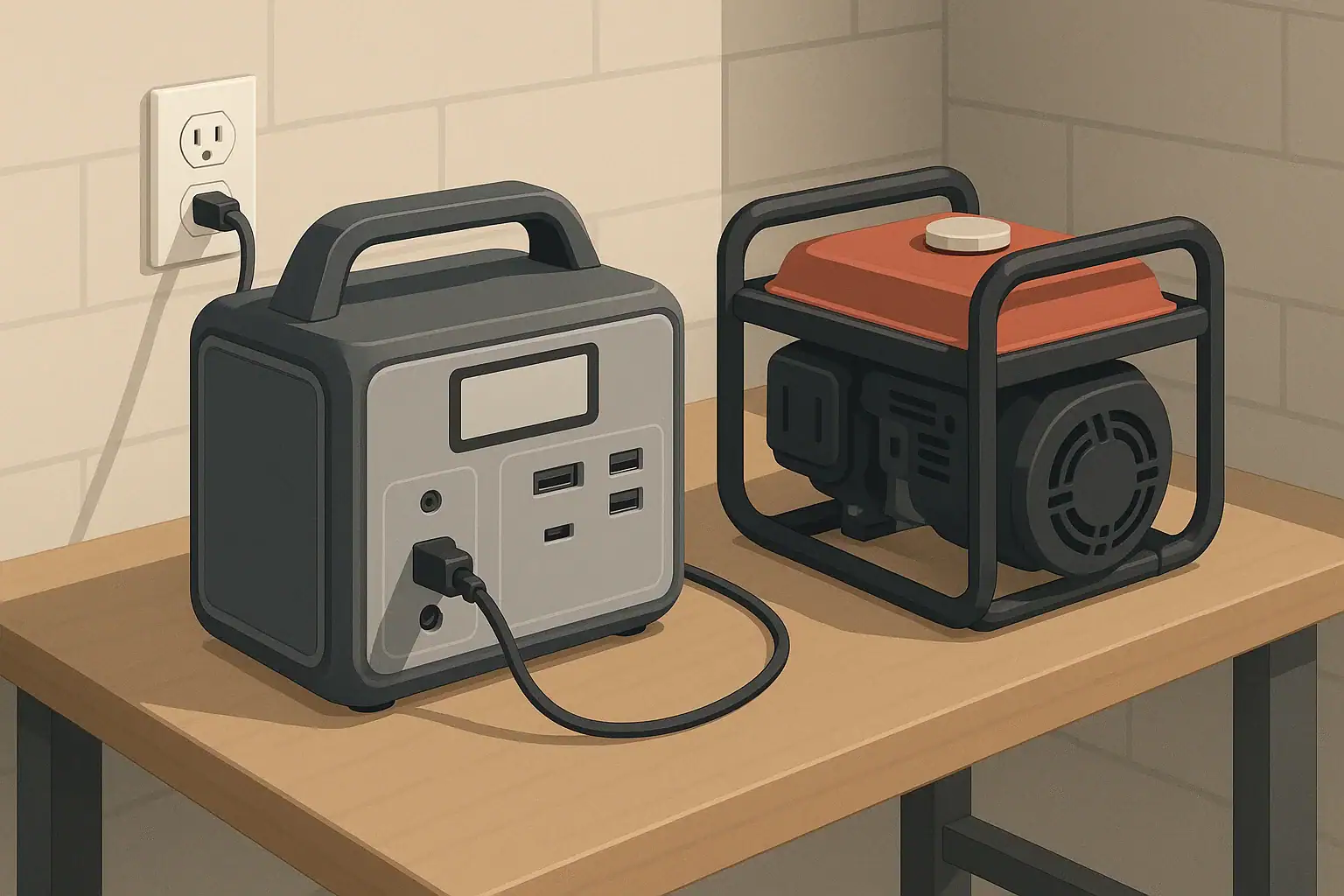
Portable power station and generator on a clean workbench

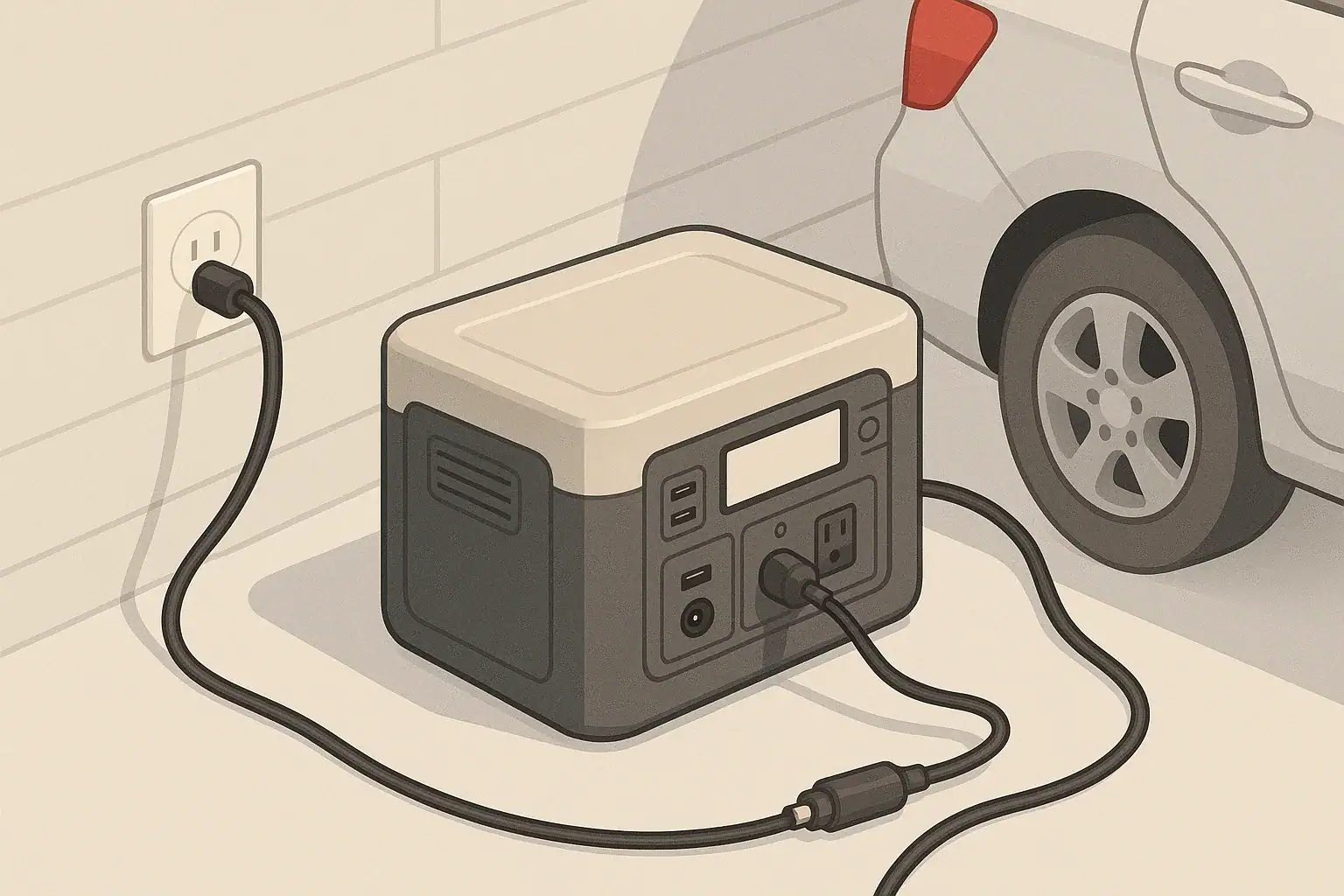
When a portable power station will not charge from a generator, it usually means the power station’s internal protections are rejecting the generator’s output. Instead of accepting power like it does from a wall outlet, the unit may show an error, rapidly start and stop charging, or simply do nothing. This can be confusing because from the outside, both the generator and the wall outlet look like the same kind of plug.

Many modern power stations closely monitor input voltage, frequency, waveform quality, and grounding. They are designed for relatively “clean” power, similar to grid electricity. Some small or older generators, especially those without inverter-style output, can have fluctuating voltage, frequency that is not close to 60 Hz, or unstable waveforms. These differences can make the power station refuse to charge to protect its electronics and battery.

Understanding why this happens matters if you plan to combine a generator and a power station for backup power, camping, RV use, or remote work. If they are not compatible, you might waste fuel, time, and money while still not having reliable charging. Knowing the role of frequency, grounding, and proper sizing helps you choose equipment that works together and avoid unsafe workarounds.

Instead of forcing compatibility, it is better to understand what your power station expects to see on its AC input and how your generator actually behaves under real loads. That knowledge will guide you toward safe troubleshooting steps and realistic expectations about charging speed and total runtime.

What the topic means (plain-English definition + why it matters)

When a portable power station will not charge from a generator, it usually means the power station’s internal protections are rejecting the generator’s output. Instead of accepting power like it does from a wall outlet, the unit may show an error, rapidly start and stop charging, or simply do nothing. This can be confusing because from the outside, both the generator and the wall outlet look like the same kind of plug.

Many modern power stations closely monitor input voltage, frequency, waveform quality, and grounding. They are designed for relatively “clean” power, similar to grid electricity. Some small or older generators, especially those without inverter-style output, can have fluctuating voltage, frequency that is not close to 60 Hz, or unstable waveforms. These differences can make the power station refuse to charge to protect its electronics and battery.

Understanding why this happens matters if you plan to combine a generator and a power station for backup power, camping, RV use, or remote work. If they are not compatible, you might waste fuel, time, and money while still not having reliable charging. Knowing the role of frequency, grounding, and proper sizing helps you choose equipment that works together and avoid unsafe workarounds.

Instead of forcing compatibility, it is better to understand what your power station expects to see on its AC input and how your generator actually behaves under real loads. That knowledge will guide you toward safe troubleshooting steps and realistic expectations about charging speed and total runtime.

Key concepts & sizing logic (watts vs Wh, surge vs running, efficiency losses)

To understand charging from a generator, you first need to separate power (watts) from energy (watt-hours). Generator and power station input ratings are usually given in watts (W), which describe the rate of energy flow. The capacity of the power station’s battery is given in watt-hours (Wh), which describes how much energy it can store. A 1,000 Wh power station drawing 500 W from a generator would take roughly two hours to charge in a perfect world.

Real charging is less efficient. Converting AC from the generator to DC for the battery wastes some energy as heat, and the power station may throttle charging at different stages to protect the battery. It is common for 10–20% of the generator’s output to be lost in conversion and overhead. If a power station advertises a maximum AC charging rate, it might only reach that rate with clean, stable power and under certain battery conditions.

Generators and power stations also have surge (or peak) and running ratings. A generator might be labeled with a higher “starting watts” number and a lower “running watts” number. Similarly, a power station inverter has a peak and continuous output rating. While charging, the power station adds a new load to the generator. If other devices are already plugged in, the combined load might exceed the generator’s stable running capability, causing voltage dips and frequency swings that the power station sees as unsafe.

Frequency and grounding complete the picture. Most power stations sold for the U.S. expect about 120 V at 60 Hz with a reasonably pure sine wave and a properly referenced ground. Some generators drift away from 60 Hz under light or changing loads, or have a floating neutral and unique grounding behavior. The power station’s protective circuits may treat these conditions as faults. Matching wattage is only the first step; reliable charging also depends on electrical quality.

Generator to power station compatibility checklist – Example values for illustration.
What to check Why it matters Example guidance (not a limit)
Generator running watts vs. charger draw Prevents overload and voltage sag while charging Aim for generator running watts at least 1.5× expected charge watts
Other loads on the generator Shared loads can push generator past stable capacity Try testing with only the power station connected first
AC voltage stability Large swings can trigger input protection in the power station Keep total load well below generator maximum to reduce dips
Frequency behavior Deviation from 60 Hz may cause the power station to reject input Use generator eco/idle modes cautiously if they affect frequency
Waveform type Distorted waveforms can confuse chargers and power supplies Inverter-based generators often produce cleaner sine waves
Grounding and bonding setup Incorrect or unclear grounding may trigger safety checks Consult generator manual and a qualified electrician if unsure
Extension cord quality and length Thin or very long cords can cause extra voltage drop Use heavy-gauge outdoor cords sized for the load

Real-world examples (general illustrative numbers; no brand specs)

Consider a mid-sized portable power station with a battery capacity in the 800–1,200 Wh range. If it can accept around 500–700 W of AC charging, pairing it with a small generator rated for about 2,000 running watts leaves room for other modest loads while keeping the generator comfortably below its limit. Under those conditions, and assuming 15–20% losses, a mostly empty battery might go from low to full in roughly 2–3 hours of continuous charging.

Now imagine the same power station connected to a much smaller generator rated around 900 running watts, while a refrigerator and lights are also drawing power. When the fridge compressor kicks on, the total demand might briefly exceed the generator’s surge capacity. Voltage may sag and frequency can dip below 60 Hz. The power station may respond by reducing its charge rate or stopping entirely until conditions stabilize.

Another scenario involves waveform quality. A non-inverter generator under light load can produce a distorted sine wave. Some power stations are relatively tolerant, while others are very strict and will not engage charging if the waveform is too noisy. A user might see the charging indicator flash on and off every few seconds as the internal charger repeatedly tests, then rejects, the incoming AC.

Grounding can also create puzzling behavior. In certain setups, the generator’s neutral might float with respect to ground unless it is bonded through a transfer device or other approved method. Some power stations monitor the relationship between hot, neutral, and ground for safety. If the expected reference is missing or unusual, the device may display a fault or refuse to pull significant current even though a simple lamp plugged into the same generator works fine.

Common mistakes & troubleshooting cues (why things shut off, why charging slows, etc.)

One common mistake is assuming that if a generator’s total watt rating is higher than the power station’s charger rating, everything will work flawlessly. In practice, voltage and frequency stability under changing loads are just as important. If other devices cycle on and off while the power station is charging, each transition can upset the generator and briefly create out-of-spec power that the charger rejects.

Another frequent issue is running the generator in an economy or idle-down mode while attempting to charge. Some generators adjust engine speed according to load, which can temporarily change frequency or voltage. Sensitive chargers may not like this, especially when the power station ramps its input up and down as it manages its own battery. Turning off eco modes can sometimes improve stability, as long as fuel use and noise are acceptable.

Undersized or very long extension cords also cause problems. Thin cords add resistance, which leads to voltage drop under load. When the power station tries to draw near its maximum charging rate, the extra drop may pull the generator’s output below the charger’s acceptable range. The result can be slower charge rates or cycling between charging and idle, even though the generator itself is technically capable.

Watch for cues from both devices. If the generator sounds like it is straining, surging, or repeatedly changing pitch, it may be near or beyond its comfortable operating range. If the power station’s display or indicators show fluctuating input watts, periodic error messages, or repeatedly starting and stopping charging, that usually means it is actively protecting itself from inconsistent input rather than failing outright.

Safety basics (placement, ventilation, cords, heat, GFCI basics at a high level)

Any time you pair a generator with a power station, safety should come first. Generators that burn fuel must always be operated outdoors in a well-ventilated area, far away from doors, windows, and vents, to prevent carbon monoxide from entering living spaces. The power station itself should remain dry and protected from direct rain or standing water, with intake and exhaust vents clear so internal components can stay within safe temperature limits.

Use heavy-duty, outdoor-rated extension cords sized appropriately for the load. Cords that are too small for the current can overheat, especially when coiled or run under rugs and doors. Periodically check connectors and cord jackets for warmth or damage during operation. Keep cords visible and routed where they will not be pinched, abraded, or tripped over.

Ground-fault circuit interrupter (GFCI) outlets and adapters are widely used for shock protection in damp or outdoor environments. Some generators include GFCI-protected receptacles by default. When you plug a power station into a GFCI outlet, nuisance tripping can occur if there are grounding or leakage issues. If this happens repeatedly, do not bypass the GFCI; instead, investigate the setup and consult a qualified electrician if needed.

Avoid improvising grounding or neutral-bonding solutions. Do not drive random ground rods or alter plugs in an attempt to “force” compatibility. Modifying cords, using adapters in unintended ways, or defeating safety features can create shock and fire hazards. If you need a permanently integrated backup setup between a generator, power station, and home circuits, high-level planning is appropriate, but the actual wiring and equipment selection should be handled by a licensed electrician.

Maintenance & storage (SOC, self-discharge, temperature ranges, routine checks)

Regular maintenance of both the generator and power station improves the chances that they will work together when you need them. Generators require oil changes, fuel stabilizer or fuel cycling, and periodic test runs. A generator that surges, stalls, or has clogged filters is more likely to produce unstable voltage and frequency, which will frustrate sensitive chargers. Running the generator with a modest test load every few months helps keep it in known working condition.

Portable power stations need less mechanical maintenance but still benefit from routine checks. Lithium-based batteries generally prefer being stored partially charged rather than full or empty for long periods. Many manufacturers recommend keeping state of charge somewhere around the middle range for storage and topping up every few months to counter self-discharge. Extreme heat or cold during storage can accelerate aging and reduce capacity over time.

When storing for seasonal use, keep the power station in a dry, cool environment away from direct sunlight and heat sources. Avoid leaving it in a vehicle on very hot or very cold days. Check ports, vents, and cords for dust, debris, and physical damage. A brief function test with a small appliance before storm season or a planned trip can reveal issues early, when they are easier to address.

Documenting your typical runtimes, charge times, and generator behavior in a notebook or digital file can be surprisingly helpful. If you know from past measurements that your setup normally delivers a certain charge rate, any significant change later on could indicate developing problems with the generator, cords, or the power station itself. Early detection allows for safer and less stressful troubleshooting.

Storage and upkeep planning examples – Example values for illustration.
Item What to do Example interval or condition
Power station state of charge Store partly charged and avoid long-term 0% or 100% Check and adjust every 3–6 months
Generator exercise run Start and run under moderate load to verify operation About 30–60 minutes every 1–3 months
Fuel condition Use stabilizer or rotate fuel to keep it fresh Replace stored fuel roughly yearly as an example
Cord and plug inspection Look for cuts, kinks, heat damage, or corrosion Before each extended use or at least seasonally
Vent and fan openings Gently clear dust and debris from grills Check during regular cleaning or before trips
Temperature exposure Avoid storage in very hot or very cold spaces Move equipment if forecasts are extreme
Performance notes Record charge times and generator behavior Update whenever you notice a change

Example values for illustration.

Practical takeaways (non-salesy checklist bullets, no pitch)

A power station refusing to charge from a generator is usually the result of protective design, not a defect. The device is sensing something about the input power that falls outside its comfort zone, such as unstable voltage, drifting frequency, poor waveform quality, or an unexpected grounding situation. Treat those behaviors as clues rather than obstacles to be bypassed.

Planning and testing ahead of time reduces surprises. Size your generator with enough running capacity above the maximum expected charging load, keep cords short and appropriately thick, and avoid stacking too many cycling appliances on the same generator while charging. Regular maintenance on both generator and power station makes it more likely they will behave predictably when used together.

Use the following checklist as a concise reference when diagnosing charging issues between a generator and a power station:

  • Confirm the generator’s running watt rating comfortably exceeds the power station’s maximum AC charge rate plus any other loads.
  • Test charging with the power station as the only load on the generator to rule out interference from other devices.
  • Turn off generator eco or idle-down modes temporarily if they cause noticeable pitch changes during charging.
  • Use a short, heavy-gauge, outdoor-rated extension cord, and avoid coiling it tightly during high loads.
  • Operate the generator outdoors with proper ventilation, and keep the power station dry and within its recommended temperature range.
  • Do not modify plugs, cords, or grounding to “force” charging; consult the manuals and, when in doubt, a qualified electrician.
  • Maintain both devices regularly and keep simple notes on typical charge times and behavior so you can spot changes early.

With a basic grasp of watts, watt-hours, surge behavior, and electrical quality, you can pair a generator and power station more effectively and safely, turning them into a coordinated backup or off-grid power solution rather than a source of frustration.

Frequently asked questions

Why does my power station refuse to charge when plugged into a generator?

Modern power stations monitor input voltage, frequency, waveform quality, and grounding, and will refuse to charge if any of those parameters fall outside safe limits. Generators with fluctuating voltage, drifting frequency, noisy waveforms, or unusual grounding can trigger built-in protections that stop or cycle charging.

How can I tell whether the generator or the power station is the problem?

Start by testing the power station as the only load on the generator using a short, heavy-gauge cord; if charging stabilizes, other loads or cords were likely the issue. You can also use a voltmeter or wattmeter to observe voltage and frequency under load—consistent large dips, frequency drift, or audible engine surging point to the generator as the likely cause.

Will switching to an inverter-style generator make charging more reliable?

Inverter generators usually produce a cleaner sine wave and tighter frequency control, which makes them more compatible with sensitive chargers, but they are not a guaranteed fix. Proper generator sizing, correct grounding, and stable load management remain important even with an inverter generator.

Is it safe to bypass GFCI or re-bond the neutral to force charging?

No. Bypassing safety devices, altering grounding, or modifying plugs and cords to force charging creates shock and fire hazards and can violate code. If grounding or GFCI tripping is suspected, consult the generator and power station manuals and a qualified electrician.

Can extension cord length or gauge stop charging, and how do I avoid that?

Yes—undersized or very long cords add resistance and cause voltage drop under load, which can pull generator output below a charger’s acceptable range and cause cycling or stoppage. Use short, heavy-gauge outdoor-rated cords sized for the expected current and avoid coiling cords tightly while operating.

USB-C PD 3.1 (240W) on Portable Power Stations: What It Changes and Who Needs It

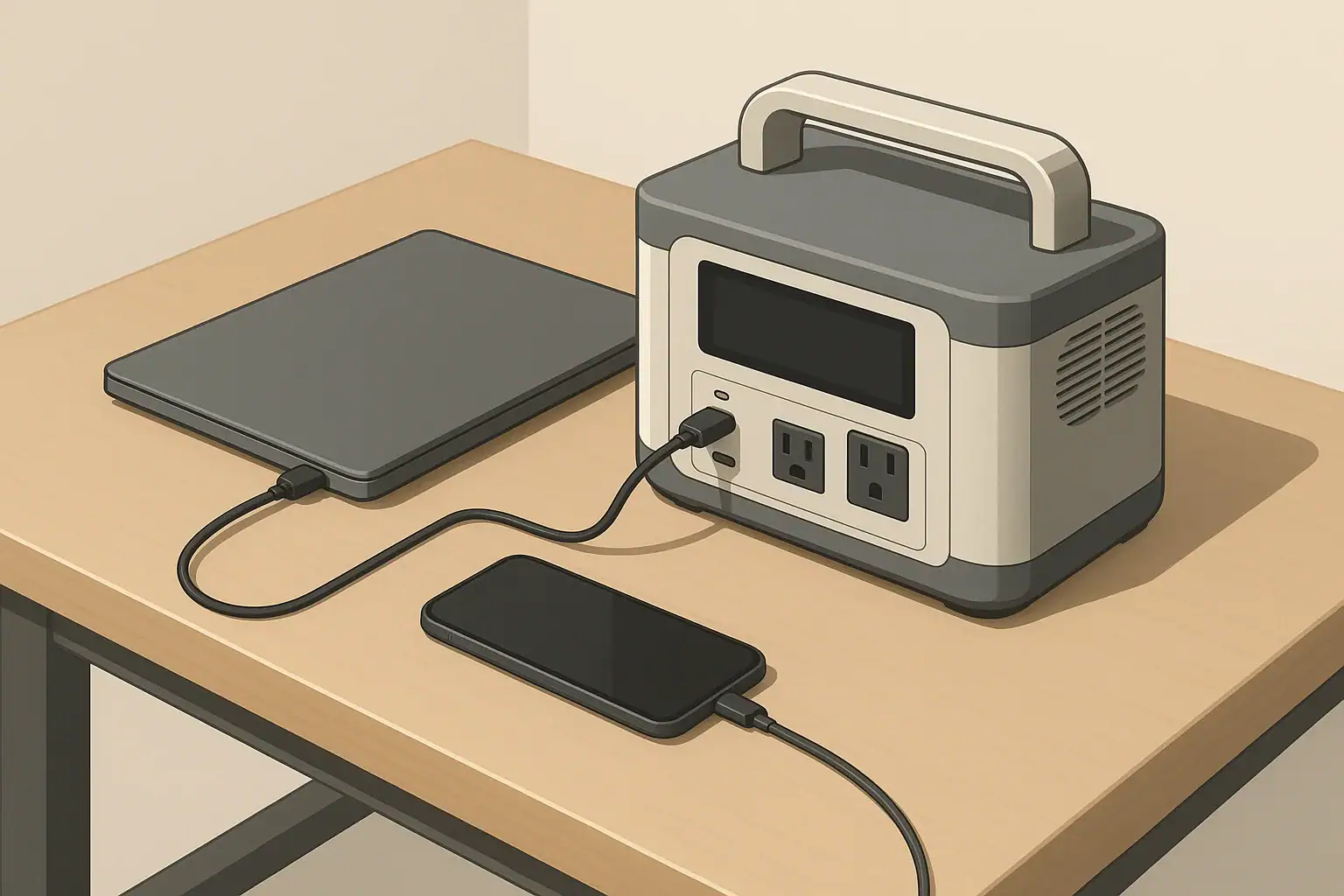
Portable power station charging laptop and phone over USB-C

What USB-C PD 3.1 (240W) Means and Why It Matters

USB-C Power Delivery (PD) 3.1 is the latest revision of the USB fast-charging standard that allows a single USB-C port to deliver higher, more flexible power levels. The headline feature is support for up to 240 watts over one cable, enough for demanding laptops, some gaming systems, and power-hungry accessories that previously needed bulky AC adapters. On a portable power station, this means the USB-C port can move from being a phone charger to a primary power output for work and travel gear.

On earlier power stations, the strongest USB ports usually topped out around 60–100 watts. That works well for tablets and many laptops, but it can struggle with performance notebooks, docking stations, and multi-device charging from one port. With USB-C PD 3.1 at up to 240 watts, a compatible device can negotiate exactly the voltage and current it needs, often replacing a standard wall brick while staying efficient and compact.

This change matters because it shifts more everyday loads away from the AC outlets and onto DC outputs. Direct DC power over USB-C typically wastes less energy in conversion than running a laptop through an AC inverter. For portable power station users, that can translate into slightly longer runtimes, quieter operation, and less clutter from separate chargers. It also simplifies setups for remote work, travel, and lightweight backup power.

Not everyone needs 240 watts over USB-C. Many small laptops, phones, and tablets still charge fine at 45–65 watts. But people who rely on high-performance laptops, USB-C monitors, or docking stations can benefit from the headroom and flexibility of PD 3.1. Understanding how this fits into overall capacity and output limits helps you decide whether a high-wattage USB-C port is a critical feature or simply a nice-to-have.

Key Concepts and Sizing Logic for USB-C PD 3.1 on Power Stations

To understand how USB-C PD 3.1 fits into portable power stations, it helps to separate three ideas: watts, watt-hours, and inverter efficiency. Watts (W) describe how fast power flows at a moment in time, similar to how quickly water flows through a pipe. A 240-watt USB-C port can deliver up to 240 watts of power to a single device, if both ends support that level.

Watt-hours (Wh) describe stored energy. A 500 Wh power station can theoretically provide 500 watts for one hour, or 100 watts for five hours, before conversion losses. USB-C PD 3.1 does not change how many watt-hours you have; it only affects how efficiently and flexibly you can use those watt-hours. High-wattage USB-C can let you concentrate more of that energy into one demanding device, but the total tank size remains the same.

Another key concept is the difference between running watts and surge watts. Surge is the brief higher draw when a device first starts. Many AC appliances have a surge, but most USB-C electronics behave more predictably, drawing close to a steady running wattage after they negotiate a power profile. That is one advantage of PD 3.1: the device and power station communicate to set a safe, stable level, which reduces surprises like sudden overloads from that port.

Finally, consider efficiency losses. When you use AC outlets, the power station must run an inverter to convert its internal DC battery power to AC. That conversion can waste 10–15 percent or more. High-wattage USB-C is DC-to-DC, which is typically more efficient, especially at partial loads. If a laptop that would normally use 120 watts from an AC brick can instead pull similar power directly from a PD 3.1 port, you may see modest runtime gains and less heat from the inverter, especially during continuous use.

USB-C PD 3.1 decision matrix for portable power station planning. Example values for illustration.
Primary use case Typical device load (example) Suggested USB-C PD level focus Notes
Phones, tablets, small electronics 10–45 W per device Up to 65 W PD is usually sufficient 240 W is helpful only for multitasking on one port
Lightweight office laptops 45–65 W while in use 65–100 W PD for comfortable headroom Focus more on total Wh than maximum port wattage
High-performance laptops and creators 90–200 W under heavy load PD 3.1 with 140–240 W capability Helps sustain performance without battery drain
USB-C monitors and hubs 30–90 W combined 100 W PD plus extra ports Check that ports can share power without throttling
Remote workstation setups 150–250 W total via USB-C 240 W PD with strong overall AC capacity Verify that total station output supports all loads
Camping and casual travel 20–80 W most of the time 45–65 W PD plus extra USB ports Focus on simplicity and runtime rather than max wattage
Backup for short outages 50–200 W mixed loads 100–140 W PD for laptops and routers AC still handles non-USB appliances

Real-World Examples of USB-C PD 3.1 on Portable Power Stations

Consider a remote worker who runs a performance laptop that can draw around 150 watts under load. On a power station with only 60-watt USB-C, the laptop might charge slowly or even lose battery charge while working hard, forcing the user to plug into AC and run the inverter. On a unit with a 240-watt PD 3.1 port, that same laptop can usually negotiate a higher power level, closer to what its original charger provides, allowing it to maintain performance while staying powered purely from USB-C.

As another example, imagine a small home office backup setup that includes a laptop, external monitor powered over USB-C, and a docking hub. Together, they may total around 120–180 watts. With PD 3.1, a single high-capacity USB-C port on the power station can power the dock, which then distributes power and data to connected devices. That consolidates power cabling and keeps the AC outlets free for other essentials like a modem, router, or a small desk lamp during an outage.

In a camping or vanlife scenario, most users do not push anywhere near the 240-watt ceiling but still benefit from the flexibility. A portable power station with PD 3.1 might simultaneously charge a laptop at 80 watts and a tablet at 30 watts from separate USB-C ports while also running a small 12V fan and LED lights. Even though no single device uses the full 240 watts, the overall system benefits from efficient DC outputs and reduced reliance on AC.

For short power outages, a modest-size power station with a strong USB-C port can keep internet access and basic work tools online. Pairing a PD 3.1 output with a laptop and router might draw around 60–120 watts combined. A 500 Wh battery could theoretically power that setup for several hours, depending on actual usage and efficiency losses, while freeing the AC outlets to handle a refrigerator cycling briefly or other essential appliance loads.

Common Mistakes and Troubleshooting Cues with High-Wattage USB-C

A frequent misunderstanding is assuming that a 240-watt USB-C port always delivers 240 watts, regardless of device. USB-C PD 3.1 still relies on negotiation. If the connected laptop or accessory only supports 65 watts, that is the upper limit it will draw, even from a higher-rated port. Users sometimes think a port is underperforming when, in reality, the bottleneck is the device or cable, not the power station.

USB-C cables is another common issue. Not all USB-C cables are rated for higher voltages and currents. Some are limited to 60 or 100 watts. If you pair a PD 3.1 power station with a low-rated cable, the devices may negotiate down to a lower power level or fail to enter a fast-charging mode. Symptoms include slow laptop charging, battery percentage still dropping under heavy load, or the system switching between charging and not charging.

Power stations can also throttle or shut off USB-C outputs when total system limits are reached. For example, if the unit is already powering several AC loads near its maximum continuous output, it may reduce power available to USB ports to protect itself. Users might see charging speeds drop or ports turn off entirely. This is not a fault with PD 3.1 itself, but a sign that the total demand on the power station is too high.

Another subtle issue is low-load auto shutoff. Some power stations turn off their DC or USB outputs when the combined draw falls below a certain threshold for a period of time, to save energy. Small devices such as wireless earbuds or low-draw sensors connected via USB-C may cause the port to cycle off unexpectedly. In these cases, adding another modest load, such as a phone charging in parallel, or checking for an “always on” mode (if available) can stabilize the output.

Safety Basics: Using USB-C PD 3.1 and Other Outputs Wisely

USB-C PD 3.1 is designed with safety features, including power negotiation and overcurrent protection, but overall safe use still depends on placement, ventilation, and cabling practices. Place the portable power station on a stable, dry surface with clear airflow around vents. High-wattage USB-C charging, especially at or near 240 watts, can generate noticeable heat both in the power station and in the device being charged, so avoid covering vents or stacking items on top.

Use quality cables rated for high power and avoid sharp bends or pinched runs. Cables that get hot to the touch, show visible damage, or intermittently disconnect should be replaced. When running multiple devices, keep cords organized to prevent tripping hazards and accidental disconnections. For outdoor or damp environments, keep the power station in a sheltered, dry location and avoid letting connectors sit in puddles or wet grass.

When you mix USB-C loads with AC loads, remember that the power station’s total output is shared. If AC outlets are feeding tools or appliances near the unit’s limit, starting another high-wattage USB-C session could trigger overload protection and a shutdown. In spaces like garages or workshops, plug sensitive electronics into appropriately grounded outlets and avoid daisy-chaining extension cords and power strips from the power station.

Many portable power stations include ground-fault protection on AC outputs to help reduce shock risk in certain fault conditions, especially around moisture. This is not the same as hardwiring into a building’s electrical system. For any connection to a home circuit or panel, even temporarily, consult a qualified electrician and rely on appropriate equipment rather than improvised solutions. Keep the power station itself away from extreme heat sources, flammable materials, and unventilated enclosed spaces.

Maintenance and Storage for Power Stations with USB-C PD 3.1

USB-C PD 3.1 does not significantly change maintenance needs, but higher power use can highlight weak spots in batteries, cables, and connectors. Periodically inspect USB-C ports for dust, debris, or damage, especially if the power station travels often. Gently clean around ports with a dry, soft brush if needed, and avoid inserting objects other than proper USB-C plugs.

For battery health, many manufacturers suggest storing portable power stations around 30–60 percent state of charge when not in use for long periods. Avoid leaving the battery fully depleted for weeks or kept at 100 percent continuously without need. All batteries experience some self-discharge over time; checking and topping up the unit every few months helps ensure it is ready when you need both the AC and USB-C outputs.

Temperature management is also important. Store and operate the power station within the temperature ranges in its manual, avoiding prolonged exposure to direct sun, freezing conditions, or enclosed hot vehicles. Cold temperatures can temporarily reduce available capacity, while high heat accelerates wear. When charging via wall, vehicle, or solar input, give the unit space to shed heat, especially if you plan to run a demanding USB-C PD 3.1 load at the same time.

Routine functional checks can catch problems early. Every so often, connect a laptop, phone, or other USB-C device and confirm it negotiates fast charging as expected. If charging is unexpectedly slow or devices frequently disconnect, try another cable and another device to isolate the issue. Addressing cable or connector problems early can prevent intermittent faults from showing up during a power outage or critical remote work session.

Storage and maintenance planner for portable power stations. Example values for illustration.
Maintenance task Suggested frequency What to look for Notes
Top up state of charge during storage Every 2–3 months Battery above roughly 30–60% Helps reduce stress from deep discharge
USB-C port and cable check Every 1–3 months Secure fit, no wobble or debris Replace frayed or loose cables promptly
Full functional test under load Every 3–6 months Devices reach expected charging speeds Try both USB-C PD and AC outputs
Visual inspection of vents and case Every few uses No dust buildup, cracks, or warping Keep vents clear for cooling
Storage environment check Seasonally Dry, moderate temperature area Avoid garages that get very hot or freezing
Firmware or settings review (if available) Once or twice a year Updated behavior, new options Some models refine USB-C performance over time
Solar or vehicle charging test (if used) Before trips or storm seasons Stable input, reasonable charge rate Confirms backup charging methods work when needed

Practical Takeaways: Who Really Needs USB-C PD 3.1 (240W)?

USB-C PD 3.1 with up to 240 watts is most valuable for users who depend on high-performance laptops, USB-C docks, or multi-device workstations and want to minimize AC adapters. It provides the headroom to run demanding systems directly from the power station’s DC side, improving efficiency and reducing clutter. For many casual users charging phones, tablets, and light laptops, lower-wattage USB-C ports still cover everyday needs.

When evaluating a portable power station, match the USB-C capabilities to your actual devices and workloads rather than chasing the highest number. A balanced setup considers both the peak power of individual ports and the total battery capacity in watt-hours. It also respects that AC outlets are still important for appliances that do not support USB-C at all.

Viewing USB-C PD 3.1 in the broader context of capacity, outputs, charging methods, and maintenance leads to better decisions. The goal is a system that runs quietly, efficiently, and safely for your specific use cases, whether that is remote work, short outages, or travel. High-wattage USB-C is a useful tool in that toolkit, but it is most effective when paired with realistic planning and good operating habits.

  • List your real devices and note which truly benefit from high-wattage USB-C.
  • Size the battery in watt-hours based on runtime goals, not just port ratings.
  • Use quality USB-C cables rated for your expected power levels.
  • Give the power station ventilation space, especially during heavy charging.
  • Check and top up the battery periodically so it is ready for outages or trips.

Frequently asked questions

Can USB-C PD 3.1 240W power any laptop that originally used a 240W AC charger?

Possibly, but only if the laptop supports USB-C Power Delivery 3.1 (Extended Power Range) and can negotiate the required voltage and current. Some high-performance laptops still rely on proprietary chargers or specific firmware, so verify the device’s supported charging profiles before relying solely on a PD 3.1 port.

Do I need a special cable to get the full 240W from a USB-C PD 3.1 port?

Yes — you need an electronically marked (e‑marked) USB-C cable rated for the higher current (5 A) and voltages used by PD 3.1’s Extended Power Range. Using a lower-rated cable will force the negotiation to a reduced power level or prevent fast charging entirely.

Will using USB‑C PD 3.1 240W on a power station increase my device run time compared to using the AC outlet?

Often it will provide modest runtime improvements because DC-to-DC delivery via USB‑C avoids inverter conversion losses present when using AC outlets. However, the total available runtime still depends on the power station’s watt-hours and the efficiency of both the station and the connected device.

Can I connect multiple devices to the same 240W PD port using a hub or dock?

A single PD 3.1 port negotiates power for one downstream connection; a powered hub or dock can distribute that power only if the hub and connected devices support the necessary PD profiles and wattage. Power sharing typically reduces the maximum available wattage per device, and the dock’s design determines whether the full 240W can be split effectively.

What safety or maintenance steps are important when using high-wattage USB‑C PD 3.1 240W?

Use certified high-current cables, keep the power station and devices well ventilated, and inspect ports and cords regularly for damage or overheating. Also follow recommended storage charge levels and temperature ranges, and avoid exceeding the station’s total continuous output to prevent thermal throttling or protective shutdowns.

AC Charging Heat & Fan Noise: Why It Happens and How to Reduce It Safely

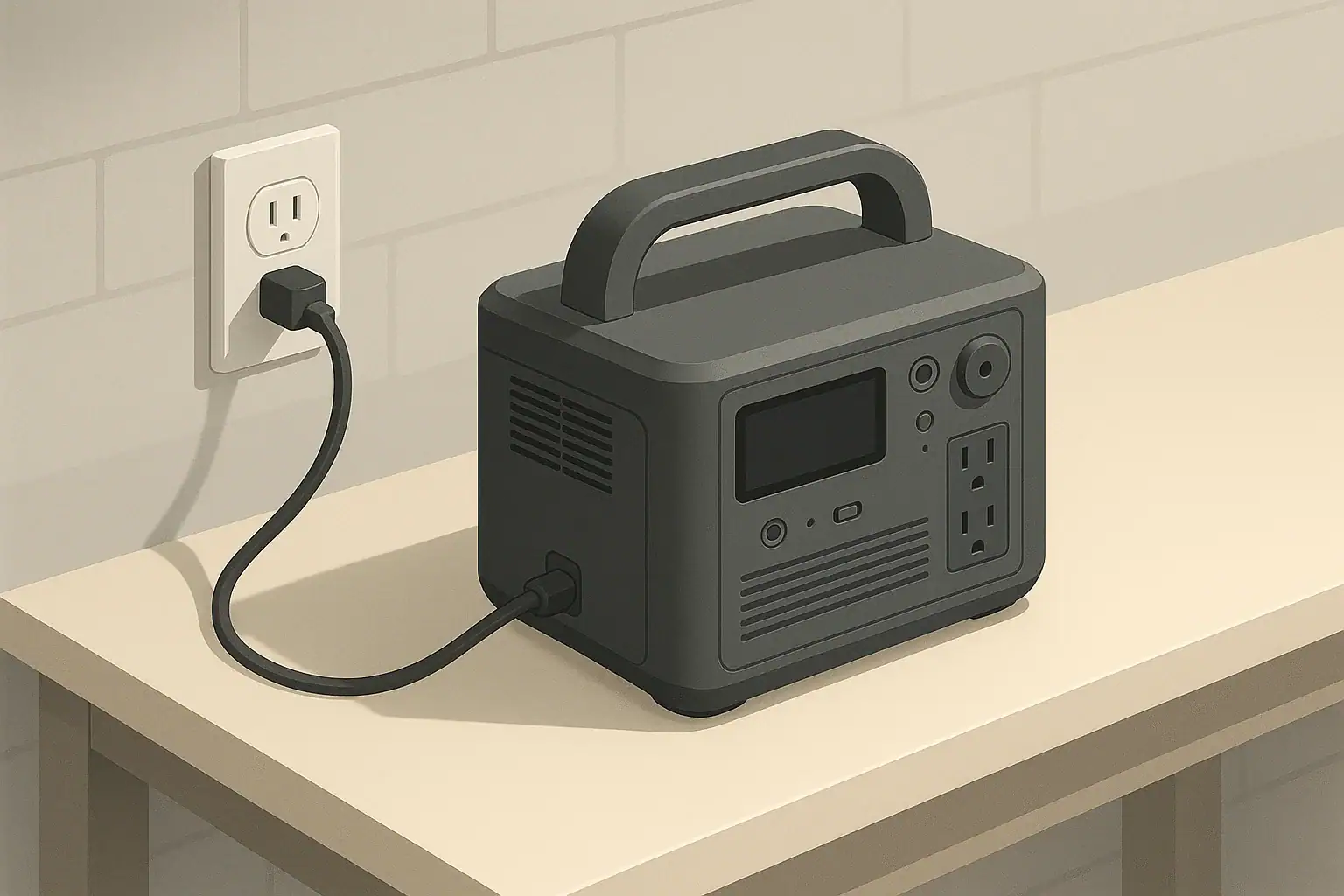
Portable power station AC charging on a clean workbench

When you plug a portable power station into a wall outlet, you are using AC charging. The station converts 120V AC power from the grid into DC power to recharge its internal battery. During this conversion, some of the electrical energy turns into heat, and the built-in cooling fans switch on to prevent overheating.

Heat and fan noise are normal side effects of this process, especially at higher charge rates. The AC charger, inverter electronics, and battery all generate heat as they work. Fans move air through the enclosure to keep internal components within a safe temperature range.

Understanding why your power station gets warm and noisy helps you judge what is normal and what might signal a problem. It also helps you choose good placement, manage loads, and adjust charging habits so you can reduce noise, extend battery life, and stay within safe operating conditions.

This matters most when you rely on a power station for backup power, remote work, or camping. Good heat management and realistic expectations about fan noise can make your setup more comfortable and help ensure your power station is ready when you need it.

What AC charging heat and fan noise mean for portable power stations

Key concepts behind heat, fan noise, and sizing logic

Portable power stations are typically rated in watt-hours (Wh) for battery capacity and watts for output power. Watt-hours tell you how much energy the battery can store, while watts describe how much power the unit can supply or accept at a given moment. Both numbers influence how much heat is produced during AC charging.

Surge watts describe short bursts of higher power the inverter can provide to start certain devices, while running watts describe the continuous power it can handle. During AC charging, the important value is input power: how many watts the charger is drawing from the wall. Higher charge power usually means the battery fills faster, but it also means more heat and more frequent fan operation.

No conversion is perfectly efficient. When the charger converts AC to DC and when the battery stores that energy, some portion is lost as heat. For example, if your power station pulls 300W from the wall but only 240W reaches the battery, the rest is lost as heat in the electronics and battery. These efficiency losses are one of the main reasons the enclosure warms up and the fans ramp up.

The environment adds another layer. If the unit is in a warm room or direct sun, or if it is charging while also powering devices (pass-through charging), temperatures rise faster. The internal temperature sensors then trigger the fans to maintain safe limits. High charge rates, low efficiency, warm ambient temperatures, and restricted airflow all combine to increase heat and fan activity.

AC charging and heat checklist – Example values for illustration.
Key factors that influence AC charging heat and fan noise
What to checkWhy it mattersExample observation
Charge power (watts from wall)Higher watts create more heat and more frequent fan use.Fast mode draws about twice the power of eco mode.
Battery capacity (Wh)Larger batteries absorb more energy and stay under load longer.A 1,000Wh unit may stay warm for several hours of charging.
Ambient temperatureWarm rooms reduce cooling effectiveness and raise internal temps.Fans run longer in a 85°F garage than in a 68°F office.
Airflow clearanceBlocked vents trap hot air and can trigger louder fan speeds.Fans quiet down after moving unit a few inches from a wall.
Simultaneous output loadCharging while powering devices increases total heat.Laptop plus charging makes the case warmer than charging alone.
Charge mode settingsSome models offer eco or reduced charge rates to cut heat.Lowering charge speed noticeably reduces fan noise.
Dust buildupDust on vents and fans can restrict cooling over time.Gentle cleaning restores more normal fan behavior.

Real-world examples of AC charging heat, noise, and efficiency

Consider a mid-sized portable power station with around 1,000Wh of battery capacity. If it charges from the wall at roughly 400W input, it could go from low to full in about three hours in simple math. In practice, charging may slow near the top of the battery to protect the cells, so total time could stretch to three and a half or four hours. During the first part of the charge, when power is highest, the enclosure is likely to feel noticeably warm and the fans may run at a moderate to high speed.

If the same unit allowed you to reduce the charge power to around 200W, the total charging time might extend to six or seven hours. However, the heat generated at any moment would be lower, fan speeds might stay in a quieter range, and internal temperatures would rise more slowly. For overnight charging, this slower, cooler approach is often more comfortable and easier on the battery.

Now think about simultaneous charging and discharging. If you are AC charging at about 300W while running a small fridge that uses around 60W on average, the total internal workload is closer to what a 360W input would produce. The fans may come on sooner and stay on longer because both the charger and the inverter are active. This can surprise users who expect the unit to be quiet just because the output load is relatively small.

Even small differences in efficiency can change how hot the unit feels. A charger that is 90% efficient at 300W wastes roughly 30W as heat, while one that is 80% efficient wastes around 60W. That extra heat has to go somewhere, and it typically means more fan activity. You cannot directly see efficiency, but you can infer it from how warm the charger area feels and how aggressively the fans behave for a given charge level.

Common mistakes, warning signs, and troubleshooting cues

Several common mistakes make AC charging heat and fan noise worse than they need to be. One frequent issue is placing the power station in a tight space, such as in a cabinet, closet, or against a wall, where vents are partially blocked. This forces the fans to work harder to remove heat and may even trigger thermal protection that slows or pauses charging.

Another common mistake is expecting silent operation at high charge power. Fast or “turbo” charge modes move a lot of energy quickly, which naturally creates more heat. If fans are spinning loudly at maximum charge rate, that is usually a sign the cooling system is doing its job, not that something is wrong. Switching to a lower charge setting can be a simple way to reduce noise if you are not in a hurry.

Watch for warning signs that go beyond normal warmth and fan noise. If the case becomes uncomfortably hot to the touch, if charging stops repeatedly with error indicators, or if the fans ramp to maximum and stay there for long periods in moderate room temperatures, those are cues to power down, unplug, and let the unit cool. Persistent overheating, strange odors, or visible damage warrant contacting the manufacturer or a qualified technician rather than continued use.

Charging that slows or stops unexpectedly can have several benign causes. The battery may be nearing full and the control system is tapering current to protect the cells. The unit may have reduced charge speed automatically due to high internal temperature. In some cases, long extension cords, loose plugs, or undersized circuits can also create voltage drop or nuisance breaker trips that interrupt charging. Checking the outlet, cord condition, and room temperature can help narrow down the cause without opening the device or tampering with built-in protections.

Safety basics for heat, ventilation, cords, and outlets

Safe AC charging starts with placement. Put the portable power station on a stable, nonflammable surface with several inches of clearance around all sides, especially near vents. Avoid covering the unit with blankets or placing it on soft bedding, which can block airflow and trap heat. Keep it away from direct sunlight, space heaters, or other heat sources that might push internal temperatures too high.

Ventilation is essential because the fans are designed to move air through specific paths inside the case. If these pathways are obstructed, hot spots can form and the unit may shut down to protect itself. In smaller rooms, consider leaving a door open so hot air can dissipate more easily, especially during long, high-power charging sessions.

Cord safety matters as well. Use properly grounded outlets, and avoid running cords under rugs or through doorways where they can be pinched or damaged. If you use an extension cord, make sure it is rated for at least the current your power station’s charger will draw, and keep it fully uncoiled to prevent overheating. Inspect cords periodically for cuts, kinks, or loose prongs and replace them if damaged.

In damp locations like garages or outdoor areas, ground-fault circuit interrupter (GFCI) outlets add an extra layer of protection by quickly cutting power if a ground fault is detected. Do not attempt to wire your power station into your home’s electrical panel or circuits on your own. Any connection that goes beyond plugging into standard outlets should be handled by a qualified electrician using appropriate transfer equipment so you do not bypass safety systems or create back-feed hazards.

Maintenance and storage to keep heat and noise under control

Routine maintenance helps keep AC charging heat and fan noise predictable over the life of the power station. Periodically check the vent areas and gently remove dust with a soft brush or dry cloth. Dust buildup restricts airflow, forces the fans to work harder, and reduces cooling performance. Avoid sprays or liquids that could enter the enclosure.

Battery health influences how much heat is generated during charging. Most portable power stations are happiest when stored at a partial state of charge rather than completely full or empty. For many lithium-based systems, keeping the battery somewhere around the middle of its range during long-term storage helps reduce stress. Topping up every few months helps counter self-discharge without subjecting the battery to constant high-voltage storage.

Temperature conditions during storage are also important. Storing the unit for long periods in very hot places, such as a parked car in summer or a sunlit shed, can age the battery faster and make it run hotter during future charges. Extremely cold storage can temporarily reduce capacity and performance. Aim for a cool, dry indoor environment within the manufacturer’s recommended range whenever possible.

Regular functional checks are useful. Every few months, bring the unit out of storage, charge it, and run a small load for a short time. Pay attention to how warm it gets and how the fans sound during AC charging. Gradual changes over the years are expected, but sudden increases in heat or unusual fan noise can signal that the unit needs inspection or professional service.

Storage and maintenance planner – Example values for illustration.
Example long-term care plan for a portable power station
TaskSuggested frequencyExample notes
Top up charge from storageEvery 3–6 monthsCharge to a moderate level to offset self-discharge.
Vent and fan inspectionEvery 3–6 monthsCheck for dust and gently clean vent openings.
Full functional testEvery 6–12 monthsCharge, run a small load, confirm normal heat and fan behavior.
Check cords and plugsEvery 6–12 monthsLook for fraying, loose blades, or discoloration.
Review storage locationSeasonallyMove out of very hot or freezing environments if needed.
Inspect for physical damageAnnuallyLook for cracks, warping, or signs of impact.
Update use planAnnuallyConfirm charging habits align with current needs.

Practical takeaways to reduce AC charging heat and fan noise safely

To keep AC charging comfortable and safe, focus on placement, settings, and habits. Charge the power station in a cool, well-ventilated room with clear space around the vents. Avoid enclosing it in cabinets or tight corners, and keep it off soft surfaces that might block airflow. If the unit feels hotter than usual, pause charging and let it cool before continuing.

Use charging modes thoughtfully. When you do not need a fast turnaround, select lower AC charge rates if your unit offers them. This can noticeably reduce heat and fan noise, especially overnight. Try to avoid frequently charging from very low to 100% if your use case allows; moderate charge levels and gentler rates are often kinder to the battery in the long run.

  • Check that vents are clear and dust-free before long charging sessions.
  • Give the unit some space from walls and other objects on all sides.
  • Use properly rated, undamaged cords and outlets, preferably indoors.
  • Consider slower charge modes when you want quieter operation.
  • Avoid charging in very hot environments or direct sunlight.
  • Pause charging and let the unit cool if it becomes unusually hot.
  • Do not open the unit or bypass safety systems; seek professional help for persistent issues.

By combining sensible placement, realistic expectations about fan noise, and moderate charging practices, you can keep your portable power station running cooler, quieter, and more reliably whenever you need it.

Frequently asked questions

Why does my portable power station get hot while AC charging?

AC-to-DC conversion and battery charging are not perfectly efficient, so some of the input power is lost as heat in the charger, inverter, and battery. Higher charge power, warm ambient temperatures, and simultaneous output loads increase heat production and cause the fans to run more frequently to maintain safe internal temperatures.

Is loud fan noise during AC charging dangerous?

Loud fan noise by itself usually indicates the cooling system is working and is not inherently dangerous. However, if noise is accompanied by repeated shutdowns, burning odors, an excessively hot enclosure, or visible damage, unplug the unit and seek inspection from the manufacturer or a qualified technician.

How can I reduce AC charging heat and fan noise without voiding the warranty?

Keep the unit on a stable, nonflammable surface with several inches of clearance around vents, charge in a cool, ventilated room, use lower charge modes when possible, and keep vents free of dust. Do not open or modify the enclosure; instead follow the manufacturer’s care instructions and use properly rated cords and outlets.

Should I stop charging if the unit becomes very hot or emits odors?

Yes—power down the unit, unplug it, and allow it to cool in a well-ventilated area. Persistent overheating, burning smells, error indicators, or visible damage merit contacting the manufacturer or a qualified service technician rather than continuing to use the unit.

Can charging at lower power extend battery life and reduce noise?

Charging at a lower power reduces instantaneous heat generation and fan activity and generally reduces stress on the battery, which can help long-term battery health. The trade-off is longer charging times, but this is often beneficial for overnight charging or when minimizing noise and heat is important.

Car Charging Explained: 12V Socket vs DC-DC Charger vs Alternator (Speed + Safety)

Portable power station charging from car and wall outlets

What the topic means (plain-English definition + why it matters)

When people talk about car charging for portable power stations, they often mix up three related but different things: the 12V socket, a dedicated DC-DC charger, and the vehicle alternator itself. All three are part of the same system, but they behave very differently in speed, efficiency, and safety.

The 12V socket is the familiar outlet on the dashboard or console. A DC-DC charger is a separate device that converts power from the vehicle’s 12V system into a controlled charge for another battery or portable power station. The alternator is the engine-driven generator that actually produces electrical power while the engine is running.

Understanding how these pieces fit together matters when you are planning to charge a portable power station on the road. It affects how long charging will take, how much fuel you may burn idling, how much load you put on your vehicle’s electrical system, and how safely you can power devices during road trips, camping, or vanlife.

Good planning helps you avoid surprises like a dead starter battery, a portable station that never fully charges while driving, or overloaded wiring. The goal is not to modify your vehicle, but to use what it already provides in a realistic and safe way.

Key concepts & sizing logic (watts vs Wh, surge vs running, efficiency losses)

Before comparing 12V sockets, DC-DC chargers, and alternators, it helps to separate power from energy. Power is measured in watts (W) and describes how fast energy is moving at a given moment. Energy is measured in watt-hours (Wh) and describes how much work can be done over time, such as the capacity of a portable power station battery.

When charging from a car, the charging power is limited by the weakest part of the chain: the vehicle socket rating, wiring, fuse size, DC-DC charger design, and the maximum input rating of the power station. For example, a typical 12V accessory socket in a passenger vehicle may be fused somewhere around 10–15A. At around 12–13.8V, that often works out to something in the range of roughly 120–180W of usable charging power, and sometimes less depending on the vehicle’s design.

Inverters and internal electronics add efficiency losses. If you use a 12V socket to power an inverter, then plug the portable power station’s AC charger into that inverter, energy passes through several conversions: DC to AC in the inverter, then AC back to DC inside the power station. Each step loses some energy as heat, so you might see only about 70–85% of the alternator’s output end up stored in the battery. Direct DC-DC charging, when supported, usually wastes less.

Surge and running power matter more on the output side of a portable power station than on the charging side, but they still affect planning. If you charge slowly in the car (low watts in) but run high-wattage appliances from the power station (high watts out), the battery can drain faster than it refills. Sizing a system means matching your expected daily energy use (Wh) to how much energy you can realistically put back into the battery during driving or from other sources.

Comparison of car charging paths for portable power stations – Example values for illustration.
Charging path Typical complexity Approximate power level (example) Main pros Main trade-offs
12V socket direct DC input Very low 50–120W Simple, plug-and-play, uses existing socket Slow charging, limited by fuse and wiring
12V socket to small inverter to AC charger Low 60–150W Works with power stations that only accept AC Extra losses through inverter, more heat
Hardwired DC-DC charger (example car) Medium (professional install recommended) 200–400W Faster charging, better voltage control Higher cost, adds load to alternator
Alternator direct to power station DC input Medium to high Varies widely Can use alternator capacity efficiently Requires careful design to protect vehicle system
Idle charging (engine running, parked) Low use effort Similar to driving levels Top up battery without moving Fuel use, engine wear, exhaust safety concerns
Driving plus supplementary solar Medium Car plus solar combined Reduces alternator load and fuel use More gear to manage and store

Real-world examples (general illustrative numbers; no brand specs)

To see how these limits play out, consider a portable power station with a battery capacity of about 500Wh. If you plug it into a 12V car socket that provides roughly 100W of charging power, it might take around 5–6 hours of driving to go from empty to full, assuming the vehicle maintains voltage, the socket can handle the current, and there are typical efficiency losses.

Now imagine a larger 1,000Wh power station. With that same 100W 12V socket input, you might be looking at 10–12 hours of driving time for a full charge, which for many people means multiple days of typical commute driving. A DC-DC charger supplying about 300W of power from the alternator could cut that to roughly 3–4 hours of continuous driving, if both the vehicle and the power station are rated to handle that input.

On the usage side, assume you are running a laptop that averages 50W and a small 10W light for six hours in the evening. That is about 360Wh of energy. A 500Wh portable power station could run those loads for one evening and still have some reserve. If you then drive for three hours the next day with 100W of car charging, you would be able to put back about 300Wh, not counting losses, which might nearly refill what you used.

These kinds of back-of-the-envelope estimates help you decide whether the 12V socket is sufficient for your style of travel, or whether you should plan on faster charging from a higher-power DC input, shore power at campsites, or supplementary solar. None of these example numbers are official limits; they are simply a way to visualize how much driving time you may need.

Common mistakes & troubleshooting cues (why things shut off, why charging slows, etc.)

One common surprise is the 12V socket shutting off when the engine stops. Many modern vehicles cut power to accessory outlets when the ignition is off to protect the starter battery. If your portable power station suddenly stops charging when you park, this is often the reason and not a fault with the power station itself.

Another frequent issue is slow or inconsistent charging from the car. This can happen if the 12V socket voltage sags under load, the vehicle uses smart alternator controls that reduce output at times, or the portable power station automatically reduces charging current to stay within its safe limits. Symptoms include the input wattage on the power station’s display dropping, pulsing up and down, or the device switching from charging to not charging repeatedly.

Tripped fuses are also common when people try to draw more power than the 12V outlet was designed for, especially when using inverters. If a fuse blows, the socket will stop working entirely until the fuse is replaced. Repeated fuse failures are a sign that the load is too high for that circuit and that you should reduce demand or use a different charging approach, not simply install a larger fuse.

Other cues include unusual heat at connectors or cables, fans on the portable power station running at high speed for long periods, or error messages indicating over-voltage or under-voltage. These are all hints that the charging setup is operating near its limits. In those cases, scaling back the load, improving ventilation, or using a more direct DC-DC charging method can help.

Safety basics (placement, ventilation, cords, heat, GFCI basics at a high level)

Safety with car charging starts with where you place the portable power station. It should sit on a stable, flat surface where it will not become a projectile during braking or sudden turns. Avoid locations that block airbags, vents, or access to pedals. Many people use the cargo area or a flat floor section where the unit can be restrained.

Ventilation is equally important. Both the portable power station and any connected inverter need airflow to shed heat. Do not cover vents with blankets, luggage, or clothing. In hot weather, interior vehicle temperatures rise quickly, especially in direct sun. Excessive heat can trigger reduced charging rates, thermal shutdowns, or long-term battery degradation.

Use cords and adapters rated for automotive 12V use, and avoid routing cables where they can be pinched by seats or doors. Coiled cables can trap heat; loosely run them instead, and inspect connectors for discoloration or looseness. If you use an inverter to produce 120V AC power in a vehicle, plug devices into grounded outlets when possible and keep cords away from moisture. For outdoor use near damp areas, ground-fault protection on AC circuits is a key layer of defense, but the specifics depend on the equipment design.

Finally, consider exhaust and carbon monoxide risk if you are idling the engine just to charge a portable power station. Never leave a running vehicle in an enclosed space. Charging while driving is usually safer from an exhaust standpoint than charging at idle in a closed garage or closely surrounded area.

Maintenance & storage (SOC, self-discharge, temperature ranges, routine checks)

Portable power stations used for car charging benefit from regular checks, especially if they are part of an emergency or camping kit stored in a vehicle. Batteries slowly lose charge over time, even when turned off. Many manufacturers suggest topping them up every few months to keep the state of charge within a healthy range and to prevent deep discharge during storage.

Temperature is a major factor in both battery life and safety. Long-term storage in a hot vehicle can accelerate aging, while extremely cold conditions can reduce available capacity and make charging less efficient. As a general guideline, aim to store the unit in moderate temperatures when possible and avoid leaving it in direct sun on a dashboard or in a closed trunk for extended periods.

Routine inspections should include checking cables for cuts or kinks, making sure 12V plugs and sockets are free of debris, and verifying that cooling vents are not clogged with dust or pet hair. If the portable power station has a display, occasionally powering it on to check its stored charge level helps ensure it will be ready when needed.

For vehicle-side maintenance, keeping the 12V outlet clean and verifying fuses are in good condition support reliable charging. If you notice dimming headlights or slow cranking from the starter battery when using a portable power station, that may be a sign that the vehicle’s battery or charging system should be inspected by a professional.

Storage and maintenance planning for car-charged power stations – Example values for illustration.
Task Suggested frequency What to look for Why it matters
Check state of charge Every 2–3 months Battery above minimum storage level Prevents deep discharge during storage
Top up charge from wall or car When below preferred storage range Battery returns to mid-to-high range Keeps battery ready for emergencies and trips
Inspect 12V cables and plugs Before long trips No cracks, burns, or loose contacts Reduces risk of overheating and failures
Clean vents and exterior surfaces Every 6 months Dust-free vents, intact case Maintains cooling performance and durability
Test car charging function Before seasonal use Stable input wattage, no error messages Confirms cables, fuses, and sockets are working
Review vehicle battery health Per service schedule Normal starting behavior and voltage Ensures car can safely support accessory loads
Adjust storage location With changing seasons Avoid extreme heat or cold spots Improves long-term battery life

Example values for illustration.

Practical takeaways (non-salesy checklist bullets, no pitch)

Using a car to charge a portable power station is convenient, but it works best when you understand the limits of 12V sockets, DC-DC chargers, and alternators. This lets you size your expectations, avoid stressing the vehicle’s electrical system, and keep both the car and the power station within safe operating ranges.

When planning, think in terms of daily energy use and available driving time. Combine car charging with other options, such as wall charging before a trip or solar during the day, to reduce reliance on any one source. Pay attention to heat, ventilation, cable quality, and the condition of your vehicle battery to maintain reliability over the long term.

  • Estimate your daily energy use in watt-hours and compare it to your power station’s capacity.
  • Check your vehicle manual for 12V socket limits and avoid overloading those circuits.
  • Use direct DC charging when possible instead of going through an inverter for better efficiency.
  • Monitor for warning signs such as hot connectors, blown fuses, or fluctuating input power.
  • Store the power station at a moderate state of charge and avoid prolonged extreme temperatures.
  • Have a backup charging plan for cloudy days, short drive times, or unexpected outages.

With these points in mind, car charging can be a practical part of a broader power strategy for road trips, camping, remote work, and short-term home backup without placing undue strain on your vehicle or your portable power station.

Frequently asked questions

Can I safely charge a portable power station from a car’s 12V socket with the engine off?

Often not reliably. Many vehicles cut accessory power when the ignition is off to protect the starter battery, and drawing significant current with the engine off can drain the starter and leave you unable to start the car. If you must charge while parked, check the vehicle manual for socket behavior, use low currents, and monitor both the starter battery and the power station state of charge.

How much faster does a DC-DC charger charge compared with using the vehicle 12V accessory socket?

Typical 12V accessory sockets commonly provide on the order of 50–120W for charging, while a properly installed DC-DC charger can often supply 200–400W depending on the vehicle and alternator. That means a DC-DC charger can be roughly two to four times faster in many real-world cases, though exact speed depends on alternator capacity and the power station’s input limit.

Will drawing high charging power from the alternator damage my car?

Not if the system is designed and installed correctly, but careless setups can risk alternator overheating, premature wear, or problems with smart alternator systems. Use properly rated wiring, fuses, and a DC-DC charger or isolation device as recommended; if in doubt, have installations done or inspected by a qualified technician to match alternator capacity and protect the vehicle electrical system.

Why does charging slow, pulse, or stop when charging from my vehicle?

Charging can slow or cycle because of voltage sag in the 12V circuit, the vehicle’s smart alternator reducing output, thermal throttling in the power station, or the station limiting its input current to stay safe. Symptoms include fluctuating input wattage or repeated connect/disconnect behavior; remedies include reducing draw, improving ventilation, checking connections, or switching to a higher-capacity DC charging method.

What practical steps prevent blown fuses and overheated connectors when charging from a car?

Check the fuse rating for the accessory circuit before pulling significant current, use cables and connectors rated for the expected current, and avoid drawing high loads through a cigarette-style socket unless it is explicitly rated and fused for that use. For higher-power charging, prefer a hardwired DC-DC charger with proper gauge wiring and inline fusing, and routinely inspect connectors for heat damage or looseness.

Fast Charging vs Battery Life: C-Rate Explained for Portable Power Stations (No Hype)

Portable power station charging from wall and car outlets

Portable power stations store energy in rechargeable batteries and let you run devices when wall power is not available. Two ideas often get mixed together when people compare models: how fast the battery can be charged, and how long the battery will last over months and years. The connection between the two is largely governed by something called the C-rate.

C-rate is a way to describe how quickly a battery is charged or discharged relative to its capacity. A 1C charge rate means charging a battery from empty to full in about one hour in theory. A 0.5C rate would take about two hours, and 2C would be about half an hour. Real charge times are longer because charging slows down as the battery approaches full, but the C-rate gives a useful comparison point.

For portable power stations, higher C-rate charging can mean less time plugged into the wall, car, or solar, which is helpful during short stops or power outages. However, regularly pushing batteries at very high C-rates can increase heat and stress, which may reduce long-term battery health. Understanding C-rate helps you balance fast charging convenience with reasonable expectations for battery life.

Instead of chasing the highest advertised charging speed, it is more practical to understand how C-rate, capacity, and your actual usage fit together. That way, you can tell whether a power station will realistically recharge between uses and how hard you are asking the battery to work.

What fast charging and C-rate really mean for portable power stations

Portable power stations store energy in rechargeable batteries and let you run devices when wall power is not available. Two ideas often get mixed together when people compare models: how fast the battery can be charged, and how long the battery will last over months and years. The connection between the two is largely governed by something called the C-rate.

C-rate is a way to describe how quickly a battery is charged or discharged relative to its capacity. A 1C charge rate means charging a battery from empty to full in about one hour in theory. A 0.5C rate would take about two hours, and 2C would be about half an hour. Real charge times are longer because charging slows down as the battery approaches full, but the C-rate gives a useful comparison point.

For portable power stations, higher C-rate charging can mean less time plugged into the wall, car, or solar, which is helpful during short stops or power outages. However, regularly pushing batteries at very high C-rates can increase heat and stress, which may reduce long-term battery health. Understanding C-rate helps you balance fast charging convenience with reasonable expectations for battery life.

Instead of chasing the highest advertised charging speed, it is more practical to understand how C-rate, capacity, and your actual usage fit together. That way, you can tell whether a power station will realistically recharge between uses and how hard you are asking the battery to work.

Key concepts and sizing logic: watts, watt-hours, and C-rate

When planning a portable power setup, it helps to separate three basic ideas: power, energy, and charge rate. Power is measured in watts (W) and describes how quickly energy is being used at a moment in time. Energy capacity is measured in watt-hours (Wh) and describes how much total work the battery can do before it needs to be recharged. C-rate ties the two together when you look at how quickly that stored energy moves in or out of the battery.

Battery capacity in watt-hours tells you how long a load can run in theory. For example, a 500 Wh battery feeding a 100 W load could supply that load for about 5 hours: 500 Wh divided by 100 W equals 5 hours. In practice, inverter losses, internal resistance, and other inefficiencies reduce this runtime. A reasonable planning assumption is that you may see 80–90% of the rated watt-hour capacity delivered to AC outlets, depending on how heavily they are loaded.

C-rate uses the battery’s amp-hour (Ah) rating to express charge or discharge current relative to size, but you can think of it in watt-hour terms for power stations. If a 500 Wh battery is being charged at 250 W, that is roughly a 0.5C charge rate: at that pace, a full empty-to-full charge would take about two hours in an ideal case. If the same battery were charged at 500 W, that would be about 1C. Higher C-rate means higher power moving through the system, which increases heat and may require the power station’s fans to run more often.

Inverter ratings add another important layer: the continuous (running) watt rating and the surge (peak) watt rating. The continuous rating is what the inverter can supply steadily. Surge rating describes short bursts to handle motor start-up or inrush current, such as from a refrigerator compressor or power tool. Running devices close to the continuous rating tends to reduce efficiency and increase heat, which also affects effective C-rate on discharge and can shorten runtime.

Decision matrix for balancing charge rate, capacity, and usage – Example values for illustration.
Scenario Example battery size Example charge power Approx. C-rate What this usually means
Occasional home backup for small essentials 500–700 Wh 150–250 W 0.2C–0.5C Slower charges, gentler on battery, easier on household circuits
Daily remote work and electronics 700–1200 Wh 250–400 W 0.3C–0.6C Balanced charge time and battery stress for regular use
Frequent fast top-offs between errands 300–600 Wh 300–600 W 0.5C–1C Shorter charge windows, more fan noise and heat
RV or vanlife with solar emphasis 1000–2000 Wh 200–600 W solar ~0.1C–0.3C mid-day Longer charge cycles, more battery-friendly if shaded heat is managed
High-demand tools used briefly 700–1500 Wh 400–800 W wall charging 0.3C–0.8C Need faster recharge, but avoid using maximum rate constantly
Emergency-only, long shelf life priority 300–1000 Wh 100–200 W 0.1C–0.3C Slower charging, less stress, better for occasional use

Efficiency losses and real-world charge times

When planning charge time, it is helpful to remember that power stations are not 100% efficient. Some power is lost as heat in the AC adapter or built-in charger, in the battery’s internal resistance, and in the inverter if it is running during pass-through use. A simple rule of thumb is that you may need 10–25% more watt-hours from the wall than the battery’s rated capacity to fill it from low to full.

Charge curves are also not flat. Most systems charge quickly up to a certain percentage, then taper off to protect the battery as it nears full. That means a power station might go from 20% to 80% much faster than from 80% to 100%. From a C-rate perspective, the initial phase uses a higher effective C-rate, and the final top-off phase uses a lower rate. If you only need enough energy to ride through a short outage or finish a workday, stopping around 80–90% can save time and reduce heat.

Real-world examples of C-rate, fast charging, and runtime

Relating C-rate to real-life situations makes it easier to judge what is “fast enough.” Imagine a portable power station with about 500 Wh of capacity. If it can charge from the wall at about 250 W, that is roughly a 0.5C rate. In simple terms, that means you could go from low to near full in a bit over two hours under typical conditions, allowing for efficiency losses and tapering.

Take that same 500 Wh unit on a camping trip. If you run a 50 W portable fridge and 20 W of lights for 8 hours overnight, that is about 560 Wh of load. Accounting for losses, you might use most of the battery in one night. To be ready for the next evening, you would want to recharge at least 400–500 Wh during the day. With a 250 W wall or generator charger, that might take around 2–3 hours; with a 100 W solar input, it might take most of a sunny day.

For remote work, consider a 700–1000 Wh power station running a 60 W laptop, 10 W router, and a few watts of phone charging and small accessories. At a 90 W total draw, a 900 Wh battery might deliver around 7–8 hours of runtime once you factor in inverter losses. If that same unit supports 400 W wall charging, you could restore a large portion of that capacity in a long lunch break, operating at around a 0.4C–0.5C charge rate.

In an RV, a larger 1500–2000 Wh power station might be recharged mainly through solar. Suppose you have 400 W of panels and get about 4–5 effective hours of good sun. That could provide 1600–2000 Wh of input on a clear day, corresponding to roughly a 0.2C–0.3C rate for a 2000 Wh battery. This slower C-rate is gentle on the battery, but you need to manage your loads so that daily use does not consistently exceed daily solar input.

Common mistakes and troubleshooting cues

Many charging and runtime issues come from misunderstandings about C-rate, load size, and what a portable power station is designed to do. One common mistake is assuming the advertised “from 0% to 80% in X minutes” claim applies under all conditions. In reality, temperature, state of charge, and input source (wall vs car vs solar) all influence the actual C-rate the battery sees.

Another frequent issue is overloading the inverter by confusing surge watts with continuous watts. If you plug in a device whose steady draw is close to or above the continuous rating, the power station may shut down or repeatedly trip its protection circuits. Motors, compressors, and some electronics can draw several times their running wattage during startup. If that surge exceeds the inverter’s short-term peak rating, you may see flickering, beeping, or immediate shutdown.

Charging can also slow down or pause when the power station gets hot. Fast charging at a high C-rate, especially in a warm room or vehicle, builds heat quickly. Internal temperature sensors may reduce charge power well below the maximum rating to protect the battery, or even stop charging until the system cools. If you notice the fan running constantly or feel the case getting warm, that is a cue to improve airflow or consider lowering the input power if the device allows it.

Pass-through charging, where the power station is charging while powering devices, can be confusing. If the output load is high, much of the incoming energy is immediately used by the connected devices rather than replenishing the battery. The display may show that it is charging, but the state of charge might climb very slowly or even drop. In extreme cases, the system may throttle charging or shut off outputs to stay within safe C-rate and thermal limits.

Signals your system is being pushed too hard

There are several warning signs that your portable power station is operating at a higher C-rate or load level than it comfortably supports. These are not necessarily failures, but they are cues to reduce stress on the system.

  • Fans running at high speed most of the time during charging or heavy use
  • Frequent thermal or overload warnings on the display or indicator lights
  • Charging power starting high, then dropping sharply after a short time
  • Noticeable case warmth, especially near vents or the charging side
  • Shorter runtimes than expected at a given load, due to elevated temperatures and losses

When you see these signs, try moving the unit to a cooler, shaded area with better airflow, reducing the load, or allowing the battery to cool before another full-power charge. These simple adjustments can reduce unnecessary battery stress and help preserve long-term capacity.

Safety basics: heat, placement, cords, and GFCI context

Fast charging and high C-rates mean more heat inside a compact enclosure, so placement and ventilation are important. Always use your portable power station in a dry, well-ventilated area where air can move freely around the vents. Avoid covering the unit with blankets, clothing, or gear, and do not place it in enclosed cabinets or tight spaces where hot air cannot escape.

Heat is one of the main factors that shortens battery life. Charging or discharging at high C-rates in hot environments raises internal temperatures and can accelerate aging. Keeping the unit out of direct sun and away from heaters, dashboards, or enclosed vehicle trunks during use and charging can significantly reduce thermal stress. When possible, operate the power station on a firm, non-flammable surface rather than carpets or bedding.

Extension cords and adapters also matter. Undersized or damaged cords can heat up under high loads, especially when running close to the power station’s continuous rating. Use cords rated for at least the maximum current you expect to draw, keep them fully uncoiled to avoid heat buildup, and inspect them regularly for nicks, loose plugs, or discoloration. For outdoor or damp environments, use cords and power strips designed for those conditions.

Many household circuits and outdoor outlets are protected by GFCI devices, which are designed to reduce shock risk in wet or grounded locations. Plugging a portable power station into a GFCI-protected outlet for charging is typically acceptable, but avoid daisy-chaining multiple power strips, cords, and adapters. If you encounter tripping or unusual behavior, disconnect everything and simplify the setup. For any connection involving a building’s wiring beyond standard plug-in use, consult a qualified electrician instead of attempting your own modifications.

Maintenance and storage for long battery life

How you treat a portable power station between uses can matter almost as much as how you charge it. Batteries slowly lose charge even when turned off, a process called self-discharge. The rate varies, but it is normal to see a few percent of charge fade per month. Plan to check the state of charge periodically, especially if the unit is stored for emergencies.

Most lithium-based batteries prefer to be stored partially charged rather than completely full or empty. A common recommendation is to keep long-term storage in the middle range, such as around 40–60% state of charge. This reduces stress on the cells while still keeping enough energy on hand for short-notice use. If you store the unit at a very low charge for too long, the battery may fall below its safe voltage range and the protection circuitry can prevent normal charging.

Temperature during storage is another key factor. Moderate, dry conditions are best. Extremely hot environments, such as attics or parked vehicles in summer, can accelerate aging even when the battery is not in use. Very low temperatures do not usually damage the battery by themselves, but charging at or below freezing can be harmful. If the power station has been stored in the cold, let it warm to room temperature before charging.

Routine checks help you catch small issues before they become larger problems. Inspect cables, wall adapters, and ports for wear or debris. Gently clean dust from vents with a dry cloth or low-pressure air so the cooling system can work properly during high C-rate charging or discharging. Turn the unit on occasionally to verify that the display, ports, and outlets function as expected, especially if you rely on it for backup power.

Storage and maintenance plan by usage pattern – Example values for illustration.
Usage pattern Suggested storage charge level Check/charge interval Key maintenance focus
Emergency-only home backup 40–60% Every 3–6 months Top up charge, test a small load, inspect cords and outlets
Seasonal camping or RV 40–70% Before and after each season Clean vents, verify solar inputs, confirm charge settings
Weekly remote work use 50–80% between sessions Weekly Monitor runtime changes, watch for excess heat or fan noise
Daily mobile power (vanlife) 30–80% cycling Monthly deep check Inspect all cables, clean dust, review charging sources and limits
Tool and jobsite backup 50–80% Monthly or before major jobs Check inverter output under load, inspect cords for damage
Mixed household and travel 40–70% Every 2–3 months Test various ports, ensure adapters and accessories are stored together

Practical takeaways: balancing fast charging and battery life

Understanding C-rate turns fast charging claims into useful planning tools instead of marketing numbers. Higher C-rate charging and discharging give you flexibility during outages, travel, and short charge windows, but they also increase heat and long-term wear. For most users, a moderate C-rate that refills the battery over a few hours offers a good balance of convenience and longevity.

Rather than focusing only on maximum charging watts, match your portable power station’s capacity and charge rate to your actual loads and schedules. Think about how long you need to run key devices, how much time you have between uses to recharge, and what energy sources you can rely on. Planning with realistic runtimes and charge times will help you avoid surprises when you need power most.

  • Size the battery in watt-hours to cover your typical loads with a buffer for inefficiencies.
  • View maximum charge power as an upper limit, not a requirement to use at every cycle.
  • Watch for signs of thermal stress such as constant fan noise and warm casing during use.
  • Store the unit partially charged in a cool, dry place and check it periodically.
  • Use appropriate cords and outlets, and avoid stacking adapters or modifying wiring.
  • Allow extra time for charging in hot weather or when using pass-through power.

With these habits, you can take advantage of fast charging when it truly helps, while giving the battery conditions that support a long, reliable service life.

Frequently asked questions

What C-rate is recommended for daily charging of a portable power station?

A moderate C-rate around 0.3C–0.6C is a good balance for daily use because it refills most capacity in a few hours without causing excessive heat. Exact safe rates vary by battery chemistry and manufacturer guidance, so follow the unit’s specifications when available.

How does charging at a high C-rate affect long-term battery lifespan?

Higher C-rates increase internal heat and mechanical stress on cells, accelerating capacity loss and reducing cycle life over time. Occasional fast charges are acceptable, but frequent high-C charging will generally shorten the battery’s useful life compared with gentler charging.

How can I estimate real-world charge time from C-rate and watt-hours?

Divide charge power (W) by battery capacity (Wh) to find approximate C-rate (for example, 250 W into 500 Wh ≈ 0.5C). The theoretical empty-to-full time is about 1/C hours, but real-world charging takes longer due to tapering and inefficiencies—add roughly 10–25% extra time and expect the final 10–20% to take disproportionately longer.

Is pass-through charging (charging while powering devices) safe to use often?

Pass-through is typically safe for occasional use, but when loads are high much of the incoming power goes to running devices rather than charging the battery, which raises heat and can trigger throttling. Frequent pass-through at high loads or in warm conditions can increase wear and reduce battery lifespan.

What signs show my power station is being charged too fast?

Look for constant high fan speed, thermal or overload warnings, rapid drops in displayed charge power, and a noticeably warm case near vents—these indicate heat-related stress or throttling. If observed, reduce input power, improve ventilation, or allow the unit to cool before further high-rate charging.

Can solar fast-charging deliver high C-rates safely for portable power stations?

Solar can provide substantial charge power, but effective C-rate depends on panel wattage, sun conditions, and the station’s charge controller. High daytime solar input spread over several hours is usually gentle, but pairing large solar input with hot temperatures or a small battery can raise internal temperatures and accelerate wear, so use MPPT control and manage ventilation.

PPS vs Fixed USB-C PD Profiles: Why Some Laptops Charge Slowly (and How to Fix It)

Portable power station charging a laptop with USB-C

USB-C Power Delivery (PD) is a standard that lets devices and chargers negotiate how much power to use over a single cable. Many modern portable power stations now include USB-C PD ports to charge laptops, tablets, and phones without using the AC outlets. However, not all PD ports behave the same. Some offer fixed voltage profiles only, while others support PPS, or Programmable Power Supply.

Fixed USB-C PD profiles use a handful of standard voltage steps such as 5 V, 9 V, 15 V, or 20 V. Your laptop chooses one of those steps and pulls current up to the power station’s limit. PPS adds the ability to fine-tune both voltage and current in small increments, allowing more efficient and stable charging, especially for devices that prefer specific voltages or that actively control battery temperature and charging curves.

This becomes important when using a portable power station because laptop charging speed, heat, and run time depend on how well the power station’s USB-C port matches what the laptop expects. If the port only offers fixed profiles and your laptop is optimized for PPS, it may fall back to a lower power mode. That can mean slower charging, or even a battery that still drains slowly while plugged in under heavy use.

What PPS vs fixed USB-C PD profiles means and why it matters

Understanding the basics of PPS versus fixed PD helps you choose a power station with the right USB-C features, estimate realistic run times, and troubleshoot slow or inconsistent laptop charging. It also connects directly to sizing decisions: the watt rating of each port, the overall battery capacity in watt-hours, and how efficiently DC power is delivered all determine whether your portable setup feels seamless or frustrating.

Key concepts: watts, watt-hours, surge vs running, and efficiency losses

Two basic units drive most charging and runtime questions: watts (W) and watt-hours (Wh. Watts describe power at a moment in time, while watt-hours describe energy stored or used over time. When a laptop charges from a USB-C PD port on a portable power station, the USB-C port’s watt rating and the laptop’s draw in watts determine charging speed, while the station’s capacity in watt-hours determines how long you can keep everything running.

On the energy side, the power station’s battery capacity is typically listed in watt-hours. If your laptop averages 50 W while charging and running, and the station has 500 Wh of usable capacity, the theoretical run time is 500 Wh ÷ 50 W = 10 hours. In practice, you have to subtract efficiency losses. DC-to-DC conversion from the internal battery to USB-C is usually more efficient than going out through an AC inverter and then back into a laptop charger, but there are still losses in cables, electronics, and heat. A realistic rule of thumb is that you may only get 80–90% of the rated capacity in real use.

Most USB-C PD ports on power stations are rated somewhere around 30–140 W. A laptop that can accept 65 W over USB-C will usually charge quickly if the port can deliver at least 65 W at a compatible voltage. With fixed PD profiles, the port might offer, for example, 20 V at up to 3.25 A (about 65 W. With PPS, the laptop can request something like 18 V at a specific current to manage heat and internal battery charging more precisely. If the laptop wants PPS but only finds fixed steps, it may choose a lower power profile, such as 45 W, causing slower charging.

Surge versus running power is less of a concern for USB-C than for large AC loads, but it still matters at the whole-station level. If other devices on AC are pulling near the inverter’s limit, the station might throttle or prioritize loads, which can reduce the available power on USB-C PD ports or even shut them off. Higher instantaneous draws, such as a laptop ramping up CPU and GPU while charging, can cause brief spikes. A well-sized power station with headroom above your combined loads is less likely to sag or shut down, and PPS can help smooth those variations by letting the laptop adjust draw more gracefully within the port’s limits.

The key sizing logic is to match your laptop’s maximum USB-C charging power with the port rating and to size the battery in watt-hours for the total time you want to run, then discount for efficiency. If PPS support is present, the laptop and power station can often find a more efficient operating point, translating into slightly longer runtimes, less heat, and more stable behavior.

USB-C laptop charging checklist for portable power stations – Example values for illustration.
What to checkWhy it mattersExample notes
USB-C PD watt ratingLimits maximum laptop charging speedLook for a port rating at or above your laptop’s charger wattage, such as 60–100 W.
PPS support on USB-C portImproves compatibility and efficiency for newer devicesIf your laptop supports PPS, a PPS-capable port can help maintain higher, more stable power.
Power station battery capacity (Wh)Determines how long you can run and charge devicesEstimate total runtime using laptop watt draw and factor in 10–20% efficiency loss.
Number of active devicesMultiple devices share limited power budgetRunning phones, tablets, and a laptop from the same unit reduces available power per port.
AC inverter vs USB-C directImpacts overall efficiency and heatUSB-C direct from the power station is usually more efficient than using a separate AC brick.
Cable quality and ratingInfluences maximum power and stabilityUse a USB-C cable rated for the required wattage, such as 60 W or 100 W.
Ambient temperatureAffects battery and charging performanceHigh heat or extreme cold can cause slower charging or throttling.

Example values for illustration.

Real-world examples of PPS vs fixed PD with portable power stations

Consider a laptop that normally uses a 65 W USB-C charger. On a power station with a 60 W fixed PD port and no PPS, the laptop may choose a 20 V profile at up to 3 A. Because the port tops out near 60 W, the laptop may charge close to full speed at idle, but if you start a demanding task, the laptop’s total power use can exceed what the port can supply. The system may reduce battery charging speed or even begin to drain the battery slowly while plugged in.

Now compare that with a similar power station whose USB-C port supports PPS up to 100 W. If your laptop also supports PPS, it can request a voltage and current combination tuned to its internal charging circuitry, staying near its ideal 65 W even as workload changes. The result is that the battery continues to gain charge while you work, instead of hovering or dropping. On a long workday powered entirely from the station, that difference can decide whether you run out of power before finishing.

Portable power station run time also shifts based on how you connect the laptop. If you plug the original AC charger into an AC outlet on the station, the laptop may still get full 65 W charging, but the station’s inverter has to convert DC to AC and your charger converts it back to DC. This double conversion adds overhead. For example, that same laptop might effectively cost the power station 70–80 W instead of about 60–65 W via direct USB-C. Over several hours, the difference adds up to noticeably shorter overall runtime.

These differences become more obvious when you combine loads. Imagine running a laptop, a small monitor, and a Wi-Fi router during a power outage. With a moderate-size power station, direct USB-C charging using supported PPS can keep the laptop closer to its rated power while leaving more capacity for the other devices. If the station only offers fixed profiles and the laptop falls back to a lower power mode, you might see the battery percentage rise slowly or even stall when the laptop is busy, even though everything appears to be connected correctly.

Common mistakes and troubleshooting cues for slow laptop charging

Slow or inconsistent laptop charging on a portable power station often traces back to a handful of common issues. One frequent mistake is assuming that any USB-C port will provide full laptop power. Many ports on power stations are designed primarily for phones or small tablets and may be limited to 18–30 W, which is far below what most modern laptops expect. Even if the station has a high-watt USB-C port, using the wrong port or a lower-rated one can cap charging speed.

Another source of trouble is ignoring PPS compatibility. Some newer laptops behave best when they can negotiate fine-grained voltages. If the power station only offers fixed profiles, the laptop may request a conservative level like 45 W for safety or thermal reasons. In everyday use, that shows up as slow charging, or a laptop that charges well at idle but cannot gain battery percentage during intensive tasks. In some cases, the laptop may briefly connect and disconnect from charging as it tests different profiles.

Cable issues can also mimic power station problems. A USB-C cable not rated for higher wattage may limit current or cause the devices to fall back to lower PD profiles. This can look like a port limitation even when the power station is fully capable. Likewise, long or damaged cables can introduce enough resistance to cause voltage drops, prompting the laptop to draw less power to stay within safe limits.

Troubleshooting cues include watching how the laptop behaves under different combinations: testing one device at a time, moving the cable to a different USB-C port on the power station, or switching between USB-C direct and the laptop’s AC charger plugged into the station’s AC outlet. If the laptop charges normally from wall power but slowly from USB-C on the power station, the issue is usually port wattage, PD profile support, or cabling rather than the laptop itself. If sudden shutoffs occur when multiple AC loads run alongside USB-C charging, you may be hitting the station’s total output limit, causing protective shutdowns.

Safety basics: placement, ventilation, cords, heat, and GFCI context

Using a portable power station for USB-C laptop charging is generally safer than improvising with extension cords or unprotected adapters, but basic safety practices still matter. Place the power station on a stable, dry, and level surface, with enough space around the vents for airflow. Blocking vents or placing the unit in a confined space can cause heat buildup, which can trigger throttling or shutdowns and reduce battery life over time.

Pay attention to cord routing. USB-C cables and AC cords should not be pinched under furniture, run through doorways that close on them, or stretched in ways that strain connectors. Tripping hazards are a safety risk to both people and equipment; a sudden pull on a cable can dislodge plugs or damage ports. Using appropriately long, undamaged cables rated for the loads you need helps maintain both safety and charging performance.

Heat management is especially important when charging larger devices like laptops. Both PPS and fixed PD profiles are designed with safety in mind, but high power transfer still generates heat in cables, connectors, and devices. If you notice connectors becoming hot to the touch, reduce the load, improve ventilation, or switch to a higher-rated cable. Avoid covering the power station or laptop with blankets, cushions, or other insulating materials while charging.

For use near sinks, garages, or outdoor spaces, be mindful of moisture and grounding. Some power stations include GFCI-type protection on AC outlets, which can add a layer of safety against ground faults. However, they are not a replacement for properly installed household wiring. If you plan to use a power station in conjunction with home circuits or transfer equipment, consult a qualified electrician. Use the station as a standalone power source for laptops and small electronics unless your setup has been professionally designed and installed.

Maintenance and storage for reliable USB-C laptop power

Good maintenance and storage habits help ensure your portable power station will deliver stable USB-C PD power when you need it. Keeping the battery within a moderate state of charge during storage is often recommended; many manufacturers suggest around 40–60% as a balance between readiness and long-term battery health. Avoid leaving the station either completely full or completely empty for long periods when not in use.

Self-discharge means that the battery will slowly lose charge over time even when turned off. Check the charge level every few months and top it up as recommended by the manufacturer to prevent deep discharge. Periodically exercising the unit by running a few typical loads, such as a laptop and a lamp, can also help confirm that USB-C PD ports and AC outlets are working correctly before you rely on them during a power outage or trip.

Temperature is another key factor. Store the power station in a cool, dry place away from direct sunlight, heaters, or very cold environments. Extreme temperatures during storage can accelerate battery aging or lead to reduced capacity. During use, particularly with high-power USB-C laptop charging, keep the station where air can circulate freely and where it will not be exposed to rain or condensation.

Inspect USB-C cables and connectors regularly for fraying, bent pins, or loose fits. Because PPS and high-watt PD depend on clean electrical connections and solid signaling, a damaged cable can reduce charging speed or cause erratic behavior. Wiping down the exterior of the station with a dry or slightly damp cloth, keeping dust out of vents, and following any manufacturer-recommended firmware updates or checks help maintain safe, reliable power delivery.

Portable power station maintenance plan – Example values for illustration.
TaskSuggested frequencyWhy it matters
Check state of chargeEvery 2–3 monthsPrevents deep discharge and confirms readiness for outages or trips.
Top-up charging during storageWhen charge falls near mid-rangeKeeps battery in a healthy range without sitting full or empty.
Inspect USB-C and AC cablesBefore extended useDamaged cables can limit PD power, including PPS, or create hazards.
Test run typical loadsEvery few monthsVerifies ports, inverter, and PD negotiation work as expected.
Clean vents and surfacesAs needed based on dustMaintains airflow and reduces heat buildup during high-power charging.
Review operating and storage temperaturesSeasonallyHelps avoid storing or running the unit in extreme heat or cold.
Check for firmware or guidance updatesOccasionallyEnsures you follow current recommendations for safe battery use.

Example values for illustration.

Practical takeaways and checklist for better laptop charging

Getting dependable laptop charging from a portable power station comes down to understanding how PPS and fixed USB-C PD profiles interact with your devices, and sizing the station around your real-world needs. While the technical details can be complex, you can usually avoid slow charging and surprise shutdowns by checking a few key specifications and using the right cables and ports.

Think about how and where you use your laptop: remote work, travel, camping, or backup during outages. In each case, a direct USB-C PD connection that matches your laptop’s expected wattage is usually more efficient than running the AC charger, and PPS support can add a margin of comfort for newer devices. Combine that with basic safety, storage, and maintenance habits, and a portable power station can be a reliable part of your everyday and emergency power plan.

  • Confirm your laptop’s typical USB-C charging wattage and whether it supports PPS.
  • Match that wattage with a power station USB-C PD port that can deliver equal or higher power.
  • Prefer direct USB-C charging over using the laptop’s AC brick when practical for better efficiency.
  • Use short, high-quality USB-C cables rated for the wattage you need, and replace damaged ones.
  • Allow good ventilation around both the power station and laptop to limit heat-related throttling.
  • Store the station partially charged in a cool, dry place and top it up periodically.
  • Test your full setup periodically so slow charging or port issues are discovered before you depend on it.

With these practices, PPS and fixed USB-C PD profiles become tools you can plan around rather than mysteries that cause unexpected slowdowns. That preparation pays off whether you are working off-grid, riding out a brief outage, or simply keeping your laptop powered wherever you need it.

Frequently asked questions

How can I tell if my laptop supports PPS?

Check the laptop’s technical specifications or the power adapter documentation for mentions of PPS or “Programmable Power Supply” and the PD revision (PD 3.0+ often indicates PPS support). If the documentation is unclear, look in system power settings or the manufacturer’s support resources for supported charging profiles.

If a power station only offers fixed PD profiles, can my laptop still charge at full speed?

It can, but only if one of the fixed voltage/wattage steps matches your laptop’s required charging profile; otherwise the laptop may fall back to a lower safe profile. Laptops optimized for PPS may reduce charging speed or prioritize running power over battery charging when they cannot negotiate a finely tuned voltage/current combination.

Does charging through the power station’s AC outlet use more battery than charging over USB-C PD?

Yes. Using the AC outlet requires the station to invert DC to AC and then the laptop’s charger converts AC back to DC, creating extra conversion losses. That double conversion typically increases the effective power draw compared with direct USB-C PD, shortening overall runtime.

What kind of USB-C cable should I use for high-watt PPS or fixed PD charging?

Use a cable rated for the wattage you need (for example, 60 W or 100 W) and ideally one that is e-marked or certified for high-current PD use. Shorter, high-quality cables reduce voltage drop and heat; damaged or low-rated cables can force a device to fall back to lower PD profiles.

What quick troubleshooting steps help resolve slow charging from a power station?

Test with the laptop idle and under load, try different USB-C ports and the laptop’s AC charger in the station’s AC outlet to compare behavior, and swap in a known-good, properly rated cable. Also confirm the station’s port wattage and PD/PPS support and ensure other devices aren’t exceeding the station’s total output.

Charging in Freezing Temperatures: Why It’s Risky and How to Avoid Damage

Portable power station at a snowy campsite in winter

Portable power stations rely almost entirely on lithium-based batteries. These batteries are efficient and compact, but they do not tolerate extreme cold well, especially while charging.

“Freezing” in this context generally means around 32°F (0°C) and below. Many lithium batteries are designed to be discharged at low temperatures, but charging them while they are that cold is another story.

When temperatures drop, several things happen inside a lithium battery:

  • Slower chemical reactions: The movement of ions through the electrolyte slows down, increasing internal resistance.
  • Thicker electrolyte: The liquid or gel that conducts ions becomes more viscous, further restricting ion flow.
  • Voltage behavior changes: The same current can create higher internal stress on the battery cells.

These changes mainly affect charging. While using (discharging) a power station in the cold will reduce runtime, attempting to charge it at the same temperature can cause permanent damage.

Why Freezing Temperatures Are Hard on Portable Power Stations

Portable power stations rely almost entirely on lithium-based batteries. These batteries are efficient and compact, but they do not tolerate extreme cold well, especially while charging.

“Freezing” in this context generally means around 32°F (0°C) and below. Many lithium batteries are designed to be discharged at low temperatures, but charging them while they are that cold is another story.

When temperatures drop, several things happen inside a lithium battery:

  • Slower chemical reactions: The movement of ions through the electrolyte slows down, increasing internal resistance.
  • Thicker electrolyte: The liquid or gel that conducts ions becomes more viscous, further restricting ion flow.
  • Voltage behavior changes: The same current can create higher internal stress on the battery cells.

These changes mainly affect charging. While using (discharging) a power station in the cold will reduce runtime, attempting to charge it at the same temperature can cause permanent damage.

What Can Go Wrong If You Charge When It’s Too Cold

The main technical risk when charging a very cold lithium battery is lithium plating. This is a condition in which metallic lithium builds up on the surface of the anode instead of moving into its structure like it should.

Lithium Plating and Permanent Capacity Loss

At low temperatures, ions move slowly but the charger may still try to push in the same amount of current. When this happens, lithium can deposit as a thin metallic layer on the anode. Over time, this can lead to:

  • Permanent loss of capacity: Less active material is available to store energy, so the battery holds less charge.
  • Increased internal resistance: The battery heats more under load and delivers power less efficiently.
  • Shortened lifespan: The battery reaches its end-of-life earlier, even if it still works.

Safety Concerns and BMS Protections

Modern portable power stations include a battery management system (BMS) that monitors temperature, voltage, and current. Many designs will:

  • Refuse to start charging when the pack is too cold.
  • Charge at a reduced rate until the battery warms up.
  • Shut down charging if sensors detect unusual behavior.

However, you should not rely on the BMS alone as your only line of defense. Extreme cold combined with high charging current, physical damage, or manufacturing issues can still increase safety risks. Keeping your power station within its recommended temperature range is a key part of using it safely.

Checklist: Before Charging a Portable Power Station in Cold Weather

Example values for illustration.

What to check Why it matters Practical notes
Battery temperature, not just air temperature The pack may be colder than the room or vehicle interior. Let the unit sit indoors for a while before charging.
Manufacturer’s temperature guidelines Minimum charging temperature varies by design. Look for separate ranges for charge vs. discharge.
Presence of any condensation or frost Moisture can affect ports and electronics. Allow the device to dry and warm gradually.
Charging method and rate Higher rates are tougher on cold batteries. Use a lower‑power input when the unit is cool.
Ventilation around the unit The battery may warm slightly while charging. Keep vents clear, even in a vehicle or tent.
Physical condition of the case and ports Cracks or damage can worsen with temperature swings. Do not charge damaged equipment in any conditions.
Extension cords and adapters Cold, stiff cords may be stressed or cracked. Inspect insulation; avoid tight bends in freezing weather.

How Cold Affects Runtime and Performance

Even when you avoid charging in freezing conditions, you will notice that your portable power station does not perform the same way in winter as it does in a warm room.

Reduced Available Capacity in the Cold

At low temperatures, lithium batteries appear to have less capacity. This is not because the energy has disappeared, but because the battery cannot deliver it efficiently under those conditions.

  • Expect shorter runtimes for the same devices compared to room temperature.
  • High-drain loads (heaters, kettles, some power tools) are more affected than low-drain loads (LED lights, phones).
  • If the power station warms back up, some of the “lost” capacity may become available again.

As a general planning rule, some users assume that cold weather may cut realistic runtime by a noticeable fraction, and they size their power needs with that in mind. This is not a precise rule, but it helps prevent surprises during a winter outage or camping trip.

Voltage Sag and Inverter Behavior

Cold batteries show more voltage sag under load. When the inverter inside your power station sees the voltage drop too low, it shuts down to protect the battery.

That means you may see:

  • Unexpected shutdowns under heavy loads, even when the display shows some remaining capacity.
  • More frequent low‑battery warnings.
  • Longer recharge times because the unit may throttle incoming power until it warms up.

Safe Charging Practices in Cold Conditions

You can safely use a portable power station in cold weather with some planning. The main idea is simple: charge warm, use cold when possible.

Every product has specific guidance for safe operation. It typically lists separate temperature ranges for:

  • Charging temperature range (often narrower and higher)
  • Discharging temperature range (often extends farther below freezing)
  • Storage temperature range (for when the unit is not being used)

A practical approach is to treat the minimum charging temperature as a strict limit. If you do not know the exact value, stay well above freezing before connecting a charger.

Warm the Battery Before You Charge

If your power station has been outside or in a very cold vehicle, bring it into a warmer space and allow it to sit unplugged before starting a charge. Helpful strategies include:

  • Bringing the unit indoors for several hours after cold use.
  • Letting it reach room temperature slowly to avoid condensation inside and outside the case.
  • Placing it in a space that is above freezing but still well ventilated, such as a mudroom or enclosed porch.

Avoid using external heaters, hair dryers, or placing the unit against radiators or heating vents. Fast, uneven heating or hot spots can stress the case and internal components. Gentle, gradual warming is safer.

Use Lower Charge Rates in Marginal Conditions

If you must recharge when the power station is cool but not frozen, reduce stress on the battery by avoiding the fastest possible charging method. For example:

  • Use a modest AC charger instead of a high‑power fast‑charge input if available.
  • Accept a slower recharge from a vehicle outlet or small solar array rather than forcing a very high input.
  • Monitor the unit occasionally for unusual sounds, smells, or error messages, and stop charging if anything seems off.

Cold Weather Camping, RV, and Remote Work Scenarios

Portable power stations are often used in exactly the environments that challenge them the most: cold campsites, winter cabins, and unheated work spaces. A few planning steps reduce risk and improve reliability.

Winter Camping and Vanlife

In a tent, van, or small trailer, your power station might spend the night in subfreezing air. To protect it:

  • Keep the unit off bare snow or frozen ground. Set it on an insulating pad, crate, or dry board.
  • Avoid running the unit in direct contact with wet snow or ice.
  • If safe to do so, store it in the warmest reasonably ventilated spot, such as near the sleeping area rather than in an uninsulated trunk.
  • In the morning, wait for the interior to warm up before starting a recharge from solar or vehicle power.

RV and Remote Work Setups

In an RV or mobile office, the power station may live in a storage compartment that sees large temperature swings.

  • Consider storing the unit inside the conditioned space when temperatures are expected to fall well below freezing.
  • Open cabinet doors and provide ventilation around the unit while charging.
  • Do not locate the power station next to heat sources such as exhaust systems, heaters, or cooking equipment in an attempt to “keep it warm.” Aim for moderate, stable temperatures.
  • When tying into an RV electrical system using external inlets or transfer equipment, follow manufacturer instructions and consult a qualified electrician or RV technician for any permanent wiring changes.

Cold Weather Home Backup and Short Outages

During winter storms, a portable power station is often used indoors for short-term backup. Cold still plays a role, even if the main living area is heated.

Bringing a Cold Unit Indoors

If the power station has been stored in an unheated garage, shed, or vehicle, it may be both cold and damp. When you bring it inside during an outage:

  • Set it on a dry, stable surface away from direct heat and open flames.
  • Allow condensation to evaporate before plugging anything in.
  • Once it feels close to room temperature, then connect chargers or critical loads.

Prioritizing Loads in the Cold

Because cold reduces effective capacity, winter outages are a good time to prioritize low‑power essentials:

  • LED lighting.
  • Phone and laptop charging.
  • Low‑wattage communications or medical monitoring equipment, as directed by device instructions.

Avoid trying to run high‑power electric heaters directly from a small or medium portable power station, as they will drain capacity quickly and may overload the inverter. Use safe, alternative heat sources approved for indoor use and follow their ventilation and carbon monoxide warnings carefully.

Safety Scenarios: Charging and Using Power Stations in the Cold

Example values for illustration.

Scenario Main risk Safer practice Quick note
Charging a frozen unit in an unheated garage Cell damage from lithium plating Warm the unit above freezing indoors before charging. Allow time for both warming and drying.
Leaving the unit on snow while running a space heater Moisture, instability, overloading Elevate the unit and power only low‑draw essentials. High‑watt heaters drain batteries very quickly.
Fast charging in a barely heated workshop High stress on cold cells Use a lower‑power charger until the unit is warm. Check for any error lights or warnings.
Storing fully charged in a freezing car all winter Accelerated aging, capacity loss Store at moderate charge level in a milder location. Aim for cool, dry, and above freezing.
Running cords through a door or window gap in winter Cord damage, pinching, drafts Use rated outdoor cords and avoid tight pinch points. Inspect insulation regularly in cold climates.
Connecting to home circuits without proper hardware Shock, backfeed, fire hazard Use only approved devices; hire a licensed electrician. Avoid improvised panel or outlet connections.
Operating near gas heaters in a closed space Overheating, fume buildup Maintain clearance and ensure good ventilation. Follow heater manufacturer safety guidance.

Storage, Maintenance, and Long-Term Cold Weather Care

Good storage habits are just as important as day‑to‑day use, especially in climates with long, cold winters.

Off-Season Storage in Cold Climates

If you will not use your portable power station for weeks or months:

  • Store it in a cool, dry place that stays above freezing whenever possible.
  • Avoid leaving it fully charged or fully empty for long periods.
  • Top it up every few months to offset self‑discharge, following the manufacturer’s maintenance advice.

If your only option is a location that does occasionally freeze, protect the unit from direct contact with concrete floors or exterior walls. An insulated shelf or cabinet can moderate temperature swings.

Inspecting After Harsh Weather

After a season of cold exposure, especially if the power station has traveled in vehicles, campsites, or job sites, perform a visual inspection:

  • Check for cracks in the housing, loose handles, or damaged feet.
  • Inspect AC outlets and DC ports for corrosion, dirt, or moisture signs.
  • Examine cables and extension cords for stiff or cracked insulation.

If you notice swelling, strange odors, or persistent error messages, stop using the unit and contact the manufacturer’s support resources for guidance. Do not attempt to open the case, repair cells, or bypass any internal safety systems yourself.

When to Involve a Professional

If you plan to integrate a portable power station more permanently into your home, cabin, or RV power system, keep the following in mind:

  • Do not modify home electrical panels, install transfer switches, or wire generator inlets without proper qualifications.
  • Use only approved accessories and follow all wiring diagrams provided by equipment manufacturers.
  • Consult a licensed electrician or qualified RV technician for any installation that ties into building circuits.

Safe operation in cold weather is largely about respecting the limits of the battery chemistry, avoiding charging in freezing conditions, and ensuring that any electrical connections are done correctly and safely.

Frequently asked questions

Can I charge a portable power station at or below freezing?

You should avoid charging at or below freezing because lithium plating can occur and the battery management system may refuse or limit charging. Warm the unit above the manufacturer’s minimum charging temperature before charging to prevent permanent capacity loss and potential safety issues.

How long should I warm a cold power station before charging?

Allow several hours for the unit to reach room temperature rather than relying on a fixed interval, since the required time depends on how cold it was and the unit’s enclosure. Ensure any condensation has evaporated before connecting a charger and follow the manufacturer’s guidance when available.

Is it safe to use (discharge) a power station in freezing temperatures?

Most lithium-based power stations can be discharged at lower temperatures than they can be charged, but you should expect reduced runtime and increased voltage sag under load. Avoid running high-draw appliances in the cold and monitor for unexpected shutdowns.

What signs indicate battery damage from charging in the cold?

Typical signs include reduced usable capacity, more frequent low-battery shutdowns, quicker voltage sag, persistent error messages, and in severe cases visible swelling. If you observe these symptoms, stop using the unit and contact the manufacturer or a qualified technician.

Will charging more slowly prevent cold-related damage?

Lowering the charge rate can reduce stress on cool cells but does not eliminate the risk of lithium plating if the battery is below its minimum charging temperature. When possible, warm the pack first and use reduced charging rates only as a temporary measure in marginal conditions.

Cold-Weather Capacity Loss: How Much Power You Really Lose

portable power station in a snowy campsite winter scene

Portable power stations rely on lithium-based batteries, which are sensitive to temperature. When it gets cold, many users notice that their station runs devices for less time than expected, even if it was fully charged indoors. This is not usually a defect; it is a normal characteristic of how batteries behave in low temperatures.

Most portable power stations are designed and rated around room temperature, often in the range of about 68–77°F (20–25°C). Once you move well below that range, especially near or below freezing, the available capacity and power output can drop noticeably.

The important point is that cold temperatures temporarily limit how much energy you can draw and how quickly you can draw it. When the battery warms back up, much of that capacity is effectively restored, as long as the battery has not been damaged by extreme conditions.

Why Portable Power Stations Lose Capacity in the Cold

Portable power stations rely on lithium-based batteries, which are sensitive to temperature. When it gets cold, many users notice that their station runs devices for less time than expected, even if it was fully charged indoors. This is not usually a defect; it is a normal characteristic of how batteries behave in low temperatures.

Most portable power stations are designed and rated around room temperature, often in the range of about 68–77°F (20–25°C). Once you move well below that range, especially near or below freezing, the available capacity and power output can drop noticeably.

The important point is that cold temperatures temporarily limit how much energy you can draw and how quickly you can draw it. When the battery warms back up, much of that capacity is effectively restored, as long as the battery has not been damaged by extreme conditions.

How Cold Affects Battery Chemistry and Performance

Inside a portable power station, lithium ions move through an electrolyte between the positive and negative electrodes. This movement enables charging and discharging. Cold temperatures slow down the chemical reactions and ion movement, which leads to several practical effects you will notice during winter use.

Slower Chemical Reactions

At lower temperatures, the internal resistance of the battery increases. Higher resistance means the battery has to work harder to deliver the same current, which leads to:

  • Lower effective capacity under load
  • More voltage sag when powering higher-wattage devices
  • Potential early low-battery cutoff by the power station’s protections

This is why a battery that is rated for a certain number of watt-hours at room temperature will appear to have less usable energy when used in the cold.

Voltage Sag and Early Cutoff

Portable power stations use built-in electronics to keep output voltage safe and stable. As the battery gets colder, voltage under load can drop faster. If voltage dips below safe thresholds, the management system may shut down output even though some energy remains in the cells.

The result is that you may see the display show a decent state-of-charge percentage, but the station shuts off earlier than you would expect in warmer weather. This is especially noticeable when running higher-power devices like space heaters or power tools.

Cold Charging Limitations

Charging lithium batteries when they are very cold can cause permanent damage, so most power stations limit or block charging below certain temperatures. In practice, this may look like:

  • Very slow charging when the unit is cold-soaked
  • A warning indicator and no charging until the battery warms
  • Reduced input power to protect the battery

This is a protective feature, not a malfunction. Warming the unit to a moderate indoor temperature before charging is generally recommended for long-term battery health.

Cold-weather portable power checklist – key factors that affect how much capacity you actually get when temperatures drop. Example values for illustration.
Checklist of cold-weather factors and why they matter
What to check Why it matters Practical note
Ambient temperature range Colder air reduces effective capacity and output Expect noticeable loss around freezing and below
Battery temperature, not just air Battery may stay cold even if air warms briefly Allow time for the unit to warm before use
Discharge rate (load watts) Higher loads amplify cold-related capacity loss Use lower-wattage settings when possible
Charging conditions Charging when very cold can stress the battery Charge indoors or in a moderate environment
Storage location Long-term cold storage affects self-discharge and life Avoid unheated sheds in severe winters
Physical insulation Helps keep battery closer to its own operating warmth Insulate the unit but leave vents and inlets clear
Runtime expectations Overestimating warm-weather runtimes can cause outages Plan a buffer for winter use cases

How Much Capacity You Really Lose at Different Temperatures

The exact amount of capacity loss in the cold depends on battery type, design, and load, but some general patterns are commonly observed. The figures below are approximate examples, not guaranteed values for any specific product.

Typical Capacity Loss Ranges

At moderate cool temperatures, such as around 50°F (10°C), you might barely notice any change for light loads. As you move closer to freezing, effects become more obvious. Many users report:

  • Light to moderate loads: modest capacity loss, especially around 32°F (0°C)
  • Higher loads: more severe loss due to combined effect of cold and high discharge rate
  • Very low temperatures: substantial reduction and difficulty sustaining high-power devices

Because of these combined factors, the same power station that runs a laptop and light for many hours indoors might run them for much less time during a cold overnight camping trip.

Example: Winter Runtime vs. Rated Capacity

Consider a portable power station with a rated capacity around 1000 Wh at room temperature. In mild weather, you might realistically plan for somewhat less than the rated capacity due to inverter losses and normal usage. In cold conditions, the available energy can drop further:

  • Near room temperature: often close to the expected runtime based on simple watt-hour math
  • Around 32°F (0°C): a noticeable reduction in usable runtime
  • Well below freezing: a significantly larger reduction, especially under heavier loads

These effects are cumulative with other inefficiencies, so the practical runtime in freezing weather can feel much shorter than the numbers on the spec sheet suggest.

Cold and High Loads Compound Each Other

Cold weather capacity loss is not just about temperature; it is strongly influenced by what you are powering. High-wattage appliances draw more current, accentuating voltage sag and causing the battery management system to intervene earlier. This results in:

  • Shorter runtimes than low-power use at the same temperature
  • More pronounced differences between warm and cold performance
  • Greater benefit from moderating loads or staggering device use

Planning Winter Runtimes for Real-World Use Cases

To make your portable power station more reliable in cold weather, it helps to plan runtimes based on conservative assumptions. Instead of using idealized math from the rated watt-hours, factor in cold-related and normal conversion losses together.

Adjusting Your Capacity Expectations

When estimating runtime, many users already account for inverter losses by assuming they will get less than the full rated watt-hours. In winter, you can add an extra margin for temperature effects. For example, you might:

  • Estimate runtime using a reduced capacity instead of the full rating
  • Plan shorter sessions for high-power tools or appliances
  • Schedule recharging sooner, before the battery is deeply discharged in the cold

This approach helps avoid surprises during a short power outage or an overnight camping trip when you are depending on the station for critical items like lights or communication devices.

Short Outages and Home Essentials

During winter power outages, portable power stations are often used for:

  • LED lights and small lamps
  • Phone and laptop charging
  • Small networking gear like a modem or router

These are usually low- to moderate-wattage loads, which are less demanding on the battery. Even with cold-weather capacity loss, a station sized appropriately for your needs can still cover several hours of critical essentials. You can improve reliability by keeping the unit in a moderately warm room and avoiding unnecessary high-power devices.

Remote Work, Camping, and Vanlife

In cold weather camping or vanlife scenarios, portable power stations often run:

  • Laptops and monitors
  • Portable Wi-Fi hotspots
  • 12 V fridges or coolers
  • Interior LED lighting

Cold-related capacity loss matters more here because you may be outdoors or in a minimally heated space for long periods. Storing the station inside an insulated area (like a sleeping compartment or under a blanket with clear ventilation for cooling vents) can help keep its temperature closer to a comfortable range once it is in use and generating a little internal heat.

Minimizing Capacity Loss and Protecting the Battery

You cannot completely eliminate cold-weather capacity loss, but you can reduce its impact and avoid unnecessary stress on the battery. Simple handling and placement choices make a noticeable difference.

Keep the Battery as Warm as Safely Practical

The battery works best close to typical room temperatures. In winter, you can:

  • Store and charge the power station indoors before using it outside
  • Transport it in the cabin of a vehicle instead of an exposed cargo area
  • Place it in an insulated bag or box during use, keeping vents clear
  • Avoid leaving it unused in freezing temperatures for long stretches

These steps help the battery stay within its more efficient operating range, which improves both capacity and overall lifespan.

Avoid Charging When the Battery Is Very Cold

If a power station has been in a cold environment, it is better to let it warm up gradually before charging. Many models restrict charging automatically at low temperatures, but you should still:

  • Bring the unit into a moderate environment before connecting chargers
  • Allow some time for the internal pack to warm, not just the case
  • Use typical charging methods (wall, vehicle, or solar) within recommended temperature ranges

This helps prevent stress to the battery and supports long-term capacity retention.

Moderate Your Loads in the Cold

Because high loads intensify voltage sag and capacity loss, especially in cold conditions, you can extend runtime by:

  • Running fewer devices at once
  • Choosing lower-power settings on appliances where possible
  • Avoiding continuous operation of heavy loads like resistive heaters
  • Scheduling heavier tasks when the battery is warmer and more charged

This approach reduces the risk of sudden shutdowns and helps your available capacity stretch further in winter.

Cold-weather runtime planning examples – approximate device loads and notes for winter operation. Example values for illustration.
Example device loads and winter planning notes
Device type Typical watts range (example) Winter planning note
LED lamp or string lights 5–20 W Low draw; cold has modest impact, but still plan a runtime buffer.
Phone or small tablet charging 5–15 W Short, intermittent loads; capacity loss is usually not critical.
Laptop for remote work 40–90 W Expect shorter sessions in the cold; keep the station warm indoors or in a vehicle.
12 V fridge or cooler 30–70 W while running Compressor cycles; cold reduces battery capacity but may reduce fridge runtime too.
Small space heater (not generally recommended) 300–800 W Very demanding; cold plus high wattage can drain capacity quickly and trigger shutoff.
Router and modem 10–30 W Good candidate for outages; keep the power station in a heated room.
Power tools (intermittent use) 200–800 W spikes Short bursts are more manageable; avoid continuous heavy cutting in deep cold.

Storage, Safety, and Long-Term Winter Care

How and where you store a portable power station in winter affects both safety and long-term capacity retention. Even when you are not actively using the station, cold temperatures still matter.

Off-Season and Between-Trip Storage

For winter storage, many manufacturers recommend keeping batteries:

  • In a cool, dry place away from direct sunlight
  • Out of prolonged freezing conditions when possible
  • Partially charged rather than at 0% or 100% for long periods

If you must store a unit in an unheated location, consider insulating it and checking it periodically. Self-discharge over months can leave batteries deeply empty, which is not ideal for long-term health.

Safe Placement and Ventilation in Winter

During use, portable power stations need adequate ventilation, even in cold weather. When insulating or sheltering the unit, make sure:

  • Air vents and fans are not covered or blocked
  • The station is kept away from liquid water, slush, or melting snow
  • Cords are routed to avoid tripping hazards in dark or icy areas

If you are using the station indoors, place it on a stable, dry surface away from heat sources and combustible materials. Do not enclose it tightly in blankets or containers that trap heat and block airflow.

High-Level Guidance for Home Backup Setups

Some users pair portable power stations with home circuits for winter outages. Any connection to a home’s electrical system involves safety and code considerations. For this reason:

  • Use clearly labeled outlets and extension cords rated for the load
  • Do not attempt to backfeed house wiring through improvised connections
  • Consult a qualified electrician for any transfer switch or inlet installation

Keeping the setup simple and external to the main panel reduces risk, especially during stressful winter outage conditions.

By understanding how cold weather affects battery capacity and taking basic steps to keep your station within a reasonable temperature range, you can plan more accurate runtimes and preserve long-term battery health, whether you are dealing with a short outage, a remote work trip, or a winter camping weekend.

Frequently asked questions

How much capacity loss should I expect around freezing temperatures?

Around 32°F (0°C), many lithium-based portable power stations experience a noticeable reduction in usable capacity — commonly in the range of about 10–30% for light to moderate loads. The exact amount depends on battery chemistry, state of charge, age, and how heavily you are discharging the pack.

Can cold weather permanently damage my power station’s battery?

Short-term exposure to cold typically causes temporary capacity loss that returns as the battery warms, but charging or repeatedly operating a very cold battery can cause long-term harm such as lithium plating or reduced cycle life. To avoid permanent damage, follow the manufacturer’s temperature guidelines and avoid charging while the pack is below recommended limits.

Is it safe to charge my power station when it’s cold outside?

Many power stations restrict or slow charging below certain temperatures to protect the cells. It’s safer to bring the unit into a moderate environment and allow the internal pack to warm before charging to prevent stress and preserve long-term capacity.

What practical steps reduce cold weather capacity loss in the field?

Keep the unit warm by storing and charging it indoors before use, use insulation or an insulated bag while keeping vents clear, moderate loads, and stagger high-draw devices. Transporting the station inside a vehicle cabin and avoiding prolonged exposure to subfreezing temperatures also helps preserve available capacity.

How should I plan runtimes for winter outages or cold-weather trips?

Use conservative runtime estimates by reducing the rated capacity to account for cold-weather capacity loss and inverter inefficiencies, avoid relying on high-wattage appliances, and schedule recharges earlier. Planning with a buffer and keeping the station in a moderately warm location when possible improves reliability.

How Many Solar Watts Do You Need to Fully Recharge in One Day?

portable power station charging from solar panel outdoors

When you rely on a portable power station, knowing how many solar watts you need to fully recharge in one day is crucial. It affects:

  • How many solar panels you buy
  • How long you can stay off-grid
  • Whether you can keep up with your daily energy use
  • How quickly you recover after a cloudy day or heavy usage

This guide walks through the step-by-step math and the real-world factors that determine how many solar watts you actually need for a “full charge in one day.”

Why Solar Watts per Day Matter for Portable Power Stations

When you rely on a portable power station, knowing how many solar watts you need to fully recharge in one day is crucial. It affects:

  • How many solar panels you buy
  • How long you can stay off-grid
  • Whether you can keep up with your daily energy use
  • How quickly you recover after a cloudy day or heavy usage

This guide walks through the step-by-step math and the real-world factors that determine how many solar watts you actually need for a “full charge in one day.”

Key Terms: Watts, Watt-Hours, and Solar Input

Watts (W)

Watts measure power — how fast energy is being used or produced at a given moment.

  • A 100 W solar panel can produce up to 100 watts of power in ideal conditions.
  • A device drawing 50 W uses 50 watts of power while it is on.

Watt-hours (Wh)

Watt-hours measure energy — how much work can be done over time.

  • A 500 Wh portable power station can, in theory, run a 50 W device for 10 hours (50 W × 10 h = 500 Wh).
  • Battery capacity for portable power stations is usually given in Wh.

Solar input rating

Portable power stations usually list a maximum solar input in watts, such as:

  • Max solar input: 200 W
  • Input voltage/current range: for example, 12–30 V, 10 A max

This is the maximum solar power the station can accept. Even if you have more panel watts than this, the power station will typically cap the input at the rated maximum.

The Basic Formula: Solar Watts Needed for a Full Recharge

At the simplest level, you can estimate the solar watts required with three pieces of information:

  • Battery capacity (Wh)
  • Usable peak sun hours per day
  • System efficiency (to account for losses)

Step 1: Start with battery capacity

Let’s call your battery capacity C in watt-hours (Wh). For example:

  • Small station: 300 Wh
  • Medium station: 600–1,000 Wh
  • Large station: 1,500–2,000+ Wh

Step 2: Estimate peak sun hours

Peak sun hours are not the same as daylight hours. They represent the equivalent number of hours per day of full-strength sun (1,000 W/m²). Typical ranges:

  • Cloudy regions / winter: 2–3 peak sun hours
  • Moderate climates: 3–5 peak sun hours
  • Sunny regions / summer: 5–6+ peak sun hours

Use a conservative estimate that matches your typical season and location. We will call peak sun hours per day H.

Step 3: Account for system losses

Not all solar energy makes it into the battery. Losses come from:

  • Panel temperature (hot panels are less efficient)
  • Suboptimal angle or partial shading
  • Wiring and connector losses
  • Charge controller and internal electronics

A realistic overall efficiency is usually around 70–80%. We will use an efficiency factor, η, between 0.7 and 0.8.

Step 4: The core equation

The solar watts needed to fully recharge in one day can be approximated by:

Required solar watts ≈ C ÷ (H × η)

Where:

  • C = battery capacity in Wh
  • H = peak sun hours per day
  • η = system efficiency (0.7–0.8 typical)

Worked Examples for Common Portable Power Station Sizes

Example 1: 300 Wh power station

Assumptions:

  • C = 300 Wh
  • H = 4 peak sun hours
  • η = 0.75

Required solar watts:

300 ÷ (4 × 0.75) = 300 ÷ 3 = 100 W

Interpretation: A 100 W solar array in good sun can roughly recharge a 300 Wh station in one clear day. If you expect more clouds or shorter days, a 120–160 W array would give extra margin.

Example 2: 600 Wh power station

Assumptions:

  • C = 600 Wh
  • H = 4 peak sun hours
  • η = 0.75

Required solar watts:

600 ÷ (4 × 0.75) = 600 ÷ 3 = 200 W

Interpretation: Around 200 W of solar can recharge a 600 Wh station in one good-sun day. A pair of 100 W panels, or one 200 W panel, is a common setup.

Example 3: 1,000 Wh (1 kWh) power station

Assumptions:

  • C = 1,000 Wh
  • H = 4 peak sun hours
  • η = 0.75

Required solar watts:

1,000 ÷ (4 × 0.75) = 1,000 ÷ 3 ≈ 333 W

Interpretation: A 300–400 W solar array is a reasonable match for a 1,000 Wh portable power station if you want a full daily recharge in decent conditions.

Example 4: 2,000 Wh power station in a cloudy region

Assumptions:

  • C = 2,000 Wh
  • H = 3 peak sun hours (cloudier or higher latitude)
  • η = 0.7 (more conservative)

Required solar watts:

2,000 ÷ (3 × 0.7) = 2,000 ÷ 2.1 ≈ 952 W

Interpretation: In less favorable climates, a 2,000 Wh station might require close to 1,000 W of solar to reliably recharge in one day. Many portable power stations have lower solar input limits than this, so fully recharging from solar alone in a single day may be unrealistic without ideal conditions.

Checking Against Your Power Station’s Solar Input Limit

Even if the math says you “need” a certain number of solar watts, your portable power station may not be able to use all of it. Two key specs matter:

  • Maximum solar input power (W)
  • Supported voltage and current range

Maximum solar input power

If your station’s maximum solar input is 200 W, any extra panel capacity above 200 W will be capped by the internal charge controller. You could still use more panel wattage to help in low-light conditions, but you will never exceed the 200 W input limit under full sun.

Voltage and current limits

Solar panels must operate within the input voltage and current range specified by the power station. When configuring multiple panels:

  • Series wiring increases voltage, keeps current the same.
  • Parallel wiring increases current, keeps voltage the same.

Always check that your combined array voltage and current stay within the allowed ranges to avoid damage and ensure proper operation.

Adjusting for Real-World Conditions

So far, the calculations assume average good conditions. Real situations vary. To size your solar setup more accurately, consider the factors below.

Season and location

Peak sun hours change by season and latitude.

  • Summer, lower latitudes: Typically more stable sunshine and longer days.
  • Winter, higher latitudes: Shorter days and lower sun angle reduce solar output.

If you intend to use solar mostly in winter or in regions with frequent clouds, use a lower peak sun hour value (for example, 2–3 instead of 4–5) in the formula.

Panel angle and orientation

Portable panels are often moved around and not always pointed perfectly at the sun. Performance drops when:

  • The sun is low on the horizon
  • The panel is lying flat when it should be tilted
  • The panel is not facing south in the northern hemisphere (or north in the southern hemisphere)

Tilting and orienting the panel toward the sun, and adjusting it a few times per day, can significantly improve real-world output.

Shading and obstructions

Even small shadows can dramatically cut panel output, especially on certain panel types or wiring layouts. Common obstructions include:

  • Tree branches
  • Nearby tents or vehicles
  • Cables or ropes across the panel

When using multiple panels, ensure all are fully exposed to the sun as much as possible during peak hours.

Heat and panel performance

Solar panels deliver their rated power at a standard temperature in test conditions. In hot sun, cell temperature rises and output falls. It is normal for real output to be 10–25% below the panel’s rated watts at midday, even in clear conditions.

Battery charging behavior

Portable power stations may not charge at full speed across the entire charge cycle. As the battery approaches full charge, the charge controller can taper the input to protect the battery, reducing effective charging power in the final part of the cycle.

Daily Usage vs. Daily Solar Input

Charging the battery from empty every day is not always the right way to think about solar sizing. Instead, compare:

  • Your daily energy use (in Wh)
  • Your daily solar production (in Wh)

Estimating daily energy use

List the devices you plan to run and estimate their usage:

  • Device wattage (W) × hours per day = energy use in Wh

Example daily usage:

  • LED lights: 10 W × 5 h = 50 Wh
  • Laptop: 60 W × 3 h = 180 Wh
  • Phone charging: 10 W × 2 h = 20 Wh
  • Small fan: 30 W × 4 h = 120 Wh

Total daily use = 50 + 180 + 20 + 120 = 370 Wh

Estimating daily solar production

Solar panels produce energy, in Wh, roughly equal to:

Panel watts × peak sun hours × η

For a 200 W setup in a 4 peak sun hour location at 75% efficiency:

200 W × 4 h × 0.75 = 600 Wh per day (approximate)

In that case, a 600 Wh daily solar input can comfortably cover a 370 Wh daily load and still top up the battery.

How Aggressive Should Your Solar Sizing Be?

There is a balance between cost, portability, and reliability. You can think of solar sizing in three broad tiers.

Minimal solar: Occasional top-ups

Goal: Extend battery life for light usage, not necessarily recharge to full every day.

  • Panel watts ≈ 25–50% of the simple “full recharge” calculation
  • Useful for weekend trips or occasional emergency backup
  • Battery may gradually drain if daily loads exceed solar

Balanced solar: Typical full-day recovery

Goal: On most clear days, recharge close to a full cycle.

  • Panel watts ≈ 70–120% of the calculated requirement
  • Good for camping, vanlife, or regular outdoor work
  • Provides some cushion for slightly cloudy days

Heavy solar: High reliability or poor weather

Goal: Maintain battery despite heavy loads or challenging weather.

  • Panel watts ≥ 150% of the calculated requirement
  • Useful in winter, at high latitudes, or for critical loads
  • More likely to hit solar input limits of the power station

Quick Reference: Approximate Solar Watts by Capacity

The table below provides rough guidance for aiming to recharge in one day under reasonable sun (around 4 peak hours, 75% efficiency). These are approximate targets before considering input limits.

  • 200–300 Wh station: ~80–120 W of solar
  • 400–500 Wh station: ~130–180 W of solar
  • 600–800 Wh station: ~200–270 W of solar
  • 1,000–1,200 Wh station: ~330–400 W of solar
  • 1,500–2,000 Wh station: ~500–650 W of solar

Always cross-check these values with your power station’s maximum solar input rating. If the required watts exceed the input rating, you will not be able to consistently recharge from empty to full in one day using solar alone, except under exceptional conditions.

Practical Tips for Getting the Most from Your Solar Watts

Prioritize peak sun hours

Try to expose panels fully to the sun during the strongest hours (usually late morning to early afternoon). Clear obstructions and adjust tilt and angle during this period.

Reduce unnecessary loads while charging

When possible, avoid running high-wattage devices from the power station while it is charging from solar. Otherwise, a portion of your solar input will go directly to the load instead of refilling the battery.

Monitor real charging power

Many portable power stations display input power from solar. Comparing the displayed watts to the panel’s rated watts helps you understand how much real power you are getting and whether your configuration or placement needs improvement.

Plan for cloudy days

Even with well-sized solar, stretches of poor weather will reduce charging. Build some margin into your system:

  • Use a battery with capacity for more than one day of typical usage when possible.
  • Consider alternate charging methods (vehicle, grid) for backup.
  • Moderate your loads during extended cloudy periods.

Revisit assumptions over time

After using your portable power station and solar panels for a while, you will have real-world data about:

  • How much energy you actually use daily
  • Typical solar input in your locations and seasons
  • How often you fully recharge in one day

Use this experience to refine your panel sizing, adjust your usage patterns, or add more panel capacity if your power station supports it.

Frequently asked questions

How many solar watts do I need to fully recharge a 600 Wh portable power station in one day?

Use the core equation: Required watts ≈ C ÷ (H × η). For example, with C = 600 Wh, H = 4 peak sun hours, and η = 0.75, you need about 200 W of solar; however, always check the power station’s maximum solar input and allow extra margin for clouds or inefficiencies.

What value should I use for peak sun hours when calculating how many solar watts to recharge in one day?

Peak sun hours represent equivalent full-strength sun hours and vary by season and location; typical ranges are 2–3 in cloudy/winter conditions, 3–5 in moderate climates, and 5–6+ in very sunny regions. Use a conservative estimate that matches your usual season and latitude to avoid under-sizing.

Can I just add more panel watts than my station’s listed maximum solar input to charge faster?

Adding more panel wattage can help in low-light conditions, but the station will usually cap input at its maximum solar rating in full sun, so you won’t get faster charging beyond that limit. Also ensure the array’s voltage and current remain within the station’s allowed ranges to avoid damage.

How much do system losses change the number of solar watts I need to recharge in one day?

System losses from temperature, shading, wiring, and the charge controller typically reduce usable solar energy by 20–30%; that is why an efficiency factor (η) of about 0.7–0.8 is commonly used in calculations. Accounting for these losses increases the panel wattage required compared with the theoretical ideal.

If I can’t fully recharge in one day, what practical options do I have to maintain power?

You can reduce loads while charging, prioritize critical devices, add panel capacity within the station’s input limits, or use alternate charging methods like vehicle or grid chargers as backups. Choosing a larger battery to cover multiple days of use or increasing panel capacity for cloudy conditions are other common strategies.

Why Charging Slows Down Near 80–100%: A Simple Explanation

portable power station charging from a wall outlet on desk

Why Charging Feels Fast at First and Slow at the End

If you use a portable power station or any modern lithium battery, you have probably noticed this pattern:

  • The battery jumps from low to around 60–70% quite quickly.
  • It takes much longer to go from about 80% to 100%.

This is not a flaw or a sign that something is wrong. The slowdown near the top is built into how lithium batteries are charged and protected. Understanding this behavior can help you plan charging time, reduce unnecessary stress on your battery, and use your portable power station more effectively.

The Two Main Phases of Lithium Battery Charging

Most portable power stations use lithium-ion or lithium iron phosphate (LiFePO4) batteries. These are charged using a method often described as CC/CV:

  • Constant Current (CC) phase
  • Constant Voltage (CV) phase

Phase 1: Constant Current – The Fast Part

In the constant current phase, the charger sends a steady flow of current into the battery. This is typically where you see the fastest charging speed, often from around 0–10% up to somewhere between 50% and 70–80%, depending on the battery design.

During this phase:

  • The charger tries to deliver a fixed power level (for example, a fixed number of watts).
  • The battery voltage gradually rises as it stores more energy.
  • The battery management system monitors temperature, voltage, and current to keep everything inside safe limits.

This is why many portable power stations advertise how quickly they can go from a low percentage to 80%. That portion of the charge usually happens in the constant current phase and feels impressively quick compared to older battery technologies.

Phase 2: Constant Voltage – The Slow Top-Off

Once the battery voltage reaches a preset level, the charger switches to the constant voltage phase. Instead of pushing in as much current as possible, it now holds the voltage steady and gradually reduces the current.

In this top-off phase:

  • Charging current starts to taper down sharply as the battery approaches full.
  • The percentage climbs more slowly, especially from around 80–90% up to 100%.
  • The last few percent may take as long as the jump from 20% to 60% did.

This is the main technical reason charging seems to “crawl” near the end. The system is intentionally easing off on power to avoid overstressing the battery as it gets full.

Why Chargers Do Not Blast Power All the Way to 100%

Your portable power station includes a Battery Management System (BMS) that controls how the battery is charged and discharged. The BMS slows charging near the top for several important reasons.

Reason 1: Battery Safety and Overcharge Protection

Lithium-based cells are sensitive to overcharging. Pushing too much current into a nearly full cell can:

  • Increase internal pressure and heat.
  • Accelerate chemical side reactions inside the cell.
  • In extreme cases, create safety hazards.

To avoid this, the BMS sets a maximum voltage for the battery pack and each individual cell. As this limit is approached, the BMS directs the charger to reduce the current. The slower pace gives the cells time to equalize and reach their final voltage safely.

Reason 2: Cell Balancing Inside the Battery Pack

Portable power stations contain many individual cells connected in series and parallel. These cells are never perfectly identical. Over time they drift slightly in voltage and capacity.

Near the top of the charge:

  • Some cells may hit their safe maximum voltage earlier than others.
  • The BMS may activate balancing circuits that bleed off a small amount of energy from higher cells to match the lower ones.
  • This balancing process works more effectively when the current is low.

Because of this, the BMS slows down charging so all cells can reach full safely and evenly. If the charger kept supplying high current, some cells could be pushed beyond their limits while others lag behind.

Reason 3: Battery Longevity and Cycle Life

Charging quickly when the battery is low has less impact on its long-term health than charging quickly when it is nearly full. Staying at very high states of charge and at high temperature can shorten the life of lithium batteries.

To help preserve longevity, many systems:

  • Limit how aggressively the battery is charged when above roughly 80–90%.
  • Use lower current near 100% to reduce stress on battery materials.
  • Accept a longer time to reach absolute full in exchange for lower wear.

This is particularly important for power stations that may be stored at a high state of charge for emergencies or backup use.

How This Behavior Appears in Real-World Use

The slow-down near 80–100% affects how you experience charging time in several practical ways.

Time to 80% vs Time to 100%

Manufacturers often state numbers such as “0–80% in X hours.” The remaining 20% usually takes proportionally much longer. For example, a portable power station might:

  • Charge from 10% to 80% in about 1 hour.
  • Take another 30–60 minutes to go from 80% to 100%.

The exact numbers depend on the charger power, battery chemistry, temperature, and how the BMS is programmed. But the pattern is consistent: the last part of the charge curve is stretched out.

Why the Percentage Seems to “Stick” Near the Top

State-of-charge (SoC) estimation is not a simple fuel gauge. The BMS uses voltage, current, temperature, and sometimes advanced algorithms to estimate remaining capacity. At high SoC:

  • Voltage changes become smaller and harder to interpret accurately.
  • Balancing activity may cause small fluctuations.
  • The display may step through the last few percentages slowly to avoid overshooting.

As a result, you might see the battery sit at 99% for quite a while, or climb from 96% to 100% in tiny, slow increments even though earlier percentages increased quickly.

Differences Between Lithium-Ion and LiFePO4

Both conventional lithium-ion and LiFePO4 cells use the same general CC/CV approach, but their voltage curves and behavior differ slightly:

  • Lithium-ion (NMC, NCA, etc.) tends to have a more sloped voltage curve, with the voltage rising more gradually as it charges.
  • LiFePO4 packs has a flatter voltage plateau over much of its charge range, with a sharper rise near the top of the capacity.

Because of this, LiFePO4 packs may appear to hold a constant voltage over a wide range, then the voltage (and displayed percentage) shifts more noticeably near the end. However, both chemistries still slow down in the high state-of-charge region to manage safety and longevity.

How Temperature Affects Charging Near 80–100%

Temperature also plays a major role in how fast your battery can safely charge, especially near the top.

Cold Conditions

In cold environments, lithium batteries are more sensitive to high charging currents. The BMS may:

  • Limit the maximum current during the constant current phase.
  • Switch to the constant voltage phase earlier.
  • Reduce current even more aggressively near full.

This can make the entire charging process slower and can make the taper near the end feel even more pronounced.

Hot Conditions

High temperatures increase chemical activity and can accelerate battery wear, especially at high state-of-charge. To protect the cells, the BMS may:

  • Reduce charging power as the battery heats up.
  • Manage internal fans if they are present.
  • Extend the time spent in the slow end phase to minimize additional heating.

If your portable power station feels warm and the last few percent are slow, this is usually a sign that the system is actively protecting itself.

What This Means for Everyday Charging Habits

Once you understand why charging slows down near 80–100%, you can tailor your usage to save time and reduce wear when appropriate.

When You Do Not Need 100%

In many situations, you do not actually need the battery to be completely full. Examples include:

  • Routine daily use for light loads.
  • Short camping trips when you can recharge regularly.
  • Using the power station as a temporary power source in a workshop or office.

In these cases, unplugging around 80–90% can:

  • Save you significant time waiting for the top-off phase.
  • Reduce the time the battery spends at very high state-of-charge.
  • Potentially support better long-term battery health.

Some devices even allow you to configure a charge limit below 100%. If available, this feature can be useful when you know you do not need maximum runtime.

When a Full 100% Charge Makes Sense

There are times when waiting through the slow final phase is worthwhile:

  • Before a long trip without access to power.
  • Preparing for a predicted power outage or storm.
  • Running larger appliances for extended periods.

In those situations, planning ahead helps. Start charging early so the extended time from 80–100% finishes before you need to leave or before a possible outage.

Avoiding Constant Float at 100%

Unlike some older battery types, lithium batteries generally do not need to be kept at 100% all the time. Keeping a power station plugged in at full charge for long periods can:

  • Keep the cells at their highest voltage state longer than necessary.
  • Add gradual stress, especially in warm environments.

Depending on how your specific device is designed, it may periodically top off from 99% to 100% or allow a small discharge window. Either way, if you only rely on the power station occasionally, storing it closer to a moderate state-of-charge (often around 40–60%) is commonly recommended for long-term health. Check your manual for specific guidance.

Why High-Watt Chargers Still Slow Down Near Full

Many portable power stations support high-wattage charging from wall outlets, car adapters, or solar panels. These can dramatically reduce the time it takes to reach 60–80%, but they do not eliminate the taper near the top.

Charger vs. Battery Limitations

It is useful to distinguish between the power the charger can provide and the power the battery is willing to accept:

  • The charger (or input source) defines the maximum potential charging power.
  • The BMS decides how much of that power the battery should actually use at each moment.

At low to mid states-of-charge, the BMS may allow near the maximum charging rate. As the pack gets close to full, the BMS progressively reduces the allowable current, regardless of how powerful the charger is. This behavior is by design and does not indicate a weak or faulty charger.

Solar and Variable Inputs

With solar charging, the input power can vary with sunlight, shading, and panel angle. Even then, you will notice the same pattern:

  • The power station may take in as much solar power as conditions allow while under about 70–80%.
  • Above that, the BMS will start to limit current, so the effective charging power drops even if the sun is strong.

This is simply the CC/CV pattern playing out under a fluctuating energy source.

Recognizing Normal Behavior vs. Possible Issues

Although slowing near 80–100% is normal, there are a few signs that might suggest a problem with the charger, cable, or battery system.

Normal Signs

The following behaviors are usually normal for modern portable power stations:

  • Fast rise from low percentage to around 60–80%.
  • Gradual taper with noticeable slowdown in the high range.
  • Long dwell around 99–100% while current becomes very low.
  • Device warming slightly during heavy charging, then cooling as current tapers.

Potential Problem Signs

Situations that may warrant further investigation include:

  • Charging remains extremely slow at low percentages, even with a suitable charger.
  • Battery percentage jumps erratically or resets unexpectedly.
  • Device becomes excessively hot, or fans run loudly for long periods at the end of charging.
  • Battery never reaches full or stops at an unusually low maximum percentage.

If you observe these issues, checking your cables, charger output, and user manual is a good first step. The manual usually lists expected input power levels, operating temperatures, and any protective behaviors programmed into the BMS.

Key Takeaways About the 80–100% Slowdown

The slowdown you see as your portable power station moves from about 80% toward 100% is a built-in feature of lithium battery technology. It results mainly from:

  • The transition from fast constant current charging to slower constant voltage top-off.
  • Protective limits on cell voltage and temperature.
  • Cell balancing inside the battery pack.
  • Design choices aimed at preserving long-term battery health.

Understanding this pattern helps you interpret what you see on the display, plan your charging schedule, and decide when it is worth waiting for a full 100% and when charging to around 80–90% is sufficient.

Frequently asked questions

Why does charging slow down near 80% on portable power stations?

Charging slows because the charger switches from constant-current to constant-voltage as the pack approaches its maximum voltage, and the battery management system (BMS) progressively reduces current. The taper lets cells balance and avoids overvoltage, which protects safety and extends battery life.

Can I safely stop charging at 80% to save time and improve battery longevity?

Yes — stopping around 80–90% is fine for routine daily use and reduces time spent at high state-of-charge, which can help long-term health. However, for long trips or emergency preparedness you should finish to 100% to get full runtime.

Will using a higher-wattage charger prevent the slowdown near 80–100%?

No. A more powerful charger can shorten the fast constant-current phase, but the BMS still controls how much current the battery accepts and will taper near full to protect the cells. The slowdown is a battery-side behavior, not just a charger limit.

How does temperature affect the slow top-off from 80–100%?

Cold temperatures often force the BMS to limit charging current earlier and extend the taper, while high temperatures can also reduce charging power to avoid overheating. In both cases, extreme temperatures make the final percent take longer than at moderate temperatures.

When should I wait for a full 100% charge despite the slow final phase?

Wait for 100% before long trips without access to charging, anticipated power outages, or when you need maximum runtime for heavy appliances. For everyday short uses, charging to about 80–90% is usually sufficient and faster.